Blog Archives
Goodbye Christopher Robin (2017)
 The young author sub-genre has become an awards season cottage industry. We’ve seen recent stories about J.M. Barrie, Jane Austin, P.L. Travers, Beatrix Potter, Ernest Hemingway, and a whole assortment of the Beats. Even in 2017 there have been stories about a young J.D. Salinger (Rebel in the Rye), the creator of Wonder Woman (Professor Marston and the Wonder Women), and soon Charles Dickens (The Man Who Invented Christmas). We seem to relish watching the formation of brilliance, or at least watching a recognizable creative voice find their flights of inspiration. Goodbye Christopher Robin is meant to be another in the tradition of young author movies served up on a platter for season-ending awards and recognition. Goodbye Christopher Robin is so serious, clumsy, and tacky in final execution that it enters awards bait self-parody.
Alan Milne (Domhnall Gleeson) is coming to terms with his PTSD after his experience sin WWI and trying to re-enter the literary and theatrical world of London. He finds inspiration through the imaginative play dates with his young son, Christopher Robin a.k.a. “Billy Moon,” and in time the formation of Winnie the Pooh’s world. The book is met with immediate success and Alan and his wife, Daphne (Margot Robbie), are all too ready to ride the wave of fame. Christopher is raised by his kindly nanny, Olive (Kelly Macdonald). Eventually, Christopher grows to resent his parents, the public’s assumption about himself, and the very name of Pooh itself, so much so that he volunteers to go to war as a means of just escaping the overbearing attention of the spotlight.
 The opening act of this movie is the best part, and it’s all pre-Pooh. It also helps that it focuses more on Alan Milne rather than his son, who will take a far larger role later. Milne is already a slightly prickly character who doesn’t exactly fit in with the British upper class. He’s also trying to process his PTSD and return to some semblance of a normal life. He’s also struggling artistically, and this is where the film is at its most interesting because it has the most focus. We get to really delve into the triggers and emotional state of a character in a way that feels engaging. We spend time establishing a person, a trauma, and how it impacts his relationships. It’s not the most singularly compelling drama but it’s still more effective than what regrettably follows.
Where things start to go irreversibly downhill is the exact emergence of Pooh. While Milne is spending more time with the son he doesn’t fully know how to relate to, he’s also pumping his boy for ideas during their play for a children’s story. We get the expected but still lazy moments of all the little signifiers in their lives that connect with future characters. Then one Pooh gets published it becomes an international best seller and the movie just zooms through plot. It goes from releasing the book to everyone in the world loving it literally in a minute of screen time. The Milne family, and especially Christopher Robin, can’t go anywhere without being recognized and hounded by fans. This is also where the film makes a sharp turn and reveals Alan and Daphne Milne to be really terrible parents. As soon as success appears, they’re actively exploiting their child at every opportunity, including such stunts as a radio station also listening in to father wishing his son a happy birthday over the telephone. If there’s a chance they can sell more books, get extra publicity, or simply parlay their fame into something, they take it, and often Christopher Robin is left home alone with his nanny while mom and dad lap it up. Rarely have you seen childhood neglect made to appear so strangely whimsical.
 Even this abrupt plot turn could have worked as an interesting and unexpected portrayal of a literary family that lost the “family” sensibility once fame and fortune arrived. Unfortunately, this is not really a movie about consequences being felt because we’ve got to speedily move onto the next plot point in order to fulfill the formula. After Olive has her big speech about how the Milnes have been mistreating Christopher Robin, it’s literally two scenes later where Alan comes to agree. Lot of internal turmoil there, huh. Christopher Robin’s life gets so bad he’s practically begging to go to war. Even his fate during the war is something the film doesn’t leave unanswered for long. Why dwell on the consequences of decades of bad parenting when we can still careen into a feel-good ending that will attempt to poorly wipe clean the slate? Everything is resolved so rapidly and without larger incident that rarely does the story have time to register. We’re never going to feel great insights into these characters if the film doesn’t give us time. Who cares about hardships and betrayals if they’re just going to be erased in the next scene or if some life lesson will be ham-fistedly learned, but not earned, in short succession?
This is not a subtle movie by any means. The second half of Goodbye Christopher Robin is all about how the boy’s life is awful and how much he dislikes the spotlight. The father comes up with the solution of sending Christopher Robin to a boys’ home way out in the country. As soon as dad leaves, the boys instantly start bullying and harassing Christopher Robin, literally throwing him down flights of stairs while chanting insults. Dear reader, the next part astounded me. It is during the shot of him being pushed down the stairs that the movie uses this sequence as a transition device. By the time Christopher Robin stumbles to the bottom of the stairs he is now a teenager. It’s as if he has been falling down the stairs for a hellish decade. Then there’s the moment where dad sees his son off to war at the train station. As he looks back, for a brief moment it’s not teenage Christopher Robin boarding that train but young child Christopher Robin. I laughed out loud at this moment. It’s too earnest and too clumsy not to.
 The acting cannot save this movie. Gleeson (The Revenant) gets to be that kind of aloof where the actor pronounces words with great care. His acting style is a bit too removed and opaque to really feel much for his character, especially when he cedes the spotlight to his neglected and exploited son. Robbie (Suicide Squad) is just completely wasted. She might be the film’s biggest villain and her disapproving stares look like they should be accompanied by cartoon steam coming out of her ears. Macdonald (HBO’s Boardwalk Empire) fares the best mostly due to her genuinely appealing nature. It also doesn’t help matters when it appears that our young Christopher Robin, newcomer Will Tilston, was hired for his toothy grin and dimples. This is not an especially good child performance. It’s powerfully winsome but in an overly cloying manner. It was hard for me to work up much empathy for Christopher Robin because the performance kept left me cold.
Goodbye Christopher Robin is a feel-good movie that made me feel like checking my watch. It’s tonally off with its mixture of sentiment and indifference, zooms through important plot points rather than dwell on the impact of decisions, and looks for any opportunity to bludgeon an audience rather than deliver something genuine and subtle. If you’re a major fan of Winnie the Pooh perhaps you’ll get something out of it knowing its author was a terrible parent. This wasn’t a movie that made me feel authentic emotions. It felt too clumsy, too mechanical, and ultimately too miscalculated. The only awards this might be contending for at the end of the year are not the kind it’s going to want.
Nate’s Grade: C-
Share this:

Suicide Squad (2016)
 After watching the debacle that was Batman vs. Superman, I said it had killed my hope for the larger DC film brand. Thanks to writer/director David Ayer, and by extension Zack Snyder’s ongoing influence, Suicide Squad reconfirms every bad step they’re down on this bad road of anti-entertainment.
Amanda Waller (Viola Davis) is worried about national security in a world where a certain Kryptonian has upended our sense of priority. She wants to assemble a team of bad guys who can do some good. Rick Flag (Joel Kinnaman) is placed as the commander of a “suicide squad,” a black ops team of super villains that are injected with devices to make their heads go kablooey if they disobey. Among the ranks is Deadshot (Will Smith), a paid assassin who never misses, Harley Quinn (Margot Robbie), the former psychiatrist and lover to The Joker (Jared Leto), an Aussie named Boomerang (Jai Courtney), Diablo (Jay Hernandez), a guy with the ability to control fire, a human-crocodile hybrid named appropriately Killer Croc (Adewale Akinnuoye-Agbaje), and the Enchantress (Carla Delevigne), a thousands-year-old spirit inhabiting the body of Dr. June Moone, who also happens to be Flag’s girlfriend. Assisting Flag is Katana (Karen Fukuhara), a masked swordfighter with a tragic and mystical past. The Squad is thrown into harms way and have to work together as a group if they plan on surviving.
The tone and structure of the movie is like an unholy marriage of Stephen Sommers’ (The Mummy) sense of careless plotting and archetypes, mish mashing tones, and Joe Carnahan’s (Smokin’ Aces) sense of wanton violence, killer cool killers, and militaristic fetishism. It’s a problematic pairing of tone that almost sort of works in the opening twenty minutes as it sets up the various bad guys with their requisite little slices of backstory. Primarily Deadshot and Harley Quinn are the spotlight characters, and it helps that the two most charismatic actors play them. The first twenty minutes doesn’t exactly push the narrative forward in a meaningful way as it involves Davis digressing with an armada of high-energy flashbacks, but it’s almost forgivable. Her pitch to the government for a black ops team of super villains seems credible enough in this anxiety-ridden world, so Ayer has at least started off not quite well but well enough. And then it all goes downhill so fast into a vortex of suck and cannot recover.
 It was at the first act break that I knew this movie wasn’t going to recover and get better. You see the advertising has been very secretive about who the true antagonist is for this movie, which is none other than the Enchantress. The introduction of this Jekyll/Hyde character and her power is initially interesting, though she certainly stands out in a world of meta-humans. The problem is that this character is obviously far more powerful than everyone else in the movie, as evidenced by Waller’s “show off” moment having the Enchantress teleport and bring back nuclear secrets from a hostile foreign nation. I think Ayer realizes this and so he quickly, and I mean quickly, positions the character as the Big Bad of the film. Dr. June Moone whispers the word “Enchantress” and she appears, and then she whispers it in her sleep and, oh no, the wicked witch lady is out and nobody seems to have any contingency for this. How has nobody thought about the risk of her accidentally saying this one word? Should she be sleeping with some sort of gag?
Enchantress steals the other ancient idol containing the spirit of her brother, which is just hanging around for some unknown reason, and the two of them are distraught that mankind, which once worshiped them, has moved on. They’re going to destroy the world by making a vague world-destroying machine, which basically comes across as a giant energy portal. The brother becomes the primary villain, a giant heavy with dumb tentacle weapons, and the two of them take human beings and turn them into a faceless army of disposable soldiers thank to the power of Enchantress kissing them. It’s at this point that the movie reminded me of Sommers’ Mummy Returns sequel where the goofy tone and careless development swallowed the movie whole, shrugging and saying, “What more did you want from us?” The villains are quasi-Egyptian gods who want to destroy the world. The last act finally positions the Enchantress as the one to topple, and our anti-heroes are attacking her with guns and baseball bats. It’s just laughable and not in the good way. The entire Enchantress as villain storyline is a swirling CGI mess and her army of faceless henchmen inspire no interest or dread.
You would rightfully think that a movie about a ragtag team of kooky anti-heroes would be darkly comic and have a whimsical sense of fun, much like what James Gunn achieved with Guardians of the Galaxy. I walked out of Suicide Squad dumbfounded and muttering to myself, “How… how do you screw this up?” I think the movie has confused snark with humor. There is precious little that comes across as funny. The characters have some one-liners but that’s about it, and they grow tiresome after a while. Suicide Squad is a classic example of trying too hard; it’s all empty posturing and posing, asking for plaudits about how edgy this cut-and-dry PG-13 movie must be with its mall Goth aesthetic and irreverent sense of good and evil. It tries so hard to be edgy that you can see the onscreen flop sweat. Case in point: the avalanche of music selections. In the first ten minutes or so it feels like there is one needle-drop music selection mere seconds after another, and Ayer chooses a mixture of artists for their on-the-nose lyrics. “You Don’t Own Me” for Harley Quinn especially, “Come Baby Come” just for a scene involving a bat with the choice lyrics, “swing batter batter batter,” a cover of Nirvana’s “Lithium” because it has “friends in my head” as a lyric, “Sympathy for the Devil” for many obvious reasons, “Spirit in the Sky” when the gang is airborne, “Seven Nation Army” when the gang is put together, and so on. If there were a handful of on-the-nose music selections, it would be passable, but it’s almost like the overzealous music director worked overtime to provide as many selections as possible to cover-up the movie’s empty sense of fun.
 No character symbolizes the film’s ethic of trying too hard more than Leto’s (Dallas Buyers Club) rendition of the Joker. Admittedly Heath Ledger’s performance was iconic and cannot be replicated, but Ayer’s script doesn’t even justify the character’s presence. There is no standout or memorable scene with the Joker to help signify just what kind of character he is, how he’s far different and more dangerous than your everyday psychopath. If you called this guy a different name you would swear it’s a different character because they fail to make his inclusion meaningful. We see Joker in flashbacks relating to Harley Quinn, and it’s in these short moments that the character plays best, in particular a high dive into a vat of chemicals all in the name of twisted love. Through Harley, we get a fleeting sense of a Sid and Nancy sort of courtship that could be interesting. However, alone, Leto’s Joker is a wash, intimidating guards with lackluster “crazy talk” and maniacal giggles. There’s a shot of him lying on the ground surrounded by a carefully constructed circle of weapons. It’s a small moment but it makes him seem more OCD than scary.
Joker’s storyline is trying to free his girl from prison, but the larger problem is that Harley Quinn is a worse character when she’s with her “puddin'” Mr. J. She loses her independence and just becomes arm candy and settles into The Girlfriend in Short Shorts. She elevates him and he drags her down. That’s a direct problem with characterization. The Joker is a distraction to the other characters and his small scenes tracking her down do not excuse the detour. Leto snarls and struts but it feels over conscious and dull. There is a better way to use the Joker: make him the target of the Squad. That pushes Harley Quinn directly into the center of the story and provides plenty of internal conflict for her to wrestle with her tortured psyche and sense of adoration for a man who had tortured her and abandoned her. That would be more interesting. In the Snyder universe, we have a Batman who has no compulsion against killing his enemies, so why the hell is the Joker still alive to terrorize? It seems bizarre that Affleck’s Batman would let this guy go unless the fan conspiracy theory that the Joker is secretly a disturbed Jason Todd, a former Robin, was accurate. That would make the character instantly more intriguing and provide some needed depth to what is a shallow character that is all exaggerated attitude. He’s the worst modern Joker but not the worst part of the movie.
The characters are just not that interesting and the far majority of the Squad teammates are meaningless background players. Killer Croc, Boomerang, Slipknot, and Katana are utterly useless in this movie. They fill out space and kill some faceless bad guys, but their plots could just as easily been attached to the other Squad members. Katana in particular is another one that feels like she’s been pulled in from a different movie entirely. She’s introduced as this killer assassin and Flag says, offhand to the point of hilarity, that her sword captures the souls of the men it kills. There’s a later moment where she’s swearing her love to the trapped soul of her husband in the glowing blade, and I just couldn’t hold back and started laughing. I’m sure this point is directly taken from the comics, but it’s thrown in without any care, any setup, and its tone is directly conflicting with the snarky nogoodniks. Diablo is given a boring and predictable arc but he at least has a dollop of characterization outside “zany” or “menacing” because he wants to not use his fire-starting powers. These characters just don’t matter to the story, and the actors aren’t given anything close to resonant character moments to make them matter to us. The Batman cameos are completely superfluous as well. There’s no reason that our criminals couldn’t have been brought in from other circumstances. Batman also has a creepy moment where it seems like he’s forcing himself on Harley Quinn to give her mouth-to-mouth resuscitation. It’s such an off-putting and curious moment I kept waiting for Bruce Wayne to wake from another dream sequence.
I think back on Captain America: Civil War again and how the filmmakers were able to deftly integrate a bevy of heroes and make them matter, giving each one a small moment to be fleshed out, providing arcs, and incorporating them in exciting and satisfying ways into combat that would let them show off their stuff. Suicide Squad is not that.
 There isn’t one good action sequence in this whole movie, and with the Enchantress army of monster goons, it starts to feel like an extended episode of the Power Rangers but with an oversight of firearms. What’s the point of bringing in a bunch of weird characters with super powers if all they get to do is one gunfight after another? Once the Squad lands in Raccoon City, er, I mean whatever city ground zero is, the movie is one long slog to eventually confront the Enchantress. It’s one abandoned street filled with goons to get shot down after another. Repetition settles in and Ayer doesn’t use the opportunity to have his characters do something fun or different. The action doesn’t excite and the characters don’t excite, and everyone trudges, head down, to their dire destination in the sky. It feels like a shadowy warzone without a clear objective, direction, or understanding of the threat. There is one interesting aspect of the action that’s never developed as it should be, and it’s the Squad’s vulnerability to losing Flag. Not only does he have the control to make their heads burst, if he is killed in action then the Squad dies too. Deadshot realizes that the team has to defend Flag and out-rightly rescue him a couple of times. It reminds me of a video game escort mission but Ayer never really does much more than having his characters recognize this dynamic. As much thought is put into the action as put into the antagonists, which is to say little. Some of the action is so poorly edited and choreographed that I just hit my head against the back of my chair and waited for it to be over.
There are a few bright spots in the film, mostly provided by the lead actors. Smith (Focus) is still one of the world’s most charismatic actors even if he’s saddled with the rote “I wanna see my daughter” storyline to humanize his remorseless assassin. Smith relishes his anti-authority figure and settles into a comfortable and appealing groove. Robbie (The Wolf of Wall Street) is delightful and her character’s zany non-sequiturs are more often funny than grating. You can tell Ayer is also a fan, as his camera lovingly oogles her body. It’s a performance that whets your appetite for more Harley Quinn that the movie doesn’t seem to be able to deliver, especially when it starts to go down a route that presents her almost sentimentally. Davis (The Help) does a fine job selling her badass tough guy moments as the leader of the program. I don’t quite buy the “government/jailers are the real bad guys” angle the movie consistently presents to elevate its Dirty Dozen. The “worst of the worst” can’t be all that bad considering we’re working under the mandate of a mainstream PG-13 rating. They’re villains with gooey centers and moral codes.
It’s not at the punishing level of disaster that Batman vs. Superman wrecked, but this is a movie that is plenty bad, and not in the good way, or the fun way, just in the bad way. Even things that should be saving graces for a comic book movie about antiheroes, the fun personalities and visuals, are lacking. Ayer doesn’t know what to do with his overabundance of characters once he gets them assembled and he doesn’t have the visual dynamism of a Snyder. Ayer has talent with writing machismo characters and can even be a fine director of action as he proved with the sturdy WWII tank movie, Fury. It certainly feels like this movie got away from him. If this is trying to be an over-the-top B movie, it fails. If it’s trying to be a flashy and stylish diversion, it fails. If it’s trying to be a subversive take on super heroes, it fails. It just doesn’t work. It wants to thumb its nose at super hero movies and dance to its own anarchic, nihilistic beat, but you never believe the movie’s own convictions. It feels like empty posturing, confusing attitude and costuming for edge. It felt like some film exec pointed at Guardians of the Galaxy and said, “Make us one of those.” The sad thing is that Batman vs. Superman wasn’t good but it was at least ambitious, having to set up multiple franchises, serve as a sequel and reintroduce Batman. Suicide Squad had to do considerably less with the easy task of making a group of crazy anti-heroes as popular entertainment, and it flounders. It’s going to be a long wait until 2017’s Wonder Woman, the next DC movie in their larger plan to compete with the Marvel big boys, and the howls from dissatisfied moviegoers will echo until then, providing a pessimistic landscape for every new scrap of footage and trailer. Remember that the Suicide Squad trailer looked mighty good too and the actual movie is well and truly awful. Sometimes the packaging is the best part and sometimes it’s the only part.
Nate’s Grade: C-
Share this:

The Big Short (2015)
 Adam McKay is not exactly the kind of name you associate with a prestige picture that’s building serious Oscar heat. McKay is best known as the director and co-writer of Will Ferrell’s best movies, from Anchorman and its sequel to Talladega Nights and the underrated 2010 buddy cop movie, The Other Guys. If you stuck through the closing credits for Guys, you were treated to an animated education lesson on the size of Wall Street’s greed and accountability in regards to the 2008 financial crisis. It was impassioned, angry, and an interesting note to end an otherwise goofy comedy. The Big Short is based upon Michael Lewis’ (Moneyball) best-selling book and it’s a disaster movie where the biggest disaster is the world economy. The movie McKay co-adapted and directed is bristling with intelligence, indignation, and a clear purpose. He wants to make you very angry, and by the end if you’re not, you haven’t been paying enough attention.
In the wake of the financial collapse in 2008, the fallout was so tremendous that many people felt nobody could have seen this coming. There were a few and they made out like bandits while trying to warn others about the impending doom. In the early 2000s, Michael Burry (Christian Bale) is a hedgefund manager who sees warning signs that the housing market is a bubble ready to burst. He sees the toxicity of the majority sub-prime mortgages wrapped together and sold as a seemingly safe security, a CDO (collateralized debt obligation). His bosses think he’s mad and they’re furious when they discover Burry has gone from bank to bank making big bets against the housing market. The banks are eager to take what they believe to be easy money from a sucker. How could the housing market burst? Other Wall Street investors take notice of Burry, notably Jared Vennett (Ryan Gosling) who pitches the plan to “short” the housing market. Nobody takes him seriously except Mark Baum (Steve Carell) and his small team who works for Goldman Sachs. Baum is curious how something so large could go unnoticed, so he and his team fly to Florida and Vegas to investigate the realities of the market and what they find does not match the rosy cheerleading from Wall Street. A pair of wannabe traders (Finn Witrock, John Magaro) stumbles across Burry’s analysis and try to make their own bets, except they need a bigger name to make the trades. They reach out to an ex-Wall Street trader (Brad Pitt) who agrees to shepherd them on this quixotic quest. Are these men righteous defenders of fraud or just people trying to get their own cut of the pie?
 The brilliance of The Big Short lies in its accessibility and the virulent passion that McKay has for the subject matter. The movie is structured like a heist and an underdog story, suckering in the audience to root for the upstarts trying to fleece the big banks and profit off their greed and stupidity. For the first 90 minutes or so, the film comes across like a caper and we follow our group of misfits as they fight against the conventional wisdom that the housing market could never topple. These guys see the signs and the risks that others could not or would not see, especially since the flow of money was rich and the good times could be shared, which lead to collusion from the very same agencies designed to regulate and enforce the financial laws. For those 90 minutes the movie flies by on its sense of whimsy and are-we-getting-away-with-this good fortune, putting our band of misfits in position to win big on the losses of the ignorant and fraudulent. And then, in one swift move, it all comes down and you’re reminded, rather indignantly by Pitt’s character, that what they are benefiting from is the meltdown of the U.S. housing market and by extension the American economy. What once felt like a celebratory caper now starts to feel queasy, and it’s in the last act that The Big Short reminds you just how awful the events of the 2008 financial crisis were and how these guys did nothing more than benefit from mass misery. These are not heroes, though Mark Baum is given plenty of moral grandstanding moments that present him as the closest thing we have in the picture. These were a bunch of guys who got rich betting on a lot of other people’s bad bets, bets that almost destroyed the world’s economic systems. The concluding half hour feels like a sudden stop after a sugar rush, where you’re left to question your decision-making but also come to terms with the reality of what seemed like a fun time. McKay lures his audience in with the guise of a heist/underdog story, appealing and accessible avenues of cinema, and then serves the cold hard medicine in the concluding moments.
McKay is admirably trying to educate and advocate while he entertains, but he truly wants the audience to understand why they should be sharpening their pitchforks. At several points, characters will break the fourth wall and talk directly into the camera, admitting that certain events didn’t happen exactly as we saw, or occasionally they’ll remind us that what we watched was exactly how it happened. It’s a measure that isn’t overplayed and helps juice the spirits of the movie, becoming something of a confidant in the schemes with the onscreen participants. When things gets a little hard to understand with the mountain of Wall Street lingo, McKay will cut to celebrity cameos to help explain the more arcane instruments of the financial system. Margot Robbie luxuriates in a bubble bath and explains sub-prime mortgages, Anthony Bourdain explains CDOs, and Selena Gomez, in a rather cogent analogy, explains synthetic CDOs as an endless chain of side bets being made off one hand of blackjack. The movie goes pretty fast and a viewer might experience information overload but McKay knows when to slow things down and provide a well-timed assist so that his learned audience will see the true extent of the corruption and greed rampant in how Wall Street handled its business.
 Of the three storylines, I found Mark Baum and his team easily the most interesting and I think McKay and co-screenwriter Charles Randolph (The Interpreter) agreed, which is why he’s the biggest part of the movie. Burry gets things started but he recedes into the background after the first act, and that’s where Baum and his financial team step into the spotlight to further explore how unstable the housing market just might be. I think this is Carell’s best dramatic performance to date (I wasn’t wowed by Foxcatcher). He’s playing perhaps one of the angriest people seen on screen but that’s because he has a moral center and the bad business practices, let alone the sociopathic greed of his “peers,” constantly enrage him. He’s something like a flabbergasted crusading journalist who keeps shaking his head in stupefying revulsion at just how deep this whole thing goes. Having Baum as our entry into the moral morass of Wall Street allows the audience to feel a sense of ethical superiority, and then like Pitt’s character, it can all go away with one perfectly articulated retort. There’s a moment where Baum is lambasting a mortgage ratings officer (Melissa Leo, her only scene too) after she admits that if they don’t rate bad mortgages as good, the banks will just go to their competitor, and then she accuses Baum of being a hypocrite. His reason for the office visit is not his outrage at the fraud but the fact that this fraud is holding up his winnings. He’s not the crusader he may wish to be. Bale (American Hustle) and Gosling (Only God Forgives) are perfectly cast and provide strong supporting work in small doses spread throughout. Pitt is in 12 Years a Slave producer mode where he knows he needs to appear in the movie to better sell it to audiences, and so he’s here and rather unremarkable. There is a bevy of familiar faces (Marisa Tomei, Rafe Spall, Max Greenfield, Karen Gillan) appearing in small moments as if everybody in Hollywood wanted to get in on McKay’s party.
There is one annoying misstep in the movie and it occurs about halfway and it’s made to stretch out the stakes in a haphazard manner. The Big Short is a disaster movie where the audience knows exactly when the disaster is coming, and yet there’s a section in the middle where the characters are all left in doubt whether their big bets will pay off because of the ratings fraud. Burry is threatened with losing his job. It’s silly because we know the economy is going to crash in 2008, but the movie throws out a weak obstacle that, hey, maybe it won’t crash. It reminds me of the Hinderberg movie from the 1970s. There were several moments where it looked like that zeppelin full of hydrogen was going to go up in flames… except students of history know that moment is fated in New Jersey, so all the close calls were foolish fake-outs for a major event that was well anticipated. We all know the economy is going down so there’s no need for the manufactured doubts.
McKay and company want to wake up a fairly apathetic general public about the crimes and negligence of the Wall Street robber barons that risked the world’s economy and then managed to skip out on the tab. The tones can juggle wildly, and I’d credit McKay’s background in comedy for his ability to maintain a reliable and firm comic footing for the film without losing the significance of his message. It’s hard to nail down a genre for the movie; it’s a dark comedy, a drama, a true crime picture, and a wake-up call. You have moments that feel like a heist flick and moments that feel like a sickening journalistic expose. It’s got highs, lows, laughs, groans, and plenty of human emotions, though the most prominent would be disgust and disbelief. The Big Short is advocacy populism as pop-entertainment, and it succeeds ably. It’s an economics lesson for the public. At the end of the movie, the closing text informs us about “bespoke tranches,” which are investment opportunities that banks are flocking to ($5 billion in 2013 to $20 billion in 2014). It’s just another name for CDOs. Unless an informed public demands action from the system, it seems that Wall Street is doomed to repeat its same high-risk mistakes and that same vulnerable public is doomed to clean up the mess.
Nate’s Grade: A-
Share this:

Focus (2015)
 The appeal and drawback of con artist films is that you know you’re being conned. You want to be fooled, but at the same time you’re conditioned to never take anything you see at face value, to be waiting for the turns and reveals and twists, and because of this fact it is rare for a con artist film to deserve more than one viewing. Focus fits this description. Will Smith is a smooth con artist who takes Margot Robbie (The Wolf of Wall Street) as his apprentice, but then he dumps her just as their feelings for one another get too real. It’s a shame then that the film peaks during its first act, when Smith and Robbie are first working together to shake down a gloriously irresponsible gambler played by B.D. Wong. The two lovebirds meet again in Argentina as they’re both circling the same rich mark. It’s fun to watch them mess around with one another and spar, and Robbie really shines, but the plot is just too formulaic to be anything more substantial. It’s fun and entertaining in spots, but the end is a cascade of twists that further muddle and complicate an already convoluted con caper involving secret race car fuel. The problem is you’re never engaged enough to forget you’re watching a con, and so you’re always suspecting every angle and doubting every character, which Focus eventually does confirm your suspicions. It’s nice to watch Smith transition into a less flashy role, though his effortless charisma still shines. It’s the kind of role he should be taking more often. You won’t have a bad time watching Focus but you won’t remember much in the morning.
Nate’s Grade: B-
Share this:

The Wolf of Wall Street (2013)
 Martin Scorsese. The greatest living filmmaker on the planet. Enough said. When his latest, The Wolf of Wall Street, was pushed back due to an editing crunch, the rumor mill started as it normally does. Are there problems? Is it any good? Will it be forgotten this late into the awards season? While I can’t speak for the Academy, but for me The Wolf of Wall Street just about blows every competing movie out of the water this season. It’s brash, exhilarating, uproarious, mesmerizing, and just about every other adjective you can fetch from a dictionary. This is first-class filmmaking from a master, and consider Wolf of Wall Street the white-collar companion piece to Scorsese’s gangster masterpiece, Goodfellas. It’s that good, folks.
Based on his memoirs, Jordan Belfort (Leonardo DiCaprio) rises on Wall Street from a rookie stock trader to the king of his own empire. From the late 80s to the 90s, Jordan assembles a cutthroat team that knowingly sells lousy stocks to gullible investors and stuffing their pockets with hefty commissions. “Better there money was with me. I knew how to spend it better,” he admits. His closest friend and business partner, Donnie Azoff (Jonah Hill), literally quits his job to work for Jordan after spying one of his pay stubs. The guys start their own firm, specializing in high-pressure sales and on penny stock commissions. From there, they expand and expand until they’re making their own noise on Wall Street. The trading floor more closely resembles a frathouse party, complete with chimp, strippers, marching bands in their underwear, midget tossing, and other objectionable behavior. Jordan easily succumbs to the sex and drugs of the high-finance world of money, leaving his plain wife for Naomi (Margot Robbie), a gorgeous underwear model. He’s got a giant estate, a huge yacht, his own helicopter, and more money than he can spend. He’s also got the attention of the FBI and Agent Patrick Denham (Kyle Chandler). With the feds circling in, Jordan has to take extra steps to keep the good times rolling.
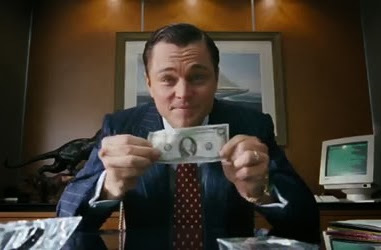 With a running time exactly one minute shy of three hours, it’s easy to call The Wolf of Wall Street self-indulgent and excessive, except that’s exactly the point. The movie is an orgy of unchecked male ego, a perverse bacchanal of Earthly pleasures that Caligula might blushingly admire. They are literally two orgies depicted in the movie and plenty of thrust-heavy sexual congress (I counted eight walkouts in my theater, most of them the little old lady variety). Here is a tilt-o-wheel of madness. These people were living like there was no tomorrow, had more money than they knew what to possibly do with, and would figuratively dance while Rome burns (in this instance, the stability of the U.S. economy). What’s important is to communicate that these individuals were having the time of their lives. It wasn’t just the hedonistic pleasures and the mountains of drugs; it was the power, the uninhibited embrace of a life available via poorly regulated capitalism. Many of those brokers in Jordan’s company were people from ordinary backgrounds. Their self-made success (that wasn’t so much earned as swindled) is a point of pride that fills them with purpose. They are seizing their full potential. There is no doubt in my mind that every broker in this movie would do it all again in a heartbeat. There is no remorse on display anywhere. The only remorse is having the ride unceremoniously end. “Was it obscene? Yeah it was obscene. In the normal world,” Jordan narrates. “And who wants to live there?”
I won’t say that there aren’t scenes and moments that could have been trimmed, but I was enjoying myself way too much to care about the bloat. This is the fastest three hours you’ll ever experience in your life. There’s some fat, yes, but man does this picture just move along like a freight train. The screenplay by Terence Winter (creator of HBO’s Boardwalk Empire) is impeccably drawn. The movie just courses with energy and watching it is often an exhilarating rush, communicating the highs the characters are undergoing. The supporting players are used to great effect to punctuate the comedy moment to moment. I loved Rob Reiner’s exasperated and profane performance as Jordan’s father. Naturally the bad behavior is entertaining in how absurd and over-the-top it can get, but one key sequence ranks up there with the finest sequences Scorsese has ever put to film. It’s the “Lemon” sequence, named after a legendarily potent batch of Quaaludes. It is a sequence of pure movie bliss, brilliantly edited and staged, as Jordan is placed in a precarious position when the drugs kick in, and his comic floundering is riotous. Winter and Scorsese have taken what, in other hands, could have been a modern American tragedy and decided to portray it as a darkly comic fantasia. I laughed long and hard throughout the movie. There are numerous scenes I can think back on and start laughing again. The ridiculous nature of moments, like discussing the logistics of tossing midgets at a dart board (“This is their gift”) is to be expected, but it’s the overall degenerate lifestyle these clowns chase after with impunity that kept me laughing.
I’ve read cantankerous critiques of the film, chastising Scorsese for celebrating the lavish lifestyle and excessive hedonism of his characters. I could not disagree with this appraisal more. The error is assuming that witnessing Jordan behaving badly is akin to celebrating it, as if adopting the perspective of our lead is the same as excusing his actions. Scorsese makes it clear early, and often, that Jordan Belfort is not a good person. Hopefully you don’t need him hitting his wife for this point to stick. This guy is fleecing people out of their life savings, living high off the fat of the land, and openly admitting to the camera how deeply illegal his activities are. But you’re under his spell, much like his brokers that worship him with unflinching zeal. Jordan, especially as portrayed by DiCaprio, is a volcano of energy and single-minded determination. He whips his troops up like a religious revival, manipulating you with every tactic in his employ. Early on, he’s defrauding ordinary middle-class and low-income clients, but because we’re all addicted to the adrenaline rush of the sale, of the con, we push this troubling reality from our minds. When he moves onto wealthier clients, we adopt a similar attitude of Teresa, Jordan’s first wife, mainly that these people can afford the losses and therefore get what they deserve from a silver-tongued shyster. It’s the audience that proves to have a selective memory because we’re drawn to Jordan’s charisma, expertise, and talent, so we ignore the pesky details of who gets stuck with the bill. Don’t pin that on Scorsese. He makes it abundantly clear that Jordan is a bad man, and the depths of his greed is but the tip of the iceberg when it comes to Wall Street. Jordan’s firm was a tiny player. Think of what horror stories Goldman Sachs or Lehman Brothers would offer if ever exposed.
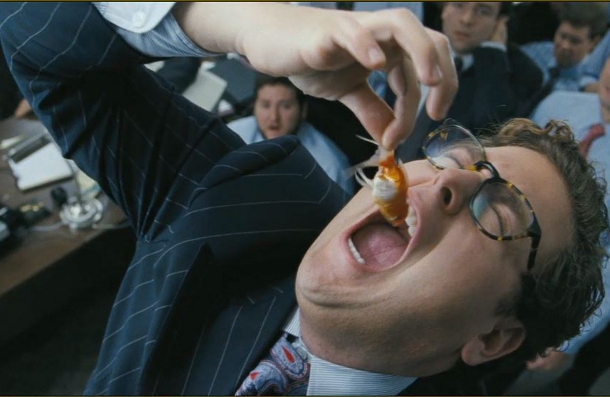 This is my favorite Scorsese film since Goodfellas, and they have plenty of similarities. It makes sense because these men of finance take their cues from movie gangsters, styling themselves as tough guys. At one point, brokers hold a guy over a building to intimidate him. There’s also certainly as much cocaine as there may have been in Scarface. But like that classic of the gangster cinema, Scorsese propels us into the hidden world of the financial institution run amok, allowing us a backstage pass to the people profiting from wrecking the economy. It’s a fascinating perspective that confirms some of our worst fears about stockbrokers. It’s a misogynistic boys club and the few women that do participate have to play by their hyper masculine, juvenile rules. These are people that find any number of ways to skirt the law, rip off their clients, and live in luxury until they can find another sucker. It’s a system built for the entertainment of the few on the backs of the many, and it’s just as relevant today as it was in the 90s. With Jordan’s inside knowledge, we’re educated on the many corrupt ways of Wall Street.
Marking the fifth collaboration with Scorsese, this may be the finest DiCaprio (The Great Gatsby) performance yet. The man sheds his vanity, easily fitting into the shark that is Jordan Belfort. He’s ruthless in one moment and completely inept in another, at the whim of his vices. DiCaprio taps into Jordan’s leadership qualities with the dynamite sales speeches, but he also shows what an insecure man he is at heart. He’s got a taste for the good life and is reinventing himself, including trading up in wives to attain that proverbial American Dream. He’s living empty pleasure to empty pleasure and he doesn’t care. DiCaprio acts as our ringmaster through his own circus, and you’ll be delighted and horrified by his actions (and also his peculiar, bird-like dance moves). There’s not a bad performance in the whole cast, and this is one huge cast. Hill (This is the End) is a becoming more and more credible as a dramatic actor, though he excels at the blustery outrageousness as Jordan’s number two. He’s a treat. Robbie (About Time) nails her New Yawk accent but more importantly nails the portrayal of a trophy wife who recognizes and eventually resents her lifestyle. And oh does she just exude sexual heat.
I want to focus on the very end of the film, so there will be some mild spoilers in this paragraph but nothing I feel that would ruin the viewing experience. You have been warned, spoiler phobes. As expected, Jordan eventually winds up in jail for his felonious misdeeds. Ordinarily this would be the end of our traditional law-and-order morality tales; the bad guys are locked away to pay for their crimes. Jordan tells us how nervous he was on his first day of prison, that is, until he remembered one very important fact: he’s rich. White-collar prison is not the same as other penitentiaries, and we see Jordan loftily playing tennis. His sentence is only three years as well, which seems like an insult given the thousands of lives he may have instrumentally ruined. But that’s the ultimate condemnation in the end: the system is rigged for people like Jordan, people with money. In the end, he wins. He goes to prison, his family life is torn asunder, and his personal relationships are strained, but the guy wins. He continues his speaking engagements motivating everyday saps how, with his cherished expertise, they too can rake in wealth. The final shot of the movie tells me everything I need to know. It’s a slight pan out to the crowd in attendance of Jordan’s speaking session. We see the collection of faces, each person hanging onto Jordan’s every word, each filled with idolatry. They want to be him. Despite everything, the bad behavior, the crimes, the waste, they all want to be him, and that’s why people like Jordan will always succeed, will always prevail, will always have the last laugh. There will always be a healthy supply of suckers that want to believe whatever nonsense he’s peddling. That’s the point. He won.
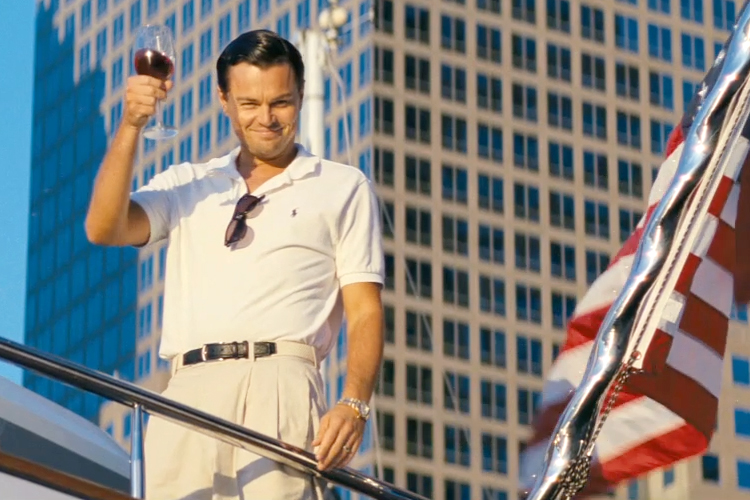 Recently I watched the very good crime caper American Hustle and noted that its director looked to be fashioning a loving Martin Scorsese homage. Well, after watching The Wolf of Wall Street twice (not back to back, mind you; I’m not nuts) I can say that there is no Scorsese like the source. This is vintage Scorsese. This is brilliant filmmaking, a bold movie that practically sings, it flies by with exhilarating force and acumen, daring you to keep watching. The fact that 71-year-old Scorsese could make a movie this highly energetic, this debased, this brash, this borderline indecent, and this awesomely entertaining is encouraging. It’s even more hilarious to me that older Academy members at a recent screening of the film accosted Scorsese, essentially being termed a “debauched scoundrel.” That’s got to count as some badge of honor. Yes, at three hours the movie can get long but it’s never dull or taxing. The propulsive narrative, the hilarious humor, the shrewd characterization, the wanton excess, the filmmaking bravado that hums, it all coalesces into a disturbing and disturbingly enjoyable condemnation of greed and our inherent celebration of this lifestyle. There is not one aspect of this movie that falls flat. The Wolf of Wall Street is an invigorating piece of cinema. The choice of music, the swinging cinematography, the wide ensemble of actors, the feverish editing, it all comes beautifully together to form a whole that surpasses everything else in cinema this year. Dig in.
Nate’s Grade: A
Share this:

About Time (2013)
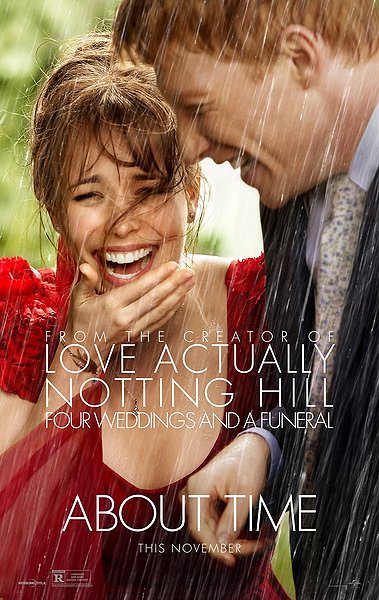 Richard Curtis is something equivalent to royalty in romantic comedy circles. The man wrote Four Weddings and a Funeral, Notting Hill, the screenplay for Bridget Jones’ Diary, and he wrote and directed Love, Actually. If you are a fan of those movies, then About Time is already at the top of your to-do list. Reportedly Curtis’ last movie he will direct (he’s only done three), this time-travel romance looks to be a break from a genre burdened by convention. If you like your British rom-coms to be mildly cheeky, hopelessly dewy-eyed romantic, filled with beautiful people, and loaded with hugs, then About Time with suffice. If you were expecting something grander from the premise you’ll walk away shaking your head at all the squandered potential.
Tim (Domhnall Gleeson, son of Brendan) is a normal upper class British student when his father (Bill Nighy) sits him down to have… The Talk. This one isn’t about birds and bees so much as it is the space-time continuum. It seems that the men in their family have the unique ability to travel through time, though only during their lifetimes. All Tim need do is find a somewhat secluded, dark corner, clench his fists, and think his way back to a particular memory. Tim is able to blink out embarrassing incidents and use his foreknowledge. He meets Mary (Rachel McAdams) and sets his sights on making her fall in love with him. He corrects their courtship until he gets everything “right.”
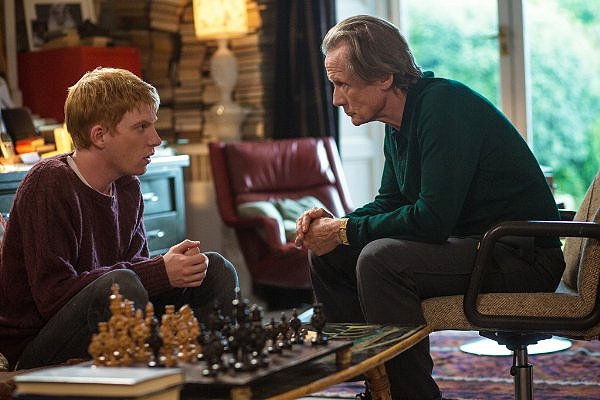 While eminently pleasant and suitably funny and emotional, About Time is a tale of wasted potential. I’m unsure why Curtis even brought in such an unconventional element like time travel if he was just going to play it safe. The standard, feel-good rom-com route feels the safe way through, and while it’s well done in that regard, I almost wish the film had pushed further with its concept. To begin with, the time travel restrictions are arbitrarily applied and will later be broken altogether as the film continues. When time travel is used it’s played out like Groundhog Day, with Tim immediately going back to fine-tune his actions, particularly his courting of Mary. That works, as we get used to the inertia of the edits, but that seems to be the lone focus. Once he gets the girl, Tim rarely uses his amazing gift. He’s content and so time travel is an afterthought when, as I suspect for any of us, it would be all we could think about. Tim lacks suitable ambition. I think the film would have been weightier had its lead been less idealistic. He’s a nice guy but imagine a Lothario having the power to travel back in time. He could physically cheat on his wife, go back and make sure it never happened, and live his life, having his cake and eating it too, except for the guilt. Is it cheating if it happened in an alternate timeline? Or what if he was a stockbroker committing insider trading with his past self. In fact, what if he just interacted with his older, more morally wanton self? There’s also the fact that Mary never finds out about any of this. At no point does Tim reveal his family’s incredible ability and have to atone for his actions. I’m fairly certain Mary would feel like her marital bliss could be the end product to manipulation. Alas, we’re stuck with our cute, acceptable, but mostly square rom-com.
While likeable, I didn’t think the characters themselves were sketched out well; I like McAdams and Gleeson, but I couldn’t really say much about them as people. He’s a lawyer. She works as a reader for a publisher. His family is kind of rich. And that’s about it. Even through their interactions we don’t learn much about Tim or Mary. They fall in love, and it’s nice, but the lack of characterization, besides the fact that they are cute together, kept me from fully investing in their love story. I doubt the target audience will have this same issue. I found them cute and their scenes are cute together but I need more about my main characters than a collection of cute scenes. Another nagging aspect of their courtship is that it seems too easy. Tim has the amazing power of time travel so he can fix any problem presented, but that shouldn’t stop the appearance of problems. Tim and Mary are nice people that seem to have no discernible differences, besides Tim’s leftover feelings for a first love. An audience may say they want a couple to be sweet together always. They don’t. It’s boring. We need conflict. With About Time, there just isn’t enough of it and Tim and Mary are too underdeveloped for me to pine for them.
There are loads of dangling storylines that feel like they are leftovers from past drafts. You would think wrapping up a peachy marriage early would lead to some sort of personal crossroads and sacrifice. Everything was coming far too easily for Tim, so I kept waiting for another shoe to drop late in the film, to give him the chance to undo his own personal happiness and marriage to, say, save a beloved family member. I kept waiting for some kind of greater personal stakes, but it never came. Then the movie has all sorts of dangling storylines that do not seem conceptualized. The doddy uncle who seems to be experiencing the ravaged effects of too much time travel? Not much there. They never explain him and so he is just the standard Brit com-com kooky family member to say weird things offhand. Seems like a waste of greater pathos. Tim’s troubled sister? She’s fixed in a pinch and of course it all has to do with the men she’s dating.
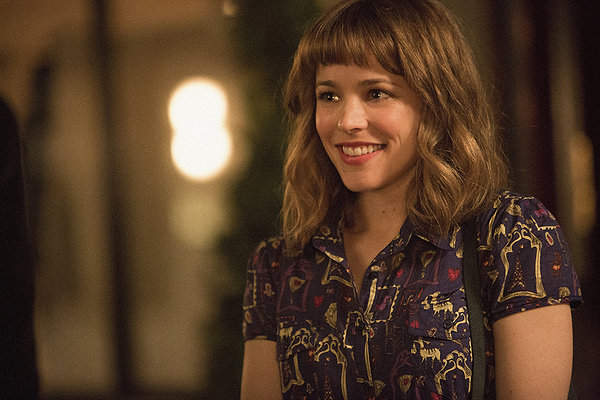 Then there are the rules, which in time travel need to be adhered to closely or else the butterfly effect ripples cascade. We’re told at first that Tim can only go backwards in time. This gives the impression that he has to live out all that extra time. So, say, if Tim traveled back two years, he’d have to live out all two years to get back to the presumed moment he began his journey backwards (writing about time travel does wonderful things with sentence tenses). So every jump back requires reliving your life. But then all of a sudden Tim can jump forward in time as well. No one comments about this. If the men in the family are reliving days and possibly years of time, then shouldn’t they be preternaturally aging, looking 70 at 50 and so on? Then there’s the fact that Tim introduces the ability to travel back in time WITH another person. This is never dealt with again, sadly, and it’s a big deal. You can bring other people with you through time. This is an amazing opportunity but it’s wasted like so many others.
However, with all that said, the movie won me over more as it transitioned into a greater emphasis on the father/son relationship, enough so that it feels like Curtis trying to get the sense of closure we so rarely get in life. I though a late trip backwards, as a young son skipping stones with his dad before he may never see him again, was quite beautiful. It got me wishing the film had given more time to explore the dynamics of father/son time travelers, a rich dramatic possibility that only reminds you how much more interesting About Time could have been.
About Time will be catnip to its target audience, namely female rom-com fans. I found it a fairly pleasant movie and its stars wholly likeable. I laughed at spots and even got teary-eyed a bit toward the end as the film’s emphasis shifted from a guy-gets-girl narrative to more of a father-son examination. The funny Brit characters do their thing, the lovely scenery remains lovely, and the declarations of love get a spit-shine. It is an effective romantic comedy that will charm and please and get its audience to swoon, but I was left feeling that its potential went untapped as it settled on a safer, more conventional story despite all the unconventional possibility. Why introduce time travel if you’re just going to take the safest route possible with your storytelling, never pitting Tim in a difficult decision he has to make, or jeopardizing his carefully manipulated happiness? There are so many possibilities Curtis had with a premise that opens up alternative histories, but it seems like he settled for another dash of more-of-the-same.
Nate’s Grade: B-


 nathanzoebl
You must be logged in to post a comment.