Blog Archives
Barbie (2023)
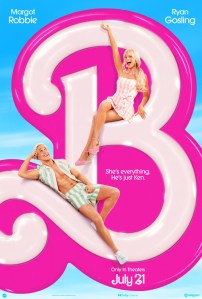
Who would have guessed a movie based upon a ubiquitous doll that dates back to the 1950s would become not just a cultural force and reclamation project but also the biggest moviegoing event of the year, as well as the highest-grossing movie in Warner Brothers’ history, even outpacing The Boy Who Lived? In 2023, it turns out we are all, every one, a Barbie girl living in a Barbie world. I came to this experience late, wondering if writer/director Greta Gerwig’s movie could live up to the lavish hype, the fawning praise, the hilarious offenses that many fragile males have levied against it. It couldn’t possibly be that good, could it? I saw it with three generations of women in my family, something I will privilege, and I must say, it is that good. Barbie is one of the best movies of the year and a shining example of what vision and passion can do to elevate any story. There’s so many ways this movie could have just been cheap corporate slop and instead it becomes an existential yet deeply personal treatise on life and death.
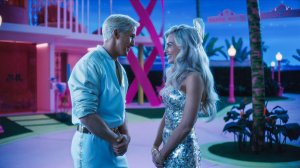
In the world of Barbies, women rule and the men are just afterthoughts. In this creation myth, the Kens were meant to compliment the Barbies. We watch “Stereotypical Barbie” (Margot Robbie) go through her daily routine of fun, frivolity, and nightly dance parties with all her best gal pals (no boys, er Kens, allowed). Then one day, this blonde Barbie started walking differently, started seeing the world differently, and started wondering about dying. Was there something wrong? Her human owner, in the real world, was in trouble, so Barbie sets off on an adventure to find her human owner and save the day, with help from her boyfriend, Ken (Ryan Gosling). Except for these two, the real world is very different from what they were expecting.

It’s easy to see how this movie could have been a mediocre fish-out-of-water comedy, with Barbie clashing in our modern-day world with its modern-day views of fashion, body image, and what skinny, buxom dolls represent to generations of young impressionable children. It’s clear to see what the scrapped version could have been when Amy Schumer was attached to star. What really impressed me with Barbie, beyond its delightful and inspired production values, is how ambitious and well-realized this movie is at every turn. It could have settled for easy jokes about Barbie and Ken not fitting in, not understanding human relationships and sex, and that stuff is there and it’s quite funny, but Gerwig and co-writer Noah Baumbach want to do so much more. This is a studio blockbuster, based upon a decades-long popular toy, that wants to do more with its platform. It aims higher, and in just about every measure, Barbie admirably succeeds. As a comedy, it had me howling with laughter, enough so that my response was providing another level of entertainment for my wife. There are jokes that are so specific, so beautifully targeted, that when they detonated, I was in awe and appreciation, (a reference to the literal definition of fascism and a Snyder Cut throwaway reference were perfectly attuned to my comedy sensibilities, thank you, Greta). As a frothy and fun fantasy, the movie has excellently crafted sets and costumes and retro visual aesthetics, making the movie a pink-accentuated sensory bombardment. But as a satire is where Barbie really becomes special.
Again, it would be easy for Barbie to learn lessons about body diversity and positivity and likely be browbeaten into what a good feminist is supposed to be, that the real world is a harder place for women than she previously thought. All of that is there, along with a consistent and entertaining critique of the faults of patriarchal society, but Barbie isn’t some reductive, man-hating screed to indoctrinate women into thinking they don’t need men (men are already very good at convincing women they don’t need men). This is a treatise on the power of inclusion and how this benefits society, both for men and for women. In Barbie Land, it’s a matriarchal society where girls rule and boys drool, but it’s a fantasy world reminiscent of a caste system, where the Kens will always be lesser afterthoughts because, well, they’re not Barbies, they’re just Kens. They are excluded in their own world. That’s why Gosling’s Ken is so excited by the real world, where the status quo is flipped, where the world is run by men, as he now sees this as an opportunity that has been denied to him. He wants to recreate his own version of the patriarchy not because he thinks women are inferior but because he just wants to be in power and respected, so he’s replicating his misguided understanding of what men in power are like, which naturally involves lots of horses. In the real world, Ken admonishes a suit-wearing corporate executive that they aren’t doing patriarchy right, to which the man winks and says, “We’re just better about hiding it.” The final act isn’t about “bringing down the patriarchy,” it’s about making a more inclusive world where people don’t have to feel marginalized and stuck and resentful.

Besides its social satire, there are other areas where Barbie goes deeper in surprising and affecting ways. There are more than a few applause-worthy moments explaining the perspective of women, particularly a monologue that is destined to be an audition piece for the rest of time, and it all works and is cutting without being too didactic. Gerwig even gets in a few jabs about corporate culture (“Are there any actual women in this boardroom?” “I’m a man with no power, does that make me a woman?”) and Mattel as an organization becomes another force of antagonism spearheaded by hapless buffoonish men (of course you get Will Ferrell to play the Mattel CEO). The biggest surprise is how emotional and deep the movie can become. There will be plenty that tear up just having a big Hollywood movie recognize their day-to-day emotional toil of being a woman in modern society. For me, the questions over what to do with the life we have flirted with some surprising existential contemplation, as Barbie is reminded at several points that death is a reality and yet would she want to move to the human world? An emotional highlight occurs when Stereotypical Barbie is speaking with the equivalent of her creator, and Billie Eilish’s tender-to-the-point-of-breaking song “What Was I Made For” lilts onto the soundtrack, and the sincerity of this sequence, topped with insert home video footage from the production cast and crew, really hit home how much more this movie is going for then bringing different dolls to life. It’s not just jokes about crotch-less creatures and weird feet, it’s about how we can live and why we do so, what inspires us. It’s a big studio summer release that flirts with the profundity and brevity of life.
There is one actor who deserves their own special recognition and that is Gosling (The Nice Guys), who so rarely gets to showcase his sharp comedy skills with the dour, serious, insular roles he gravitates to. Gosling is so committed to his role that he is operating on another plane of excellence, hitting sly jokes within jokes and selling every wonderfully stupid moment with Ken. This man isn’t afraid to look silly, he fully courts it, embraces it at every opportunity, and yet his performance doesn’t detract from Robbie but only makes them both shine brighter. He reminded me of Tommy Wiseau at points. His hilarious ballad “I’m Just Ken,” which segues into a wild West Side Story-style dance battle that is peak peacocking, is a phenomenal run of inspired silliness (the storming of the Malibu beach had me rolling), yet also connected to the character’s co-dependent arc and dissatisfaction with himself (when feeling down, just quote: “I’m just Ken, and I’m enough, and I’m great at doing stuff”). Ken has to learn to think of himself outside his combined definition with Barbie, and they both need to spend time discovering who they really are rather than who they think they’re supposed to be before considering forming attachments. I would not be surprised if Gosling earns a Best Supporting Actor nomination. It was the role he was born to play: insecure accessory doofus.
Gerwig has launched to mega-stardom with just three directing efforts (four if you count her co-directing effort in 2008 with Nights and Weekends, back in her early mumblecore breakout days). Already this woman has been nominated for Best Director, one of only seven ever, and she now owns the highest grossing movie of the year as well as in studio history. She’s proven herself with her 2017 coming-of-age semi-autobiographical Lady Bird, richly realized and achingly felt, with an established literary classic that is a foundation to generations, and had been adapted a dozen ways for the cinema, and yet she found ways to make her 2019 Little Women modern and personal, and now, on her biggest stage, being handled corporate IP that would be perfectly fine with just selling more toys, she has made a movie for the moment, something that compelled audiences back to theaters in droves, that will become a staple for a generation of film lovers. With just three movies, Gerwig has established herself in a league of her own as a director. Anyone who can turn the Barbie movie into a hilarious, poignant, and meaningful meditation on our times, on the relationships between mothers and daughters, and on life itself is a talent that deserves every creative latitude to achieve her vision. The voice and vision behind this, even to the smallest detail, is so impressive and fully committed and well developed and fabulous. Barbie is one of the best movies of the year and proof that studio blockbusters can indeed be more.
Nate’s Grade: A
Share this:

Asteroid City (2023)
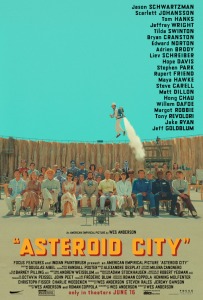 It’s not a good sign that a week after watching a movie I was racking my brain to try and remember what I had watched, and it’s even worse when it’s a movie by Wes Anderson, a filmmaker with such a distinct sense of intricate style it’s now become a go-to A.I. test for untalented people. Asteroid City has the makings of an appealing comic escapade set in a Southwest small town known for its tiny asteroid, and once aliens make their presence known, the entire town and its tourists and wanderers and scientists are quarantined. The problem comes almost immediately, as the movie is presented through several added layers of obfuscating framing devices. The story itself is a play, and we’re watching a movie version, but then also the play of the movie, and the behind the scenes of its now-deceased playwright toiling with his authorial messages and stubborn actors, and it feels like two different movies at odds with one another. The Asteroid City sequence is the more engaging, with some sweet storylines like Jason Schwartzman as a widower processing loss with his family, including his father-in-law (Tom Hanks) who never liked him, while beginning to find a possible romantic kinship with a struggling actress and single mom (Scarlett Johansson). I enjoyed weird little asides about the history of this little town, like a vending machine for land ownership, and s science fair with brainy whiz kids finding their own comradery. There’s even a nice moment in the meta-textual framing where the Schwartzman actor recites an exorcised dialogue scene with the actress who played his deceased wife in the play. It’s elegantly heartfelt. However, the added layers don’t really add extra insight or intrigue but serve as muddy trappings, making meaning less likely rather than more. It feels like Anderson didn’t have enough material with the central story so he added on the meta to make up the difference. There are too many moving pieces and too many characters, and versions of characters, here to settle into something grander. The whimsy and visual style of Anderson is still evident throughout every highly-crafted and pristine arrangement in the movie, so if you’re an Anderson diehard, he still has his charms. This is two Anderson movies in a row that felt disorganized, distracted, and chiefly under-developed, and I’m starting to worry that the form has taken over the function as storyteller.
Nate’s Grade: C+
Share this:

Babylon (2022)
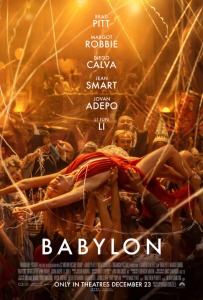 I completely understand how Babylon is such a divisive movie, and this seems entirely the point of writer/director Damien Chazelle (Whiplash, La La Land). It’s over three hours long, it’s got a budget of around $100 million dollars, and the entire enterprise just shouts artistic hubris, at best, and petulantly self-indulgent miasma at worst. Any movie that literally opens with a sequence that includes shots of an elephant defecating and a prostitute urinating on her giggling john is clearly trying to provoke a very strong response, and Chazelle’s expose on the early romanticized days of Old Hollywood is, chiefly, intended to revile and disgust. Chazelle’s mission is to rip apart the cozy nostalgia and hazy romance of the dawning of the film industry, to proclaim that Hollywood has always been a cesspool of exploitation and misogyny and racism and greed. The movie wallows in giddy exploitation but also hijacks the illusion of achieving stardom and asks whether or not the lasting art is worth all of the horror and ugliness of the systems that produce it. Babylon is a wild party of a movie with multiple sequences brimming with pure brilliant filmmaking bravura, and it also ends in a way that just might collapse Chazelle’s righteous fury and contempt.
Within the first half-hour, we are introduced to the three main characters we’ll be charting over many years. Nellie LaRoy (Margot Robbie) crashes a big house party that would make Gatsby jealous. She’s come to California to follow her acting dreams, which her family and small-town peers would sneer at, and she is faking it until she makes it with her boisterous personality. Manny Torres (Diego Calva) is a Mexican-American just trying to get his big break in Hollywood and willing to do whatever it takes to pal around with those in the movies (he is one of our primary elephant wranglers). Jack Conrad (Brad Pitt) is the highest-paid silent movie star famous for his sweeping epics as well as his drinking and multiple broken marriages. Over the next few years, as the industry transitions into the precarious era of sound, each of these three will experience their own rise and fall as they struggle to hold onto their dreams despite the many personal compromises and risks they have to endure to cling to that glitz and glamor.
 If Baz Luhrrman’s Great Gatsby and The Wolf of Wall Street had an illicit baby, and then it was raised by Boogie Nights-era Paul Thomas Anderson, you might get Babylon. It is a big movie founded on the principle of grandiose excess in all capacities. First off, it’s three hours long though this might be some of the fastest-paced three hours, albeit twenty minutes could have been trimmed here and there. I was never bored once, partly because the structure of the movie is episodic in nature, boasting varied sequences that run the gamut from brilliant to ridiculous to brilliantly ridiculous. From an overall thematic standpoint, there isn’t really any subtlety or nuance. The movie is like having the director screaming in your face. Chazelle’s depiction of Old Hollywood is one of direct shame and wanton hedonism, and beyond the obvious “It was always this bad” moralizing there isn’t much more that Chazelle has to articulate, except for a strangely misguided and arguably antithetical coda (more on this later). For almost three hours, Chazelle holds the industry accountable on their buzzy, boozy wavelength of high energy and thrills.
Babylon is presented as a big raucous party where you’re happy to be a guest but also glad you can go home to your own bed. This isn’t a movie that excuses the misdeeds of its degenerates and hangers-on and the systems of power that enshrined the horrible to be even more horrible. Babylon pushes its many characters into uncomfortable questions of what they’re willing to compromise for fame. It’s a process of assimilation and people cutting free their identity, which can be liberating for some and lacerating for others. A significant supporting character is a black jazz musician who begins to find success in the pictures. Then the producers want the man to blacken his face even further, and the ensuing anguish and rage is so palpable that it’s hard to think Chazelle has anything but seething contempt for the sordid history of his own industry. Babylon yearns to be shocking, to be provocative, and it does so easily, sometimes too easily. It’s exceptionally gratuitous to a fault, cavorting with topless women, drug binges, abrupt and callous violence, and all sorts of lewd bacchanalia. Chazelle is demystifying Hollywood’s self-serious fable, and he’s doing so by boldly leaving no bodily fluid untapped and un-splattered.
 This movie is a lot, and it’s also offering very little on a thematic level, so I can understand why plenty of people would hold their repulsed noses and say, “Not for me.” I get it. Not everyone is going to want to watch Nellie projectile vomit onto a hoity-toity snob during a party where she’s trying to re-frame her coarse, lower class identity to be accepted by the brain-dead social elites. Hollywood is presented as a vehicle for self-actualization, but the system is relentless and unforgiving, and even those who achieve success are never afforded a secure perch. The careless regard for safety in Old Hollywood is highlighted by memorable moments, like when a Medieval war epic is halted as a dead extra has a spear sticking straight up in his gut. The crew argue that the man was known as a drinker and therefore it must have been an accident of his own doing. And then the movie skips back to filming, this man’s passing given no more passing thought. And yet there are thousands arriving every year to work themselves senselessly to be the next awaiting sacrifice for this town. It’s an industry built upon human suffering and I can see how many viewers would view the many examples as wallowing in the muck for titillation. The difference for me is that I don’t feel like Chazelle is glorifying any of these antics…
…With the exception of the ending, of which I will discuss more in depth because I find it to be wholly curious and in conflict with every fiber of the movie up until this very final point. I don’t think much of this would spoil the movie for you, but if you wish to avoid my discussion of the conclusion, then skip to the next paragraph, dear reader. The film has a very definitive perspective on the movie industry’s sadistic history and yet in the last five minutes, Manny is subjected to a montage of cinematic high points, zooming ahead into history to include such movies as Terminator 2, Titanic, The Matrix, and Avatar, and he weeps. For 170 minutes, Chazelle has taken us along the road of perdition of Hollywood exploitation and degradation, complete with a skin-crawling trip through hell with Tobey Maguire. And then in the final ten minutes, Chazelle says, yeah, but maybe all of that exploitation and death and disaster was all worth it because we now have movies like… Avatar. It’s the conclusion where Chazelle, as my pal Ben Bailey would say, reveals himself as an art maximalist, that only the art remains and only the art shall matter, arguing that all the vile behavior we’ve endured has meant nothing. It’s the opposite of what the rest of the movie has been purporting, and it’s strangely sentimental for an unsentimental film. It feels like a misguided misstep that concludes with excuse-making and moral relativism, which is far queasier than any of the gratuitous sequences of nudity, drugs, vomit, piss, and rat-eating.
 The technical qualities of Babylon are outstanding, and when working in such symbiotic symphony, they can be absolutely thrilling to exhibit. The sterling production design, extravagant costuming, and swinging cinematography work with the fevered editing and pumping score, and expertly recreate this era with amazing scope and lived-in period detail. I’m still humming the score’s memorable, jazzy, percussive leitmotifs days later. There are sequences that are simply stunning, such as the first day on a movie set for Nelly and Manny, both of them making names for themselves through problem-solving and scene-stealing, and the revelations and race-against-time brinkmanship are electric. The introduction of sound also creates many complications, brilliantly encapsulated in a comedic sequence where Nellie is trying to adjust to this new reality on a soundstage. It’s a comedy of errors cracked up to a hallucinatory madness by the end. Chazelle also delivers one of the best fart jokes in film history, where Conrad is in a bathroom questioning the appeal of sound and why audiences would want to hear, and as punchline, a giant fart erupts from one of the bathroom stalls. The parties are ribald, with the opening making use of an elephant as a literal distraction stomping through a mansion, and a latter one that ends in a frenzied man-to-snake fight. The entire sequence with Maguire is best left as a stupefying surprise, a sequence that reminded me of the dread-fueled Wonderland scene in Boogie Nights. In my view, even if you found the movie was thematically shallow, the individual sequences are so entertaining and so technically executed that the movie demands to be seen.
I’ve noticed some complaints that Chazelle’s messy opus could have pulled from actual Hollywood scandals, that he didn’t need to make up characters and fictional scenarios. That’s fair, but Chazelle wants to impart an impression rather than a case-by-case history of literal bad men. There are characters meant to resemble clear inspirations, like Fatty Arbuckle (who was innocent, by the way) and the affair of Greta Garbo and Marlene Dietrich or Errol Fylnn’s penchant for underage girls, but I don’t think the movie loses its spirit or bite because it’s not strictly recreating existing historical scandals. It’s still an expose on Old Hollywood without the names.
 Babylon is a rip-roaring experience that condemns the history of cinema through the expansive art of cinema, and it’s a wild party populated by sleazy provocateurs and capitalists. Even some of the criticisms of Babylon I can find artistic explanations for, from its gratuitous nature to even the sidelining of its minority and queer stories, perspectives themselves cruelly sidelined and erased from the studio system of Hollywood. Even its overwhelming explicit nature is partly the point, as characters spin round and round, indulging in every debauchery to avoid the march of mortality. Robbie’s high-energy performance is like if a bag of cocaine became a sentient human being. It’s all about sensation and distraction and the many willing to give everything to be part of that, and for almost three hours, Chazelle makes the manic chaos absorbing and horrifying before going soft in the end and arguing that maybe it’s all worth it. Babylon is dazzling filmmaking that will exhaust and nauseate as many as it potentially thrills. I’m glad Chazelle decided to use much of his carefully built artistic cache to make something this extravagantly divisive and ambitious.
Nate’s Grade: A
Share this:

Amsterdam (2022)

It’s been seven long years since writer/director David O. Russell made a movie. He was prolific from 2010-2015, making four movies, which were nominated for a slew of Oscars, especially in multiple acting categories. Three were also nominated for Best Picture and Russell was nominated for Best Director three times as well. It was quite a vaunted run of mainstream and critical success, with devoted actors like Christian Bale and Jennifer Lawrence eager to sign up for Russell’s quirky ensembles (it helps when both won Oscars playing Russell roles).
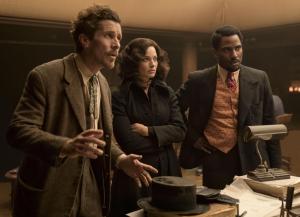
It’s natural to want to take some time off after such a busy creative period, but as the years stretched on, and after the Me Too accountability movement, Russell’s on and off-set behavior gathered more scrutiny and rebuke. His volatility had been known, like his screaming fit he had on the 2004 I Heart Huckabees set with Lily Tomlin. Even George Clooney recounts stepping up to Russell’s bully behavior on the set of 1999’s Three Kings (rumor has it Clooney was the one who released the Huckabees footage). On 2013’s American Hustle, Amy Adams said she cried repeatedly from Russell’s bullying and felt intimidated and isolated. Then there were the renewed revelations from Russell’s own niece who had been transitioning and accused Russell of inappropriate touching when it came to her changing body. Russell even admits to this, though he defends his actions by saying he was given tacit permission, or so he says. With all of this controversy and harassment swirling around Russell, it’s a wonder who would want to continue working with this kind of person. I guess as long as he was producing at his peak level, studio execs would excuse his bad behavior and keep funding his ballooning budgets. Well Amsterdam might just be the end of Russell’s star-studded big studio ride.
In 1933 New York, Burt Berendsen (Bale) is a WW1 veteran making ends meet as a doctor who specializes in veteran care. He and his best friend Harold Woodman (John David Washington) are framed for a murder and on the run, and the only way to clear their good names is to uncover a conspiracy that leads to a possible government coup. Helping the fellas out is Valerie Voze (Margot Robbie), a nurse who makes art from the shrapnel she recovers from inside war vets, and a wealthy socialite who also happens to be in love with Harold. Together, the three friends bumble their way through danger and mystery and crazy mishaps.
This is a mess of a movie, a waste of its top talent, and an excess of Russell’s excesses. The director has established a certain style since 2012’s Silver Linings Playbook, a movie I still to this day genuinely love (it was my top movie for that year). It’s a style that communicates mania, a nervous energy, and it made sense for Silver Linings Playbook as the movie was following a bipolar protagonist given to uncompromising bouts of mania. It makes less sense with each additional movie, but this improv-heavy, experimental, loose sensibility has become the default style for the director, and it feels misapplied. It leads to Russell bombarding his actors with questions or different requests in the moment, keeping them guessing, and actors have gone forward saying they never knew what they were shooting on the day and the shooting never stopped. This indulgence leads to stories that feel like a lot of elements are sloppily thrown together with the undying hope that somehow it will all come together in the end. With Amsterdam, it doesn’t.
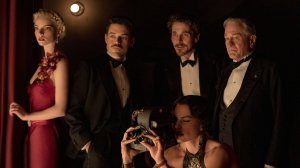
It’s not a great sign when I can say that the entire first hour could be jettisoned. There’s little sense of urgency for far too long, and what is presented feels almost comically unrelated, like even Russell can’t believe his silly characters are in real danger. The uneven pacing creates many dead spaces that feel like an awkward improv detour that you wish could have been avoided. We’re introduced to Bert as a drug addict, and then as a World War One veteran helping other veterans with facial scars and wounds, Bert’s relationship with his pal Harold, then their history in France during the war, then their introduction to Valerie and their kinship, then we have a mysterious death that also leads to a secondary love interest, which requires more setting up of the first love interest and her disapproving family, and then we get police investigating and warning about the first death and then a second murder, this time blamed on our characters, and they’re off to clear their names by… reuniting with Valerie and then bumbling through more characters before, finally the movie presents what it’s actually about well after a full hour-to-80 minutes of movie. It is exhausting and feels like a meandering alternative story that was clumsily grafted onto the Business Plot of 1933. The first half of the movie feels like a slipshod screwball comedy, and then once the particulars of a fascist conspiracy to overthrow the president are introduced, it’s like watching Looney Tunes characters try and foil Adolf Hitler. It just does not tonally work.
The Business Plot is a lesser known event in history, glossed over by the fact that the chief perpetrators more or less got away with their insurrectionist planning. They never did succeed in overthrowing FDR and installing their puppet, but they also did not get prosecuted in the end and most of the media dismissed the scheme as hogwash. It’s undetermined how advanced this plot eventually got but a coup was discussed by a consortium of business leaders. It feels like Russell is applying what he learned from 2013’s American Hustle, which introduced a crazy group of fictional criminals and then, in its last hour, explored the real Abscam criminal sting of the 1980s. I can see themes that Russell thinks are still prescient today, like a dark element desiring to overthrow the U.S. government because it didn’t get its way, as well as the collusion of big business in political king-making, seeking shells that will do what their benefactors demand. The problem is the themes behind this scheme are too serious for Russell’s trifling antics. Think about retelling the insurrection on January 6th but for the first hour it’s two bumbling bank robbers who keep finding themselves in the worst possible situations, ending at the U.S. Capitol. If you’re going to treat the rise of fascism, assisted by corporate overlords, as a serious threat, and something relevant for today, then maybe don’t have most of the movie be wacky nonsense.
Russell’s past films have often glided on energy and in-character authenticity, but this one feels so grasping and desperate. When the master plan to reveal the conspiracy and its shadowy participants is throwing together a big veteran’s show, I was reminded of the movies of young Mickey Rooney and Judy Garland where the solution to any dilemma was to put on a show. Then at one point the literal Nazis are singing loudly in German and are being confronted by our characters and the good patriotic Americans counter by singing “America (My Country ‘Tis of Thee)” and I had to stop the movie and just let out a deep sigh. I think Russell was going for the famous reference in Casablanca, also against Nazis, but it just flounders into unintentional comedy, accentuated by the antsy energy that treats it like camp. There are a couple of spots that I laughed out loud, though I doubt that was the intended response, like watching Taylor Swift abruptly run over by a car. The attempts at actual humor are winding and often lead to little, and the characters feel like more of a collection of quirks than firmly established personalities and perspectives to anchor a movie. What does Bert having a false eye add besides something for Bale to fidget with? What does Chris Rock have to do here? What does Anya Taylor-Joy have to do here? Most egregiously, what does John David Washington have to do here? It feels like Russell just wanted a character for Bert to talk to. The screenplay is overstuffed and polluted with all these minor and underwritten characters that could have been better consolidated.

I suppose you can still have fun with Amsterdam and engage with it on a light-hearted level, smiling as you watch the many big stars having a good time messing around with accents, props, and wacky character traits and tics, like a bunch of kids with a dresser of costumes (maybe it is a throwback to those corny Rooney/Garland kids pictures after all). With other Russell movies, I’ve felt invigorated by the energy and artistry, encouraged to sit a little closer and be more attentive of the character turns, and dig into the actors making three-course meals of their roles. With Amsterdam, I felt the desperation to recreate the success of old patterns but the creeping realization that it wasn’t going to materialize. It’s just a big mess of a movie, not without interesting ideas or moments or good acting, but too much feels resoundingly and frustratingly frivolous. You could ditch entire characters, entire subplots, even entire hours of this movie. Amsterdam cost Disney/Fox $80 million dollars, the biggest of Russell’s career, and only earned a pittance, so I think there is a retraction in due order. Begin with not watching Amsterdam yourself.
Nate’s Grade: C
Share this:

The Suicide Squad (2021)
 When Disney foolishly fired writer/director James Gunn for offensive past tweets, tweets the studio had already known about before hiring him to helm the first Guardians of the Galaxy Marvel movie, the brass at DC was more than happy to pounce. They offered Gunn the opportunity to tackle any of their many superhero properties. Gunn had earned a reputation as a blockbuster filmmaker whose bizarre sense of humor and style made him just as much as selling point as the property itself. Gunn gravitated to the Suicide Squad, though he didn’t want to be beholden to the 2016 film from writer/director David Ayer. The studio gave Gunn free reign. He could do whatever he wanted creatively, which just happened to be an extremely violent, R-rated sequel that also serves as a soft reboot. Gunn was the perfect person to tackle a project like The Suicide Squad and even with all his goofy humor, gallons of gore, and slapdash dispatching of numerous big names, there’s a real affection for these scruffy characters. Not that there was a big hurdle to clear, but this is clearly the superior big screen Suicide Squad.
Amanda Waller (Viola Davis) has assembled another team of criminals and has-beens and tasked them with a mission. If they fail, or deviate from their orders, she will detonate an explosive placed within the skulls of Task Force X a.k.a. the Suicide Squad. Skilled marksman Bloodsport (Idris Elba) is extorted into being the defacto leader of a band of squabbling misfits that includes Harley Quinn (Margot Robbie), the patriotic warrior Peacemaker (John Cena), the vermin-controlling Ratcatcher (Daniela Melchior), and even a giant living shark, King Shark (voiced by Sylvester Stallone), with a voracious appetite. The squad must destroy a scientific station on an island nation that has undergone a military coup and great political instability. Within that station, run by mad scientist The Thinker (Peter Capaldi), is a threat that could doom the world. Enter the Suicide Squad, but can they even be bothered to save the day?
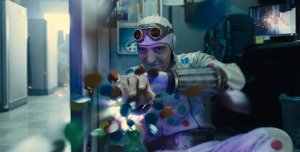
 It feels like Gunn wanted to take the most ridiculous, pathetic characters in DC cannon and then find a way to make them appealing and worth rooting for. There is a strategy to take the scraps of the comic book universe and to make gold out of them. Case in point, Polka Dot Man (David Dastmalchian), a figure easily ridiculed by fans and populating just about every list of the worst villains of comic book lore. Gunn takes the maligned character and says, “Yeah, I’m going to keep his dumb power of flinging polka dots, and by the end, you’re going to care,” and you do care, or at least I did over the course of the film’s 132 minutes. Gunn is drawn to strange, dysfunctional found families, the misfits of society who find an unexpected kinship with one another. You can tell that even when Gunn is at his most irreverent, he still has an acute sense of reverence. The team-comes-together aspect of these sort of movies plays as a predictable but satisfying formula, and while I wouldn’t say anything took hold of my emotions like the best of the Guardians entries, I did come to care about the core of the team. I cared about the father/daughter dynamic between Bloodsport and Ratcatcher. I cared about Polka Dot Man coming into his own as a hero. I cared about King Shark feeling like he had a group of friends. The fact that I typed those last two sentences, which would sound insane absent context, is a testament to Gunn’s strengths.
The climactic villain, whom I will not spoil, is the greatest example of making the most with the least. It is immediately goofy to the point of laughter but still threatening and creepy. Gunn has taken one of the weirdest characters in comics and given it its due. Even by the end, as this villain is vanquished (not a spoiler), the movie finds a small moment to re-contextualize this absurd character as another victim. It was happier before being kidnapped and experimented upon by its devious captors. Even that extra passing consideration is impressive.
The movie also lets its weirdos have their fun. Watching bad guys, who are somewhat bad at being bad guys, try their hand at being good guys, but badly, or at least not as well, has plenty of comedic possibility as well as setting up the redemption and community payoff. The opening beach assault sets the sardonic and sloppy tone. I consistently enjoyed the contentious banter between the different members of the Squad and the jockeying for position. The gag about Polk Dot Man envisioning every enemy as his abusive mother is enjoyably goofy when visualized from his perspective (Elba’s line reading for “It’s YOUR MOM!” is a delight). King Shark’s dullard nature is a routine source of comedy that almost wears out its welcome. Nothing seems out of bound for him to say or do, whereas the others have more defined comedy boundaries. I laughed out loud frequently though some of the comedy bits feel a bit too stale and juvenile even for Gunn (a 69 joke?). This all feels very much like this is Gunn’s $180-million-dollar Troma movie he miraculously got to make with a studio blessing. The violence is over-the-top, occasionally gasp-inducing and occasionally beautiful. That’s an odd but an adept combination for Gunn as a filmmaker, a man who digs into the grimy bins of exploitation cinema and elevates it upon a bigger stage while still managing to stay true to his own silly style.
 Gunn hasn’t dulled the darker reality of his rogue’s gallery either. Bloodsport and Peacemaker get into a macho contest of killing foot soldiers in increasingly theatrical and flamboyant ways where their flippancy and hostility toward one another is the joke. King Shark is portrayed as a dumb brute who also tries to eat team members. Many, many characters have similar back-stories where their parent or guardian or captor experimented on them and live with the lingering trauma, trying not to have their pain define them. The 2016 movie wanted you to see the Squad as PG-13-approved antiheroes. The 2021 movie wants you to remember that they are indeed crazy, demented, dangerous, and murderers. Even Peacemaker, meant to evoke shades of the patriotic Captain America, says he will ensure peace “no matter how many men, women, and children I have to kill.” Harley isn’t fetishized as a punky pinup in short shorts like in 2016 (digitally shortened), but she’s still a psychopath who makes impulsive decisions. Her recognition about always falling for the wrong kind of man is a mixture of sadness, character growth, and a clear reminder that you should not let down your guard around this woman.
Spending time with these characters is made even better from the superb casting. Elba (Hobbes and Shaw) is the biggest welcomed addition; his character was likely initially intended to be the continuation of Will Smith’s Deadshot. Elba is charismatic and self-effacing and handles the comedy and action with equal measures of confidence. When he loses his patience, or opens up about his hidden phobia, it’s even more amusing because of how it contrasts with how naturally suave he is as a default setting. I wasn’t missing Will Smith at all with Elba and his natural accent. Robbie (Bombshell) was born to play Harley Quinn and should hopefully get many more opportunities. Cena (Fast and Furious 9) is so natural at comedy and slides comfortably into a macho blowhard coming into conflict with the other alpha males on the Squad. I loved the simple visual of him strutting around in vacation shorts for a long period of the second act. Viola Davis (Ma Rainey’s Black Bottom) is always excellent and might be the scariest character of them all. There are many joke characters played by actors firmly in on the tongue-in-cheek game.
 As a second chance at franchise-making, The Suicide Squad is a brash, bloody, and irreverent retake and the best DCU movie yet from a studio that seems to be throwing anything at the wall to see what potentially sticks. That has its benefits, like allowing Gunn the creative freedom to make a movie this crazy and schlocky and entertaining. It’s a shame, then, that this Squad movie looks like it will make a whopping hundred million less in its opening weekend at the box-office compared to its 2016 predecessor. It’s a sign that the traditional theatrical market hasn’t quite rebounded from COVID-19 (even Marvel’s own doesn’t look like it will crack $200 million domestic). It may also be a sign that audiences are not terribly interested about a sequel to a movie they didn’t really care for five years prior. Beforehand, I would have bet even money that the studio would give a blank check to bring Gunn back for more after he fulfills Guardians of the Galaxy volume 3 for Marvel, but maybe that’s not the case. Maybe The Suicide Squad will be more of an entertaining one-off than the start of a new direction for this lagging franchise. Regardless, if anything good came of Disney firing Gunn on dubious terms, it’s the existence of this movie in the interim for the in-demand filmmaker. While not everything works in The Suicide Squad, and the emotional depth is sacrificed for giddy gory bombast, it’s what you would hope for with the combination of James Gunn, wacky superheroes, and a commitment to an R-rating.
Nate’s Grade: B+
Share this:

Birds of Prey (2020)
 Not really a Birds of Prey movie, not really a Suicide Squad sequel (see you in 2021), this is really more of a Harley Quinn solo spinoff that’s fun, colorful, bonkers, edgy, and a smile-inducing delight… when Margot Robbie is onscreen as Harley. Robbie is a charming, hyperactive live wire that commands your attention, and giving her the reigns of the storytelling, quite literally in some Deadpool-esque meta storytelling tweaks, is the best decision the filmmakers make. I enjoyed the frivolity, visuals, and narrative trickery, but I noticed something whenever Harley took a powder off screen. None of the other supporting characters are that interesting. I don’t know anything about Cassandra Cain (Ella Jay Bosco), the plot device that everyone is after because of the prized diamond she swallowed. She’s more attitude than person. There’s also Black Canary (Jurnee Smollett-Bell) who doesn’t do much and has a super power she doesn’t use until the end. Renee Montoya (Rosie Perez) provides the police angle and references to cop movie cliches (a hat on a hat). Huntress (Mary Elizabeth-Winstead) is almost a self-parody as the young girl growing up to be an elite assassin to avenger her murdered family and the movie treats her like an also-ran. The only other person of interest is the villain, Roman Sionis a.k.a. Black Mask (Ewan McGregor), because the performance is campy while also being menacing. Birds of Prey suffers absent Robbie because its additional pieces cannot carry the movie on their own. The vacuum of charisma is too noticeable. The fight choreography is impressive and with plenty of longer takes to fully appreciate the cool moves. I enjoyed how every action sequence was different from the last and director Cathy Yan makes excellent use of her environments; a police lock-up is a fantastic place for an action scene with all the evidence/props to utilize. A romp inside a fun house also keeps things fresh even though the goons never bring guns to their big fight. Birds of Prey works very hard with quirk and narrative shuffling, and it feels like a decided attempt to dazzle as well as distract, because there’s not much to this movie. It’s style and personality over substance, and that’s fine, but it does make the second half feel a bit like coming down from a sugar rush. I know there will be plenty that celebrate a group of strong women taking ownership of their own stories and fighting together against toxic men. I know there will be plenty of my friends that love this movie. For me, it was an enjoyable experience that made me realize just how much I enjoy Robbie as an actress, as this character, and when given extra room to roam with an R-rating. Birds of Prey is the kind of tasty junk food you just crave from the cinema every now and then, but without Robbie it’s decidedly less flavorful.
Nate’s Grade: B
Share this:

Bombshell (2019)
 More an expose on toxic work environments than anything overtly political, Bombshell is an effective true-life drama about the many pitfalls, humiliations, traps, harassment, and compromises that women face in the workforce. We follow the downfall of news magnate Roger Ailes (John Lithgow), the imposing man who built the Fox News empire and who also bullied his employees and solicited sexual favors from the many women who were on his payroll. Margot Robbie plays an invented character meant to provide that entry point into Ailes the creep in creepy action. She’ll be harassed and pressured for sex by a man described as “Jabba the Hut,” and Robbie is terrific in her big dramatic moments portraying what the pressure and shame does for her ambitious anchor. The other two main characters wrestle with how far to go in a corporate culture of keeping secrets from very powerful, very dirty old men. Gretchen Carlson (Nicole Kidman) is consulting lawyers for a personal harassment lawsuit against Ailes the person, not Fox News, but she needs other women to come forward. Megyn Kelly (Charlize Theron) is struggling with the scrutiny she has endured after then-presidential candidate Donald Trump turns his small Twitter thumbs against her. The Fox bigwigs won’t go on record to defend her, and their journalists, because they need Trump to drive ratings. The movie uses several Big Short-style narrative tricks to help tell its sordid tale, including swapping narration and fourth-wall breaks; a run through of hearing from Ailes’ past victims in their own words is striking, especially a woman who says she was only 16 at the time. Part of the fun are the many many cameos and just watching actors portray different Fox News personalities (Richard Kind as Rudy Guiliani!). The makeup is also phenomenal and Theron looks unrecognizable as Kelly. The film itself doesn’t feel like it’s telling you anything you already don’t know about the subject; people will compromise their morals for personal gain, power leads to exploitation, women are unfairly treated, and it’s easier to fall in line than stand up to power. There’s still a thrill of watching the downfall of a serial abuser, and the acting is strong throughout, but Bombshell can’t shake the feeling of being a slicker, more star-studded TV movie version of recent history. Even with the urgency of the topic, it feels light, and not because of its use of incredulous humor. I could have used more behind-the-scenes details, and maybe that’s where Showtime’s miniseries The Loudest Voice comes in, retelling the same story with Russell Crowe as Ailes. It’s a solid movie on a very pertinent subject and worth seeing but it also makes me wish for a harder-hitting, more widely sourced expose on this very bad man who felt forever protected by the status quo of power.
Nate’s Grade: B
Share this:

Once Upon a Time… in Hollywood (2019)

Quentin Tarantino has been playing in the realm of genre filmmaking for much of the last twenty years. He’s made highly artful, Oscar-winning variations on B-movies and grindhouse exploitation pictures. There are some film fans that wished he would return to the time of the 90s where he was telling more personal, grounded stories. His ninth movie, Once Upon a Time… in Hollywood, is Tarantino returning to the landscape of his youth, the Hollywood back lots and television serials that gave birth to his budding imagination. Tarantino has said this is his most personal film and it’s easy to see as a love letter to his influences. It’s going to be a divisive movie with likely as many moviegoers finding it boring as others find it spellbinding.
In February 1969, actor Rick Dalton (Leonardo DiCaprio) is struggling to recapture his past glory as a popular TV star from a decade prior. Cliff Booth (Brad Pitt) is Rick’s longtime stuntman, personal driver, and possibly only real friend. Rick’s next-door neighbor happens to be Sharon Tate (Margot Robbie), a rising star and the wife to famed director Roman Polanski. All three are on a collision course with the Manson family.
 The thing you must know before embarking into a theater to see all of the 160 minutes of Tarantino’s latest opus is that it’s the least plot-driven of all his movies, and it’s also in the least hurry. This feels like a hang-out movie through Tarantino’s memories of an older Hollywood that he grew up relishing. It’s very much a loving homage to the people who filled his head with dreams, with specific affection given to the life of an actor. Tarantino is exploring three different points of an actor’s journey through fame; Sharon Tate is the in-bloom star highly in demand, Rick Dalton is the one who has tasted fame but is hanging on as tightly as he can to his past image and wondering if he’s hit has-been status, and then there’s Cliff Booth who was a never-was, a replaceable man happy to be behind the scenes and who has met his lot in life with a Zen-like acceptance. Each character is at a different stage of the rise-and-fall trajectory of Hollywood fame and yet they remain there. This isn’t a movie where Rick starts in the dumps and turns his life around, or even where it goes from worse to worse. Each character kind of remains in a stasis, which will likely drive many people mad. It will feel like nothing of import is happening and that Once Upon a Time… in Hollywood is more a collection of scenes than a whole.
What elevated the film was how much I enjoyed hanging out with these characters. Tarantino is such a strong storyteller that even when he’s just noodling around there are pleasures to be had. Tarantino movies have always favored a vignette approach, unwieldy scenes that serve as little mini movies with their own beginnings, middles, and often violently climactic ends. An excellent example of this is 2009’s Inglourious Basterds where the moments are brilliantly staged and developed while also serving to push the larger narrative forward. That’s missing with Hollywood, the sense of momentum with the characters. We’re spending time and getting to know them, watching them through various tasks and adventures over the course of two days on sets, at home, and on a former film set-turned-ranch for a strange commune. If you’re not enjoying the characters, there won’t be as much for you as a viewer, and I accept that. None of the central trio will crack Tarantino’s list for top characters, but each provides a different viewpoint in a different facet of the industry, though Sharon Tate is underutilized (more on that below). It’s a bit of glorified navel-gazing for Tarantino’s ode to Hollywood nostalgia. There are several inserts that simply exist to serve as silly inclusions that seem to be scratching a personal itch for the director, less the story. I was smiling at most and enjoyed the time because it felt like Tarantino’s affection translated from the screen. I enjoyed hanging out with these people as they explored the Hollywood of yesteryear.
 DiCaprio hasn’t been in a movie since winning an Oscar for 2015’s The Revenant and he has been missed. His character is in a very vulnerable place as he’s slipping from the radars of producers and casting agents, filling a string of TV guest appearances as heavies to be bested by the new hero. He’s self-loathing, insecure, boastful, and struggling to reconcile what he may have permanently lost. Has he missed his moment? Is his time in the spotlight eclipsed? There’s a new breed of actors emerging, typified by a little girl who chooses to stay in character in between filming. Everything is about status, gaining it or losing it, and Rick is desperate. There’s a terrific stretch where he’s playing another heavy on another TV Western and you get the highs and lows, from him struggling to remember his lines and being ashamed by the embarrassment of his shaky professionalism, to showing off the talent he still has, if only given the right opportunity. DiCaprio is highly entertaining as he sputters and soars.
The real star of the film is Pitt (The Big Short) playing a man who seems at supernatural ease no matter the circumstance. He’s got that unforced swagger of a man content with his life. He enjoys driving Rick around and providing support to his longtime friend and collaborator. He has a shady past where he may or may not have killed his wife on purpose, but regardless apparently he “got away with it.” This sinister back-story doesn’t seem to jibe with the persona we see onscreen, and maybe that’s the point, or maybe it’s merely a means to rouse suspicion whether he may become persuaded by the Manson family he visits later in the movie dropping off a hitchhiker he’s encountered all day long. The role of Cliff seems to coast on movie star cool. There is supreme enjoyment just watching Pitt be. Watch him feed his dog to a trained routine, watch him fix a broken TV antenna and show off his ageless abs, and watch him navigate trepidatious new territory even as others are trying to intimidate him. It’s Pitt’s movie as far as I’m concerned. He was the only character I felt nervous about when minimal danger presented itself. There’s something to be said that the best character is the unsung one meant to take the falls for others, the kind of back-breaking work that often goes unnoticed and unheralded to keep the movie illusion alive.
There aren’t that many surprises with Once Upon a Time… in Hollywood as it moseys at its own loping pace. It reminded me of a Robert Altman movie or even a Richard Linklater film. It’s definitely different from Tarantino’s more genre-fed excursions of the twenty-first century. It’s a softer movie without the undercurrent of malice and looming violence. There is the Manson family and Tarantino knows our knowledge of the Manson family so we’re waiting for their return and that fateful night in August, 1969 like a ticking clock. It wouldn’t be a Tarantino movie without an explosion of bloody violence as its climax, and he delivers again, but I was shocked how uproariously funny I found the ending. I laughed throughout but as the movie reached its conclusion I was doubled over with laughter and clapping along. There’s a flashback where Cliff and a young Bruce Lee challenge each other to a fight, and it’s so richly entertaining. The phony film clips are also a consistent hoot, especially when Rick goes to Italy. It’s a funnier movie than advertised and, despite its ending, a far less violent movie than his reputation.
 As Tarantino’s memory collection, the level of loving homage can start to eat the narrative, and this is most noticeable with the handling of Sharon Tate. The initial worries that Tarantino would exploit the horrendous Manson murders for his own neo-pop pulp was unfounded. Tate is portrayed with empathy and compassion, and as played by Robbie she nearly glides through the film as if she were an angel gracing the rest of us unfortunate specimens. She has a great moment where she enters a movie theater playing a comedy she is a supporting player in. The camera focuses on Robbie’s (I,Tonya) face as an array of micro expressions flash as she takes in the approving laughter of the crowd. It’s a heartwarming moment. But all of that doesn’t make Tate a character. She’s more a symbol of promise, a young starlet with the world at her fingertips, the beginning phase of fame. Even the Manson clan doesn’t play much significance until the final act. Charles Manson is only witnessed in one fleeting scene. I thought Tarantino was including Tate in order to right a historical wrong and empower a victim into a champion, and that doesn’t quite happen. I won’t say further than that though her narrative significance is anticlimactic. You could have easily cut Sharon Tate completely out of this movie and not affected it much at all. In fact, given the 160-minute running time, that might have been a good idea. The movie never really comes to much of something, whether it’s a statement, whether it’s a definitive end, it just feels like we’ve run out of stories rather than crafted an ending that was fated to arrive given the preceding events.
The Tarantino foot fetish joke has long been an obvious and hacky criticism that I find too many people reach for to seem edgy or clever, so I haven’t mentioned it in other reviews. He does feature feet in his films but they’ve had purpose before, from arguing over the exact implications of a foot rub in Pulp Fiction to Uma Thurman commanding her big toe to wiggle and break years of entropy in Kill Bill. However, with Hollywood, it feels like Tarantino is now trolling his detractors. There are three separate sequences featuring women’s feet, two of which just casually place them right in the camera lens. At this point in his career, I know he knows this lame critique, and I feel like this is his response. It’s facetious feet displays.
 When it comes to Once Upon a Time… in Hollywood, if you’re not digging the vibe, man, then there’s less to latch onto as an audience member. It’s a definite hang-out movie reminiscent of Altman or Linklater where we watch characters go about their lives, providing peaks into a different world. It’s a movie about meandering but I always found it interesting or had faith that was rewarded by Tarantino. It doesn’t just feel like empty nostalgia masquerading as a movie. It’s funnier and more appealing than I thought it would be, and even though it’s 160 minutes it didn’t feel long. The acting by DiCaprio and Pitt is great, as is the general large ensemble featuring lots of familiar faces from Tarantino’s catalogue. I do think the inclusion of Sharon Tate serves more of a symbolic purpose than a narrative purpose and wish the movie had given her more to do or even illuminated her more as a character. However, the buddy film we get between DiCaprio and Pitt is plenty entertaining. It might not be as narratively ambitious or intricate or even as satisfying as Tarantino’s other works, but Once Upon a Time… in Hollywood is a fable for a Hollywood that may have only existed in Tarantino’s mind, but he’s recreated it with uncompromising affection.
Nate’s Grade: B+
Share this:

Mary Queen of Scots (2018)
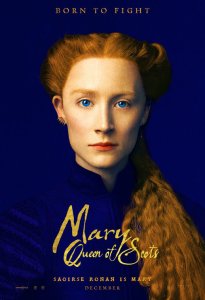 Serving as a feminist reclamation project, Mary Queen of Scots attempts to re-contextualize “Bloody Mary” in the royal dispute for the English throne. As played by Saoirse Ronan, Mary is portrayed as an empathetic, open-minded but strong-willed ruler looking to make peace between the two nations, and Elizabeth is portrayed as a flinty, scared, aloof woman that literally tells her younger cousin that she is her better in every manner. It’s a flip of how the two women are often portrayed throughout history, which raises the question of whether history has been twisted from centuries of revisionist and political obfuscation. There are definitely elements in this movie that I know are historically questionable, like Mary accepting a gay man into her royal court of ladies with open arms and a dismissive view of his sexual leanings. I find it hard to fathom that a devout Catholic woman who ordered heathens burned at the stake would be so anachronistically tolerant of homosexuality. If there’s a new theme for this costume drama it’s that women, even those in power, even those who were deemed wicked or corrupt by historians (universally men for centuries), were hemmed in by scheming men who were trying to usurp their power, undermine them, and manipulate them. Mary is thrown into one faulty suitor after another, positioning her as the victim of a patriarchal society. Again, I suspect there is validity to this context but it treats Mary with kid gloves, denying her righteous impulses. Ronan (Lady Bird) delivers a fine performance of grit and grace, but it’s Margot Robbie (I, Tonya) as Elizabeth that really misses the mark. She is sadly miscast and seems to shrink in the role. The depiction of Queen Elizabeth is also a disservice for drama and the concluding makeup reminded me of the Queen of Hearts from Tim Burton’s Alice in Wonderand. Mary Queen of Scots is an acceptable costume drama told with a little more heat (it’s R-rated for some reason) and a little more consideration to its subjects, but Mary Queen of Scots made me question the voracity of its portraits and made me really wish I was watching the Cate Blanchett Elizabeth movie instead.
Edit: There are two Marys at this time, Stuart and Tudor, and I have conflated them. In my defense, it seems like there shouldn’t be more than one Mary by name when you’re talking about a Catholic rival who is related to Elizabeth. I’ve left my review uncorrected to further own my ignorance.
Nate’s Grade: B-
Share this:

I, Tonya (2017)
 Back in 1994, popular culture was rabidly obsessed with figure skating thanks to Tonya Harding (Margot Robbie), the “bad girl” who was accused of coordinating an attack on her skating rival, Nancy Kerrigan. Tonya’s skuzzy husband, Jeff Gillooly (Sebastian Stan), had hired a friend to “intimidate” Kerrigan, and the end result was a broken knee and the world-famous outcry of, “Why?!” I, Tonya takes a look at the players of this media circus and lets them tell their own stories in their own words.
I,Tonya feels brazenly like a Scorsese movie populated with kooky Coen brothers characters. Director Craig Gillespie (Lars and the Real Girl) cribs from the best and uses all those propulsive camera moves, voice over leading to fourth-wall-breaking, and music needle drops to draw an audience into this crackling crime story. The biggest decision made by screenwriter Steven Rogers (P.S. I Love You) is the dueling perspectives of Tonya and Jeff being given equal treatment. They both sit for a series of on-camera interviews and will even interrupt the flashbacks to object. Jeff will recount a time Tonya chased him around with a loaded shotgun, and then Tonya will turn to the camera and argue that this moment never happened. I, Tonya doesn’t tell you who to believe and who to doubt. The account will purposely contradict one another, often demonizing the other party and painting themselves as a larger victim of fate. The movie is steadily entertaining as it mixes moments of light and dark. Tonya breaking the fourth wall to talk about her domestic abuse is another way of showing just his disassociated she’s become to a life of abuse. It turns fourth wall break into coping mechanism. I was laughing at the buffoonery of Jeff’s goons and moved by the relentless torment of Tonya. It’s a story that’s worth revisiting and is given an invigorating sheen of inept crime thriller. Gillespie goes a little too hard with the Scorsese speed ramp zooms and quantity of literal song selections, but it doesn’t detract from the film’s overall entertainment impact.
 This is a film about reassessing preconceived notions about who the characters are, what the story exactly is, and where the truth lies amidst all the madness. Tonya scoffs, “There is no such thing as truth,” as if she were channeling the forty-fifth president of the United States of America. This becomes a foundational thesis of the movie as we’re presented with conflicting personal accounts where characters will break the fourth wall to criticize the validity of what they are doing or saying. All of these conflicting accounts force the audience to constantly reconsider what we are seeing and being told. We have to consistently think about the source and how there might be bias at play. As expected, Tonya and Jeff’s differing versions of events paint the other as more knowingly duplicitous. Tonya flat-out accuses Jeff of years of physical abuse, the kind of relationship Tonya’s vicious mother had primed her for. LaVona Golden (Allison Janney) would say all of her cruel hostility was valuable in an ends-justify-the-means crucible. Through fighting to earn the approval of an abusive authority figure, Tonya became one of the greatest figure skaters in the world, the first to achieve the vaulted triple axle. LaVona shouts that “nice” doesn’t get you anything in this world (her own mother was nice and LaVona became a waitress). People throughout I, Tonya are reshaping worldviews, angling for sympathy, and spinning history for personal advantage. Everyone wants to be a victim, a martyr, or at least the person who was right in the end. By the end, you don’t know what exactly to believe and whose truth is closest.
This was a media scandal that the public gladly gobbled up every new morsel, bringing out the knives to carve up a villain served up on the Olympic stage, but I, Tonya is a very empathetic portrayal that still doesn’t take the edge off of its title heroine. She grew up poor and scrappy and had to make her own costumes for her skating performances. From a technical standpoint, Tonya Harding could out skate anyone, but she didn’t fit into the cookie cutter beauty pageant image of what a wholesome girl should represent. The same bias against her, the trailer trash girl who couldn’t catch a break, was still dragging her down even when her skating was superior to her competitors. It definitely helps to paint a sympathetic portrayal for the woman, and that’s even before the years of abusive relationships, and a husband she may have returned to in order to appear more “wholesome family.” It’s easy to castigate Tonya Harding as a villain, but it’s even harder to see the person inside the caricature that was sold for mass media consumption.
The use of humor has to be very delicate because of all the controversial material. We have naturally offbeat characters doing incredibly stupid things, and then we have a husband repeatedly hitting his wife. This seesaw of tone means that the comedy needs to be precise or else it will undercut the drama or, worse, cross into gross mitigation of abuse. LaVona is a popular source for verbal abuse, and it’s meant to be shocking, but at no point do I think the film trivializes the conditions of Tonya’s childhood for ironic comic fodder. It’s presenting an abnormal treatment of an abnormal upbringing, and the later detours with “The Incident” are highlighting the naturally cracked criminals. These people were not good at what they were doing and were easily caught. The nimwits-try-their-hands-at-crime subgenre is ripe for laughter, in particular Shawn Eckhardt (Paul Walter Hauser) and his self-professed masterful skills at counter terrorism planning. The Tonya Harding scandal is so inherently sensational and with so many bizarre, colorful characters that to treat it without its penchant of natural humor would be a disservice. Crazy people doing dumb things are going to tend to have some humor value. Where the film falls short is in the realm of media satire. There are a few tasty morsels sprinkled throughout, like LaVona forcing reporters to stand behind a rope line if they wanted to snap her picture, but overall the media satire feels flat. Bobby Cannavale (Spy) feels completely wasted as a Hard Copy reporter/exposition device. He offers few insights and fewer colorful anecdotes. The most pointed the film gets with media commentary is when Tonya looks directly into the camera and accuses each person of being her abuser. It’s a stark turn that stops the action cold, and the audience has to think about their own tacit approval through media consumption. By rewarding this coverage and the easily packaged version of events, have we all played a part in Tonya’s suffering and shame?
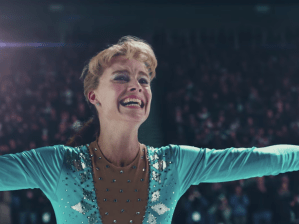 Robbie (Suicide Squad) is sensational in the role, eliciting so much emotion that it can instill whiplash. One moment you’re impressed by the depth of her vulnerability and the next you’re whistling at her hard-as-nails persona and sheer tenacity. It’s an unapologetic performance that goes dark places and serious places, but Robbie doesn’t stoop to pander. Tonya wants your empathy but she doesn’t want your pity, and she sure as hell isn’t going to pretend to be somebody she’s not. The tricky part is the question over who is Tonya Harding. With Robbie, she’s a profane firebrand who is impatient with a world that refuses to accept her and her talents. The scene where Tonya is stripped of ever competing again in professional figure skating is a dazzling piece of acting on Robbie’s part. Tonya has sacrificed much of her own life for this sport, and by her own admission she doesn’t know how to do anything else. To see it all go away with the pound of a gavel, she pleads for jail instead as a more humane punishment. This feels like Robbie marking her grand entrance into the next acting echelon in Hollywood.
The supporting roles nicely serve their purpose, with Janney (The Girl on the Train) being the obvious standout. Her hellish mother is overpowering in every sense. Janney is abrasive and fierce and a crutch for the screenplay when it needs something shocking. I do not doubt the voracity of what the Tonya and other participants have said about LaVona, but the filmmakers don’t know when to leave enough alone. There are insights to be had through LaVona’s relationship with her daughter but it’s too often one-note. She’s the angry older woman berating people for shock, comedy, or a transition.
I, Tonya might change your mind about Tonya Harding. She’s definitely unrepentant in the movie while at the same time asking you to view her with an empathy that was lacking during the parade of 1990s tabloids. She’s an abuse survivor who had to claw for every advantage she could earn. You might not like her, or maybe you’ll grow to appreciate her, but you will understand her better. Robbie is outstanding, Janney is highly memorable and perfectly cast, and the direction provides plenty of jolts, from electric camerawork to the energetic propulsion through its diverging viewpoints. The dark comedy works, the serious drama works, and the domestic violence is not trivialized with so many ironic winks. I, Tonya is an unflinching expose that forces you to question the validity of everything. It’s a movie that dares you to question your perceptions while you’re keenly watching. Perhaps twenty years later, Tonya Harding will get whatever she is due.
Nate’s Grade: B+


 nathanzoebl
You must be logged in to post a comment.