Blog Archives
After the Hunt (2025)
 An unpleasant movie about unpleasant people being unpleasant to one another, After the Hunt is a movie supposedly about ethical dilemmas in academia but it comes across as insufferable people complaining about everything. The framing is about Maggie (Ayo Edebiri), a PhD candidate at Yale, who accuses an older male professor, Hank (Andrew Garfield), of sexual impropriety. He denies it and believes he’s the real victim of a post-Me Too witch hunt, especially after he suspected Maggie of plagiarizing her thesis. Maggie is looking for guidance from her mentor Alma (Julia Roberts) who feels pulled in many directions and unsure whom to believe. Given that premise, you would imagine there would be plenty of scorching drama and intrigue and characters divided by different loyalties and self-interest, especially when all these professors are supposed to be experts on ethics and philosophy too. I found myself so distant and disengaged with the characters because I found them all to be self-involved, cold, and entitled jerks. Worse than all of that, I found them all to be thoroughly boring. Watching After the Hunt feels like you’re trapped at a party with the worst people. That might as well be the moral of the movie: everybody sucks. I wasn’t expecting the characters to be shining examples of heroism, but I wanted them to be a little more interesting and the drama to be more insightful. Alma is our main character and she quietly seethes for most of the movie, that is when she isn’t running to puke into a toilet from her ulcers (symbols!). The movie is replete with characters just whining about “the kids today” and their brittle feelings. You know there’s only so many possibilities given the story; either the assault happened or it didn’t, either Maggie cheated or she didn’t. The score is absurdly discordant and intrusively obnoxious, sounding akin to a rack of instruments falling onto the ground. The abrasive score creates its own unintentionally hilarious jump scares. The more I think about After the Hunt the more I actively dislike it.
Nate’s Grade: C-
Share this:

Queer (2024)
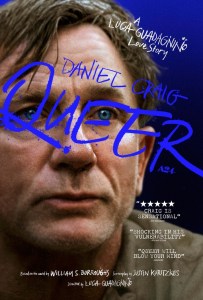
Based upon Beat writer William S. Burroughs, and by the creative team behind this year’s Challengers, Queer is a gay romantic drama equal parts desire and desperation. It also happens to be a confounding artistic misfire and one of the more head-scratching Oscar-bait entries of late.
Set in the 1950s, William Lee (Daniel Craig) is a middle-aged writer living in Mexico City and looking for companionship. One day he meets Eugene Allerton (Drew Starkey, Outer Banks), a young Army expat who he can’t stop thinking about. Lee circles the man, flattering him and throwing affection his way, and eventually the two of them get involved in a relationship, though Allerton is quick to proclaim he is “not queer.” Can they find something lasting or meaningful and work through their own doubts and personal hang-ups?
What really hinders this doomed romance is that it never feels special for either of the participants, at least something to remember through the ages. Unrequited romances in an era where people could never act out their passions because they were considered inappropriate or obscene are their own sub-genre of movies, the Romance That Could Not Be. I initially thought that Queer was going to be a gender flip of 2015’s Carol, Todd Haynes’ film about two gay women trying to carry on a covert relationship through glances and finger touches. Queer is not Carol, and I wasn’t even a big fan of Carol. For starters, even though the setting is in 1950s Mexico City, it doesn’t at all feel like any of the characters are being forced to repress their authentic selves. I’m unfamiliar with whether or not Mexico was so accommodating to gay foreigners, but from a narrative standpoint, it saps the story of conflict on a social scale. If society accepts these men carousing around the neighborhood for homosexual hookups, then what’s halting our gay couple for achieving happiness cannot be external, it must be internal. That means we need to know much more about these characters because we can’t just blame the pressures of society keeping these men apart and/or repressed. The problem with this approach is that the story keeps both of these characters too far at a distance to fully understand them, including any faults that might ultimately lead to their falling out or parting ways.

The burden of romances that are meant to be so powerful they leave a mark, good or bad, is that you need to feel that ache and power so that it feels tragic they could not work out, that they will be haunted by the memory of what they had and what could have been. With Queer, I can’t understand what drew either of these men together beyond lust and inertia. Eugene is an enigmatic blank of a character, a young G.I. who doesn’t consider himself queer. That’s as much as you’re going to get about this man as he’s mostly held as a desirous placeholder, something for our older character to yearn over, but he already feels like a half-remembered, overly-gauzy nostalgic memory of a person even in the present. He’s just kind of there. He doesn’t say much, he doesn’t do much, but he’s reciprocal, and I guess that’s something. The character of William Lee is a writer living abroad, ostensibly writing and publishing with financial freedom. His life abroad is essentially an ongoing vacation where he gets to casually drink, stroll about, and find younger men to warm his bed. Now if Lee had all these things but, because of his middle age, he was seen as less desirable, that these young men only used him for their own gratification and then abandoned him, then we have a scenario where he might find someone who can fulfill what he is missing, who can be different from the others. I don’t know what either of these men see in one another because they’re both so terribly underwritten. It makes it hard to care or become emotionally invested in these men and their connection.
Then the movie just collapses entirely in its meandering, abstract, and generally mystifying second half. I figured the movie would be these two men leaning into their feelings and daring to act them out, becoming infatuated with one another, and that’s really only the first half. Then Lee gets the idea to travel to South America to look for a rare plant believed to offer telepathic powers. Now clearly there’s some metaphors here about the desire for connection and understanding, and you would think the motivation would be spurred by being denied these aspects. Instead, Lee and Eugene seem to lack any real challenge to being together, nor is there any pertinent threat that Eugene will leave him or that there is any competition for his affections. There’s not really a conflict present that can keep them apart; even Lee’s drug addiction plays such a minimal part. I suppose it’s meant to convey the character’s dependency issues, but then present a parallel where Eugene is his new drug, his new obsession, and chasing it leads to his self-destruction. That’s not what we get. We get a boring couple going on a weird vacation. This journey south becomes one very tedious expedition into extended trippy visuals and sketchy symbolism like vomiting out one’s heart. It was at this point that my wife had lost all patience with the movie and just wanted it to end. I couldn’t blame her. Even if the story and characters were lacking for the first half, they’re just abandoned completely in that second half. The movie is actively challenging you to disengage with it when it already gave me little to hold onto.

The main headline for Queer was that this is Craig’s big awards gamble, and he is good, but absent the material to really explore the complexity of his character, the performance is limited because Lee is so archetypal. He’s the middle-aged lush, the sad gay man looking for love and connection in an era that was not kind to said pursuit, and yet in Queer he’s not really persecuted, he’s not really challenged, and he’s not really explored in any meaningful manner. Craig has a few moments where he showcases the vulnerable heartache at the edges of this man, giving you a glimpse of a tortured soul that would have been worthy of being explored with more development. Alas, as the movie descends into its second half abstract, Lynchian morass, I gave up my attempts to find meaning and depth and just became morbidly curious where this all could possibly lead. The conclusion is meant to evoke some sense of tragedy and regret, but Queer failed to make me interested in these two men being together and it failed in making me interested in them at all. At two hours, the biggest struggle of Queer is the patience of the audience to keep watching.
Nate’s Grade: C-
Share this:

Challengers (2024)
 The sweaty, sexy indie hit from the spring is about a tennis throuple told over the course of one pivotal match, where our two male athletes are at very different points in their careers and the woman who came between them. Patrick (Josh O’Conner) and Art (Mike Faist) are the best of friends when they started on the tennis circuit with dreams of making the big tournaments. They both set their sights on Tashi (Zendaya), a tennis phenom since her teenage years who is starting to reach her prime. The movie bounces back and forward through time (like a tennis ball!) to chart the changing relationships between the three, as we’re left to pick up the pieces as to what happened, who fell for who, who broke up with who, and how it relates to the central battle of wills playing out in the present-day match. The best part of Challengers are its characters and ever-shifting power dynamics, which makes each scene rich to digest and examine, especially once Tashi’s career takes an unexpected turn. Director Luca Guadagnino (Bones and All, Call Me By Your Name) keeps things lively with plenty of style including exercising every POV imaginable from the floor, to a tennis balls, and the players with racket banging in hand. We might have gotten a POV from a passing bird had it only gone longer. The movie is electrified by a pulse-pounding score by Trent Reznor and Atticus Ross, a propulsive energy that reminded me of the similar service of the Run Lola Run soundtrack. What holds back the film for me is that the last act is dragged out and it culminates in an ending that is the most obvious as well as underwhelming, which makes the extended dragging even more ultimately tedious. The acting is good all around with each member getting to experience a high-point and low-point of their career and personal lives. However, it’s really Art and Tashi’s movie as Patrick serves as an elevated supporting role. And for a movie with such heat and hype, I guess I was expecting a little more action, if you will. Challengers is an intriguing, entertaining, and refreshingly adult sports drama that I wish had, forgive me, some more balls.
Nate’s Grade: B
Share this:

Bones and All (2022)
 What do you get when you team up Oscar-nominated director Luca Guadagnino, twee handsome man Timothee Chalamet, and the ravenous consumption of human flesh? You get the new indie drama Bones and All, a literal love story between cannibals. It’s boy-meets-girl-meets-dinner.
It’s 1980s Reagan America, and Maren (Taylor Sheridan) is in high school and not allowed out to parties for a good reason. Her father (Andre Holland) nails her bedroom window shut, and we soon realize why when, at a slumber party, Maren eats one of her friend’s fingers. It’s back on the run except Maren’s father has finally had enough. He leaves her behind one morning with a tape recorder to explain. Maren travels to the Midwest and discovers other Eaters, those afflicted with her same impulses. One of them is the young man Lee (Chalamet), who Maren decides to follow. They can look out for one another, but what’s to be done when the hunger strikes, and how far will they go to feed?
 Bones and All is a doomed Romeo and Juliet romance with its own provocative subversion. I was hooked for the first half of the movie, as the script slowly revealed that these cannibals are born this way and their compulsion may also give them super powers, like the ability to smell their own kind as well as key characteristics, like a last feeding or even when a person may be close to death. The movie plays along the fringes of a monster or superhero formula, where we have people with extraordinary abilities, or a curse they must keep hidden depending upon your perspective, and how this challenges their vulnerability and sense of self. It’s reminiscent of vampirism, the need to feed, so we’ve seen aspects of this kind of story dozens and dozens of times, but the world and rules can still be engrossing to learn. Maren and Lee trade stories of their “first time,” though in this context it’s the first time they fed on human flesh, and it so happens both are with a traumatized babysitter. It’s a morbid bonding experience but such is partnering with a person who shares your unorthodox appetites. I was getting shades of Bonnie and Clyde, with our cross-country duo keeping on the run, and also Let the Right One In, where a man is reluctantly killing in order to feed and protect his ward. There’s also the 2017 French film Raw with a young woman discovering her family trait of cannibalism. The source material of Bones and All is a 2016 YA novel by Camille DeAngelis and the script feels very much like the total of its many pop-cultural and literary influences.
There’s still something compelling here about two oddballs finding a person who understand their unique situation. The addiction analogy is apt and provides an interesting discovery, as both Maren and Lee inherited their eating habits from a parent similarly affected. Maren’s search for her biological mother is a solid direction as it also promises a search for answers. Russell (Netflix’s Lost in Space, Escape Room) is an understated but captivating lead. Her character has never been out on her own and doesn’t know much about a larger world of Eaters, so every encounter is her stretching her boundaries and discovering what she is capable of. She also needs to learn how to better live with her impulses, or whether she even can, and being paired with a more experienced companion allows her to explore those feelings with better understanding. Chalamet (Dune) is part scraggly drifter, part twink prostitute, part deceitful vampire, and part sensitive boyfriend. In other words, he fits right in as a brooding Byronic love interest that Maren questions how close she can allow herself to be in his presence. The us-against-the-world sensibility of young and/or forbidden love is amplified with the extra genre trappings. In many ways, Bones and All feels like a strange amalgamation of Guadagnino’s last two movies, the 2018 gory remake of Suspiria and the 2017 tender gay romance, Call Me By Your Name.
 Where the movie starts to lag is its second half, which is built upon two conflicts that feel inadequately developed. The first, and biggest, is the relationship between Maren and Lee. It’s natural for Maren to be wary of Lee early on, especially with how much is at stake if either one of them. There’s also the danger of being alone with a cannibal, much like befriending a wild animal and always having to keep one eye open. It becomes a guessing game of trust and compulsion, can either control their urges? However, the romantic coupling between Maren and Lee felt very distant, as if the movie intended for them to be these star-crossed lovers and instead both of them looked at each other and shrugged and settled on being friends. It’s not that there isn’t really any heat or chemistry there. I can ignore that when both members are struggling to control how much of themselves they offer to the other. It’s a relationship built upon mutual survival and the occasional make out, but the difference between the two of them is at once emphatically stated and then casually ignored. The big hiccup for a Maren/Lee relationship seems to be that Lee will kill people in order to feed and Maren disagrees with this. You would think over the course of their time together the movie would follow one of two directions: 1) Lee’s willingness to kill for food becomes more extreme and Maren is pushed away, or 2) Maren begins to share in Lee’s willingness to kill and changes her moral outlook. Neither of these really happen, so when Maren considers leaving Lee’s company, I was left wondering what changed. He’s presented as dangerous, but he doesn’t become more unhinged, and there isn’t a point of no return for their relationship. I didn’t feel much when this union was arbitrarily was put on pause.
The other conflict is an external one and a nag. I thought there would be more attention about Lee and Maren having to hide from encroaching law enforcement. Instead, it’s another Eater who becomes a stalker, and this character would have been best served as a one-sequence passing weirdo. The reappearances feel contrived and poorly integrated once the fledgling Lee/Maren relationship takes center stage. There isn’t enough to the character to deliver with multiple appearances. The fact that this character plays such a big role in the second half is a letdown. If Lee and Maren were worried about people coming after them, why not the police tracking them for the murders they leave behind? Why not even a gang of Eaters that have decided there is even more security in number and have no compunctions over eating their own kind? That topic isn’t even explored, whether eating an Eater would be even more compelling. You could even have someone deem themselves a Super Eater who seeks out other Eaters to consume, either because he or she feels they are an even more exquisite taste/addiction, or because they have a self-righteous sense of purpose and feel eliminating other Eaters will protect the innocent they feed upon. It’s not even expressed whether they have to eat living people or if old corpses could suffice. There are different external threats that could have been better developed and integrated, so it’s a shame that the one we have is given so much more attention than deserved.
 With every movie, it’s important to judge what you’re presented rather than what could have been; it would be unfair judging a hamburger at a restaurant for not being a pizza. Still, I felt like the more compelling perspective to tell this cannibal love story was a parent protecting a child rather than as disaffected teenagers. I thought following Maren’s father from raising her and realizing she had a problem but ignoring it until he couldn’t, and then his challenges to reign in her impulses, would be the more compelling and dramatically charged point of view. It doubles down on the theme of what a parent would do for their child, as well as the personal fear of every parent whether they are capably raising the child to be a moral and self-sufficient adult. Then you mix in the possibility of the genetic lineage for cannibalism, and you can have the parent trying to pass down their knowledge to their progeny or the parent feeling immense guilt for bringing this would-be innocent into a situation that may spell their doom. Every time the narrative went back to Maren listening to her father’s audio narration, I felt like I was getting a bigger picture of the weight of the years of raising Maren. I suppose that also might lean a little heavily into a similar Let the Right One In dynamic. I understand that Bones and All is an adaptation of a YA novel and young outsider lovers is par for the course with the genre, so I wouldn’t expect such a radical adaptation even if it feels like a superior story perspective for drama.
Even as things didn’t fully come together for me, I was always interested in Bones and All for its two-hour duration. It’s not every day that genuine artists are putting their all into a love story that also involves chewing the nipple off a dying man. It didn’t really work as a romance for me because I didn’t really feel invested in the coupling of our main characters. There is so much more intriguing dramatic potential here with these story particulars that I can’t help but feel slightly disappointed by the end results hewing very closely to YA staples. More could have been explored in the romance, especially what nourished the attraction and what would compel Maren to rethink her feelings. As a gauzy, young lovers-against-the-world drama, it has its melancholic pleasures and diversions, one of which is that it was filmed primarily in southern Ohio. It was also filmed in Columbus, so I got to point to the screen and say, “Hey, I recognize that Greyhound bus station” (that was the extent of the Columbus filming, one five-second external cutaway). Bones and All can surprise plenty of viewers, and I’m positive many will be swooning from its mixture of romance and depravity, but the bigger surprise for me was that it left me ultimately hungry for more of everything.
Nate’s Grade: B-
Share this:

Suspiria (2018)
 The idea of remaking Dario Argento’s horror classic Suspiria seems like movie heresy. How could any filmmaker attempt to come close to the Italian master’s original? Though that has not stopped Hollywood from remaking other horror classics of yore. Italian director Luca Guadagnino (Call Me By Your Name, A Bigger Splash) tempts the unwise with a new version of Suspiria, this time following the exploits of Susie (Dakota Johnson) in Cold War Germany as she is seduced by a private dance company lead by Madame Blanc (Tilda Swinton) that’s really a front for the occult. The new Suspiria is a worthy, splashy artistic endeavor but it suffers from too much airy meandering in the name of redundant atmosphere, vague and arbitrary plotting, and poor characters.
We’re told up front this is a story in six acts and a resolution but frankly the first two acts could have been completely eliminated. Their bearing on the overall story is minimal, but then I could say the same thing about much of the characters. Chloe Grace Moritz’s role could have been entirely cut. The majority of the story is strange things happening very slowly in the background of a dance school. The characters that do investigate aren’t our protagonists, which then traps us with people who know too much and won’t share, people who don’t know anything, and people who don’t want to know anything. It gets frustrating spending that much time with them, especially when the end destination (coven conspiracy sacrifice) is obvious even if you haven’t watched the 1977 original. I was told that Guadagnino edited an hour out of the final movie. How? What in the world was left out? It feels like everything they could have shot found its way into the finished film, whether it needed to be there or not. There’s an ongoing subplot about the Red Army Faction (a.k.a. Baader-Meinhof Gang) that we keep returning to as if there’s supposed to be larger relevancy. It’s a left-wing conspiracy that translated post-war anger into violence against the government. If I work really hard I can make a larger thematic connection to witches and women, but I won’t. With Suspiria 2018, it’s really just historical atmosphere that adds little but yet is returned to again and again. There is even a post-credit scene of a character doing something unclear while looking toward the camera. Why include any of that? It’s arbitrary and superfluous to the very end.
 The new Suspiria toggles through three tepid lead characters: 1) Johnson’s new dance recruit, 2) Swinton’s artistic director at the school, and 3) Swinton in old-age makeup as a grieving psychiatrist trying to make sense of his life (yes, “his,” as she plays a man). Two of these characters matter in strict plot terms and only one of them are granted some degree of characterization. Susie is essentially an empty vessel who is extremely passive, going along with whatever she’s told (there is a reason for this but it falls under the category of contrived dues ex machina). There are hints of the connection she has to some occult force at play, but we don’t really see any transformation on her part because she’s so opaque to start with. Madame Blanc is the most interesting character, somewhat by default, but she only becomes that in the last third of the film when her personal feelings for Susie make her doubt how far she’s willing to go to achieve the coven’s goal. It’s the only character with a direct internal conflict that seems to matter to the story. The old man has no reason to be in this movie. By the end, it feels like the film has found a significant story reason for his inclusion, one that will actually produce some thematic relevance for Swinton also playing this role, but nope. He serves no purpose other than exposition and to hammer home a tangential historical context of generational guilt. There is a nice character moment between two characters in the resolution but by then it’s too little too late. Even this nice moment doesn’t really need to happen. I think the reason the film toggles between these three characters is even it knows you will get bored with them.
When the horror hits, that’s when Suspiria is at its most rattling. Watching a woman’s body betray her, one excruciating limb convulsion after another, culminating in her own jaw seeming to rotate out of her head, is wince-inducing and terrifying. The sudden jolts of violence made me gasp and squirm every time. This culminates in a third act that is heavy on blood and lunacy, so much so that it feels like the finale to another movie. If the proceeding two hours was understated, atmospheric horror, the last thirty minutes feels like the splatterific Sam Raimi Evil Dead 2. There’s an explicit campiness that feels at odds with the self-serious meanderings of earlier. There are also moments that cannot be described as any other word than “goofy.” There’s an ongoing shot of characters being dispatched in a very exaggerated and theatrical manner, and the fact that we watch thirty of these in a row just invites some degree of laughter. I know I laughed. The final act and confrontation is my favorite part of the film, delivering some long-sought vengeance, but it feels like a different movie. It’s also where Guadagnino’s “put the camera anywhere” stylistic approach betrays him. It’s hard to tell what exactly is happening on a literal level, let alone understanding it, and that’s not even taking into account the muffled sound design of several characters when they hoarsely whisper aloud whatever.
 I would be more forgiving if the new Suspiria had not been as exasperatingly long, a full hour longer than the 1977 original. Long movies only feel long when they haven’t fully engaged you, and there are generally only so many ways to keep an audience’s sustained attention and investment. I understand wanting to allow a movie to breathe or wanting to create an uncertain atmosphere of intoxicating dread, but there has to be more than that. There’s also what I’ll affectionately coin the Nicolas Refn Trap, meaning where all of that breathing space ultimately exposes a lot of empty indulgences and vamping. Suspiria 2018 falls into this trap too often; there simply isn’t enough of anything to spread over those 150 minutes. The odd comparison I would make is to the notorious 1980 Western disaster, Heaven’s Gate, a movie I watched for the first time two years ago and actually appreciated. Let me be more specific: I appreciated the 100-minute very good movie somewhere inside there suffocated by the artistic excesses and peculiar and mercurial artistic demands from its uncompromising director (the man refused to shoot anything for ten hours until he got a cloud positioned exactly where he wanted). I’m convinced there’s a potentially great movie in Suspiria but it’s going to require a lot of excavation to allow it to see the outside.
I was interested in re-watching Argento’s 1977 original for the first time in years, and some things have aged better and some things have aged worse. Argento is a first-class visual stylist and his famous use of color makes the cinematography often beautifully horrific as young women are terrorized. There is even less plot than I remembered, a series of surreal murders finally leading to the obvious reveal of the dance company being a coven of witches. The characterization is even thinner than the thin 2018 film, which means that Guadagnino and company had a lot of room to roam when it came to their grandly grotesque remake. Argento’s film is a remarkable example of the immersive power of the screen, with his gorgeous use of light and color, production design, and a pulsating score that is perhaps a bit too omnipresent and anxious. There is one reoccurring musical sting that sounded precisely like the beginning of “Footloose” and it made me laugh every time, imagining Kevin Bacon dancing through the hallways. It’s a testament to the transcendent power of style when done by a first-rate stylist, and it works so far as to create a nightmarish, oppressive atmosphere. However, that eerie atmosphere and technical craft are about all the original Suspiria has to offer since there is a gnawing scarcity when it comes to characters, structure, and story. That makes the 2018 Suspiria a little more confounding. While it clearly works as an homage to Argento it’s also radically different, and yet it still manages to also have underwritten characters and bad storytelling choices even when it could have ditched the original’s original sins. At least Argento’s version is only 90 minutes and a lot easier to watch in one sitting.
 The Suspiria remake was clearly a labor of love and not a soulless paycheck for all those involved. The technical craft is accomplished, and even though it lacks the vibrant colors of Argento’s original the cinematography is still highly evocative and unsettling. Guadagnino has put a concerted effort into making his movie operatic, lavish, and radically different from the source material. I think it’s different yet reverent enough that fans of the original will find something to enjoy as the film asserts its own identity. And yet the moody atmosphere is undercut by the shortcomings of the characters and the contrived nature of the overly padded and meandering plot. The more I think back on the movie the more it falls apart under further scrutiny. Suspiria is a tonally confused movie that doesn’t have enough substantial material to fill out its gargantuan 150-minute running time. There will be blood but what there needed to be was a more judicious editor.
Nate’s Grade: C
Share this:

Molly’s Game (2017)/ Call Me By Your Name (2017)
 Two new awards-caliber film releases couldn’t be more different. One of hyper-literate in a high-stakes world of drama, gambling, and crime, and another is somber, lackadaisical, and personal, chronicling a summer love that changed lives. One movie has scads of plotting it zooms through with high-powered visuals and voice over, and another luxuriates in the moment, a placidity on the surface interrupted by rising passions. One of these movies I found captivating and the other I found perfectly nice but unremarkable.
Molly’s Game is Aaron Sorkin’s directorial debut, clearly having studied at the altar of David Fincher, and he packs a lot into his 140 minutes chronicling the rise and fall of Molly Bloom (Jessica Chastain), a former Olympic hopeful who found herself running an expensive, private series of poker games. She’s drawn into an unfamiliar world and through her tenacious grit, preparation, and fortitude, she is able to become a fixture amongst the rich. Then the FBI comes knocking and wants to charge her in conjunction with being part of a Russian money laundering operation. Driven by a fierce performance from Chastain, Molly’s Game is a gloriously entertaining movie that glides by. It burns through so much plot so quickly, so much information, that you feel like you might have downloaded Bloom’s book while watching. The musical Sorkin dialogue has never sounded better than through the chagrined, take-no-prisoners Chastain. The snappy dialogue pops, the characters are richly realized, and even during its more outlandish moments, like a surprise paternal reunion therapy session, Sorkin packs multiple movies of entertainment in one brisk, excellently manicured production.
 In contrast, Call Me By Your Name is a slower peak into the discovery of romantic feelings between 17-year-old Elio (Timothee Chalamet) and grad student Oliver (Armie Hammer). Set amid the sunny countryside of northern Italy, the film takes it sweet time establishing the lazy world of its characters and their closely intersecting orbits. I became anxious because the characters kept me at arm’s length, leaving their burgeoning romance to feel distant and tame. I understand the hesitation of both parties and the age difference complicating matters. I understand caution. But it feels like the film is cautious to a fault, to the point that one of them laments later why they wasted so much time. The acting is pleasant if undistinguished. The best scene is a terrific monologue by Michael Stuhlbarg as the world’s most lovably accepting father. For an earth-shattering romance, I too often felt unmoved and restless. If we’re going to spend this much time hanging out with these people we should get to know them more intimately, and not just in the physical sense. I missed the compelling artistic charge of something like a Moonlight. I’m a bit stupefied at all the praise heaped upon Call Me By Your Name, a fine indie drama that, for me, too infrequently delves below its pretty surface into something more substantial.
I don’t know if this recent comparison sheds light on any personal insight, but perhaps I just love big, showy, obvious plot that calls attention to itself, with characters that fill a room, rather than an airy romance that moves at the speed of its own breeze. Anyway you have it, one of these movies makes my Best Of list and the other just makes me shrug.
Nate’s Grades:
Molly’s Game: A-
Call Me By Your Name: B-


 nathanzoebl
You must be logged in to post a comment.