Blog Archives
Queer (2024)
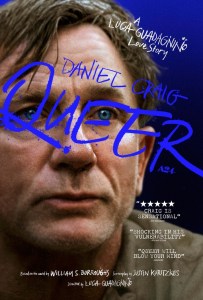
Based upon Beat writer William S. Burroughs, and by the creative team behind this year’s Challengers, Queer is a gay romantic drama equal parts desire and desperation. It also happens to be a confounding artistic misfire and one of the more head-scratching Oscar-bait entries of late.
Set in the 1950s, William Lee (Daniel Craig) is a middle-aged writer living in Mexico City and looking for companionship. One day he meets Eugene Allerton (Drew Starkey, Outer Banks), a young Army expat who he can’t stop thinking about. Lee circles the man, flattering him and throwing affection his way, and eventually the two of them get involved in a relationship, though Allerton is quick to proclaim he is “not queer.” Can they find something lasting or meaningful and work through their own doubts and personal hang-ups?
What really hinders this doomed romance is that it never feels special for either of the participants, at least something to remember through the ages. Unrequited romances in an era where people could never act out their passions because they were considered inappropriate or obscene are their own sub-genre of movies, the Romance That Could Not Be. I initially thought that Queer was going to be a gender flip of 2015’s Carol, Todd Haynes’ film about two gay women trying to carry on a covert relationship through glances and finger touches. Queer is not Carol, and I wasn’t even a big fan of Carol. For starters, even though the setting is in 1950s Mexico City, it doesn’t at all feel like any of the characters are being forced to repress their authentic selves. I’m unfamiliar with whether or not Mexico was so accommodating to gay foreigners, but from a narrative standpoint, it saps the story of conflict on a social scale. If society accepts these men carousing around the neighborhood for homosexual hookups, then what’s halting our gay couple for achieving happiness cannot be external, it must be internal. That means we need to know much more about these characters because we can’t just blame the pressures of society keeping these men apart and/or repressed. The problem with this approach is that the story keeps both of these characters too far at a distance to fully understand them, including any faults that might ultimately lead to their falling out or parting ways.

The burden of romances that are meant to be so powerful they leave a mark, good or bad, is that you need to feel that ache and power so that it feels tragic they could not work out, that they will be haunted by the memory of what they had and what could have been. With Queer, I can’t understand what drew either of these men together beyond lust and inertia. Eugene is an enigmatic blank of a character, a young G.I. who doesn’t consider himself queer. That’s as much as you’re going to get about this man as he’s mostly held as a desirous placeholder, something for our older character to yearn over, but he already feels like a half-remembered, overly-gauzy nostalgic memory of a person even in the present. He’s just kind of there. He doesn’t say much, he doesn’t do much, but he’s reciprocal, and I guess that’s something. The character of William Lee is a writer living abroad, ostensibly writing and publishing with financial freedom. His life abroad is essentially an ongoing vacation where he gets to casually drink, stroll about, and find younger men to warm his bed. Now if Lee had all these things but, because of his middle age, he was seen as less desirable, that these young men only used him for their own gratification and then abandoned him, then we have a scenario where he might find someone who can fulfill what he is missing, who can be different from the others. I don’t know what either of these men see in one another because they’re both so terribly underwritten. It makes it hard to care or become emotionally invested in these men and their connection.
Then the movie just collapses entirely in its meandering, abstract, and generally mystifying second half. I figured the movie would be these two men leaning into their feelings and daring to act them out, becoming infatuated with one another, and that’s really only the first half. Then Lee gets the idea to travel to South America to look for a rare plant believed to offer telepathic powers. Now clearly there’s some metaphors here about the desire for connection and understanding, and you would think the motivation would be spurred by being denied these aspects. Instead, Lee and Eugene seem to lack any real challenge to being together, nor is there any pertinent threat that Eugene will leave him or that there is any competition for his affections. There’s not really a conflict present that can keep them apart; even Lee’s drug addiction plays such a minimal part. I suppose it’s meant to convey the character’s dependency issues, but then present a parallel where Eugene is his new drug, his new obsession, and chasing it leads to his self-destruction. That’s not what we get. We get a boring couple going on a weird vacation. This journey south becomes one very tedious expedition into extended trippy visuals and sketchy symbolism like vomiting out one’s heart. It was at this point that my wife had lost all patience with the movie and just wanted it to end. I couldn’t blame her. Even if the story and characters were lacking for the first half, they’re just abandoned completely in that second half. The movie is actively challenging you to disengage with it when it already gave me little to hold onto.

The main headline for Queer was that this is Craig’s big awards gamble, and he is good, but absent the material to really explore the complexity of his character, the performance is limited because Lee is so archetypal. He’s the middle-aged lush, the sad gay man looking for love and connection in an era that was not kind to said pursuit, and yet in Queer he’s not really persecuted, he’s not really challenged, and he’s not really explored in any meaningful manner. Craig has a few moments where he showcases the vulnerable heartache at the edges of this man, giving you a glimpse of a tortured soul that would have been worthy of being explored with more development. Alas, as the movie descends into its second half abstract, Lynchian morass, I gave up my attempts to find meaning and depth and just became morbidly curious where this all could possibly lead. The conclusion is meant to evoke some sense of tragedy and regret, but Queer failed to make me interested in these two men being together and it failed in making me interested in them at all. At two hours, the biggest struggle of Queer is the patience of the audience to keep watching.
Nate’s Grade: C-
Share this:

Back to Black (2024)
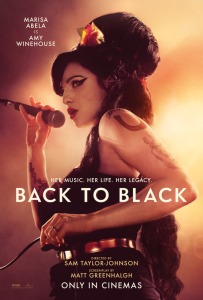 What do you remember about Amy Winehouse? The tragic singer with the booming voice that was mercilessly picked apart by a rabid tabloid media, as well as rampant online speculation, over every step of her addiction to drugs and alcohol? If that’s the extent of your memory, as well as some of her more notable songs like “Rehab” or “Back to Black,” then this musical biopic directed by Sam Taylor-Johnson (Fifty Shades of Grey, Nowhere Boy) is going to feel like a shallow exercise in piling on a troubled and talented performer gone far too soon.
Back to Black, the film, literally has Amy Winehouse (Marisa Abela) vocalize what she wants to be remembered for, not the drugs and alcohol, and the movie then erases Amy as a vibrant, complicated human being into a blurred statistic on the dangers of unchecked addiction. You can’t tell her story without documenting her demons, and yet the movie also seems exceptionally forgiving to the men who contributed to her downfall, her doting father Mitch (Eddie Marsan) who enabled her and her bad boy boyfriend Blake (Jack O’Connell) who introduced her to hard drug abuse. We spend so much emphasis on the bad times and her downfall and yet the movie is strangely reticent to cast much judgment on her bad influences, which makes it seem like the movie is further blaming Amy. At the same time, her downfall is focused on being rejected by a man, which is really insulting and limiting for her as an artist as well as a person capable of independent thought. It’s an even stranger decision given that these two influences, her father and ex, were given withering condemnation in the 2015 Oscar-nominated documentary on Winehouse. Apparently, Mitch Winehouse was furious with the documentary’s portrayal of him and Amy. His secondary complaint was that the documentary focused too much on the negative aspects of her life story, which is comical considering the skewed balance that Back to Black dwells upon. We speed through the good times to wallow in the bad, and without a stronger and more complex portrayal of Amy as a character, it all feels trashy and degrading. It’s harder to feel the heartbreak when the movie is only defining her by our foreknowledge of her death.
 Amy never feels like her own person in this movie, which is a shame since she was a dominant presence. We never get into her creative process or her inspirations. We never get to see the person behind the omnipresent tabloid headlines. The formulaic rise-and-fall structure is so rushed and uninterested in fleshing out Amy as a person, so we get simplistic impressions like she sure loved her “nan” (Leslie Manville) and never recovered from her death. The movie sets a midpoint montage where her grandma’s funeral pushes her to get a signature tattoo and beehive hairdo, and it plays like a superhero finally donning their cape and cowl (At last, she has become… Batman, I mean… the Amy We Remember). It’s played so dramatically that it might even unleash a titter or two. There is such scant insight into this woman and her demons that I doubt anyone will come away with a better understanding of Amy and her place in music history, as well as who she was as a person. The movie omits other struggles that might take the focus off its specific topic of drugs and alcohol. Her bulimia gets nary a mention except for maybe one scene where her inconsiderate roommate asks Amy to please vomit into the toilet a little less loudly. While skipping judgment over her enablers, the movie also avoids being too judgemental on the social impulses and rubbernecking that fed upon the harassment and mockery of Winehouse and her struggles. Again, by omission this is placing further blame onto Amy herself.
For each viewer, Back to Black is going to sink or swim depending upon your reaction to Abela’s (Industry) performance. She does her own singing and learned to imitate Winehouse’s signature soaring vocals, so that’s generally impressive. However, I felt her greatest moments of acting were the scenes where she wasn’t in song. Her over-extended enunciation and head bobs made me consistently cringe, like watching an overzealous Vegas impersonator. In the few instances where the movie slows down, that is where Abela is best, being distraught over the loss of her nan, infuriated by her ex, incredulous at music producers that want to market Amy like the Spice Girls, and charmingly innocent confiding to a young fan in a checkout line. If the movie had cut all of her vocal performances and given me more time with this Amy Winehouse, I would have gotten more insight and entertainment. Abela isn’t given the material to really bring Amy to life.
 Back to Black isn’t so much Amy’s movie as it is her father Mitch’s response to earlier portrayals. He’s portrayed here as a doting and loving father who only wanted what was best for her. You see, his initial refusal to the demands to send his daughter to rehab was because he wanted her to kick this whole addiction thing on her own. She didn’t want it so he wasn’t going to push her. If anything, he’s the hero of this movie, the proud papa who was let down by his daughter’s duplicitous boyfriend-turned-husband, the man who took his little girl away and turned her to the dark side of drugs. When you analyze the approach, it all comes across as a little insidious, a little icky, and unworthy of recreating this woman’s life experiences to better glorify her father. Abela gives it her all, it’s just too little to be had with Back to Black, a shallow biopic treading upon distaste. I’d recommend skipping this movie entirely, unless you’re irreversibly curious, and watch the 2015 documentary Amy instead. You’ll get a much better sense of Amy Winehouse the singer, the star, the addict, and most importantly, the complicated person.
Nate’s Grade: C
Share this:

Phantom Thread (2017)

When the 2017 Oscar nominees were announced, one of the bigger surprises was the amount of love the Academy dished out for writer/director Paul Thomas Anderson’s Phantom Thread. In hindsight, maybe this should have been more obvious considering the Oscar-friendly pedigree (Anderson a.k.a. PTA), the acting phenom (Daniel Day-Lewis), the setting (1950s), and the subject matter (obsessive artists). I had no real desire to see Phantom Thread after enduring PTA’s last two movies. I strongly disliked Inherent Vice and The Master, to the point that when I read about the love for either I can only stare at my feet, shake my head, and hope one day these defenders of rambling, plotless, pointless navel-gazing will come to their better senses. While not nearly ascending to the heights of his early, propulsive, deeply felt works, Phantom Thread is for me a marked improvement as a PTA film experience and an intriguing study in toxic desire.
In 1950s post-war London, fashion designer Reynolds Woodcock (Day-Lewis) is famous for dressing movie stars, princesses, and the rich elite of the world. His sister, Cyril (Leslie Manville), acts as his business manager and personal manager, including kicking out the old muses who have overstayed their welcome. After a day out in the country, Reynolds becomes instantly smitten with Alma (Vicky Krieps), a foreign waitress. He pulls Alma into his highly secluded world. She lives in the Woodcock offices and he summons her at all hours, caught up in the madness of inspiration. Alma is overjoyed by the attention and adoration from such a famous and brilliant artist. It’s the kind of feeling she doesn’t want to end, and when Reynolds begins to lose interest with her, Alma will fight however she can to stay longer in this new and exciting world.

While this doesn’t have nearly the same amount of plot in comparison to early PTA, Phantom Thread at least held my interest and felt like what I was watching mattered. The character dynamics were compelling. Reynolds is a puzzle and we’re side-by-side with Alma trying to figure him out, suss his moods, and analyze why he is the way he is and how best to compensate. It becomes something like a portrait of a Great Artist who doesn’t operate on the same social and interpersonal levels as the rest of us, leaving Alma fumbling for stability. A breakfast in silence can become a battle of wills on the sound design team (you’ll never notice the sound of bread scraping like ever before). It’s not quite the thorough character study that There Will Be Blood purported to be, but Day-Lewis is as reliable an anchor for a movie as you’ll get in cinema. I was especially fascinated by the role of his sister, Cyril. She’s the gatekeeper to a very private world and knows the precise routines and preferences of her very fussy brother. She doesn’t necessarily approve of his actions but she sees them out, though occasionally she has to be more of the responsible one of the pair. Cyril is his lifeline, enabler, and enforcer. She treats Alma as a visitor into their home, further magnifying her worry about eventually being replaced by another muse for Reynolds. This insecurity is what drives much of the film’s second half as Alma tries everything she knows to assert power and influence so that she will not be unceremoniously carved out of this new special life for herself.
At its core Phantom Thread is an exploration of the stubborn artistic process and the toxic relationship of chasing those mercurial, waning affections. It’s very easy to feel for Alma, a relative nobody plucked form obscurity and whisked away to a glamorous world of the London’s fashion scene where she is the chief muse of a brilliant man. When he lays the full force of his attentions on her, it’s like feeling the warmth of the sun, and her world revolves around feeling that intensity. When his attention is elsewhere, Alma can feel lost and discarded, desperate to seek that warmth and fulfillment once more, though running into barriers because of Reynolds’ peculiar personal habits and demands. She plans a surprise romantic dinner that Reynolds resents, and he congratulates himself on the “gallantry” of eating his asparagus with butter instead of the salt he normally likes. Reynolds is a powerful figure who casts a powerful shadow. You feel for Alma as she tries again and again to find the exact formula for pleasing and comforting this obsessive man given to routines. She’s tying to crack the code back into Reynolds good graces. He’s an inscrutable force and one Alma is willing to genuflect to for his affections. Because of this dynamic, much of Phantom Thread is watching Alma try and fail to impress or win back the attentions of Reynolds, which is part fascinating and part humiliating. The film explores Reynolds’ history of burning through his shiny new muses, relying upon the iron-hearted determination of his sister to finally push out the discarded lovers/muses. For Reynolds, his muses follow the cyclical pattern of a love affair, the excitement and discovery of something new, the possibilities giving way to artistic breakthroughs, and then what once seemed en vogue is now yesterday’s old fashion.

Because of this tight narrative focus, the film does become repetitious in its second half, finding more ways to expound upon the same ideas already presented. Reynolds is a jerk. His process is of utmost importance and must not be altered. Alma is struggling to make herself more essential and less expendable in his orbit. She doesn’t want to end up like all the other prim women who have been elbowed out of the spotlight. She’s feisty and pushy and will challenge Reynolds, and this doesn’t usually work out well. While the strength of the acting never wavers, the plot does feel like it reaches a ceiling, which makes the film feel like it’s coasting for far too long (and it’s also far too long). It feels like Alma is fighting an unwinnable battle and after all her efforts she’ll just be another muse in a history of muses. That’s probably why Anderson gooses his third act with a thriller turn and with a specific plot device I’ve weirdly seen a lot in 2017. It feels like this plot turn is going to disrupt the cycle of Reynolds affections, and then as things begin reverting back to the old Reynolds, it all feels so hopelessly Sisyphean. And then, dear reader, the literal last few minutes almost save this entire movie’s lethargic second half. It’s a new turn that made me go, “Ohhhhh,” in interest, and it redefined the relationship and power dynamic between Alma and Reynolds in an intriguing way. It says a little something about the relationship between self-sacrifice and self-sabotage and how the power of giving can approach perverse levels of distorted self-fulfillment.
The biggest selling point of any movie with Daniel Day-Lewis is the man himself. He’s literally only been in four movies over the last decade, and in two of them he’s won Best Actor Oscars and was just nominated for another with Phantom Thread (Gary Oldman has that thing in the bag this year, though). The excellence of Day-Lewis is beyond dispute, and yet I would argue that Day-Lewis is pushed aside by the acting power of Krieg (A Most Wanted Man). This woman commands your attention enough that she can go toe-to-toe with Day-Lewis and win. She’s the worst at holding back her emotions and playing games, which makes her the most affecting to watch. When her romantic dinner goes badly, you can feel her reaching for reason, thinking out loud, her eyes glassy with uncertainty. When she’s speaking in an interview about her relationship with Reynolds, the warmth in Krieg radiates out from her. The other standout is Manville (Harlots) who does an incredible amount with mere looks. She can be withering. It’s a performance as controlled as Alma is uncontrolled, relying on the facade of calm to operate through a manufactured space of rules and expectations. And yes Day-Lewis is terrific. It’s also the first time he’s used his natural speaking voice in decades on screen.

Paul Thomas Anderson’s newest movie is about the world of fashion but it’s really about three characters jostling for understanding, attention, and control. We follow the tumultuous power dynamics of an artist-muse-lover relationship and the toxic implications it has on Alma as she struggles to maintain her position. The second half can get a bit repetitious and feel rudderless, but the eventual ending and wealth of great acting makes it an arguably justified journey. I lamented that Anderson was no longer making movies for me with the lurch he had taken with The Master and Inherent Vice in particular. He doesn’t have to make movies for me at all, but it was this sad realization that made me feel like I was undergoing a breakup with an eclectic artist I had loved tremendously in my younger days (Boogie Nights remains one of my favorites). Phantom Thread doesn’t exactly return things back to the way they used to be but it at least rights the ship, offering a mild course correction with a movie that is accessible and substantive. If this is indeed Day-Lewis’ last movie, at least it was better than Nine.
Nate’s Grade: B
Share this:

Birdman or (The Unexpected Virtue of Ignorance) (2014)
 Expecting a comedy from Mexican director Alejandro Gonzalez Inarritu would have preposterous. The man was known for his cinema verite of suffering, notably Babel, 21 Grams, Biutiful, and his best film, Amores Perros, roughly translated to Love’s a Bitch. Perhaps there isn’t much of a shift going from tragedy to comedy. Inarritu’s newest film, Birdman or (The Unexpected Virtue of Ignorance), has been wowing critics and audiences alike, building deafening awards buzz for its cast, Iarritu, and the superb cinematography, but will it fly with mainstream audiences? This may be one of the weirdest Oscar front-runners in some time.
Riggan (Michael Keaton) is an actor best known for playing the superhero Birdman in the early 1990s and walking away from the franchise. He’s still haunted by that role (sometimes literally) and struggling to prove himself as an artist. He’s brokered all his money into directing, adapting, and starring in a theatrical version of Raymond Carver’s short story, “What We Talk About When We Talk About Love.” The show is in previews and about to open its run on Broadway but it’s already got a rash of problems. The leading man needs to be replaced immediately. The supposed savior is famous actor Mike (Edward Norton), an undeniably talented but temperamental actor who pushes buttons to find some fleeting semblance of “truth.” Mike’s girlfriend, Lesley (Naomi Watts), is growing tired of his antics and desperate for her own long-delayed big break. Laura (Andrea Riseborough) is Riggan’s “girlfriend” and co-star and may be pregnant. Sam (Emma Stone), Riggan’s personal assistant and also his detached daughter, is fresh from rehab, and spiteful against her neglectful dad. Toss in Riggan’s best friend/manager/play producer (Zach Galifianakis), Riggan’s ex-wife (Amy Ryan), and a feared theater critic (Lindsay Duncan) who is determined to kill Riggan’s show to send a message to the rest of Hollywood polluting the integrity of the theat-tah. Oh, and throughout all this, Riggan hears an ominous voice that alternating encourages him and humiliates him.
 It’s an industry satire, a bizarre comedy, a father/daughter drama, an examination on identity and the complicated pulls of affection and admiration, and a stunning virtuoso technical achievement. As a movie, Birdman is hard to pin down or categorize. It’s a movie that you definitely need to experience on your own rather than have described (don’t stop reading, come back…), and that is a reason enough to see the film, a rare aspect among modern movies. It’s an artistically offbeat movie and yet it ultimately is about one has been actor looking back on his career and coming to terms with his own impact with pop-culture, art, and his family. It’s about a man struggling to find his place in his own life, beset at all odds by doubters and traitors and obstructionists. The refreshing aspect about Riggan is that he’s a has-been but not a sad sack; he’s fighting from the beginning, sometimes pathetically and sometimes in vain, but the man is always fighting to regain his dignity, to reclaim his life’s narrative, and to fight for his legacy. Riggan, after all, set the stage for the modern superhero industry that currently dominates Hollywood bean counters. He was too just soon, and the parallels with Keaton (Batman) are superficially interesting but there’s more of an original character here than a reflection of the actor playing him. He’s neurotic, egotistical, hungry, and fighting for respect, like many actors, and the film flirts with the façades people inhabit. Many of the characters are emotionally needy, desperate for validation wherever they can find it.
Another strength of the film is that it finds a moment for each of its talented ensemble players to shine, chief among them Keaton. The actor hasn’t had a showcase like this in some time and he is a terrific guiding force to hold the entire story together. Whether it’s marching in his tighty whities or working through his complicated degrees of neuroses, Keaton is alive in a way that is electrifying. We see several highs and lows over the course of two hours, some moments making us cheer on Riggan and others making us wince, but he comes across more like a person than just the butt of a joke. It’s also just fun to watch him adopt different acting styles when he steps on stage, including one early on where he’s purposely too stilted. It’s so comforting to watch Norton (The Grand Budapest Hotel) get to be great again, not just good but great. Early on, you see the appeal of Mike, his allure, and Norton keeps pushing the audience, as well as the characters, back and forth with his wealth of talent. Stone (Amazing Spider-Man 2) spends most of the film as the sulky daughter but she gets to uncork one awesomely angry monologue against her loser dad. The thawing father/daughter relationship ends up supplying the film with its only degree of heart. Watts (The Impossible) is comically frazzled for the majority of her time but gets a memorable character beat where she breaks down in tears, realizing her dream of “making it” might never materialize. Riseborough (Oblivion) also has moments where he sadness and vulnerability cut deep. The supporting characters aren’t terribly deep but they all have a moment to standout.
It’s a decidedly offbeat film that dips into the surreal though never dives completely inside. The movie is rather ambiguous about whether or not the fantastical flourishes are a result of Riggan being mentally ill, or at the least overtaxed with stress. Is there really a Birdman or is it a voice in his head, a manifestation of his ego or a ghost to remind him of the past when he was a star? Does Riggan really have the powers he seems to believe he does, including the ability to make objects move with his mind? Innaritu playfully keeps the audience guessing, treating the bizarre in an offhand manner reminiscent of magic realism. The bizarre embellishments blend smoothly with the film’s darkly comic tone. It’s a funny movie but one that you laugh at between clenched teeth.
 Is it all the unblinking camerawork a gimmick? I don’t think so. While the story can engage with its weirdness and surreal unpredictability, the long tracking shots bring a heightened reality to the unreal, they bring a larger sense of awe to the proceedings, watching to see the magic trick pulled off to the end. If anything, it’s an extra thrill to the script and greatly compounds the artistic audaciousness of the film, but I think it also channels the live-wire energy of theater, of watching actors have to walk that tightrope of performance and blocking, weaving together to pull off the ensemble. It makes the film medium feel more like live theater. Thematically I think the style also connects to the anxious mentality of Riggan. In the end, I don’t truly care that much whether it’s a gimmick or not (though I vote it is not) because the camerawork is rapturous. Made to resemble an entire two-hour tracking shot, it is a joyous thrill to watch these technical wizards do their thing, to watch the best in the business perform a visual magic trick over the duration of two hours. Even if you don’t care for the overall movie you can at least be entertained by the imaginative and thoroughly accomplished cinematography by Emmanuel Lubezki, fresh from his Oscar for Gravity and who should be clearing shelf space for the next bushel of awards he’s destined to win with this film. It’s an intoxicating experience to behold, though the film is structured into 10-minute or so chunks for feasibility. If you want to watch a real cinematic magic trick, check out the film Russian Ark, which is an entire movie, performed in one uncut single tracking shot.
I’m still wrestling with the debate over whether Birdman is an artistically ambitious romp or a truly great movie. Much like the characters in the film, I’m wrestling with whether I have confused my admiration with adoration. It’s a movie that I feel compelled to see a second time, and maybe a third, just to get a handle on my overall thoughts and feelings. That may be a sign that Birdman is a film for the ages, or maybe it’s just a sign that it’s not as approachable and denied a higher level of greatness by its obtuseness. Inarritu’s surreal showbiz satire is plenty entertaining, darkly comic, and a technical marvel thanks to the brilliant camerawork. The percussion-heavy musical score is another clever choice, naturally adding more urgency and anxiety to the proceedings. Birdman is a strange and beguiling movie, one that deserves to be seen, needs to be experienced, and stays with you rolling around in your brain. That sounds like a winner to me.
Nate’s Grade: A
Share this:

Topsy-Turvy (1999)
 Mike Leigh’s latest might prove to be the old Brit’s most daring and ambitious spectacle of memory. It’s the tale of English musical maestros Gilbert and Sullivan chronicling their rocky yet firm relationship and the bustle of theater life. The period is set down exquisitely with massive amounts of elegant costumes and set designs, all of whom do well to distract you from the plot. Oh I forgot, there isn’t one. The drawback to Leigh’s Topsy-Turvy is that it is less a movie and more of a recreation of Gilbert and Sullivan musical numbers. Each musical piece lasts in its enduring entirety unyielding to be edited in the least. Thus in between each interlude is a snippet of theater life and the insanity displayed much more fluently by 1998’s Shakespeare in Love. Topsy-Turvy degenerates into a Fantasia style movie — a musical number here, a snippet in between, then another musical number, and repeat for two hours and forty minutes. To theater lovers, and especially Gilbert and Sullivan enthusiasts, Mike Leigh’s celluloid account should prove a triumph and brilliant in its startling recreation of 1880s English life. But to any other audience members out there, boredom will set in quickly enough and you’ll be asking yourself when you leave if you bought a movie ticket or a theater ticket.
Nate’s Grade: C


 nathanzoebl
You must be logged in to post a comment.