Blog Archives
The 40-Year-Old Virgin (2005) [Review Re-View]
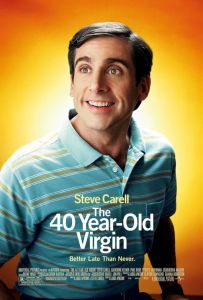 Originally released August 19, 2005:
Yes it’s an uproarious sex farce, that’s a given from the ads, but this movie is also surprisingly sweet and genuinely moving. A lot of credit goes to star/co-writer Steve Carell and co-writer/director Judd Apatow, creator of some of the best, most honestly funny TV series unjustly cancelled. Apatow is a master at mining human comedy for pathos, where you get a great sense of character and really feel for those onscreen, and yet nothing feels cheap or unwarranted, all the while deriving comedy from the situations. We need more men like Apatow in the film industry. Carell can do it all whether it’s deflecting his insecurity, which we feel so bad when he comes up with outrageous things he’s overheard to make himself seem like one of the guys. The supporting cast is top-notch. They’re basically the stock roles in a sex comedy and yet they bring so much more to the table, with a true-to-life boys-will-be-boys camaraderie that you can identify with. The character relationships in The 40-Year-Old Virgin really elevate the story and the jokes and make the film something really special. It’s not merely a barrage of gross-out humor; it’s a nice story with some very tender moments. This is a movie that goes well beyond its gimmick premise, never feeling like a skit blown up into a feature film. It mixes in psychology, heartbreak, awkwardness, but also insights into loneliness and human connection. The best character-based comedy in years.
Nate’s Grade: A
——————————————————
WRITER REFLECTIONS 20 YEARS LATER
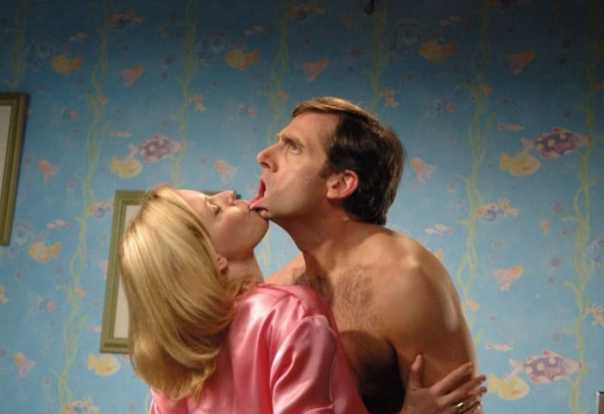
It’s always an interesting prospect to revisit beloved comedies decades after their impact. Comedy is, by its nature, a form of entertainment with the shortest shelf life. What one generation and time considers funny may prove antiquated or offensive the next or, just simply, not funny. I challenge readers to watch the old vaudeville routines and really try to laugh, not just snicker or titter but laugh, the kind of laughter where you have to hold your sides and worry about losing bladder control. Shakespeare wrote many comedies but I would argue most would view them today as clever rather than gut-busting. That’s just the nature of funny, which is in constant flux. One day you’re a popular comedian building your brand on copious “I hate my wife” jokes, and the next you’re a has-been who has transparent issues hating women. I experienced this before when I revisited the movies of Kevin Smith, a filmmaker who made a significant formative impact on my burgeoning sense of comedy and indie cinema. I found that the same movies that proved so funny and outrageous in my teenage and young adult years now, in the light of distance and decades, felt painfully dated and grasping, gassed and flailing. Comedy is a cultural time capsule.
The 40-Year-Old Virgin was a delightful surprise when it was originally released twenty years ago, but it wasn’t only a popular sex comedy, it began a new era of dominant comedy, the Judd Apatow Era. The prolific producer had been responsible for critically acclaimed TV series that always got cancelled too soon, like Freaks and Geeks (created by Paul Feig), Undeclared, and The Ben Stiller Show. He was a well-regarded writer with a sharp eye for talent, but it wasn’t until 2004’s Anchorman that Apatow had a hit under his name, a comedy that crossed over from a small cult audience into the zeitgeist. After The 40-Year-Old Virgin’s reign, the Apatow style of comedy became hip and desirable. It was a winning mixture of broad body humor and character-driven pathos, usually following lonely men suffering from arrested development and finding kinship, agency, and a fuller sense of who they are by the end. There were regular set pieces like traditional comedies but these were more focused on character moments and vibes, which lead to roaming running times and loose-goosey, improv-heavy jam sessions. It was the combination of salty and sweet that proved a winning combination, starring less conventional leading men like Steve Carell, Seth Rogen, Jason Segel, and Jonah Hill, many of whom also wrote or co-wrote their own movies. The Apatow factory created a comedy coaching tree of influential big screen storytellers.
 It was the apex of studio comedy and then… it wasn’t. This isn’t so much a tale of the world growing fickle to the Apatow formula, though with time any formula can start to wear out its novelty. Apatow went on a cold streak for me, first with 2009’s misanthropic and misshapen Funny People and then again with 2012’s This is 40, a sequel to Knocked Up that was obnoxiously wallowing in its sense of woe-is-me rich privilege (it definitely wasn’t my life turning 40). After that, he became something of a shepherd for exciting new comic voices, creating starring vehicles for Amy Schumer (2015’s Trainwreck) and Pete Davidson (2020’s The King of Staten Island) and Lena Dunham (HBO’s Girls). Then he made 2022’s The Bubble, a limp COVID-era satire of studio filmmaking that was painfully unfunny. It felt like Apatow had run out of things to say and even things to laugh about. It was pretty depressing for this comedy giant.
However, the downturn in Apatow’s influence also coincided with the downturn in studio comedies. These mid-budget vehicles used to dominate the box-office and then by the end of the 2010s, they seemed to vanish, seemingly folded into larger-budgeted superhero movies and/or ceded to streaming venues. This became even more entrenched in the theatrical environment during and “after” COVID. Even the occasional A-list starring vehicle, like 2023’s No Hard Feelings with a brassy Jennifer Lawrence performance and the selling point of a full-frontal nude fight scene, could only muster so much attention. Take for instance a Will Ferrell and Reese Witherspoon comedy released just this year directed by Nicholas Stoller (Neighbors). Can anyone even remember the title? I had to look it up myself and I watched it. Have moviegoers grown to expect comedies being lesser or have people lost their sense of humor in the Trump Era where every day can feel like a burdensome weight on your very soul.
I genuinely enjoyed most of the Apatow-related comedies of the 2000s, and The 40-Year-Old Virgin holds up because its central appeal is on the engaging characters, their winning camaraderie, and the relatable vulnerability and awkwardness of sex and dating. While some of the jokes and attitudes have changed in twenty years, there is a timeless quality to the inherent vulnerability of feeling like you cannot connect with others and the steps taken to rectify that, risking shame. Dating is still a minefield for awkward yet relatable observational comedy just as it was and just as it always will be. Apatow and co-writer Carell anchored their movie on a repressed man’s awakening, taking the formula of a sexual awakening we usually see in teen/young adult movies and applying it to an older man. It redefines a sub-genre but also provides a little sadness and sweetness, as we can’t help but hope that Andy (Carell) will luck in on pleasurable experiences denied him. He’s not a creep, and the explanation for how a man could hold onto his virginity for 40 years (the CDC stats say 0.3% of women and 1.2% of men aged 40 to 44 are indeed virgins) is painfully plausible. After a few embarrassing experiences, he just waited with the expectation it would happen eventually, and the longer it took, the more shame built, and the less certain he was to pursue a romantic relationship. He knows once his secret is out that people won’t just look at him differently, they’ll look at him as if he’s a freak and think less of him. That’s why it’s genuinely sweet how involved his co-workers get to help Andy get over this hump, so to speak. While each co-worker has a different perspective of advice, they open up about their own troubles with women and self-confidence. It’s not like this is a searing relationship drama, but the fundamentals that make it worth investing are there, and that begins and ends with the characters and their conflicts and their camaraderie.
 Each of Andy’s co-workers is giving him bad advice because each one of them wants him to be someone else. Cal (Rogen) advises Andy to be inscrutable and standoffish, turning everything into a question while revealing nothing personal. It’s reminiscent of those smug 2000s pick-up artists that trained a generation of young men into thinking the way to a woman’s heart was to insult her. He does have a hilariously specific note (“Be like David Caruso in Jade”) that still made me laugh hard. Jay (Romany Malco) advises Andy about it being a numbers game, to embrace a bravado to ensnare women, and to pick them up where they are most impressionable. David (Paul Rudd) is still hung up on his ex and is lovelorn, so his advice is often coated in reflexive bitterness. He’s the friend who advises Andy to explore more about his own desires, leading to a very funny sequence where Andy sets up his home environment for his attempt at masturbation, turning around family pictures to spare their eyes. It’s actually through the character of Marla (Kat Dennings, Thor), the teen daughter of his girlfriend, that Andy finds a level of self-acceptance for being a novice to human sexuality. I think it’s telling that the best advice he receives on the subject is from a teenage girl rather than his horndog pals who consider themselves female experts.
The movie pivots into a more focused romantic comedy by its second half once Andy finally works up the nerve to ask out Trish, played by Catherine Keener (Get Out, Being John Malkovich). This is a natural transition because now Andy has a person to practice all the advice and prove himself. They have a chummy and self-deprecating chemistry together, so the challenge becomes how long he can hide what amounts to his secret shame. Things are going so well he throws out obstacles to delay their physical copulation because he’s afraid that’s when she’ll realize he isn’t worth it. You’re rooting for Andy to get over his hangups and recognize he’s actually a nice guy and that Trish would be really happy to have sex with him, especially after waiting over twenty-plus dates. This is one of Keener’s warmest performances in her storied career. This was Carell’s star-making role. He had been a notable scene-stealer before in Bruce Almighty and Anchorman, but now he was a leading man, further solidifying that same year with the role that would define him, as Michael Scott on the American version of The Office. The both of them are a winning pair and you want their shared adorkable energy to work out for the best.
Much of the comedy still works very well, like the famous chest-waxing scene where Carell really had his chest hair ripped out, but there are some elements that would have been scuttled had The 40-Year-Old Virgin been released today. It’s hard to conceive of a modern studio comedy that would allow two straight guys insulting each other with the many ways they are irrefutably gay. The 2000s was a time rife with gay panic jokes. What has aged the worst is the advice to prey upon “drunk bitches” because they have fewer defenses. Given the term, “prey upon,” you’ll no doubt surmise that this advice is predatory. This dubious thinking is something that would set up a guy as one of the bad men in Promising Young Woman, and it would have proven fitting had one of those women gotten one over on the guys. Frustratingly, Jay has a brief moment of recompense and self-reflection when his long-suffering girlfriend has had enough of his cheating ways, but then she goes right back to him and reveals she’s pregnant. We’re missing a scene that would help solidify how this event changes Jay, but instead he’s basically rewarded for his bad behavior with a baby and a woman forgiving him once again.
 You’ve probably heard about the loneliness epidemic of modern men, a media-friendly term exploring how many of today’s available men are having difficulty making connections with women and some of them using this rejection and/or fear of rejection as the excuse to radicalize themselves. There’s been so much written on the subject, but I think most of it really just comes down to empathy. When you care about other people, and allow yourself to think about their needs and desires, it communicates an openness to others and that their time and emotional investment is worth it. It’s hard to fathom a swath of young men, the ones who identify as reactionary incels, deigning to view empathy as a strength rather than character defect. Empathy communicates two important self-realizations: 1) other people matter, and 2) being vulnerable and possibly being hurt is worth the risk. You can’t have one without the other. When young men reach that epiphany and acceptance, they will discover women are, amazingly, much more open to seeing them as a romantic partner worth their time, affection, and their bodies. Nobody owes anyone their bodies or emotional bandwidth. Sharing your life with others should be valued, not entitled.
This is also a perfect spot to talk about one of the minor co-stars, Shelley Malil as co-worker Haziz, who was charged with stabbing his girlfriend 25 times in 2008. He was released from prison in 2018 after serving eight years of a twelve-years-to-life prison sentence, which doesn’t sound very close to “life” for me, but on the flip side, “12 years to all years” seems like too expansive of a window of time to serve.
Twenty years later, The 40-Year–Old Virgin still funny and sweet and entertaining because it nails the tenets of what makes movies worth coming back to again and again, our connection to the characters and their relatable plights. Even two decades later, we can still see elements of ourselves in these characters, though maybe fewer. This was the announcement of the Judd Apatow Era of big screen yuks, and frankly I’d be happy to return to it if we got more movies like this and Knocked Up, a comedy I liked even more upon release. My original review was correct for all the accolades The 40-Year-Old Virgin deserved and still deserves, and so it remains a comedy classic with more on its dirty mind than many adult dramas.
Re-View Grade: A
Share this:

Good Luck to You, Leo Grande (2022)/ Cha Cha Real Smooth (2022)
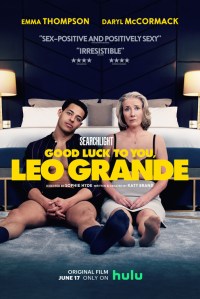 I was taken immediately and repeatedly by the many charms and intriguing personal details of Good Luck to You, Leo Grande (hence referred to as Leo Grande for the sake of my typing). This little indie played at the 2022 Sundance film festival and is primarily two people in one hotel room talking for the entirety of its 97-minute run time, and oh how early I was enraptured. This is a small-scale but laser-focused character-driven drama with edges of comedy and romance. It’s sex positive, very mature and tasteful given its subject matter, and the general awkwardness of watching two strangers combat sexual and personal hang-ups and vulnerabilities melted away thanks to the deftly superior acting, writing, and directing of those involved.
Emma Thompson plays Nancy Stokes (not her real name), a retired school teacher who worked for a parochial institution and taught Christian religion. Her husband has died and she reveals that, over the course of their thirty years together, she has never truly known physical pleasure. She seeks to change that by hiring a professional sex worker, Leo Grande (not his real name), played by Daryl McCormack. We will chart Nancy’s sexual awakening over four intimate encounters.
 What stood out immediately to me was how well developed the story unfolds at such a natural pace. I’ve watched more than a few indies that simply don’t know what to do with their premise, that feel like they’re biding time to get to feature-length, and some that are likewise constrained to single or minimal locations but fail to secure the most essential need: providing a reason for the audience to care. Whether a movie takes place in one room or a hundred rooms, you have to make the time spent meaningful whether through compelling characters or a story that keeps you engaged and waiting for more. You need to connect to the characters or be intrigued by the revelations to come, and Leo Grande does both immediately. Its setup is rife with drama and conflict, two people navigating their relationship to physical intimacy, two people who have never met until now for a transactional evening. There are obvious, natural personal conflicts to be explored here, with the novice out of their depth in many senses. There are also plenty of intriguing possibilities, because as these two get to know one another so too are we getting to know each and getting glimpses of who each of them are outside of this room. Both people are putting on fronts of some sorts, trying to settle into a performance of who they could be, and peeling away the layers of this subterfuge becomes even more intimate and engaging. Writer Katy Brand, known for outrageous British sketch comedy, skillfully maps out the story so that each conversational stop, detour, and ramp-up feels organically composed. It takes a great writer to keep your attention from a movie about two people talking, and Brand is that good. The contrast between our characters and intimacy, from forced to unlocked, keep us glued intently.
I also think there’s an interesting generational character study here, though the film doesn’t ever make any grand pronouncements about the symbolic representation of its heroine. Nancy is over 60 and at a point where she’s used to compliments with the added qualifier of “for her age.” When she discusses her sexual history with her husband, it’s almost like a confession that she’s been unable to get off her chest for decades, an acknowledgement of her disappointment and longing. Her husband was the kind of man who would lie in bed, roll on top, and then a minute later roll off, mission accomplished (no wonder this woman has never experienced an orgasm). Talking through this embarrassment, it brings Nancy to tears, realizing she’s lived so much of her life without accessing physical pleasure, a joyful repose that so many others seem to revel in. This bold step, hiring a sex worker online, is her making a leap outside of her comfort zone, and the subsequent return engagements give her new opportunities that have eclipsed her for so long.
 In essence, this is woman who feels like she’s playing catch-up. Her character is from a generation where women didn’t make as much of a fuss about reciprocal pleasure. Her view of her aging body is one of general shame. She will repeatedly say she has no idea what she’s doing. Nancy feels like she’s been missing out for so long and wants what has been denied to her. However, she also has her own personal sexual hang-ups she’s pushing through, with decades of religious upbringing and enforcing moral codes with her students and their wardrobe choices. All of it adds up as far as her view on sex and her body. Leo asks her if she just wanted sex why not find a man in a pub and go from there, and she curtly says she doesn’t want an old man, an old man that will simply be another version of her husband, another disappointment in a lifetime of unrealized intimacy; she decidedly wants a young man. She’s indulging in her desire and a young man best represents a promise of sexual fulfillment (and she definitely doesn’t have any teacher/student fantasy, she will let you know). I think there are many more Nancy’s in the world, older women who soldiered through their lives, carrying the burdens of others while sacrificing their own pleasure, and are now at point in their lives where they are hearing more about body positivity, about female pleasure, and about being worthy of physical intimacy on their own terms and desires. Nancy is a character having a delayed sexual re-awakening; in her confession with Leo, she details her first impulse of desire when she was 17, a feeling that she hasn’t experienced as surely for the decades hence. While being a unique and well-rounded character, Nancy also serves as a representative of an older generation and perspective coming into conflict and revelation with a modern sense of intimacy and self.
Leo Grande is a smooth and charming man but one who doesn’t feel oily or like he’s obnoxiously masculine. With McCormack’s kind eyes and soothing Irish balm of a voice, it’s easy to see how this man could set others at ease. But then you also have to remember that Leo Grande is not who this man really is; it’s a character he’s playing, and as Nancy opens herself up to this man, she’s looking for him to do the same, for them to share something more special than a simple client-professional relationship. The more that Nancy pushes and pries, the more that Leo himself is pushed outside his own comfort zone. Leo is willing to talk about some things, like his frayed relationship with his mother, a point of unity with Nancy and her adult children, and his cover story of being away and working on an oil rig, an outlandish excuse that makes Nancy and eventually Leo break into laughter. By the nature of this character dynamic, Leo must be the more confident and assured participant to better contrast with Nancy’s personal and cultural insecurities. He’s the pro and she’s the novice. However, that doesn’t mean emotionally he’s as self-assured and without regret. Listening to these two characters bounce off one another and come in and out of intimate contact is fully entertaining.
I hope that Thompson (Cruella) gets nominated for an Oscar for her portrayal. She’s in just about every second of the movie and so much of it hinges upon her baring herself, physically and emotionally, to this man and us, the tacit observers. It’s a performance of radical self-love in so far as Nancy is reclaiming her body as a point of pride rather than as one of shame. In some ways, she’s shedding her past sins, easy judgement on the mores of others and their bodies. Thompson goes through such a wide range of emotion and gets to play so many different revealing sides to this woman putting herself in a most unfamiliar position. It’s Nancy coming to terms with her own disappointments, misgivings, and hypocrisy, and Thompson is splendid at every moment. She gives so much life to this character without sacrificing her complexity or occasional coldness. By the end, when her character hits her arc’s climax, it feels like a journey fully earned.
 Another 2022 Sundance indie, this recipient of the Audience Award and a plum Apple Plus streaming spotlight, feels less smooth despite its title. Cha Cha Real Smooth is from writer/director/star Cooper Raiff, the twenty-five-year-old up-and-coming filmmaker best known for 2020’s Shithouse, a talky and introspective movie about older teens trying to gravitate with the adult world they feel ill-equipped to handle. While I found some promise with Raiff’s naturalistic dialogue, I found the lead characters to be too dull to really care about. Enter Cha Cha (which will also, henceforth, be how I refer to the title) which benefits from deploying more recognizable rom-com and indie movie plot mechanics. Working from a more familiar movie template, it actually helps Raiff better temper his writing and focus his story. While I enjoyed the movie overall, I would say it still has not won me over to the charms of Raiff just yet.
Raiff plays Andrew, a recent college grad who is still very much trying to figure out his life. He knows he doesn’t like his mother’s (Leslie Mann) new husband (Brad Garrett). He also doesn’t like his job working at a mall food court. He’s also not happy that his ex-girlfriend broke things off before leaving for Barcelona. He’s struggling to plan his “what comes next” when he stumbles into a job being a “party starter” after his enthusiastic chaperoning of a local bar mitzvah. Soon the neighbors are all seeking Andrew’s party-starting ability to make their next bar or bot mitzvah a fun time. Andrew becomes attached to a thirty-something single mom, Domino (Dakota Johnson), and he autistic teen, Lola (Vanessa Burghardt), he persuades onto the dance floor to loosen up. Domino is intrigued by the younger man and asks him to babysit Lola, especially since the two have bonded and earned a trust. Andrew doesn’t know whether Domino is feeling the same level of attraction but someone who would not be happy is her fiancé, Joseph (Raul Castillo).
 You spend a lot of time with Raiff as the lead, so your ultimate determination on Cha Cha will hinge on your perception of Andrew and as Raiff as a performer. He’s got an easy smile and his enthusiasm can be endearing at points, like he’s incapable of being still in thought. I found the scenes where he encourages little kids to be cute and easy to enjoy. He’s an infectious presence when he’s dealing with children. However, when Andrew is dealing with adults or people his own age, he seems to be out of his depths with arrested development. He’s rude and pissy with his stepfather for no real discernible reason given. He’s fairly thick-headed about romantic ideals about following his girlfriend to Spain, who declines his grand offer. Andrew’s uncertainty about charting his own path is a familiar story, and Raiff takes advantage of the overall coming-of-age blanket of tropes. The problem is that too many of them feel easily discarded. The only characters that seem to matter in Cha Cha are Andrew and Domino. Even Andrew’s younger brother (Evan Assante), who loves his big brother so much that he is constantly asking for advice on romancing a girl he likes, and the kid even cries at the prospect of his brother moving out of his room, is just another underwritten foil like Andrew’s mother, always supportive, and stepfather, always wary, and friend-with-benefits girl, always… there? These characters are meant to be reflections of our main character, serving to make him look charming or sincere or naïve or deluded but always serving Andrew. This can work in screenwriting but it helps if the characters don’t feel so obviously cultivated to make our hero look good.
I did find the central will-they-won’t-they relationship between Andrew and Domino to actually be entertaining. Much of this helps from Johnson sliding into a role that definitely fits her skill set. The role doesn’t even seem too different from her struggling thirty-something mother in The Lost Daughter. In the last few years, I have grown as a fan of Johnson with strong supporting turns in Bad Times at the El Royale, Peanut Butter Falcon, and as a dying mother in Our Friend. In each one of these roles, there is an inherent melancholy to her that she so effectively radiates. She has certainly broken free from the long shadow of the Fifty Shades franchise. Much of Domino feels from the point of view of a young man projecting onto her, and I think that is also Raiff’s larger thematic point. In Shithouse, a significant plot development is when Raiff’s central character has a different interpretation of a sexual encounter. He bombards the young woman with eager texts and is carried away with making an attachment, whereas she did not view their college hookup on the same terms. Although, this hard wisdom is undercut at the end of Shithouse by this same lady relenting and saying, “Yeah, okay, I’ll be your girlfriend.” To Andrew, Domino is a wounded soul looking for a rescue and he’s her dutiful man in shining armor. From his perspective, she is crying out for kind attention and support that he feels is being neglected. The learning curve for Andrew is that Domino can distinguish between a person who excites her and a person she can see herself settling down with. Their age discrepancy is never really addressed until the very end, though Johnson herself is only 32 years old, which doesn’t seem like an insurmountable gap though Domino’s age is kept purposely vague. I would have preferred the movie being told from her perspective as she had the most interesting role. Johnson and Raiff have an easy-going chemistry, with his overeager charmer meshing with her subdued, glassy-eyed, taking-it-all-in openness. She makes him feel a little more excited, but ultimately, that may not be as important as other more practical concerns.
 This leads to what seems like the lesson of Cha Cha, because for a movie that seems to operate on a powerful level of irony-free sincerity, the big life lesson it seems to impart is that becoming an adult is one about accepting compromise and disappointment. Sure, that’s an important lesson, to adapt as well as process personal reflections, but with Raiff’s movie, Domino’s lesson seems to be she’s accepted that her fiancé doesn’t make her feel all the things that young Andrew does but he will provide stability for her and her daughter and that means more at this point. I cannot say whether the movie is asserting that Dakota’s reasons are mature and something Andrew will come to understand in time when he gets a little older or whether we’re supposed to see her as someone willfully forgoing her personal happiness to settle for something less and that, to Raiff, is what adulthood means, settling for less. The way that writer/director Raiff could have shore his thematic intentions would be with the supporting characters, seeing this larger nugget of wisdom reflected in his own mother’s relationship with the stepdad who Andrew could attempt to understand better rather than view with contempt. This is where underwriting the supporting characters can also undermine the artistic aims of your movie. It appears like Raif, at 22, is saying that growing up means essentially giving up on some level, which is a strangely pessimistic lesson for a movie that trades in such earnestness and sunny go-go positivity.
I sound more negative with Cha Cha Real Smooth than I’m intending. It’s a relatively breezy movie to watch with fun exchanges, solid jokes, and characters that I found amusing and some of them even engaging. It has its charms and sweetness and I can completely understand falling under Raiff’s spell. This is definitely a step in the right direction for Raiff as a filmmaker after his 2020 debut, and I think he’s going to continue to grow and tell these personal, highly verbose little indie dramas with big feelings where whomever Cooper Raiff portrays learns some life lesson, likely from his interaction with the person of the opposite sex he desires. As such, every Raiff movie from here on out seems likely to rest upon your feelings about him. With Cha Cha, the sequences between Andrew and Domino or Lola were my favorite, so the film mostly worked.
Good Luck to You, Leo Grande and Cha Cha Real Smooth are both fine examples of indie filmmaking supporting distinct voices adding their stamp on the larger contours of the romantic comedy genre. Leo Grande is a grand example of character writing and it’s even poignant and a little sexy. It’s extremely tasteful and nuanced and even empowering for an entire movie about two strangers meeting in a hotel room for sex. Cha Cha is a fun and formulaic coming-of-age movie and with Dakota Johnson hitting her stride with a winning character with pools of depth. There are some writing and thematic shortcomings but it’s still a charming experience. Both movies can definitely brighten your mood and generate their share of smiles for 100 minutes.
Nate’s Grades:
Good Luck to You, Leo Grande: A-
Cha Cha Real Smooth: B-
Share this:

The Bubble (2022)/ Moonfall (2022)
 What to do with a comedy that just isn’t that funny? I come to co-writer/director Judd Apatow’s The Bubble with a rhetorical surgeon’s scalpel ready to figure out this conundrum. There are plenty of funny people involved with this Netflix project. Apatow has been an industry unto himself in developing comedic talent going back to his Freaks and Geeks TV days and with such heralded twenty-first century comedies to his credit like The 40-Year-Old Virgin and Knocked Up. The cast assembled for The Bubble has great comic potential. Even the premise is fun, a group of spoiled actors trying to film a bad sci-fi action movie under the challenges of the COVID-19 quarantine. So what went wrong here and why is The Bubble Apatow’s least engaging and least funny movie to date?
We follow the Hollywood production of Cliff Beasts 6, filming in rural England under the supervision of studio execs trying to keep the secluded production as problem-free as possible under the 2020 COVID outbreak. Karen Gillan (Avengers Endgame) plays Carol Cobb, an actress returning to the franchisee she had once left behind to star in a misguided Oscar bait movie where she, a white woman, was the solution to solving the Israeli-Palestinian conflict. She’s hoping to save her career, while her coworkers are just hoping not to go insane with the forced isolation and new safety protocols during their film shoot.
 So let’s circle back to the central question of why The Bubble isn’t funny, and I think I have some theories. First, we can acknowledge comedy is subjective but at the same time also acknowledge that the construction of good comedy can be academically identified and appreciated, that there are tenets that hold and maintain, like setups and payoffs, rules of threes, etc. I think one of the big problems is that nothing is really that surprising throughout the protracted and unfocused duration of The Bubble.
The characters are intended to be shallow but are too shallow to even register as distinct comedy types played against one another. There are levels of general buffoonery, but so many of these characters are missing out on a more definite angle or perspective. Take for instance the smug movie star (David Duchovny) who takes it upon himself to rewrite the script. This should be an obvious route where the story comes undone or character actions are inconsistent or that other characters, especially those who had larger roles, become subservient to the star and his ballooning ego. There needs to be distinct differences for the comedy to land and be an indication of his ideas about what he thinks would be an improvement. This doesn’t really happen. Take the recent Oscar winner (Pedro Pascal). He’s not haughty and pompous, thinking himself beneath this kind of genre filmmaking. He’s simply a dumb hedonist who is seeking out pleasure he is denying himself. That’s fine, as at least one character is set up to be more of a wild card to stir trouble. This character spends the entire movie whining and having unfunny fantasies when they should be the one causing havoc and unexpected consequences from their behaviors. What a waste. Every character falls into this nebulous underwritten area without being distinct enough to be considered stock and ultimately useful for comparisons and generating comedic conflicts.
Another lack of surprise is how every character is exactly how they are presented, so with no points of change it all gets very redundant. If this was going to be the case, Apatow needed to be far more exacting with his satirical barbs. If he wants to really send up the industry and self-absorbed actors, we need something akin to 2008’s Tropic Thunder, which, by the way, had very distinct character differences it used for maximum comedy. This movie feels more like an extension of the privileged world populated by the bourgeoisie characters from 2012’s This is 40, a marked misstep for Apatow and his idea of recognizable midlife struggles (“Oh no, we’ll have to move from our ridiculously large house to… just a very large house!”). It’s the same pitiable rich people whining about their lives while they quarantine in luxury. Watching montage after montage of them being bored in their private hotel suites is not funny. It doesn’t even work as a criticism of the characters on display. They aren’t doing anything out there or particularly telling, they’re just being bored, and just watching bored people is boring.
 The moviemaking process and the film-within-a-film itself is also shockingly unfunny. Apatow has worked in Hollywood for decades, so I was expecting harder-hitting satire of the moviemaking industry and the way that films are continuously compromised. As another example of shallow character writing, take the director (Fred Armison), a Sundance award-winning indie artist tackling their first studio project. The expected route would be to start with this character having big ideas about a grand artistic vision, taking real chances, and trying to do something different and compelling within the realm of giant dinosaur action movies, and then little by little, they have to compromise and delete this grand vision, taking studio notes, limitations from the actors, and bad luck. This would provide a foil for every bad item complicating the production, the artist struggling to watch their dream die piece-by-piece. This doesn’t happen and the director’s indie background is never utilized as a contrast for comedy.
Apatow plays the same trick over and over with the film-within-a-film. It will be a dramatic sequence and then cut to the actors running on a treadmill or swinging behind a green screen, the same undercutting gag on repeat. It’s not funny and, frankly, gets tiresome. The ridiculous nature of blockbuster filmmaking should be ripe for satire (again, Tropic Thunder did it) but Apatow never pushes too hard, settling on the same soft-pedaled jokes on simple characters. Pascal is left to practice funny accents, but none of what they say within the movies is funny-bad; it’s just tin-eared dialogue that is merely bad only. The only segment that genuinely had me laughing was when the young actress (Iris Apatow) teaches a raptor how to do the latest TikTok dance. This is the only moment that feels biting on the out-of-touch desperation of modern moviemaking to chase and incorporate vaporous youth trends to remain hip. The Hollywood film gone awry should feel like a mess, it should be getting progressively worse or more out of control or at least something so outlandish it separates itself from its targets. I suppose shooting the CGI genitals off dinosaurs is something you don’t see every day but it too gets old fast.
 Fortunately, these actors can still be charming even with lesser material, but you’ll simply walk away feeling enormous sympathy for them. Everyone is trying to do so much with so very little, and it can get painful at points, like Pascal’s character clinging to an amorphous evolution of an accent. There are very funny people here. Keegan Michael-Key is very funny, but he gets nothing here, especially with a ripe subplot where he might be starting a self-help cult. Maria Bakalova is very funny, and was even nominated for an Oscar, a rarity for a comedian, but she gets nothing here, being a horny hotel worker. Gillan is very funny, but she too gets nothing here as a slumming actress desperate to rehabilitate her career. It’s remarkable considering she’s the main character but really just an insecure straight man role. The main character needed to be Gavin (Peter Serafinowicz), the producer on location doing his best to herd all these spoiled and irresponsible people into getting this movie made and on time. You want to focus on the character with the most chaos to try and control, and that’s him. It just feels criminal that a cast this good, with fun supporting players like Samson Kayo (Our Flag Means Death) and Harry Trevaldwyn (Ten Percent) to round out the more famous faces.
This also made me think to reflect on the recent release of Moonfall, which looks like the big, schlocky sci-fi disaster movie that Judd Apatow would be satirizing with The Bubble. It’s a Roland Emmerich disaster movie where he does exactly what Roland Emmerich does best: expansive scenes of cataclysmic destruction on the biggest scale possible. It was believed by industry watchers that Moonfall would be the kind of epic that people would go back to the movies to experience, watching the scale of destruction on the biggest screen and cheering along. It didn’t work out that way and Moonfall reportedly will lose over a hundred million dollars for its investors. It seemed like a smart bet as disaster movies have performed well for Emmerich, like 2012 and The Day After Tomorrow. In times of struggle, human beings enjoy fantasies about surviving fantastic odds, or at least that was the established way of thinking. After two years of life during COVID-19, maybe our idea of sci-fi escapism isn’t quite what it used to be.
I watched Moonfall with general indifference. It felt like a mediocre hodgepodge of other Emmerich disaster movies and veered into campy nonsense at many points. It’s the kind of movie that demands you shut off your brain and just go along with the scientific gobbledygook, especially once the moon begins making Earth’s gravity go all haywire. At that point the movie becomes an inconsistent video game with its liberal use of physics. It doesn’t seem like it matters, but watching characters do Super Mario Brother-level jumps has a fun appeal as well as being impossibly goofy. One character says, “The moon can’t do these things,” and another character waves away that pertinent thought and says, almost directly to the audience, “Yeah, but this isn’t a normal moon, so forget everything.” The special effects are also quite hit or miss. Plenty of the larger effects are quite awe-inspiring and suitably terrifying in depicting an awesome reality, and then others look like they didn’t quite have enough money when it came time to render. Some of the CGI reminded me of moments from 2008’s Torque, where the high-speed backgrounds resembled badly composited video game texture blurs. If your movie is going to exist primarily in a junk food realm, then you need to either have as minimal distractions as possible to rip you from the believability of this world, or you simply need to veer into it and accept that the instability and chaos will be part of the general appeal. Provide the goods, and Moonfall just doesn’t.
 The movie also takes an inordinate amount of time to get back to space after a prologue, almost halfway through its two hours. This first half stalls with setting up so many characters to follow that you simply won’t care about. I didn’t care what happened to anyone back on Earth. When the rednecks found our party (again!) in a petty car chase, I literally laughed out loud. The alien/moon mythology is also convoluted and vague enough to simply apply a good versus evil designation for technology, and the big sacrifice doesn’t feel so big when you find that character to be annoying for the duration of their grating screen time. It’s another movie tipping you off about a possible linked sequel and one that appears more appetizing than the film we just witnessed (just like Emmerich’s 2016 Independence Day sequel). In short, Moonfall is a bit of a mess, a mess I can imagine others enjoying and laughing with, but definitely one of the lower outputs in Emmerich’s long career of destroying global landmarks and formerly pristine vistas.
I found Moonfall and The Bubble to both be poor examples of what Hollywood thinks audiences will desire as escapism in the wake of COVID-19 disrupting routines and lives. Each of the movies is disappointing because it doesn’t fulfill what it promises. The Bubble has a bunch of combustible characters in a combustible scenario and squanders its time with weak satirical gags and lazy characterization. Moonfall wants to be the big, fun epic of Emmerich’s past, but it takes its sweet indulgent time with uninteresting characters, convoluted and underwritten lore, and a plot that would have been more entertaining had it better embraced the absurdity of its implications. You may likely have an enjoyable time watching either movie, and they’re almost the same length too, but I found both to be middling examples of Hollywood’s attempt to try and give the people what they think they want and missing the entertainment mark.
Nate’s Grades:
The Bubble: C
Moonfall: C+
Share this:

Motherless Brooklyn (2019)
 I remember reading this novel back in college, so it’s been a long road for Jonathan Lethem’s crime story to find its way to the big screen. Motherless Brooklyn is a decade-plus passion project for star/adapter/director Edward Norton, and it’s easy to see why an actor would want to latch onto the lead role. Lionel Essrog (Norton) suffers from Tourette’s syndrome and is given to verbal and physical tics he needs to indulge or else his brain feels like it will explode. He’s our eyes and ears into a criminal world that views him as a freak. It’s an intriguing vulnerability given sympathy, forethought, and it’s an intriguing way to make something old new again through a disadvantaged lens. Norton is great in the lead and Lionel feels like a companion portrait to Joaquin Phoenix’s Joker, another struggling man given to unconformable physical outbursts that make him feel isolated from society. The book was fascinating from being inside this unique headspace and understanding how Lionel’s brain operated with obsessions and various pressure valves. The movie, which Norton rewrote completely and set in the 1950s, is an acceptable film noir, but without that specific perspective it would get lost. It’s handsomely made and has plenty of enjoyable actors in supporting roles. There’s an intelligence to the storytelling and power dynamics, but the movie is also a bit too smart for its own good, losing its way in a convoluted mystery where the pieces don’t so much add up as they’re just given to you after a long enough wait. And the wait is long. This is 144 minutes and takes its sweet time, applying more and more layers of intrigue and period settings like Norton is checking a list of Noir Elements to include in his first directing work in 19 years (Keeping the Faith, anyone?). The world itself is surface-level interesting but the main character is the real hook, so getting more of the world without going deeper on the character, or expressly placing him in different predicaments where he can utilize his unheralded abilities, feels like wheel spinning. Motherless Brooklyn is strictly for genre fans or those who don’t need much more from their movies than a high-concept quirk.
Nate’s Grade: B
Share this:

Welcome to Marwen (2018)
 When I saw the trailer for Welcome to Marwen my first response was pained wincing. Robert Zemeckis is one of the most daring, inventive, and imaginative filmmakers working today, but this movie just looked misguided with its approach. Welcome to Marwen is so fascinating, so tonally off, that I might almost recommend people watch it.
Mark Hogancamp (Steve Carell) was a war illustrator until the day he was attacked by a gang of neo Nazis. In the ensuring months, Mark has lost portions of his memory, is unable to use his hands to illustrate any longer, and has become something of a shut-in. He has gained notoriety through his new artistic outlet. Mark has created a WWII era Belgian town called Marwen with a group of dolls fighting evil Nazis. We escape into fantasy sequences where Mark imagines himself as Cap’N Hogie and his gang of supportive ladies. Nicol (Leslie Mann) moves in next door to Mark and he takes an immediate interest in her (she even appears in Marwen in doll form). Mark must grapple with his feelings and work up the courage to attend the court hearing to make sure the men who hurt him stay in prison.
 I was amazed at how miscalculated Welcome to Marwen plays out. It feels like Steve Carell’s Patch Adams, a sentimental movie where every step seems strange, mistaken, maudlin, and false. Firstly, this is the second documentary that Zemeckis has taken and adapted into a live-action film, as if the man is spending the wee hours of his nights pouring over award-winning documentaries of the past and determining which he can add a little razzle dazzle to with visual whimsy. Look out The Cove because maybe an undersea realm of talking dolphins will open up that horrifying Oscar-winner to a whole new mainstream audience. I’d have less of an issue with Zemeckis remaking the documentary if it didn’t seem like his entire rationale was the fantasy interludes.
The original documentary is about one man and his unique brand of healing through art. He is becoming further whole by building an intricate world through his imagination. By visualizing the fantasy worlds, Zemeckis is turning the doll segments into literal escapism that becomes tedious, obvious, and often redundant. The doll segments are about his gang of girls supporting him, expressing his interest in his kind new neighbor, and tackling the Nazis in a safe space where he can win. Every time we cut to the doll sequences it feels like the movie is spinning its wheels with these ill advised fantasy cut scenes. It gets boring watching the doll segments without any sense of stakes. The special effects are creepy and there are aspects that amplify this, like one doll’s penchant for having her top ripped off in combat, revealing her stout, rounded chest. Keep in mind that the female dolls, with the exception of one, are all analogues for people in his life, so then Mark is consistently indulging in stripping one woman of her clothes. Even though the movie sets this character up to be a potential love interest, it’s still not a good choice. Zemeckis intends to literalize Mark’s struggles and fears so that he can triumph over them, but it feels like it’s minimizing the complexity of trauma into digestible whimsy. With every trip to Marwen, I was eager to return back to the land of human beings where they might still be over-the-top but at least I wouldn’t have to watch creepy doll CGI.
 The most significant doll is the blue-haired Deja Thoris (Diane Kruger) who is meant to represent Mark’s suicidal impulses. He keeps her atop his wall so that she can watch over him, and in his sleep he dreams about her whispering in his ear, “Nobody will ever love you like I do. You should just end it now.” Oh man, that’s heavy, but when applied through the prism of a talking Barbie doll it loses its sense of seriousness. If you don’t lose yourself in the central conceit and take the dolls seriously, the movie will fall flat. Take for instance the cross-dressing aspect of Mark, which is what lead to his brutal beating. It’s a delicate subject and something easy to get muddled, and that’s exactly what happens in the presentation of this movie. The shoe fetish is initially portrayed as wacky and then becomes serious and then becomes like an artifact of horror. It’s another sign that the tone for this movie is mismatched. These things require a delicate touch with some ambiguity and sensitivity. Welcome to Marwen turns these into a loud, noisy cartoon that bumbles into its messages. Things that are meant to be charming or endearing or emotional can come across as goofy or campy or even uncomfortable.
I felt bad for so many of the actors. Carell (Vice) is trying to maintain his character’s sense of dignity throughout, but the story often goes into contrived contortions to force him into dramatic confrontations. It turns out the court appearance is rescheduled to be the same day of Mark’s photographic exhibit. Will he be able to triumph over these forces to stand up for himself? Carell is a capable dramatic actor but he’s struggling here to find stable footing because of the mish mashing tones. The development of Mark makes him come across as a creep in some moments, like his one-sided advances for Nicol, and a simpleton at other moments, where he might have sustained brain damage. Mann (Blockers) is sweet and gentle but strangely the movie hides her most interesting character aspects, like the prospect of a deceased child. You would think overcoming tragedy would be a tool for Nicol and Mark to bond. Merritt Wever (Godless) is another sweet and gentle woman in a world that seems overstocked with them. It feels like everyone in this small town exists just to be nice to Mark. She’s clearly romantically interested in Mark but he doesn’t care until the very end. She deserves better than being someone’s runner-up choice, especially only after he was turned down.
 A movie that deals with delicate issues through fantasy escapism can work, but it requires a precise hand with tone and with its storytelling detours. Guillermo del Toro has been able to prove he can tell rich, adult stories with the assistance of whimsical, weird fantasy elements. Charlie Kaufman has been able to weird the mundane and the fantastic. It can be done and Zemeckis has done it himself before, best evidenced by the masterpiece, Who Framed Roger Rabbit?. However, Welcome to Marwen is a sizeable tonal misfire. The serious elements don’t blend well with the fantasy elements, and even worse, they are made less serious and approach the realm of camp. The fun, fantasy elements are given bizarre and unsettling contexts that make them creepy and inappropriate. Escaping into Mark’s imagination winds up stripping him of much of his agency, and literalizing his psychological push-and-pull feels like a misguided examination on depression. I left my theater in a daze, trying to make sense of what I had just witnessed. The filmmakers and cast certainly mean well and want the film to be a triumph of the human spirit. I found it to be two meandering hours of watching somebody play with their disused toys.
Nate’s Grade: C-
Share this:

Blockers (2018)
 Blockers (nee Cock Blockers, and changed on some posters to appear like Rooster-Shape Blockers) is like getting two fairly funny sex comedies in one. We have the perspective of the panicked parents (Leslie Mann, John Cena, Ike Barinholtz) who are doing whatever they can to thwart their daughters from seeing through their presumed deflowering pact on prom night. We also have the horny teen perspective from the teen girls (Kaitlyn Newton, Geraldine Viswanathan, Gideon Adlon). Each group has their own character arcs and comic set pieces, flunkies and wild supporting characters, and as they criss-cross over the course of one debauched night, lessons will be learned and, more importantly, feel earned. I was steadily impressed with how much Blockers does and does well, chiefly maintaining a sex positive attitude and never supporting the parents in their hysterical, generally sexist alarm. Each parent has to confront their feelings about really letting their daughter grow up, and that relationship leads to a sweet moment for each to acknowledge the error of their ways and grow closer with their child. If this had come out in the 80s or 90s, I’m sure the film would have adopted the parental viewpoint as correct. Hell, if it came out in the 80s, the fact that one of the daughters is gay would have been a source of shock or shame. Today, the father already knows and supports his daughter being a lesbian (he frets she’ll feel pressured to lose her virginity to the wrong sex). Oh, on top of all that, the movie is pretty funny from start to finish thanks to a deep cast of characters. Cena impressed with 2015’s Trainwreck and he shows yet again the promise of his heretofore-untapped comic resources. There is one comic set piece involving blind couple foreplay that feels downright inspired as it develops. Blockers is a raunchy sex comedy with more on its mind than yuks. It’s got a sweet center that allows the characters and their relationships to feel genuine. When you care about the people onscreen, it helps eliminate the sense of downtime.
Nate’s Grade: B
Share this:

Mr. Peabody & Sherman (2014)
 Surprisingly adroit, Mr. Peabody & Sherman might just be more fun for adults, especially fans of the original 1960s cartoon, than for little kids. It’s under the “family film” banner, a dubious one historically, but I was laughing consistently and good, snorting laughs, long chuckles; the whole gamut. With The LEGO Movie, the wide release of The Wind Rises, and now this, 2014 is shaping up to be a stellar year for animation aficionados. The movie between a genius dog and his adopted son is given the right amount of reverence before all the cheeky irreverence through history. The hops through time, notably the French Revolution, ancient Egypt, and the Trojan War, are fast-paced and clever without stooping to provide much context for the jokes; you either get them or you don’t. Even the necessary character building components between father and son are treated smartly, coming together for an ending that approaches poignancy. The plot can get a little complicated toward the end, what with opening a space-time paradox, but I respect the movie for being complex and tricky and scientific and trusting its audience to play along. The animation looks a little scruffy compared to other big screen efforts, but the script just flat-out works. The comedy, the drama, the relationships, but especially the comedy. If you’re on the fence, please, do yourself a favor, and go see Mr. Peabody & Sherman, especially if you appreciate history and those who love it. I saw it with my father and we both laughed ourselves silly. Needless to say, this blows 2000’s Adventures of Rocky and Bullwinkle out of the water.
Nate’s Grade: A-
Share this:

This is 40 (2012)
 In the five years since 2007’s comedy smash, Knocked Up, writer/director Judd Apatow has ascended to heights in Hollywood that few ever achieve. And while his disappointing 2009 film Funny People may have been an example of the man flying too close to the sun (let’s mix metaphors, why not?), he’s had a stable career guiding mostly hit comedies to big numbers, particularly last year’s Bridesmaids. For Apatow’s next directing effort, he picks up a handful of supporting characters from Knocked Up and gives them their own spotlight. This is 40 is Apatow’s “sort-of sequel.” It may seem familiar in tone and style to his previous efforts, but there’s one big difference between this film and Apatow’s previous works. This movie never feels like it goes anywhere. Even Funny People went somewhere even if I disliked it.
Five years after the events of Knocked Up, Peter (Paul Rudd) and Debbie (Leslie Mann) are struggling to keep their household afloat and sane. Their daughters, Sadie and Charlotte, (played by Apatow’s real daughters, Maude and Iris), are constantly fighting, Debbie’s worried one of her employees is stealing from her business, and Pete’s trying to save his record company without alerting his family to his panic. Pete has put all his efforts into promoting a new album from 1970s rocker Graham Parker, but really he’s fighting a losing battle against mainstream taste. Pete has also been secretly loaning out money to his no-good father (Albert Brooks), while Debbie has been trying to reconnect with her distant biological father (John Lithgow). Weirdly enough, both fathers have started secondary families and have broods of young children. As Debbie and Pete both approach the big 4-0, both of them make resolutions to better themselves, renew their family bonding, and reignite the spark in their romance. Of course, after two kids and several years of marriage tallied, it’s easier said than done.
 The Apatow films have always had their own loping rhythm to them, an easygoing quality that isn’t as directed by plot as character. So when I say that This is 40 feels rather aimless, I want readers to recognize that this goes beyond the normal loosely plotted Apatow affairs. Usually his movies have defined events to direct the overall trajectory of the plot; a baby on the way, losing one’s virginity, etc. I’m hard pressed to say what exactly is the direction of This is 40. It’s about the ups and downs of a married couple, but there isn’t necessarily any definable conflict. They’re sort of in a malaise and internalizing their unhappiness, but the movie is the sum total of many small conflicts that never seem to congeal. As a result, the movie feels like it’s often coasting, going beat-for-beat until something new takes it on a mild diversion. It’s a movie of diversions without a unifying path. Sure the couple becomes, presumably, stronger by the end of the film, but I can’t say what’s taken place to explain this progression. The movie plays out like a series of loosely connected scenes. I enjoyed myself, and found the movie often amusing, but I kept wondering what it was amounting to. It was never enough of a niggling concern to stop from being entertaining, but when it was done, I thought to myself that I just watched Apatow’s friends hang out for two hours and call it a movie.
There’s also the issue of indicating this is a sequel to Knocked Up or at least exists within the same universe. There’s very little continuity between the two films other than Pete and Debbie’s family. Jason Segel (The Muppets) and Charlyne Yi (Paper Heart) make reappearances playing characters with the same names, but they don’t seem like the same characters (though the gyno doc is the same – hooray). My major sticking point is the complete absence of the stars of Knocked Up, Ben (Seth Rogen) and Alison (Katherine Heigl). Now I wasn’t expecting a drawn out cameo from these two, especially after Heigl publicly badmouthed Apatow and the movie that made her a star. I did expect some passing reference, even something as small as, “Ben and Alison are looking at schools for their daughter.” I just wanted something to feel satisfied. Where this becomes a problem is that I’m fairly certain that Ben and Alison would be attending several of these major social events for their family members. They make a big deal about Pete’s 40th birthday party, so why wouldn’t Ben and Alison be there? And with her litany of marital woes, wouldn’t Debbie seek out, you know, her sister to talk with, the same sister she hung out with all the time in Knocked Up? Apatow might as well have just given everyone a new name if this was as sequel-y as This is 40 was daring to go.
Part of my lukewarm reception to the film is likely my lack of empathy with the problems of the main characters. Good storytelling should allow anyone to be able to empathize with characters dissimilar to themselves. I found many of the problems in This is 40 to be the stuff of rich fantasy. Pete is worried his record company, that he started, might not make it. He’s also been secretly giving his mooch of a father $80,000 (!) over the years. Maybe these people could stand to cut back and live within their means. Their house is huge, downright opulent, and it seems like Pete has wasted plenty of money on needless expenditures, which his own employees eventually point out at work. Did they need a big 40th birthday bash? Do their kids need every expensive gadget? When they take a vacation, does it need to be in a lavish hotel along the beach? I found too many of these complaints to be whiny and indulgent. That’s not to say that there aren’t serious relationship problems that are given thoughtful attention. This is 40 is arguably Apatow’s most mature and reflective film yet, though that might be faint praise to some. I would rather the movie spent more time focusing on the relatable concerns of a relationship crumbling rather than the stress of possibly having to move from a super-rich house to a merely somewhat rich house.
And yet the movie is routinely funny and charming, thanks to the Apatow standards of cast camaraderie, character, and the mixture of raunch with sweetness. I like these characters and so I enjoy spending time with them, and even if I feel like we’re not going anywhere fast, I don’t mind that much. I’ll gladly spend two plus hours with these funny people and their mid-life crises comic follies, at least once. The characters are well drawn and played by capable comic players that can do their Apatow jazz deal, finding peculiar riffs to work and squeeze out mirth. I thought a discussion over the appeal of being a widower and the fantasy of a spouse’s untimely demise to be quite funny as well as a topic generally unspoken (“This is the mother of your children we’re talking about. You want her to go peacefully.”). Rudd (Wanderlust) and Mann (The Change-Up) are terrific together and entirely convincing as a longstanding couple, people who know the ins and outs of one another. It’s fascinating just to watch the nuts and bolts of a relationship that is still a battle; it also helps when you like both participants and find that they each have valid points. Though I cannot fathom how hiding impending financial doom is a smart move.
 Apatow does a fine job of making sure the dramatic parts do not overweigh the film, usually settling things with a nicely punctuated joke or pop-culture critique (oddly enough, TV’s LOST becomes a major reoccurring gag, though you expect a bit more of a comedic payoff when they get to the controversial finale). I’m not sure that many people are going to know who Graham Parker is, but here he is folks. There are a lot of Apatow players peopled throughout, like Chris O’Dowd (Bridesmaids), Lena Dunham (TV’s Girls), and Melissa McCarthy (Bridesmaids), making fine work with minimal screen time. You’ll recognize other familiar faces as well. Occasionally the jokes feel like they go on too long, catching the downward slope of an overstayed improv riff, but I was laughing throughout and enjoyed the unpredictable nature scene to scene. You’ll likely predict the outcomes for certain storylines and conflicts, since Apatow is a sucker for the squishy ending, but you’ll feel like it got there on its own relative terms. It’s not exactly a happy ending but it’s a less unhappy ending.
There are plenty of supporting actors that shine in this movie, though I feel that I need to single out the great Albert Brooks (Drive). He plays such a passive-aggressive, manipulative, mooch of a father, but he does it in a way that almost wins you over, how straightforward he is with his bad behavior. When Pete tells him he cannot loan any more money, Brooks blithely, almost cheerily, theorizes that murdering some of his recent kids can solve this problem. He marches out, gets a hose, and asks the kids to volunteer who wants to be murdered. It’s scenes like this that manage to be funny but also cutting to a dramatic truth that the film hovers around, occasionally hitting the bullseye. Megan Fox (Transformers) is also enjoyable as a, what else, vivacious employee men are falling all over themselves for. And even Apatow’s own kids give rather strong performances, now playing actual characters rather than scene-stealers. Maude, the oldest, has a lot of dramatic scenes as the teenager daughter coming to grips with hormones and her crazy parents. The Apatow clan might just get some outside work after people see dad’s movie.
While I doubt Apatow has made any sort of definitive statement on what it means to approach four decades worth of life (and poop jokes), This is 40 is a perceptive and enjoyable movie even if it feels like a collection of scenes. Good thing I like these characters and enjoy spending time with them, otherwise I might find this whole film to be a bit aimless and self-indulgent. Seriously, how many scenes are there going to be of people singing along to music? This is 40 has enough going for it, be it comedy or some insightful dramatic moments, though it keeps an audience a bit removed due to the unrelatable nature of their posh problems. If there’s a This is 50 in the works, next time get me some more Rogen time. I’d rather watch him deal with raising a teenage girl in the age of social media. You don’t have to know anything about Knocked Up to follow along with This is 40, but then again, if you haven’t seen Knocked Up, just go watch that movie instead. Trust me.
Nate’s Grade: B
Share this:

ParaNorman (2012)
 The gorgeously animated stop-motion film ParaNorman is a terrific sight for the eyes. There’s a certain magic to stop-motion, the tangible nature of it all, the knowledge that these intricate worlds actually existed. Like Coraline, the previous film by the same animation house, I thoroughly enjoyed immersing myself in this handcrafted world. The animation is so fluid, so sprightly, and displays a rich artistic tone. The story, about a kid who can see ghosts, is noticeably less ambitious. The characters are a tad one-dimensional (bratty older sister, dimwitted jock, socially awkward chubby best friend, etc.) and the plot is fairly predictable, but what really elevates ParaNorman is its sense of humor. I was laughing heartily throughout the movie, not just a giggle or a chortle but good, solid laughs. ParaNorman has an irreverent sense of humor with some surprisingly adult-oriented gags (nothing to worry about parents). With these virtues, the movie becomes an entertaining horror comedy aimed at young teens and older adults. It’s a fun movie, short of a saggy second act, and the animation is aces.
Nate’s Grade: B
Share this:

The Change-Up (2011)
 For once, I’d love somebody to construct a body-swap movie where the characters realize the tropes and clichés of the body-swap pictures, a parody of the genre. It’d be nice if the characters instantly accepted their situation and knew that they would each have to learn some form of a life-lesson before changing back, and they tried to falsely engineer these saccharine life-lessons. Then it would be fun if they rented all the body-swap movies to write down notes and pointers on how best to deal with their unusual situation. Then, and here’s the best part, both body-swap participants realize that they prefer their new situations. They reject turning back and simply enjoy the whims that come with their new existential home. They reject learning life-lessons and simply make the best of things. For a brief second, I thought The Change-Up might be that very movie but no such luck.
Dave (Jason Bateman) is a business-obsessed lawyer working his way to make partner in his firm. His wife, Jamie (Leslie Mann), and his three children, including twin babies, are neglected at home. Mitch (Ryan Reynolds) is a struggling actor/womanizer who inexplicably is best friends with Dave. After a night at a bar, the fellas relieve themselves in a public fountain. The fountain lady statue obviously has taken offense and thus curses the both of them. The next morning, each awakes to discover they are in different bodies. The business guy has to act like a jerk! The jerk has to act like a business guy! And then there’s the matter of Jamie, who Dave/Mitch has strictly forbidden Mitch/Dave from sleeping with. Complicating matters further, the fountain has been moved by the Atlanta parks department and lost in bureaucratic limbo.
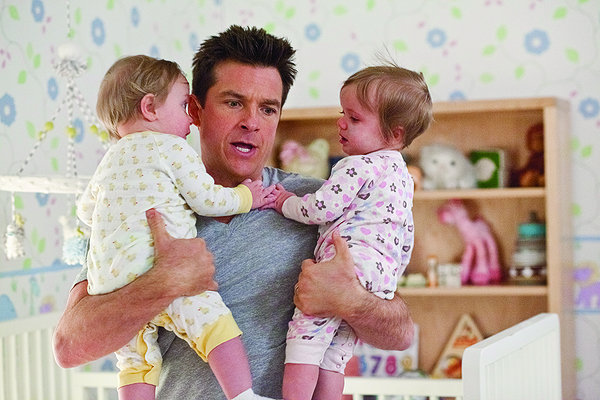 I knew I was in trouble by the first minute of the grossly unfunny Change-Up. Not only do we suffer a poop joke so early, we have to witness a baby firing a stream of fecal matter into Dave’s open mouth. That’s just a taste of the unpleasantness that follows. The movie plays like an exaggerated, sophomoric cartoon written by children. It seems to exist in the same broad universe of 2009’s abominable rom/com The Ugly Truth. What I wrote for that movie could easily apply to The Change-Up: “It’s questionable whether the comedy even reaches juvenile levels. It’s tasteless and piggish, but the weird part is that it comes across as knowledgeable on the subject of sex as a ten-year-old kid who just discovered his dad’s secret stash of Playboys. It talks about the right stuff but does so in a clueless manner. It’s like an exaggerated randy cartoon that chiefly plays to a male fantasy.” I’m not opposed to raunchy sex comedies. However, I am opposed to sex comedies that can’t figure out how to be funny without relying on easy gags. There’s a difference between gross-out humor and simply being gross, though I don’t believe this film knows what that difference is. So we’re treated to an over-the-hill porn star, some anal defilement, a voraciously sexual nine-months pregnant lady, even more poop jokes, and 90 minutes of penis discussion. There’s one actually interesting section where the guys debate the moral ambiguity of body-swap sex. Is it really cheating if Dave/Mitch is in somebody else’s body? What is Mitch/Dave to do if his wife wants to have relations? Sadly, this lone moment of interest is crushed to death by more penis jokes and then forgotten. Reynolds (Green Lantern) and Bateman (Horrible Bosses) try to stay above the fray, fighting the good fight, but even they succumb to the unfunny script and disjointed direction.
After being a distasteful cartoon for so long, the film wants to be dramatic. It wants to be emotional. Tough break, Change-Up, because you cannot have it both ways. The dramatic parts ring resoundingly false, a last-ditch attempt to class up what is a deeply unclassy picture. The tonal shifts are jarring and land with crashing thuds. It’s mostly because these characters are deeply unlikely, particularly the Mitch persona. He’s not just some brash, rude individual who sidesteps social mores, no this guy is downright sociopathtic. He’s egotistical, mean-spirited, and constantly boorish to every person in Dave’s life. He’s cruel to the daughter, he tells Dave’s wife that she’s not attractive, and then there’s the babies whom he treats like a couple of rag dolls to toss around. At one point, Mitch/Dave is on the phone and the kids are left to get in trouble with the kitchen. We’re not talking about getting messy with food, we’re talking sticking their tiny hands in a spinning blender, throwing knives, and licking electrical outlets (it’s like the Roger Rabbit cartoon that opened that flick). Instead of getting off the phone immediately, he continues talking and casually tends to the troubled tots per potential disaster. He teaches Dave’s daughter “violence is always the answer.” Mitch is an unrepentant jerk, and even when Bateman plays Mitch he’s still irredeemable. Am I supposed to feel sorry for this obnoxious guy just because his dad thinks low of him? I think low of him. I detest him. Therefore, when Mitch/Dave is having his Big Emotional Catharsis, it seems facile and hollow. We can generally find a point of likeability for uncouth characters, but not Mitch. As presented, this character has no introspection and few redeeming qualities, so why do I want to spend nearly two hours with this person? You’d think Dave would be the “nice guy” alternative, but he’s smarmy and neglectful too. Besides the “family man/pussy” and “playboy/prick” designations, the characters aren’t different enough to warrant a change of scenery.
 The Change-Up has the single most bizarre moment of any film this calendar year, and it has nothing to do with the metaphysical mechanics of body swapping. Wilde (Cowboys & Aliens, TRON: Legacy) at one point gets rather frisky and takes off her clothes, the last piece her brassier. Mitch’s hands cover her breasts for most of their onscreen freedom except for a handful of side angle shots where Wilde’s breasts are out and ready to greet the audience. Except those are and are not Wilde’s breasts per se. The in-demand actress had pasties to cover her nipples. The pasties were then digitally removed in post-production and replaced with CGI nipples. Let me repeat that for the slower among you – CGI nipples! It was some guy’s job to spend weeks painting nipples onto Olivia Wilde’s breasts. When I see nudity, can I trust that it’s real, or was it doctored by some computer technicians who are laughing at me the whole time? What is happening to this world when it makes me distrust the very sight of breasts?
The Change-Up is a mean-spirited, objectionable, nasty, classless, clueless comedy that’s tonally all over the place. The characters are unlikable, the comic setups are cartoonishly drawn, and the dramatic shifts are flatly false. What’s even worse is that the movie just seems downright hostile toward women. Just because it has a scene where Mann gets to vent the frustrations of the put-upon wife/mom doesn’t mean women are given a fair shake. I’d be more forgiving if the vulgar comedy was ever funny. The Change-Up erroneously believes that having characters say dirty words or inappropriate remarks is the same as comedy. It can be a component of comedy but rarely does it work as a whole substitute. The jokes fall flat, the drama feels forced, and the characters range from nitwits to jerks to deviants and back to jerks once more for good measure. Why would anyone subject themselves to nearly two hours with these people? I just felt bad watching this movie. The Change-Up makes humanity look like a species that deserves an extended time-out.
Nate’s Grade: D+


 nathanzoebl
You must be logged in to post a comment.