Blog Archives
Shutter Island (2010)
 This was a pulpy B-movie put together with A-movie artistry. In a year that had some artistically polished genre movies, Shutter Island was Martin Scorsese’s return to genre filmmaking and he brought with him an entire team of experts and professionals. The movie is playful and intriguing, engaging the mind enough for a crime thriller that appears to be a straight-forward mystery but then shows flashes of being about something more, something darker. And when you’re dealing with a movie with Holocaust flashbacks, dead kids, Nazi doctors, mental asylums, well you know you’re not going to be reaching subtlety even with a stick. But the way Scorsese orchestrates all these foreboding elements, tying together various plotlines, and working at different levels to satisfy the informed and uninformed, right before delivering a dynamite twist that calls for further investigation and rewatching, well it’s nothing short of masterful. Shutter Island may not be anything more than a souped-up B-movie, but with this level of artistry, it’s also one of the most entertaining films of the year.
Nate’s Grade: A-
Share this:

Inception (2010)
 Without a doubt, no movie has piqued curiosity like Christopher Nolan’s Inception. After breaking all sorts of box-office records with The Dark Knight, Nolan earned some capital. He wanted to make an expensive, intellectually demanding, high-concept movie that takes place mostly in the realm of dreams. The studio said yes, anything to keep their golden goose happy before a third Batman can roll out. Nolan has been tinkering with the script for Inception for almost ten years, trying to scale it down but never being content. This is a story that called for the biggest stage, which required a heavy price tag, and could only be fulfilled once Nolan was an established hit-maker. Early images of shifting gravity and folding cityscapes got people buzzing but then the concern was whether Inception would be too smart for audiences to embrace. You know, the same public that made two Alvin and the Chipmunks films blockbusters. Two weeks running, Inception has made a sizeable portion of money and become the “must-see” movie of the summer. Score one for the public.
Dom Cobb (Leonardo DiCaprio) is an expert extractor. He can sneak into your dreams and discover whatever secret you’re hiding from your self, your wife, even your shrink. All for a tidy sum, of course. He’s on the run from U.S. authorities because they believe he killed his wife Mal (Marion Cotillard). A rich businessman, Seito (Ken Watanabe), promises to clear away the pending charges if Cobb can perform one important job. Instead of stealing an idea, Cobb will have to plant an idea, known as inception. A young upstart (Cillian Murphy) will inherit his dying father?s empire, and Seito wants the guy to break up that empire and sell it off. Cobb enlists the help of a skilled team to pull off what is believed to be impossible; Arthur (Joseph Gordon-Levitt) as the point man, Ariadne (Ellen Page), as the architect of the dream world, Eames (Tom Hardy), a forger who can convince the mark he?s other identities, and Yusuf (Dileep Rao), a chemist that creates a compound to put the team under a deep sleep. They’ll need it because Cobb plans to go three levels deep, a dream within a dream within a dream in order for inception to take root. The only way out is a “kick,” the sensation of falling that will awaken the dreamer. The team is under great risk not just from the dream world, but also from Cobb. He?s been secretly keeping memories of his dead wife alive and she keeps intruding into shared dreaming, causing havoc, relying on the same info that Cobb knows. The deeper they go into the dream the deeper they also go into Cobb’s memories.
 Inception can be many things to many people, as is the nature of dreams. I found the movie to be a master class mousetrap. Watching Nolan and his origami-like script fold and bend and connect is a true pleasure. However, the movie is not a great character piece. Cobb is the only person on the entire team allowed any sort of back-story or inner lives or even personality traits. What do we know about Arthur, Ariadne, Eames? Nothing. They are all members of the team, but it is Cobb who is the only one allowed to have supporting details. Despite Cobb’s tragic past with his wife, emotionally the movie can best be described as a bit distant (not cold, distant). Nor does Inception deal with the psychology of dreams or the interpretation of the subconscious and its links to our own reality; this movie does not have Freudian psychoanalysis in mind. What Inception does deliver is a brilliantly staged heist that takes place in the realm of dreams, and if that doesn’t sound like a fun concept then I don?t know what does. To get to that heist, the audience must slosh through about 90 minutes of solid set-up and exposition (Pages character is essentially an exposition device). There are a lot of rules to digest in order for the final hour to have the impact that it does. If you nod off for a portion of that time, like my father, you will be lost as to why anything is exactly happening. Having seen the film a second time, I can say that once the hyperactive “Oh my gosh, this is awesome!” haze of newness wears off you do realize that the pre-heist portion of the movie can be a bit slow. I think that for future DVD-viewings I will skip to the start of the heist and sit back and relax (much like skipping the first hour of King Kong).
After talking about what Inception is not, let’s focus on what Inception is. It is a massively entertaining, brain-tickling thriller with eye-popping visuals that verge toward the iconic. Nolan isn’t the greatest orchestrator of action (a foot chase in Mombassa is pretty lackluster short of a narrow alleyway) but the man knows how to put together tremendously memorable set pieces. From Paris folding upon itself to a fistfight in a revolving hallway, Inception is packed with stimuli to ignite the senses. It’s the first movie in years that I walked out and thought, “How did they do that?” It renewed my sense of mystery and wonder with the movies. And the last hour is ridiculously fraught with tension as the movie descends level after level of subconscious, juggling four separate action set pieces with mounting climaxes. The revolving hallway fight is perhaps my favorite action scene in years. I still got goose bumps the second time. Gordon-Levitt hops from ceiling to floor like he’s Spiderman, or Gene Kelly, all while the camera remains fixed. Gordon-Levitt gets a lot of zero gravity experience in this movie. He might have qualified for a free ride on the space shuttle.
Like the alternate reality of The Matrix, people can manipulate the world of dreams, which allows for some imaginative visuals. Aside from the dreams-within-dreams impacting one another, there aren’t really playful distortions of reality. There?s a few M. C. Escher-inspired staircases but nothing too out of bounds. Nolan devises a reason for this since the dreamers do not want to call attention to altering the dream. They want to hide among the subconscious projections; get in and get out without being noticed. You do wish that Nolan played to the potential of his flexible reality, but on the other hand, it’s still fairly mind-bending to reach inside a magician?s hat into another magician?s hat and so on. I wonder if there was another story that could have succeeded in this setting, namely competing thieves that have to race against time within the world of dreams. Think about it next time, Nolan. That one?s on me.
 But the most exciting aspect of the movie is how intellectually stimulating it is. The movie is jam-packed with ideas like Nolan’s other works, so much that it’s hard to fully process everything the film offers in one sitting. The pieces do fit together and the movie follows its own internal logic, so if you didn’t skip out on any bathroom breaks, you should be able to follow along reasonably. On first viewing, Inception is bristling with intelligence and narrative complexity, and it rarely stops to pander to an audience. It expects you to keep up for the rewards that will follow, and they are indeed rewarding. The movie isn’t as complicated to follow but it can definitely get complicated when you try and explain action beyond a literal level. Nolan laces all sorts of narrative stops and peculiarities that can be targeted for an alternative thesis statement on the ending. The very ending shot is ambiguous perfection. It keeps the mystery of what constitutes reality while providing an out for people that want to formulate a happy ending. There’s plenty of room for interpretation and analysis but it doesn’t get in the way of telling a good story. Hollywood is pretty risk averse when it comes to anything that makes people think, let along anything expensive that requires active synapses. Nolan has long been a filmmaker of intellectual heft and non-linear narratives. His narratives are complex puzzles that snap together with airtight precision. The joy of a Nolan film is surrendering yourself to his narrative origami and waiting to see the Big Picture. There are new insights to discover with every viewing. Nolan may not be the second-coming of God, as those frothing at the mouth on Internet message boards proclaim, but I can think of no other director working today who harnesses Big Ideas on such a big stage.
Inception is a $160-million dollar studio film with substance, but it also looks like money well spent. The film looks amazing. The cinematography by Wall Pfister (Dark Knight) is gorgeous without being self-consciously arty, pleasing the senses without drawing too much attention away from the story. But with a screenplay that makes all kinds of leaps, you need the help of a good editor to guide the proceedings. Lee Smith (Truman Show, Master and Commander) is that man. While the repeated cutbacks to the van falling in slow motion can be giggle-inducing, Smith gamely holds everything together thanks to his skill in juggling all the parallel storylines/dreamscapes. Finally, the score by Hans Zimmer (The Lion King, Gladiator) is full of ominous, blaring horns that send shivers and get your blood pumping. Johnny Marr (The Smiths, Modest Mouse) even added an assist by strumming the guitar licks on the score. Apparently Zimmer’s key score themes are actually the tune “Non, Je Ne Regrette Rien,” the Edith Piaf signature song used to signal “kicks,” played at a slowed speed. At the risk of sounding like one of those frothing from the mouth on the Internet, that’s insanely cool.
 The acting is uniformly good with a few bumps. DiCaprio (Shutter Island) might need to do something light after continuous roles where he inhabits mean weighed down by guilt and dead wives (three in a row for those counting). He’s a good emotional anchor. Watching the star of 500 Days of Summer and Brick as a suave, cool-as-can-be action star is improbably awesome. Hardy (Bronson) is a scene-stealer mostly because he?s the only member of the team that has a sense of humor. Cotillard (Nine, Public Enemies) who won an Oscar playing Edith Piaf in 2007’s La vie en Rose, gets her best part since then. She gets to do many things as Mal, a projection of a character. This means that she must be limited in how she fills out the character because she is defined by Cobb’s fading memory. Yet she can be malicious, playful, spiteful, loving, vulnerable, and more. Cotillard and her big, glassy eyes do a great service in selling a romance we only see after the fact. Page (Juno) just feels out of place. She seems like the kid among a group of adults. And while the elfin actress will always look youthful until she applies for an AARP card, Page just seems in over her head. Her performance is fine if a bit mealy-mouthed but she still feels miscast.
Inception. Expect it to become a fanboy religion in a matter of weeks. It wears its influences on its sleeve, from The Matrix to Abre Los Ojos (or the American remake, Vanilla Sky). Thrilling, stimulating on different levels, and supremely engrossing, Inception is just about everything you could wish for in a summer blockbuster, except when it can also feel mechanical, distant, and free of emotion and character development save DiCaprio (perhaps this is further evidence that it was all a dream?). Regardless, Inception is easily the brainiest movie of the year, and usually those don?t get packaged as big-budget Hollywood spectacle. Just make sure to bring your totem the second time you watch the movie.
Nate’s Grade: A
Share this:

Reservation Road (2008)
 This movie beguiles me. I watched it over a month ago and I am still turning it over in my brain, and not just for the fact that I get it confused with the similar sounding yet also disappointing Reservation Road. It’s another movie that presents the suburbs as a prison of bourgeoisie social moirés about how men and women are expected to live to be happy. The movie looks magnificent thanks to skilled cinematography by Roger Deakens, even if it falls back on redundant visual metaphors (look, the windows are shaped like prison bars!). The acting by Leonardo DiCaprio and Kate Winslet, the unhappily 1950s married couple Frank and April Wheeler, is mostly impressive. Michael Shannon deservedly was nominated for an Oscar as an unhinged realtor’s son who cuts through all the troublesome and fake niceties. It is a terrific performance and jolts the movie with much-needed energy, somewhat like Renee Zellweger’s role in Cold Mountain. I think that’s where my biggest area of concern is: the movie is just kind of placidly dull. Watching people be miserable for most of a two-hour running time isn’t a deal-breaker, but the movie needs to have some life to it. Revolutionary Road feels just as morose and restrained as its assortment of doomed married couples eeking out an existence. Perhaps that is an achievement to be heralded for director Sam Mendes. Then again, perhaps it just means I felt purposely remote and directionless and just waited for the movie to expire.
Nate’s Grade: B-
Share this:

Babel (2006)/ Blood Diamond (2006)
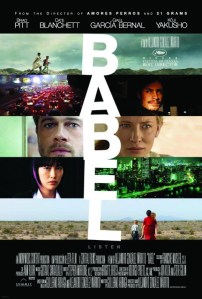 The world is a global community. It is increasingly difficult to shut out unpleasant news just because it happens to an unfortunate few we’ll never know. Hollywood has reminded us through the years that our actions do have sound repercussions, including our indifference. Babel is Mexican-director Alejandro Gonzalez Inarritu’s examination on the fragility of human relationships in the world. Blood Diamond wishes to shine the spotlight on America’s love of diamonds fanning the flames of genocide in Africa. Both movies wish to convince the public that they matter, and not just in box-office, though that would be appreciated. Both of these films have good intentions but the results are sloppy and leaden.
In typical Inarritu fashion, the different storylines of Babel converge, blend, criss-cross, and crash together. The timeline isn’t as disruptive as it was in 21 Grams, so that is a welcome relief. The storylines offer wide-eyed views into different worlds and cultures. A Morocco goat herder purchases a riffle for his sons to protect the herd. The two brothers turn sharp-shooting into a competition, with the one betting the other he cannot hit a bus far in the distance. On that bus is Richard (Brad Pitt) and Susan (Cate Blanchett), a married couple at odds with each other. Suddenly a shot whizzes through the window and into Susan’s neck. Richard panics and struggles with his options being far removed from advanced medical care and being unable to speak with the natives.
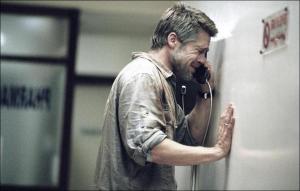 The incident becomes the shot heard round the world. The U.S. government is quick to suggest a terrorist link (who didn’t see that one coming?) but caught up in red tape to rescue the couple. Their nanny, Amelia (Adriana Barraza), cannot find someone to watch the kids so she can attend her son’s wedding in Mexico. Santiago (Gael Garcia Bernal) agrees to drive her and the kids south of the border where the blonde moffetts can learn things like how to kill a chicken. Things take a sour note when reentering the United States at a border crossing manned by suspicious patrolmen.
And half a world away, a deaf-mute Japanese schoolgirl (Rinko Kikuchi) deals in the aftermath of her mother’s suicide by flashing her vagina at boys and throwing herself at older men. Therapy might also be a workable alternative.
The strong ensemble acting is what kept me watching. Babel is filled with many talented actors that each get a turn to look pained, incredulous, and helpless. This is a movie primarily built around sadness and misfortune, and actors jump at those chances. Exhibit A: Brad Pitt. I’ve always thought his serious acting credentials get cast aside because of his good looks (the man even played a Greek god), but he’s into his 40s now and weathering some grown-up gray and wrinkles that, I don’t know how, add a mature sexiness to the man, much like George Clooney. Pitt was serviceable in Babel but failed to impress. He gets to pace a lot and look haggard but he still seems like a distant character. The whole American tourist storyline cannot outrun the sense of pointlessness it seems to be circling. The greatest moments of acting come from the extreme anxiety of Barraza and the dissatisfied yearning of Kikuchi. I expect both women to get nominated for many awards.
The most frustrating aspect of Babel is how little it matters. It’s hard to connect with the characters. And in the end, nothing all that tragic happens to reach anything profound. Most characters leave their shadowy places and only a small number are changed for the worst, mostly the victims of some very bad decision making. But when the movie concludes there is only one dead body and one displaced person. That’s it, and Babel doesn’t even hang on to let us feel that pain. It just skips from story to story never settling in and never evoking any human emotion except for that of morbid curiosity. These people are victims of fate and not much else. Babel is a letdown of a letdown.
 The Japanese schoolgirl storyline has no place in this film. The other three storylines all have a pertinent relationship, but the only thing that ties the schoolgirl into this web of international kerfuffle is that her father once owned the gun in question. Wow. It might have made better drama, and more sense, had this riffle had some significance, like it was the weapon of choice for her suicidal mother. Nope, it’s just another object with no more bearing to this family than a stapler. I think the deaf-mute Japanese schoolgirl is a terrific character and intensely intriguing, especially as she battles the trials of teenage life and feeling like even more of an outcast than usual, but this story needs its own separate movie. It has no business being here and, like much of Babel, adds little understanding or significance. So much of the movie isn’t even told to the audience, like character back-stories and written catharsis, so any distraction feels like a waste of time for a 140-minute movie.
The ending is symptomatic of the film in general; it just kind of peters out and thinks its message has been well-received. What message? What the hell is Babel saying? Stop, look, and listen? The world stage is at such a precarious time and is, for better or worse, unified; someone else’s problem has ripples that will become our problem. Isolationism is dead. But Babel squanders any attempts at a deeper message by playing it safe; never pushing further than the scene descriptions it has confined itself to. The title refers to the Biblical story where God punished man’s arrogance by creating multiple languages. Most of the conflicts revolve around communication issues, but they really only seem like a small portion of the story. When Amelia takes the kids to Mexico, there really aren’t any communication problems. When the car is stopped by the Border Patrol there aren’t any slip-ups in communication, but Santiago freaks out and bolts. The central idea of Babel, lost communication, never really feels properly executed except with the Japanese schoolgirl, who, like I said, doesn’t even belong here.
When Babel does have something political to dwell upon it is usually very lazy. Law enforcement treats illegal immigrants like crap. The U.S. government is more interested in punishing perceived threats than medically helping those in need. American tourists are boorish and see dusty places like Morocco as a place to be alone, despite all the impoverished people shuffling about. Give me a break. There’s nothing within Babel that makes it worth more than one viewing. Once you know the outcome for characters than the film ceases to have a point. This is a true surprise and disappointment from the team that had so much emotional vitality and open humanity with Amores Perros and 21 Grams. I guess a lot must have gotten lot in translation.
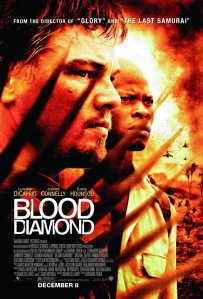 On the flip side, while Babel is a mildly interesting movie desperately needing a message, Blood Diamond is a message in desperate need of an interesting movie. The message rings loud and clear in the film?s opening moments: conflict diamonds are bad. They account for 15 percent of all diamond sales and help finance genocide, civil war, and child brainwashing in Africa. The diamond industry says they cannot decipher which diamonds are which, but come on, they know. They use their market share to control world prices, thus creating a windfall for African rebels. They come up with more diamonds, and the diamond industry purchases them to take them off the market. Got it. But now what?
The short answer is, “‘Just say no’ to conflict diamonds, that is.” The long answer is one very trite movie that wears its liberal idealism on its sleeve with a bit too much fondness. Africa has become the cause celebre of recent films, but have any of them really made a difference? Did The Constant Gardener make us think twice about why drugs are so cheap (because Africans are exploited)? Did Syriana make us think twice why oil was comparatively cheap for Americans (because Africans AND Middle Easterners are exploited)? I doubt it. I may sound a pinch too cynical but I believe that the Unites States of America just generally doesn’t care as long as prices stay nice and low. I applaud filmmakers for attempting to open eyes and change hearts and minds, especially for many thought-provoking and worthy causes. But if you’re going to sponsor a message movie than you need a spoonful of sugar to help the medicine go down.
 Blood Diamond will make you gag, that’s how heavy the message is. It displays a depressing showcase of Africa recycling violence, but it always manages to stay on point. The movie is supposed to be concerned with the well being of Africa, but yet it hangs its attention on a pair of white people. Danny (Leonardo DiCaprio) is a South African diamond smuggler who gets the classic Hollywood redemption arc, courtesy of Solomon (Djimon Hounsou) an enslaved mine-worker that has found a pink diamond the size of a bird egg. Danny and Solomon form a reluctant partnership to get recover the diamond, rescue Solomon’s lost son, and get everyone out of the raging gunfire. But the film is focused on Danny’s arc as he goes from scoundrel to savior, with all those black faces in the background just becoming that — background. The film’s climax involves Danny running through a mining camp looking to rescue Solomon’s lost son. However, Danny shoots and kills all the other kids holding weapons as he dances in between explosions. You cannot root for that as a moral audience member, can you? Danny may save one child but he’ll blow away all the rest, and to the pounding score of Hollywood glory. If this was meant to seem meditative than God help us all.
Jennifer Connelly plays a photo journalist that?s a self-described action junkie. She says she just can’t go through her day sipping lattes and reading Ziggy in the funny papers, not with knowing how cruel the world is to one another. Did she just become aware of this? The world has always had people getting treated poorly and will forever. Her character is an outlet to the Western world, a lens that can capture and broadcast the horrors of Africa which she flippantly predicts will be a minute on CNN “between sports and weather.” She’s your prototypical bleeding heart and the not-so-subtle outlet for the righteous indignation of the filmmakers. There’s nothing to her character except a camera for proof, an unyielding moral compass, and a pair of breasts for Danny to improbably snuggle up to.
 The message of Blood Diamond is what we’re reminded of time and again, including tidbits to clue us in on how it all began (where did Africa learn some brutality? Why white colonists of course). The movie is built as an action vehicle, but it’s an action vehicle going in the wrong direction. The bursts of action are frequent but never anything well imagined or exciting. Usually the film follows two, or more, characters talking and then they’re interrupted by bouts of gunfire. Danny starts uttering “GO!” and “MOVE!” every other breath and they escape. This formula is repeated for the rest of the movie. It hampers getting to know and feel for the characters and sure as hell doesn’t amount to a lot of interesting action. There’s the main problem: we can’t feel for the characters because the movie doesn’t spend enough time with them, and yet we can’t get excited because the movie doesn’t spend enough time to build effective suspense. Blood Diamond finds its way into a balancing act it is hopelessly ill-prepared for.
Director Edward Zwick (Glory, The Last Samurai) is used to fashioning mass-friendly entertainment with cultural issues bubbling to the surface. Perhaps, though, he should have taken a cue from Andrew Niccol’s Lord of War. That film had an easily identifiable message (guns can be bad) but found ways to engage an audience. It had a lot of political ire and troubling statistics to dish, but Niccol knew that an audience must be entertained first and foremost. He found inventive camera angles, stirring monologues, and fascinating true-life anecdotes about arms trading. The main character wasn’t likeable but you just wanted a longer peek into this world behind the curtain. Blood Diamond lacks the biting insights that made Lord of War powerful and enjoyable. Even Lord of War handled the subject of turning children into a blood-thirsty army better. Zwick seems adrift and too close to his message to care about sharpening a good movie.
The movie has a handful of odd moments. In our introduction to Danny he is negotiating a weapons deal. He speaks to the head of a militia in a highly accented speech and subtitles pop up on the screen. Naturally, you would assume the language currently being spoken is not English. Danny is actually just impersonating an African’s English speaking voice. If you listen to what they’re saying they speak English the entire time. And the line, “In America, it’s bling-bling, but over here it’s bling-bang?” No. A thousand times no.
 DiCaprio is muscling his way into a riveting and meaty actor of prominence. His accent is near flawless, just like his Bah-stun accent was in The Departed. He gives more simmer to his role than deserved. Hounsou is a great actor but his most emotive scenes involve a lot of yelling that just seems like yelling. A lot of high-volume yelling doesn’t work when the character is so flimsy. Both of these actors are victims of playing characters with little else to them besides the title of Victim and Victimizer. Connelly and DiCaprio have no chemistry to them, not that the film’s neutered sensuality and agitated story help much. It’s as if Blood Diamond expects that by smashing the two characters together long enough their romance will be plausible. It isn’t. The romance is a distraction at best and eye-rolling at worst.
Babel and Blood Diamond are both pieces of misguided Oscar-bait. Innaritu and his writer for three films, Guillermo Arriaga, have said to have clashed since Babel‘s release and may no longer work again together in the near future. I welcome this trial separation because their film collaborations seem to be dulling. Babel has all the technical skills evident in 21 Grams and Amores Perros, but nothing substantial or contemplative. Conversely, Blood Diamond is a message movie posing as an action flick. It can’t succeed with poorly constructed action sequences and archetypal characters posing as openings for outrage and shameful finger-wagging. The movie is crushed to death by a message. Blood Diamond is a message movie that’s so weighted down it never gets very far. Both films are marginally interesting but nothing transcendent or demanding. Hollywood has its heart in the right place. They just need to make better movies.
Nate’s Grades:
Babel: B-
Blood Diamond: C
Share this:

The Departed (2006)
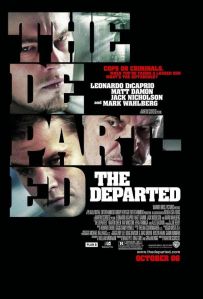 “I don’t want to be a product of my environment,” growls Frank Costello (Jack Nicholson) in the opening seconds of The Departed. “I want my environment to be a product of me.” Without question, the filmmaker that has shaped the environment of movies more than any other in the last 30 years is Martin Scorsese. No one does the cops-and-robbers territory better than Scorsese, and it’s great to have him back on familiar turf. It’s not that Gangs of New York and The Aviator were lacking in directorial skill, it’s just that they felt so labored and reeking of classy awards envy. With The Departed, it all feels so artistically effortless, like Scorsese settled in a zone of brilliant filmmaking. I just hope Marty bangs out more of these excellent gangster flicks before trying again to woo Oscar. In fact, his return to his violent stomping grounds might finally be his long-overdue ticket to the winner’s circle.
The premise is appealingly simple. The Boston State Police Department is desperate to nail local crime lord Costello. They pluck a young recruit, William Costigan (Leonardo DiCaprio), who has a shady family history of small-time crooks. He agrees to infiltrate Costello’s mob and report back to the Boston PD. To make is situation credible, Costigan is expelled from the force and sent to prison to earn a rep. Only two other people know Cosigan’s real identity, the police chief (Martin Sheen) and the head of undercover work (Mark Wahlberg). On the other side of the law, Costello has a mole all his own working inside the Boston State police force. Colin Sullivan (Matt Damon) has quickly risen through the ranks and has a prime position working with the state?s FBI crack force. He’s also an acolyte of Costello’s ever since he was a young Southie kid seeing the draw of power. Now full grown, Sullivan tips Costello and tries to redirect the ongoing investigation to bring the man to justice.
 The real sparks come when both moles try to discover the identity of the other, without compromising their own precarious identities.
The Departed is a bruising, bristling return to form for Martin Scorsese and his most entertaining film since his last Great Movie, 1990’s gangster-rific Goodfellas. This is a movie that crams multiple characters, storylines, and histories into one tight, focused setting, but then the flick glides smoothly on electric storytelling and intense performances. The movie’s twists and turns are, at times, of a knockout variety, and there’s a stretch of late surprises that each feels like a shot to the gut. I was possibly winded from gasping so hard. This is a film so fantastically alive with feeling and vigor that you cannot help but get ensnared. It sets up all the players and back-story before we even get the opening titles set to the blaring wails of the Dropkick Murphies. The thrills are real because we feel the danger, and the onslaught of brutal violence is another rhythmic piece in Scorsese’s masterful conduction. Adding to the feeling is the sure-handed, quick-fire editing of longtime Scorsese collaborator Thelma Schoonmaker and the ominous cinematography of Michael Ballhaus. Even though this film is based on a 2002 Hong Kong film, Scorsese has firmly made The Departed a movie all its own in spirit and personality. No one so easily brings us into the sordid lives of criminals better than this man, who, when in that creative zone of his, brings such palpable energy to his melding of image, song, and consequence, that the results are simply intoxicating. The Departed reminds you why Scorsese is still our greatest living director, no matter what Oscar thinks.
What elevates The Departed from the clutter of other macho men-with-guns crime capers is its studious attention to character. This is a film that works beyond a concept. The movie’s central moral theme is the price of identity. Frank opens the film asking what does it matter who’s holding the gun to your head, cop or crook. Costigan is tormented from wearing too many faces. He’s having trouble justifying his deeds and actions and is scared he may lose his own soul at the price of his lost identity. Sullivan, on the other hand, has gladly sold his own soul for a pittance. He’s a class conscience yuppie that craves power and will cut any throat if it gets him ahead. The movie steamrolls ahead with intrigue but it’s our connections to these characters that elevate the life-and-death stakes. You have a real emotional investment in this story, therefore when things get murky you really feel the danger. My heart was racing with excitement and dread. There may still be impressions from where I was squeezing the movie chair.
 Complimenting these complex characters are brilliant performances. DiCaprio may have been nominated for a Best Actor Oscar for his second Scorsese collaboration, The Aviator, but he turns in his strongest work here. DiCaprio expertly bares a gnawing moral conflict with equal parts desperation and the hunger to do good. He’s trying to finally do right and step out of his family’s criminal past, and DiCaprio brings sharp intensity to this plight. You really feel every stomach churn this guy goes through to do what he does and stay alive. I knocked the boy for being too boyish a gangster in Gangs of New York, and let me say I take back my words. On the flip side, Damon utilizes his angelic, choirboy good looks and masterfully downplays his character’s pragmatic villainy. The character has to hide so much from the outside world, be it the police, his true bosses, his girlfriend, and even himself. Damon goes about his deceitful business with slickly sick ease, tapping a killer’s instinct for self-preservation. You may shudder from how methodically cold and manipulative he comes across. He’s a mesmerizing rat bastard of a human being and yet Damon presents an almost seductive portrait of evil.
Nicholson is equally good though at times can be a distraction to the storytelling. There are a handful of moments where Nicholson seems to go too far off the page, indulging his crazier tendencies. Costello is supposed to be a scary, unpredictable, potentially unhinged man, and Scorsese has plenty of moments that bring home this point. It just feels inappropriate then for Nicholson to, in a few small moments, transform into a goofy cartoon. With that said, it’s great to see Nicholson cracking some heads for Scorsese. He has devilish fun and is insanely watchable while definitely going for broke. After some nice guy roles it’s nice to have back an unrestrained Nicholson to play the film’s abyss of evil.
 The collected supporting players all leave some mark. Baldwin and Wahlerg are perfectly profane hardass characters that you warm up to. Sheen, free from the Oval Office, displays nice touches of weariness and, in one moment, practically breaks my heart with his brave resignation. Breaking up this boy’s club is Vera Farmiga (Running Scared) as a somewhat contrived plot point to connect Costigan and Sullivan as the police shrink to one and the girlfriend to the other. There’s a perceived sadness to her willowy eyes and slender face that she plays to great effect. She?s a captivating new face and gives an extra ladling of emotion to the tale.
It’s been over a week since I’ve seen the movie and I still can’t get it out of my head. There are only a handful of flaws that separates The Departed from Scorsese’s rich pantheon of mythically Great Movies. This is a complex, gritty, amazing crime thriller stuffed to the gills with entertainment. Making the bloody body count resonate are the incredibly intense performances, particularly Damon and DiCaprio. This is a gripping gangster thriller pumping with the blood of a sterling character piece. The unexpected twists and turns will shake you, and the movie goes well beyond a snappy premise. The Departed is a moviegoing experience that will thrill you, stir you, sadden you, exhilarate you, and firmly plant itself in your memory banks. Welcome back Marty.
Nate’s Grade: A
Share this:

Catch Me If You Can (2002)
January at the theaters is a tale of two kinds of films. One type are the studio bombs (take Just Married and Darkness Falls, please take them far away). The other type are the prestige pictures expanding their releases in hopes of garnering some of that Oscar magic. A lot of prestige films were released around the holidays and though not every one could be a winner, they were all better than Kangaroo Jack. Well, except for The Hours.
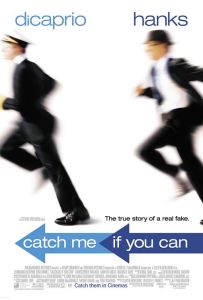 Catch Me If You Can (2002)
Premise: Successful true-life con artist Frank Abagnale Jr. (Leo DiCaprio) zips across the world posing as a pilot, doctor and lawyer all before the age of 18. A mousy Tom Hanks provides the chasing.
Results: Breezy and light-hearted, Catch is an entertaining and fun romp that works with a charming Leo (unlike in Gangs), a jazzy score and a skillful recreation of the 1960s life and mood. Spielberg hasn’t made a film under two hours since 1989, so Catch is a tad long.
Nate’s Grade: B
Share this:

Gangs of New York (2002)
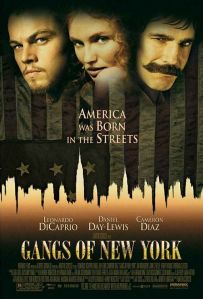 Watching Martin Scorsese’s long-in-the-making Gangs of New York is like watching a 12-round bout between two weary and staggering prize fighters. You witness the onslaught of blows, see the momentum change several times, and in the end cant really tell which fighter is victorious. This is the experience of watching Gangs of New York, and the two fighters are called Ambitions and Flaws.
The film begins in the Five Points district of 1840s New York among a vivid gang war over turf. Amsterdam (Leonardo DiCaprio) witnesses the slaying of his father, Priest Vallon (Liam Neeson), at the blade of William Bill the Butcher Cutting (Daniel Day-Lewis) and his Native Americans gang. So what does this son of a dead preacher-man do? Well he grows up, plots revenge by making a name under the wing of the Butcher becoming like a surrogate son. But will vengeance consume him?
 Watch Leo DiCaprio assemble toughs, rake heels, and ne’er do wells to his Irish gang of rapscallions with facial hair that looks to be tweezed! Witness a one-dimensional Leo suck the life out of the film like a black hole! See Leo become the least frightening gangster since Fredo. Watch the horribly miscast Cameron Diaz play pin-the-tail-on-an-accent! Witness as she tries to play a pickpocket with a heart of gold that falls hopelessly and illogically in love with Leo! Marvel how someone looking like Diaz would exist in a mangy slum! See the brilliant Daniel Day-Lewis upstage our stupid hero and steal every scene he inhabits! Witness one of the greatest villains in the last decade of movies! Watch Day-Lewis almost single-handedly compensate for the films flaws with his virtuoso performance! Admire his stove-top hat and handlebar mustache!
Witness a wonderful supporting cast including John C. Reilly, Jim Broadbent and Brendan Gleeson! Wish that they had more screen time to work with! Wonder to yourself why in all good graces this film took nearly two years of delays to get out! Speculate away!
Gangs has the sharp aroma of a film heavily interfered with by its producers. The whole exercise feels like Scorsese being compromised. Gangs is a meticulous recreation of 1860s New York that often evokes an epic sense of awe. The story has more resonance when it flashes to small yet tasty historical asides, like the dueling fire houses and the Draft Riots. But all of these interesting tidbits get pushed aside for our pedantic revenge storyline with Leo front and center. You know the producers wanted a more commercial storyline, which probably explains why Diaz has anything to do with this.
 The script is credited to longtime Scorsese collaborator Jay Cocks, Steven Zallian (Academy Award winner for Schindler’s List) and Kenneth Lonergan (Academy award nominee for You Can Count on Me). So with all these writing credentials, dont you think one of them would realize all of the dumb things going on with the story? The ending is also very anticlimactic and ham-fisted. Just watch as we segue from a graveyard to present day New York, all thanks to the Irish rockers of U2!
I know this much, Day-Lewis needs to stop cobbling shoes and act more often. Gangs is his first visit to the big screen since 1997’s The Boxer. He spent part of this hiatus in Italy actually making shoes. I don’t know about everyone else but this man has too much talent to only be acting once every five years. Somebody buy his shoes and get him a script, post haste!
Scorsese’s Gangs of New York is at times sprawling with entertainment in its historic vision and at other times is infuriating, always dragging behind it a ball and chain called stupid revenge story/love story. I’m sure the film will get plenty of awards and Oscar nods in prominent categories, and this seems like the Academy’s familiar plan: ignore a brilliant artist for the majority of their career and then finally reward them late for one of their lesser films. So here’s hoping Scorsese wins the Oscar he deserved for Raging Bull and Goodfellas.
Nate’s Grade: C+


 nathanzoebl
You must be logged in to post a comment.