Blog Archives
New Moon (2009)
 Admittedly, I am not a fan of the Twilight series. I have never read one of the books but I didn’t hate the first Twilight movie. I thought it kind of worked on its own merits even if it wasn’t for me. However, New Moon is a crushing bore and a mess.
Bella Swan (Kristen Stewart) is celebrating her eighteenth birthday with her vampire boyfriend, the 119-year-old Edward Cullen (Robert Pattinson). She accidentally cuts her finger and the sight of blood sends one of the Cullen vampires crazy with instinct. Edward concludes that his love would be safer without him. He bids her goodbye and promises, “This is the last time you will ever see me,” forgetting that there are two more books to go. Bella is heartbroken and spends months in a stupor. She finds solace with Jacob (Taylor Lautner), her friend of many years. Jacob’s people are indigenous Native Americans to the area, and he holds a secret as well. Turns out that Jacob is a werewolf. Now Bella has to decide between a vampire or a werewolf (does a Frankenstein monster enter the romantic fray later?). Edward mistakenly believes that Bella has died, so he too wants to die and will seek execution at the hands of the illustrious Vultari, the ruling vampire clan in Italy. Bella must decide between her two loves.
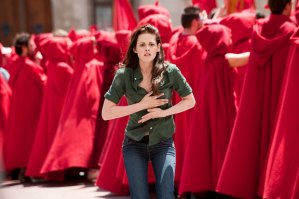 I can precisely indicate where everything goes wrong for the abysmal New Moon — the character of Bella Swan. For the majority of this sequel, I didn’t just detest and dislike her I downright hated her. I hated her. I understand her appeal to the millions of Meyer’s literary acolytes, but man does she come across as a self-centered, casually cruel, messed up girl who spends most of her time being whiny, mopey, and sulky. It’s not just that she has a guy interested in her, it’s the absurd notion that every man cannot get enough of this sullen gal. As presented in New Moon, Bella is such a dour and lifeless personality. I cannot see whatsoever why she is worth such effort. This criticism may be tracked all the way to Meyer’s source material, making Bella absent in defining character dynamics expressly so pre-teen readers can insert themselves as the character and swoon over being the object of universal desire. It is insultingly thin wish fulfillment that this girl has every man, vampire, and werewolf fighting over her in the Pacific Northwest. After Edward leaves, she shuts herself out and rejects all her friends. We see in one camera pan that she spends literal months in a stupor. I understand that teenagers think everything is the end of the world, but she and Edward were together for, what, a few months? Then again, heartache is something that knows no exact time frame for healing, so consider this but a quibble. Bella seems to push others away except when she needs a set of ears to whine.
It is post-Edward where Bella becomes insular, self-centered in her pursuit of danger placing herself in stupidly reckless scenarios, and hurtful. Where Bella really infuriated me is her treatment of her lifelong friend, Jacob. Obviously the big guy has a thing for his her and she knows this, which allows Bella to string Jacob along for almost a whole movie. She leads this little doggie along, teasing him with a “Maybe I will be with you, maybe I won’t” dance that becomes irritating and rather loathsome. Jacob is a swell guy who has looked out for Bella from day one, accepted her coupling with a vampire, sworn enemy of werewolves, and he’s been the best listener to all her self-involved drama. Plus this guy is ripped and has hip flexors that could cut glass. And he is there for her and didn’t abandon her like Edward. So Bella toys with her self-described “best friend” until she can hear the word “Edward” and then she can think about nothing else, even after months of complete separation. I understand that Edward has the sexy, brooding, bad boy appeal, where women think they will magically be the key ingredient to change the troubled man for the better. But on the flipside, Jacob thinks he?’ the key ingredient to finally get Bella to commit to a healthy relationship, and he gets screwed. Seriously, what’s the worse thing about dating a werewolf? You may have to take him for more walks. I suppose this makes me sound like I’m on Team Jacob, as the fans call themselves. I’m really on Team Bella Deserves to be Alone.
 I don’t want to sound unduly harsh. I don’t necessarily have an inherent dislike for characters that make bad decisions or who are, at their core, unlikable. I could forgive the sins of Bella Swan if she had even a hint of subtext. Bella Swan is a void of personality. I cannot recall if this was the same with Twilight, which I haven’t seen since I watched it on opening day in the theater a year ago.
What also sinks New Moon is how it repeats the same plot from Twilight. Once again Bella feels alone, she finds comfort in a boy that says they can’t be together, this intrigues her and pushes her into action, she’s warned of danger, and then finally she settles in with a pseudo relationship with a supernatural stud who makes blanket promises like “I’ll always protect you,” and, “I’ll never let anything happen to you.” It’s not complex folks; Meyer is just feeding pre-teen girls their fantasy of a male romantic interest. Because of this repetitious plot structure, very little of substance happens during the overlong 130 minutes of New Moon. Bella kinda sorta almost gets involved with a werewolf, there’s some lousy Romeo and Juliet allusions, and thanks to a delightfully hammy Michael Sheen (Frost/Nixon, The Queen), we learn a little bit about what makes Bella special to the world of vampires (it’s telling that her “specialty” is her lack of reaction). Beyond that, this is two hours of posturing and some gratuitous beefcake shots of shirtless men. My theater was sold out and packed with the Twilight faithful who swooned when they saw Edward strutting in slow-mo and openly hollering in approval when Jacob first whipped off his shirt. For supernatural creatures, they do more brooding than anything.
Director Chris Weitz (The Golden Compass, About a Boy) replaces Catherine Hardwicke to steer the second movie. I actually think Hardwicke had the right sensibilities for this franchise and she brought a youthful, rambunctious spirit that gave the first film a teenage synergy that made the romance feel pulpy. Weitz does away with this and makes the movie feel more ornate and chaste and dull. The execs spent major money to film in Italy for the vampire Volturi clan, but as near as I can tell some sets would have done the trick. Note to filmmakers: if you spend money to film in an exotic location, show it. As far as I can tell, Weitz was hired because of the bump up in special effects for this picture. Gone are goofy vampire baseball sequences and now we have cheesy wolf battle sequences, which come across like a less refined version of the polar bear brawl from Golden Compass. The special effects have improved but that doesn’t mean they?re good.
 This isn’t exactly the kind of movie that asks for much from its actors, and screenwriter Melissa Rosenberg distills Meyer’s text to the point that the actors pout and yearn. Stewart is an actress I have liked for years since Panic Room, so imagine how I would feel about the Bella character with a less capable actress. Pattinson is absent for almost the entire movie and it’s hard to say that his presence was missed. The best actor of this weird love triangle is Lautner who at least seems to have some fun with his role. He has an amiable spirit that penetrates all the gloom. He’s come a long way from being Shark Boy in 2005?s The Adventures of Shark Boy and Lava Girl.
The plot is a shadow of the first film, and the main character is annoying and hard to sympathize with, there?s so little of consequence that happens, it?s way too long, and, oh yeah, did I mention how much I disliked Bella Swan? At this point, the Twilight franchise is a juggernaut that cannot be contained (as I write this it’s poised to make over $70 million on opening day) and the Twi-hards will find the movie to be catnip, swooning at the visualized male sex objects. For anyone outside the cult of Twilight, the movie version of New Moon will fail to communicate the appeal of the series. The movie feels bloodless. Twilight is like a tedious soap opera scrubbed clean of teenage hormones. I think I’ll stick with HBO’s True Blood, a more nuanced, adult, sexy, and just plain fun series following vampire-human love. Bella could learn plenty from Sookie Stackhouse.
Nate’s Grade: D+
Share this:

Twilight (2008)
 It’s only been three years since the first book in the Twilight series was published, but man has it already become a phenomenon among young girls. Author Stephenie Meyer was a Mormon housewife who professed to never having seen an R-rated movie, so of course she seems like a natural fit for vampire literature. Meyer has taken the torch from Anne Rice and created an insanely popular series of books that chronicle the lives of humans and vampires in the rainy Northwest United States. I had never heard about the books until the spring of 2008, months before the hotly anticipated release of the fourth and final book in the series. Then again, I’m not a preteen girl, so excuse my ignorance. I decided to bear the hormonal, high-pitched squeals and sit with a packed house to experience the movie with the Twilight faithful. Judging from my screening, I think it might be mandatory for all girls between the ages of 7-14 to go see the Twilight film.
Bella Swan (Kristen Stewart, Into the Wild) is the new kid in school. She’s moved back to live with her father (Billy Burke), the sheriff of a tiny Washington town with a population of 3,000 people. Bella has her sights set on the Cullen family, a group of weird kids that are pale and keep to themselves. Edward Cullen (Robert Pattinson) goes out of his way to avoid Bella, and of course this just makes him more mysterious. He tells her that they shouldn’t be friends. Then one day at school he saves her life by stopping a van from crushing her. Bella suspects that this Cullen kid might not be a usual teenager. He’s not. He’s a vampire who hasn’t aged since 1918. Bella is smitten with her otherworldly protector. It’s your typical high school relationship. Bella doodles Edward’s name on her notebook and falls in love with an unattainable boy. Edward must resist the constant temptation to drink Bella’s blood (he and his vamp family are “vegetarians,” meaning they only drink animal blood).
 Let’s examine the distinctions of the Twilight vampire incarnation. Now, the vampire myth is not written in stone, so it allows for creative interpretation. Some vampires cast a reflection, others don’t. Some vampires are thwarted by garlic and crosses and others are not. Some vampires sleep in coffins and others just prefer a comfy mattress. It seems that the two characteristics that follow every vampire tale involve the insatiable thirst for blood to drink and the fact that sunlight is a vampire’s enemy. Meyer’s vampires don’t even adhere to this. They walk around in the daylight with no concern; in fact, we learn they never sleep at all, which means they must have all the late night infomercials memorized by this point. Removing the danger of daylight from the vampire myth proves to be somewhat troublesome decision. This is because, when you think about it, there are little to no drawbacks or limitations to being a vampire in Meyer’s world. Yeah you’ll live forever and crave an unorthodox beverage, but as a vamp you get super abilities, super strength, super speed, and a laughable diamond-like glow when the sun hits your exposed skin (think of those people that encase cell phones in tacky “bling” jewelry). If this is what it means to be a vampire in Meyer’s world then I wouldn’t be surprised if every freaking teenager in the world was signing up to join the army of the undead. The vampire myth brings with it plenty of baggage but it also helps to patch up holes in a narrative; just introducing the concept of a vampire allows an author some free pass with the details. However, vampire tales bring with them a certain set of expectations due to audience familiarity with the popular concept. I could care less if Meyer’s vampires have fangs or chow down on garlic bread, heavy on the garlic, but she loses me when she has vampires roam around during the day with little to no drawbacks. They just don’t feel like vampires. What they feel like are superheroes with skin conditions and a unique appetite. Which is fine, but don’t call it a traditional “vampire” flick.
I completely understand the enormous appeal of the Twilight series because it’s totally pre-teen wish fulfillment. I’m positive that the majority of the pre-teen readership projects themselves as Bella, the typical Every Girl. She encounters a sexy boy who ignores all the flashy and trashy girls and recognizes that special something in the Every Girl. In fact, he respects her and doesn’t want to be physical with her because he’s afraid of giving in to his urges (a rather obvious abstinence metaphor). He wants to love her forever and protect her. He has a dangerous bad boy angle but yet he’s still safe. In short, Edward Cullen is the idealized male for a nation of pre-teen girls who are just stepping into the world of boys (Bella also becomes an object of affection for no less than three boys at school). The Twilight tale even pulls a gender flip: the girl is pressuring the boy to give in to his carnal urges. And yet I can also understand why the books appeal to an older, mostly female, readership as well. If you remove the vampire angle from the story, it’s that old classic literary tale about a gal falling in love with the rebel, the boy who’s misunderstood. Hollywood has been making those sorts of love stories for decades, and so Meyer is able to tap into this classical romantic appeal.
 Twilight never delves too deeply into the dramatic dynamics of a 17-year-old girl dating a 90-year-old vampire. There are a lot of dramatic consequences drawn from dating somebody who cannot age. The Buffy the Vampire Slayer TV show explored the ins and outs of human-vampire relationships with wit and sincerity. Edward is forever seventeen but does that mean he still digs the high school girls? If you’re trapped in the body of a teenager does that mean you are still attracted to teenagers? If I were almost a century old I think I might seek out the comfort and conversation of a more mature woman, which is precisely the notion I’m sure the older female readership also fantasizes about (for all those guilty soccer moms, it doesn’t qualify as fantasizing an underage when he’s undead). Talking to teenagers for the rest of your life seems like a strange form of penance, as does repeatedly completing high school. Are the vampires just bored and attend school to pass the time? Don’t they know that TV was invented?
Twilight doesn’t have much of a plot to fill out a two-hour running time; the bulk of the movie consists of two characters feeling each other out. When the film does introduce an exterior threat (Cam Gigadet as a vamp obsessed with the hunt) it never feels that dangerous or fitting. The outside threat is saved for the very end and is easily dispatched, so the movie would have been better off without forcing a last-minute life-or-death dilemma into its love story. The love story itself doesn’t feel as properly nourished as it needed to be. The whole film experience feels like one long introduction and set-up, not so much an open-and-shut story.
Now, with all of that established, the Twilight film itself isn’t too bad. The movie is well made and certainly has a pulpy romantic vibe. The movie never feels overly burdened by excessive emotion or fake drama. It also follows a leisurely pace but never becomes dull. The actors are a big help. The leads don’t seem like they stepped out of a magazine photo spread; Stewart and Pattinson (Harry Potter and the Goblet of Fire) have a palpable chemistry that simmers throughout. Stewart is a terrific actress that embodies a typical teen, and Pattinson has the heartthrob glower down cold. I think there is rarely a scene where Edward isn’t glowering. Director Catherine Hardwicke (Thriteen) might as well provide onscreen instruction telling the audience when to swoon. Hardwicke is a filmmaker that doesn’t wallow in pretension, so she knows what kind of flick she has at her disposal. On the other hand, she is able to tamp down the inherent cheesiness that can go with a gooey supernatural love story. Twilight is able to work because it strikes the right balance between romance and silliness.
 Fans of Twilight should be delighted by the big screen adaptation of their favorite characters and heartthrobs. Sure the plot is a tad lightweight, the vampires might not be vampires as we traditionally understand them, the characters make giant leaps in their proclamations of love, and the outside conflict is a bit too poorly manufactured, but the movie has some bite. The movie isn’t moody, it isn’t too heavy, and it can come across as entertaining, though I’m at a loss to explain its extraordinary popularity. Now that Hardwicke and company have established the Twilight inhabitants, I hope the inevitable future installments will be better at providing resonating story and characters. If you doubt the certainty of sequels, need I remind you yet again that it is mandatory for girls age 7-14 to see this movie. The Twilight phenom has yet to reach its peak. Get used to it. It’s only a matter of time before Hollywood starts cranking out the Twilight knock-offs. Then, perhaps, I will join the armada of pre-teen girls and shriek wildly.
Nate’s Grade: B-
Share this:

Into the Wild (2007)
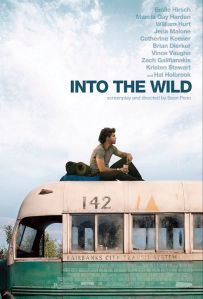 Undeniably well made, I just couldn’t emotionally connect with the main character, Christopher McCandless (Emile Hirch). Chris turns his back on his affluent parents and his bourgeois lifestyle and heads off into the wilderness to experience nature and find what has been missing in his life. Director/screen adaptor Sean Penn turns Chris into a Jesus-like figure that touches all those who he encounters on his cross-country tour that will meet its end in Alaska. I found the character treatment to be a tad naive and off-putting, and his lack of communication with his family, especially his younger sister who was in the same boat with him, seems especially cruel. And yet, the movie has its share of transcendent moments that bury themselves deep inside you, like when Chris befriends an 80-year-old widower (Oscar nominee Hal Holbrook) who is given new life. The closing moments, when Chris has accepted is fate, is profoundly moving and exceptionally performed, and this is coming from a guy that felt an emotional disconnect from the main character. Into the Wild is lovely to watch with top-notch cinematography, a fabulous score by Eddie Vedder, and fine acting by a diverse cast. I’m very impressed by what Penn has accomplished here. However, I admire the movie more than I can embrace it, and it all goes back to the character of Chris. He’s a mystery and both romantic and frustrating, which is kind of a fit summation for the movie.
Nate’s Grade: B
Share this:

Jumper (2008)
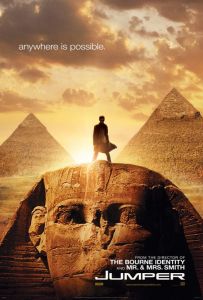 The premise for Jumper seems like adolescent wish fulfillment. Who wouldn’t want the ability to instantly get away? Plus, being able to instantly vanish would unleash an inner Lothario in some men, causing them to love the ladies one night and leave them high and dry the next morning. Having the ability to be anywhere at a moment’s notice is quite a powerful gift but could it lead to tremendous vanity? Director Doug Liman doesn’t seem too interested in all the interesting possibilities afford by teleporting teenagers and instead unleashes what feels like an empty prequel to a hopeful sci-fi franchise.
David (Hayden Christensen) is a shy kid at school when he discovers one day that he has the ability to instantly transport himself to another location simply through the power of his mind. David uses this teleporting ability to, naturally, rob banks and build a cushy lifestyle for himself. He can snack on top of the Sphinx’s head, surf along Australian waves, hang off the clock face of Big Ben, and best of all, he never needs to reach for the TV remote again (seriously, David teleports from one couch cushion to another just to snag the not-too-distant remote). David is a jumper and he discovers he is not alone. Griffin (Jamie Bell, the true star of the movie) has the ability as well and enlightens David on the perils of the jumper lifestyle. Paladins have been hunting and killing jumpers for hundreds of years. The Paladins carry staffs that shoot electrified tethers out, hoping to wrap up the jumpers. The electric bolts stop the jumper from being able to concentrate and escape. Roland (Samuel L. Jackson), a head Paladin, explains that “only God should be able to be all places at all times.”
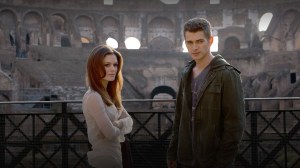 Complicating matters is that David has reconnected with his high school crush Millie (Rachel Bilson). He whisks her off to Rome and they break into the Coliseum together like crazy kids do. He’s vague about where he’s been for 8 years and says he can afford such expensive getaways thanks to his “banking” job. But Roland is circling and plans on getting to him by any means, even if poor Millie gets gutted in the process.
Jumper has some flashes of excitement and a halfway decent premise, but this film is completely hollow on the inside. Liman must have been too entranced with his premise to ask for anything substantive from his slew of screenwriters. The movie has a handful of great images and moments that surely make for a crackerjack trailer, however, there is hardly any attention paid to plot or character or even enticing action. There is one good chase scene between two jumpers going through many stops around the globe; one second they’re running on a beach, the next through downtown Tokyo, and another falling off the Empire State building to landing safely inside a community swimming pool. The pace is a little too break-neck for my taste but the sequence is high on imagination and finally plays with the fun possibilities of teleporters otherwise ignored by the film. That’s the highlight of the movie, right there, and yet even it feels mildly derivative of the sequence in Being John Malkovich where Cameron Diaz chases Catherine Keener through the subconscious bowels of John Malkovich’s memory. This is a movie that asks little of its audience because the filmmakers barely scratched the surface with their material. The execution is a wash and the movie feels like a scattered sightseeing tour told by someone high on crystal meth.
The characters are pretty shallow and powerfully bland, and the romance between David and Millie is entirely contrived and unbelievable. In fact, Millie isn’t a character but a plot contrivance. In the beginning she’s established as the caring girl next door for adoration, then flash ahead years later and upon her first reunion with David she has sex with him because, well, I don’t know, because the plot demands some impromptu sex. Then her purpose is to serve as a broken record of morality; a good hour of Millie’s dialogue is reiterations of the lines “What’s wrong?” “Are you okay?” and “What aren’t you telling me?” It gets really annoying and all she does is keep repeating these queries while David drags her by the hand through Rome. It also hurts that Christensen and Bilson have zero chemistry together. But expectantly, Millie’s final purpose is to be the damsel in distress that requires rescuing. Millie’s lax characterization is emblematic of the film as whole. She and the other characters serve a strict, utilitarian purpose to move the plot forward when it’s called for, but the plot isn’t even that good!
The audience is willing to accept the unbelievable as long as it makes some for of logic on its own terms. People have the ability to teleport, got it. But then the movie throws in the Paladins and gives us little explanation. These grey-coated hunters are some religious order or something and have hunted jumpers since the Middle Ages, though their grasp of technology must have improved. I wanted to know more about these hunters, and “religious fundamentalism” seems like a lazy excuse for motivation. Why do these people go to such great ends to kill jumpers? What is their history? Why do they use tazers instead of guns? If a jumper can’t dodge an electric cord then surely they wouldn’t be able to dodge a bullet. How come the jumpers don’t use guns to easily knock off the Paladins? If this is an ongoing war then how come no one else has caught on to the massive collateral damage of the battles? The jumpers leave trace damage to wherever they appear, so how come no one else seems to have caught on? Just like all the other plot elements, the Paladins are established and then ignored by the filmmakers. I kept finding my mind wandering and I created my own intriguing back-story for the Paladins, one where the insurance companies of the world are sick of losing money to the self-serving jumpers, so they subcontract the Paladins to kill these financial fiends. Right there I just spent more time thinking about how to make this movie interesting than the people responsible for making this movie interesting. The corporate avenging angle is more fun than simply making the villains an age-old religious sect like they were plot leftovers from The Da Vinci Code. This movie needed a whole heaping helping of exposition to provide some minute level of clarity to all the flash and noise.
 There are so many plot holes and loose storylines that it seems like the filmmakers had the delusional thought that this movie was the first step in a franchise. Because of this belief, we are treated to every single character being left hanging and there is no resolution or sense of finality. The subplot with David’s mother (Diane Lane) is tacked on with promise of addressing it in the future. Jumper doesn’t so much end as put everyone on hold, including the audience.
Liman delivered on his Hollywood potential with 2002’s Bourne Identity and 2005’s Mr. and Mrs. Smith, so Jumper is a pretty crushing letdown for a man with such a great mind for inventive action sequences. Liman is sunk by such a terrible script, but it almost seems like the plot was dictated by Liman’s handful of visual cues he had in his brain. There are some nifty images and a couple of cool moments, but cool moments do not make a 90-minute movie, and Jumper lurches from plot point to plot point with depressing routine. There’s so little imagination with the brief, lackluster action sequences given the sheer possibilities with teleporting.
The acting seems on autopilot. Christensen is too bland for words. I repeat my earlier prediction that Christensen will likely be nothing more than the human equivalent of a vacant, pretty mannequin for his acting career; though I must suggest that everyone see his one piece of acting greatness in 2003’s Shattered Glass. His character in Jumper is pretty much a cipher for the audience to have some vicarious, globe-trotting fun, but David is pretty hard to like and doesn’t give an audience much insight into his character. His monotone delivery buries the cheesy dialogue. And, as a die-hard Ohio State fan, it made it even harder for me to root for an Ann Arbor kid. Bilson is pretty but relies on looks of anxiety and sensuous lip biting to display the depths of her one-note character. Jackson delivers a performance suitably in the Samuel L. Jackson canon of screaming and scowling, this time with a white buzz cut hairdo.
If I were being charitable, I’d say that the absence of a succinct story and sufficient characters is because Jumper feels like the pilot to a franchise. But I’m not being charitable. I expected much better from Doug Liman than 20 minutes of setup and another hour of shiny, flashy diversions with little context. The premise isn’t capitalized at all and for a film about the thrilling possibilities of having the world at your fingertips, this movie sure lacks any sense of whimsy and fun. Jumper tells the audience that it has the power to go anywhere, but all I wanted to do was transport myself into a different theater.
Nate’s Grade: C
Share this:

In the Land of Women (2007)
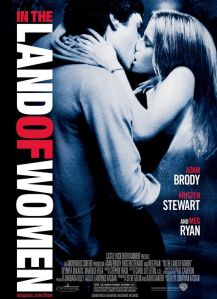 Nepotism is about as prevalent in Hollywood as venereal diseases. Plenty of people get their foot in the door because they just so happen to share genetic material with successful filmmakers. It happens all the time in the world of business, and movies rake in the cash, so the Kasdan clan isn’t any exception to the rule. Papa Lawrence has a storied pedigree. He’s responsible for Body Heat, Raiders of the Lost Ark, The Big Chill, The Accidental Tourist, and two, count ’em, two Star Wars movies (the good ones). His oldest son Jake has directed Zero Effect and Orange County. Now younger son Jon Kasdan is taking the leap into the family business with In the Land of Women.
Carter (Adam Brody) is a Los Angeles writer for soft-core pornography. He?s just been dumped by an up and coming Spanish actress (Elena Anaya). He feels lost and comes up with a plan that will help inspire him to write his serious novel that’s been gestating for ten years. He heads out to a small Michigan suburb to live with his crabby hypochondriac grandmother (Olympia Dukakis). Across the street is a glum family. Sarah (Meg Ryan) is coping with raising a family and undergoing chemotherapy for the lump in her breast. Her teen daughter Lucy (Kristen Stewart) is full of angst and hates her mom. Carter inserts himself into the family’s life and may just heal longstanding wounds.
 In the Land of Women is a strange experience because it feels like the entire movie is cobbled together by subplots. There doesn’t seem to be a strong central storyline, a strong central character, or any real connective tissue. You start to feel the lack of direction and discipline from Kasdan. The characters are all underdeveloped when they aren’t behaving in unbelievable manners. This is another drama where the characters take long strolls and wax introspectively about their life, spelling everything out with rare clarity to strangers. This would be more permissible had the film presented any other avenue for character development. Ryan gets the sick mom storyline, Stewart gets the awkward and angry teen storyline, and Dukakis gets the crazy grandma storyline. It may be a land of women but these aren’t very well constructed women, and I’m uncertain what exactly Carter has learned from this supposedly life-changing experience. He met some women, he listened; in fact, I think that’s where the film takes its first wrong turn. Carter is a self-described great listener, so guess what happens when he meets women who have bottled up their secrets and true feelings? Yep, he listens. And we watch him listen for most of the movie. This allows characters to unload dramatic monologues that do the major work for characterization, but it still keeps our main character, the traveler to the titular land of women, as nothing more than a low-key cipher. He’s a handsome couch for the female characters to unwind. When Carter is typing his Big Serious Novel I’m clueless as to how he has changed as a person and how he reached his point of enlightenment.
I get the unmistakable feeling that Kasdan is really trying to make his own Garden State. This is another story of personal maturation and it takes places with a visit home to a simpler life with comic oddballs. He’s taken the elements that made Garden State click, including a hip and frequently heard soundtrack, but Kasdan must have missed the part where Garden State benefits from strong, likeable characters and a plot. Just like Carter, Kasdan is striving for something grandiose to say about the world, but the end results are no better, and no worse, than something you could catch on a nondescript cable channel. The movie is stuffed with familiar moments, like the bustling teen party, the precocious teen wise beyond her years, the feeble love triangles, and the asshole jock boyfriend. The handful of new wrinkles that Kasdan does explore is easily forgotten; Carter’s job deserves far more discussion. When the Hollywood life butts back in Kasdan doesn’t push the juxtaposition as hard as he should, so Carter’s troubles feel puny, especially compared with cancer. In the Land of Women has some touching moments to it and an occasional wise bit of dialogue, and they stand out amongst an otherwise underwhelming panorama.
 In the Land of Women reaches its awkward peaks when it treats Carter?s mother-daughter interaction like two choices for romance. Carter is supposed to be 25, making him about 20 years younger than mom and 10 years older than daughter. In my book, that’s an “ick” on both accounts. Carter gets to smooch both women (hell, one of the kisses is the poster) and the audience gets to squirm both times. Our sense of guilt is alleviated by multiple characters telling us that Sarah’s father is having an affair, so then it shouldn’t matter if she finds understanding and warmth in the arms of a young emo pup. But what makes these sidesteps so awful is how clumsy and meaningless they prove to be.
The acting in the movie is well done. Brody is apt for a romantic comedy leading man. He’s got oodles of laid back charisma and a winning sense of humor that made him the breakout star of a prime time soap. He’s affable and enjoyable to watch, but his relaxed acting style doesn’t help an undefined character. Stewart is a wonderfully natural actress and largely communicates with her gangly physicality. She has the teen contempt down perfect and looks like an average teenager, which compounds how icky it seems to see her kiss Carter. Ryan hasn’t been onscreen in 3 years, and to tell the truth, I kind of missed her. She gets some standard emotional scenes as an afflicted, underappreciated mother and sells them well.
Jon Kasdan’s filmmaking debut isn’t going to do much to redefine his artistic image other than that of a lucky genetic benefactor. In the Land of Women is earnest and well acted, but the movie is just far too underdeveloped and shapeless to succeed. The film is a collection of non-starting subplots and familiar elements; you just feel that the movie needs a kick in the ass to get on track. The soundtrack is pleasant, the production is competently made, but the story is ultimately lacking and underwhelming. The land of women and men deserves better.
Nate’s Grade: B-
Share this:

Zathura (2005)
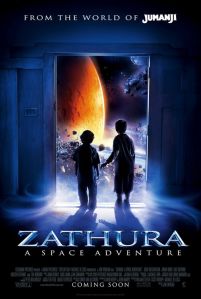 I’m kind of perturbed at how Zathura is being dismissed by the movie going public as, “Jumanji in space.” Seriously folks, does Jumanji hold that big of a place in our collective hearts as a nation? The only thing the two films have in common is that they’re both based on books by noted children’s author/illustrator Chris Van Allsburg (The Polar Express) and that they both involve board games coming to life. That?s it. Do we say that Titanic is ?Romeo and Juliet on a boat” because they both involve doomed lovers? Do we say that Jaws is “Moby Dick with a shark?” Or that Blade: Trinity is “The Hunger minus lesbians”? Or that The Island is “Parts: The Clonus Wars with a budget?” Okay, maybe the last one is accurate, but Zathura is a fabulous family film that has little comparison.
Danny (Jonah Bobo) and Walter (Josh Hutcherson) are brothers that have little in common. Ten-year-old Walter loves sports and isn’t too interested in the “kiddy” things his six-year-old brother likes. Danny himself is battling his own fears and feels left out by his older brother. Their big sister (Kristen Stewart) just wants both of them out of her hair. The family is visiting their dad’s (Tim Robbins) new house. While dad’s out to get some work done, Danny and Walter are antagonizing each other. Walter sends his little brother to the scary basement where Danny finds an old, dusty board game called Zathura. He sets up the tin game board beside his brother and starts playing. Small rockets on poles lurch across the board according to a spinning number. Then a card pops out and says, “Meteor showers,” and sure enough their living room is deluged with fiery meteors (Danny yells to take “erasive action”). Walter is shocked to open the front door and discover their house isn’t parked neatly in the neighborhood but orbiting through the vastness of space. To get back home the squabbling brothers must complete the game, and along the way they’ll encounter giant robots, a lost astronaut (Dax Shepard), and the Zorgons, a race of aliens hungry for some warmth and some fresh meat.
 The child acting is rather outstanding. The interaction between Bobo and Hutcherson (Kicking & Screaming) is great. Each really defines and shapes their character well, from Bobo’s whiny insecurity to Hutcherson’s disinterested anger and overt competitiveness. Stewart (Panic Room) leaves a very sizable impression as the agitated older sister. She has the looks and talent to explode in Hollywood in a few years, a la Rachel McAdams. Dax Shepard (Without a Paddle) is the biggest acting surprise. He gives a weighty and endearing performance as a father figure in the film, and he’s totally on the same wavelength with the movie’s tone.
Yes, Zathura gets a bit more conventional with its story as it draws toward the conclusion (trials of courage, learning from past mistakes, reconciliation), but there’s really only one kind of ending for this film. What did you expect from a 30-something page children’s book, half of which are drawings? Zathura may be predictable but it’s got a loose energy, a comedic zest, and a sense of wonder that elevate the familiar.
Smart family films are about as rare as they come. Zathura breaks the template of what “family film” means nowadays; it doesn’t go for cheap, tasteless jokes, it doesn’t hurl scattershot pop-culture references (seriously Shark Tale, are children going to be amused by a Scarface reference?). Refreshingly, the movie doesn’t have a single joke revolving around flatulence or someone getting hit in the nuts. This is a smart, good-natured family film that will thrill adults and children alike. John Favreau (Elf) is carving a really nice niche for himself directing these high quality family films that are in short supply. His direction is focused and his decisions are right on the money. He doesn’t overwhelm the film with an orgy of special effects. He gets the tone of this movie and never panders to his audience, but he keeps the pace bouncy and the tension racked. I was rapt in suspense during the Zorgon docking sequence, and yet Favreau can also illuminate the tensions of our childhood fears, like a dark basement. Favreau is proving himself to be a dynamite artist behind a lens.
 Isolating the action inside the house definitely helps build the film’s drama. Instead of unleashing the crazy world of the jungle and watching it wreck havoc, Zathura keeps everything bottled up. This decision does wonders for the film’s suspense by giving a claustrophobic overtone. This is a movie more concerned with storytelling than loud special effects. In short, Zathura is light years beyond Jumanji.
The family dynamic feels exceptionally realistic, and the film has a terrific sense of humor. Siblings do behave this way, and Zathura captures their everyday conflicts in a meaningful way. The dialogue has a real zest to it but never feels trite or inauthentic. Mark my words, “Get me a juice box, biyatch,” will be the best movie line you hear all year. Zathura really soars because of its rib-tickling sense of humor. This isn’t Man Drops Banana Peel followed by Man Falls Down. No I?m talking about a consistent tone that’s sly and whimsical, complete with comedic payoffs for even inanimate objects. The various story elements really come together nicely. Zathura is a blast that will hard to beat this holiday season and beyond.
Favreau has directed yet another family film destined to become a classic. The thrills are thrilling, the comedy is whimsical and smart, the storytelling is careful and focused, the special effects are great, the acting is superb, and even the score really soars. This is just a delightful movie of all stripes and should please adventure-seekers of all ages. I was laughing and cheering from beginning to end and so was my theater. It’s a family film that proudly and refreshingly reminds us the possibilities of family films. Zathura is tremendous fun and one adventure that will suck you in instead of just sucking.
Nate’s Grade: B+
Share this:

Panic Room (2002)
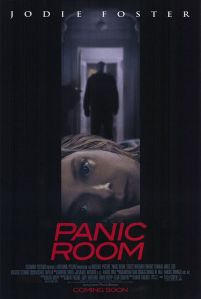 Meg Altman (Jodie Foster) is a newly divorced woman shopping around Manhattan for a new place to sow her wild oats thanks to a healthy marital settlement. The brownstone in question is truly spacious. It comes complete with four floors and a working elevator installed by the invalid former owner. Megs teenage daughter Sarah immediately takes a shine to her new digs and urges mom to sign the dotted line. It seems besides a great location the place also comes complete with a secret room that houses a separate phone line, a wall of monitors all corresponding to cameras, as well as medical supplies and a silver commode. This panic room is surrounded by four feet of concrete and sealed by an airtight steel door. It seems its the ultimate in home protection.
But before Meg and Sarah can barely unpack a trio of burglars enters the home with the hopes of securing the reclusive former owners riches. Meg grabs her daughter and scurries into the panic room just in time to seal the door behind her. She communicates to the men to take what they want and leave. One of them writes on a piece of paper that what they really want is inside the panic room. The burglars aren’t going anywhere, are well equipped and know the panic room better than she does. Meg and her daughter are safe but trapped with little voice to the outside. Thus the pieces are all set and an intricate game of moves and counter-moves takes place to see who has the upper hand, in and out of the panic room.
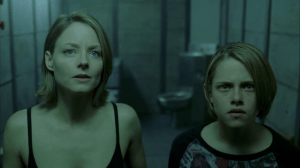 Panic Room is that rare treat as a movie alive and well with energy, tenacity and a double-dose worth of entertainment. The movie flies by and youre left catching your breath or checking your pulse at certain junctures. The suspense continues in an arching fashion and keeps giving the audience new situations to be taken with.
It’s been two years since the public has last seen Jodie Foster in a movie and its good to have her back. Her performance is nominal but she’s put through what must be the most physically strenuous film of her career. She has that rare versatility as an actress to wear corsets and frilly-wear one film and then to be holstering a gun and barking at transsexual serial killers the next, all while maintaining complete confidence and integrity at either.
It seems that today we have a staggering lack of female action leads that could kick your ass. Sigourney Weaver once owned this throne but now the only thing we have to offer is pinups. We have Angelina Jolie’s scary glares. We have the pout of Michelle Rodriguez, who has since blown what promise she showed in Girl Fight by starring in two horrible consecutive films about zombies (one of these said zombies being Vin Diesel). And I dont think I even need to go into Milla Jovovich. So it’s refreshing knowing that Foster, even while pregnant for part of filming, can swing with the big boys and surely roll some heads and take some names.
The actors portraying the burglars play basic criminal archetypes, but do passable jobs with them. Forest Whitaker is the soft-spoken security expert who refuses to play rough if the situation calls for it. Jared Leto is the comically impulsive grandson who feels slighted by not being granted a sum of the inheritance. Dwight Yoakam (yes the Dwight Yoakam) is the questionable addition with an itchy trigger finger and a determination to get his mitts on the money.
 Director David Fincher, the auteur that gave us a head in a box with Se7en, returns with his kinetic kick and brooding finesse. Fincher is a vastly talented visual director and adds more richness to the film with lovely cinematography and an astutely mature sense of tension.
However, Fincher’s sensory excesses get the better of him the longer the film goes. Does the audience really need to have the camera travel through the handle of a coffeepot? Does anyone really need the camera to swirl into the bulb of a flashlight so we see how it works? It may come to the point where you’re anticipating the next superfluous camera movement, and praying that it isn’t plunging into Yoakam’s nostrils. Once or twice is fine, but after awhile the nomadic camera movements become far more distracting to the film. The ending is also a bit anti-climactic for my taste.
Panic Room, despite a few missteps, is a great exercise in suspense. You may get so wrapped up youll find yourself, as I surprisingly did, reverting to the annoying habit of talking to the characters on screen and trying to instruct them. Panic Room is the kind of movie you wish Hollywood made more often: something with genuine thrills that leaves you pinned to your seat and bubbling with anticipation, before turning you into a puddle of warm goo.
Nate’s Grade: B


 nathanzoebl
You must be logged in to post a comment.