Blog Archives
No Other Choice (2025)
 The title of the Korean movie No Other Choice is spoken, in English actually, a few minutes into the movie. It’s the brief, unhelpful reasoning from an American exec that just bought a South Korean paper company and is reducing the local labor force. Our main character, Yoo Man-su (Lee Byung-hun), has been work-shopping his spirited speech about how important these jobs are to appeal to the American businessmen, and then when it comes time to deliver, he’s reduced to chasing them down as they quickly depart. Before he can even get into a second poorly-formed sentence, the exec cuts him off by saying, “No other choice,” and then sidles into the protective safety of a chauffeured vehicle. The implication is that this business has to reduce its labor force to stay profitable, and yet rarely is this so simple. In legendary director Park Chan-wook’s (Old Boy, Decision to Leave) latest, characters will often repeat the title of the movie as a deference to guilt, that they were forced to make hard decisions because those were the only decisions that could be had. Unfortunately, as this mordantly funny, exciting, and intelligent movie proves, people have a way of deluding themselves when it comes to finding justifications for their bad behavior and greed.
 The real plot of No Other Choice is Man-su’s readjustment. In the beginning, we see the life he’s built for his family, his wife Lee Mi-ri (Son Ye-jin), stepson Si-one, and daughter Ri-one, with their two big dogs. After a year of job searching, Man-su is bouncing from one job to another, and the family has been forced to make cutbacks to their lifestyle (“No Netflix?!” the son says in shock). Lee Mi-ri takes on a part-time job as a dental assistant to a hunky doctor. The dogs are shipped to Lee Mi-ri’s parents. Ri-one might have to stop her expensive cello lessons, which is a big deal as her teacher says the Autistic child is a prodigy, but her parents never hear her play. The paterfamilias needs to find a good job fast. That’s when Man-su gets the idea to post a fake job for a paper company manager to better scope out his competition. He takes the top applicants, the guys he acknowledges would be hired ahead of him, and creates a list. From there, Man-su pledges to track them down and eliminate them so his own odds of being rehired climb up.
The movie keeps shifting in new directions and tones with each new target, and it creates a much more fascinating and intriguing experience. I loved how each of the targeted rivals is treated differently and how each of these men come across as people who are struggling, hopeful, and quite like our beleaguered protagonist. There are good reasons why this movie has been described as Chan-wook’s Parasite, his culminating condemnation on the pitfalls of capitalism, how it pits peers against one another when they should be allies. Man-su views each man as his competition, impediments to him getting that prized position. However, each of these people is far more complicated than just their resume. At any time the movie could stop on a dime and just have two strangers, one of them intending to possibly kill the other, just have a heartfelt conversation about the difficulties of providing for your children and knowing that there are hard limitations that cannot be overcome. One man is struggling to adapt to a new marketplace after working in the paper industry for twenty years, and Man-su even echoes the complaints from the man’s wife, chiefly that he could have applied himself to other industries and jobs, that he didn’t have to be so discriminating when it came to a paycheck. Now, from her perspective, she’s arguing this point because she feels he is not casting a wider net for promising non-paper job opportunities. From Man-su’s perspective, he’s chiding the man because he doesn’t want to kill him but the guy’s intractability has put him in Man-su’s crosshairs. The unspoken comment is that Man-su is doing the same thing. At no point does he really consider getting a different job and thus being in a position where he does not feel forced to literally eliminate his best competition. He too is just as stubborn and blind to his own intractability. The system has a way of turning men against one another in order to boost a corporate balance sheet. This movie is just taking things a little further to the extreme when it comes to cutthroat competition.
 I also appreciated that the movie has a larger canvas when it comes to charting the ups and downs of its conspiracy. Man-su’s wife is not kept as some afterthought, you know the kind of movie where the husband goes on these wild journeys of the soul and his wife is just as home going, “Where have you been?” She’s an active member of her household and she is not blind to their financial shortfalls nor her husband’s increasingly worrying behavior and absences. She’s worried her husband may have begun drinking again after years of sobriety and peace. She makes attempts to reconnect with her distant husband, who is becoming more consumed with jealousy about her boss and his desirability. She’s not just the doting spouse or concerned spouse. She’s a resourceful character who recognizes problems. When another threat to their family materializes, Lee Mi-ri takes it upon herself to find a solution. Naturally, given the premise, whenever you have one member of a couple doing dastardly deeds, whether they get caught by their partner is a primary point of tension, as well as if so, how will their partner respond. I think the track that Chan-wook and co-writers Lee Kyoung-mi, Don McKeller, and Le Ja-hye decide is perfect for the story that has been established and especially for the darker satirical tone of the enterprise.
Despite the murder and gnawing guilt, No Other Choice is also a very funny dark comedy as it channels the absurdity of its premise. It’s always a plus to have amateur murderers actually come across as awkward. Just because they decide to make that moral leap shouldn’t translate into them being good at killing. There’s unexpected humor to Man-su’s amateur stalking and preparations. He’s also not immune to the aftereffects of his actions, getting queasy with having to dispose of these men and thinking of the best ways to obscure his physical presence from crime scenes (there was one moment I was literally screaming at the screen because I thought he forgot a key detail). Lee Byung-hun (Squid Games) is terrific as our lead and finds such fascinating reactions as the movie effortlessly alters its style and tone, one minute asking him to engage in silly slapstick and the next heartfelt rumination. I don’t think the film would be nearly as successful without his sturdy performance serving as our foundation. You really do feel for him and his plight, and perhaps more than a few viewers might feel the urge for Man-su to get away with it. The culmination of the first target is a masterful sequence where three characters all have a different misunderstanding of one another as they literally wrestle for a gun inside an oven mitt. It’s one of those moments in movies where you can stop and think about all the small choices that got us here and appreciate the careful plotting from the screenwriters. I found myself guffawing at various points throughout the movie and I think many others will have the same wonderfully wicked reaction.
 I could go on about the movie but hopefully I’ve done enough to convince you, dear reader, to give No Other Choice the ultimate decision for your potential entertainment. It’s a movie that covers plenty and leaves you deeply satisfied by its final minutes, feeling like you’ve just eaten a full meal. The ending is note-perfect, but then I could say just about every scene beforehand is also at that same artistic level. I won’t go so far as some of my critical brethren declaring this as Chan-wook’s best movie; I’ll always fall back on 2016’s The Handmaiden, also an adaptation of an English novel, much like No Other Choice (would you believe the source materiel is from the same author who gave us the novel for Play Dirty?). Regardless, this is exceptional filmmaking with a story that grabs you, surprises you, and glues you to the screen because you don’t know what may happen next (Patricia Highsmith would have loved this film).
Nate’s Grade: A
Share this:

Play Dirty (2025)
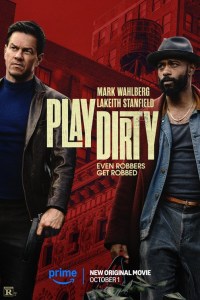 Shane Black is one of the best known writers in Hollywood across three-plus decades. His brand of witty, self-referential genre writing became its own appealing sub-genre of action cinema from the 1980s into the 90s. He resurrected Robert Downey Jr.’s career with Black’s directorial debut, the rollicking and immensely entertaining Kiss Kiss Bang Bang. Downey returned the favor by getting Black the gig writing and directing Iron Man 3. It’s been eight years since Black’s last directing effort, 2018’s messy and ultimately disappointing Predator reboot (Black actually had a small acting role in the original film). Shane Black movies are never ever boring even when they’re not completely working. Play Dirty is based on the Parker book series, a character portrayed by six other actors including Mel Gibson, Jason Statham, and Jim Brown. There are 26 of these Parker books, but after watching Play Dirty, by far Black’s worst movie, I don’t even understand what the appeal would be. This character just plain sucks.
Parker (Mark Wahlberg) is a slick professional criminal trying to score big and get his revenge. In the opening sequence, one of his heist crew, Zen (Rosa Salazar), betrays the group, steals the money, and kills everybody except Parker. He tracks her down and she’s in the middle of an even bigger scheme, one involving billions of dollars from uncovering literal sunken treasure on the ocean floor. He doesn’t like her or trust her but he sure could use his cut of a billion dollars. He taps old colleagues from other old jobs, the colleagues who haven’t been killed, and they must all work together to get their next big score.
 I was blown away by how powerfully unlikable the main character comes across. I don’t need characters to all be beholden to my opinion of likeability, but deficits in this matter are typically offset by writing the character with some degree of personality, menace, or intrigue, something that makes you want to keep watching them onscreen even if you don’t agree with everything they’re doing. However, this Parker guy, as portrayed by Wahlberg, is a big dumb guy who doesn’t recognize he’s a big dumb guy. As a result, he’s beholden to impulsive decisions that come across as cruel to the point of being sociopathic. Again, we’re used to criminal characters being flippant or prone to violence in other stories, but the introductory presentation of this character simply befuddles me and rubbed me the wrong way throughout.
Take for instance the literal opening minutes of Play Dirty. It’s in the middle of a heist but the story doesn’t start us off with the perspective of our thieves collecting their loot. It starts instead with a security guard stumbling onto their heist. He’s with his wife and child in the car and decides, rather than intervening, he’s going to use this opportunity to steal himself some of their ill-gotten loot. Right there, we’re starting with a character making a consequential choice, and our perspectives are not aligned with the robbers but with the robber of the robbers. I wanted him to get away, and frankly, following his story could have proven compelling as well, as someone who gets in over their head and tracked down by professional criminals who want what was taken. Parker gives chase through a race track and eventually shoots this man dead in front of his wife and child. Lest you think Parker is an irredeemable, unfeeling cretin, he takes stock of this woman’s grief and trauma and offers her ten thousand dollars of their loot, to bribe her silence and make amends for the murder of her spouse (that’s not even a good life insurance payout). I don’t know why Black wanted us to begin empathizing from the perspective of some guy who was only intended to be unceremoniously killed, in front of his wife and child. This move made me immediately dislike Parker, and then his little gift for the wife’s trauma felt completely insulting.
 This incident isn’t the only example of Parker being a shoot-first-ask-questions-never brute of limited intelligence. When he reunites with Zen, she’s talking with some guy who planned her new big scheme. Parker doesn’t know anything about this guy other than his physical proximity to Zen. He shoots him dead. For what reason? I don’t know what he was trying to accomplish except an expression of his impatience and hatred for life. I wonder if an elderly nun had been standing next to Zen at this moment and would Parker have committed the same rash act of violence. What about if it was his own mother? To make matters even worse, Parker accompanies Zen to break the news to the dead man’s boyfriend, and it’s in this moment of shock and grief that Parker harasses this bereaved man that Parker berates for crying. He seems to take amusement in how bluntly he informs the other man that his love is never coming back, though leaving out the key part where he carelessly murdered the man. He also shoots Mark Cuban in the leg while he dines in a restaurant for no reason other than being near the guy that he wanted. Again, much of this could be workable if the character of Parker was… anything. He’s not funny, he’s not charming, he’s not really clever or good with plans; he’s just a big dumb guy prone to violence, scowling, and deep sighs. Wahlberg looks bored throughout the whole movie and it makes the character even harder to entertain. If this guy doesn’t want to be here, can we select someone else to be our requisite protagonist?
We might have a leaden dud of a lead, but what about the rest of our enterprising team of thieves and conmen? Do we have any winners here to compensate? Sadly, the team is just as listless. Take Grofield (Lakieth Stanfield) who fraternizes as a theater owner, one who is constantly losing money. That setup has some interest, a criminal who possibly longs to be more of a professional actor, perhaps that eagerness even pushes him into suggesting different covers and roles he could play in their heists. Perhaps he might even see himself above the others since he feels like he is trying to promote the arts. There’s all kinds of ways this introduction could better shape his personality, interests, and contrasts with the other crew. For the rest of the movie, Grofield is just another guy on screen, just another guy driving a car or shooting a gun. There is one brief moment that takes advantage of his interest in acting as he poses as a drunk on a rooftop threatening to jump. After a security guard arrives on the scene, he and Parker subdue the guard, coat him in the same outfit Grofield was wearing, and then toss him off the roof to his death (ho ho). There’s a husband and wife team of crooks (Keegan-Michael Key, Claire Lovering) and that could be interesting, especially if they’re mixing professional and romantic squabbles, or maybe working together is the thing that keeps their spark going, the showcase for their real teamwork. They have one scene with some passing bickering but otherwise they too are just more indiscriminate people onscreen, another person to hold a gun or drive a car. Even the bad guys are boring. Who should I actually care about? I was rooting for that grieving mother and the one guy’s sad boyfriend to team up and punish Parker’s crew.
 Part of the fun of heist crews and con artists are the colorful personalities, the peculiarities, the intra-group conflicts and dynamics, but this movie gives us so little. It’s almost as if the characters are merely meant to trick the brain of a viewer barely paying attention, providing an assurance, “These are the guys,” without forcing thinking over differentiation. It’s like the film equivalent of not wanting to arouse like your elderly grandfather with conflicting evidence contrary to his memories. It’s like accepting defeat.
So the characters are lousy, are there any outstanding or fun caper or action scenes? Black is known for his snappy style and pulpy sensibilities across genres. He hasn’t made a boring movie yet, so I had hoped that even if Play Dirty ultimately proved lackluster, at least it would provide some flash and fun. Nope. Many of the action scenes are Parker and company just throwing caution to the wind and shooting a bunch of guys. There’s one sequence in the middle that involves actually planning and steps to draw our interest, it’s a ridiculously over-the-top plan that shows once again the crew’s disregard for collateral damage. Their valuable cargo is being shipped through the city on an elevated train, so the team decides to derail the train in the middle of the city. Not in a deserted area unpopulated by civilians, in the middle of town. As expected, the train careens off the tracks and through the city, likely causing the deaths of dozens of innocents we’ll never know because their existence is unworthy of the movie’s attention, much like the suffering of that widow and child in the opening sequence. The sequence is the equivalent of killing a mosquito with a flamethrower, and while overkill can certainly be cinematic and pleasingly entertaining, just ask Michael Bay or James Wan, it needs to exist in a world where that overkill is normalized. Otherwise, it just stands out as excessive and causes us to poke holes at the baseline reality.
Play Dirty is astoundingly dull and witless, lacking any of the spark and personality flair I expect from a Shane Black vehicle. Mark Wahlberg’s somnambulist performance is the best symbol for this entire enterprise, a crime thriller going through the motions but with its mind elsewhere. I know I certainly felt my mind going elsewhere while watching. Not just dull and tedious, Play Dirty is also just an uncomfortable experience because we’re stuck watching a group of unrepentantly amoral characters endanger and kill innocent lives in the pursuit of ill-gotten gains, but these characters aren’t intriguing, complex, memorable, or even cool, so the whole movies feels like you’re watching a pack of dude bros just randomly terrorize anecdotal characters out of sheer detached boredom and nihilism. It’s not fun, it’s actually quite the opposite of fun, and I wish Black had put more of himself into this enterprise (hey, the Christmas setting is present). Who wants to play with characters this boring and repulsive for two hours?
Nate’s Grade: C-
Share this:

Hit Man (2024)
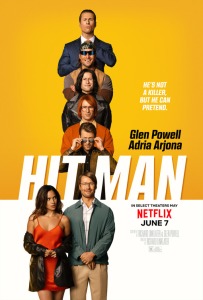
Hit Man is a movie that is wonderfully hard to describe. The premise has an easy-to-grasp hook that promises fun and hijinks, but where it goes from there takes on as many transformations as its protagonist, Gary Johnson (Glen Powell). It transforms from a fun game of undercover conning with wigs and silly accents into an unexpected rom-com hinging upon mistaken identity, maintaining assumed appearances, and secrets that then transforms into full film noir without losing its unique identity and the stakes of the character relationships. If you’d expect any filmmaker to pull off that trick, writer/director Richard Linklater has to be one of the best to keep things running smoothly, and that he does, as Hit Man is a crowd-pleasing comedy with some unexpected directions to keep everyone guessing until it lands on its own morally gray terms.
The movie is also, chiefly, a showcase of star and co-writer Powell, a handsome young actor hitting a new ascent of his career with last year’s Anyone But You and the upcoming Twisters. Powell is probably best known as the smirking guy you loved to hate in Top Gun: Maverick, but he’s also played memorable supporting roles in Scream Queens and three other Linklater film projects, notably 2016’s Everybody Wants Some!!, a pseudo-spiritual sequel to the seminal Dazed and Confused. This is Powell’s acting showcase and he’s utterly terrific. He has great infectious fun getting into the various hitman characters, which mostly exist in montages, and trying on different personas and voices. I cackled when he was doing his impression of Christian Bale’s Patrick Bateman, and I smiled throughout most of the other personas. It’s easy to see the network TV version of this premise, where every week Gary adopts a new persona and disguise to bust the next possible criminal from hiring a hitman, like an edgier Quantum Leap). The culprits are played like nitwits but then again the police are also played as nitwits (are there THIS many attempted hitman hirings in one city for the police to have a full-time unit?).
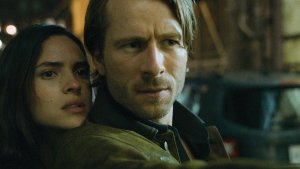
But before this acting experiment can get too broad or too redundant, Linklater and Powell switch things up. Around the Act One break is where Gary meets Madison (Adria Arjona), and that’s when everything changes for him and the audience. Now we have emotional stakes, because Gary intervenes to save Madison. While the circumstances of their first meeting involve her wanting to kill her husband and believing Gary as the professional to do such a job, the scene plays as a disarming first date you’d find in another charming romantic comedy, where it’s clear to anyone with a pulse that these two have something together. Instead of busting her for the solicitation, he pushes her to change her mind, take the money and leave her no-good husband rather than finding a questionable man to eliminate him. From there, they form a romantic relationship that fluctuates wildly. She thinks Gary is “Ron,” the suave and confidant persona Gary adopted for their sit-down. So the nerdy tech nerd who teaches philosophy must pretend to be the daring and dangerous man of mystery he wishes he could be. The script doesn’t get carried away with its farcical elements in play, juggling multiple identities for multiple specific audiences, but it asks the question, “Why can’t the milquetoast Gary simply be Ron? Is this an unexpected means of self-actualization for the nerd to win the girl?” Through this extreme exercise, Gary can mold himself into the man he would like to be. The rom-com is flirty, funny, and just as enjoyable as the earlier wacky comedy of being a versatile master of disguise.
It also really helps things when your two lead actors have such strong chemistry. Powell and Arjona (Father of the Bride, Andor) are smoldering together, like full on “get a room already” territory. This lends even more credence when Hit Man makes its next transformation into film noir thriller. I won’t divulge the specific plot elements but it all works with what Linklater has already established. There’s trouble for the both of them, and the question becomes how far is each participant willing to go to stay above the fray. The transition from silly costume comedy to sundry noir thriller is handled so naturally, as if the characters, already existing under such unique circumstances, found themselves in the elevated movie-movie version of their crazy relationship. Rather than feel contrived, Linklater and Powell have put in the work to make these twists and turns credible and exciting. The shifting nature of the movie is a wonderful reflection of its fake hitman hero. There’s a scene late in the film, where all of our principal players have come together, and you have characters saying one thing, intimating another, for different versions of different audiences, and it’s such a masterful tonal dance that feels satisfying as a climactic turning point as well as genuinely impressive for all the myriad subtext in play.

This is a clear-cut case of a movie being “inspired by” a true story rather than being “based on” a true story. Generally, we expect the “based on” stories to have some voracity to reality. We accept that there will be alterations for dramatic purposes, externalizing the internal, condensing timelines and characters into a more accessible structure, etc. If you go to a movie about Jackie Robinson, you don’t expect to see the famous baseball slugger fighting space monsters (“Racism was the real giant monster all along”). Hit Man is based upon a 2001 long-form news article by Texas Monthly journalist Skip Hollandsworth, the same author of the source material for Linklater’s fascinating true crime dark comedy gem, 2011’s Bernie, which I highly recommend (a career-best Jack Black). The real Gary Johnson really did pose as a fake hitman for the purposes of catching real criminals, but the rest of the movie exists in its own fictional universe of dramatic complications. Usually we want our film stories to have more fidelity with the truth and reality, but I’m glad Linklater and Powell recognized the sheer storytelling potential of this quirky premise. Sticking to the facts could have told an amusing story, but feeling confident to take bold leaps with well-worn genre motifs, when called for, is the right call for making the most of this tale.
The shame of Hit Man is how quickly it will likely be subsumed by Netflix’s suffocating tidal waves of content. Here is a fun, likable, and surprising indie comedy with definite mass appeal buoyed by great performances, clever writing, and a tonally shifting narrative to keep things fresh. Powell gets the breakout showcase he deserves and we get one of the most unexpected and amusing rom-coms of recent years. Hit Man is a movie that deserves to be seen, to be enjoyed with a crowd, but I worry it will get lost in the shuffle of streaming titles. I suppose this might just be the current reality for fans of mid-level adult dramas and comedies. At least they have a home on the streaming networks even if these movies would have been theatrical breakouts years ago. Regardless, Hit Man is a good time with good people pretending to be bad, or is it bad people pretending to be good, but whatever pretense, it’s a charming winner worth your two hours.
Nate’s Grade: B+
Share this:

The Hunger Games: The Ballad of Songbirds & Snakes (2023)
 Who exactly was watching The Hunger Games and thought to themselves, I wonder if this evil old fascist dictator played by Donald Sutherland was ever young and sexy and in love? Well fear not, whomever you are, because 2023 gave us the adaptation of The Ballad of Songbirds & Snakes, the far too long adaptation of Suzanne Collins’ prequel book, thus granting the studio more material to grind into products. I guess we should all be grateful that this wasn’t stretched into two movies like the original plan. Taking place 60 years prior to the events of the first movie, young Coriolanus Snow (Tom Blyth) is trying to financially secure his family’s safety in the Capitol, and he’s also mentoring one of the district combatant’s in the tenth annual Hunger Games death match. His charge is District 12’s Lucy Gray Baird (Rachel Zegler), a feisty Romani-esque young woman who uses song as her vehicle for rebellion, and young Snow has to coach her to victory if he has any hope of righting his family’s lost standing. Fortunately, the Hunger Games behind-the-scenes coordination and development is interesting, and filled with top-level actors living it up in these outsized roles (Viola Davis, you national treasure). The deadly games themselves are confined to one dilapidated arena and are visually engaging even in such a limited space. Unfortunately, the would-be Romeo and Juliet romance between Snow and Lucy Gray is far less engaging, and young Snow proves to be a handsome bore. There was potential here in exploring the origin of a monster but the villainy seems awfully contrived to push him along on an arc, with several drastic personal decisions absent believable development. We’re talking big character leaps here, the kind that I can’t even really explain except, “Well, I guess he just had it in him the whole time.” The hazy rationalization and rushed development reminded me of Anakin Skywalker’s underwhelming descent into the dark side. Songbirds & Snakes is only really going to work for the diehard fans of the franchise asking for a little more time in this dystopian universe and daydreaming about the washboard abs and baby blue eyes of their favorite older fascist.
Nate’s Grade: C+
Share this:

The Killer (2023)
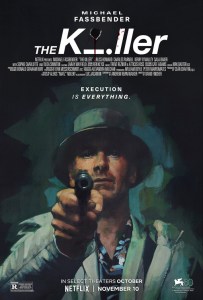 Were you even aware that David Fincher had a new movie? The celebrated director has been very mercurial since 2014’s Gone Girl, only helming one other movie. His partnership with Netflix has afforded the notoriously perfectionist director a lot of creative latitude, though sadly not a third season of Mindhunter. But even the artistic cache of a new Fincher movie isn’t enough for Netflix to change its business model. The Killer only played in theaters for two weeks before beaming into millions of homes. You would think this streaming giant would want to leverage its big names and their new projects, but I’m reminded of how much money Netflix likely left aside forgoing Glass Onion’s theatrical run. Alas, The Killer is an intriguing if cold and unsatisfying thriller that epitomizes the limits of surface-level living.
Our titular killer (Michael Fassbender) is hired to kill a Parisian businessman and botches the job. He’s on the run and fears for his well-being from his employers wanting to eliminate any loose ends. His girlfriend in the Dominican Republic is beaten and threatened, and the lead killer realizes he’s going to have to out-kill all the other killers after him if his loved ones don’t get killed. Through five chapters, each ending in a death, the killer works his way up the food chain.
 Fincher is attempting to strip out the movie-cool mythos of the world of hired assassins, to subvert the entertainment value that can come with expert murderers leading to blood and death. The Killer is Fincher’s stubborn subversion of what a trained assassin movie should be, and his main takeaway, beyond stripping the misplaced glamor from the profession, is how tedious it would all be in real life. In the movie world, being a trained killer involves all sorts of exciting derring-do and acrobatics and the like. In the possible real world, being a trained killer is more like a paid security guard; it’s a lot of protracted sitting and waiting and watching, and it’s easy to understand just how overwhelmingly boring all this would be. The opening twenty minutes quite convincingly strips the cool factor away from this profession. It doesn’t make you feel the weight of the culpability, like 2018’s You Were Never Really Here (more on that later), but what it makes you feel is just how maddening and boring this whole job must be and what kind of dedicated people would succeed. It’s like Fincher is making a bet with a mainstream audience that he can find a way to make a boring assassin movie, and while doing so can be seen as subversive to some degree, bleeding much of the thrills out of the picture, it also feels like a bet gone wrong. You made the main character boring on purpose to prove a point, but regardless of intent, your protagonist is still boring. Victory?
As physically inactive as Act One proves, watching our title killer sit and wait and watch, it is conversely hyperactive in narration. This is wall-to-wall narration as our lead character expounds upon his regiment to keep his mind and body ready when his eventual window materializes. It reminded me of the narration of Patrick Bateman from American Psycho, about his methodical lifestyle routines. Except that character was being satirized from their first moments, whereas the emptiness of our killer here is the larger point, that he’s fashioned himself into an unfeeling weapon. Here is a character that feels he is only effective if he strips everything human away, if he only focuses on the job regardless of politics or consequences, and lives his spartan existence. I’m sure he envisions himself as some noble modern-day samurai, living a code others cannot keep. Except the movie reveals throughout that he might not be the best killer in the phone book. First off, he misses shooting his target, which sets everything into motion. All his narration about focus and yoga and dedication and even I know you shouldn’t fire while someone else is in front of your target. There’s a jarring scene where he fires nails into the lungs of a character and theorizes the man has six or seven minutes left to live before his lungs fill up. Nope. The man dies within one minute max. For all his resourcefulness, which is benefited by the long reach of capitalism, the man also doesn’t live up to his self-image. His paranoia keeps him from returning to his home on time and allows the attack on his girlfriend to happen in his absence. There might be an even deeper commentary on how even the lead is confusing his life for a movie.
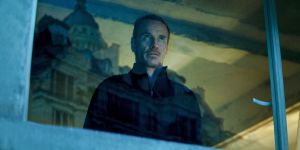 My favorite scene is a sit down with a competing hired hitman played by Tilda Swinton (Three Thousand Years of Longing). She’s one of the two competing assassins responsible for targeting his girlfriend, so she presents a threat. He meets her at a fancy restaurant and she already accepts that she will not be making it to dessert. She is the exact opposite of our main character, a woman who has found a way to live a normal life in the suburbs, marry a man, and enjoy the luxuries of a life afforded by her wealth. She’s not living out of storage units or purposely dressing like a German tourist to stay under the radar. In some ways, this has allowed our more single-minded assassin to get the jump on her, to take advantage of her complacency. However, it’s also an indictment on the stripped-down, isolationist life our lead killer has prioritized. Here is a woman who has embraced allowing herself to enjoy things. She’s not eating McDonald’s breakfast sandwiches minus the slimy egg patty. She’s not slumming it for her “art.” She sees no value in abstinence. This stark contrast, as well as a sustained conversation between two foes, is the highlight of the film. It’s also interesting to watch Swinton’s character go through her own mini-grieving process accepting the likelihood that this will be her final meal, and so she savors it without fear.
Being a David Fincher movie, you can rightly assume that the technical elements are nearly flawless. The visual arrangements are beautiful, the cinematography is chilly and atmospheric, and the editing is precise and smooth. The first attempted kill has a nice degree of tension simply from shifting audio levels, going from diegetic to narration, never allowing the viewer to properly adjust during such a heightened point of paying attention. It’s naturally unsettling and effectively raises the tension of a moment we’ve been waiting over twenty minutes to arrive. There is an extended hand-to-hand fight sequence that’s exceptionally well choreographed and carries on from room to room, transforming with each new location and utilizing the geography of each space nicely (the John Wick folks would approve). The overall movie feels more in keeping with the likes of Fincher’s Panic Room or The Game, a more straightforward thriller that lacks simply extra levels and commentary, like Zodiac or Gone Girl. There’s nothing wrong with a well-executed and developed thriller purely designed to be a good time. It’s just at this stage of Fincher’s career, the expectations are raised, fairly or unfairly, with every new release. The Killer is a polished thriller meant to be pared down to its essential parts and can be enjoyed as such.
There is little to hold onto here emotionally though, so we’re left with the intellectual curiosity of watching a so-called professional go about their business and see how he gets around obstacles. Very often it’s dressing up in a delivery outfit and simply waiting on other polite strangers to open doors for his unassuming facade. One could argue that the character arc is about a man who rejects empathy, argues that it is weakness, comes around to accept empathy, and embraces it on his way out. I can see some of this, as the motivation for his trail of vengeance is to protect his loved one from being harmed again. There’s even a moment where he demonstrates a sliver of sympathy to a victim, albeit still utilizing gruesome violence. Except I don’t believe that easy assessment of this being a journey of embracing empathy. This doesn’t come across as a character changing who they are but instead as a character cleaning up their own mess. The main character keeps reiterating to “stick to the plan, don’t improvise,” but I don’t think he’s reflecting at any point on his actions beyond a clinical cause-effect relationship. He’s stripped all the complexities of humanity out from himself but recognizing fault isn’t the same as building and maintaining a sense of empathy. I also think the reading that many critics are making of Fincher standing in for the main character, a dedicated tactician who tries to do it all, is a little too cute and desperate for meta-narratives to derive a better lens to analyze the overall vacancy of the lead character.
 This is very different from Lynn Ramsay’s You Were Never Really Here, a film that also subverted the same hitman sub-genre and made the audience re-examine its own bloodlust. As I wrote in 2018: “The focus of the movie is on the man committing the acts of violence rather than how stylish and cool and cinematic those acts of violence can be. …Ramsay offers discorded images and brief flashes and asks the audience to put together the pieces to better understand Joe as a man propelled and haunted by his bloody past…. It’s not all tragedy and inescapable dread. Amidst Joe’s tortured past and troubled future, there’s a necessary sense of hope. You don’t know what will happen next but you’re not resigned to retrograde nihilism.” This is not the feeling I took from The Killer, and I recommend everyone watch Ramsay’s movie too.
The problem with making a boring assassination thriller on purpose is that, at the end of the day, you still have a boring assassination thriller. Fassbender (who hasn’t been on screen since 2019’s Dark Phoenix killed the X-Men franchise) can be compelling for two hours doing just about anything, and a performance that is minimal in spoken dialogue does not mean a minimal performance. He’s great to sit and watch, the running commentary of his narration serving as a starting point to assess all the concentrated, nuanced acting under the surface. The Killer has sheen and skill, much like its title character, but it too also misses the mark where it counts.
Nate’s Grade: B-
Share this:

John Wick Chapter 4 (2023)
 As many of you are well aware, I believe great action can be some of the highest cinematic highs one can experience through the transporting thrill of the movies. It’s the larger-than-life quality, the symbiosis of so many tactical teams working in harmony to pull off the breakneck stunts, rapidly escalating stakes, and organic story complications, that it all feels like the best kind of magic trick. For my money, Mad Max: Fury Road is closer to the pinnacle of the artform than a majority of self-serious Oscar bait drivel. In many ways, musicals are very similar to action movies, as fight choreography is nothing more than a rehearsed dance between professionals. Both must incorporate geography, spacing, and interaction to maximize their appeal. It is from this perspective that I approach the John Wick franchise, a series that I have enjoyed and has gotten more popular with every new entry. John Wick: Chapter 4 is about as action-packed as they come, running at nearly three hours long. I purposely waited and saw the movie with my father, a fellow lifelong lover of big screen action and particularly Fury Road. We both had a blast, and rather than write a review of exclamatory nonsense, I thought I’d look over some of my finer critical points with 2019’s John Wick 3 and analyze how 4 excels beyond.
John Wick (Keanu Reeves) is a legendary assassin in a world where I think half the population are secretly, or not so secretly, trained assassins. I have to think the union collective bargaining negotiations are brutal. Regardless, John has been on the run ever since he upset the High Table, the cloak-and-dagger authority over this clandestine universe. He’s had a bounty on his head getting larger and larger with every foiled assassination, and there have been hundreds at this point. To finally clear his name, John plans on challenging the Marquis (Bill Skarsgard), the new controlling High Table member who is un-sanctioning every international hotel that gives refuge to Wick. The old rules state that Wick can challenge the Marquis to a duel, but getting to the actual dueling site might be murder.
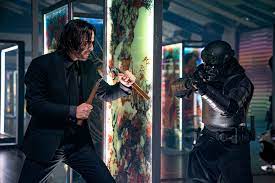 As I wrote in 2019: “Most other action movies have one or two moments that make you wince or make you shake your head in astonishment of something intense, gnarly, or self-evidently awesome. John Wick 3 is packed with these moments… For action fans, the John Wick series is a simplified adrenaline shot where the director and star are working in unison to compose goose bump-triggering action cinema for the masses.”
This compliment is still applicable because the lasting draw of the John Wick franchise has always been its highly polished and intense action sequences. Series director Chad Stahelski has an intimate understanding of his star’s physical capabilities, having served as Reeves stunt double for years, and he and his team stress the fidelity of visceral realism with their overtly preposterous movie. The action is displayed in long takes, wide shots, and gloriously accessible visual arrangements to allow the audience to truly enjoy the splendor of the moment. This philosophy stretches to car chases, like an exciting roundabout of the Arc de Triomphe making bodies fly through the air, and even horseback chases, like an opening evoking Lawrence of Arabia. There were several moments that made me giggle in giddiness, like a woman relentlessly stabbing a man she rode piggyback up the stairs, and a sustained high angle where Wick clears room after room of baddies with fiery canisters that turn each target into a burst of flames, and a fight ascending many flights of stairs that has echoes of Wile E. Coyote slapstick. If you are a lover of action, these movies will not disappoint in that department. The movie takes about 30-40 minutes to set up its stakes and goals, and from there it’s relentless. The best compliment I can give is that Chapter 4 did not feel like three hours because it just flew by for me.
This is where my small criticisms of 2019’s third entry began, and I’ll address them one-by-one: “Because the movie rarely catches its collective breath, it can also feel like a mindless video game, with each new location a new level and with innumerable, faceless cohorts rushing in to be battled. The violence can be brutal but also feel a bit programmed, lacking some of the visceral dynamic realism of The Raid movies, the closest equivalent action franchise.”
 This was a concern I was beginning to notice with Chapter 3, that the movies were in danger of becoming repetitive as Wick clears room after room of opponents. In general, that is the plot of all four movies, so the emphasis needs to be on how each sequence differentiates itself. Chapter 4 does this very well by giving every sequence its own underlying identity. This can be through unique locations or even weapon preference. One sequence is entirely John battling with nunchucks. One sequence is John fighting through a rainy Berlin club that becomes an ax fight. There’s a fight that utilizes well-placed doorbells to cue a blind swordsman Caine (Donnie Yen). The change in locations also helps differentiate the action sequences, with trips to Osaka, Berlin, and finally Paris each adding their own style. It’s a lot more fun to change things up and make sure that the change in scenery, weapon preference, and character is incorporated into the fight.
Another undervalued aspect of the Wick franchise is how damn good looking these movies are. Stahelski can frame some beautifully lit sequences to make all the subsequent carnage and fisticuffs that much more pleasing. We’ve been settling for far less for far too long, folks. There’s no reason our grungy, dank, overly gray action movies cannot look as pristine and striking as the John Wick series.
I also wrote in 2019: “The further and further we get from the events of the original John Wick, the less emotional involvement the series seems to ingratiate, especially with its central baddies onscreen. Every dog-loving audience member was willing Wick to get his vengeance in the first movie. We wanted him to get the bad guy in the sequel. Now it’s basically wave after wave of hired guns that he has to defeat, and without a better connection to that opposing force, the movie franchise runs the risk of losing any long standing personal stakes. The bad guys are just interchangeable and only present to be dispatched. There’s no emotional victory or satisfaction for the audience if Bad Guy #12 gets toppled by the climax.”
 I was beginning to worry that by the time of John Wick 12 he would have killed the entire world’s population and forgotten it all started because of one dog. It’s not that story is the preeminent feature of the Wick franchise but there is more thought and curiosity put into this world building and it would be a shame to ignore it simply for wall-to-wall violence. Fortunately, I think Chapter 4 does the best about introducing new and engaging characters. The John Wick series has introduced new faces but rarely do they seem like more than overly glorified NPCs meant to root for John or take stock of the current predicament (they’ve never found a meaningful use of Laurence Fishburne). With Chapter 4, the new characters actually matter, and they’re great. The best addition is Caine, made even more intriguing by being a blind assassin and made even more fantastic through the performance of Yen (Rogue One, Ip Man). He’s a friend to John and feels great guilt about trying to kill him (his daughter’s life is threatened as leverage). He’s a conflicted killer, the rueful warrior, and his disability makes every fight worthy of watching how exactly he’ll take down his next opponent. It’s enough that I could foresee a Caine spinoff if the fortunes of the universe demand even more Wick spinoffs (Ballerina, a spinoff starring Ana de Armas, is expected to be released summer 2024).
The other new characters are also strong. Skarsgard (It) makes a great hiss-able villain and he really eats up his French dandy accent. There’s also Mr. Nobody (Shamier Anderson) who spies from afar, biding his time until the bounty on Wick gets high enough. He has a dog too that is trained to attack men in a very vulnerable spot first. Then there’s Scott Adkins (Ip Man 3) in perhaps the performance of his career. He gets to slather on makeup, a fat suit, false teeth, and really becomes a broad character, a German crime lord but more a menacing fairy tale behemoth. The way Adkins relishes every syllable is a delight. The man isn’t known much for his acting, other than his finely honed martial arts skills, but he showcases plenty of potential if given a chance. It’s fun to watch all these martial arts experts cut loose, most in their middle age. Recording artist Rina Sawayama makes a killer acting debut as the concierge of the Osaka Continental hotel, and she wreaks havoc with a bow and arrow and some intense knife work.
Because of having more interesting characters meaningfully involved, including those who have a familial history with John Wick, it brings a new emotional stakes to the franchise because we don’t know what will happen to these new faces. I cared enough to be newly invested.
 And lastly, in 2019, I concluded with: “I’ll happily continue watching further adventures of John Wick, though I’d be just as interested in an exploration of the world without its titular star. At some point it may be necessary to retire John Wick (Reeves seems to have lost a step, but he’s still like a hundred steps beyond most of us) and when they do, I hope this interesting and peculiar world is allowed to house further weird and exciting adventures.”
By the end of Chapter 4, you question whether this universe can exist beyond the bloodshed of Mr. Wick, and my answer would be yes. A Continental TV series is premiering in the fall on Peacock, taking place in the 1970s with younger versions of Winston (Ian McShane) and Charon (the late Lance Reddick). There’s at least one spinoff in the works I’ve mentioned earlier. It very much appears that Reeves and Stahelski intended for Chapter 4 to be the definite conclusion to their story they began in 2014. I doubt things will stay that way, especially with Chapter 4 becoming the biggest earner in the franchise. I would suspect the studio would be begging for a Chapter 5. Regardless, if this is the intended series finale, then Reeves and Stahelski have gone out on top. John Wick: Chapter 4 is action movie nirvana.
Nate’s Grade: A-
Share this:

The Many Saints of Newark (2021)
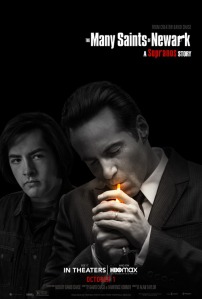 If you’re a fan of The Sopranos, I can’t say you’ll enjoy The Many Saints of Newark, and if you’re not a fan of The Sopranos, I can’t say you’ll enjoy The Many Saints of Newark. It’s a prequel set in the early 1970s, decades before an adult Tony Soprano was ruling his turf in New Jersey and going to therapy to deal with his rising panic attacks. The Sopranos was an era-defining, ground-breaking show for HBO and creator David Chase would captivate and infuriate audiences in equal measure, mixing shocking violence, twisted comedy, strange side steps, pessimistic psychoanalysis, and stubborn subversive storytelling to its very end with a polarizing finale that still elicits debate to this day (count me in the Tony-is-dead camp). It would be too much to expect a return to that world to pack in all the entertainment and enrichment of a peak TV series, but I was at least hoping that Chase’s return to his mobster magnum opus would present an engaging story that would add further insight or intrigue into the series and its characters. After two hours, I’m left shrugging like Silvio Dante and about as clueless as Paulie Walnuts.
As personal background, I watched all seven seasons of The Sopranos and eagerly anticipated its finale in 2007. I was one of those people that even questioned whether my cable had somehow gone out as the series suddenly shifted to a black screen without further warning. I enjoyed the show though I haven’t watched it since it originally concluded over ten years ago. It would be a worthy series to re-watch in our binge era, but I think I would keep my initial interpretation of the show and its self-loathing patriarch, Tony. I think over the course of 8 years Chase intended to demystify the perverse allure of organized crime and the glamor of Hollywood myth-making. I think he subversively took a familiar setup, a family man trying to fight for respect from his family and his Family, and knew many people would find themselves rooting for Tony Soprano and his underdog status and his potential redemption through therapy and self-analysis. Except, Chase’s point, is that these bad men are not complicated, they’re not geniuses, and they’re not capable of real empathy. Tony’s near-death experience and inevitable return to his old ways was proof of that. Chase created a vehicle where people sided with the anti-hero lead and he systematically provided more and more evidence that this man was cruel, impulsive, selfish, and incapable of redemption, and every episode, especially in that final season, pushed the viewer to ask, “How much longer can you look the other way? How many more excuses can you give?” It was Chase taking the appeal of mob movies and anti-heroes and testing viewer loyalty, making people question the appeal of these kinds of stories about these kinds of men. That’s my reading.
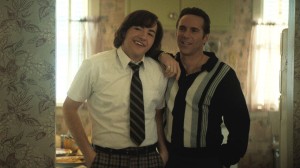 As a prequel, The Many Saints of Newark might appeal to the most diehard fans of The Sopranos who just want to have two hours more in this world, seeing these characters again one more time. Perhaps fans will thrill to see James Gandolfini’s son, Michael Gandolfini, play teenage Tony Soprano. Perhaps they’ll thrill to see Tony’s mother at a younger age but recognize some of her self-pitying and antagonistic quirks that would define her as an elderly woman. Perhaps they’ll thrill to watch Christopher Moltisanti’s father, Dickie (Alessandro Nivola), as Tony’s uncle, the man he said from the series who was so influential to him. In essence, this story, written by Chase and Lawrence Konner, is about how Tony got to be on his doomed path of crime. The fact that Tony is merely a supporting character in this tale is not a grievous structural fault. However, the fact that Dickie is such an uninteresting lead character in such an uninteresting and glum story is a significant fault.
The Sopranos was dark and frustrating too, though your emotional investment was grander, but it was rarely boring. The majority of my time with Newark was spent stooped and patiently waiting for something meaningful to happen. There were bloody murders and gunfights and love affairs, but I kept waiting for it to seem like it mattered to the overall bigger picture. Very little in this movie ever felt important, because the movie doesn’t invest in its own characters and its own story on their own terms, it merely coasts off the attached appeal of the TV show it’s meant to link up to and coasts off the good will of its audience. If you removed the names of the characters, thus denying its creative inheritance, then I doubt even the most ardent fans of mob movies would find that much to appreciate here. If this wasn’t a Sopranos movie, it wouldn’t have gotten this platform and attention, and that seems less a reason to run with an underdeveloped story with a dull protagonist stumbling through mundane mob cliches.
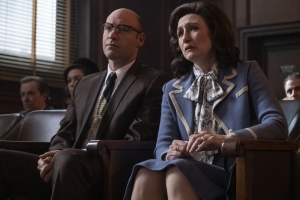 If Dickie is meant to be so influential, I don’t understand the appeal. I guess he’s slightly more emotionally stable than Tony’s father, played by Jon Bernthal, but that’s not saying much. Dickie violently confronts his father, “Hollywood Dick” (Ray Liotta), over his abuse of his young new bride from Italy, Giuseppina (Michela De Rossi), to defend her. That’s good? But when Dickie takes up an affair with the same woman, his stepmom, he proves just as depressingly violent. That’s bad. The problem is that Dickie is not a complex character to hang a movie upon. I thought there was going to be a slow temptation to begin an affair with his new stepmom, but that happens far too early, which places her as simply the “goomah” on the side he retreats to for sexual gratification and empty promises of building a life. She goes right from being a potentially interesting character, a woman with agency and danger, to another mob movie cliché, the arm candy waiting on her bad man to patronize her. Dickie says that his wife has had trouble conceiving, so I thought maybe this new stepmom would be revealed to be Christopher’s actual birth mother. That’s why she was here in this story. Nope, yet again this possibility is dismissed early. The Many Saints of Newark frustratingly takes every tedious story detour it can when presented.
The movie is set primarily in the late 60s and early 70s in Newark, barely tackling the riots of 1967 to use them as a cover for a storytelling choice for Dickie. The entire subplot featuring the struggles of the African American community feel tacked on to this movie, as if Chase is responding to criticisms that his series wasn’t diverse enough. The rise of Harold (Leslie Odom Jr.) as a gangster is given such little significance. He begins as an employee of Dickie’s and then becomes a rival, but this complicated relationship isn’t played like it’s complicated. Every time Odom Jr. (One Night in Miami) appeared I kept hoping that finally the movie was going to give him something to dig into, to really explore this perspective in a meaningful way. The rivalry between Harold and Dickie doesn’t even feel significant because both of these men are criminally underwritten. The Newark riots are played so incidentally and without consequence. Why begin to explore racial unrest and police brutality if you’re just going to ignore it after twenty minutes of movie?
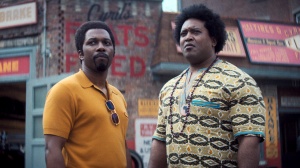 As a movie, The Many Saints of Newark did not work for me. As a Sopranos prequel, The Many Saints of Newark did not work for me. I had some mild amusement and intrigue with moments like Corey Stoll going full force in his impression of a young Uncle Junior, with Vera Farmiga chewing the scenery as Tony’s mother, and the impeccable resemblance of Gandolfini to his late father. I enjoyed the weirdness of Liotta playing twin brothers. I enjoyed the period appropriate production values and music choices. Unfortunately, it doesn’t add up to a vital experience that lends better understanding and insight into the Sopranos universe. Again, some fans may just be happy enough to exist in this universe for two more hours, to soak up even the most superfluous of details (I know I would be for my TV show favorites). That’s fine, but for me, what’s on screen barely resembles the daring and complex characterization of the series. Maybe a movie was always set up to fall short but this one falls short even as a mediocre mob movie.
Nate’s Grade: C
Share this:

Gunpowder Milkshake (2021)
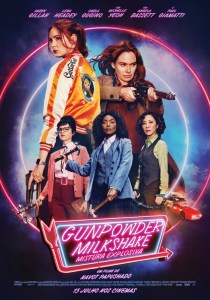 The reason we typically watch crime/action movies is for the slick style, the gonzo action, and the over-the-top characters cutting loose in the most violent of manners. We watch these movies to capture that whiff of cool, something flashy and entertaining with its eye-popping combo of sight and sound. Think Snatch, and Drive, and Atomic Blonde, and what appears to be the upcoming James Gunn Suicide Squad sequel. By these standards of stylized violence and colorful anti-heroes, Netflix’s Gunpowder Milkshake falls too flat to be duly satisfying.
Sam (Karen Gillan) is a hired killer working for the secretive order, The Firm. Her handler (Paul Giamatti) has accidentally assigned her the son of a commanding mobster who now demands vengeance. Her lone way to keep the protection of her employers is to kill a man who robbed them, which she does, but then regrets her actions. The troubled man had stolen the money to pay the kidnappers ransoming his daughter, Emily (Chloe Coleman). Sam decides to get involved and save this girl, and in doing so loses protection. The scornful mobster sends teams of goons to track Sam and kill her, forcing her to find refuge with her absentee mother (Lena Headey).
 The problem with playing in this stylized sandbox is having little to back up the attitude and style. Admittedly, those two aspects go far in a sub-genre dominated by appearances, but if you just have tough-looking shells of characters posturing and acting tough, it doesn’t matter how much style you dump onto the screen, it will only distract for only so long. The characters in Gunpowder Milkshake are so powerfully bland and all adhere to the same lone character trait. They’re all glib and badass and brusque and smug and fairly boring. It’s like somebody took the John Wick universe of clandestine killers and copied and pasted the same default personality.
If everyone is super cool, and super deadly, and super nonchalant, then you need to put even more work into making the characters stand apart. They’ll need specific quirks, competing goals, faults and obsessions, some key nub of characterization even if its superficial (a guy with one eye he’s insecure about it, etc.). With Gunpowder Milkshake, there’s nothing to work with. The screenwriters made this so much harder on themselves. I guess we’re merely supposed to be won over by the casting and the imagery of these bad ladies holding powerful weaponry. The protagonist is boring. She is the familiar hired killer who grows an inconvenient conscience. That’s an acceptable starting point but the moral growth is hindered when her young charge, the little girl that forces her paradigm shift, wants to be her apprentice to learn to kill people. The fraught mother/daughter relationship resorts to a lot of “I didn’t want this life for you,” “It’s the only life I’ve known” roundabout conversations, and neither furthers our understanding of either side.
With all that being said, there are moments of bloody fun that can be enjoyed. There’s a middle portion of the movie that gave me hope the film had transformed. At one point, Sam is indisposed and unable to use her arms, which dangle without any muscle control. She’s about to be beset by angry if bruised bad guys and must plan what to do. The resulting clash is a burst of creative choreography and an excellent demonstration of Sam’s resourcefulness and drive. Watching her dispatch a dozen armed men so indifferently, always knowing where and when to turn and dodge is not nearly as entertaining or engaging as watching her struggle and solve a problem. This sequence is extended and makes clever use of its location and the elements that would be available. Then we go a step further, as Sam and her youngster must drive a car to flee except the uncontrollable arm problem persists. Sam will pump the pedals and give directions while Emily sits on her lap and turns the steering wheel. This made me excited. We had organic complications and potential solutions that involved both characters having to rely upon one another. That is solid screenwriting and finding a way to spice up an ordinary parking garage chase sequence. By the end of this sequence, my hopes started to dwindle because Sam reverted to her earlier super cool, impervious version. She knew every exact move to make, and the small-scale car chase started losing my interest even with the extra driving dynamic. I wish the filmmakers could analyze how these sequences differed to better harness that creative surge.
 The concluding act of Gunpowder Milkshake is a deluge of false climaxes and waves of bad guys that never pose any discernible threat. It all feels too repetitive and like a video game. This group of people need to be killed, and then this next group of people need to be killed, and then this next next group of people need to be killed, and I just started getting bored. There is the occasional fun burst of violence and style, but the enemies are stock and dispensable, so it doesn’t feel like it matters what the numbers are. Whether it’s a dozen or a thousand, nothing really seems to matter because our super team of badass women will never be stopped. If you’re going to establish the protagonists as so far ahead of their competition, then work needs to be done to provide another outlet for audience interest. Use that time to explore the peculiarities of the cracked-universe world, like in the John Wick franchise. Use that time to meaningfully push the characters toward personal confrontations with one another. Alas, it’s all slapdash style with the same dead-eyed cool stare from start to finish (with the noted exception above). The entire final act could have been five minutes or fifty. It’s filler violence until the director tires out.
The cast is blameless and eminently watchable. I’ve been a fan of Gillan’s since her early Doctor Who days, and it’s been fun to watch her come into her own with the major spotlight afforded from franchises like Guardians of the Galaxy and Jumanji. She’s more than capable of kicking ass and looking cool doing so but this is the thinnest of characters. Once Sam chooses to put her safety at risk to save an innocent girl, it’s the end of her character growth. I suppose you can argue everything she does from there further proves the lengths she will go to solidify this important choice. Gillan deserves a worthy star vehicle. It’s fun to watch Angela Bassett, Michell Yeoh, Carla Gugino, and Headey push back with a grin against the misogyny of the overconfident wicked men who wish to do them harm. I wish they were better integrated into the world to have more significance other than as old allies who double as a weapons depot. There’s only so many guns-in-books jokes you can have before it too feels overdone.
 For fans of stylized violence, there may be enough cooking with Gunpowder Milkshake to meet out its near two-hour investment. The neon-infused, candy-colored production design and cinematography can enliven moments. The actors are fun to watch. Some of the fighting is brutally choreographed and cleverly executed, like the sequence where Gillan has no control over her arms. It’s got slow-mo violence set to wailing pop music tracks. If you’re looking for a pretty movie with some style, then it might be enough. If, however, you’re looking for a movie with interesting characters with memorable personalities, well-developed action with variance, and a story with a nice array of twists and turns and payoffs, then maybe look elsewhere.
Nate’s Grade: C+
Share this:

Ava (2020)
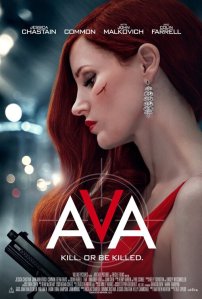 The movie Ava was never meant to have this title. The spy thriller was beset with trouble when the original director, Mathew Newton, dropped off the project after domestic abuse accusations resurfaced. Jessica Chastain, serving as star and as producer, reached out to her Help director Tate Taylor to come aboard and helm the project. Even with that upheaval, the movie went through production under the title of Eve, the name of Chastain’s character. Every person refers to her by this name throughout the movie, and it wasn’t until after the film was complete that some studio executive said, “What if her name was Ava instead?” The filmmakers then had to re-record every line of dialogue referencing her name to replace with this new identity. I cannot fathom a reason for doing so unless some exec really had a thing for that name or it was a concerted move to further distance themselves from Newton, who also wrote the screenplay. Just like that, Eve becomes Ava, and suddenly it’s a whole new creative project. Too bad they didn’t go further because whatever you call it, Ava is a fairly lackluster genre exercise for all involved.
Ava (Chastain) is a former soldier who was discharged from the Army and battled an addiction to drugs and alcohol. She’s gotten better and found a job that suits her, namely killing people for hire. Her fatherly handler (John Malkovich) tells her the marks, she dispatches them, and then collects the payouts. She assumes the men on her kill list are specimens of evil but begins to have her doubts, enough so that Simon (Colin Farrell) sends agents to snuff Ava out.
 There’s very little presented in Ava you haven’t seen in any litany of other spy thrillers before except with this pedigree of cast. I kept questioning why all these actors had agreed to be part of this project. The characters aren’t exactly complex or original. The scenarios aren’t exactly intricate or subversive. The action isn’t exactly well choreographed or well shot. The movie isn’t even that long at 95 minutes or so. The screenplay by Newton is unremarkable in every way, no different than any direct-to-DVD genre entry. I could just as readily see, say, Kristanna Loken (BloodRayne) filling the role of Ava than I could an actress as accomplished and in-demand as Chastain. That nagging question of what made a generic spy thriller so appealing will never be answered, because Ava offers little to a viewer already steeped in genre thrillers. It’s more of the same, just with A-list talent voluntarily “slumming it” as underwritten archetypes.
By no means am I against genre movies as a whole. I love genre movies. They can be some of the most entertaining and exciting film experiences, and under the right guidance, they can be thoroughly compelling and rewarding and even enlightening. Plus they’re just fun. Matt Damon resurrected his career as Jason Bourne. If Ava was trying to do something along those lines, re-calibrate the spy movie as a jangly, nerve-wracking thriller grounded in realism, that would have been something. Or if the movie had embraced its genre tropes knowingly, with tongue firmly placed in cheek, it could have been an over-the-top hoot. Instead, Ava just presents the same tropes without any sense of self-awareness. Ava really feels like an imitation of one of the lesser Luc Besson (The Professional, La Femme Nikita) action thrillers, or maybe one of those Besson imitations of a Besson work (3 Days to Kill). It’s going through the motions of motions.
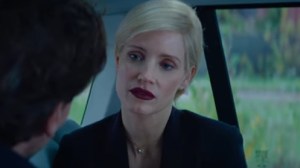 The domestic side of Ava’s life feels like a messy soap opera intruding onto a spy thriller, bordering into farce though without the awareness. Ava’s father died while she was out murdering others, and her sister Judy (Jess Wexler) hasn’t forgotten. Ava’s ex-fiancé, Michael (Common), is also now dating Judy. Michael is also struggling with his own gambling addiction and the debts he owes to local loan shark, Toni (Joan Chen), who has bad blood with Ava. Then there’s Ava’s mother, Bobbi (Geena Davis), who has gone in and out of the hospital for heart problems and wants her family to get along. As you might assess, for a 90-minute movie, there is way too much going on there to keep checking in with. Every time we gain more understanding of the people in Ava’s life, the more ridiculous her life seems to evolve, and remember she also is a recovering addict who is wavering over the possibility of relapse. That’s a lot of capital D drama but the screenplay lacks the follow-through to make it matter. It feels like Newton just keeps piling on the complications rather than developing and twisting them. There’s one genuinely strong moment when Bobbi has a sit-down with her daughter and warns her about the costs of being honest and expresses her content to luxuriate in the lie of Ava’s cover story of a career. As Ava contemplates having an affair with her ex, her sister’s boyfriend, you may start to forget that you’re watching a movie about a trained assassin.
Taylor (The Girl on the Train) shows just as much affinity for directing spy thrillers as directing horror with last year’s Ma. It’s not a good fit, folks. Taylor lacks the innate ability to stage action in a pleasing and exciting manner. The fight choreography is mundane and there is no scenario that develops and transforms with complications. The final confrontation is literally a limping slow-walk foot chase that will draw more unintended laughter than suspense, especially as it keeps going and going and I questioned the character walking speed. There is one standout moment and it’s a knock-out, drag-out fight between Ava and Simon that breaks just about every stick of furniture in a hotel room. Both are left bleeding and bruised and fatigued. It’s nothing exceptional in choreography but the sustained duration is what makes it stand apart. I’ll grant Taylor some leeway considering he was a late hire for a project already moving forward. However, with the results of Ava as a finished film, I wouldn’t advise hiring Taylor for any other action movies.
 Chastain (It Chapter 2) is of course a strong anchor. She taps into some of that ferocious power she had with 2012’s Zero Dark Thirty, and I would have loved to see her kick all sorts of ass in a spy thriller worthy of her talent. Even something like 2012’s Haywire, which was built to showcase the raw fighting skills of MMA-fighter-turned-actress, Gina Carano, or 2017’s Atomic Blonde, which was expanded upon due to the balletic precision and capability of Charlize Theron. We needed something more for Ava. Chastain kicks and punches and stalks the grounds with her cold badass stares, but she could be doing so much more. The soapier plot elements betray her. At one point, she’s crying, laughing, holding a bottle and contemplating putting a gun to her head. It’s just so much that, again, it points to farce but can’t quite tonally commit.
I’m trying to fathom the reason anyone should watch Ava. It’s short. It’s got talented actors. It’s not offensive in any technical or storytelling regard. If you had 95 minutes to waste, you most certainly could do worse. But there’s nothing that separates this spy thriller from any other mundane, mediocre, cliché genre exercise. What about this script excited Chastain to produce and make sure the world could have the opportunity to see this story? Maybe it was her commercial gambit to tell more meaningful indies later, like when Michael Fassbender produced Assassins’ Creed. I’ll never know the full appeal. Maybe it all just sounded a lot better when her name was Eve.
Nate’s Grade: C
Share this:

The Hunt (2020)
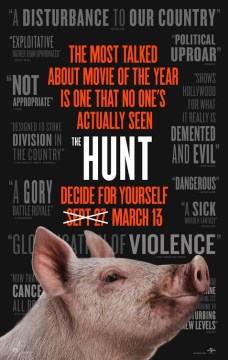 Has there been a movie with worse luck than The Hunt? It was originally scheduled to be released in late August 2019 and was postponed after the back-to-back mass shootings in El Paso and Dayton. Its studio, Blumhouse, pulled the movie out of sensitivity and rescheduled it for March, trying to draft off some of the latent controversy once President Trump caught wind of its liberals-versus-conservatives battle-to-the-death premise and tried to make political hay from it. The marketing highlighted quotes from political figures and writers and asked audiences to judge the controversy for themselves. Flash forward, and the new release date was pretty much the last weekend of theatrical action in 2020. Thanks to the worldwide spread of COVID-19, very few people ventured out from the safety of their socially distant homes to the movies, and it’s only become more dire since. Now just about every wide release has been scuttled from the release date from March into the middle of the summer, and who knows how long this may carry on for. The Hunt may be the last new theatrical movie for the foreseeable future. Thankfully, Universal made their theatrical releases available on demand (this may be an irreversible new reality of distribution) and I watched The Hunt at home. I home hunted, and I’m glad I did. If you’re a fan of Ready or Not and You’re Next, then The Hunt and its shocking violence, demented humor, and political satire might prove appealing.
A group of strangers wakes up gagged in a field. They’re given weapons and then the hunt is on from an unseen force. Crystal (Betty Gilpin) is trying to make sense of where she is, what is happening, and how she can escape into safety and who she may be able to trust.
 I was consistently laughing throughout The Hunt and amused at its breakneck twists and turns. It’s a film that lets you know very early that it’s willing to go to some dark and twisted places. It throws a lot of characters immediately into the grinder, as you go from following one person who is ultimately slain to another person who eventually meets the same fate, and it creates a desperation of trying to find an anchor. It also makes it feel like anything can happen at any time, that whatever might seem normal could really be hiding a dangerous reality. It’s the kind of movie that isn’t below throwing a grenade down someone’s pants. It has definite satirical sights but that doesn’t stop it from being an enjoyable dark and thrilling little movie. Once we settle on our main heroine, the new joy becomes her ability to see through the facades of different scenarios and fight back, again and again. It’s a wonderfully executed setup of giving us a very capable fighter who is constantly underestimated and then watching her opponents toppled. Each new scenario gives us someone to root for and a new mini-boss to foil. The film becomes a series of escalating payoffs tied to the smartest person making others pay for their mistakes.
I always thought the anger that conservative pundits, and Trump, assailed The Hunt with was misplaced considering that, given the premise, it seemed very much like the liberal elites were the villains. For most of the first act, this is the case, as we’re dropped right into the mix and left to learn on our own much like the hunted conservative characters. We are put in their shoes and don’t even see who may be hunting them until 15 minutes in. For the opening of the movie, it’s like the beginning of the Hunger Games. What is this crate? Why is it filled with weapons? What’s the deal with the pig? It’s a game that you’re trying to learn the rules of while bullets are whizzing by heads, and sometimes splattering into them too. Unquestionably, our allegiance is with these vulnerable people trying to make sense of this madness and survive. We see their humanity. When they do finally encounter their predators in disguise, the liberals can barely conceal their contempt and prejudices. If anyone is actively rooting for the predators after the first act, then they haven’t been paying attention or were too far gone with empathy.
However, the movie does start to take a turn the longer we spend with the hunted conservative characters, all but one not given official names (the list on IMDB cites names like Staten Island, Yoga Pants, and the parenthetically-enabled, (Shut the F*** Up) Gary). They begin to play into the same overblown prejudices and negative stereotypes of their across-the-ideological-aisle peers. As The Hunt continues, it becomes more and more apparent that screenwriters Damon Lindelof and Nick Cuse (HBO’s The Leftovers) have crafted a political satire that takes aim at both sides (more on this specific aspect later). Eventually the real target reveals itself to be extremism and how it can cloud one’s judgement and ability to see other people on human levels. There’s a late scene where a conservative figure confronts the liberal designer of the Hunt, and they get into a circular argument over which side is responsible for the creation of this death game. It’s a hilarious blame game but also emblematic of what happens when people try to play on the same level as conspiracy theorists who distort reality to their pre-selected biases. Sometimes in politics you need to fight fire with fire and sometimes that extra oxygen only makes things worse.
 Now The Hunt does have an issue with its “both sides are to blame” approach and that’s the false equivalency of the danger of right-wing and left-wing conspiracy clans. Right-wing militants are the ones saying Sandy Hook was a hoax with crisis actors, that Jade Helm was a military plot to take over the states, that scientists are in a cabal to bring down the petroleum industry, and cooping Americans up from COVID-19 to damage Trump, that immigrants are bringing crime and disease into the United States, and other such nutjob ideas. While left-wing extremists can be callous and have their own science denial problems (GMOs, vaccines), they aren’t the ones taking arms, storming federal buildings, sending pipe bombs in the mail, killing anti-Nazi protestors with cars, and shooting brown-skinned strangers in a Wal-Mart parking lot. One of these two ideological sides seem far more likely to support dangerous extremism than the other, especially with a man in the Oval Office who seems to wink and nod at these reactionary elements in approval. While the “both sides are bad” approach to satire allows The Hunt and its filmmakers more ground to market their movie to a wider audience sick of extremism, it’s also a dubious false equivalency that deserves to be called out.
Betty Gilpin (Netflix’s GLOW, Stuber) is the star of the movie and a force of nature. She’s capable, cunning, disarmingly physical and perceptive, and she creates wonderfully bloody havoc. She is a delight and her one-upping her opponents never gets old. She is no-nonsense and blunt, and her efficiency is admirable and highly entertaining. Gilpin is a surprise in badass mode, but she makes it her own with style. A late Act Three fight is brutal as it goes from room to room, smashing everything in sight. It goes on for so long that the fighters start to get fatigued, pleasantly reminding me of the excellent fight choreography of 2017’s Atomic Blonde. It’s a satisfying final confrontation and doesn’t find a contrived way to hold back her formidable ability.
 The Hunt might have been cursed with bad luck but it also might have the distinction of being the last new movie in theaters in what is proving to be an increasingly challenged year of content delivery. It’s certainly not going to be a film for everyone despite its aim at centrism. I was entertaining by the script’s constant knack for surprises and upending my expectations, of laying out dominoes and then laying waste to said dominoes. Gilpin is a star in the making and a terrific lead. It’s a movie that can get people talking by the end, debating its satirical messages, but it can also just be a fun, nasty little movie that will make you hoot in delight with each violent twist. I’m glad The Hunt could finally be judged on its own merits rather than the presuppositions of others. There might be a lesson in there somewhere.
Nate’s Grade: B


 nathanzoebl
You must be logged in to post a comment.