Blog Archives
Wake Up Dead Man (2025)
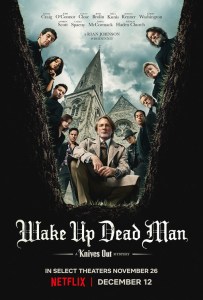 Being the third in its franchise, we now have a familiar idea of what to expect from a Knives Out murder mystery. Writer/director Rian Johnson has a clear love for the whodunit mystery genre but he loves even more turning the genre on its head, finding something new in a staid and traditional style of storytelling. The original 2019 hit movie let us in on the “murderer” early, and it became more of a game of out-thinking the world-class detective, Benoit Blanc (Daniel Craig). With the 2022 sequel Glass Onion, the first of Netflix’s two commissioned sequels for a whopping $400 million, Johnson reinvented the unexpected twin trope and let us investigate a den of tech bro vipers with added juicy dramatic irony. With his latest, Wake Up Dead Man, Johnson is trying something thematically different. Rather than adding a meta twist to ages-old detective tropes, Johnson is putting his film’s emphasis on building out the themes of faith. This is a movie more interested in the questions and value of faith in our modern world. It still has its canny charms and surprises, including some wonderfully daffy physical humor, but Wake Up Dead Man is the most serious and soul-searching of the trilogy thus far, and a movie that hit me where it counts.
In upstate New York, Pastor Jud (Josh O’Connor) has been assigned to a church to help the domineering Jefferson Wicks (Josh Brolin). The congregation is dwindling with the exception of a few diehards holding onto Wicks’ message of exclusion and division. The two pastors are ideologically in opposition, with Pastor Jud favoring a more nurturing and welcoming approach for the Christian church. Then after one fiery sermon, Wicks retires to an antechamber and winds up dead, with the primary suspect with the most motivation being Pastor Jud. Enter famous detective extraordinaire Benoit Blanc to solve the riddle.
 I appreciated how the movie is also an examination on the different voices fighting for control of the direction of the larger Christian church. Wicks is your traditional fire-and-brimstone preacher, a man who sees the world as a nightmarish carnival of temptations waiting to drag down souls. He sees faith as a cudgel against the horrors of the world, and for him the church is about banding together and fighting against those outside forces no matter how few of you remain to uphold the crusade. Pastor Jud rejects this worldview, arguing that if you think of the church as a pugilist in a battle then you’ll start seeing enemies and fights to come to all places. He’s a man desperate to escape his violent past and to see the church as a resource of peace and resolution but Wicks lusts for the fight and the sense of superiority granted by his position. He relishes imposing his wrath onto others, and his small posse of his most true believers consider themselves hallowed because they’re on the inside of a special club. For Pastor Jud, he’s rejecting hatred in his heart and looks at the teachings of Jesus as an act of love and empathy. It’s not meant to draw lines and exclude but to make connections. These two philosophical differences are in direct conflict for the first half of the movie, one viewing the church as an open hand and the other as a fist. It’s not hard to see where Johnson casts his lot since Pastor Jud is our main character, after all. I also appreciated the satirical tweaks of the church’s connections to dubious conservative political dogma, like Wicks’ disciples trying to convince themselves the church needs a bully of its own to settle scores (“What is truth anyway?” one incredulously asks after some upsetting news about their patriarch). It’s not hard to make a small leap to the self-serving rationalizations of supporting a brazenly ungodly figure like Trump. At its core, this movie is about people wrestling with big ideas, and Johnson has the interest to provide space for these ideas and themes while also keeping his whodunit running along pace-for-pace.
There is a moment of clarification that is so sudden, so unexpectedly beautiful that it literally had me welling up in tears and dumbstruck at Johnson’s capabilities as a precise storyteller. It’s late into Act Two, and Blanc and Pastor Jud are in the thick of trying to gather all the evidence they can and chase down those leads to come to a conclusive answer as to how Pastor Jud is innocent. The scene begins with Pastor Jud talking on the phone trying to ascertain when a forklift order was placed. The woman on the other side of the line, Louise (Bridget Everett, Somebody Somewhere), is a chatty woman who is talking in circles rather than getting to the point, delaying the retrieval of desired information and causing nervous agitation for Pastor Jud. It’s a familiar comedy scenario of a person being denied what they want and getting frustrated from the oblivious individual causing that annoying delay. Then, all of a sudden, as the frustration is reaching a breaking point, she quietly asks if she can ask Pastor Jud a personal question. This takes him off guard but he accepts, and from there she becomes so much more of a real person, not just an annoyance over the phone. She mentions her parent has cancer and is in a bad way and she’s unsure how to repair their relationship while they still have such precious time left. The movie goes still and lingers, giving this woman and her heartfelt vulnerability the floor, and Pastor Jud reverts back to those instincts to serve. He goes into another room to provide her privacy and counsels her, leading her in a prayer.
 The entire scene is magnificent and serves two purposes. This refocuses Pastor Jud on what is most important, not chasing this shaggy investigation with his new buddy Blanc but being a shepherd to others. It re-calibrates the character’s priorities and perspective. It also, subtlety, does the same for the audience. The wacky whodunit nature of the locked-door mystery is intended as the draw, the game of determining who and when are responsible for this latest murder. It’s the appeal of these kinds of movies, and yet, Johnson is also re-calibrating our priorities to better align with Pastor Jud. Because ultimately the circumstances of the case will be uncovered, as well as the who or whom’s responsible, and you’ll get your answers, but will they be just as important once you have them? Or will the themes under-girding this whole movie be the real takeaway, the real emotionally potent memory of the film? As a mystery, Wake Up Dead Man is probably dead-last, no pun intended, in the Knives Out franchise, but each movie is trying to do something radical. With this third film, it’s less focused on the twists and turns of its mystery and its secrets. It’s more focused on the challenging nature of faith as well as the empathetic power that it can afford others when they choose to be vulnerable and open.
Blanc doesn’t even show up for the first forty or so minutes, giving the narration duties to Pastor Jud setting the scene of his own. Craig (Queer) is a bit more subdued in this movie, both given the thematic nature of it as well as ceding the spotlight to his co-star. Blanc is meant to be the more stubborn realist of the picture, an atheist who views organized religion as exploitative claptrap (he seems the kind of guy who says “malarkey” regularly). His character’s journey isn’t about becoming a true believer by the end. It’s about recognizing and accepting how faith can affect others for good, specifically the need for redemption. Minor spoilers ahead. His final grand moment, the sermonizing we expect from our Great Detectives when they finally line up all the suspects and clues and knock them down in a rousing monologue, is cast aside, as Blanc recognizes his own ego could be willfully harmful and in direct opposition to Pastor Jud’s mission. It’s a performance that asks more of Craig than to mug for the camera and escape the molasses pit of his cartoonish Southern drawl. He’s still effortlessly enjoyable in the role, and may he continue this series forever, but Wake Up Dead Man proves he’s also just as enjoyable as the second banana in a story.
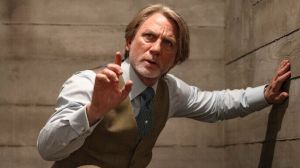 O’Connor (Challengers, The Crown) is our lead and what a terrific performance he delivers. The character is exactly who you would want a pastor to be: humble, empathetic, honest, and striving to do better. It’s perhaps a little too cute to call O’Connor’s performance “soulful” but I kept coming back to that word because this character is such a vital beating heart for others, so hopeful to make an impact. It’s wrapped up in his own hopes of turning his life around, turning his personal tragedy into meaning, devoting himself to others as a means of repentance. He’s a man in over his head but he’s also an easy underdog to root for, just like Ana de Armas’ character was in the original Knives Out. You want this man to persevere because he has a good moral center and because our world could use more characters like this. O’Connor has such a brimming sense of earnestness throughout that doesn’t grow maudlin thanks to Johnson’s deft touch and mature exploration of his themes. O’Connor is such a winning presence, and when he’s teamed with Blanc, the two form an enjoyable buddy comedy, each getting caught up in the other’s enthusiasm.
Johnson has assembled yet another all-star collection of actors eager to have fun in his genre retooling. Some of these roles are a little more thankless than others (Sorry Mila Kunis and Thomas Haden Church, but it was nice of you to come down and play dress-up with the rest of the cast). The clear standout is Glenn Close (Hillbilly Elegy) as Martha, the real glue behind Wicks’ church as well as an ardent supporter of his worldview of the damned and the righteous. She has a poignant character arc coming to terms with how poisonous that divisive, holier-than-thou perspective can be. Close is fantastic and really funny at certain parts, giving Martha an otherworldly presence as a woman always within earshot. Brolin (Weapons) is equally fun as the pugnacious Wicks, a man given to hypocrisy but also resentful of others who would reduce his position of influence. The issue with Wake Up Dead Man is that elevating Pastor Jud to co-star level only leaves so much room for others, and so the suspect list is under-served, arguably wasted, especially Andrew Scott (All of Us Strangers) as a red-pilled sci-fi writer looking for a comeback. The best of the bunch is Daryl McCormack (Good Luck to You, Leo Grande) as a conniving wannabe in Republican politics trying to position himself for a pricey media platform and Cailee Spaeny (Alien: Romulus) as a cellist who suffers from deliberating pain and was desperate for a miracle delivered by Wicks. He’s the least genuine person, she’s hoping for miraculous acts, and both will be disappointed from what they seek.
Wake Up Dead Man (no comma in that title, so no direct command intended) is an equally fun movie with silly jokes and a reverent exploration of the power of faith and its positive impact, not even from a formal religious standpoint but in the simple act of connecting to another human being in need. This is the richest thematically of the three Knives Out movies but it also might be the weakest of the mysteries. The particulars of the case just aren’t as clever or as engaging as the others, but then again not every Agatha Christie mystery novel could be an absolute all-time ripper. That’s why the movie’s subtle shifts toward its themes and character arcs as being more important is the right track, and it makes for a more emotionally resonant and reflective experience, one that has replay value even after you know the exact particulars of the case. If you’re a fan of the Knives Out series, there should be enough here to keep you enraptured for more. Because of that added thematic richness, Wake Up Dead Man has an argument as the best sequel (yet).
Nate’s Grade: A-
Share this:

The Prom (2020)
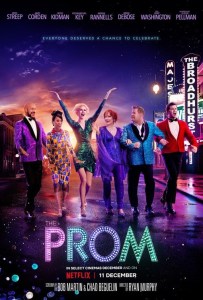 It’s full of big feelings, declarations of self-identity, an unabashed love of the transformative power of theater, and its power of positivity can be a balm to many during this holiday season. The Prom is based on a short-lived Broadway musical about a girl in Indiana who wants to bring her girlfriend to the school prom and the ensuing media controversy that erupts. A team of out-of-work theater actors (Meryl Streep, Anthony Rannels, Nicole Kidman, James Corden) see publicity value in rallying to her cause, so they decamp to Indiana and challenge the homophobic PTA leader (Kerry Washington) who refuses to hold an inclusive prom. Director Ryan Murphy’s style and sensibilities work well within the realm of musical theater; a decade of television curation for FX and now Netflix has made him an expert on camp and flash. The man loves applying slick gloss to trash. His camera is constantly, uncontrollably moving during the numerous musical numbers, attempting to compensate for the generic quality of the majority of them. There are two standouts. The first is when Corden’s character takes our lesbian teen to the mall for a makeover. It’s got a catchy hook and one that becomes a reoccurring theme for the show. The second is when Rannels’ character is pointing out the hypocrisy of local Christians decrying homosexuality but falling short of other Biblical teachings. The story is sweet but un-challenging. The plot exhausts so quickly that I was amazed at one point to discover there was still an hour left in the over two-hour production. Each member of the squad gets a signature number to varying degree of success. The happy ending is affirming and heartfelt but also quite easy and kind of unearned. The amount of catharsis and reconciliation doesn’t gel with the emotional investment and development of these characters. They’re nice but relatively dull, and the industry satire only goes so far to chide the out-of-touch Broadway elites for their own prejudices of Midwest life. The Prom is disposable fluff that will pacify an afternoon.
Nate’s Grade: C+
Share this:

Django Unchained (2012)
 It’s an understatement that no one makes films like Quentin Tarantino, though after Pulp Fiction it seemed like everyone was trying. The famous writer/director is an audacious filmic DJ, taking samples from all genres and mixing and matching them into a new and elevated form of art; he takes low-grade B-movie concepts and genres and turns them into highly literate A-class films. My only quibble is that, while I heartily enjoy the man’s unique efforts, I don’t know if we’re ever going to see a different Tarantino anymore. Since 1997’s Jackie Brown, he seems intent on re-imagining exploitation films and B-movies and putting his articulate spin on them. I have yet to dislike a Tarantino film (I rate Jackie Brown the lowest but that’s still an A-) and I’ll be first in line for anything the man attaches himself to as writer/director. Django Unchained is Tarantino’s ode to spaghetti Westerns, and it’s every bit as violent and tense and entertaining as you’d hope it to be.
In 1858 Texas, an abolitionist bounty hunter, Dr. King Shultz (Christoph Waltz) frees a slave named Django (Jamie Foxx) and enlists his help in tracking down a team of outlaws. They strike up a mentorship, gunning down outlaws for money. “Kill white folk and they pay you for it? What’s not to like?” Django reasons. After a successful season nabbing bad guys and training Django in the ways of shooting, the men come to a crossroads. Django is looking for his wife Broomhilda (Kerry Washington). She was torn away from him and sold off to wealthy Mississippi plantation owner Calvin Candie (Leonardo DiCaprio). Schultz and Django cook up a scheme to rescue Broomhilda. Schultz will pose as a rich power player wanting to enter the “mandingo fighting” game (think savage gladiatorial combat). Django will play a black slaver, and expert when it comes to picking out prized fighters. With a generous offer, the two get invited to Candie’s family plantation, dubbed Candieland. Standing in the way of their plan is Stephen (Samuel L. Jackson), Candie’s head of the house. Stephen is deeply suspicious of their guests and ready to expose them for who they truly are.
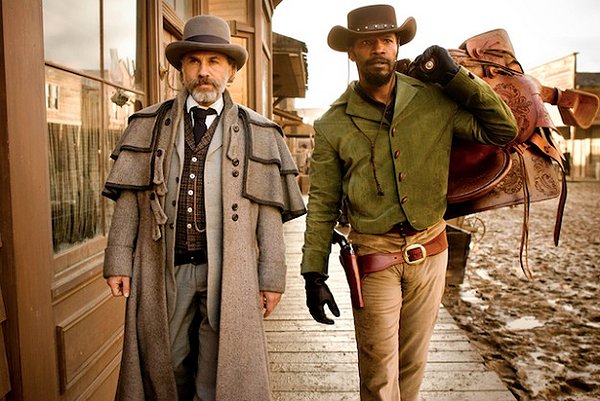 I’ve been dragging my feet writing a review of Django Unchained and I’m trying to determine why that is. Just after typing that sentence I spent 30 minutes checking my e-mail. I’m an avid Tarantino fan, so I’m left wondering what my hesitation is about. I certainly enjoyed the film, thoroughly, but perhaps my question is whether I should have enjoyed the film as much as I did given the historical reality of slavery. No movie will ever approach the true horrors of slavery; even the very act of owning another human is a detestable and crushing reality. Of course I’m coming at this movie from the perspective of a white male, so I feel like aspects of my commentary can only be minor. Is the backdrop of slavery too horrific for Tarantino to stage his spin on a revenge-filled Western? Spike Lee seems to think so via his critical public remarks. Tarantino has great glee in reveling in over-the-top movie violence, the kind that audiences (at least mine) cheer for. I guess the questionable angle is marrying the two realities and tones. You don’t want to take away from the brutality of slavery and at the same time you want to tell a compelling revenge-soaked thriller that satisfies with its buckets of blood. I’d say Django Unchained mostly finds the right balance to hit you in the gut one minute and the next have you clapping along.
It seems like the media is pressing every black celebrity for his or her personal thoughts on Django and especially Tarantino’s copious use of the N-word. Tarantino has gotten into hot water before with his penchant for the N-word, notably his own sequence in Pulp Fiction, but the N-word is entirely period appropriate for Django. Let’s face it, a majority of Americans, let alone Southerners, had really one word for slaves, and it wasn’t kind. This is the word that would have been uttered. However, after seeing the film a second time, I can see the complaints about the overwhelming use of the N-word. If you were to turn this into an awful and disrespectful drinking game, you’d probably pass out before DiCaprio even steps onscreen.
Like Inglourious Basterds, this movie is really a series of sit-downs that simmer with tension. The man has gotten so good with establishing the particulars of a scene, what the characters desire, and to push it to its breaking point when it comes to tension. While I don’t think anything approaches the highpoints of Basterds, this is still a movie that luxuriates in beautifully played tension and the danger lurking underneath Tarantino’s finely crafted words. And let’s talk about those wonderful words of Tarantino talk, the kind that seem so effortless to build sensationally interesting characters. The man sure enjoys writing his umpteenth variances on badasses engaging in verbal pissing contests (the literal kind are far less entertaining, at least for me). When you have character this sharply developed with such counter objectives, I could watch them duke it out all day. There are some pacing concerns with the movie, particularly once we get to Candieland, but when I’m engaged this much in a movie, I’d rather it go overboard than scrimp. Tarantino’s signature cool/funny/funny cool dialogue is alive and well. Every scene advances the plot, pushes it toward its bloody conclusion where bodies explode with sprays of red mist. It’s completely over-the-top in the Kill Bill vein, enough to draw snickers and laughter from a crowd, but Tarantino knows how to serve up a satisfying ending even with a body count to rival Hamlet.
 I don’t want to give the wrong impression that Django Unchained is deadly serious given the subject matter and historical context. I don’t think it disrespectfully sanitizes the horrors of slavery, but Tarantino’s brand of humor finds opportune moments to poke through. There’s a sequence with an early version of the KKK, a group of Southerners on horses arguing over whether they need to wear the ill-fitting bags on their head they prepared (plus Jonah Hill cameo). I was laughing so hard I thought people around me were going to shush me. It may well be the funniest thing Tarantino has ever written. There’s also natural humor to be had in the awkward handling of race relations, something that hasn’t exactly been perfectly ironed out to this day. A wealthy plantation owner (Don Johnson) struggles to explain how his slaves should treat Django, presented as a freeman by Schultz. “You want me to treat him like white people?” someone asks. This is followed promptly with a curt, “No.” There’s also plenty of gallows humor to be had with the over-the-top violence that pervades in the finale. It’s all key moments to blow off steam, so to speak, and make the film more bearable.
Django Unchained follows a traditional Western plot; in fact I’d say what we watch is essentially Tarantino’s whacked out spin on The Count of Monte Cristo (Alexander Dumas is even referenced in the film by name). Our lead character, Django, is in the Clint Eastwood mode of the strong and silent type. Schultz is the one who does all the talking while Django learns and glowers. They make a terrific buddy team and you almost wish that Tarantino had just diverged his story and allowed them to keep doing their bounty business. But Django’s wife needs some saving and that’s where the movie slows down. I wish Broomhilda had been given more character development. She’s pretty much the princess that needs saving, much like the German folk tale we learn is where Broomhilda gets her uncommon name. My sister described Django Unchained as a love story and I think that’s being a little generous (Tarantino did cut much of her torture, physical and sexual, from his script). We certainly feel Django’s desire to rescue her, and we worry about all the plot machinations and masks the characters must wear to accomplish this feat. With that said, the movie still has plenty of sucker punch surprises, much like Basterds, where violence erupts and despicable characters are given arias to illuminate the depths of their depraved worldviews.
I do wish that Tarantino had been a bit more judicious with his editing (the first without longtime editor Sally Menke who died in 2010) and curtailed all his self-indulgent meta film homage nods. We get stuff like Amber Tamblyn (The Sisterhood of the Traveling Pants) in one shot. Why you ask? See her father also stars in the movie in a small role, and he once played a character titled “Son of a Gunfighter.” So in his own credits, Tarantino lists him as “Son of a Gunfighter” and his daughter as, what else, “Daughter of a Son of a Gunfighter.” When all of that contorting is for an end credits gag and one shot in the whole movie, you feel like it was strictly masturbatory. Then there’s the original Django, Franco Nero, asking Foxx how to spell his name. Old Django asking new Django how to spell his name. I guess it’s supposed to be like a cinematic passing of the torch but it’s another moment that feels superfluous in a 165-minute movie. The movie can get a tad exhausting. The final 15 minutes, while still smartly written and boasting some terrific bloody comeuppance, feels like an add-on that wasn’t needed. It does manage to tie some elements back together but at this point the audience is ready for Django to ride off into the sunset, not have another obstacle to overcome in improbable yet badass fashion. At my first viewing, the kid behind me kept complaining to his parents that the movie had failed to end (“This is still going? It’s already been two hours!”). I also understand the fruitless and ironic nature of asking Tarantino to reign in his self-indulgences; that is, after all, what makes him who he is.
As expected from Westerns, the movie is a boy’s show. Foxx (Ray) has a steely screen presence that works very effectively for the character. The man’s quiet confidence and growing insolence play well, as he burrows into a role that boosts his confidence and assertiveness. Foxx’s journey from beleaguered and shell-shocked slave to mighty walking vengeance is definitely a full performance and one that Foxx delivers without any winks to the camera. Waltz (Carnage) will be dinged for playing a character similar to his Oscar-winning role in Basterds, but he’s still joyously entertaining, with that strange speech pattern of his that he plays like a musical instrument. He has a lot to say with plenty of theatrical flourishes, but that’s what makes him so entrancing. Simply put, Waltz and Tarantino are a match made in heaven.
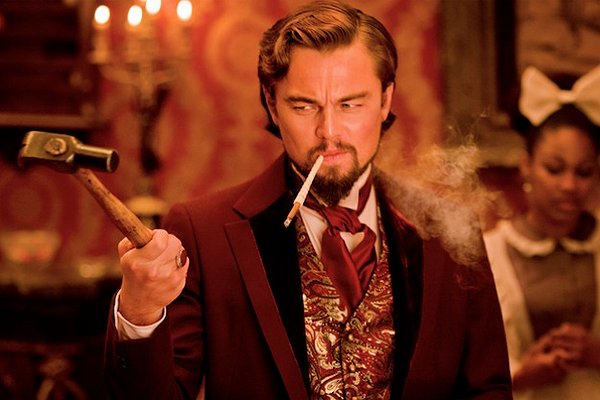
 DiCaprio (Inception) doesn’t appear until over an hour into the film but he’s worth the wait. At my first screening, I thought DiCaprio was good but was unimpressed. Upon a second viewing, I must say my appreciation grew for the man’s performance. Calvin Candie is certainly a vile man and DiCaprio is able to give him such an intriguing brio; he’s not the magnetic source of evil that Waltz was in Basterds, a man able to stay two steps ahead of his prey. Candie is easily taken for a fool. He’s not the smartest guy in the room but he can work up a pretty sizable fury; DiCaprio actually cuts open his hand during a confrontation and remains in character, undeterred. But the best actor in the movie is Jackson (The Avengers). There are far more layers to his head house slave than meets the eyes. It sure seems like he’s really the fist behind the glove. He may put on an act for company, but the man is far more calculating and sinister than anyone else in the film. You know he’s a good villain when the audience cheers the loudest at his demise (don’t act surprised, spoiler-phobes). I wouldn’t be surprised if Waltz, DiCaprio, or even Jackson get nominated for supporting Oscars.
It seems like Tarantino has also stumbled into a hidden lucrative subgenre at the box-office, namely the historical revenge film. Who doesn’t want to see a group historically shafted get some sweet revenge, the bad guys punished, and all with sparkling dialogue? In 2009, Tarantino went on a Nazi scalping spree and got to shoot Hitler in the face. With Django, a brutalized slave becomes the hero of his own story and kills some vile slave owners and traders. It’s essentially a Nat Turner-style rebellion from history, albeit with some harebrained scams and colorful characters. Following this lucrative model, Tarantino could take other maligned minorities and give them cinematic justice. Sadly, there are too many examples to count where Tarantino can take inspiration.
Django Unchained is a bloody, rollicking, talky, messy, exciting, surprising, uncomfortable yet satisfying movie and probably one of the oddest crowd-pleasers in recent memory. I saw it on Christmas day and my theater was a sell out. They loved it, soaking up every minute, laughing at the funny parts and wincing at the gruesome violence. I couldn’t think of a better way to celebrate the birth of baby Jesus. It doesn’t whitewash the evils and viciousness of slavery, but at the same time Tarantino knows how to serve an audience and their demands for big characters, big set pieces, and big vengeance. Django is a sturdy Western/blaxploitation film, and whatever other genres Tarantino feels like tossing into his cinematic blender. Whatever you classify it as, Django Unchained is another Tarantino original specialty and his tremendous talent comes through loud and clear, even with a few false endings and self-indulgences at play. It looks great, has a great soundtrack, and presents great acting talent reciting Tarantino’s great words like they were prized possessions. It’s a bit long and a bit overdone, but when you’re enjoying yourself, who wants to leave the party early?
Nate’s Grade: A


 nathanzoebl
You must be logged in to post a comment.