Blog Archives
Eternal Sunshine of the Spotless Mind (2004) [Review Re-View]

Originally released March 19, 2004:
No other movie this year captured the possibility of film like Michel Gondry and Charlie Kaufman’s enigmatic collaboration. Eternal Sunshine was a mind-bending philosophical excursion that also ended up being one of the most nakedly realistic romances of all time. Joel (Jim Carrey restrained) embarks on having his memories erased involving the painful breakup of Clementine (Kate Winslet, wonderful), an impulsive woman whose vibrant hair changes as much as her moods. As Joel revisits his memories, they fade and die. He starts to fall in love with her all over again and tries to have the process stop. This labyrinth of a movie gets so many details right, from the weird physics of dreams to the small, tender moments of love and relationships. I see something new and marvelous every time I watch Eternal Sunshine, and the fact that it’s caught on with audiences (it was nominated for Favorite Movie by the People’s friggin’ Choice Awards) reaffirms its insights into memory and love. I never would have thought we’d get the perfect romance for the new millennium from Kaufman. This is a beautiful, dizzingly complex, elegant romance caked in visual grandeur, and it will be just as special in 5 years as it will be in 50, that is if monkeys don’t evolve and take over by then (it will happen).
Nate’s Grade: A
——————————————————
WRITER REFLECTIONS 20 YEARS LATER

“How happy is the blameless vestal’s lot!
The world forgetting, by the world forgot:
Eternal sunshine of the spotless mind!
Each prayer accepted, and each wish resigned;”
-Alexander Pope, Eloisa to Abelard (1717)
“Go ahead and break my heart, that’s fine
So unkind
Eternal sunshine of the spotless mind
Oh, love is blind
Why am I missin’ you tonight?
Was it all a lie?”
-Kelly Clarkson, Mine (2023)
This one was always going to be special. Eternal Sunshine of the Spotless Mind is not just one of my favorite movies, it’s one of those movies that occupies the place of Important Formative Art. It’s a movie that connected with me but it’s also one that profoundly affected me and changed me, that inspired me in my own creative ventures. With its elevated place in my memory, I’ll also admit that there was some mild trepidation about returning to it and having it not measure up to the impact it had all those twenty years ago. It’s impossible to recreate that first experience or to chase after it, but you hope that the art we consider great still has resonance over time. This happened before when I revisited 2000’s Requiem for a Dream, a movie that gobsmacked me in my youth, had such innate power and fascination, and had lessened over the decades. It was still good art but it wasn’t quite the same, and there’s a little tinge of disappointment that lingers.

When I saw the movie for the first time it was at a promotional screening. I was a senior in college and had dyed my hair bright red for the second time. After marveling over my first encounter with 1999’s Run Lola Run, I was determined to have hair like the titular Lola. My parents were hesitant and set parameters, like certain grade achievements, and I met them all. Afterwards they had nothing left to quibble so I dyed my hair red, as well as other colors, my sophomore year and then again my senior year. At the screening, a publicist for the studio asked if I wanted to compete for a prize. I demurred but then she came back and asked again, and sensing something to my advantage, I accepted. It turns out the pre-show contest was a Clementine (Kate Winslet) look alike contest and my only competition was a teen girl with one light swath of blue hair. The audience voted and I won in a landslide and was given a gift basket of official Eternal Sunshine merchandise that included the CD soundtrack and a bright orange hooded sweatshirt modeled after the one Clem wears in the movie. That sweatshirt quickly became one of my favorite items of clothing, something special that nobody else had from a movie I adored. I wore it everywhere and it became a comfort and a confidence builder. Back during my initial courtship with my wife, in the winter months of 2020, she held onto the orange hoodie as a memento to wear and think of me during our time apart. She said it even smelled like me, which was a comfort. It had meaning for us, and we cherished it. I had to marry her, of course, to ensure I’d eventually get the sweatshirt back in my possession (I kid).
The lessons of Eternal Sunshine run deep for me. On the surface it’s a breakup movie about an impulsive woman, Clem, deciding to erase her memories of her now ex-boyfriend Joel (Jim Carrey). Out of spite, he elects to have the same procedure, and from there we jump in and out of Joel’s head as a subconscious avatar experiences their relationship but in reverse. It’s the bad memories, the hurt and ache of a relationship nearing or past its end, but as each memory degrades and Joel goes further into the past, he discovers that there are actually plenty of enjoyable memories through those good times, the elation and discovery, the connections and development of love, that he doesn’t want to lose. He tries to fight against the procedure but it becomes a losing battle, and so he gets to ride shotgun in his cerebellum as this woman vanishes from his life. What began out of spite and heartache ends in mourning and self-reflection.
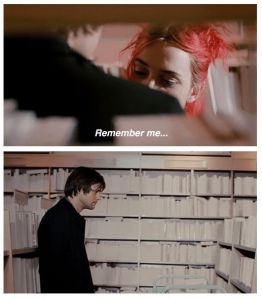
At its heart, the movie is asking us to reflect upon the importance of our personal experiences and how they shape us into the people that we are. This includes the ones that cause us pain and regret. The human experience is not one wholly given to happiness, unfortunately, but there are lessons to be had in the scars and pain of our individual pasts. I’m not saying that every point of discomfort or pain is worthwhile, as there are many victims who would say otherwise, but we are the sum total of our experiences, good and bad. With enough distance, wisdom can be gained, and perhaps those events that felt so raw and unending and terrible eventually put us on the path of becoming the person you are today. Now, of course, maybe you don’t like the person you are now, but that doesn’t mean you’re also a prisoner to your past and doomed to dwell in misery.
After my divorce from my previous wife in 2012, I wrote a sci-fi screenplay following some of the same themes from Eternal Sunshine. It was about two dueling time travelers trying to outsmart one another, one hired to ensure a romantic couple never got together and one hired to make sure that they had. The characters represented different viewpoints, one arguing that people are the total of their experiences and the other arguing people should be capable of choosing what experiences they want ultimately as formative. Naturally, through twists and turns, the one time traveler learns a lesson about “living in the now,” to stop literally living in the past and trying to correct other people’s perceived mistakes, and that our experiences, and our heartache, can be valuable in putting us into position to being the people we want or living the lives we seek. It shouldn’t be too hard to see that I was working through my own feelings with this creative venture. It got some attention within the industry and I dearly hope one day it can be made into a real movie. It’s one of my favorite stories I’ve ever written and I’m quite proud of it. It wouldn’t exist without Eternal Sunshine making its mark on me all those years ago.
It’s an amazing collaboration between director Michel Gondry and the brilliant mind of Charlie Kaufman. The whimsical, hardscrabble DIY-style of Gondry’s visuals masterfully keeps the viewer on our toes, as Joel’s memories begin vanishing and collapsing upon one another in visually inventive and memorable ways. There’s moments like Joel, after finding Clem once she’s erased her memory of him, and he storms off while row after row of lights shuts off, dooming this memory to the inky void. There’s one moment where he’s walking through a street and with every camera pan more details from the store exteriors vanish. A similar moment occurs through a store aisle where all the paperbacks become blank covers. It’s a consistent visual inventiveness to communicate the fraying memories and mind of Joel, which becomes its own playground that allows us to better understand him. The score by Jon Brion (Magnolia) is also a significant addition, constantly finding unique and chirpy sounds to provide a sense of earned melancholy. By experiencing their relationship backwards, it allows us to have a sense of discovery about the relationship. This is also aided by Kaufman’s sleight-of-hand structure, with the opening sequence misleadingly the beginning of their relationship when it’s actually their second first time meeting one another. The pointed details of relationships, both on the rise and decline, feel so achingly authentic, and the characters have more depth than they might appear on the surface. Joel is far more than a hopeless romantic. Clem is far more than some Manic Pixie Dream Girl, a term coined for 2005’s Elizabethtown. She tells Joel that she’s not some concept, she’s not here to complete his life and add excitement; she’s just a messed up girl looking for her own peace of mind and she doesn’t promise to be the answer for any wounded romantic soul.

The very end is such a unique combination of feelings. After Mary (Kirsten Dunst) discovers that she’s previously had her memories of an affair with her boss erased, she takes it upon herself to mail every client their files so that they too know the truth. Joel and Clem must suffer listening to their recorded interviews where they are viciously attacking one another, like Clem declaring Joel to be insufferably boring who puts her on edge, and Joel accuses her of using sex to get people to like her. Both are hurt by the accusations, both shake them off as being inaccurate, and yet it really is them saying these things, recorded proof about the ruination of their relationship. Would getting together be doomed to eventually repeat these same complaints? Clem walks off and Joel chases after her and tells her not to go. Teary-eyed, she warns that she’ll grow bored of him and resentful because that’s what she does, and she’ll become insufferable to him. And then Joel says, “Okay,” an acceptance that perhaps they may repeat their previous doomed path, maybe it’s inevitable, but maybe it also isn’t, and it’s worth it to try all the same. Maybe we’re not destined to repeat our same mistakes. Then it ends on a shot of our couple frolicing in the snow, the descending white beginning to blot out the screen, serving as a blank slate. It’s simultaneously a hopeful and pessimistic ending, a beautifully nuanced conclusion to a movie exploring the human condition.
Winslet received an Oscar nomination for her sprightly performance, and deservedly so, but it’s Carrey that really surprises. He had already begun to stretch his dramatic acting muscles before in the 1998 masterpiece The Truman Show and the far-from-masterpiece 2001 film The Majestic. He’s so restrained in this movie, perfectly capturing the awkwardness and passive aggressive irritability of the character, a man who views his life as too ordinary to be worth sharing. Clem begs him to share himself since she’s an open book but he’s more mercurial. She wants to get to know him better but to Joel there’s a question of whether or not he has anything worthwhile getting to know. Carrey sheds all his natural charisma to really bring this character to life. It’s one of his best performances because he’s truly devoted to playing a character, not aggressively obnoxious Method devotion like in 1999’s Man on the Moon.
Eternal Sunshine of the Spotless Mind is a messy, enlightening, profound, playful, poignant, and mesmerizing movie. A perfect collaboration between artists with unique creative perspectives. I see something new every time I watch it, and it’s already changed my life in different ways. I used to see myself as Joel when I was younger, but then I grew to see him as self-pitying and someone who too often sets himself up for failure by being too guarded and insular. It’s a reminder that our cherished relationships remain that way by allowing ourselves to be vulnerable and open. We are all capable and deserving of love.
Re-View Grade: A
Share this:

Avatar: The Way of Water (2022)
 In the 13 ensuing years since James Cameron’s smash hit Avatar, we’ve debated whether or not the collective consciousness has simply moved on and forgotten what was, at one point, the highest-grossing movie of all time. What cultural dent had it made? Are there really still fans? Was it a fad of the new 3-D, itself already dissipated? Does anyone really want three or four sequels? Then Avatar: The Way of Water was released in late 2022 and it didn’t do as well as its mighty predecessor. Instead of being the highest-grossing movie ever, it’s only the third highest-grossing movie ever with a paltry $2.3 billion worldwide (how can the man even sleep at night?). It’s a lot of the same, both in its big feelings, awe-inducing visuals, and its resurrection of characters, scenarios, and conflicts of before, so you’ll likely find yourself reliving your own 2009 Avatar reaction.
Cameron’s long-awaited follow-up returns to the alien word of Pandora where our Marine-turned-Na’vi Jake Sully (Sam Worthington) has raised a large blended family with his Na’vi partner, Neytiri (Zoe Saldana, given little to do but cry this time). The first hour of this three-hour blockbuster is establishing the family dynamic with the different kids, including adopted daughter who is… somehow… the daughter of the deceased scientist Grace (both Sigourney Weaver) as well as the human child nicknamed Spider who is the biological son of Quaritch (Stephen Lang), our deceased villain. Nobody seems to stay dead in this series as Quaritch concocted his own backup plan in case of his untimely demise. He transferred his consciousness into a tank-born avatar, and this new Na’vi Quaritch has his own team of Marines in blue-skinned Na’vi bodies. They’re heading back to Pandora for some out-of-body vengeance, and thanks to their genetics, they seem to get a pass from the natural environment of Pandora mistaking them as native.
 There’s a lot of set up here, and the second hour introduces us to the coastal community, and it becomes another formula of the outsiders learning the rules and culture of the new setting and integrating, turning enemies into friends, gaining honor, etc. It’s within this second hour that the big environmental message coalesces around whaling, with one Sully son bonding with an alien whale Free Willy-style. There’s a whole hunt sequence that poaches a mother and her calf that’s quite upsetting. The parallels are obvious but subtlety is not exactly one of the storytelling options in the Avatar universe. This is a broad canvas in the biggest sense, so every message will be spelled out very finely and underlined, with character voicing obvious themes and villains practically twirling space mustaches. And that’s okay. The final hour is an action-packed showdown bringing all the characters to account and forcing Jake to face off once again with his old commander.
The visual immersion is outstanding and the real reason to sit still during all three hours of Way of Water. The Oscar-winning visual effects are transcendent, and the extended sequences underwater really captivate and achieve the sense of natural awe Cameron aspires for. It is an exceedingly pretty movie to watch, and the level of high-definition detail is astounding. There’s a tangible realism here even when it’s entirely gangly CGI characters. At no point does it feel like an empty green screen stage or an over-exposed cartoon. The world of Pandora is still interesting and worth exploring, and the coastal aliens with their evolutionary differences makes me excited to explore other corners and communities of this alien world. The story works, and the payoffs work, and each of the Sully kids has a moment to shine, though I kept confusing the two older brothers (where did one of these kids learn to say “bro” every other word?). It’s a bit strange to see and hear Weaver in a preteen alien’s body, but that disconnect is part of the point, as the character feels like a foreigner searching for meaning. Considering the decade-plus delay, the huge scope, and setting up potentially three other movies, I’m impressed that Way of Water even works as well as it does as a sequel. I was able to re-acclimate pretty easily in that first hour.
 It’s not revolutionary storytelling but not every movie need be. It follows a familiar formula but puts in the work to make the action meaningful and connected to character and for the emotional beats to resonate. I thought the upside-down sinking military vessel had some striking, terrifying Poseidon Adventure-esque visuals, and the sequence was rooted in the family trying to save one another. With so many moving pieces and characters, the plot can be overburdened and redundant at times (the Sully kids get kidnapped so often they might as well save time and tie themselves up early) but even at three hours it doesn’t feel slow or wasteful. There is a sense of repetition in bringing back so many of the same faces, like literally rehashing the same villains. I wish more consideration was given to the new Quaritch and his own existential journey of the self. Just because you have the brain of this dead evil guy, do you have to follow in his doomed path? That could have been a really intriguing and profound character journey, the cloned Marines bred to be weapons who decide their own identities. That could have sufficed as the entire movie for me. The messages are heavy-handed but effective, though Pandora already had a natural resource that Earth wanted to exploit so I didn’t think we needed a second natural resource that essentially functions as immortality juice. At this point, will the third movie introduce ANOTHER magical resource that cures cancer? Likewise, I hope the next movie doesn’t find us yet another Quaritch (a twin brother!) looking for further score-settling. The ending sets up a larger confrontation with Earth’s corporate elite that will come about with the ensuing sequels, though I would have thought since Way of Water makes a big leap forward in time that Earth’s powerful forces would have already marshaled their unhappy response to being kicked out in the original movie.
Cameron has an innate blockbuster sensibility and storytelling structure; the man just knows how to tell rousing big screen adventures like few others. I didn’t see Way of Water in theaters but I won’t make the same mistake with the many Avatar sequels that will dominates the 2020s. It’s a bit hokey though deeply sincere, and Cameron proves yet again that he should not be doubted on big stages of his own creation. It might take the domestic gross of a small country to make these sci-fi epics of his, but the man delivers like few in the rarefied field of dependable blockbuster artists. There’s going to be an Avatar sequel every two years, so this universe won’t go extinct anytime soon, and I’ll be there waiting too.
Nate’s Grade: B
Share this:

Ammonite (2020)
 Fair or unfair, my mind kept comparing Ammonite to 2019’s Portrait of a Lady on Fire, another period film about repressed women, furtive expressions of forbidden love, and isolation-fueled intimacy, and Ammonite was inferior in every regard. In all fairness, Portrait of a Lady on Fire was one of the best films of 2019 and deeply emotional, romantic, and sumptuous. It would be hard for many films to compete in direct comparison, and as such Ammonite can’t compare.
In 1840s England, Mary Anning (Kate Winslet) is a nationally renowned paleontologist. She spends her days digging up fossils along the rocky shore of her small town, caring for her aging mother, and keeping to herself. Her life is turned upside down when Charlotte (Saoirse Ronan) becomes her boarder while recuperating from some melancholia following a miscarriage. Charlotte wants to learn from Mary but Mary is more annoyed, and yet the two lonely women find a kinship in one another that turns into a romantic courtship neither knows where it will lead.
Repressed romances work best when you feel the connection between the characters, a growing hunger or desire, and you’re compelling them together from afar. This was the case for me with Portrait of a Lady on Fire. This was not the case for me with Ammonite. I cannot tell you why either Mary or Charlotte fall for one another. Neither is a very interesting character, especially Mary, who is very private and closed-off. She’s been hurt in the past with a previous gay romance (an underused Fiona Shaw) so likely gun-shy about risking vulnerability once more. There are mentions about her career and the satisfaction it provides but much of it is kept as generalized motivation, a woman making a name for herself in a man’s world. Charlotte is recoiling from a personal tragedy and an absent husband, but why do these two feel any spark of romance for one another in this oppressively drab setting? There’s more intense heat between Winslet and her fossils than with Ronan. It feels like we’re only at this point out of boredom and a lack of better options.
 For a movie about repressed passions, Ammonite is decidedly grey. This muted color palette and tone extends to everything about the movie. It’s all grey skies, grey pebbles, grey shores, grey bonnets, grey leggings, grey carts, grey houses, grey this, grey that, irrepressible grey. This dreary life is effectively conveyed and saps the movie’s energy. The characters go about their dreary lives that you, as the viewer, are begging for some renewed life to emerge. We’re begging for these characters to find something with one another because the world, as depicted, is bereft of life and excitement. To that end, the movie has established a favorable threshold to succeed and yet it still falls short.
This stark, stately, and tight-lipped style of writer/director Francis Lee (God’s Own Country) smothers the resulting romance and drama at play. These two women should be able to unwind with one another, open up, become their true selves the rest of the world is denied, something that cannot be manifested separately. They should be more interesting together, plain and simple. This person should unlock something within. I don’t feel like I gained any more insight into either Charlotte or Mary when they were together. Part of this is because it takes so long to get there and also because their coupling seems, in retrospect, to be completely surface-level in personal meaning. Looking back from its completion, it appears that each woman seems to misread the other person and what their intimacy has meant. I’ll credit the filmmakers for at least tacking on a resolution that amounts to more than “woman returns to husband and they can never ever be together again because Evil Patriarchy.” There is an ending but it’s not that much better than the two of these women sadly parting knowing they’ll never see one another again and that this brief time together will remain precious. I don’t know if I’m supposed to leave with the impression that Charlotte and Mary have the opposite conclusion. While they likely enjoyed the companionship and sex, as the camera seemed to, it seems like maybe both women are realizing that’s where it stops. If this was the intended goal, that’s fine, but don’t set up the entire estate of your storytelling upon this romance if it’s meant to fizzle. This ends up becoming the latest film example of Women Looking Sad in Bonnets.
 I’m sorry dear reader but I was growing bored with this movie. In comparison, I was spellbound with Portrait of a Lady on Fire and found its awakened passions to be luminous and directly tied to two interesting characters. Charlotte and Mary are quite boring. Again, they have potential to be interesting; any lesbian romance set in the 1840s certainly has potential for appealing drama. I was asked by my girlfriend, who herself was giving voice to an argument carrying on social media, why there must be no shortage of forbidden queer romances, and why can’t gay audiences just have movies where gay characters can fall in love and be comfortable being gay? It’s a legitimate question, though my only answer is that these period piece queer tales inherently involve internal struggles given the secrecy and consequences that make for ready drama for big-time actors. There’s also the fact that Mary Anning is a celebrated paleontologist and recognized superstar in her field and there is no evidence that any of her close female friendships were anything more than that. I’m fine with rewriting historical figures as queer and changing things up (I heartily enjoyed the queer revisionism in The Favourite) as long as it still makes the people interesting. Imagine taking a historically celebrated female paleontologist, making her gay, and then somehow making this character even more boring? How do you even do that?
Winslet (Steve Jobs) does a fine job of looking and acting glum. My trouble was trying to determine what points of life were recognizable with her character. How does one acknowledge what this change agent is doing to her when she’s, by nature, so insular and shut off? Winslet is one of her generation’s finest actresses and can do so many amazing things, and yet her guiding directorial note must have been, “Can you dial it back even more?” There’s a fine line between subtlety and just being lifeless. Ronan (Little Women) has even less substance to work with. At first, her character is suffering and lonely, but she leaps at companionship with abandon. Her character doesn’t seem like she’s wild or reckless or impulsive in any other regard. She stops wearing black when she embraces her feelings for Mary (Get it? She’s no longer in mourning). Still, Charlotte’s ultimate view of the world is one of privilege but this doesn’t inform her character until the very end. Ronan does her part making an audience believe she’s lovesick for Mary, but feeling it is another matter, and even an actress of Ronan’s caliber cannot accomplish this with this flagging script.
Ammonite is so drab, so passionless except during its sweaty sex scenes, that you’d be forgiven for wondering why anyone would even bother making this story come alive in the first place. If you’re all about furtive gestures and glances and the color grey, well you might be in luck. Look, I’m just going to be blunt. If you’re even remotely thinking about watching Ammonite, just seek out and watch Portrait of a Lady on Fire. It’s superior in every regard and a forbidden romance that is actually, surprise surprise, romantic and full of evocative feeling. Plus it’s French, so automatically more romantic. Watch that instead.
Nate’s Grade: C+
Share this:

Wonder Wheel (2017)
 It feels like Woody Allen is trying to recapture his magic from 2013’s Blue Jasmine, a character study of a tragic modern Blanche DuBois coming undone by her bad decisions. Whereas that film rightfully garnered Cate Blanchett an Oscar, Wonder Wheel is not going to do much for its own tragic heroine, Kate Winslet. She plays Ginny, and she’s stuck in a dull marriage, a dull life as a waitress at a Coney Island diner, and she keeps thinking of the life she could have and should have had as an aspiring actress. She has a summer affair with Mickey (Justin Timberlake), a lifeguard who wants to be a writer with experiences. Ginny’s affair is jeopardized when Mickey starts seeing her stepdaughter, Carolina (Juno Temple), who is on the run from her own mobster husband. All of this melodrama is kept at a fever pitch, and the film feels far too stagy, with characters careening in limited locations and having long, combative conversations. The cinematography is gorgeous as sets and people are draped with glowing, amber waves. Winslet’s character is not nearly as compelling as Allen intends as a tragic heroine being laid low by her flaws. She’s not exactly likeable but she’s also not exactly interesting, not like Blanchett. Losing her fling to a younger woman makes her even more desperate and self-destructive, which amplifies Winslet’s fussy and broad acting. Timberlake is strangely the narrator of this story and has several fourth wall breaking moments, and it doesn’t work, especially since his character is more a cobbled together cipher. There’s an odd subplot where Ginny’s young son is a pyromaniac and it adds nothing but stress. The story doesn’t add up to much and the characters just aren’t that interesting; they’re loud and abrasive but they don’t tap into anything larger about the human condition. It’s Allen’s half-baked homage to Eugene O’Neill. In a most unexpected move, I think the best actor in this movie is Jim Belushi as Ginny’s dimwitted husband. I think that says everything you need to know about Wonder Wheel, an up-and-down melodrama that has its mind set as a theatrical production and never leaves that space.
Nate’s Grade: C+
Share this:

The Mountain Between Us (2017)
 At what point can you tell an onscreen pairing just isn’t working? Chemistry is one of those elusive and ineffable qualities that can make or break a film, especially one that relies upon sexual tension and romantic yearning. If the actors don’t feel like they want to be with one another, it’s all going to fall apart. This is what I kept thinking as I watched The Mountain Between Us and was dumbstruck by the powerful lack of chemistry between its leads, each an accomplished actor in their own right. I don’t thin the movie could have been saved given its script but it certainly could have been at least better. If you’re going into The Mountain Between Us expecting a thrilling survival tale or a stirring romantic pairing, then you’ll be sorely disappointed.
Ben (Idris Elba) and Alex (Kate Winslet) are strangers who have the same problem. Their flights have been canceled and they have important places to be. He’s a surgeon. She’s a journalism photographer who is getting married. They share a single engine propeller plane to fly over the mountains and into the Denver airport. Unfortunately, the pilot suffers a stroke and the plane goes down, stranding Ben, Kate, and the pilot’s helpful labrador in the mountains. They’ll have to rely upon one another to survive in a hostile wilderness and seek rescue when nobody knows where they may be.
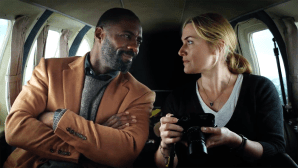 Watching pretty people endure hardships and persevere is as old a story as Hollywood, and The Mountain Between Us fails on so many levels, but none more so than chemistry. Elba and Winslet are meant to fall in love with one another over the course of their struggles and it is that love, we are told, that was the real key to their survival. If that sounds like Nicholas Sparks dribble, you’re on the right track, as the source material was very much a romance story. I’m sure the characters had to be better established and the romance felt more organic than what we get in the movie. I think the setup is an interesting place to start: two strangers who rely upon each other for survival and that co-dependence transforms into something they deem to be love. However, we don’t really get much in the way of the consequences of this except for an extended coda that doesn’t feel like nearly enough. Other than a spur-of-the-moment sex scene the movie doesn’t dwell on this looming romantic relationship in any way other than glances of gratitude. We hardly know anything about these characters before they are in a plane crash, and from there the survival against the elements takes precedence. Winslet spends most of the movie laying down and needing to be taken care of. If this movie needs to survive on their romance then it was doomed at casting. Granted, there is nil in the way of characterization and plot development for them to work with as well. At no point do you feel any emotional connection or even any sort of sensual heat between them. They seem far more irritated and put-upon by one another, but that’s supposed to melt away into something deeper and meaningful, though it never does. These are two talented actors but whoa do they not work together (other pairings were going to be Michael Fassbender and Margot Robbie, Charlie Hunnam and Rosamund Pike). Let this film be a lesson to everyone about the importance of hiring the right actors.
 Given the life-and-death survival, it seems shocking that the film has such low or non-existent stakes. You never once feel like these characters are in real jeopardy. They always seem to luck out, whether it’s a perfectly placed flare gun to ward off a bobcat, a cabin that’s none too far from their crash site, or that same dead bobcat that can provide some nourishment. There doesn’t seem to be much of a struggle on screen other than walking through the snow. It’s missing the visceral realism that survival stories offer audiences as entertainment. Ever since watching Wind River, stories about characters running long distances in sub-zero climates is ruined for me. I keep thinking, “Why aren’t their lungs exploding now?” I was surprisingly bored through much of their survival outdoors because none of it felt that serious or memorable (this isn’t Kate Winslet’s personal Revenant). This is less a survival story than a sudsy romance. Apparently, how they survive is less important than their eventual acknowledgement of love. It removes all sense of danger. The inclusion of the dog is the single greatest antidote to realism. Ben and Alex have a cute pet this whole time. This makes The Mountain Between Us feel like a “movie” rather than a “story,” and so we just wait and wait for precious moments that will successfully entertain, few and far between they are.
Director Hany Abu-Assad (Paradise Now, Omar) makes fine use of the Canadian Rockies to provide breathtakingly picturesque landscapes. Even if you’re relatively bored with the characters there’s always the scenery to take in and enjoy. Abu-Assad does have one memorably effective sequence and that’s the plane crash itself. His camera bobs and weaves inside the tiny cabin as long unbroken shot, reminiscent of the famous sequence inside the car in Children of Men. It’s an effort level that isn’t really matched, or at least evident, for the rest of the movie. It peaks at the crash. The human drama seems more interested in the human drama than the survival thrills, which is fine, but if that was the case then we should have gotten better characters and the room for them to develop so that whatever romantic connections form feel and believable and desirable.
 I have a solution to all of these issues except the chemistry one. This movie needed a radical rehaul at the structural level to be a better-developed and more interesting story. The movie needed to be told primarily AFTER Ben and Kate are rescued (spoilers, I guess, but I doubt many thought this was going to end in Greek tragedy). It’s during this fifteen-minute coda where the movie becomes its most interesting, and that’s because our characters have to readjust to the outside world but are forever changed. Starting from that point allows the characters to open up so much more and we see a different array of challenges, ones that are more relatable but also with an undetermined outcome. We know these actors are going to live by the film’s end without question. We don’t know if they’ll still be psychologically stable or whole though re-acclimating to their lives. This needed to be more like the second half of Room. This approach would give substantially more for these great actors to dig into. You could also use flashbacks to fill in notable experiences during their time stranded in the mountains. This would provide contrasts but it would also smartly allow us to skip all the dull stuff we know is just filler. This would also allow more genuine surprises and chances for narrative irony. At one point Alex develops the film roll she took during her time in the mountains, and at this point we already know she snapped a picture while Ben was asleep post-coitus. What if seeing these pictures was our first clue that some romantic intimacy happened? These two people bonded over the course of a couple weeks and no two other people may fully understand what they’ve gone through. Explore that with their difficulty to reconnect to the “outside world” and how much they have come to rely on one another after their rescue. That way it’s a character-piece about relationships with worthy material.
The Mountain Between Us is a mediocre romantic drama hindered by terrible chemistry, half-formed characterization, and a poorly developed story. When the life-and-death survival after a plane crash in the mountain feels lacking in stakes and peril, then you have a problem. When the romantic union between its mega-watt stars feels perfunctory, you have an additional problem, especially when it seems to be the point of the exercise. The Mountain Between Us plays, as one other astute critic wrote, as “Idris Elba fan fiction,” with the injured lead being tended to by the handsome and capable protector who can’t help but fall in love with this woman. It’s not an offensively bad movie but a fatally flawed disappointment that had potential given its premise. There needed to be a dramatic restructuring of the screenplay to emphasize their recovery, which would have better served the talents of these actors. Still, there are worse people to be stranded with.
Nate’s Grade: C
Share this:

Collateral Beauty (2016)/ Manchester by the Sea (2016)
 Trauma and grief are common colors in the palette of screenwriting. Wounded men and women overcoming loss and sorrow allow us all an opportunity to learn and heal through someone else’s personal pain and suffering. It’s the movie theater as therapist’s office with art serving as catalyzing event to help those in need. When 2006’s United 93 was released many critics thought it was too soon for a dramatic recreation of the events of 9/11. First, there’s never a right estimation for how long the world of art should wait to respond to shared tragedy, but I argued that United 93 could function as a facilitator for healing for select moviegoers. It helps to be able to live vicariously through fictional characters on screen, and it makes us smile when they overcome those obstacles and give hope to the rest of us. Two new movies have taken very different paths to explore responses to trauma onscreen. Collateral Beauty is a star-studded affair built from a screenplay that sold for an estimated three million dollars. Manchester by the Sea premiered at the Sundance film Festival and blew away audiences with its understated and unsentimental portrait of loss. One of these movies goes big and miscalculates badly and the other delivers one of the better, more emotionally involving films of the year. I think once you hear the premises it’ll be clear which is which.
In Collateral Beauty, Howard (Will Smith) is an advertising guru still reeling two years later from the unexpected death of his six-year-old daughter. He’s become a hermit who furiously rides his bicycle into traffic to tempt fate. He shuns his old friends and minority partners, Whit (Edward Norton), Claire (Kate Winslet), and Simon (Michael Pena). He also writes angry letters to the concepts of Death, Time, and Love to note his general displeasure. Major accounts are lost because of Howard’s seclusion and now it looks like the whole company might go under unless they accept a stock buyout. Howard refuses to sign off on the purchase, which forces his trio of friends to hire struggling actors to play “Death” (Helen Mirren), “Time” (Jacob Latimore), and “Love” (Keria Knightley). These three personified concepts will converse with Howard to provide an unorthodox therapeutic breakthrough. The actors will be paid handsomely and they relish the challenge. If that doesn’t work, they will record his public feuds with the actors, digitally erase the actors, and make it seem like he’s gone crazy with grief. Along the way, Howard gets closer and closer to talking about his loss in a support group run by the saintly Madeleine (Naomie Harris), a woman also suffering the loss of her child. If the universe is all about making connections, Howard is on a collision course with the fates.
Few films have dropped in estimation so precipitously in my mind as Collateral Beauty. To its credit, while you’re watching the movie you don’t notice as many of the misguided manipulations from prolific screenwriter Allan Loeb (Things We Lost in the Fire, Just Go with It). You’re aware of their presence but they don’t remove you from the movie, that is, until you extend further thought on the full implications. Allow me to simply vocalize in print the Christmas Carol-esque premise of this “feel good” holiday movie.
“A group of wealthy advertising executives scheme to get their grieving mentor and friend declared mentally incompetent so they can sell their company. They hire duplicitous actors to pose as metaphysical concepts, engage with Howard in public, and then they will digitally erase the presence of the actors, making it look like Howard fits the lazy man’s definition of crazy. And these people are the heroes.”
The characters give plenty of rationalizations for why they’re forced to set up their supposed friend, mostly about saving the company and saving jobs. Simon especially needs the money and medical insurance with where he’s headed. Howard is spiraling and they worry that he will take down everyone with him. That’s fine, but why do they resort to the outlandish and ethically dubious practices that they do? The hiring of actors seems like a helpful therapeutic exercise on the surface, unless you stop and think about a grieving man badgered by an antagonistic universe. Howard is already exemplifying mentally unsound behavior so I don’t know why the public spats are required. The digital erasure constitutes explicit fraud and it feels so much grosser. It’s an expensive step to provide visual evidence of a man having a nervous breakdown. They could have simply recorded Howard in his office for a week while he builds elaborate domino structures just to watch them topple (symbolism!). Even the characters call-out one another for this gaslighting trick. On another note, won’t Howard eventually find out? What if some enterprising digital effects editor has a moral crisis and confesses? This is the equivalent of false documents forged to push the rich old lady into the booby hatch so her scheming relatives could abscond with her vast fortune. It’s even more egregious when Collateral Beauty presents these characters as the heroes. Yes they have different degrees of guilt but that is tamped down by their moral relativism justifications. It makes it a little harder to swallow all that outpouring of cloying sentiment later. These murky and misguided manipulations will symbolize much that is wrong with the movie.
I hope the audience is prepared for Smith to be sidelined for much of the movie because Howard is more a supporting character in someone else’s story. Howard is really more a catalyst than a fully developed character. He grieves, he suffers, but his point is how his grief and suffering affect others, which is a strange tact to take. His journey is quite similar to Casey Affleck’s in Manchester by the Sea. He must come to terms with loss, accepting the cruelty of that reality in order to move forward and let others in. Moving on doesn’t mean we forget, especially when that trauma is a loved one’s loss, and Howard holds onto that pain for so long as a means to still feel his daughter’s presence. It’s an acceptable character conceit but it flounders in the movie because EVERYONE simply talks at Howard. Smith’s asked to be teary-eyed and mute for most of the picture. Any significant breakthroughs, developments, or even passing of information occurs from others applying meaning to this sad silent man who must not remain sad.
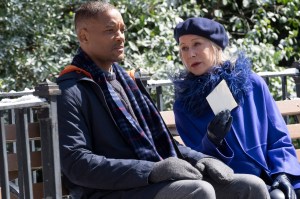 As a result, the movie pumps up the supporting characters and pairs them with one of the actors. “Death” relates with Simon for him to accept his declining health and to allow his family to know. “Time” relates with Claire over her worry that she’s sacrificed starting a family by prioritizing her career (this is another film world where nobody puts serious consideration into adoption). I need to stop and question this particular storyline. Doesn’t it feel a bit tacky and outdated? It’s also, by far, the storyline with the least attention; we literally see Claire glance at a sperm donor brochure and website for a scant few seconds and that’s it. Then there’s “Love” who relates with Whit to try and get him to repair his relationship with his rightfully angry young daughter after Whit cheated and broke up his marriage. “Love” literally just goads Whit to actually try being a parent and accept some responsibility for his failings. That’s it, and she has to use the incentive of a date to convince him to try and be a better father (Whit sloppily hitting on “Love” definitely lays a plausible peak into why exactly he’s divorced). “Death” and Simon play out the best mostly because Mirren is impishly amusing, and also benefits from naturally being Helen Mirren, and Pena’s character is given the most sincerity. He has the most at stake personally and setting things right for his family is taking a toll. Loeb has given each actor something to do, and the talents of the actors are enough that I was distracted from the overall machinations at least until the very end.
For most of its relatively brief running time, Collateral Beauty has kept to its own form of internal logic and avoided blatantly manipulative calculations for heightened drama. Sure Pena’s first instance of movie cough is an obvious telegraph to more astute members of the audience, but it makes some sense since this is less our real world and more the well-sculpted Movie World. Then the final ten minutes play out and the movie doesn’t just skid, it steers into this skid of counterfeit sentiment. I’ll refrain from spoiling both of the major reveals but they both serve to make you rethink everything. It’s not one of those eye-opening twists but more something my pal Eric and I were dreading in our seats, mumbling to ourselves, “Please please don’t.” These final two reveals are completely unnecessary. They disrupt the tenuous reality of the movie and the balance of tones becomes a mess. It also divulges how overly constructed the screenplay really was, designed to lead an audience to these chosen end points that don’t engender catharsis. It’s about pointing out how clever the screenplay was rather than the emotional journey, a movie in service of its twists. Neither twist serves strong narrative purpose other than to be out-of-the-blue surprises.
 Let’s get to that ungainly and clunky title. It’s a nonsense pairing of words that’s meant to sound profound but is really just confusing and remains so even though the characters repeat this clumsy phrase like eight times. There’s a conversation where it appears in every sentence, as if repetition alone can make this phrase/idea successfully stick. It doesn’t. I think I understand what it means, or at least what Loeb was going for, but I’m not sure. Madeleine talks about making sure to see all the collateral beauty in the universe, but is this merely a more obtuse way of restating Wes Bentley’s floating plastic bag declaration in American Beauty? Is it a more pretentious way of saying to stop and smell the roses? Here’s where I thought it was going with its meaning: “collateral” in this sense means accompanying and instead of accompanying damages we’re focused on the accompanying beauty, therefore a contemplation of the possible unintended helpful ramifications. This was going to make sense for Madeline since she uses her personal tragic experience to reach out and help others heal through their own tragedies. It’s the long ripples of human kindness reaching out far beyond our initial actions. And maybe, juts maybe, Howard and Madeleine would become romantically linked through coping with their similar heartache and find one another. However, the movie’s real ending torpedoes this interpretation. What we’re left with is a clunky pairing of words that still makes little sense by film’s end.
Collateral Beauty is probably the best-looking Hallmark movie you’ll see at the theaters this holiday season. It’s a gauzy and manipulative endeavor packed with movie stars doing their sad and redemptive best before hopefully cheering you up. There’s nothing that can’t be overcome with a good group of friends who only want what’s best for you while they take part in a criminal conspiracy to defraud you of your business stakes. That’s because even the most nefarious of behaviors can be forgiven with the right actor to provide a twinkle of the eye, a little swooning musical score to tell the audience how and when to feel, and the backdrop of lightly swirling snowfall. It’s a universe that refuses to allow Will Smith to stay sad and so it intervenes. Collateral Beauty has its draws, namely its core of great actors who each find some point of emotional grounding to their character’s plight. The finest actor in the movie is Harris (Moonlight) who radiates tremendous empathy and a bittersweet serenity. I’d watch the movie from her perspective. To Loeb’s credit, the movie is more grounded and less fanciful than its premise could have lead. It doesn’t sink to the depths of a Seven Pounds (“Do not touch the jellyfish”). Waterworks are shed all around, hugs are evenly distributed, and I’d be lying if I didn’t feel a lump or two in my throat by film’s end. However, its emotional journey doesn’t feel anywhere as revelatory as Manchester by the Sea.
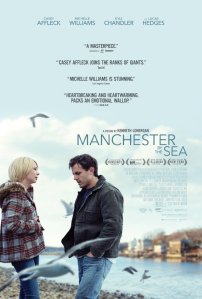 Lee Chandler (Casey Affleck) is living out an ordinary existence as a Boston apartment complex maintenance man. His routine is rudely interrupted when he receives news that his older brother Joe (Kyle Chandler) has fallen deathly ill. On the car ride north to Manchester, Joe passes away. Guardianship of Joe’s 16-year-old son Patrick (Lucas Hedges) is entrusted to Lee much to his shock. “I was just supposed to be the back-up,” he says to himself to little avail. Lee wants to move back to Boston with his new ward but Patrick refuses, pleading that he already has a life in town he enjoys. Lee is itchy to leave because of his painful associations with his hometown, tracing back several years to a fateful night of tragedy he shared with his current ex-wife, Randi (Michelle Williams). Lee takes on the mantle of parent while trying to ignore the trauma he’s doing his very best to ignore with every fiber of his working-class Bostonian being.
The first impression from writer/director Kenneth Lonergan’s movie is just how achingly authentic it feels. We drop in on the lives of these hardscrabble folks and glean important details as we progress, better forming a clear picture as to why they carry such pain with them as penance. In simplistic terms, it’s a two hour-plus journey to reach a point where the main character can openly cry. It’s also much more than that. It’s an incisive character piece on grief and tragedy, a surprisingly funny movie, and an effortlessly engaging movie that swallows you whole with its familiar rhythms of life. There is no formula here for Lonergan. Each fifteen-minute sequence opens the movie up again for further re-examination, especially a middle passage that is truly devastating. It provides compelling evidence why Lee has decided to become a recluse drifting through life. It’s not that Lee is lonely; he’s actively disengaged from all communities and connections. There are three different potential openings with women who seemed flirty and interested that Lee could have capitalized upon, or at least pursued, but he does not. A woman spills a beer on his shirt and squeezes closer to apologize, pleading to buy him a drink. He coolly looks away, ignoring her, and instead chooses to wait until closing time so he can get into a drunken fight instead. Lee would rather feel pain than momentary pleasure.
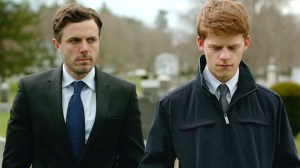 The movie is also a poignant father/son relationship told in waves, with as much humor as emotional breakdowns. Lee is trying to fix the situation the best way he can as if it was another clogged drain. He’s thrust into a parental position that he doesn’t feel fits. It’s not that he’s actively evading responsibility as he does try to accommodate his nephew, even driving him back and forth and covering for one of his two girlfriends to sleep over. Lee cannot work in his hometown because of his own lingering pain and also because nobody will give him a job thanks to the reputation he carries. For a long while it feels like Patrick isn’t even registering the death of his father except for his distress at the thought of his father’s body remaining in a freezer until the ground thaws for a burial. He’s trying to live a normal teenage life filled with activity like band practice, hockey practice, and juggling some alone time with his two girlfriends. He seems like a normal teenager with a normal teenage attitude, and that flies in the face of our expectations. Hedges (Kill the Messenger) provides a nice dose of awkward comedy to keep the movie from drowning in sadness. The burgeoning relationship between Lee and Patrick takes on new familial elements and dynamics and each is feeling out that new role. This movie is more than an elegant bummer.
Lonergan has only directed two movies prior to Manchester, both of them insightful, complex character studies with meaty parts for game actors. 2000’s You Can Count on Me cemented the wide appeal and remarkable talents of Laura Linney and Mark Ruffalo. Then his follow-up, the criminally underseen Margaret, ran afoul with producers who wanted to trim its near three-hour running time. It was kept in limbo for five long years until 2011 where it met with a degree of fervent critical fandom, including yours truly. Manchester began as a starring vehicle for producer Matt Damon, but when scheduling conflicts got in the way, the project was reworked with Affleck in the lead and Lonergan told the story his creative impulses desired without studio interference. As a big fan of his previous directorial outings, I’m not surprised by the gripping results. He lets an audience draw conclusions from the impressions and pieces he offers, notably with Patrick’s mother (Gretchen Mol) who he refers to as “not an alcoholic anymore.” There isn’t one big obvious scene but we’re given enough pointed clues about Patrick’s history with his mother and why Lee is adamant that his nephew does not live with his mother. The history of characters and their relationships follow this model, layering in further meaning as we continue at a safe distance in our seats. Things aren’t spelled out as they are allowed to breathe, the furtive connections becoming perceptible in time like a message written in the fog of a window. Lonergan has great affection for his characters and their flaws, insecurities, and struggles. This was evident in Margaret where the title character (vividly played by a pre-True Blood Anna Paquin) was a teenager exploding with emotions, opinions, and thoughts and Lonergan celebrated her for this fact. I appreciate Lonergan’s refusal to paint in broad strokes with all of his characters.
 This is Affleck’s (The Finest Hours) movie and while good the more extroverted performers around him overshadow him. Affleck can be a gifted actor as evidenced with The Assassination of Jesse James by the Coward Robert Ford. He has a quiet intensity and a habit of burrowing inside himself to discover something raw and different. His performance feels like he’s trapped in a PTSD shield that saps the life from him. He’s drifting through his life and waiting to die, simply put. Because of his taciturn nature he doesn’t garner any sizeable monologues to spill out all his feelings. He has to use little moments and the nuances of choosing his words carefully. When he tells Patrick “I can’t beat it” those words are loaded with meaning that he can only convey in subtext. When he stops to process that Randi has gotten pregnant from another man we notice the subtle registration of pain and regret, a twinge of memories he’s trying to hold back. Affleck’s performance is very subdued for most of the movie but it’s in the final act where he cannot maintain his well-manicured bubble of resistance to the outside world. When Lee does start to cry, it will earn every ounce of your sympathy.
Williams (My Week with Marilyn) is more presence than character in the movie, but when she does stay long enough she leaves an emotionally gut-wrenching impression. I understand that “gut-wrenching” is a pejorative term but it’s really one of the more uplifting moments in the movie. That’s because her character’s reunion with Lee isn’t one of enmity but reconciliation, allowing her to make amends and say plenty of things that she’s been holding back for years. It’s an unburdening and once Williams starts it’s hard not to feel the flow of tears coming from your own eyes. She is a one-scene wonder, reminiscent of Viola Daivs in 2008 for Doubt, nominated for Best Supporting Actress and well deserving a win for one brilliantly acted scene. Fitting then that Davis looks to be Williams’ chief competition for Supporting Actress this year. I invested even more in this scene because the power of Randi’s emotional honesty almost pulls Lee out. He’s shaking, his voice cracking, and trying to stick to saying the customary conversational tokens that have gotten him through to this point. He’s avoiding confronting reality but the sheer emotive force of Randi almost pushes him to that genuine breakthrough.
If there is one noticeable drawback to such an exquisitely rendered film, it’s that it follows the narrative structure of real life perhaps a bit too faithfully. Life doesn’t normally follow a three-act structure with clearly defined character arcs and a carefully orchestrated system of measured payoffs. While Manchester by the Sea isn’t exactly an automatic entry in mumblecore paint drying, it’s certainly less indebted to familiar story structure, which does affect the overall motor of the story. You don’t have a strong sense of its overall direction, an end point, and while the pacing isn’t glacial it can start to feel bogged down in those wonderful New England details of everyday mundane life (how many times do we need to see Lee driving?). There are also probably more flashbacks than necessary to flesh out the characters in an implicit manner. If the movie wasn’t 137 minutes I might accuse it of padding its running time. It doesn’t take away from the overall enjoyment of the film but you feel a certain loss of structure and payoff. In contrast, Collateral Beauty is entirely reliant upon plot machinations and a formula serving a very Hollywood-styled ending. Sometimes maybe an audience would prefer a little more of a driving force and a little more oomph for an ending. While certainly lacking in just about every factor, I’d say that Collateral Beauty does feel more climactic with its conclusion than Manchester, which sort of rolls to a close that makes you say, “Oh, I guess that’s it then.” Sometimes realism can profit from a judicious nudging. Then again with Manchester it’s more the journey and Collateral Beauty is all about the destination.
 While ostensibly being about two men overcoming the loss of someone close to them to function in everyday society once more with meaningful personal relationships, there’s quite a wide divide between Collateral Beauty and Manchester by the Sea. One represents a more calculated and morally dubious reflection of trauma as a theatrical game leading to Big Twists that are meant to leave an audience swooning from the magic of reconciliation. While fairly grounded on its own terms for a far majority of its time, Collateral Beauty can’t help itself and steers into a ditch of bad plotting, made even worse by the fact that it puts so much significance on its preposterous final destination. It manages to cheapen the movie as a whole in retrospect as an elaborate parlor trick that rivaled what the ethically challenged heroes of the tale were perpetrating. On the other side, Manchester by the Sea is a carefully observed and intimate portrait of grief and the consequences of self-destructive detachment from a larger world of compassion. The acting is terrific and lived in, authentic to its core and stuffed with meaningful details that Lonergan leaves to his audience to formulate. However, some of its indie auteur sensibilities do have a somewhat negative impact on the pacing and ultimate conclusive nature of the movie. It’s not that the film is open-ended; it’s just a “life goes on” kind of ending that doesn’t exactly inspire the strongest feelings of satisfaction. Grief will always be a topic that attracts filmmakers and especially actors because of its inescapable drama, stakes, and general relatabilty. I only implore any readers that if you’re trusting filmmakers with two hours of your emotion, make sure they earn that privilege.
Nate’s Grades:
Collateral Beauty: C
Manchester by the Sea: A-
Share this:

Triple 9 (2016)
 Sometimes the most upsetting movies are the ones that have a glimmer of promise and then never take advantage of that promise, instead falling upon staid genre clichés and predictable plotting that makes you wonder how a good idea was smashed into a boring and formulaic product. Triple 9 falls into this category of film disappointment. It has a great premise: a group of corrupt cops (Chiwetel Ejiofer, Anthony Mackie) are in debt to an Israeli mob matriarch (Kate Winslet) and owe her one last score, and their solution to ensure they can get away with their crime is to arrange for a new cop on the beat (Casey Affleck) to be killed, thus providing a major distraction. The problem here is that none of these characters are at all interesting. They all have conflicts and the movie does a fine job of providing each one with some kind of pressure and general motivation, but outside of the forces against them, you can summarize them in a scant few words apiece (drug addict, war vet, single dad, etc.). The plot events also just seem to coast around until a pile-up of climaxes, all of which lack satisfying closure as the body count mounts. It’s hard to care, and the only character that seems worth following is Affleck’s newcomer sniffing out the dangers that are closing in on him. Woody Harrelson feels like he’s making a special guest appearance from a separate movie from Oren Moverman as a drug-addled and angry detective. Too often the characters feel out of orbit from one another, the storylines rarely coalescing. It feels like everyone was given the same acting note of being dour and harried. Winslet’s hammy turn as an Israeli mob boss allows her to reuse her accent from Steve Jobs. Director John Hillcoat (Lawless) provides a certain charge with how he stages the robbery sequences but it’s not enough. Triple 9 is a movie that wastes a great cast, a fine premise, and a talented director. It’s not terrible by most accounts but it’s resoundingly mediocre, and sometimes that can be even worse than bad.
Nate’s Grade: C
Share this:

Steve Jobs (2015)
 Dizzying with its dialogue, Steve Jobs tells the story of its titular man through three Apple product launches, 1985’s Macintosh computer, 1988’s Apple rival and failure, Next, and 1998’s iMac, the beginning of the re-emergence of Apple into ubiquity. It’s really an Aaron Sorkin movie above all else, which means we get absurdly intelligent characters walking and talking at rapid-fire with brilliant one-liners and snappy dialogue that bristles with musicality to it, the kind that your ears perk up for. It’s a feast for the ears; however, Steve Jobs is really an emotionally cold stage play on film. Danny Boyle (Slumdog Millionaire) is the director but the staginess of the conceit is too much for the visually nimble filmmaker to overcome. There are a few small visual flourishes as inserts but the star is Sorkin’s verbose screenplay. We get a glimpse into the prickly, egotistical, bullying, visionary, and curious man that was Steve Jobs. His continual denial of being the father to his daughter is a source of great contrarian insight. The structure of the script lends itself to repetition and artificiality. All these characters keep turning up and having these important conversations at these moments? After a while it feels like the characters are talking in circles and waiting for catharsis, and the concluding ten minutes is a detour into unearned sentiment. The movie and its major themes just do not come together with the clarity or force that the filmmakers believe. Michael Fassbender is superb as Jobs and there isn’t a bad performance in the bunch. It’s an engaging movie in the moment but I don’t feel like I know Jobs any better than before. In attempting to tell the life of one influential man, Sorkin has made the movie about himself, but The Social Network this is not.
Nate’s Grade: B
Share this:

Insurgent (2015)
 A return to the world of Divergent yields little forward momentum, in fact just enough to end on the point that I thought where a sequel would naturally begin. Turns out we needed a whole other movie, Insurgent, to arrive at this obvious narrative next step. Insurgent picks up with Tris (Shailene Woodley) and company on the run following the coup of two of the five social factions. Tris is a Divergent, able to apply herself to multiple factions, and she and her kind are the only ones who can open a secret box left behind by the founders of this post-apocalyptic civilization. The film does enough to hold your attention and we get to visit the other two factions we missed the first time, providing further shape to what is still a confusing world. I think the Divergent series will always fall short of the YA pacesetter, The Hunger Games, but they offer their escapist moments of entertainment. The second film is a bigger, louder, and more heavily coated CGI affair, especially the magic box’s mental trials that amount to a repeat of the first movie’s psychological trials of fear. Woodley is the strong center of the film and she processes her own PTSD over being forced to kill friends in order to survive; you do start to sense that Woodley is growing restless with the franchise. The third book is, as required by the mandate of milking YA franchises, being split into two movies, and while it served little to the Hunger Games, I hope better for the Divergent series, a group of movies inferior and somewhat mystifying but still interesting enough. For now.
Nate’s Grade: C+
Share this:

Labor Day (2013)
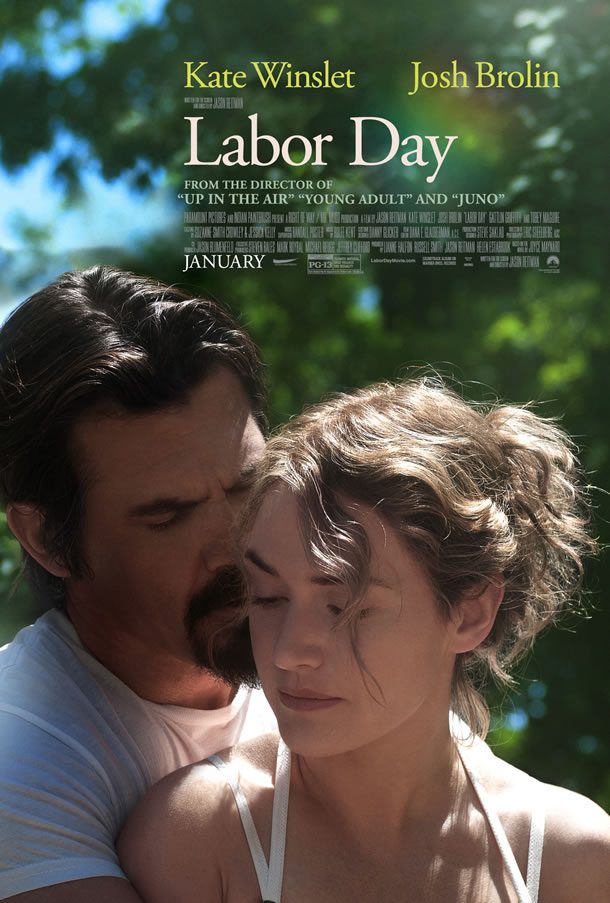 Labor Day, based upon the novel by Joyce Maynard, is the kind of sappy material that you never would have expected director Jason Reitman to attach his name to. Reitman has been accumulating an enviable career of top-shelf dark comedies (Thank You for Smoking, Up in the Air, Young Adult), yet his touch with characters and actors, as well as his delicacy with tone, reminded several of a young Billy Wilder. The stuff of Labor Day felt more like a Lifetime channel original movie. This is just one artistic miscalculation from the start and it doesn’t get better as it goes.
Back over Labor Day weekend in 1987, young Henry (Gattlin Griffith) is living with his grieving mother Adele (Kate Winslet) and performing many of the duties of a husband (don’t get gross). It’s been some time since Henry’s parents divorced but Adele has become a shell-shocked recluse who can barely talk or look others in the eye. While visiting a grocery store, Henry runs into a dangerous man named Frank (Josh Brolin). He’s bleeding from the abdomen and intimidates Adele to give him a ride. Frank is an escaped prisoner and he takes to hiding at Adele’s home. After the initial hostage period, Frank allows Henry and Adele to walk around freely, as long as they don’t tell anyone where he is. As the days pass, Frank helps out around the house, helps Adele get out of her funk, and becomes a surrogate father figure for Henry. The unconventional family must evade the police and skeptical townsfolk to make a run for it.
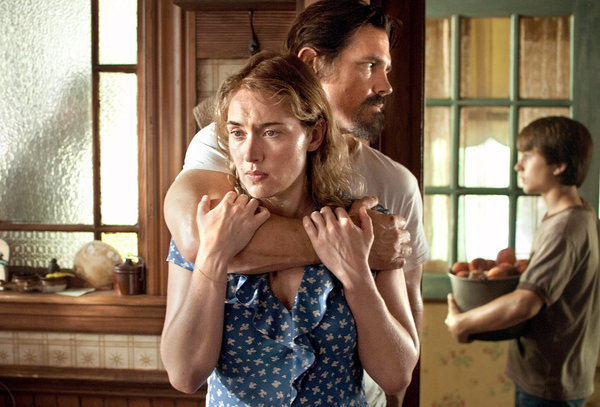 The very premise and its tone are just not a good fit for Reitman. First off, the movie plays out far more like a hostage thriller than any sort of romance. If you were to look deep inside, the romance can be explained as one very emotionally needy woman and her child going through Stockholm syndrome. The entire movie takes place over the titular Labor Day holiday, which means that all these changing feelings have to morph over the time period of three days. I don’t know if I’d call that love, even in Movie Land. Hey, Frank didn’t kill everyone and he helps around the house, isn’t he great? These people should be far more afraid for far longer. It is almost comical how saintly Frank becomes and how many surrogate father activities he squeezes into the abbreviated window of time. He performs handyman jobs all around the house, teaches young Henry how to change a tire, tosses a baseball with the kid, teaches everyone the finer points on pie making, and other such helpful activities. I understand that these two lonely people finally see a replacement man; for Henry a father, for Adele a lover. Again, the three-day time window makes everything appear like the manifestation of Stockholm syndrome. How many of those abducted have uttered, “He’s not that bad. You just don’t know him like I do”? Frank’s back-story is tragic but he is a wanted felon and he has no problem threatening both of these people’s lives in the beginning. Yeah he doesn’t resort to violence or yell in their faces, but why would he against an adolescent boy and his easily cajoled mother? No matter how long Reitman spends showing us the softer side of Frank, especially while preparing delectable dishes of food, he’s no more developed than the common Misunderstood Bad Boy.
Then there are the dawdling coming-of-age moments clinging to young Henry, a boy growing up quickly in a tumultuous holiday weekend. It strikes me as tonally odd to already take a tricky balancing act with the film’s plot and then tossing on a coming-of-age addition. The story is told from Henry’s perspective, and that’s a major problem as well. He’s the least interesting person in this dramatic setup. Being confined to his viewpoint often keeps us distant from the deeper drama going on. I’d rather spend time with Adele and Frank bonding so that the romance can find some traction, but no. Al we hear are the thumps from the other side of the wall and the gentle whisperings between them in stolen glances. It’s a frustrating perspective because quite frankly nobody really cares about this kid’s sexual awakening and his daydreams about the cute girl’s bra. His dad (Clark Gregg) wants to talk to him about the birds and the bees. His mom talks about the same. It’s a somewhat uncomfortable position for the audience with both parents wanting to cover the sex talk. There’s a wanted man hiding in his home! Henry’s personal growing up drama has no equivalency to this. Of the three main characters, doesn’t Henry seem like the worst participant to tell the story? It doesn’t help that Tobey Maguire narrates as older Henry. Have we not learned from The Great Gatsby: Maguire’s voice does not suit narration.
It’s the film’s more tense moments where you get glimpses of the real movie here, the thriller that’s been gussied up and disguised as some strange romance. Whenever someone gets close to discovering what’s really going on in that house, the movie picks up and grabs your interest once more, albeit fleeting. The fear of getting caught is potent but it should have been more omnipresent. The film, through Henry’s perspective, is treated like this nostalgic chestnut of that one summer a convicted killer held us hostage. The police are canvassing for an escaped prisoner but the neighborhood doesn’t seem to be that alarmed, still going about their business bringing desserts and fresh produce to one another’s doorstep. Too much of the film implies the threat, like with a short glimpse of a police checkpoint, but places it on the back-burner so that the romance can take shape. Again, this is a byproduct of being stuck in Henry’s perspective whereas the kid might not have the best understanding of how serious everything is (he’s worried his mom will abandon him and run off with Frank). But in those brief moments of dread and tension, this is where Labor Day works, and Reitman does a great job of turning the screws and building that suspense. It makes you wish the whole thing were a thriller.
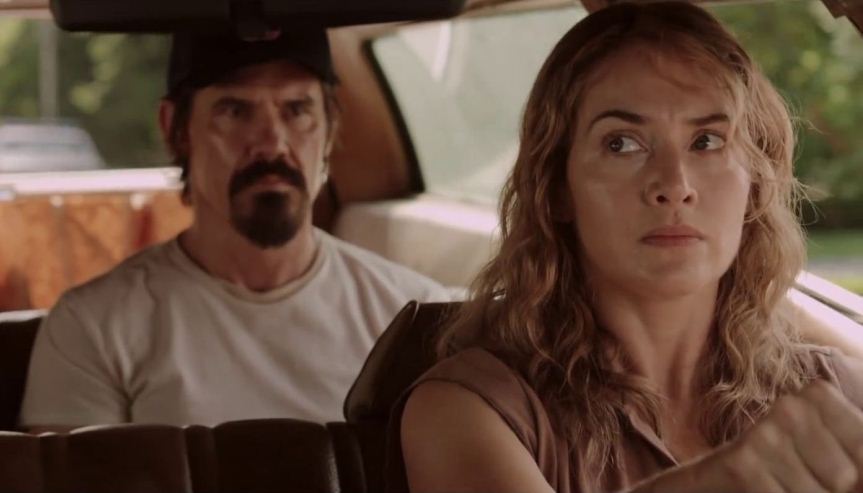 No one is going to question that Winslet (Divergent) and Brolin (Gangster Squad) are great actors, but boy do these characters underachieve. There is one very effective and moving monologue Winslet has about her pregnancy problems that have turned her away from the world, but it’s not enough. For much of the movie, she plays such an anxious and internalized character, so it’s hard to really follow her emotional development. That monologue does the most heavy lifting but it’s pretty wan before and after. Winslet is too good an actress to play essentially a catatonic woman that’s fairly mute. Brolin can play a soulful brute in his sleep. There’s so little to challenge him and so he seems on autopilot. It also hurts that both Frank and Adele have very limited conversations. It’s a romance told in gestures and handclasps (and the rhythmic thumping of walls at night). It’s not their fault that their characters are underwritten and unsatisfying. Griffith (Green Lantern) is a nice young actor but he too is forced to communicate much with little and comes up short. James Van Der Beek (TV’s Dawson’s Creek) is a local cop who appears for one scene, and afterwards you wish he would stick around longer. Look for Reitman good luck charm J.K. Simmons (Dark Skies) as a helpful neighbor.
Reitman is such a talented director that he can almost pull off sequences in Labor Day despite all of its inherent structural, tonal, and perspective flaws. From a technical standpoint, the movie is a gauzy, amber-accented tale with plenty of strong alluring visuals to set you at ease. There are these trembling moments where you almost see what attracted Reitman to the film, but the finished product is just a mushy misfire. It’s earnest without having earned our emotions, and the thriller elements and the romance elements are in constant conflict. We all remember our grandparents telling us that magical moment they knew they had met the one when he tied her up and held her hostage. Much of the drama that comes from the premise is handicapped from the mistake of having Henry as the chief storyteller and point of view. His limited involvement means we’re kept at the peripheral for too many important moments. I have no doubt Reitman will rebound and quickly (he’s already filming his next movie and has optioned a book for his next next movie). Get ready to have Labor Day play every subsequent Labor Day weekend on the Lifetime channel, its true home.
Nate’s Grade: C


 nathanzoebl
You must be logged in to post a comment.