Blog Archives
(500) Days of Summer (2009)
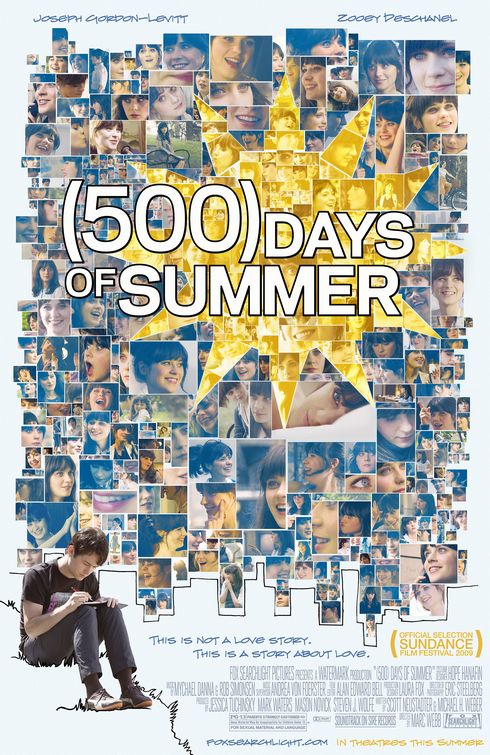
It doesn’t take long before you realize that (500) Days of Summer is a different kind of romantic comedy. In fact, to slap that genre title onto it does a disservice. I’ve watched plenty of romantic comedies (a notable rise in viewership since getting married in 2006), and the traditional Hollywood romantic comedy exists in a world not our own. It is a sitcom world where people blurt out their feelings, interact in bizarre manners, and get into wacky hijinks and contrived misunderstandings. These tales also exist in “movie world”; (500) Days of Summer, on the other hand, is refreshingly recognizable. Granted the characters still have fantastic if slightly off kilter jobs (writer of greeting cards), and the characters live in fabulous and gigantic apartments. Excusing those contextual quirks, the movie is upfront about its intention. “This is a story of boy meets girl,” a narrator intones, “but it is not a love story.”
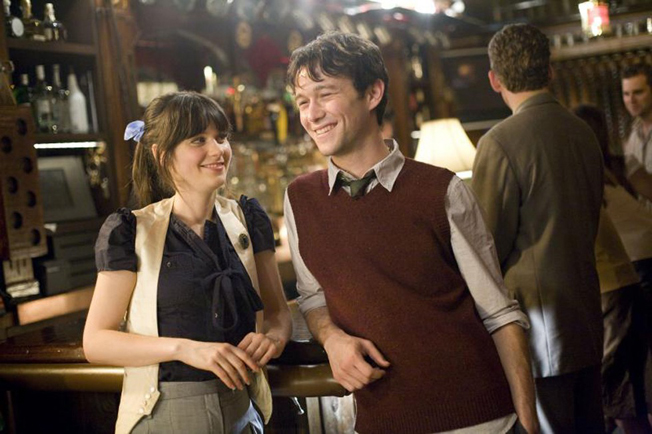
Tom (Joeseph Gordon-Levitt) recounts the 500 days he has spent with his ex-girlfriend, Summer (Zooey Deschanel), the girl he aches over because he feels her to be his “one.”
This is a movie about love and relationships but it has such a wider scope. It’s perceptive and insightful in the way that human beings engage in coupling. Tom ping-pongs between memories, tying together happy moments and the failed recapturing of those exact happy moments later. I enjoyed how reflexive the film can be with romance. When Tom is infatuated with Summer he lists her attributes: “I love her smile. I love her hair. I love her knees. I love how she licks her lips before she talks. I love her heart-shaped birthmark on her neck.” And then when he is frustrated with Summer, he lists her faults: “I hate her crooked teeth. I hate the way she smacks her lips. I hate her knobby knees. I hate that cockroach shape splotch on her neck.” I appreciate a movie that tries to tackle the complexities of love in a manner that doesn’t seem trite or sensational. A movie doesn’t have to say anything new about romance (is it even possible to scoop the Romantic poets?), but it can still say something true and revealing. It is a story about love, but not a love story.
 It also helps that the characters are meaty and are played by capable actors. Tom is a smart enough guy, though a bit of a foolish romantic. He buys into the love that is talked about in pop songs and greeting cards; he’s not naïve per se but plenty vulnerable enough to get his heart broken in the real world. Summer is an independent woman who says at the start that she is not looking for a boyfriend. She doesn’t wish to be constrained by a relationship and wants to enjoy the carefree days of youth. Yet Tom persists thinking he can wear her down or win her over, waiting for Summer to cave and find solace in Tom’s embrace. He fancies Summer as the “girl of his dreams,” though everyone else isn’t so sure. His little sister argues, “Just because she likes the same bizzaro crap you do doesn’t mean she’s your soul mate.” One of Tom’s friends has a really nice monologue describing his “perfect girl,” and these descriptions noticeably differ from that of his long-term high school sweetheart. But then he stops, reflects, and says that’s what his “perfect girl” would be like, but his current girlfriend, well, she’s better than his imaginary version of a perfect girl. But Summer isn’t a fantasy of romantic perfection, she’s a person. She has her own desires, her own insecurities, her own ambitions, and her own life to lead. These two feel like actual human beings and not stock players, though (500) Days of Summer does carry its own share of stock parts like the square boss (Clark Gregg) and the goofy, horny friend (Geoffrey Arend).
The saying “the camera loves” somebody seems outdated, old fashioned, and liberally applied. But when it comes to actress Zooey Deschanel, well, the camera just loves her. It’s hard not to fall in love with this blue-eyed beauty. She’s adorable, but not in an overly quirky way, and she’s smart, but still approachable, and altogether lovely. She is the face of unrequited love. She can be cold and aloof and jubilant. Deschanel plays the complications and complexities of an enigmatic woman who refuses to abide by labels. Her last conversation with Tom manages to be both crushing and inspirational. Her chemistry with Gordon-Levitt feels entirely naturalistic and pleasant. Gordon-Levitt has been cranking out strong performances in indie films like Brick, Mysterious Skin, and The Lookout. He’s quite possibly becoming one of the premier young actors working today. He has an everyman capability but he also can turn on the charm in a way that doesn’t seem forced, like Shia LaBeouf. Gordon-Levitt is the anchor of this movie and we see the world and Summer through his eyes. He brings great vulnerability to his role and we feel each step of his emotional journey. Both actors deliver terrific performances that don’t stoop to playing by the conventions of the romantic comedy.
 The nonlinear story structure seems like a gimmick until you realize that the writers, Scott Neustadter and Michael H. Weber, have cleverly freed themselves from the contrivances of movie romance time. MRT, for those who prefer their nomenclature in the shorthand, is that unbelievable breadth of time where the characters fall head over in heels in love with each other. It always feels so fast and far too fleeting, so that when complications have to arise late in the second act they too feel rushed. You could apply a healthy dose of montages to signify massive time passages, but those get old unless you’re Sylvester Stallone training to fight another boxing match. (500) Days of Summer tells you right away that this story takes place over a year and a half, and Day One isn’t when boy got girl but when boy met girl. By skipping around to specific dates, Neustadter and Weber are hitting only the highpoints, the memorable moments, and leaving out the unforeseen groundwork. All those mundane yet essential moments of pulling together a successful relationship are there, they are just now implicit. They are implied in the time jumps. The relationship between Tom and Summer, therefore, exists in an expanse of time that feels believable. The nonlinear structure also belies the way our memories work. Human beings don’t remember everything in a straight line, especially in matters of the heart.
There’s a lot of drama to be mined here with the breakup territory, but the movie is also playful and funny. Director Marc Webb, he of the video music world, pokes fun at other filmic expressions of love. At one point, Tom struts down the street and becomes the center of a lively choreographed dance sequence complete with animated blue birds. At another point, during Tom’s heartbreak, the movie descends through Bergman and Fellini visual tropes. It simultaneously communicates Tom’s emotional highs and lows and satirizes the histrionic nature of his feelings. Truly, when one’s in love you couldn’t feel better, or worse, but upon retrospect you can see how silly such in-the-heat-of-the-moment proclamations can be. There’s also a scene later in the film where Tom attends a party that Summer invited him to. The screen cuts in half, and on one side we see Tom’s expectations of what will happen that night and on the other side we see what actually occurs. The visual symmetry is interesting and a great glimpse inside the mind of a hopeful romantic.
 (500) Days of Summer manages to be breezy, moving, delightful, perceptive, charming, and just a great time at the movies. It’s a story about falling in love for the right reasons with the wrong girl. Summer isn’t the villain of the piece but her own woman, and she can be fickle and frustrating but she is not cruel or indifferent. Tom is desperately in search for his “one true love” but he’s playing by a checklist he’s drawn up from movies, TV, and love songs. All of this could have been sticky and formulaic (in fact, the dynamic vaguely resembles the characters from the abysmal Ugly Truth), but the filmmakers and the talented actors make the movie feel honest and relatable. The nonlinear narrative allows the movie to simultaneously be more playful, believable, and actually easier to understand, linking selective memories. No matter your current romantic situation, (500) Days of Summer is a slick antidote to Hollywood’s rom-com factory line.
Nate’s Grade: A
Share this:

G.I. Joe: Rise of Cobra (2009)
 While plenty stupid, the big-budget G.I. Joe movie is actually passably entertaining. Sure the characters are one-note, the motivations and romances are strained, the acting is abysmal, Dennis Quaid looks to be in particular pain, the plot has too many unneeded flashbacks, the special effects are cheesy, and the movie is crammed with deliberate toy merchandizing connections, but I had fun with this flick. Director Stephen Sommers (The Mummy) works the right kind of stupid, the loud noisy kind that manages to tickle a childlike sense of glee like watching an eight-year-old’s imagination blown up on screen. The scale of weapons and special vehicles and special suits and special ladies in special leather outfits for engaging in criminal activity should delight younger film goers. The action is frenetic (if there is a pane of glass within 100 miles, the movie assures that you will see it shatter) and the international collateral damage is colossal, so much so that G.I. Joe almost comes across as a goofy, straight-laced version of Team America. Certainly the benefactor of rock-bottom expectations, G.I. Joe: Rise of Cobra is a brash blast of acceptable action movie stupidity. Grab a big bag of popcorn, shut off your brain, and enjoy the film’s cartoonish yet entertaining qualities.
Nate’s Grade: C+
Share this:

Brick (2006)
 I appreciate movies that try something different. That isn’t to say I love all movies that try, like Gus van Sant’s latest collection of watch-grass-grow cinema. More often than not I appreciate stabs at originality even if it results in colossal failure. That’s why I can never beat too much on M. Night Shyamalan. When Brick came out last spring it had my attention immediately. Writer/director Rian Johnson placed a hard-boiled detective story in the contemporary setting of a high school. And true to my promise on my podcasts, I bought it the day it came out on DVD. For fans of crime fiction and excitingly bold cinema, rent this movie.
Brendan (Joseph Gordon-Levitt) is a kid that knows the ins and outs of the high school scene. He’s currently looking into what happened to Emily (Emile de Ravin), his ex-girlfriend who was last seen trying to fit in with the popular types. She was in some form of danger and contacted Brendan for help. With the help of The Brain (Matt O’Leary), an old friend, Brendan must negotiate a web of unsavory characters, each with their own game. There’s Dode (Noah Fleiss), a burnout who was last seen crushing on Emily. There’s Laura (Nora Zehetner), a rich girl accustomed to hanging out with bad boys. It all leads to The Pin (Lukas Haas), the man controlling the area’s drug supply and who, we’re told, is “way old, like 26.” The Pin’s been volatile ever since a brick of heroin went missing. If Brendan’s head isn’t spinning piecing together all the clues, surely the audience’s will be.
 Brick is a film that refuses to simply be an afternoon afterthought. This is a movie that demands you sit on edge, poised to decode its complicated detective jargon and twisty storyline. It takes a while to first get into the movie because of its stylized dialogue and how straight everyone plays it. Johnson has recycled the same hard-boiled talk you’d expect coming from the mouths of Humphrey Bogart and Lauren Bacall. I heard that some theaters actually gave a glossary of terms and verbal exchanges for people who went to see Brick. Whether that’s true or not, your brain is working overtime to decipher what is being said, and I love that. I love that Brick doesn’t take time out to explain its terminology but expects you to keep up as best you can. I don?t want to scare readers off, because even if you don’t know any noir vernacular you’ll be able to know what’s going on, but it’s just cooler to be in on the fun. The snappy dialogue is only one part of Johnson’s extremely intelligent, very meaty script.
Brick relies on a gimmick, yes, but what an inventive and clever gimmick. There’s just an extra level of fun for film noir fans, spotting the same archetypes (mysterious damsel in over her head, femme fatales, goons, underworld boss) and locations (gin joints become house parties, detective offices become teen bedrooms). Brendan even gets chewed out by his superior who wants results… his assistant vice principal (Shaft‘s Richard Roundtree). There’s such a common language of film noir and its staples, and part of Brick‘s enjoyment is placing all of them. I’m fully aware that Brick will exist more as an artifact in a film class than as a film casual moviegoers will actively watch. The plot is blissfully twisty with many intriguing players, and once it’s all laid out it actually holds together. Brick is rewarding for those willing to stay attentive.
The movie succeeds because of how committed everyone is. The gimmick seems doomed to fail but the movie has creativity in spades. Of course it’s all highly unrealistic but it all works splendidly within the world it creates. Because the filmmakers play it all straight, you never look at the movie from an outside perspective. You’ll never laugh at it unless you’re giggling about how much fun it is. Unlike other recent brainteasers like Syriana, you do have an emotional connection to the movie and you do care about the characters and are interested to see where the story goes (and it’s not nearly as confounding as Syriana). I love that Brendan outsmarts everyone and sometimes he does it by taking a pounding. I love that he takes so many beatings that he actually gets sick from swallowing so much blood. It’s the attention to details like that where Brick shows its commitment to the world it has created. Brick is reveling instead of deconstructing the detective genre, like the audaciously cheeky Kiss Kiss Bang Bang.
 There are some humorous winks that remind you of Brick‘s gimmick, which is surprisingly easy to forget. The Pin’s mother serves juice to her son’s “friends;” The Pin walks along a beach discussing the details of his operations and then drops a peculiar non-sequitur, asking Brendan if he’s ever read J.R.R. Tolkien (“His descriptions of things is really good. He makes you want to be there.”) That moment has haunted me still months after I viewed Brick in a theater. The Pin is a scary bad guy but it’s that line that makes me go back and say, “Yeah, but they’re just kids.”
Johnson masterfully handles his actors. Gordon-Levitt is fast becoming one of the most versatile young actors. He’s the moral anchor of the movie and Levitt carries the film on his back. He’s great handling the dialogue but even better making Brendan seem human in a highly stylized tale. Zehetner leaves quite an impression as a smoky seductress who may be the biggest player in the film. Haas plays his villain role to eerie perfection.
Brick is an exciting, disarming, demanding, vibrantly different movie that is stone cold cool. This is not the easiest movie to get into, but once you open up to its freshly retro wavelength then Brick is one greatly rewarding movie. Johnson has built a movie around a gimmick but it all holds together so well thanks to his total commitment. The dialogue is heavy in noir slang and the story is crammed with twists and surprises. I loved this movie from the first frame to the last. Johnson has found a refreshingly original movie by going back in time. They don’t make ’em like this anymore.
Nate’s Grade: A


 nathanzoebl
You must be logged in to post a comment.