Blog Archives
Unfrosted (2024)
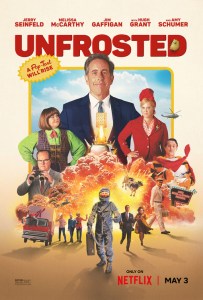 What to make of a movie like Netflix’s Unfrosted. It’s Jerry Seinfeld’s directorial debut, working off a screenplay he co-wrote, his first foray into film writing and acting since 2007’s Bee Movie. His eponymous sitcom “about nothing” was a 1990s mainstay and popularized an ironic meta form of comedy that still continues to dominate comedic tastes. Making a movie about the pseudo history of the invention of Pop Tarts, and the corporate rivalry between the major cereal brands, seems like a further exercise in that realm of humor, potentially satirizing a burgeoning sub-genre of late, the Biopic of Products (Air, Tetris, Flamin’ Hot, Blackberry). Except this supposed “biopic about nothing” is really a head-scratcher. Its humor feels pained and stale, the satire feels missing or glancing at best, and it seems like an expensive lark, wasting the nigh-infinite money of Netflix to purposely make a stupid comedy with all his friends.
Set in the mid 1960s, we follow two households, both alike in dignity, in fair Battle Creek, Michigan where we lay our scene. Kellogg’s has been the dominant cereal-brand for years but its chief rival, Post, is set to launch a new product that will revolutionize breakfast mornings. Bob (Seinfeld) is the head of development for Kellogg’s and reaches out to his old colleague, Donna (Melissa McCarthy), when it becomes evident that Post stole their unused research to develop a pastry treat designed to be cooked in one’s toaster. The warring CEOs, with Jim Gaffigan as Edsel Kellogg III and Amy Schumer as Marjorie Post, are desperate to one-up one another and be seen as more than an inheritor of their family’s wealth. It’s a race to see which company can get their treat to market first and capture the hearts, minds, and sweet teeth of America’s youth.
 I’d be lying if I said I didn’t laugh at points through Unfrosted, which operates like a spoof movie on a slower jokes-per-second pacing guide. There are zany sight gags amidst broadly drawn characters treating the silly straight, though occasionally you’ll have wisecrackers commenting on the inherent absurdity of moments, mostly confined to the stars making asides to the audience. Sometimes it’s lazy jokes that rely upon our foreknowledge, like when Bob coins a NASA beverage by saying it has a “real tang” (get it?). The movie frequently intensifies into goofy escalation when Kellogg’s impanels a team of mascots and inventors as a breakfast brain trust. Every one of these wacky characters is here to provide the exact same joke they will provide throughout the movie, and their inclusion is already suspect. Having the Schwinn bicycle guy (Jack McBrayer) comment on why he should be there is not enough. The hit-to-miss ratio will vary per everyone’s personal sense of humor, but overall I just felt mystified why this project would tempt Seinfeld from his comedy repose. What about this idea excited him? Was it just his lifelong love of cereal and Pop Tarts, a topic from his standup act decades ago? I ate a lot of cereal as a teenager too but I don’t want to make a movie about the Lucky Charms advertising campaign teaching children to beat and pillage the Irish (maybe Ken Loach could direct – to the three people on the Internet who appreciate this joke, I want you to know I appreciate you also).
It can be fun to simply watch dozens of famous people take their turns being silly in what is unquestionably a “dumb comedy.” When you have comedians of this quality in your movie, they’ll find ways to make even so-so jokes hit a little better, and that’s the case here. There’s an entertainment value in just wondering who will show up next, as many characters are only onscreen for a single scene or an abbreviated moment. Unfrosted becomes an example of Seinfeld’s industry power as he empties his Rolodex to fill even the tiniest of roles. Look, it’s James Marsden as Jack LaLanne. Look, it’s Bill Burr as JFK and Dean Norris as Kruschev (double Breaking Bad). Peter Dinklage as the head of the nefarious milkmen cartel? Why not? If you set your expectations low, maybe lower than what you were accounting for, there can be a mild amusement scene-to-scene just seeing who might show up next, almost like a modern-day version of those anarchic big ensemble comedies like It’s a Mad, Mad, Mad, Mad World.
 There is one segment that fell so flat for me that I was in utter amazement, and that was the unexpected January 6th insurrection parody. In a movie that has sustained a surreal and offbeat version of our universe, it evokes one of the most startling days of recent history. I think the humor is meant to derive from simply seeing a bunch of mascots in big colorful costumes as a mob running havoc, but there’s no jokes about like the challenges of a mascot costume in a fight, or say someone tipping over and being unable to get back up like a helpless turtle. There are jokes that can be had with this scenario, but instead Seinfeld is relying on the ironic juxtaposition of the ridiculous with the serious, and I don’t think it ever works as a joke. My sinking feeling began when Hugh Grant’s embittered mascot character wore a headdress resembling the QAnon shaman. It feels tacky and strange and the longer it persists the more I kept wondering what Seinfeld was doing with this. Why include this especially as the only form of relatively topical political humor, beyond, I guess, the depiction of business elites being complete morons? Why this? Again, it would be different if it was funny in execution, like the Saving Private Ryan D-Day parody from Sausage Party. This just isn’t funny, and its inclusion feels so odd compared to the stale nature of its other comedy.
As an admittedly silly enterprise, one that doesn’t even pretend to be accurate even as it flirts with the truth, Unfrosted is a successfully stupid comedy that feels a little too aimless, a little too edge-less and safe, and a little too dated and stale in its approach to comedy (lots of 1960s Boomer nostalgia ahoy). It’s hard to work up that much risible anger over a 90-minute movie that features a living ravioli creature. Clearly this movie wasn’t trying to be anything other than a gleefully stupid comedy, but I wanted more pep from its jokes and whimsy and general idiocy. I think the way to go may have been all the way in the other direction, treating the formation of a toaster pastry like international nuclear secrets and playing the corporate espionage completely straight while also making it patently ridiculous. Unfrosted did, however, make me want a Pop Tart that I ate afterwards, although it was my local grocery store’s generic brand, so I guess that doesn’t directly benefit Kellogg’s. This movie exists as a Seinfeld curiosity that ultimately left me hungry for more.
Nate’s Grade: C
Share this:

Mean Girls (2024)
 Child: “I want Mean Girls [2024], mom.”
Parent: “We have Mean Girls [2004] at home.”
Consider this bouncy 2024 remake Mean Girls Plus, as the only additions from the popular high school comedy are the adaptations made to retrofit Tina Fey’s comedy for the Broadway stage. Twenty years later, the cast is more diverse, some of the jokes that have aged the worst have been removed (fewer fat jokes and no more teachers sleeping with underage Asian students), and the 97-minute original now becomes a 112-minute musical. The cast is winsome and charming but fail to disperse your memories of the original cast that featured future Oscar nominees Rachel McAdams and Amanda Seyfried or even Lindsay Lohan during the height of her career (Lohan cameos as the mathlete judge). Renee Rapp (The Sex Lives of College Girls) has got the most command as this next generation’s Regina George, a role she played during the Broadway run. Your overall impression is going to hinge entirely upon your evaluation of the pop-heavy songs, which to my ears were pleasant but unmemorable melodic pap. There is the occasional snarky line (“This is modern feminism talking/ Watch me as I run the world in shoes I cannot walk in”) but most of the lyrics and jokes are mild additions from what Fey’s movie already established. The standout musical moment might be a goofy throwaway number about all the different sexy Halloween costumes a woman should be able to dress in (“If you don’t dress slutty, that is slut shaming us”). The staging features lots of long takes and tracking shots to better appreciate the nimble dance choreography with the occasional visual addition (phone screen inserts make for modern backup singers). The memorable 2004 lines that have stuck as Millennial memes are included but treated like returning victors, but when elevated and given space for applause, it feels so strange and artificial. The 2004 movie didn’t do this. Regardless, you can do worse than a slightly updated version of Mean Girls with all-right songs, though you could also simply re-watch the original.
Nate’s Grade: B-
Share this:

Top Gun: Maverick (2022)
 Until just the other day, I had never seen Top Gun. Growing up in the 80s into the 90s, I was familiar with the film as it was a staple in friends’ homes, as was the lousy Nintendo video game, and one of the major pillars of Tom Cruise becoming a superstar, but I was too young when it came out and then it got buried behind other movies I always intended to catch up with. Honestly, as I got older, I just didn’t have much interest in rote military thrillers the likes of Tom Clancy (I dub them “dad movies,” as they’re my father’s long-standing Clancy-loving preference). Then came the 2022 sequel, Top Gun: Maverick, and it became Cruise’s highest-grossing movie of his blockbuster career and the fifth highest-grossing movie of all time. I’m probably one of the last few people on the planet to finally catch Maverick and I’m a little befuddled what made this movie as highly praised, to the point where it’s a given it will be nominated for Best Film awards and even stands as populist chance of winning. Maverick is a perfectly enjoyable action movie with satisfying character arcs. It’s an example of what big-budget moviemaking can accomplish when the right artists are aligned. However, let’s not start jumping on any couches and going nuts here. It’s a solid sequel elevated by a great finish.
We follow Maverick, a.k.a. Pete Mitchell (Cruise), as he’s tasked with training the next generation of top guns for a very specific, highly dangerous aerial assault mission to take out a foreign nuclear arms lab. The big issue is that one of these pilots, Rooster (Miles Teller), is the son of Maverick’s former wingman, Goose (Anthony Edwards), who died in the 1986 original movie. Mav has been denying Rooster senior-level opportunities out of fear of being responsible for the death of father and son, but Rooster will not be ignored and denied, and they’ll square their feelings of guilt and resentment over the course of this impossible mission.
 I can see why this movie would be successful. It plops our older hero down in a teaching role which allows the satisfying arc of building a team, gaining his own feet as a teacher, and the two-way transmission of respect. It’s a formula that works. We watch the younger pilots grow and become more capable, we watch Maverick settle into a natural teaching role, reaching out to others, and we also watch him and his team stick it to the naysaying Naval authority with every victory. It’s all there and developed with enough precision by screenwriters Ehren Kruger, Eric Singer Warren, and Cruise-lifeline Christopher McQuarrie to operate smoothly. In the 1986 movie, we had hotshot pilot Maverick learning personal responsibility and teamwork, though much of that original movie was preoccupied with so… many… characters telling young Mav how gosh darn special he really is and how the U.S. Navy needs him so bad. The emotional reconciliation also works between Maverick and Rooster (I guess the name and the mustache are affectionate odes to dear deceased dad) and serves as an effective emotional foundation for old fans and new. The drama works and the legacy elements and cameos feel better incorporated, though the “Great Balls of Fire” piano bar singalong was awkwardly forced nostalgia bait. The romance with Jennifer Connelly’s single mother barmaid even feels a little wiser and more honest rather than setting her up as a good-looking woman cheering our hero onward. Nobody’s going to leave the film citing the prerequisite love story as their favorite part, but it’s at least more thoughtful and less tacked-on than I was dreading. For all these reasons, Top Gun: Maverick has the tools to succeed as a sequel that can transcend its initial nostalgic fandom.
 Where the movie really takes flight is in its action photography and the final act. Director Joseph Kosinski (Oblivion, Spiderhead) filmed the aerial sequences with IMAX cameras and the in-cockpit perspectives make the action far more immersive and thrilling. The actors were charged with being their own camera operators while flying in their planes, so Kosinski would wait on the ground and then review the footage and then send the actors back up in the air for further takes. It’s a painstaking process, made more so by Cruise’s obsessive insistence on making things as real as possible, and it pays off remarkably. The dazzling footage within the cockpits as they swoop and swerve has an exciting verisimilitude that can’t be replicated by computer effects. The dogfights are easy to understand and follow thanks to the careful visual orientation from Kosinski, smooth editing that doesn’t become jumbly, and clearly stated goals and mini goals within the mission training (McQuarrie is so good at this stuff). It made me wish that they never got out of the air. It also made me envious of the grandiose IMAX presentation.
It’s the final act that really seals the deal from an entertainment standpoint. The team tackles their mission at the 90-minute mark, and it’s thrilling and everything you’d want in an action set piece. The way the mission is structured in well-defined pieces working in tandem reminded me of the Mission: Impossible franchise during its 2010s swing into becoming the best studio action franchise. It makes for a satisfying and thrilling conclusion, and it’s not a real spoiler to say that the team of underdogs defies the great odds and succeeds, but then the movie surprised me. There was still twenty minutes left, and Top Gun: Maverick says, “Oh, you think we’re done? We’re not going to just give you a good climax, we’re going to give you a buffet of action peaks, each somehow elevating the movie even higher while still working with the established character arcs.” It is a feat of deft studio action construction. After the mission, there’s a personal behind-enemy-lines rescue and escape that literally hinges upon a recognition of nostalgia as intrinsic value. I won’t explain the exact particulars, but the characters literally survive relying upon the devices and training of old, surely a reassuring nod to the older generation audience members. It’s like the movie has taken Cruise’s penchant for showmanship to heart and wants to give you everything it can. The results are a good action movie flying off the charts by the end with a fantastic finish.
 Still, it’s hard for me to join the cheering masses declaring Top Gun: Maverick as one of the best films of recent years. It’s slickly made, solid in its storytelling and emotional foundation to produce satisfaction, and it’s filmed with visual panache from its commitment to practical effects and realism. The final act is a fabulous sendoff that shows the heights of blockbuster popcorn cinema. Maverick is without a doubt the superior Top Gun movie. The original had its own sense of style from director Tony Scott, one that became synonymous as the visual vocabulary of Hollywood military thrillers for decades. It’s also hard to watch the movie in 2022 and not see the dozens and dozens of imitators that came after, making the movie feel less enticing and more simply the progenitor of a genre formula that isn’t my favorite to begin with. Maverick improves in every way and sheds the worries of being a late-sequel nostalgic cash-grab. It’s a good and effective movie with a rousing and uncommon finish, and maybe that’s enough. Maybe people are looking for something that feels like comfort food done right, and I suppose that could be Top Gun: Maverick for many, as the box-office numbers would chiefly indicate. I might not be in its inner fandom but I can see what others would celebrate, even if I do less.
Nate’s Grade: B+
Share this:

No Sudden Move (2021)
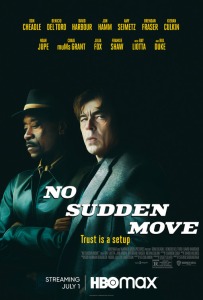 A star-studded collaboration between director Steven Soderbergh (Logan Lucky) and screenwriter Ed Solomon (Bill and Ted Face the Music), No Sudden Move is a class in how to effectively use tension and confusion to a movie’s benefit. Don Cheadle and Benicio del Toro play a pair of low-level criminals struggling to make ends meet. They accept a quick job “babysitting” a family while the husband (David Harbour) retrieves a very valuable document that certain higher-ups are after. Very early on, you feel like something is wrong and something will quickly go wrong, and this feeling persists throughout the film’s two hours. Our two protagonists sense they’re being set up, take action, and from there the movie becomes them trying to cash out with this valuable document while constantly looking over their shoulders. There are many different parties that are willing to do whatever it takes to obtain this document. In all honesty, the screenplay by Solomon is a little too over-plotted. There are several betrayals and schemers and acrimonious relationships built upon past betrayals and mistakes that it can all be a little hard to follow at times. The dread I felt was palpable. You don’t expect these guys to get away with this, not against the forces they’re going against, and so it becomes a nerve-wracking game of assessing every moment and whether this is when disaster will strike. Soderbergh’s dashes of style don’t always jibe with the 1954 Detroit setting, like his penchant for fish-eyed lenses communicating the distortion of this murky world of shadow brokers. It feels like Soderbergh has to resort to some new gimmick to get himself excited about movie projects (at least is wasn’t filmed on an iPhone). The acting is strong throughout, though Cheadle can be hard to hear at times from his guttural, frog-in-throat speaking voice. The movie kept me guessing, with some surprise cameos, and it left me dreading what would happen next. A modest success for glamorous discomfort.
Nate’s Grade: B
Share this:

Lucy in the Sky (2019)
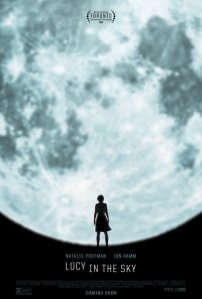 I don’t really know what this movie was trying to say. I think co-writer/director Noah Hawley (TV’s Fargo, Legion) was better trying to humanize the story of Lisa Novak, the astronaut who drove 900 miles, while wearing diapers to skip bathroom breaks, to confront the current lover of an ex-boyfriend, all three NASA employees. It was a story so bizarre, so tabloid ready, that a big screen adaptation was inevitable. What I wasn’t expecting was an artist to take this and discard the attention-grabbing details and turn this into a ponderous existential meditation. Lucy (Natalie Portman) has recently returned from Earth and our big blue planet doesn’t feel the same after she’s touched the majesty of space. Her life seems small, meaningless, boring, and she can’t shake her terrestrial depression. She begins an affair with a co-worker (Jon Hamm) to feel that same special sensation again, but she’s chasing something uniquely elusive. Lucy in the Sky is structured like a meandering Terrence Malick movie was crossbred with a heavy-handed addiction melodrama. It’s not a good fit. The ever-changing aspect ratios are meant to convey her emotional state, but just when I thought I had a handle on how to decode them, Hawley would frustratingly break the rules with them. As far as I can tell, the wider ratio (during space) is meant to convey… good things, and the smaller, boxier ratios (Earthbound) are meant to convey… not good things. But then wide shots will be filmed in super widescreen and it throws away that interpretation. It’s an annoying visual tic in a movie that feels over-directed. The blunt characterization for Lucy fails to open her up beyond that of a self-destructive addict. She had a demanding mother (Ellen Burstyn), an existential crisis, and a boring husband (Dan Stevens), so does that explain her behavior? Portman commits to the madness and I give her credit, though her thick Texas accent made me rear back (it sounded like Reba McEntire). The movie is almost worth watching just for her game performance, kind of like last year’s similar artistic misfire, Vox Lux. Lucy is definitely unhinged by the time she’s making her fateful cross-state road trip. She mutters that women are regarded as “too emotional” as a common slight to sideline, but her behavior isn’t exactly dispelling this criticism. Maybe trying to turn “diaper astronaut love triangle” into a symbol for female discrimination wasn’t exactly the best call. Lucy in the Sky is an arty mess that is trying so hard to say something profound but loses the very appeal of its source material. Either you embrace “diaper astronaut love triangle” or you don’t.
Nate’s Grade: C
Share this:

Richard Jewell (2019)
 As I was watching Richard Jewell, a shocking realization began to form in my mind, something I had not anticipated from an awards-friendly venture from the likes of director Clint Eastwood – I was watching a strange secular version of a Kirk Cameron movie. Suddenly it all made sense where I had experienced this exact feeling before while watching a movie I knew wasn’t working. For those who have never watched the low-budget Christian indie dramas starring Cameron, such as Fireproof or the hilariously titled Kirk Cameron Saves Christmas (spoiler: he encourages materialism), they aren’t so much movies as they are filmed sermons, morals that have been given lackluster attention to turn into actual stories with actual characters. They don’t quite exist in a recognizably human reality, so they are often heavy-handed, tone deaf, and very very clunky, and sadly I can ascribe those very same qualities to the movie Richard Jewell.
Jewell (Paul Walter Hauser) is an eager, kind, awkward man who desperately wants to become a police officer and serve the public. His experience with law enforcement hasn’t quite worked out, so he’s currently serving as a security guard during the time of the 1996 Atlanta summer Olympics. He spots a suspicious bag during a concert in Centennial Park, follows protocol alerting others, and in doing so saves lives as it turns out to be a homemade bomb. At first Jewell is a national hero, and the everyman is on talk shows, thanked by strangers, and has a potential book deal in the works. Then the FBI, led by Agent Tom Shaw (Jon Hamm), and the media, represented by Atlanta journalist Kathy Scruggs (Olivia Wilde), turn the scrutiny onto Jewell himself. Suddenly the narrative twists and Jewell is believed to have planted the bomb to become the hero. Jewell is harassed by law enforcement, media speculation, and the pressure of trying to clear his name. He reaches out to an old colleague, rascally lawyer Watson Bryant (Sam Rockwell), to launch a defense and fight back against the Powers That Be.
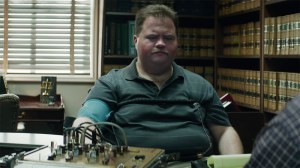 This is the passion play of Richard Jewell but nobody actually feels like a human being, let alone the person at the center of attention. There isn’t a single person onscreen that feels like a person, though the closest is the lawyer, Bryant. Jewell’s mother, Bobi (Kathy Bates), serves no other purpose but to act as her son’s cheerleader through good times and bad. When she has her teary media speech late in the film, I was relatively unmoved, because she was a figurehead. Everyone in the movie represents an idea or an organization, thus serving them up for double duty. Much like a passion play, we’re just here to watch the suffering and scold the abusers. It’s a movie meant to get our blood boiling, but other movies have been made to provoke outrage, especially highlighting past injustices under-reported through history. There’s nothing wrong with a movie that is made with the direct purpose of provoking anger at the mistreatment of others. The key is to make that central story relatable, otherwise the main figure is simply a one-dimensional martyr who only has the emotion of suffering. Without careful plotting and characterization, it can become an empty spectacle. With Richard Jewell, the main character is simply too boring as presented to be the lead. He’s an ordinary guy, but rarely do we see him in moments that provide layers or depth to him. And maybe that’s who he was, a transparent, average man who was too trusting of authority figures and a fair system of justice. Still, it’s the filmmakers’ responsibilities to make Richard Jewell feel like a compelling and multi-dimensional character in a movie literally called Richard Jewell. Even if the character arc is this poor sap starts to stand up for himself, this is severely underplayed. I sympathized with him but he felt more like a Saturday morning children’s mascot. He doesn’t feel like a person, let alone an interesting person, and that’s a big problem when he’s the closest thing the movie offers as a character and not a figurehead.
By far the worst character is Wilde’s media stand-in, a character so abrasively tone deaf and odious that when the bombing happens, she prays that she will be the one to get a scoop. The Evil Media Lady, which is what I’m renaming her because that’s all she serves in the story, is an awful amalgamation of the worst critiques people have with the media: rushing to judgment, callous indifference, and naked self-serving greed. The fact that she’s an invented character means she’s meant to represent the whole of the media, and yes, the media is one of the bad guys in the Richard Jewell story. They deserve ample criticism and condemnation, but when you serve them up in this careless, over-the-top manner, the vilification becomes more apparent than their culpability. Evil Media Lady literally sleeps with an FBI agent to get her scoops, scoops that end up being wrong, because she’s so devious and doesn’t care about The Truth. There is literally a dialogue exchange where she says, “I print the facts,” and another character retorts, “What about the truth, huh?” And wouldn’t you know, by the end, when Jewell’s mother gives her speech, who is listening and having a completely out-of-character turnaround but Evil Media Lady. I texted my friend Joe Marino as this was happening: “The power of her old white lady sad is making EVIL MEDIA LADY sad too, which means old white lady sad is the most powerful sad on Earth.”
 The FBI are also portrayed as a group of conniving snakes who must have thought Jewell was the dumbest human being on the planet the way they interacted with him. When the FBI sets its sights on Jewell as the prime suspect, they bring him in under the guise that they’re filming a training video and he needs help them with some role-playing scenarios. It’s so obvious that it feels fake, and yet my pal Joe Marino replied that this was a real moment, that the FBI had such a low opinion of Jewell that they could get him to sign away his confession through trickery: “We’re going to… pretend… see, that we brought you in as a suspect… and pretend we read you your rights… and you’re going to… pretend… you’re the bomber. Now please actually sign this… pretend form and do not ask for a real lawyer.” I almost need a Big Short-style fourth-wall break where somebody turns to the camera and says, “This really happened.” In fact, a Big Short mixture of documentary, drama, and education would have served this movie well. Here’s the problem with serving up the media and FBI in this manner. They deserve scorn and scrutiny, but when you turn them into exaggerated cartoons of villainy, then it colors the moments onscreen when they’re actually doing the things that they did in real life. This is mitigating the movie’s level of realism as well as the emotional impact. It’s not a person versus a system but rather a martyr versus a series of cartoonish cretins all trying to punish this good Christian man.
The shame of the matter is that Jewell was done great harm for acting courageously, and there is definitely a movie in his tale, but I think the way to go would have been making his lawyer the main focal point. That way there’s more of a dynamic character arc of a man putting it all on the line to defend a media pariah, it could open up to the doubts the lawyer has early on, especially as Jewell is aloof or cagey about certain damaging info (he didn’t pay taxes for years?), eventually coming to realize the quality of man he was defending. Jewell, as a character, is static and stays the same throughout despite his great emotional upheaval. A story benefits from its protagonist changing through the story’s circumstances, and that’s where Rockwell’s character could come into view. He’s also by far the most engaging person and he has enough savvy to be able to fight back in the courts and court of public opinion, becoming an effective ally for a desperate man. That way it’s a story of trust and friendship and righting a wrong rather than a good-if-misunderstood man being martyred.
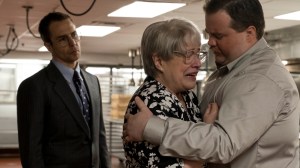 Throughout the two hours, Richard Jewell kept adding more and more examples of being a clunky and heavy-handed exercise. It would have been better for the bombing to be the inciting incident rather than the Act One break, sparing us so many scenes that do little and could be referenced rather than witnessed. Do we need to actually see Jewell getting fired from jobs to feel for him? There’s a reoccurring motif of Jewell bringing Snickers candy bars to Bryant as a friendly gift, and it’s so clumsy and weird. I started wondering if maybe Mars, Incorporated had paid for the bizarre product placement (“When you definitely did not plant a bomb in Centennial Park, break into a Snickers!”). There’s a dramatic beat where Jewell is trying to coax his distraught mother on the other side of a closed door. He just keeps repeatedly saying, “Momma please,” over and over while the music builds, and I guess the magic number was 17, and after that iteration she opens the door and they hug. It’s such an amazingly awkward scene. The dialogue has that same unreality as the rest of the movie, trying too hard to be declarative or leading, giving us lines like, “I’d rather be crazy than wrong,” and, “A little power can make a man into a monster.” It’s the kind of portentous, inauthentic dialogue exchanges I see in those Kirk Cameron movies. I wouldn’t have been that shocked if, by the end, the patriarch of Duck Dynasty showed up, running over the Evil Media Lady, and then they held a benefit concert for the persecution of white Christian males. I’m being a bit facetious here but Richard Jewell shouldn’t remind me of the derelict storytelling and characterization in hammy message-driven religious panoplies.
I was honestly shocked by Richard Jewell. I was expecting far more given the caliber of talent involved in the project as well as the inherent injustice in Jewell’s plight. Eastwood’s modern passion play feels too insufficient in passion. It’s an awkward movie that doesn’t give us a real character at its center, and it plays like every other human being in the universe is a representative of some storytelling function to service that empty center. There were lines of dialogue I just had to scoff over. There were moments that made me roll my eyes. I just couldn’t believe something this clunky could be designed for a late run for awards. The acting is all suitable, and Hauser does fine work as a mild-mannered everyman in a crucible, though I think he showed more adept skill in the enormously compelling I, Tonya. In fact, that 2017 movie could have been a lesson in how to tackle the filmic story of Richard Jewell, mixing in non-fiction elements to retell a story from multiple, fractured, contentious points of view that leapt off the pages. It feels there are many steps that should have been taken instead. Richard Jewell isn’t an awful or irredeemable movie, even though Eastwood’s typically plain shooting style feels even more strained and bland. It’s a movie I could see a contingent of the public genuinely enjoying, especially those already with a healthy mistrust of the FBI and media (you know who you are). But for me, it felt like I was watching the awards-friendly version of Kirk Cameron’s Christians are People Too. And again, Jewell deserves a major expose to chronicle his real injustices. He also deserves better than this.
Nate’s Grade: C
Share this:

Bad Times at the El Royale (2018)
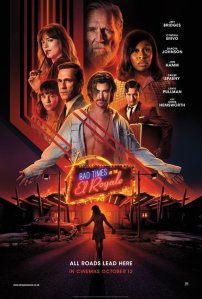 It is no disservice when I say that Bad Times at the El Royale joins the ranks of the finest of Tarantino imitators. It’s packed with twists and turns that keep an audience glued to the screen and continually re-evaluating the characters that we thought we knew. Because of that dynamic the movie invites the audience into becoming more involved, dissecting the information available and waiting for the next clue or plot revelation. It turns watching the film into a game and makes the experience that much more active and thrilling.
In the summer of 1969, the El Royale hotel is in for one hell of a night. The old fashioned hotel sits on the border between Nevada and California, allowing its dwindling customer base the opportunity to choose which state they would like to stay in. A group of strangers cozy up for the night including a priest (Jeff Bridges), a chatty vacuum salesman (Jon Hamm), a hopeful lounge singer (Cynthia Erivo), a skittish bellhop (Lewis Pullman), and a mysterious woman (Dakota Johnson) who happens to have a hostage in her trunk. As the night progresses and the characters uncover one another’s secrets, sometimes with deadly results, menacing cult leader Billy Lee (Chris Hemsworth) comes swaggering to the El Royale to reclaim by force what he feels is rightfully his.
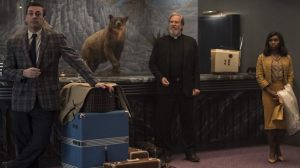 There are Act One twists and reveals in El Royale that would have been the Act Threes of other movies. Writer/director Drew Goddard (Cabin in the Woods, The Martian) has packed his movie full of sinister intrigue as he establishes the hotel, the main characters, and an immediate impression of each in the first 15 minutes. From there, the movie is divided into chapter titles (another Tarantino motif) where we follow different room inhabitants who get 20-minute-vignette spotlights. Once in private, the characters shed their false faces and begin to reveal who they really are, or who we think they might really be, and the movie starts to resemble Tarantino’s own hidden identity parlor game, 2015’s Hateful Eight. The vignettes begin to overlap, ending on cliffhangers and then circling back with a new character as our focal point, re-watching prior scenes but from a different perspective. Goddard’s script is wonderfully clever, layering in questions and answers and a constant desire to upend audience expectations. Even though some segments will repeat, Goddard doesn’t waste time on redundancy. A character will be seen prying loose floorboards searching for something desirable, and we never have to relive the before or after of this moment from that character’s perspective because we’ve been imparted the necessary info and can put the pieces together with the next jump. I appreciated Goddard’s faith in the intelligence of his audience. The pleasure of El Royale is watching it deftly unfold as a fun, funny, startling, appealing mystery.
The characters must also be worthy of our attention, and Goddard does fine work teasing out his colorful cast of criminals and lost souls and deepening most. Everyone has something to hide at the El Royale, and finding out his or her true intentions and motivations is part of the film’s fun. I won’t spoil any of the big surprises or which characters are really putting on a show. Despite all the many plot machinations intertwined, Goddard still finds time for his film to breathe and let the characters talk, opening themselves to one another, sometimes with the assistance of dramatic irony. Jeff Bridges and Cynthia Erivo play the best characters and deliver the best performances. Both of them are haunted by pasts they don’t feel like sharing, both are under some element of disguise to embark on finding their happy ending, and both form a sort of bond throughout the film as kindred spirits, even if they can’t fully trust one another. Bridges has the most complicated back-story but it actually links with a very real and emotional condition: memory loss. His character is (legitimately) going through early dementia and he’s losing full control of his sense of self, occasionally blanking and forgetting who he even is and how he got where he did. For a character pretending to be someone else, there’s a cruel irony to this malady. The seven main characters aren’t all on the same level (some are more plot devices than people) but Goddard knows this, making sure his 142-minute movie spends the most time with the best of them.
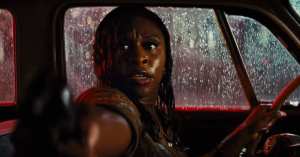 The actors given the best characters are also the ones that deliver the best performances, if you can imagine that. Bridges (Hell or High Water) brings a strong sense of pathos to his memory-addled priest trying to assess his life and his choices. He seems genuine in every moment, which is a feat considering his character has his share of secrets like anyone else. Erivo is a Broadway star making her film debut here, and she steals the show with her bruised sense of optimism. She’s the heart of the movie and a proven survivor, especially from a rigged system that protects predatory men. She brings a quiet power to her character as well as a believable vulnerability that makes you care. Hemsworth (Avengers: Infinity War) is all shaggy, scraggly charm as a cult leader who gets off pitting his followers, and captives, against one another. Really he likes to listen to himself speak, and Hemsworth is having a grand ole time with the part. Another actor exhibiting clear joy is Hamm (Baby Driver) who is, if you’ll pardon the pun, hamming it up with great gusto. He does a far majority of the talking for the first twenty minutes. He’s practically bouncing all over the place as an unchecked extrovert, but when alone, Hamm demonstrates an additional layer to his outlandish character. Another strong impression is from Pullman (Strangers: Prey at Night) as the lone employee eager to find absolution for his part in the El Royale’s history of sin as well as his own personal demons. The weakest of the ensemble ends up being Johnson (Fifty Shades Freed) who gets lost in her femme fatale archetype and can’t seem to find her way out again.
This is only Goddard’s second directing feature and his best directing aspect is that he knows when to linger on the written page. There are several segments that dwell in a certain emotion, elevated by Goddard’s tracking shots to continue the predicated unease. There’s one early moment where the bowels of the El Royale are revealed as hidden viewing areas to secretly record the guests doing their seemingly private illicit good times. The lead character of this vignette walks along the corridor, studying other characters and slowly realizing the implications of what he or she is finding. The scene is given a beautiful and eerie soundtrack thanks to Darlene practicing her singing, belting out “This Old Heart of Mine” like her life depended upon it, the tune taking on a sinister edge as it echoes through the dark hallway along with the tick-tock of the metronome. There’s another terrific singing suspense segment in this very same location, except with a different character spying on Darlene as she and another character work in conjunction to coordinate their movements, timing striking sounds in the room to her claps. Goddard has an adequate eye for visuals but he benefits from the gorgeously conceived and constructed El Royale setting, allowing the quirks of the rundown hotel to serve as another character to his ensemble. I enjoyed little touches, like only the Nevada side having a liquor license and the bright red line that runs down the middle of everything.
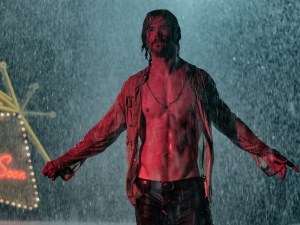 And yet there are some lingering doubts that halt me from a full-throated endorsement of El Royale, and I’ve been trying to articulate them better in the days since I watched the film. It frankly doesn’t fully come together by the end in a way that feels suitably climactic. Once Billy Lee enters the third act, the movie stabilizes and we spend time with the remaining characters assembled together to be terrorized by the cult leader. After seeing everyone else’s story in smaller vignettes with some slippery non-linear perspectives, we’ve finally come to our big confrontation and summit with everyone. Except it doesn’t feel as big as the movies needs it to be. Characters will be dispatched swiftly, and instead of it feeling shocking it feels abrupt and contrived, devaluing the character arcs that had been shuffling forward to that point. The deaths feel too ho-hum, and the final confrontation and melee too chaotic and random. The sacrifices feel wasted and sloppy rather than the payoff from some long established setup. It’s here where Goddard cannot hide his narrative trickery anymore and the machinations are exposed. I couldn’t help but feel that the final act was slowly losing the momentum and excitement that had been built carefully over the course of two hours. Billy Lee isn’t quite the force that his whispered presence has been made out to be, no fault to Hemsworth, who impresses me more and more with every new performance. It’s like by the end of his movie Goddard has realized that certain characters were inevitably just more interesting than others and he saves room for them to get a climax and brushes off the rest. Thematically I don’t quite know if it comes together with any sort of final statement about the 1960s, the dichotomy of good and evil, or anything else. It’s a final act that left me a little disappointed and realizing the end wasn’t nearly as fun as the journey.
Bad Times at the El Royale is a movie jam-packed with twists, plot turns, and colorful characters played by great actors who are clearly enjoying themselves, given the room to roam and stretch their muscles as exaggerated and dangerous criminal cohorts. Goddard’s film is impeccably structured up until its final act where it feels like the answers and confrontations cannot match the mysteries and setup that had been laid before. If you’re a fan of the top level of Tarantino imitators, like Things to Do In Denver When You’re Dead or Lucky Number Slevin, or enjoy unpacking a good mystery, then check into the El Royale, a hotel where maybe the cockroaches have the best chance at survival.
Nate’s Grade: B+
Share this:

Tag (2018)
 Tag is based on the true story of a group of grown men who continue to play a highly competitive game of tag for 30 years. There are even real clips of the real men before the end credits, raising the hope for a potential documentary on the subject. The Hollywood version is a sprightly ensemble comedy that’s not afraid to go silly or dark in its pursuit of laughs. Given the nature of its premise, there is a lot of slapstick to behold, but it was cleverly staged, routinely netting some big laughs from me. This is a definitely adults-only R-rated venture and the movie proudly wears this identity on its sleeve, finding strange and exciting comic detours that can walk a fine tonal line, like an ongoing bit about miscarriages that had me wincing as much as I was laughing. The main characters are all relatively familiar types; Ed Helms is the high-strung dweeb, Jake Johnson is a sarcastic stoner, Jon Hamm is a smarmy exec, Hannibal Buress is as laconic as his standup persona. There are a string of supporting characters (often female) that add very little, including a rekindled love triangle with Rashida Jones, a journalist who tags along on the game and adds nothing, and Isla Fisher as the grating, always-yelling, intense wife to Helms. Surprisingly, the funniest member of the movie is Jeremy Renner, an actor who heretofore had never shown much comic ability in movies. He’s a formidable opponent, and every time he went into his Sherlock Holmes-styled voice over detailing the steps and mistakes of his friends, I loved it. Also, strangely, Renner’s arms are actually CGI arms since he broke them days into filming. You would never be able to tell. I appreciated that Tag is directed as a comedy even during its action set pieces. It looks at action through the lens of comedy and taps into the absurdity. Overall, Tag is a fun, rambunctious comedy with some dark impulses yet it still finds room for sentiment that doesn’t feel entirely out of place. 2018 is shaping up to be the year of the hearty, enjoyable R-rated comedy with Tag joining the ranks of Blockers and Game Night. Catch it while you can if the prospect of men behaving like overgrown children appeals.
Nate’s Grade: B
Share this:

Baby Driver (2017)
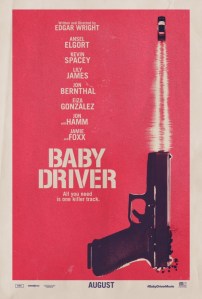 Car chases are one of the greatest things in movie history. The visceral sensation, the speed, the urgency, the thrills, the syncopation of edits to carry out the escalating collateral damage and stakes, it all works to seamlessly create one of the pinnacles of the moving pictures. If you’re going to create a musical where car chases are the chief instrument, then you could do no better than having director Edgar Wright as the maestro. Baby Driver is being hailed by critics as a blast of fresh air, an eclectic wild ride of an action movie with style to spare. That’s true. Unfortunately, this is the first movie of Wright’s career where it feels like the gimmick is all there is to be had.
Baby (Ansel Elgort) is the getaway driver for Doc (Kevin Spacey) and his crews. Baby was in a car accident that killed his parents when he was a child and he was left with tinnitus (a “hum in the drum” as Doc dubs it). To drown out the ringing, he listens to music at all times, including during those high-speed getaway chases. In his downtime, Baby romances Debora (Lily James) a diner waitress eager to hit the road without a map. Pulled into one more job, Baby is paired with a hotheaded group of dangerous criminals (Jamie Foxx, Jon Hamm, Eiza Gonzalez) that could threaten his future plans with Debora.
Baby Driver is a gimmick movie, but this isn’t exactly unheard of from Wright. Each of his movies has a strong genre angle that can tip over into gimmicky, so a gimmick by itself is not an indictment. This is, by far, the least substantial film of Wright’s career. Let’s study his previous film, 2013’s The World’s End. Like the other entries in the Cornetto Trilogy (Shaun of the Dead, Hot Fuzz), that film has a clear adoration for a certain genre and its styling, in this case alien invasion/pod person sci-fi. It didn’t just emulate the style and expected plot trappings of its genre. It spun them in a new direction while telling an engaging story on the strains of friendship over addiction and stalled maturity. It’s the heaviest and most emotionally grounded film in the trilogy. Every single moment in that movie adds up, every line, every joke, every plot beat, it all connects to form an inter-locked puzzle that would make Christopher Nolan whistle in appreciation. It wasn’t just clever plot machinations of genre parody. It was a layered and heartfelt story. It all mattered. With Baby Driver, what you see is pretty much what you get.
 It’s a car chase musical, a novelty that certainly entertains with Wright’s visual inventiveness and ear for music. The film has that alluring quality of wondering what will happen next, especially with its extensive collection of songs on the soundtrack. A trip to get coffee can become a long take perfectly timed so that graffiti and prop placement along street windows lines up with lyric progressions in the song. Some sonic standouts include “Bellbottoms” and Queen’s “Brighton Rock” during the climax. There’s a fun sense of discovery with the movie and each new song presents a new opportunity to see what Wright and his stunt performers do. The car chases are impressively staged and the stuntwork has dynamism to go along with Wright’s high-level energy output. The emphasis on physical production goes a long way to add genuine excitement. This isn’t the ricocheting CGI car chase cartoons of the Fast and Furious franchise. As far as gimmicks go, it’s at least an amusing one. Perhaps I’m just a musical philistine, or more likely my brain just isn’t as accustomed to sound design idiosyncrasies, but I actually wish Wright had done more with his central gimmick. I’m fairly certain I missed half of the connections with the music. If this is the film’s calling card then it needs not be subtle; rub my face in all the clever edits and how the gunshots equal the percussion, etc.
The ceiling imposed upon Baby Driver is because of its characters. Wright and his collaborators have done effective work shading depth to genre characters in the past, even Scott Pilgrim vs. the World, which examined unhealthy usury relationships and entitlement. The characters in Baby Driver are defined by their archetype designations and often behave in unbelievable ways just because the plot necessitates them. The worst offender is Baby’s love interest, Debora. Her initial scenes with Baby are sweet and work on their own, but when she’s ready to abandon her life for a guy she met days ago, Debora comes across like one of those people who write engagement proposals to incarcerated felons. Her decision-making leaps don’t feel plausible. I don’t think she’s acknowledged her lingering co-dependency issues. The problems are magnified when so much of the second half involves Debora being put in harm’s way or needing to be rescued. Then there’s Baby, a kid with a conscience who uses music as an escape figuratively and literally. He’s too bland and uncomplicated for the lead. Baby takes care of a deaf foster father. He surreptitiously records conversations to remix them into Auto-Tune cassettes. Yes that really is as dumb as it sounds especially when those conversations involve criminals. All we know about Baby is he’s nice, he wants out, and he’s good at driving. Elgort (The Fault in Our Stars) doesn’t have the space to do anything but look cool and springy. The supporting characters are assorted hardasses and nincompoops. Foxx (Django Unchained) seems like he’s there always to push contrived conflict.
 As a genre movie with above-average execution, Baby Driver is going to be a suitably enjoyable time at the movies for most. Wright couldn’t make a boring movie if he tried. However, it doesn’t feel like he tried hard enough with Baby Driver, at least to make a full-fledged movie. It’s an admirable assemblage of music and visuals but after a while it feels like a collection of music videos, albeit with highly impressive stuntwork. The movie suffers from overblown hype because it doesn’t have the characters or story to balance the action. There isn’t much of an attachment to what’s going on beyond the surface-level thrills of Wright’s central gimmick. As a result, you may get restless waiting for the next song selection to kick into high gear to provide another pert distraction. It feels like the gimmick has swallowed the movie whole and Wright was too busy timing his precise edits to notice the absence of appealing, multi-dimensional characters. Baby Driver is a fun movie with plenty of sweet treats for your senses but it’s too devoid of substance to be anything other than a rapidly dissipating sugar rush.
Nate’s Grade: B
Share this:

Bridesmaids (2011)
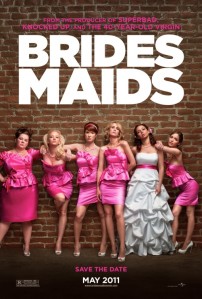 To refer to the bawdy new comedy Bridesmaids as a “female Hangover” seems disingenuous and a facile comparison cooked up in some marketing laboratory. This is nothing like The Hangover, a conceptual comedy that, can we all agree, was a funny movie but not the funniest movie of all time? Bridesmaids is a byproduct of the Judd Apatow comedy factory, and that’s what it feels like. This is no mere concept comedy built around a madcap premise. This is a magnificent character-based comedy that lets the women finally be in on the joke rather than the butt of it. Bridesmaids proves that the ladies can do everything their gender counterparts can do and better.
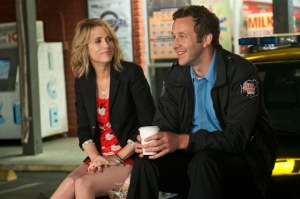
Annie (Kristen Wiig, who co-wrote the screenplay) is a woman down in the dumps. She lost her bakery due to the crummy economy, she lives with a pair of cretin roommates, and she’s a sleazy creep’s (Jon Hamm, wonderfully douchey) number three choice whenever he needs some casual sex. Her lifelong best friend, Lillian (Maya Rudolph), has just gotten engaged and asked Annie to be her Maid of Honor. Annie is threatened by Helen (Rose Byrne), a rich socialite who has grown close to Lillian in Annie’s absence. Helen is also apart of the bridal party and is always at the ready with a classy alternative when Annie stumbles. Annie gets pulled over by state patrol Officer Rhodes (Chris O’Dowd) who takes pity on her but warns her to get her taillights fixed. She continues to meet Rhodes at different spots and the two seem to be circling something romantic. Annie’s life seems to be unraveling just as Lillian’s is coming together.
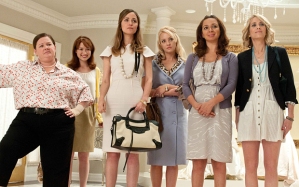 Apatow himself has been accused of making overly guy-centric comedies about rude adolescent man-children (I wouldn’t agree fully with that statement), and people have been rightfully asking when do the girls get a chance? When will the ladies be able to be something other than “love interest” or “device that triggers male character’s metamorphosis into maturity” (Forgetting Sarah Marshall, even from a clear male POV, was rather charitable and empathetic with its feminine characterizations). Well here it is, folks. Bridesmaids let’s the ladies are just as rude, crude, crass, and sexual as the men in the comedy universe. Bridesmaids is a terrific gross-out adult comedy told from a distinct feminine point of view. They can be just as crude as the dudes. But what really sets it apart is that it’s even more so a story about the dynamics of female friendship and the pain of growing apart due to the circumstances of life. Much like the joyous male camaraderie as one of the hallmarks of an Apatow film, we get to witness an entirely female dynamic that feels authentic. These women, their troubles, their friendships, all feel real and deeply felt. Even the supporting characters get a chance to be fleshed out with added dimension rarely seen in mainstream comedies, like Becca (Elli Kemper) and Rita (Wendi McLendon-Covey) confiding in each other about their disappointments with married sex. In other movies these ladies would just be “Bridesmaid #3” or “One-note Bridesmaid,” and while Becca and Rita could both be designated as types, they transcend classification when the script allows them to become rounded out as people. Another hallmark of an Apatow production, this is a true ensemble work.
You really do care for these people because of how relatable they are. I’ve never been the operator of a uterus, but that doesn’t stop me from being able to greatly relate to the anxieties of the female characters on screen. I know how significant female friendships are, and that is the central focus of the movie. You buy the relationship between Lillian and Annie, the comfort level they have with one another, the importance, the history, and you feel the pains of Annie’s plight. You feel like the entire bridal party could actually be a group of friends instead of a collection of wacky caricatures. These feel like real people, and people you want to see experience good times. Even the treatment of Helen feels thoughtful. She’s not this shrewish antagonist, but a trophy wife trying to impress the one person she could call a friend in her own life. For Helen, her friendship with Lillian means the world to her. She comes across as another real person, albeit a fabulously looking one. Annie’s romance with Officer Rhodes is indelibly cute and the duo has a warm, charming interaction. You pull for their union. Their relationship spawns a very funny sequence where Annie tries an assortment of illegal driving activities to get his attention. A romantic subplot is expected but that doesn’t mean it has to feel like rote, and in Bridesmaids the romance feels just as authentic and charming as the female friendships.
But don’t let my adoration with its character-work fool you into thinking this is some sort of “chick flick,” a divisive term tragically slapped onto anything female-centric or female-led. Just because there is rarely a Y chromosome on screen does not mean that this is some frilly, frothy sentimental fantasy replete with a “trying on clothes” montage and some sequence where the main characters break out into song in a bar. A wedding central to the plot should hopefully not be disqualifying for male audiences (men don’t get married too?). This is not a story about a crazed, jealous woman who wants to shiv another pretty lady in her pretty lady ribs because she stole her Maid of Honor duties. The cinema is littered with plenty of awful movies that revolve around women battling over petty squabbles. This is not that movie. It is not about who wields the title of Maid of Honor. It is a tale about your friends making new friends, entering new phases of their lives and possibly leaving you behind in the process. It’s about insecurity and holding onto those important people in your life, despite a gradual pulling apart. Relationships change over time, and it’s terrifying to have to adjust to the people closest to you taking lesser stations. It’s terrifying to feel like you’re being pushed out by new people. That sounds fairly universal to me, not some chick flick pabulum.
 There were several spots where I laughed so hard I was crying; the film kept me in fits of laughter throughout. The fact that a great majority of the comedy is character-based and not situation-based makes the jokes richer and more satisfying. Even a hard-to-top gross-out sequence where the girls are trying on bridal dresses at a chic store and all start losing control over their bodies due to food poisoning is related to character. Annie took the bridal party to a cheap restaurant to save money, because she’s too proud to admit her own penniless nature and too stubborn to allow Helen to swoop in and claim another victory. So the women all get terrible bouts of food poisoning, which causes them to spew vomit and forces Megan to make one very unfortunate decision with a sink (“Don’t look at me!” she bellows). The movie doesn’t shy away from the gross-out goods but doesn’t overly rely upon them for surefire gags.
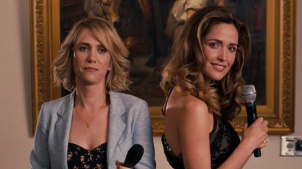
The film has several terrific comedic set pieces that connect back to the fractious relationship between Annie and Helen. The two get into a competition when it comes to party toasts. They must upstage the other, asserting who has the closest relationship with Lillian. Just when you think it’s done, one of them grabs the mic again and takes it to another level. Bridesmaids has several comic set pieces that carry on longer than you would expect for a comedy. Director Paul Feig (director of episodes of Arrested Development, The Office, and co-creator with Apatow of Freaks and Geeks) has the resolve to keep the situation alive, steadily building the comic momentum as situations get more and more out of hand, but pulling back before we reach farce levels. The movie goes one step further, convinced that the audience would be there to follow. The movie expertly lays out setups, finds satisfying payoffs, and ties up its storylines in worthwhile ways.
The dialogue is sharp and jokes work on a very fundamental level of context and defying expectation. Annie is terribly nervous to fly. She sits next to a passenger (Wiig’s co-screenwriter, Annie Mumolo) who is also deadly afraid of flying. “I had a dream last night. This plane went down,” she sys. “You were there.” That last part just turns an okay joke into a great joke. There’s a great visual gag where people keep assuming that the unkempt men standing behind Annie at a party is her husband or boyfriend. And then there’s a conversation between Annie and Officer Rhodes about being born for a profession. He encourages her to get back to baking, relating that if he were not a police officer he would still “patrol the streets and… shoot people.” These are just a few small examples I wanted to share that illustrate that, to its core, Bridesmaids is a funny story and knows the fundamentals of comedy.
Wiig has been a comic that I have found grating due to her ever-present dominance of Saturday Night Live. Her stable of wacky characters grew tiresome, but now she gets to play someone who has three dimensions. Annie is often as big an antagonist in the story as Helen. She can be self-destructive and stubborn and when she finally decides to stop being quiet is when people get hurt in her wake. You give her some latitude because, like many comedies, Annie begins as a put-upon character and has to regain her dignity and put her life together. Her life hasn’t turned out as she’s hoped, and how relatable is that? Wiig is a tremendous center for the film. Her rapid-fire eyes communicate so much nervousness and indecision, as well as her crinkly defensive smiles. But she’s also funny, tremendously funny as she loosens up and becomes more aggressive. The film is impeccably cast from top to bottom, another Apatow hallmark.
 What Melissa McCarthy does in this movie is incredible. You’ve never seen a person steal a movie at this high degree of theft. McCarthy, best known from the TV show Gilmore Girls, is Megan, the sister of the groom and an unapologetically brash woman with limitless confidence. She’s built like a linebacker but, thankfully, no attention is made to the fact that McCarthy is an overweight woman. That’s not significant to her character, though it does provide for a nice character moment as she confides to Annie late about the horror of being fat in high school. It’s not funny because she’s overweight; she’s just a brash woman without a filter who happens to be overweight. The fact that nobody cracks a joke at her expense or even comments on her weight is refreshing, and a reminder that character is not confined to outward appearance. With all that said, McCarthy is flatly hilarious. There won’t be a scene that McCarthy doesn’t get in one solid belly laugh out of. She is consistently funny from scene to scene, but stays true to her character at the same time. I would love for Megan to have her own spin-off movie much like what Russell Brand earned after his scene-stealing work in Sarah Marshall.
Bridesmaids is a comedy and it is one hell of a comedy. It may no be the best movie under the ever-expanding Apatow banner, but it is easily the funniest film yet. Yes, I said it. Bridesmaids is funnier than Knocked Up, The 40-Year Old Virgin, Superbad, and all the rest. Wiig deserves to become a star and so does McCarthy. This movie left me sore from laughing and giddy with happiness. It’s funny, touching, and genuinely entertaining, and destined to become a modern classic worth revisiting. I foresee this becoming a word-of-mouth sensation this summer, particularly from appreciative female ticket-buyers who feel like they finally have a worthy, relatable, very funny comedy that they can call their own. It’s kind of like the old slogan for female deodorant: strong enough for a man, made for a woman. That may sound too flippant, so I’ll just put it like this: do yourself a favor and RSVP ASAP for the funniest film of 2011 and one destined to charm members of both genders.
Nate’s Grade: A


 nathanzoebl
You must be logged in to post a comment.