Blog Archives
The Wolfman (2010)
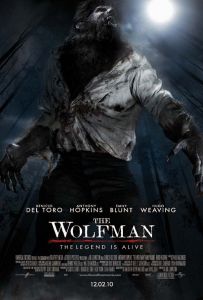 After re-shoots, reedits, a second director late in the process, and delayed release dates, it’s no surprise that The Wolfman is a bit of a shaggy mess.
In 1880, Lawrence Talbot (Benicio Del Toro) is an actor who returns home to England when he learns that his brother has been killed. Gwen (Emily Blunt), the fiancé to Talbot’s dead bro, writes that the departed brother was mauled, which points toward some kind of vicious creature roaming the woods. Inspector Aberline (Hugo Weaving) has been called in to clear the matter. Talbot’s father, Sir John (Anthony Hopkins), welcomes his prodigal son back but warns him of the dangers lurking in the countryside. The villagers are ready to blame the gypsy caravan and their chained bear when the feral creature strikes again, thus exonerating the bear. Talbot is bitten by the beast but survives only to transform into the cursed werewolf once every full moon.
Structurally, this movie feels like it’s all Act 1 and Act 3 with about ten minutes in between. By that I mean it’s all protracted setup and climax and little to connect the two. The beginning takes so long, with characters walking around like zombies who have no sense of wonder or fear given the extravagant circumstances. This is a movie that confuses set changes with plot advancement. Dour characters enter half-lit rooms and say little that isn’t cryptic or terse about the unusual happenings. This is what you have to look forward to for about an hour. The central mystery of who is the initial Wolfman is pretty easy to figure out when you play the economy of characters, which only compounds the movie’s sluggish pacing problems. You’re going to have definite pacing issues when your monster can only appear once a month, so say hello to massive time-lapse montages with the moon. It makes it hard to keep track of how much time is actually elapsing.
 There is little cogent explanation for why anything happens and the movie does an extremely poor job of maintaining a credible suspension of disbelief. What exactly are the rules here? What are the limitations for the Wolfmen? How far back does this whole thing go? The movie traces it back to an Indian kid, who looks like Gollum, in a cave, but where did he get it from? What is the history of this lycanthropy illness? When you turn into the monster, do you have any control? Are you a slave to your animal impulses? Are you culpable for what happens? Is it more like having multiple personalities except one of them is harrier? Nothing is really made clear and the movie just plows along while the unanswered questions continue to pile up, never to be addressed.
The Wolfman does a fine job of establishing an ambiance that feels ripped right from the old Hammer horror films, but fog and shadows and art direction can only take you so far. Every room looks like it’d be a prize-winning example of how to build a haunted house, though the lighting tends to be overly murky. Danny Elfman also provides a darkly lush score that mingles well with the onscreen atmosphere. But the refined sets only tease a better movie. An attack at the gypsy camp can get interesting. The beast flaring up at an insane asylum calls for something wickedly entertaining and scary, but everything is over before it really gets going, and we’ve moved on to the next scene of character sitting glumly in the dark. There’s nothing to startle beyond some overused jump scares. The movie lacks good scares because the film fundamentally can’t sustain a mood because the plot is never elaborated.
The character work is exceedingly shallow. Talbot is the main character but what do we learn about him? He’s an actor, he left town, he gets bit by a wolf, he skips stone’s with his dead brother’s girl, and that’s about it, folks. There’s an entire back story about Talbot spending time in a mental ward, which could prove to be fascinating but it’s just another set piece and nothing more. Talbot is pretty much a placeholder for a character; he’s the dude that has to get bit for there to be a story. He’s more catalyst than character, and you can feel that painful realization in how Del Toro (Traffic, Che) plays his non-character. Del Toro is a truly capable actor but he sleepwalks through the entire movie and mumbles most of his lines. Despite being a dead ringer for Lon Chaney Jr., he brings no energy to his role, nor does he ever seem truly concerned with his beastly transformation. You got more reaction and contemplation from Michael J. Fox in Teen Wolf.
The rest of the actors try and make good with the parts they’ve been tossed. Blunt (Sunshine Cleaning) can be a very good actress but she’s playing the thankless task of the underwritten love-interest-to-monster part. She’s no more fleshed out than the blonde damsel that screams and faints in the old classic monster movies. Blunt has the annoying habit of her voice turning into this simpering whine when she’s distressed. Hopkins (Fracture) pretty much gives the plot away with his maniacal cackling and incessant ear-to-ear grinning. You can pretty much faithfully assume where his character is going from the first malevolent twinkle in his eye. The screenplay exerts no effort to disguise its easily telegraphed character reveals. The person who comes out best is Weaving as the inspector, but that may be directly linked to the fact that he has the least amount of screen time of any of the main characters.
The special effects are fairly good and the practical makeup effects by screen legend Rick Baker are even better. The actual Wolfman is a snarling, spooky creature, but I wonder why we don’t get more shots allowing us to fully view the makeup work. Director Joe Johnston (Jurassic Park 3, Jumanji) seems to be more of a proponent of CGI, which means that we get scenes of Wolfie jumping from ye olde rooftop to rooftop like he’s any sort of wily creature. There’s nothing in the movie that really makes use of the specifics of being a Wolfman. We get a few POV shots of the Wolfman running extremely fast, but little else takes advantage of what makes the Wolfman a creature to be reckoned with. We only get a slew of decapitations and sliced innards that display the ferociousness of those wolf claws. Johnston isn’t afraid of gore but he doesn’t help his case when he fails to create any feeling of dread. It’s hard to dread what you can barely understand and with people you don’t really care about. Consider me stubborn, but when I got to a movie called The Wolfman I want some attention paid to the title animal.
 As I was watching The Wolfman I began to disassemble it in my head and piece together my own version of the film, an infinitely better version. For the sake or argument, I’ll explain my version and you can tell me which seems like the superior product. In my imaginary version, I completely eliminated Blunt, Hopkins, and most of the other side characters. I focused on Talbot and the Inspector and their relationship. Talbot has known about his lycanthropy for some time but he’s been able to control it for the most part, until recently. It haunts him, his inability to stop the sinister urges inside him that take over. The inspector is called in after the mysterious murders have picked up and they resemble some equally gruesome murders from 20 years prior (when Talbot first grappled with his hairy alter ego). The bent of the plot would then be on the relationship forged between the two men, how it turns into mutual affection and admiration all the while Talbot is trying to stay one step ahead of the investigation. Then my Act 2 break would be the Inspector finally realizing who is responsible for the murders (his friend!) and struggling with his own moral obligation to meet justice. Maybe this sounds too much like a crime thriller, but to me that sounds like a better film than watching two CGI werewolves claw at each other and spit.
The Wolfman is yet another misguided remake in a genre being gutted by horror remakes. The old monster movies of old were more than creature features and deserve better treatment than this bloody mess. I suppose few films can survive given the retooling process this one went through. This super serious monster movie has terrific production design, some alluring atmosphere, and a whopping void where a story should be. Characters will bumble about and the plot hums along with no explanation or elaboration given, meaning that setup often immediately crashes into climax. That’s not a satisfying recipe for a moviegoer. The Wolfman is mostly suspense-free and the actors are phoning it in; Hopkins is a kook, Blunt trembles her lower lip, and Del Toro seems to be drugged. This is mostly a costume drama with a little gore splashes in for good measure. It’s boring and half-baked and the best attribute is the scenery. If I wanted to watch scenery I’d flip through a Home and Gardens magazine. I was expecting entertainment here but instead it’s just another reminder to stick with the original.
Nate’s Grade: C
Share this:

Hidalgo (2004)
 It is important to talk about Hidalgo being marketed as a “true story.” As a general rule, it’s good to be wary of movies that are heavily pushed as being “true stories” or “based on true events.” You have to pay close attention to the wording. Last fall, The Texas Chainsaw Massacre remake was heavily marketed as a film “inspired by true events.” Which means it’s about as real as your dreams are. With this said, Hidalgo is based on the real Frank Hopkins and his stories about his life. Oh yeah, it just so happens that Hopkins is also a pathological liar and none of this is real. So, what the marketing of Hidalgo should really say is something like “based on the true story of what we heard from a pathological liar.” Something like that.
In fact, if you do some minor research, you’ll discover that the only thing true is that there was a guy named Frank Hopkins. He wasn’t part Native American, a Pony Express employee, a member of Wild Bill’s Circus, and he never had a horse named Hidalgo AND there has never been any 3,000-mile race in the Arabian desert. Yet Disneys marketing department still goes with “based on a true story.” I’ll remember that next time I have a dream involving little people and ice cream.
 Hidalgo is the “story” of Frank Hopkins (Viggo Mortensen), a former Pony Express employee who’s turned to the bottle to try to forget the slaughtering of Native Americans (exactly like Tom Cruise in Last Samurai). Hopkins enters a legendary 3,000-mile race across the Arabian desert to regain his spirit. The race, across the “Ocean of Fire,” is dangerous, the elements are brutal, and the other riders will stop at nothing to win. Can the American cowboy who no one believes in triumph in the end?
Taking a hard look at Hidalgo, roughly 50 percent of the finished movie is watching Hopkins travel from Point A (usually on the left) to Point B (usually on the right). So, yes, half of this movie is watching someone walk one direction. I can’t imagine what the editing process was like. How do you know exactly where one shot of Hopkins walking should go? Sure, Lawrence of Arabia had a lot of walking in the desert from left to right, but it was also 4 hours long! Both films do star Omar Sharif, though.
25 percent of what is left involves people sitting around talking about all kinds of clichés, like pining for acceptance, independence, equality, etc. These sequences tend to bog down Hidalgo‘s narrative and bring the action to a halt. I realize that these “sit down” scenes are meant to be breathers and expand the characters. However, the characters don’t deepen because they are amidst a patchwork of clichés instead of a story. The actors are also saddled with some laughably awful dialogue, like, “There is a tempest in my tent,” or the greatest groaner of them all, “Even a blind man could see you’re beautiful.”
So, continuing numbers crunching, an audience is left with 25 percent of a movie, and what is that 25 percent? In short, the rest. Hidalgo does have some lively action sequences and exciting horse races but these bursts of fun are much too far apart. When getting down to it, Hidalgo is 25 percent an interesting movie. Now, whether 25 percent of entertainment is enough for someone depends on how hard-fought they are for amusement.
The thing Hidalgo has going for it is Viggo’s star power. He is a handsome guy and has a smoldering presence but he whispers more lines than any actor I know. Maybe he threw out his voice after three of years of yelling with The Lord of the Rings.
 There are just some wondrously odd moments in Hidalgo. When Hopkins gets to the Arabian desert he notices a group of chained black people walking beside him. “Never seen slaves before?” a rider asks Hopkins. Then we cut away. What was that? The movie gives a shoulder shrug to slavery and then moves on. Later the slave kid becomes part of Hopkins’ pit crew, which also includes a wily old goat farmer. What? I have no idea how this kid became like Hopkins’ servant, and I have no idea why he’d be so happy about it. This part of the movie leaves me stumped, especially for a film where a character is so forward thinking about tolerating other races (as the protagonists always are in movies now). By the time you get to a laugh-out-loud sequence where Hopkins is on his knees chanting Native American chants, and the wavy ghosts of his brethren encircle him, you may have already checked out of the building.
Some of the blame must be heaped upon director Joe Johnston (Jumanji). His pacing is quite slack (136 minutes) and yet he stuffs more subplots and minor characters than the narrative seems able to handle. A very long subplot involving a kidnapped princess is a nice diversion, but entirely inorganic and almost to a distracting level of fantasy. Johnston also employs some hatchet CGI work that seems like it was left over from The Mummy movies. It does not speak well to the quality of a film when it’s been on the shelf for close to a year. The surprise antagonist who kidnaps, kills, and does whatever to win the race has no repercussions at the end. They lose. That’s it. Hopkins doesn’t even find out the person is a villain. What’s up with that? There’s no comeuppance
Hidalgo is not a bad film, but it’s not exactly a good film either. It’s cliché-ridden, clumsily plotted, and full of bad dialogue and stiff characters. The movie looks good, and the horses are beautiful, but this is one tale to put out to pasture. Those hungry for a grand adventure with a hunky lead may be partially pleased, but that’s only if they can put up with 25 percent of an entertaining movie.
Nate’s Grade: C+
Share this:

Jurassic Park III (2001)
 Jurassic Park 3 – or – How I Stopped Worrying About Plot and Started Loving Dinosaur Mayhem
As we last left Dr. Alan Grant (Sam Neill) he is still making the rounds to financially support his ailing archeological digs in Montana. A couple (William H. Macy and Téa Leoni) ask the good doctor to be their guide as they have chartered a plane to fly over the island of Isla Sorna (or Nublar, I forget which, they’re both really Hawaii anyway). Grant hesitates at first but when their checkbook comes out he begrudgingly accepts – proving again like the first two, that no matter what the danger, archeologists will do whatever for grants. The truth is that the couple is searching for their lost boy (Trevor Morgon) who was stranded on the island when he partook in an idiotic para-sailing sight seeing adventure by the island. Of course the plane gets destroyed and they must all fend for themselves.
Jurassic Park 3 makes no bones about what it really is – a dino thrill ride. There’s no opportunities to flesh out characters, there’s no time for set-up, it’s just straight to the island and constant running from peril from there. The pacing of the film and structure is like an amusement park; the people are on one ride that thrills, then they quickly move to another within minutes, and repeat for an afternoon of fun. To boil it down it’s dinos chase humans, stir, and bake for 90 minutes.
 It seems that in every Jurassic movie we have some kind of new scientific theory being explored and eventually vilified. In the first it was dinosaurs behaved more like birds and perhaps evolved into them, the second had something to do with maternal behavior and parenting. And now in Jurassic Park 3 the new scientific dig is that raptors could communicate verbally to one another – in essence talk. There’s even a sequence late into the flick where they basically “talk” straight for something like a minute. I was hoping Dr. Doolittle would waltz in at any moment and start singing, but, despite my best hopes and wishes, it was not to be.
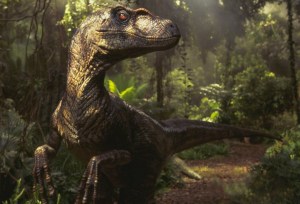
The effects and animatronics have gotten better than ever, and they were stellar to begin with. There are moments of great thrills and fun, but too often then not, it all feels routine. What should be an awesome sight of dinosaurs roaming is now blasé. What should be fearsome coming face to face with the familiar predators like T. Rex and the raptors now seems, well… too familiar. The only true moment of great awe and freshness is when the group is walking along a rickety walkway only to discover they’re inside a giant aviary complete with hungry pterodactyls.
 Acting in a Jurassic Park film usually consists of a healthy scream and some fast legs. Everyone is okay by those standards, but Leoni’s character is just far too annoying. I would’ve enjoyed the flick more if she had been eaten. In another stroke of sure luck, all of the major Hollywood cast members survive yet all the extras or unknowns perish. Call it the Poseidon Adventure syndrome (Thank you Ebert for writing this first so that I might rip you off in the future).
Director Joe Johnston (The Rocketeer, Jumanji) inherited the dino franchise from master guru Spielberg and has done a fairly capable job with his efforts. The action is fast and there are a couple of particularly nice visual set-ups sprinkled through out the film. The marvel that was in Spielberg’s touch is the most missing however. The “script” (and I use this in a very loose sense) is actually co-credited to Alexander Payne, which is a rather interesting morsel. The most interesting one though has to be that the young Morgon has actually starred in another dinosaur picture before in his short career – Barney’s Great Adventure.
For action fans in this bleak summer release period Jurassic Park 3 will serve a fine dish at 90 minutes of fast dinosaur attacks and squeals. Hopefully though the ‘Jurassic Park’ franchise will be stopped before the wonder it used to have turns passé. Because right now it’s teetering on the brink.
Nate’s Grade: C+


 nathanzoebl
You must be logged in to post a comment.