Blog Archives
Fool’s Paradise (2023)
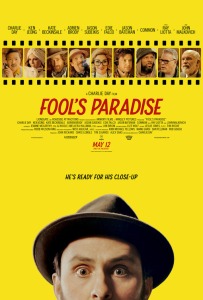 Charlie Day is a very funny guy who works with lots of funny people, so why isn’t his directorial debut, Fool’s Paradise, well, funnier? It’s about a mute simpleton (Day) with the intelligence of a five-year-old, or a Labrador retriever we’re told, who is mistaken for an acting savant. The intended joke is that this industry projects what it wants to see and is full of shallow, insecure, greedy idiots chasing anything that might be popular or career advancing. That’s a fine start but there is a shocking lack of jokes and funny scenarios to be had here, so the 93 minutes just creaks on by in protracted and pained awkward silence. It was a mistake to have Day, a comedian with such a distinct voice and often prone to hilarious outbursts, play a character who doesn’t talk at all. It’s not just that, he kind of shrugs or raises his eyebrows in response, and every time the camera cuts to him for a reaction shot, I was left wondering if this is all the movie had. This passive character, mistakenly named “Latte Pronto” by a director who finds him as a replacement for a prima donna Method actor (also Day), is just a miss. He’s not interesting, and what her reveals about the people around him is even less interesting and just as obvious and tiresome. It’s a movie about non-stop mugging to the camera and hoping to evoke some overly generous pity laughs. It’s attitude over wit. The jaunty score tries hard to make you feel the missing levity from scene to scene. It’s not convincing. The movie is chock full of stars, many of them friends and colleagues that Day has accumulated over a decade in comedy, but nobody has anything funny to do. It’s just all so confounding. Clearly the inspiration owes a debt to 1979’s Being There, a gentle political and social satire where everyone projects what they want to see on one middle-aged gardener raised on TV (I recently watched that movie and felt it was rather dated and quaint). At least that movie had a larger point. There’s just so little to hold onto with Fool’s Paradise, with a boring nothing of a character that never seems to uncover or reveal anything on a tour through Day’s many famous friends. Even the physical comedy is an afterthought. This is no charming Little Tramp. Do yourself a favor and watch any 90 minutes of 2022’s Babylon and you’ll see a funnier and more excoriating satire on Hollywood than the collective shrug that is Fool’s Paradise.
Nate’s Grade: C-
Share this:

Sword of Trust (2019)
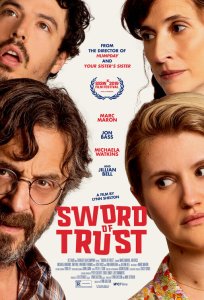 Writer/director Lynn Shelton is a filmmaker that has a habit of flying under the radar with her wonderful entries in the fly-on-the-wall hipster mumblecore sub-genre of indie dramas. The hilariously awkward Humpday punctuated insecure masculinity and was on my Top Ten list for 2009, and 2012’s Your Sister’s Sister was another laser-like focus on characters trying to deal with a lifetime of relationship secrets coming out. Both of those movies have been remade as French films too, with Humpday becoming 2012’s Do Not Disturb and Your Sister’s Sister becoming 2015’s Half Sister, Full Love (which sounds more like a porn title to my ears). Sword of Trust is one part mumblecore drama, one part screwball comedy, and a bit of a lovely, shambly mess.
Mel (Marc Maron) owns and operates a pawn shop in a small Alabama town. He’s used to losers and lowlifes and junkies coming through and giving their sad stories. Enter Cynthia (Jullian Bell) and Mary (Michaela Watkins), a gay couple looking to make the most of a strange inheritance. Cynthia’s grandfather gave her a Union sword and a story that says this sword is proof that the South did not lose the Civil War after all… somehow. The trio, along with Mel’s dimwitted shop employee Nathaniel (John Bass), hatch a scheme to try and con an underground Confederate memorabilia group for all its worth.
 The real draw of Sword of Trust is the low-key comic sensibilities of the cast. As I wrote previously in my review for Your Sister’s Sister: “There’s a tremendous naturalistic ease the film exudes, with the actors so familiar with one another that they truly feel like family. When I have well developed characters, and actors who seem so knowledgeable of their character’s tics and flaws and secrets and smallest details, I could honestly listen to them talk for hours.” Sword of Trust (written by Shelton and Michael Patrick O’Brien) probably ranks a distant third in the three Shelton-directed movies I’ve seen, but her skills and care are still evident in characterization and empathy.
Maron has matured into an impressive dramatic actor thanks to Netflix’s wonderful wrestling series GLOW. He has a natural sad sack aura to him, as well as a brittle fuse that’s in danger of being set off at any moment. The character of Mel seems tailor-made for him, and I wouldn’t put it past Shelton that it was (she directed several episodes of GLOW as well as Maron’s 2017 comedy special). He’s the biggest mystery of the movie and we get hints early on in a disarmingly dramatic moment when his ex-girlfriend Deidre (Shelton herself) tries getting collateral so she can secure a job. She professes that he knows “she’s good for it,” and that this time will be different, and the way the two of them seem to circle a larger conversation, one filled with hurt and heartache, is a masterful example in writing subtlety and subtext. We’ll have their personal connections revealed later in the movie, but this scene serves as a tantalizing clue that there’s more to this movie than a group of oddballs in a pawn shop. It’s the first stab at drama and it’s quite effective, and Shelton can be one hell of an actress too. She leaves an impression as a character you want to get back to, and sadly the movie keeps her at a distance as we learn more.
 The rest of the movie doesn’t quite tap into this vein (more on that below) but the agreeable camaraderie of the characters is a major selling point. Mumblecore movies are typically character-driven and small observational movies that lean on broken people navigating their way through the world, pushing forward onto greater emotional growth by the closing credits. If you’re not a fan of these kinds of movies, then Sword of Trust might still prove appealing based upon the broader comedy elements and the wackiness that can come at a moment’s notice, like when a man at gunpoint instructs each hostage to dance in a different bizarre style. Otherwise, Sword of Trust is a movie that ambles along on its own gentle wavelengths, buoyed by the performances and interactions of its core cast. There’s an uneasy alliance between the foursome. Primarily this is with Maron and Bell’s characters, the two most significant players. Bell (22 Jump Street) is enjoyably sunny and awkward as a woman trying to make the best of a bad inheritance. It’s the most dramatic and restrained I’ve ever seen Bell, best known for loud-mouthed, course comic supporting roles. Watkins (Casual) is more a force to push her girlfriend into further action, and Bass (Baywatch) is kept as the goofball meant for easy ridicule as a symbol of preferential ignorance. He’s never more than a quick punchline, especially as he tries explaining his scientifically strained flat Earth beliefs.
They’re an enjoyable group and watching them bicker, jostle for leverage, and ultimately work as a team for common cause it sweetly entertaining. Everyone is trying to make the best of an unexpected situation, with each playing their part to try and capitalize on this strange money-making scheme. A lengthy conversation in the back of a truck bounces from character to character, each revealing further layers they feel comfortable now sharing. It’s the kind of enjoyable character beats that the mumblecore genre is known for, crafting relatable, interesting, flawed characters and watching them play off one another. There’s also plenty of comedy because of how the characters are drawn, like when Mel insists that an attacker stole his own screwdriver to use as a threatening weapon. This small comedic beat grows and grows as it almost consumes Mel so that even when that harried situation clears up he has to know whether or not it really was his own screwdriver. That’s a sly comedy beat connected to character. Shetlon’s film has an improvised feel but honed to a script that provides a necessary degree of discipline.
 Despite the amiability of the cast and the comedic potential of the premise, Sword of Trust doesn’t really rise above being a pleasant if minor hang-out picture. I feel like if it was ultimately about the characters then we needed a few more scenes where they can grow, be challenged, or simply share their conflicts and histories. If it’s going to be more a wacky send-up of willfully ignorant conspiracy theorists and anti-intellectuals, then I feel like the final act needed more complications and examination. Shelton’s movie settles into a middle ground trying to have the wacky sitcom shenanigans and the heartfelt, modest mumblecore character beats. It doesn’t feel like either side is fully utilized and explored to its best version. I enjoyed the characters and found the movie getting better as they opened up, especially Maron’s curmudgeonly lead with a guarded past. I also laughed some big laughs at the wacky hijinks of a dysfunctional gang working together to con a group of Confederate revisionists. There are moments that point toward the more studio-friendly, concept-driven version of this movie, like when the gang creates a cover story of them being romantic couples. In Shelton’s film this is a momentary gag and then it’s left behind, also because it occurs so late into the movie. You can see where the escalation of misunderstandings and trouble could make the film a broader comedy. You can also see the avenues where the characters eschew the broad comedy for more intimate, revealing conversations. The resulting film is enjoyable and solid, but I think it would have been better if it had chosen its preferred tone.
Sword of Trust (my fingers keep wanting to type Sword of Truth) is definitely a lesser but still enjoyable film for Shelton and her ensemble. It’s stuck in a pleasant but diverting hangout zone when it could have been more observational or broader and wackier. I was hoping for more of a send-up of the fringes who cling to rumors and disbelief in the face of overwhelming evidence to the contrary, whether it’s that the South legitimately lost the war or that the Earth is indeed round. Sword of Trust benefits from a group of actors who can smartly handle improv scenarios while still keeping things true to character. It’s an enjoyable 90 minutes just hanging out with these people, even if the film feels like it’s losing some of its momentum as it veers into its third act. While not as polished, there’s still enough to enjoy and recommend with Shelton’s latest, and she’s a storyteller that deserves an adoring audience.
Nate’s Grade: B
Share this:

Rough Night (2017)
 As the girl power counterpart to Very Bad Things, the rowdy comedy Rough Night follows a group of broadly characterized friends through a night of mishaps, but the strangest development is that the funniest moments all center around the men. Jess (Scarlett Johansson) and her gal pals (Jillian Bell, Kate McKinnon, Ilana Glazer, Zoe Kravitz) are celebrating her bachelorette party when they accidentally kill a stripper. From there the ladies have to try and dispose of the body while not getting caught. The movie is rather slow to get started, establishing broad character types for each of the bachelorette partiers. It’s once things get criminal that the movie enters more solid comedic ground. The acting ensemble is rife with terrific comedy stars that know how to hit their material in stride, in particular the boorish Bell and the goofy McKinnon. And yet it’s the asides with Jess’s fiancé Peter (Paul W. Downs, co-writer) where the movie hits its highest marks and delivers inspired comedy. At first the wild atmosphere of the girls’ night out is contrasted with the quaintly tame boy’s night out. Soon after Peter is worried something troubling has happened and is determined to travel nonstop to reach Jess. His traveling moments produce the most unexpected comedy, like a badass montage about something very uncharacteristically badass. It just kept going, trying to maintain the same demeanor, and I was almost in tears from laughing so hard. There’s a sequence at a gas station that could be taught in comedy classes for how well structured and developed it plays out, tying together characters and conflicts and even ending on a sweetly jocular moment. It got to the point where I wanted to check back more often with Peter. I chuckled throughout Rough Night and the energy level of the actors keeps things eminently watchable but it plays it too safe for something so apparently transgressive. The sentimental moments don’t feel earned and the dark comedy doesn’t feel dark enough. Still, when it gets to be weird and unpredictable, Rough Night can be a delight.
Nate’s Grade: B
Share this:

Inherent Vice (2014)
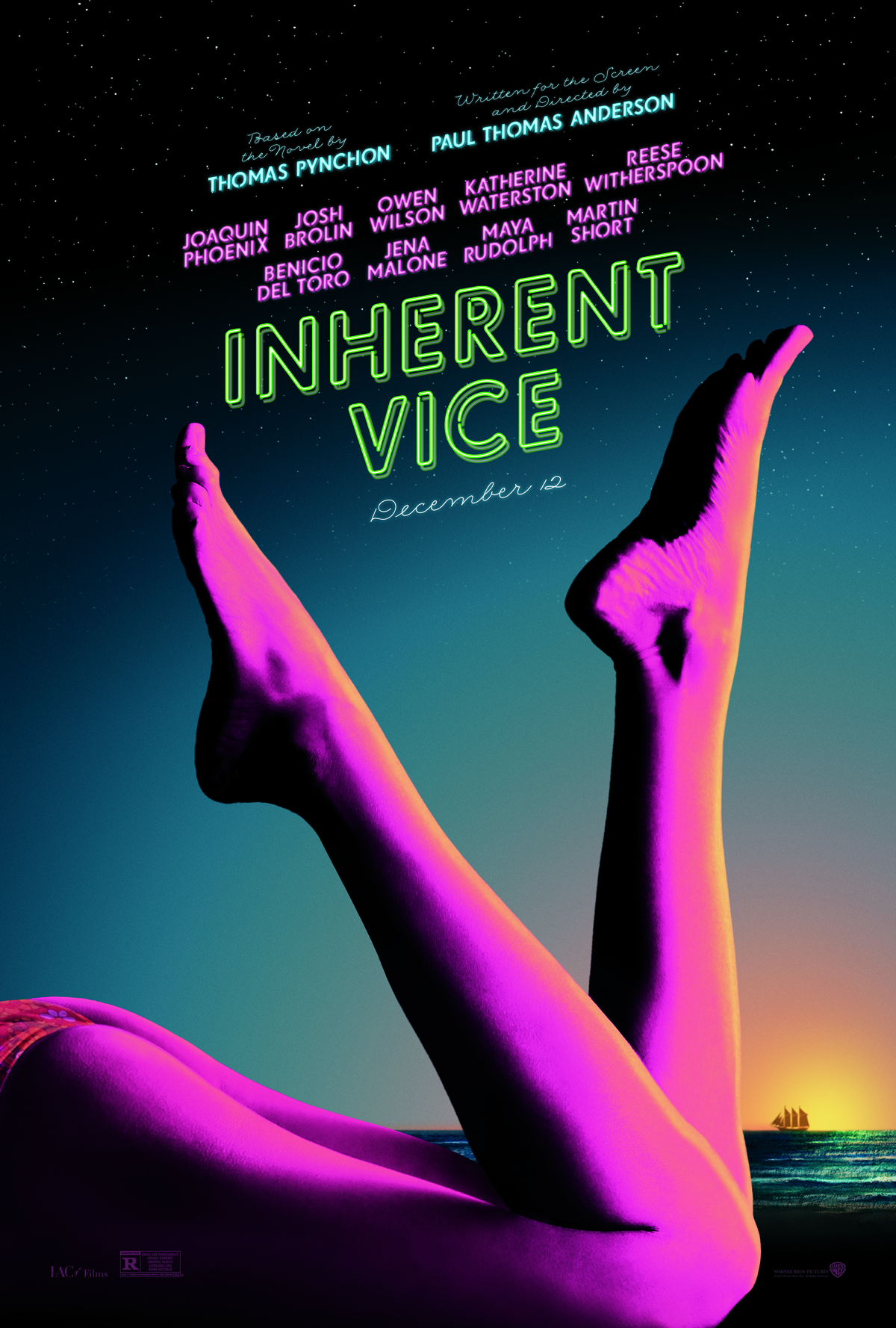 This is one of the most difficult reviews I’ve ever had to write. It’s not because I’m torn over the film; no, it’s because this review will also serve as my break-up letter. Paul Thomas Anderson (PTA), we’re just moving in two different directions. We met when we were both young and headstrong. I enjoyed your early works Paul, but then somewhere around There Will be Blood, things changed. You didn’t seem like the PTA I had known to love. You became someone else, and your films represented this change, becoming plotless and laborious centerpieces on self-destructive men. Others raved to the heavens over Blood but it left me cold. Maybe I’m missing something, I thought. Maybe the problem is me. Maybe it’s just a phase. Then in 2012 came The Master, a pretentious and ultimately futile exercise anchored by the wrong choice for a main character. When I saw the early advertisements for Inherent Vice I got my hopes up. It looked like a weird and silly throwback, a crime caper that didn’t take itself so seriously. At last, I thought, my PTA has returned to me. After watching Inherent Vice, I can no longer deny the reality I have been ducking. My PTA is gone and he’s not coming back. We’ll always have Boogie Nights, Paul. It will still be one of my favorite films no matter what.
 In the drug-fueled world of 1970 Los Angeles, stoner private eye Doc (Joaquin Phoenix) is visited by one of his ex-girlfriends, Shasta (Katherine Waterston). She’s in a bad place. The man she’s in love with, the wealthy real estate magnate Mickey Wolfmann (Eric Roberts) is going to be conned. Mickey’s wife, and her boyfriend, is going to commit the guy to a mental hospital ward and take control of his empire. Then Shasta and Mickey go missing. Doc asks around, from his police detective contact named Bigfoot (Josh Brolin), to an ex (Reese Witherspoon) who happens to be in the L.A. justice department, to a junkie (Jena Malone) with a fancy set of fake teeth thanks to a coked-out dentist (Martin Short) who may be a front for an Asian heroin cartel. Or maybe not. As more and more strange characters come into orbit, Doc’s life is placed in danger, and all he really wants to find out is whether his dear Shasta is safe or not.
Inherent Vice is a shaggy dog detective tale that is too long, too convoluted, too slow, too mumbly, too confusing, and not nearly funny or engaging enough. If it weren’t for the enduring pain that was The Master, this would qualify as Anderson’s worst picture.
One of my main complaints of Anderson’s last two movies has been the paucity of a strong narrative, especially with the plodding Master. It almost felt like Anderson was, subconsciously or consciously, evening the scales from his plot-heavy early works. Being plotless is not a charge one can levy against Inherent Vice. There is a story here with plenty of subplots and intrigue. The problem is that it’s almost never coherent, as if the audience is lost in the same pot haze as its loopy protagonist. The mystery barely develops before the movie starts heaping subplot upon subplot, each introducing more and more characters, before the audience has a chance to process. It’s difficult to keep all the characters and their relationships straight, and then just when you think you have everything settled, the film provides even more work. The characters just feel like they’re playing out in different movies (some I would prefer to be watching), with the occasional crossover. I literally gave up 45 minutes into the movie and accepted the fact that I’m not going to be able to follow it, so I might as well just watch and cope. This defeatist attitude did not enhance my viewing pleasure. The narrative is too cluttered with side characters and superfluous digressions.
The plot is overstuffed with characters, many of which will only appear for one sequence or even one scene, thus polluting a narrative already crammed to the seams with characters to keep track of. Did all of these characters need to be here and visited in such frequency? Doc makes for a fairly frustrating protagonist. He’s got little personality to him and few opportunities to flesh him out. Not having read Thomas Pynchon’s novel, I cannot say how complex the original character was that Anderson had to work with. Doc just seems like a placeholder for a character, a guy who bumbles about with a microphone, asking others questions and slowly unraveling a convoluted conspiracy. He’s more a figure to open other characters up than a character himself. The obvious comparison to the film and the protagonist is The Big Lebowski, a Coen brothers film I’m not even that fond over. However, with Lebowski, the Coens gave us memorable characters that separated themselves from the pack. The main character had a definite personality even if he was drunk or stoned for most of the film. Except for Short’s wonderfully debased and wily five minutes onscreen, every character just kind of washes in and out of your memory, only registering because of a famous face portraying him or her. Even in the closing minutes, the film is still introducing vital characters. The unnecessary narration by musician Joanna Newsome is also dripping with pretense.
 Another key factor that limits coherency is the fact that every damn character mumbles almost entirely through the entirety of the movie. And that entirety, by the way, is almost two and a half hours, a running time too long by at least 30 minutes, especially when Doc’s central mystery of what happened to Shasta is over before the two-hour mark. For whatever reason, it seems that Anderson has given an edict that no actor on set can talk above a certain decibel level or enunciate that clearly. This is a film that almost requires a subtitle feature. There are so many hushed or mumbled conversations, making it even harder to keep up with the convoluted narrative. Anderson’s camerawork can complicate the matter as well. Throughout the film, he’ll position his characters speaking and slowly, always so slowly, zoom in on them, as if we’re eavesdropping. David Fincher did something similar with his sound design on Social Network, amping up the ambient noise to force the audience to tune their ears and pay closer attention. However, he had Aaron Sorkin’s words to work with, which were quite worth our attention. With Inherent Vice, the characters talk in circles, tangents, and limp jokes. After a protracted setup, and listening to one superficially kooky character after another, you come to terms with the fact that while difficult to follow and hear, you’re probably not missing much.
Obviously, Inherent Vice is one detective mystery where the answers matter less than the journey and the various characters that emerge, but I just didn’t care, period. It started too slow, building a hazy atmosphere that just couldn’t sustain this amount of prolonged bloat and an overload of characters. Anderson needed to prune Pynchon’s novel further. What appears onscreen is just too difficult to follow along, and, more importantly, not engaging enough to justify the effort. The characters fall into this nether region between realism and broadly comic, which just makes them sort of unrealistic yet not funny enough. The story rambles and rambles, set to twee narration that feels like Newsome is just reading from the book, like Anderson could just not part with a handful of prose passages in his translation. Much like The Master, I know there will be champions of this movie, but I won’t be able to understand them. This isn’t a zany Chinatown meets Lewboswki. This isn’t some grand throwback to 1970s cinema. This isn’t even much in the way of a comedy, so be forewarned. Inherent Vice is the realization for me that the Paul Thomas Anderson I fell in love with is not coming back. And that’s okay. He’s allowed to peruse other movies just as I’m allowed to see other directors. I wish him well.
Nate’s Grade: C+
Share this:

22 Jump Street (2014)
 When 21 Jump Street was proposed as a movie, nobody thought it was a good idea. Even its stars and writers. They used that as an opportunity to craft one of the more charming, surprising, and hilarious films of 2012, a movie so good that it was also one of the best films of a relatively great year at the movies. Now that was something nobody expected with a 21 Jump Street movie. As often happens, Hollywood looks to keep the good times going, and 22 Jump Street is knocking at the door. In Hollywood tradition, sequels usually follow the “more of the same” format with a dash of “bigger is better,” a fact that 22 Jump Street takes to heart.
Having successfully busted a high school drug ring, Officers Schmidt (Jonah Hill) and Jenko (Channing Tatum) are the toast of their unit. That is until they let a dangerous criminal (Peter Stormare) get away with a shipment of drugs. It’s back to the Jump Street program, as their police chief (Nick Offerman) laments that everybody just needs to do the exact same thing that worked the last time. Captain Dickson (Ice Cube) has assigned Schmidt and Jenko to go undercover at the state university to sniff out where the student body is getting a powerful and deadly designer drug. Schmidt grows close to Maya (Amber Stevens), an art major who knew a girl who overdosed on the new drug. Likewise, Jenko is falling for team quarterback Zook (Wyatt Russell), or more accurately the bond they share as two athletes with a similar brain. The partnership of Schmidt and Jenko may be in trouble for the long haul if they can’t work together.
 This may be one of the most meta movies of all time, existing outside itself in tandem to always provide a winking dose of commentary about its own silliness, excess, and corporate mentality about replicating success through the least creative means possible. There’s even a character with a literal red herring tattooed on his bicep. There are plenty of in-jokes without breaking down the fourth wall, and the meta cleverness is an entertaining way to pave over the general same-ness that goes along with the limited undercover premise. While cracking wise for its full running time, 22 Jump Street really is “more of the same.” For most, myself included, that is completely acceptable since the first 21 Jump Street was an unexpectedly witty and comically brash outing. Seeing another adventure with this same team is more than justifiable, especially with the kind of comic kinship that Hill (The Wolf of Wall Street) and Tatum (White House Down) share. Once again the guys go undercover to bust a drug operation, and once again they each get close to a different set of students, and once again their relationship takes a personal hit. It’s the same plot beats but with different jokes (like the R-rated version of Anchorman 2). The entire “going undercover as a school student” concept is so dated to begin with, and neither Hill nor Tatum can credibly pass at this point, so the entire enterprise feels like they’re squeezing the most they can while they can, enjoying the good times, the good chemistry, being silly on the studio dime, and counting their luck.
The end credits for 22 Jump Street deserve special praise just for the appearance of burning down its franchise. Throughout the film the guys are mocking the very notion of a sequel. By the end, they mock, without abandon, the idea of a franchise. We flash through an absurd array of new assignments, new sequels, and new school-setting undercover gigs, and it’s almost like a flash-forward into the timeline of the movie, like the finale of Six Feet Under. There are some amusing cameos and business satire to mock with as well as the general ludicrous nature of repeating this plot/formula (Magician school?). The end credits leave the audience feeling buzzy and giggly, a perfect comic high, and it’s the best end credit high since the original Hangover.
The real enjoyment is watching Hill and Tatum continue to mine what has become one of film’s best onscreen bromances of all time. I never would have pictured these two fitting together so smoothly, or Tatum being such an unexpectedly natural comedic talent. Thank goodness for the 21 Jump Street movies for offering us these untold comic gifts and for knowing what the main attraction is and how to properly develop it. The relationship between friends/colleagues/bros Schmidt and Jenko is the most consistently interesting, surprisingly emotional, and comically ripe subject in the film. We have two great actors and watching them butt heads is just as fun as watching them get along. In the sequel, the guys go through what serves as an analogue for a separation, wanting to see other partners. We know in our hearts these two are meant to be together, and so much of the fun is watching just how this odd coupling now seems so indispensable to one another, with Tatum’s zigs blending ever so delightfully with Hill’s zags. I could watch another movie of just these guys doing paperwork.
In the first film, Jenko and Schmidt were set up to fall back into stereotypical roles before the movie found a better solution. Jenko was going to be the jock with sports classes, and Schmidt the nerd with AP classes and drama. Then a mix-up, and they have each other’s identities, and the movie is that much better, forcing each out of their comfort zone and finding the better comic scenario. With 22 Jump Street, the movie falls back to the old social order. Jenko hangs with the football jocks and the frat brothers and gets to be the super popular student-athlete, while Schmidt is left to investigate the art majors who knew the dead coed. It has them falling back into their high school roles (popular vs. outsider) and it’s not nearly as interesting, especially after seemingly growing beyond these moments. The side characters aren’t as interesting either, many lacking material to develop beyond one-note joke machines, like Zook. I was mildly intrigued by H. Jon Benjamin (TV’s Archer, Bob’s Burgers) as a football coach obsessed with protecting the goalpost, but I wanted more. Twin stoners who talk at the same time are not enough.
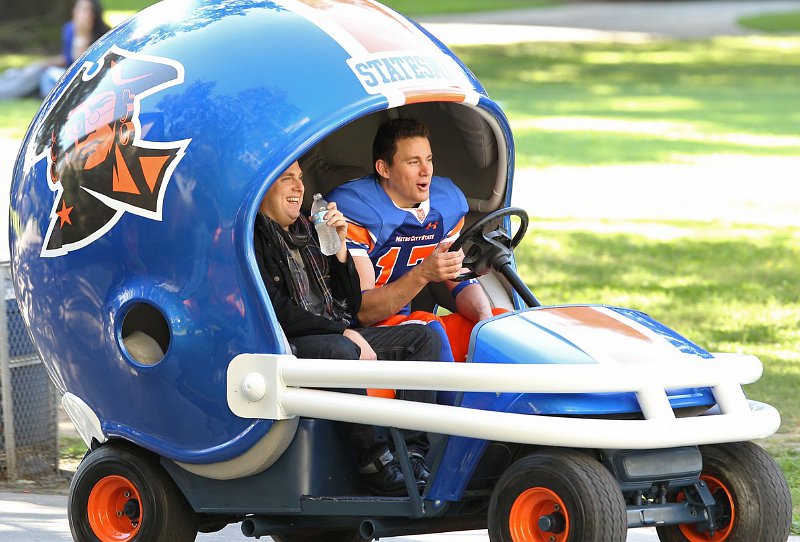 There is one supporting actor given enough material to shine and that is Workaholics’ actress Jillian Bell. She plays such a deadpan, biting, sarcastic, no-nonsense roommate who won’t entertain for one second that Schmidt is who he says he is, and she is wonderfully brutal with her insults. There’s a later scene where she keeps wrongly misinterpreting a fight with Schmidt into something else. It’s a highlight of the movie, a great example of her physical comedy skills and sense of timing, and it’s a plumb example of taking a topic that a situation that could be uncomfortable and finding the right balance to guide an audience along for the best laugh.
Like before, once the movie adapts to its action-filled climax, the jokes start taking a backseat to the action theatrics. Returning directors Phil Lord and Christopher Miller (The LEGO Movie) have kept their same brand of rambunctious spirited comedy alive and well, which keeps the movie’s pace brisk and always open to fresh weirdness. While some jokes don’t work as well the second time (Vietnamese Jesus, the drug freak-out fantasy sequence, though its use of Creed music almost makes up for that), this is still more sequel than retread. This is not an Austen Powers that repeats the exact same jokes with slightly different settings. Lord and Miller understand how to satiate an audience without overt pandering. They know how to build payoffs that are small and payoffs that are big, ones directly linked to character goals. There are strong comedic set pieces unrelated to any sort of meta commentary, Schmidt’s impromptu slam poem being one of them. It’s a manner of giving people what they want while still finding new ways to surprise, because otherwise comedy is dead without the subversion of expectations.
“More of the same” is the best and worst summary for 22 Jump Street, and despite 1500 words of film criticism, all you really need to ask yourself. Is more of the same good enough for you when it comes to another 21 Jump Street movie? Sure, we’d all wish for the same sort of unexpected cheeky revelation that was the first film, but then again no one had any expectations that a 21 Jump Street movie would be anything worth watching, let alone one of the best films of that year. 22 Jump Street is hilarious, witty, aggressive, irreverent, and even when it has to take on the role of action-comedy, it does so with a consistent wink, pointing toward all the sequel tropes and absurdity without rubbing your nose in every single reference and gag. The second time around Jump Street is, by definition, never going to be as fresh, but the company is still top-notch, the jokes are still layered and cracking, and the determination is high. It’s a sequel that delivers what it promises. I’m ready to take this franchise as far as it can conceivably go for two men well into their 30s-posing-as-high-schoolers. Magician school, here we come.
Nate’s Grade: B+
Share this:

The Master (2012)
 Writer/director Paul Thomas Anderson met with great resistance when he was shopping his script around for The Master. It was dubbed the “Scientology movie” and reportedly based upon the controversial religion and its leader, L. Ron Hubbard. It looked like Hollywood was spooked by the prospect of a movie that appeared to take on Scientology. Eventually Anderson got his financing and made the movie he wanted to make. Calling it the “Scientology movie” is misleading. I wish The Master was a Scientology expose because that would be far more interesting than the exasperating film I got, which is one nutty guy who dabbled in a Scientology-like cult. Maybe the resistance Anderson experienced wasn’t an indication of the subject matter. Perhaps it was only an indication that The Master just wasn’t a compelling story, a charge I can agree with wholeheartedly after viewing this disappointing film.
Freddie Quells (Joaquin Phoenix) is struggling to adjust to life after World War II. Fresh out of the Navy, he works as a department store photographer, until his rage and social awkwardness lead to him being fired. He’s drifting about and hops onto a ferry leaving town. Onboard is Lancaster Dodd (Phillip Seymour Hoffman) who describes himself as “a writer, a doctor, a nuclear physicist, a theoretical philosopher, but above all, a man.” Dodd has gathered a revered following. He believes that people can regress to past lives trillions, yes you read that right, of years into the past. Dodd’s own children admit that dear old dad is “making it up as he goes along.” His movement, known as The Cause, has been called a cult by detractors, the will of one man, and the followers don’t take kindly to challenges from the outside. Dodd adopts Freddie as a project. He’s on the verge of completing his second major treatise and Freddie seems to be an inspiration for him. Freddie finds some measure of acceptance within Dodd’s community of followers, but his erratic behavior keeps people on constant edge.
I found The Master to be boring; uncompromisingly boring, hopelessly boring, but worse than all that, pointlessly boring. Was this really a story that needed to be told? I cannot fathom why Anderson chose to tell this story or, in particular, why he chose to tell it through the character of Freddie Quell. A story about a huckster exploiting people with a religion he made up is a fascinating story with or without the Scientology/L. Ron Hubbard connections. That’s a story worthy of being made. Now, instead of this, we have two hours of a guy acting nuts. I would better be able to stomach the Freddie character if I felt like anything of significance was happening to him. He’s a broken man, clearly mentally ill in some capacity, and prone to outbursts that turn violent. Does he change? Does he grow? Does he do anything? Does his life have anything of significance happen to him over the course of 137 minutes? Not really. He’s pretty much the same guy from start to finish; his arc is essentially that he’s crazy at the start, meets Dodd, and then is crazy at the end. We get it, the guy is messed up. He makes a drink out of paint thinner for crying out loud. I didn’t care about him at all. I don’t need to see static scene after static scene of this guy acting out. I wasn’t a There Will Be Blood fan but at least Daniel Plainview was a strong central character with enough dimensions to carry a film. Freddie Quell just isn’t that interesting or entertaining. He’s actually a tiresome character because you get a perfect sense of who he is in just 10 minutes. The rest of the movie just seems to remind you what you already know.
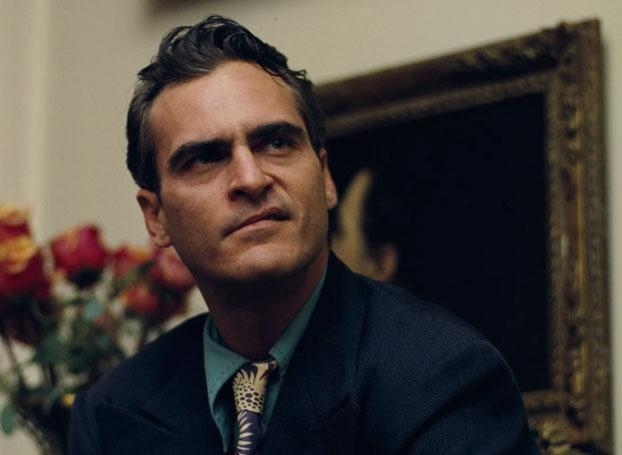 It is a disappointing realization but I feel like the Paul Thomas Anderson I enjoyed is slipping away, as his flashy, propulsive, plot-heavy early work has given way to opaque, reserved, and plotless movies. It’s like I just watched someone with the verve of Martin Scorsese transform into a poetic film somnambulist like Terrence Malick; not a good move. I don’t know what Anderson’s message is or what he was trying to say, and I’m unsure why he decided to use a limited character like Freddy Quells as his prism. It almost feels like Anderson is compensating for his plot-driven films of his early career, like he has to balance the scales in his mind. I shudder where this recompense might take Anderson for his next film. I like to think of myself as an intelligent moviegoer who enjoys being challenged by movies. But that doesn’t mean I’ll accept anything challenging as quality. Case in point: Jean-Luc Godard’s Film Socialism, which was contemptuous of its audience. I don’t mind doing work but you have to give me a reason. There has to be a reward, either with the narrative or with the characters. I found no rewards with The Master and it’s not because I didn’t “get it,” film snobs, it’s because the movie was too opaque to say anything of substance beyond simplistic observations about the abuse of power and influence.
When I say plotless I don’t mean that we’re simply watching paint dry, though there are stretches of The Master where I would feel that could be a suitable test from Dodd. There are events. There are scenes. There are changing relationships. It’s just that none of this seems to matter, or at least it never feels like it does. There’s no build, no increase in urgency, and The Master just sort of drifts along to the detached rhythms of Freddie. The movie can feel interminable, and you may ask yourself, on a loop, “Is this going anywhere?” There are two scenes that stand out because there are so few that seem to matter. One is shortly after Dodd and Freddie have been arrested. The two men are locked in opposing cells and they explode in venomous anger. It feels like Anderson can finally allow his characters to vent out what they’ve truly been feeling. Another memorable scene, just for weirdness, is when we jump inside Freddie’s head. All the women, young and old, at a social gathering suddenly lose their clothing (think: Choke). It’s one of the best scenes at exploring Freddie’s sexual compulsions, plus it’s just peculiar. I wanted more scenes like this where we try and get inside the man’s mind. The rest of the characters are underwritten, especially Amy Adams (Trouble with the Curve) as Dodd’s wife and fierce protector. This is a movie about two strong-willed men and everybody else gets relegated to minimal supporting positions. I miss the sprawling humanism of Boogie Nights and Magnolia.
From a technical standpoint, the movie is very accomplished. The 1950s era setting is lushly recreated, aided by cinematography that seems to present this bygone age in a colorless manner. By this I mean that the world feels muted, repressed, the colors are there but they don’t pop, and I think this look fits the movie marvelously. Anderson shot the film in 70mm, which would offer startling detail to his images. I did not see the film projected this way (as will most) but you could sense the time and effort put into getting the details of his world right. The musical score by Johnny Greenwood is minimalist but effective, with a few key strokes of a guitar to note rising tension.
 The true draw of the film is the performances, which are excellent and at least provide a reason for staying awake. This is Phoenix’s first role since his two-year performance stunt documented in I’m Still Here. It feels like his off-putting, confrontational, bizarre antics for that faux documentary were all just training for playing the character of Freddie. The man has sad, droopy eyes, a fixed sneer that denotes his permanent displeasure and cocksure attitude. He speaks in mumbled sentences, he walks with his arms pinned out, donning the posture and behavior of a chicken. It’s at once an odd and striking performance, and Phoenix does his best to make the character worthy of your attention. He gives it his all, but sadly Freddie just doesn’t merit prominence. Hoffman (Moneyball) is equally alluring as the charming huckster who seems to come alive under a spotlight; the man exudes an oily presence, and yet there are a handful of moments where he lashes out, venting the roiling anger that seems to be barely contained at times. Hoffman’s performance is one of willful self-delusion rather than rampant self-destruction, which makes him far more compelling in my opinion. I would have preferred a Lancaster Dodd movie rather than a Freddie Quells movie.
The Master is a confounding, airless, opaque character study that is far from masterful. The faults of the film and its stilted ambitions lay squarely at the feet of its flawed central character, Freddie Quell. The movie adopts Freddie’s demeanor, managing a distant, standoffish, defiant attitude that thumbs its nose at audience demands. Don’t you know entertainment has no place in art, silly filmgoers?
Anderson is still a vastly talented filmmaker but I lament the path his career has taken. I adored the first four movies of Anderson’s career, but now I wonder if I’ll ever get something along the likes of Boogie Nights or even Punch-Drunk Love again. At this point Anderson has earned enough artistic latitude to tell whatever stories he so chooses. This is why my frustration has mounted because I am at a loss to why he feels compelled to tell this story and in this manner. The Master is an artistically stillborn affair. You want to believe there’s more under the surface but I don’t see it. The main ideas and themes are hammered with little variation, the slight plot drifts aimlessly finding no sense of momentum, and the characters are kept at such distance that the film feels clinical, like we’re observing creatures under glass for study. It just so happens that none of these characters warrant the attention. The Master will be praised by a plethora of film critics. Peter Travers of Rolling Stone said it renews your faith in American cinema. I had the opposite reaction. The Master made me lose faith, mainly that I’ll ever enjoy a Paul Thomas Anderson film from this point on.
Nate’s Grade: C


 nathanzoebl
You must be logged in to post a comment.