Blog Archives
Elizabethtown (2005) [Review Re-View]
 Originally released October 14, 2005:
Cameron Crowe is a filmmaker I generally admire. He makes highly enjoyable fables about love conquering all, grand romantic gestures, and finding your voice. His track record speaks for itself: Say Anything, Singles, Jerry Maguire, Almost Famous (I forgive him the slipshod remake of Vanilla Sky, though it did have great artistry and a bitchin’ soundtrack). Crowe is a writer that can zero in on character with the precision of a surgeon. He’s a man that can turn simple formula (boy meets girl) and spin mountains of gold. With these possibly unfair expectations, I saw Elizabethtown while visiting my fiancé in New Haven, Connecticut. We made a mad dash to the theater to be there on time, which involved me ordering tickets over my cell phone. I was eager to see what Crowe had in store but was vastly disappointed with what Elizabethtown had to teach me.
Drew Baylor (Orlando Bloom) opens the film by narrating the difference between a failure and a fiasco. Unfortunately for him, he’s in the corporate cross-hairs for the latter. Drew is responsible for designing a shoe whose recall will cost his company an astounding “billion with a B” dollars (some research of an earlier cut of the film says the shoe whistled while you ran). His boss (Alec Baldwin) takes Drew aside to allow him to comprehend the force of such a loss. Drew returns to his apartment fully prepared to engineer his own suicide machine, which naturally falls apart in a great comedic beat. Interrupting his plans to follow career suicide with personal suicide is a phone call from his sister (Judy Greer). Turns out Drew’s father has died on a trip visiting family in Elizabethtown, Kentucky. Drew is sent on a mission from his mother (Susan Sarandon) to retrieve his father and impart the family’s wishes. On the flight to Kentucky, Drew gets his brain picked by Claire (Kirsten Dunst), a cheery flight attendant. While Drew is surrounded by his extended family and their down homsey charm and eccentricities, he seeks out some form of release and calls Claire. They talk for hours upon hours and form a fast friendship and stand on the cusp of maybe something special.
 I think the most disappointing aspect of Elizabethtown for me is how it doesn’t have enough depth to it. Crowe definitely wears his heart on his sleeve but has never been clumsy about it. Elizabethtown wants to be folksy and cute and impart great lessons about love, life, and death. You can’t reach that plateau when you have characters walking around stating their inner feelings all the time, like Drew and Claire do. They might as well be wearing T-shirts that explain any intended subtext. Crowe squanders his film’s potential by stuffing too many storylines into one pot, thus leaving very little attachment to any character. Elizabethtown has some entertaining details, chiefly Chuck and Cindy’s drunk-on-love wedding, but the film as a whole feels too loose and disconnected to hit any emotional highs. If you want a better movie about self-reawakening, rent Garden State. If you want a better movie about dealing with loss, rent Moonlight Mile.
This is Bloom’s first test of acting that doesn’t involve a faux British accent and some kind of heavy weaponry. The results are not promising. Bloom is a pin-up come to life like a female version of Weird Science, a living mannequin, possibly an alien with great skin, but he isn’t a real compelling actor. He has about two emotions in his repertoire. His whiny American-ized accent seems to be playing a game of tag. He’s not a bad actor per se; he just gets the job done without leaving any sort of impression. To paraphrase Claire, he’s a “substitute leading man.”
Dunst is chirpy, kooky and cute-as-a-button but is better in small doses. Her accent is much more convincing than Bloom’s. Sarandon deserves pity for being involved in Elizabethtown‘s most improbable, cringe-worthy moment. At her husband’s wake, she turns her time of reflection into a talent show with a stand-up routine and then a horrifying tap dance. Apparently this gesture wins over the extended family who has hated her for decades. Greer (The Village) is utterly wasted in a role that approximates a cameo. Without a doubt, the funniest and most memorable performance is delivered by Baldwin, who perfectly mixes menace and amusement. He takes Drew on a tour of some of the consequences of the loss of a billion dollars, including the inevitable closing of his Wildlife Watchdog group. “We could have saved the planet,” Baldwin says in the most comically dry fashion. Baldwin nails the balance between discomfort and bewilderment.
 Elizabethtown wants to be another of Crowe’s smart, feel-good sentimental field trips, but it falls well short. I was dumbfounded to see how little the story progressed. It lays the groundwork for a menagerie of subplots and then, in a rush to finish, caps everyone off with some emotionally unearned payoff. To put it simply, Elizabethtown wants credit and refuses to show its work. The film is packed with characters and ideas before succumbing into an interminable travelogue of America in its closing act, but what cripples Crowe’s film about opening up to emotional growth is that the movie itself doesn’t showcase growth. We see the rough and tumble beginnings of everyone, we see the hugs-all-around end, but we don’t witness that most critical movement that takes the audience from Point A to Point B. The results are beguiling and quite frustrating. Take the subplot about Drew’s cousin, who can?t connect to his father either and wants to be friends to his own son, a shrill little terror, instead of a father. Like most of Elizabethtown‘s storylines, these subplots die of neglect until a half-hearted nod to wrap everything up. Father sees son perform and all is well. Son does little to discipline child but all is well. Elizabethtown is sadly awash in undeveloped storylines and characters and unjustified emotions, and when they’re unjustified we go from sentiment (warm and fuzzy) to schmaltz (eye-rolling and false). I truly thought Crowe would know better than this.
Crowe has always been the defacto master of marrying music to film. Does anyone ever remember people singing Elton John’s “Tiny Dancer” before its virtuoso appearance in 2000’s Almost Famous? Crowe has a nimble ear but his penchant for emotional catharsis set to song gets the better of him with Elizabethtown. There’s just way too many musical montages (10? 15?) covering the emotional ground caused by the script’s massive shortcomings. By the time a montage is followed by another montage, you may start growing an unhealthy ire for acoustic guitar. Because there are so many unproductive musical numbers and montages, especially when we hit the last formless act, Elizabethtown feels like Crowe is shooting the soundtrack instead of a story.
Elizabethtown is an under-cooked, unfocused travelogue set to music. Crowe intends his personal venture to belt one from the heart, but like most personal ventures the significance can rarely translate to a third party. It’s too personal a film to leave any lasting power, like a friend narrating his vacation slide show. Elizabethtown is gestating with plot lines that it can’t devote time to, even time to merely show the progression of relationships. The overload of musical montages makes the movie feels like the longest most somber music video ever. Bloom’s limited acting isn’t doing anyone any favors either. In the end, it all rings too phony and becomes too meandering to be entertaining. Elizabethtown is a journey the film won’t even let you ride along for. This movie isn’t an outright fiasco but given Crowe’s remarkable track record it can’t help but be anything but a failure.
Nate’s Grade: C
——————————————————
WRITER REFLECTIONS 20 YEARS LATER

I truly hope some day Cameron Crowe reads this. I owe him an apology.
I’ve always considered Elizabethtown the turning point in Crowe’s career, where things took an errant path that he’s been stuck on ever since, though there were certain warning signs with 2001’s Vanilla Sky. I was disappointed by this movie and the ensuing twenty years have only made me think back less favorably, since this was the juncture where Crowe’s hit-making streak of such tender, personal, and tremendously entertaining studio dramedies came to an end, where the Crowe projects afterwards felt more like Crowe was chasing after the idea of what makes a Cameron Crowe movie and losing his sense of self. I selected Elizabethtown for my 2025 re-watch mostly because I’ve never gone back to it in the proceeding two decades but also because it’s an important switch point in a popular artist’s career. What I wasn’t expecting when I re-watched the movie was to be so taken in by it considering my own personal circumstances.
 This is a movie about grief, about putting one foot in front of the other, about coming to terms with mistakes and regrets, and ultimately looking ahead. It’s still a little corny, and it’s still got some flaws, but in 2025, having lost my own father not even a year ago as of this writing, Elizabethtown hit me square in the chest. It made me a mess of emotions and I could plug myself into this bittersweet yet gentle nudge of a film. Even the amiable tone and gentle, searching nature worked for me, as it felt like it was expertly channeling the fog of grief upon experiencing significant loss. Your body is sort of operating on autopilot and you feel outside yourself, like you’re watching a documentary about your life. You feel numb and recognize you’re in pain but you never really want to talk about it yet you crave human connectivity, and even when people awkwardly ask the question, “Are you doing okay?”, while the answer is obvious to all parties, you’re still unexpressively grateful for someone else granting the kindness of reaching out. This movie encapsulates this drifting feeling of loss and shock better than any I can recall. And in Crowe’s universe, which is like a more filled-in and colorful version of our own, strangers will take a moment to recognize your emotional pain and give you a hug. It’s a universe that cares about you, where even a guy getting married in your same hotel wants to invite you to his reception. There are no cynics in a Cameron Crowe universe, or at least if there are, they will be converted by the end like a Charles Dickens tale. It is a universe supremely about feeling and connectivity, and that’s what Drew (Orlando Bloom) has to learn.
Drew is under personal and professional crises. He’s been cast off at his job as an athletic shoe designer because his big design was recalled to the cost of a billion dollars. He says he’s begun cataloging “last looks” by co-workers, when people think this will be the last time they see him again. It’s a nice detail that comes back but also gets us thinking about the later drama with life and death, how every one of us will give our last looks to the people in our lives, we just won’t have the same sense of clarity. Drew is traveling to Kentucky to retrieve his father’s body and return home to his immediate family. This is intended to be a pit stop, a brief sojourn with extended family he doesn’t really see often, a respite before he gets his life back together. These significant loops in life become a natural reflective point, and that’s where Drew is coming from. His life has seemingly bottomed out, and the movie functions as his therapy session to process his grief and his shattered self-image. His sister, an undervalued Judy Greer, keeps asking if he’s had his “big cry” yet, and reminds him that it’s coming. By the end of the movie, it’s not Drew having come full-circle and found his way out of his grief fog. The whole movie is about just setting him up to actually address the loss and feel the completeness of his sadness. Under this perspective, the movie’s many menial supporting characters that dot the plot feel like gentle well-wishers. I complained about them in 2005 but in 2025 it makes the entire world feel like therapy accessories.
 Much of the movie is also pinned on the romance between Drew and quirky flight attendant Claire (Kirsten Dunst), and it was her performance that coined the term Manic Pixie Dream Girl (MPDG). She can definitely fit that mold but there’s a more subtle sadness to her that you see along the edges, like she’s putting so much effort into maintaining this front in public lest the mask drop and she has to deal properly with her own loneliness and disappointments. I think a more accurate depiction of the MPDG trope as a transparent sop to male fantasy is 2004’s Garden State with Natalie Portman’s spunky character. There is a sense that Claire’s off-screen long-distance bad boyfriend, Ben, is actually made up, an excuse to stop her from getting too close. She uses the term “tourist” to describe herself and Drew, and it’s fitting. The reality of her job makes her feel like she’s constantly in motion without setting down roots, prone to a thousand superficial human interactions that get washed from her memory as the day resets. It’s a transitory life and it can make a person feel outside of themself, questioning which version is their true self. The romantic dance between Claire and Drew really is all about both of them working up the nerve. It’s less a relationship that is fully formed and banging the drum of love; it’s far more an infatuation, where each side is circling over whether to risk the fun for something more. Under that guise, I’m more forgiving of the movie not exactly “showing its work” as I criticized in my original review. It’s not there because they aren’t there. This isn’t a relationship but a flirtation and friendship coalescing. It’s sweet and pleasant, like much of the movie, falling right in line with Crowe’s compassionate, humanist vibes.
It’s hard to exactly quantify but Elizabethtown is more of its moments and the gradual pull that is tugging Drew toward his ultimate destiny, which amounts to self-acceptance and fully processing his grief. I originally castigated Drew’s mother (Susan Sarandon) trying out new hobbies as a means of busying herself in the wake of her husband’s demise, including turning the wake into a standup comedy audition. The jokes themselves can be a little cringey or in poor taste for a funeral, but the overall effort is about this woman trying to define her life now that her partner, the old sturdy definition, has departed. I see something similar with my own mother in the wake of my father’s death. I’m not expecting my mother to start making boner jokes like Sarandon, but I see how this identity crisis can become all-too familiar. I love the absolute chaos of the actual wake that erupts into a literal flaming bird while the family band jams out to Lyndard Skynard’s “Free Bird,” and as that famous guitar solo hits the stratosphere, the movie’s built-up pressure all seems to come to a head, and the continued playing of the song despite all the chaos is its own defiant act of catharsis. It unbounded something inside me as it does for the characters. Then there’s the extended conclusion where Drew drives all over with his father’s ashes and with Claire’s travel guide, notes, and curated soundtrack as companion. It’s a lot, but it’s also the final stretch that gets Drew to finally accept his feelings, to finally feel the totality of loss but also that totality of love, and while his father may be gone, that does not eliminate the lessons and love and memories that live within him. Having this personal deeper dive happen on a father-son road trip actually feels rather fitting and poignant even.
 This is the third Cameron Crowe movie I’ve re-examined for my twenty-year re-reviews and it’s also my last. I never formally reviewed any of Crowe’s follow-up movies after 2005. I’ve already talked about how his career has taken a different track in other re-reviews, but I’ve come around on Elizabethtown, and that makes me wonder if maybe I’ll be more charitable to We Bought a Zoo or Aloha in time as well. In 2005, I found Elizabethtown to be a disappointing grab bag of Crowe’s touchy-feely familiarity, and now twenty years later, the movie really gelled for me. Perhaps I needed to go through a similar experience as the protagonist to be more open to its charms and artistic waves, or perhaps I’m getting nostalgic for Crowe’s kind of big-hearted romantic storytelling that hasn’t exactly been proliferating cinemas for some time. Perhaps I’ll watch Elizabethtown again years later and feel completely different, but I kind of doubt it, because now this movie is linked with my own reconciliation of grief after my father’s passing. It’s now been elevated from a disappointment from a revered filmmaker to something personal and passingly profound. It exemplified the foggy feelings and desire for connection for me post-funeral. As Claire says, “We are intrepid. We carry on.” Responding to failures and regrets should continue to resonate, and so Elizabethtown might actually become a personal movie I cherish over the years. It’s not the masterpiece that Almost Famous is, an all-timer, but hardly any other movies will rise to that level. I’ll accept Elizabethtown on its own terms in 2025, and those were the exact terms I needed to feel more whole.
So thank you Cameron Crowe. It took twenty years but I’ve come around. This isn’t a folly, a failure, and certainly no fiasco. It’s actually a sweet and moving tale about trying to find your direction in the face of grief and shame and just finding your way out the other side of the fog. For me, this whole movie was about the universe working through a million cheerful helpers to nudge Drew back onto his feet, including our love interest, which seems less damnable if the entire movie is achieving the same results. For a person looking through tragedy and asking why, it’s just enough encouragement, wisdom, and empathy to feel nourishing without feeling overwhelming, and it doesn’t feel phony at all to me in 2025.
Elizabethtown was what I needed. I love you dad and miss you every day.
Re-View Review: B+

Share this:

The A-Team (2010)
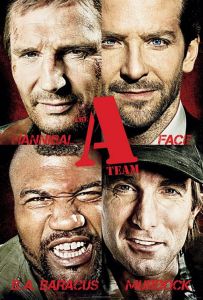 “Overkill is underrated,” quips Col. Hannibal Smith (Liam Neeson) in this big-screen adaptation of the 1980s hit TV show of the same name. And appropriately enough, like its source material, The A-Team is the very definition of mindless action. It’s completely shallow, goofy, yet over plotted and occasionally too serious for its own good, but like the A-team, the movie delivers when it counts. There is an undeniable pleasure in watching professionals work together, hatch a plan, and then watch that plan come to fruition. The A-Team is like an ADD-child because it can rarely sit still; five minutes won’t pass before something blows up. Writer/director Joe Carnahan (Smokin’ Aces) makes sure to keep things flying on screen so that the audience won’t stop and think about the multitude of plot holes and absurdities. The signature sequence that sums up the movie best is when the A-Team boys have escaped a downed aircraft by hiding inside a tank with parachutes attached. As they tumble back to earth they must try to “fly that tank” to land properly. It’s ridiculous on its face but rather entertaining. But the movie has its tongue firmly planted in cheek, even when it comes time to incorporate the show’s signature catch phrases (you could make an effective drinking game for the amount of utterances of “fool,” and, “I love it when a plan comes together”). The A-Team is overblown, silly, high-octane B-movie that obliterates your senses and thinking abilities, which means it successfully captures the spirit of the TV show.
Nate’s Grade: B-
Share this:

Next (2007)
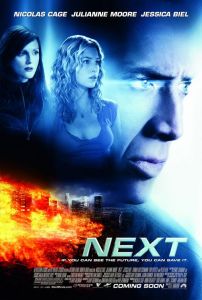 Nicolas Cage, channeling Tom Hanks’ greasy mullet in The Da Vinci Code, can see his own future but only two minutes ahead. Based on a Phillip K. Dick something or other (does it really matter at this point?), this half-baked sci-fi thriller keeps shooting itself in the foot by retreating back in time to reveal, over and over, that what was just shown was merely Cage seeing his future. Now it’s do-over time, hooray. This tricky concept is given little thought and Next hews close to tired thriller clichés and formulaic trappings. There’s the hot girl dragged into the fray (Jessica Biel, pretty but pointless), the shady government agents that need Cage’s help but don’t fully trust him, and the nondescript bad guys with a hidden nuke. Next had potential for disposable escapist entertainment, but man do they blow it big time. For a 90-minute film, there’s way too much setup and not nearly enough payoff. There’s about a grand total of two action sequences for the entire film, neither very good, and then the movie utterly collapses as half of it folds in on itself as one of Cage’s visions. In the blink of an eye, half of the movie we watch is erased; it’s a freakin’ cheat, especially when the movie slouches to a close right after. This easily forgettable sci-fi bobble is another nail in Cage’s coffin as a reliable actor.
Nate’s Grade: C-
Share this:

The Illusionist (2006)
 The Illusionist is a satisfying, well-staged period piece con game. It’s set in 1900 Vienna (though everyone’s accents sound British to me) and revolves around Eisenheim (Edward Norton), a magician that truly dazzles the crowds and leaves his skeptics guessing. He becomes a monstrous hit with tricks like making an orange tree grow from a seed and having butterflies carry handkerchiefs. The city’s Chief Inspector (Paul Giamatti) is a fan but also inquiring on counts of fraud. Prince Leopold (Rufus Sewell) is planning to marry the beautiful duchess Sophie (Jessica Biel). Little does the prince know that Eisenheim and Sophie were childhood friends forbidden to see each other because of class differences. It’s been 15 years since they last saw one another but they’re making up for lost time. The Prince sets the Inspector to ensnare the lovers and shut down Eisenheim.
The movie has a very interesting character relationship between Eisenheim and the Chief Inspector. They have a friendly, respectful relationship, with the Inspector pleading with Eisenheim not to force his hand. The Inspector enjoys magic and showmanship, but he also knows what backs he has to scratch to keep his title. I found the frustrating friendship and admiration between Eisenheim and the Inspector to be meatier than the forbidden love angle that drives the story. The Illusionist has the air of a historical romance, but it’s really more about these two men and their bond.
 Giamatti has a very strong role and plays all the different shades of his well-trodden man who still keeps hold of his ethics when he’s told to look the other way. He’s just as an important a character and Giamatti has completely wiped my memory of Lady in Water (not that he had to atone for it). Norton is easily one of our greatest actors, but in The Illusionist he underplays too much, slightly smiling his way through an altogether stale performance. I know part of his acting requires a reserved knowledge, since he is setting up those around him. I just felt that anyone else could have played the role the same, with or without a teenage goatee. Biel holds her own, which is something I never would have thought possible amongst celebrated Oscar-nominees. Her role is pivotal but small and doesn’t require much speaking, but all things considered she does pleasantly surprise. Maybe there is an actress somewhere in that pinup body.
The Illusionist, like its title practitioner, knows that an audience loves to be fooled, but only for so long. A magician is the perfect profession to showcase a con game, and writer/director Neil Burger crafts an intriguingly enjoyable tale where we do want to know how they did it. Burger knows how to misdirect but also how to stretch a small budget to create a rich dramatic environment. I don’t know if the explain-a-lot-in-a-minute ending does a disservice to the film or not, but I was happy to get some answers even if they were a tad predictable. That’s the whole thing with magic — we want to know but we love being confounded.
This is an extremely well made indie period film. The production design is astute and often times foreboding, like the Prince’s hallway completely filled with deer heads whose antlers form a really creepy canopy. The special effects are used judiciously and have more impact than the mega budget Hollywood summer spectacles. The Illusionist is a nice example of a character driven mystery that seems to be overlooked all too often today. This is an engaging, satisfying, and handsome movie that entertains by hooking into our curiosity to know how the trick is done.
Nate’s Grade: B+
Share this:

Cellular (2004)
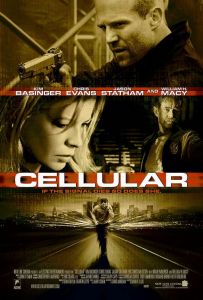 Cellular, a new thriller, relies on the simple device of a cell phone for the crux of its plot. With cell phones becoming ever more present, and ever more an eyesore in our daily lives, it was only a matter of time before they had their own movie. They’ve slimmed down from their heavier 1980s days, and become more useful, allowing one to surf the Web, take candid pictures of people in gyms, and are able to ring in the tone of the new hot rap song of the week. The premise for Cellular may be pitch-perfect for our modern society, but will an audience answer its call?
Jessica Martin (Kim Basinger) is a high school biology teacher caught up in some scary events. She’s been kidnapped by a gruff man (Jason Statham), and locked in an attic. She’s informed that her son and husband will be found and kidnapped, unless she tells him what he wants to know. Unfortunately, she’s clueless as to what her kidnappers want. There is a wall phone in the attic, and one kidnapper smashes it with a sledgehammer and walks away satisfied. Jessica goes to work re-configuring the shattered phone pieces, tapping wires until she can reach out and touch somebody.
Ryan (Chris Evans) is a hunky beach bum who’s chastised by his ex (Jessica Biel, I know, I didn’t believe it too) for being too irresponsible. He’s driving around in his cool ride when he gets a panicky phone call from, you guessed it, Jessica. At first he thinks it’s a practical joke until he overhears her kidnappers threaten her. Reluctant to help, Jessica asks him to stop the kidnappers from reaching her family. Ryan runs around town all day scrambling to help Jessica’s family and solve the case. He also enlists the help of a retiring police officer (William H. Macy), who’d rather open a day spa than do desk work.
 The premise for Cellular is near-genius and provides an abundance of smart, problematic possibilities. Ryan runs around and is always in danger of losing the signal. At one moment his cell phone is about to die from low battery charge. Another time the lines get crossed. Every step seems believable and the characters’ reactions seem credible. With Cellular, the audience thinks along with the characters step-by-step. When Ryan encounters stumbling blocks, the audience is with him in solving them, and this makes for a very engaging and thrilling movie.
The acting in thrillers is usually a minimal speed bump but the actors in Cellular do fine work. Basinger attempts to make up for her role in The Door in the Floor and plays harried and teary like a pro, but her best moments are when she uses her biology teacher know-how in precarious situations. She’s like a female MacGyver. Cellular is really a coming-out for Evans as a leading man. He’s had small roles before in The Perfect Score and Not Another Teen Movie, but this is his first leading-man role, and he handles the running, shouting, and panting with aplomb. Statham does his usually fine work of sneering and acting menacing. It’s also fun to watch William H. Macy, usually playing an every-man or a sadsack loser, play a bloodhound cop that morphs into an action hero.
The pacing in Cellular is breakneck. In the first 10 minutes, we witness Jessica’s kidnapping, and the momentum built up from that point is exhilarating. There is rarely a moment to catch your breath in Cellular. The action sequences are exciting but not redundant, and the tension readily mounts, especially when the audience is given more information than our heroes. There’s also some fun jabs at our country’s cell phone lifestyle.
 Director David R. Ellis worked as a stunt coordinator for 20 years, before advancing into the director?s chair and helming 2003’s schlocky gore-fest Final Destination 2. Ellis knows how to keep his plot moving, and something is always happening in Cellular to draw our attention or to push us on edge. Cellular was written by Larry Cohen, who also penned Phone Booth and probably won’t rest until he’s the Robert Rodat of telecommunications (Rodat wrote Saving Private Ryan and The Patriot, and seems destined to write a movie about every American war). Might I envision an erotic thriller with the “Can you hear me now?” Verizon guy just around the corner? Only time will tell.
As with any thriller, there are going to be lapses in logic that have the possibility of stopping the story dead in its tracks. Cellular‘s biggest logic loophole occurs right at the start, and if you can get behind it then you can enjoy the rest of the ride. Instead of smashing a telephone, why not yank it out of the wall and fully decommission it? Or, even better, why leave your kidnapped victim in a room, out of your sight, with a phone? Would it not have been easier to just tie her to a chair in plain sight? The mind boggles. The real answer we all know, of course, is because then we wouldn’t have a movie. There’s also a sequence late in the film where the bad guys discuss their evil plan on cell phones, which seems a tad careless considering anyone with a police scanner could listen in. As I said, gaps of logic are expected in this movie terrain and it’s your ability to rise above them that will determine if you enjoy the film.
Cellular is a thriller that dials the right numbers. It may have some gaps in logic, but it delivers when it comes to sharp suspense, smart action and a great premise. Fans of action thrillers should lick their lips with what Cellular has to offer. Just remember to keep your cell phones turned off during the movie, unless, of course, you’re surfing the Web, sneaking pictures of some girl, or jammin’ to the rap song of the week.
Nate’s Grade: B
Share this:

The Rules of Attraction (2002)
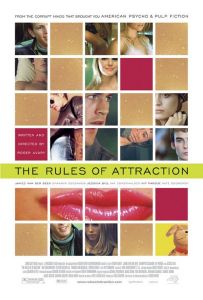 The Rules of Attraction is based on Bret Easton Ellis’ hedonistic 80s novel about boozing coked-out, aloof teenagers and their rampant debauchery. Roger Avary was Quentin Tarantino’s writing partner for years, with an Oscar sitting at home for co-writing Pulp Fiction. As a director Avary lays the visual gloss on thick utilizing camera tricks like split-screens and having entire sequences run backwards. While Ellis’ source material is rather empty, echoing the collegiate friendships bonded over substances or social lubricants, Avary does his best to represent the dazed world of college.
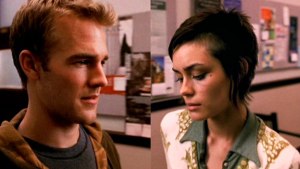 We open with Lauren (Shannyn Sossamon) getting raped by some drunk “townie” while the film buff she had her eyes on videotapes it. She’s just broken up with the bisexual and apathetic Paul (Ian Somerhalder), and both are interested in the sociopath Sean Bateman (James Van Der Beek), a self-described emotional vampire. Lauren keeps a picture book of venereal diseases to ward her from her wayward sexual urges. Her roommate Lara (Jessica Biel) needs no such book. Our introduction of Lara has her dancing down a hall, liquor bottle in each fist, bedding an entire sports team. Some attractions connect, many don’t, but the fun is watching the characters interact in their own seedy yet often hilarious ways.
The best thing that The Rules of Attraction has going for it is its about-face, against-type casting. The film is populated with the WB’s lineup of clear-skinned goody-two-shoes getting a chance to cut loose. Van Der Beek broods like a predatory hawk and bursts with spontaneous rage. Biel sexes it up as a cocaine-addicted harlot who asks if she’s “anorexic skinny” or “bulimic skinny.” Even Fred-Wonder-Years-Savage shows up briefly to shoot up between his toes! The adults of this world are no better than the kids. Eric Stoltz has an extended cameo of a duplicitous professor offering a higher GPA if any coeds are willing to go down on their morals. Swoosie Kurtz and Faye Dunaway show us that pill-popping ditherheads may likely breed drug-addled teenagers.
 Attraction may have the most disturbing suicide I’ve ever witnessed in film. After having her advances rejected a woman slips into the bathtub, razor in hand. The scene is as unsettling as it is because the camera hangs on the poor woman’s face every second and we gradually see the life spill out of her as the music becomes distorted, not letting us escape the discomfort.
Some of Avary’s surface artifice works perfectly, like Victor’s whirlwind account of an entire semester in Europe. Some of the visual fireworks are distractions to the three-person narrative but the film is always alive with energy, even when it’s depressing you. What The Rules of Attraction does get right is the irrational nature of attraction. Each character is trying to fill an inaccessible void with what they think is love but will often settle for sex, drugs, or both. The Rules of Attraction is made up of unlikable, miserable characters that effectively do nothing but find new ways to be miserable. It constantly straddles the line of exploitation and excess but maintains its footing. The movie is entirely vapid but it is indeed an indulgently fun yet depraved ride. If you’re looking for degeneracy instead of life-affirmation, then The Rules of Attraction is your ticket.
Nate’s Grade: B


 nathanzoebl
You must be logged in to post a comment.