Blog Archives
The Ruins (2008)
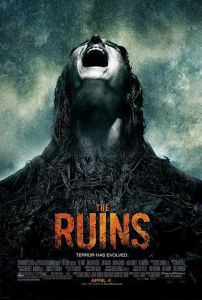 Author Scott Smith is from Ohio, my home state, which makes me like him. What made me respect him was his adaptation of his own novel, A Simple Plan. The movie version was splendid and taut, well acted and riveting and disturbing. Smith even received an Oscar nomination for his screen adaptation. When Smith released The Ruins, his second book, in 2006 I was mildly intrigued but never got around to reading it. Something about tourists, and Mayan temples, and bad things, and it got plenty of good reviews. Then I saw that Hollywood was producing a film version and that Smith had written the screenplay himself. Well, I figured, I’m going to be in for a chilling treat. Let’s just say my opinion of Smith has been slightly diminished.
Four over privileged American tourists are enjoying their final hours of a vacation to Mexico. Jeff (Jonathan Tucker) is studying to be a doctor. His girlfriend Amy (Jenna Malone) is best friends with Stacy (Laura Ramsey), and the two pal around together. Stacy’s boyfriend Eric (X-Men’s Shawn Ashmore) is along for the ride and enjoying every sun-soaked, boozy second. Lounging around the hotel pool, the group comes across a German (Joe Anderson, Across the Universe) who has a map to a hidden Mayan ruin. It’s a bit off the beaten path but the group decides to witness some genuine history. They take a taxi 12 miles into the jungle, hoof the rest, and discover a not very well hidden path to a not very well hidden Mayan temple (seriously, you’re going to have to do better than a couple of palm leaves if you want to obscure the path and keep people out. Try a fence next time). As soon as they arrive so do a band of armed Mayans that really insist the tourists do not leave the site. The Mayans chase the tourists onto the ruins and then they set camp around the perimeter. The Americans are being kept quarantined. Why? Inside and atop the ruins are a deadly plant that has a powerful hunger.
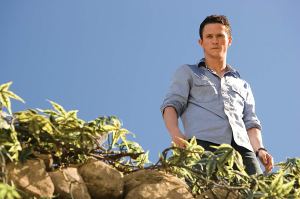 For a horror movie filled with unremarkable and generally unlikable characters, I must say that they at least don’t do anything incredibly stupid as is accustomed to the genre. Once they are chased to the top of the ruins you, the audience, are now put in their shoes. Every choice they make seems decently reasoned and cautious, exploring their surroundings and testing their boundaries. The Ruins features cheesy killer plants, yes, but the more interesting element to me was the survival game. These characters are quarantined in a remote area with little water, armed guards, and a handful of useful tools. What will they do next? This scenario grabbed my interest, as I played out my own personal survival scenario step-by-step and it wasn’t too different from what befalls the characters onscreen. However, I’m surprised no one tried setting the freakin’ plants on fire. The eventual psychological meltdowns and increasingly grim outlook help The Ruins maintain some level of credible drama.
But I think in the end I just couldn’t get over the fact that the main culprit was killer fauna. I can accept carnivorous plants, but seeing them is a whole different matter. Somewhere from pages to screen a step was forgotten to make them believable. The ancient plant system inhabiting the ruins looks like an overgrown swatch of ivy and marijuana leaves, and the vines would slowly inch forward to retrieve fallen pieces of meat. It’s downright comical to see a stringy piece of a vine trying to discreetly drag a dead body away, and frankly that’s where the movie fails. I shouldn’t be giggling at the killer plants. The execution comes across as way too goofy and made me shudder that I could be watching Little Mayan Shop of Horrors. I’m also wary that this highly localized plant has evolved to the point that it can duplicate exact sound. It mimics a specific cell phone ring tone to lure our vacationers deeper inside the ruins. Now, how in the world would it know well enough to do that? I can’t imagine in its potentially thousands of years of existence that it was come across a significant amount of cell phones. How would it know that exact sound would effectively lure others? I did enjoy the notion that the indigenous birds and insects have wised up and learned generations ago not to go anywhere near the ruins. Let this be a lesson to you, backpackers of America, that when insects refuse to go somewhere then perhaps you should take note.
 The Ruins should play out with a slow-burn sense of dread where the characters sadly realize with setback after setback that they are doomed; to be played right the plot needs to be methodical. Instead, Smith’s adaptation is more like a haunted house tale with crummy, obvious jump scares and lackluster spook setups. It seems like most of the film is intended to be a setup but the payoff is badly muffed, like seeing the stupid thin, twisty vines creeping out to sneak inside people’s open wounds. The Ruins has some fittingly disturbing scenes where something is moving and growing under the surfaces of people’s skin, but then you remember it’s just a plant vine and your mind starts racing with questions that illuminate how inane this whole situation comes across (How does a plant stem continue to grow inside a human body? What purpose does having an offshoot inside the prey serve? How does it penetrate open wounds without anyone noticing at all? Why should I be watching this?). I would have preferred if the under-the-skin creatures were some kind of insect or worm that had a symbiotic relationship with the plants. That would be cool and far creepier than stupid ivy vines.
From a gore standpoint, The Ruins has a few squirm-inducing moments. One character is badly injured and needs to have their legs amputated to survive. Oddly enough, this amputation sequence comes across as the most memorable part of a movie dealing with killer vegetation that can mimic cell phone ringtones and, later, lovemaking noises (now who goes out to have sex atop Mayan ruins?). The imprecise nature of the amputation is what makes it so gruesome. In one feel swoop, this character has to have leg bones crushed, then legs sliced off, and then have the stumps cauterized with a frying pan. And the only anesthetic is a bottle of Jack Daniels. Yikes. The amputation is played out with a deliberate pace and allows a satisfying buildup of nervous, queasy anticipation. Aside from that, there isn’t anything notable from the makeup department.
 None of the characters approach anything closely resembling characterization, but the acting is a notch above what you might expect from a horror movie populated with expendable, good-looking twenty-somethings. Tucker makes for a capable lead and projects a cool and controlled persona, never rising to hysterics. When he does realize the inevitable he begins to crack and it’s more effective because of how stoic he was before. The actor who gets tested the most is Ramsey, and this isn’t because she started her career in the derided “reality TV documentary” The Real Cancun. Her character is put through an emotional wringer and she sells the distress and Stacy’s fraying mental state. I never once was tempted to laugh even as she sliced herself open and fished around her insides. Malone and Ashmore are stuck being in the stock roles of whiny girlfriend and horny carefree dude.
The Ruins is a horror movie that’s far from horrible but not scary or perverse or funny enough to be recommended. The setup of isolation in unfamiliar territory could definitely produce some chills and thrills, however, when you throw in a ridiculous carnivorous plant that looks as menacing as your mother’s flower bed, well then, things just fall apart. I’m sure The Ruins worked well on the page, since it demands the reader create their own version of what goes bump in the night. Too bad that when you see it fully realized on the big screen it comes across as stupid. I really expected a lot more from Smith than this. The Ruins doesn’t justify why it should be treated any different than cheap, straight-to-DVD cheesy horror flicks (If there are multiple horror movies about killer snowmen, then there has to be an entire sub-genre of killer plants). I know M. Night Shyamalan’s upcoming summer release The Happening also features plants turning on humans. Let’s hope the creative force that brought us Lady in the Water can do more with the subject.
Nate’s Grade: C
Share this:

Into the Wild (2007)
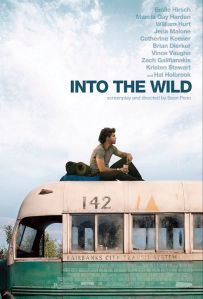 Undeniably well made, I just couldn’t emotionally connect with the main character, Christopher McCandless (Emile Hirch). Chris turns his back on his affluent parents and his bourgeois lifestyle and heads off into the wilderness to experience nature and find what has been missing in his life. Director/screen adaptor Sean Penn turns Chris into a Jesus-like figure that touches all those who he encounters on his cross-country tour that will meet its end in Alaska. I found the character treatment to be a tad naive and off-putting, and his lack of communication with his family, especially his younger sister who was in the same boat with him, seems especially cruel. And yet, the movie has its share of transcendent moments that bury themselves deep inside you, like when Chris befriends an 80-year-old widower (Oscar nominee Hal Holbrook) who is given new life. The closing moments, when Chris has accepted is fate, is profoundly moving and exceptionally performed, and this is coming from a guy that felt an emotional disconnect from the main character. Into the Wild is lovely to watch with top-notch cinematography, a fabulous score by Eddie Vedder, and fine acting by a diverse cast. I’m very impressed by what Penn has accomplished here. However, I admire the movie more than I can embrace it, and it all goes back to the character of Chris. He’s a mystery and both romantic and frustrating, which is kind of a fit summation for the movie.
Nate’s Grade: B
Share this:

Donnie Darko (2001)
 Donnie Darko (Jake Gyllenhaal) is your normal malcontent teenager in late 1980s Reagan America. He bickers with his older sister, worries over the right moment he’ll kiss his new girlfriend, and tries to ignore the advice of many imprudent adults. Donnie’s your typical teenager, except for his imaginary friend Frank. Frank is a sinister looking six-foot tall rabbit that encourages Donnie into mischief and gives a countdown to the impending apocalypse. And I haven’t even gotten to the time travel yet.
One night as Donnie wanders from his home at the behest of Frank, an airline engine mysteriously crashes through the Darko home and lands directly in Donnie’s room. The airlines are all at a loss for explanation, as it seems no one will take responsibility for the engine or knows where it came from. Donnie becomes a mild celebrity at school and initiates a relationship with a new girl, Gretchen Ross (Jena Malone). One of his classes consists of watching videos of self-help guru and new age enlightenment pitchman Jim Cunningham (Patrick Swayze). His school has even, under the persistence of self-righteous pain Kitty Farmer, persuaded Cunningham to speak and try to help students conquer their “fears.”
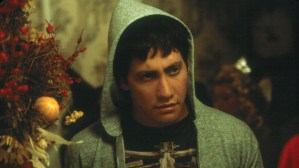 Donnie is also seeing a therapist for his emotional problems and taking medication for borderline schizophrenia. Around this time is when Donnie starts to inquire about a strange old woman, obsess over the possibilities of time travel, as well as see weird phosphorescent pools extend from people’s chests. He also floods his school at the urging of Frank. This is no Harvey type rabbit.
The longer Donnie Darko goes on the more tightly complex and imaginative the story gets. First time writer-director Richard Kelly has forged an excitingly original film that is incredibly engaging with charm and wit. He masterfully mixes themes of alienation, dark comedy, romance, science fiction, and a sublime satire of high school. Donnie Darko is the most unique, head-trip of a movie unleashed on the public since Being John Malkovich. Kelly has a created an astonishing breakthrough for himself and has ensured he is a talent to look out for in the future.
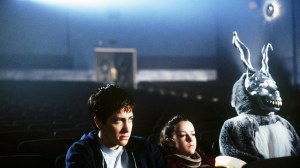 Gyllenhaal (October Sky) is superb as disenchanted Donnie, a Holden Caulfield for middle suburbia. His ghastly stare conveys the darkness of Donnie but his laid-back nature allows the audience to care about what could have merely been another angst-ridden teenager. Swayze is hysterical as the scenery-chewing Cunningham. The rest of the cast is mainly underwritten in their roles, including stars Drew Barrymore (who was executive producer) and ER‘s Noah Wyle, but all perform admirably with the amount they are given. Not every plot thread is exactly tidied up but this can easily be forgiven.
Donnie Darko is a film that demands your intelligence and requires you to stay on your toes, so you can forget any bathroom breaks. The film is one of the best of 2001 but also one of the funniest. You’ll be honestly surprised the amount of times you laugh out loud with this flick. The theater I saw this in erupted every half a minute or so with boisterous laughter.
Donnie Darko is a film of daring skill and great imagination. You don’t see too many of these around anymore.
Nate’s Grade: A
Reviewed 20 years later as part of the “Reviews Re-View: 2001” article.


 nathanzoebl
You must be logged in to post a comment.