Blog Archives
IF (2024)/ The Imaginary (2024)/ Imaginary (2024)
Every so often, I find myself drawn to reviewing movies in pairs, whether it’s because of the same source material (the 2022 Pinoochios), similar perspectives (2018’s BlackkKlansman and Sorry to Bother You), or even diametrically opposed artistic responses to a similar theme (2016’s Manchester by the Sea and Collateral Beauty). However, in my twenty-five years as a fledgling film critic, I don’t think I’ve ever reviewed three movies at the same time for whatever relevancy, yet that is what I find most appropriate for this trio of exceedingly similar films about imaginary friends. Earlier in the year, Blumhouse released Imaginary, their horror-thriller take on an imaginary friend refusing to go away. At the start of the summer, writer/director John Krasinski gave us IF, a live-action fantasy/comedy about imaginary friends finding their former children as adults. And recently, Netflix released an anime movie The Imaginary, a Studio Ghibli-esque fantasy about forgotten imaginary friends trying to find new kids and new homes. I’ve elected to review all three at once and, much like the Pinnochios, declare a winner through different categories.
Begin the critical gauntlet! Bring on the (imaginary) bloodshed!
- PREMISE

Two of these movies went in a sweetly sentimental direction and the other went in the horror direction, so let’s tackle that one first. Imaginary gets at a rarely spoken truth: children can be super creepy. Watch a child hold an involved conversation with some entity that isn’t there, or just stare into the dark and say, so plainly, “That’s where the eyes are watching me,” or any number of personal anecdotes to make you shudder, and you’ll understand the significant horror potential with a malevolent creature that the child can communicate with that adults cannot see. This also lends itself to a low-budget film production as so much of the wicked entity is implicit and unseen. It’s a cost-saving genius when you can just use your, wait for it, imagination. Now Imaginary isn’t the first horror version of this premise, but it deserves points for taking a childhood concept and thinking of an effective way to transform it into a diseased and malignant antagonist, haunting its adult child Jessica (DeWanda Wise) and seeking a new child, likely her youngest step-daughter Alice (Pyper Braun). It then presents its conflict like a curse that the past generation is trying to spare the next generation from suffering through. Of course this also includes getting adults to recognize the threat as they are often dismissing it. Nobody wants to believe that Chauncey the teddy bear is the one urging you to self-harm.
The other two movies take a far more family-friendly approach to their imaginary premises. There’s a lot of shared real estate between The Imaginary and IF. Both are about outdated imaginary friends finding refuge together in a sort of halfway house, a… foster home for imaginary friends (someone should make a cartoon series about that). Both of the movies follow imaginary friends trying to find new children who will accept them and give them a new life. IF briefly follows the possibility of reuniting the forgotten imaginary friends (a.k.a. IFs) with their former owners now grown up into adulthood. This is actually the movie at its best, as the creatures find a renewed sense of purpose and reconnect with a person they cherished but had to let go. For a strange reason, Krasinski only dabbles with this poignant story direction, switching gears to find them new homes with new kids, which serves as another story direction that is also quickly ditched. IF seems to be trying on so many different versions of its premise and then discarding them like the IFs themselves. The Imaginary has more focus on its central predicament, finding new homes before these characters fade away, or worse, get eaten by a cannibalistic imaginary fiend looking to gain more years of his own existence by consuming the life force of his imaginary peers. It also has the urgency of its main character, an imaginary boy named Rudger, hoping that his child wakes up from a car accident, and if so, that she’ll still need him. The other characters are trying to set Rudger up for a life after his child, since they’ve all experienced the same fate and are trying to help him adjust to not just letting go but also being open to a new child. It’s simplified but has plenty to still explore, plus a creepy super villain.
Winner: The Imaginary
2. WORLD-BUILDING

This is what really separates IF from The Imaginary. The world of imaginary figures populated in Kransinski’s movie are cute but their larger world context is unfortunately underdeveloped. This is likely because much of the movie is connected to the personal journey of one twelve-year-old girl, Bea (Cailley Fleming), trying to keep herself busy while her father (Krasinski) undergoes vague “heart surgery.” The IF Coney Island respite feels like a secret nursing home where the discarded friends just kind of hang out. There’s even swimming and painting lessons. There’s no further examination on whether these are only the IFs from this zip code, though Bradley Cooper voices a talking glass of ice water whose child originated in Arizona, so that’s undetermined. I was also hoping for an imaginary friend from decades back, like Franklin Roosevelt or Alexander Hamilton’s imaginary friend, or from other countries. Each character design can say something inherently about their past child creator, what they regarded as fulfilling or lacking from their present. Alas, the world-building is mostly one little girl’s discovery of her new friends and then how they ultimately support her with her family predicament looming over every scene. Seriously, for a father going through major surgery, the family in IF is pretty blase about Bea’s whereabouts. Her grandmother (Fiona Shaw) doesn’t seem too pressed about letting an unattended adolescent run around New York City for hours. Bea’s experience with helping the IFs are reflections of her optimism and hope. It all comes back to her, so the movie chooses to ignore the larger possibilities of its magical unseen world.
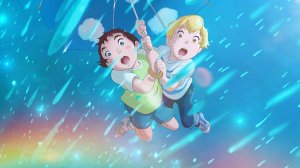
The Imaginary feels modeled after the Studio Ghibli movies that have delighted children and adults for generations. Its main character is Rudger, an imaginary friend, and not the child who birthed the imaginary friend, Amanda. That creates a different sense of discovery, as Rudger also learns about the hidden library housing other imaginary friends and the rules. He’s to stare at a bulletin board and await a prospective child he feels a connection to, then holds onto a picture of them to transport into the child’s imaginative play where they can contribute to the creative adventure. However, there are dangers like if you die in the imaginary world, you can die for real, which is never fully explored as a real threat. The imaginary characters are told to stay indoors at night, as they don’t want to run into Mr. Bunting, the cannibalistic antagonist. I got a little lost with the different rules, some of which seemed to be emphasized more or canceling out previous rules, but I appreciated the level of thought given to making its world alive.

This is also where Imaginary begins to get lost in its own hazy imagination. Imagine the bedroom door-hopping mechanic from Monsters Inc. but with the narrative formula of Insidious, and there you have Imaginary. The world of imagination is treated very similarly to a hellish dimensional getaway, much like what happens in Insidious where dad had to retrieve his son in the demon’s phantasmagorical realm. Because the spooky imaginary world relates back to the main character’s childhood, we have a few other characters that have history with this trauma. Jessica’s father Ben has been committed to a hospital and seemed mentally ill, until you realize he rescued his little girl from evil Chauncey and lost his mind in the process. He’s not some lost cause, he’s a hero. Also, there’s a former neighbor and babysitter (Betty Buckely, always welcomed) who is obsessed with childhood psychology and willing to do some extreme things to continue her obsession with Chauncey. It’s at least widening the scope to look at how these traumatic events have impacted other people, not just the little girl bottling up those nightmares. However, beyond the simple explanation of Chauncey existing as a parasite feasting on the imaginative power of children, little else is established about the creature or its own world. At one point, a character relishes the possibility of imagination as a wish-fulfillment service, but why would this evil creature delegate its power? It reminds me of all sorts of other movies where characters side with some apocalyptic power thinking they’ll somehow be the lucky exception.
Winner: The Imaginary
3. CHARACTERS

This is where IF shined the brightest. The little girl is cute and optimistic, a fitting tonal foil to Ryan Reynolds being such a loquaciously sardonic naysayer. She wants to be so helpful, though keeping herself so busy might just be her coping mechanism to try and stop her dreadful encroaching thoughts about the possibility of losing her second parent. Her taking the lead to help the IFs then allows for little episodic asides for the different characters to share their stories and their former creators. Having a protagonist be so driven at being empathetic is a natural conduit for championing the feelings and triumphs of others. It works. Reynolds is still doing his fast-talking cynical schtick, so your mileage will vary how well it continues to appeal. Curiously, I don’t think the character of Blue (voiced by Steve Carell) is fully utilized. He’s a more childlike exaggeration of the character features already provided by Bea’s involvement. Blue resembles the McDonalds’ Grimace, and is outwardly friendly, unafraid of big emotions, and a bit silly, but his elevation in the script as being the primary IF sidekick is arbitrary. The same story could have afforded tapping, say, the excitable unicorn (voiced by Emily Blunt) as the primary sidekick and produce similar results. Again, I think there’s so much that could have been further explored as to the existential requirement of the different imaginary characters, how they represented what their former kids felt they needed. Their exact existence was what a child yearned for (the strong IF to protect the child who is afraid, the squishy lovable IF to comfort a lonely child, etc.).
The characters from The Imaginary fall into general archetypes that any Miyazaki fan will be familiar with. There’s the bossy know-it-all, the excitable goof, the silent contemplative, the wise and warm-hearted authority figure, the dangerous rogue. They all work but it’s the larger themes that resonate more than any specific individual character. Mostly, the conflict is whether Rudger decides to move on from his creator and find a new child/home. He has loyalty and emotional attachment to little Amanda but the reality is that, at some point, she will grow up and he’ll be left behind. Whether that happens now, because she passes away, or years later through becoming an adult, there will be a parting and he will need to consider a new life. The loneliness and melancholy of this existence is ignored through the kooky characters, strange worlds, and pressing points of danger, so the reality of Rudger’s eventual loss is thematically sidelined.

With the Blumhouse Imaginary, the characters are relatively stock types for a supernatural horror mystery. There’s some effort to make it about Jessica trying to ingratiate herself with her new step-children, the oldest who looks at the new mom with great suspicion and resentment. At one point, the old mom serves as a jump scare, hiding in the house; the old mom is mentally ill but the stepdaughter thought, erroneously, that mom was “getting better.” Jessica is trying her best to rise to the challenges of being a parent, but it’s hard when there’s a sneaky ghost trying to emotionally manipulate your youngest to hurt herself. I don’t know why Jessica decided to move her new family back into her childhood home, the source of her trauma, except if you looked at the real estate market, it might have been by far the best deal she could swing. What’s some reawakened childhood trauma when it comes to skipping ballooning mortgage payments? Have you seen interest rates and the price of houses post-pandemic? That’s the real terror for adults.
Winner: IF
4. EMOTIONAL INVOLVEMENT/CONCLUSIONS
Despite what Pixar may have set in stone, it’s not a requirement for a children’s movie to make you cry. I did end up tearing up from two of these movies, and it should likely be obvious which of the three was the outlier. Krasinski’s movie is designed as a big warm hug, complete with soothing, milky light pouring in from every setting. I thought it looked very similar to how Steven Spielberg’s preferred cinematographer, Janusz Kaminski, shoots natural light, and lo and behold Kaminski was the cinematographer for IF (excuse my pat on the back here). Bea’s big emotional moment where she tells her story of adventure to her unconscious father in his hospital bed pulled some heartstrings, but what I felt even more emotionally cathartic were the asides where Bea helps the IFs reunite with their former kids. When an IF is being thought about, they start to glow from within, like happiness radiating out. It was these little moments, like Blossom (voiced by Phoebe Waller-Bridge) getting to dance with Bea’s grandmother like they used to, or the simple act of Blue wishing good feelings to his nervous former-child with a silent shoulder touch and world-clarifying exhale. It was the acknowledgement that these friends, while gone, are still fondly remembered, and that they will always have that connection even if their exact relationship has changed through the years. The Imaginary operates on a similar emotional wave of adults reuniting with their former childhood friends, and it’s that sweet acknowledgement of appreciation and love that hits hardest. It reminded me a little bit of 2001’s Amelie where she’s on a mission to help strangers remember beloved items from the past. The overarching worry about losing her father seems unnecessary as a complication, especially how “heart surgery” is kept so purposely vague and seemingly uneventful until that bedside chat. There is a difference between wanting to protect your kid from the possible trauma and downplaying it to the point where it becomes a strangely superfluous plot device.
I won’t pretend there’s much to get emotional over with the Blumhouse Imaginary, though there is one Act Two twist I thought was simply astounding, but in order to explain I will need to go into spoilers, so you have been warned, dear reader. For a solid hour, we watch Alice play with a teddy bear that she calls Chauncey, the embodiment of her imaginary friend. So far so good. Then after a disturbing session with a child psychologist, the professional shows Jessica her recorded session. This is where we discover that Chauncey the bear… has never been there. Alice has been talking to the unseen entity of Chauncey and Jessica has been the only person who was seeing a teddy bear. That’s right, the twist is that the bear was never there. Bam.
Winner: IF
Three imaginary friend movies and the exploration of the meaning these figures have to children and adults after years removed. I had my quibbles with each movie, but with adjusted expectations, each movie can supply a degree of entertainment. The animation in The Imaginary is gorgeously fluid, so that alone will prove a draw to hand-drawn animation fans such as myself. Krasinski’s family film is gooey at its well-meaning core though it has underdeveloped avenues I wish had been given more articulation and exploration. The Blumhouse Imaginary movie is fairly formulaic but has a couple enjoyable twists and turns, even if they’re ridiculous. There is a potent storytelling reservoir with imaginary friends, both benevolent and malevolent, so I imagine (no pun intended) this won’t be the end of these stories making their way to the big screen.
Nate’s Grades:
Imaginary: C
IF: B
The Imaginary: B
Share this:

Fantasy Island (2020)
 I wasn’t expecting to become a defender of Blumhouse’s much-reviled remake of 1970s TV staple, Fantasy Island (it currently has a 7% fresh rating on Rotten Tomatoes) but this year has been defined by surprises. I’m not going to say that this is a good movie but turning a cheesy TV drama into a horror thriller that might as well take place on the magical island from Lost, I have to admit that’s a daring approach and it almost works. Michael Pena is miscast as a villainous Mr. Roarke who invites a group of strangers to a beatific island resort to have their fantasies come true be they hedonistic (wild parties with sexy guys and gals) or vengeance (Lucy Hale getting even against a high school bully) or regret (Maggie Q saying yes to a proposal and starting a new life). At first the fantasies seem too good to be true and then the darker reality comes forward, forcing many characters on the run. I was very happy that the filmmakers, the same creative team behind the equally-reviled Truth or Dare, present the proceedings as being clearly supernatural and stick with it. I was expecting some hackneyed explanation of how it was all a show, or a simulation, or some kind of televised event for the rich to gamble upon, but the movie stays supernatural to the end as if it is the Lost island with its weird secrets. Because of that scenario, even when the rules of the island and the final scheme comes to light as to whose fantasy all of this pertains to, it’s a forgivable level of convolution. There were moments I even had fun, mostly just seeing how crazy and far away from the source material everything can get. It felt like if someone was ordered to remake The Love Boat and came up with Ghost Ship. It’s just fun how different it can go. I didn’t care for any of the characters outside of Maggie Q, who gets the best acting showcase as a woman with many regrets who is trying to ignore her misgivings. Hale seems to be playing a character ported from the Spring Breakers universe (what a dreadful thought). Michael Rooker (Guardians of the Galaxy) appears as a grizzled veteran of the island. Even when things aren’t working, like black-eyed zombies or much of the comedy, I wasn’t ever bored. How crazy would things get next? How would they tie this all together? Fantasy Island is not the horrible experience critics claimed earlier this year. It’s not a great movie but it works as silly escapism, and during a time of pandemic-initiated quarantine, a little silly escapism might just be what you need for a couple of hours.
Nate’s Grade: C+
Share this:

Truth or Dare (2018)
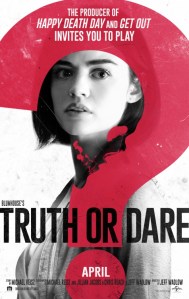
A group of college friends spend Spring Break south of the border and stumble into a deadly game of… truth or dare? Blumhouse has spun gold out of just about any high-concept horror property but can it make Truth or Dare work? Here’s the truth: nope.
This is a powerfully dumb movie that caused me to yell at the screen several times, shake my head even more, and contemplate my own life choices. The entertainment level is related to every befuddling choice this movie makes, and it makes many of them. Take basic dramatic opportunities that it weirdly pushes aside. One character is gay and hasn’t come out to his father yet, so the demon-inhabited game dares him to come out. Rather than watch this genuinely dramatic moment play out, Truth or Dare has it all take place entirely off-screen. Hilariously, the gay student comes back and recaps the audience what they missed (“Yeah, I came out to my dad, and he said some things, and we’re good now.”). Imagine if an action movie did something similar (“Hey, yeah, so I jumped out of a flaming helicopter onto that skyscraper and then scaled down only using my pants as a makeshift rope”). That’s bad writing no matter the genre. Take another scene where Olivia (Lucy Hale) tracks down the old Mexican lady who supposedly started the curse. She gets there but is told by the granddaughter to wait outside. So she does. Then we cut to a later scene where the granddaughter says, “She has agreed to see you.” Why did we need that first scene denying them entry? If all it does it kill mere seconds in the running time, why is it even included? This scene also involves the granddaughter being coy when Olivia asks to speak to the old lady. She cut out her tongue long ago and the granddaughter knows this but is just being a jerk. These are basic storytelling miscues that Truth or Dare doesn’t seem capable of overcoming.

We must talk about these silly demonically possessed faces. Oh the faces. It looks like a bad Snapchat filter promotion. I am convinced some studio exec saw a Snapchat filter and said, “Hey, we can make a horror movie based on that” (Look out for the upcoming dogface filter horror movie in 2019). The faces are so dumb. They pinch into pained rictuses, big eyes, and triangular, pointy chins. It’s not a creepy image at all. It’s like a bad special effect trying to turn the cast into caricature. Then they even directly address it, as one character literally cites the look as a “Snapchat filter.” Don’t hang a lampshade on it, movie, and make us all realize that even you know how dumb and derivative you are. The accompanying scary modulated voice is also worth a hoot. The end credits even end on the demonic voice challenging the audience to a game of truth or dare. Joke’s on you, movie, because nobody stuck around for the end credits of this one (except for me). The faces are never scary, are always goofy, and always funny looking, and that’s all we get.
The scariest thing in Truth or Dare is the uproariously bad dialogue. These are actual lines of dialogue spoken in the movie: “The game followed us home from Mexico.” Oh? “We’re not playing the game, it’s playing us.” Uh huh. “I dare you to get on the pool table and show everyone your pool cue.” Oh, PG-13 movie, how naughty of you. “I know things have been a little Bette and Joan since Mexico.” No, movie, you do not earn referencing Bette Davis and Joan Crawford or even Bettie and Joan from Mad Men.
The characters might be as bad as the cringe-inducing, laughable dialogue. Our protagonist is kind of a terrible human being (spoilers to follow). Olivia is obviously in love with her best friend Markie’s (Violett Beane) boyfriend Lucas (Tyler Posey), blurts out her best friend’s cheating ways to the whole world, will eventually sleep with the best friend’s boyfriend (more on that later), and then also reveals a painful secret regarding her best friend’s deceased father, namely she is indirectly responsible for his death, suggesting he kill himself after he tried to sexually assault her. All of these abuses are targeted at her best friend, and yet she constantly keeps trying to say, “You have to trust me,” as if these cruel torments should be waved away. It’s so one-sided and directed at one person, her ostensible best friend, that it becomes comical. At one point Markie has a gun to her head and screams she has nothing left. “You have me,” Olivia says, and I wanted Markie to pull the trigger right then because this was after Olivia told her everything. Hale (TV’s Pretty Little Liars) has a fixed expression of confusion with her large doe eyes, which don’t require that much in the way of adjustment for the Snapchat filter face. I don’t think we’re supposed to care about any of these characters, including our eventual Final Girl played by Hale. I was rooting for the demon to bump them off in bulk.

The mysteries of Truth or Dare are exasperating and demand further analysis, which I will ably try and perform for you, dear reader. First off, the rules of this game are very sketchy and feel rather arbitrary. A demon will jump around participants but needs more contestants, like the Ring cursed videotape. Eventually more players will be roped in but the old players are still part of the game, I guess, which means there’s no escape. This all started because some demon was released from its containment pot at an abandoned monastery, and it just so happened there was a group of teens playing truth or dare. So the evil demonic spirit said, “Hey, why not?” and adopted the game as its own? What if they had been playing spin the bottle or “Head’s up 7 UP”? I am almost certain, given the cannibalization of the horror genre, there has to be an evil spin the bottle movie somewhere (a cursory Internet search found a 2011 film with the premise). I feel like the other demons at Hell High pick on this particular demon and with good cause.
When given a choice between answering a question and doing some dangerous dare the choice seems obvious. The game seems to know this as well, which is why halfway through the characters are not allowed to choose “truth” any longer. This seems like cheating. The game is called “truth or dare” and not “…or dare.” By removing the choice it stops becoming a game. Admittedly, most human beings will tap out of horrible truths to reveal after a while unless you happen to be a politician. After a while it will just resort to making people talk about their Internet search histories. When these people have to blurt out painful truths, why do they scream them? Could not whispering achieve the same results? There’s the question of what constitutes finishing a dare as well. Since one’s life is on the line, it’s important to see the dare through. There’s one scene where the game dares Olivia to have sex with her best friend’s boyfriend. I don’t know about you, but if somebody said, “an evil force says I must have sex with you or else I’ll die” it would be a real mood killer. Regardless, they strip off their clothes and take the wanton opportunity given to them (Her: “You’re just doing this because you have to” Him: “No, you do. I’m doing this because I want to”). Except in the middle of their coitus the dare demon returns and possesses Olivia, challenging Lucas to pick next. Has Olivia finished fulfilling her dare? What constitutes “finishing” when it comes to sexual congress? The dares also escalate to an arbitrary degree, often robbing the player of a real chance to see it through. When the demon dares you to kill one of two people and the previous dare was far less significant, then it feels like the movie is compensating for a lack of developing thrills. If I go, “I dare you to eat that cheese,” and then next, “I dare you to rip it out of your intestines,” it feels like too much too soon. Alas, demon party games and pacing.

Then there’s the would-be solution, which as you could assume also doesn’t make much in the way of logical sense. They can rope the demon itself into the game if they reach the hallowed spot where the game began and time things right. the demon has the ability to alter your vision and hearing, so it can already alter your reality to its whims to whatever ends it wants. When the rules are arbitrary and you’re dealing with a supernatural presence that flouts mortality, what good is any of this going to do? It’s like the kids from a Final Destination movie scheming to have Death killed by Death. This isn’t the only movie to offer false hope as far as defeating a supernatural curse, like with The Ring and It Follows. Actually a lot of the plot is similar to It Follows. Just watch It Follows.
Truth or Dare is a thoroughly entertaining and thoroughly bad movie. It’s not scary and it’s not effectively dramatic. It’s confusing and capricious and hilarious. And yet, it does find that ineffable groove to come across as something in the “so bad it’s good” echelon, something I wouldn’t mind watching again with a group of friends and some adult beverages at hand. Truth or Dare is this year’s Bye Bye Man. I dare you to watch it.
Nate’s Grade: D
Share this:

Kick-Ass 2 (2013)
 It’s hard for me to discuss Kick-Ass 2 without sounding like a hypocrite. I enjoyed the first film’s visceral thrills, style, and satire of superhero tropes. The sequel gives me more of the same except not nearly as well polished, and in typical sequel mentality, it goes bigger, expanding the world and the height of the sick puppy violence. Kick-Ass (Aaron Taylor-Johnson) and Hit Girl (Chloe Grace-Moritz) are trying to live ordinary lives but keep feeling the need to don their suits and fight crime. Kick-Ass joins a ragtag team of other costumed vigilantes to battle a super villain team, lead by the former Red Mist (Christopher Mintz-Plasse). For long stretches, the movie seems like an unwanted Heathers knockoff as Hit Girl attempts to fit in at high school. She has some particularly nasty vengeance against a popular bully, and if there is a line, it may have been crossed here. I don’t know what it says about me, but I guess I’m fine with a pint-sized kid slicing up bad guys and cursing like a sailor, but making a woman simultaneously vomit and defecate herself, watching both projectile streams spray out her ends, is too much for me. This is a darker, cruel, and mean-spirited feel with the material, and writer/director Jeff Wadlow fails to compensate for the lack of creativity this go-round (I miss you Matthew Vaughn). The humor is still lively, but the plot is predictable at every step, the characters behave in ways that don’t make sense, and the action sequences are poorly filmed, leading to an anticlimactic ending that simply peters out. Kick-Ass 2 won’t be knocking anyone out.
Nate’s Grade: C+


 nathanzoebl
You must be logged in to post a comment.