Blog Archives
The Bikeriders (2024)
 For a four-year period, writer/director Jeff Nichols is a filmmaker who appeared on my Best of the Year list three years, including making my top movie of 2011, Take Shelter. He’s a filmmaker I highly prize, so an eight-year gap from Nichols is an extended leave that makes me personally sad, though his latest movie, The Bikeriders, was delayed by a year after Disney decided to sell it rather than release it for the 2023 awards season. It’s a pretty straightforward drama about a Chicago motorcycle club in the 1960s. It’s all about a group of men that really don’t know how to express their feelings, so it comes out as drinking and fighting and general rebellion against outside authority. These social outsiders find kinship under the leadership of Johnny (Tom Hardy), an unstable man with his own code of honor and retribution. Our narrator is Kathy (Jodie Comer), a plucky woman who falls for a reckless biker, Benny (Austin Butler). There are plenty of interesting moments and sequences, like the rejection of wannabe new members too eager for approval for institutional violence. The changes the club undergoes through the mid 1970s are interesting, especially as the rules of the club begin to fray with the influx of new members and drug addictions, and the challenges to leadership we know will eventually end in tragedy and a betrayal of what the club was intended to be. Regardless, it feels like the movie has all the authentic texture and period details right but is missing a stronger sense of story. It’s more a collage of moments that doesn’t add up to a much better understanding of the three main characters. It’s more like a mood mosaic than engrossing drama, so if you have a general interest in retro motorcycle culture or the time periods, then maybe it will cover the absences in character. I found The Bikeriders to be a good-looking coffee-table book of a movie, more recreation than investment.
Nate’s Grade: B-
Share this:

Loving (2016)
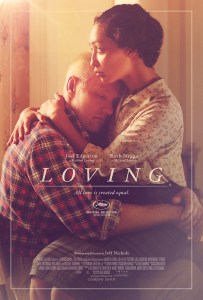 Richard (Joel Edgerton) and Mildred Loving (Ruth Negga) are a young couple deeply in love in the late 1950s. The only problem: he is white and she is black. The laws in their native Virginia forbid marriages to different races. The Lovings traveled to Washington D.C. to be married and then had to live as fugitives before ultimately getting caught and exiled under threat of jail time. Eventually an ambitious ACLU lawyer (Nick Kroll, broadening his range) challenges the legality of the miscegenation law, which will lead to the landmark 1967 Supreme Court ruling striking down laws barring interracial marriage.
The ordinariness of the Lovings betrays the kind of movie moments we expect from great historical turning points, namely moral grandstanding and stentorian speechifying. We’re so used to accentuated versions of history because, deep down, that’s what our storytelling impulses crave because the real thing is often less streamlined and usually more boring. We want Daniel Day-Lewis as President Lincoln admonishing his fellows with the power of his oratory. We don’t necessarily want to watch President Lincoln rewrite his speeches for grammatical mistakes. With all that being said, I appreciated the approach that writer/director Jeff Nichols took with Loving because the very point at the heart of the movie is just how powerfully ordinary Mildred and Richard Loving are. Their love is meant to be ordinary, their relationship relatable. They’re meant to be just like you or I. This thematically taps into the message of the movie about the fundamental human rights of American citizens to love who they love regardless of what others may think. There is nothing dangerous or subversive about their marriage. There is nothing radical. The rationale for why the state would care so much about a marriage can be flabbergasting, including one judge’s written opinion that God created separate races and placed them at separate points on the globe thereby never intending for them to mix. This was considered acceptable legal justification for discrimination in the 1960s and it’s absurd. The other argument against interracial marriage is that biracial children are a harm to larger society… somehow. It’s easy to look back to the past and shake our heads with a fury of moral indignation and say “How could they do that?” but some of these exact same legal arguments have been used in the twenty-first century to justify denying gay citizens the same equality. In that sense, Loving shows us how far we’ve come but also how far we have to go to make sure that human beings are simply considered human.
 If that wasn’t enough the movie also makes a powerfully compelling case about how the state’s miscegenation laws were an offense to human decency. The Lovings are given the legal ultimatum to separate or be exiled from the state, their families, and the home they were making for their family. They have been banished for loving the “wrong” person. Mildred and Richard try living out of the state in a D.C. suburb but it’s not the same; Mildred misses the quiet and relative safety of the country as well as the warmth of her immediate family. They decide to sneak back into Virginia and lay low, and you get a genuine sense of the day-to-day anxiety of having to constantly look over your shoulder and fly under the radar lest someone throw you in prison for loving another race. The degradation and dehumanizing effect of the miscegenation laws is on full display with how Mildred and Richard must act like criminals afraid of their country of laws. They may be used to the glares and hateful comments from intolerant onlookers but it’s another thing when the power of the state is employed to enforce that same hate. The wear and tear of their love perplexes some of the Loving friends and family. Mildred’s brother and sister each take turns blaming Richard for knowingly bringing this heap of trouble upon their beloved sister and for taking her from them. Her brother confesses he doesn’t know why he doesn’t just divorce her and stay together, satisfying the definition of the law. It’s a pertinent question that asks what is the value of marriage? He could readily be with Mildred and save themselves the persecution, but why should they have to settle for something less with their love? Why should they have to be second-class citizens?
This is very much a duet of a movie and Negga and Edgerton deliver admirable, understated work that cuts deeply. I was most impressed with Edgerton (The Gift) who has the more private and insular character. He’s not seeking the spotlight and doesn’t want to be a civil rights crusader. Richard Loving isn’t exactly a man prone to those speeches we crave and he’s certainly not a man to blurt out his feelings. Edgerton has to play within a tiny frame of emotional reference and he makes it work. When he does start to break down, his stoic defenses melting under the pressure and soul-killing compromises, the moments carry even greater emotional weight. Negga is the more emotive of the two but even much of her performance lies in her large, expressive eyes, taking in the collective injustices and triumphs. Using approximately the same Southern accent from her plucky performance on AMC’s Preacher, she radiates warmth and goodness and a sense of indomitable perseverance. It’s a performance that speaks in small gestures and small moments. Much of the film is Negga and Edgerton working together and each lifts the other up, providing the right space needed. There’s a physical intimacy that says much as each member of the relationship seeks out the other’s touch, grip, presence for comfort. It’s a delicate and understated duet of performances that bring the Lovings to faithful life.
 Nichols (Mud, Take Shelter) is the kind of filmmaker that astonishes me with every new movie. He reinvents himself with every picture and he takes genres and redefines them, shaping them to his needs, while never losing sight of tone and characters and narrative payoffs. He’s already delivered one of the best movies of the year with Midnight Special and now he impresses yet again, this time turning toward awards-friendly Important Stories of History. Nichols’ sense of place is implacable. He’s also superb at developing characters and giving them the time to properly breathe. He keeps the spirit of the story linked to his subjects, Richard and Mildred Loving, and makes sure we understand their plight and the larger issue at hand. This isn’t a film that’s going to hit you over the head with its message; in fact you could make a claim that perhaps the movie is too insular. As presented, the Lovings are relatable but we’re only given a fraction of insight into who they are as people and what makes them tick. There’s much subtext here to unpack. It does feel like we’re fighting through the defenses of Mildred and Richard to better know them. This specific approach allows the movie to keep in spirit with the ordinariness of the Lovings and their unknowing place in the history of civil rights, but it also caps the potential emotional impact. We’re invested in them as people but not as completely as characters. It’s a minor criticism perhaps but it’s really the only one I have for Nichols’ movie.
Given our recent turbulent political environment, Loving is an even more significant film. Jeff Nichols has crafted a poignant and affecting movie that passes over easy histrionics for a better representation of history and its characters. These people didn’t want to change the world; they just wanted to live out their lives. Mildred and Richard Loving are regular people living regular lives and that’s the ultimate message of the movie and their love. Having won their Supreme Court battle, the couple returns home to their original plot of land Richard bought in Virginia with the purpose of building his wife a house. Somber text appears in the sky to inform us that Richard would die in a car accident a mere six years later. It left me with a pall thinking about what a short span of time this man had to cherish the woman he loved without recriminations before it all came to a tragic end. It doesn’t seem fair, and I hope that’s a message other audiences take with them. When demagogues try and use religion in place of civil law to justify state-sponsored discrimination, saying the love others share is inferior and somehow a danger to their own lives, that’s when people need to remember the Lovings. This life is too short to harangue others about whom they choose to give their love to. Here is a beautiful, gentle, and restrained film that reminds us that the power of love is in its superhuman perseverance.
Nate’s Grade: B+
Share this:

Midnight Special (2016)
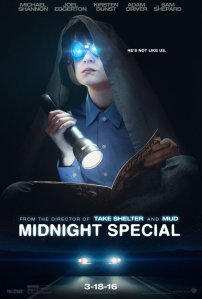 Jeff Nichols should already be a household name after Mud and Take Shelter, and with his new movie Midnight Special, the man has done nothing to break his incredible record of success with making deeply personal, ruminative, thrilling, and brilliant films. Midnight Special is a better and more earnest love letter to the cinema of Spielberg than Super 8 was. A young boy exhibits strange and supernatural powers. The religious compound he came from looks at him as a prophet. The government thinks he might be a weapon. Two different groups are on the hunt for this boy, and that’s where Nichols drops us right into the middle of, respecting the intelligence of his audience to catch up and figure things as they develop. In some ways it reminds me of Mad Max: Fury Road, an expert chase film that establishes its characters naturally as it barrels onward. The acting is wonderful all around and Nichols does a great job of finding small character moments that speak volumes, giving everyone time in the spotlight. The various twists and turns can be surprising, heartwarming, funny, but they stay true to the direction of the story he’s telling and grounded in the simple, unyielding anxiety and love of parents for their child. Michael Shannon (Nichols go-to collaborator) is directly affecting as a humble but determined father risking everything for the well-being of his son. The concluding act left me awed and felt something akin to what I think Brad Bird may have been going for with Tomorrowland. This is a thoughtful science fiction movie that allows its characters space to emote, its plot room to breathe, and yet still thrills and awes on a fraction of a Hollywood budget. It shouldn’t be long before some studio finally taps Nichols to jump to the big leagues of a franchise film, but if he wanted to keep making these small, character-driven indies on his own terms, I’d die happy.
Nate’s Grade: A
Share this:

Mud (2013)
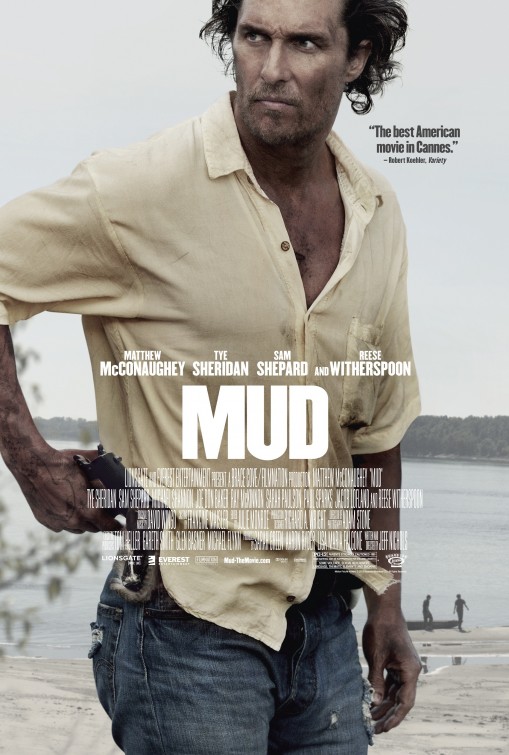 If you aren’t familiar with writer/director Jeff Nichols, do yourself a favor and get acquainted and fast because this guy is headed for indie stardom. Nichols’ last movie, the somber and unbearably tense thriller Take Shelter, was my top film of 2011. Mud, in contrast, is a harder sell, something akin to a modern-day Mark Twain fable about romantic outsiders, fugitives, friendship, and boys coming of age. Matthew McConaughey plays the titular character, a wanted man hiding out on a small island along the Mississippi River. He befriends two teens that help him rebuild a boat so that Mud can escape with his lady (Reese Witherspoon) and evade a team of dangerous bounty hunters seeking vengeance. Nichols is truly gifted at his ability to craft wholly believable characters regardless of circumstance. There is a great sense of setting here, without nary a judgment to the lower class moorings and difficulties, just as Nichols expertly showcased rural Midwestern life and day-to-day anxieties in Take Shelter. His new film is admittedly slow and takes a while to rev up, but the performances are just so good and richly delivered, from top to bottom, that you’re happy to go along with the somewhat loping ride. It’s such a pleasure to witness McConaughey fully engaged with a role, pushing him to utilize new and exciting acting muscles. Nichols also doesn’t soft-pedal the hardships of his characters. While it’s poignant and satisfying how the various plot threads come together for a thrilling conclusion, Mud also has the grace to leave several storylines absent tidy bows. There’s real heartbreak, real disappointment, and recognizable people of all walks trying to do good and find their place in this complicated world. If Mud is playing near you, it should shoot to the top of your must-see list.
Nate’s Grade: A-
Share this:

Take Shelter (2011)
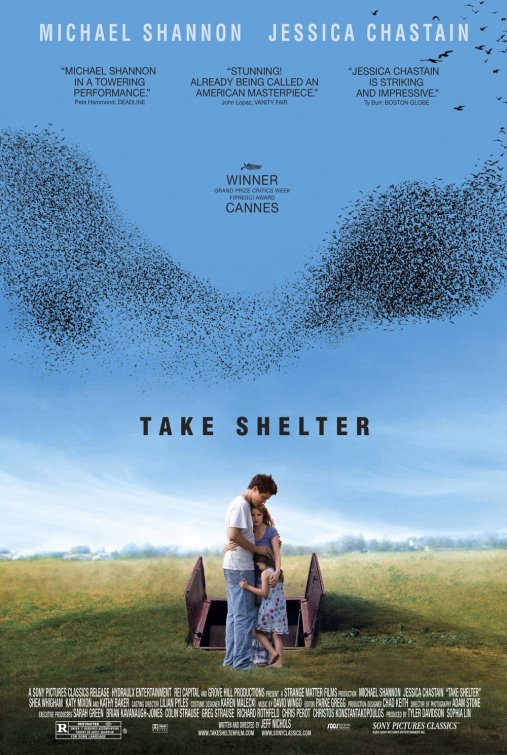 It’s rare that I get to take some local pride and puff my chest about a movie being shot in Ohio. Take Shelter, a small, suspenseful character-piece, was filmed in Loraine County, near Cleveland. Several of the actors in the production are local actors, including Tova Stewart, the adorable seven-year-old who plays the onscreen deaf daughter. The young gal, who is also deaf in real-life, is from Columbus and was in attendance at the theater I saw Take Shelter at. And I can beam with even more local pride at the fact that Take Shelter is unwaveringly magnificent. It’s a remarkably tense movie, deeply realized, expertly crafted, and one of the best films of the year.
Curtis (Michael Shannon) is a working-class family man in rural Ohio. He works as a manager of a two-man drill team, scouring the earth for valuable deposits. His wife, Samantha (Jessica Chastain), cares for their recently deaf daughter, Hannah (Stewart), and sews pillows and embroidery on the side. They are making ends meet to save up for Hannah’s cochlear implant surgery. This family tranquility is interrupted when Curtis begins having strange visions. He sees dark, ominous storms that no one else seems to see. He hears loud cracks of thunder during clear skies. He feels the dark rain fall on his person. He wakes from frightful dreams detailing friends and family turning on him. What does it all mean? Curtis feels compelled to remodel the storm shelter in the backyard. He even purchases a cargo container and buries it in the yard, collecting some end-of-the-world provisions. Could Curtis just be crazy? His mother has been in a psychiatric home since she abandoned Curtis as a child. She began having schizophrenic episodes in her mid 30s, and Curtis is now 35. Is he being warned of what lies ahead or is he succumbing to the pull of a hereditary mental illness?
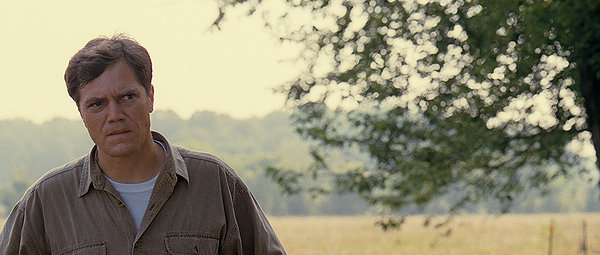 This is very likely the most nerve-racking, tense, dread-filled film I’ve watched since 2009’s Oscar-winner, The Hurt Locker. Writer/director Jeff Nichols (Shotgun Stories) masterfully lays out the particulars of his tale. Even the family drama has some nicely constructed tension. Curtis’ family is living paycheck to paycheck, so his backyard project is a real financial setback. By borrowing equipment from his work, Curtis is even risking losing his job, the only way he can afford his child’s cochlear implant. Not only do we dread stormy weather and strange flocking patterns for birds, we dread the everyday struggles of keeping afloat. Curtis following his visions can very likely put his family into financial ruin, but is that a risk worth taking? Nichols nicely creates an authentic small-town setting. There are small, acute character touches that enrich the story, like when Dewart (Shea Wigham) concludes that the best compliment a man can give is that “he’s lived a good life.” When Curtis and Samantha watch their daughter sleep, they share behavior they are still trying to kick in adjusting to having a deaf child (“I still take my boots off not to wake her,” he confides. “I still whisper,” she returns). These people and their troubles feel believable, and their reactions to Curtis’ strange behavior feel extremely believable. Whispers begin to spread and people start to treat madness like it’s a communicable illness. Religion seems like a natural landing zone when discussing anything apocalyptic and/or prophetic, but Nichols sidesteps this discussion. There could have been some interesting theological room to explore here, considering a Biblical prophet would likely be derided as mentally ill in our modern age. Nichols keeps things secular. Curtis is admonished for missing church again, but that’s about the extent of religion in the man’s life. He does not seek out spiritual advice. He seeks out psychiatry, at least if he could afford it he would.
There are some terrific standard thriller moments, like some well-calculated jump scares and many nightmare fake-outs, but the film’s real skill is drawing out tension to the point where you want to shout at the screen. This is a deliberately paced thriller knotted with unbearable tension. We become conditioned to start doubting the onscreen imagery after Curtis’ series of nightmares. Every time there’s a storm now the audience, too, fears the validity of what we witness. What is the significance of these portent signs? There’s a moment toward the climax, where a storm door needs to be opened, and I simultaneously was dreading every second leading up to that door opening and silently screaming in anticipation. Every part of me wanted to see what was going to happen next and I could not guess where Nichols would take us. I was a nervous wreck. The dread was so heavy, so all consuming, and not just from an apocalyptic standpoint. Curtis understandingly thinks he may be nuts, especially since his own mother is a paranoid schizophrenic. The threat isn’t just the strange apocalyptic signs but also Curtis himself unraveling and lashing out. He worries that he’ll become a danger to his own family, and if he cannot discern the difference between reality and fantasy it’s only a matter of time before he jeopardizes his loved ones. He fears he’ll be ripped away from his family. He wants to be better, he wants to be “normal,” but he can’t trust his own senses.
 Take Shelter is also so effective thanks to Shannon, a talented actor who always seems to be on the brink of freaking out. The bug-eyed, crazed, monotone actor has played plenty of nutcases in the movies. He was nominated for an Oscar in 2009 for Revolutionary Road for playing such a nutter. He’s a live wire of an actor, simmering, waiting for the final cue to explode. Shannon uses this intensity to his great advantage, wonderfully mirroring the movie’s compounding dread. Shannon’s character is troubled, that’s for sure, and worries about slipping into insanity. His performance is simply riveting, searching for answers amidst the desire to keep his family safe at all costs, even if that eventually means his removal. When he has to confront his central dilemma, the legitimacy of his visions, Shannon is racked with fear, eyes glistening with tears, terrified to go on faith, and your eyes are glued to the screen, completely taken in by the depth of the performance. I hope Shannon gets some due recognition come awards season because I doubt I’ll see few performances more compelling.
Chastain has had quite a breakout year for herself with lead roles in Tree of Life, The Help, and The Debt. She has a remarkable vulnerability to her, radiating an ethereal vibe (no doubt why Terrence Mallick chose her), and both aspects are put to fine use in Take Shelter. She’s much more than the oft underwritten put-upon wife, silently enduring her husband’s foibles. She’s desperate for an answer to explain her husband’s actions and motivations. She’s alert, angry, compassionate, and deeply concerned. Chastain holds her own with Shannon, and the two elevate each other’s performance subtlety, making their supportive relationship even more believable.
Take heed movie lovers, and make sure to find Take Shelter, an intelligent, expertly constructed, suspenseful drama with powerful performances and a powerful sense of dread. Shannon’s coiled intensity nicely fits the mounting tension. Nichols has created a taut thriller, a fiercely felt human drama, and an involving character-piece attuned to the talents of its cast. Take Shelter is a commanding, unsettling film that puts the audience in the unreliable position of the main character’s point of view. You may almost hope for some actual apocalypse just to validate the guy’s struggle. When was the last time you secretly hoped for the end of the world just to give one person a sense of relief? Take shelter from inferior movies and find a theater playing this tremendous movie.
Nate’s Grade: A


 nathanzoebl
You must be logged in to post a comment.