Blog Archives
The Darjeeling Limited (2007)
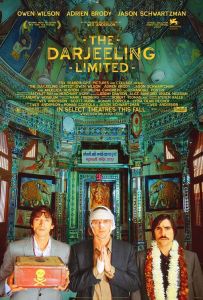 I’m starting to think Wes Anderson may become his own worst enemy. The man seems trapped in his precious, idiosyncratic style that revolves around intricate, dollhouse-style production design, slow-motion and simple pan shots, clever-to-smug characters, family dysfunction that coalesces somewhat by the end, and a soundtrack full of hip, retro songs. I like Wes Anderson; I loved his first three films, was rather lukewarm on 2004’s Life Aquatic, but The Darjeeling Limited is pretty much a bland rehash of the same. Instead of a father reconnecting with his long-forgotten son it’s three brothers reconnecting in the wake of their father’s death and mother’s abandonment. The humor is fairly subdued and while the movie is brief it seems to run out of gas early on and get repetitive. I think Anderson is more interested in showing off his highly elaborate production design than crafting interesting things for his characters to do inside those complex sets. I didn’t feel a blip of emotion for any of the character, all of who have some lasting fear of women ever since their mother ran out to become a nun. There’s kind of an unsettling misogynistic vibe in the movie against women, which is an unfortunate surprise. There’s a spiritual quest that some may relate to but I found it superficial at best, intended to gloss over the plot holes and character miscues. I wish Anderson well, but his next venture behind the camera might work better if he threw out his fraying filmmaker playbook.
Nate’s Grade: C+
Share this:

Marie Antoinette (2006)
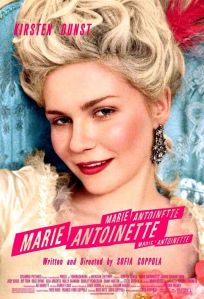 From its opening 80s New Wave soundtrack, you know Sophia Coppola’s Marie Antoinette is a period piece like none other. The famous daughter of Francis Ford Coppola has long been planning a movie around the famous queen that lost her head during the French Revolution. She premiered it at the Cannes film festival where it was booed by the homeland critics. This cast a shadow of doubt over Coppola’s dreamy pop confection of a biopic. Maybe the French don’t like having one of their most iconic historical individuals turned into a bouncing, troubled teenager. Too bad because this is the most interesting and, later, the most frustrating accomplishment Coppola achieves.
Marie (Kirsten Dunst) is a young Austrian girl married away by her family with the hopes of strengthening an alliance between France and Austria. She’s intended to wed Louie August (Jason Schwatzman, Coppola’s cousin), a rather goofy young man more comfortable with hunting than women. Their marriage is arranged by Louis XV (Rip Torn) with the intent on keeping the family line with a male heir. Trouble is, Marie’s husband is more interested in locks than her in a nightie. She’s warned in letters by her family at home, and by a caring ambassador (Steve Coogan), that her only leverage is a child. Without a child her marriage could be annulled. Life at the Versailles palace is a vortex of gossip and attention, and the idea that the queen cannot interest the king is most stressing.
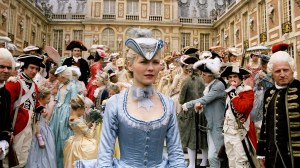
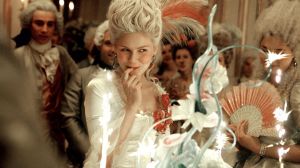 Marie Antoinette is a feast for the eyes, and that’s saying nothing about Dunst. The costumes are gorgeous, the multitudes of food look delectable, and the sets are the real deal, filmed at the actual Versailles palace for that extra oomph. I’d let them eat cake too if I got the stuff she had. Expect Marie Antoinette to at least get several Oscar nominations for its lavish technical merits; it very well might win too. There’s a really neat sequence that informs the audience through a series of family portraits about a death in the family.
Anyone looking for a strict biography on the famous queen will be left scratching their head. Coppola has thrown historical accuracy to the wind and produced a movie less about plot and character and more about an impression. She really nails the insular palace life, from its ridiculous and rigid traditions to the importance placed on blind formality. There’s a very amusing scene where Marie has to be dressed by handlers, and her clothes must keep getting swapped to the current highest-ranking person in the room. Coppola also smoothly handles this extravagant, opulent world from the point of view of her young teenage girl, betrothed by the age of 14. The world of royals and Versailles was one of constant gossip where everyone’s eyes were glued to the new girl. In many ways, Coppola’s world mirrors high school existence, just with far better clothes. When Marie is ignored yet again by her clammy husband, she goes on a wild shopping spree with fabulous shoes and fabrics in bright, sticky colors. She stays up late with a close circle of friends to watch the sun rise over the palace. Coppola firmly reminds us that Marie Antoinette was still a teenage girl and perhaps was still fighting to be one. The movie is good at stripping away the context of history and showing us the awkward lives of two kids selected to be leaders of their country. Better yet, the film is good at exploring what it?s like for teenagers to have the world at their fingertips and have no clue what to do with it. Besides shoe shopping, that is. The film is an excellent mosaic that reiterates the breezy sensation of being young and trapped in the world that never seemed big enough.
But, alas, the trouble with establishing an impression is that we get the idea pretty quickly, and yet the movie keeps going on and on without anything else to interest us. You can watch Marie lay in the field, host a tea party in her garden, marvel at sumptuous food, try on different clothes, play with her puppies, and, hell, the woman even sings an opera in one moment. I don’t know if Coppola intended to establish the tedium of life in Versailles but the audience will definitely start to feel suffocated by it. At least she never steers into a Terrence Mallick danger zone (the man would have sat in a forest with a camera in his lap and called the results a “movie”). That’s the issue with the movie. Like her 2003 Oscar-winner Lost in Translation, Coppola is more interested in mood and silence than character and plot. This approach worked splendidly in the sparely beautiful and moving Translation, but it cannot fully save this film. After a while it just all gets too repetitious and feels slight, like Lizzie McGuire’s Fabulous Versailles Vacation.
The figure of Marie Antoinette is too big to just be dressed up and put in a room. Coppola doesn’t seem to care about the politics or historical anxieties of the time. That’s a shame since France was going through one of the most amazing turnarounds in all of history. There’s no social commentary and the last quarter of the film seems to go off track. When the peasant mob does appear at the very end it feels like a misplaced subplot instead of a world-changing event. Likewise, the affair Marie Antoinette embarks on feels all too shrift and meaningless, like a high school crush of the week (might she doodle his name on her diamond-encrusted notebook?). Marie Antoinette is an interesting, ambitious period drama trying to be a youthful fantasy turned nightmare. It just doesn’t have enough going on to justify a prolonged experience.
Dunst is an actress I’ve been really hot and cold with. Sometimes she dazzles me but more often she bores me. As the title monarch, Dunst totally comes across like a vibrant teen girl still feeling out the world. She seems impetuous, sensual, and naive, all hallmarks of a growing girl that just so happens to be the queen of France. She does a lot of communication with her face. Sometimes she comes across like a silly, vapid little girl playing dress-up, but then that seems within the scope of Coppola’s aim.
 Schwartzman’s portrayal makes the king look like an aloof adolescent, but he make me laugh very easily at his pained awkwardness. Judy Davis is a hoot as the palace’s liaison of policy and manners, tsk-tsk-ing whenever etiquette is broken. The rest of the cast mostly have moments but it’s surprising to me that I’d see Marianne Faithfull, Rip Torn, Molly Shannon (!), and Asia Argento in a period piece movie. Like I said, Marie Antoinette is a costume drama like none other.
Much was made about the anachronistic soundtrack of 1980s tunes set amongst the pomp and circumstance of 18th century France. I like it because it works in engineering the breezy, bubbly youthful impression Coppola wants. It shouldn’t be that big of a deal because the music is not incorporated into the story unlike 2001’s tandem Moulin Rouge and A Knight’s Tale. It provides some of the more fun moments in the movie, though at times the lyrics become all too transparent; “I Want Candy” during a spending spree, “Fools Rush In” when Marie goes to her affair, The Strokes screaming “I want to be forgotten,” as Marie runs off.
Coppola’s luscious period piece feels more like a dreamscape in a daze. Her focus relies less on linear storytelling and character than on creating an impression of youthful decadence and emptiness. Marie Antoinette manages to simultaneously be fluffy and vague. After a while it all just gets repetitious and a bit dull watching scene after scene of Marie being indulged and bored. Perhaps some of that boredom will translate over to the audience. Coppola reminds us that Marie Antoinette was still a teenage girl beneath her powdered wig and bustle, but after two hours you might wish Coppola had more on her agenda.
Nate’s Grade: C+
Share this:

S1mone (2002)
 Director Viktor Taransky (Al Pacino) needs a hit like a crack addict (my apologies to Chris Rock). His new movie is in the can but his temperamental star (Wynona Ryder in a juicy cameo) pulls out and demands all footage of her be left on the cutting room floor. The studio is close to dropping Taransky’s film deal, and the studio head just happens to be Taransky’s ex-wife (Catherine Keener).
Under this intense pressure Taransky retreats to mourn his failed potential, until an eccentric one-eyed computer engineer gives him the key to his solution. It seems that instead of interacting with actors and their egos and trailer demands, Taransky has found a new movie star — one completely made up of ones and zeroes named Simone. Taransky edits Simone into his film and soon after the nation is in love with the digital blonde. Simone mania sweeps the nation and soon her smiling image graces all sorts of memorabilia. The public can’t get enough of the mysterious Simone who never goes to public functions and only seems to speak or appear for Taransky.
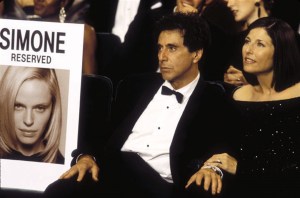 Writer/director Andrew Niccol (Gattaca) has some fun with the premise but tries to have his cake and eat it too when it comes to his satire. S1mone starts out satirizing egotistical stars, then the Hollywood system, then the press, then the public as star worshipers. The movie is all over the map trying to have something witty to say about all these different topics but is too busy to settle down on any one for a while. The satire S1mone embodies feels deflated from all the work it’s trying to do.
Pacino has always been able to do comedy but seems wearier than ever. He indulges in his comic like over-the-top aggression he’s been doing since Dick Tracy. Keener plays another of her icy businesswomen roles although she thaws quite easily and quickly in the film.
There’s a rather funny subplot involving Pruitt Taylor Vince and Jason Schwartzman as tabloid reporters on the prowl of the elusive Simone that deserves much more attention than it gets. The bulk of the movie could have been these two entertaining characters.
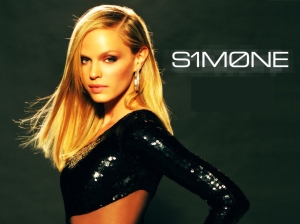 When Taransky finds that his creation has become more than he can handle he tries to discredit her through a series of very funny public appearances and avante garde film choices. But then S1mone sadly goes back to its more mediocre roots. Taransky tries to get rid of Simone but it all horribly backfires.
As the film progresses you start to realize all the gaping holes that come up – like how can Taransky, a self-described computer illiterate, handle the most technical computer program of all time? How come no one would find out that Simone lacks a birth certificate, social security number or even tax records for her studio work? And why does the audience have to sit through the disgustingly cute daughter of Taransky and Keener, who just happens to be a computer whiz-kid, besides the fact she’ll have a late fourth quarter save of dad?
It’s not that S1mone is necessarily a bad film; it just has this missing piece to it when you watch it. Some scenes are funny, many drag, and the whole thing needed to be tighter and punchier. And to clear up any confusion, it is indeed an ACTRESS who plays Simone. Her name is Rachel Roberts.
Nate’s Grade: C+


 nathanzoebl
You must be logged in to post a comment.