Blog Archives
Wanted (2008)
 Wanted isn’t so much a movie as a fetish vehicle for teen males, with sexy cars, sexy guns, and sexy tatted-up Angelina Jolie, daring the predominantly male audience to decide which is sexiest (I am not a car aficionado nor a gun person, so I’ll say that Jolie easily outpaced her competition).
Wesley (James McAvoy) is a pathetic office drone that sweats out his days never raising his voice. His best friend is constantly screwing Wesley’s bitchy girlfriend, his boss constantly harangues him into panic attacks, and, saddest of all, a Google search results in nothing for Wesley Gibson’s name. He tells us he has done nothing with his life. This all changes when a mysterious woman named Fox (Jolie) tells Wesley that the father he never knew has just died. Not only that, Wesley’s father was one of the world’s greatest assassins and he might just be a chip off the old block. Wesley is recruited into The Fraternity, a thousand year-old organization whose membership includes the best-trained killers. Sloan (Morgan Freeman) is the leader who assigns the targets. He gets his orders, literally, from the Loom of Fate, a weaving loom that writes binary letters via stitches. The Loom of Fate decides whom the planet would be better off without. Fox and her cohorts train Wesley to accept his destiny and avenge his father’s murder.
 The movie fails to establish any form of internal logic or continuity, so anything preposterous suddenly becomes accessible. That means people can jump from one skyscraper to another, you can outrun a moving train, cars will do the damndest things, and that you can curve a bullet simply by rotating your hand and shutting off that little part of your brain that says, “This is defying all laws of physics.” For some reason, people are able to shoot bullets down in mid-air as a defensive maneuver but they rarely take aim at the person, surely a bigger and slower target. It’s like The Matrix outside of the Matrix with no reason for being Matrix-y. The idea is that these super assassins have super hearts that beat like 400 times faster, which pumps more blood and allows their senses to heighten. This somehow allows them to slow down time, zoom in on subjects, and react extra fast. It doesn’t make any sense but then again this is a movie where the killers are taking orders from the Loom of Fate. While I’m on the topic, really, a loom that stitches targets in binary code? Isn’t there an easier way for fate to decree who should be bumped off than someone scrutinizing the stitch work of a rug? What happens when it lists a name with more than one owner? How many “John Smiths” must be killed to secure that the correct Mr. Smith has been erased? My father thought the Loom of Fate was the most bizarre and interesting aspect of the movie.
Despite the freewheeling action, there is something decidedly depraved about fully embracing Wanted. The premise of awesome killers demands awesome carnage, and Wanted dishes out violence as an act to be savored and glorified. Wesley’s self-actualization is linked with getting better at making others suffer, and in the end the film advances a questionable message to follow suit. The movie exists in a hyper-realistic video game universe devoid of consequences. I can see future news reports of idiot teenagers playing their own deadly game of curving bullets (they may have to establish a Wanted category for the Darwin Awards). But yet the most disconcerting feature of Wanted is its dismissive nature toward human life. I’m not even talking about the assassin premise, though trained killer flicks usually work better when the pros have some sort of personal code. Wanted is a fetishistic worship of human bodies being taken apart in loving, gory detail under the auspices of being “cool.” Innocent life barely merits a half-hearted shrug. When Wesley and Fox bring their fight on board a train the eventually force the vehicle off a cliff, and the movie makes no mention of all those innocent people plummeting to their doom. That would get in the way of the film being “cool.”
With all that said, Wanted can feel like a high-octane rush to the senses. This film is soaked in adrenaline. The stunt work is astounding and the action is ramped-up to ridiculous levels. I say ridiculous because the film never establishes any form of internal logic or continuity, but I also say ridiculous because the action can be tremendously exciting and embellished with stylistic flourishes. Wanted is a slick and imaginative action movie, and the fact that it often dances with satisfaction makes me sick for enjoying it so. Summer is the perfect opportunity for empty calorie movies with style to spare, and Wanted is a five-course meal of glossy, disposable artifice. Director Timur Bekmambetov previously directed the Russian vampire films Night Watch and Day Watch, but Wanted is a giant leap forward in budget and sheer scope. Life inside this man’s head must be crazy. He takes the outlandish and makes it seem common.
 The story is rather derivative and smashes the plots of Fight Club and The Matrix together, proving that not only were screenwriters Michael Brandt and Derek Haas alive in 1999 but they were also furiously taking notes. The whole notion has been done to death, a loser who secretly harbors superior talent and ability waiting to be realized. It still proves to be a popular and mostly pleasing storyline because it taps into a universal desire to be special. Brandt and Haas aren’t so much constructing a story as they are constructing a series of eye-popping moments. There is very little substance beneath all the fireworks (stand up for yourself and slay your antagonists?). Normally I’d take issue with a film’s trashy vapidity; however, when that film happens to be so good at being so good looking.
McAvoy is rather believable when he plays the dweeb eking out a miserable existence. He knows how to play meek and anxiety-riddled while maintaining a vulnerability that stops his character from coming across as a figure of annoying inaction. He sure gets beaten up a lot and I’m not quite sure why this is supposed to make him more inclined to join The Fraternity, but then again it hasn’t stopped thousands of college males from wanting to join their own fraternities. McAvoy is less believable when he suddenly transforms into a super soldier, like a pint-sized Rambo. Jolie relies on her exceptional sex appeal in lieu of acting, which is fine with me. It’s good to see her in a role where she can fully make use of her physical talents. Freeman is essentially in the Samuel L. Jackson role and even gets a chance to drop an MF-bomb.
Wanted is a crazy cool and mostly crazy action thriller that is more than a little sick in the head. Its video game universe covets beautiful bloodshed and exquisite carnage. It’s rather depraved and morally questionable not in approach but in execution (no pun intended, well maybe). Wanted is a gory, profane, darkly humorous action movie that secretes adrenaline with every frame. The imagination on display is impressive but you may wish that it had been used for better purposes.
Nate’s Grade: B
Share this:

Atonement (2007)
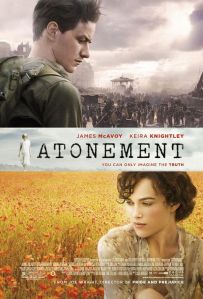 No film this awards season seems to have been kicked and beaten more than the sweeping period romance, Atonement. This poor movie has a strong stable of well-respected British thespians, a red-hot young director in Joe Wright (2005’s Pride and Prejudice), plenty of lofty, top-notch production values, and the whole enterprise is based off a highly acclaimed novel by author Ian McEwan. Where did all the hate come from? I think it has something to do with the fact that somewhere along the line Atonement became, on paper, the presumptive favorite to win Best Picture. Then reality hit and it hit hard. Atonement wasn’t even nominated by the Writer’s Guild, the Producer’s Guild, or the Director’s Guild and yet the film still managed to eek out a Best Picture nomination for 2007. I became suspicious that Atonement would turn out to be this year’s Dreamgirls, namely a presumptive front-runner that was too calculating and self-conscious and ultimately free of substance to make its mark. While Atonement is perfunctory and nothing altogether special, the film still succeeds as a worthy piece of entertainment that doesn’t deserve to be dragged through the mud.
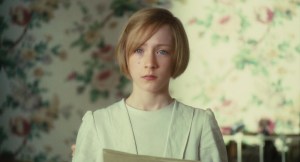
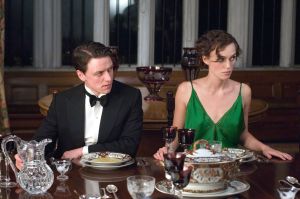 In the mid 1930s, Robbie (James McAvoy) works as a housekeeper’s son on a lovely English estate. He has his eye on Celia (Keira Knightley) and puts his burning passion to paper, typing two very different notes. The first one is blunt (and features a naughty word that rhymes with “blunt”) and the second one is more of a poetic declaration of his affections. Robbie has instructed Celia’s younger sister, Briony (Saoirse Ronan), to pass his love letter to the rightful party. He realizes too late that he sent her off with the wrong letter and Briony reads it herself, dumbfounded at the message and terminology. Briony is a bright child that fancies herself a playwright, but she’s still a child that cannot fully grasp the meaning of Robbie’s advancements. When she intrudes on Robbie and Celia having spontaneous sex against a library wall, she can only assume that Robbie is attacking her older sister (stupidly, neither says anything to clear up the awkwardness and just leaves the scene wordless). That same night Briony discovers her cousin being attacked and she’s certain that Robbie is the culprit, or is she? Her false confession sends Robbie to jail and alters lives forever.
Flash ahead to World War II, and Robbie has joined the Army to be released from jail, Celia reunites with him for the first time in years, and a now 18-year-old Briony (Romola Garai) realizes her foolishness as a child and tries expunging her overwhelming feelings of guilt by working as a nurse and tending to the ghastly numbers of wounded soldiers.
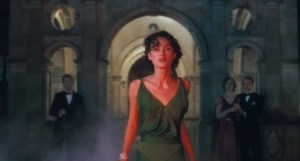
Atonement is visually ravishing to watch. The cinematography by Seamus McGarvey is lushly colorful and blends light and shadow to an extraordinarily effective degree, draping the performers in contrasting colors that pop. Wright’s camera always seems to be perfectly located to discover beautiful compositions indoors and out; the movie is just visually pleasing on all fronts, like seeing Knightley in her dark green dress bathed in the glow of police lights at night. At several points, however, the film’s look does get overly soft and glossy, like the cameraman smeared gobs of Vaseline over the lens. The period costumes and production design are agreeably period-y. The musical score has moments of great lyrical poignancy and then it shatters when the score resorts to integrating the sound of a clacking typewriter as a percussive instrument. I wanted to beat my head against a typewriter to make it stop.
 There’s a vague mechanical air over the entire two hours, like the filmmakers felt that merely assembling all the right pieces and having the right, awards-friendly pedigree would be enough. The five-minute uninterrupted tracking shot along the Dunkirk beach epitomizes this flawed belief. This superfluous shot wanders around soldiers stationed on a beach, winds around the outskirts of the bombed out city, and finally rests in a pub crawling with Brits, but nothing is added by the shot continuing uninterrupted and the staging fails to illuminate anything remarkable about the expensive set. The shot exists simply to call attention to its self and to serve as another bragging point for the filmmakers. The Dunkirk shot adds little to the atmosphere of the film because the scene barely flirts with giving a bigger picture of what is happening. Instead, that shot, like the movie, while well composed and entertaining, is an exercise in self-congratulation.
The film loses serious momentum as it transitions into war and its period of titular atoning. The movie just isn’t as compelling watching Robbie shuffle around at war. Rarely is he in any danger and he just seems to be biding time. Atonement is a tad too prim, a tad too demure to really go deep enough. The romance is intended to be of the unrequited variety but it feels malnourished even at an unrequited level, which is truly saying something. There is so much more beneath the surface but the film never wants to push too far for whatever reason. Knightley and McAvoy have a nice workable chemistry and that’s part of what makes the first half of Atonement the better half. So much of the story involves internal struggle but the movie doesn’t wish to invest the time needed to explore serious psychological wounds. Atonement never capitalizes on the intriguing if melodramatic opening of the film. This is by no means a love story, no matter what the marketers wish to convince otherwise. The romance between Celia and Robbie has little setup to seem believable or worthwhile. This is a movie about the power of words, which naturally is a topic that functions better in books.
After Kinsey and now Atonement, Vanessa Redgrave seems to have found a contemporary niche or her talents: she shows up in the final minutes to give a monologue that demands that the audience reflect from a fresh perspective. Redgrave plays an older adult Briony who has written several best selling books and is being interviewed for television. The ending is designed to be more devastating in print form, and it wants to call into question the nature of fiction and whether or not one lie and be absolved by another. But in the medium of film, the shockwaves are minimal because the language of film is visual. The stutter-step plot structure, which occasionally bends backwards to replay an event from an alternative perspective, is an extraneous annoyance that’s finally justified by Redgrave’s late appearance. What is the true cost for a “happy” ending?
 While Knightley and McAvoy get all the attention and cause teen girls to swoon uncontrollably, the real star of Atonement is 13-year-old Ronan. The young actress is a revelation as a sophisticated girl entering the earliest stages of womanhood. She’s nursing some serious puppy love on Robbie and his disinterest fuels her false confession; she means to punish him. Ronan is eloquently precocious at the start, acting wise beyond her years, but when she steels a glimpse at Robbie’s unfortunate letter, she drops her older pretensions and presents the spirited and unrestrained eagerness of a girl that’s madly curious and madly in love. Ronan effortlessly switches between the two sides of Briony, playing the astute, proper young lady or the nervy, confused girl trying to make sense of her budding sexuality. Kudos to the casting director as well for casting an older actress to play the 18-year-old Briony that genuinely looks like a grown-up Ronan.
Naysayers dismissing Atonement as outdated rubbish are diluted; it’s a well-crafted movie from considerably all angles. Then again, those that champion the film as a testament to bravura filmmaking are also diluted; the film is good, yes, but entirely unexceptional. Atonement is a fine film that takes a reportedly unfilmable novel and gives it a good attempt.
Nate’s Grade: B
Share this:

The Chronicles of Narnia: The Lion, the Witch, and the Wardrobe (2005)
 I have never read one single word from C.S. Lewis’ classic children?s tales, The Chronicles of Narnia. I have never read one word from J.R.R. Tolkien’s Lord of the Rings tomes either. I read five pages in Dune and returned it to the library (50-page glossary of vernacular my ass!). I have also never read one word of any Harry Potter book, and I’m quite all right with that. I have several friends that were consumed by Lewis’ series in their childhoods and now are consumed by J.K. Rowling’s series. I don’t confess to be geek-free; I read the Shanara series by Terry Brooks when I was in junior high. I collected comic books, I watched cartoons, I still do both to an extent, but I suppose I left the fantasy genre with my appreciation for flannel all the way back in junior high (I also discovered women). Whenever I enter a fantasy film I bring with me no baggage. And so I strolled into The Chronicles of Narnia: The Lion, the Witch, and the Wardrobe ready to be entertained by a good story, whether Lewis, a big Christian theologian and author, was advancing some kind of Christian allegory or not. After seeing all 125 minutes, it’s safe to say I’ll be in line for any potential sequels.
In the heat of WWII, the Pevensie children are being transported out of London to live with a kindly professor (Jim Broadbent) on a safe rural farm. Peter (William Moseley) is the oldest and assumes the leader position vacated by their departed father. Susan (Anna Popplewell) is the brainiest, Edmund (Skandar Keynes) is the moodiest, and little Lucy (Georgie Henley) is the precocious true believer.
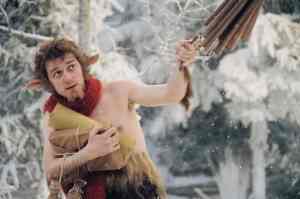
 One day during a game of hide and seek Lucy hides in an upstairs wardrobe. To her delight and amazement, she is transported to a magical, snow-covered realm known as Narnia. She encounters a faun, half man-half hoofed animal, named Mr. Tumnus (James McAvoy). He’s shocked to see a live human girl before his eyes and invites her for tea. There’s an old prophecy that says when two Sons of Adam and two Daughters of Eve arrive then the 100-year winter will end. The evil White Witch (Tilda Swinton), the one ruling Narnia with an icy fist, wants the humans captured and dead so she can rule forever. Lucy tells her siblings about her amazing adventures but they don?t believer her, that is, until they all tumble forth into the land of Narnia. The older kids mostly want to return home, but Edmund has sold them out by aligning with the White Witch. Now they’re on the run from her pack of wolves and the Pevensie children must seek out the powerful Aslan (voiced by Liam Neeson), a heroic lion who is all that stands in the way of the White Witch.
I declare my undying love for Tilda Swinton, truly the best character actress we have working today. Swinton already gave one bizarre yet outstanding performance this year as the androgynous angel Gabriel in Constantine (Swinton does androgyny better than anyone else; hell, she was convincing as a man and a woman in Orlando). In Narnia, Swinton exhumes a chilly command that could make you stand at attention. She’s such a hostile, icy, stone-faced villain, and Swinton has such calm confidence the whole time. She preens like a rock star and has the oversized ego to boot. She’s the kind of bad girl you could really fall in love with, especially if you have monstrous maternal issues.
The rest of the actors are mostly good. Henley steals every scene she’s in, and I’m not talking about the added attention of her suitable British choppers (my apologies to U.K. readership). Neeson seems a little bored with yet another wise teacher role just this year. I would be more interested in hearing the original voice of Aslan, the stupendous Brian Cox (Troy). McAvoy has a gentle sweetness to him.
Director Andrew Adamson integrates the flashy computer effects with surgical-like precision. Adamson?s experience as co-director for the Shrek films has given him the know-how to coordinate massive effects sight unseen and still coherently direct his live-action actors (ahem, George Lucas, ahem). The special effects in Narnia are outstanding. The characters move and behave with staggering authenticity (I know most of these creatures are mythical and have no comparison). The vistas and landscapes are beautiful, particularly the winter wonderland of Narnia. Adamson has a keen eye for visuals and lavishly recreates his visions; the climactic battle is bloodless but no less exciting.
 Most of the story flaws come from the source material. Narnia lacks the epic scope of the Lord of the Rings movies as well as the seriousness. As a result, no one feels very much in danger even during the more harrowing moments of battle. Lucy’s gift of “resurrection juice” kind of let’s the air out of the tension balloon. What suspense is there if a character has a magical healing elixir they can just whip out? The two girls are removed from the final battle and have little impact on its outcome. The White Witch’s tactic of freezing her enemies instead of killing them seems to be foolish, especially when they can be thawed at inopportune times. A major character’s sacrifice seems a tad superfluous if he can just reappear, lickity split like he had an extra life. Lots of secondary characters get the shrift when it comes to characterization, so you feel less than you should when something happens to them; this is even further hampered by Lucy’s Jesus Juice.
There’s a real genial sense of magic to Narnia. When little Lucy first transports to this magic realm, her face lights up in that adorable cherubic way, she wafts through the falling snow, catching it with her hands. Her moments with Mr. Tumnus are note-perfect from the dialogue, to the vocal inflections, to where the scene leads. Their relationship is very tender and provides some of the film’s best moments. Looking back, I can pick apart the movie, but while I was sitting in my theater I was deeply surprised how affected I was. I felt their fear, I felt their sorrow, and most of all I felt some sense of magic. The logic part of my brain was telling me how silly it was to see Santa Claus, let alone witness jolly ole Saint Nick handing out weapons for all the little good girls and boys (“Ho ho ho, kill ’em good for Santa.”). Yet while I watched I never questioned these things. The power of Narnia had taken full hold of me and I was swallowed whole by its tale.
Narnia is a good entry point for children in the world of fantasy. It’s suspenseful without being scary, and familiar without being too simplistic. Unlike Tolkien’s complicated worlds and heavy tales, Narnia is more a children’s story, what with the inclusion of unicorns, centaurs, fauns, and a menagerie of talking animals. There’s the suitable kid fantasy, like becoming king and fighting monsters, but there’s also a focus on family reconciliation and being accountable for your own actions. This isn’t a story that will overwhelm its audience but will leave them hungry for more adventures. The characters are mostly sketches (the leader who doesn’t want to be a leader, the overly logical one, the disaffected youth constrained by too much discipline, the little believer in the unknown), so it’s a testament to the filmmakers that the story and the characters have as much resonance as they do. The Lion, the Witch, and the Wardrobe sets up the parameters of the Narnia universe and its inhabitants and now future sequels can add meat to this bare skeleton. Narnia is a fantasy film the whole family can enjoy.
 The Christian allegories and metaphors mostly fly under the radar, with the exception of one extremely obvious scene that might make Mel Gibson wince. I even think Narnia is better enjoyed as a straight-up story than as an elaborate series of codes and messages harkening toward Christianity. If you view Narnia with the intent to break down its meaning and supplant connection to the Bible, then you’re really missing out on some great storytelling. And Narnia isn’t outwardly religious; it’s mostly a film preaching good values rather than simply good Christian values. Most of the lessons and values taught within Narnia are universally applicable to all people.
The Chronicles of Narnia: The Lion, the Witch, and the Wardrobe is a superbly entertaining retelling of C.S. Lewis’ classic children’s series. Adamson connects all the expected fantasy dots while seamlessly incorporating awe-inspiring special effects. The bountiful imagination up onscreen is the film’s biggest charm, rendering a divine touch of magic to the finished proceedings. Despite any better judgment pointing out the simplicity of the tale and characters, the production is first class and compelling. I was completely surprised how affecting I found the film and how immersed I became. This is great storytelling aided by gifted storytellers. Narnia is bigger than a family film, more accessible than a “Christian movie,” and more entertaining and endearing than most films released this year by Hollywood.
Nate’s Grade: B


 nathanzoebl
You must be logged in to post a comment.