Blog Archives
Zodiac (2007)
 Zodiac is something altogether different from a genre best known for cannibalism, skin suits, and express shipping of human heads. It has more in common with All the President’s Men than director David Fincher’s 1995 masterpiece, Seven. This is a serial killer thriller steeped in police procedural, closed door deliberations, and the slow drip of a decades long investigation into the Zodiac killings that terrorized California from the 1960s and 70s. Watching close to 3 hours of procedure with nary a car chase or a shoot-out may not sit right for fans of the genre, but I enjoyed the film for the same reasons people will decry it — the details. I loved how methodical this film is, how dogged and stubborn it is, and I found myself being enveloped into the minutia of the case.
It all began with a young couple looking for a bit of privacy in 1968. They park at a lover’s lane and nervously engage in a bit of the old “neckin.” A passing car interrupts them, and then that car returns with its headlights blasting into the couple’s faces. This man then takes out a gun and starts firing, killing the woman and badly injuring the young man. Robert Graysmith (Jake Gyllenhaal) is a political cartoonist for the San Francisco Chronicle when a curious letter has stirred up a lot of discussion. It’s a cryptic message with a puzzle attached made up of symbols and codes. The author demands his puzzle run in the newspaper, and if not, more will suffer at his hands. There are further attacks along the California coast and the mysterious figure finally gives himself a name at the end of one of his letters: Zodiac.
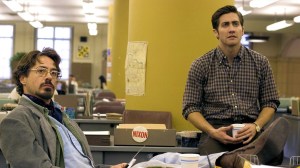 San Francisco detectives David Toschi (a great, raspy Mark Ruffalo) and William Armstrong (Anthony Edwards) are called in after Zodiac executes a cab driver in the city. The Chronicle‘s star crime reporter, Paul Avery (Robert Downey Jr.), pesters the police for details and eventually gets under Zodiac?s skin. Graysmith becomes obsessed with the case through a life-long love of puzzles and the case eventually consumes him, dooming his marriage to a pretty girl (Chloe Sevigny). Thanks to the tutelage of Avery, Graymsith becomes an amateur detective of his own, and his zeal to solve the case outlasts the actual police.
The Zodiac killer was really the first mass media serial killer. As the news of brutal attacks spreads, the media ate it all up and enlarged the figure of Zodiac to grand heights. And he was eager to help inflate his image, taking credit for crimes and slayings that were not his doing. The killer used the media age to terrorize the populace and increase his notoriety, similar tactics used by today’s stream of terrorists. The detectives didn’t just have to navigate all the shifting evidence but the formation of an urban legend.
This is before the day of DNA and super computers, so all progress comes from good old-fashioned police work. Long hours are spent pouring over mounting evidence while coordinating around bureaucracy; because Zodiac has struck in several different small communities it can take a saint’s patience to figure out the correct jurisdiction and compile the various parts in various offices. The film packs a lot in its running time introducing scores of information, suspects, witnesses, and varying theories, but the film cannot be faulted for pace; nearly every scene takes place weeks, months, even years after the last.
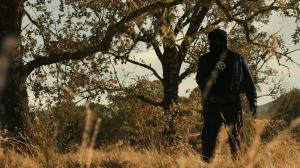 Zodiac is Fincher’s most restrained work even at a gargantuan running length. Fincher is a master tactician with slick visuals but has a penchant for getting too dazzled by needless visual flourishes (did the camera really need to zoom through the handle of a coffee pot in Panic Room?). He tones down the excess but still maintains a refined visual palate that makes the film feel fluid. The period detail is incredibly reconstructed, giving an authentic feel for a very serious story. But Fincher knows that with Zodiac the impetus lies with the story, and he devotes his considerable style to the service of the story. The mood balances nicely with intrigue, humor (after Zodiac singles out Avery fellow journalists start wearing “I’m Not Avery” buttons), and some truly terrifying moments involving the Zodiac attacks. The violence is sparse but when it does occur it is shocking, particularly watching a knife plunge repeatedly into the writhing body of a woman at a lake. One key element of sustaining such an ominous mood is fabulous song selection. Very often pop songs can be counter-productive to a movie, coming across as a lazy attempt to cobble together a soundtrack to shill. With Zodiac, “Hurdy Gurdy Man” becomes a powerfully haunting medley for the killer and the sonic linchpin for the film.
Fincher does an excellent job of transporting us back in time and recreating the sense of paranoia that grappled many. There is a great scene late in the film where Graysmith comes to the sudden realization that he may have walked right into the spider’s parlor. The scene plays out to an agonizingly uncomfortable length, and you too feel like running out the door as fast as your legs can take you. By not knowing definitively who the Zodiac may be, the film gets a boost of suspense from a multitude of creepy suspects. In an interesting decision, Fincher uses different actors of different shape during the Zodiac attacks, playing against the varying reports from witnesses and survivors.
There?s a sizeable danger trying to find a climax to a case that remains open to this day and where no one has been officially charged. Zodiac does as good a job as possible to present a fitting, mostly satisfying conclusion. The movie presents the best theory and points a convincing finger at who Zodiac perhaps really was.
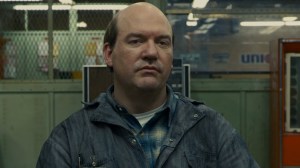 Zodiac is expertly crafted but has a handful of minor flaws that hold it back. The overall script is rather nimble with how it dishes new information to digest, however the intricacies can amass and become too great, and some scenes congest too much without needed forward momentum which causes the flow to get caught up in an expository pile-up. Still, the film is demanding but not overwhelming and not without reward. The film follows the ups and downs of the Zodiac investigation, and that means characterization runs short and simple. I fear the only false note amongst a vastly talented cast is Gyllenhaal, an actor I adore. He works fine in the portrayal of a young kid in the newsroom trying his hand at crime solving, but it’s the film’s second half where the actor falters. He fails to sell the obsession and desperation that dominates his life, instead looking wiped out but no worse for wear, like the temporary results of an all-nighter before a big test.
It was five years since Fincher’s last film, and he wasn’t sitting on his laurels when he crafted Zodiac, an exceptionally intelligent and demanding movie. Decades pass, suspects weave in and out, evidence and testimony contradict one another, it’s all a lot to keep track of but I found myself absorbed in the case just like Graysmith. This is a serial killer movie that could bring the smarts back and redefine the genre, that is, if fans are willing to sit through 3 hours of police work. If not, well they might get their kicks out of the more genre loyal The Zodiac, released in 2006. And that movie’s only 97 minutes long.
Nate’s Grade: A-
Share this:

Brokeback Mountain (2005)
 Go ahead and work the snickers out of your system. Brokeback Mountain has been dubbed “that gay cowboy movie,” and been condemned by certain fundamentalist Christian organizations as “a very dangerous and insidious message to America.” But what message is Ang Lee’s film even putting out there? It seems to me that Brokeback Mountain is putting a human face on a slur, making homosexuals look like you or me. For some that prospect may be terrifying. The movie is playing well on the blue-state coasts, expectedly, but it’s also surprisingly playing well in America’s heartland. It seems that people are lining up all over to see a movie about two gay cowboys in love. And perhaps the more people that witness Brokeback Mountain, the harder it will be to listen to those so-called family advocacy groups with their sterling Christian morals. Maybe people will really see what’s behind many of the words of outcry – hate and ignorance (I am in no way insinuating that disliking the flick means you are homophobic). Despite all this political talk, Brokeback Mountain is by no means a political movie. It’s a love story, above all, and it’s a doozy.
In the summer of 1963, Ennis Del Mar (Heath Ledger) is a quiet man looking for work in rustic Wyoming. He finds a job as a sheep herder working atop the canyons and mountains of Brokeback. Working alongside Ennis is Jack Twist (Jake Gyllenhaal), a charismatic rodeo rider. The weeks are long and Ennis and Jack are all the company they have, excluding the hundreds of sheep they tend. Eventually, the more taciturn Ennis finally opens up and bonds with his herding partner. “That’s more words than you’ve spoken in two weeks,” Jack says. “Hell,” Ennis adds, “That’s the most I’ve spoken in a year.” The rules have been laid out: every night one man sleeps in a tent campsite, the other sleeps next to the sheep to guard them. Well one night Ennis has had too much whisky and cannot make it back to the sheep. Jack invites him to sleep in the tent instead of freezing outside. Then something surprising takes place – both men have an alcohol-fueled bout of rough sex. The next morning both men stress they “ain’t queer,” but they have a hard time fighting their feelings inside. Ennis warns that, “If this thing, it grabs hold of us again… at the wrong place… at the wrong time… and we’re dead.” He recounts a childhood memory where his father showed him the corpse of an older homosexual man, brutally beaten and mutilated. For them, their love must stay on Brokeback Mountain.
 The men part ways. Ennis marries Alma (Michelle Williams), a quiet woman after his own heart, and fathers two daughters. In Texas, Jack meets fellow rodeo rider Lureen (Anne Hathaway) and gets involved in a relationship with her, fathering a son of his own. But Jack still thinks of his Brokeback pal and sends him a postcard. Ennis nearly lights up at the returned sight of Jack and the two passionately embrace. He tells Alma that Jack is an old “fishing buddy” and they sneak away every few months for a fishing getaway. Really the men are returning to the countryside to rekindle the love that they haven’t left behind. But can they keep their love a secret, and should they even have to?
I wonder if Lee would ever have directed this if 2003’s Hulk didn’t bomb so badly. Lucky for us, he’s taken the Brokeback helm and infuses lots of emotion into the story. The Wyoming countryside (actually Canada, but it’s all close enough) is gorgeous, and the film has a great earthy feel. Best of all, Lee allows his love story to breathe and go at its own pace, never cutting corners or rushing an emotion. There’s a lovely, lilting feel to the film, and Lee’s guided hand allows the story to play out to its grand promise. Based on Pulitzer Prize winner Anne Proulx’s 11-page short story, screenwriters Diana Ossana and Larry McMurtry (Lonesome Dove, The Last Picture Show) have given incredible depth and subtext to the tale. McMurtry, in particular, has great knowledge of the West and the cowboy lifestyle, and the screenplay gives you an idea of small-town Western life. There are a few moments at bars, social scenes, stores, but they brilliantly give you every detail you’d need to know about this way of life. I even loved how the people of Wyoming wore fashions that were five years removed from their height of popularity, which is exactly how fashion moves around to the smaller parts of America. Ossana and McMurtry are also commended for presenting their characters as people first and never as agenda bulletins. All three lend a level of authenticity that makes the story feel organic and never trite.
In films about forbidden desire and heartbreak, the acting is the cornerstone for how powerful the tale resonates. The acting in Brokeback Mountain is phenomenal. Ledger is the breakout star and the majority of the film’s focus. He gives the performance of his life. Ledger is outstanding as the reserved, taciturn Ennis, brought to believe that queers were something sub-human and now he wrestles with his own identity. He may be a restrained man of few words but you see every emotion bubble under the surface, every conflict played out in his eyes. Ledger’s few violent or emotional outbursts are startling because they show an uncontrollable feeling, one even he can’t withhold 24/7.
Gyllenhaal has the showier role but masterfully displays the frustration of forbidden love. He’s willing to sacrifice everything for Ennis, and the fact that Ennis won’t do likewise tears him apart. Isn’t love enough, he wonders. There’s a moment in the film that so sharply displays Jack and Gyllenhaal as an actor. It involves two different shots in a moving truck. The first is Jack headed to Ennis’ ranch, singing, bouncing, and with a wall-to-wall smile. The second is Jack driving away from the ranch unfulfilled, sullen, broken, and seemingly unable to cry another tear. It’s two small moments and they sum up Jack and Gyllenhaal perfectly. The only thing unsettling about Gyllenhaal’s performance is his late 70s porn star ‘stach. With his tremendous work in Jarhead and now Brokeback Mountian, Gyllenhaal is in class all his own (he’s got the dreamiest doe-eyes in Hollywood).
The ladies of Brokeback Mountain have less screen time to play with but they each deliver fine performances. Williams is a silent, put-upon mother and is shattered when she discovers her husband’s secret love. She just crumbles. She’s never the same and Williams showcases her character’s distress and mounting bitterness. One of the film’s highpoints is her confrontation with Ennis, many years later, finally sharing all that she knows. Me thinks an Oscar nod is headed in her post-Dawson’s Creek future. Hathaway plays quite an opposite character. She begins as a wild, headstrong cowgirl with a healthy sexual appetite, something perhaps Jack sees as a reflection of his self. Then their love dies at some point and she pours herself into work, but Hathaway illuminates every step along the way. Her small smile during a scene where Jack finally browbeats her obnoxious father is terrific.
This is an elegiac, engrossing love story. Brokeback Mountain is not necessarily a “gay thing,” more so it’s a story about forbidden love and about the consequences of moving forward without ever letting go. That sounds universal, right? Nothing “gay” about that. Brokeback Mountain explores the force of love and shows how uncontrollable and unpredictable it is. Jack and Ennis are just as surprised by their feelings and their rough night of passion as the audience, but the happiness they share is hard to argue.
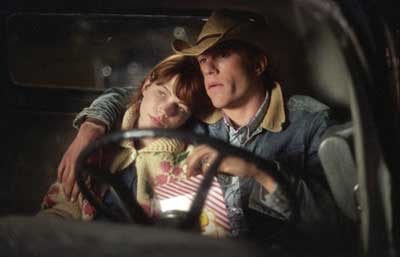 Because of the film’s gentle pace, and Lee’s loose control, we really immerse ourselves in their relationship as they frit away the hours looking after sheep. There was a woman in my theater (I won’t name names, partly because I don’t know hers) who felt that Brokeback Mountain was far too slow and could have been put to better use by cutting 2 hours out. The film’s placid pace is integral to the story’s success; you need to see how expansive that countryside is to feel alone, you need to have the many small conversations to draw out a closer camaraderie, you need the added time to open up to these men, and then once you have –BAM! — they turn their worlds upside down. This buildup is necessary for our connection to the characters but it’s also essential so we can understand what happens. Yes, the film portrays love as it truly is: an all-encompassing emotion that can be as maddening as it is passionate. But Brokeback Mountain doesn’t dare introduce a gay romance, something so dangerous in this land, all lickity-split. It’s supposed to be a surprise to these men, grown up with John Wayne movies and strong, silent role models. The movie enjoyably takes its time to seduce an audience with its tale before choking out every last tear in the end.
The tragedy of Lee’s film is that these men have each found the love of their life but, because of society’s prejudices, are not allowed to act. As a result, each man puts on a different face and pretends they’re a happy heterosexual Western buck for the public, but each is being eaten away inside. Ennis drinks a lot and is full of self-loathing. Jack is less publicly reserved about his feelings and finds momentary comfort with other warm bodies, mostly through silent nods with other closeted gay men. I’m reminded of a line in Paul Thomas Anderson’s Magnolia: “I have a lot of love to give; I just don’t know where to put it.” Ennis and Jack cannot quit each other but they also tragically can never fully commit to one another, at least without any threat of ostracism or death. That’s the power of Brokeback, that it shows you these simple men, shows you their love, and then won’t let that happy ending ever manifest that we yearn for. When we reach our somber, haunting conclusion there weren’t many dry eyes in the theater, mine included. Brokeback Mountain is a love story that won’t let itself be happy, and that’s what provides all the kicks to the gut and lumps in your throat.
I think some of the more hostile criticism of Brokeback Mountain is because of how normal Jack and Ennis are presented. Neither is a swishy stereotype, neither is any less of a man, and that notion probably terrifies the homophobes: “Well, they look normal, and if they get gay then maybe I will too!” That’s a shame really, because those ignorant few will miss out on a powerful, sweeping, complex, aching love story with fantastic acting. Ledger and Gyllenhaal will make you feel every moment of joy, every moment of pain, and every lingering conflict on what makes them whom they are. Lee stressed that he wanted to show the world a love story where you really felt that love was an uncontrollable force. His heartfelt, touching film is a revolution for being a normal love story, albeit with two classic Marlboro men. There is no propaganda, no gay agenda, but perhaps the film will open people’s eyes and strip away any narrow definitions we have toward the ownership of love. Brokeback Mountain set out to merely tell a good story, not change the world. It’s accomplished the first part and maybe, just maybe, it’ll spark discussion, debate, and lasting memories to lay groundwork for the second.
Share this:

Jarhead (2005)
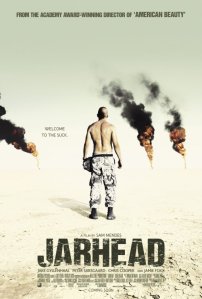 The controversy surrounding Jarhead, a hotly anticipated movie dealing with the 1991 Gulf War, seems rather misplaced. Some argued it would be anti-American, anti-war, anti-Marines, and on the other side of the coin, some even argued that it would be pro-war and pro-aggression. Now the movie seems to be taking flak for not being too political. Director Sam Mendes (American Beauty, Road to Perdition) is interested in crafting a movie about the soldiers, a true first-person war. I was actually very pleased, and somewhat relieved, that Jarhead didn’t try to bend over backwards and make any forced parallels to our current Gulf War conundrum. When you’re arguing about whether a movie leans right or left then perhaps the movie stands tall on its own, and Jarhead stands very tall indeed.
Anthony Swofford (Jake Gyllenhaal) is a “jarhead” the nickname for Marines because of what their heads resemble after their sheering, but it’s also indicative of a vessel, ready to be filled with knowledge. Swofford says he entered the corps because he “got lost on the way to college.” He’s humiliated, beaten, and looking for a way out when Staff Sergeant Sykes (Jamie Foxx) offers (more like orders him) to try out for the elite position of Marine snipers. It’s during this new training regiment that Swofford becomes “hooked” on being all he can be. He’s partnered with his barrack buddy Troy (Peter Sarsgaard), who serves as Swofford’s moral anchor. The boys get their hopes up when they catch the news that Iraq has invaded Kuwait. They’re shipped out to the action and are finally going to get a taste of combat … or so they think. They spend months in the Saudi desert amongst 114 degree heat and interminable boredom. They drink water, they play football in their gas suits for the cameras, they goof off, but mostly they wait. And wait. And wait. When the war does finally come into being, any action is short-lived: “Four days, four hours, one minute. That was my war.” Swofford, Troy, and his fellow Marines are aching for some kind of combat, any kind of violence that they’re physically and mentally breaking down in the monotony.
 Even the safety nets in previous war films, like the chickadee at home waiting for you, are ripped away in Jarhead. Usually the life at home is a source of release for movie soldiers, but in Jarhead it’s just one more source of mounting anxiety. The men have a Wall of Shame with pictures of ex-wives and girlfriends who have left them or cheated on them.
The acting on display is tremendous. Gyllenhaal (The Day After Tomorrow[) gives a sensational performance that should turn him into a bona fide, A-list leading man. All at once he can display fraternal bravado, closeted fear, confusion, and dulled horror. His show stopping moment is when he’s amidst a mental breakdown and turns a rifle on a comrade and then on himself, pleading that a shot be taken. The scene is a powder keg of intensity and Gyllenhaal is utterly captivating, startling, and horrifying with every teeth-grinding second. What?’ even better is that his performance doesn’t stop when the camera isn’t centered on his beautiful baby-eyes. He draws stronger performances out of those around him, and he does it quietly with confidence. He masks his fear and does so in fascinating, layered ways. Performances like this are what Oscars are for. And for any Jake fans out there, yes he does show a good bit of flesh in the film.
Foxx (Ray) breathes fiery life into what otherwise could have been a stock character, the tough love drill sergeant. He’s given much more screen time than I had ever thought and makes the most of it. Sarsgaard (Garden State) is a steely, dependable shoulder of support in the film, and his own big breakdown scene is amazing to witness. He?s so close to a kill but is overruled by the military brass, and Sarsgaard just lets everything go. It’s incredible. Chris Cooper (Adaptation) and even Dennis Haysbert, 24‘s president Palmer himself, have brief but very memorable small turns.
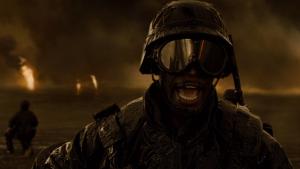 The cinematography by Roger Deakins (replacing Mendes previous Oscar-winning collaborator, the late great Conrad Hall) is gorgeous and uses light and shadow in remarkable ways to convey the turmoil of the soldiers and the other-worldliness of the desert. There are scenes amongst the lit oil fields that look like some alien world. It’s a perfect visual representation of how alone these men are and how ill-equipped they are for that scenario. The camerawork beautifully echoes the emptiness of their surroundings. Jarhead should easily score a much-deserved Oscar nomination for Deakins (House of Sand and Fog).
Jarhead is really an analysis of the psychology of what it takes to go to war. There is a transformation process, where young boys get stripped down and turned into killing machines. Jarhead poses a central question: what happens when you create the ultimate killing machine and give it nothing to do? Essentially, these men are breaking down in the tedium and many will be broken for the rest of their lives. A very poignant scene comes late in the film during their triumphant bus ride home. A Vietnam vet hops on to cheer his fellow Marines and in his hazy jingoism, you see how haunted and broken this man is from his own war experiences decades past. The future is staring them right in the face. Swofford opens and closes the film with narration explaining that once a man holds a rifle in combat, no matter what else he does in his life his hands will feel that rifle. These are men trained for war and adjusting to everyday life where the only war resides inside. Jarhead is a monstrously powerful study on the lasting effects of turning young men into monsters of combat.
Jarhead‘s inherently anticlimactic nature works against it, which will cause some level of disconnect with an audience. This is a very loosely structured flick about delayed gratification with no payoff. That’s not exactly a recipe for success. Jarhead is essentially the Waiting for Godot of war movies. The film is about monotony, about inaction, and the movie achieves a surprising yet palpable tension simply from drawing the viewer along for so far. In lesser hands a movie about boredom would still be boring, but Mendes brings an unprecedented art to it. Mendes has a confidant vision and the technical skill to bring out the drama of boredom. Jarhead has a deadpan sense of humor and some very sobering moments, like when Swofford comes across the remains of a traffic jam caught in napalm. These killing machines are getting rusty and will come back home without ever getting to pull a trigger, and what does that do to a man? These are important questions and Mendes is interested in answering them at a pace that still serves his characters. I love that Mendes has directed three films that are wildly different from one another. In my view, this guy is three-for-three.
 Jarhead is no Full Metal Jacket and yet Mendes gives passing nods to Vietnam and how our culture has shaped its history. The Marines watch Apocalypse Now and cheer as helicopters mow down villages set to a thundering soundtrack by Wagner. They’ve completely missed the point of one of the most anti-war films ever, transforming it into a bloodlust ritual. When Mendes reaches the desert then Jarhead becomes a war movie unlike any other. It’s a war movie without a war, sort of. All wee see are the results, both external and internal.
In a way, Jarhead is all about transformations and transitions, one of which is the Gulf War itself. This was arguably the first made-for-TV war and viewers were amazed at the green-tinted images of explosions and military might. War had been brought into the video game age where what once took months on the ground could be accomplished by pushing a button. Jarhead shows you the side of the Desert Shield/Storm that never made it to the cameras. The movie also presents some of the more obscured details of the war, like the care for and disposal of human waste from outhouses. That stuff never made CNN. Jarhead shows, very quietly and somberly, that sometimes the soldiers who return home have still been left behind.
Jarhead is an intense, sobering, evocative, and deeply contemplative film about the psychology of turning young men into killers and then leaving them with nothing to do. The inherent anticlimactic nature will likely push some audiences away while others will simply find it tedious. Mendes’ direction is strong and confidant and able to squeeze drama and tension from inaction, crafting an existential war movie that feels relevant and profound. Gyllenhaal is amazing and utterly captivating; you can’t take your eyes off him and, for many out there, a certain strategically located Santa hat. This movie isn’t anti-America, anti-troops, or even anti-war for that matter. Jarhead tells us that all wars are different and all wars are the same. We know war is hell, but for some, the absence of war is an even greater hell.
Nate’s Grade: B+
Share this:

The Day After Tomorrow (2004)
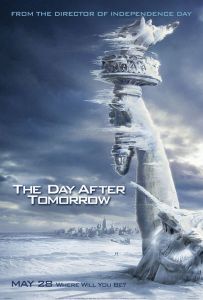 I must confess a giant moment of geekery: for a month or so I waited patiently until the Wednesday before the new disaster opus The Day After Tomorrow opened so I could finally say, The Day After Tomorrow opens … the day after tomorrow. Im surprised the marketing department didn’t beat me to that punch.
Jack Hall (Dennis Quaid) is an environmental scientist concerned about global warming trends and the chaos they could cause. He tries to alert government officials to these dangers but is met with a cold shoulder. Jacks son, Sam (Jake Gyllenhaal), is traveling to New York for a school quiz tournament on the slightly less grave mission of earning the affections of one of his classmates. Somewhere between the establishment of these two stories, all hell breaks loose. Jack and another researcher (Ian Holm) share data and discover that the world is headed toward a gigantic climate shift, a new Ice Age. While the world is crumbling, Jack is determined to reunite with his son, trapped in New York.
The special effects of The Day After Tomorrow are indeed awe-inspiring, but once they finish the viewer is left with a story that is, shall we say, overcast. Unlike director Roland Emmerichs other disaster films with aliens or giant lizards, a cataclysmic climate shift is not a beatable foe, so the story is left without resolution. It’s kind of hard to vilify the weather.
 What do you do once the world starts another Ice Age? Not much besides keeping your butt from freezing off. So this means that the crux of the after scenes revolve around Jack trying to reunite with his son. Jack tells his son to hole up where he is and, cue heroic music, he will come find him. Sure. Does anyone stop and question, Why? I know why Jack treks, on foot no less, from Philadelphia to New York, but it isn’t even necessary. His son and their friends are fine where they are and the only severe threat they face is when the giant frosty eye of the storm looms overhead. Quaid’s character has no opportunity to assist them during even that scene. Im sure someone thought it would be a touching display of a fathers love for his son, but its really just winds up looking foolish. He tells his son not to move, then disobeys his own advice to venture out. Nothing of significance happens because of Jack’s journey. He might as well have stayed home and read a book.
The acting of any disaster flick is really confined to yelling and … panting, I suppose (which could also accurately describe the acting prowess of the late night programming of Showtime). Quaid is a sturdy hero but seems to look ten years older than normal. Gyllenhaal is one of my favorite young actors (I adore Donnie Darko) and, to his credit, he does a suitable job of running around and yelling.
Perhaps the funniest thing in The Day After Tomorrow is a Vice President who refuses to listen to environmental concerns that looks a heck of a lot like our current VP, Dick Cheney. The timeliness also extends to a somewhat witless president who, when faced with a crucial decision, turns to his VP and asks, What do you think?
The necessary scenes of planetary and civilization destruction are first-rate in the film. Emmerich is our premiere master of laying waste to the world, particularly New York City. Emmerich keeps our view of the carnage mostly restrained to long shots where we can witness the full magnitude of devastation he is trying to put forth.
 The weather effects are top notch, especially a series of tornadoes that devastates downtown Los Angeles. There are some beautiful visual moments, like seeing thousands of birds migrating from impending doom, or a final image from above of the iced Statue of Liberty. Tomorrow also has a clever moment late in the film when the frost storm hovers over New York and forces characters to outrun advancing … frost. Its not as stupid as it sounds. And, as per usual in disaster flicks, Mother Nature always knows where to strike – landmarks. How else does one explain the precision of taking out the Hollywood sign?
For a good hour, The Day After Tomorrow is great escapist entertainment. The scenes of destruction are riveting, and the moments leading up to them have great suspenseful pacing. The film’s climax is its half-way point, which is never a good sign. After all the floods, rain, snow, twisters, and everything Mother Nature has in her arsenal, we are left with characters scrambling around running from … wolves. Going from tidal waves to wolves is not exactly an increase in suspense.
There is a hilariously awful moment in the film involving Sam’s wife, played by Sela Ward. Sela is a nurse at a hospital watching over a child with cancer. She refuses to leave him alone and waits for an ambulance to arrive, because, for some reason, the cancer kid can only be transported by ambulance. It’s just distasteful and dumb that this storyline even exists: brave woman determined to stay by the side of cancer child.
The Day After Tomorrow is an exciting diversion that doesn’t know what to do with itself after all the big money shots are spent. Its like a balloon once the air is all out. Perhaps the creators should have consulted any prior warning about stranding an audience in a story that no one cares much about. It’s worth seeing, but it’s also worth leaving after Mother Nature unloads her goods.
Nate’s Grade: C+
Share this:

The Good Girl (2002)
 Jennifer Aniston, a Friends favorite, has been getting attention for her less than attractive turn in adultery with The Good Girl. However, the movie’s biggest flaw is Aniston herself. The Good Girl can try and make her look as disheveled as they can, and they can try and make her wear as much unflattering baggy clothing as possible, but in the end we’re still watching Mrs. Brad Pitt groan about the purgatory that is Middle America. An actress of better caliber could likely pull off the rub, but alas, Aniston is not quite that actress yet.
Aniston narrates the disenchantment as Justine with her dead-end job working at a Wal-Mart-esque chain store and her dead-end marriage to perennially stoned house painter Phil (John C. Reilly). She longs for an escape and a change of pace from a grind where there appears none. Then one day a new teenage co-worker named Holden (Jake Gyllenhaal) comes into her life and seems to represent the danger and vitality Justine has felt missing in her life for so long. Her affections are at first stalled in apprehension, but soon Holden and Justine are ducking into motels and finding excuses to get busy in the stock room. But soon enough the honeymoon ends. Justine learns more distressing items about the emotionally dependent and unstable clerk, like his real name is Tom (“Tom is my slave name” he tells her). What once seemed exciting is now becoming more perilous to cover up.
 The Good Girl then descends into blacker territory with some unexpected turns, but also some more unbelievable moments. When confronted by Phil’s best friend Bubba (Tim Blake Nelson) about her infidelity she is given a rather unpleasant ultimatum that she gives in too way too easily. The longer the affair and messy cover up continues the more audience loyalties shift toward the victim, Phil. He admits he isn’t the smartest man or the best husband, but his feelings are authentic for his wife. And the more the audience views him the more they see that he truly does love Justine.
And again, we have to come black to that road block of a lead. A more accomplished actress could pull off this bittersweet role with aplomb and believability. A better actress could have slowed down the audience shift in loyalty away from her unfaithful protagonist. The supporting cast of The Good Girl has a lot more bite to them. Gyllenhaal (Donnie Darko) now seems to be an expert in the disturbed youth. Reilly starts off as a loaf but transforms into a sympathetic character that has his own touching moments of unannounced affection to Justine. Nelson gives the film some of its funniest moments along with the lethally deadpanned Zooey Deschanel. The lone stereotype in the bunch is played by Mike White (who wrote the film) as an overly enthusiastic Christian do-gooder.
It’s a pity The Good Girl has its anchor around the neck of Aniston and willing to go as far as she will take it, because The Good Girl is indeed a good film with some wicked moments of comedy and a well-written story. It’s just that Aniston’s acting limitations gravitate what could have been a better film.
Nate’s Grade: B
Share this:

Donnie Darko (2001)
 Donnie Darko (Jake Gyllenhaal) is your normal malcontent teenager in late 1980s Reagan America. He bickers with his older sister, worries over the right moment he’ll kiss his new girlfriend, and tries to ignore the advice of many imprudent adults. Donnie’s your typical teenager, except for his imaginary friend Frank. Frank is a sinister looking six-foot tall rabbit that encourages Donnie into mischief and gives a countdown to the impending apocalypse. And I haven’t even gotten to the time travel yet.
One night as Donnie wanders from his home at the behest of Frank, an airline engine mysteriously crashes through the Darko home and lands directly in Donnie’s room. The airlines are all at a loss for explanation, as it seems no one will take responsibility for the engine or knows where it came from. Donnie becomes a mild celebrity at school and initiates a relationship with a new girl, Gretchen Ross (Jena Malone). One of his classes consists of watching videos of self-help guru and new age enlightenment pitchman Jim Cunningham (Patrick Swayze). His school has even, under the persistence of self-righteous pain Kitty Farmer, persuaded Cunningham to speak and try to help students conquer their “fears.”
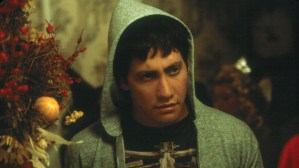 Donnie is also seeing a therapist for his emotional problems and taking medication for borderline schizophrenia. Around this time is when Donnie starts to inquire about a strange old woman, obsess over the possibilities of time travel, as well as see weird phosphorescent pools extend from people’s chests. He also floods his school at the urging of Frank. This is no Harvey type rabbit.
The longer Donnie Darko goes on the more tightly complex and imaginative the story gets. First time writer-director Richard Kelly has forged an excitingly original film that is incredibly engaging with charm and wit. He masterfully mixes themes of alienation, dark comedy, romance, science fiction, and a sublime satire of high school. Donnie Darko is the most unique, head-trip of a movie unleashed on the public since Being John Malkovich. Kelly has a created an astonishing breakthrough for himself and has ensured he is a talent to look out for in the future.
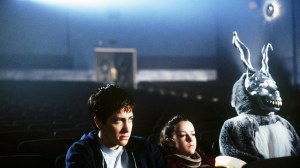 Gyllenhaal (October Sky) is superb as disenchanted Donnie, a Holden Caulfield for middle suburbia. His ghastly stare conveys the darkness of Donnie but his laid-back nature allows the audience to care about what could have merely been another angst-ridden teenager. Swayze is hysterical as the scenery-chewing Cunningham. The rest of the cast is mainly underwritten in their roles, including stars Drew Barrymore (who was executive producer) and ER‘s Noah Wyle, but all perform admirably with the amount they are given. Not every plot thread is exactly tidied up but this can easily be forgiven.
Donnie Darko is a film that demands your intelligence and requires you to stay on your toes, so you can forget any bathroom breaks. The film is one of the best of 2001 but also one of the funniest. You’ll be honestly surprised the amount of times you laugh out loud with this flick. The theater I saw this in erupted every half a minute or so with boisterous laughter.
Donnie Darko is a film of daring skill and great imagination. You don’t see too many of these around anymore.
Nate’s Grade: A
Reviewed 20 years later as part of the “Reviews Re-View: 2001” article.


 nathanzoebl
You must be logged in to post a comment.