Blog Archives
Unfrosted (2024)
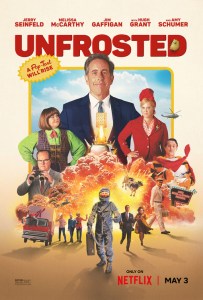 What to make of a movie like Netflix’s Unfrosted. It’s Jerry Seinfeld’s directorial debut, working off a screenplay he co-wrote, his first foray into film writing and acting since 2007’s Bee Movie. His eponymous sitcom “about nothing” was a 1990s mainstay and popularized an ironic meta form of comedy that still continues to dominate comedic tastes. Making a movie about the pseudo history of the invention of Pop Tarts, and the corporate rivalry between the major cereal brands, seems like a further exercise in that realm of humor, potentially satirizing a burgeoning sub-genre of late, the Biopic of Products (Air, Tetris, Flamin’ Hot, Blackberry). Except this supposed “biopic about nothing” is really a head-scratcher. Its humor feels pained and stale, the satire feels missing or glancing at best, and it seems like an expensive lark, wasting the nigh-infinite money of Netflix to purposely make a stupid comedy with all his friends.
Set in the mid 1960s, we follow two households, both alike in dignity, in fair Battle Creek, Michigan where we lay our scene. Kellogg’s has been the dominant cereal-brand for years but its chief rival, Post, is set to launch a new product that will revolutionize breakfast mornings. Bob (Seinfeld) is the head of development for Kellogg’s and reaches out to his old colleague, Donna (Melissa McCarthy), when it becomes evident that Post stole their unused research to develop a pastry treat designed to be cooked in one’s toaster. The warring CEOs, with Jim Gaffigan as Edsel Kellogg III and Amy Schumer as Marjorie Post, are desperate to one-up one another and be seen as more than an inheritor of their family’s wealth. It’s a race to see which company can get their treat to market first and capture the hearts, minds, and sweet teeth of America’s youth.
 I’d be lying if I said I didn’t laugh at points through Unfrosted, which operates like a spoof movie on a slower jokes-per-second pacing guide. There are zany sight gags amidst broadly drawn characters treating the silly straight, though occasionally you’ll have wisecrackers commenting on the inherent absurdity of moments, mostly confined to the stars making asides to the audience. Sometimes it’s lazy jokes that rely upon our foreknowledge, like when Bob coins a NASA beverage by saying it has a “real tang” (get it?). The movie frequently intensifies into goofy escalation when Kellogg’s impanels a team of mascots and inventors as a breakfast brain trust. Every one of these wacky characters is here to provide the exact same joke they will provide throughout the movie, and their inclusion is already suspect. Having the Schwinn bicycle guy (Jack McBrayer) comment on why he should be there is not enough. The hit-to-miss ratio will vary per everyone’s personal sense of humor, but overall I just felt mystified why this project would tempt Seinfeld from his comedy repose. What about this idea excited him? Was it just his lifelong love of cereal and Pop Tarts, a topic from his standup act decades ago? I ate a lot of cereal as a teenager too but I don’t want to make a movie about the Lucky Charms advertising campaign teaching children to beat and pillage the Irish (maybe Ken Loach could direct – to the three people on the Internet who appreciate this joke, I want you to know I appreciate you also).
It can be fun to simply watch dozens of famous people take their turns being silly in what is unquestionably a “dumb comedy.” When you have comedians of this quality in your movie, they’ll find ways to make even so-so jokes hit a little better, and that’s the case here. There’s an entertainment value in just wondering who will show up next, as many characters are only onscreen for a single scene or an abbreviated moment. Unfrosted becomes an example of Seinfeld’s industry power as he empties his Rolodex to fill even the tiniest of roles. Look, it’s James Marsden as Jack LaLanne. Look, it’s Bill Burr as JFK and Dean Norris as Kruschev (double Breaking Bad). Peter Dinklage as the head of the nefarious milkmen cartel? Why not? If you set your expectations low, maybe lower than what you were accounting for, there can be a mild amusement scene-to-scene just seeing who might show up next, almost like a modern-day version of those anarchic big ensemble comedies like It’s a Mad, Mad, Mad, Mad World.
 There is one segment that fell so flat for me that I was in utter amazement, and that was the unexpected January 6th insurrection parody. In a movie that has sustained a surreal and offbeat version of our universe, it evokes one of the most startling days of recent history. I think the humor is meant to derive from simply seeing a bunch of mascots in big colorful costumes as a mob running havoc, but there’s no jokes about like the challenges of a mascot costume in a fight, or say someone tipping over and being unable to get back up like a helpless turtle. There are jokes that can be had with this scenario, but instead Seinfeld is relying on the ironic juxtaposition of the ridiculous with the serious, and I don’t think it ever works as a joke. My sinking feeling began when Hugh Grant’s embittered mascot character wore a headdress resembling the QAnon shaman. It feels tacky and strange and the longer it persists the more I kept wondering what Seinfeld was doing with this. Why include this especially as the only form of relatively topical political humor, beyond, I guess, the depiction of business elites being complete morons? Why this? Again, it would be different if it was funny in execution, like the Saving Private Ryan D-Day parody from Sausage Party. This just isn’t funny, and its inclusion feels so odd compared to the stale nature of its other comedy.
As an admittedly silly enterprise, one that doesn’t even pretend to be accurate even as it flirts with the truth, Unfrosted is a successfully stupid comedy that feels a little too aimless, a little too edge-less and safe, and a little too dated and stale in its approach to comedy (lots of 1960s Boomer nostalgia ahoy). It’s hard to work up that much risible anger over a 90-minute movie that features a living ravioli creature. Clearly this movie wasn’t trying to be anything other than a gleefully stupid comedy, but I wanted more pep from its jokes and whimsy and general idiocy. I think the way to go may have been all the way in the other direction, treating the formation of a toaster pastry like international nuclear secrets and playing the corporate espionage completely straight while also making it patently ridiculous. Unfrosted did, however, make me want a Pop Tart that I ate afterwards, although it was my local grocery store’s generic brand, so I guess that doesn’t directly benefit Kellogg’s. This movie exists as a Seinfeld curiosity that ultimately left me hungry for more.
Nate’s Grade: C
Share this:

Wreck-It Ralph (2012)
 Disney has taken plenty of drubbings with its non-Pixar animation output. They’ve all but abandoned traditional 2D animation, and the failure of The Princess and the Frog is unlikely to alter that decision-making. The Disney stand-alones have gotten better in quality; last year’s Tangled was well received and banked some nice dough. I expect Wreck-It Ralph to do even better. A film about the lives of video game characters seems ripe for a merchandizing bonanza, plus all the parents will need something to shut up their sweet little bundles of joy for two hours of relief.
Wreck-It Ralph (voiced by John C. Reilly) is the villain of a classic arcade game. He climbs a condo building, Donkey Kong-style, and smashes windows. Felix (Jack McBrayer) is the handyman the player controls, hopping from ledge to ledge fixing what is broken with his magic hammer. But Ralph is tired of always being the bad guy, getting hurled off the roof at the end of every game by the residents. He’s labeled as a “bad guy” but he doesn’t believe he’s so bad. To convince the townspeople of his game of his worth, Ralph abandons his game to seek a medal like what Felix earns at the end of every game. He trounces around an assortment of games, including a space Marine shoot-em-up led by the no-nonsense Calhoun (Jane Lynch), before landing in Sugar Rush, a girlie version of Mario Kart. Here he meets the rascally girl Vanellope (Sarah Silverman). She agrees to help Ralph get his medal if he’ll help her build a racing car and get her in the game. Vanellope lives on the run as a glitch in programming. The other game characters tell her she’s a mistake, but she knows she’s a racer at heart. Except without Ralph, Felix and the other game characters seem like they’re glitching. If they can’t get him back, they may lose their game and their home.
 It’s essentially a Toy Story for gamers, discovering the hidden world of video games when nobody’s looking. There’s a great sense of fun and discovery learning about these characters and their worlds as well as what they do off the clock. I love the idea of a support group for video game villains coping with their lot in life. I feel like this could have been a movie unto itself and I would have been pleased. There are plenty of references to games from the 80s and 90s, before everything became an endless variation on first-person shoot and kill games of sport. Really the references are only going to work for former or current gamers in their 20s or 30s, maybe even 40s. Are teenagers even going to understand the famous Konami code or get the subway scrawl, “All your base are belong to us”? Heck, are teenagers even going to know what arcades are at this point? The cameos are kept to a minimum as we switch over to our main characters. Wreck-It Ralph isn’t as clever or groundbreaking as the Toy Story films, but it gets points for trying something different than most family films, which are content with the somehow irresistible combination of fart jokes and inappropriate pop-culture references. Even non-gamers will likely find something to enjoy with the movie. I’ve gone on record saying that there will likely never be a good video game movie. Allow me to amend that statement: there will never be a good movie BASED upon a video game.
Set in the world of video games is another matter. The animation style is very colorful and impressive, with some fun quirks to give the movie an extra dash of personality. I really enjoyed how the Weeble-like people in Ralph’s game move in staccato 8-bit style; a herky-jerky movement that left me smiling every time. The running jokes helped to turn a half-hearted gag into a thing of beauty, like Calhoun’s tragic bridal backstory. The antagonist of King Candy (voiced by an unrecognizable Alan Tudyk) proves to be more interesting than at first glance. The different game settings all have very different tones, allowing the movie to present a nice variety of visual imagery. Some of the more frenzied action of the “Hero’s Duty” game might scare young children. The animation looks wonderful and even the recreation of the graphically limited games is cause for some amusement. That’s probably the best word for Wreck-It Ralph; it’s routinely amusing and provides enough chuckles for me to mildly recommend to others. I would not, however, recommend seeing this movie in 3D. You would think a world of video games would be quite a boon in the extra dimension, but the 3D is hardly noticeable at all. This may be the worst 3D rendering of a major movie I’ve ever seen, and usually animated films are the best ones to see with 3D. Regardless, the substandard 3D won’t detract from what is an enjoyable theatrical experience.
What helps smooth over the film’s flaws is the presence of heart. Yes it too can get saccharine at turns, and that’s not a joke about Sugar Rush, but you’ll be surprised that by the end of the movie, you may actually be feeling things in your heart-space for these characters and their plights. Again, here is another 2012 movie that rips off the ending to the brilliant 1999 animated classic, The Iron Giant. Perhaps some of my emotional engagement is residual association from that masterpiece. If this is true, and Hollywood filmmakers have found the secret formula to make audiences feel emotions, then I await the onslaught of movies copying the ending to The Iron Giant (I won’t spoil it but for God’s sake, go out and see that movie). After about 30 minutes, the film really becomes a buddy picture between Ralph and Vanellope, outcasts from their games. Neither character is that deep, though perhaps that goes with the programming. They both are denied better lives because of others prejudices against them. When they join forces as a team to buck the establishment is when the movie finds a wealth of sweetness. While their character arcs will be completely predictable, from the misunderstanding and reconciliation, but that doesn’t mean it misses the mark. Their relationship, and the film’s simple goals, can get bogged down in the messy plot mechanics of the movie (there are a lot of rules to digest). The climax, though, is filled with all number of payoffs, some big some small, some you’d forgotten about; I’m genuinely impressed how smoothly the movie ties together storylines, finding a perfect return of the bad guy support group pledge to form an emotional peak.
 There is a fun to be had and Wreck-It Ralph has enough colorful imagery to make your eyes glaze over. However, the story is a blend of familiar “be yourself” aphorisms given a retro polish. The motivation for Ralph, and Vanellope as well, is very flimsy, and the more time they repeat these miniscule goals (get a medal/compete in a race) the flimsier they become. Ralph is risking it all to get a medal because a shiny award is all it takes to convince the people in his game that he deserves better. The dubious logic seems pulled right out of a video game. There’s also a fair amount of messages about not being trapped by labels, breaking from the herd, believing in yourself, all those sorts of Disney beatitudes they’ve been dishing since the 90s. The plot also seems to fly well below its potential. We’re talking about a world of video games, and there’s a definite interest in seeing these realms mix and match. Unfortunately, the movie spends 2/3 of its running time in the candy-coated land of Sugar Rush. It’s here where Vanellope takes over the movie. Her relationship with Ralph works in fits and starts, and her annoyance level will vary sharply depending upon your tolerance index for Silverman’s baby-doll voice. Aside from a few retro cameos and puns, the humor is assuredly juvenile and filled with endless slapstick. Hope you like three minutes of “duty/doodie” jokes. You’re better than this, Wreck-It Ralph.
There’s one glaring plot hole that I feel deserves some deliberation. Throughout the film we glimpse Felix’s hammer magically fixing things that are broken. Just one whap and good as new. A late conflict arrives with the danger of the Sugar Rush game getting its plug pulled. The residents of the game could flee, but Vanellope would be stuck because she is a glitch, she cannot escape the game if it goes dead. Well couldn’t Felix use his hammer, tap Vanellope, and then “fix” her? To that end, what happens if the whole arcade goes out of business? We see the displaced game characters hang out at the surge protector, modeled like a train station. But what if that gets unhooked as well? How far can these guys run away to? They all seem inevitably doomed due to the dwindling business of arcades. Maybe somebody should start up a non-profit charity. Cue the Sarah McLachlan song (for just quarters a day, you can help a video game character in need…).
Colorful, vibrant, and occasionally witty, Wreck-It Ralph is Disney’s latest animated film to succeed with a solid formula of heart, attitude, and with an extra dash of nostalgia. I did enjoy the film but I always kept thinking there were so many better movies ready to be made given this setup. It does seem a little confused about who its audience is. It’s a bit too childish for grown-ups and a bit too plot-heavy and full of nostalgia for little kids. It packs a lot of jokes and plot into 108 minutes, which feels draggy at turns but flies by with enough spirit and energy that it’s hard to complain. Wreck-It Ralph is a perfectly entertaining movie that fits the definition of cute. It manages to make you care about the characters, which is a small miracle when you’re dealing with characters named Vanellope. Now that they’ve established this universe, hopefully Disney and the writers can expand their storytelling and really have fun with the possibilities at play.
Oh, and the short before the movie about a couple looking to find one another in the big city is rather cute though I liked it better before it went overboard with the supernatural.
Nate’s Grade: B
Share this:

Cats & Dogs 2: The Revenge of Kitty Galore (2010)
 Obviously this movie is bad. A sequel to a lukewarm family film from nine years ago, the chances were slim that Cats and Dogs 2: The Revenge of Kitty Galore would have ever worked. They don’t even have the temerity to have the subtitle read “Pussy Galore” for fear that repeating the most famous Bond girl name might cause parents discomfort. It’s a live-action talking-animal movie that posits that cats and dogs have been fighting an ages-old feud and they all have secret lairs and technology at their service despite lacking opposable thumbs. Really, premise alone you’re already lowering the standards, and with standards firmly and securely lowered, you may even laugh once or twice (that’s probably about it). It depends on how susceptible to puns you are because that is the primary joke vehicle. The film makes an attempt to throw animals into a Bond-styled action thriller with, pardon me, shaggy results. The character animation is poor, the dialogue feels like it was stitched from one groan-worthy pun after another, and yet Cats and Dogs 2 doesn’t offend with its sheer badness. Premise alone, you sort of watch the thing in a vegetative state.
Nate’s Grade: D+
Share this:

Forgetting Sarah Marshall (2008)
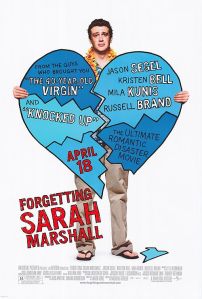 So much ink has been spilled on Jason Segel’s full-frontal nudity that you would think the public has never known that penises have appeared on film before. It seems that female nudity is used to titillate and male nudity is used for awkward laughs, and this is the case with Forgetting Sarah Marshall, which Segel stars in and wrote. His character Peter is humiliated by a breakup, even more so because the man is breaking down while in the buff. He even states at one point the naive belief that as long as he doesn’t put clothes on reality cannot hit. It’s funny and sad and he’s completely vulnerable, but Forgetting Sarah Marshall is much more than the story of one slightly doughy man and his penis. This is a story from producer Judd Apatow (The 40-Year-Old Virgin, Knocked Up) about heartache and mending and the struggle it takes to keep a relationship healthy. But it is also about a man and his penis.
Peter (Segel) is dating TV actress Sarah Marshall (Kristen Bell), star of the brilliantly reflexive title Crime Scene: Scene of the Crime. Peter provides the music for the TV show, which he laments is nothing more than “ominous tones.” Then one day she has some bad news. She’s breaking up with him (this is where Segel loses it, both emotionally and from a clothes perspective). Peter mopes and cries for days, goes out to clubs with his step-brother (Bill Hader), and tries to engage in meaningless sex but that too leads to crying and moping. Peter takes a vacation to Hawaii in order to forget his ex, but as chance would have it Sarah is already there with her new man, British rocker Aldous Snow (Russell Brand). Peter is stuck in the same hotel as his ex and her new lover. The hotel staff takes pity on Peter and they all seem to look out for him, setting him up in a $6,000 suite, involving him in hotel activities, and feeding him drinks. Rachel Jansen (Mila Kunis) works at the front desk and takes a special interest in Peter and his woes. She helps Peter get over Sarah and fin
 Forgetting Sarah Marshall is another hit from the Apatow brand. It features another leading man with an unorthodox physique and a healthy interest in geek culture. However, Peter doesn’t need to learn to be responsible, or outgoing, or to transition from boy to man. He’s actually fairly well adjusted and even has a job that suits his composing talents. His dilemma is heartbreak, a universal affliction if ever there was one. He’s a little frumpy and has a thing for puppets, but Peter is really a sweet guy who is working through the pain of a breakup. He was together with Sarah for over five years, so it feels strange when the characters keep harping on him to get over it in the span of a few weeks. He is awash in self-pity and wails so loudly that other guests complain about a woman crying in his room. He makes for a capable lead and his budding romance with Rachel allows him to heal. The romance is strongly felt and I was completely absorbed by wanting Peter and Rachel to have a happily ever after.
Segel is a charitable screenwriter. The could have easily become a vanity wish-fulfillment project, but instead he rounds out the main characters and builds a deep supporting cast that add delightful additions that enrich the narrative. I admire Segel’s decision making when it came to fleshing out his characters instead of writing them off as stock types. In an ordinary romantic comedy, the beautiful girl that dumps the lead is a bitch. It would have been extremely easy for Segel to demonize Sarah and keep her as an established antagonist, but instead he makes her feel real. She has real, solid reasons for her breakup with Peter, and she has several revealing moments that open her character up and humanize her. Aldous is another pristine example of Segel’s screenwriting skill. In an ordinary romantic comedy, the girl always dumps the nice guy for the douchebag, and Aldous starts in that territory. But a magical thing happens and as the film continues Aldous becomes very charming; he’s unpretentious and is the same transparent and genial man to everybody. He appreciates Peter’s music and gets him and Peter’s passions. Peter says at one point, “This would be so much easier if you weren’t so cool.” It would have been easy and even expected for Segel to cast both the ex-girlfriend and her new boyfriend as evil cretins. Instead, he broadens and rounds out all the central characters to the point that they feel like real people and not just comedy types.
 The movie is resolutely pleasant and amiable, lacking gut-busting laughs but offering plenty of cringe comedy. It’s not as outrageous as other Apatow comedies, or as good, but it is completely entertaining. There is one terrific sequence that stands out in my memory. It involves the two couples sitting at an awkward dinner. Then they comment on how awkward it is, then they comment on commenting how awkward it is. The dinner bathes in unease but then as it carries on you see the different tensions. Aldous and Peter hit it off discussing their dislike for a terrible horror script offered to Sarah that involved a killer cell phone (sounds like One Missed Call). They are genuinely bonding. Sarah hides her growing dissatisfaction with the decisions she’s made, but Rachel catches on. She kisses Peter long and hard and shoots Sarah a very knowing glance that all women know as “back off.” This dinner packs all of the different tensions of the movie into one well-written, expertly performed scene. The characters aren’t shouting their feelings point-blank but you can follow along to the conversations that are unsaid.
I love comedies that involve deep supporting casts, where a supporting player can enter at the right moment and deliver a perfect in-character addition. I was delighted at how wide Segel cast his net of characters and yet how well incorporated they are. There’s a newlywed couple (30 Rock‘s Jack McBrayer, Maria Thayler) that haven’t mastered the art of sexual intercourse. They’ve waited until marriage and know are wondering what all the fuss is about. Hearing McBrayer’s amped-up frustration is funny, but it’s even better when he solicits advice from Aldous on pleasing a woman. The tutorial between the two left me in stiches and made me like Aldous even more. I enjoyed spending time with all of these characters. Apatow regulars Jonah Hill and Paul Rudd pop up in hilarious cameos. Rudd is a super stoned surf instructor and Hill is an obsessed Aldous Snow fan who creepily doesn’t abide touching boundaries. The supporting players never outstay their welcome and add great splashes of variety to the story.
Forgetting Sarah Marhsall continues the Apatow tradition of mixing raunch with sentimentality. There’s plenty of dirty humor but it’s the little touches that won me over. I loved the title of Sarah Marshall’s TV show, perfect references to movies like The Buena Vista Social Club, Rachel reflecting Peter’s romantic advances only to initiate the first kiss, the brilliant music video for Aldous Snow where he carries an earnest sign that reads, “Sodomize Intolerance,” the flashbacks to Peter and Sarah’s relationship, the helpful advice of Dwayne the bartender and his great knowledge of fish native to Hawaii, and a vocally competitive dual of sexual intercourse. This is a comedy that works because even they details have been looked after with care.
 Segel easily conveys his character’s sweetness; the man can’t help but be sweet even in anger. Bell is given complexity with her role and nails bitchiness and tearful regret with the same skill she radiated on her defunct TV show, Veronica Mars. I never thought Kunis was capable of playing more than a shrill ditherhead thanks to her role on TV’s That 70s Show but she nicely handles the drama. She makes the romance more than believable but desirable. The actors all do a great job but it is Brand that steals every single scene he is in. His carefree demeanor and hysterical physical gyrations cast him early as one type of character, but his charisma rules the day and will win over audiences.
This is all familiar romantic ground covered by countless other movies. Boy loses girl, boy meets new girl, boy gets new girl, but Forgetting Sarah Marshall adds the Apatow touch. Another Freaks and Geeks alum writes another male-centric but hilarious comedy that deals with mature themes in untidy ways. The movie takes place in a world that resembles ours, where people are not cast in black and white, good or bad, victim and victimizer. Segel’s screenplay lets the audience empathize with a wealth of characters, and the humor is bittersweet but mostly on the sweet side. Any film that ends with a puppet musical about Dracula has to be seen as special.
Nate’s Grade: B+


 nathanzoebl
You must be logged in to post a comment.