Blog Archives
Kraven the Hunter (2024)
 Kraven the Hunter feels like a movie that was never meant to be seen. That seems paradoxical considering the efforts of many talented people over years took place to bring the Spider-Man villain solo movie to some form of creaking, wheezing life. Since 2017, Sony has decided to create their own Spider-Man universes minus, of course, Spider-Man. They’ve been making solo movies about Spider-Man villains and while the Venom movies have been inexplicably popular, the rest have been regarded as unmitigated disasters. In 2022, Morbius was bad enough that Sony thought they could re-release it to capitalize on the memes and derisive entertainment factor. To no avail and a total lack of morbin’ time. In 2024, Sony released three Spider-Man villain movies, though Madame Web was never really a villain per se, but then again nobody really wanted a Madame Web movie anyhow, though it once again gave us some memorable memes. Now Kraven is reportedly closing out this shared cinematic universe experiment, and the president of Sony is blaming those mean ole film critics for the failures of these would-be superhero classics (always a smart movie, assuming audiences are incapable of making up their own minds). Delayed almost two years from its original January 2023 release date, Kraven the Hunter is the death knell of this enterprise and it comes to a thoroughly mediocre conclusion, feeling even more disposable, poorly developed, and mechanical, and ultimately a footnote to a footnote of superhero cinema.
Kraven, nee Sergei Kravinoff (Aaron Taylor-Johnson, portraying his third superhero) is the son of a notorious Russian crime boss, Nikolai (Russell Crowe). One day on a hunting trip in Ghana, Sergei rescues his brother Dimitri (Fred Hechinger) from a lion. The lion injures Sergei and takes him for food, but thanks to a magic elixir from a tourist, Calypso (Ariana DeBose), who saves him. Now he has animal-like senses and speed and strength. As an adult, Kraven seeks out villains to bring to justice, but he’s also trying to square the legacy of his father and whether he is like dad. 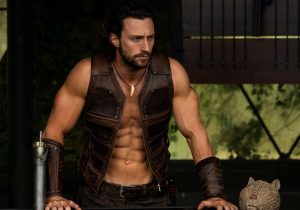
The problem with these Spider-Man-Minus-Spider-Man movies is making people get interested in the famous web-slinger’s rogues gallery. This usually means treating the character’s best known for trading punches with another hero as their own individual anti-hero, complete with a more villainous villain for our future villains to have to topple. Usually these villains (the actual individual movie antagonists, not the protagonists) are an imitation of our heroes (still referencing the future villains), the mirror version of them. So if your protagonist is going to be a vampire, then your antagonist is going to be a slightly more evil vampire. If your protagonist is an alien goo monster who likes to eat heads, then your antagonist is going to be a slightly more evil alien goo monster that likes to eat heads. You get the idea. However, you digest enough of these, and it all seems a bit too perfunctory, the main character having to defeat a version of themself. The main challenge is finding a way to make an audience care about these characters, and having them rescue a love interest or defeat a new-but-same villain with the implicit promise that maybe, if you’re patient enough, you might see them eventually try to murder Spider-Man, is not it. I’m not against the idea of giving these villains their origin tales, but it feels like in order to make them more palatable to a mass audience means they’re neutering the nature of these characters. The hypothetical future Sinister Six movie can’t all be six misunderstandings against Spider-Man.
Alas, Kraven is a real bore of an action movie even with its R-rating, the first for these Spider-Man villain movies. The added bloodshed and curse words don’t exactly make the movie feel more adult when we’re still dealing with plotlines like a super lion biting our hero and giving him super lion powers, much like the origin story of Spider-Man, or another villain suffering from a very silly and similar Amazing Spider-Man 2 Goblin-itus medical malady. This is not a serious movie in the slightest but that doesn’t mean it can’t be passably fun, but everyone is just so dour and passionless that it drains all entertainment. At least Madame Web was perplexingly interesting with its bad decisions. There’s such little energy to be had through the middling two hours. Kraven is gifted superhuman powers and he uses them to hunt down bad men and big game poachers, becoming let’s say Captain Planet if he watched nothing but Charles Bronson movies. There’s got to be an exciting movie there, or at least a more interesting one than what we eventually got here. It’s hijacked by some pretty rote family drama of a bad dad who was too hard on his kids and rescuing a kidnapped little brother who he feels guilty about leaving with the bad dad after Kraven got his new powers. The family drama is pretty rote and uninspired, with both of the other characters kept to the sidelines for most of the movie, which makes it hard to care that much about either of their impacts. The haphazard integration of a romantic subplot with Calypso is even more perfunctory when I would much rather see Kraven fall in love with a lion instead.
 I like J.C. Chandor as a director, and he’s someone who leaps at new challenges. His debut movie, 2011’s Margin Call, was an engrossing character piece about Wall Street traders and execs on the verge of the 2008 financial meltdown. It was so bare-bones that it was practically a play. His next film, 2013’s All is Lost, was the exact opposite: a movie completely told through visual storytelling and with a minimum of spoken words as Robert Redford tries to patch up his sinking boat. 2014’s A Most Violent Year was a slow-burn crime drama about the lengths people will go to escape their past and their nature. From there, Chandor has been circling larger studio projects, leaving 2016’s Deepwater Horizon and then replacing Kathryn Bigelow for Netflix’s action thriller, 2019 Triple Frontier. He’s a chameleon of a director and the only real point of interest I had with Kraven. What would he do in the superhero space? Well, the answer is not much. The visual flourishes we’ve seen before in other movies but without a sense of humor. Watching Kraven periodically run on all fours may make him more animal-like but it doesn’t look good. The movie gets lost in the convoluted mythology and rules of its characters and what they’re capable of, and so the action sequences feel cobbled together and short on imagination. The climax is during a stampede of buffalo but there’s no real danger here like dodging around the animals. They very conveniently allow space for our hero to fight his battle, thus becoming a thundering backdrop. Even if you’re overly generous, there’s not much here to excite the senses or even your morbid curiosity.
There is one line of dialogue that needs to be singled out for its absurdity. While Madame Web was ridiculed for its “researching spiders in the Amazon with my mother before she died” line, the filmmakers had the good sense to eliminate it from the final film, though not the good sense not to include it in their initial marketing. With Kraven the Hunter, there’s a character who talks about her mother and literally says, “She died and I never saw her again.” That’s usually how that works.
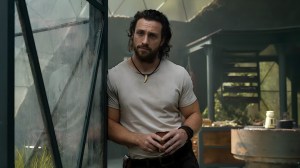 As the final piece of Sony’s Spider-Man villain spinoff universe, Kraven the Hunter brings this diversionary superhero franchise to a merciful end. The frustrating thing is that Kraven as a character can work, as recently demonstrated in the popular Spider-Man PlayStation video game sequel. He’s supposed to be the ultimate hunter, a force of nature, but that doesn’t mean he needs to carry his own movie, just like Morbius or Madame Web or any other Spidey villain. Launching these characters could have worked but needed much more imagination and care. Instead, it was Spider-Man movies without Spider-Man and, with the exception of the Venom movies with their goofy buddy movie appeal, audiences have responded with the indifference you would assume. It’s not enough for these movies to merely be adjacent to Spider-Man to be appealing. They need to be good, to be able to stand on their own, and to support an extended time with this character. It’s hard not to see the larger machinations for eager franchise-extension as the primary motivation. But if these are the impressions of the characters we’re getting, who would want any more? Turns out nobody was actively cravin’ another underdeveloped and mediocre superhero movie.
Nate’s Grade: C-
Share this:

Deepwater Horizon (2016)
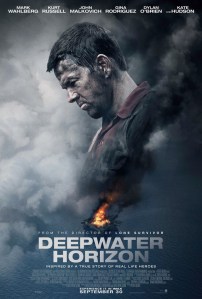 Peter Berg is becoming the go-to director for inspirational true-life thrillers following the heroic exploits of everyday Americans thrust into danger. It began with Lone Survivor, it will continue this year with the Boston bombing drama Patriot’s Day, and in between there is Deepwater Horizon about the oil rig drillers and the culminating explosion that lead to the worst environmental disaster in U.S. history. It’s a sober and reverent movie, with Berg and his screenwriters taking great care to educate the audience on the science of drilling, the technology, the geography of the floating rig, and just exactly why things went as badly as they did that fateful night. The windup lasts about half the movie but that’s because when the explosion hits there isn’t much plot left (the movie is barely 100 minutes). Deepwater Horizon becomes a full-tilt disaster movie by that point with Mark Wahlberg stalking hallways and looking for injured survivors. The tension prior to the blown pipeline can get genuinely powerful, and the action that follows is suitably rousing as the rig resembles a snapshot of hell. Flames and heat consume the rig and escape seems nigh impossible. The sound design is sensational. The characters are mostly stock roles, with Wahlberg as our blue-collar everyman, Kurt Russell as the irritable boss fighting for his workers, and John Malkovich as the villainous penny-pinching BP representative. Malkovich’s campy performance almost needs to be seen to be believed. It’s like he’s visiting from another planet, the garbled Cajun representative. The lack of politics and curiously narrow focus (nothing about Halliburton, nothing about BP consequences, no environmental effects) does hamper any greater impact the film could have had. It’s a respectful slice-of-life drama that humanizes some of the lives lost that day but only by keeping to formula and stock action character development. It’s like a Towering Inferno-style Hollywood disaster movie, except one that treats its subject with stiff-lipped seriousness. In this new docu-action sub-genre, Berg and Wahlberg are kings.
Nate’s Grade: B
Share this:

All is Lost (2013)
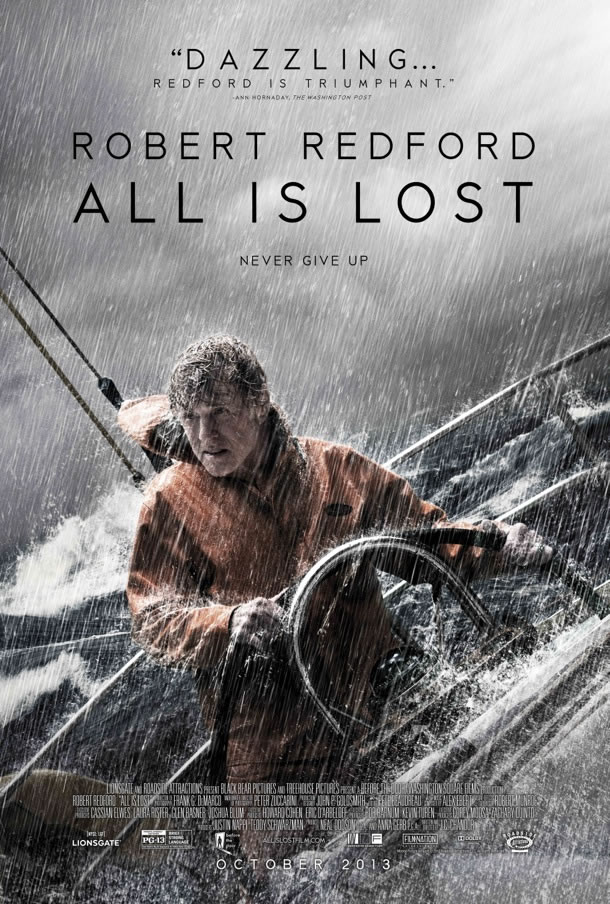 J.C. Chandor, nominated for an Oscar for writing Margin Call, chose a curious follow-up. In All is Lost, Chandor serves as writer/director and takes acting legend Robert Redford, strands him in the middle of the ocean, and watches him flounder. Considering Margin Call was heavily dialogue-driven, it’s an interesting detour to a nearly wordless film. Redford plays an older sea-faring gentleman who discovers one morning that his boat has been damaged by a floating shipping container. He has to repair the hole and take inventory of his remaining supplies. As his boat takes on more water, being battered by storms, Redford must strive to reach a shipping lane as his best bet to be rescued.
 Allow me to furor my brow at the reception All is Lost has gotten thus far. It’s not a bad movie but when you boil it down it’s a rendition of The Old Man and the Sea minus, you know, the giant fish. I knew going in that the film was going to be minimalist, but I didn’t think it would be this dull. It is literally a guy manning a boat for 90 minutes, patching things up, with the situation getting worse. Then he’s in a raft. Then he’s low on supplies. Then, well, it ends pretty much how you’d expect though with a flicker of ambiguity for the squeamish. The drama of human survival, of man against nature, can be plenty invigorating, but instead Chandor takes a more leisurely and studiously pessimistic approach, and so we watch Redford slowly fail. The filmmaking can barely keep your interest. He hoists the sale. He tends a hole in his boat. He salvages electronics. There are a couple of choppy storms that throw the ship around, but The Perfect Storm this isn’t. Nor is it Open Water. There is a certain brainy enjoyment from survival thrillers, thinking alongside the characters, but our opportunities are absent here unless you know a thing or two about sailing, otherwise I just kept thinking, “fix the hole in your boat.” It takes a good while, until the third act when Redford is forced to abandon his sinking vessel, before the perilous reality seems to settle in. Beforehand it feels like the film is dawdling, and I just found myself shrugging and growing restless. It feels callow of me to complain that not enough happens onscreen when I’m watching a man struggle to survive at sea, but that’s because the sense of urgency is nil. I watched Redford eat beans out of a can more than I saw him sweat over his predicament. I wish Redford had been paired with a tiger or a volleyball for decent screen company.
This is very much a one-man show with Redford ably holding the screen, but will you care about his character and his plight? The character is nonexistent, far more so than the similar charge against the other awards-friendly survival thriller, Gravity. I always felt like I was observing Redford from a distance, never fully emotionally engaged, and more so just studying his survival skills like there might be a test later. That’s because Redford serves as a metaphorical stand-in for all of humanity (the character’s listed name is “Our Man”); the movie feels replete with allegory, which makes the tedium all the more unbearable for me. I didn’t feel the man’s horror or nerves or despair or urgency. I didn’t feel much of anything. That’s because I believe that Redford’s acting history is meant to fill in for the absence of character. We’re not watching any man brave the dangers of the ocean, we’re watching the aging Hollywood screen idol dig into his own screen history and showcase what remains. It’s a fine performance that kept me watching but it felt too modulated, too controlled, too internalized to translate the myriad of emotions necessary. It’s 90 minutes of Redford standing in for himself standing in for humanity, named “Our Guy,” remember. That already sounds laborious.
 Chandor received notoriety for his smart, hard-hitting Mamet-esque dialogue, and deft handling of actors, but All is Lost showcases a whole other set of skills in his storyteller toolbox. Being nearly wordless, the movie is one giant exercise in visual storytelling. Chandor’s camera angles, editing, and in particular the use of sound and lighting, keep the audience oriented smoothly. While it may take a moment to gauge what Redford is doing, there is a logical connection to his actions. There’s a visual mastery here that was not even hinted at with Margin Call, which was mostly a stage play of boardroom conversations put on film. The special effects are seamlessly integrated into the film and having Redford perform many of his own stunts adds to the overall verisimilitude, the film’s calling card. I feel like Chandor the director outdid Chandor the writer.
All is Lost is a film I can better respect than support, an intellectual exercise in a deteriorating and seemingly doomed survival scenario, the anti-Cast Away. It’s probably as realistic as these things get, but does that make it interesting? The details of reality are there but the story and especially the character work is lagging. It’s nice to see Redford with such a meaty part, and obviously one he is connecting with, but I wish his talents were put to greater non-metaphorical purposes. With the plot and characterization stripped, it appears that Chandor’s film is rife for allegorical analysis, noting the struggle in the face of overwhelming odds, the futility of existence, etc. To me, that sounds like you’re doing the movie’s work for it. The overall lack of urgency just wrings out what entertainment there could have been with this tale of survival. When your main character doesn’t recognize the threat, then that transfers to the audience, and we too shrug. All is Lost is certainly well made from a technical standpoint, with Chandor showing impressive visual storytelling prowess, but it drags and offers little incentive to connect. What ends up being lost is your patience and attention.
Nate’s Grade: B-
Share this:

Margin Call (2011)
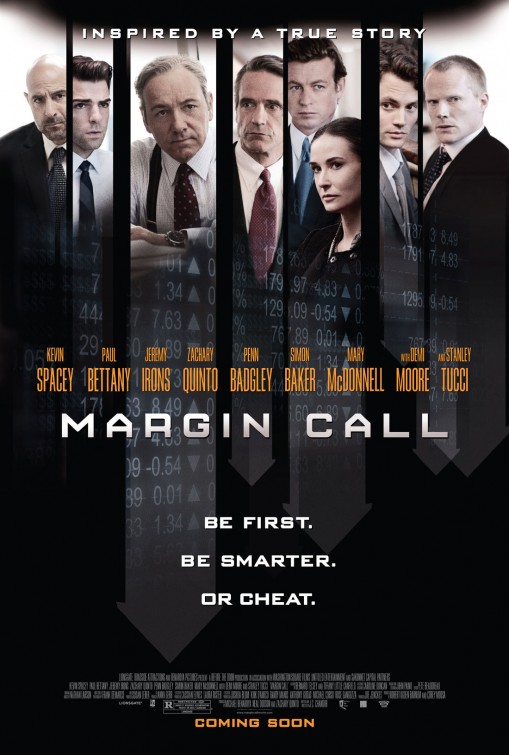 Set during the first twenty-four hours of the 2008 economic meltdown, Margin Call feels like David Mamet’s classic play Glengarry Glen Ross just set fifty floors higher. It’s a tense stew of ego and hubris and cunning and manipulation and self-preservation, peppered with some salty language. The corporate bigwigs of a fictional financial firm scramble to get out the door first before everyone else catches on to the looming market crash. “There are three ways to make a living in this business: be first, be smarter, or cheat,” says the CEO (Jeremy Irons). Debut writer/director J.C. Chandor brilliantly captures the rationalization of sociopathic greed; the CEO waxes about the historical inevitability of our own self-destructive influences, glibly recounting other market crashes and saying he will survive because the nation’s class systems are fixed. The behind-the-scenes scheming has a sick appeal, witnessing how Wall Street wriggled free of responsibility. This isn’t a far-reaching look into the financial meltdown; it’s more of an insular, thoughtful, occasionally meditative play about the moral questions at play. The prosaic pacing caused quite a slew of yawns in my audience. There does seem to be a never-ending cascade of scenes where two characters will just sit and talk. However, when the writing is this sharp and the actors are all at the top of their game (Kevin Spacey is emotionally spent in a test of loyalties; Irons is charmingly sleazy), then you can forgive some stagnate pacing. Margin Call has a few heavy-handed metaphors (Spacey putting his dog down = the economy!), but overall it’s astute, insightful, sophisticated, and compelling enough to forgive its overreaches.
Nate’s Grade: B+


 nathanzoebl
You must be logged in to post a comment.