Blog Archives
Secretary (2002) [Review Re-View]

Originally released September 20, 2002:
Secretary is a new romantic comedy with a few kinks to it. It’s actually the most romantic S&M movie ever. It’s the first S&M romantic comedy since maybe Garry Marshall’s disastrous 1994 Exit to Eden. I’m still trying to get the image of Rosie O’Donnell in a bondage mask out of my ongoing nightmares.
Lee Halloway (Maggie Gyllenhaal) is fresh from a stop at a mental institution for her hazardous habit of cutting herself to feel relief. Her overbearing mother stashes the entire kitchen cutlery in a locked cabinet. The sheltered Lee resorts back to a kiddy make-up box stashed under her home bed. Instead of colorful brushes and arrays of lipstick, she has a selection of sharp objects. Lee goes job hunting to step back from her habit, and is hired as a secretary to E. Edward Gray (James Spader). He is a rigid taskmaster who delights in pointing out typographical errors with his red marker, his weapon of choice. Gray enjoys his dominance and Lee complies, even if it’s routing through garbage. He ticks away Lee’s flaws like a checklist of annoyance but also appears to have genuine concern for her. When he notices her wounds Gray confronts her and convinces Lee to stop cutting herself.
The turning point arrives when Gray orders Lee into his office one afternoon. He commands her to bend over his desk and then delivers a sound spanking. Lee stares at her purple rump with fascination, like something has been awakened inside her. Soon enough Lee purposely makes typos so she can re-assume her spanking position.
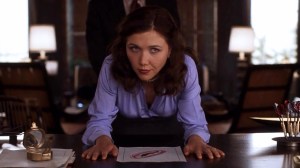 Maggie Gyllenhaal is a cinematic find with a fearless and breathtaking performance that is at once delicate, nervous, self-controlled, seductive and delightful. Gyllenhaal, with her heart-like face and pert lips, radiates star quality. She allows the audience into Lee”s head and we quickly fall in love with this peculiar yet charming heroine. If there is any justice in this world Gyllenhaal should at least get an Oscar nomination (she didn’t). Spader can do this left-of-center creepy character stuff in his sleep.
Secretary on the surface may seem like a fetish flick but it’s no different than boy (sadist) meets girl (masochist) and falls in love. Director Steven Shainberg treads carefully around serious subject matter, like Lee’s self-mutilation, to focus on these two very special characters. Secretary isn’t making any loud statements on sadomasochism or post-feminism, it’s just showing us that S&M is the route these two people take to find true love. It doesn’t judge them for their unconventional tastes and neither should we. This is one of the finest romances in recent memory and it seems to come from one of the most unlikely places.
Sadomasochism has been predominantly shown involving pain or some leather-masked madman evoking torture. Secretary may be the film that shows there can be pleasures with pain. Some people regard what Lee and Edward do as sick, perverted, or downright wrong. Secretary is a foot in the door to get people to understand what willing sadomasochism really is about. We all have fetishes and interests, and S&M is the number one fetish truth be told. This isn’t your everyday romance.
Obviously, this is a movie that will not appeal to everyone. The relationship between our leads is surprisingly complex but gentle and even sweet (if that’s the proper word for an S&M romantic comedy). Secretary shows that it truly takes different strokes and, despite an overly silly ending, is the most pleasing romance of the year. You’ll never look at red felt pens the same.
Nate’s Grade: A
——————————————————
WRITER REFLECTIONS 20 YEARS LATER

I’ll be honest with you, dear reader, because I think you deserve that. I didn’t recently re-watch Secretary. I did re-watch it a year or two ago, and the return experience was so jarring that I didn’t feel that I would greatly benefit from watching it so soon again, but I knew I would have to include it on my 2002 re-watch list when it was time. When I first watched it in 2002, I was smitten with its offbeat charms about an unconventional romance through the BDSM community and a young woman’s self-actualization through accepting her kinks. It was a star-making performance from Maggie Gyllenhaal (originally was going to be Gwyneth Paltrow) and as a sucker for quirky romances, it was one of my favorite films of the year. Nearly two decades later, I took out my DVD copy to share with my now fiancé, who is also a fan of quirky romances and who had never watched Secretary. Surely, I thought, she would be entertained. Dear reader, she was very not entertained. She was horrified. She was shaking with disgust. She was having a literal violent reaction to the movie and its onscreen display of what constituted romance, and I will say it struck me differently too. I understand that not every film will age well, as our sense of what is funny or acceptable or what is even compelling will change over time as our culture inevitably shifts. That’s art. But hoo boy has Secretary aged about as well as milk in the ensuing twenty years.
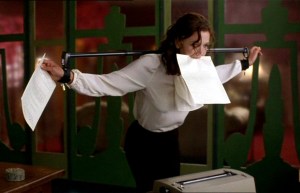 The very nature of the S&M relationship between boss and secretary was already problematic when it was released in 2002, but in a post-Me Too universe it is inexcusable and taints any charms the movie may have had. Mr. Grey (James Spader), the dominant boss and rigid stickler for rules, is the villain of the movie and not its Byronic hero, the brooding and damaged man that a pure-hearted woman just needs to find a magical way to reach and reform. He is not romantic. He is appalling, and the early critical praise, myself included, excused far too much of his behavior. While not condoning his excesses, critics may have given more leeway because the end result was framed as a happy ending, with Lee (Gyllenhaal) being cared for by Mr. Grey. However, he completely uses his position of authority in many inappropriate manners, and while they do develop a mutual relationship, eventually, the power dynamic is not equal at all. This takes away the agency of Lee and makes the romance feel like a false choice. Much of her relationship can be summarized by the awful moment he ejaculates on her back: she just has to take whatever he dishes and like it. That’s not romantic. That’s not cute. That’s toxic. It also hurts the overall movie that the way Lee proves her devotion as the film’s climax is to stay fixed at her boss’ desk for many days, to the detriment of her physical health. Yes, Mr. Grey gets Lee to kick her habit of self-harming but she replaces one need with another. He resembles a predator by most every definition, and to try and say, “Well, he’s just complicated,” is bad man excuse-making.
I tried imagining tweaks and alterations that could make this all work, but anything where he is her boss muddies the issue of consent. Maybe if he was a visiting businessman, but that would also offer a questionable dynamic. The core of Secretary is built upon the secretary/boss interplay and imagery. The tagline is, “Assume the position,” and depending upon the poster, you might only get a woman’s rear in fishnets as the sole imagery. Director Steven Shainberg (Fur) and screenwriter Erin Cressida Wilson (Chloe, The Girl on the Train) are clearly veering into the obvious office power dynamics for provocation. They are very intentional about subverting romantic clichés and looking for something different for our heroine. We have a nice guy, played with squirmy energy by Jeremy Davies, who just won’t cut it. He’s too vanilla for her and afraid to be too forceful in his spanking. It’s like the filmmakers are declaring that Lee demands more, and her specific combination of qualities just so happens to align with this gross man. The movie wants us to hold our judgment, and I could in 2002 in a “love is love” declaration, but what I see on-screen in 2022 is not indicative of love. It’s obsession. It’s codependency. It’s sad.
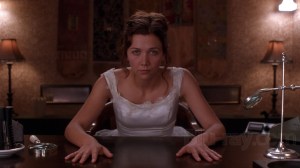 The other problem, sadly, is Maggie Gyllenhaal’s fragile performance. The choices she makes collapse Lee, greatly infantilizing her and magnifying all the icky feelings I had. She’s playing Lee less like an adult woman who is struggling to figure out her confusing life, and impulses, and more like a teenager who woke up in the body of an adult woman. Part of this is the screenplay but it’s not helped by the acting choices that Gyllenhaal engages with. I do really enjoy her as an actress, and it’s easy to see why she could captivate so many circa 2002 with this performance, but it plays so differently now. Today, she comes across as another young woman trying to remodel herself to please a man. Her little girl acting choices only make the courtship feel even more abhorrent. I wonder if they were trying to aim for the movie to be its own kinky fable, wherein the infantilization would harken back to older fairy tale tropes and Mr. Grey as the unorthodox knight in shining armor.
This is one of the biggest critical swings I’ve had since re-watching twenty-year-old movies and my initial reviews, and I’d say even one of my biggest changes on any movie I’ve watched. I do think you can make a funny and sexy S&M rom-com; for years I thought Secretary was it. Not so. I wouldn’t even recommend this movie and it used to be in my top of 2002. I suppose people who are curious could give it a chance, but I think the objections outweigh whatever positives can be gained from viewing. Oh well. That’s the nature of art. Not every movie or book or song will have the same power over time. They stay the same but we, the prism upon which art is judged and related, are constantly in flux. That’s just the way it is. This won’t be the last movie where my opinion changes dramatically. I just won’t watch Secretary again, and that’s okay.
And you’ll never be able to convince me that E.L. James didn’t take her BDSM character’s name from this film.
Re-View Grade: D
Share this:

Licorice Pizza (2021)
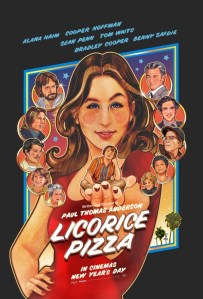
It took me many months but I’ve finally watched the last of the 2021 Best Picture nominees, and now I can safely say, I just don’t understand all the love for Licorice Pizza. It’s writer/director Paul Thomas Anderson’s (Phantom Thread, Boogie Nights) nostalgic L.A. hangout movie, but the axiom of hangout movies is that they only really work if you actually want to hang out with the participants. I’m not certain I needed or wanted to watch either of our lead characters navigate the curious bounds of their possible romantic entanglement. Alana Haim plays Alana, an under-achieving 25-year-old looking to better define herself, and Cooper Hoffman, son of the late Phillip Seymour Hoffman, who appeared in five prior PTA movies, plays an over-achieving 15-year-old that is in a hurry to grow up and conquer the adult world. He’s crushing on her, she’s flattered but says it’s not appropriate, and over two hours we watch a series of meandering episodic adventures that test their will-they-won’t-they determination. I found Haim’s character to be generally unlikable and, worse, uninteresting. She’s petulant, needling, prone to jealousy but also clearly likes the attention but doesn’t know how far to test it. Hoffman’s character, based in part on Tom Hanks’ childhood friend and producing partner Gary Goetzman, is like a human puppy dog, so overwhelming and sunny and anxious to be liked, but I can’t see any more depth to him or her. They’re just kind of annoying and maybe that’s the point about looking back. I don’t see the larger thesis or theme in many of Anderson’s small and unfunny asides. He’s trying so delicately to recreate a feeling of time and place of early 1970s Los Angeles, but the movie doesn’t succeed in answering why anyone else should really care about this personal PTA slice of nostalgia. The best part of the movie, by far, is the segment where Bradley Cooper plays the lascivious and self-absorbed hairdresser-turned-producer John Peters. Too many of the other misadventures feel like table anecdotes brought to overextended life with technical pizazz and minimal emotional accessibility. Licorice Pizza left me cold and unfulfilled.
Nate’s Grade: C+
Share this:

River Road (2022)
 I was asked to review River Road by an Ohio producer, although he is the lone Ohio connection and it was filmed in British Columbia, so it doesn’t exactly count as an official Ohio indie. It’s written and directed by Rob Willey, a Canadian commercial and music video director with one previous feature credit, 2016’s Dark Cove, a horror thriller with a budget of only $25,000. Willey is definitely a talented visual stylist, that much is apparent from watching clips of his shorts or the trailers for his movies. He sure makes a pretty picture. My issue with River Road as a drama is that the plot, characterization, and structure felt not nearly on par with the alluring visuals.
Travis (Cody Kearsley, Daybreak) is a Vancouver guitarist living a wild life of drugs, sex, and rock and roll. He meets Zoe (Lexi Redman) at his journaling spot while he’s luxuriating at a friend’s home on the eponymous River Road. She’s an American visiting a friend and over the course of a party they hook up in more ways than one. Zoe’s cocaine ends up being heroin and now both become inexorably tied together, two addicts sinking lower and relying upon one another for support. Travis empties his bank account, sells his belongings, including his prized guitar, and then considers increasingly risky crime to be able to afford more drugs. This brings him and Zoe to their most dangerous option: robbing local drug lord, Fresno (Steven Roberts), and making a very bad man a very clear enemy who will want very real and violent vengeance.
 In short, I found these characters to be insufferable. This is billed as a crime movie but it’s really more of an addiction narrative following the descent of two people into more desperate and self-destructive behavior. As an addiction narrative, it’s best to start with some tangible semblance of what the “before times” are like so we have a baseline to contrast with the damaging effects of drug abuse. If we followed a story about a deranged homeless man with alcoholism who suddenly started using crack, that’s not enough of a dramatic contrast to effect much added drama and tension. This is the first error of River Road. Our introduction to Travis is that he’s a traveling hedonist, playing in a rock band and going through women like water. He has a montage about “getting clean” after the band’s last tour but this literally lasts minutes before he’s right back to snorting cocaine at the local parties (maybe we have different definitions of “clean”). With Zoe, we have one meet-cute first encounter, and then she’s already at the same party snorting cocaine and introducing Travis to heroin. This all happens fifteen minutes into the movie, so not enough time to effectively establish a “before” phase, but Willey errs by failing to give us more to either Travis or Zoe as characters. They were vague before and now, for the next hour, they will be defined by the depths of their addiction. However, I was never emotionally engaged with either of them so I found much of their rather redundant wallowing to be tedious and, shocking, failing to provide further needed characterization.
My engagement was also hampered by much of the clunky and inauthentic dialogue. When people speak, you don’t really feel like you’re learning much about them; it’s like empty air unless they’re directly expositing what is, by all other means, unclear. Travis says, via helpful future narration, that he never met someone “so alive” like Zoe and he was won over by her sense of humor. I shook my head and wondered where the evidence for this was, because the previous twenty minutes did not establish either of these aspects. The dialogue often falls into being redundant or exceedingly expository. We’re told Zoe has a great sense of humor, but where did we see it? We’re told this romance was electric, but where did we see it? The conclusions are being dictated to us rather than shared and earned. And then paradoxically we’re given scenes where characters will talk in circles but just hit the same note into oblivion. I found every scene with music producer Cash Dirty (Sunee Dhaliwal) to be excruciatingly long and unnecessary. I think he’s supposed to be “comic relief” but he’s just a more verbose version of most of the men, trading in the same levels of hedonism and casual misogyny. The big villain likes to keep taking but it’s the same improv note with too much time to fill. I’ve seen this kind of haphazard writing before in other indies that confuse “authenticity” with uninteresting and bland dialogue.
 If you’re making an addiction movie you chiefly go one of two tonal routes: tragedy or immersion. Naturally, you can combine the two like Requiem for a Dream, but usually a filmmaker wants you to feel an emotional connection or a vicarious immersion with an overload of style. So, if you’re falling short from a characterization standpoint you can at least provide a satisfying array of style to bring to haunting visual and auditory life what the addiction process is like. I suppose one could argue that depictions of addiction without even the attempted integrity of characters and drama is simply cheap exploitation, and that can be true. With River Road, the characters don’t cut it to supply the tragedy. It’s just not there. I think it was another screenwriting error to provide not one but two framing devices, Travis and Zoe each narrating from the future when they’ve both gotten some form of treatment or help. I understand why this would be appealing to Willey because you can immediately plug into a scene of the past and cut to the character literally explaining, via voice over, what they were thinking at any moment. The problem with this is that the insight of these future narrators is pretty deficient. We don’t need future Zoe to tell us such obvious statements like “once you’re high there is no pain, there are no worries.” I think we understood that through the serene expressions on their faces, plus the general nature of drugs. They’re appealing for a reason. The other problem is that having both of our participants in this doomed love story as future storytellers means they won’t die. It eases some of the tension of its more fraught Act Three when they begin their dangerous decisions.
There’s also a misplaced twist at the one-hour mark that I find absolutely self-defeating, but to explain further will require some spoilers, so if you want to remain pure dear reader, skip to the next paragraph. From the fifteen-minute mark until the one-hour mark, we’re beset with redundant scenes of Zoe and Travis getting high, wandering around, being happy, and then being mopey during their withdrawal times, which shockingly don’t take up more time. It’s awkward to watch Travis mess up recording his guitar part for a song, and this is one of the few instances where we at least get a semblance of personal before/after contrast, but how many stagnant scenes do we need of people getting high, then begging people for money, then getting high again? This descent into debauchery doesn’t feel like we’ve regressed too far. Then at the one-hour mark the twist detonates that Zoe… actually knew about Travis when she saw his band perform in New York City. She stalked him online and followed him and planned her “chance meeting,” and my response was to merely shrug. So what? What does this twist do for the narrative? They were addicted to heroin before the first act was finished, so what does her being a stalker change with their current addiction crisis? After he demands she leave, Zoe comes back, and it’s as if this weird twist never happened for all its minimal impact. Travis does get to scream that Zoe hooked him on heroin on purpose, to try and control him, but, again, this is not evident with what we’ve seen onscreen. Also again, what does it matter? They’re stuck now. The manipulative woman trope, added onto the crazy groupie trope, is tacky, though I don’t know if we’re supposed to adopt Travis’ assessment when he learns the real truth. If this twist were going to be effective, we needed a lot more work done with Zoe’s characterization, with more time spent establishing a clear persona before the drugs became the dominant force. As it’s written, the twist plays like, “Hey, that vague girl who got addicted to drugs really quickly had maybe some other motives while she was vague.” You can’t earn that Gone Girl-style twist without putting in the proper time and effort for the rug pulling to genuinely upend the viewer.
 From a technical standpoint, River Road is a slick-looking movie with moody, neon-drenched cinematography and an atmospheric and evocative film score, both done by Willey (he also edited and produced too). There are some fantastic visual compositions here and that’s where I think Willey has his true passion. The movie makes extensive use of montage where you can tell the shot composition and arrangement and editing are just much more ambitious. It almost feels like the drug montages and time lapse montages were what Willey enjoyed making the most. In contrast, the scenes of characters talking have less appealing composition, often relying upon a stifling shot-reverse shot rhythm where each person is left in a single shot. After a while, the discerning viewer can start to categorize the scenes that Willey prioritized more. Every filmmaker invariably does this to some degree; it’s just more apparent with River Road. The drug use sequences are entrancing, like the first taste of heroin leading to Zoe and Travis losing one another in the cosmos with snow falling on them being overlapped. I’m surprised we don’t have more visual sequences trying to convey the highs. Much of the scenes after this initial jolt are watching people close their eyes and nod in contentment. The editing in the montages is also smooth and seamlessly melting from shot to shot with ease. There are other scenes where the editing gets less prioritized as well. A scene where Zoe is laying perpendicular across Travis’ stomach kept cutting at sharp forty-five-degree angles that it ruined the flow of the scene. Likewise, a climactic foot chase is hampered from edits where the proximity is hard to judge. We needed more shots of Person A being seen with Person B. Without, or without clear markers to denote progression of the chase, it’s a jumble of frantic images without forming an important visual continuity.
River Road is a production where I would recommend just about every element with one big exception, the storytelling. I don’t blame the technicians nor the actors. It’s the screenplay that doesn’t know what to do with its 85 minutes, the wasted and redundant characterization, and the shrug-worthy climax (why do I care about an ultimate showdown between the big bad dealer and the guy who Travis works with at the gym?) that mitigate the other shining qualities. I think Willey is a filmmaker with some serious chops but maybe defer on the screenwriting next time.
Nate’s Grade: C
Share this:

Adeline (2022)
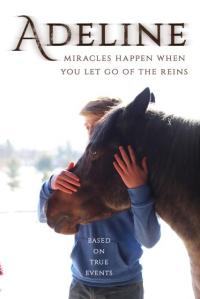 The story behind Greg James, the filmmaker from Ohio, is surprisingly tied to, of all things, dodgeball. In 2004, the movie Dodgeball: A True Underdog Story was released and grossed $168 million worldwide, but there were two legal challenges accusing copyright violation to writer/director Rawson Marshall Thurber, and both have central Ohio connections. The first was by writers Ernando Ashoka Thomas and David Price, a Bexley, Ohio native that put his own experiences as an adult dodgeball tournament organizer into the script. Where things get interesting is that this other script, entitled Dodgeball: The Movie, was passed along in March 2001 to Shaun Redick, who worked for an agency and was friends with Thurber. This was one month before Thurber finished and registered his draft of his dodgeball screenplay. During the copyright lawsuit in 2005, a judge determined that a jury might “reasonably infer” that Thurber had access to the other dodgeball screenplay via Redick. There were other similarities between the two scripts that appear to be more than just formula and genre trappings, like both featuring a wheelchair-bound former dodgeball champion who becomes a coach and dies in a freak accident midway through before the big game but then reappears as a ghost to cheer them on.
The second and lesser-known suit was for authorship of that other dodgeball script, and that’s where James comes in. He and Thomas worked together under the YNOT production company they founded. They directed and produced a movie in 2001, Raw Fish, that Thomas wrote. Afterwards, in 2001, Thomas was working on the dodgeball script and James claims he was a co-author (Price was not listed as co-author until 2004 in screenplay registration). Thomas listed himself as the sole author on all the drafts he copyrighted and shared, and because James did not assert his copyright dispute until 2005, the statute of limitations ran out. James said that Thomas removed James’ name from the cover page before submitting the draft but never inquired further because he trusted his would-be partner. Lacking proof of collusion, and beyond the three-year window, James’ case was dismissed. The suit with Thomas and Price against Fox was later settled for an undisclosed sum, and James was left with nothing.
 James returned to Columbus after 25 years in L.A. and was inspired to make a local story into a feel-good family film that could inspire others. Adeline is based on a horse at Serendipity Stables that provided therapeutic care for children with disabilities and those on the spectrum. In 2002, a tornado struck and Adeline reportedly held people against a barn wall to protect them rather than running away from danger. The horse’s bravery was rewarded by locals donating over $15,000 to allow Adeline to receive life-saving surgery (Adeline lived another three years). Adeline is James’ homecoming, and it’s sweet and slickly produced to look like any number of other faith-based inspirational family films, and that’s also its problem, if you find that to be a problem.
In a small Ohio town, Kay (Jane Mowder) moves onto a horse ranch and her presence changes everything. Bethany (Orli Gottesman) is running from foster home to foster home for setting fires, but one encounter with Adeline the horse and she’s rethinking her pyromania. The town preacher John (David Chokachi) and his wife Terry (Erin Bethea) have an autistic son who takes a shine to Adeline and actually speaks. John is skeptical and worries putting faith into Kay and her holistic solutions will lead to another disappointment. He challenges his parishioners to not lose sight of where to place their faith, and then the big tornado comes twistin’ through.
 If you’re fans of sweet feel-good movies, Adeline will likely hit most of what you’re looking for, but I found the central idea a little too simplistic to the point of incredulity. In short, this is a magic horse. This is the only conclusion I must derive from what I see onscreen. I love animals. I always have. As my fiancé would attest, they flock to me. With that being said, I have a problem with animal movies because too many of them feel lazily projected onto the animal as its symbol. I had this same feeling with the 2020 inexplicably Oscar-winning My Octopus Teacher: “Does this octopus really see this man in a snorkel as a friend or an ally? She reaches out a tentacle to touch the appendage of this underwater man, but what does that mean? Is this signaling a friendship or is it merely signaling an animal taking stock of its surroundings? I don’t know and depending upon your personal relationship with the animal world, you will either accept everything [this man] says at face value without skepticism or you will see him as a slightly foolish romantic.” Adeline is such a magic horse that all it takes is Bethany looking once into her eyes to break her free from her fire-setting impulses. Adeline is such a magic horse that all it takes is a couple of rides and the preacher’s autistic son is now talking. This horse is spoken about in such grandiose terms and yet the screenplay by Sam Lewis doesn’t make the horse a character, which can be done for animals (see: Seabiscuit). The problem is that if effort is not put into giving the horse something, then the horse is merely a plot device for easy miracles. It might as well have been a magic couch whereupon every sit heals thy sitter. Given this horse’s track record, I’m surprised the town didn’t trot Adeline into their office to fix any budget shortfall. I know this is based on a true story, and I’m being more than a little facetious, but we need more from the drama than “Person A nuzzles horse or rides horse. Person A is now better. Repeat.”
Where the movie seems to want to go is the idea of alternate routes of healing, and this has dramatic potential that’s never fully realized. Much of the conflict revolves around John being skeptical and unwilling to see the benefit of the horse. His job asks him to put his faith in God and not a horse. He’s also hurting because of the frustrations with raising a non-verbal autistic child that he has difficulty communicating and connecting with. At one point, he even says he blames God for cursing his family (yikes). It looks like Adeline is going to be a conflict between traditional faith and alternative healing, an Old School versus New Age kind of battle. It appears that John might even feel threatened by the horse, like his parishioners will start looking to the special horse for answers and healing rather than their local minister. Does he feel threatened? Does he think his authority is being challenged by the horse or by God? Had the script really explored this personal crisis it could have made for an interesting character study about belief systems in conflict. Instead, it mostly plays as John being the most stubborn man who has to be the last one to accept the gift of Adeline. Lacking that depth, it means we’re just waiting for John to finally come around to the obvious, and it can be a frustrating waiting game. Even after the horse protects a dozen people from a tornado, David still pushes back. He even lays out a theory that since the horse farm was the only one hit by the tornado that God must disapprove (people literally groan and walk out of church in disgust after he proposes this theory). I think re-centering the movie on one man’s crisis of faith, accelerated by already feeling shaken from his son’s diagnosis, would be the smarter storytelling foundation rather than making the horse the magic new neighbor.
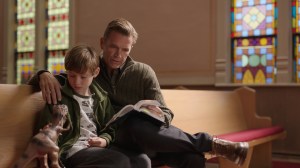 The story has too many characters and subplots that don’t get enough attention, but at the same time Adeline benefits from a pacing standpoint by having more stories to switch over. The Bethany storyline could have been its own movie but she feels more like Exhibit A for the miraculous potential of the horse. We’re told that she can’t stop starting fires and bounces from foster home to foster home, and all of a sudden Kay agrees to adopt her on the spot, and why not if all it takes is one encounter with Adeline to prove curative for Bethany’s troubles? Because this conflict is amazingly resolved so quickly, we have to add the extra conflict of the town teenagers bullying Bethany for her past, though this is comprised to one scene where the kid she may or may not have a crush on, Jason (Jake Satow), stands up for her and punches the lead bully. This is the end of Bethany being picked on for her past. Having an outcast character in a small town is a good viewpoint and a natural source of conflict going up against community expectations. Unfortunately, Bethany is just treated like a testimonial. Likewise, the autistic child is merely a plot device, and the script then transforms Terry into little more than a pleading support network. She wants her husband to acknowledge the healing power of the horse. That’s about it. She’s the sweetly smiling, eyes-glistening “why won’t you see?” figure in these kinds of movies. I think the character that suffers the most is Kay. She doesn’t feel like a person but yet more of a plot device. She stirs up the status quo, and she has a mysterious past, and yet she’s just deliverer of miracles without further dimension.
Even though its budget was half a million dollars, Adeline looks and sounds like a professional movie that would ably fill the scheduling slots of a Hallmark or Christian TV network. The cinematography by Dan Parsons (Treasure Lies) is rich and autumnal in its color palate, and the use of dappled lighting and depth of field visual arrangements helps add an extra pleasing cinematic quality to the movie. The score is also quite nice by Erik Schroeder, a man with over 100 scoring titles to his name. It’s pleasant and twinkly without overwhelming the emotions on screen. The special effects with the tornado and its destructive wake are quite good for the budget. The acting is above average too. Mowder (Foxcatcher) is dignified, Chokachi (Baywatch) is perfectly flummoxed, Bethea (Fireproof) is winsome, and Gottesman (1-800-HOT-NITE) has a natural presence that makes me think she has even bigger opportunities on the horizon. Plus, there’s the always enjoyable Ralph Scott (Double Walker) as John’s unflappable friend and soothing voice of reason.
 There is plenty to enjoy with Adeline. It’s a passion project where you can feel the affection of everyone, and James has an invisible ease behind the camera. The acting and technical merits are solid and the pacing keeps things moving smoothly. Where Adeline frustrated me is with its screenplay that settled too often on its staid formula. We’ve seen these kinds of movies before and Adeline rests upon that familiarity a little too often for me. Genre fans will find enough to satisfy them, and everything is kept at such a family-friendly level of nice (even the disagreements are short and never more than G-rated) that is wholesome without feeling overly maudlin. I think the screenplay could have done much more with its pieces, but my opinion is going to be a minority for the movie’s target audience. Adeline is a nice movie about good people experiencing good tidings and will leave many people feeling, mostly, good.
Nate’s Grade: C
Share this:

A Story for Winter (2021)
 Writer/director Nathan Weidner is a local teacher at Canal Winchester schools where he teaches video production and French. The 54-year-old has made two other movies before, both of which available on YouTube, but it’s clear that A Story for Winter is his passion project. The man wrote the first draft in 2009 and was rewriting it for over a decade. It’s inspired upon his own real-life family tragedy. Weidner’s daughter Meah was born in 1988 with cerebral palsy. She was non-verbal and Weidner said he always wondered what she could be imagining. The movie’s end is even dedicated to her with archival footage. Sadly, Meah was taken tragically when her mother’s new boyfriend shook her too violently (he is now serving a life sentence). In the summer of 2021, Weidner gathered former high school students, a budget of $3000, and his iPhone 12, and over the course of 15 August days he made his movie. Weidner was the photographer, editor, producer, and even wrote and performed a mournful song in the movie. A Story for Winter is currently available on Amazon and is a clear labor for love for Weidner and everyone involved wanting to see this through. Their intentions are pure and lovely. I wish the final movie was a bit more focused to better tap into its accessible emotions.
Dr. Owen Hughes (Adam Ashton Scott) is the new small-town Ohio doctor after his 80-year-old predecessor kicks the bucket. He’s chaffing under adapting to the new position, and he insists he will not see children for medical consultation. He freaks out when his newly eloped wife, Connie (Allison Kuck), even suggests they could have a child. His chilly stance begins to soften when he meets Winter (Chloe Gardner), an ailing child in town with cerebral palsy who was abandoned by her drug-addict parents. She’s being taken care of by the kindly Cora Preston (Cynthia Smith) who has opened her home to many foster children, most of whom have some form of special needs. She recognizes that Winter will not be long for this world but that doesn’t mean the life she has remaining cannot still have its rewards. As her condition worsens, Dr. Hughes opens himself up by telling allegorical fantasy stories to Winter about his own troubled family history.
 The first thing you have to acknowledge with A Story for Winter are its technical and professional limitations. It’s unfair to complain too much about obvious limitations of time and budget. You’ll notice that there is very little editing coverage or camera movement in the movie. Until the late narration-heavy fantasies, just about every shot is stationary. Characters will often talk directly in front of one another and the edits primarily feature a shot-reverse shot rhythm that feels born out of necessity than creative vision. The excuse of the newly moved couple explains the sparse nature of the home furnishings. However, there are some budgetary choices that made me scratch my head that could have been avoided. The setting is around Christmas to slot the movie as one of those feel-good holiday movies, a thriving industry unto itself. There are some references to Christmas as a theme of giving and blessings but it’s more a superficial connection, so I think the story could have stood on its own minus the holly jolly. Regardless, it’s a snowy Christmas season that keeps several characters housebound. Considering the budget and that it was filmed in the summer, I would avoid anything that would give away the unreality of the season. This movie disagrees. We see obvious green screen shots of Dr. Hughes driving in the snow. Even more befuddling, there is a plurality of exterior shots of the home except it has been rendered as a completely CGI model. It is not subtle. I kept wondering why even bother with these shots. Does it make the movie more seasonal? If so, why not use affordable stock footage or, failing that, wait until actual winter in Ohio and record thirty seconds of an establishing exterior shot of the same house but now with real snow? So even with being considerate to the limitations at hand, there are creative decisions that seem iffy.
I think many fans of sweet Hallmark movies will find A Story for Winter to be heartwarming and be inspired from its message. Characters talk about the value of human life as well as the prospect of human suffering in familiar Christian terminology. I’ve never been a big fan of “this person exists to teach you how to be a better person” as a plot device, but I can understand and sympathize with the human impulse to find larger meaning in personal tragedy. However, where the movie feels more complete, for me, on a message front is that even those who have limited times on this planet are still of value and our compassion. I’m reminded of 2016’s Arrival that hinged on a twist ending that the (six-year-old spoilers ahead) flashbacks were actually flash-forwards, and Amy Adams wasn’t mourning a past daughter but knew ahead of time that her eventual daughter would tragically die at a young age, and yet she chose to have her. For that review, I wrote, “Knowing what is to come means that a child was brought into existence to die sadly as a teenager and will suffer, but she will also live and love and laugh for many days beforehand, and knowing the end provides a lens that incentivizes every moment spent together. Yes, she will die eventually but any one of us could be snatched from the world at any moment. At least she got to know love and life for so many years before it was taken away from her.” I thought it was very nice when the movie gives Winter her voice, granted it’s through dream sequences, which means it’s Dr. Hughes’ conception of what that voice could be. I wish the movie had given her more time to express herself rather than utilize her as the key to getting Dr. Hughes to finally reveal his own family drama, though also through the lens of fantasy.
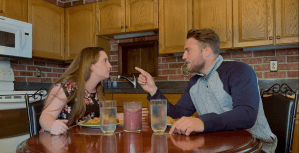 My emotional investment was stalled because of two main factors: Dr. Hughes being a jerk and having far, far too many underdeveloped subplots competing for attention. Our protagonist is a prickly person, immediately dismissive and practically disdainful of his medical practice coworkers. He’s also a jerk to his wife and makes a snide comment whenever he feels she could have been doing more to settle their home. He keeps complaining about eating on disposable plates or Styrofoam containers. Hey, buddy, you can put dishes away too. They are recently married, eloped after a year of dating, and Connie’s extended family is not too happy about it. What better way to assure her than have her marital partner is the right person for her with him being a mean jerk? He’s also actively hiding his past and hastily establishes a cover story for not explaining to her that the town sheriff (Bryce Millikin) is his “uncle.” This should all be red flags to his wife, and how he treats her makes me dislike this man even more. For half of the movie, Dr. Hughes is a jerk, and then after the hour mark, he just spills his own personal history. There are short flashback clips peppered throughout of a young Owen with his distraught, inebriated, irritable mother and his younger sister suffering from an incurable illness. It’s enough to establish why a child with a terminal ailment would affect him so, never mind just general empathy. Now, beginning with a grumpy character and watching them transform is nothing new to storytelling. Ebenezer Scrooge wasn’t exactly a nice guy either, although we got glimpses of his past self so we knew there was a core of decency that could possibly return.
The movie cannot be a character study of Dr. Hughes finding his way back from his grief and grievance. The character doesn’t have enough dimension to him because the movie is divided with so many subplots. Namely, in our 100 minutes of movie, we have: 1) fitting into a new town and sliding into the shoes of a beloved predecessor, 2) being newlyweds with his wife and the strain of their marriage, 3) caring for Winter and opening up to her, 4) the many lives of Aubrey House, 5) Connie’s family unexpectedly coming over for a Christmas gathering, 6) Dr. Hughes explaining Winter’s past through a fantasy allegory, 7) Dr. Hughes communicating with Winter through his lucid dreams, 8) Dr. Hughes sharing his own family tragedy through a fantasy allegory, and 9) Dr. Hughes coming to terms with his relationship with his mother and forgiving her. There are more aspects to each of these, and some are more prominent than others, but that’s A Story for Winter. It’s easy to see the connected tracks but the narrative could have benefited with some careful pruning to better emphasize its most essential moments.
 I don’t think much is added by keeping Connie in the dark about her husband’s past. You can still dole out the truth over time, saving the full picture for the end of your movie. It’s not like she’s seriously second-guessing her marriage, or at least we are not given a scene that expresses this doubt. I also think little is gained through the first allegorical vehicle, using the realm of children’s fantasy to explain Winter’s own past to her. The character of Winter, again through the lens of Dr. Hughes’ subconscious mind, doesn’t seem too concerned about coming to terms with her own family’s faults. Perhaps she’s meant as the starter vehicle for Dr. Hughes to then come to terms, but why go through this process twice? Revealing Dr. Hughes’ backstory is also not a mystery that I was too desperate to uncover. The movie seems to think delaying the full information will provide more dramatic catharsis, but I’m not as certain. I think uncovering Winter’s past, then dealing with it through allegory, then doing the same with Dr. Hughes, is just making things too busy. Especially when Connie, her family, and everyone else is put on literal hold during these lengthy fantasy interludes, freezing them out from further development. The only two characters the movie really examines are Winter and Dr. Hughes, so why not consolidate? Too much feels ladled on to either pad the running time, make superficial connections to holiday film staples to satisfy its presumed audience, or reflect upon Owen’s emotional journey. If the world is cultivated to better bring one man to a change of heart, then let’s give enough room for that journey to feel well-developed and organic and satisfying.
The conclusion about acceptance and, more importantly, about forgiveness is sweet and still has some dramatic points that will hit plenty of viewers. Weidner knows how to craft a workable redemption story, though much of the comedy bits are a bit stale and hokey, though that could also be a selling point for fans of Hallmark movies that view hokey comedy as comfort food. My criticisms are directed at what could help make this the improved version of the screen story. Streamlining, being less precious with our protagonist back-story, and giving more consideration and depth to Connie would have benefited the overall emotional investment and uplift.
A Story for Winter is a nice movie made by people who really wanted to see the director’s vision become a reality, something so close to home and so personal. I won’t fault the limited budget, the bland editing and shot selections, or the amateur acting by the leads. However, creativity is not dependent on money. Even with its minuscule budget, I think Weidner could have made further judicious choices to maximize the characters and story he had on the page. There are interesting characters here but they are too defined by their circumstances, thus becoming static mouthpieces about their experiences and not enough about them in the present. Maybe I’m being a seasonal Grinch, as admittedly Christmas movies are not a salve for me, so take everything with whatever caution you’d heed. A Story for Winter feels a little too beholden to its message and its feel-good holiday genre trappings to really explore the human drama at its beating heart. It’s a commendable micro-budget DIY effort with all the right intentions, though some of its storytelling choices managed to hold back my full intrigue and investment.
Nate’s Grade: C
Share this:

Men (2022)
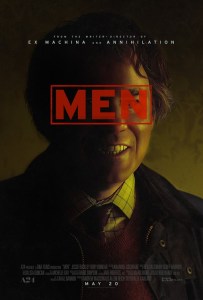 Longtime Hollywood go-to genre screenwriter Alex Garland has only directed two other movies, 2015’s Ex Machina and 2018’s Annihilation, both using the realm of science fiction to explore feminine trauma and the sea change of societies on a precipice. I loved Ex Machina and admired but didn’t fully enjoy Annihilation. His newest movie, a small-scale indie horror titled Men, lands somewhere in the middle. It’s in keeping with his other movies, following a woman named Harper (Jessie Buckley) dealing with trauma, and it’s atmospheric while still maintaining a clear point of view that could likely rub people the wrong way. It’s an uncomfortable nightmare of a horror movie and one that isn’t as deep as it appears to be.
Men accomplishes what I had been hoping with 2021’s Chaos Walking, namely portraying everyday life as a woman as a living horror movie. It’s a highly metaphorical and atmospheric movie but, at its core, it’s all about the danger, discomfort, and indignities that women endure on a near daily basis dealing with men. I don’t think the movie has as much to say on the topic or is as ambiguous as others are presenting (more on this later), but its central theme is so bracingly direct and deeply unsubtle but sometimes a sledgehammer is better than a scalpel. This is an intense movie from the start and a frequent reminder of the hazards of being female in a patriarchy. Each of the men that Harper encounters represents a different facet of toxic masculinity. The seemingly kindly priest, who places his hand on Harper’s thigh to “calm her,” is projecting guilt and blame onto her for the actions of men and views her femininity as a corrupting and tempting influence, very akin to Eve. The little boy, who likes wearing creepy masks, is a brat who refuses to accept no for an answer and turns on a dime into verbal attacks, much like the men of the Internet ready to flip at a moment’s notice. The police officer is dismissive of Harper’s account of being harassed and threatened, representing a legal arm that often downplays and diminishes women as victims. There’s even Geoffrey, who seems almost like the best man in town by default, is aloof, doesn’t understand boundaries, and is trying to present himself as a “nice guy” looking for his delayed dues. The only person in town that seems sympathetic to Harper is the one female police officer who takes her statement. Each man is played by Rory Kinnear (Our Flag Means Death) for thematic reasons. I’ve read people complain, “Why wouldn’t Harper realize this obvious similarity in the town’s men?” The answer is simple: it’s because the men do not literally all look the same. It’s meant to reflect Harper’s perspective, much like 2015’s Anomalisa where the protagonist viewed every person as looking and sounding like Tom Noonan until one unique voice cuts through the malaise and monotony. This movie is wall-to-wall with uncomfortable, seething misogyny in many forms, and given the times we live in, I wouldn’t blame any woman saying, “No thanks.” I’m glad I watched this one alone and without my now-fiance, as she would have brought this up forever as a “You made me watch…” tease.
 The flashbacks with Harper’s unstable ex-husband James (Paapa Essiedu) are the most personally illuminating and make up a significant portion of the narrative, as Harper is forced into her painful memories from her present encounters. Her husband showcases clear signs of being mentally ill and is also verbally and physically abusive to her. He greets her news about seeking a divorce by declaring that if she doesn’t take him back, he will kill himself. This emotional blackmail feels par for the course in this relationship and another sign why Harper would want out for her own well-being. The movie opens with Harper watching James fall to his death, and this trauma is what she’s processing through every male interaction. James is indicative of a kind of man that imposes demands on their partner without holding themselves to the same standards, but it goes beyond hypocrisy; it’s about a damaged person who holds another hostage with further threats of their damage. It’s a person who puts the entire onus of their existence onto another, removing their own personal responsibility, and thus blaming the convenient external party when something inevitably goes wrong. This central relationship is revisited in different ways throughout the movie, and you could even argue that Men is a metaphorical journey of Harper trying to shed herself from the weight of this disturbed dead man.
However, the real draw of Men is its allegorical nature and that is bound to rub plenty of viewers differently. The best comparison I can make is 2017’s mother!, a deeply polarizing movie from Darren Aronofsky (Black Swan, Requiem for a Dream) that completely existed as a none-too-subtle Biblical allegory as the primary plot. Usually, screenwriters will work with metaphor and allegory as subtext, adding extra depth and meaning to their storytelling. We don’t expect it to serve as the primary narrative. With Men, like mother!, it is indeed the primary narrative. I can reduce the plot down to this description: woman explores English countryside and is harassed by men of various forms. To be fair, Jaws could be reduced to “guys try to kill big shark,” so this is a little reductive. The emphasis is on exploring the experiences that Harper is enduring, her exploration of nature and seclusion that, at each turn, gets sabotaged by a man. If you’re not open to a narrative that is a little looser and more atmospheric, you’ll find the movie to be plodding and overwrought. When Act Three kicks in, the movie goes full-on into bonkers horror and isn’t even flirting with a direct correlation with reality any longer. I can safely say that some of the bizarre imagery is truly some of the strangest and grossest things I’ve ever seen in any movie. The chief symbol (toxic men begetting toxic men) is central to the icky body horror cavalcade.
 However, the movie’s allegory doesn’t lend itself to much in the way of interpretation. That’s not exactly a creative hindrance; stories can simply be what they are intended to be. Men is fairly obvious what it’s about even from the starting point of its one-word title. It’s a movie heavy in allegory but the allegory itself is also pretty unambiguous and straightforward. There may be interpretation for this symbol or that but Garland’s horror movie is pretty much thematically obvious. It all supports his theme about the horror of being a woman in modern society, magnified across a metaphorical horror movie canvas. I’m sure there will be others who go into great detail to dissect this movie but all of it seems to come to the same basic conclusion, and that’s fine.
Men is the kind of movie that almost wears out its welcome at 100 minutes. The technical merits are strong, the photography and imagery are lush and transporting, and Buckley (The Lost Daughter) is a great actress to hinge a story of mounting distress and terror. If you’re the kind of person that seeks out new cinematic avenues of nightmare fuel, then the final act and its chief monster with its distinct disfigurement will sate your morbid appetite. It’s an effective and evocative movie but it’s also the same thesis statement hammered again and again. While the movie has some perplexing moments, there isn’t much to unpack as far as meaning, and ultimately that can limit some of the play of a movie built on the engine of metaphor. It feels like a scream against the overwhelming and entrenched social forces of misogyny, and I cannot say whether it’s worth 100 minutes of squirm-inducing discomfort of art imitating all-too-real life.
Nate’s Grade: B-
Share this:

Crimes of the Future (2022)
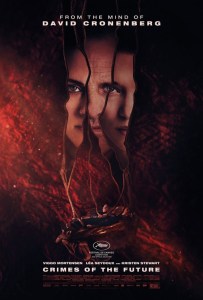 David Cronenberg returns to the thing David Cronenberg is best known for. It’s been twenty-plus years since the director has gone back to his body horror roots, and Crimes of the Future is certainly a gross gross movie. If that’s what you’re hoping for, then the discomfort and bizarre sexual analogies might be a selling point for you. For me, I just felt nauseated without an interesting core to keep my mind from drifting away. In the future, people have evolved (?) pain tolerance and infection rates, so our protagonist Saul (Viggo Mortsensen) turns surgery into public performance as his assistant/lover (Lea Seydoux) removes the vestigial organs his body produces. Kirsten Stewart’s antsy, horny character states that “surgery is the new sex,” and you’ll get plenty of parallels as we watch person after person get all squirmy while being cut open. My problem with the movie is that there isn’t anything beyond the shock value. The commentarry about body experimentation as a form of sensuality feels trite and more an opening for weird moments, like when Saul gets a zipper installed across his pelvis and his assistant decides to open it and somehow pleasure this… pouch? There’s a hint of an interesting movie here. Saul is being asked to serve as a confidential informant for the government hunting down an extremist group trying to kick-start evolution so that children will be able to consume plastics. That would have put our main character into a discovery role for this world that would have provided more than shock value. The movie begins, literally, with a child being suffocated by his mother, so that sets the tone as to where Cronenberg is headed. Crimes of the Future is essentially a geek show of a movie absent meaningful social/sexual commentary and interesting characters. It’s more a movie of pliable body parts.
Nate’s Grade: C
Share this:

Good Luck to You, Leo Grande (2022)/ Cha Cha Real Smooth (2022)
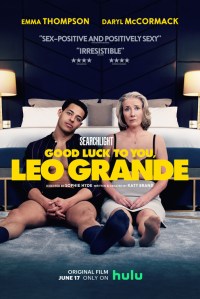 I was taken immediately and repeatedly by the many charms and intriguing personal details of Good Luck to You, Leo Grande (hence referred to as Leo Grande for the sake of my typing). This little indie played at the 2022 Sundance film festival and is primarily two people in one hotel room talking for the entirety of its 97-minute run time, and oh how early I was enraptured. This is a small-scale but laser-focused character-driven drama with edges of comedy and romance. It’s sex positive, very mature and tasteful given its subject matter, and the general awkwardness of watching two strangers combat sexual and personal hang-ups and vulnerabilities melted away thanks to the deftly superior acting, writing, and directing of those involved.
Emma Thompson plays Nancy Stokes (not her real name), a retired school teacher who worked for a parochial institution and taught Christian religion. Her husband has died and she reveals that, over the course of their thirty years together, she has never truly known physical pleasure. She seeks to change that by hiring a professional sex worker, Leo Grande (not his real name), played by Daryl McCormack. We will chart Nancy’s sexual awakening over four intimate encounters.
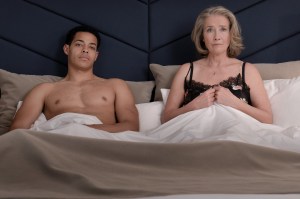 What stood out immediately to me was how well developed the story unfolds at such a natural pace. I’ve watched more than a few indies that simply don’t know what to do with their premise, that feel like they’re biding time to get to feature-length, and some that are likewise constrained to single or minimal locations but fail to secure the most essential need: providing a reason for the audience to care. Whether a movie takes place in one room or a hundred rooms, you have to make the time spent meaningful whether through compelling characters or a story that keeps you engaged and waiting for more. You need to connect to the characters or be intrigued by the revelations to come, and Leo Grande does both immediately. Its setup is rife with drama and conflict, two people navigating their relationship to physical intimacy, two people who have never met until now for a transactional evening. There are obvious, natural personal conflicts to be explored here, with the novice out of their depth in many senses. There are also plenty of intriguing possibilities, because as these two get to know one another so too are we getting to know each and getting glimpses of who each of them are outside of this room. Both people are putting on fronts of some sorts, trying to settle into a performance of who they could be, and peeling away the layers of this subterfuge becomes even more intimate and engaging. Writer Katy Brand, known for outrageous British sketch comedy, skillfully maps out the story so that each conversational stop, detour, and ramp-up feels organically composed. It takes a great writer to keep your attention from a movie about two people talking, and Brand is that good. The contrast between our characters and intimacy, from forced to unlocked, keep us glued intently.
I also think there’s an interesting generational character study here, though the film doesn’t ever make any grand pronouncements about the symbolic representation of its heroine. Nancy is over 60 and at a point where she’s used to compliments with the added qualifier of “for her age.” When she discusses her sexual history with her husband, it’s almost like a confession that she’s been unable to get off her chest for decades, an acknowledgement of her disappointment and longing. Her husband was the kind of man who would lie in bed, roll on top, and then a minute later roll off, mission accomplished (no wonder this woman has never experienced an orgasm). Talking through this embarrassment, it brings Nancy to tears, realizing she’s lived so much of her life without accessing physical pleasure, a joyful repose that so many others seem to revel in. This bold step, hiring a sex worker online, is her making a leap outside of her comfort zone, and the subsequent return engagements give her new opportunities that have eclipsed her for so long.
 In essence, this is woman who feels like she’s playing catch-up. Her character is from a generation where women didn’t make as much of a fuss about reciprocal pleasure. Her view of her aging body is one of general shame. She will repeatedly say she has no idea what she’s doing. Nancy feels like she’s been missing out for so long and wants what has been denied to her. However, she also has her own personal sexual hang-ups she’s pushing through, with decades of religious upbringing and enforcing moral codes with her students and their wardrobe choices. All of it adds up as far as her view on sex and her body. Leo asks her if she just wanted sex why not find a man in a pub and go from there, and she curtly says she doesn’t want an old man, an old man that will simply be another version of her husband, another disappointment in a lifetime of unrealized intimacy; she decidedly wants a young man. She’s indulging in her desire and a young man best represents a promise of sexual fulfillment (and she definitely doesn’t have any teacher/student fantasy, she will let you know). I think there are many more Nancy’s in the world, older women who soldiered through their lives, carrying the burdens of others while sacrificing their own pleasure, and are now at point in their lives where they are hearing more about body positivity, about female pleasure, and about being worthy of physical intimacy on their own terms and desires. Nancy is a character having a delayed sexual re-awakening; in her confession with Leo, she details her first impulse of desire when she was 17, a feeling that she hasn’t experienced as surely for the decades hence. While being a unique and well-rounded character, Nancy also serves as a representative of an older generation and perspective coming into conflict and revelation with a modern sense of intimacy and self.
Leo Grande is a smooth and charming man but one who doesn’t feel oily or like he’s obnoxiously masculine. With McCormack’s kind eyes and soothing Irish balm of a voice, it’s easy to see how this man could set others at ease. But then you also have to remember that Leo Grande is not who this man really is; it’s a character he’s playing, and as Nancy opens herself up to this man, she’s looking for him to do the same, for them to share something more special than a simple client-professional relationship. The more that Nancy pushes and pries, the more that Leo himself is pushed outside his own comfort zone. Leo is willing to talk about some things, like his frayed relationship with his mother, a point of unity with Nancy and her adult children, and his cover story of being away and working on an oil rig, an outlandish excuse that makes Nancy and eventually Leo break into laughter. By the nature of this character dynamic, Leo must be the more confident and assured participant to better contrast with Nancy’s personal and cultural insecurities. He’s the pro and she’s the novice. However, that doesn’t mean emotionally he’s as self-assured and without regret. Listening to these two characters bounce off one another and come in and out of intimate contact is fully entertaining.
I hope that Thompson (Cruella) gets nominated for an Oscar for her portrayal. She’s in just about every second of the movie and so much of it hinges upon her baring herself, physically and emotionally, to this man and us, the tacit observers. It’s a performance of radical self-love in so far as Nancy is reclaiming her body as a point of pride rather than as one of shame. In some ways, she’s shedding her past sins, easy judgement on the mores of others and their bodies. Thompson goes through such a wide range of emotion and gets to play so many different revealing sides to this woman putting herself in a most unfamiliar position. It’s Nancy coming to terms with her own disappointments, misgivings, and hypocrisy, and Thompson is splendid at every moment. She gives so much life to this character without sacrificing her complexity or occasional coldness. By the end, when her character hits her arc’s climax, it feels like a journey fully earned.
 Another 2022 Sundance indie, this recipient of the Audience Award and a plum Apple Plus streaming spotlight, feels less smooth despite its title. Cha Cha Real Smooth is from writer/director/star Cooper Raiff, the twenty-five-year-old up-and-coming filmmaker best known for 2020’s Shithouse, a talky and introspective movie about older teens trying to gravitate with the adult world they feel ill-equipped to handle. While I found some promise with Raiff’s naturalistic dialogue, I found the lead characters to be too dull to really care about. Enter Cha Cha (which will also, henceforth, be how I refer to the title) which benefits from deploying more recognizable rom-com and indie movie plot mechanics. Working from a more familiar movie template, it actually helps Raiff better temper his writing and focus his story. While I enjoyed the movie overall, I would say it still has not won me over to the charms of Raiff just yet.
Raiff plays Andrew, a recent college grad who is still very much trying to figure out his life. He knows he doesn’t like his mother’s (Leslie Mann) new husband (Brad Garrett). He also doesn’t like his job working at a mall food court. He’s also not happy that his ex-girlfriend broke things off before leaving for Barcelona. He’s struggling to plan his “what comes next” when he stumbles into a job being a “party starter” after his enthusiastic chaperoning of a local bar mitzvah. Soon the neighbors are all seeking Andrew’s party-starting ability to make their next bar or bot mitzvah a fun time. Andrew becomes attached to a thirty-something single mom, Domino (Dakota Johnson), and he autistic teen, Lola (Vanessa Burghardt), he persuades onto the dance floor to loosen up. Domino is intrigued by the younger man and asks him to babysit Lola, especially since the two have bonded and earned a trust. Andrew doesn’t know whether Domino is feeling the same level of attraction but someone who would not be happy is her fiancé, Joseph (Raul Castillo).
 You spend a lot of time with Raiff as the lead, so your ultimate determination on Cha Cha will hinge on your perception of Andrew and as Raiff as a performer. He’s got an easy smile and his enthusiasm can be endearing at points, like he’s incapable of being still in thought. I found the scenes where he encourages little kids to be cute and easy to enjoy. He’s an infectious presence when he’s dealing with children. However, when Andrew is dealing with adults or people his own age, he seems to be out of his depths with arrested development. He’s rude and pissy with his stepfather for no real discernible reason given. He’s fairly thick-headed about romantic ideals about following his girlfriend to Spain, who declines his grand offer. Andrew’s uncertainty about charting his own path is a familiar story, and Raiff takes advantage of the overall coming-of-age blanket of tropes. The problem is that too many of them feel easily discarded. The only characters that seem to matter in Cha Cha are Andrew and Domino. Even Andrew’s younger brother (Evan Assante), who loves his big brother so much that he is constantly asking for advice on romancing a girl he likes, and the kid even cries at the prospect of his brother moving out of his room, is just another underwritten foil like Andrew’s mother, always supportive, and stepfather, always wary, and friend-with-benefits girl, always… there? These characters are meant to be reflections of our main character, serving to make him look charming or sincere or naïve or deluded but always serving Andrew. This can work in screenwriting but it helps if the characters don’t feel so obviously cultivated to make our hero look good.
I did find the central will-they-won’t-they relationship between Andrew and Domino to actually be entertaining. Much of this helps from Johnson sliding into a role that definitely fits her skill set. The role doesn’t even seem too different from her struggling thirty-something mother in The Lost Daughter. In the last few years, I have grown as a fan of Johnson with strong supporting turns in Bad Times at the El Royale, Peanut Butter Falcon, and as a dying mother in Our Friend. In each one of these roles, there is an inherent melancholy to her that she so effectively radiates. She has certainly broken free from the long shadow of the Fifty Shades franchise. Much of Domino feels from the point of view of a young man projecting onto her, and I think that is also Raiff’s larger thematic point. In Shithouse, a significant plot development is when Raiff’s central character has a different interpretation of a sexual encounter. He bombards the young woman with eager texts and is carried away with making an attachment, whereas she did not view their college hookup on the same terms. Although, this hard wisdom is undercut at the end of Shithouse by this same lady relenting and saying, “Yeah, okay, I’ll be your girlfriend.” To Andrew, Domino is a wounded soul looking for a rescue and he’s her dutiful man in shining armor. From his perspective, she is crying out for kind attention and support that he feels is being neglected. The learning curve for Andrew is that Domino can distinguish between a person who excites her and a person she can see herself settling down with. Their age discrepancy is never really addressed until the very end, though Johnson herself is only 32 years old, which doesn’t seem like an insurmountable gap though Domino’s age is kept purposely vague. I would have preferred the movie being told from her perspective as she had the most interesting role. Johnson and Raiff have an easy-going chemistry, with his overeager charmer meshing with her subdued, glassy-eyed, taking-it-all-in openness. She makes him feel a little more excited, but ultimately, that may not be as important as other more practical concerns.
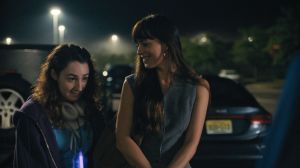 This leads to what seems like the lesson of Cha Cha, because for a movie that seems to operate on a powerful level of irony-free sincerity, the big life lesson it seems to impart is that becoming an adult is one about accepting compromise and disappointment. Sure, that’s an important lesson, to adapt as well as process personal reflections, but with Raiff’s movie, Domino’s lesson seems to be she’s accepted that her fiancé doesn’t make her feel all the things that young Andrew does but he will provide stability for her and her daughter and that means more at this point. I cannot say whether the movie is asserting that Dakota’s reasons are mature and something Andrew will come to understand in time when he gets a little older or whether we’re supposed to see her as someone willfully forgoing her personal happiness to settle for something less and that, to Raiff, is what adulthood means, settling for less. The way that writer/director Raiff could have shore his thematic intentions would be with the supporting characters, seeing this larger nugget of wisdom reflected in his own mother’s relationship with the stepdad who Andrew could attempt to understand better rather than view with contempt. This is where underwriting the supporting characters can also undermine the artistic aims of your movie. It appears like Raif, at 22, is saying that growing up means essentially giving up on some level, which is a strangely pessimistic lesson for a movie that trades in such earnestness and sunny go-go positivity.
I sound more negative with Cha Cha Real Smooth than I’m intending. It’s a relatively breezy movie to watch with fun exchanges, solid jokes, and characters that I found amusing and some of them even engaging. It has its charms and sweetness and I can completely understand falling under Raiff’s spell. This is definitely a step in the right direction for Raiff as a filmmaker after his 2020 debut, and I think he’s going to continue to grow and tell these personal, highly verbose little indie dramas with big feelings where whomever Cooper Raiff portrays learns some life lesson, likely from his interaction with the person of the opposite sex he desires. As such, every Raiff movie from here on out seems likely to rest upon your feelings about him. With Cha Cha, the sequences between Andrew and Domino or Lola were my favorite, so the film mostly worked.
Good Luck to You, Leo Grande and Cha Cha Real Smooth are both fine examples of indie filmmaking supporting distinct voices adding their stamp on the larger contours of the romantic comedy genre. Leo Grande is a grand example of character writing and it’s even poignant and a little sexy. It’s extremely tasteful and nuanced and even empowering for an entire movie about two strangers meeting in a hotel room for sex. Cha Cha is a fun and formulaic coming-of-age movie and with Dakota Johnson hitting her stride with a winning character with pools of depth. There are some writing and thematic shortcomings but it’s still a charming experience. Both movies can definitely brighten your mood and generate their share of smiles for 100 minutes.
Nate’s Grades:
Good Luck to You, Leo Grande: A-
Cha Cha Real Smooth: B-
Share this:

Terror Trips (2022)/ Isolated (2022)
 Two new Ohio-made indie films have just become available for rental or purchase both on DVD and digital streaming, and I’m here with reviews of both. Terror Trips is written and directed by Jeff Seeman (Elly) and even won the award for Best Ohio Film at the prestigious genre fest, the 2021 Nightmares Film Festival. Then there’s Isolated, directed by Tyler Lee Allen and written by Michael Ferree (Poor Baby), a single-location contained thriller mystery. Both movies have their merits and both movies have their faults when it comes to developing a satisfying story.
I genuinely like the initial premise of Terror Trips. Six friends from Cincinnati start a business where they host tours and overnight stays at various famous horror locations for horror fans. They talk about Camp Crystal Lake, the Burkittsville, Maryland woods, and Monroeville, Pennsylvania mall as some possible destinations. Granted, plenty of horror movies take place in fictional locales (Haddonfield, Illinois) but this seems like a fun business idea. Go to the site, mingle with other horror diehards, and then watch the movie at the famous location. We get a taste of this with a somewhat meta montage, and then the movie transitions to its own fictional movie, a 1970s Polish flick (Black Volga) about a child abductor terrorizing a small town. The gang is disturbed by the realistic quality of the grindhouse film but also eager to travel to Poland (still only scenic Ohio) to scout it as a possible travel destination for their clientele. While there, they become victims of a KGB organ harvesting plot, which was not the direction I was anticipating with the first act. However, there was still possibility here. There are three places that can be emphasized with this direction: 1) characterization, 2) suspense, and 3) commentary. Let’s go route by route and see how Terror Trips performs.
 It should be of little surprise that the characters in Terror Trips are inherently disposable. Horror is a genre that can get away with stock characterizations more than most, especially if there’s an added subversion or commentary to those stock roles. We have about six main characters, which is a good number to lead to plenty of death sequences. We know going into most horror movies that the character count is higher because it provides more people to then bump off. However, the group of six friends are so unremarkable from one another that you could rename them, consolidate them, or even remove them, and you would have little bearing on the plot. They’re six versions of the same character. They’re all horror nerds and that’s about it. I’ll credit the filmmakers for making them all very visually distinctive to tell apart, but the same kind of effort wasn’t given to what they were saying or how they were acting. For horror nerds, they don’t seem to recognize too many of the tropes to avoid. I wish at least one of the characters resembled the hyper-literate teens from the Scream franchise and could diagnose threats and options with encyclopedic vigor. What is the point of making them experts if they don’t use this expertise? I did like one character note; there’s a couple who engage in arguments, and before they walk away, or walk into what seems like certain danger, they say, “I love you” as a call and response. It’s funny that even under extreme circumstances, or moments of aggravation, they will utter their “love you”’s. I got to thinking about a deeper rationale for this, like characters who know they’re about to enter a definite horror no-no, and they don’t know if they’ll ever have the chance to say one final “I love you,” so they make a point to do so before any risky action. Perhaps I’ve imbued more depth in my analysis than these characters justify. I wish these characters were more interesting to remotely care whether they lived or died (more on that later).
So, if the characters aren’t going to entertain us or make us emotionally invested, then one other viable option is to essentially view them as sacrificial offerings and come up with some well and truly deranged manners of demise. This is another area where Terror Trips lacks development. Even abandoning the horror movie iconography and running with the organ trafficking goons, there is still plenty that could have been done. I wasn’t expecting the movie to so definitively go the Hostel route, but I was more surprised to get more scenes of Russian characters conversing about the dull details of their evil schemes than from the survival scenarios. If you want to be Hostel, with our characters placed on a slab to be carved up, then you better differentiate the killing. There’s one character who is running down the middle of an empty road (these people don’t really value stealth) and this character is pounced upon. They have their Achille’s tendons purposely sliced (Hostel nod?) and are dragged away still alive. Now, if you included this development, you’d want to also include a sequence where this character tries to escape, hampered by their injury cutting down on mobility, which would nicely build further suspense. Alas, none of that happens. This character might as well have been tackled and that’s it. A heavy torture angle is pretty budget conscious for a production, allowing devious creativity and twisted suspense, while possibly leaving much to the viewer’s imagination. I know we’ve moved away from the torture porn era of the mid 2000s, but if that’s your chosen playing field, you might as well make use of what it has to offer as far as discomfort. I’m shocked that there isn’t even one drawn out sequence of torture in Terror Trips at all. Maybe that’s a sign of restraint but I see it as more of failure to capitalize on its suspense possibility. There are no memorable dispatches or shocking deaths or well-developed suspense sequences. If you’re going to stick the audience with boring, interchangeable characters, at least make their troubles and terror entertaining.
 So, that brings us to the third and final area for creative nourishment, the hardest one of them all, and Terror Trips doesn’t seem that interested in any form of social commentary. There was potential on a few storytelling fronts. The movie could have satirized the ugly American attitudes and general ignorance of its main characters as they travel to rural Poland. You could turn their general ignorance into dark comedy and it would also provide welcomed characterization. You could also have opened up the world of these locals more, showing the great economic hardships and pressures they are under to do what they have to do to survive. At least 2005’s otherwise forgettable Turistas (remember? It had Josh Duhamel and Olivia Wilde) had an organ harvesting plot where they made some stab at social commentary. In that film, they were taking the rich gringo organs and providing them to the poor and needy in Brazil, those who would never rise to the top of a transplant list in their lifetime. With Terror Trips, it falls into the xenophobic tropes that drew similar critiques from Hostel but without attempted commentary to smooth the portrayals over for added meaning. Once the movie reveals that every person in this town is in on the conspiracy, it makes every non-American seem duplicitous and untrustworthy. Again, if that’s the direction you want to go, then own it and really embrace it, but Terror Trips feels so indifferent to its villains. They could just as easily be any group doing any nefarious scheme. The scheme is just KGB goons doing bad things because they’re bad. There’s an exciting possibility here about “underground horror” blending fact and fiction, exploiting real people’s pain, turning sites of trauma into tourist destinations, whether it’s critiquing an audience or capitalism. Unfortunately, there’s not a whole lot intellectually going on with Terror Trips.
 I wanted to highlight the ending, and in doing so will deal with spoilers, so you have been warned, dear reader. We spend the last 15 minutes or so following Ginny (Hannah Fierman) as she successfully calls for the police. Too bad that they too are in on it, and she apparently goes to sleep in the back of their car and allows the officer to carry her, like a child, into the creepy car from the horror movie-within-a-movie. There she’s also with one of her friends, the one who had their Achille’s tendons sliced. They commiserate and try to escape from the backseat (there’s a wall dividing the front and back seat like a cab). Then Ginny’s friend implores her to basically mercy kill them, and Ginny must go through her arguments of survival before realizing after everything they’ve been through that this might be a choice not presented later. Through tears, she slices her friend’s wrist, holds their hand, and watches as the life ebbs away – AND THEN THE MOVIE ENDS! “What?!” I spat at my screen. You have the Final Girl, or at least the supposed Final Girl, and you end things like this? It’s like the filmmakers ran out of time to make a climax. This is where the underwritten characters become an anchor. The movie cannot pull off this drama, especially as shaped as the film’s climax, because we haven’t invested in these people and their personal relationship. The work wasn’t set up for this as a big emotional payoff.
From a technical standpoint, Terror Trips is ably filmed. The visual compositions and acting are competent to good. I liked Abigail Esmena (They/Them/Us) as George and Fierman (V/H/S). They were both able to make positive impressions over the blandness of their characters. The Russian actors were authentic. Kate Kiddo (great name) was also memorable as the Polish intermediary for the tourists. The editing is a little overly jumpy for the first thirty minutes, like it needs to cut to a new shot for every sentence spoken, but it eventually settles down. The gore effects are few but serviceable and bloody. My biggest compliment is the sound design. For a movie spending a far majority outside, the sound quality here is shockingly good. I’m so used to sound being one of the most flagrant issues in low-budget indies, but here it’s an asset.
 With Isolated (formerly titled O9en Up), we have a contained thriller, which means much will hinge upon the chain of discovery for survival or enlightenment. There’s no shortage of people-stuck-in-mysterious-room movies. It makes sense from a production standpoint. It’s cheap. I remember one movie I saw on Netflix where it was like 50 people standing at game show podiums and they had to vote one person to die every so many minutes or else one person would randomly die. There’s two dozen Twilight Zone episodes about characters trying to make sense of a mysterious place they’re stuck in. It’s also featured in just about any Saw movie. It’s an immediate mystery that can work wonders. The trick is to either string the cause-effect plot elements so that we are learning and building off that knowledge along with the protagonist or connect the clues as to what or why their encasement means for them. I enjoy survival thrillers. I included Buried on my Top Ten for 2010 and that movie is one hundred percent Ryan Reynolds inside one cramped coffin. The problem with Isolated is that the mystery doesn’t feel that intriguing after about 30 minutes. The room itself looks like it should have more mystery to it, with a countdown and a giant nine painted on the wall. There’s a skylight with a latch just out of reach. Our main character, Nell (KateLynn Newberry), is even given her phone, which plays a song on the regular that seems too specific to be of little insight. But what does the movie actually do with its time and mystery?
At 99 minutes, you might find yourself getting a little antsy for the next reveal or clue to maintain an interest. I’m surprised the movie keeps its protagonist as such a blank. Nell seems resourceful, determined, and nursing some kind of personal pain or regret, but why is she here? Because we’re not given anything direct, your mind may likely anticipate that a major twist is in store by the end, and lo it happens (I don’t think the end explains the many hoops). I think the location just isn’t that intriguing enough to sustain the central mystery, and because we’re given few insights into this character we’re sharing a cell with for a whole movie, it made me feel restless. After Act One, Nell is given a cellmate, so to speak, on the other side of her wall, Travis (Lanny Joon), and the movie becomes a two-hander, though the perfunctory dialogue exchanges sound like the screenplay is filling time. It reminded me of 12 Monkeys when Bruce Willis’ character, a convict from the future sent back in time and doubting his sanity, hears a raspy voice on the other side of his wall who seems to know his dilemma. It becomes a playful and antagonistic exchange, and Willis doesn’t know if there is someone on the other side of the wall or if it’s all in his deteriorating mind. With Isolated, if Travis is meant to be our lifeline, it’s not enough. Now in a confounding location we have a confounding character, and rather than add layers to the mystery and our understanding, it just feels like vague on top of vague in service of stretching out a running time to feature length. I don’t think the twist earns the time spent, nor are the implications handled in a manner that feels satisfying or worthy. The ending reminded me of Old where for the final ten minutes M. Night Shyamalan basically says, “Okay, I’m just going to tell you everything explicitly now. Hope it’s been worth it. It hasn’t? Oh. Oh, okay then. Well, anyway…”
 As a low-budget thriller, Isolated has some nice technical merits to praise. The cinematography by Greg Kraus (The Curse of Lilith Ratchet) is very good with more than a few shots that made me nod in appreciation, like an attached camera angle to Nell running in a panic. The editing, also by Kraus, is solid and nicely integrated with the visuals. I liked the quick cut montages of awful flashbacks forcing their way inside Nell’s mind. There are some neat visual tricks here for a low-budget film. The brooding musical score by TJ Wilkins (Knifecorp) does a lot of heavy lifting for the story.
For both films, there is a difficulty in following through with the story direction each chooses. With Terror Trips, it’s a horror movie that abandons its premise early to become a bland organ harvesting thriller with characters that are too indistinct and personality-free to care and with suspense sequences that are brief or underdeveloped. With Isolated, I went a little stir crazy from waiting for enough vital components to keep my attention and intrigue. The main character is simply not that interesting of a character to share 90 minutes with. Each movie feels padded out and undernourished where it counts with its storytelling, failing to capitalize on the promise of its plot elements. Horror and mystery fans might find enough to satiate their genre needs. Both of the movies have technical merits and agreeable acting, but it’s the story and, even more specifically, the development of its characters and suspense or mystery scenarios, where they do eventually stumble.
Grades:
Terror Trips: C-
Isolated: C
Share this:

The Other Side of Darkness (2022)
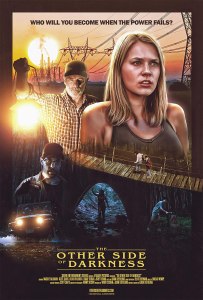 Adam Deierling is a native Ohioan who spent ten years in the hustle and bustle of the L.A. film scene before relocating back to the Buckeye State in 2008. He has since focused on wedding videography and short films and spoken that his goal was to get a professional feature film off the ground locally, an admirable goal, and he wanted to create a family-friendly adventure film that could inspire others. That result is The Other Side of Darkness, written and directed by Deierling and filmed entirely in Ohio and West Virginia. Unfortunately, the movie doesn’t know what to do with its major plot elements and feels a bit too lost by its own creative indecision.
Taylor Jo (Maggie Callahan), a.k.a. TJ is turning sixteen soon and eager to leave her small Ohio town. She works in her foster father’s auto shop and hates it and the direction of her life. Then one day she gets a mysterious note in the mail with a key that leads to an old Jeep. Turns out, the Jeep belonged to her biological mother and the note is from her still-living grandfather, Jack (Scott C. Davis). She hops in her new car, her best friend Hannah (Olivia Billings) and her cute brother Patrick (Drake Tobias) come along for the ride, and they head out to meet gramps. However, he might not be all that he seems, and a looming threat emerges that might cause the power system to go down, and then who can these beleaguered teens trust in these troubled times?
 The Other Side of Darkness is like several different scripts stitched together, none of them richly developed or integrated to the other, which makes for an unfulfilling and tedious experience. Each of the half hours feels like a different movie. The first 30 minutes establishes the small-town life for TJ and her desire to escape, especially her predator of a foster parent. Then the next 30 minutes is about TJ and her friends going on a road trip to West Virginia to meet her biological grandpa and for TJ to learn more about her departed mother. Then the next 30 minutes is a mystery of whether or not the grandparent is who he says he is and discovering the terrain. Then the final 30 minutes is an action thriller to thwart homegrown terrorists. Each of these sections goes on far longer than it needs to, each of them presents very little sustained character development, and each of them feels adrift when compared to the other section. In the barest sense, these sections have a tenuous cause-effect relationship; however, the difference is whether the narrative feels like it’s actually building from scene-to-scene or just biding its time. I don’t know why we need a full half-hour to establish how awful TJ’s life is, especially throwing in the topic of sexual molestation, a serious subject that feels shoddily mishandled. The hook of this movie is the idea of our power system falling. Even the tagline says, “Who will you become when the power fails?” Well fear not, dear reader, because, spoiler alert, you’ll never have to wonder because the power grid doesn’t go down at all. The marketing sure looks like it’s going to be about people surviving in a world without power, with society possibly breaking down, but in reality, it’s about stopping two yokels from blowing up their local power station. That’s right, it’s not some far-reaching conspiracy that would trigger the crumbling of America’s interconnected infrastructure like the downfall of the Death Star. Nope. So, even if they blew up this lone power station, the power company would just come out and restore power. For a movie literally called The Other Side of Darkness and playing up a powerless world of survival, the actual employment of these big plot elements is strangely myopic and half-hearted.
Perhaps the title is in reference to the personal journey of our protagonist and her self-discovery, and I’ll humor this charitable interpretation and explain why this still doesn’t work. TJ’s story feels like it should have the right material to be engaging and even inspiring. The first part of the movie establishes her attitude, her plight, and eventually her escape via mysterious family member. This sets us off on her to discover her birth family and perhaps a little more of herself. When she meets her grandfather, he has one teary-eyed monologue, and then the rest feels like everyone is just dithering around and waiting for instructions on what to do. Grandpa gives TJ taped recordings her mother made with the intention of her daughter to one day listen. I don’t understand why this plot element was not explored far more in depth. This is her direct line of communication with her mother, her ability to hear her voice, listen to her singing, and emotionally connect with a woman who has long since departed her life. I also don’t understand why TJ isn’t interrogating her grandfather non-stop about her mother and father, or even simply bonding with dear old grandad and he her. It feels like right after everyone establishes their identities, the characters are just aimlessly hanging around loitering. In one early scene, it looks like Hannah and her brother are asleep on the couch behind TJ as she talks to grandad for the first time. I was mistaken because Hannah then moves, so she’s not asleep but she looks transparently bored (I’m sorry this family reunion couldn’t be more exciting for you). The writing for the characters keeps their conversations very surface-level. Every person is flat-out telling each other what they feel, who they are, what their personal journeys constitute. It’s a clunky, inauthentic manner of speaking that shows the writer’s too obvious hand.
 Another factor that keeps me emotionally distant from the movie is how little it makes use of its near two-hour running time. There are long stretches that resemble a glorified car commercial. TJ, Hannah, and her brother go riding along and the music rises in celebratory volume and then things just keep going from there. With the drone shots of the car passing along a dusty trail, the interior shots of the characters laughing and smiling maniacally, and the attached camera angles to show the wheels flying across the muddy roads, all you’d need is to slap “Life is a Highway” and some ad copy at the bottom and it would be indistinguishable from any glossy car commercial. Why does this bother me? It’s because the movie is unmistakably filling time, dragging out its plot with extended sequences of transportation. There are numerous sequences of people walking from Point A to Point B, especially trouncing through the woods, and rather than see one sequence of a character walking to establish distance, we get four or five. This is all at the expense of storytelling and character, and that’s what I chafe at. Let’s take as another example the best friend character Hannah. In the first 30 minutes, the film establishes her as TJ’s only friend and a supportive outlet, enough so that she agrees to come along when TJ wants to track her out-of-state grandfather. Hannah and her brother spend what appears to be days away from home and I kept wondering what their parents would be doing, whether they would be calling the police, especially since Hannah cannot get cell service. This plot point bothered me for two reasons: 1) why can’t Hannah just travel in the car to reach an area where she has service, and 2) why does Hannah even need to be here at all? At least her brother becomes an underdeveloped romantic interest for TJ. Hannah’s role is inconsequential. And, again, all of these dawdling decisions are at the expense of the dramatic potential of the plot, of a granddaughter learning about her mother and bonding with her grandfather for the first time. Once the movie reunites its characters, it feels so shiftless and waiting for delayed instruction.
From a technical standpoint, The Other Side of Darkness is low-budget but has a nice sheen of professionalism for a $15,000 budget. I have seen movies with ten to twenty times that budget that don’t look as good as this. The cinematography by co-producer Vinny Sisson is crisp and with satisfying visual compositions. The acting is generally competent. Nobody will astound but nobody took me out of the movie with a bad performance. I thought Davis (Chosen, Between the Walls) has a warm and weathered presence that improved the role. Callahan reminded me of Britt Robertson (Tomorrowland, I Still Believe). Billings reminded me of Sarah Yarkin (2022’s Texas Chainsaw Massacre). I can only imagine what these people could have done with a superior screenplay that allowed them the material and space to really dive into their character dilemmas with nuance and emotional authenticity. The one technical aspect that needed some curtailing is the overzealous musical score by Niklas Wempe. The score is everywhere and never subtle; it is loud, in your face, and trumpeting what is happening onscreen, pushing moments into unintended levels of farce, like people walking through the woods now feel like they must be running for their lives when the reality of the circumstances is nowhere near as urgent. The musical score is so intrusive and old fashioned that it reminded me of 1940s moviemaking.
 At almost two hours long, The Other Side of Darkness is a frustrating viewing experience. It’s not the movie it advertises itself as delivering. Just looking at that poster, you might surmise a post-social breakdown thriller like The Trigger Effect, or maybe even a nostalgic 80s adventure like The Goonies. You would be let down by either genre expectation. Sadly, the movie cannot live up to its own dramatic premise of a family reunion between grandfather and granddaughter sharing their common link, a deceased loved one they can relive with the other. It’s bizarre to watch a movie with such potent storytelling elements and seeming so indifferent to them or confused what should be done. This feels like a first draft of a screenplay, where characters are just expositing their direct feelings and desires, unencumbered by subtext. Too often the movie just has its characters milling about, and at two hours in length this is inexcusable. The power outage thriller concept feels almost entirely tacked on to provide more of a marketable angle. It’s shockingly underdeveloped and relatively unimportant in the film’s grand scheme of human drama. Often with first-time filmmakers also dabbling in their screenwriting, I find the stories that would have sufficed as short films expanded into feature-length but not given the attention for the adaptation to succeed. The Other Side of Darkness proves that Deierling has the technical chops to make the most with a micro-budget. I just hope his next feature takes more time to really establish what it wants to be and how best to develop and achieve these goals. The Other Side of Darkness is a little too much in the dark.
Nate’s Grade: C-


 nathanzoebl
You must be logged in to post a comment.