Blog Archives
Adam (2009)
 It’s a romantic comedy with a quirk. Adam (Hugh Dancy) has Asperger’s syndrome, a higher-functioning level of autism that makes social interactions difficult. Lucky for him he?s handsome enough that his new neighbor (Rose Byrne) falls for him anyway. What follows is mostly standard romantic comedy stuff, with boy and girl feeling each other out, except Adam has trouble with figurative language and implied speech. The movie works on a low-key cuteness as it hits all the conventional plot destinations, but then it charts its own path for an ending. I give credit to writer/director Max Mayer for bucking formula and following his convictions, refusing to tie everything together so easily. With that said, the Asperger’s portrayal seems to go into an extreme, Rain Man-level of social disability. Adam is crippled with fear even to leave his home; he is a slave to routine. Dancy is a sympathetic lead, though he’s overly reliant on his character’s quirks. Adam isn’t a freak or some delicate flower needing to be protected from the rigors of reality, and I think the movie would have benefited from a broader look at Adam’s ongoing lifelong struggle with his brain. Mostly, audiences are served up a sweet if somewhat plain romance with an extra dash of eccentricity, but not enough to rock any rom-com sensibilities. It’s a non-threatening alternative to the genre.
Nate’s Grade: B
Share this:

Humpday (2009)
 There’s a definite squeamishness out there when it comes to the idea of men expressing intimacy. Brokeback Mountain proved even liberal Hollywood wasn’t ready to anoint a movie about two gay dudes secretly getting it on. There will be large portions of people that will refuse to give a movie like Humpday a chance simply because of its premise: two guys plotting to have sex. It’s not a dirty movie by any means, nor does it get graphic with details or conversations. But the movie exactingly explores the uncomfortable relationships men have with expressions of romance. Humpday is also extremely funny in that pained, awkward sensibility, and I challenge the squeamish to give this charming indie a shot at love. If it makes it any easier for people to take (SPOILER ALERT) they don’t actually go through with it.
Ben (Mark Duplass) is living a comfortable existence with his wife, Anna (Alycia Delmore). Then one day his old friend from college, Andrew (Joshua Leonard), unexpectedly visits. Andrew has lived a Kerouac-like existence on the road as an aspiring artist. The two guys catch up on old times and Andrew invites Ben over to a party. He ditches his wife, and her pork chops, for the party, which turns out to be hosted by a group of free-love artists. The alcohol-fueled conversation lands on Humpfest, the annual amateur pornography festival held in Seattle. Ben and Andrew come up with their own entry idea: two straight guys that will have sex. “That’s beyond gay,” somebody says. Both men refuse to back down. Ben books a hotel room. The only thing he has to do now is tell his wife about Andrew’s “art project.”
 Humpday explodes male sexual insecurities better than any film since 1997?s Chasing Amy. Each man refuses to back out of having gay sex because they don’t want to be seen as less masculine. It’s masculinity brinksmanship, willing to go all the way to prove superior heterosexuality through a homosexual act, and it?s nothing short of brilliant. Neither Ben nor Andrew wants to “puss out” on their big moment. But neither of them really wants to go through with it either, which leads toward tremendous amounts of awkward comedy. Writer/director Lynn Shelton has fashioned a scenario that is hilarious but also subtlety heartfelt; many films deal with the bromance of heterosexual love, but Shelton pushes it to the limit. These two guys do care about each other, and you can see their camaraderie as they recount old stories and open up to one another, and in the end they might be willing to go to the extremes for their friendship, whatever the consequences may be.
Both Ben and Andrew have deep-seated insecurities about their personal lives; Andrew wants to live a free-spirited artistic lifestyle but is really too scared to fully commit, and too “square” for abandoning all sexual inhibitions like some of his casual artsy pals; Ben has a house, a job, a wife, and feels defensive about his life choices, particularly the idea that he’s settled down and giving up. Both men are also insecure by sexually adept women, so it may be natural that they seek the company of each other for solace and mutual understanding. The final act, where the two friends meet in a hotel room for their big night, is a slice of awkward comedy heaven. They haven’t worked out any logistics, locations, warm-ups, anything, and watching them verbally hatch a game plan is hilarious and oddly touching in equal doses. They really don’t know what they’re doing and why they’re there.
The actors have a naturalistic feel because, as I’ve found, the dialogue was almost entirely improvised. They shot in chronological order so to build from conversation to conversation, and you can feel the character dynamics strengthen and deepen. Duplass (The Puffy Chair) has a great, wide fake smile that hides a lot of anger and dissatisfaction. He’s sort of a schlubby everyman that we can empathize with even as he moves forward with his participation in the “art film.” Leonard (The Blair Witch Project), and his scraggly beard, effectively conveys a man weary about where his rugged life has led him. He is also hiding behind a guise, the guise of being a nonconformist that chooses to have no earthly ties, but bit-by-bit you see that Andrew is tired of disposable human connections. Leonard and Duplass feel like life-long friends. Then there’s Delmore, who really is the wary, incredulous voice of the audience. She too comes across as realistic under the circumstances, and her reaction when she discovers the true purpose of the “art project” is volatile, yes, but also surprisingly reflective. The three leads never feel like actors; the illusion that these are real people is never broken even given the peculiar circumstances of the premise.
 What I really appreciated about Humpday is that every moment feels genuine and every scene has a point. I was amazed that Shelton and her small unit of actors had made it so that every conversation had purpose; there is so little fat to this screenplay. Each scene reveals something new about a character or pushes the narrative forward toward its uncomfortable climax, and each moment never breaks the reality of the story. Given these characters and the amiable direction they follow, Humpday is believable. I suppose it might be easy to dismiss it as another entry in the fly-on-the-wall “mumblecore” film series gaining traction in independent cinema, but Humpday is really more an observational character study that examines male relationships and the sexual politics of being a “man’s man” in today’s world of sexual liberation. There is a nuanced perspective on human sexuality here that I may be erroneously crediting to Shelton simply because she is a woman. It helps to have a more mature, open-minded perspective about the complexities of human behavior for this story to succeed, and I think a female presence behind the camera affords that luxury. There is commentary below the surface; however, Humpday can be entirely enjoyed as a surface-level comedy of an awkward heterosexual showdown.
I find it interesting that the original theatrical poster only featured the two shirtless guys eyeing each other, and with a pink background no less. The DVD cover has inserted Anna between the two guys and gone with the more boy-friendly blue background cover. I think this tiny detail is another reflection of just how uncomfortable the subject matter is for many people. Humpday is an insightful, perceptive little character study that feels real and honest, while at the same time the movie doesn’t allow sexual politics to become the headline. The movie remembers to be funny, often, and any discomfort is worth it.
Nate’s Grade: A
Share this:

Sin Nombre (2009)
 Part immigrant drama and part crime thriller, this stirring film is one of the rare instances where I was begging it to be longer. Writer/director Cary Fukunaga intertwines two tales, a southern Mexican family riding atop a train car to reach the U.S. border and the moral journey of a gang member who turns on his brothers during a crisis of conscious. Everybody is on the run, from the border patrols to the blood-thirsty gang members seeking vengeance. Fukunaga gives this tale startling realism without diverting to self-consciously docu-drama camerawork. I was fascinated by the details of life atop a train, the determination of these family members for a better life, and I was thrilled with the many near misses and escapes. Sin Nombre is such an accomplished movie that it’s hard to believe that it is Fukunaga’s first feature film. It mixes social commentary with film noir, an unlikely romance and plenty of naturalistic performances. The cinematography is gorgeous and crisp, beautifully showcasing the squalor and arresting countryside. My one complaint is that the movie gets into a new gear of added conflict, and then it quickly comes to an end at an all too brief 96 minutes. I really could have done with another 20-30 minutes of our main characters on the run for their lives. Sin Nombre roughly translates to “the nameless” and I can all but assure you that Fukunaga is a filmmaker who will most definitely not remain nameless.
Nate?s Grade: A-
Share this:

The Girlfriend Experience (2009)
 This may be Stephen Soderbergh’s most accessible throwaway experimental bobble, and yet even a movie about a high class call girl played by real-life porn star Sasha Grey gets tedious. Set amidst the economic meltdown in the fall of 2008, we toggle back and forth between the professional lives of Chelsea (Grey) and her boyfriend (Chris Santos), a personal trainer. Chelsea’s services are more akin to a date than a quick romp between the sheets. Said “girlfriend experience” includes dinner, talking, a deep knowledge of her client’s interests so she can relate, and perhaps some late night cuddling and maybe, just maybe, sex. There are multiple parallels involving the idea of prostitution, Chris sells himself and his services to his gym clients much like his girlfriend; but where does any of this add up? The movie is told out of order for little benefit and there isn’t so much a climax but a dissolution of plot. The realities of a New York City call girl having a committed relationship can be intriguing; at one point Chelsea says that the clients want her to be herself, but if that were true they wouldn’t be paying her. However, when Chelsea decides to ditch her man of 16 months because her astrology book told her this Hollywood client might be “the one,” the audience loses any sympathy. Once this happened I just checked out. At a mere 77 minutes, too much of the movie is consumed by Chelsea’s life style of high rises, fancy restaurants, limos, and powerful businessmen. It can feel like a big screen episode of MTV?s The Hills, following the empty exploits of shallow twits. Grey is flat throughout, and maybe that?s the point to display how disconnected she must be to make sexual encounters just work. Let’s just say that she shows more promise in I Wanna Bang Your Sister (actual title).
Nate’s Grade: C+
Share this:

Paranormal Activity (2009)
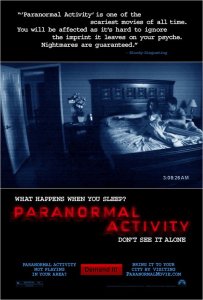 My eyes are bleary. I feel like a walking ghost. My body aches just a tad. I’m over responsive to sudden movement. Not only have I just seen Paranormal Activity, the small indie horror film that has been sweeping the nation, but also I’ve just endured my first post-Paranormal night of sleep. To say it was refreshing would be an outright lie. My then-partner was tossing and turning, routinely grabbing my arm to hold her, also sitting straight up to peer through the darkness of our bedroom, and occasionally she would request that our dog jump on the bed to sit with us for extra support. She and I have seen scary movies before but none have interrupted my sleep patterns like this low-budget sensation. That alone is the best blurb that I could possibly offer to the Paranormal Activity marketing gurus: this movie will make it difficult for you to sleep in your home.
The back-story to this Cinderella tale is that writer/director Oren Peli was hearing unexplained strange noises in his San Diego home. After some research he said, “Why don’t I set up a camera and make a movie about this?” He then hatched a plot involving a young couple, Katie (Katie Featherston) and Micah (Micah Sloat), who hear some bumps in he night while they sleep. Micah sets up a stationary video camera to record the strange happenings as a cool project. It begins with small, subtle noises, then the presence of something unwelcome becomes much more pronounced. Micah taunts the antagonistic spirit, coaxing some kind of response. Katie is terrified because, as they learn from a psychic, this is the same entity that has been following and haunting Katie her whole life; her family home burned down unexplainably when she was a child. It wants Katie. That was the story, though Peli says most of the dialogue was improvised (it shows). The actors doubled as camera operators, the movie was shot over seven days in Peli’s own San Diego home, and the total cost was $11,558, a pittance for a Hollywood movie. So how did this cheap home video haunting take the nation by storm, becoming the indie phenomenon of 2009 and one of the most profitable films in modern history?
 Let’s start with the fact that it’s actually scary. That’s likely what audiences have been responding to — competency. The film is presented as “found footage” much like the similar low-budget horror sensation, The Blair Witch Project (can you believe it?s ten years old already?). The story is presented as factual footage, and Peli makes a point of not breaking the terms of reality. Some of the spook stuff is easy to explain, like lights going on and off in the distance, but there are some moments that are more dramatic and give no hint of special effects. I am impressed by the ingenuity of Peli on his super low budget. I went from being startled to admiring the technical craftsmanship. Paranormal Activity isn’t a big scream movie, it’s more unsettling and the majority of its scary moments occur while the camera is on its bedroom tripod (the tripod should receive third billing in the credits, frankly). Sure, a creaking door or lights magically turning on doesn’t sound like surefire moments of blood-curdling terror, but the fact is that stuff is happening while this couple sleeps, a time when we are most vulnerable, is the point and why it’s scary. Peli structures the movie so that it fosters a slow burn of suspense. By making the camera the only viewpoint, we as an audience feel trapped, much like the characters. The idea that something will get us while we sleep isn’t new but it’s certainly creepy.
The actors work well enough not to betray the “found footage” motif as well. Neither gives a spellbinding performance, mind you, but Featherston and Slout are believable for almost every second onscreen. They’re a couple experiencing a home invasion of a different sort. Micah is more interested in his technical toys than the traumatic state of his girlfriend of three years, and Katie even admonishes him after a scare, “Did you actually run and get the camera first?” Featherston exhibits the most fear and trepidation, and her squeals and cries can be alarming. Their interaction and intimacy doesn’t really communicate a couple of three years time. However, this does not detract from the flick because the title isn’t Relationship Drama, now is it?
 So at this point I need to ask myself, why was I scared during Paranormal Activity and merely amused by the similar exploits in The Blair Witch Project? Maybe it’s the location. The bedroom is supposed to be your sanctuary, your respite. It’s a bit more universal than getting lost in the woods to make a movie. I also think the concept is responsible for my different reactions. In Blair Witch, they were being haunted by a forest ghost who had a thing for arts and crafts. Waking up to stone piles and stick figures just doesn’t resonate like footage of something happening to you while you sleep unaware. Peli does a fine job of making an audience dread what is to come next. Just as I wrote ten years ago for Blair Witch: “The anticipation of the unknown is far more frightening than being slowly chased by a man in a rain slicker. It’s no typical horror flick, it lets you create the fear in your head and let you drive yourself mad with it.” This is why Paranormal Activity works as well as it does. You can immerse yourself and then grip the armrest in fear and then laugh about it later. I also appreciate that Peli solved my number one problem with haunted house movies. You see, if your house is haunted then — MOVE! Simple, huh? Why try sticking it out to regain the resell value when the walls are dripping blood? At least in Paranormal Activity says that the evil spirit is attached to Katie.
Thanks to weeks spent at the top of the box office, even besting the lingering Saw franchise, it is inevitable that Paranormal Activity will balloon in hype that it cannot compete with. Rather than its budget limitations hindering the final product, Peli and his actors have embraced their low-budget aesthetics and produced something effectively eerie and occasionally ingenious. What these people have done with $11,000 (probably the budget for bagels on the pseudo true story, The Fourth Kind) is worth applauding. Like most horror movies, this one will play better with a full crowd ready to ride the roller coaster wave of screams and giggles. Paranormal Activity is proof that you don’t need stars and major budgets to get audiences scared. Your feelings of terror are the great equalizer, which is why cheap but smart and inventive horror movies can easily outpace their bigger budget brethren. Just be prepared for a few rough nights of sleep afterward.
Nate’s Grade: B+
Share this:

A Serious Man (2009)
 The Coen brothers, Joel and Ethan, have been making stupendous movies for three decades, but they have never really gone too introspective. Usually their movies follow quirky characters making poor decisions and getting in too deep in a cruel world. A Serious Man is the first Coen film that feels personal. Set in the same landscape of the Coen’s own upbringing, 1960s Minnesota, A Serious Man gives a few insights into how these two remarkable men became who the filmmaking geniuses they are today. But if that isn’t enough for film fans, the movie is also hilarious and brilliant.
It’s 1967 in suburban Minneapolis. Larry Gopnik (Michael Stuhlbarg) is a meek physics professor up for tenure. Larry is beset at all sides, from his redneck neighbor encroaching on his land, to being bribed by a Korean student unhappy with his grade, to the news that his wife, Judith (Sari Lennick) is leaving him for his colleague, the more dignified Sy Ableman (Fred Melamed). Sy suggests that the best course of action is for Larry to move out to a hotel: “The Jolly Roger is eminently habitable.” The tenure board is having second thoughts because of anonymous letters, Larry’s daughter is stealing money from his wallet for a nose job, his son spends more time getting high than practicing for his bar mitzvah, and Larry’s unemployed, socially awkward brother (Richard Kind) is sleeping on his couch. Larry seeks counsel from three rabbis and tries to find meaning as to why his life is spinning out of control.
 This is a bleak comedy with almost all of the laughs coming from how much worse things get for Larry. Now, it’s not a pitch black comedy, something akin to being loathsome and eager to push an envelope; you simply can’t help but laugh at how he universe is ganging up on this poor man. His life is spiraling out of control and he is helpless to stop it, and his search for some sort of theological wisdom just leaves him more confused. The various rabbis don’t really have an answer to explain his suffering, and instead they each give comically nonsensical answers or stories. The junior rabbi, projecting his own low stature, asks Larry to seek God in small things, like the parking lot highlighted by his office’s lone window. “Just look at that parking lot,” he gushes hopefully. One rabbi gives a fantastic story about a Jewish dentist discovering a strange Hebrew message carved on a patient’s (a goy’s) teeth. The story eventually goes nowhere and the rabbi’s advice is merely a shoulder shrug and this bit of feeble wisdom: “Helping others? It couldn’t hurt.” To the Coens, Larry is the modern-day equivalent of Job, befalling misery and looking heavenward to ask, “Why me?” He could easily be any one of us. In the face of turmoil, it feels like the Coens prescription is to laugh, the only way to remain sane in this world. And so we do laugh, dubiously, and this is how we cope with life and its ongoing uncertainty.
And A Serious Man is seriously funny. I snorted out loud three times, unable to control my growing guffaws. The supporting group of characters is all wonderfully utilized, popping in for a perfectly timed plot development or a joke. This movie is relentlessly funny, structured like a runaway car that picks up momentous speed. Not a single frame feels at waste. The conversations between the supporting characters are priceless; every character has their precise place in this narrative, and the Coens manage them brilliantly. The writing is intricate and the Coens again showcase their magnificent ear for local color. Each of these people has a different speech pattern, from one Hebrew school kid’s abundant use of the F-bomb, to Larry’s daughter insisting she has to use the bathroom to always wash her hair, to Larry’s bathroom-hogging brother’s conditional response of, “Out in a minute.” It’s almost like a musical how well the various comedic elements harmonize. The mostly unknown cast of actors is all superb; I love how the Coens select actors with such great, easily recognizable faces. These people stand out just visually. Stuhlbarg, a theater veteran, is a terrific lead, and his performance is steeped in pursed-lip incredulity. I loved every conversation with the powerfully unctuous Sy Ableman, a character who hides his distaste in pompous vocabulary. I loved Larry’s interactions with his South Korean blackmailer and his broken English. I loved how Larry’s son will interrupt important occasions just to complain about the TV picture quality of F-Troop. I loved that the only person concerned for Larry’s well-being is the Columbia records salesman who signed up Larry for a subscription because he failed to reject their offer.
 I haven’t done extensive research on this one, but A Serious Man may be the most Jewish film ever, or at least since Barbara Streisand cross-dressed in Yentl. I’m not talking movies that explore a significant chapter in Jewish history, like the Holocaust, but I can think of no other movie so steeped in the minutia of Jewish culture. A Serious Man even opens with a seemingly unrelated anecdote with a 19th century Eastern European Jewish couple arguing, completely in Yiddish, whether a guest is alive or a dybbuk (demon). Not only do we get notable religious events and observances like bar mitzvahs, sitting shiva, counsel from rabbis, the concept of a religious divorce known as a get so that a “serious man” could remarry in the faith, but the Coens get everything right down to the tiniest detail, like the exact sound of soup slurping. Even the overall tone, perseverance in the face of struggle, is an extremely Jewish perspective given what has transpired historically to the Jewish people.
The abrupt ending will likely win no favors from the people that thought they were shortchanged by No Country For Old Men‘s anticlimactic close, but it certainly fits the movie’s bleak worldview. Larry is, by his own accounts, trying to be a “serious man” in an ever-changing community, so beware what happens if he compromises his moral values. The pessimistic finale leaves much to the imagination and whether you want to connect the events as uncoordinated random plot points, or as an ongoing celestial judgment, well the Coens are canny enough to let you figure it out. They don’t have any more answers than the rabbi and the goy’s teeth.
This will not be a movie for everyone, especially considering 90 percent of the laughs come from one man’s unrelenting misery. Larry isn’t exactly the deepest character, making it spotty to emotionally invest in his troubles. However, I found him to be an everyman cipher allowing the audience a safe entry point into the Coen spectacle of doom. The Coen brothers have always been technical marvels, but they seem to have raised their inconsiderable talents at the close of this decade. No Country for Old Men was a genre masterpiece, Burn After Reading was an entertaining farce, but perhaps A Serious Man is the most lasting picture. How do we explain bad things and bad things happening to people striving to be serious men and women in the world? I?’m not sure if the Coens have an answer or even think the answer is important. I think their viewpoint is to enjoy the ride and laugh while you can. As the Korean student’s father puts it, “Accept the mystery.”
Nate’s Grade: A
Share this:

Sunshine Cleaning (2009)
 This mordant family drama has an intriguing premise, sisters who start a business cleaning up after messy crime scenes, but the film suffers from a crippling passivity. It’s nicely acted all around, especially Emily Blunt as the more troubled, wild child sister. The dysfunctional characters are established with momentary glimpses to back-stories, mostly tragic, but the narrative just sort of nudges them along. Sunshine Cleaning is a little too removed and clinical for its own good. The working-class characters are rundown but that doesn’t mean the movie has to feel the same way. Subplots and characters will be abandoned or left with no resolution. Alan Arkin’s scheming grandfather character never seems related to the plot, and he feels like he was lifted from another movie with a wackier veneer. It also makes time for cute sentimental elements that don’t jibe with the film’s tone, like using a CB radio to talk to loved ones in heaven. Sunshine Cleaning is sweet and sincere drama with some dark humor mixed in and it comes across as affable entertainment. Still, this movie had much more promise, if only it was less reserved and afraid to get its hands dirty.
Nate’s Grade: B-
Share this:

(500) Days of Summer (2009)
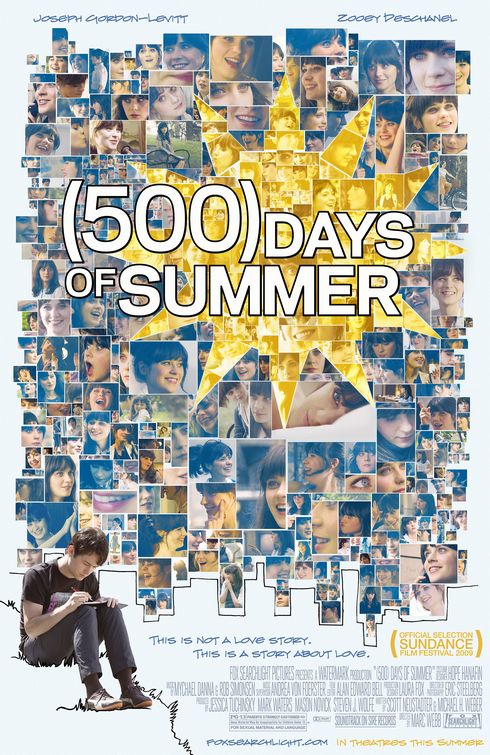
It doesn’t take long before you realize that (500) Days of Summer is a different kind of romantic comedy. In fact, to slap that genre title onto it does a disservice. I’ve watched plenty of romantic comedies (a notable rise in viewership since getting married in 2006), and the traditional Hollywood romantic comedy exists in a world not our own. It is a sitcom world where people blurt out their feelings, interact in bizarre manners, and get into wacky hijinks and contrived misunderstandings. These tales also exist in “movie world”; (500) Days of Summer, on the other hand, is refreshingly recognizable. Granted the characters still have fantastic if slightly off kilter jobs (writer of greeting cards), and the characters live in fabulous and gigantic apartments. Excusing those contextual quirks, the movie is upfront about its intention. “This is a story of boy meets girl,” a narrator intones, “but it is not a love story.”
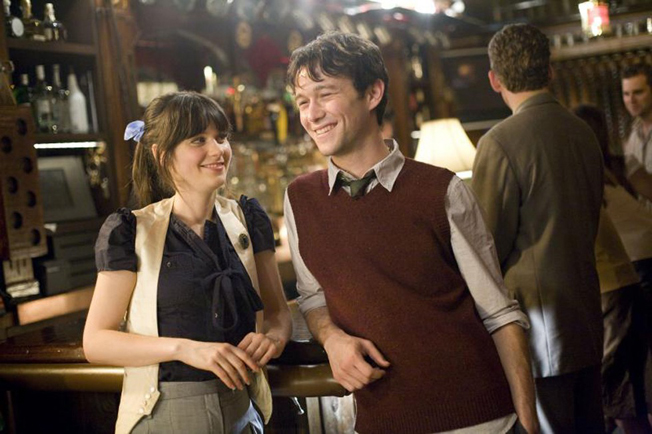
Tom (Joeseph Gordon-Levitt) recounts the 500 days he has spent with his ex-girlfriend, Summer (Zooey Deschanel), the girl he aches over because he feels her to be his “one.”
This is a movie about love and relationships but it has such a wider scope. It’s perceptive and insightful in the way that human beings engage in coupling. Tom ping-pongs between memories, tying together happy moments and the failed recapturing of those exact happy moments later. I enjoyed how reflexive the film can be with romance. When Tom is infatuated with Summer he lists her attributes: “I love her smile. I love her hair. I love her knees. I love how she licks her lips before she talks. I love her heart-shaped birthmark on her neck.” And then when he is frustrated with Summer, he lists her faults: “I hate her crooked teeth. I hate the way she smacks her lips. I hate her knobby knees. I hate that cockroach shape splotch on her neck.” I appreciate a movie that tries to tackle the complexities of love in a manner that doesn’t seem trite or sensational. A movie doesn’t have to say anything new about romance (is it even possible to scoop the Romantic poets?), but it can still say something true and revealing. It is a story about love, but not a love story.
 It also helps that the characters are meaty and are played by capable actors. Tom is a smart enough guy, though a bit of a foolish romantic. He buys into the love that is talked about in pop songs and greeting cards; he’s not naïve per se but plenty vulnerable enough to get his heart broken in the real world. Summer is an independent woman who says at the start that she is not looking for a boyfriend. She doesn’t wish to be constrained by a relationship and wants to enjoy the carefree days of youth. Yet Tom persists thinking he can wear her down or win her over, waiting for Summer to cave and find solace in Tom’s embrace. He fancies Summer as the “girl of his dreams,” though everyone else isn’t so sure. His little sister argues, “Just because she likes the same bizzaro crap you do doesn’t mean she’s your soul mate.” One of Tom’s friends has a really nice monologue describing his “perfect girl,” and these descriptions noticeably differ from that of his long-term high school sweetheart. But then he stops, reflects, and says that’s what his “perfect girl” would be like, but his current girlfriend, well, she’s better than his imaginary version of a perfect girl. But Summer isn’t a fantasy of romantic perfection, she’s a person. She has her own desires, her own insecurities, her own ambitions, and her own life to lead. These two feel like actual human beings and not stock players, though (500) Days of Summer does carry its own share of stock parts like the square boss (Clark Gregg) and the goofy, horny friend (Geoffrey Arend).
The saying “the camera loves” somebody seems outdated, old fashioned, and liberally applied. But when it comes to actress Zooey Deschanel, well, the camera just loves her. It’s hard not to fall in love with this blue-eyed beauty. She’s adorable, but not in an overly quirky way, and she’s smart, but still approachable, and altogether lovely. She is the face of unrequited love. She can be cold and aloof and jubilant. Deschanel plays the complications and complexities of an enigmatic woman who refuses to abide by labels. Her last conversation with Tom manages to be both crushing and inspirational. Her chemistry with Gordon-Levitt feels entirely naturalistic and pleasant. Gordon-Levitt has been cranking out strong performances in indie films like Brick, Mysterious Skin, and The Lookout. He’s quite possibly becoming one of the premier young actors working today. He has an everyman capability but he also can turn on the charm in a way that doesn’t seem forced, like Shia LaBeouf. Gordon-Levitt is the anchor of this movie and we see the world and Summer through his eyes. He brings great vulnerability to his role and we feel each step of his emotional journey. Both actors deliver terrific performances that don’t stoop to playing by the conventions of the romantic comedy.
 The nonlinear story structure seems like a gimmick until you realize that the writers, Scott Neustadter and Michael H. Weber, have cleverly freed themselves from the contrivances of movie romance time. MRT, for those who prefer their nomenclature in the shorthand, is that unbelievable breadth of time where the characters fall head over in heels in love with each other. It always feels so fast and far too fleeting, so that when complications have to arise late in the second act they too feel rushed. You could apply a healthy dose of montages to signify massive time passages, but those get old unless you’re Sylvester Stallone training to fight another boxing match. (500) Days of Summer tells you right away that this story takes place over a year and a half, and Day One isn’t when boy got girl but when boy met girl. By skipping around to specific dates, Neustadter and Weber are hitting only the highpoints, the memorable moments, and leaving out the unforeseen groundwork. All those mundane yet essential moments of pulling together a successful relationship are there, they are just now implicit. They are implied in the time jumps. The relationship between Tom and Summer, therefore, exists in an expanse of time that feels believable. The nonlinear structure also belies the way our memories work. Human beings don’t remember everything in a straight line, especially in matters of the heart.
There’s a lot of drama to be mined here with the breakup territory, but the movie is also playful and funny. Director Marc Webb, he of the video music world, pokes fun at other filmic expressions of love. At one point, Tom struts down the street and becomes the center of a lively choreographed dance sequence complete with animated blue birds. At another point, during Tom’s heartbreak, the movie descends through Bergman and Fellini visual tropes. It simultaneously communicates Tom’s emotional highs and lows and satirizes the histrionic nature of his feelings. Truly, when one’s in love you couldn’t feel better, or worse, but upon retrospect you can see how silly such in-the-heat-of-the-moment proclamations can be. There’s also a scene later in the film where Tom attends a party that Summer invited him to. The screen cuts in half, and on one side we see Tom’s expectations of what will happen that night and on the other side we see what actually occurs. The visual symmetry is interesting and a great glimpse inside the mind of a hopeful romantic.
 (500) Days of Summer manages to be breezy, moving, delightful, perceptive, charming, and just a great time at the movies. It’s a story about falling in love for the right reasons with the wrong girl. Summer isn’t the villain of the piece but her own woman, and she can be fickle and frustrating but she is not cruel or indifferent. Tom is desperately in search for his “one true love” but he’s playing by a checklist he’s drawn up from movies, TV, and love songs. All of this could have been sticky and formulaic (in fact, the dynamic vaguely resembles the characters from the abysmal Ugly Truth), but the filmmakers and the talented actors make the movie feel honest and relatable. The nonlinear narrative allows the movie to simultaneously be more playful, believable, and actually easier to understand, linking selective memories. No matter your current romantic situation, (500) Days of Summer is a slick antidote to Hollywood’s rom-com factory line.
Nate’s Grade: A
Share this:

Waltz with Bashir (2008)
 A mix between animation, documentary, and war drama, this Israeli film is something uniquely different and remarkable. Filmmaker Ari Folman interviews fellow veteran servicemen from Israel’s 1982 invasion of Lebanon in hopes of jogging his memory. He has blocked out the painful memories of war but his mind is reawakened as he reexamines the truth about the conflict and eventual massacre of Lebanese Arabs. Folman utilizes a rotoscope style of animation, which gives it a heightened reality and an intoxicating painterly beauty. He also takes advantage of the fact that atrocities can be easier to stomach when presented through the barrier of tasteful animation. However, it will be hard to keep from being affected (a scene of dying horses got to me bad). The realms of reality, fantasy, nightmare, and memory can crash together in fascinating ways, and eventually the movie transforms outright into a full-fledged documentary that melts away any last obstacle of empathy, ending with real disturbing footage of the massacre’s aftermath. Waltz with Bashir does not come with an agenda in tow, which allows the movie to explore the ambiguities of being young, nationalistic, confused, and armed in a hostile land. Folman is trying to peel away at the unbiased truth of the matter and cleanse his curiosity and, perhaps, his conscience. His filmic journey to that elusive and painful truth is a movie that crosses cultures and redefines what a documentary can be.
Nate’s Grade: A
Share this:

Moon (2009)
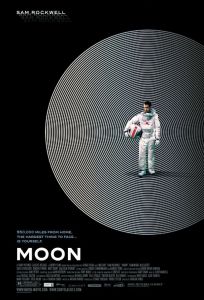 David Bowie’s son, Duncan Jones, directs two Sam Rockwells in this steely mood piece. Rockwell plays a lunar astronaut about to complete his three-year tour of duty when he finds another him. Is he hallucinating? Is this other Rockwell a clone? Who is the clone? The mystery unravels at a nice pace and Rockwell a pair of great performances, fully giving each character a different personality. Jones uses his small space to great use, multiplying the feeling of cabin fever more so than claustrophobia. Some will chafe that Moon doesn’t spell everything out, but the movie is smart enough to leave other things to the imagination. Moon tells a very specific, very select story and it does so with great economy that serves the story. This is Rockwell’s showcase and he carries the movie and nails the nervous breakdowns. For people let down by Hollywood’s slate of sci-fi duds, here is a satisfying small-scale sci-fi story told with intelligence and subtlety.
Nate’s Grade: B+


 nathanzoebl
You must be logged in to post a comment.