Blog Archives
Compliance (2012)
 The day at a fast food eatery began like any other. Sandra (Ann Dowd), the manager of the branch, has to shepherd her small group of employees through a hectic Friday evening. Then she gets a phone call from an “Officer Daniels” (Pat Healy). He tells her one of her workers, Becky (Dreama Walker), has stolen money from a customer. Sandra takes Becky into a storeroom and confronts her. Becky is aghast and professes her innocence. This is where things start to get out of control in writer/director Craig Zobel’s potent indie pressure-cooker. “Officer Daniels” insists that Becky be searched, then strip searched, and then worse, and Sandra and the employees begrudgingly go along. After all, it’s an officer of the law telling them what to do. Except that “Officer Daniels” is no police officer. This whole incident is an awful prank, and the people involved will never be the same.
This really is an indie horror movie, flipping the oft-repeated cry, “Don’t go in there,” with, “Why are you still doing this?” You may have to watch portions of this movie between your fingers. I was squirming and crying out at numerous points. The tension and dread just continue to mount, and you watch the characters slowly degrade, as they’re asked to do more insidious acts of humiliation in the name of compliance, and to watch them carry on the path of shame. It’s a step-by-step process of human degradation, so that the more disturbing moments of sexual obedience don’t feel entirely implausible given the journey through hell the characters have endured. It is impossible to watch this movie silent and detached. This is a provocative film that will garner many reactions but it’s also something of an endurance test. How long can you watch? How far can you watch these characters descend? The movie hooks you early and then you almost feel complicit, but you’re completely taken over by morbid curiosity.
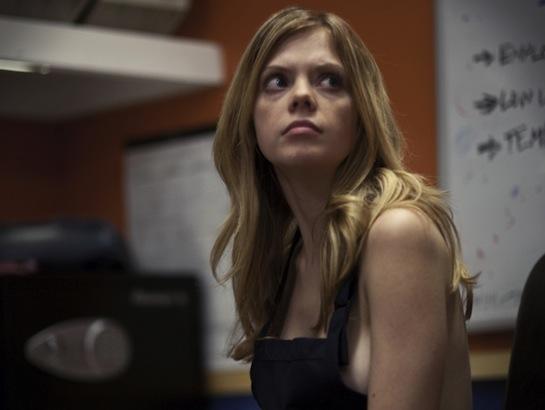 The movie is a powerful modern-day example of the Milgram experiment, the famous psychological exercise where a figure in authority, who assumes all responsibility, gradually gets average people to commit increasingly harmful acts to others. As long as people believe they are following orders, they can be convinced to do almost anything by someone in control. It’s easy to sit back and judge these characters, scoffing at how naïve they seem to be. It’s always easy for us to say what we would do in hypothetical situations, that is, until they happen. Compliance is an intriguing analysis of the shifting facets of power, authority, and manipulation. “Officer Daniels” enlists a host of tricks and verbal intimidation to persuade his victims to do things outside their better judgment (the caller’s true profession is a brilliant backstory). After a while, Sandra looks to be developing some slight Stockholm syndrome as she empathizes more with the plight of the phony officer on the phone than her employee. He provides just enough sympathy and validation she’s looking for to win her over. He also plays people against one another; he implores Becky to spare Sandra any extended grief, which often cows her into consenting. “Officer Daniels” isn’t the only one manipulating others; Sandra pressures employees to become involved in the situation, using her position of power to squeeze others into getting what she wants. There are numerous victims and culprits here.
Zobel could have easily given over to the exploitation elements of his story and made a very tawdry, voyeuristic exercise in sexual dominance. We watch as Becky bares all of herself and then goes even further, as “Officer Daniels” instructs male attendants to physically inspect her body cavities. It is a credit to Zobel’s sensitive direction that Compliance does not come across like a glorified S&M masturbation fantasy. He treats the incident very seriously, providing clear distaste without going overboard into preachy condemnation or superiority. It’s amazing that Zobel’s script finds so much empathy for his participants. You may be surprised at how relatable and “normal” these people seem. You may even recognize some of them. They’re all trying to do the right thing at heart, but that distinction gets extremely blurry as the night carries on. The point of Zobel’s script is that these people could be us. The added empathy makes the downward spiral all the more stomach-churning, as we want these characters to take a stand, to wise up and question the voice of authority.
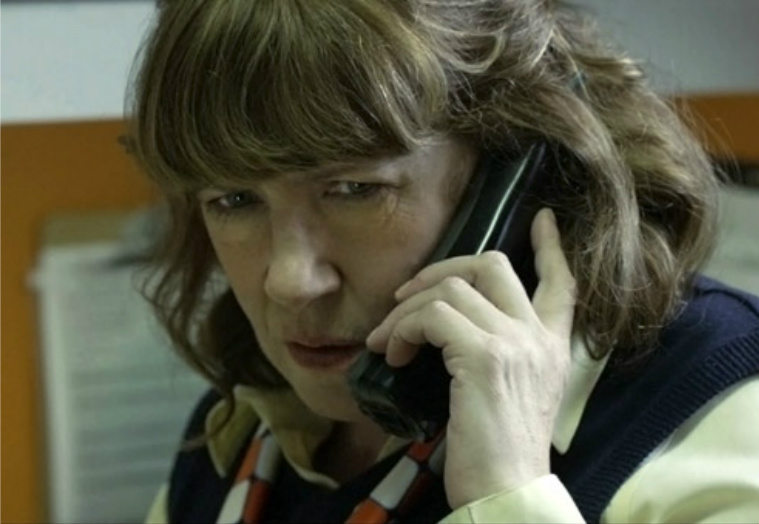 Dowd (Marley & Me) is downright heartbreaking and deeply frustrating in the movie. We get a clear sense of the pressure she’s under in her position, but she’s really the focal point of the movie. Walker (TV’s Don’t Trust the B in Apartment 23) is the martyr of the piece, and her slow resignation to the humiliation is deeply affecting, but this is Dowd’s movie. The longtime character actress takes the character of the dowdy Sandra, striving for respect, and transforms her into a figure worthy of Greek tragedy. She can be vindictive and, well, bossy, but she’s also a figure struggling for respect and validation and what she feels is morally just. We watch as her confidence starts getting chipped away, the flickers of doubt that she must tamp down because now she’s gone too far to reverse course. I don’t imagine that a movie as small as Compliance will be remembered around Oscar time, but I’ll certainly recall Dowd’s sad and transfixing performance.
I’d like to share a spooky bit of personal connection to the film. No I’ve never experienced anything this heinous before, but there was an offhand music cue that caught my interest. When we cut to the dining area early on, there’s an Admiral Twin song playing. Who is Admiral Twin? Why they’re a brilliant pop-rock band from Tulsa, Oklahoma that I’ve been singing the praises of since 2000. I’ve won over friends with my discipleship, but the band is still relatively unknown, playing few performances outside of their native Tulsa. Given the phonetic approximations of my name with the film’s writer/director, and the inclusion of an obscure indie band that few know (but should), it seems likely that Zobel may indeed be some far off relative of mine or, more likely, myself. I must have crafted an entire film without ever knowing about it. This seems like the most probable scenario.
I don’t want it sound like Compliance is some grueling exercise in group sadism. In lesser hands, it might have devolved to that. It’s a fascinating and provocative game that challenges and incenses an audience. The movie is a sickening but compulsively watchable dramatic experiment that will leave you talking for hours once it concludes. It’s an uncomfortable sit, yes, but that doesn’t mean it’s not worthwhile. The events in the film seem unbelievable and yet it’s based on a true story. This stuff happened, people. Not only that, it happened multiple occasions in multiple vicinities. What does that say about human nature? Will we only be as good as society lets us be? If we are absolved of responsibility, how far removed from our own sense of ethics will we go? Are we all susceptible to this moral failing under the right circumstances? I think that’s the truly terrifying and lasting lesson of Compliance. These people could be us, both victim and unwitting antagonist. Destined to stir debate and become a college ethics course favorite, Compliance is a gripping movie that will make you cringe but also give way to some scary introspection. How far would you go?
Nate’s Grade: A-
Share this:

V/H/S (2012)
 The found footage subgenre seems ripe for overexposure at this point. Just this year we’ve had a found footage party movie, a found footage superhero movie, a found footage cop movie, and this week will open Paranormal Activity 4, the latest in the popular found footage horror series. I understand the draw for Hollywood. The movies are cheap and the found footage motif plays into our culture’s endless compulsion for self-documentation. There are definite benefits to the genre, notably an immediate sense of empathy, a sense of being in the fray, and an added degree of realism. There are plenty of limitations too, notably the restrictive POV and the incredulous nature of how the footage was captured. With that being said, I think the people behind V/H/S finally found a smart use of this format. V/H/S is an indie horror anthology that offers more variety, cleverness, and payoffs, than your typical found footage flick.
Normally, found footage movies consist of 80 minutes of drawn out nothing for five minutes of something in the end. Usually, the payoff is not worth the ensuing drudgery of waiting for anything to happen. Watching the Paranormal Activity movies has become akin to viewing a “Where’s Waldo?” book, scrutinizing the screen in wait. V/H/S has improved upon the formula by the very nature of being an anthology movie. Rather than wait 80 minutes for minimal payoff, now we only have to wait 15 minutes at most. I call that progress. I haven’t seen too many found footage films that play around with the narrative structure inherit with a pre-recorded canvas. I recall Cloverfield smartly squeezing in backstory, earlier pre-recorded segments being taped over. With V/H/S, this technique is utilized once and it’s just to shoehorn in some gratuitous T & A. Plus, the anthology structure allows for a greater variety. If you don’t like some stories, and chances are you won’t, you know another one’s just around the corner.
 For my tastes, the stories got better as the film continued. I was not a fan of the first few stories. The wraparound segment (“Tape 51”) involves a band of delinquents who are hired to retrieve one VHS tape in a creepy home. The guys are annoying jackasses, and our opening image involves them sexually assaulting a woman and recording it to sell later, so we’re pretty agreeable to them being killed off one by one inside the creepy home. I just don’t know why anyone would record themselves watching a movie. It’s not like it’s Two Girls One Cup we’re talking about here. I found the wraparound segment to be too chaotic and annoying, much like the band of idiots. It ends up becoming your standard boogeyman type of story and relies on characters making stupid decision after stupid decision. Why do these idiots stay in the house and watch movies? Why do these people not turn on the lights?
The first actual segment (“Amateur Night”) has a solid premise: a bunch of drunken frat boys plan to make their own porn with a pair of spy glasses. They bring the wrong girl back to their motel room and get more than they bargained for. Despite some interesting commentary on the male libido (interpreting a woman’s spooky actions as being sexually aroused), this segment suffers from a protracted setup. There’s a solid ten minutes of boys being boys, getting drunk, that sort of thing. And when the tables are turned, the spyglasses lead to shakier recording, which is odd considering they are pinned on the guy’s nose. The horror of the ending is also diminished because it’s hard to make sense of what is literally happening. The weakest segment is the second one (“Second Honeymoon”), which is surprising considering it’s written and directed by Ti West, a hot name in indie horror after The Innkeepers. West’s segment is your standard black widow tale, following a couple on their vacation to the Southwest and their home movies. However, a stalker is secretly videotaping them while they sleep. Borrowing from Cache, this is a genuinely creepy prospect, and the sense of helplessness and dread are palpable. It’s surprising then that West concludes his segment so abruptly, without further developing the stalker aspect, and tacks on a rather lame twist ending that doesn’t feel well thought out. “You deleted that, right?” says one guilty character on camera washing away blood. Whoops.
The second half of V/H/S is what really impressed me, finding clever ways to play upon the found footage motif and still be suspenseful. The third segment (“Tuesday the 17th”) begins like your regular kids-in-the-woods slasher film. The very specific types of characters (Jock, Nerd, Cheerleader) are set for some frolicking when they come across a deranged killer. However, the slasher monster is a Predator-style invisible creature that can only be seen via the video camera. When recorded, the monster creates a glitch on screen. I think this is a genius way to cover the biggest head-scratcher in found footage horror: why are you still recording? With this segment, the video camera is the savior, the protector, the only engine with which they can see the monster. The fourth segment (“The Sick Thing That Happened to Emily When She Was Younger”) is shot entirely through Skype conversations on laptops. Emily is convinced her apartment is haunted and seeks support from her boyfriend, away on business. This segment’s co-writer and director, Joe Swanberg, is more known for being the mumblecore king than a horror aficionado, but the man makes scary good use of the limitations of his setup. The story might be a bit hard to follow, especially its ending, but there are some great jolts and boo-moments. There’s even a fantastic gross-out surprise as Emily shares her own elective surgery/exploration.
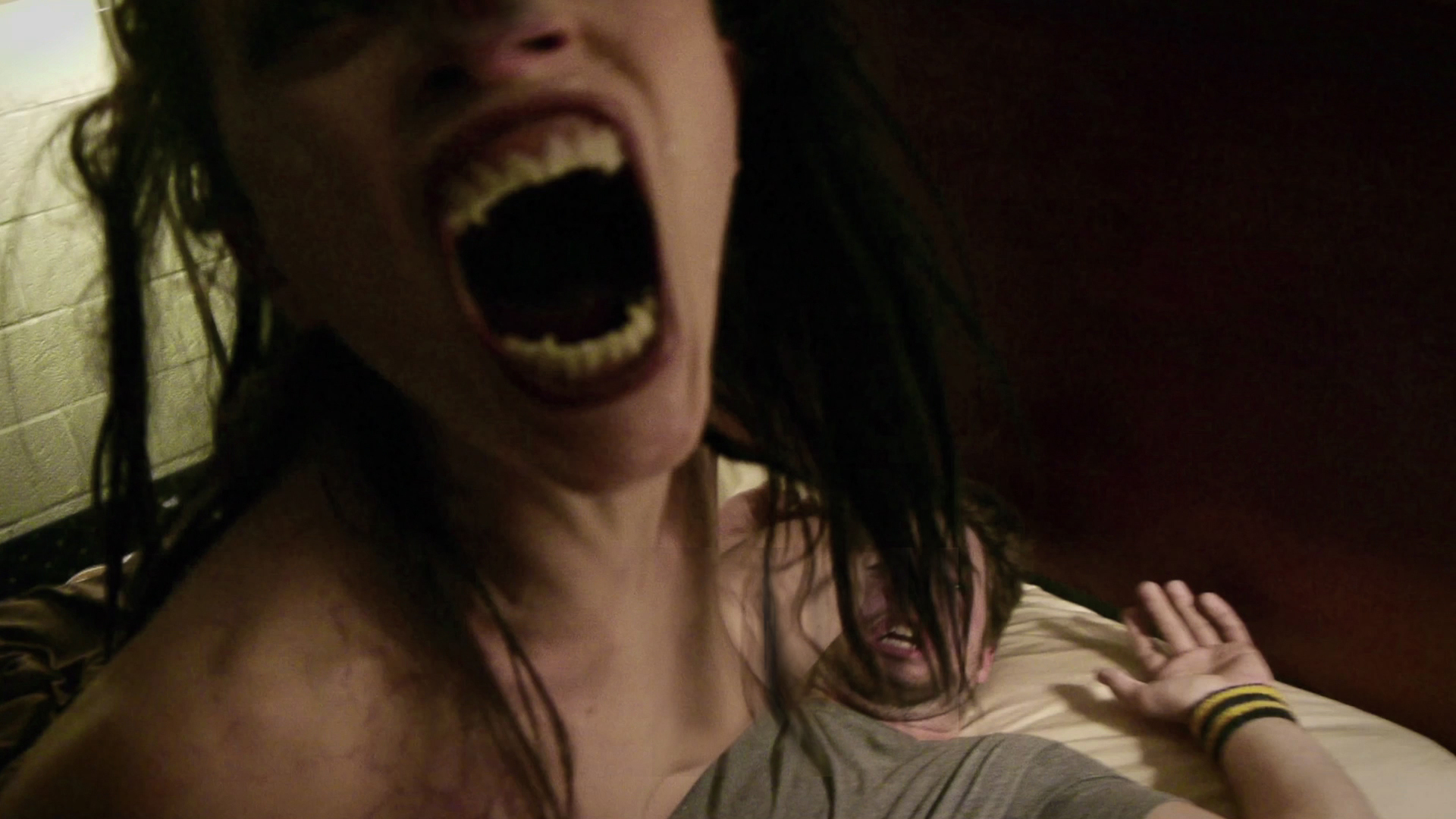 But it’s the last segment that takes the cake, ending V/H/S on a fever pitch of action. The wraparound segment isn’t even that, since it ends before the final segment, “10/31/1998.” It’s a haunted house story about a group of guys who stumble into the wrong house on the wrong night. Initially they think the human sacrifice in the attic is part of the show, but then weird things start happening like arms coming through walls and door knobs vanishing. This segment is a great example of how effective atmosphere can be aided by smart and selective special effects. When the madness hits the home, it feels just like that, and the rush to exit the house is fueled with adrenaline. You don’t exactly know what will be around the next corner. The CGI effects are very effective and the lo-fi visual sensibilities give them even more punch. The frenzied chaos that ends “10/31/1998” would be apt for a feature-length found footage movie, let alone a 15-minute short. It’s a satisfying climax to a film that got better as it went.
With all found footage movies, there’s the central leap of logic concerning who assembled this footage, for what purposes, and how they got it. With movies like the abysmal Apollo 18, I stop and think, “Why do these people assembling the footage leave so much filler?” V/H/S doesn’t commit a sin worthy of ripping you out of the movie, but when it’s concluded you’ll stop and ponder parts of its reality that don’t add up. The very idea of people still recording onto VHS tapes in the age of digital and DVD seems curious, but I’ll go with it. Several segments obviously had to be recorded onto a hard drive; the Skype conversations would have to be recorded onto two perhaps. So somebody transferred digital records… onto a VHS tape? And it just so happens that this tape then got lost.
While inherently hit-or-miss, V/H/S succeeds as an anthology film and generates new life into the found footage concept. Not all of the segments are scary or clever, but even during its duller moments the film has a sense of fun. There’s always something new just around the corner to keep you entertained, and the various anthology segments give a range of horror scenarios. The lo-fi visual verisimilitude can be overdone at times, but the indie filmmakers tackle horror with DIY ingenuity. I don’t know if anything on screen will give people nightmares, but it’s plenty entertaining, in spots. V/H/S is an enjoyable, efficient, and entertaining little horror movie just in time for Halloween. If you’re going to do a found footage movie, this is the way to do it.
Nate’s Grade: B
Share this:

Salmon Fishing in the Yemen (2012)
 Salmon Fishing in the Yemen will likely not be outdone in 2012 for strangest title of a mainstream film release. It is indeed about the crazy idea of bringing salmon to an emerging system of rivers in a Middle Eastern country. You’d expect some cultural conflicts and even some can-do uplift by the end. What I wasn’t expecting was a hokey romantic comedy to take hold of the movie. Ewan McGregor plays a repressed fish expert who partners up with Emily Blunt, whose company represents a wealthy Yemen sheik with a cockamamie dream. I felt that the sheer magnitude of project, transforming an environment, the triumph of the human spirit and cooperation, would be compelling enough. But this trifle of a romance demands the greater attention. There’s a contrived plot point where Blunt’s boyfriend of three weeks is presumed dead in Afghanistan. Guess who comes back later? This entire storyline hinges around the fact that she was only with the guy for three weeks; even she admits, “I never got to know him better.” The coupling feels extra tacky because McGregor is married too. Sure his marriage appears to be in a rut, but does that excuse his behavior? The political satire of the British government also feels pretty tin-eared and forced, like they’re compensating with volume for wit. Then there are the corny moments like McGregor foiling an assassination attempt on the sheik with a fly fishing rod. Yes, he whips it around the attacker’s arm like Zorro. Salmon Fishing in the Yemen is a nice enough little film, at least it would have been had it ever been allowed to jettison the yoke of a lackluster romantic comedy.
Nate’s Grade: C+
Share this:

The Master (2012)
 Writer/director Paul Thomas Anderson met with great resistance when he was shopping his script around for The Master. It was dubbed the “Scientology movie” and reportedly based upon the controversial religion and its leader, L. Ron Hubbard. It looked like Hollywood was spooked by the prospect of a movie that appeared to take on Scientology. Eventually Anderson got his financing and made the movie he wanted to make. Calling it the “Scientology movie” is misleading. I wish The Master was a Scientology expose because that would be far more interesting than the exasperating film I got, which is one nutty guy who dabbled in a Scientology-like cult. Maybe the resistance Anderson experienced wasn’t an indication of the subject matter. Perhaps it was only an indication that The Master just wasn’t a compelling story, a charge I can agree with wholeheartedly after viewing this disappointing film.
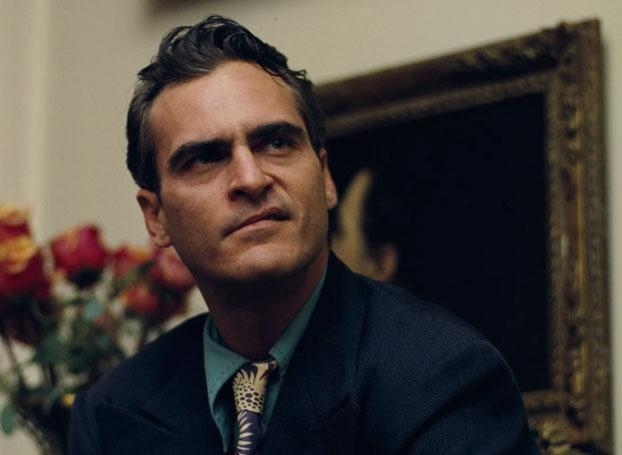
Freddie Quells (Joaquin Phoenix) is struggling to adjust to life after World War II. Fresh out of the Navy, he works as a department store photographer, until his rage and social awkwardness lead to him being fired. He’s drifting about and hops onto a ferry leaving town. Onboard is Lancaster Dodd (Phillip Seymour Hoffman) who describes himself as “a writer, a doctor, a nuclear physicist, a theoretical philosopher, but above all, a man.” Dodd has gathered a revered following. He believes that people can regress to past lives trillions, yes you read that right, of years into the past. Dodd’s own children admit that dear old dad is “making it up as he goes along.” His movement, known as The Cause, has been called a cult by detractors, the will of one man, and the followers don’t take kindly to challenges from the outside. Dodd adopts Freddie as a project. He’s on the verge of completing his second major treatise and Freddie seems to be an inspiration for him. Freddie finds some measure of acceptance within Dodd’s community of followers, but his erratic behavior keeps people on constant edge.
I found The Master to be boring; uncompromisingly boring, hopelessly boring, but worse than all that, pointlessly boring. Was this really a story that needed to be told? I cannot fathom why Anderson chose to tell this story or, in particular, why he chose to tell it through the character of Freddie Quell. A story about a huckster exploiting people with a religion he made up is a fascinating story with or without the Scientology/L. Ron Hubbard connections. That’s a story worthy of being made. Now, instead of this, we have two hours of a guy acting nuts. I would better be able to stomach the Freddie character if I felt like anything of significance was happening to him. He’s a broken man, clearly mentally ill in some capacity, and prone to outbursts that turn violent. Does he change? Does he grow? Does he do anything? Does his life have anything of significance happen to him over the course of 137 minutes? Not really. He’s pretty much the same guy from start to finish; his arc is essentially that he’s crazy at the start, meets Dodd, and then is crazy at the end. We get it, the guy is messed up. He makes a drink out of paint thinner for crying out loud. I didn’t care about him at all. I don’t need to see static scene after static scene of this guy acting out. I wasn’t a There Will Be Blood fan but at least Daniel Plainview was a strong central character with enough dimensions to carry a film. Freddie Quell just isn’t that interesting or entertaining. He’s actually a tiresome character because you get a perfect sense of who he is in just 10 minutes. The rest of the movie just seems to remind you what you already know.
 It is a disappointing realization but I feel like the Paul Thomas Anderson I enjoyed is slipping away, as his flashy, propulsive, plot-heavy early work has given way to opaque, reserved, and plotless movies. It’s like I just watched someone with the verve of Martin Scorsese transform into a poetic film somnambulist like Terrence Malick; not a good move. I don’t know what Anderson’s message is or what he was trying to say, and I’m unsure why he decided to use a limited character like Freddy Quells as his prism. It almost feels like Anderson is compensating for his plot-driven films of his early career, like he has to balance the scales in his mind. I shudder where this recompense might take Anderson for his next film. I like to think of myself as an intelligent moviegoer who enjoys being challenged by movies. But that doesn’t mean I’ll accept anything challenging as quality. Case in point: Jean-Luc Godard’s Film Socialism, which was contemptuous of its audience. I don’t mind doing work but you have to give me a reason. There has to be a reward, either with the narrative or with the characters. I found no rewards with The Master and it’s not because I didn’t “get it,” film snobs, it’s because the movie was too opaque to say anything of substance beyond simplistic observations about the abuse of power and influence.
When I say plotless I don’t mean that we’re simply watching paint dry, though there are stretches of The Master where I would feel that could be a suitable test from Dodd. There are events. There are scenes. There are changing relationships. It’s just that none of this seems to matter, or at least it never feels like it does. There’s no build, no increase in urgency, and The Master just sort of drifts along to the detached rhythms of Freddie. The movie can feel interminable, and you may ask yourself, on a loop, “Is this going anywhere?” There are two scenes that stand out because there are so few that seem to matter. One is shortly after Dodd and Freddie have been arrested. The two men are locked in opposing cells and they explode in venomous anger. It feels like Anderson can finally allow his characters to vent out what they’ve truly been feeling. Another memorable scene, just for weirdness, is when we jump inside Freddie’s head. All the women, young and old, at a social gathering suddenly lose their clothing (think: Choke). It’s one of the best scenes at exploring Freddie’s sexual compulsions, plus it’s just peculiar. I wanted more scenes like this where we try and get inside the man’s mind. The rest of the characters are underwritten, especially Amy Adams (Trouble with the Curve) as Dodd’s wife and fierce protector. This is a movie about two strong-willed men and everybody else gets relegated to minimal supporting positions. I miss the sprawling humanism of Boogie Nights and Magnolia.
From a technical standpoint, the movie is very accomplished. The 1950s era setting is lushly recreated, aided by cinematography that seems to present this bygone age in a colorless manner. By this I mean that the world feels muted, repressed, the colors are there but they don’t pop, and I think this look fits the movie marvelously. Anderson shot the film in 70mm, which would offer startling detail to his images. I did not see the film projected this way (as will most) but you could sense the time and effort put into getting the details of his world right. The musical score by Johnny Greenwood is minimalist but effective, with a few key strokes of a guitar to note rising tension.
 The true draw of the film is the performances, which are excellent and at least provide a reason for staying awake. This is Phoenix’s first role since his two-year performance stunt documented in I’m Still Here. It feels like his off-putting, confrontational, bizarre antics for that faux documentary were all just training for playing the character of Freddie. The man has sad, droopy eyes, a fixed sneer that denotes his permanent displeasure and cocksure attitude. He speaks in mumbled sentences, he walks with his arms pinned out, donning the posture and behavior of a chicken. It’s at once an odd and striking performance, and Phoenix does his best to make the character worthy of your attention. He gives it his all, but sadly Freddie just doesn’t merit prominence. Hoffman (Moneyball) is equally alluring as the charming huckster who seems to come alive under a spotlight; the man exudes an oily presence, and yet there are a handful of moments where he lashes out, venting the roiling anger that seems to be barely contained at times. Hoffman’s performance is one of willful self-delusion rather than rampant self-destruction, which makes him far more compelling in my opinion. I would have preferred a Lancaster Dodd movie rather than a Freddie Quells movie.
The Master is a confounding, airless, opaque character study that is far from masterful. The faults of the film and its stilted ambitions lay squarely at the feet of its flawed central character, Freddie Quell. The movie adopts Freddie’s demeanor, managing a distant, standoffish, defiant attitude that thumbs its nose at audience demands. Don’t you know entertainment has no place in art, silly filmgoers?
Anderson is still a vastly talented filmmaker but I lament the path his career has taken. I adored the first four movies of Anderson’s career, but now I wonder if I’ll ever get something along the likes of Boogie Nights or even Punch-Drunk Love again. At this point Anderson has earned enough artistic latitude to tell whatever stories he so chooses. This is why my frustration has mounted because I am at a loss to why he feels compelled to tell this story and in this manner. The Master is an artistically stillborn affair. You want to believe there’s more under the surface but I don’t see it. The main ideas and themes are hammered with little variation, the slight plot drifts aimlessly finding no sense of momentum, and the characters are kept at such distance that the film feels clinical, like we’re observing creatures under glass for study. It just so happens that none of these characters warrant the attention. The Master will be praised by a plethora of film critics. Peter Travers of Rolling Stone said it renews your faith in American cinema. I had the opposite reaction. The Master made me lose faith, mainly that I’ll ever enjoy a Paul Thomas Anderson film from this point on.
Nate’s Grade: C
Share this:

Robot & Frank (2012)
 It’s the age-old story about an elderly man (Frank Langella) suffering from Alzheimer’s who teaches his robot helper to be his partner in jewelry heists. While that sounds a lot more fantastic than the movie we eventually get, Robot & Frank is a mellow, sincere, and overall nice movie that treats the particulars of its world with a wry sense of whimsy. The movie is really a mismatched buddy film as Frank is hostile to being forced to live with robotic help, but soon the two of them form the basis of a friendship, and when things get dangerous it’s heartwarming the lengths they’ll go to save the other. Give the Alzheimer’s subject, expect some twists in the final act concerning Frank’s world. The movie wants to hit us emotionally but I felt mostly remote, smirking at some of the fun of the old codger back in the burglary business of his youth. But the film just stays at a very even-keel level of emotional resonance, drawing us in but not exactly taking us anywhere. The ending is curiously without any sort of comforting resolution that could have put a solid piece of punctuation on the film’s emotional drama. Langella, it should be said, is excellent. Robot & Frank is a high-concept buddy film, fairly pleasant and entertaining but when it comes to a close you may wish that the film had relied less on chaste understatement.
Nate’s Grade: B
Share this:

Celeste and Jesse Forever (2012)
 Celeste (Rashida Jones) and Jesse (Andy Sandberg) have been best friends ever since high school, the couple everyone admired. They’ve been married for six years but now they are in the middle of divorce proceedings. Why? Celeste loves her longtime best friend but worries he’s not maturing or stable to be her marriage partner. During their separation, Jesse admits he’s found another woman whom he cares about. Celeste professes to be happy but deep down is troubled, second-guessing her decision now that there’s a real threat she might lose Jesse. The two buds act like nothing has changed, goofing around and paling it up, but how long can they keep up this façade? Eventually, someone is going to get hurt because divorce cannot be shrugged off. Reality has a way of outliving ironic detachment.
Can you remain best friends with someone you once loved? How about someone you once knew as your spouse? Celeste and Jesse are certainly trying but their idealistic “BFF” status seems destined to meet a harsh reality. Celeste and Jesse Forever is labeled as a “loved story” and I think that’s a pretty apt description. These two characters clearly have a deep affection for one another, but after six years the feelings just aren’t enough. What happens when you marry your best friend but that just isn’t enough? I was hoping for some greater answers from the movie, or at least a harder examination on why some relationships fall apart when things look like they should work. That’s not exactly what the movie offers. For a film with an aim to be more realistic about the fallings out of love, the movie follows a familiar formula. There’s the cute guy at yoga (Chris Messina) into Celeste, but first she has to get settled. I think I wouldn’t have minded this character if he didn’t feel so much like a plot device, a hasty happy ending meant to be put in a holding pattern until called upon. The “Jesse” half of the title will be gone for lengthy chunks of the movie. His portrayal also borders on simplistic. I wish we got more of his side of the relationship, especially since he’s going through sudden change himself. After seeing the trailer, I thought I was going to find the movie immensely relatable. Maybe I just got all the recognizable personal drama out of my system with The Five-Year Engagement (double feature for bitter lovers?).
 Fortunately, the movie is also fairly funny. The comedy can feel a tad sitcomish at times with misunderstandings and catching people in embarrassing situations. The screenplay by Jones and co-star Will McCormack (TV’s In Plain Sight) is routinely amusing, settling with soft chuckles rather than anything histrionic. It fits the subdued tone of the movie, since it’s about people coming to terms with messy emotions and not whacky mishaps. Then there’s a whole subplot involving a teen pop star (Emma Roberts) that feels recycled from a whole other movie. This storyline leads to a few good jokes but it doesn’t seem to add anything of value to the plot. The comedy doesn’t overpower the dramatics, and Celeste and Jesse Forever finds a nice tonal balance between the heartache and humor. I wouldn’t say the film is necessarily quirky but it certainly operates to an offbeat comedic rhythm. There are a few cringe-worthy editions but the characters and the actors make it worth any personal discomfort.
If Jones (TV’s Parks and Recreation) needs a good boyfriend I will gladly volunteer my services. My God this woman is beautiful. I don’t want to set off any alarm bells, but this woman is a goddess. She’s also extremely talented and a naturally charming presence. Her chemistry with Sandberg (That’s My Boy) is out of this world. They are so relaxed together, so amiable, so enjoyable, that it really does come as a shock when their unamused friends have to sternly remind them they are getting a divorce. They have a wealth of in-jokes and secret couple codes, and they’re so cute together that you wonder if maybe, just maybe, they’ll reconcile by the end. Sanberg is better than I’ve ever seen him, giving a strong, heartfelt performance as a nice guy trying to make sense of his eroding situation. But this movie is Jones’ movie, and she shines. While her facial expressions can get a little overly animated at times (TV-ish mannerisms?), this movie is a terrific showcase for her dramatic and comedic talents. This woman will excite you, frustrate you, break your heart, make you laugh, but you’ll be glued to the screen.
 The tricky part is that Celeste is both our protagonist and antagonist. She is the root of her own unhappiness, and coming to terms with the fact that she was wrong is a big moment of personal growth, however, it’s not exactly the direction audiences may be happy with. It’s harder to root for a character that is sabotaging her own progress. Jessie, especially as played by Sandberg, is pretty much an adorable puppy dog throughout the whole movie; it’s hard to stay upset with him, and occasionally Celeste will lead him on and then punish him for following. She tells him to move on but then pulls him back to her when he threatens to do just that. She chastises him for not being serious enough, for not having direction, yet you get the impression throughout the movie that Celeste bares some responsibility in this situation as well. Jesse is laid back, though hardly the arrested development slackers dotting most of modern comedy these days. As one character notes, perhaps Celeste enjoyed keeping her husband grounded, limited, stuck. I don’t chalk it up as malice, more a comfortable situation that Celeste is afraid to disrupt. She’s the overachiever, he’s the underachiever, they compliment one another, that is, until Celeste decides they don’t. Then when it looks like Jesse’s growing up, she wants him back, or thinks she does, at least this newer version of Jesse. As you can see, it’s complicated. At no point would I dismiss Celeste as a callous person, but the movie is tethered to her personal growth of being able to admit fault. Her window with Jesse has passed. The movie is about her journey to realizing that.
Celeste and Jesse Forever feels like a movie of small waves. It doesn’t have the Big Declarative Moments of most rom-coms or indie romances, and that’s because it’s not a romance as much as an autopsy on why a romance went down for the count. It’s melancholy without getting mopey. It has certain hipster tendencies but nothing that rises to an insufferable level of twee; it’s routinely adorable and rather heartfelt in places, though I wish it had offered more potent insight into its characters. This isn’t going to be a movie that people build up great emotion for. By nature it’s pretty low-key, choosing to handle its emotional pyrotechnics with delicacy and the occasional comedic set piece. For a comedy about divorc,e this si surprisingly sensitive. These are nice people, good humored, and you sort of wish the movie would just scrap any indie ambitions and substitute a happy ending. You want to shout at the screen, “Just reconcile already!” Maybe that was me just using the movies as good old therapy again (see: The Five-Year Engagement review, or don’t). Celeste and Jesse Forever is an agreeable, affable, bemusing movie, with enough laughs and emotion to justify giving it a chance.
Nate’s Grade: B
Share this:

Killer Joe (2012)
 This is one nasty, alarming, but very involving movie that wallows in darkness and plays it up for laughs. Killer Joe is a dysfunctional family drama, a crime thriller, and a mesmerizing character study when it comes to the lessons of amorality. Based on the play by Tracy Letts (August: Osage County), Joe (Matthew McConaughey) is a crooked cop who works as an assassin on the side. A weasely loser (Emile Hirsch) and his family hire Joe to kill their mother for the insurance money. Things get out of hand in frequent measure, with splashes of brutal violence, healthy amounts of sex and full-frontal nudity, and a disturbing sexual act with chicken that more than earn this film its adults-only NC-17 rating. What makes the movie rise above base exploitation is its depraved, deep-fried sense of humor. There is plenty of uncomfortable laughter and guffaws. The end of the film, during a fever-pitch of violence, is so sudden, so kooky, so debauched, that my friend and I burst out laughing. Without its wicked sense of humor, and its sharp ear for working-class dialogue, the movie could be accused of wallowing in the muck. There’s also the terrific acting, chiefly from McConaughey. He gives a hypnotic performance, chilling, unpredictable, and deeply committed to retribution. When he zeroes his cold eyes on you, boy does the flesh crawl. It’s an intense performance and arguably the best of the man’s career. Directed by William Friedkin (who also directed the 2006 adaptation of Letts’ play, Bug) with brutish élan, Killer Joe is one nasty piece of work, but given the right audience, it could prove to be a perverse entertainment.
Nate’s Grade: B
Share this:

Margaret (2011)
 The behind-the-scenes story of Margaret could make for a compelling feature all its own. It began filming in 2005. Writer/director Kenneth Lonergan had spent two years on the script. It was the follow-up to his Oscar-nominated 2000 film, You Can Count on Me. The only requirement was that Lonergan turn in a cut of the movie that was under 150 minutes. His first cut was three hours. The producers paid their own editor to chop the film down to two hours. Then came the flurry of lawsuits and countersuits between the producers and Lonergan. No less a cinematic statesman than Martin Scorsese was asked to take a look at the movie and edit it down to 150 minutes (Lonergan labored on the script for Gangs of New York). Several protracted years later, Fox Searchlight dumped the 150-minute Scorsese cut in a handful of theaters. Then a funny thing happened. The rare critics who got a chance to see Margaret flipped for it. Lonergan’s initial three-hour cut is now available on Blu-ray. It’s a happier ending than any of the participants might have imagined only a couple years ago. I’ve been eager to see Margaret for myself, to see if all these arty critics were being a bit overzealous in their praise. Days later, I can’t get it out of my head and I’m sure others would suffer the same wonderful affliction.
Lisa Cohen (Anna Paquin) is a privileged New York City teenager who usually gets what she wants. She’s on the hunt for a cowboy hat when she spots a bus driver (Mark Ruffalo) with one. She runs alongside the bus, trying to ask him about the hat. It’s just enough to distract the driver. He runs a red light and plows into a pedestrian, Monica Patterson (Allison Janney). As a crowd forms and help is called for, Lisa holds the broken woman during her final, hellish moments. Afterwards, she lies to the police to protect the driver. The guilt eats away at her. She lashes out, she hurts others, she butts heads with her stage actress mother (J. Smith-Cameron), and she’s looking for anything to cope. Eventually Lisa decides to come clean and seek justice but it just might be too late.
 Margaret is a messy, imperfect film, over-indulgent and cluttered, but man does it stick with you. It sits in your stomach. You can’t shake it. You just keep thinking back on it. And after a while, the flaws itself start to transform into virtues themselves. The film is messy and all over the place but my God does it excel at recreating, in startling spasms of uncontrollable emotion, the life of an American teenager. There is no off switch when it comes to emotions, and when you’re young everything seems like the end of the world. Like Lisa, you alternate between self-involvement and idealism, and you haven’t hardened to the way the world works just yet. The movie, thematically, latches onto the same wavelength as its heroine. Lisa is a flawed creature, deeply hurting and trying to come to terms with her own responsibility and guilt for the accident. It just so happens that she makes mistakes trying to deal with that pain, and innocent people get hurt, and people we once thought were noble reveal their own impulses and vulnerabilities. Whether she’s sympathetic as a protagonist doesn’t matter, though even when she hurt others I never found her less than fascinating. She feels everything so intensely, and those intense feelings bleed into other areas of her life. She can be woefully self-involved and callous at times, but she can also be self-possessed and fearless in a moral quagmire. At one point, a character argues that teenagers would govern better than adults because teens are still idealistic and proactive, even if their actions are dismissed as naive. Lisa wants to find justice in the world somehow, so she can make sense of this random tragedy. She still clings to the belief, even as the film becomes a messy legal battle (one of its many genres Lonergan dabbled in).
There are plenty of storylines and themes and messages that Lonergan wishes to weave into a seamless patchwork version of our intolerable, detached, self-involved culture. The film is something of a time capsule, way back in 2005, and the post-9/11 anxieties and civil insecurity is also dealt with in interesting ways. Lisa’s social studies class repeatedly descends into shouting matches, debates that reduce the opposition in the simplest terms. After a while, all we’re doing is trying to out-shout the other and no one is listening anymore. Lisa comments that our culture feels so disconnected and that people have stopped relating to one another. Of course this also extends to her as well, as she confuses her feelings and those around her. The mother-daughter dynamics are a fascinating character insight and one of the better onscreen relationships I’ve seen in years. You can clearly see where Lisa gets some of her showboat tendencies. Both mother and daughter have stopped being able to relate to one another, and Lisa can wield sarcasm like a weapon, as teenagers are wont to do to their parents. Mom is dating a man she doesn’t particularly connect with, and yet she enjoys the company and the desire to be wanted. Is that enough to fulfill her gnawing sense of loneliness? Lisa’s father is the type to run from conflict, and yet the man is just as self-absorbed and hurtful as anyone else in the film. Except he’s an adult and, theoretically, should know better. In that regard, the movie reminds me of the excellent Little Children; this is a movie of mitigated personal responsibility from people of all ages. If this is the way the world works, then why not give teenagers a chance?
 The opera is a reoccurring motif for the film, and it’s a strong artistic association for the film because Lonergan sort of gives his characters arias with which to work. The emotions are sent to overdrive, the arguments are full-blast, and the dialogue lands in that articulate, hyper-verbal territory but isn’t self-consciously snappy. It’s hard to quantify but it’s dialogue that’s painful and revealing and, while beautifully crafted, can come across as genuine. The entire movie is the same way. This is a drama where, in Spinal Tap terms, the emotions go to eleven. It’s a big bleeding heart of a movie, but it’s not corny or maudlin or mawkish or TV movie sentimental. It’s fearlessly emotional and takes you on a journey with many stops. You’ll likely be horrified, thrilled, precarious, elated, angry, saddened, and frustrated.
It may be best described as a series of potent, powerful scenes rather than a traditional screenplay with a clear through line. The most memorable scene also happens to be the one that sets everything in motion – the accident. It is horrific and awful in ways that movies rarely deal with. The first image we see is a leg pinned under the bus. Oh no, we think. But then the camera continues to pan down and we see… the rest of her in a heap. Oh no, we say to ourselves again, even more aghast. We’re there for the harsh reality, the sad realization of Monica that she’s going to die (“Are my eyes open? I can’t see…”), and the shock and confusion of the situation. There’s blood shooting everywhere, no sign of help, and the woman is fading away, confusing Lisa with her deceased daughter of the same name. Lonergan makes us stay in this traumatic scene for a long time, an uncomfortable amount of time, enough that the horrible incident is burned into our memory as well, and when Lisa crusades for justice or looks for some physical or emotional escape from the trauma, we know why. It’s one of those one-scene marvels, a byproduct of near-perfection on every technical level.
This is pre-True Blood Paquin and boy does she deliver when it comes to the dramatic feats of her character. She’s convincing as a coy, too-smart-for-her-own-good teenager, she’s devastating as a lost, dour soul lashing out at the world, looking for anything to ease the pain, and even when she stumbles, she’s fascinating. Paquin goes through a variety of moods to suit the variety of tones and storylines for the film, and her performance never falters. I’m amazed at how fast she can spit out the verbiage, while crying her eyes out, and all without gasping for breath. She’s nothing short of amazing.
 The rest of the movie is filled with recognizable actors in small parts, from Matt Damon (The Adjustment Bureau) as a nice guy math teacher with his own weakness, Matthew Broderick (Election) as a pompous English teacher, Jean Reno (Couples Retreat) as the off kilter suitor to Lisa’s mother, Kieran Culkin (Scott Pilgrim vs. the World) as the bad boy druggie who deflowers Lisa, John Gallagher Jr. (TV’s The Newsroom) as the nice guy with the unrequited crush on Lisa, Rosemarie Dewitt (The Watch) as the bus driver’s wife, Lonergan himself as Lisa’s neglectful father, and the triumphant return to screen of Jeannie Berlin (The Heartbreak Kid) who hasn’t appeared in a movie since 1990. Berlin has the juiciest part as Monica’s closest friend and eventual confidant for Lisa. She takes on Lisa’s mission for justice, but she’s still wary of Lisa and her hyperbolic nature. She accuses Lisa of making up a garish detail (the Lisa name confusion in Monica’s last moments): “This isn’t an opera! And we are not all supporting characters to the drama of your amazing life!”
The title of the film comes from a poem called “Spring and Fall” by Gerard Manley Hopkins addressed to a grieving subject named Margret: “Ah! as the heart grows older/ it will come to such sights colder/… /It is the blight man was born for/ It is Margaret you mourn for.” When you come down to it, Lonergan’s film is about the awareness of mortality, the shock of death, the realization of the end, and our pitiful attempts to turn off the feelings more fully felt. Adults, Lonergan argues, have become hardened to the world to the frailty of life, and you question if that hardening, a natural process, is a good thing. Perhaps the dubious claim that teenagers should take a chance running the world is not without some sliver of merit. Margaret is a movie that’s hard to pin down; there’s so much going on, not all of it fully realized or satisfying I freely confess, but it’s a thrill to witness an artistic vision that’s bursting with things to say, so many things that life cannot contain them all. The 150-minute running time will be a stumbling block for some, but honestly I never felt the film drag like I do most Hollywood action thrillers of that length. When you step away, and take the film’s messiness into context, then Margaret stops being an ambitious but erratic artistic miscue and starts coalescing into something bolder, richer, and thought provoking. It took a long strange journey to get here but Margaret is a movie that deserves to be savored and debated.
Nate’s Grade: A-
Share this:

Beasts of the Southern Wild (2012)
 After months of rapturous praise from Sundance and Cannes, allow me to be the wet blanket of the critical community, because Beasts of the Southern Wild is one big helping of “meh.” I didn’t enjoy this movie at all and its mixture of strange fantasy elements and a hellish childhood reminded me of another misfire, 2009’s Where the Wild Things Are.
Six-year-old Hushpuppy (Quvenzhane Wallis) lives on a spit of land off New Orleans and below the levy. This tucked-away land is nicknamed by its colorful, besotted residents as the Bathtub. Hushpuppy lives with her father Wink (Dwight Henry) in large shacks elevated high off the ground. This comes in handy because after a disastrous flood, Hushpuppy and her father have to navigate the waters to find others and scramble for some return to their life and culture. The residents must also make sure to be cautious because the U.S. government, which is evacuating all flood-devastated areas, is looking for survivors to forcibly remove. Wink is sick and has to impart the ways of his family and culture to young Hushpuppy, who sees herself as one piece in a big puzzle.
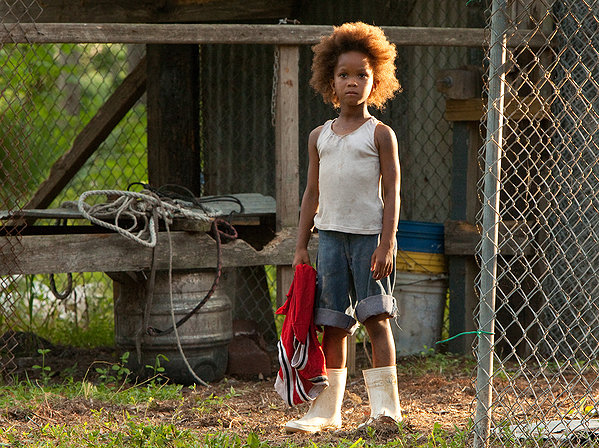 This movie is awash in all sorts of tones and storylines, failing to cohesively gel together or form some kind of meaningful message. I could have sworn that the fantasy elements, namely the giant thundering pack of large boars, were just going to be a visual metaphor for Hushpuppy’s journey. And then they actually show up and every person can see them. So, now what? The boars are one of many ideas that the movie just sort of toys around with before losing interest. This is not a film of magic realism. This is not a film about the escapes from a hard reality. In a way, this movie plays out like if Terrence Malick had made Gummo, and if you know me, you know I loathe both Gummo and Terrence Malick movies. Beasts constantly flirts with pseudo-intellectual pabulum, trying to reach something profound but instead settling for confounding. Hushpuppy’s curlicue unnatural narration talks about being a little piece in a big universe and the interconnectedness of all things, but by film’s end you get no dynamic sense of this. What I got was a little kid’s poor life getting worse, and that’s about it. If the film has anything larger to say about the world, Katrina, human connection, then I’m at a loss as to explain what that may be. Beasts offers half-formed ideas, strange, conflicting imagery, and characters that are rather thinly written and barely register. I never found Hushpuppy an engaging protagonist and felt like her very age and the heavy burdens she is forced to carry were manipulative substitutes for actual characterization. I cannot understand the love here.
The movie is something of a wild stew of Southern folklore and coming-of-age tropes and plenty of indie trappings, like weak political allegory, roaming handheld camerawork, and sacrificing story to the altar of realism. So much of this movie feels like it was made to give a sense of how an overlooked life in poverty is lived. From that standpoint the film does a commendable job of showing everyday life and the struggle to feed and survive. There’s a certain sense of ingenuity at work. But all of these setting details do not take the place of an involving story and characters we should care about. I felt sorry for the various residents of the Bathtub and their lot in life, but I never felt attached to any of them. That’s because, as mentioned before, they’re bland and simplistically drawn, but also because Beasts doesn’t bother to do anything else other than create its rich, tragic, harsh world. It’s authentic all right, but what does all that authenticity have to add to genuine character work? Artistic authenticity is not always synonymous with telling a good story. The Bathtub feels real, got it. So now what?
Hushpuppy lives in squalor and the movie has a disquieting romanticism of abject poverty. To the residents of the Bathtub, they are living in some forgotten paradise away from the concerns of the mainland. They refuse to leave their homes and their lives, even though there isn’t much of a home to call one’s own. We wade in this horrible existence and are meant to pretend like it’s an idyllic lifestyle, you know, with all the creature comforts of child abuse thrown in for extra measure. While Beasts looks entirely authentic with its impoverished, junkyard-esque production design, the overall mood and atmosphere hardly seems worth celebrating. Now, I’m not saying that characters can’t make the most of whatever life has given them and meet the implacable with fearless optimism. These characters would likely shun our pity; they reject any government assistance after the great flood and just want to sneak back to their simpler lives. This is not an enviable life, and the fact that the movie tries to romanticize it feels deeply irresponsible. At least with a film like Winter’s Bone, where you felt the crushing existence of systemic poverty, the filmmakers didn’t try and put a smile on all the drudgery. In that movie, you felt the trappings of poverty and how it can sink into your soul. On some level perseverance in the face of adversity is noble, but so would escaping poverty. Regardless, this is not worthy of romanticizing or fetishizing.
 Little Wallis is certainly getting her fair share of attention for anchoring the film. She’s six years old so it’s hard to assess her full acting potential, but the kid looks to have some fire in her. However, it is not a performance that leaves a lasting impression. I realized that much of her performance was long reaction shots and that ponderous voiceover narration. True, she does get some dramatic sequences and lets loose a few tears, but it feels like the movie didn’t want to push her too far and settled on a barrage of shots of Hushpuppy being stoic. I was more impressed with Henry, he too an acting novice making his debut. His character is more complex than an innocent naïf we have as our protagonist. He’s clearly dying and trying to quickly get his daughter prepared for a life of independence. He’s also quick to anger and you can feel the heavy weight of his life and his fledgling mission. In fact, I think Beasts would have been better if it had been told from the father’s perspective rather than our child trying to understand the great big scary world. There’s certainly a lot more drama and an easier route for sympathy, even if he could be accused of being cruel and neglectful.
I’ll admit that Beasts of the Southern Wild is different, daring, and fitfully imaginative, as well as benefiting from strong production design and special effects work. But “different” and “daring” doesn’t always mean good. I cannot in good faith say I enjoyed this movie, especially with its freeform plot, messages, tones, and occasional garish imagery. The plot seems desperate for some form of greater meaning, defaulting to ponderous poetry rather than supply a workable narrative and characters that are developed. Then there’s the whole romanticizing of systemic poverty that I find off-putting and wrongheaded. This is just a swampy mess of a movie, one that sinks under the weight of its own pretensions. It’s admirable from a technical standpoint but as a movie, Beasts of the Southern Wild is an exercise in eclectic navel-gazing.
Nate’s Grade: C+
Share this:

Safety Not Guaranteed (2012)
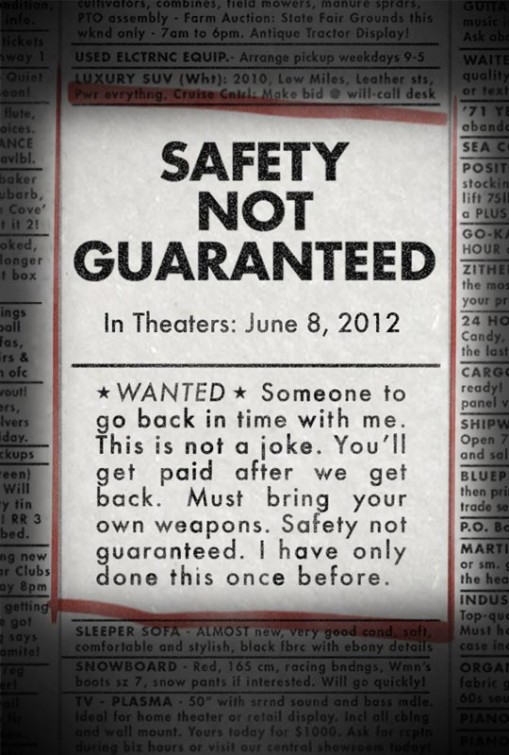 A man puts a classified ad in the newspaper asking for an unusual companion. No, it’s not some weird sex thing. Kenneth (Mark Duplass) intends to travel back in time to correct a few regrets. He’s looking for a partner, though he specifies his traveling companion must bring his or her own weapons and that safety is not guaranteed. This quirky ad grabs the attention of Jeff (New Girl‘s Jake Johnson), an egotistical writer for a Seattle magazine. He takes along a pair of interns, the surly Darius (Aubrey Plaza) and the nerdy Arnau (Karan Soni). Together, the gang heads out of town to seek out Kenneth and determine whether or not he is for real. However, Jeff’s real intention for this “work vacation” was to travel back to his hometown and try and score with Liz (Jenica Bergere), an old high school flame he is horrified to discover has… aged. Darius is the only one who can get close to Kenneth, but what starts as an opportune assignment into investigating a weirdo becomes something more. The guy, sweet if a little off, may be on to something… big, and Darius may be falling for him despite her own misgivings.
Safety Not Guaranteed is a modest film but does it ever sneak up on you and deliver an emotional wallop. I’m a romantic at heart, and so I’m generally affected by seeing two lonely people find their special something in the world reserved for them, and it’s even more affecting when these people are oddballs, and thus it’s even more resonant and meaningful for them to find that connection so elusive before. At its heart, Safety Not Guaranteed is a quirky yet naturally developing love story, and those are my favorite kind. I found my heart melting every time Darius couldn’t help herself and smiled. Perhaps it’s because Darius is our outside heroine or that Plaza is best known for her stone-faced deadpans on TV’s Parks and Recreation, but every one of those smiles felt so richly earned and rewarding. These aren’t the typical rom-com characters that are going to lapse into great speeches about love at key clichéd moments; while dabbling in some fantastical elements, Safety Not Guaranteed exists in our own recognizable world. And with that established, the unguarded moments of genuine happiness for characters we care about translates into a surprisingly touching experience. My heart felt so full at different points, melting and swelling and doing other non-medically accurate things. I honestly had tears in my eyes at different points. By the perfect end, I was so hopeful and overjoyed and left the theater soaring on my good vibes. I can’t guarantee everyone will find the same level of engagement in the romantic relationship, but I believe that the movie is inspired, clever, and authentic enough to deliver a crowd-pleasing finish. It’s earnest without being hokey.
 I’m trying to tiptoe around spoilers, though for those critical readers out there I’m sure you can infer a thing or two about the end of the film given my positive, beaming response. I’m sure my reaction would have been quite different if, say, Darius and Kenneth died in a horrible fireball because he was criminally insane from the start. All I’ll say is pay attention to certain discrepancies and see if they might prove to be a conversation-starter when you leave the theater.
Have I mentioned how truly funny this movie is? I’ve been talking all about the “rom” portion of the equation, but Safety not Guaranteed is a consistently funny movie, with a few big laughs. The movie’s sharp sense of comedy is more than everyone simply derisively laughing at the nutball. To be sure, Kenneth provides plenty of comedy in his super serious demeanor, and the movie doesn’t overplay the idea that he may be mentally unbalanced. The jokes come from the character interaction more than any contrived set piece, and the pleasure is in watching conflicting personalities bounce off one another. Every character contributes nicely to the comedic rhythms of this picture, adding a line here, a reaction there, to assemble one very funny movie. In movies where one character enters a relationship under initial false pretenses, usually you just keep waiting for that particular shoe to drop. You wait for the truth to come out and then deception reconciliation dominates the third act. Thankfully, the movie speeds over this narrative trap and gets us to the good stuff. We don’t need an entire act for people to be contrite and prove their love when what we see onscreen is obvious enough.
What elevated Safety Not Guaranteed for me was that beyond the oddball romance, there’s careful and compassionate attention paid to a slew of supporting characters. Now with a scant 80-minute running time, and the attention-grabber of a guy who thinks he can travel through time, naturally the supporting characters have minimized roles, but what I enjoyed was that they were not just relegated as stock players. The film has two stock roles, Nerd and Jerk, and fleshes them out further (though, to be assured, those are still defining characteristics). Arnau is a guy who is convinced any interaction with girls will ultimately lead to personal embarrassment. He’s only focused on the future and what he needs to get there, barely living in the present. It’s nice to watch him grow some confidence, albeit a small amount, and find some degree of enjoyment. And then there’s self-described asshole Jeff, who only submitted the story so he could come back and bang his old high school girlfriend. Some will find Jeff’s minimal personal growth to be disappointing and stagnate, but I thought anything substantial for this character over a three-day period of time would be unrealistic. Jeff is chasing his past memories, a faded time that had so much possibility when he was a stud in high school. The movie explores this notion of returning to a period of innocence as well. Going back to a time before overwrought cynicism, before settling, before compromising, before life became work, it’s something of a wish that the characters seem to be chasing. Jeff realizes how truly empty his life is, yet he’s probably too set in his ways to alter his path, which is a shame because Liz certainly seems like a lovely, caring, and capable romantic opportunity. Hey, she bakes, too (Bergere is great and easy to fall for). The unlikely friendship that emerges between Jeff and Arnau is also quite enjoyable and disarmingly sweet.
 I also need to single out the score from first time composer Ryan Miller, the lead singer and guitarist for one of my favorite alternative rock bands, Guster. The music has a lilting, dreamy quality to it but then follows a steady melodic rock path, reminiscent of the melancholic score for Little Miss Sunshine. The strumming guitars, plinging pianos, and swelling violins come together in harmony with little sci-fi touches. The score gives the film another sense of enchantment. I’ve been listening to “Big Machine,” the song Kenneth plays for Darius, on a loop for over an hour, if that gives you any indication on how much I enjoyed the original tune. The fact that “Big Machine” plays over the end credits when the movie meets its perfect end has got to account for some of my positive association. I think Miller has a bright future in crafting film scores.
Plaza (Funny People) deserves to break out in a big way after this film. She’s the heart of the movie and deeply vulnerable, covering it up with nonchalant cynicism. Darius is well within her surly comfort range so it’s no surprise that she excels with the hipster character, but the moments of dramatic weight are not given flippant treatment. Duplass (TV’s The League), just about everywhere in 2012, delivers a committed performance, though it seems mostly committed to the goofiness of his character. Yet when Duplass is able to show you some of the edge to his character, that’s when the performance walks a line between dangerous and exciting. The movie hinges on the two actors working together and they have good chemistry; the goofball and the cynic.
It’s so nice to discover a movie that lifts your spirits, that touches your heart without reaching for the treacle, and delivers a funny experience without compromising its modest aims and modest tone. Safety Not Guaranteed obviously plays a deliberate dance with the audience, vacillating between moments that make Kenneth seem crazy and moments that make you question whether he’s legit. The movie reminded me in a lot of ways of the underrated 2000 flick Happy Accidents, which featured Vincent D’Onofrio as a romantic suitor who also might be a time traveler or just plain nuts. Safety Not Guaranteed is a charming movie that seems to work a spell on you while watching; you get so invested in watching lonely people find meaningful human connections that you are compelling the movie to end under some happy scenario. Director Colin Trevorrow and writer Derek Connolly deserve to make waves in Hollywood with what they’re able to accomplish with a tidy budget and some clever yet earnest writing. This beguiling love story is all about stretching out of your comfort zone and taking a plunge into the unknown. Just like Kenneth, we’re all looking for a partner worthy of that plunge (not necessarily a romantic partner, mind you). Take the plunge and go see Safety Not Guaranteed, one of the best movies of the year. Not bad for a movie potentially based upon an Internet meme, huh?
Nate’s Grade: A


 nathanzoebl
You must be logged in to post a comment.