Blog Archives
Alien: Romulus (2024)

I will maintain that over the course of forty years that there have been no bad Alien movies. While 2017’s Alien Covenant gets the closest, I think each of the four Alien movies from 1979 to 1997 are worthy of praise for different reasons. The Alien franchise is unique among most sci-fi blockbusters in that each of its movies feels so radically different. The groundbreaking first movie is the hallowed haunted house movie in space; the 1986 sequel set the foundation for all space marine action movies, with Sigourney Weaver earning a Best Actress nomination, a real rarity for any sci-fi action movie; the much-derided third film from 1992 is much better than people give it credit for, and while flawed it has really intriguing ideas and characters with a unique setting and a gutsy ending; the fourth film from 1997 might just be the most fun, going all-in on schlocky action and colorful characters. Each of them is different with a style and tone of their own, and each is worthy of your two hours. Enter director/co-writer Fede Alvarez’s Alien: Romulus, meant to take place between the fifty-year time span between Alien and Aliens. It was intended to be a Hulu streaming movie but got called up to the big leagues of theatrical release, and while it has some underwritten aspects and clunky fan service, Romulus is another worthy sequel for a franchise that admirably keeps marching to its own beat.
It’s 2142 and life on an off-world colony isn’t exactly the adventure advertised. It’s a mining colony that’s slowly poisoning its huddled masses. Rain (Cailee Spaeny) has just finished her two-year contract only to be informed by her greedy company that, because of worker shortages, she’s locked in for another two years of indentured servitude. She’s also in charge of her adoptive brother, Andy (David Johnsson), a malfunctioning android that her late father reprogrammed. An ex-boyfriend comes back into Rain’s life with a plan: there’s an old derelict research station that they can scavenge and retrieve the cryo chambers, which can make long-term travel to a new life in a new system a possibility. There’s also a catch: they need Andy because only he can open the ship’s locked gates. The ragtag crew flies out to the derelict ship orbiting a ringed planet and, of course, discovers far more than they bargained for as the ship, of Weyland-Yutani origins, is crawling with face-hugging fiends just waiting for new faces.

Despite my grumbles, I found Alien: Romulus to be a very entertaining new entry that had the possibility of genre greatness. The setting and central character dynamic are terrific. The Alien franchise hasn’t exactly been subtle about its criticisms of multi-faceted corporations and their bottom-line priorities, but it’s even more effective to see the dinghy world of this mining colony. It’s a bleak existence of dystopian labor exploitation and you get an early sense of the desperation that motivates the characters to flee at any opportunity. Eventually, the evil corporation’s big plans for the “perfect organism,” a.k.a. the xenomorph, are to replace the depleting labor force. Humans, it turns out, aren’t built to work in space long-term, and the human cost is felt effectively in Act One. Another key part of what made the movie so immediately engaging for me is the sweet surrogate brother-sister relationship between Rain and Andy. He’s vulnerable, an older android model who needs some repairs, but he’s loyal and kind and loves pun-heavy jokes. This central relationship hooked me and gave me something to genuinely worry over as things get more dire, and it’s not just the scary aliens. Once onboard, Andy uploads the programming of a different android, and the competing objectives make him become a different person, all wonderfully played by Johnsson, who was supremely appealing in Rye Lane. While literally every other character is remarkably underwritten (this one doesn’t like robots, this one is pregnant, this one is… Buddhist?), the genuine bond between Andy and Rain grounded me.
Romulus also has some sneaky good set pieces that kept me squirming in my seat or inching closer in excitement. Alvarez (Don’t Breathe, Evil Dead) can concoct some dynamite suspense sequences and knows how to draw out the tension to pleasingly anxious perfection. This is the best Alien movie yet to really sell the danger of the springy face-huggers. There’s a taut sequence where the humans have to slow their movements to walk through a face-hugger minefield lest their spike in temperature alert the deadly creatures. There’s another later sequence that ingeniously utilizes space physics to escape the xenomorph acid blood. I loved how well it was set up and then the fun visuals of zero-gravity acid blood. The practical effects make for lots of great looking in-camera effects, and the production design is incredibly detailed while achieving a chilling overall mood of dread. Alvarez leans upon the visual frameworks of Ridley Scott and James Cameron, as who doesn’t, but finds ways to make his Alien movie his own. I really appreciated the dedication to the sprawling vistas of space, like extended shots outside the ship that really translate the sheer majesty and terrifying scale of space. The last-second threat of demolition is made all the more arresting by crashing into the rings of the planet. I think most people confuse a planet’s rings like it’s some kind of water vapor when instead it’s like a crowded highway of debris.
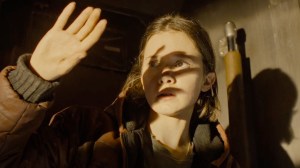
However, there are some misguided nods toward fan service that go overboard and become groan-inducing. There’s a fine line between homage and back-bending fan service, and Romulus skirts over occasionally into the dangerous territory, given over to references to the other movies that lack better context to make them anything more than contrived callbacks. Take for instance a triumphant killing of a xenomorph where a character utters, “Get away from her,” which itself would have sufficed, as any Alien franchise fan knows this reference point. Then the character continues, in an awkward pause, almost stumbling over the words and translating the awkwardness directly for us, as they add, “…You bitch.” Why? Why would this character need to say this exact same line (although, timeline-wise, this is now the first use of the phrase as Ripley is still in hypersleep)? The moment doesn’t call for this specific line; it could have been anything else, but they made it the line we all know from Aliens. There’s also the familiar ending where the characters think they’ve won and, wouldn’t you know it, there’s one more tussle to be had with a xenomorph who has snuck onto the escape ship. I’m less bothered by this continuation as it’s almost a formula expectation for the franchise at this point, though keeping Rain in her sleeping undies for the final fight seems like another unnecessary nod to the 1979 original. They even tie back the mysterious black goo from the Engineers via Prometheus, though as a vague power-up when, if I can recall, it was a biological weapon of mass destruction, but sure, now it’s a power-up elixir.
But the worst and most misguided act of fan service is where the movie literally brings a performer back from the dead (some spoilers ahead, beware). When Rain and the gang stroll through the derelict company ship, they discover the upper torso of a discarded android, like Ash (Ian Holm) in the original Alien. Not just like Ash because for all intents and purposes it is Ash, as the filmmakers resurrect Holm (who passed away in 2020) and use Deepfake A.I. technology to clumsily animate the man. This isn’t the first instance of a deceased actor brought back to screen by a digital double, from Fred Astaire dancing with a mop to Peter Cushing having a significant post-death supporting role in 2016’s Rogue One. Here’s the thing with just about all of these performances: they could have just been a different actor. Why did it have to be Grand Moth Tarkin (Cushing) and not just any other obsequious Empire middle manager? With Alien: Romulus, why does it have to be this specific version of an android when it could have been anyone else in the world besides the dearly departed Holm? I just can’t comprehend why the filmmakers decided to bring back Holm in order to play A DIFFERENT android who isn’t Ash but might as well be since he’s also been torn in half. Why not have the android be another version of Andy? That would have presented a more direct dichotomy for the character to have to process. The effects reanimating Holm are eerie and spotty at best, apparently built from an old scan from The Lord of the Rings. It’s just a distracting and unnecessary blunder, the inclusion of which can only be justified by trying to appeal to fans by saying, “Hey, remember this character? Even though he’s not that character. Well. Here.” We used to readily accept other actors playing the same character before the rise in technology. Nobody watching The Godfather Part II wondered why Robert DeNiro wasn’t a slimmed-down Marlon Brando.

As an Alien movie, Romulus starts off great and settles for good, but it still has several terrific set pieces, its own effectively eerie mood and style, and a grounded character dynamic that made me genuinely care, at least about two characters while the others met their requite unfortunate ends. It doesn’t have the Big Ideas of a Prometheus or the narrative arcs of Aliens, or even the go-for-broke schlock of Alien Resurrection, but Romulus delivers the goods while also feeling like its own movie, a fact I still continue to appreciate with the Alien franchise. It’s an enjoyable genre movie that fits in with the larger franchise. I wish some of the clumsy nods to fan service, especially the resurrection of a certain character, had been reeled back with more restraint to chart its own course, but it’s not enough to derail what proves to be a winning sequel.
Nate’s Grade: B
Share this:

IF (2024)/ The Imaginary (2024)/ Imaginary (2024)
Every so often, I find myself drawn to reviewing movies in pairs, whether it’s because of the same source material (the 2022 Pinoochios), similar perspectives (2018’s BlackkKlansman and Sorry to Bother You), or even diametrically opposed artistic responses to a similar theme (2016’s Manchester by the Sea and Collateral Beauty). However, in my twenty-five years as a fledgling film critic, I don’t think I’ve ever reviewed three movies at the same time for whatever relevancy, yet that is what I find most appropriate for this trio of exceedingly similar films about imaginary friends. Earlier in the year, Blumhouse released Imaginary, their horror-thriller take on an imaginary friend refusing to go away. At the start of the summer, writer/director John Krasinski gave us IF, a live-action fantasy/comedy about imaginary friends finding their former children as adults. And recently, Netflix released an anime movie The Imaginary, a Studio Ghibli-esque fantasy about forgotten imaginary friends trying to find new kids and new homes. I’ve elected to review all three at once and, much like the Pinnochios, declare a winner through different categories.
Begin the critical gauntlet! Bring on the (imaginary) bloodshed!
- PREMISE

Two of these movies went in a sweetly sentimental direction and the other went in the horror direction, so let’s tackle that one first. Imaginary gets at a rarely spoken truth: children can be super creepy. Watch a child hold an involved conversation with some entity that isn’t there, or just stare into the dark and say, so plainly, “That’s where the eyes are watching me,” or any number of personal anecdotes to make you shudder, and you’ll understand the significant horror potential with a malevolent creature that the child can communicate with that adults cannot see. This also lends itself to a low-budget film production as so much of the wicked entity is implicit and unseen. It’s a cost-saving genius when you can just use your, wait for it, imagination. Now Imaginary isn’t the first horror version of this premise, but it deserves points for taking a childhood concept and thinking of an effective way to transform it into a diseased and malignant antagonist, haunting its adult child Jessica (DeWanda Wise) and seeking a new child, likely her youngest step-daughter Alice (Pyper Braun). It then presents its conflict like a curse that the past generation is trying to spare the next generation from suffering through. Of course this also includes getting adults to recognize the threat as they are often dismissing it. Nobody wants to believe that Chauncey the teddy bear is the one urging you to self-harm.
The other two movies take a far more family-friendly approach to their imaginary premises. There’s a lot of shared real estate between The Imaginary and IF. Both are about outdated imaginary friends finding refuge together in a sort of halfway house, a… foster home for imaginary friends (someone should make a cartoon series about that). Both of the movies follow imaginary friends trying to find new children who will accept them and give them a new life. IF briefly follows the possibility of reuniting the forgotten imaginary friends (a.k.a. IFs) with their former owners now grown up into adulthood. This is actually the movie at its best, as the creatures find a renewed sense of purpose and reconnect with a person they cherished but had to let go. For a strange reason, Krasinski only dabbles with this poignant story direction, switching gears to find them new homes with new kids, which serves as another story direction that is also quickly ditched. IF seems to be trying on so many different versions of its premise and then discarding them like the IFs themselves. The Imaginary has more focus on its central predicament, finding new homes before these characters fade away, or worse, get eaten by a cannibalistic imaginary fiend looking to gain more years of his own existence by consuming the life force of his imaginary peers. It also has the urgency of its main character, an imaginary boy named Rudger, hoping that his child wakes up from a car accident, and if so, that she’ll still need him. The other characters are trying to set Rudger up for a life after his child, since they’ve all experienced the same fate and are trying to help him adjust to not just letting go but also being open to a new child. It’s simplified but has plenty to still explore, plus a creepy super villain.
Winner: The Imaginary
2. WORLD-BUILDING

This is what really separates IF from The Imaginary. The world of imaginary figures populated in Kransinski’s movie are cute but their larger world context is unfortunately underdeveloped. This is likely because much of the movie is connected to the personal journey of one twelve-year-old girl, Bea (Cailley Fleming), trying to keep herself busy while her father (Krasinski) undergoes vague “heart surgery.” The IF Coney Island respite feels like a secret nursing home where the discarded friends just kind of hang out. There’s even swimming and painting lessons. There’s no further examination on whether these are only the IFs from this zip code, though Bradley Cooper voices a talking glass of ice water whose child originated in Arizona, so that’s undetermined. I was also hoping for an imaginary friend from decades back, like Franklin Roosevelt or Alexander Hamilton’s imaginary friend, or from other countries. Each character design can say something inherently about their past child creator, what they regarded as fulfilling or lacking from their present. Alas, the world-building is mostly one little girl’s discovery of her new friends and then how they ultimately support her with her family predicament looming over every scene. Seriously, for a father going through major surgery, the family in IF is pretty blase about Bea’s whereabouts. Her grandmother (Fiona Shaw) doesn’t seem too pressed about letting an unattended adolescent run around New York City for hours. Bea’s experience with helping the IFs are reflections of her optimism and hope. It all comes back to her, so the movie chooses to ignore the larger possibilities of its magical unseen world.
The Imaginary feels modeled after the Studio Ghibli movies that have delighted children and adults for generations. Its main character is Rudger, an imaginary friend, and not the child who birthed the imaginary friend, Amanda. That creates a different sense of discovery, as Rudger also learns about the hidden library housing other imaginary friends and the rules. He’s to stare at a bulletin board and await a prospective child he feels a connection to, then holds onto a picture of them to transport into the child’s imaginative play where they can contribute to the creative adventure. However, there are dangers like if you die in the imaginary world, you can die for real, which is never fully explored as a real threat. The imaginary characters are told to stay indoors at night, as they don’t want to run into Mr. Bunting, the cannibalistic antagonist. I got a little lost with the different rules, some of which seemed to be emphasized more or canceling out previous rules, but I appreciated the level of thought given to making its world alive.

This is also where Imaginary begins to get lost in its own hazy imagination. Imagine the bedroom door-hopping mechanic from Monsters Inc. but with the narrative formula of Insidious, and there you have Imaginary. The world of imagination is treated very similarly to a hellish dimensional getaway, much like what happens in Insidious where dad had to retrieve his son in the demon’s phantasmagorical realm. Because the spooky imaginary world relates back to the main character’s childhood, we have a few other characters that have history with this trauma. Jessica’s father Ben has been committed to a hospital and seemed mentally ill, until you realize he rescued his little girl from evil Chauncey and lost his mind in the process. He’s not some lost cause, he’s a hero. Also, there’s a former neighbor and babysitter (Betty Buckely, always welcomed) who is obsessed with childhood psychology and willing to do some extreme things to continue her obsession with Chauncey. It’s at least widening the scope to look at how these traumatic events have impacted other people, not just the little girl bottling up those nightmares. However, beyond the simple explanation of Chauncey existing as a parasite feasting on the imaginative power of children, little else is established about the creature or its own world. At one point, a character relishes the possibility of imagination as a wish-fulfillment service, but why would this evil creature delegate its power? It reminds me of all sorts of other movies where characters side with some apocalyptic power thinking they’ll somehow be the lucky exception.
Winner: The Imaginary
3. CHARACTERS

This is where IF shined the brightest. The little girl is cute and optimistic, a fitting tonal foil to Ryan Reynolds being such a loquaciously sardonic naysayer. She wants to be so helpful, though keeping herself so busy might just be her coping mechanism to try and stop her dreadful encroaching thoughts about the possibility of losing her second parent. Her taking the lead to help the IFs then allows for little episodic asides for the different characters to share their stories and their former creators. Having a protagonist be so driven at being empathetic is a natural conduit for championing the feelings and triumphs of others. It works. Reynolds is still doing his fast-talking cynical schtick, so your mileage will vary how well it continues to appeal. Curiously, I don’t think the character of Blue (voiced by Steve Carell) is fully utilized. He’s a more childlike exaggeration of the character features already provided by Bea’s involvement. Blue resembles the McDonalds’ Grimace, and is outwardly friendly, unafraid of big emotions, and a bit silly, but his elevation in the script as being the primary IF sidekick is arbitrary. The same story could have afforded tapping, say, the excitable unicorn (voiced by Emily Blunt) as the primary sidekick and produce similar results. Again, I think there’s so much that could have been further explored as to the existential requirement of the different imaginary characters, how they represented what their former kids felt they needed. Their exact existence was what a child yearned for (the strong IF to protect the child who is afraid, the squishy lovable IF to comfort a lonely child, etc.).
The characters from The Imaginary fall into general archetypes that any Miyazaki fan will be familiar with. There’s the bossy know-it-all, the excitable goof, the silent contemplative, the wise and warm-hearted authority figure, the dangerous rogue. They all work but it’s the larger themes that resonate more than any specific individual character. Mostly, the conflict is whether Rudger decides to move on from his creator and find a new child/home. He has loyalty and emotional attachment to little Amanda but the reality is that, at some point, she will grow up and he’ll be left behind. Whether that happens now, because she passes away, or years later through becoming an adult, there will be a parting and he will need to consider a new life. The loneliness and melancholy of this existence is ignored through the kooky characters, strange worlds, and pressing points of danger, so the reality of Rudger’s eventual loss is thematically sidelined.

With the Blumhouse Imaginary, the characters are relatively stock types for a supernatural horror mystery. There’s some effort to make it about Jessica trying to ingratiate herself with her new step-children, the oldest who looks at the new mom with great suspicion and resentment. At one point, the old mom serves as a jump scare, hiding in the house; the old mom is mentally ill but the stepdaughter thought, erroneously, that mom was “getting better.” Jessica is trying her best to rise to the challenges of being a parent, but it’s hard when there’s a sneaky ghost trying to emotionally manipulate your youngest to hurt herself. I don’t know why Jessica decided to move her new family back into her childhood home, the source of her trauma, except if you looked at the real estate market, it might have been by far the best deal she could swing. What’s some reawakened childhood trauma when it comes to skipping ballooning mortgage payments? Have you seen interest rates and the price of houses post-pandemic? That’s the real terror for adults.
Winner: IF
4. EMOTIONAL INVOLVEMENT/CONCLUSIONS
Despite what Pixar may have set in stone, it’s not a requirement for a children’s movie to make you cry. I did end up tearing up from two of these movies, and it should likely be obvious which of the three was the outlier. Krasinski’s movie is designed as a big warm hug, complete with soothing, milky light pouring in from every setting. I thought it looked very similar to how Steven Spielberg’s preferred cinematographer, Janusz Kaminski, shoots natural light, and lo and behold Kaminski was the cinematographer for IF (excuse my pat on the back here). Bea’s big emotional moment where she tells her story of adventure to her unconscious father in his hospital bed pulled some heartstrings, but what I felt even more emotionally cathartic were the asides where Bea helps the IFs reunite with their former kids. When an IF is being thought about, they start to glow from within, like happiness radiating out. It was these little moments, like Blossom (voiced by Phoebe Waller-Bridge) getting to dance with Bea’s grandmother like they used to, or the simple act of Blue wishing good feelings to his nervous former-child with a silent shoulder touch and world-clarifying exhale. It was the acknowledgement that these friends, while gone, are still fondly remembered, and that they will always have that connection even if their exact relationship has changed through the years. The Imaginary operates on a similar emotional wave of adults reuniting with their former childhood friends, and it’s that sweet acknowledgement of appreciation and love that hits hardest. It reminded me a little bit of 2001’s Amelie where she’s on a mission to help strangers remember beloved items from the past. The overarching worry about losing her father seems unnecessary as a complication, especially how “heart surgery” is kept so purposely vague and seemingly uneventful until that bedside chat. There is a difference between wanting to protect your kid from the possible trauma and downplaying it to the point where it becomes a strangely superfluous plot device.
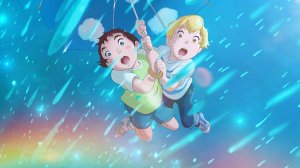
I won’t pretend there’s much to get emotional over with the Blumhouse Imaginary, though there is one Act Two twist I thought was simply astounding, but in order to explain I will need to go into spoilers, so you have been warned, dear reader. For a solid hour, we watch Alice play with a teddy bear that she calls Chauncey, the embodiment of her imaginary friend. So far so good. Then after a disturbing session with a child psychologist, the professional shows Jessica her recorded session. This is where we discover that Chauncey the bear… has never been there. Alice has been talking to the unseen entity of Chauncey and Jessica has been the only person who was seeing a teddy bear. That’s right, the twist is that the bear was never there. Bam.
Winner: IF
Three imaginary friend movies and the exploration of the meaning these figures have to children and adults after years removed. I had my quibbles with each movie, but with adjusted expectations, each movie can supply a degree of entertainment. The animation in The Imaginary is gorgeously fluid, so that alone will prove a draw to hand-drawn animation fans such as myself. Krasinski’s family film is gooey at its well-meaning core though it has underdeveloped avenues I wish had been given more articulation and exploration. The Blumhouse Imaginary movie is fairly formulaic but has a couple enjoyable twists and turns, even if they’re ridiculous. There is a potent storytelling reservoir with imaginary friends, both benevolent and malevolent, so I imagine (no pun intended) this won’t be the end of these stories making their way to the big screen.
Nate’s Grades:
Imaginary: C
IF: B
The Imaginary: B
Share this:

In a Violent Nature (2024)
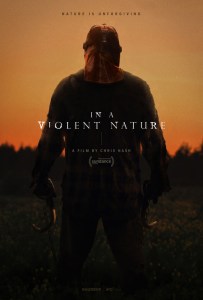 In a Violent Nature is going to be a very trying movie by design. Its entirety follows its very Jason-esque supernatural killer in near real-time as he goes through the woods and eventually kills several unlucky locals and partying teenagers. That means it’s several long sequences of watching the back of this hulking zombie killer walk through the woods and eventually get closer to victims. The actual kill scenes have some impressively nauseating gore, which might serve as a reward to the audience for enduring the lengthy walking. Seriously, this guy perambulates like a boss. He walks. And walks. And walks. Occasionally, he’ll kill someone in gruesome fashion, but most of his journey, and by extension the movie’s journey, is tagging along on his extensive nature hike. Is that going to be interesting to the average horror fan? Probably not. It’s designed to wear down your patience. The filmmakers clearly understand what effect their creative choices would have, and they went through with them anyway. It’s not like writer/director Chris Nash is lacking in style. His segment in 2014’s The ABCs of Death 2, “Z for Zygote,” is ingeniously horrifying. There is a great moment here where our killer’s hand is reaching toward the screaming face of his soon-to-be victim and then Nash performs a match cut with the same hand, now dripping with blood, reaching out for a desired necklace moments later. It’s quick and also subversive, denying the viewer our first opportunity at onscreen violence. This is a movie that works primarily in the realm of denying its target audience what it wants, and that is kind of fascinating to me. I don’t know if it’s enough to make me declare In a Violent Nature as good, but this movie seems destined to work on a different level than good/bad.
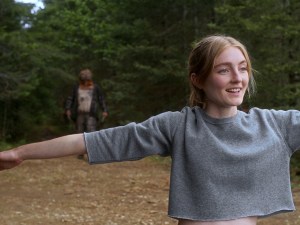 And yet, the movie invites a deeper contemplation through its very experimental nature. We’re walking side-by-side with this undead specter as he tromps through the woods looking to reclaim his special token, and it’s boring by design. I hate using that as an excuse because the movie does get rather tedious at parts, and yet it challenged me to engage more with the movie on an intellectual level, to examine its deliberate creative choices. Just about every slasher movie is designed around the clockwork killing of its easily disposable characters, usually dumb teenagers, by some powerful malevolent force. However, just about every slasher I can recall places the viewer in the perspective of the dumb teenagers engaging in dumb teenager antics, usually drinking and trying to engage in premarital sex. Let’s not pretend those characters are generally any more nuanced or well written than the villain stalking them. Instead of spending all our time with these character archetypes and the occasional pop-in from the villain, it’s reversed. It’s the dumb teenagers that pop-in while we’re on the journey with the slasher fiend. Does it make the kills hit harder because of the long stretches leading up to them because we see how many close calls there have been? Because this guy is trying his best? I don’t know, but the cries of In a Violent Nature being unbearably tedious makes me reflect on whether tedium is, by nature, part of the slasher genre, and perhaps we’ve all ignored the formula because of regular intervals of blood and boobs. Are dumb teenagers that much better company than a silent brute going for a walk?
It was around the halfway point where I began to question whether this approach was causing me to develop empathy for our supernatural killing machine. The back-story is tragic, being a young child tricked by kids he thought were his friends, only to plunge to his death from a water tower. Children can be cruel, and if this was one’s ever-lasting memory of human interaction, then I would understand coming back as a murderous revenant. He also didn’t ask to be brought back to life. The dumb teenagers stole his mother’s necklace and his goal is to simply reclaim it. Yes, he’ll kill plenty of people that had nothing to do with bringing him back, collateral damage from messing with forces that humans should never mess with. He’s just on the hunt for his dear departed mother’s keepsake. In essence, he is looking for the item to return back to the land of the dead, to end being pulled back into corporeal existence. When you look at that context, every dead teenager becomes one step closer to finding that necklace and going back to his eternal slumber. Perhaps our big bad is suffering and looking for that pain to cease. When you’re quite literally walking beside this figure for the duration of the movie, it sparks a personal reflection whether you may be unexpectedly developing empathy. Is it simply projection and all proximal, spending all this time with only one character? Is this a human byproduct of wanting to imbue emotional depth to characters for our sense of engagement? I cannot say. When you walk a mile, or more accurately several, in another (dead) man’s shoes, maybe you start to see the world in his weary, irritable perspective and want that big nap back.
 I have no idea how each viewer will respond to In a Violent Nature. I was wrestling with different mixed feelings, including boredom. I don’t think traditional fans of traditional horror will find the long slog worth taking its time to smell the proverbial flowers. I imagine most will grow restless, antsy, and maybe even angry, and that response is entirely valid and understandable. The novelty of watching the killer stalk his future victims in real time can be one of those ideas that, upon execution, feels better as a short film than as a feature experiment. I admire the gusto of embracing this approach and flipping the slasher script into what amounts to an unorthodox nature documentary between predator and prey. It’s an interesting approach that invites ongoing textual analysis with the genre, the depiction of the characters and their tired archetypes, as well as what makes these movies worth our time and passing investment. Likely there will be more people that shrug and deem In a Violent Nature a dull bore, but I’m also positive there will be people who find themselves unexpectedly thinking and feeling things they didn’t anticipate. Ultimately, it’s a movie I can begrudgingly admire more than engage with, but I appreciate taking the familiar and presenting it in a way we’ve seldom witnessed before.
Nate’s Grade: C+
Share this:

I Saw the TV Glow (2024)/ The Watchers (2024)
 I Saw the TV Glow is a strange experience by design, a hallucinatory ode to early 1990s television, coming of age sagas, feeling out of place in one’s own body and mind, and on a Lynchian dream logic wavelength that few filmmakers occupy. From a plot standpoint, Owen (Justice Smith) is a shy kid who looks up to an older girl at school, Maddy (Bridget Lundy-Paine), and they share a love for the TV show The Pink Opaque, a tween-aimed horror series in the vein of Goosebumps or Are You Afraid of the Dark?, which ultimately might be real after all. This movie exists more on a slippery emotional plane than on its story sense. Writer/director Jane Schoenbrun (We’re All Going to the World’s Fair) has created an allegory for self-actualization and self-acceptance through a love of 90s nostalgia and that transitional time of being young and just seeing the cusp of what adulthood promises for the good, the bad, and the mundane. The recreation of the SNICK-era television is perfect, and I loved the little glimpses of these horror monsters taking on new nightmarish incarnations. I wanted the movie to explore its premise more, that this old TV show might be real and posing a danger that only they would uncover. It’s really more a pathway for the characters to explore their selves, what animates them, what confuses them, what provides a sense of community. It’s a movie about the perils of loneliness and finding an outlet, a life raft, whatever that may be, and for Owen it’s this TV show. He connects more with this world than the real one, and when he revisits it later as an adult, it doesn’t live up to his memory. It’s a weird movie but it’s designed for weird kids, or weird adults who used to be weird kids, who found kinship through weird media. It’s a slow and provocative experience that asks you to give yourself over to its vision, but Schoenbrun also makes that engagement quite accessible. While existing as a clear trans allegory, I Saw the TV Glow is open to any outsider who felt unsure of themself and their body and their place in the universe. It’s about obsession and the price of holding onto said childhood obsessions, even if they prove disappointing in your adulthood. It doesn’t offer any general answers or catharsis and is kept on the slowest of slow burns. I began daydreaming of the less arty version of its spooky premise, but that’s simply not going to be this movie. I Saw the TV Glow is impressively personal and surreal and obtuse, but by the end I was hoping for a little more of a foundation to hold onto and its ideas to be fully realized.
Nate’s Grade: B
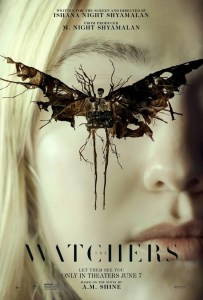 The expansion of the M. Night Shyamalan creative dynasty has begun. While based on a 2022 novel by A.M. Shine, The Watchers is brought to us primarily by Ishana Shyamalan, who makes her feature directing debut and adapted the screenplay. It has a buzzy premise that feels at home in a Shyamalan movie, namely a young woman (Dakota Fanning) who stumbles into a strange location with captive people telling her she cannot leave or her life will be in danger from monsters. The group of survivors have to “perform” for their unseen watchers, staring into a two-way mirror inside a closed room. There are certain rules that are hazy and unevenly applied: don’t go out after dark, never turn your back to the mirror, don’t go into the creatures’ subterranean dwelling. This poses an intriguing mystery for a while as the movie unpacks and reveals more about this world and the creatures. However, The Watchers ultimately cannot help feeling like an over-extended episode of a sci-fi anthology TV series like Black Mirror or maybe even Shyamalan’s own Apple Plus series Servant (Ishana wrote and directed several episodes). There just isn’t enough here. The revelations do not sustain our emotional and intellectual investment. Once it’s revealed what the monsters are, I kept waiting for extra levels of twists and turns, and there really aren’t any. Once we settle into Act Three, the movie becomes more or less about housekeeping and gaining acceptance. The whole reason the protagonist is on her journey is to deliver a bird in a cage, and every time this thing keeps appearing even so late into the movie, while she’s running for her life but cannot forget about the caged bird, I felt like laughing. It’s a case of inelegantly finding a way for the visual metaphor (the bird is her!) to continue being tied to the plot after it long stopped making sense. Likewise, there are cutaways to the captives watching a Love Island/Big Brother-stye reality TV show, but little is made as far as commentary on communal voyeurism, so they just come across as little odd comic asides. The movie loses some serious momentum once we get to the convenient info dump sequence (a Shyamalan family favorite: scientist vlogs) and you realize there are no more tricks to deliver. It’s disappointing that a movie with such potent folklore atmosphere becomes a lackluster variation on The Village.
Nate’s Grade: C
Share this:

Winnie the Pooh: Blood and Honey 2 (2024)
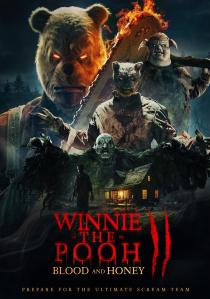 The first Winnie the Pooh: Blood and Honey was, unquestionably, my worst film of 2023. It wasn’t merely a bad horror movie, it was a depressingly cynical cash-grab with such little forethought of how to subvert the wholesome legacy of its classic characters. As I said in my review: “The startling lack of imagination of everything else is depressing, as is the fact that this movie has earned over four million at the global box-office, hoodwinking enough rubberneckers looking for a good bad time. The problem is that Winnie the Pooh: Blood and Honey is only a bad bad time.” Oh, dear reader, I wasn’t looking forward to the inevitable deluge of follow-ups, as writer/director Rhys Frake-Waterfield would resupply his surprising success with further sinister revisions to public domain properties. He’s planning on a “Poohniverse” crossover event with a combination of Pooh, evil Pinnochio, vengeance-fuelled Bambi, and a traumatized or villainous Peter Pan. Again, schlocky movies that lean into their schlock can be wonderful things, but a movie that does next to nothing with its subversive hook, with the history of its cutesy iconography, and could be easily replaced with any other menacing slasher killer is beyond lazy, it’s insulting. I figured there could be nowhere to go but up with a sequel, and while Blood and Honey 2 is an improvement in just about every way, it’s still not enough to qualify as a fun or ironic treat.
Wakefield and new co-writer Matt Leslie (Summer of 84) completely rework the mythology and history established in the first movie, which is now revealed to be the literal movie-within-a-movie of the account of the Massacre of the 100 Acre Wood where Pooh and Piglet slaughtered a troupe of bad-acting British coeds. In this prior film, it was established that Pooh and his buddies were angry with Christopher Robin (Scott Chambers, replacing Nikolai Leon) when he left for college. They felt abandoned and grew feral and monstrous, rejecting the ways of man (though still wearing the clothes of man and driving the cars of man). However, now in the sequel it’s revealed they were always feral and blood-thirsty and it was Christopher who incorrectly remembered them as cute and fluffy. This scene makes for the hilarious visual of a child waving innocently at a blood-strewn manimal lurking about. Also, Christopher had a young brother who was abducted by the creatures of the 100 Acre Wood and never seen again. Also also, there was a mad scientist who was creating human-animal hybrids from missing children, so the blood-thirsty animals might not be actual animals after all (can you see where this is going?). While the first Blood and Honey movie did nothing with the characters, this movie actively gives them a tragic history with some twists and turns, enough to lay a mythos. The use of hypnotherapy-induced flashbacks isn’t exactly smooth or subtle, but I’ll take it. At least this movie provides a distinguishing plot that makes some use of its particular elements. Don’t mistake me, dear reader, this is faint praise at best, but after enduring the creatively bankrupt first film, it’s like a desperately needed oasis. Ultimately, it might all just be a mirage but at least it’s something to those of us who suffered!
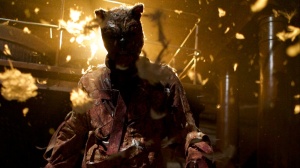
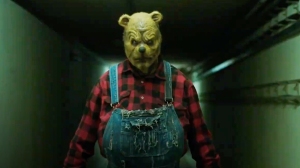 In the grand sequel tradition, bigger is better, and now instead of two ferocious beasts wreaking havoc, it’s four, with the addition of Owl (Marcus Massey) and Tigger (Lewis Santer). None of these monsters has a particular style or attitude that distinguishes them. I guess Tigger calls people “bitch” a lot and slashes people. There is one point where hapless cops are investigating a crime scene and say, “Let’s bounce,” and Tigger says from the luxury of the shadows, “Hey, that’s my line.” I figured they’d incorporate the signature Tigger bounce on his tail, but perhaps that was too expensive to perform or that bounce was more a byproduct of the Disney version of the character, still under copyright, and not the available A.A. Milne version. The animal costumes look better than the cheap Halloween masks of the original, though for my money Owl looks more like a turkey vulture wearing cray paper. I’m sure we’ll get Kanga in the inevitable third movie in 2025 where her zombie baby leaps out of her pouch to feed on brains. There is a snazzy addition late into the proceedings where Pooh is welding a fiery chainsaw. It makes little sense for the character but it’s cool, so it’s excusable in lapsed movie logic.
I was hoping for more unique kills, twisted takes related to the characters, like Pooh turning some poor soul’s head into a honeypot. The kills are just grizzly and extensive, favoring quantity over quality. There are plenty of decapitations, gougings, impalings, and other fraught and violent encounters, nearly all of them featuring squealing, terrified women. It’s always women that seem to get the worst in these movies, but of course this is a feature and not a bug of the genre back to its 80s heyday. It gets relentless but I suppose at least these girls aren’t having their tops mysteriously fall off while they’re being butchered. A third act rave set piece features maybe two dozen kills and risks becoming tedious slaughter. It got to the point where I was hoping not to see another cowering person hiding behind a corner because it meant the sequence was going to be even more unbearably long (I’m not personally cut out for the Terrifiers).
 In between the spillings of blood and guts is the attempts at human drama, namely Christopher Robin trying to live a normal life while also re-examining his past. Apparently people think he’s to blame for the massacre from the 100 Acre Wood, and so he’s become a pariah, whose very presence unsettles others. He’s trying to find steady work in a hospital setting but he’s blacklisted from pursuing his career because of the negative attention his name generates. He even has a romance with a single mom so that when the Robin family is inevitably skewered we have other characters that can be personally threatened to provide meaningful stakes. The life of Christopher Robin and his discovery of repressed memories makes for a surprising story foundation for Blood and Honey 2, especially when the plot of its predecessor was mostly Christopher being held prisoner and the baddies casually roaming and killing coeds. I think Chambers is a better actor as well, and he’s posed to be the writer/director of Neverland Nightmares, which just began principal photography a month and a half ago as of this writing. Good luck, guy.
While the budget has increased tenfold, Blood and Honey 2 is still a scuzzy, sleazy slasher movie at heart. If you’re in the mood for a low-budget exploitation movie heavy with gore, there may be enough to qualify this sequel as moderately mediocre, which again is a marked improvement from what I declared the worst movie of 2023. I’ll credit the influence of co-writer Matt Leslie to try and put some standards in place for this runaway gravy train of IP allocation. What’s scariest of all is what Frake-Waterfield’s unexpected success has wrought, encouraging imitators to jump on his now proven novelty act. There’s a 2025 Steamboat Willie horror movie called Screamboat as Steamboat Willie has now entered the public domain (but not other versions of Mickey). Will it be any good? I sincerely doubt it. Will it make money from curious horror hounds looking for an ironic twist on a wholesome childhood fixture? Most assuredly. This is our present. This is our future, and it’s the legacy of Frake-Waterfield and his ilk that stumbled onto a lucrative novelty act. Winnie the Pooh: Blood and Honey 2 is just bad, and for that it’s an improvement.
Nate’s Grade: D+
Share this:

The Strangers: Chapter 1 (2024)
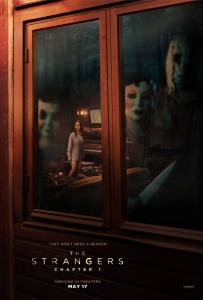 The most terrifying part of The Strangers: Chapter 1 is during its closing seconds, as text appears to inform all of us woeful viewers: “To be continued.” Oh no. Chapter 1 is intended to be the first in a new trilogy bringing back the essential concept of the 2008 home invasion thriller, that the masked attackers have no agenda, no motivation, and are being sadistic silent tormentors just because. The explanation, “Because you were home,” was a key revelation to the original, and here this famous line gets re-worked and has the same clumsy impact as Madame Web trying to reword that Spider-Man oath (“When you take on the responsibility, great power will come“). Not that the dialogue is the strong point of this thriller, with clunky expositional lines as nakedly transparent like, “Today is the third day of our three-day road trip around the country,” followed by, “Or our five-year anniversary.” It’s in the annoying, “Yeah I work here too” kind of lazy exposition. But you’re here for the scares, of which Chapter 1 has precious few because I think these are the most unimpressive and lackadaisical home invaders I’ve ever seen. I think the Wet Bandits might give these goons a run for their money (I’d watch Kevin take on The Strangers). Much of the movie is spent waiting, or checking places around the cabin, sometimes while one intruder plays the piano for ambience. One could make an argument they’re toying with their prey, but I would counter that I just don’t think they’re good at their whole enterprise. It doesn’t help that the main couple are so boring and undeveloped and I found it hard to fear for their well-being. As far as memorable scares or set-pieces or ingenious obstacles or overcoming said obstacles, it’s a big miss on all counts. A home invasion scenario can be exciting and terrifying, and it can be delicious fun to turn the tables on the attackers. This movie has so little that even the core ideas feel stretched beyond their breaking point. It’s hard to even feel much reverence for the original here, as The Strangers: Chapter 1 feels more like the steady, unrelenting squeezing of all IP for any possible drops of renewed audience interest. If this is what Chapter 1 has to offer, please spare us the rest. Fun fact: if you want to know what director Renny Harlin (Die Hard 2, Cliffhanger) has been doing lately, well here’s your underwhelming answer.
Nate’s Grade: D+
Share this:

Abigail (2024)
 Abigail feels very much like a spiritual sister for 2019’s Ready or Not, as it is a follow-up from the same writers and directors. It’s a bloody, funny movie about a hunt in a big mansion with a heroine who is battling against supernatural forces over the course of one long hellish night. We have a team of thieves kidnapping the young daughter of a man with money and having to hold her overnight. They don’t know one another and there’s an initial bristle to their discovery, like when an ex-police detective (Dan Stevens) and a recovering addict (Melissa Berrera) have equal measure not to trust one another. Things get worse when it’s revealed that their hostage, the titular Abigail (Alisha Weir), is not what she seems, a fact spoiled in the trailer. What follows is a topsy-turvy game of cat and mouse with some effective creepy moments and some lively humor without losing sight of the escalating stakes as well as the acclimation of new rules. The acting ensemble is highly enjoyable, particularly Stevens as a scuzzy authority figure, Kevin Durand as a himbo with an emotional core, and Weir, who has tremendous range to pull off the changes her character goes through. It’s not as fulfilling and finely developed as Ready or Not, one of 2019’s best films and one of the best endings to a movie ever, but Abigail is a first-rate bloody B-movie that might not hit as high but still satisfies.
Nate’s Grade: B
Share this:

Late Night with the Devil (2024)/ Immaculate (2024)
 Late Nigh with the Devil is an intriguing novelty, a found footage item of 1970s late night talk show fame reportedly documenting the last show of Night Owls, a talk show hosted by a man who recently lost his wife to cancer and is also slipping in the ratings and losing his traction in the industry. So Jack Delroy (David Dastmalchian, best known as Polka Dot Man in 2021’s The Suicide Squad) gets the great idea to hold an exorcism live on stage or his big spooky Halloween show. What could go wrong, right? The movie is dedicated to upholding the style and awkward tone of 1970s talk show, and its commitment is by far its most interesting aspect to the found footage sub-genre. I wouldn’t classify the movie as necessarily scary, but it held my attention and I appreciated the corny little nuances of recreating an older form of television and comedy schtick, with a growing sense of foreboding as things start to get progressively worse and Jack pressures his new girlfriend, an occult writer, to bring out her possessed pupil. It takes a little long to get going, and the overall conspiracy of Jack’s connection to an Ilumminati-esque showbiz cult feels so tangential to be important, but I was objectively impressed with the overall recreation of an archaic form of TV. The conclusion, once all chaos is finally unleashed, breaks the rules of the found footage setup but at that point it’s welcomed and things can get a little more weird and visually audacious. Late Night with the Devil works more as a late-night curiosity than a boo-style horror thriller. I appreciated the committed efforts and artistry, as well as the game actors and some wicked gross-out makeup prosthetics, more than the overall movie.
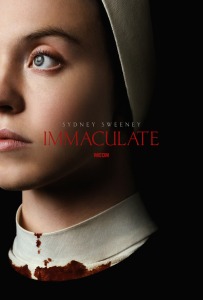 Nuns in Distress has long been a horror genre staple, as the mixture of Catholic imagery and overwrought religious themes proves an unbeatable mix with classic exploitation elements, the depraved and the sanctity. To this we have Immaculate with rising starlet Sydney Sweeney (HBO’s Euphoria) as an American nun traveling to a remote Italian convent and becoming an unwitting victim in a sinister ploy to gestate a new potential messiah. While very serious and broody in presentation, Immaculate is a pretty by-the-numbers mystery that goes to its most obvious route and becomes an overextended hostage thriller for Sweeney. The movie is at its best when it gets crazy, and that includes Sweeney, when she’s allowed to be all-out histrionic. For too long, the movie is too somber and simmering, which works best if the mystery is at least involving and surprising or we build to a great gonzo finish. I wish the movie was more wild. The ending is the best part of Immaculate, where Sweeney is pushed to the point of intense madness, while splattered in blood as per genre rules, and is forced to make extreme and personal choices. In that regard, perhaps Immaculate best operates on a metaphorical level about the horrors of pregnancy, more forced birth from oppressive leaders, and restricting women’s autonomy in a post-Roe v. Wade world. It’s a long wait to that worthwhile finale, and you might get restless from your unholy wait.
Nate’s Grades:
Late Night with the Devil: B-
Immaculate: C
Share this:

The Passion of the Christ (2004) [Review Re-View]

Originally released February 25, 2004:
The Passion of the Christ is a retelling of the last 12 hours of Jesus Christ’s life (perhaps you’ve heard of him?). In these final hours we witness his betrayal at the hands of Judas, his trial by Jewish leaders, his sentencing by Pontius Pilate, his subsequent whippings and torture and finally his crucifixion. Throughout the film Jesus is tempted by Satan, who is pictured as a pasty figure in a black hood (kind of resembling Jeremy Irons from The Time Machine if anyone can remember). The Passion spares no expense to stage the most authentic portrayal of what Jesus of Nazareth endured in his final 12 hours of life.
For all the hullabaloo about being the most controversial film in years (and forgive me for even using the term “hullabaloo”), I can’t help but feel a smidgen of disappointment about the final product. The Passion is aptly passionate and full of striking images, beautiful photography and production values, and stirring performances all set to a rousing score. But what makes The Passion disappointing to me is the characters. You see, Mel Gibson’s epic does not devote any time to fleshing out the central characters. They are merely ciphers and the audience is expected to plug their feelings and opinions into these walking, bleeding symbols to give them life. Now, you could argue this is what religion is all about, but as far as a movie’s story goes it is weak. The Passion turns into a well-meaning and slick spectacle where character is not an issue. And as a spectacle The Passion is first-rate; the production is amazing and the violence is graphic and gasp-inducing. Do I think the majority of people will leave the theater moved and satisfied? Yes I do. But I can’t stop this nagging concern that The Passion was devoid of character and tried covering it up with enough violence to possibly twist its message into a Sunday school snuff film.

For my money, the best Biblical film is Martin Scorsese’s 1987 The Last Temptation of Christ (also a film mired in controversy). Last Temptation, unlike Gibson’s spectacle, was all about Jesus as a character and not simply as a physical martyr. Scorsese’s film dealt with a Christ consumed by doubt and fear and the frailties of being human. But the best part is the final 20 minutes when Jesus is tempted, by Satan, to step down from the cross and live out a normal life. Jesus walks away from the cross, marries Mary Magdalene, fathers children (this is where the controversy stemmed from but they were married) and dies at an old age. Jesus is then confronted by his aging apostles who chastise him for not living up to what he was supposed to do to save mankind. Jesus wakes up from the illusion and fulfills his mission and dies on the cross. Now, with the story of Last Temptation an audience has a greater appreciation for the sacrifice of Jesus because they witness his fears and they witness the normal life he forgoes to die for man’s sins. There is a sense of gravity about what Jesus is sacrificing.
With The Passion Gibson figures if he can build a sense of grand sacrifice by gruesomely portraying the tortures Jesus endured. Even if it is Jesus, and this may sound blasphemous, torturing a character to create sympathy and likeability is the weakest writing trick you can do. Yes Jesus suffered a lot, yes we should all be horrified and grateful, and yes people will likely be moved at the unrelenting violence he endured, but in regards to telling a story, I cannot feel as much for characters whose only characterization is their suffering. Sure, The Passion flashes back to some happier moments of Jesus’ life, which I like to call the Jesus Greatest Hits collection, but the movie does not show us who Jesus was, what he felt (beyond agonizing pain) or the turmoil he went through in finally deciding to give up his own life for people that despised him. The Passion is not about character but about spectacle.
So let’s talk about the violence now, shall we? Gibson’s camera lovingly lingers on the gut-churning, harrowing, merciless level of violence. But this is his only message. It’s like Gibson is standing behind the camera and saying to the audience, “You see what Jesus suffered? Do you feel bad now? FLAY HIM MORE! How about now?” What was only three sentences of description in the Gospels takes up ten minutes of flogging screen time. Mad Mel has the urge to scourge. After an insane amount of time spent watching Jesus get flayed and beaten the violence starts to not just kill whatever spiritual message Gibson may have had in mind, but the violence becomes the message. The Passion does give an audience a fair understanding of the physical torture Jesus was subjected to, but the movie does not display Christ as fully human, enjoying life and love, or fully divine. The only thing The Passion shows us about Jesus is that the son of God sure knew how to take a whuppin’. For Gibson, the violence is the message and the point is to witness what Jesus endured. Some would call that sadistic.

The actors all do a fine job and it’s impressive that everyones’ lines is in two dead languages (Latin and Aramaic, though for the life of me I can’t tell them apart). But the acting is limited because of the nature of the film. Had there been more moments of character the acting would come across better. As it stands, the acting in The Passion is relegated to looks of anguish or looks of horror, interspersed with weeping. Monica Bellucci (The Matrix sequels) really has nothing to do as Mary Magdalene but run around in the background a lot. Jim Caviezel (Frequency, Angel Eyes) gives everything he has in the mighty big shoes he tries to fill. It’s too bad that his Jesus spends most of the screen time being beaten, which kind of hampers his acting range.
Now let’s address the anti-Semitic concerns. The Passion does portray a handful of Jewish religious leaders as instigators for Jesus’ eventual crucifixion, but there are also Jewish leaders who denounce their actions and just as many people bemoaning the torture of Jesus as there are calling for it. Who really comes off looking bad are the Romans. Excluding the efforts to make Pilate look apprehensive, the Roman soldiers are always seen kicking, punching, whipping, spitting on Jesus and laughing manically with their yellow teeth.
And like I said before, most people will be extremely satisfied with the film because it’s hard to find a person who doesn’t have an opinion on Jesus. Gibson is counting on audiences to walk in and fill in the holes of the character so that The Passion is more affecting. Gibson’s film is worthy spectacle, and despite the vacuum of character I did get choked up four separate times, mostly involving Jesus and his mother. The Passion is a well-made and well-intentioned film that will hit the right notes for many. I just wish there were more to it than spectacle. I really do.
Nate’s Grade: C
——————————————————
WRITER REFLECTIONS 20 YEARS LATER

In 2004, Mel Gibson made an R-rated foreign film that was two hours of savage brutality against Jesus, and it wound up being one of the biggest box-office hits of the decade and forged a trail for other Hollywood execs to chase after a “faith-based audience.” It could be said that this grisly movie gave the people what they wanted, and apparently what they wanted was to watch their messiah suffer physical feats that should have killed any mortal five times over. Twenty years later, The Passion of the Christ is still a curiosity, a movie with so much technical quality and devotion to a specific purpose, but that purpose is so narrow: make people feel bad. If you were being charitable, you could argue that the sacrifice of Jesus is felt stronger when every whipping, beating, scourging, and blood-letting is endured from the audience. Except I don’t believe this, because that assumes that more time spent on visual carnage equals more appreciation earned, as if our empathy has an equation. The emphasis on the death of Jesus feels like a telling insight into certain elements within mainstream American religious culture, where the focus is on violence and loss and less so the resurrection of Jesus, wherein the man conquers death and preaches forgiveness of sin for all mankind. It’s the preoccupation with grievance and brutish power over the helping of others different and less fortunate from ourselves. I’m not going to say the hard-core fans of The Passion of the Christ are valuing the wrong spiritual ideals, but it was this Jesus guy who did say everyone should love thy neighbor as thyself.

This is going to be a rarity for my twenty-year re-review series, but I agree almost one hundred percent with everything I wrote in 2004. I can’t really improve upon that analysis and my explanation for the faults of the movie and its spiritual shortcomings. Some of these lines are still terrific: “…Twist its message into a Sunday school snuff film,” “The only thing The Passion shows us about the Son of God is that he sure knew how to take a whippin’,” and, “Mad Mel has the urge to scourge.” More time is spent obsessing over the blood of Jesus than any of his words. I’m still debating the exact legacy of this movie besides as a harbinger of a wider Christian marketplace as well as Jim Caviezel’s own god complex. Gibson only directed two other movies after, 2006’s Apocalypto and 2016’s Hacksaw Ridge. His personal failings also became hard for many to ignore after his anti-semetic drunken ramblings and allegations of abuse, relegating him chiefly to direct-to-streaming (13 films from 2020-2023). In many ways, The Passion of the Christ represents Gibson at his height of powers within Hollywood, and it was accomplished outside the studio system who thought he was crazy, though he proved them right for different reasons.
Some strange Passion facts lost to history. 1) This movie actually killed a viewer. During the crucifixion scene, a man suffered a fatal heart attack and later died. Sure, the man’s genetics and life-style choices are more likely at fault here, but had this man not seen Gibson’s movie he might have survived or at least been in a better capacity to deal with his eventual heart attack symptoms. 2) Gibson attempted to re-edit the movie for a PG-13 theatrical re-release in 2005, trimming five minutes of some of the more gruesome violence, yet the MPAA still said the movie was keeping its R-rating. 3) During filming, Caviezel was literally struck by lightning. 4) A sequel has been in development for almost twenty years, confirmed by Gibson’s Braveheart screenwriter Randall Wallace in 2016. In 2023, Gibson revealed he has multiple versions of the sequel script in the works, including one that visits hell. Caveizel has predicted the possible sequel would be the “biggest film in history,” but this is the same guy who declared Donald Trump as the modern-day Noah, so maybe let’s not regard this guy too credibly with his opinions.

The challenge with any on-screen depiction of Jesus is fleshing him out as man and god. Only focusing on one obscures the complexity of characterization, denying filmgoers a more engaging examination of the key figure of Christianity. I’d still advise everyone to watch Martin Scorsese’s The Last Temptation of Christ for all the important elements that The Passion of the Christ lacks. This is a movie designed only for brutal spectacle and nothing more, and it’s just as tedious and empty now as it was twenty years ago. Apparently, Scorsese feels like he still has more to say on the subject and is planning another Jesus movie based on a 2016 book by Shūsaku Endō, the same author of the source material for Silence. While I would maintain that Scorsese has already made the greatest movie about Jesus, as well as the greatest movie about the exploration and challenge of reckoning with faith (2016’s Silence), who am I to deny one of our living legends another bite from the apple? It’ll certainly be more spiritually meaningful than watching an execution of Jesus for two miserable hours designed as enlightenment.
Re-Review Grade: C-
Share this:

Night Swim (2024)
 It feels like the genesis of Night Swim was somebody saying, “We need a new way to do a haunted house movie so… what if…?” and then just pointed to different parts of the home and questioned whether it could be haunted. What I’m saying is we were probably a coin flip away from a terrifying tale of a haunted barbecue grill (working title: Dead Meat). A haunted pool would naturally lead to the question, “Well, why don’t you stay out of the pool?” and, well, we don’t really have an answer, so the pool can’t do too much because it’s immobile. There’s a possibility here with some spirit linked to the pool water seeking sacrifices and offering rewards in return, but this is downplayed so much and eventually forgotten during the muddied reasoning that concludes this confusing movie. I don’t think the film can even stick to its own rules. It needs to be either goofier, fully embracing its ridiculous premise of a haunted swimming pool, or going even darker and deeper with its back-story and rules and how this corrupts the new family, not because of some evil possession but from the simple wish-granting opportunity of feeding this monster for personal gain. There’s a way to make this concept work, specifically bringing the revelation earlier and dealing with the devil’s bargain implications and moral relativism. Alas, instead we get a movie about a husband being possessed by evil spring spirits and literally playing a game of Marco Polo with his children and, upon stalking them, pounces by ominously shouting, “You’re supposed to say ‘Polo’!” Just keep swimming, folks.
Nate’s Grade: C


 nathanzoebl
You must be logged in to post a comment.