Blog Archives
Homeroom: Heart of America (2003)
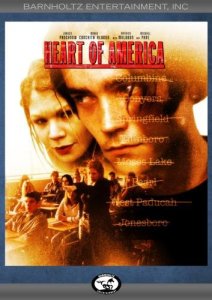
The film spans one morning of a “normal” high school in Oregon (it looks like the school is a three-story motel). It’s the last day of school and everyone is ready to jump into the real world. The storylines are rife with every high school cliché that can be found. Drum roll please, and they are:
1) Good Virgin (Stefanie MacGillivray) is dumped by Jerky Jock (Will Sanderson) because she refuses to put out. The majority of this storyline takes place in the guy’s car where he sadistically tells her all the details of the many other girls he was “forced” to sleep with (“The whole school f*cks. Everybody except you.”). One of these girls is the transient High Girl (Elisabeth Rosen), who has fallen in love with Jerky Jock over the course of him using her for sex.
2) High Girl has no parental involvement and lots of free time. She thusly gets high a lot and trips out for most of the movie. Dealer Dude spends all day implausibly hanging around the high school with sacks of drugs to sell. He’s stopped by Idealist Guidance Counselor (Maria Conchita Alonso) who wants to make a difference.
3) Good Student apparently wasn’t good at contraceptive planning because she’s pregnant. She wants an abortion and her life back. She’s also upset with her Boyfriend who wants to keep the baby and support her but is also willing to support whatever decision she makes.
4) Mean Creative Writing Teacher (Michael Paré) gets a good talking-to by the school principal (Jurgen Prochnow). The teacher is struggling with his own writing and taking out his frustrations by being overly critical of his students’ works. His grades appear to be unfair and unprofessional. One of his students is High Girl.
5) A team of bullies regularly beat up and humiliates Barry (Michael Belyea) and Daniel, who masterminds a plot for revenge. Daniel (Kett Turton) is tormented by his abusive father (Clint Howard) who just laughs when he sees bruises and black eyes on his son. The bullies are lead by King Bully (Brendan Fletcher) who is visited by his older brother, Former King Bully (Steve Byers), who reminisces about the good ole days of beating people up because they were different. These storylines mix and match until our inevitable shoot-em-up conclusion.
 Heart of America is based on a story by Boll and written by Robert Dean Klein (Blackwoods). The plot structure is competent and the film is mildly entertaining, which was a great surprise for me. The cinematography is above average for its budget and the score is quiet and reflective. Heart of America, with all its shortcomings, is still a better movie than Gus van Sant’s school shooter opus, Elephant (I dread to see this statement on the front of a re-released DVD).
Despite all of its simplicity, Heart of America makes some boneheaded decisions. It closes with lengthy text detailing other school shooters in the previous years. The text takes away from the drama and has no significant purpose other than to say, “You’ve just watched kids shoot up their school. Here’s how some other kids did it. If you’d like to learn more, visit your local library.” Heart of America also lacks subtlety; every item that is meant to carry a message of significance is hit so hard you’ll wonder if a gong is rattling. Then again, Boll isn’t well known for subtlety. This should explain Heart of America’s aches and pains with revealing its twists and revelations.
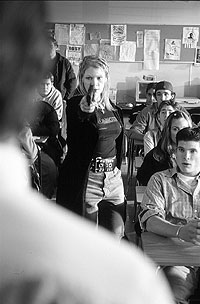
For two acts we’re led to believe that Daniel and Barry are the ones who are going to shoot up their school. Daniel IM’s his co-conspirator and reminds them not to “punk out on him.” Then minutes before the bloodbath it’s revealed that his co-conspirator is . . . another person! It’s High Girl, who takes a gun and gladly goes about killing classmates. Heart of America intentionally teases the viewer whether Barry will not follow through and this twist is intended to be something of a surprise. Trouble is someone should have told that to the DVD manufacturing folks. On the Heart of America DVD cover (as you can see for yourselves above) are the faces of Daniel and High Girl side-by-side. Superimposed over them is a list of school shooting locations that have been crossed out (it’s little wonder that Boll held back from the final one saying, “Anytown, U.S.A.”). Below all of these images is another picture of High Girl, this time standing in class and pointing an accusatory finger at some unforeseen figure. Any person intending to watch Heart of America will instantly associate High Girl with Daniel and already be thinking they’re Bonnie and Clyde. You can’t have a twist when you’re advertising it on the front cover of your DVD. Would The Sixth Sense have been as effective if the poster had Bruce Willis walking through walls like Ghost Dad (no respect to Ghost Dad intended)?
The most disturbing moment in Heart of America doesn’t even take place around the school. It involves a story Big Brother tells his bully clan about his greatest accomplishments. One of these is inviting a mentally challenged girl into his basement, getting her drunk, and then assaulting her. At first I thought it was rather unwarranted and unethical to have flashbacks of Big Bro’s story so that we can actually see the assult. Then it hit a slightly interesting juxtaposition, as Big Bro’s positive recount of his victim’s experience doesn’ match what we see happening. So I was willing to let it slide for a while until the film hit a deplorable low – a gratuitous nude scene of the mentally challenged girl (dubbed “Slow White”). You can tell it’s gratuitous too because most of the scene isn’t even shot at angles that expose her. It’s disturbing on the level that Boll was knowingly trying to shoehorn in some nudity and elicit titillation. The decision actually detracts from the power of the scene because it feels so tackily gratuitous.
 Once the end credits start to roll, the casual viewer will think two things: 1) What is that awful, tonally inappropriate pop song playing that actually has the lyrics, “The roads you made are the ones you pave,” and 2) what the hell was the message of Heart of America? In the first ten minutes or so we see teens on drugs, teens on medication, teens with no parental involvement, teens with parental abuse, and teens bullying to feel better about themselves. Do any of these things cause school violence, or is it some kind of magic combination? I never expected Heart of America to fashion a thesis on why kids grab guns and shoot up their schools but the ending feels ridiculously, artlessly devoid of meaning.
To further get into this point of discussion I will be spoiling all of the major plot lines of the movie, so in the rare instance anyone is remotely interested in watching Heart of America, scroll down. You won’t be missing much, trust me.
As expected, Daniel and High Girl get revenge primarily upon their tormentors. What I don’t get is that before High Girl sweeps into her classroom for her vengeance, she tells Dealer Dude, “I couldn’t have done it without you.” Huh? Does she mean she wouldn’t have gone to these lengths had she not be high? Or is this statement farther reaching, like blaming Dealer Dude for being apart of a system that has turned her into a degenerate drug user? I have no idea, but High Girl struts into class and kills Creative Writing Teacher, who had made fun of her and forced her to read her poetry aloud. Got it. But then she aims her pistol at Jerky Jock, whispers “I love you,” and then shoots Good Virgin to death. Apparently High Girl did not catch the news that Jerky Jock had dumped her minutes earlier. So what is the point of Good Virgin’s storyline? The only thing I can surmise is that if you don’t have sex you will be killed. If Good Virgin had given up her goodly virginity then Jerky Jock wouldn’t have been on the prowl, and he wouldn’t have used High Girl for throwaway sex, and then she wouldn’t have shot Good Virgin in jealousy. You see how this works? It’s the exact opposite of a horror movie. Daniel also shoots and kills Good Student’s boyfriend/father of her baby. What is that saying? Why couldn’t any of the shooters have clipped Patrick Muldoon’s nails-on-the-chalkboard horndog sex ed teacher? It seems Boll has a soapbox but he has nothing understandable to say.
Heart of America makes the audience not only side with the school shooters but also practically roots for them. Daniel and Barry undergo constant bullying from the get-go. The film, in its simplistic approach, plays the bullies as irredeemable assholes and Daniel and Barry are the hapless victims. Heart of America practically justifies its characters resorting to violence. Sure some innocent people get caught in the fray, but then aren’t they all to blame somehow? Again, I have no idea what Boll is trying to say.
Despite Boll having no command with actors (Muldoon is a constant reminder of this), the younger actors in Heart of America give pretty good performances. Turton (Saved!, Walking Tall) really festers with anger and discontent but also gives insights into a fragile kid just wanting to live. Belyea really works his nervous indecision to a nub, going so far as to hide his mother’s car keys so she won’t chance going to his school. Fletcher (Freddy vs. Jason) is a grinning monster as a bully but, in the film’s lone turn at character depth, also shows how uncomfortable he is being a bully. It seems that he too is just doing it to fit in. Fletcher’s pained and awkward reactions are a welcome sign of humanity, though it seems to be too little too late when we the climax hits. Rosen seems decidedly disconnected and dead-eyed scary.
 It’s puzzling that the top listed actors in Heart of America’s credits are as follows; Jurgen Prochnow, Michael Paré, Patrick Muldoon, and Maria Conchita Alonso. All four of those actors amount to about ten minutes of total screen time; Muldoon essentially has a grating cameo. Why are the kids not credited as the rightful stars of the show? The adults all give terrible performances (seriously, I cannot overstate how awful and creepy Muldoon is) but the kids are all right. The most shocking fact about the cast is that somewhere in this mix is Emmy-nominated Mad Men actress Elisabeth Moss. Look for her in here somewhere as “Robin Walters.”
Heart of America works with paint-by-numbers characters and Boll only doles out one color. The jock is a jerk. The virgin is good. The bullies are mean. The stoners are high. Very seldom does the film delve any deeper than these cursory characterizations. Because of this simplicity Heart of America strains credibility during its more unrealistic moments. At one point, King Bully and his posse force Daniel and Barry to eat dog poop and the moment is played as a defining point of drama. Does this stuff really happen? If it does then it certainly doesn’t happen often enough to be included in Boll’s depiction of a “normal” school. Then again, Boll’s idea of a normal American educational environment also involves raping mentally challenged girls. The name of the movie itself indicates how typical everything is supposed to seem.
This is a thought-provoking film, with the main thought being “What the hell is the movie trying to say?” Heart of America wades in a kiddy pool of high school clichés. The characters are paint-by-numbers and lack definition beyond their social title (Virgin, Jock, Bully, etc.). This film is awash in unresolved statements and stacks the deck so the audience will practically root for the school shooters. With no help from Uwe Boll, the younger actors are the movie’s stars and give good performances despite the limited range of their characters. You won’t know anything deeper after watching Heart of America. It’s Boll’s Big Statement Film but your guess is as good as mine as to whatever that is. Violence breeds violence? Parents need to spend more time with their kids? Don’t force kids to eat poo if they’re not ready? Heart of America is unrealistic, strained, unfocused, shallow and clumsy, and it’s also Boll’s best work to date.
Nate’s Grade: C
Share this:

Sky High (2005)
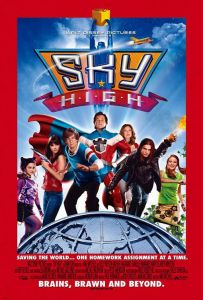 The film is pleasant, the acting overall is even pretty good, the humor is really peppy, but it’s not enough to overcome such a formulaic plot. Sky High feels exactly like a Disney afternoon movie; everything is there just fill in the blanks, Mad Libs style. Disney cranks these out like processed hamburgers. This time people have super powers and the budget is slightly bigger. There are some things I’ve seen so many times in teen movies. People still learn big lessons, people still go through social awkwardness, there’s another big house part where everyone is invited and someone has a misunderstanding, the best friend since childhood obviously has a crush on the lead that he cannot see, and the person the moves up the ranks of popularity becomes a self-centered jerk and shuns his true friends from the beginning. The best aspect is its comedic support cast including two members of Kids in the Hall, Bruce Campbell as a gym coach, Kevin Hefferman from the Broken Lizard troupe. This supporting cast should really be the focus of the story. A super hero high school is interesting but the staff of a super hero high school is even more interesting. Still, it has a nice sense of humor and is pleasant enough.
Nate’s Grade: B-
Share this:

Confessions of a Teenage Drama Queen (2004)
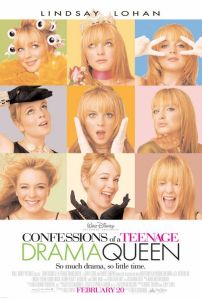 There was a glut of teen-oriented princess fantasy films in 2004 but none seemed as artificial, as simplistic, as transparent, and as dull as Confessions of a Teenage Drama Queen. Lindsey Lohan played Lola, a flamboyant new girl at school trying to fit in and find her way. This Disney confection aggressively spoon feeds its life lessons. You can successfully guess the entire plot of this trifle from the first second on. Confessions of a Teenage Drama Queen has a prolonged musical climax that’s a shameless ploy to set up Lohan as a pop singer and ensnare preteens into buying the soundtrack. When you get down to it and count the life lessons, simplicity, costume changes, and musical numbers, Confessions of a Teenage Drama Queen isn’t a movie, it’s an awards show patting itself on the back.
Nate’s Grade: C-
Share this:

Elephant (2003)
 Writer/director Gus Van Sant could never be accused of taking the easy road. He’s been an indie provocateur whose long career has involved Keanu Reeves, Uma Thurman with giant thumbs, villainous weather girls, and Sean Connery uttering the immortal line, “You’re the man now, dawg.” After 1997’s Good Will Hunting made over $100 million, Van Sant had an artistic blank check. He chose to do a shot-for-shot remake of Alfred Hitchcock’s masterpiece Psycho, now with added scenes of masturbation at no extra charge. So, as you can tell, there’s no telling what Van Sant will do next. On the heels of the experimental 2002 Gerry (where Matt Damon and Casey Affleck wander around and that’s it) comes his Cannes-winning portrait of high school violence, Elephant. But is Elephant an influential eye opener, or does it fall short of its artistic intentions?
Van Sant’s exploration on school violence is startling, realistic, and ultimately a failure. Van Sant does a great job of echoing the mundane reality of high school life with long, elegant tracking shots and numbing classical music; however, Elephant merely becomes an overindulgent and pretentious art exercise. There’s little below the surface, and Van Sant’s actors do little in their brief gasps of screen time to empathize with.
 There are some jolting moments of violence but by the time they arrive Elephant has worn out its welcome. Once we’re even introduced to a character and thirty seconds later they’re killed off. It’s hard to get emotionally attached to so many characters we get mere fleeting glimpses of before they are murdered in the name of artistic statement. The horror of high school violence is less jarring when you feel nothing for the characters. Some of the scenes are shocking, but by the time the school shooting actually arrives the audience might actually be feeling pangs of guilt over their reluctant happiness that something finally is going on, even if it is students being murdered by their peers.
Van Sant also trades heavily in tired stereotypes, from the sexually promiscuous jock, to the nerdy bookish girl, to a trio of bulimic girls used as shameless comic relief. His teen killers watch documentaries about Hitler, play violent shoot-em-up video games, and, of course, have negligent parents. In a very peculiar scene, before the school shooters march off they share a shower and lament that they’ll never be able to kiss a girl… and then they kiss each other. I don’t know exactly what Van Sant is trying to say and I don’t think he knows either.
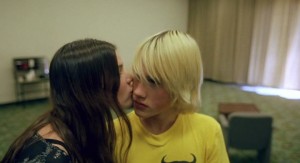 This is the longest, most appallingly boring 80 minutes of my life. Elephant’s running time should be brisk, but oh boy does it feel like an eternity. The pacing of the film is practically non-existent. Old women in check-out lanes could move along faster than Elephant. All the drawn out tracking shots give the viewer an eventual idea of the school’s geography, but it also lulls the viewer into a coma. The long bouts of static nothingness set to the soothing classical music might be the downfall for a sleepy audience. Perhaps in the future Elephant will be the cure for insomnia, but right now, in the present, it’s the dullest, most monotonous waste of 80 minutes you could spend in a theater.
Elephant sure takes its time to say a whole lot of nothing. On paper, Elephant could have been an artistic exploration into the reality of high school and the glazed indifference teenagers face in a society of apathy. Instead, Elephant equates cinema verite with real time. It’s not enough we have to watch someone do a film test strip but we have to watch the whole thing in real time. It’s not enough we have to watch one of the school shooters practice piano but we have to watch and listen to the whole thing. It’s not enough to see one inconsequential scene but we have to witness it three different times from alternating points of view. It’s a monumental waste of time for everyone involved, especially the poor audience.
What may be most terrifying about Elephant isn’t that it has no answers for school violence, but that it doesn’t even have the ambition to pose any questions. Van Sant’s followers could have their interest piqued by Elephant, but this film is going to appeal to a very very small number of people (I’m thinking maybe six, tops). Elephant is an artistic overindulgence masquerading as thoughtful meditation.
Nate’s Grade: D
Share this:

Donnie Darko (2001)
 Donnie Darko (Jake Gyllenhaal) is your normal malcontent teenager in late 1980s Reagan America. He bickers with his older sister, worries over the right moment he’ll kiss his new girlfriend, and tries to ignore the advice of many imprudent adults. Donnie’s your typical teenager, except for his imaginary friend Frank. Frank is a sinister looking six-foot tall rabbit that encourages Donnie into mischief and gives a countdown to the impending apocalypse. And I haven’t even gotten to the time travel yet.
One night as Donnie wanders from his home at the behest of Frank, an airline engine mysteriously crashes through the Darko home and lands directly in Donnie’s room. The airlines are all at a loss for explanation, as it seems no one will take responsibility for the engine or knows where it came from. Donnie becomes a mild celebrity at school and initiates a relationship with a new girl, Gretchen Ross (Jena Malone). One of his classes consists of watching videos of self-help guru and new age enlightenment pitchman Jim Cunningham (Patrick Swayze). His school has even, under the persistence of self-righteous pain Kitty Farmer, persuaded Cunningham to speak and try to help students conquer their “fears.”
 Donnie is also seeing a therapist for his emotional problems and taking medication for borderline schizophrenia. Around this time is when Donnie starts to inquire about a strange old woman, obsess over the possibilities of time travel, as well as see weird phosphorescent pools extend from people’s chests. He also floods his school at the urging of Frank. This is no Harvey type rabbit.
The longer Donnie Darko goes on the more tightly complex and imaginative the story gets. First time writer-director Richard Kelly has forged an excitingly original film that is incredibly engaging with charm and wit. He masterfully mixes themes of alienation, dark comedy, romance, science fiction, and a sublime satire of high school. Donnie Darko is the most unique, head-trip of a movie unleashed on the public since Being John Malkovich. Kelly has a created an astonishing breakthrough for himself and has ensured he is a talent to look out for in the future.
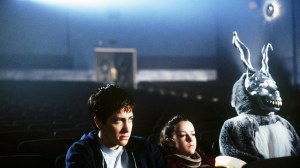 Gyllenhaal (October Sky) is superb as disenchanted Donnie, a Holden Caulfield for middle suburbia. His ghastly stare conveys the darkness of Donnie but his laid-back nature allows the audience to care about what could have merely been another angst-ridden teenager. Swayze is hysterical as the scenery-chewing Cunningham. The rest of the cast is mainly underwritten in their roles, including stars Drew Barrymore (who was executive producer) and ER‘s Noah Wyle, but all perform admirably with the amount they are given. Not every plot thread is exactly tidied up but this can easily be forgiven.
Donnie Darko is a film that demands your intelligence and requires you to stay on your toes, so you can forget any bathroom breaks. The film is one of the best of 2001 but also one of the funniest. You’ll be honestly surprised the amount of times you laugh out loud with this flick. The theater I saw this in erupted every half a minute or so with boisterous laughter.
Donnie Darko is a film of daring skill and great imagination. You don’t see too many of these around anymore.
Nate’s Grade: A
Reviewed 20 years later as part of the “Reviews Re-View: 2001” article.
Share this:

Not Another Teen Movie (2001)
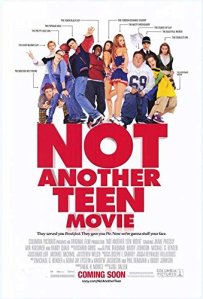 Spoofing is often believed the cheapest and lamest form of comedy. One runs jab after jab, and gag after gag relentlessly hoping that some hit but content that if they don’t more will follow with the potential to. But many of the jokes in a spoof aren’t textured; there’s nothing below their surface. Spoofs can be done well or they can be embarrassing and wretched to sit through. Count Not Another Teen Movie in the latter category.
At John Hughes High School (can you feel the parody, can you?) it’s life as we know it for stereotypes and clichés. The Bitchy Cheerleader has just dumped the Popular Jock and the Cocky Blonde Guy has initiated a bet that PJ cannot turn anyone into prom material. The men size up their choices, including an albino girl singing about her lost pigmentation (one of the few funny gags), and decide on the Pretty Ugly girl who is beyond all hope with her glasses and ponytail. Meanwhile, the Cruelest Girl is trying to find a way to seduce her brother, the Popular Jock, a trio of Virgins try and, what else, lose their virginity, and the Best Friend with Hopeless Crush tries to work his klutzy charm.
 In a genre full of Freddie Prinze Jr.’s greatest hits (or misses, however you want to look at it) a parody wouldn’t be too difficult to prescribe. All too often the film has no edge and falls back on scatological humor as its savior once too often. An exploding toilet and a flying vibrator can only do so much. There has to be things behind it. Alas, there is nothing. For every one part funny (a character tries to find the right moment to start a slow and building applause) there are three parts inane, satirically flaccid, crudely useless, or bordering on exploitative (the foreign exchange student who drapes around completely nude the entire film). The jokes arrive many times cold and require a good deal of familiarity with the subject material it’s spoofing. NATM seems to not think too greatly of the audience for it. The film continually seems to explain jokes after they happen or reacquaint the audience with the source for spoofery. The worst example may be that the movie has to SHOW a character watching a scene from ‘Pretty in Pink’ mere seconds before it spoofs that very scene.
The movie, as a whole, has about six good gags and bits but the rest is watch-checking time. Some comedic threads don’t even get the proper treatment to become good jokes. The Token Black Guy’s introduction is rather funny, but then all he does in the film is repeat the words he said he could only say. Now, if the other characters had begun to question this law of teen movies, and asked him questions then this idea could have been ripely handled. As it stands it’s another joke in a line of jokes that go nowhere but we keep going back to repeatedly.
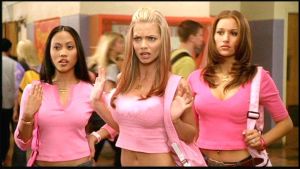 The flick was directed by Joel Gallen, marking his film debut after years as an MTV producer. Gallen shows no finesse when it comes to comedy as everything is rammed into the ground. His film is a spoof with nothing to do, much like the bad but better Scary Movie 2 earlier this year. Jokes come and go but they serve no purpose in moving things along or setting up greater jokes. This is comedy lost in the woods.
NATM is an attempt to satirize the teen genre, which should have been a rather easy job to do but instead just becomes another sad addition to it. And a rather poor and limp addition at that. NATM doesn’t know that the audience isn’t laughing with it but at it.
Nate’s Grade: C-
Share this:

Harry Potter and the Sorcerer’s Stone (2001)
 If you don’t know about Harry Potter at this point you must be living under a stone, perhaps a Sorcerer’s stone. The little tyke with glasses and a lightning scar has become a sensation across the seas and of course a big budget movie was merely just a matter of time. The imagination of author J.K. Rowling is bustling with a complex world that has given her acclaim from children and parents all over, not to mention made her filthy rich. The movie is a meticulously faithful adaptation but this is both its strength and its weakness.
The story of Harry Potter is a long and complicated one, full of numerous funny names as well. Harry (Daniel Radcliffe) is an orphan living with his nasty aunt (Fiona Shaw) and uncle (Riachard Griffiths) who force Harry to live under the stairs. Harry is informed one night by a gigantic and bearded figure named Hagrid (Robbie Coltrane) that both Harry’s parents were magically inclined and he is to gather his own education at Hogwarts School of Magic. On his way there, after picking up supplies in a special place I have forgotten totally the name of, Harry meets and befriends the aloof Ron Weasley (Rupert Grint) and the Type-A studious Hermione Granger (Emma Watson). Once there Harry picks up a rival in Draco Malfoy, a cold glare from Professor Snape (Alan Rickman), a good scare from a poor CGI three headed guard dog, and a mastery in the art of broomstick flying. The school sessions are a barrage of characters and minute plot points that readers will just be grinning that have been included.Through later revelations it is divulged that Harry’s parents were killed by the powerful wizard Lord Voldermort. It seems that old Voldy for whatever reason decided not to kill Harry. Thus because of this Harry has worldwide fame as the boy who lived against Voldermort. It seems as well that this evil wizard is trying to achieve immortality by using the advantages of the hidden Sorcerer’s stone. It’s up to Harry and his friends to stop this from happening.
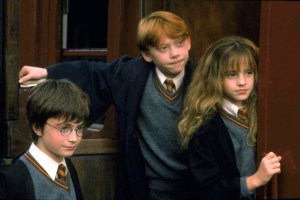 Chris Columbus (Home Alone, Mrs. Doubtfire) wrestled this franchise away from such directorial heavyweights like Spielberg, and it’s clear to see why he was selected. Rowling ordered the movie adaptation to be completely faithful to her book, and Columbus is a director with no remarkable visual flair or distinct vision. Everything that is occurring is so faithful to the book that it has no individual flavor or distance. It’s directing with your hands tied, which is fine for most people. With this project he seems like he is basically a go-between with Rowling and the studio suits. Basically it should be Rowling’s name for the director’s credit because she’s the one with the vision being translated.
Large portions of this film need to carried by the acting of several of its young stars and it’s quite a 120 million dollar weight. For the most part the child actors in Harry Potter deliver. Emma Watson is the standout as Hermione, with her extra energy and enthusiasm in every step and every smile simply winning over the audience in spades. The only real detraction acting wise in the entire film is, unfortunately, the star. Daniel Radcliffe plays Harry in a very stiff manor and spends most of the film looking overly subdued. After you experience more time with the other characters in the film one realizes how frightfully dull the character of Harry Potter really is. Any of the characters would be more exciting to watch than Harry. As characters go, he’s about as interesting or entertaining as stereo instructions.
Harry Potter contains an all-star all British cast for the fanciful faculty of Hogwarts. Everyone seems so meticulously cast that they were born to play these roles. Richard Harris becomes a gentle grandfatherly figure as the headmaster. Robbie Coltrane is a large and lovable figure that the audience can rely on again and again. Richard Griffiths is so over-the-top in a very entertaining light. Alan Rickman owns every scene he is in with such a snarling and full-of-life presence. He is perfect, as is most of the adult casting.
 The most exciting moment of the film occurs during a match of Quidditch, which is basically like rugby in the sky. Two teams on broomsticks whiz and zoom around one another in a fierce aerial competition. At this moment Columbus can declare himself the true director. The entire sequence is done that it perks the viewer’s imagination and also provides great moments of excitement. Seeing the scene itself was a testament to the wizardry of special effects.
The length of Harry Potter and the Sorcerer’s Stone clocks in around two hours and thirty minutes, which might seem like an eternity to small children if they weren’t so overly obsessed with the book series. The film is structured more like a novel than a screenplay (again with the induced restrictions), so instead of a usual three-act system it has moments that drag and moments that seem to go on endlessly (like the final near obstacle course the three kids must go through). The entire first hour or more is set-up explaining all of the characters and the world they inhabit, then they just sneak in a mention to the Sorcerer’s stone toward the end and introduce our titular story line. Hopefully, with the set-up out of the way now, the next movie will be a tad shorter.
Harry Potter is a worldwide phenomenon that is already breaking box-office records and parents’ bank accounts. The first four books have been optioned by Warner Bros. so expect to see an armada of kids dressed up in Halloween costumes around Thanksgiving for the next few years. Harry Potter is a fairly light-hearted but entertaining venture that I wouldn’t mind revisiting and reacquainting every now and then like an old friend.
Nate’s Grade: B
Share this:

O (2001)
 “I did what I did and that is all you know. From here on out I say nothing.”
The story behind O has become more infamous than the film itself. The film has had twelve different release dates and was actually finished in 1999. It had the dubious nature of having the themes of jealousy and violence set in high school around the time Columbine had polarized the nation. Miramax subsequently kept pushing the film back until it finally jettisoned it over to Lions Gate films, the same people who rescued ‘Dogma’ when Miramax felt it was too hot to handle for corporate parent Disney. Finally now O is getting the release it has waited for.
O is the modern update of Othello but is by no means in the same brethren of the bubbly Shakespeare ripped teen comedies proliferating the screen big and small. O is a serious tale told with earnestness in its portrayal, and with its conviction and refusal for exploitation, executes the best modern day transition of Shakespeare to date. What better setting for lust, jealousy, love, betrayal, murder and tragedy than a high school? It is almost chilling how well the tale translates to the high school setting, particularly with the notices of race and jealousy.
Odin James (Mekhi Phifer) is the only black student at an all white prep school in Charleston, South Carolina. Odin is the senior leader of the school’s basketball team and an all-star in the making. Odin, or “O” as the crowd chants at games, is dating Desi (Julia Stiles), the daughter of the dean. She’s a spitfire but they love one another with great intensity. Everything seems to be going well for Odin with school, his relationship, and his team entering into the state playoffs. His coach (Martin Sheen) proclaims his love for Odin like a son at a pep rally with the denizens in the stands cheering along. Everyone appears to be cheering for their popular hero, except for Hugo (Josh Hartnett).
 Hugo is the coach’s son and perennially looked over on the basketball team. He looks at Odin and is fueled with jealousy for the admiration and love his father would rather bestow on him than his own son. Dinner at home is a more a cold silence than a family activity. Hugo is jealous of all the things Odin has that he cannot have and some that he will never have. So he sets forth in motion a plan to bring the downfall of the popular kids he despises. Hugo enlists the aid of gullible Roger (Elden Henson) who’s picked on heavily from the same people Hugo wishes to topple. Hugo coaxes Mike (Andrew Keegan), ousted form the basketball team after a staged fight with Roger, that the best way to regain the good will of Odin and his father is to cozy up to Desi and convince her. He then plants the seeds of doubt in Odin with Desi. He draws Desi’s roommate Emily (Rain Phoenix) into the scheme by seducing her into stealing a rare handkerchief that Odin had given Desi as a show of love and commitment.
With every pawn somehow moving in the directions Hugo wishes the jealousy boils, love turns to heartbreak, and the game ultimately ends violently. It isn’t called “tragedy” for nothing folks.
Othello is, at its heart, the tale of a villain and his masterminding. The center figure is not on our hapless Moor or his lovely Desdemona, but on the treacherous Iago as he plots the tragedy of those around him with woeful precision. Shakespeare’s Othello has quite possibly the greatest villain in all of literature with Iago. He is a man who positions an elaborate staging of jealousy, insecurity, mistrust, and ultimately murder – and all this time he is given center stage to propel his masterwork. And it’s exciting, giving genuine evil a face, a name, and more importantly than anything else, a vicious intelligence to play out. This is why Othello transcends its problems in story staging and character turning points, because it is a tale told from the hands of its most essential leg: the villain.
Hartnett takes the reigns of the picture and gallops with them with great care. Though shot and filmed years before many of his latest pictures, O shows Hartnett in his most methodical and enticing acting turn. He portrays Hugo smoothly giving equal shades of bitterness and envy with his sullen performance. Harnett is so invigorating as the villain that one almost sides with him, but that is the attraction of evil. O decides to pump more motivation for its villain than Shakespeare had included, and it works in a startlingly believable way. A student plotting the demise of a more popular and athletic student and seeking the love of an inattentive father – maybe this is why Miramax shelved it for two years. The motivation in this setting is totally believable to a chilling point.
 Phifer is a charming presence and reflects the descent of Odin with good emotion. One can feel the rage just resonating from him during a slam dunk contest which he brings down the backboard and sternly glares at Desi in the stands. His final declaration with all the chaos that has swarmed around him is almost heart breaking. Stiles, on the other hand, is not given too much to work with but seems to make decent use out of her part. Sheen blusters about like the spawn of Bobby Knight, but shows a more frightening side in his ambivalent relationship to his son.
O is deftly directed by Tim Blake Nelson who might be more well known as the “other” chain gang member in O Brother where Art Thou? Nelson periodically adds little touches of great artistic exchanges that elevate O into something more than another teen film. It even achieves a certain level of poignancy and power as Hartnett is led away and speaking reflective about his deeds to the audience. The script from debut screenwriter Brad Kaaya drops Shakespeare’s prose but for the best. The film has a greater sense of realism and authenticity when the main characters aren’t talking in iambic pentameter.
The film isn’t perfect by certain means. Hugo’s plot seems a tad too elaborate and easily achieved, and Odin seems to fall for some questionable pieces of doubt. I mean, what else will an old hanky be used for in a modern film? But these faults can be blamed on Shakespeare as much as the principals involved behind the film. Despite these minor stumbles O is indeed a great film that deserves to be seen and thought over afterwards.
Nate’s Grade: B+
Share this:

Teaching Mrs. Tingle (1999)
 The directorial debut from Scream scribe Kevin Williamson is in a dire identity crisis no marketers would want to handle. Is it trying to be a teen drama? Is it trying to be a thriller? Is it trying to be a comedy? Whatever it’s trying to be it most certainly isn’t entertaining. Maybe they should’ve tried that first.
Williamson, the man who made self reflective pop-culture references a career and the puppeteer over Dawson’s Creek, takes a stab at directing his own movie he wrote embittered over an unpleasant English teacher of his long ago. The wit found in most of Williamson’s trademark slash-and-dash-and-instant-cash pictures are completely absent in this outing and we are replaced with dull cardboard characters, predictable plotting, and poor direction.
The movie is bubbling over to the brim with every high school cliche you can think of. The characters aren’t even people, or even grossly overdone cartoons, they’re basically cut-outs of real people. It’s like every person phoned in a performance and had cut-outs stand in their places. Let’s see there’s the good girl hero who’s falsely accused (Katie Holmes), the good girl’s rival who kisses up to teacher (Liz Stauber), the bad boy without a cause that the good girl hates but just can’t help herself to fall in love with later (Barry Watson), and the good girl’s best friend who serves for the purpose of comic foil (Marisa Coughlan). Have we got everything covered? Okay, greenlight it!
One of the pleasant things in Tingle is Helen Mirren’s wonderful over-the-top performance as the misanthropic title villain. She shows how she can out-act anyone that dares vie for her creed. Though for the latter part of the movie she’s mainly reduced to clawing and hissing.
This effort comes off as a juvenile fantasy to exact revenge upon all those in the educational system that have ever done wrong. Notice that this same idea was used in last winter’s The Faculty to much better results. Ultimately when it comes down to, Teaching Mrs. Tingle has a few funny parts, mostly revolving around The Exorcist in some way, and a lot of predictably dull parts. Williamson doesn’t have the visual prowess to keep a career as a director, and the entire horror world has moved on from the post-irony movement he himself forged. While I do think there is a place for this man’s talent, I hope he sticks behind a typewriter more than a camera. Now what did we learn class?
Nate’s Grade: C


 nathanzoebl
You must be logged in to post a comment.