Blog Archives
Me and Earl and the Dying Girl (2015)
 In many ways Me and Earl and the Dying Girl feels like the perfect specimen that was programmed and brought to life in some mad scientist Sundance film lab. It’s got a hip point of view, a meta commentary on its plot and the directions it doesn’t take, style to spare with lots of self-aware camera movements, and even Wes Anderson-styled intertitles and colorful visual inserts, including stop-motion animation. It’s about two amateur filmmaking teenagers, Greg (Thomas Mann) and Earl (R.J. Cyler), who befriend Rachel (Olivia Cooke) who happens to have terminal leukemia. The movie has a good heart and it deviates from convention with its storyline, though it has to stop and add narration to point out how it does this, like it demands a pat on the back for not being a “typical cancer weepie.” The big problem is that we’re stuck with the perspective of Greg, who is the least interesting character and just trying to stay invisible. He has a low opinion of himself and his friendship with Rachel will somehow make him a better person. Earl and Rachel are both tragically underwritten but valiantly played by their actors. The annoying aspect is that Greg makes everything about him and so does the movie. The supporting parts are broadly portrayed and fit awkwardly with the larger setting, like Greg’s overenthusiastic teacher, Rachel’s lush of a mother who seems one drink away from committing statutory rape, and Greg’s mom, who forces Greg to hang out with Rachel, even though they were acquaintances at best, because the plot demands it. The script by Jesse Andrews, based upon his YA book, sets up the completed tribute film as an emotional climax that cannot be met, and the abstract movie results prove it. This is a likeable, funny, and entertaining indie with a sense of style and wit. It’s good, but it could have been better. I wish the “Me” had been removed from its title.
Nate’s Grade: B-
Share this:

Easy A (2010)
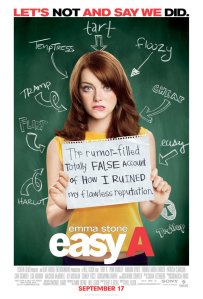 Usually when I think “teen comedy” I think lowest common denominator and a pitch straight down the middle of the plate. Will there be fart jokes? Probably. Will the climax taken place at the prom? Absolutely. Does Easy A do either? Not a chance. This is the sort of teen comedy that would have greatly appealed to me back in my own days of high school institutional education.
Olive (Emma Stone) is a high school senior that gets good grades, behaves well, and spends her weekends hopping around her bedroom and singing a song she can’t get out of her brain. She’s not into parties or idiots or anything remotely dangerous. Then her world turns upside down when she fibs about losing her virginity. Suddenly Olive is branded as the school’s hussy. Inspired by Nathaniel Hawthorne’s famous character, Olive decides to embrace the rumors, accessorizing her wardrobe with plenty of scarlet “A”s along the corseted bust line. Olive’s gay friend asks her for a huge favor: he wants to use her fake notoriety to lose his virginity. The two will attend a party, find a room, and dramatically interpret animated sex. It works like a charm. Her pal is given a free pass, some extra popularity, and it isn’t long before other downtrodden high school rejects seek a similar deal. Outraged at Olive’s lack of shame is Marianne (Amanda Bynes), the school?s busybody and leader of a vocal Christian abstinence program. She doesn’t know whether she wants to save Olive or banish her.
 All hail the coming of Emma Stone, comedy goddess and future heartbreaker. Easy A is a fantastic showcase of the many strengths of this irresistible actress. After several supporting roles in films like Superbad and The House Bunny, this is the first opportunity for Stone to have a film where she gets to be the lead, and trust me folks, this won?t be the last one. Stone has a great way of becoming instantly empathetic and, much like the film, being brainy and playfully risqué at the same time. Watching the success of Stone is like watching the road not taken by Lindsay Lohan (be careful whose advice you take, Emma). Stone makes her good times seem effortless, like she really is having a blast playing up her bad girl image. Her facial expressions and sarcastic, know-it-all line readings help push her comedic range even further, and yet she remains completely empathetic the entire time. Stone is the kind of girl that other girls would want to hang out with and guys would crush on. It is impossible to not love this actress, and she makes Easy A easily enjoyable and downright effervescent at times.
The rest of the cast is having just as much fun with the material as Stone. Chief among them are Stanley Tucci and Patricia Clarkson as Olive’s hyper-literate parents. They may seem like they stepped off the train from a Diablo Cody movie at first, but you will quickly get used to their glib rapid-fire repartee. Some might dismiss them as kooks. Thomas Haden Church (Sideways) tries to make the glamorous movie idea of the Hip Teacher into a droll square and succeeds admirably. There’s even Lisa Kudrow (TV’s Friends) as a guidance counselor and Malcolm McDowell (Halloween) as a blasé principal (“This is public school. If I can keep the girls off the pole and the boys off the pipe, I get a bonus”). Then there’s Bynes (Hairspray, She’s the Man) in what was billed as her final film performance before hastily retiring from acting, and then following in the footsteps of other famous retirees like Michael Jordan, Stephen King, Jay-Z, and Brett Farve, and hastily un-retired. She has her cutesy, dimple-faced shtick she cling to, but what happened to her? Her face looks very swollen, like she had an allergic reaction on every day of shooting. It looks like someone inflated her head with the plot to turn her into a Macy’s Day balloon. I started to get concerned for Bynes by the end.
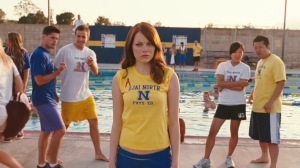 While Stone is the number one, two, and three reasons for seeing this movie, Easy A doesn’t let down her efforts. This is a teen comedy that might just be light years ahead of the pack. There are jokes guaranteed to go over the heads of a majority of audience members, from wisecracks about Sylvia Plath to French wordplay to the Kinsey scale. You’re not going to find any of that stuff in your typically brain-dead Freddie Prinze Jr. vehicle (is it just pathetic to keep holding onto a 10-year-old anti-FPJ grudge? The answer is, “No!”). Though I died a little inside when the movie resorts to explaining the plot of The Scarlet Letter to Joe Public; however, this intellectual Cliff Notes salve was saved by Stone bemoaning the idiotic 1995 Demi Moore film that takes some of the sharpest deviations I’ve ever seen from a classic literary adaptation (“If I have to grade one more paper talking about Hester Prynne taking baths all the time?”). The dialogue is routinely snappy and occasionally barbed, which is a bit of a surprise. It’s witty, a little cheeky, but it doesn’t go over the line or play for the easy gross-out gag. It?s a well-constructed, well-executed teen comedy that has a playful zing, a facetious tone that celebrates literature and makes being smart sexy.
While sex is at the forefront of the plot, the film does not treat the serious subject matter with flippancy. There’s some heavy stuff about what it means to sell out your ideals, prostituting yourself in more ways than the obvious. Olive begins her crusade as a means of taking ownership of her reputation and as an amusing character to play. But then as she dives ahead, accepting gift cards for her imaginary yet cred-boosting favors, the bloom of idealism dims and the meaning of her crusade become murky. What point is she trying to prove, exactly? In the end, is there a sharp difference between being a prostitute and being a “prostitute”? How big of a distance can irony give you? Easy A may have its fun when it comes time to doing the deed (I was howling with laughter about Olive chastising her first “client” about his comment on the aroma of sexual intercourse), but this is a teen movie ready to accept the consequences of its actions with a clear and level head.
 Not everything hums with precision. Easy A can be faulted for being too reverential and referential to 1980s teen comedies. Its ambition to be a modern-day member of this group is a bit too in-your-face. The abstinent Christian opposition feels too broadly drawn and setups for cheap shots and some downright mean punchlines. This movie is better than stooping to tin-eared caricature. The relationship between Olive and her best friend (Alyson Michalka) is vastly underdeveloped. The emergence of a Herpes outbreak also seems a little tacky, especially given its salacious carrier (trying hard not to spoil plot reveals). Then there are simply questions of believability. I?m not expecting a journalistic document of the American educational system, but since when was a high school student losing their virginity scandalous gossip? Why would Olive become the talk of the town by doing something that, according to the CDC, 80% of men and 75% of women have accomplished by age 19? Now, later in the film, the whiff of prostitution would definitely create a stir in the social gossip machine, and with technology, a rumor can spread at the speed of texting.
The film follows a well-worn path and owes a serious debt to the teen films of the 1980s, but Easy A is a winning teen comedy thanks to a snappy script, a playful sense of the taboo, and the courage to shoot for a higher level joke, also Stone’s charismatic comedic performance makes the grade. The entire movie has this bustling, quirky energy to it that feels un-labored. They make it all look so easy. Despite being a thorough genre flick, it is lifted thanks to its zesty writing and acting. In the most simplistically crass terms, Easy A scores.
Nate’s Grade: B
Share this:

Fame (2009)
 Was there anyone out there clamoring for a remake of the 1980 movie Fame? If so, was there anyone clamoring for a remake that drains all life and intensity and passion from the original, leaving behind a squeaky-clean, shallow, and dumbed down version perfect for teenagers? As we churn through Freshman Year to Senior Year, we will follow scads of teens (played unconvincingly by actors in their 20s) that aren’t worth our time. The movie is overproduced and utterly simplistic. Fame is a genuine waste of most of the talent on screen.
Apologies to the Fame theme song, but I was hard-pressed to remember anybody’s name even minutes after the movie ended. Literally, I was walking back to my car and for the life of me could not remember a single character’s name. This is because the movie crams about a dozen characters and gives little to no time to them for development. We don’t get scenes, more like snippets of scenes, snapshots compressing four years of life, and yet Fame also fails in displaying any maturation during that time period. I understand that the actors have to act like they?re plainly “acting” at the start, but the script doesn’t focus much on the rigorous training these kids undergo. Somehow in between one of the many fadeouts, the students are just better. Cutting to the chase makes for fine drama, don’t you think? Screenwriter Allison Burnett (Feast of Love) foolishly thought the audience would be more interested in watching the characters in sub-par soap opera dynamics rather than long moments of training talent. Inside the classrooms are expert teachers played by the likes of Kelsey Grammer, Bebe Neuwirth, Megan Mullally, and the stupendous Charles S. Dutton. We would all have been better served by spending more time at school.
 The structure works out to this: small character snippet, then song and dance number, small character snippet, then song and dance number. Repeat. But the movie’s fatal flaw is that it has no showstopper. This is a movie about forging talent, and yet the song-and-dance numbers feel uninspired. They look competently choreographed but there’s little to dazzle because the sequences are few, treated indifferently, and edited within an inch of their lives. We are rarely afforded the luxury of enjoying the dancing. At least the Step Up movies knew that the audience didn’t come for the story. The high points for the film include a Halloween party with some impressive stutter-stop gyrations (does the school have a production design class to make all those fancy costumes and sets?) and an improvisational jam in the school cafeteria. One kid lays down a beat, others join in adding texture to the jam session. Though I suppose the aspiring actors are left with little to do. This moment isn’t necessarily fully believable but it effectively communicates the creative energies that should be coursing through a school dedicated to performing arts.
I don’t care about any of these characters, mainly because these people are one-line descriptions of characters. These are cardboard cut-outs of characters, and they do a disservice to cardboard. Jenny (Kay Panabaker, looking like Ellen Page?s little sister) is the mousy girl-next-door who needs to come out of her shell. On the opposite end, Malik (Collins Pennie) is an angry street kid who needs to tap into his life experiences for acting power (Burnett also has to make sure the “street kid” character has a deadbeat dad and a little sister who was killed in a drive-by shooting). One girl’s entire story is that she wants to be a dancer and wouldn’t mind annoying her stuffy WASP parents. She invites her new Hispanic wannabe DJ boyfriend (Walter Perez) out to dinner. Cut to thirty minutes later ad she’s breaking up with him to tour with a dance company. It’s supposed to be a moment of drama but I defy anyone to care. Why should I care about this relationship or these characters when the movie doesn’t bother to care?
 The conflicts are usually contrived (oh no, the girl with the most talent in the rap group is told… she has the most talent), mostly involving grumpy, disapproving, fabulously wealthy parents. Denise (Naturi Naughton) is given both of these aforementioned conflicts. Her father demands she play piano, but she wants to sing, so how about she can play piano and sing? It hasn’t hurt Alicia Keys. In other instances, the conflict makes the characters annoyingly naïve, like when Jenny goes to the trailer of a sleazy soap actor to record an audition alone. When the characters do get a chance to speak their minds, well, you wish they would go back to dancing or singing. This also has to be the first time that Sesame Street is responsible for a student flunking out (an actor student gets a small-time gig on the long-running educational show and can’t keep her grades up at the same time).
Let’s face it, in the world of performing arts not everyone is on an even playing field of talent. The movie stumbles early during its montage of auditions, which provides some comic relief in watching the hopeless and untalented. Mostly, this audition process is a blur, but Fame loses serious credibility points when it reveals that some of the auditioning students who WERE the comic relief actually were accepted! How does that work? The movie wants me to make fun of a character for being bad and then the next minute the movie tells me that this applicant beat out thousands of other aspiring performers. I’m sorry, but that’s a credibility gap that Fame never recovers from.
For dancers and singers, it’s clear when they have talent, and it’s easy for a film to indulge. But what happens to the actors? Everyone in the movie is already an actor, per se, so when we get treated to supposedly revealing monologues, meant to display great acting talent, it comes across as unremarkable. The only time I have been blown away by a actor auditioning in a movie was when Naomi Watts just became a different person in 2001’s Mullholland Drive. It was sensational the way that she oozed sensuality and took control of her audition scene. Is it too much to ask that the actors who go through four years of intensive work in their chosen discipline be … better? But my biggest irk was the pseudo-filmmaker (Paul Iacono) who displays no discernible talent. His biggest creative break that we see is taping a drunken student poorly reciting NWA’s “Boys in the Hood” and then vomiting. But wait; being an auteur, he also uses split screens. I really hate it when movies involve amateur filmmakers because it always goes one of two ways, either 1) the movie overdoes it to the point of parody, or 2) the movie underplays the actual creative work, meaning that there is no foreseeable impression of talent. Why can’t amateur filmmakers ever be authentically good in movies? In Fame‘s case, I never saw anything that would justify this kid’s placement at such an esteemed performing arts school; and HE was one of the opening comic relief kids too. Is there a legacy program that they have to adhere to at this school or something?
 Now, Fame is rated PG but is it too much to ask for something a little edgier than another sanitized high school musical? For one thing, the movie dances around the subject of its would-be gay ballet dancer (Paul McGill) being gay. It’s implied in mannerism but that’s all the bait you get, folks. Any school that deals in theater, performing arts, dancing, and acting, well let’s just say that there?s more than one token homosexual. The original 1980 Fame dealt with sex, drugs, abortion, and the hardships of pushing your body to the limits for a dream. You don’t ever see these performers sweat. Instead, they sit around and spout bland “follow your dreams” platitudes.
The best moment in Fame is the end credits, and I don?t mean that to be disingenuous. During the end credits we roll through the various actors and they cut loose, dance, act goofy, and get an opportunity to be silly. And it is in those final moments where these people feel like people, where they have become unrestrained by the director and the screenplay. The movie itself is overly labored without having anything to show for it. The large amount of characters and quick jumps through time make it downright impossible to connect. Worst of all, the signature performance sections are few and lacking true style. This is a derivative, easily forgettable remake that doesn’t even know the right steps to be an entertaining movie.
Nate’s Grade: C
Share this:

17 Again (2009)
 My introduction to tween sensation Zac Efron came last fall. After hearing about the dominance of the High School Musical franchise I decided to finally watch the first made-for-Disney Channel film and see why exactly tween girls were screaming themselves hoarse. And after watching the musical I felt, well, how can I put this diplomatically? It sucked. Hard. First off, the plot only covered auditioning for a musical, not the actual show. What the heck is up with that? How does a movie musical climax around callbacks? Amidst the bland vanilla pop tunes, goofy hoofing, and painfully simplistic life lessons about class-consciousness, there was the overall dreadful acting by the cast. Efron wasn’t the worst actor of the lot but he seemed to go on autopilot, beaming dreamily and leaving his mouth agape long enough to stockpile flies for a long winter. I could not understand why young girls and the media were making such a fuss over Efron. I am clearly not in Efron’s core flock of fawning fans, but after catching his fairly nimble work in 17 Again I think perhaps this guy might be able to break out from the clutches of Disney and grow into his own, unlike Miss Miley Cyrus, who I believe has an ankle bracelet that will detonate if she travels further than 100 feet from the Disney execs. They don’t want another Hilary Duff getting away and sticking a scorpion down her shorts (see: War, Inc.).
Mike O’Donnell (Matthew Perry) hates his life. He’s 37, just been passed over for a promotion at his job, is getting divorced from his wife Scarlett (Leslie Mann), and his two teenage children (Sterling Knight, Michelle Trachtenberg) think dear old dad is a doofus. Apparently, everything was better 20 years ago, in 1989 when Mike was a 17-year-old basketball phenom who had his whole life ahead of him, until he walked out on a climactic game to tend to Scarlett, who just revealed that she was pregnant. Mike wishes he had one last shot to be 17 and have his whole life ahead of him again. Thanks to a magic janitor (I believe it’s really the magic hobo from The Polar Express, except now he’s gone through a work program and become a respectable community custodian), Mike transforms into the visage of his 17-year-old self (Efron). Mike seeks help from his childhood pal Ned Gold (Thomas Lennon), who poses as Mike’s father and enrolls him in the same high school his children attend. This leads to many awkward family encounters.
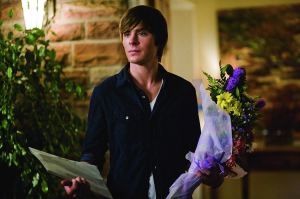 The body swap genre can be counted on for some decent fish-out-of-water laughs and some earned wisdom. Usually transporting young people into older bodies allows for more comedy because it leads to more socially awkward moments and the exaggerations of trying to be old before your time. 17 Again is consistently amusing enough and I was pleased that it found fun plot developments to explore from its body swap angle. So Mike is young once more but that doesn’t stop him from having, on the surface, inappropriate feelings for Scarlett. On top of that, teen Mike must beware the romantic advances of his own teenage daughter. Yes, the movie simultaneously explores robbing-the-cradle romance while dodging incestuous pratfalls al la Back to the Future. There is uncomfortable father-daughter sexual tension without getting too perverse. These two wrinkles nicely take advantage of the older person body swap premise and add some spice to an otherwise safe and sunny movie. Besides that, if you’ve seen any body swap movie from the past (and the 1980s were littered with body swap movies) then you’ll know exactly how everything will turn out with 17 Again. The movie is mostly silly, mostly the fun kind, but it doesn’t dip into being outrightly dumb. It’s derivative but it’s not fluff. I mean the essential premise revolves around a man regretting supporting his pregnant teen girlfriend/eventual wife. You won’t find that in the Hannah Montana Movie no matter how hard you try, perverts.
17 Again isn’t great art but it works as a showcase for its appealing star, the dewy-eyed, shaggy-coifed Efron. The filmmakers clearly know their target audience because Efron is shirtless and sweaty by minute one, displaying killer abs. By minute four, he’s dancing before his big basketball game (does this kid have a clause in his contract that he must play basketball in all his movies?). 17 Again asks little of Efron and he easily delivers on that mandate with a convincing performance that easily charms. He’s also adept at comic timing, particularly when he’s sparring with Lennon. Efron has a fabulous toothy grin and he’s a good-looking pup, but the jury’s still out on whether or not this kid can go the distance. He’s improved considerably since the first High School Musical launched his mug onto thousands of household products. He probably doesn’t have an Oscar in his future but he certainly will be headlining movies for years to come. He’s more movie star than actor, but let’s not mince words, the kid is a star (fun fact: Efron’s first acting credit is for an episode of Joss Whedon’s Firefly).
The supporting cast surrounding Efron greatly add to the film’s surprise enjoyment. The subplot involving adult dweeb Ned romancing the principal (Melora Hardin) is an amusing diversion that manages to make me like all of the characters more. Lennon (Reno 911!) steals every moment he’s onscreen and develops a kooky chemistry with Hardin (TV’s The Office). The more these two actors interacted the more I wanted the movie to ditch everyone else. Mann gets the thankless job as “upset wife” but brings a spark to the character without coming across as grating. Trachtenberg (Euro Trip, TV’s Gossip Girl) is actually 23 years old but her youthful looks seem to lock her into teenage girl roles. Look out for cameos by comedians like Jim Gaffigan and Margaret Cho. Perry must have enjoyed working for about a week and cashing his check. Also, Perry looks absolutely nothing like Efron and appears to be over a foot taller than his younger, more genetically blessed doppelganger.
 I feel sympathy for the editor of 17 Again, because clearly script supervisor Steve Gehrke must have been asleep for the entire film shoot. There are continuity gaps galore in this movie. Now, normally I don’t care so much about mild continuity errors in a movie because that’s just part of moviemaking. So if a character sits up in bed and the sheets are a few inches lower, or in a different ruffled state, well who cares? But when errors compile wildly and become flagrant distractions, then the movie has a problem and the script supervisor, the person in charge of catching those errors in progress, failed miserably. When teen Mike eats a hamburger in the school cafeteria it goes from being in his hands, out of his hands, having a bite out of it, and then magically reformed. Even worse is a moment when teen Mike is nursing a battle wound and his wedding ring keeps changing hands. Why would anyone even bother switching hands for a ring to begin with? That sounds like an easily avoidable hassle. To be fair, there are several factual errors that are not Gehrke’s total fault, though I’m dumfounded why no one else caught these. In 1989, the coach yells at Mike to quite dancing and refers to him as “Vanilla Ice,” but Vanilla Ice didn’t release his debut album until 1990 (apparently the coach knows his underground white hip-hop). What’s even more puzzling is that this pop culture reference is destined to sail over the heads of Efron’s target tween audience. All of this is easily verifiable. I won’t even get into Mike referring to “hippogriffs” 10 years before Harry Potter was published.
17 Again is a pleasant enough confection that is undemanding and yields some laughs and enough heart. The movie manages to be more mature than expected thanks to some kinky-for-PG-13 sexual tension and yet the movie is a harmless good time at the movies. Efron carries the movie ably but he’s got a great supporting cast to help carry the comedy load. Body swap movies are all invariably the same, and truly 17 Again must have been born with the sentence, “It’s reverse-Big.” It’s playful and light and cheery and pretty much an adept project for its star. It’s a small step in the right direction for Efron, and perhaps his fan base will start including more than squealing teenager girls primed to swoon at a moment’s notice. Swooning: it’s not just for the youngsters any more.
Nate’s Grade: B
Share this:

American Teen (2008)
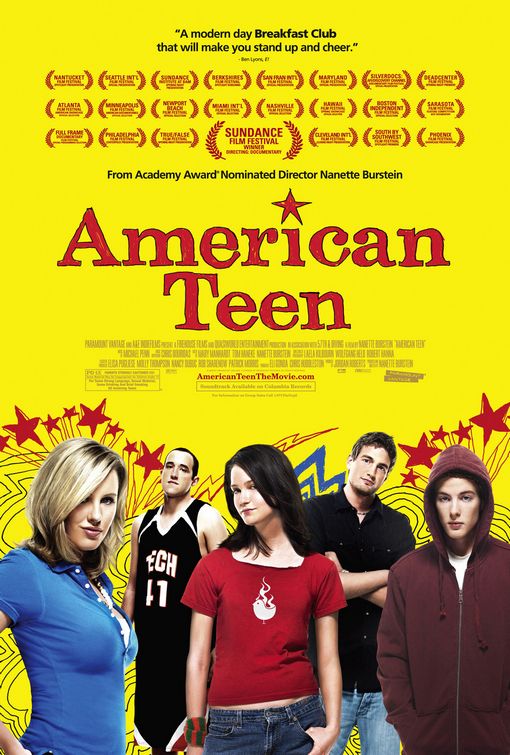 Filmmaker Nanette Burstein (On the Ropes) wanted to document the lives of actual American teenagers. After a national search, she settled on the town of Warsaw, Indiana, which we’re told in the opening narration is “mostly white, mostly Christian, and red state all the way.” American Teen is the feature-length documentary that chronicles the lives of four Warsaw teens during their senior year. The class of 2006 includes Colin, a basketball star worried about securing a scholarship. His father, an Elvis impersonator, supports his son but reminds the kid that dad has no money for school, so it’s either a scholarship or the Army. This, naturally, places tremendous pressure on a 17-year-old and his play diminishes as he tries to up his stats. There’s Megan, the queen bee at the school who feels pressured by her family to get into Notre Dame. This makes her act like a cretin, apparently. Jake is a kid who feels uncomfortable in his own acne-scarred skin. He plays video games a lot and desperately wants to find a girlfriend. Then there’s Hannah, the artsy girl prone to spontaneous dancing who feels trapped by her town.
I found American Teen to be largely unbelievable for two major reasons. First, teenagers today are way too media savvy after having grown up on a bevy of reality TV programming, the ultimate genre of manipulation. Remember way back in 1991 when MTV first started The Real World, the pioneering reality TV show? The people selected to live together as a social experiment were interesting, unguarded, a nice cross-section of the country; you felt like you could run into these people on the street some time. Then about half way into its run, the likely turning point being the Las Vegas season, The Real World participants became self-aware. They knew to exaggerate behavior for manufactured drama, to play up romantic crushes, and to work from the realm of playing a well-defined cliché character; no longer did these people feel real, instead they felt like drunken auditions for a really lousy soap opera. And all of the people started looking inordinately beautiful, chiseled hunks and leggy, waif-thin models. When was the last time they ever had an overweight person on that show? Anyway, the point of this anecdote is that thanks to the machinations of reality TV, teenagers today have grown up with the concept of cameras and they know how to manipulate reality. One could argue that you will never capture the true essence of a person by pointing a camera at them, because the instant a camera is placed to document reality it changes reality; people talk differently, either more reserved or confessional. A camera changes reality, but this discussion point is a little beyond the realm of American Teen. So I doubt the legitimacy of watching the “real lives” of “real students,” especially when these kids come from a more affluent area and probably digest other MTV semi-reality dramas like the unquestionably fake The Hills.
 So how would you behave if you knew a film crew was making a documentary in your school? I fully believe that many of the actions caught on camera are done so because the students wanted to ensure that they would be in a movie. I cannot blame them. I mean, if I was close to being involved in a film I would probably check every possibility to ensure my lovely presence eventually fills up the big screen. What do you want from kids who have grown up as a generation of self-reflective narcissists thanks to reality TV and uninvolved parents (sorry, soapbox moment)? This is why the nature of documenting reality in a high school setting is questionable. Burstein’s cameras follow Jake around and he’s able to walk up to girls and ask them out, point blank. Would he normally be so bold? I don’t know. What I know for certainty is that there would be fewer girls interested in the acne-scarred self-proclaimed geek if he didn’t have the adjoining camera crew. I’m sure girls looked at Jake and thought, “Here’s my ticket to being in a movie.” I’m not trying to be mean here because Jake is a rather nice, typically uncomfortable and socially awkward teenager who will find his niche once he leaves the confines of high school. I’ve known several Jakes in my life. But I don’t believe that a socially awkward kid like this naturally dates three different girls, all of them pretty, without the promised presence of cameras.
Also, there’s this popular guy Mitch completely thrown in at the middle of the film. All of a sudden he sees Hannah onstage rocking out at a school battle of the bands function, and the movie slows down, Hannah literally starts glowing, and Mitch says, “Wow, I have a crush on Hannah Bailey.” Allow me to doubt the sincerity of this sudden cross-clique crush. We never witness the beginning of this relationship, each side feeling the other out, the nervousness and delightful possibilities. We just get a voice over of Mitch saying he likes her and then the film cuts to like weeks into their supposed relationship when they’re goofing off at a gas station. When Hannah is invited to a party with Mitch’s friends, naturally she’s going to feel a bit out of place amongst the cool, popular crowd. He hangs out with his friends instead of his girlfriend. He makes sure to say hey to everyone else even while Hannah is sitting next to him. The next day Mitch breaks up with Hannah via the modern marvel of text messaging (ouch). You never see Mitch again until the end credits reveal that he feels he has matured. Essentially, Mitch is only seen and introduced to the movie because of his attachment to Hannah. Clearly, Mitch knew that if he buddied up next to the pixie girl he would ensure some place in the movie’s running time. It worked, because Mitch is featured in the trailer, the poster, and even tagged along on the national press tour. To paraphrase the title of Burstein’s superior documentary, the kid found a way to stay in the picture.
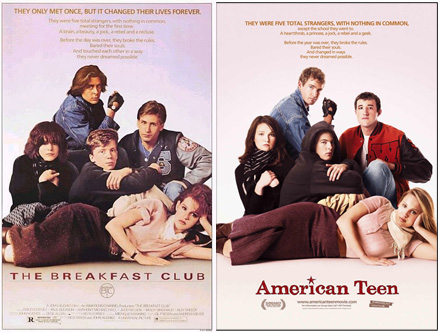 My second point of contention is that Burstein has taken scissors to 1200+ hours of footage to make her documentary about high school stereotypes, not people. Burstein has selected five figures to spotlight and she has whittled them down to one-word stereotypes: jock (Colin), geek (Jake), princess (Megan), rebel (Hannah), and heartthrob (Mitch). She isn’t destroying these lazy classifications but reinforcing them willfully. The marketing campaign around American Teen recreated the poster from The Breakfast Club. I swear, I think that art imitated life and now high schoolers are just imitating what they have seen propagated time and again as stone-cold reality in their schools: the rigid social caste system. There are so many missed opportunities by painting in such broad strokes. Colin is a jock because he plays on the basketball squad, but why can’t he also be a geek? Why can’t a rebel be a princess? I feel tacky talking in such degrading, baby-fied terms. Burstein doesn’t help her case by giving the main figures their own animated fantasy segments. Hannah is obviously the star of the film, and Burstein has seen to it that she narrates the tale as well. I suspect some canniness on Burstein’s part. Either the filmmaker felt that Hannah would most reflect the spirits of the crowds that attend indie documentaries, thus ensuring a bigger gross, or Burstein saw much of herself in Hannah and naturally wanted to make the “different girl” the star, possibly working through some of her own high school demons.
There’s also the issue of how staged some of this comes across. Am I to believe that Burstein’s camera crew managed to capture those perfect moments where the students stare out into space, thoughtfully? Am I to believe that the camera crew managed to capture everyone’s dirty little text messages then and there in the moment? Am I to believe that scenes of Hannah dramatically walking down the hallway weren’t planned? I’m forgiving when it comes to re-enactments but when a movie feels overburdened with re-enactments or posed figures, then it feels too manufactured. Just like The Hills.
Perhaps I’m coming down too hard on American Teen. After all, most documentaries distort some facet of reality and generally are edited to present a series of points. But the reason American Teen doesn’t work is because it offers zero insights into the American high school setting and little to no insights with its “characters.” Hannah is a cute girl with an independent streak but I fail to get a sense of her as a person. She gets dumped twice over the course of American Teen, suffers from crippling anxiety to the point that she misses almost a month of class, and she longs to leave the reach of her conservative town for the holy destination of California, so why then does the film not present her as a person instead of a classification? I also get the feeling that we don’t see any of would-be filmmaker Hannah’s own work because Burstein may be shielding her subject from the harsh realities or critical response.
 Obviously Megan is the villain of the piece and Burstein takes advantage of the girl’s self-absorbed sense of entitlement. Megan could be an interesting subject as far as casual cruelty. Megan vandalizes a student council member’s home because the guy had the gall to devise a different prom theme. We watch Megan literally spray paint a penis on a window followed by the word “FAG,” and then she whines that everyone is being mean to her even when the punishment she gets for a borderline hate crime is a slap on the wrists. Megan’s friend Erica makes the unfortunate decision to send a topless picture of herself in an e-mail to the guy she likes, who happens to be Megan’s friend and object of territory. So Megan briskly sends the picture to scads and scads of students with e-mail subject lines like “silver dollars” and “pepperonis.” Megan then leaves mean-spirited voice mail messages saying that Erica is destined “to live the rest of her life as a slut.” This is her friend! Burstein has the good sense of mind to interview a teary-eyed Erica after the topless photo fallout, and it probably is the emotional highpoint of the film because it’s so honest and wounded. Why not follow Erica after this? Surely her story, recovering from humiliation, is more intriguing then watching Megan scoot along her privileged life or whether or not Colin can be a better teammate. Speaking of the tall kid with the Jay Leno-sized chin, why does his dad insist that Colin needs a basketball scholarship or else “it’s the Army”? Has he not heard of student loans? Does Colin’s father believe sending his son into a war zone is preferable to amassing debt?
American Teen is a pseudo-documentary that has little intention to dig deeper under the surface of the realities of high school life. If your high school experience exactly mirrors this film, then perhaps you watched too many movies. Or the filmmakers did and tried to feed into the film idea of what goes on in a high school. Or both.
Nate’s Grade: C
Share this:

Nick and Norah’s Infinite Playlist (2008)
 When you’re a teenager, sometimes there is nothing more important in life than music. Generally one of the most prominent means for a teenager to outwardly define his or her emerging personality is by music. Coming of age and maturing musical tastes seem to go hand in hand. I may date myself here but I can recall my own personal blossoming thanks to the likes of Green Day, the Smashing Pumpkins, and the Offspring (you couldn’t go anywhere in 1995 without hearing “Self Esteem”). Nick and Norah’s romantic interlude begins over common musical tastes and move from there. Having a person “get” you seems to be linked with having a person “get” your music. Nick and Norah’s Infinite Playlist is an inviting and mostly successful teen comedy that “gets” it.
Nick (Michael Cera) is nursing the common teen ailment of a broken heart. He’s one part of a queer core punk band and just happens to be the only heterosexual band member. Nick has been sending mix CDs to his ex-girlfriend, Tris (Alexis Dziena), but she’s been tossing them in the trash. Norah (Kat Dennings) has been fishing those mix CDs and falling in love with her unknown musical soul mate. Norah’s best pal Caroline (Ari Graynor) has informed her that her favorite indie band, Where’s Fluffy?, is playing a secret late-night show in New York City. The slew of characters, Norah and Caroline and Tris and her new boyfriend, attend a nightclub where Nick’s band performs. Awkward. Norah poses as Nick’s new girlfriend and the two take off together to drive a very drunk Caroline home. It is here that they begin an unforgettable odyssey filled with gross toilets, drag queens, Norah’s ex-boyfriend (Jay Baruchel), jaunts to recording studios, and many stops along the way to try and find Where’s Fluffy?
 Nick and Norah isn’t anything altogether remarkable but its charm comes in how, well, unremarkable it comes across. I do not mean this as faint praise or a backhanded compliment. The majority of teen-oriented films have the habit of slotting characters into rigid archetypes. Earlier this year, the documentary American Teen was released and barely made a blip. The director of this documentary condensed an entire high school year into a feature-length film, but she framed her characters as entrenched stereotypes patterned after movies (movies began the stereotype, now is life merely following its lead?). The marketing even had its main “characters” recreate the Breakfast Club poster with the requisite Jock, Geek, Princess, etc. It’s so easy to paint in broad, well-established strokes when it comes to teenage characters and a high school setting. So it’s genuinely entertaining and encouraging to see Nick and Norah where the characters just are people. Granted the gay characters are a bit too cutesy by half, though they never become swishy stereotypes and the slutty manipulative ex-girlfriend character is a pretty familiar and clichéd antagonist. But the real charm of the movie is seeing characters that cannot be painted in broad strokes, characters that do not hide who they are, and characters that refuse to be typecast. Just watching Nick and Norah interact, I felt like I was watching two friends instead of high school archetypes having the same tired class warfare. Making the characters reasonably realistic and unremarkable is a breath of fresh air.
Not all the elements in Nick and Norah entertain; some feel like they’ve been surgically attached from different movies. The entire subplot involving the sloppy drunk escapades of Caroline seems extraneous at best, providing an unnecessary plot point that keeps Nick and Norah together for the night. It provides some laughs due to Graynor’s highly amusing drunken performance, but the subplot also pushes the movie into outlandish gross-out humor, like when Caroline vomits into a toilet, drops her gum in the same toilet, and then decides to foolishly go after the gum. The same piece of chewing gum has its own fantastic journey. The coupling between Nick and Norah is also given a weird and somewhat unseemly addition. Clearly these two kids “like like” each other and the wild night presents different coupling obstacles before these fun kids eventually decide to make a move. In one scene Norah is taunted by Tris about never having had an orgasm. So then the movie makes it a point that when nick and Norah do hook up that we are presented with Norah earning her first O-face (the whole climactic sequence is done off camera and only with audio). Orgasmic proof was not needed to convince the audience that Norah has finally found a worthy guy. The fact that they’re high school-aged students brings an unsettling, seedy element into an otherwise wholesome film. It wasn’t needed.
The plot of Nick and Norah has a few bumps along the way because the emphasis is on the groovy and genial atmosphere. Watching the movie is somewhat akin to attending a party with some cool people. You leave the theater with your spirits lifted a tad, a smile on your face, and some fond memories for the time being. I’m not saying that Nick and Norah is comparable to the best teen comedies of all time but it manages to spin a little magic. I couldn’t help feel wistful as I watched the teen characters romp through the late night music scene of New York City, a character all its own. The movie manages to capture the exciting essence of being young and alive in an authentic way.
 The two leads are deeply enjoyable. Dennings (The 40-Year-Old Virgin) is a great find and comes across as a natural teenager. She’s not precocious or glib, but she seems grounded, unassuming, and yet intelligent in a way that doesn’t pass as hyper-literate. Dennings gives a spunky performance that is tinged with awkwardness and heartache, as she explores the scary yet exhilarating prospect of romance. She’s also got a bashful beauty to her, like the girl next door that would never admit that she could be attractive. She’s got lips like red licorice and classic features that could work in old Hollywood. Dennings gives every scene a boost of heart and the movie shines brightest every minute she’s onscreen. Cera (Juno, Superbad) seems to have patented his nervous stammer that he’s previously showcased. I wonder what Cera’s acting range actually is because he seems to be playing different variations on the same character. However, I have written before that Cera is the living master of comic understatement and the well-timed pause, and he proves it again. He mopes a bit too much through the movie but Cera manages to make him empathetic and not pathetic. The two of them have a sweet chemistry and it’s easy to yearn for their coupling.
Nick and Norah’s Infinite Playlist exists in a world that doesn’t exactly resemble our own but seems like a swell place to visit. The movie almost contains a certain innocence to its teenage shenanigans. Dennings and Cera make for engaging leads and an adorable couple onscreen. Not all of the parts come together as well as Nick and Norah do, but the movie’s overall vibe is authentic and low-key, apt to provoke cheerful smiles more than laughs.
Nate’s Grade: B
Share this:

Hamlet 2 (2008)
 Believe it or not, there actually is a sequel out there about William Shakespeare’s most famous play concerning family dysfunction. Author David Bergantino surely doesn’t feel that he can improve upon the Bard’s classic Hamlet, but Bergantino is a writer who doesn’t cower from a challenge, like where to go next when all the main characters are dead. That’s why Bergantino took it upon himself to write Hamlet II: Ophelia’s Revenge (no joke). Apparently modern students at Globe University are playing out a family squabble very similar to anyone that has taken a high school literature class. The synopsis over at Amazon.com says it better than I could ever hope:
“When he unexpectedly inherits a creepy old castle in Denmark, Cameron tries to put his worries behind him, inviting his girlfriend and college buddies along on an overseas trip to check out the gloomy fortress. The plan is to get some serious partying done. Too bad nobody counted on the ghost of a drowned girl rising from her watery grave with vengeance on her mind! Now the only question is: to die or not to die?”
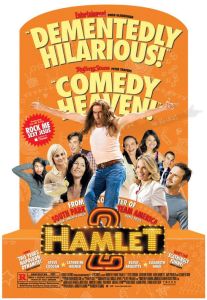
In the wake of Hamlet 2, a popular comedy at the Sundance Film Festival, I pity Bergantino. The man is going to be the Leif Ericson of pointless Shakespeare sequels: forgotten by history at the original pioneer. The film Hamlet 2 follows the miserable life of Dana Marschz (Steve Coogan). He teaches drama at a Tucson, Arizona public school and barely gets paid. His wife (Catherine Keener) is anxious to get pregnant and convinced Dana is shooting blanks. The couple is so poor that they have to rent out their home to a boarder (David Arquette). His drama class has two very WASP-y pupils (Phoebe Strole and Skyler Astin), but the rest are disinterested Hispanic students bused in from another school district. The school’s theater critic chides Dana’s laughable productions of Hollywood movies, like Mississippi Burning and Erin Brocovich. Then comes the news that drama has been slashed from the school budget. The pint-sized theater critic tells Dana to try something original to save the drama department. The answer? Hamlet 2. Thanks to a time machine, and Hamlet’s new best buddy Jesus Christ, the pair can go back and save everyone who previously perished.
 Hamlet 2 is Coogan’s show and the British comic makes his character endearing sad-sack. His character is pathetic and subject to all sorts of personal humiliations, and yet Dana is so earnest that it makes it hard not to empathize with his exploits. Coogan has a wild leer to him that gives the character a manic edge of desperation. He’s a gifted comic but he’s used to playing smug, droll characters, and Dana Marschz is the exact opposite of that mold. Coogan’s many breakdowns and bouncy spirit give the material an extra lift. He works hard for every laugh. It’s a shame, though, that he sort of disappears into the background during the staging of his infamous play.
So what is the comedic point of view with Hamlet 2? Are we to laugh at Dana and find him a buffoon? Well if that’s the case, then why serve up a musical finale that’s actually worthwhile and completely hilarious? The production values are pretty extravagant given the money limitations on the characters. Not only that, it’s so bonkers that I wanted to just watch Hamlet 2 on stage and not cut back to life outside. I wanted to luxuriate in the inspired craziness of a musical that involves time travel, Shakespeare, Albert Einstein, the song “Raped in the Face,” the devil, the Gay Men’s Chorus, lots of father issues, and Jesus moonwalking over water. That’s way more interesting than the ho-hum characters interacting backstage. In truth, the play’s the thing and it’s way too short for my liking. The performance serves as the film’s payoff, so I wanted to get every crazy kernel of shameless joy. The “Rock Me Sexy Jesus” song is irresistible and I haven’t been able to get it out of my head for days. It’s so bouncy and fun and melodic. I’ll be walking along and then I’ll start humming the damn thing. I doubt that I will come across a catchier original song in movie this year. Hopefully those bigwigs in the Academy will realize the tune’s musical merits and give it a nomination it rightfully deserves.
Then is Hamlet 2 a parody of all those treacly teacher inspiration movies, the kind that seem to always be populated by tough minority kids who just need someone to take the time and break through to them? Well Dana constantly refers to Hollywood movies like they’re documentaries, and even a whole class lecture concerns Dangerous Minds. When he accidentally injures a student, Dana jumps at his students being alert and offers in summation, “Yes it was stupid but it was theater.” The movie takes some shots against the likes of Dead Poet’s Society and Mr. Holland’s Opus, but ultimately Hamlet 2 becomes yet another inspirational teacher movie. Dana is able to rally his students to the cause of theater, prejudices are broken down, and certain students take charge of their young lives. It’s all so predictable, and predictability blunts edginess and can destroy comedy. The only true genre tweak seems to come when standoffish Octavio’s background comes to light. He’s not the underprivileged wannabe gangster but a bright kid whose been admitted to an Ivy League school early. And his parents don’t object to the play because of “ethnic narrow-mindness” but because they think it’s poorly written.
 Like Dana’s students, the film never seems to match its potential. The concept is great and so is having a main character who is inspired by theater but profoundly inept at teaching it. Dana lacks talent but can it be made up for with such big-hearted enthusiasm? There is plenty of ripe material there, but Hamlet 2 doesn’t seem to fully realize the comedic possibilities. Watching Dana fight administration officials in the name of the arts is worthwhile conflict but it’s rarely funny. Keener seems wasted as Dana’s passive-aggressive wife. An ACLU lawyer (Amy Poehler) is a great political target, especially as she fights in the name of bad art, but she appears too late in the film to be really capitalized. The climactic staging of Dana’s masterwork is another example of not fully thinking out the comic potential of a situation.
Here’s a perfect example: Elisabeth Shue appears in the film as herself, actress Elisabeth Shue. She’s quit the acting business and taken residence as a nurse in Tucson. What exactly is the joke here? Is it that Hollywood has the habit of spitting out aging actresses? Dana’s students have no idea who Shue is. Is it self-parody? If it was self-parody then the filmmakers needed to give Shue more of a personality. She’s appears infrequently and beams a nice smile but that seems like the only demand, though I must admit always in her nurse outfit, a nice visual gag. If Hamlet 2 had spent more time in revision it would utilize the comic possibilities of integrating a real-life actress playing herself in such a remote city.
Ultimately, I don’t know what to make out of Hamlet 2. It’s a marginally funny and entertaining venture that celebrates the power of the arts, which is a noble cause. Coogan straps the production on his back and carries it as far as he can go. There are some decent laughs and the closing 15 minutes is a giddy blast. However, the movie often feels flat and simply odd, missing potential punchlines and settling for second-rate comedic situations. The crafty premise afforded better material then what eventually comes across onscreen. The whole thing also feels like a mild retread of Waiting for Guffman. But take heart, because Bergantino is not about to lose the spotlight just yet. He also has written A Midsummer Night’s Scream: Hamlet II (I have no idea where the two stories connect but that’s the genius of it). It’s only a penny at Amazon.com. Get it while you can. Or don’t. Preferably, don’t.
Nate’s Grade: B-
Share this:

Freedom Writers (2007)
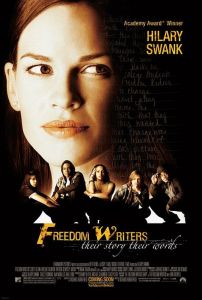 Add this to the feel-good genre of true-life teacher-makes-a-difference movies. It is suitably well acted and uplifting and doesn’t necessarily pander even if it does hit all the expected stops of the genre. These kids have grown up in an area heavy with gang affiliations, and the film earns extra credit for dealing with the heavy reality of gangs better than most any other teacher-in-urban-setting flick. Hillary Swank relies on her mega-watt smile to communicate her character’s perseverance and idealism and does a fine job along with a strong supporting cast including Imelda Staunton as the doubtful, pessimistic, dismissive principal. Freedom Writers clings to the us-vs.-them model and builds a believable underdog tale that actually could inspire a few future educators out there. This film is cozy and familiar but it also made will skill and care.
Nate’s Grade: B
Share this:

Superbad (2007)
 Seth Rogen makes me feel like a slacker. I’m two months older than him, but already he’s broken out as a comic actor on great-but-cancelled shows like Freaks and Geeks and Undeclared, and now he has risen to headlining star thanks to the runaway success of Knocked Up. Now here comes Superbad, a comedy he’s co-written with his friend Evan Goldberg, and I haven’t even gotten one movie off the ground or, for that matter, a starring role in any TV series, canceled or on the air. Oh well. At least Rogen’s consistent attachment to quality projects makes me a happy, if marginally envious, moviegoer.
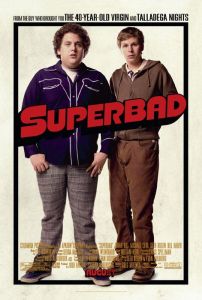
Seth (Jonah Hill) and Evan (Michael Cera) are high school seniors looking to score with the ladies. Their nerdy friend Fogell (Chistopher Mintz-Plasse) has a scheme to get himself a fake ID, and the trio seizes upon this opportunity to become important figures in the teen circuit. With the promise of the fake ID, Jules (Emma Stone) has asked Seth to provide all the alcohol for a house part that she’s throwing that night. Not only that, Evan’s unrequited crush Becca (Martha MacIsaac) is going to be there. Seth and Evan figure that this party will be the best chance they have ever had to get lucky thanks to the miracles of what some would call, “liquid panty remover.” They just have to get the booze first. Fogell’s ID lists him as simply as McLovin. He is set back when his attempt to purchase alcohol is interrupted by a robber. He’s interviewed by Officers Michaels (Rogen) and Slater (Bill Hader) who take a shine to McLovin (“It sounds like a sexy hamburger”). The threesome spend a madcap night drinking, busting crime, sharing worldly wisdom, and running away at the faintest sign of other police officers.
 First off, Superbad is raucously funny. It’s plenty profane and has several memorable moments, like Seth’s imaginative scenarios for buying alcohol and a dance that goes in a very unexpected direction. The humor is timeless and built around the nervous interaction between the sexes; there are very few jokes that reference pop culture or dependent on a specific context. I imagine what makes Superbad hilarious will still make it hilarious in 20 years to a new audience that can relate to the same trials and tribulations of teen life, though perhaps at that point we will be replaced by robots.
What separates Superbad from other offensive sex comedies is that it’s really a story about male friendship. I don’t mean in the tacky, Hollywood vein of working together for a common goal, which is commonly to lose one’s virginity. Superbad is another entry into the Judd Apatow (40-Year Old Virgin, Knocked Up) school of comedy that professes that a comedy should be character-based and that those characters should be painfully human. This is no mere genre movie. Underneath all the boobs and booze discussion is the pain and worry of a long-standing friendship being able to survive. Seth and Evan have been close friends all of their lives, but many good friends have grown apart in time thanks to their lives moving in different places. There’s unspoken tension between the two of them and Seth is concerned he’s about to be abandoned by the person that means the most to him. Many films touch upon the indelible companionship between men but few can accurately articulate the authentic love that can foster bonds of friendship. Superbad explores the exploits of real friendship, and while it’s chock full of funny the film also has its fair share of moderately touching moments. You really do care about the characters and want them to triumph. Fogell’s ascension to becoming a confidant, cool lady’s man is one of the summer’s true pleasures. Apatow’s fingerprints are all over this, and that is a glorious thing.
But this isn’t some phony Porky’s-style high school sex comedy with male fantasy set pieces and lots of dunderheaded beauties prone to bouts of frequent nakedness. Superbad is a relatively realistic portrayal of high school life in the world of movies. This isn’t a school ordered by cliques of entrenched stereotypes like the jocks, the Goths, etc. In fact, I don’t think Superbad makes any social distinction between the students.
 Superbad is a celebration of the glories and anxieties of the male members’ member. Even for a teen sex comedy, the film is very phallus-centric, complete with a hilarious anecdote about a “treasure chest of dick drawings.” It seems Seth, at a young age, was stricken with the unique compulsion to draw a phalanx of penises. The anecdote is quite unexpected and funny and underscores how often the penis prevails in the minds of young men. The boys discuss at length the life and times of the penis, especially how women can compliment this. The constant dick-chat may get old after a while for most of the female audience in attendance (a.k.a. those without), and I can’t exactly blame them, but Superbad does convey, in a convincing manner, how much teenagers think about sex (“You know how many foods are shaped like dicks? The best kind”). Some have argued that there’s an undercurrent of misogyny with Superbad, but I feel like those detractors are missing the deeper point. These guys are totally terrified of women and go through one wild night just to avoid actually confessing their feelings to the objects of their affection. These guys don’t hate women, they’re just frightened and utterly bewildered by them, and so they rely on what pop culture and their peers have taught them is the way to a woman’s heart: booze.
The movie is taken to an extra level of excellence thanks primarily to the outstanding comedic performances by its cast. Cera was a star of brilliant understatement on TV’s Arrested Development, and when it comes to portraying awkwardness, Cera is king. The gangly teen is a textbook example on high school awkwardness; he feels uncomfortable in his own skin. He seems antsy to leave most scenes. His self-effacing smile, wide-eyed gawk, and nattering stutter are spot-on signals of clumsy, confused, and embarrassed teen life. Cera is a master with impeccably punctuated line deliveries. The kid could make any line funny by flawlessly placing a pause in the right place. Arrested Development was a great showcase for Cera’s comedic chops, and now Superbad is a juicy platform for the funniest straight man on the planet (and he’s only 18 years old).
 Hill has been a supporting player in previous Apatow productions, but this is his first major role. Hill is the loud, boorish, vulgar, and more outlandish half of the duo. When he gets worked into a frothy rage you can practically feel his indignant teen spittle. What makes Hill special is that, in an instant, he can go from foul-mouthed cretin to a vulnerable buffoon. In the end, when the police bust a party, Seth runs on instinct and his instinct is to save his friend. It’s the versatility of Hill that allows Superbad to channel the sweet, gooey center behind all the sex-obsessed hijinks.
Not all the different elements of Superbad seem to fit together. The cops subplot is played very broad and relies on a lot of physical comedy; it feels at odds with the genuine teen comedy that is the heart and soul of the movie. The subplot is indeed full of laughs and it turns McLovin into a legendary teen character, but it feels like a separate movie, albeit an interesting one. For a male-dominated comedy, the female roles are pretty sparse but even those take heed not to slip into empty stereotypes. Becca and Jules are portrayed as sensible and approachable.
In short, Superbad is super good, and it’s thanks to relatable characters, a sweet sensibility, plenty of raunch, and some excellent performances. Apatow has opened the 2007 summer with a winner and now he closes it with another one.
Nate’s Grade: B+
Share this:

Half Nelson (2006)
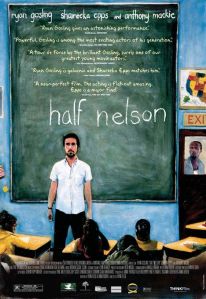 Ryan Gosling gives a devastating performance as an inner city schoolteacher addicted to crack. This is a thoughtful look at friendship and vice as Gosling befriends one of his female students and becomes something of a mentor, trying to steer her in a good direction. The film is refreshing because of how awkward and authentic it is, and it does not pull punches; there are no happy endings or storylines wrapped with bows. The biggest drawback from this powerful film is that it’s too insular and doesn’t get much of an outside perspective. Scenes have a tendency to drag, but the movie is set ablaze by the troubled yet hopeful turn by Gosling, already firmly established as the most astonishing talent of his age. Who ever would have guessed a former Mousekateer would be our next Marlon Brando?
Nate’s Grade: B+


 nathanzoebl
You must be logged in to post a comment.