Blog Archives
Big Fish (2003) [Review Re-View]

Originally released December 25, 2003:
Premise: Estranged son Will (Billy Crudup) travels back home in an effort to know his ailing father Edward Bloom (Albert Finney; Ewan McGregor as the younger version). Will hopes to learn the truth behind a man who spent a lifetime spinning extravagant tall tales.
Results: Despite a shaky first half, Big Fish becomes a surprisingly elegant romance matched by director Tim Burtion’’s visual whimsy. McGregor’’s shining big-grinned optimism is charming. Not to be confused with the similar but too mawkish Forrest Gump, Burton’’s father-son meditation will have you quite choked up at its moving climax. Fair warning to those with father issues, you may want to steer clear from Big Fish. You know who you are.
Nate’’s Grade: B+
——————————————————
WRITER REFLECTIONS 20 YEARS LATER

Tim Burton has never really made a movie like Big Fish before or in the twenty years since. He’s made movies that are aimed at children, like the Disney live-action remakes for Dumbo and Alice in Wonderland, and he’s made animated movies that are more wholesome while still holding to the man’s creepy-cute aesthetic, but he’s never made a movie so unabashedly sentimental as 2003’s Big Fish. Many of his stories involve alienation and outcasts and outsiders and characters accepting themselves, their unique oddities, and their unconventional families. This movie was different. It was based on the 1998 novel by Daniel Wallace and primarily concerns the relationship between fathers and sons as the paterfamilias is nearing his end, a not unfamiliar plot structure for treacle and tears. It’s about a smooth-talking man of legendary tall tales about his life and his exasperated son trying to find real answers. That’s the movie. It’s purposely small even though the tales are tall. There’s nothing larger than simply resolving the strained relationship between father (Albert Finney) and son (Billy Crudup). It’s the most intimate movie of Burton’s career while still finding a place for his fantastical visual whimsy, as the outlet for Edward Bloom’s (Finney as the dying version, Ewan McGregor as the younger version) fantastical tales of adventure. It’s a movie elevated by Burton’s signature style and it’s one that still, in 2023, had me choking up and tears streaming down my face by the conclusion.
This is an episodic movie by design and it does hamper some of the emotional investment, until that whammy of a culmination. Because we know the younger Edward Bloom is exaggerating his life’s travails for entertainment, and perhaps a dash of pride to heighten his deeds, it makes the many sequences of young Edward and his escapades feel a bit fleeting, as if we’re trying to find the larger meaning hidden within the fables and the fabulous. The ultimate point is that the entertaining diversions and exaggerations are who Edward Bloom is, and ultimately trying to discern truth from legend loses sight of the appeal of this charming man and his wild tales. I can understand this while also slightly disagreeing with the conclusion. It’s a little pat to say, well, the point of all these extravagant stories is simply that they were entertaining, never mind about finding a buried meaning or truth. It’s like saying, “Hey, just enjoy the ride.” The point is to fall in love with the storyteller and see the storytelling itself as its own act of love, which I don’t think works until the very end of the movie. Until then, it’s a transitory series of adventures, from wartime to the circus to aggressively persistent courtships and hidden magical towns, each reflective of the indomitable spirit and cheery optimism of our chief yarn-spinner.

In that way, it’s easy for the viewer to adopt the same perspective as Will (Crudup), and that may be the hidden genius of screenwriter John August (Go), or I may be projecting. Our plight is the same as the son: we’re trying to discover what is actually real about the real man. It’s easy to feel his exasperation as he wants something genuine from this man and only keeps getting the same old tales and stories, and everyone else is smiling broadly and happy to just accept the man on his own terms. That’s where Will’s character arc goes, finally accepting his father on his terms, which means playing along with his rules. It’s a level of empathy and acceptance rolled together, but it’s also like two hours of a character going, “My dad might be a liar and I’m curious who he is,” and then in the end going, “My dad might be a liar but I guess that’s who he is.” It doesn’t feel like the grand epiphany that the movie thinks it is, even with Danny Elfman’s Oscar-nominated score trying to stir every doldrum of your heart (Elfman has only been nominated four times in his storied career, also for Good Will Hunting, Milk, Men in Black). So for much of the movie’s running time I’m pleasantly entertained but a little frustrated that the movie doesn’t seem to be digging closer into the man garnering all this unwavering attention.
However, it’s at the very end where Big Fish really transcends its limitations to become something deeply moving and powerful. As I re-watched, I’m twenty years older, and likewise my own father is twenty years older, and moments like this have more potency to me. It’s about the son accepting his father on the same terms he fought so hard to circumvent, and so the ending becomes a beautiful exchange of the storyteller inviting someone else to finish his story’s ending. It’s surprisingly profound when you boil it down to its essentials, and that may be why I had tears dripping down my face as the adult son narrates one last fantastic tale of helping his father escape from the hospital, dart through traffic in his classic car, and arrive for a farewell with all the many friends he’s made through his many decades of laughter and camaraderie. Edward then transforms into the fish, becoming the very symbol of his “fish tales,” and lives on through the stories and memories of others, simply but effectively communicated with the mourners engaged in retelling Edward Bloom’s escapades through engaged pantomime. It’s one of the most clear-cut examples for me of a perfectly good movie really hitting another level in the end.
Big Fish began a long collaboration between Burton and August, who has become such a prolific Hollywood scribe that he’s likely had his hand on just about every script in town. August would later be trusted to write Charlie and the Chocolate Factory, Corpse Bride, Frankenweenie, and Dark Shadows; that’s five Burton projects in nine years. For those keeping track, this was only the second Helena Bonham Carter appearance in a Burton movie, the first being the misbegotten 2001 Planet of the Apes remake. It’s also fun to watch Marion Cotillard (Inception) in her first American movie as Will’s pregnant wife.

Big Fish also has a strange unintended legacy regarding someone else who connected with it. It was the last film seen by the famous playwright and monologist Spalding Gray, an enormously compelling storyteller who, much like Edward Bloom, favored the oral tradition. He suffered through depression most of his life, which was amplified after a severe car accident and multiple surgeries to recuperate in the early 2000s. On January 10, 2004, he took his children to see Big Fish and the next day was declared missing. His body was found in the East River in New York City and it’s believed Gray took his own life leaping from the Staten Island Ferry. His wife, Kathleen Russo, told New York Magazine in 2008 that Gray had cried throughout the movie and she concluded, “I think it gave him permission to die.” It’s unfair to blame the movie for a suicidal man’s decision-making, but I think it’s interesting that the emotional closure onscreen was so powerfully felt that Gray may have felt a personal level of closure as well.
My original 2003 review was so minimal, one of five or six short capsule reviews I wrote together as end-of-the-year awards contenders (same with the upcoming Cold Mountain re-watch), so I wanted to add more thoughts to the subject. My opinion feels relatively the same twenty years later though the ending had even more power as a 41-year-old than at twenty-one. I’ll keep my review the same for relatively the same reasons, though I hope Burton returns back to telling another Big Fish kind of detour (2014’s Big Eyes was not that).
Re-View Grade: B+
Share this:

Enola Holmes (2020)
 I’m shocked this isn’t the pilot for a new series, and maybe it one day will serve as such, because Enola Holmes is such a sprightly, effervescent, enjoyable rehash of the classic sleuth but this time from the girl power point of view of a younger sister. Millie Bobby Brown (Stranger Things) shines as the headstrong, quirky, loquacious Enola Holmes setting off on her own adventure to find her missing mother (Helena Bonham Carter) and to push against her older brothers Mycroft (Sam Claflin) and Sherlock (Henry Cavill) and their perceptions of what is appropriate for a lady. The best moments are when Brown gets to showcase her pluck and grit, proving presumptions wrong, and winning fans along the way. There is nothing new about this kind of movie where a young woman fights against sexism and proves herself capable and heroic. It’s a tried-and-true formula that works because, with enough polish, an underdog is always going to draw in the audience to watch them triumph over their doubters. Add a dash of feminism to boot and bake as necessary (not a joke on feminism, mind you). The actual plot is secondary to the situational mishaps and character bickering, which is good because there isn’t really a mystery to uncover. Enola gets pulled into protecting a young royal on the run from a wealthy family benefactor that wants to make sure he doesn’t live to collect his inheritance. Their interaction adopts a screwball romance sort of tone, which provides Brown ample opportunity to be sunny, exuberant, and overall delightful, a side rarely seen as the somber, alienated Eleven. I enjoyed the stylistic asides and visual inserts to better showcase Enola’s hyperactive thinking and sleuthing, borrowing a page from the new Benedict Cumberbatch Sherlock TV series to visualize the processes of rapid-fire thought in a pleasing and amusing manner. Cavill is perhaps the most dashing Sherlock put to screen and provides a suitable establishment stand-in of accepted masculinity and intelligence that serves as contrast for what Enola is pushing against. Given that almost all the main players are attached to ongoing Netflix series (The Witcher, The Crown) I feel like we should expect more adventures down the line with the irascible Enola Holmes, and with a bubbly Brown seizing the mantle, that’s fine by me.
Nate’s Grade: B
Share this:

Ocean’s Eight (2018)
 The Ocean’s movies, with the exception of the too-cool-for-school 12, have glided by on their charm, style, and a knack for having fun with cool characters and satisfying twists and turns. After 2007’s rebounding Ocean’s 13, it looked like the franchise was going back to dormancy, and then writer/director Gary Ross (The Hunger Games) resuscitated it with an all-female team, following the exploits of recently paroled Debbie Ocean (Sandra Bullock). Like her (recently deceased?!) older brother, Debbie has a big score in mind, the New York Met Gala, but more specifically a $150 million diamond necklace to be worn by self-involved acting starlet, Daphne Kluger (Anne Hathaway). Debbie gathers a team of specialists and, with the help of he best friend Lou (Cate Blanchett), the assembled eight schemes to get rich off the neck of Ms. Kluger. Like its predecessors, this movie glides on by thanks to fun characters to root for and a fun heist that packs enough setups, payoffs, and reversals. The heist formula demands a protracted setup but this gives way to a bevy of payoffs, when done correctly, and even more payoffs when complications must be dealt with in a rapid time. Each of the ladies get a significant part of the heist, though not all of them have the same level of memorable involvement in the movie itself. Ocean’s Eight is a slick crime fantasy given a feminine twist, dipping into gaga fashions, killer jewelry, and celebrity worship. Bullock is a strong lead but it’s Blanchett that won my heart, so confidant in her wardrobe of striking men’s wear. Hathaway is a cut-up as a flaky actress needing constant validation. Part of the allure of the movie, and the heist itself, are the high-end clothes and accessories. Its prime escapism for the target audience to “ooo” and “ahhh,” as my theater did. Ross follows the house style of Steven Soderbergh closely with lots of tracking shots, zooms, and a consistent sense of movement. The pacing is swift and thankfully there’s a significant resolution after the heist that still finds time for even more payoffs. It’s not quite on par with the original, but I’d declare Ocean’s Eight the best of the sequels. It’s fizzy fun, but what happens if there are three more of them?
Nate’s Grade: B
Share this:

Cinderella (2015)
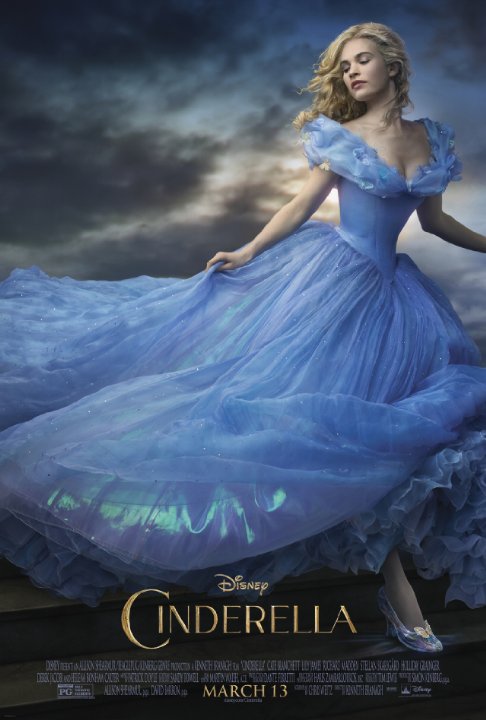 What is it about old stories that we enjoy so much? I pose this question after watching a commercial for the TV movie, Killing Jesus, based upon Bill O’Reilly’s best-selling novel. While it’s based upon a popular book, what can possibly be told with this newest rendition of the death of Jesus that hasn’t been shown a thousand times in other movies? There was even a movie that was released in theaters last year, Son of God, which covered the same territory with equal reverence. There’s something to be said for good stories and the universal appeal of the familiar, but why do people constantly pay more money for new renditions of the same old same old? That question leads me to Disney’s live-action Cinderella, a fairly faithful and warm-hearted rendition of the oft-told tale. I can’t exactly muster many reasons for an audience to dust off their best glass slippers and run out to the theater, but if you’re looking for the comforts of old and some family-friendly entertainment, then Cinderella will charm with its modest and achievable goals.
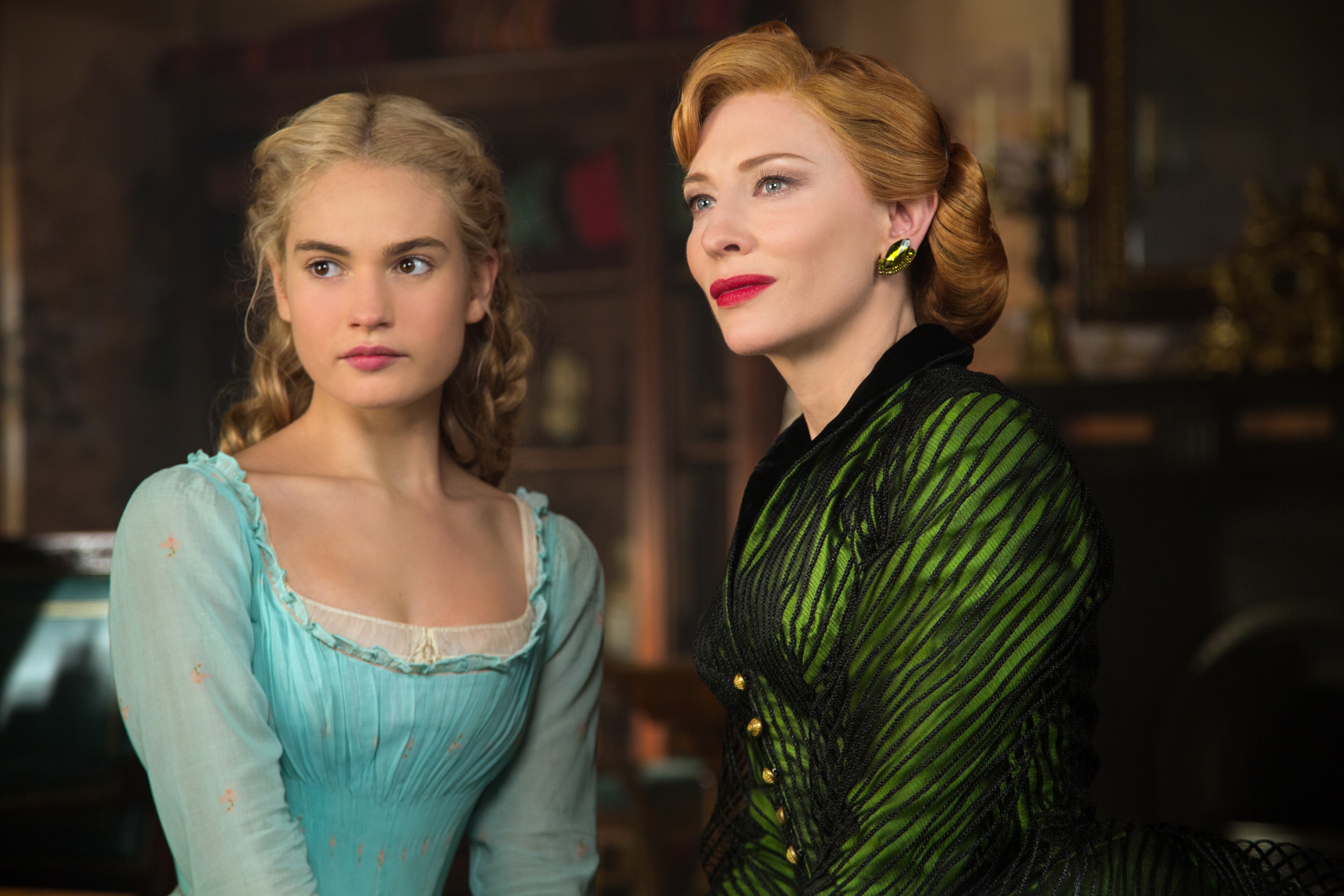
Cinderella (Lily James) is the titular put-upon heroine suffering under the cruelty of her two stepsisters and her new Stepmother (Cate Blanchett). Cinderella thinks back to the advice her mother gave her at a young age, to always be “kind and courageous.” One day she rides off into the countryside and comes upon a handsome man who just happens to be the Prince (Richard Madden). He’s smitten with their exchange and convinces his father to open the royal ball to all members of their kingdom, in order to see his special someone once more. His adviser (Stellan Skarsgard) is against such matters because he wants the Prince to marry for a political alliance, not for love. Cinderella is forbidden from attending the ball by her Stepmother, but luckily she has a Fairy Godmother (Helena Bonham Carter) who, with a pinch of magic, will make sure Cinderella attends in style and steals the Prince’s heart. None of this should be rather new to you, dear reader.
 The first aspect of Cinderella I enjoyed was how it attempts to ground the story without losing a sense of magic to the proceedings. It’s still a fantasy film under director Kenneth Branagh (Thor), but there’s a concerted effort to place these characters in a world that resembles more of our own than the animated landscape from Disney’s original 1950 classic. Thankfully, half the movie isn’t spent with anthropomorphic mice wearing clothes and escaping the clutches of a house cat. There are a handful of helpful mice but at least they don’t talk and are mostly kept as cute accessories rather than co-stars. The reality of Cinderella’s hardships, especially after the death of her parents, is given an appropriate degree of solemnity. I also appreciated that the Prince is given an entire character to portray, one where his pursuit of a bride is placed in a political context about the security of his kingdom. He’s pressured to marry several available ladies for various political reasons, but he’s smitten with the girl he saw in the woods one fine day. The movie also succeeds in advancing a stronger, more developed relationship between Cinderella and her Prince. Instead of love-at-first-sight, they interact before the ball, and there is terrific chemistry between James and Madden (HBO’s Game of Thrones). There’s also a rather nice subplot between the Prince and his father (Derek Jacobi) that opens up their relationship. It’s a subplot that could have just as likely never existed and yet there’s something touching about the love shown between father and son. These moments, and the care to develop them, allow the characters to feel like flesh-and-blood people and to charm us all over again.
Another tilt toward greater narrative realism occurs with the villains, played by Blanchett (Blue Jasmine) and Skarsgard (Thor 2). While she’s still an arch villain, the treacherous Stepmother, who has no actual name, is given a generous treatment by Blanchett and especially writer Chris Weitz (The Golden Compass). The movie actually attempts to articulate her position, one where a woman of her age is left with few options to secure her family’s stability after the death of a husband. She clearly knows how society sees her waning value and Blanchett does a good job of casting that bitterness in way that you’re still reminded why she’s so furious and devious. I was so pleased I wanted more. I wanted the Stepmother to break down and admit that Cinderella is proof that her father will never love the Stepmother the same as Cinderella’s mother; she’ll always be second place to a ghost, and Cinderella is a constant reminder of this. Blanchett is also deliciously dishy as the wicked stepmother every moment she’s onscreen. Skarsgard can’t compete with the main attraction, but he provides an interesting secondary antagonist as he schemes behind the scenes to ensure the Prince marries a specific maiden with a reliable family name. He’s seemingly devoted to strengthening his kingdom, and he can’t let something as important as a marriage securing an alliance to fall aside because the Prince happens to be in love with a commoner. The extra dose of political intrigue is further attempt to ground and humanize the fairy tale, and it mostly succeeds.
 That’s not to say that the movie is without its fantasy pleasures. It is still a Disney movie about a famous Disney princess, and as such it maintains a bouncy, exuberant tone that keeps the heavier moments of drama from getting too heavy. Carter (Les Miserables) works wonders as the Fairy Godmother; she’s only in the movie for a solid ten minutes but she makes every second count. She has a silly nature that provides a welcomed jolt of scatterbrained comedy. Carter is clearly having a ball of her own with the role. The magical coachmen and assorted helpers supply extra cuteness. I also appreciated the quick fix of just creating a spell so that Cinderella’s step-family doesn’t recognize her at the ball. However, I never understood why all the artifacts of magic disappear at midnight but the shoes are left behind. Are they not magic too? Maybe only one of them happens to be magic and that was the one left behind. As presented, the shoe fitting is merely a ceremony rather than the missing clue toward finding the absent Cinderella.
So with all that said, does the new live-action Cinderella justify retelling what is one of the most retold stories in cinema history? I’d conclude a mild affirmative. It’s a charming adaptation that develops its characters with greater attention to detail, providing flights of fancy but also further humanizing the good guys and the bad. It’s no a deconstruction of the fairy tale, nor is it a revision, but it’s a faithful attempt to take what works but ground it in a slightly more realistic context, and it works. It’s at turns magical and touching and fun and buoyant and heartwarming. The casting all around is excellent, with every role impeccably chosen. Blanchett and Carter are great fun, and James and Madden have a winning chemistry. The technical merits are up to the same challenge, as the costumes and set design are gorgeous. Of course the aims of a new Cinderella movie are modest. Even if it benefits from a reworked attention to detail, we’re not reinventing the wheel here. It’s still the same story with the same major plot beats and the same ending we’ll all expect from the moment the Disney logo appears onscreen. The greatest achievement of Branagh’s Cinderella is that it makes you ignore these impulses. You find yourself once again returning to a familiar world and enjoying it all again.
Nate’s Grade: B
Share this:

The Lone Ranger (2013)
 With the director, star, and writers from Disney’s original Pirates of the Caribbean trilogy, you’d likely expect The Lone Ranger simply to be Pirates in the West, and it pretty much is, for better and worse. The pieces don’t nearly come together as well, and the characters aren’t anywhere close either, but I was mostly pleased with the finished results after coming to terms with the flaws of the execution. This is a semi-supernatural reinvention of the Lone Ranger and Tonto, prankish and proudly peculiar.
In 1869 Texas, John Reid (Armie Hammer) is the new district attorney for a small outpost along the railway run by tycoon, Mr. Cole (Tom Wilkinson). John’s brother (James Badge Dale) is the sheriff and the more accepted hero. This all goes awry when the nefarious criminal Butch Cavendish (William Fichtner) kills the sheriff, his posse, and leaves John for dead. He’s brought back thanks to Tonto (Johnny Depp), a Native American with his own quirks. Together, the duo struggle with the idea of justice versus vengeance and taking responsibility.
Thanks to screenwriters Justin Haythe, Ted Elliot, and Terry Rossio, it still follows the summer movie blockbuster blueprint while maintaining its own sense of self. I enjoyed the 1933 framing device and the sense of commentary it added to the legend of Wild West tall tales. Many of these story elements will be painfully familiar, from the unrequited love interest that needs saving, her plucky son, to even the villainous railroad baron, but the film finds ways to keep all these formula figures at least integrated and satisfying, doling out payoffs to several storylines. More so, the film just has a wild sense of fun to it, enlivened by Verbinski’s exuberant feel for action. When he gets things going, the man has a touch for inventive action orchestration akin to Steven Spielberg. He is a director who knows how to add scale and scope to action and make it felt. The movie feels constantly alive and full of surprises, stepping outside itself for some non-linear asides, adding bizarre examples of nature undone (In the words of Nicolas Cage: do not touch the bunny), and a heavy dose of magic realism. It’s just too funky and weird not to be interesting even when it threatens to be boring. Disney put crazy money into something this crazy, folks, reportedly $200 million.
 There are serious problems here much as there were in the Pirates sequels, notably a lingering sense of bloat. At 149 minutes, there could have been a lot of cuts. The saggy middle seems to almost derail all momentum, as Reid and Tonto stumble about the desert, filling in a majority of Tonto’s tragic back-story. Most of the supporting characters are chiefly underwritten. I pity the great Ruth Wilson, so nerve-fryingly awesome on the BBC’s Luther as an enthralling sociopath, and here she’s basically Love Interest/Single Mom for Reid. At least she does a decent job with her Texas twang. There’s plenty of overindulgence all around, and I won’t even entertain the argument that its handling of Native American displacement, while not as clumsily racist as feared, was anything other than schlocky. There are also three villains of different stripes that need to be juggled. There are a lot of storylines and characters to keep active and the movie just cannot keep up. The tone can be somewhat jarring as it dances around dark comedy, earnest sentimentality, tragic drama, and cavalier heroism. It feels like the movie never settles down, which can keep an audience from being fully engaged, fully invested. It hurts even more when the characters are nowhere near as charismatic as Captain Jack Sparrow.
Perhaps I’m being overly generous after coming from Man of Steel, and perhaps, nefariously, Man of Steel is still going on, locking me forever in some sort of parallel mobius strip where I’ll never be able to leave, but I greatly enjoyed the action sequences in Lone Ranger. Verbinski is one of the most talented visual filmmakers working today but, more importantly, he knows how to orchestrate large-scale action sequences in a way that they matter. Yes, like most things in The Lone Ranger, they can go on a bit too long, but here the situations develop naturally with organic complications, the sequences move the plot forward, and they escalate in excitement. The concluding twenty minutes involves a sumptuous dual train chase that keeps shifting and changing, going from atop to parallel trains, to cars being dislodged, people jumping from one to the other, all racing toward a bridge triggered with explosives. It’s a thing of beauty, this final action sequence, and Verbinski’s shot compositions allow things to play out so artfully while the audience still maintains its sense of orientation. It’s a finale that feels exhilarating, and the playful whimsy and sense of danger that the movie had been flirting with before comes together, enough for you to wish the whole movie had tonally coalesced with the skill shown toward the end. As an action fan, I was lapping it up, and the playful non-linear jumps, as well as the satisfying ends to some satisfying villains (Fichtner is terrific), left me grinning and hopping with excitement. A strong finish went a long way toward improving my opinion on the film and minimizing my misgivings.
Who is this dark, weird, somewhat clunky movie really appealing to? The Lone Ranger had its cultural peak back in the 1950s and thus the people actually excited for a Lone Ranger movie must be slim. And those people are probably going to be turned off by something as jokey and unfaithful to the source material as this movie. It does utilize the Ranger’s theme song, the William Tell Overture, but saves it for the end. What about kids? The movie is released under the Disney imprimatur and has the stamp of “from the creators of Pirates of the Caribbean.” Everybody loved the first movie and the sequels were also huge global hits, but this movie is even darker and somewhat grisly. There’s a moment when Cavendish literally cuts open a dude’s chest and eats his heart (mostly off-screen and implied mine you, but still). I can already hear the parental uproar. And while it’s somewhat implied that Cavendish and his men are cannibals, this storyline is never really touched upon again. Did we need the heart-eating scene to fully communicate how nasty our villain is? The true audience for the big-screen Lone Ranger may very well only be the mega fans of 2011’s Rango, Vernibski’s Oscar-winning foray into animation. If you like a somewhat weird, somewhat anarchic, tonally uneven movie with personality and eye candy, then perhaps Lone Ranger is for you. Problem is that this potential audience is going to be meager, but it does include me.
 I know there are many people out there experiencing stage four Depp fatigue, and I can’t blame them. His penchant for peculiar character construction can get somewhat tiresome if the movie doesn’t have more going on. In something like Alice in Wonderland, a movie I didn’t even like, at least his weirdness fit with the weird world unlike, say, Dark Shadows, a movie best forgotten by everyone involved. Here his Tonto is as head scratching as he is humorous. And is there an inherent awkwardness having a white actor, in this day and age, playing a Native American? According to the Internet, Depp has said he “probably” has some Cherokee ancestors because he’s from Kentucky. The funny (awful?) thing is that Tonto is often in white face with his special face painting (red face in white face?). I just don’t think he can apply the same bug-eyed, swishy, eccentric sensibility to every character and call it a day. Just when you think he’s gotten away from starring in every movie with Helena Bonham Carter, surprise, here she is. And it’s not even a Tim Burton movie, people! Tonto is seen less as side kick and more of a co-lead if not the real star, and part of that is the bankability of Depp as a box-office draw, part of that is Depp as an executive producer on the project, and part of that is just because the kooky Tonto is just far more interesting than the straight-laced Reid. Hammer (Mirror, Mirror) has the jaw line, the look, and an engaging yet square appeal to him, and if anyone saw The Social Network you know the handsome lad can act. Too often he ends up being a minor foil to Tonto; it takes him far too much hemming and hawing before he accepts his masked outlaw status. As a result, he’s something of a bland fuss bucket.
Disney’s big-budget reworking of The Lone Ranger will probably be held up as the prime example, in a non-Michael Bay summer, of everything wrong with studio filmmaking, the punching bag for blockbusters. Some may even invoke a comparison to another costly Disney endeavor, last year’s flop, John Carter. There are plenty of faults the movie exhibits, namely an extended sense of bloat and an uneven tone, but I’d be lying if I said I was obsessed with the faults by its spectacular end. The movie does enough right, and enough semi-right with enough style and verve, that I left my screening feeling giddy and satisfied. It might be too dark, too glib, too weird, or too self-indulgent, but those are all reasons that made me like this movie even more. There’s a character with a wooden leg that doubles as a rifle, and not only that but one of our villains, a cavalryman, has a clear fetish for prosthetic legs. And this is a Disney film! I can’t help but love the spirit at large. Thanks to a fine supporting cast, Verbinski’s high wire visual stylings, and some strange sensibilities, not to mention a grand finish, The Lone Ranger is as entertaining in what it does right as with what it does wrong.
Nate’s Grade: B
Share this:

Les Miserables (2012)/ Rock of Ages (2012)
 I have no qualms with my heterosexual nature to make the following statement: I love a good musical. Why shouldn’t I? None other than Martin Scorsese said any true film lover is a fan of horror movies and musicals, two genres uniquely suited to the visual flourishes of cinema. My tastes tend to run toward the more offbeat, like Avenue Q and Hedwig and the Angry Inch and Sweeney Todd and Dancer in the Dark. My favorite movie musical of all time is 1952’s Singin’ in the Rain, but that’s probably because I’m a movie lover first and foremost. A well-done movie musical can sweep you off your feet. The polarizing Moulin Rouge! is still my favorite film of 2001; I love every messy, ambitious, transporting second of it. And that’s what the best musicals and, in general, best films achieve: they transport us to another realm. Since the success of 2002’s Chicago, there’s been a run of hit-or-miss movie musicals proliferating the big screen. It’s hard to think of any longstanding Broadway hits that have yet to make the leap (you’ll get your turn, Book of Mormon). Of course it also works the other way, with plenty of movies being adapted into Broadway musicals, like Shrek, Elf, Ghost, Catch Me if You Can, Newsies, A Christmas Story, Sister Act, Legally Blonde, Bring it On, and Tony-winner for Best Musical, Once. Then you get movies turned into musicals and back into movie musicals, like The Producers and Hairspray. It seems like Broadway and Hollywood are stuck in a loop, feeding off one another’s spoils.
In 2012, two high-profile musicals got the big screen treatment: Rock of Ages and Les Miserables. The former is from 2009 whereas the latter is one of the most successful Broadway shows of all time, beginning in 1980 and spanning continents. Rock of Ages was savaged by critics and bombed at the box-office, whereas Les Miz is soaring this holiday season and is seen as a major Oscar contender. Of course one of these films is about the outrage of the lower classes being exploited by an unfair system that benefits the rich, and the other has Tom Cruise and a monkey named “Hey Man.” Having seen both films recently, and Les Miserables more than once, I think they present an interesting discussion on the pitfalls of adapting a popular theatrical show to film. You won’t have to wait long to figure out which movie succeeds and which falters badly.
 Les Miserables, based on Victor Hugo’s novel, is set in early 19th century France. Prisoner Jean Valjean (Hugh Jackman) is nearing the end of his twenty-year sentence for stealing a loaf of bread. Inspector Javert (Russell Crowe) is convinced Valjean will never reform and go back to a life of crime. After help from a kindly bishop, Valjean flees his parole and sets up a new life as a businessman. Fantine (Anne Hathaway), one of Valjean’s workers, gets thrown out and tumbles down a chain of regrettable circumstances. She becomes a prostitute to support her young daughter, Cosette. Valjean recognizes poor Fantine on the street and, horrified at his own neglect leading her to this path, takes it upon himself to care for her and her daughter. Years later, the teenaged Cosette (Amanda Seyfried) has fallen for the young revolutionary Marius (Eddie Redmayne). Marius enlists his good friend Eponine (Samantha Barks) to help find out who Cosette is, all the while ignorant that Eponine is clearly in love with him. The young people of France are riled up about class abuses and exploitation, and the spirit of revolution is in the air. Javert is also becoming suspicious of Valjean’s true identity, so Valjean feels the need to flee once again. However, Cosette’s love and the bravery of the young revolutionaries makes Valjean decide to stop running from his past.
Oscar-winning director Tom Hooper (The King’s Speech) made the ballsy but ultimately brilliant decision to have his performers sing live. Every line, every note, every performance is captured in the moment; there is nary a second of lip-synching. I cannot overstate how blessed this decision was. It places the emphasis on the performances, and that’s exactly what something as big and deeply felt as Les Miserables required for the big screen. Look, Hollywood actors are never going to be able to outdo trained and professional theatrical singers. What I expect from movie stars is movie-star level performances, and Hooper understands this. These actors aren’t playing to the cheap seats, belting the tunes with power and over exaggerated dramatics (note: there is absolutely nothing wrong with this style given the theatrical setting). In many ways, this is a more intimate Les Miserables, and it still maintains its charms and magic. There is no choreography, short of perhaps the more jovial “Master of the House” number, and Hooper puts us right in the muck of life in a 19th century impoverished slum. This is one dirty movie with lots of grimy period details, creating a reality that can only be implied on stage. The more visceral version of Les Miserables demands performances that are more naturalistic and less bombastic, to a degree. I am a cinephile first but I genuinely prefer my musicals with trained actors to trained singers. A great actor can add so much inflection and personality through the prism of song, whereas a great singer is concentrating on the notes first and foremost. I value performance over nailing the mechanics, and more movie musicals should follow Hooper’s path. This, ladies and gentlemen, is how to do the movie musical experience right.
 I don’t know if Hooper was exactly the right man for the job but he certainly does the beloved stage show justice. Hooper’s visual tics are still present. The man loves to film in close-ups and at all sorts of tilted Dutch angles; he also loves filming a conversation between two people where neither one will be in the same shot. It’s a peculiarity that I never really warmed up to. However, Hooper generally has the best interests of his movie at stake, capitalizing on the large outpouring of feeling. This is a Big Musical with big emotions, and it’s easy to be swept up in its exuberant earnestness and humanism. It even has a famous concluding line, “To love another person is to see the face of God.” It’s the kind of stuff you roll your eyes at under lesser circumstances. Now, thinking back, you’ll realize that many of these people were simply painfully naïve and that there was a slew of death for no good reason. Purists may chafe at some altered lyrics and truncated songs, but really this is pretty much the closest version of the famous stage show you’ll ever see adapted. Not one of the songs has been cut (in fact a new one was written for the film by the original composers), and at a lengthy 157 minutes, it’s practically as long as the stage show, and just about sung through every moment. There are probably ten total lines that are merely spoken. I predict hardcore Les Miz fans will lap up every second.
Les Miserables also boasts some fortuitous casting (Taylor Swift at one point was rumored to be up for a role… shudder), none more than Anne Hathaway (The Dark Knight Rises). She is nothing less than perfect as Fantine. There isn’t a false note during any of her acting. Her performance of “I Dreamed a Dream” is so powerful, so breathtaking, so intensely felt, that it ranks up there with some of the best moments in all of 2012 movies. And oh can this woman sing her ass off too. You feel every flicker of anger and devastation, the grain in her voice, on the verge of tears and fury. This woman deserves every accolade they can come up with this year. This woman is a total lock for Best Supporting Actress. She’s wonderful during every moment of her screen time and the lengths and emotional ferocity of her performance, and subsequent pitfalls the character endures, left me reaching for the tissues at several points.
The other standout amidst a pretty stellar cast is Barks. This is her first film work though she has plenty of experience with her character, portraying Eponine in the 25th anniversary run of Les Miserables. Her singing is terrific, as you’d imagine, but her acting is just as strong. Her rendition of “On My Own” is a showstopper of a number. Barks naturally transitions to the demands of film. I was completely on Team Eponine and found her to be an infinitely better catch than Cosette. After people get a glimpse of this woman, she is going to get plenty more acting offers, and a few concerned inquiries into the size of her waist, which at times looks like it might be the size of The Rock’s neck. Hooper also has the good sense to film both “I Dreamed a Dream” and “On My Own” in unbroken takes; focus tightly pinned on our outstanding actresses, letting the skill of their performances sell the big emotions.
 Of course the crux of the tale rests on two men, Valjean and Javert, and the rest of the cast does kind of get saddled in underdeveloped roles made more apparent as a movie. It seems blasphemous to say I was a little disappointed with both lead actors. Crowe (Robin Hood) is easily the weakest singer of the cast but that doesn’t mean he’s bad. He has a lower register and sings his parts like a rock musician rather than a Broadway player. Fans of the stage show will have to adjust their expectations for a more subdued Javert. Still, having an actor of Crowe’s talents is definitely a plus even if his singing is adequate. Jackman (Real Steel) is a Tony-winning thespian, so I held him to a higher standard. He’s got a lot of heavy lifting to do as Jean Valjean, and Jackman does an admittedly fine job with the bigger emotional parts. I just expected more from his vocal abilities but it’s not a major detraction. As my mother noted, it’s not too difficult to spot the classically trained singers in the cast. Also, for eagle-eyed Les Miz fans, look for the original Jean Valjean, Colm Wilkinson, as the Bishop in this movie.
There is the tricky nature of translating a Broadway production into some variance of period reality. There’s plenty of relevance with the class struggle illustrated in the second half of the movie (Bane would approve). It’s an obvious statement but film is a different medium than the theater and affords different opportunities. The depressing reality of lower class life and the vultures that preyed on others is striking, yes, but sort of conflicts with the comic relief characters represented by the scheming Thenadiers (Sacha Baron Cohen, Helena Bonham Carter). When the seriousness of the period is inflated, they feel like they sort of belong in a different movie. Then there’s just the conflict between stage reality and film reality. On the stage we’ll accept Marius falling madly in love with Cosette at first sight. When it’s on film, the guy comes across as a callous chump, oblivious to Eponine’s pining. He ignores the friend he’s had for years for some blonde in a bonnet. And the final number, reuniting all the dead cast members, works better as a curtain call than a finale to a film. These are just the quirks of theater one must just accept. I wouldn’t say the songs and music is in the same category as Sondheim or Webber, but there are definitely some hummable tunes here made all the more swooning. You’ll have a fine pick of songs to get stuck in your head for days (mine: “Look Down”).
 Earlier this year, Rock of Ages came and quickly left the box-office, failing to make a splash with the American public despite a healthy enough run on Broadway and touring the country. The stage show is a jukebox musical set to the head-banging tunes of 1980s hair metal. Adam Shankman, the director behind the bouncy and thoroughly entertaining 2007 Hairspray movie musical, was tasked with bringing Rock of Ages to the screen with the same finesse. Cherie (Julianne Hough) a hopeful singer just off the bus from Oklahoma, meets up with Drew (Diego Boneta), a nice kid who gets her a job at The Bourbon Room, a rock club running afoul with the mayor (Bryan Cranston) and his moral crusading wife (Catherine Zeta-Jones). The club owners (Alec Baldwin, Russell Brand) are relying on fickle, burned-out, taciturn, and overall mysterious rock legend Stacy Jaxx (Tom Cruise) to save their club from financial ruin. Along the way, Cherie and Drew look for their big breaks, fall in love, get pulled apart, and reunite in time for one final sendoff to leave the audience tapping their toes.
 Allow me to elucidate on my main problem with the rise in jukebox musicals: I find them to be, with rare exception, exceedingly lazy. The musical number is meant to advance the narrative and give insights into character and situation, just like any other aspect of plot. You’ll find great original tunes that do this. When you’re dealing with pop songs that the public is well familiar with, then your job becomes even harder, and I find many are just not up to the task. Too often jukebox musicals are designed to merely string together a pre-packaged and time-tested number of hit songs, utilizing the faintest of narrative threads to get from one song to the next. The appeal of jukebox musicals lies not with the story or characters but waiting for the next recognizable song and wondering how it will, poorly, fit into this new context. You’ll notice that these jukebox musicals seem to have twice as many song numbers. They know their selling point, and more singing means less time spent developing characters and story. And so my impression of the jukebox musical is one of a cynical cash grab following the bare minimum of narratives to achieve the status of musical so it can be resold with low risk. I’m simplifying things in my ire, yes, but there’s a definite reason that jukebox musicals have sprouted like mad in the past few years. They don’t require as much work and the audience seems to hold them to a lesser standard. Much like the worst of Friedberg and Seltzer (Disaster Movie, Meet the Spartans), it seems just recognizing the familiar has become the core draw of entertainment.
And this is one of the main problems with Rock of Ages. I’ve never seen the stage show, but my God for something that purports to live the rock and roll lifestyle, it’s certainly so tame and scrubbed clean of anything dangerous. This feels like your grandparents’ idea of what “modern” rock music is. After a cursory search online, I’ve found that the movie makes some significant changes to convert a story about rock and roll hedonism into sanitized family friendly fare (spoilers to follow, theatergoers): apparently in the stage version, Cherie and Jaxx had sex, Jaxx remains a creep and flees the country on statutory rape charges, though before that he and Cherie share a lap dance/duet to “Rock Me Like a Hurricane,” the family values crusader characters were new inventions, the Rolling Stone reporter (Malin Akerman, the best singer in the film) is considerably beefed up to provide Jaxx his happy ending, and they don’t even use the song “Oh Cherie.” I’m not a stickler for adaptation changes, but clearly it feels like Rock of Ages had every edge carefully sanded down to reach out to the widest array of mainstream filmgoers (Shankman says he cut Cherie’s lap dance number because it tested poorly with mothers). The funny part is that the movie lambastes a slimy manager (Paul Giamatti) for playing to demo numbers, shooting for pandering mass appeal rather than the art, man. Feel the hypocrisy.
 The first hour of Rock of Ages is mildly passable mostly because of the goofy supporting cast, but then the movie just keeps going, getting more and more tedious with every protracted minute. The second half involves Cherie and Drew apart and finding new lows; for him it’s selling his soul to join in a boy band, and for her it’s selling herself, working as a stripper. Let’s look back at that sentence. One of those life choices is not nearly as upsetting as the other. Nothing against the hard-working strippers in this country, but Cherie taking to the pole is definitely more of a moral compromise for the character than whatever the hell Drew endures. It’s this leaden second hour that made me lose faith that Rock of Ages would even provide a morsel of cheesy entertainment. It has the misfortune of two of the blandest leads I’ve ever seen in a musical. Hogue (Footloose) and Boneta (Mean Girls 2) are both physically blessed specimens of human genetics, but oh are these kids boring boring boring. Their love story is completely malnourished and you couldn’t scrape together one interesting thing about them combined. The fact that Rock of Ages further strips away any interesting personality from Cherie (see above) makes them even more disastrously boring. To be stuck with these two for another hour of vapid griping, only to magically get back together, is interminable. Thank God they pumped up the side characters because that is the only time when Rock of Ages even challenges for your attention. Cruise isn’t the best singer but he’s pretty good belting out 80s rock hits, and the man has his natural charisma and stage presence to spare.
So I guess where Rock of Ages goes wrong, and where Les Miserables succeeds, is thinking of how best to translate the experience of the stage to the medium of film. Shankman does a pitiful job staging his musical numbers, with lackluster choreography that rarely takes advantage of the sets and characters. Worse, Shankman feels like he strays from the tone and angle of the stage show, sanitizing the rock and roll lifestyle and looking for ways to squeeze in bland happy endings. In other words, he doesn’t capture enough of the essence of the original stage show to please neophytes and fans of the Broadway show. With Les Miserables, I think most fans of the stage show, and they are legion, will walk away feeling satisfied with the results, content that real artists treated the long-running musical with justice. Hooper opens up the world of the stage show, utilizing the parameters of film, and the emphasis on performance over singing mechanics maximizes the unique power of film. Les Miserables is a grand movie musical smartly adapted to the opportunities of film. Rock of Ages is a sloppy, neutered, criminally boring mess poorly developed and poorly translated to the silver screen. Let this be an educational resource for future generations. Take note, producers, and learn from the mistakes of Rock of Ages and the accomplishments of Les Miserables. Oh, and guys, if you see Les Miserables, it will get you super laid with your girlfriend (I have anecdotal evidence).
Nate’s Grades:
Les Miserables: B+
Rock of Ages: C-
Share this:

Dark Shadows (2012)
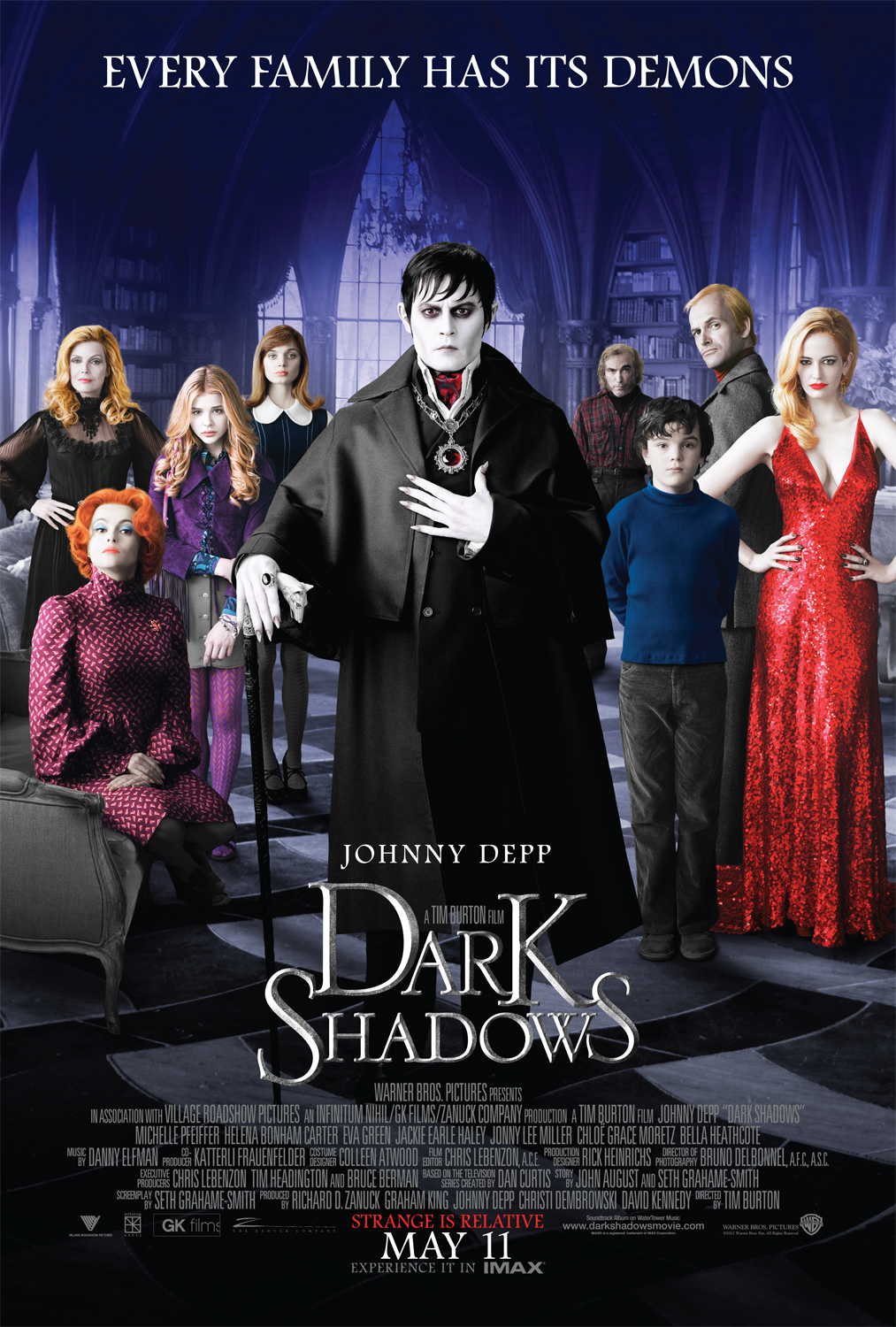 Dark Shadows was a daytime soap that aired for only a brief period of time as far as soaps are concerned, 1966-1971, but it was enough to make a lasting impression. The supernatural soap featured vampires, werewolves, and other creatures of the night, entangled in high-stakes drama and romantic excursions – it was the Twilight of its day. Director Tim Burton and his attached-at-the-hip collaborator, actor Johnny Depp, were fans as children and have kicked around a big-budget big screen version for years. Now that Dark Shadows hits theaters, you’ll be left wondering whether they really ever liked the original show or secretly despised it.
In the 1770s, Barnabus Collins (Depp) is the son of fishing and canning magnate in colonial Maine. He has a fling with Angelique (Eva Green), one of his family’s servant girls, and unfortunately for him, the gal is also a witch in her spare time. She curses the Collins family, killing Barnabus’ mother, father, and the woman he loves. She then turns him into a vampire, riles the villagers into mob mode, and Barnabus gets trapped in a coffin and buried for good.
Two hundred years later, a construction crew unearths an old coffin and out pops Barnabus from his prison. The world is a very different place. Elizabeth Collins Stoddard (Michelle Pfeiffer) is running the Collins family manor and canning company, which has fallen on hard times. A rival canning company is snapping up fisherman contracts, and this company is led by none other than the same ageless Angelique. Elizabeth tries to conceal her distant relative’s unique “condition” from the rest of her family, her brother Roger (Johnny Lee Miller), and his son David (Gulliver McGrath), grieving the loss of his mother, moody 15-year-old daughter Carolyn (Chloe Grace Moretz), and caretaker, Willie Loomis (Jackie Earle Haley). The Collins family also has a new hire, Victoria Winters (Bella Heathcote), who looks strikingly like Barnabus’ lost love from 200 years ago. He becomes smitten with the new lass, who may be the reincarnation of his lost love. That’s enough to rev up Angelique’s wild sense of jealousy, as she tries to get her long-desired man and destroy anyone that stands in her way.
 Is this ever one ghoulish mess of a movie. It never settles on a tone; is it supposed to be a larky tongue-in-cheek send-up, a Gothic melodrama, a dysfunctional oddball family comedy? What is this supposed to be, because whatever it is, it isn’t entertaining. Oh sure, it’s entertaining in a, “Where the hell is this going?” kind of way, but so is being kidnapped by a drifter. The movie feels like it has a box filled with ideas, and every so often it just shakes up that box, reaches inside, grabs one and says, “Let’s give this a try.” The screenplay, credited to author Seth Grahame-Smith (Abe Lincoln: Vampire Hunter), is awash with half-baked ideas and poorly developed characters. The live-in doctor, played by the second stalwart of the Burton Repertory Players, Helena Bonham Carter, is a hoot. Carter (The King’s Speech) has got an edge to her and an interesting dynamic with Barnabus, but sadly her storyline is tied up far too quickly. The character of Victoria is a rather interesting one, a girl who could communicate with her ghostly former relatives, who happen to look just like her. The gal was sent to a mental asylum by her parents and escaped, compelled to come to the Collins mansion. Why in the world wasn’t she the movie’s protagonist? That is a far more compelling perspective than a goofy vampire who speaks all old timey. Seriously, the Barnabus stuff is your basic fish-out-of-water comedy, lazily commenting on the times. There is no joke that is too obvious for this movie (Barnabus inquires why Carolyn has no husband; Barnabus is fascinated by a lava lamp; Barnabus thinks Alice Cooper is an ugly woman – sigh). A lot of the shapeless narrative would be forgivable if the movie was just funnier. Barnabus is just not that fun of a character. His anachronistic verbiage gets dull when you discover that seems to be the movie’s one joke. You may start tuning him out like I did.
The movie feels like a collection of subplots and no main storyline to gather traction. We’re told that the youngest Collins, little David, is enamored with Barnabus, though considering we’ve only seen the two together in like one previous scene, this seems like quite a leap. Unless David has gotten particularly skilled at hiding behind rocks, we haven’t seen any of this. The entire character of David and his sleazy father could be eliminated and they would only minimally affect the story. And then there’s the late revelation that one of our characters has a hidden secret identity, a revelation that fostered no setup. When the character looks into the camera to explain and ends with a curt, “Deal with it,” it’s like Grahame-Smith himself is speaking directly to the audience, mocking it for hoping that the movie would actually do a good job of setting up and paying off character development and relationships. Stupid audience. Why can’t you just be happy with all that neat Tim Burton set design?
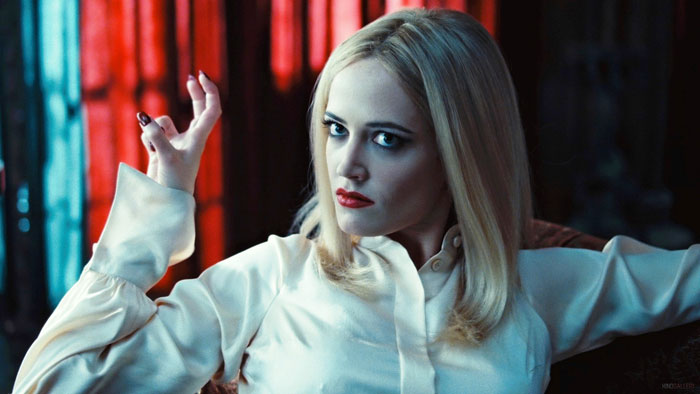 The final melee between the Collins family and Angelique keeps reminding you of the dashed promise of the flick. Angelique, in her witchy withiness, summons dark forces to make statues come alive. Well, sort of. They flail their arms a tad. And then she makes the walls bleed. Well, sort of. The dripping blood stops after just a few inches from where it began. If you’re going to make the house bleed, I want Shining-level torrents of the red stuff. The tonal inconsistency, matched with the muddled plot and scant character work, makes for a pretty frustrating bore of a movie.
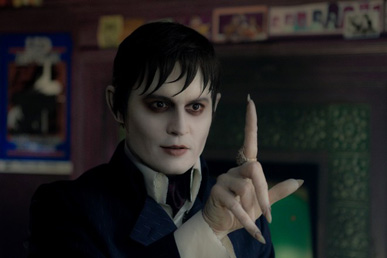
You could usually count on Depp (Alice in Wonderland) for at least committing himself to another bravura weird performance, but the material fails him. He’s caked with alabaster makeup, given claw-like hands thanks to additional knuckles (why…?), and he’s trying his best to transform a list of peculiarities into a character, but like most things concerning the movie, it does not coalesce properly. I actually think the most entertaining actor in the movie is Green (Casino Royale). There’s not much to her role but at least she has fun with it, bringing an admirable level of energy while her peers remain laconic, content to submerge into the 70s scenery. She shows a nice flair for comedy heretofore unseen. Strangely, Green adopts a slightly raspy voice that sounded like an imitation of, none other than, Helena Bonham Carter. If Burton’s note to his film’s young, frisky, sexy antagonist was, “Sound more like my wife doing an American accent,” then I think we’ve butted into something personal best left between husband and wife.
Ultimately, I have no idea who this movie is going to appeal to. The fans of the original soap will surely not be pleased with the jokey, tongue-in-cheek manner that Dark Shadows treats its source material. Fans of Burton’s stylized, dreamy, Gothic fairy tale visuals will find the film tedious and a poor waste of the man’s talents. Even the casual Depp fan will probably find the movie mostly unfunny, weird, and boring. The tonal whiplash never settles down, and the plot is replete with half-developed characters, ideas, and plot points. It just seems to throw everything at the wall to see what sticks, but that’s not the best way to tell a story. Not even Burton’s visuals or Depp’s performance can save this movie. Dark Shadows is unquestionably amongst Burton’s worst films (2001’s Planet of the Apes debacle takes the crown), made all the more inexplicable by the fact that Burton and Depp are self-described fans of the TV show. Maybe we all have different definitions of “fan” that I am not privy to. This movie deserves a quick death.
Nate’s Grade: C
Share this:

Harry Potter and the Deathly Hallows: Part Two (2011)
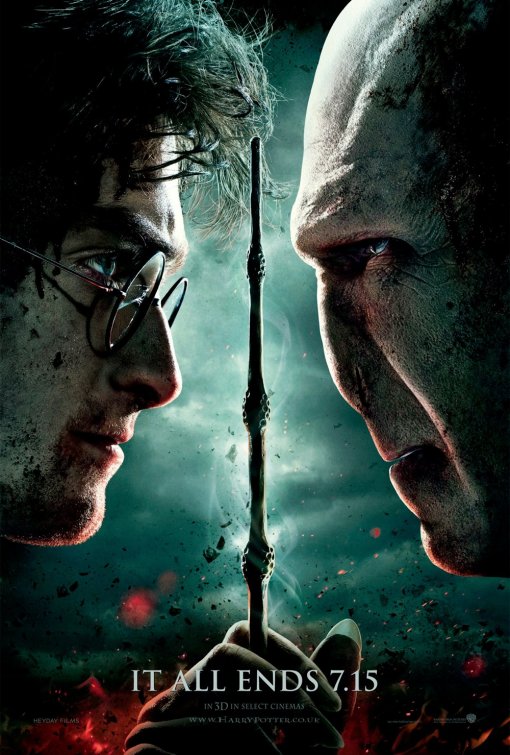 While not the best film in a series spanning ten years, part two of the final chapter of Harry Potter is a solid, satisfying close that’s fittingly grandiose but also sneakily emotional at points. The plot finally gets simplified once all those silly magic items are found, and what we have is a war at the Hogwarts School of Magic between good vs. evil. The action sequences are the best in the film’s series and some very dark events take place, including the deaths of many characters, some children, though too many critical deaths occur off camera. Harry (Daniel Radcliffe) faces off against Voldermort (Ralph Fiennes) for the fate of the world, and after the protracted, wearisome setup of Part One, it’s a relief to say that the final film moves like it’s on fire. There’s very little downtime and a great pull of urgency to the flick. So what if Ron (Rupert Grint) and Hermoine (Emma Watson), Harry’s best pals since the start, are completely forgotten and useless in the movie’s final hour. The focus is all on Harry and his messianic sacrifices. Alan Rickman shines again, showing a depth of emotions not available to Snape until the character’s final revelations. In fact, there needed to be more Rickman, but I can lay this same charge with every film. I wish the resolution, spanning forward 19 years, would have slowed down a bit and accept the paternal/maternal changing-of-the-guard as the emotional payoff billions of people have been waiting for. Harry Potter and the Deathly Hallows: Part Two is a thrilling, gratifying capper to a series that, while to me was never as magical as the Potter die-hards have claimed, was, over eight movies and almost 20 hours, an enchanting franchise that stayed consistent in quality and entertainment. Here’s to you, Potter. Now maybe I can finally stop hearing people badgering me about how the books were better.
Nate’s Grade: B+
Share this:

The King’s Speech (2010)
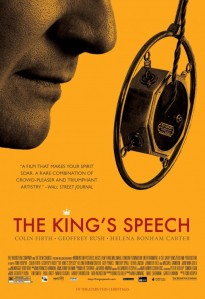 Public speaking is a nerve-racking position. Nobody wants to seem like a fool but it can be hard to do anything else when all eyes fall upon you with expectation. There was a poll a few years ago that asked Americans what their top fears were, and death came in second to public speaking. The Grim Reaper should feel relieved. Now imagine that you’re the leader of a country during a time of duress and you have a speech impediment. That’s the grueling circumstances for King George VI (affectionately known as “Bertie” to family), leader of Britain on the eve of World War II. The King’s Speech tells the inspirational true story of one of the most powerful men in the world finding his own voice.
Before becoming king of his country, Bertie (Colin Firth) was the Duke of York and a man suffering from a debilitating stutter. When stressed, it was difficult for Bertie to even read a statement. This speech impediment is made all the more troublesome now that the world has entered into the radio age; kings and presidents are now expected to speak to their peoples, no longer content to just be a striking figurehead. Elizabeth (Helena Bonham Carter), future Queen Mother, seeks out different speech therapists but the traditional methods are getting her husband nowhere. Then she comes across Lionel Logue (Geoffrey Rush), a self-taught speech therapist who worked with shell-shocked WWI soldiers in his native Australia. His methods are unorthodox but he’s the first to begin to get results with Bertie. The demands of his position get even greater when Bertie’s father, George V (Michael Gambon), dies in 1936 and Bertie’s older brother, Edward VIII (Guy Pearce) abdicates the throne. Now Bertie is expected to lead his nation, that is, if he can string two sentences together in public.
 The King’s Speech is really the heartwarming story of the unlikely friendship between a king and a quirky Australian commoner. Their warm, humane friendship allows for several scenes of great humor and great drama. Watching the irreverent Lionel bounce off the proper and isolated Bertie supplies plenty of comedy. It’s essentially an odd couple comedy mixed with a true-life historical drama. There’s great pleasure in watching the chilly relationship between classes thaw, the men grow closer together, and Lionel’s unconventional tactics make progress. Each time Bertie discovers a new practice that removes his stutter, whether it is speaking while listening to music or speaking in the cadence of a song. This is a film that follows the English tradition of understatement even given the dramatic setting, principle characters, and a speech impediment. The characters don’t go around blurting their feelings, leaving the actors room to explore oodles of subtext. There’s a signature scene where Lionel coaxes Bertie into opening up by promising to allow him to paint a child’s model airplane (a treat for a man of title never allowed such toys). As he paints away, Bertie reveals a damaging truth about a neglectful childhood nanny. The truth is so painful that Bertie is forced to reveal it through the cadence of song, which somehow makes the revelation more sad and tragic. Their ongoing relationship is deeply satisfying and emotionally rewarding.
You won’t see a better-acted movie all year, thanks to Firth and Rush. More than following a checklist of gimmicks, Firth inhabits his character from the inside out. He feels like a living, breathing, somewhat broken person instead of a collection of ailments. Firth doesn’t overdo his stutter and treats the character, and the ailment, with a deep sense of compassion. Firth gives what is likely the greatest acting performance by any male in 2010. He is magnificent, commanding, and empathetic in every scene. Likewise, Rush doesn’t overpower as a personality foil. His character manages to be irreverent but without being flippant; he finds a reverent irreverence, if you will. Lionel is treating the future King of England, and the gravity of this stately relationship is not lost on him. Both men hide an inner melancholy, perhaps one of the things that ultimately bonds them together. Rush is flush with vigor and merriment, truly delightful to watch. This is his finest onscreen performance since he won his Oscar in 1996 for Shine.
The enormity of the king’s duties is given due care. You feel the weight of the crown that awaits Bertie and empathize with his quaking hesitation. Ever since childhood, his family looked down on Bertie. His father felt a stern tone would best aid the young stammerer, and his older brother would often belittle Bertie with cruel taunts. You see flashes of this unhealthy dynamic when Edward cuts down his little brother after their father passes.
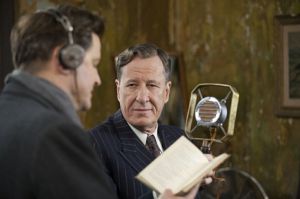 Bertie was seen as unimportant. Edward was the one set up for the throne. And yet Edward is the one who shirks his responsibilities in the name of love (a twice-divorced American woman). Edward refuses to become the leader of his people if the ancient rules forbid him from marrying a divorced woman. Bertie cannot buckle under the tremendous pressure and expectations that wait. Even when the rather passive Bertie lashes out, you feel like his anger is a moment of achievement. King George VI also had to deal with the fact that his brother is still alive and well and an alternative to the throne if Bertie is deemed incapable. Firth makes it easy to feel the remarkable pressure of being a leader not born or elected, merely expected. And even if an audience is clueless about British monarchy history and the rules of royal succession, The King’s Speech is easy to follow and comprehend for a daft American like myself.
Truth be told, The King’s Speech is a little stagy, a little square, and a little too fastidious for its own good. Hooper and crew are too content with making a pleasant moviegoing experience that the film lacks any slight form of edge. It’s all just a little too safe, a little too staid. While rated R, this movie could easily be a PG-13 family film, maybe even a PG one, sans the two sequences where Bertie unleashes a torrent of profanities in frustration (he discovers that he does not stutter while swearing). I feel like a curmudgeon for dinging a movie for being, essentially, too nice and gentle, but it clips the ambition of the movie when crowd-pleaser is the zenith of accomplishment. The fateful speech to the nation, on the eve of war with Germany, is even given an extra oomph thanks to the background music of Beethoven. A larger story of triumph seems reduced to the Oscar favorite storyline of Man Overcoming Physical Adversity. The direction by Hooper has some curious tics to it, like sequences of two people talking where they will never share the frame despite sitting side by side. I assume Hooper is trying to communicate some form of emotional distance or wariness, or perhaps it’s just a nod that different actors had unworkable schedules and could not be filmed together. Hooper is a talented director, as anyone who saw the massive undertaking of the masterful HBO miniseries John Adams can attest. However, like John Adams, Hooper is prone to TV-movie staging. His direction limits the cinematic power of the film. It looks like any ordinary episode of Masterpiece Theater.
The King’s Speech is pretty much everything you’d wish for in a movie groomed for awards consideration. This is prime Oscar bait. You may tear up at points, you’ll probably smile in many places, and your spirit will definitely rise. Plus it features some of the finest acting you’ll witness all year. And yet it’s that conscious need to please, to uplift, that can occasionally distract you from the many charms that The King’s Speech offers. The fact that the story is predictable is not a detriment, but the fact that the film doesn’t push harder, dig deeper, or expect more from its audience is a missed opportunity. The material is so rich, but a terrifically acted, smartly written film isn’t a bad consolation. Especially when that film happens to be one of the most rousing and rewarding theatrical experiences of the year.
Nate’s Grade: A-
Share this:

Harry Potter and the Deathly Hallows Part 1 (2010)
 When author J. K. Rowling dropped off her last 700-page tome in the Harry Potter series, the world went into a state of mourning, right after ravishing every page of The Deathly Hallows. There would be no more literary adventures. You can expect that same sense of longing for the studio suits over at Warner Brothers considering the Harry Potter franchise has grossed over five billion worldwide. The bounty was about to be over, especially with one last book to adapt into an eventual overly long movie. Then the suits came across a genius strategy: split the last book into two separate movies. Filmed simultaneously over a year, Harry Potter and the Deathly Hallows will be released in two parts eight months apart. I understand that it’s hard to say goodbye to the boy wizard that charmed millions, and tow movies almost guarantee that nothing will be left out in the adaptation process. It also ensures that Warner Brothers will have two movies that make giant piles of money instead of one. Deathly Hallows: Part One plays its part setting up the finale, but judging from what we’re given, this series conclusion could have effortlessly been condensed to one overly long film instead of two.
Picking up shortly after the events of Half-Blood Prince, Harry (Daniel Radcliffe) and his best pals, Ron (Rupert Grint) and Hermione (Emma Watson), are on the run. Lord Voldermort (Ralph Fiennes) is determined to be the one to slay the boy wizard. Voldermort and his influence have taken over many facets of the magic world’s infrastructure, and they are all after Harry. Harry learned that his snake-faced nemesis has broken his soul into pieces and hidden them inside magical items known as horcruxes. Unless these horucruxes are destroyed, Voldermort will never be able to truly die. Harry and company has to hunt down those accursed horcruxes while being hounded by evil forces determined to kill them all.
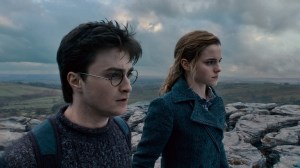 For a solid hour I felt like I was watching the second best Harry Potter film; Alfonso Cuaran’s Prisoner of Azkaban still stands as the artistic highpoint. Watching the characters on the run and constantly in peril spurs your protective feelings. We’ve seen them grow up, vanquish evil and hormones, and now they seem to be in serious danger and you feel real tension. I stopped to realize how much I actually cared for these characters and how concerned I was. There is a somber sense of finality, and I enjoyed characters and events colliding back together for one big finish. It truly feels like everything is coming to a titanic close, and the film manages to be the most emotionally satisfying of the series. That’s likely because it’s building off six films of character growth and goodwill. But it’s also due to the fact that Deathly Hallows spends the most time examining the characters of Harry, Ron, and Hermione. The series has followed a very lockstep plot formula and now it’s been stripped away. The kids are removed from the school setting so we get to spend plenty of time alone with the trio. In fact, it’s a bit too much time. We spend an interminable amount of time with these kids lost in the woods, waiting for something important to happen. While we wait we have the trio address fears, anxieties, and emotional hang-ups, which turns Part One into the most insular, reflective movie in the entire series. While this makes the movie rich with feeling before we come to the finish line, it also makes the film somewhat boring because these kids aren’t that deep.
Luckily, Deathly Hallows Part One presents some of the more exciting action sequences and tense mood yet for a franchise mostly built upon investigation and Hardy Boys stuff (with extra magic!). The Harry Potter world has always been more interesting to me the darker it got, and now the series has now firmly converted to the dark side (as far as PG-13 fantasies go). The opening shows each of the three kids being left alone, including Hermione protecting her Muggle parents by wiping away their memory of their daughter. Tough stuff. Then we transition to a floating Hogwarts teacher held prisoner by Voldermort and his legion of Death Eater followers. She’s struck dead and we see a tear roll down her bloodied face right before Voldy’s pet snake eats her. Parents be warned, this is no longer kid’s stuff. Death comes to several supporting characters and there’s plenty of spooky stuff that adds up to a gloomy atmosphere. The infiltration of the Ministry of Magic is a thrilling sequence. Harry and pals disguise themselves as Ministry workers to locate a horcrux from Dolores Umbridge (I cheered at the sight of Imelda Staunton back in pink). The scene is tense and lays out the stakes and important characters to fear. It also produces some potent drama as Ron is disguised as a Ministry member whose innocent wife is being interrogated. The moment culminates in a genuinely exciting chase sequence that got me excited for what was ahead. What I failed to realize is that there was not much more ahead.
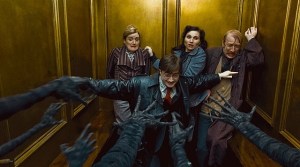 With all that extra attention spent on character, I can also say that Part One has some definite issues with its stagnating narrative. Having never read the books (get over it, Potter nation), I go in blind every time short for the mega-spoilers that I can’t help but learn thanks to all the Potter readers inhabiting my circle of friends and family. I can tell you if something doesn’t make sense because I don’t have the background knowledge of the books to fill me in. There was plenty in Deathly Hallows that made little sense. The adaptation introduces the titular deathly hallows, which ends up being another three super special magic items. There’s a nicely Gothic animated sequence to try and explain the three hallowed items, but it all adds up to a fairy tale that makes little traction. The narrative has already shaped up into a portentous scavenger hunt. Harry and friends are after the remaining horcruxes containing the soul of Mr. Snarly Face. The entire 145 minutes of Part One is spent destroying a single horcrux, leaving 3 or 4 remaining. Now they add three more magic items to find and it all compounds my feelings of fatigue. Did I mention they also have to find a magic sword? How many magical items are these kids going to be responsible to find and how many am I expected to care about?
I left the theater with many questions about what the hell the deathly hallows were, why they mattered, and all sorts of other storylines too. I could not follow all the new characters they threw so late into the game, especially some old wand maker and his connection to wand thievery. And when the hell did everyone gain the ability to teleport at will? Why don’t they teleport all the time then, especially out of danger or when they’re chased through the woods? My friend (an avid Potter reader) had to deal with a litany of stupid questions, likely treating me as a parent would a child asking about where the sun goes when it becomes night.
Also, the film is intended to be a prelude for an epic finale but it mishandles its own sense of climax at several turns. I’ll refrain from heavy spoilers, but one of the most interesting characters, played by an actor I adore, is killed off screen. Off freaking screen! Some other character comes back and says, “Oh yeah, he’s gone,” and then everyone looks glum and goes about their business. It happened so matter-of-factly and anticlimactically that I never made the connection. So later in the film when it’s confirmed that this character is in fact dead, I felt pretty thick. The last chapter of Harry Potter is destined to be a combined 5 hours, and you’re telling me they couldn’t fit in a fight scene that lets this character go out with style? I suppose somebody thought it was more dramatic to just mention a character death offhand. Following this logic, I can’t wait for the grandiose finale where Harry Potter just walks back into a room and says, “Oh, by the way, I just killed Voldermort. So who wants to get a bite to eat?” The emotional climax of the film involves the death of a supporting character I have yet to see onscreen for 8 years. How am I supposed to feel for a character that hasn’t been seen for so long? The ending is sad, sure, but it would have been more effective if: a) I knew what significance the character had in the narrative, and b) it didn’t look like Harry was clutching a rubber doll to his chest. We spend too much time with new characters that end up having minor worth or come across as one-offs. The movie would have benefited from some of the deathly exposition that clogged the first two film’s storylines. As the movie comes to a close it should be clearing things up instead of polluting the narrative with more names and faces.
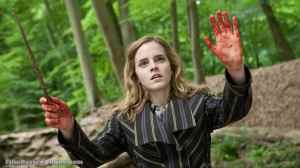 Director David Yates has been captain of the Potter helm since 2007’s Order of the Phoenix, and he seems to have found a unifying visual balance for the series. The film’s tone has gotten heavier and having a singular director take the series to an end looks to be a godsend. Despite a lengthy slog in the middle, Yates keeps the pacing fairly tight and tense. The visuals and special effects are just as luminous as ever. The true treat for me is watching all these splendid British actors assembled: Alan Rickman, Ralph Fiennes, Imelda Staunton, Helena Bonham Carter, Timothy Spall, Jason Isaacs on Team Evil, and Brendan Gleeson, David Thewlis, Rhys Ifans, Julie Waters, Robbie Coltrane, Michael Gambon on Team Good. Then there are new additions like glass-jawed David O’Hara (Wanted) and the great Peter Mullan (Young Adam) making strong yet short appearances. I don’t really care why all these talented thespians are together but I’ll enjoy them all the same.
Harry Potter and the Deathly Hallows: Part One is the beginning of the end, literally a prelude for the finale coming to theaters in summer 2011. The film manages to be exciting and dramatic and equally boring and confusing, especially for someone who has willfully refused to read the books. Spending more time with the teen actors has its pluses and minuses, chief minus being that while they wait for stuff to happen so do we. The manufactured end point for the movie feels far from satisfying, but the film manages to effectively whet the appetite for the follow-up. As the Harry Potter series comes to a close it’s hard not to get nostalgic and apologetic, but I resist this urge. Looking back, many of the Potter films have been fine pieces of entertainment but also too long, misshapen, and too slavish to making a book on tape. Part One of Deathly Hallows still falls victim to some of these faults, but the accumulated goodwill of the series and actors makes a 145-minute prologue easily bearable.
Nate’s Grade: B


 nathanzoebl
You must be logged in to post a comment.