Blog Archives
The Flash (2023)/ Spider-Man: Across the Spider-Verse (2023)
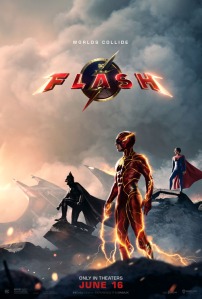
Released within two weeks of one another, two big summer movies take the concept of a multiverse, now becoming the norm in comic book cinema, and explore the imaginative possibilities and wish-fulfillment that it proposes, but only one of them does it well. Spider-Man: Across the Spider-Verse is the sequel to the Oscar-winning 2018 revolutionary animated film, and it’s a glorious and thrilling and visually sumptuous experience, whereas DC’s much-hyped and much-troubled movie The Flash feels like a deflated project running in place and coming apart. Let this be a lesson to any studio executive, that multiverses are harder than they look.
Barry Allen (Ezra Miller) has the ability to travel at fantastic speeds as his superhero alter ego, The Flash. He’s tired of being the Justice League’s errand boy and still fighting to prove his father is innocent of the crime of killing Barry’s mother. Then Barry discovers he can run fast enough to actually travel back in time, so he returns with the intention of trying to save his mother. Except now he’s an extra Flash and has to train his alternate self (also Miller) how to control his powers. In this different timeline, there is no Justice League to combat General Zod (Michael Shannon, so thoroughly bored) from destroying the planet for Kryptonians.

This is the first big screen solo outing for The Flash, and after none other than Tom Cruise, Stephen King, and James Gunn calling it one of the best superhero movies of all time, it’s hard to square how trifling and mediocre so much plays out as an example of a creative enterprise being pulled in too many directions. Miller was cast as the speedster almost ten years ago, and this tale has gone through so much tortured development, leaping through numerous filmmakers and writers, that its purpose has now gone from being a pillar of the expanding DC cinematic universe began with Zack Snyder’s Man of Steel in 2013 to becoming the Snyderverse’s death knell. The premise of traveling back in time is meant for Barry to learn important lessons about grief and responsibility and the limits of his powers, but it’s also intended as the reboot option for the future of these cross-connected comic franchises. It allows Gunn, now the co-head of the new way forward for DC movies and TV, to keep what they want (presumably Margot Robbie and Jason Momoa) and ditch the rest (Henry Cavill, Ben Affleck, Black Adam, Shazam, and Zack Snyder’s overall creative influence). So reviewing The Flash as only a movie is inadequate; it’s also a larger ploy by its corporate overlords to reset their comic book universe. In that regard, the quality level of the movie is secondary to its mission of wiping the creative slate clean.
Where the movie works best is with its personal stakes and the strange but appealing chemistry between the two Millers. It’s an easy starting point to understand why Barry does what he does, to save his mother. This provides a sturdy foundation to build a character arc, with Barry coming to terms with accepting his grief rather than trying to eradicate it. That stuff works, and the final talk he has to wrap up this storyline has an emotional pull that none of the other DCU movies have exhibited. Who wouldn’t want one last conversation with a departed loved one, one last opportunity to say how you feel or to even tell them goodbye? This search for closure is a relatable and an effective vehicle for Barry to learn, and it’s through his tutelage of the other Barry that he gets to see beyond himself. The movie is at its best not with all its assorted cameos and goofy action (more on both later) but when it’s a buddy comedy between the two Barrys. The older Barry becomes a mentor to himself and has to teach this inexperienced version how to hone and control his powers as well as their limits. It puts the hyper-charged character into a teaching position where he has to deal with a student just like him (or just him). It serves as a soft re-education for the audience alongside the other Barry without being a full origin story. The impetuous young Barry wanting to have everything, and the elation he feels about his powers, can be fun, but it’s even more fun with the older Barry having to corral his pupil. It also allows the character an interactive checkpoint for his own maturity and mental growth. Miller’s exuberant performances are quite entertaining and never fail to hit the comedy beats.

The problem is that the movie puts so much emphasis on too many things outside of its titular hero. Much was made of bringing back Keaton to reprise his Batman after 30 years. I just wish he came back for a better reason and had legitimate things to add. His role is that of the retired gunslinger being called back into action, and there’s an innate understanding with Barry wanting to go back in time and save his family, but too much of this character’s inclusion feels like a stab at stoking audience nostalgia (the callback lines all made me groan). I highly enjoyed Keaton as Batman and appreciated how weird he could make the billionaire-turned-vigilante, but he’s no more formed here than a hologram. The same thing happens with the inclusion of Super Girl a.k.a. Kara Zor-El (Sasha Callie). In this universe, there is no Superman, so she’s our requisite super-powered alien that Zod is hunting to complete his plans for terraforming Earth. She’s an intriguing character as a tortured refugee who has lingering doubts about whether humanity is worth the sacrifice, but much of her usage is meant only to make us think about Superman. She’s not given material to make her own impression, so she simply becomes the imitation of the familiar, the shadow to the archetype already being left behind. But these character additions aren’t even the worst of the nostalgia nods, as the final climactic sequence involves a collision of worlds that harkens to just about every iteration of the famous DC heroes, resurrecting several with dodgy CGI and uncomfortable implications (spoilers… the inclusion of George Reeves, when he felt so typecast as TV’s Superman that he supposedly killed himself because he thought his acting career was over, can be galling).
The action of The Flash is mostly fine but with one exceptional example that boggles my mind. In the opening sequence, no less, Barry is trying to help clean up a crumbling hospital when it collapses and literally sends a reign of babies falling through the air. I was beside myself when this happened, horrified and then stupefied that this absurd action sequence was actually happening. Barry goes into super speed to save the day, which more or less reverts the world into super slow-mo, though he needs to power up first, so we get a quick edit of him stuffing food into his face to load up on calories. We go from Barry breaking into a falling vending machine, stuffing himself in the face with snacks, getting the green light from his suit which I guess measures his caloric intake, and then grab a baby and literally put it in a microwave to shield it from danger. Just describing this event makes me feel insane. I figure the filmmakers were going for an over-the-top approach that also provides light-hearted goofiness to separate the movie from the oppressively dark grist of Snyder’s movies. However, this goes so far into the direction of absurdity that it destroys its credibility. It’s hard for me to fathom many watching this misguided and horrifying CGI baby-juggling sequence and say, “Yes, more please,” rather than scoff and shake their head. It’s not like the rest of the movie keeps to this tone either, which makes the sequence all the more baffling. There are Flash rules that are inconsistently applied to the action; Barry’s caloric intake is never a worry again, and the effects of moving a person during super speed don’t ever seem to be a problem except for one spewing gross-out gag.
While not being an unmitigated disaster, it’s hard for me to see the movie that got so many figures in the entertainment industry raving. The Flash has some notable emotional stakes, some amusing buddy comedy, and some goofy special effects sequences that run the gamut from amusing to confounding, but it’s also quite a mess of a movie, and too many of its nods to the fandom feel like empty gestures of nostalgia compensating for imagination. For all it gets right, or at least keeps interesting, it seems like another cog in a multi-billion-dollar machine, a stopping point also intended to be a reset and starting point. It feels like the character wasn’t trusted enough by the studio to lead his own solo movie even after years of buildup with Miller, nine seasons of the popular TV series, and 80-plus years of prominent placement in DC comics.
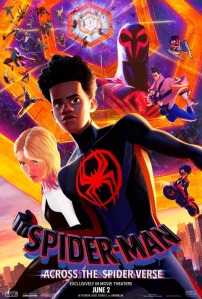
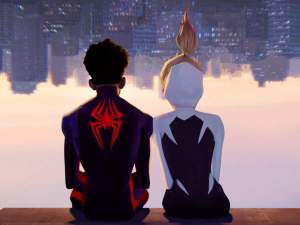
Conversely, Across the Spider-Verse is a sequel that expands an already stuffed story but knows what stories and themes to elevate so they don’t get lost amidst the fast-paced lunacy. Taking place a year later, Miles Morales (voiced by Shameik Moore) has grown into his role as the new Spider-Man for his world. He strains to meet the expectations of his parents, and keep up his grades, while fulfilling the duties of a superhero jumping into danger. When Gwen Stacey (voiced by Hailee Steinfeld) reappears to discuss joining the multiverse police, Miles jumps at the chance, having genuinely missed his other Spider friends, especially Gwen. There are countless Spider people in countless worlds, even including a Spider-T. Rex and a Spider-Car (Peter Parked Car, I believe the name was). Miguel O’Hara (voiced by Oscar Isaac) is the Spider-Man tasked with keeping order across the many interconnected multiverses, and he insists that sacrifice is essential to maintain balance, one that hits too close to home for Miles to abide.
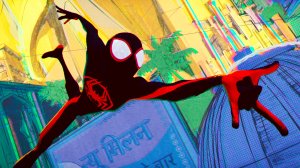
The 2018 original is a hard act to follow, and while Across the Spider-Verse doesn’t quite overrule its predecessor it is a more than worthy sequel that has everything fans loved about the first trip. The visual inventiveness has been taken even higher, with the mixture of even more different animation and art styles. I loved seeing each Spider person and how they fit into their unique art style of their world, like the living water colors of Gwen’s world and the punky paper collage style of Spider-Punk (voiced by Daniel Kaluuya). There’s a villain that comes from a paper universe, so he resembles a three-dimensional paper construction with hand-scribbled notes appearing around him like Da Vinci’s commentary. There is something to dazzle your senses in every second of this movie. The visuals are colorful, creative, and groundbreaking with the level of detail and development. There’s probably even too much to fully take in with just one viewing. I want to see the movie again not just because it’s outstanding but so I can catch the split-second vernacular asterisk boxes that pop up throughout the movie. Going further into living comic book aesthetics, new characters will be introduced with boxes citing their comics issue reference point, and certain names and vocab will get their own citations as well. These are split-second additions, nothing meant to distract from the larger narrative. Simply put, this is one of the most gorgeous looking movies of all time, animated or live action. It’s bursting, thrumming, nearly vibrating with life and love stuffed into every nook and cranny, and it’s exhilarating to just experience a vivid, thriving world with animators operating at peak talent.
However, the movie has an engrossing story to better position all those eye-popping visuals. The worry with any modern multiverse story is that the unlimited possibilities of variations and opportunities for characters to do just about anything will overwhelm a narrative, or like The Flash, become a checklist of overburdened and empty fan service. The screenplay by Phil Lord, Christopher Miller, and Dave Callaham is all about relationships. If Miles’ relationship with his stern police lieutenant father (voiced by Brian Tyree Henry) wasn’t such an important focal point, then the emotional stakes of the movie would be meaningless. We see a relatable struggle from both sides, the parents trying to connect with their growing child and give him enough space to find himself, and the child who clearly loves his parents but doesn’t fully appreciate or understand their concerns. They worry about Miles leaving them and whether others will love and support him like his parents. Miles has to experience a wider world of possibility, but these experiences make him appreciate what he has at home, and what could be permanently lost. I don’t mind saying there were more than a few moments that caused me to tear up. I found Gwen’s storyline equally compelling, and her turmoil over keeping her secret identity and then coming out to her father was rather moving. The family bond resurfacing will get me every time, and the simple action of a hug can be as heartwarming and fulfilling as any romantic ode. Across the Spider-Verse makes sure we care about the characters and their personal journeys.
At a towering 140 minutes, this is the longest (American) animated movie ever, and it’s still only one half of a larger story. I knew ahead of time this was only the first part so as soon as we entered Act Three I kept gearing up for the cliffhanger ending. Every five or so minutes I thought, “Okay, this is going to be the end,” and then it kept going, and I was relieved. Not just because I got to spend more time in this unique universe but each new moment added even more to raise the stakes, twist the intrigue, and make me excited for what could happen next. I was shaking in my seat at different points, from the excitement of different sequences to the emotional catharsis of other moments. I cannot wait to experience this same feeling when the story picks back up reportedly in March 2024, though I fear it will get delayed to late 2024.
Even with the unlimited possibility of jokes and silly mayhem, the filmmakers keenly understand that it doesn’t matter unless we care about the characters and their fates. I am shocked that a goofy character I thought was going to be a one-scene joke, The Spot (voiced by Jason Schwartzman), could end up becoming the ultimate destroyer of worlds. I think this reflection nicely summarizes the impeccable artistry of Across the Spider-Verse, where even the moments or characters misjudged as fleeting or inconsequential can be of great power. It’s a movie that is full of surprises and thrills and laughs, all in equal measure, and a blessed experience for a movie fan. In the crush of comic book multiverse madness, Across the Spider-Verse is a refreshing and rejuvenating creative enterprise, one that builds off the formidable talent of its predecessor and carries it even further into artistic excellence that reminds us how transporting movies can be. If you see one superhero multiverse movie this summer, the choice should be as obvious as an inter-dimensional spider bite.
Nate’s Grades:
The Flash: C
Across the Spider-Verse: A
Share this:

Bumblebee (2018)
 Why haven’t they been making these kind of Transformers movies from the beginning? Bumblebee is a scaled-down, character-driven family film where the bigger moments re about fitting in, finding your sense of self, and keeping your new alien robot friend hidden from your parents. Set in the late 80s, Hailee Steinfeld (Edge of Seventeen) plays a high school senior dreaming of a life beyond her neighborhood and family. The ticket out is a new car, which just happens to be an Autobot from another planet disguised as a VW beetle. Because Bumblbee had his memory wiped from a fight years earlier, he’s very childlike and endearing, and the interaction between the big robot and Steinfeld will rekindle more than a few memories for The Iron Giant, E.T., and other classic “boy and his dog” tales. There’s a real attention to the characters, big and small, that makes this the best Transformers movie. Not everything has to be about the next world-destroying cataclysm. There’s plenty of formidable drama in watching a teen girl navigate the world with an unconventional new friend. Director Travis Knight (Kubo and the Two Strings) graduates to the world of live-action with a terrific feel for the visual parameters and material. It helps that Knight gives his film a sense of scale without sacrificing coherency. The camera prefers wider shots and longer takes so the audience can follow the action. The movie also has a sly sense of humor it knows when it call upon, like a highly enjoyable John Cena who is baffled at his government’s open door policy to evil robot aliens: “They have Decepticon in their name. Is that not a red flag to anyone else?” This is a well-paced, sweetly heartfelt movie with good humor, good characters, and good action. If this is what happens when you strip Michael Bay from the franchise, then lock him up.
Nate’s Grade B+
Share this:

Spider-Man: Into the Spider-Verse (2018)
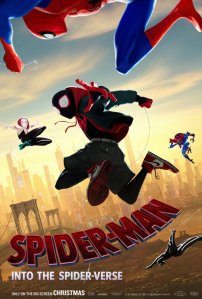 Walking out of Brad Bird’s hotly anticipated sequel to The Incredibles, I was convinced there wouldn’t be a better-animated film for the rest of the calendar year. Then I saw Ralph Wrecks the Internet and felt the same conclusion. What could top these two incredible movies from Disney? I wasn’t expecting a parallel world Spider-Man animated film to contend with that heralded echelon, but after watching Spider-Man: Into the Spider-Verse, I am now certain. This is the best-animated film of the year and one of the best films of the year, full stop. It’s rich, imaginative, exciting, satisfying, and way too much fun.
Miles Morales (voiced by Shameik Moore) is an ordinary teenager starting a new school he’s eager to leave. His police officer father, Jefferson Davis (voiced by Brian Tyree Henry), is pushing him and can be embarrassing. His cooler uncle Aaron (voiced by Mahershala Ali) encourages Miles to express himself through his graffiti art. One night, Miles encounters the famous Spider-Man, a particle collider, and a special spider from another dimension that bites him. He develops super powers and seeks out Peter Parker (voiced by Jake Johnson) as the only other person who might understand what he’s experiencing. Except there happens to be multiple Spider-laden heroes, including Spider Gwen, a.k.a. Gwen Stacy (voiced by Hailee Steinfeld), Spider-Pig (voiced by John Mulaney), Spider-Man Noir (voiced by Nicolas Cage), and an anime heroine Peni Parker with a giant spider robot friend. They’re all from alternate dimensions, dragged into Miles’ world thanks to Kingpin’s (voiced by Liev Schreiber) particle collider. If they don’t get back to their original worlds they’ll glitch out of existence, and Miles’ own world, and everyone inside it, is threatened by the instability of that collider.
 Into the Spider-Verse is bursting with color, imagination, kinetic energy, and a real celebration of the art form of animation and comics. Once that super spider bites Miles, the visual mechanics of the movie alter as well as him. Suddenly his thoughts are louder and appear in floating boxes (only we can see), in addition to thought bubbles, sound effects, and the occasional panel shifting transition device. It gets far closer than Ang Lee’s Hulk at recreating the experience of a living comic, and it’s joyous. The animation style too recreates the cross-shading effect of comic artists and the fluidity of the animation has purposely removed frames, giving it a slight stutter-step more often found in stop-motion animation. This distinct style might be off-putting to certain audience members accustomed to the smooth movements of modern animation mimicking real life, but for comic fans, it better approaches the captured stills of comic panels being connected into a whole. The different animation styles of the new Spider characters, Looney Tunes to anime to stark noir Frank Miller riffs, become reminders of separate universes with their own visual rules that keep things fun. The film is vibrantly colorful and gorgeous to watch on the big screen where a person can best luxuriate in that flamboyant palette. The finale feels like an explosion of splash pages and graphic designs merging together, even mimicking the sprawling graffiti art of Miles. It’s a spectacular visual feast that manages to be that rare treat of something new yet familiar.
The action of Into the Spider-Verse is delightful when it’s comedic and thrilling when it’s serious, but at every turn its fun, well developed, and wonderfully rendered. Early on, as Miles learns the tricks of his new and confusing abilities, the action is wildly funny. Take for instance a sequence where he becomes attached to an unconscious Peter Parker through the Spider-Man webbing. Soon after, the police approach Miles, and now he has to make a break for it while still attached to another body, forcing him into a series of comic escapes. It’s highly spirited and filled with enjoyable jokes. Later, as Miles gets more centrally involved in Kingpin’s scheme, the action becomes harsher, more violent, and dangerous. A battle between Miles and The Prowler gets more and more extreme, especially after some twists an audience may or may not see coming depending upon their source material knowledge (this is a parallel universe, after all). The action is frenetic, inventive, and visually engaging, easy to follow and filled with wonderful organic complications that allow each scene to feel vital and different from the last.
 Into the Spider-Verse is also brashly hilarious from beginning to end. Being co-written by the writers responsible for The Lego Movie and 22 Jump Street, I was expecting a combination of clever and antic, and that’s what they delivered and then some. There are brilliantly conceived and executed jokes but, and this is what separates the professionals, they do not distract from the larger work of the characterization. Often the humor is built through the characters, their personality and motivation differences, and the unique circumstances, so even when its zany it feels connected or grounded. There’s a silly joke about getting more bread from a waiter that works on multiple levels and they keep going back to it for further meaning, and it’s one example of many that shows the work put into their funny is meaningful and smart. After six movies and several animated series, audiences are well versed in the origin of Spider-Man, so Into the Spider-Verse even turns that knowledge into a source of humor itself, laying a formula for each new Spider character to introduce themselves with the same fill-in-the-blanks origin speech. The alternate universe Spider heroes do not overstay their welcome and, miraculously, even find themselves with some potent small character moments, which is an amazing feat given the 100-minute running time. The laboratory break-in with Peter Parker and Miles is a comic highlight with plenty of complications, and there’s a smart, sly joke about personal biases that just slides by nonchalantly that had me howling. The post-credit scene had me laughing so hard that I was crying. Please, I implore you, stick around for it and go out laughing with the biggest smile on your face.
Besides being a great comic book movie and a great action movie, Into the Spider-Verse is also just a great movie. The Spider-Man character is so familiar that the film easily could have gone on autopilot yet it puts in the work to build characters we care about, give them arcs, and provide setups and payoffs both big and small to maximize audience satisfaction. Miles is a terrific new character with a voice all his own, and his teenage foibles are both recognizable and refreshing. He’s a hero worth rooting for, and his more personal family issues can be just as compelling as the end-of-the-world adventures. That’s the core of what makes Spider-Man still an invigorating character 50 years later, and Into the Spider-Verse taps into that essential element even with an alternate universe Spider hero. It’s got the DNA of Stan Lee and Steve Ditko’s original creation and given a welcomed jolt of relevancy thanks to the onscreen racial diversity and youthful perspective.
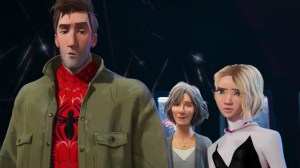 There are two relationships at the core: Miles and his father and Miles and Peter Parker. The latter is an unexpected mentor/pupil relationship that provides the enjoyment of watching both members grow through their bond, and the former allows a familial baseline to come back to and demonstrate how far we’ve come. The Peter Parker/Miles relationship has that big brother/little brother angst that keeps things sharp while still maintaining an undercurrent of emotional need. There were genuine moments where my eyes welled up. The film can be that affecting because it is so well structured and developed from a characterization standpoint. Even the chief villain, the Kingpin, has a motivation that is personal and effectively empathetic. Everyone involved gets careful consideration, even the bad guys.
Let me cite one prime example that showcases how great the storytelling can be (minor spoilers). At one point, Miles is bound and gagged by the other heroes to prevent him from joining them in a dangerous activity they do not believe he is ready for. They’re removing him from the team for his own good. Then, at this low point, his father comes to visit him and tries talking to him through the other side of his dormitory door. They’ve had some challenging moments between them and what Mr. Davis has to say is extra challenging. He’s trying to connect with a son he feels he’s losing touch with, and it’s a one-sided conversation where Miles is unable to respond to his father’s pleas, who eventually walks away knowing his son is there but not ready to talk. Right there, the screenwriters have gone from the fantastic to the personal, finding a way to bring Miles even lower but in an organic fashion that plays right into his ongoing communication problems. It’s a simple moment to start with, standard even, but then having it contribute to the father/son estrangement is beautiful and handled so well. The sparkling screenplay for Into the Spider-Verse is packed with moments like this.
The voice acting is perfectly suited for their roles. Moore (The Get Down) is an expressive and capable young actor that brings a terrific vulnerability to Miles, selling every emotion with authenticity. Johnson (Tag) is the absolute best choice for a slacker Spider-Man who has become jaded and self-indulgent. His laid back rhythms gel nicely with Moore’s eager breathlessness. Henry (Widows) is so paternal it hurts your heart. Steinfeld (Bumblebee) is poised and enjoyably spry. Cage (Mandy) is doing everything you’d want a Nicolas Cage-voiced crime fighter to be. Schreiber (Ray Donovan) can be threatening in his sleep with that velvety voice of his. Plus you get Katheryn Hahn as a villain, Zoe Kravitz as Mary Jane, and Lily Tomlin as Aunt May, and they’re all great.
 As the credits rolled for Spider-Man: Into the Spider-Verse, I tried searching my brain for any flaws, minor quibbles, anything that would hold the film back from an entertainment standpoint. The only thing I could think of is that animation style, but different people will either find that look appealing or irritating. This is a glorious and gloriously entertaining movie replete with humor, heart, surprises, payoffs, and a great creative energy that bursts from the big screen. This really is a movie to see on the big screen as well, to better feast on the eye-popping visuals and pop-art comic book aesthetics that leap from the page to the screen. It’s the second best Spidey movie, after 2017’s impeccably structured solo venture, Homecoming. The late addition of the other alternate universe Spider heroes keeps things silly even as it raises the stakes. The film is a wonderful blending of tones and styles, from the different characters and universes to the heartfelt emotions and vicarious thrills of being young and super powered. This is a movie that even Spider novices can climb aboard and fall in love with. Into the Spider-Verse is a film for fans of all ages and nothing short of the best animated film of 2018. It’s as good as advertised, folks.
Nate’s Grade: A
Share this:

Ender’s Game (2013)
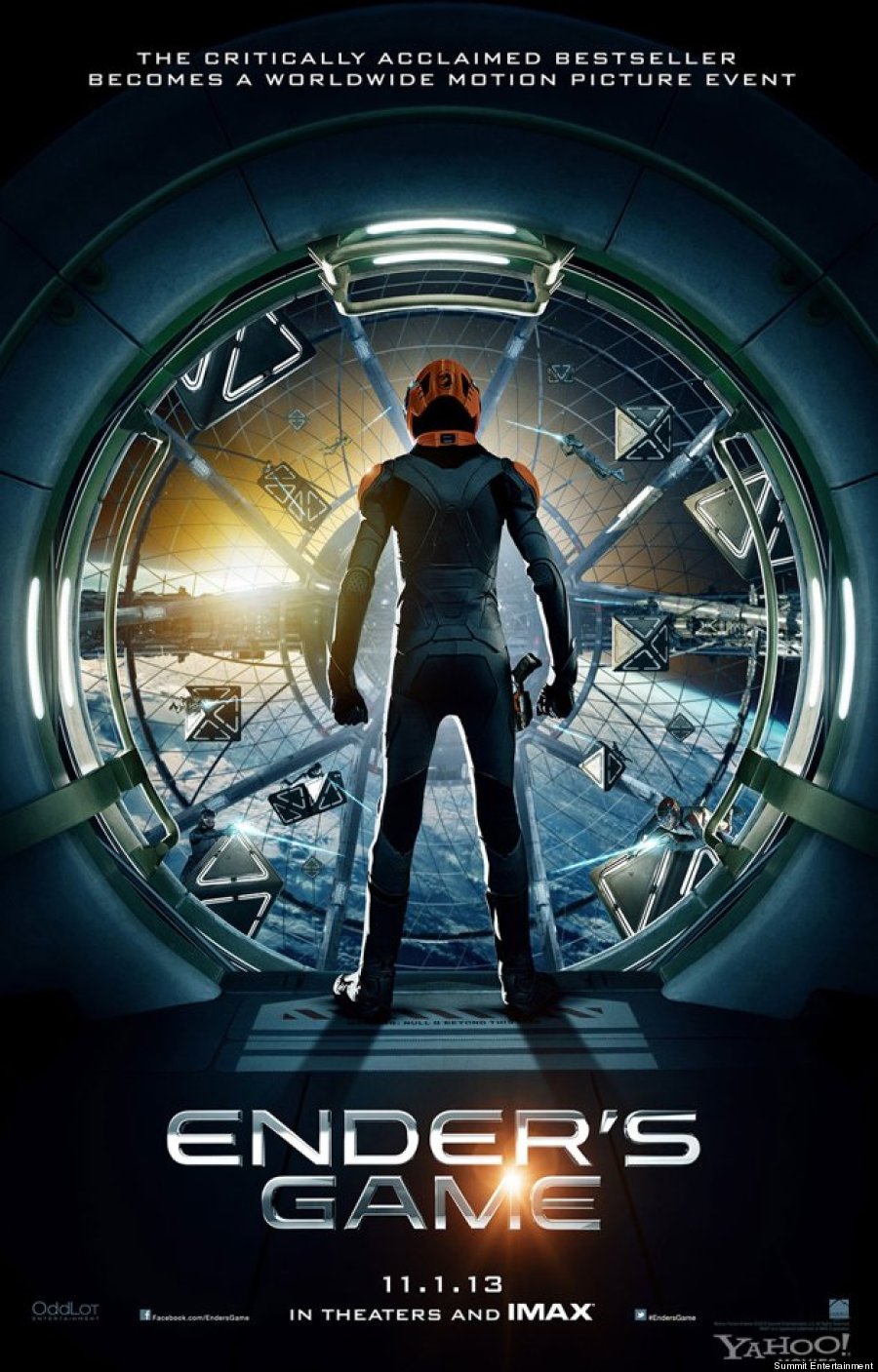 Honestly I know more about Ender’s Game thanks to the swirling rabble about boycotting the film thanks to author Orson Scott Card’s homophobic personal views. I didn’t even know this book existed until I heard about the movie. With my cloud of ignorance, as well as some lingering worries that the director of X-Men Origins: Wolverine was at the helm of this expensive would-be franchise, I was pleasantly surprised at how entertaining I found the movie. It’s set in a future where children are culled and trained to be super soldiers against an alien race that has been in seclusion after a failed invasion of Earth. The emphasis is on strategy and manipulating your opponent, which leads to many military training sequences. At one point I wondered, “Is this whole story going to be training sequences and zero-gravity laser tag?” It’s not, thankfully, but even those sequences are fun. Writer/director Gavin Hood does an excellent job of fleshing out this world while giving enough time in between the games to also flesh out his ragtag group of characters. There’s something inherently satisfying to watching a team come together, and the film has plenty of small payoffs. The visuals are astounding to soak up. The zero gravity fun, backlit by the stars, is dazzling. The acting is strong across the board, with special appreciation that Harrison Ford has a good role that he’s actually well suited for. The pacing does start to slag toward the third act, mostly because the plot feels like an escalating series of games, until it’s not. There’s a measured degree of ethical ambiguity and contemplation to the film that’s admirable. Whether you plan on boycotting Ender’s Game or not, it’s a successful, thrilling, and visually engaging sci-fi flick that deserves to be seen at some point.
Nate’s Grade: B+
Share this:

True Grit (2010)
 It may sound like sacrilege to some to remake True Grit. What can the Coen brothers add? Can Jeff Bridges fill in the boots of John Wayne? Those familiar with the 1969 original will recognize many of the same elements and a solid 70% of the dialogue is the same owing to the fact that both films come from the same source, Charles Portis’ novel. Where the Coens step out is placing the story’s focus on Mattie Ross (Hailee Steinfeld), the 14-year-old seeking vengeance for her dead father. Marshall Rooster Cogburn is a rascally often drunken cynic, so it’s easy to get swept up in the amusing character, initially played by the Duke and now played with great gruffness by Bridges. But the Coens know this is Mattie’s story, and apologies to Kim Darby, but Steinfeld looks like a 14-year-old. Every second onscreen reminds you how truly vulnerable she is, that is, until she opens her mouth. Steinfeld is remarkable and so self-assured. She holds her own with the stars. This is a young actress that has a bright future in Hollywood.
The Coens have put together such richly drawn characters, so it’s a tremendous pleasure just to watch the people interact, luxuriating in that old West speaking style that actors chew over like gumbo. It takes a while for the film to assemble its pieces, but once the gang is underway you just want to spend. As anyone who has ever seen a Coen brothers’ picture, the movie is technically flawless. Whether it be the sumptuous old west cinematography by the best man in the industry, Roger Deakens, the stirring score by Carter Burwell, impeccable sound design, or the overall languid yet authentic pacing of the whole film. There are moments of offbeat humor, moments of quiet tension, explosions of brutish violence, but I had to ask what it all added up to. It’s a good time spent with some nice characters, but it’s hard to shake the idea that the movie falls short of greatness. The Coens can’t be expected to make a masterpiece every time they step behind a camera. But the films that fall short of the M-word generally can be slotted in the “mostly very good” category (O Brother, Burn After Reading). You’re left with a somewhat sour resolution and it starts you thinking whether or not the film had anything substantial to say about vengeance, friendship, community, or a legion of topics. It turns out, True Grit is a solid two hours of great actors working through an entertaining story. For any other filmmaker, that would be all you could ask for. For the Coens, it means the film only can be classified as “very good.”
Nate’s Grade: B+


 nathanzoebl
You must be logged in to post a comment.