Blog Archives
Frankenstein (2025)
 One of the reasons Mary Shelley’s novel Frankenstein has been so richly relevant two hundred years later is because of her thought-provoking themes and concepts, which still prove potent with each new malleable reinterpretation from the newest creative caretaker. It’s the “be careful what you wish for” adage combined with man’s hubris and our self-destructive impulses to play with things we don’t fully understand. It’s also a monster story that asks us to reconsider the perception of who the monster may truly be, and under writer/director Guillermo del Toro, the answer is always and forever man himself. This isn’t a surprise from the same filmmaker who gave us Hellboy and The Shape of Water. The man identifies with the monsters more than other people. The man turned his astounding stop-motion animated Pinocchio movie into a deft Frankenstein allegory, so the famous story has been on his mind for quite some time. It’s been an obvious influence, and now that he’s gotten his chance on his own imprint, it’s hard not to see elements of del Toro’s other movies everywhere. It creates this bizarre echo chamber of creative influence where the movie can feel derivative at times even though the source material was an influence on those other del Toro works. It’s just the nature of finally tackling the influence later in his career. It reminds me of 2012’s John Carter, based on Edgar Rice Burroughs’ highly influential sci-fi series, and yet because it took 100 years to leap to the big screen, it couldn’t help but seem derivative of the same popular movies that were inspired by it. This is a convoluted way of saying del Toro’s Frankenstein is a much better Guillermo del Toro movie than a Frankenstein adaptation.
You probably know the story well enough to recite it yourself. Victor Frankenstein (Oscar Isaac) is obsessed with conquering death after his own mother’s demise in childbirth. He gathers the parts of criminals and dead soldiers to reanimate into a new being, a Creature (Jacob Elordi) of superhuman strength and regeneration who cannot die. Victor’s cruelty punishes the Creature and disowns it, setting the stage for a showdown between dysfunctional father and son and the havoc caused by recklessly playing God.
 There are deliberate decisions that mitigate some of the more compelling characterization of the novel. With del Toro’s version, Victor is the clear-cut villain. There’s some setup given to his strict childhood where his domineering father (Charles Dance) would quiz him and physically abuse Victor if he failed to recite the correct answers to his medical questions. Dear bad dad was doing this, you see, out of a belief that good doctors need to know intuitively because any hesitation could cost lives. When we witness Victor abusing the Creature in the same manner, we’re meant to see the connection between abusive fathers confusing disappointment with defiance. In the original story, Victor abandons the Creature on the night of its birth and then it’s gone. In this version, Victor imprisons the Creature, keeps him chained, attempts to train him, grows frustrated, and then tries to destroy the evidence. That’s a little more diabolical than simple morning-after regrets. This Victor can also be viewed as a forefather of incels the way he projects his romantic feelings onto Elizabeth (Mia Goth) and then gets huffy when she doesn’t return them. There are other deaths later in the story that are directly attributed to the Creature that are now Victor’s doing, which continues to squeeze out moral ambiguity from Shelley’s novel. If the Creature is purely innocent and Victor is purely villainous, that makes the relationship between father and son, Creator and Creature, far less meaningful and layered. It’s so obvious that another character, in their literal dying words, says to Victor, “You are the real monster.” It all becomes an ongoing cycle of bad fathers and the Creature ultimately trying to reach forgiveness. Even if the Creature ultimately finds that, is this Victor even worthy of redemption?
Another significant feature of del Toro’s retelling is, how do I put this delicately, the inherent magnetism of the Creature, a.k.a. Sexy Frankenstein. Elordi (Saltburn) is a tall, lithe actor to begin with with classical Hollywood features, but there was a conscious choice to portray this figure in a certain light, a sexy light. You might find parts of you that are suddenly alive while watching the character onscreen. That’s why even though he’s a literal assembly of corpses the makeup effects are very minimal and less intentionally grotesque or monstrous. The delicate lines around his body make me think of a cross between the Engineers in Prometheus and the body paint of that Gotye music video “Somebody I Used to Know.” The gentle makeup is meant to further convey the Creature as a sensitive figure; granted, he’s also capable of ripping the jaw off a wolf. By swerving away from the Creature’s physical deformities, the movie is also inadvertently downplaying the isolation that he felt that led to such rage and resentment. Is this man that hideous that some good woman couldn’t love him as is? The movie is already presenting Elizabeth as someone who sees through to his gentle nature, and she certainly also seems more than a little attracted to what he’s got going on. This Sexy Frankenstein reconfirms del Toro’s penchant for identifying with the monster, the outcasts, the underdogs. However, Sexy Frankenstein also takes something away from the horror and cost of the creation if he’s just going to be another brooding, misunderstood Byronic hero. Still, there are definitely worse pieces of meat you could be watching, so enjoy monster sweethearts.
 With all that being said, del Toro’s Frankenstein is still a sumptuously made and entertaining Gothic spectacle. The production design is immense and immersive with del Toro’s knack for perfect details to create such a lived-in sense of mood (never enough giant stone face edifices). I loved Victor’s models of human torsos that looked almost like ballet dancers at rest; granted, ballet dancers having their skin peeled back by dozens of hooks. I just wanted to spend as much time as possible soaking up these sets and this heightened Gothic realm. It’s the kind of world where Victor’s laboratory needs to be an opulent abandoned castle complete with a pit in the middle of the floor plan that goes through several floors to a sewar/aqueduct basement level. There’s even what appears to be a water slide out of the estate, and the Creature gets to escape it in the most fun way. The movie is gorgeous with del Toro’s signature orange/green color palette bathing his universe. Even if the story isn’t quite reaching the heights it could, the visuals are always sterling and inviting. There’s also a surprising amount of gore, which maybe shouldn’t have been that surprising. I don’t know if we needed as much of the Arctic framing device, which itself was structured as a series of letters in the novel. It’s a platform for del Toro to demonstrate the Creature’s physical prowess and get some quality big-screen bloodshed flowing. I don’t know if we needed to keep cutting back throughout the whole running time like it’s a Christopher Nolan movie. Regardless, if you’re a general fan of monster movies, there’s going to be plenty here to proverbially sink your teeth into and savor on that super Netflix budget.
Mary Shelley’s Frankenstein gave birth to science fiction in 1818 and the James Whale movies from the 1930s gave birth to some of cinema’s most iconic and lasting images and influences. There’s quite a legacy for anyone who wants to put their own stamp on the material, so it helps that Guillermo del Toro has quite a legacy himself, a career built upon the dark recesses of a verdant imagination (I’ll always lament what could have been his version of The Hobbit movies, alas). His Frankenstein has all the hallmarks of a classic del Toro film experience, from the impeccable technical qualities, to the celebration of the mythic and Gothic, to the sympathetic portrayal of the outsiders condemned by a society too square to accept them, and an unironic emotional undercurrent that can approach self-parody. It’s a little long, a little ungainly in its shape, and a little too simplistic with its themes and characterization, but it can also be fittingly transporting and romantic and easy to feel that swell even if it’s all too familiar. For my money, the best Frankenstein adaptation is still the 1994 Kenneth Branagh version, flaws and all.
Nate’s Grade: B
Share this:

Hellboy (2004) [Review Re-View]

Originally released April 2, 2004:
Guillermo del Toro loves things that go bump in the night. The Mexican born writer/director has shown prowess at slimy, spooky creatures with Cronos and 1997’s Mimic. He helmed the 2002 sequel to Blade, which had super vampires whose mouths would open up into four sections with rows of chattering teeth. The man sure loves his movie monsters. del Toro also loved Mike Mignola’s cult comic book Hellboy enough to turn down directing Harry Potter 3 and Blade 3 to ensure he could bring Hellboy to the big screen. Was it worth the sacrifice?
Let me just explain to you the villains of this movie as an example of how ridiculously stupid Hellboy is. The villains are … Nazis. Yes, the tried and true villains everyone can hate – Nazis. But these ain’t yo’ daddy’s Nazis; they’re immortal and led by zombie Rasputin (yes, the Rasputin). They all wish to puncture a hole into another dimension. What’s in this alternate dimension? Why nothing except for a giant floating spaceship that houses, I kid you not, the Seven Gods of Chaos, which all happen to be gigantic space squids. Why would anyone create a universe that has nothing but the imprisoned gods of evil? That seems awfully precarious. How exactly are giant squids going to take over the industrialized, nuclear-age world? Shoot ink at everyone? Sorry, space ink?
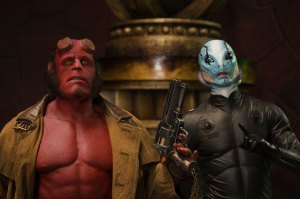
Let me not forget a Nazi assassin and his handy dandy arm-length blades. This assassin is also 100 years old and his body is filled entirely with sand. He winds himself up like a big clock. But if his body is filled completely with sand how can the clock gears work inside? You see what the normal audience member has to deal with? Plus these are just the villains, there’s a whole plot left to toil over as well.
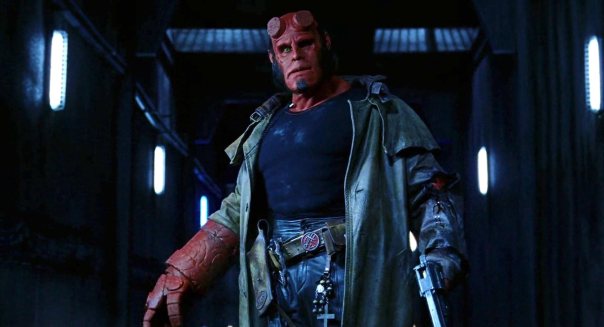
The story revolves around a hulking, red demon named Hellboy (veteran character actor Ron Perlman). Hellboy escaped the space squid dimension in the 1940s when the Nazis unsuccessfully tried to open a dimensional hole large enough for your everyday on-the-go space squid. Now, Hellboy is an elite soldier for the government’s Bureau of Paranormal Research. He fights the creepy crawlies. He has to deal with a wide-eyed rookie, the watch of his “father” (John Hurt) and an attempt to rekindle a romance with a mentally troubled fire starter (Selma Blair). Oh yeah, and all the Nazi/Rasputin/space squid stuff mentioned before.
Perlman is really the only redeeming thing about this movie. The makeup is impressive, and he gives an enjoyably droll performance as a man who fights monsters with the same ho-hum-ness as a plumber reacts to clogged sinks. The rest of the acting runs the gamut of either being too serious (I’m looking at you Blair) or just too over-the-top silly (I’m looking at you, league of villains).
Hellboy is strung together with bizarre inanities, flat one-liners, heavy Catholic imagery, conflicting logic and contradictions, ridiculous villains, painful comic relief, half-baked romance and frustratingly ever-changing plot devices.
Watching Hellboy is like playing tag with a kid that keeps making up new rules as he goes (“You can’t tag me; I have an invisibility shield!”), and after a while you lose any interest. Late in the film, the Nazis will all of a sudden decide not to be immortal, and at a very inopportune time. Why? How? I don’t know. Hellboy also gets sudden new powers for some reason. Like he can bring people back to life by whispering otherworldly threats in their ears. For some reason nobody’s clothes burn when they’re set on fire.
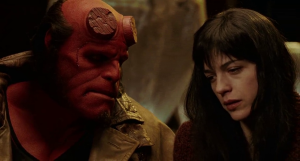
Not only does Hellboy frustrate by changing the rules of its world arbitrarily, it will also frustrate out of sheer uninhibited stupidity. How come characters can’t hear or see a pendulum the size of the Chrysler building? How come during a vision of the apocalypse we see a newspaper that actually had the time and staff, during the Apocalypse, to print an issue that reads, “APOCALYPSE”? Why doesn’t Blair use her pyro superpowers immediately to vanquish all the H.P. Lovecraft creatures instead of letting Hellboy foolishly wrestle with them all? The gaping holes in Hellboy are large enough to squeeze a gigantic space squid through.
All this frustration and insanity might have been moot if the action sequences were somewhat thrilling. Sadly, they are not. del Toro’s action sequences seldom matter. There’s such little consequence of what’s going on that the action becomes stiff and lifeless. The first time we see Hellboy chase a creature through city streets it’s a fun experience, but soon the novelty wears off. The overuse of CGI wears down the audience, and after the third or fourth time we watch Hellboy battle the same monster, the audience is ready to go to sleep. There’s little entertainment in the film’s action sequences but just as much frustration and stupidity.
I have never watched a film that induced more eye rolls, shoulder shrugs, raised eyebrows, pained and confused glances and mutters of, “What the hell (boy)?” Comic book aficionados may enjoy the fruits of Hellboy but general audiences will simply shrug. I’m amazed that the majority of film critics seem to think positively about this movie. Maybe I’m the last sane person in an insane world but Hellboy is one of the worst films of the year and one of the craziest films you could ever hope to see in a lifetime.
Nate’s Grade: D+
——————————————————
WRITER REFLECTIONS 20 YEARS LATER
When I first saw 2004’s Hellboy, toward the tail end of my undergraduate years that April, I had no real familiarity with the character and went in with my pal, and fellow college newspaper entertainment critic Dan Hille. I went in a blank slate to the grumbling demonic lug created by Mike Mignola. To say I was underwhelmed would be an understatement in my original review. I had an extremely hard time gelling with the world and finding some firm internal logic, and my general astonishment colored every inch of that incredulous review from a snarky 22-year-old soon-to-be college grad. Twenty years later, we have a sequel, reboot, and a series of animated shorts and feature-length films, so the character is much better known today than back in 2004. I also think its occult-heavy, Lovecraftian world-building has also been further established through mainstream horror and science fiction projects. So, in 2024, I’m more familiar with the title character, the cultural connections and background, and especially Guilermo del Toro as a filmmaker, and I’m still left unmoved by this initial pitch to the character and his weird world.
It took del Toro and company years to get this movie made as the big studios lacked faith in the material, in Ron Perlamn as the lead, and in superhero and comic book properties period. This really was its own superhero story with outlandish villains, oversized heroes burdened with secrecy, shame, and guilt, and heavy themes reaching into religion and determinism. The concept of an underground agency of monsters to fight monsters is a good starting point for stories, and Perlman brings the right degree of curmudgeon charm to the outcast character who might become the ultimate hero of the world or its instrument of doom. The iconography of a demon trying to be a good guy provides a fun sense of irony, as well as a natural point of conflict as the wider world would have trouble seeing past the red skin, forked tail, and big curved horns. It makes me think of the gut-punch reveal from Arthur C. Clarke’s novel Childhood’s End where the benevolent aliens look exactly like the common visualization of a hooved and horned demon. The starting point for Hellboy has potential. However, it’s the rest that ultimately lost me.

Secret agencies and hidden conspiracies working behind the scene need to, themselves, be interesting. Think of the Men in Black and their assortment of goodies and agents. With the Bureau for Paranormal Research and Defense (BPRD), I expect more from the supporting characters and what they can unlock about our understanding of the world and the unknown. There really are only two super-powered supporting players, with Doug Jones playing Abe Sapian, a variation on the Creature from the Black Lagoon gillman, and Selma Blair as a pyrokinetic woman who checks herself into mental asylums to protect others. Both of these characters have possibility and are fellow outcasts like Hellboy, but neither feels sufficiently fleshed out and incorporated into this story. Because of Abe’s scenic limitations of being in water, he serves as more of a taste of “the world world” and narrative device. He’s not even involved in the entire final act of labyrinth misadventures. With Blair’s unstable pyro, her character is relegated to a tormented love interest for Hellboy to save, get jealous, and also save again through even more ludicrous means. For a secret agency, it all feels a little too small.
The biggest side character is John Myers (Rupert Evans, The Man in the High Castle), invented for the movie to be the audience’s entry point into learning more of this strange land of strange creatures. He’s a total bore, and he also doesn’t factor much more into the story than being a living reaction shot. He has one significant moment in the climax, and that’s simply telling Hellboy to remember who he is, ultimately convincing the big man to turn back from his destiny of enabling the apocalypse. Why do we need this character? Can’t another super-powered creature serve this same purpose? Why not Blair’s love interest figure, which would then present more attention on beginning that romantic connection between her and Hellboy? There’s a reason in X-Men that we followed a mutant to learn about other mutants and not some boring human. John Myers isn’t even included in the 2008 sequel, The Golden Army, because by that point he had served his only purpose of introducing us to a new world and being a benign romantic foil.

In a story with literal living Nazis brought to life through the magic of anti-Semitic clockwork, I’m dumbfounded why so much of the movie is watching Hellboy fight these boring lizard creatures with tongue tentacles. I appreciate the emphasis on practical effects and the reality that it’s a bunch of stunt performers in monster suits rather than complete CGI. The movie is another love letter of del Toro’s to his influences. His affection for the monsters and outsiders is apparent in every movie going back to his first, 1993’s Cronos. It’s too bad then that the primary opponent are these rudimentary lizard monsters that feel like the kind of easily disposable pawns you would see heroes fighting in other superhero spectacle. They’re faceless, and the fact they can regenerate and duplicate upon death doesn’t make them more formidable, only makes them more depressing as they can’t be easily rid of. If you’re going to give me giant space squids in an alternate dimension, then give me the giant space squids. If you’re going to give me Nazi zombies led by Rasputin, then give me that crazy mess. Don’t confine these potentially interesting villains to the opening and closing only. I will also say the ending is still a rather sizable letdown as far as how formidable these evil space squid gods might prove in a world of explosive devices and a modern military with a practical blank check for its budget.
Fun fact, at the time of its release, some theaters were so worried about playing a movie with “hell” in the title during Easter weekend, and coming off the ongoing success of The Passion of the Christ that brought in more conservative ticket-buyers, they decided to re-title it “Helloboy” on their theater marquis. I find this absolutely hilarious.
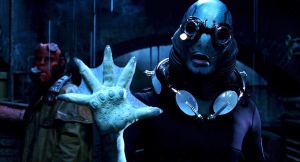
Hellboy has some points of interest, as del Toro was still fine-tuning his brand of fantasy-horror into a more mass-appealing conduit. It’s got terrific makeup effects and some fun ideas, and it’s also certifiably insane. It threw me for a loop back in 2004, and I just couldn’t process this level of hyper absurd elements jumbled together, and it still makes for a bumpy viewing. I enjoyed the 2008 sequel much more, which took more of a dark fantasy bent, and I wonder if I was more accepting of that realm of material than I was for Lovecraftian sci-fi nonsense. del Toro has learned from the Hellboy experience, becoming something of a masterful chameleon. He delivered one of the best kaiju action movies of all time that made me feel like a giddy kid. He created a haunting fairy tale timed to the Spanish Civil War. He created a charming romantic fable where a woman falls in love with a fish and it won an Oscar for Best Picture and he won Best Director. He created one of the most visually impressive stop-motion animated movies of all time that can make me cry like a baby and deservedly won another Oscar. Next up, he’s got another stop-motion animated movie and another creature feature, a remake of Frankenstein. Through his versatility, creative consistency, and inherent ability to find human drama in the most peculiar places, I’ll see any movie that del Toro decides to devote his worthy attention towards. Hellboy though? I’ve seen it twice now, and I think I can leave it at that. I’ll upgrade my earlier ranking but not too higher, Hoo boy is that 2004 review a fun read.
Re-View Grade: C
Share this:

Guillermo del Toro’s Pinocchio (2022)/ Pinocchio (2022)
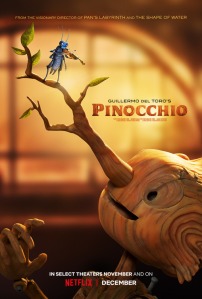 It seems 2022 has unexpectedly become the year of Pinocchio. The 1883 fantasy novel by Carlo Collodui (1826-1890) is best known via the classic Walt Disney animated movie, the second ever for the company, and it was Disney that released a live-action remake earlier in the year on their streaming service. Now widely available on Netflix is Guillermo del Toro’s stop-motion Pinocchio, so I wanted to review both films together but I was also presented with a unique circumstance. Both of these movies were adaptations of the same story, so the comparison is more direct, and I’ve decided to take a few cues from sports writing and break down the movies in a head-to-head competitive battle to see which has the edge in a series of five categories. Which fantastical story about a little puppet yearning to be a real boy will prove superior?
1. VISUAL PRESENTATION
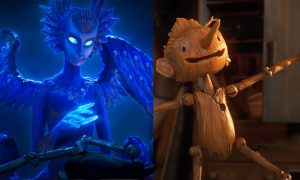
The Netflix Pinocchio is a lovingly realized stop-motion marvel. It’s del Toro’s first animated movie and his style translates easily to this hand-crafted realm. There is something special about stop-motion animation for me; I love the tactile nature of it all, the knowledge that everything I’m watching is pain-stakingly crafted by artisans, and it just increases my appreciation. I fully acknowledge that any animated movie is the work of thousands of hours of labor and love, but there’s something about stop-motion animation that I just experience more viscerally. The level of detail in the Netflix Pinocchio is astounding. There is dirt under Geppetto’s fingernails, red around the eyes after crying, the folds and rolls of fabric, and the textures feel like you can walk up to the screen and run your fingers over their surfaces. I loved the character designs, their clean simplicity but able readability, especially the sister creatures of life and death with peacock feather wings, and the animation underwater made me question how they did what they did. del Toro’s imagination is not limited from animation but expanded, and there are adept camera movements that require even more arduous work to achieve and they do. I loved the life each character has, the fluidity of their movements, that they even animated characters making mistakes or losing their balance or acting so recognizably human and sprightly. There’s a depth of life here plus an added meta-textual layer about puppets telling the story about a puppet who was given life.
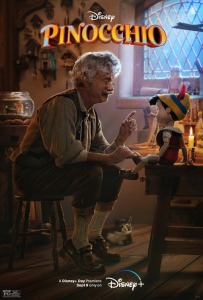 In contrast, the Disney live-action Pinocchio is harsh on the eyes. It’s another CGI smorgasbord from writer/director Robert Zemeckis akin to his mo-cap semi-animated movies from the 2000s. The brightness levels of the outside world are blastingly white, and it eliminates so much of the detail of the landscapes. When watching actors interact, it never overcomes the reality of it being a big empty set. The CGI can also be alarming with the recreation of the many animal sidekicks of the 1940 original. Why did Zemeckis make the pet goldfish look sultry? Why did they make Jiminy Cricket (Joseph Gordon-Levitt) look like a Brussel sprout come to life? It might not be the dead-eyed nightmare fuel of 2004’s The Polar Express, but the visual landscape of the movie is bleached and overdone, making everything feel overly fake or overly muddy and glum. The fact that this movie looks like this with a $150 million budget is disheartening but maybe inevitable. I suppose Zemeckis had no choice but to replicate the Pinocchio character design from 1940, but it looks remarkably out of step and just worse. When we have the 1940 original to compare to, everything in the 2022 remake looks garish or ugly or just wrong. The expressiveness of the hand-drawn animation is replaced with creepy-looking CGI animal-human hybrids.
Edge: Netflix Pinocchio
2. FATHER/SON CHARACTERIZATION
The relationship between Pinocchio (voiced by Gregory Mann) and Geppetto (David Bradley) is the heart of the Netflix Pinocchio, and I don’t mind sharing that it brought me to tears a couple of times. As much as the movie is about a young boy learning about the world, it’s also about the love of a father for a child. The opening ten minutes establish Geppetto’s tragedy with such surefooted efficiency that it reminded me of the early gut punch that was 2009’s Up. This Geppetto is constantly reminded of his loss and, during a drunken fit, he carved a replacement child that happens to come to life. This boy is very different from his last, and there is a great learning curve for both father and son about relating to one another. This is the heart of the movie, one I’ll discuss more in another section. With del Toro’s version, Geppetto is a wounded and hurting man, one where every decision is connected to character. This Pinocchio is a far more entertaining creature, a child of explosive energy, curiosity, and spitefulness. He feels like an excitable newborn exploring the way of the world. He’s so enthusiastic so quickly (“Work? I love work, papa!” “I love it, I love it!… What is it?”) that his wonder can become infectious. This Pinocchio also cannot die, and each time he comes back to life he must wait longer in a netherworld plane. It provides even more for Pinocchio to understand about loss and being human. This is a funny, whimsical, but also deftly emotive Pinocchio. He points to a crucifix and asks why everyone likes that wooden man but not him. He is an outsider learning about human emotions and morals and it’s more meaningful because of the character investment.
 In contrast, the Disney live-action Pinocchio treats its title character as a simpleton. The problem with a story about a child who breaks rules and learns lessons by dealing with the consequences of his actions is if you have a character that makes no mistakes then their suffering feels cruel. This Pinocchio is simply a sweet-natured wannabe performer. He means well but he doesn’t even lie until a sequence requires him to lie to successfully escape his imprisonment. The relationship with Geppetto (Tom Hanks) is strange. This kindly woodcarver is a widower who also has buried a son, but he comes across like a doddering old man who is quick to make dad jokes to nobody (I guess to his CGI cat and goldfish and multitude of Disney-tie-in cuckoo clocks). I don’t know what Hanks is doing with this daffy performance. It feels like Geppetto lost his mind and became stir crazy and this performance is the man pleading for help from the town, from the audience, from Zemeckis. It’s perplexing and it kept me from seeing this man as an actual character. He bounces from catalyst to late damsel in distress needing saving. The relationship between father and son lacks the warmth of the Netflix version. Yet again, the live-action Pinocchio is a pale imitation of its cartoon origins with either main character failing to be fleshed out or made new.
Edge: Netflix Pinocchio
3. THEMES
There are a few key themes that emerge over the near two-hours of the Netflix Pinocchio, which is the longest stop-motion animated film ever. Sebastian J. Cricket (Ewan McGregor) repeats that he “tried his best and that’s the best anyone can do,” and the parallelism makes it sound smarter than it actually is. The actual theme revolves around acceptance and the burdens of love. Geppetto cannot fully accept Pinocchio because he’s constantly comparing him to Carlo. When he can fully accept Pinocchio for who he is, the weird little kid with the big heart and unique perspective, is when he can finally begin to heal over the wound of his grief over Carlo, allowing himself to be vulnerable again and to accept his unexpected new family on their own terms. There’s plenty of available extra applications here to historically marginalized groups, and del Toro is an avowed fan of freaks and outcasts getting their due and thumbing their nose at the hypocritical moral authorities. By setting his story in 1930s Italy under the fascist rule of Benito Mussolini, del Toro underlines his themes of monsters and scapegoats and moral hypocrites even better, and the change of scenery really enlivens the familiar story with extra depth and resonance. All these different people want something out of Pinocchio that he is not. Geppetto wants him to strip away his individuality and be his old son. Count Volpe (Christoph Waltz) wants Pinocchio to be his dancing minion and secure him fame and fortune. Podesta (Ron Perlman) wants Pinocchio as the state’s ultimate soldier, a boy who cannot die and always comes back fighting. When Pinocchio is recruited to train for war with the other young boys to better serve the fatherland’s nationalistic aims, it’s a far more affecting and unsettling experience than Pleasure Island, which is removed from this version. In the end, the movie also becomes a funny and touching exploration of mortality from a magic little child. The Wood Sprite (Tilda Swinton), this version of the Blue Fairy, says she only wanted to grant Geppetto joy. “But you did,” he says. “Terrible, terrible joy.” The fleeting nature of life, as well as its mixture of pain and elation, is an ongoing theme that isn’t revelatory but still feels impressively restated.
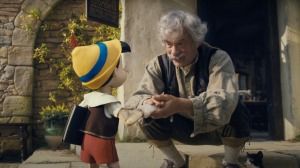 I don’t know what theme the Disney live-action movie has beyond its identity as a product launch. I suppose several years into the Disney live-action assembly line I shouldn’t be surprised that these movies are generally listless, inferior repetitions made to reignite old company IP. For a story about the gift of life, the Disney Pinocchio feels so utterly lifeless. I thought the little wooden boy was meant to learn rights and wrongs but the movie doesn’t allow Pinocchio to err. He’s an innocent simpleton who gets taken advantage of and dragged from encounter to encounter like a lost child. The Pleasure Island sequence has been tamed from the 1940s; children are no longer drinking beer or smoking cigars. They’re gathered to a carnival and then given root beer and told to break items and then punished for this entrapment. The grief Geppetto feels for his deceased loved ones is played out like a barely conceived backstory. He’s just yukking it up like nothing really matters. By the end, when he’s begging for Pinocchio to come back to life, you wonder why he cares. If you were being quite generous, you might be able to uncover themes of acceptance and understanding, but they’re so poorly developed and utilized. That stuff gets in the way of Pinocchio staring at a big pile of horse excrement on the street, which if you needed a summative visual metaphor for the adaptation, there it is.
Edge: Netflix Pinocchio
4. EMOTIONAL STAKES
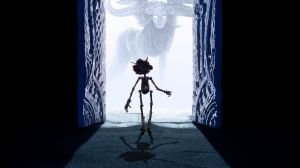 One of these movies made me cry. The other one made me sigh in exasperation. The Netflix Pinocchio nails the characterization in a way that is universal and accessible while staying true to its roots, whereas the Disney live-action film feels like a crudely packaged remake on the assembly line of soulless live-action Disney remakes. By securing my investment early with Geppetto’s loss, I found more to relish in the layers of his relationship with Pinocchio. In trying to teach him about the world, Geppetto is relying upon what he started with his past son, and there are intriguing echoes that lead to a spiritual examination. Pinocchio is made from the tree from the pinecone that Carlo chased that lead to his death. Pinocchio hums the tune that Geppetto sang to Carlo. Is there something more here? When he visits Death for the first time, the winged creature remarks, “I feel as though you’ve been here before.” These little questions and ambiguity make the movie much more rewarding, as does del Toro’s ability to supply character arcs for every supporting player. Even the monkey sidekick of the villain gets their own character arc. Another boy desperately desires his stern father’s approval, and he’s presented as a parallel for Pinocchio, another son trying to measure up to his father’s demands. Even this kid gets meaningful character moments and an arc. With this story, nobody gets left behind when it comes to thoughtful and meaningful characterization. It makes the movie much more heartwarming and engaging, and by the end, as we get our poignant coda jumping forward in time and serving as multiple curtain calls for our many characters, I was definitely shedding a flurry of tears. Hearing Geppetto bawl, “I need you… my boy,” to the lifeless body of Pinocchio still breaks me. Under del Toro’s compassionate lens, everyone is deserving of kindness.
As should be expected by now, the Disney live-action movie is lackluster at best when it comes to any kind of emotional investment. The characters stay as archetypes but they haven’t been personalized, so they merely remain as grubby facsimiles to what we recall from the 1940 version. Jiminy Cricket is meant as Pinocchio’s conscience but he vacillates from being a nag to being a smart aleck who even breaks the fourth wall to argue with his own narration. I hated every time he called the main character “Pee-noke” and he did it quite often. He’s far more annoying than endearing. There’s also a wise-cracking seagull that is just awful. The Honest John (Keegan Michael-Key) character is obnoxious, and in a world with a talking fox who dresses in human clothing, why would a “living puppet” be such a draw? He even has a joke about Pinocchio being an “influencer.” The only addition I liked was a coworker in Stromboli’s traveling circus, a former ballerina who injured herself and now gets to live out her dancing dreams by operating a marionette puppet. However, the movie treats the puppet like it’s a living peer to Pinocchio and talks directly to the puppet rather than the human operating the puppet, and the camera treats her like she’s the brains too. Safe to say, by the end when Pinocchio magically revives for whatever reason, just as he magically reverted from being a donkey boy, I was left coldly indifferent and more so just relieved that the movie was finally over.
Edge: Netflix Pinocchio
5. MUSIC
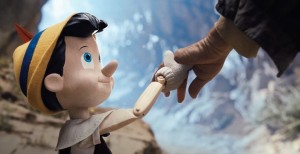 This was one area where I would have assumed the Disney live-action film had an advantage. Its signature banger, “When You Wish Upon a Star,” became the de facto Disney theme song and plays over the opening title card for the company. It’s still a sweet song, and Cynthia Erivo (Harriet) is the best part of the movie as the Blue Fairy. It’s a shame she only appears once, which is kind of negligent considering she sets everything in motion. The Netflix Pinocchio is also a musical and the songs by Alexandre Desplat (The Shape of Water) are slight and low-key, easy to dismiss upon first listen. However, the second time I watched the movie, the simplicity as a leitmotif really stood out, and I noticed the melody was the foundation for most other songs, which created an intriguing interconnected comparison. While nothing in the Netflix Pinocchio comes close to being the instantly humable classic of “When You Wish Upon a Star,” the songs are more thoughtful and emotionally felt and not just repeating the hits of yore, so in the closest of categories, I’m going to say that Netflix’s Pinocchio wins by a nose (pun intended).
Edge: Netflix Pinocchio
CONCLUSIONS
One of these Pinocchio movies is a visual marvel, heartfelt and moving, wondrous, and one of the best films of 2022. The other is a hollow vessel for corporate profit that copies the imprint of the 1940 animated film but only more frantic, scatalogical, and confused. In the year of our lord Pinocchio Two Thousand and Twenty-Two, there is only one movie you should see, and at this point ever see as it concerns this old tale. Guillermo del Toro has harnessed magic, and we are all the better for his bayonet imagination and enormous heart for his fellow outsiders.
Nate’s Grades:
Guillermo del Toro’s Pinocchio: A
2022 Pinocchio: C-
Share this:

Nightmare Alley (2021)
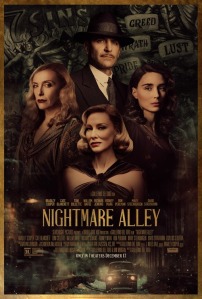 I’ve now watched both versions of Nightmare Alley, the 1947 movie and the 2021 Guillermo del Toro remake, and I guess I just shrug at both. Based upon the 1946 novel by Lindsay Gresham, we follow an ambitious yet troubled man, Stanton (Bradley Cooper), who finds refuge in a traveling carnival, mentors as a phony mentalist, and then uses his skills of manipulation to fleece the rich and privileged while possibly losing his own soul in the process. I kept watching this 150-minute movie and waiting for it to get better, to hit another level, and I had to keep asking, “Why isn’t this playing better for me?” It’s del Toro, an early twentieth-century freak show, a dashing of film noir, and a star-studded cast (Cate Blanchett, Willem Dafoe, Rooney Mara, Toni Collette, David Strathairn), and all those enticing elements should coalesce into something special and dark and adult and transporting, like del Toro’s 2017 Best Picture-winning Shape of Water. However, for me it just feels so turgid and overly melodramatic. I wish the movie had stayed with the traveling carnival and the colorful weirdos that it ditches halfway through. I think it’s because the movie plays to your exact expectations. You expect it to be beautifully composed, and it is, with a flair for the grotesque, a del Toro specialty, and the beats of its film noir-heavy story with femme fatale and double crosses comes across so predictably but minus substantial depth to compensate. I kept waiting for the themes to deepen, to be a better reflection of ourselves, but it’s one man’s circular downfall that doesn’t play too tragic because he’s already an unrepentant scoundrel. Cooper also just seems too old for the part, especially when everyone refers to him as a “young chap.” You might not see a better looking movie from 2021. The cinematography, production design, costumes, and stylish panache that del Toro trades in are all present and glorious to behold. I just wish I could get more from Nightmare Alley besides an admiration for its framing and less about what is happening to the characters within such doting artistry.
Nate’s Grade: B-
Share this:

Scary Stories to Tell in the Dark (2019)
 Based on the popular horror anthology for children, Scary Stories to Tell in the Dark is a fun, spooky appetizer for tweens and teens, and those who remember what it was like, as they transition into horror. Set in 1968, we follow a group of marginalized teenagers who come across a haunted book that is literally writing vengeful stories with their names in them. The stories are plucked from the books and brought to wonderful life with ghastly impressive practical makeup effects that eerily mirror the illustrations by Stephen Gammel. I wouldn’t call the movie disturbing or gory or even overly gross, but it can be unnerving at times drawing upon the suspense of someone hiding and/or worrying about what is advancing without recourse. I had some quality squirming in my seat in this movie. It’s a simple yet effective formula that is played well by director André Øvredal (The Autopsy of Jane Doe). Even when the signature vignettes aren’t on display, I was enjoying spending time with the teenage characters and watching them try and navigate being different in a small town, feeling lost or misunderstood, and really trying to decipher some system of rules with the haunted book. It feels akin to a Final Destination where a small band of characters are doomed and have to out think their supernatural boogeyman before the next one is picked off. It’s just enough that the movie doesn’t feel like it’s losing too much momentum when we have to transition back to the original material after leaving the scary story stars, the monsters. This is an enjoyable throwback to 80s children’s movies that were allowed to be a little creepy, a little odd, a little spooky, and not so safe and mundane. It’s also a fun movie for your more macabre-enchancted youngin’s out there and older adults that remember being macabre-enchanted youngin’s themselves.
Nate’s Grade: B
Share this:

Pacific Rim: Uprising (2018)
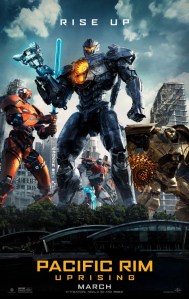 The original Pacific Rim brought out my inner child with its gee-whiz spectacle of giant robots fighting giant monsters, and under the artistic vision of Guillermo del Toro. I was eager for a sequel, as was my inner child. Thanks to China, a sequel was granted, though del Toro left to go win Best Director and Best Picture at the Oscars. The new director replacing del Toro, Steven S. DeKnight, came to fame on shows like Buffy the Vampire Slayer, Spartacus, and Netflix’s Daredevil. DeKnight acquits himself well in a world of big-budgets and big worlds, and while Pacific Rim Uprising is definitely lesser than the original, it’s still a whole lot of fun. John Boyega (The Last Jedi) leads the way as the son of Idris Elba’s character. It’s been ten years since the events of the first film and humanity is considering replacing Jaeger pilots with more cost-efficient drones. Then a rogue Jaeger starts attacking the remnants of the fleet, and Boyega and a scrappy pre-teen girl have to team up with a bunch of other Jaeger recruits to save the day. Where the first Pacific Rim rode the wave carefully to find a middle ground between cheese and awe, this time the movie swerves far more into cheese. Stuff gets silly, but if you can’t abide a little silliness then what are you doing watching this movie? The mythology and world building deepen, building off the last film, and they even supply a motivation for the aliens. It does feel at times like a pilot for a TV series, Jaeger Academy, and oddly the plot seems to follow Independence Day 2, Iron Man 2, Ender’s Game, and then ends right back with Independence Day 2’s closing sales pitch for a sequel that was never destined to be. Boyega has a fine reserve of charm and much is asked of him since the remaining characters are pretty slight. The action takes place almost entirely in daylight, a positive change from the original. The monsters don’t appear until the final act, which is not a positive change. It’s fun, goofy, and entertaining in the way that Saturday morning cartoons of your youth were entertaining. Uprising probably won’t be saved by China this time, but if you’re a fan of the first I have to think you’ll still enjoy the sequel.
Nate’s Grade: B-
Share this:

The Shape of Water (2017)
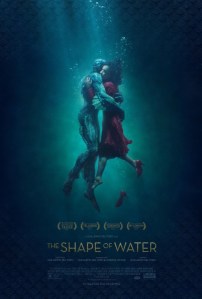 You haven’t seen a romance like director Guillermo del Toro’s latest monster mash (monster smash?), The Shape of Water. del Toro, an aficionado of cinematic creepy crawlies, has swerved from big-budget studio fare into a smaller, stranger period romance between a woman and an amphibious creature who already arrives pre-lubricated (I apologize already for that joke). I was compelled to watch The Shape of Water twice to better formulate my thoughts, mostly because I was not expecting the movie to be so enthusiastically whimsical, adult, and romantic, and the best beauty and the beast tale of this year.
Elisa (Sally Hawkins) is a lonely mute woman working on the cleaning staff at a classified government laboratory. Her neighbor, Giles (Richard Jenkins), is a hopeless romantic trying to find his place in the world as a gay man. Her best friend, Zelda (Octavia Spencer), is supportive but thinks they should mind their own business. An Amphibian Man (Doug Jones) from the Amazon is confined to a cell and repeatedly beaten by Richard Strickland (Michael Shannon), the vile head of security at the station. They believe the creature’s ability to breathe underwater and on land will be the key to winning the space race. The scientist in charge, Dr. Hoffstetler (Michael Stuhlbarg), is secretly a Russian spy, though his allegiances are more to the fragile creature than any country. Elisa teaches the creature sign language, the joys of hard boiled eggs, and lots of cheery music. She also falls in love with the creature and grows determined to save the Amphibian Man by breaking him loose.
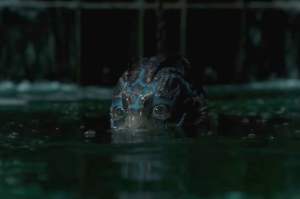 From the get go, del Toro drops us into a world that is not our own, as he’s so skilled at doing. This version of 1960s Baltimore feels as though it’s the twentieth century equivalent of a fairy tale village, and our monster is also the princess in need of rescue. Our heroine has a strange scar that foreshadows her place of belonging. The entire film bristles with a sense of expertly curated magic realism even though there isn’t anything explicitly magical. The supernatural and fantastical are met with a casual acceptance, as they would be in any storybook legend of old. When Elisa discovers the Amphibian Man in his tank, it’s literally at the ten-minute mark or even earlier, and she is unfazed. She immediately accepts the existence of this scaly mere-man, establishes a line of communication, and befriends the creature. It’s as if del Toro is trying to prime the audience for what’s to come and hoping to skip over the intermediate waiting period of incredulity. For del Toro, the real fun is once the characters connect, and belaboring that necessary connection is not in the audience’s best interests or time.
The movie glides by on effusive outpouring of charm, given such vibrant, sweeping life thanks to del Toro’s repertoire of pop-culture influences and his passionate love of cinema. The Shape of Water feels like del Toro and co-writer Vanessa Taylor (Hope Springs) took one of the old Universal horror B-movies and decided to make it into one of the most personal, delightful, and curious filmgoing experiences of the year. It’s film as escape for society’s outsiders. The sense of whimsy is ever-present without being overpowering or diluting the drama. It never feels quirky for its own sake of satisfaction. You’ll recognize several of del Toro’s artistic references, the re-purposing of cultural artifacts, but the magic suffused within every frame is thanks to del Toro and his team of filmmaking artists. If Amelie was going to fall in love with a sea creature, it might look something like this The Shape of Water.
The movie is also surprisingly, refreshingly adult in its depiction of human beings. Again the opening minutes set a standard of what to expect. We get a sense of Elisa’s daily routine before leaving for work, and one crucial component involves furious masturbation in her bathtub (set to an egg timer for sport?). This is a far more sensual movie than I was ever anticipating. There are multiple sequences of Hawkins disrobed and offering herself to the Amphibian Man. We never see any underwater action but we do hear about some of the mechanics of how the coupling is even remotely possible physically (“Never trust a man,” Zelda chuckles upon hearing those dirty details). It’s not all sexy time indulgences. There’s a sharp undercurrent of very real and very upsetting violence, typified by Strickland’s ruthless determination to break the creature. He’s a Bible-thumping sadist generally dismissive of those he finds different and lesser and yet he’s drawn to Elisa. Why is that? Because she’s a diminutive woman who cannot talk, and this sexually excites him like nothing else. He even comes on to her, thinking his interest is a form of masculine charity. There are some shocking moments of very real violence and its lingering effects. Strickland’s on-the-job injury becomes a metaphorical moral gauge for the putrid character’s state of being. The Shape of Water is a movie that does not blunt anything, whether it’s the sexuality or violence of its story (beware pet lovers: this is the second 2017 entry where an amphibian being hidden from the government eats somebody’s house cat). This is a fable for adults, a grimy Grimm’s tale with a sprinkle of Old Hollywood sparkle.
 The Shape of Water is also a deeply romantic and earnest love story about two outsiders finding a connection in the most unlikely of places. Engineering a story that pushes two oddball characters together, each finally finding a kindred spirit, is an easy recipe for a satisfying conclusion; however, their romantic connection has to feel rightly earned. If we don’t believe the characters have fallen for one another, that this potential relationship elevates their existence, that the colors of the world seem brighter when around this person, then it doesn’t work. You have to buy the love story and it must be earned. Amazingly, del Toro is able to craft a love story with a mute woman and an Amphibian Man that checks most of the boxes of Hollywood romantic escapism. Elisa has an openhearted way of looking at the world, and her acceptance provides her with a bravery few others have. The creature presents somebody who views her not as a woman with a disability, as something lesser, but as something whole and wholly fulfilling. Everyone wants to be truly seen by someone for who they are rather than what they’re not.
While del Toro is supremely skillful at making Elisa’s romantic yearnings felt, there is one inherent weakness in this girl-meets-fish dude tale of love. The Amphibian Man isn’t really much of a character and far more of a symbol to the other characters. To Elisa, he’s her hope. To Giles, he’s a wild animal. To Strickland, he’s a defiant challenge to be tamed. To Zelda, he’s the questionable new boyfriend for her pal. To Hoffstetler, he’s a beautiful creature. To the U.S. government, he’s a potential scientific breakthrough. To the Soviets, he’s a liability and a potential future weapon. We’re told the indigenous people of the Amazon worshiped the Amphibian Man as a god but ultimately he remains a cipher others project onto. The love story feels a little too one-sided from an audience investment perspective. Still, the romance works and that fact alone is incredible considering the unique pairing.
 Hawkins (Maudie) is the beating heart of the movie and delivers a wonderfully expressive portrait of a woman finding her voice, so to speak. She’s relatively upbeat and that fits the whimsical tone of the picture. Hawkins plays a woman excited by the possibilities of the world. She reminded me of Bjork’s tragic heroine from 2000’s Dancer in the Dark, a woman who saw the extraordinary in ordinary life, who could perceive a symphony of music just on the outer edges of everyone else’s hearing. Going completely wordless for the movie, save for one very memorable fantasy sequence, requires a lot of daunting physical acting from Hawkins, and she’s more than up to the task. I guarantee a scene where she tearfully forces Giles to say out loud her signing will be her Oscar nomination clip.
When we talk about the weird and wild promise of cinema, it takes a controlled, assured vision and precise execution to bring together the dispirit elements and allow them to coalesce into something that feels like a satisfying, mesmerizing whole. The Shape of Water is del Toro’s gooey love letter to monster movies while stepping outside of homage and into the realm of something daring and different. I could talk about the Busby Berkley musical number as declaration of love, or that the story is told from socially marginalized voices finding an affinity together, or the small character moments that give generous life to supporting figures like Zelda and Hoffstetler, or that it leaves implied stories to be chewed over for extra richness like Giles likely being outed at his work to the dismay of his closeted superior, or the perfect casting for secondary antagonists, or the exquisite cinematography that seems to utilize every shade of green the human eye is capable of seeing, or the stunning production design, or the sweetly eccentric whistling musical score by Alexadre Desplat, or the grace of Doug Jones’ performance in the amphibian suit, or just how funny this movie can be, even the sadistic villain. I could talk about all that stuff but I’ll simply condense it all to a plea to give The Shape of Water a chance. It’s rare to see a storytelling vision this precise that’s also executed at such a high degree of difficulty. In other hands, this could have been an unholy mess. With del Toro, it’s a lovely mess.
Nate’s Grade: A-
Share this:

Pacific Rim (2013)
 Pacific Rim is director Guillermo del Toro’s (Hellboy, Pan’s Labyrinth) giddy ode to the great monster movies of his youth, and if you’re fond of men in suits and large-scale cardboard destruction, then this movie is definitely for you. The word “awesome” seems too inadequate to describe the rock ‘em sock ‘em action of this picture. This is likely the most realistic and serious this concept will ever be realized, with a gargantuan budget and some top-notch special effects. del Toro, already something of a god in fanboy circles, will get his chiseled bust alongside Joss Whedon. Pacific Rim is a transporting blockbuster that doesn’t pull its punches, at least when it’s dealing with robots fighting monsters. If this is why del Toro dropped out of directing The Hobbit then I think it’s a good trade off.
In the near future, a rift opens at the bottom of the Pacific Ocean that opens a gateway to another dimension. Through this portal, giant horrifying monsters the size of skyscrapers appear to wreck havoc on coastal cities. The monsters, known as kaiju, take a whole lot of work to go down. “To battle monsters, we had to make monsters, “ say a character in the prologue. The world unifies and responds with a program where two people pilot giant mechanical robots known as jaegers (yes college kids, you read that right). These pilots are psychically linked via a process known as the Drift; they work in tandem, sharing one mind. Raleigh (Charlie Hunnam) is a former jeager pilot recovering from the loss of his co-pilot/older brother in battle. Stacker Pentecost (Idris Elba) recruits him back to the final days of the jaeger program, a defense that has fallen out of favor with world leaders once the kaiju started winning again. Stationed in Hong Kong, Raleigh is looking for a new co-pilot and by all accounts it seems Pentecost’s diminutive assistant, Mako Mori (Rinko Kikuchi), is the best candidate, though Pentecost won’t allow it. Add some wacky scientists (Charlie Day, Burn Gorman) and an underground monster parts trader (Ron Perlman). The last days of the beleaguered jaeger program are all that stand between mankind and annihilation from giant beasts.
 It’s undeniable how well Pacific Rim taps into your inner ten-year-old, the kid who crashed his toys together imagining larger-than-life battles. Truthfully, if I were ten years old, I’d likely declare Pacific Rim the greatest movie of all time, that is, until I saw one with boobs in it. Conceptually, this feels like just about every anime brought to life, and fans of anime, as well as monster movies in general, should be in heaven. It’s so much fun to watch but it also doesn’t get lost in the cacophony of special effects like many modern blockbusters. del Toro has a wonderful way of showcasing his action without losing track of the scale or the destruction. Unlike Man of Steel, we have city-wide devastation that feels like devastation. Giant monsters are a state of life for the world and so is the day-to-day anxiety that one’s coastal existence is about to be in ruins. The movie doesn’t get bogged down in post-9/11 solemnity, but at the same time I appreciated that del Toro makes his violence feel significant and the loss feel real.
The action onscreen is often exciting and screenwriter Travis Beacham (Iron Man 3) employs a nice system of escalating the stakes by applying a category system to the kaiju, rating them on a 1-5 scale. It provides a natural progression of opponents. Plus, besides the inherent excitement with the premise, Beacham and del Toro drop us into the middle of this story, years after the jaegers have fallen out of favor as a means of defense, thus providing another hook – underdogs. Our heroes don’t just control giant fighting robots, they are also underdogs and have to prove their mettle to dismissive authority figures. I was hooked.
del Toro has always been a man who can create living, breathing worlds that you just want to explore, and Pacific Rim is the same. I loved immersing myself in the minutia of this world, learning the different fighting techniques of the robot designs, the cultures that harvest the kaiju bodies (there are monster groupies as well), the rock-star status of the jaeger pilots, and most of all, the Drift. Psychically linking the pilots is an ingenious way to add to the emotional investment of what are otherwise fairly clichéd character types. They have to be in synch mentally, which requires a whole other level of trust and connection. The tragic back-story of Raleigh is given even more weight knowing that not only was he witness to his brother getting eaten alive by a giant scary monster, he was psychically linked and felt his brother’s overwhelming fear and pain. That would definitely shake me. The Drift also provides a unique way to include back-story without feeling like forced exposition. Seeing Mako’s horrifying childhood survival account is quite affecting, but it works even better knowing this is also a chance for Raleigh to understand and bond with her. That sequence, Mako as a child, is stunning, staying with her pint-sized perspective as she tries to outrun a ferocious monster bearing down on her. It slows things down and allows the true terror of the situation to seep in. Beacham and del Toro have put a great amount of thought with how this world operates, and it’s appreciated as seemingly every detail adds to a richer big picture.
Naturally, the special effects are just about every positive accolade you can put together. It’s a CGI heavy film that doesn’t look like a cartoon; something Michael Bay’s Transformers have difficulty overcoming. The robot designs aren’t overly busy. In fact, the main robot reminds me a lot of Metroid’s Samus suit (anybody?). The monsters are all a bit too similar in design though. They all start to bend together making it hard to differentiate them from one another, especially when they’re supposed to be getting bigger and badder. Part of my lukewarm reception with the monster designs, besides from del Toro’s sterling past reputation when it comes to creature designs, is that so many of the epic fight scenes happen with some level of visual obfuscation. They fight at night, they fight in the rain, they fight in the fog, they fight underwater, but rarely will they fight in a setting where you can clearly focus on the fighters. This very well could be a budgetary decision, allowing less work for visual effects artists so they can cover the scope of del Toro’s imagination. Still, it’s hard for me to compose an argument that a $200 million-dollar movie needed just a bit more money to properly show off the goods.
 When it’s not wrecking havoc onscreen, the story can drag and you’ll notice how thin the characters are developed. It’s another reluctant hotshot and learning to get over a personal tragedy, trusting a new co-pilot, and taking stern advice from a begrudging father figure. That doesn’t mean they don’t work within the framework of the story; Hunnam (TV’s Sons of Anarchy) is solid if unspectacular, Elba (Thor, TV’s Luther) is the universe’s most authoritative badass, Day (Horrible Bosses) and Gorman (The Dark Knight Rises) provide a nice array of comic relief, and Kikuchi (Babel, The Brothers Bloom) makes for a formidable upstart hero. The character roles are familiar and thinly sketched but they come together in a satisfying manner, each contributing to the mission, and each finding a moment to make you care. When the fate of the world is at stake, it’s hard not to feel some investment in our ragtag assembly of heroes. With that being said, you will still feel drag in the middle, waiting for the next attack and for our heroes to suit up and do what they do best. The extended second act involves denying Raleigh and Mako the opportunity to do what we all know they need to do – man a jaeger. It can get restless as we keep getting roadblocks to something that seems inevitable. It’s akin to waiting too long for John Reid to accept his outlaw status in The Lone Ranger. I will give Beacham and del Toro extra credit for not leaving themselves open for an immediate sequel. Also, do stay through the credits for a nice treat.
I can easily recommend Pacific Rim with minor reservations, and if giant fightin’ robots and monsters is your thing, then the reservations won’t even matter when you get a movie this entertaining, fun, and skilled at providing the gee-whiz factor. I wish all summer movies were this fun. I was squealing with glee watching a giant robot drag a cargo ship across the streets of Hong Kong, gearing up to beat down a huge monster. The movie is packed with little moments like that. As with other del Toro productions, the world feels nicely realized, lived in, and sprawling with detail, even if the monsters all start looking the same (monster racism?). The plot does suffer a bit when it refocuses on the humans, but then again what plot wouldn’t suffer when it takes you away from giant robots fighting aliens? Pacific Rim isn’t the first of its kind. Besides the anime, Godzilla, and even Power Rangers influences that spring to mind, there have been numerous movies that follow a similar premise of Giant Thing A squaring off against Giant Thing B. What sets Pacific Rim apart is del Toro’s innate ability to channel your childlike glee at the concept, turning something monstrous into something fun while still giving respect to the weight of the moment. This is not a dumb action movie. del Toro’s sprawling artistic sensibility takes on summer blockbuster filmmaking and shows you how it can be done right for optimal effect without making your brain hurt. Now I need round two.
Nate’s Grade: B+
Share this:

Mama (2013)
 Guillermo del Toro is no stranger to the things that go bump in the night. He helped shepherd the horror film Mama to the big screen, and his love of heavy atmosphere and creepy, agile, lithe figures of terror is still evident. This is a rather effective and very creepy little horror movie that has enough little scares, big screams, and plain skin-crawling moments to recommend. The plot involves two little girls left to fend for themselves out in the wilderness. The two young actresses are fantastic, with terrific physical command of their bodies, able to slink and hop around like feral beasts. They help emotionally ground what could have been an otherwise ordinary ghost story. Oh yes, the girls prayed to a protector known as “Mama” who happens to be a malevolent and jealous spirit. Pity Jessica Chastain (Zero Dark Thirty), not just for her Gothic haircut and heavy eyeliner, but also as the girl’s reluctant foster mom. I’m shocked at how disturbing it is to watch a highly articulated physical specimen bend and snap and scurry at odd angles, broken arms bouncing like insect mandibles. And director/co-writer Andrés Muschietti knows how to properly tease an audience with just enough show and tell. The end is rather rote and familiar but, due to the emotional connection, has moments of genuine poignancy. Credit the considerable talents of the little ones as well as the devious vision of Muschetti and the guiding hand of del Toro. Give Mama a look.
Nate’s Grade: B
Share this:

Rise of the Guardians (2012)
 Dreamworks animation has long existed in the mighty shadow of Pixar, but as of late the studios might be at a creative crossroads. After the excellent Kung Fu Panda films and How to Train Your Dragon, suddenly Dreamworks animated movies matured beyond feverish, pop-culture explosions and into character-driven, colorful, and genuinely heartfelt family films. I don’t think we’ll be getting something as dismal as Shark Tale again with the current path the studio is blazing. Rise of the Guardians looks like the pilot for a new lucrative Dreamworks family franchise. It’s easy to see the appeal for a superhero assembly of fantasy figures, though is every region going to have working knowledge of the Tooth Fairy? The movie just looked too silly to function for me, but I was optimistic after raves from a few trusted friends. Perhaps my own childlike sense of wonder is permanently replaced with a heart of stone, but I found Rise of the Guardians to be a somewhat entertaining but mostly stilted, intellectually and emotionally, journey.
The guardians are an ancient group of holiday-themed characters entrusted with keeping the sense of wonder alive in children. There’s Santa Claus, a.k.a. North (voiced by Alec Baldwin), and his army of yetti workers, the tooth Fairy (Isla Fisher), and her own collection agency of tooth-gathering fairies, the Sandman, in charge of the sweet dreams of children, and the Easter Bunny (Hugh Jackman), an Australian jack rabbit with a bit of a chip on his bunny shoulder. The world is threatened by Pitch (Jude Law), a bogeyman who desperately desires children to fear him again, because belief is what powers the Guardians. To stop Pitch and his array of nightmare creatures, the Guardians must add another member to their outlet, Jack Frost (Chris Pine). Except Jack has no interest in joining this fuddy-duddy group and would rather do his own thing, which usually involves wrecking havoc. Jack’s desperate to find out his past and figure out why he was chosen for his immortal role and what it will take to make kids believe in him.
 Ultimately, I just couldn’t really get into this movie. It’s set up like an Avengers team of children’s fantasy figures, but I felt like the movie failed to make me emotionally connect with their plights. The Jack Frost protagonist was another tired variation on the selfish, plays-by-his-own-rules cowboy character that needs to learn a dash of personal responsibility and putting others first. But his goal is essentially to be… seen. He’s worried kids will never see him because they won’t ever believe in him. That’s a fairly abstract existential crisis for your main character to have, and one that I found too odd to care about. The entire core of the movie revolves around children’s sense of belief, and unless you’re twisting this into some general statement about the purpose of faith (the Man in the Moon = God?), then I find it all to be silly considering we’re talking about the Tooth Fairy and Easter Bunny. I mean, the main kid (Dakota Goyo) has to be eight or nine years old and still fervently believes in these mythical creatures, to the point that he is literally the only person on the planet who believes at one dour point (sheesh, talk about how easily disillusioned kids can get these days). We’re celebrating a kid going into adolescence believing in these things. That just smacks me as a little weird if you stop and think about the film’s implications. This kid is going to grow up socially warped. Then again his beliefs are proven right, so maybe it’s just the rest of us cynical bastards out there who need to adapt. I guess I’m going to go accept my fate and be a crotchety old man now.
The plot feels too airy for my liking, too frenetic to get to the next set piece or chase sequence. It doesn’t feel like it ever takes the time to settle down and develop its characters or story. As a result, we’re left with a fairly middling backstory for Jack Frost that should be easy to figure out, but we’re also stuck in a world that doesn’t feel like the rules have been sufficiently explained. Case in point: the Tooth Fairy keeps all those baby teeth in one huge archive because, you see, the teeth hold memories. I guess. But then Jack’s after his own teeth to retrieve his forgotten past (yes folks, we have an amnesiac protagonist). I’m okay with this so far though it’s a tad forced, but when Jack does get those teeth, he’s presented with memories at the age of 18. I know people suffered through poor dental hygiene hundreds of years ago, but you cannot expect me to believe that Jack is still losing baby teeth. This is just one example where the movie didn’t come across as fully formed. The Guardians all seem to possess different super powers involving space-time travel, but then they don’t seem to do anything with these abilities that matters by the final battle. Pitch has the ability to craft nightmare creatures and all he does is end up making wispy evil-looking horses. That seems like a waste. There are not enough payoffs here with all the imaginative possibilities.
Rise of the Guardians has some enjoyable moments but it practically relies upon you to supply all the work as far as character empathy. We’re familiar with these magical figures, and so the movie gets by because we put in the emotional connection to Santa and the Easter Bunny, but the characters just don’t register on the page, at least with this story. I don’t know if David Lindsay-Abaire (Rabbithole, Inkheart) was the best candidate for the job, but he doesn’t give me enough reasons to engage with the movie. The characters are lackluster, their conflicts feel too abstract, the conclusion feels superfluous, and the world feels poorly defined, developed, and unsatisfying.
 I like Chris Pine (Unstoppable) as an actor, but the man brings absolutely nothing to the table when it comes to voice acting. Baldwin (Rock of Ages) and Jackman’s (Real Steel) performances are defined by their respective accents. I feel like Hollywood needs some sort of seminal moment to go back to genuine voice artists rather than hiring whatever celebrity. Yes we all enjoyed Robin Williams as the Genie in Aladdin, but are you going to tell me that Pine’s vocal work was so exceptional he had to be cast? It’s like having celebrities provide the voices for the helium-sounding Chipmunks. The best voice actor in the film is clearly Law (Sherlock Holmes) who does such a good job I felt more sympathy for him than I did Jack Frost. I know it’s commonplace in movies for the hero and the villain to have some duality, but I wasn’t probably supposed to jump ship as far as loyalty. Maybe I just found the actual kids in the movie to be annoying so I didn’t mind a magical creature preying upon their collective childhood fear. It reminded me of the space cloud villain from 2011’s Green Lantern flop, where I wondered if this fear-sucking cloud sought out the delicacy of children’s fears first.
To top it all off, I found myself left rather cold by the visual aesthetics of the movie. It has this overly androgynous, big-eyed anime feel, and I kept getting the sense that the whole movie looked like an extended video game cut scene. This movie even had Guillermo del Toro (Hellboy) and the brilliant cinematographer Roger Deakens (Skyfall) as producers or visual consultants, so I’m even more baffled at how visually poor I found the movie. The colors are so muddy and the visuals felt so limited for me, especially considering the imaginative parameters of the characters and their respective worlds. I thought Pitch seemed oddly similar in visual approach to Hades in Disney’s underrated Hercules. The action sequences had some nice visual panache to them as far as choreography, but I couldn’t stop thinking how cruddy and dreary everything looked.
Rise of the Guardians is based upon a series of yet-to-be published books by famed author William Joyce, who won an Oscar himself the previous year for the animated short, The Fantastic Flying Books of Mr. Morris Lessmore. I feel like that short was a better representation of magic and imagination than this film. The humor, the life lessons, the character development, it all felt so stilted to me. I thought the conflicts were too abstract and hard to care about (oh no, people have stopped believing in the Tooth Fairy!) and the world and rules felt too amorphous, poorly explained and creatively handicapped. If you’re going for a fantasy setting with larger-than-life figures, each with certain gifts and powers, hen I want the promise of that setup to be fulfilled. Rise of the Guardians isn’t a bad movie by any means but it left me cold and indifferent. It’s meant to strike at my childish sense of wonder, but I felt too often like a cynical adult, picking apart the frailties of its storytelling and muddy visual designs. It felt like it was missing the best magic of all: gifted storytelling. You’ll probably have more fun than I did, but that’s just because I probably have no soul.
Nate’s Grade: B-


 nathanzoebl
You must be logged in to post a comment.