Blog Archives
Elektra (2005)
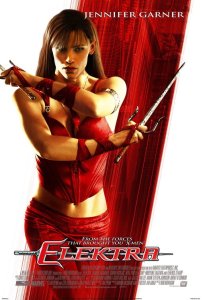 January is typically a cinematic wasteland. It’s the place where films go to die. So imagine my surprise when I heard that Elektra, a comic book movie built around a nimble sai-spinning assassin, was going to be released in January 2005. I remember at one time there were plans for a summer release, which means Elektra had fallen from the very top to the very bottom of expectation. After viewing Elektra for myself I can perfectly understand why anyone would want to dump this clunker.
Elektra (Jennifer Garner) is a feared assassin-for-hire (she even has an agent for her hits). She’s been brought back to life by a powerful sensei, but has ignored a possible higher calling to make her money killing folks. Apparently she is the mythical warrior that will keep the balance between good and evil, or something or other. Her next hit ends up being a nice guy (Goran Visnjic) and his teenage daughter. Elektra doesn’t have the heart to kill them, so she joins them and all three run away from the really bad guys, an ancient group known as The Hand.
Elektra doesn’t really bare comparison to other comic book films because Elektra feels more like a video game. In true video game fashion, I’ll numerically list the likenesses:
1) There is no such thing as characterization, just definition by super power. One assassin is super strong, another can suck the life out of creatures, and a third has the amazing ability to have his tattoos come to poorly rendered life (lucky this guy doesn’t have butterflies and fairies). With a powerful lack of imagination, these assassins are called Stone, Pestilence, and Tattoo (not the Russian girls who make out with each other. That’s Tatu.).
 2) The only sense of a story is pitting Elektra against one bad guy after another. There aren’t character arcs and subplots so much as there are end stage boss battles. It gets really repetitious.
3) The film seems like it’s bending over backwards to get character special moves into the story. With 1995’s Mortal Kombat, the writers, and I use that term in the loosest possible sense, had to work a story that included popular video game moves. Working so hard to include something so trivial and arbitrary really ties the storyteller’s hands. Elektra feels like the film would rather try and include some character’s special move rather than formulate a cogent storyline.
4) Once our assassins are vanquished they burst into clouds of yellow dust. I am not kidding. When they die they explode into clouds of mustard-hued gas. Just like in a video game, once you kill the bad guy they disappear with no necessary cleanup. It’s really thoughtful of them.
5) A second player can jump in at any time! In Elektra, different characters magically appear whenever it’s convenient and I?m not even talking about the super assassins.
6) Just like in a video game, you get an extra life! I don?t know why the producers of Elektra didn’t just make a prequel. With a sequel they have to work around their heroine’s untimely death in 2003’s Daredevil, and so we are introduced to the idea that a warrior of great mind can bring people back from the dead. So if Elektra dies (again) she can just be brought back to life. This whole idea practically eliminates any sense of danger and consequence.
So little of Elektra makes any kind of sense. Characters make rash choices and surprise appearances. The villains are a bland, cliched crop from some back order of ancient kung-fu brotherhoods. The plot is mysteriously oblique and has the frustrating habit of using cheats to get around logical roadblocks. About halfway through Elektra I gave up shrugging my shoulders and rolling my eyes. There is no definition on character limits, so anything can happen, and when it does it’s usually very stupid.
 Even worse is how dreadfully dull Elektra can be. The last two acts are compromised of nothing but a long, boring chase scene. The action sequences are brief and unoriginal, which include the thousandth inclusion of a hedge maze. There’s one moment where Elektra is battling in a room that has sheets flying all around for no good reason. It’s visually reminiscent of a Where’s Waldo? page. Take that for what you will.
The film is brisk, clocking in at just 90 minutes, but you don’t care about the characters because 20 minutes is spent establishing them, and the remaining 70 is spent watching them run.
The only redeeming quality of Elektra is its star. Garner is suited for the running, jumping movies, but she also has great acting chops behind her square jaw and impeccable physique. She casually generates intensity but also has a light, humorous touch. It doesn’t hurt that she looks fabulous in a red bustier. Her character is given OCD but then this plot is dropped entirely. Without the appeal of Garner, Elektra would simply be Catwoman.
Elektra is a flat comic adaptation that plays more like a video game, and just like in real life, watching a video game is no fun at all. Things happen, characters appear, people explode into clouds of yellow dust, and it’s all a bunch of uninteresting, half-baked nonsense. Elektra is frustrating, labored, ridiculous, and empty of thought and enjoyment. Why should I pay to watch Garner kick ass when I can watch Alias on TV and see Garner kick ass for free? And the plots of Alias are brazenly complex, fun, and high-spirited. I care about the people and events on Alias. With Elektra, the only thing I cared about was when the film was going to be over.
Nate’s Grade: D
Share this:

The Deep End (2001)
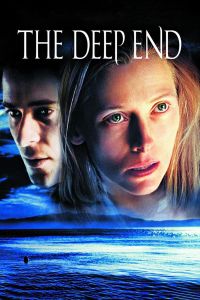 In the vast wasteland the summer has become of mediocrity and sub-mediocrity, go to your local art house. There you may very well see The Deep End, a dramatic thriller that burrows itself into the audience’s mind. The film is an absolute breath of fresh air in the stagnant summer finally winding down.
Tilda Swinton plays a normal mother living on the banks of Lake Tahoe. Her days usually consist of trying to ship her kids to school on time and handle the duties of the home in the long stretches her Naval officer husband is gone. She’s juggling responsibilities and chores when her first strike of maternal protection occurs. Her 17 year-old son is, to her great surprise, in a relationship with a sleazy man in his 30s. She discovered this when her son got into a serious car accident while this paramour was traveling with. The scene of the crash is replayed in flashbacks for Swinton as a motivational jump-start for her protection and love.
She tells the man she doesn’t want him seeing her son any longer, but of course he refuses to desist… unless the price is right. This revelation sends her son to a late night confrontation at home that ends in the accidental death of the sleaze. Mom sees her son rush back into the house in the middle of the night and decides to go out and investigate. On her stroll to her horror she finds the dead body of her son’s lover. From that moment on something in her clicks and she clumsily tries to hide the body and any evidence that could incriminate her own brood.
Just when she believes her headaches are over a dark and handsome stranger (Goran Visnjic) visits her one day. He has within his possession a videotape of her son having explicit sex with the dead lover. He threatens to turn the tape into the police and thus destroy the peace Swinton has created. The video can be hers, but she must pay him and his unseen partner the sum of $50,000.
 Tilda Swinton is best known as the gender-swapping title figure in Orlando based upon Virginia’s Woolfe’s story. The Scottish actress has a wonderfully pallid face and soulful eyes that express every moment the determination and fear she wrestles with. Swinton gives a remarkable performance of pure emotion. She is a mother determined to protect her son and family at every cost, no matter the means. She is constantly in over her head but refuses to relent. Swinton’s portrayal is a woman running on maternal instinct and she herself is the very gravity that makes The Deep End as great as it is.
Goran Visnjic currently plays a Croatian doc on E.R. but has a provocative presence in this flick. He’s got the smoldering good looks and his character opens up more and more as the tale progresses to strip away pretensions layer by layer.
The Deep End is directed, written, and produced by David Siegel and Scott McGehee, with only one other film to their credit all the way back in 1993. They inject their story with great moments of character and suspense but also have a terrific visual eye to create mood. The cinematography is lush and hypnotic with certain moments of exquisite beauty. Even the music adds to the feeling of the film unlike so many other accompanying scores. Every component of ‘The Deep End’ is just clicking.
The Deep End is a luminously tight thriller with remarkable performances. They story has a few implausible moments but outweighs them with heapings of great dramatic depth. Swinton better be one of the first choice on everyone’s lips when the name of Oscar rolls about, because I doubt I’ll see a performance more elegant and wonderful as hers this year.
Nate’s Grade: A


 nathanzoebl
You must be logged in to post a comment.