Blog Archives
Captain America: Brave New World (2025)

After seventeen years of constructing interconnected fables, not every Marvel movie is going to be exceptional, as each one serves as a mighty oar to propel the larger entity that is the Marvel cinematic Universe (MCU) forward. With over thirty movies, there are going to be duds and there are going to be movies that get lost in the machinery of the cinematic universe grinding onward. Consider Captain America: Brave New World one of those sacrificial offerings that nobody will remember in short order.
Sam Wilson (Anthony Mackie) has taken over the mantle of Captain America in the wake of the original, Steve Rogers (Chris Evans), retiring. General Ross (Harrison Ford) has recently been elected president and he wants Sam to reconstitute the Avengers. However, someone is triggering sleeper agents to try and kill Ross, and Sam is entrusted to get to the bottom of this conspiracy.

Brave New World is certainly trying to relive the formula that made 2014’s Winter Soldier such a genre standout, upending the status order of good versus evil through the prism of a political thriller. There’s an assassination attempt on the newly elected president, and it also happens to be brainwashed sleeper agents that can be activated at a moment’s notice. What helped make that 2014 movie work was that the sleeper agent happened to be Steve Rogers’ former best friend he thought had died back in WWII. There was a personal connection to the mystery and especially the figure of destruction. With this movie, the personal connection that Sam has to the mystery is almost immediately locked away, made to be an objective needing to be saved by eventually capturing the real bad guy in the shadows. Rather than having to face down a ghost from the past, a personal friend gone rogue, now we have Sam just chasing one shady bad guy to link to the next shady bad guy to a conspiracy that doesn’t even involve him. That was another aspect that made Winter Soldier excel, Steve’s allegiance and sense of patriotism running in direct conflict with the wishes of his government. It was personal and meaningful and challenged his perception. With Brave New World, it could have literally been any character uncovering this very limited conspiracy. That’s not a great start, making your lead character practically superfluous to the larger plot.
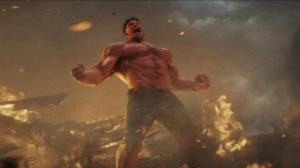
Much of this lingering conspiracy also hinges upon the identity of the Red Hulk, which might have been mildly surprising had Red Hulk not been such a vital element of the movie’s marketing. He’s in the TV ads, he’s in the trailers, he is the poster. This movie had more Red Hulk advertising than its titular hero. Unless you’ve walked into the theater blind, and congrats to you, for all intents and purposes this has been sold as the Red Hulk movie, and even if you’re walking in hoping for some wall-to-wall Hulk smash, then you’ll be sorely disappointed. There’s perhaps ten minutes at most of Red Hulk action, and it’s saved for the very end. It’s a climax that feels more perfunctory than satisfying, with the obvious reveal being held as something revelatory and meaningful when it’s just going through its basic blockbuster dance moves.
As is typically the case with movies that undergo many delays and re-shoots, Brave New World feels like it has far too many things going on and also simultaneously not enough going on. This is an unexpected sequel to 2008’s Incredible Hulk, generally regarded as one of the weakest MCU movies. The only thing that survived that movie was William Hurt (R.I.P.) as General Ross. I don’t think too many Marvel fans have been dying to have those characters and storylines picked back up after 17 years, but at long last you can see Tim Blake Nelson’s character again. Do you know what his character’s name is? Unless you’re the keeper of the 2008 Incredible Hulk fan wiki, I strongly doubt it. Quick, what’s his name without looking it up? It’s Samuel Sterns. Did you even remember Tim Blake Nelson being in the 2008 movie? The movie also has a global resource land grab to finally explain the frozen celestial body rising from the ocean ever since the events of 2021’s Eternals, a movie I fear we’ll wait an additional 17 years to get its own conclusion. This colossal being is the source of a new all-purpose element – adamantium, and that name should be instantly familiar for fans of the X-Men, as this movie pushes their inclusion that much closer. If The Marvels gave us Kelsey Grammar and Patrick Stewart’s return as Beast and Professor Xavier, this one boldly gives us… an elemental alloy (at this rate, two movies from now will introduce the X-Men’s jet as another sign to those in the know about what’s to come). It’s taking the leftovers from another movie to set up the larger scope of a branch of new movies down the road, while also tying back elements and characters from the earliest days of the MCU. It’s all a lot of table-setting unless there’s a compelling storyline with engaging characters and relatable conflicts and drama, and Brave New World does not. As a result, it’s all like watching a fast-moving assemblage of familiar parts trying to package itself together as a cohesive movie, and it just cannot. It’s one of those sacrificial movies at the altar of larger stories.
Which is a shame because there was a really fascinating and thought-provoking story at the core of Brave New World that barely gets any recognition amidst the explosions and gunfire, namely what does it mean for there to be a black Captain America? How does society respond when their patriotic symbol of American might now has more melanin? Considering how the Internet has throngs that lose their mind whenever a traditionally white male character gets changed into something different, I have to imagine there would be waves of people grumbling that this new “thuggish” Cap isn’t “their Captain America.” This is epitomized in the character of Isaiah Bradley (Carl Lumbly), a veteran who was also selected for the Army’s experimental super soldier project that gave birth to Captain America. Except because he was black during a time of segregation as the norm, he never got the adoration of Steve Rogers, and his accomplishments were ignored. In our current political climate, where diversity has become a convenient boogeyman, it would have been interesting to explore how the culture responds to a black man picking up the shield and being the next Captain America. It also would have invited a worthy conversation about where this country has let down its black populace, symbolized with Bradley’s past. Some of these themes were explored in the 2021 Disney Plus TV series Falcon and the Winter Soldier, but that doesn’t mean they couldn’t be meaningfully revisited given the elevated platform of the Captain America moniker. This was also the TV show that argued refugees could be terrorists, so there was room to grow. Unfortunately, this is only ever given passing mention, as institutional racism gets in the walk of Hulk smashing.

There was possibility with Brave New World but it too often seems to run aground with too many conflicting directions, underdeveloped ideas, and unfocused themes. The political complications, as well as evaluating the sins of the country’s past, could have made for a poignant and relevant movie with bigger things on its mind rather than getting to the next CGI slug-fest. It’s a Captain America with a new Captain America, so let’s explore what that means. It’s the franchise’s opportunity to begin anew with a different hero at its helm, and yet it feels more like an over-extended, disappointing finale to the Falcon/Winter Soldier TV series. It feels like an unneeded epilogue to an epilogue, and tying in so many disparate elements from films that people have forgotten or care less for seems like a strange creative choice when Marvel is looking to find its way in the wake of its post-Endgame walkabout. The worst crime with Brave New World is merely how boring all of it turns out to be. Far from brave, far from new.
Nate’s Grade: C
Share this:

The Electric State (2025)

The fire hose that has been the Netflix cash flow may be reigning in, but that didn’t stop the streaming giant from making another attempt at a huge blockbuster to rival those Hollywood designs for the big screen. The Electric State is a $320-million sci-fi adventure spectacle from the Russo brothers, Anthony and Joe, the team that gave us the highs of the Marvel Cinematic Universe (MCU) later Avengers movies, and the lows of, well, everything after their MCU movies. Netflix is actively trying to compete with the theatrical experience brought to you at home, so they take these big expensive swings on large-scale, quippy, action vehicles like Red Notice and 6 Underground every so often to mixed results. Netflix has become the go-to place for a kind of movie that has altogether vanished in the studio sphere, the mid-tier movie for adults. We need those stories. What Netflix hasn’t done as effectively is compete with the big studios for comparable expensive action spectacle. The Electric State is further proof.
In an alternate America, robots were created and given menial tasks by mankind. Naturally, they grew tired of this and attempted a revolution for their equal rights. Mankind was on the brink when an unlikely savior emerged. Tech CEO Ethan Skate (Stanley Tucci) created an army of humanoid drones controlled via VR helmets. This disposable army of avatars was able to beat back the robots and forced their leader, literally an animatronic Mr. Peanut (voiced by Woody Harrelson), to sign a “peace treaty.” The results exiled the robots into a walled off wasteland in the American southwest, and humanity went on its merry way, now with VR-controlled avatars that allowed every American the luxury of staying on their duff. Michelle (Millie Bobby Brown, contractually obligated to be in every Netflix original not starring Joey King) is an orphan WITH AN ATTITUDE. One day she’s greeted by a pint-sized robot looking like the Cosmo cartoon character her younger brother was obsessed with. The little robot says he is her brother and Michelle realizes that maybe she has some family left after all. She and the Cosmo bot are on the run from scavengers and bounty hunters trying to stop their fateful face-to-face reunion.

The Electric State is lacking such vital creative sparks to feel anything more than the ramshackle sum of its derivative sci-fi parts. It began as a melancholy mixed media book from the same Swedish author behind Tales From the Loop and it’s become a giant lumbering mess of mediocre and familiar elements. It kind of feels like the newer Ready Player One-era Steven Spielberg trying to emulate early E.T.-era Spielberg, but then that would give us an artist on the level of Spielberg, and that’s not what we have here. It’s standard adventure fare with a brother and sister crossing the country to save the day and thwart a big evil corporation along with scrappy, rakish rogues joining them along the way for fun and life lessons. Chris Pratt’s character is so transparently a Han Solo clone but he’s an empty vest with eye-rolling quips. This is an alternate history story with a literal robot uprising but it devotes so little interest in its own world building and history. The movie essentially castigates all the robots to a forbidden zone that naturally will be visited by our plucky heroes. The majority of the movie is watching these robotic avatars (reminded me of the Geth from Mass Effect) for people who can’t be bothered to leave their VR helmets. If this new world has devolved human interaction into a series of screens (commentary!) then maybe let’s explore that with meaning. If robots are going to be an exploited labor class (commentary!) then maybe let’s explore that too. If this is a future world where robots have been exiled and feared as an Other (commentary!) then let’s explore that too. There’s one moment where Evil Steve Jobs enjoys a VR recreation of his deceased mother, except he admits that this version is the version he wishes he had, and the real figure was far less doting and far more abusive. That’s an interesting concept, that VR offers users the ability to live in a reality of their own desires. But this isn’t a movie that wants to take time to explore interesting and relevant themes, because that would get in the way of action set pieces and goofy robot action. Seriously, there’s one fight where a U.S. postal service robot is literally hurling undelivered mail at a killer robot avatar and succeeds. Because this isn’t a deep movie, we have essentially good robots and bad robots, and if you’re shocked that the robots may have been misunderstood, well congratulations on seeing your first movie. I assure you, they mostly get better from here if you give them a chance.
The inclusion of robots is so underutilized, tapped for ready sidekicks and villains, that you could have replaced them with aliens or clones or any other disposable science fiction element. In this parallel world, Walt Disney created the robots for Disney World, so wouldn’t it be worthy of exploring that history and the sense of Victor Frankenstein-style paternal obligation? Wouldn’t the robots retreat to their ancestral home of Disney World? Or perhaps they view this as the birth of their enslavement? What about different generations of robots, especially older models being replaced with newer ones, thus creating class warfare within an exploited secondary class? What about looking at robots having to subsist off junk to continue with their meager existences? What about robots still living in forbidden zones that are hunted by the government and its armada of robot drones? There are so many possible ideas and stories and characters that are open through the inclusion of robots, but the movie doesn’t have the interest or drive to make them matter. As a result, it’s mostly a swift-moving travelogue with some ugly-looking or cranky guests riding shotgun. Occasionally The Electric State will remember, oh yeah, robots can do stuff people cannot, like having one of them hack into a server or having a smaller robot inside like a high-tech Russian nesting doll.

I think it was a combination of the uninvolved storytelling as well as the character design that left my emotional attachment to be null and void. I hated the Cosmo character design. He’s this big spherical head with little skinny limbs, but the head might as well be an un-moving mask. A giant toothy smile is drawn on the front and it’s so inexpressive. Also, the fact that the kid has to exclusively rely upon only using sound bytes from this canceled cartoon series makes for a quickly annoying little brother. I didn’t care about this kid, human or robot, and I didn’t care if Michelle ever reunited with her brother. Then the fact that the movie’s climax involves such a serious and emotional choice seems absurd considering what has been underdeveloped up until this abrupt shift in intended emotional stakes. It’s such an out-of-left field escalation that I almost laughed out loud at what the movie was asking me to feel, as well as what it was asking its protagonist to decide. Likewise, the betterment of robot-kind is given such little recognition, culminating in a showdown between the avatar of good robots and evil robots essentially going to revise a treaty that we don’t know much about. For a movie about how easy it can be to distance ourselves via technology, it sure fails to reasonably make the viewer care about robot equality.
Then there’s the fact that this whole enterprise cost an astounding $320 million for Netflix to platform it as its next hit movie to doze off to while in the middle of doing laundry. The Russo brothers have retreated back to Marvel to handle the next two Avengers movies, and it seems like at a time where both parties have missed and could use one another. Outside of Marvel, the Russos have delivered one super expensive action movie (The Grey Man), a super expensive spy action series (The Citadel), and one lackluster biopic that used every Scorsese stylistic trick they’ve been saving up (Cherry). With The Electric State, we have the brothers’ more familiar mixture of large-scale action and special effects in a mass appeal studio blockbuster space. However, every movie outside of Marvel has made me question their capabilities of handling these big movies. I know the Russos can be fantastic with comedy, as some of their TV episodes are the best of recent memory, and their stewardship of the big MCU movies in the wake of Joss Whedon’s departure was undeniably successful. So why isn’t The Electric State successful? It comes down to the screenplay which is so disinterested in its own ideas, world, and characters, held together by the familiarity of other adventure blockbuster staples like loose chewing gum. It’s a movie replete with famous faces and big effects but feels so devoid of life and creativity, a blockbuster automaton intended to hold the attention but rarely engage one’s imagination and emotions.
Nate’s Grade: C
Share this:

Megalopolis (2024)

Trying to make sense of Megalopolis is something of a fool’s errand. It clearly means something significant to its creator, legendary director Francis Ford Coppola. He’s been wanting to make this movie for decades and finally the urge just became too strong to ignore, so he sold his successful Zoetrope winery and put over $100 million of his own fortune into this movie to ensure his vision would be unclouded by meddling studio execs and moneymen. It’s the kind of bracing act of artistic hubris and ambition that is worth celebrating. It’s a big swing from a legendary filmmaker who has quite often gone overboard only to return from the brink with cinematic classics, like Apocalypse Now and Bram Stoker’s Dracula. Given his filmography, you would think that Coppola has more than earned the benefit of the doubt. Except… the Coppola of today isn’t exactly in his prime. He hasn’t had a great movie since 1992’s Dracula, and in those ensuing 30 years, he’s made inexplicable movies like Jack, where Robin Williams plays a kid who ages rapidly, and Twixt, a bizarre misfire with Edgar Allan Poe and vampires that was reportedly inspired by a dream he had. I would expect any new Coppola project to lean more towards these kinds of artistic follies than his generation-defining classics. The man is 85 years old and put all his remaining artistic cache and wealth into guaranteeing that we live in a world with Megalopolis. After seeing his long-gestating opus, I cannot say we are better for the trouble.
It’s hard to condense the plot of Megalopolis because so much is happening while nothing seems that important. For example, brilliant architect Caesar Catilina (Adam Driver) wants to build a new wondrous city he calls Megalopolis, a utopia for the masses. The power brokers of New Rome, including Mayor Cicero (Giancarlo Esposito) and CEO of the largest bank Hamilton Crassu III (Jon Voight), are against such radical changes and see Caesar as an upstart. It also so happens that Caesar can stop time at will, until he cannot. He also has discovered a miracle material to build his futuristic city, but nobody seems to care. The masses of New Rome are more interested in whether or not a pop star is still really a virgin. Julia (Nathalie Emmanuel), the mayor’s party girl daughter, witnesses Caesar stopping time, which is a big deal, or maybe it’s not, but she’s intrigued by the mercurial artist seeking to bring to life his unique vision. But Caesar only likes people interested in art and philosophy and books. Could he fall for her, and will it possibly cost his artistic vision from becoming a shimmering reality of hope?

This is a $100-million-dollar movie created entirely for one person, and if you happen to be Francis Ford Corolla, then congratulations, you will understand and properly appreciate the artistic messages and bravado of Megalopolis. For the rest of us poor souls, we’ll be struggling for meaning and insight. The movie almost exists on a purely allegorical level, or at least it must considering that so much of the scene-to-scene plotting is haphazard and underdeveloped.
Let’s start with the central conflict: why are these forces so immovably against one another? If you were the mayor of a city with a raft of problems, it would sure seem like a great move for a utopian addition. I suppose he and the other men in power are afraid of ceding some of their influence and status to this newcomer, and that is something that could have been explored stronger through generational conflict, the old having a stranglehold on power and losing sight of relevance but still clinging to their storied perches. Caesar should be a threat, an appeal to the people that they no longer truly serve. However, in this story, Caesar is so brilliant and any person standing in his way is meant to look foolish or evil. It reminded me a lot of Ayn Rand’s terrible book Atlas Shrugged that was turned into a terrible trilogy of ideologically rotten movies where the brilliant billionaires are tired of their genius being wasted by government regulation. Obviously Caesar is meant to represent The Artist who is being doubted or interfered with, which is how Coppola views himself, or at least filmmakers in general. Therefore this character can have no flaws and must always be right because the message is to give the great artists their space to be great, to challenge our preconceptions of what art can be. He must be vindicated, so it makes him a rather boring and simplistic character who wants a glorious future for the people.
But what exactly is Megalopolis as a utopia? All we know is that it has moving sidewalks and gyroscope orbs for traveling and it’s very glowy. Visually it reminds me of another Adam Driver movie, 2016’s Midnight Special, when the alien world began co-existing with our world. This magic future city is made of a magic future element that also has the magic ability to heal Caesar after he gets critically injured. All of those details beg for more clarity or development, along with Caesar’s ability to stop time, which I guess is hereditary. These elements should be more impactful, but like the utopian city of Megalopolis, they’re just convenient devices, to simply provide the protagonist with a means of solution whatever his dilemma may be. There’s another conflict in the middle where Caesar is framed with an altered video of him having sex with that virginal pop star, but this too is resolved ludicrously fast. Even this scandal cannot last longer than a few minutes before once again dear Caesar is proven virtuous and unassailable. When he has a magic solution for every problem, including reconstructing a hole in his face, and he can never be wrong, and he has no complexity except for his supposed genius, but his genius is also vaguely defined as far as the actual outcome of his supposed utopia, it makes for an extremely uninteresting main character that gets tiresome as we never flesh out his important attributes.

Likewise, the satire of Megalopolis is fleeting and broad and hard to really engage with. There’s the rich and powerful living in excess and with a sense of depraved callousness toward those they feel are lesser. This is best epitomized by Aubrey Plaza’s tabloid journalist character with the exceptionally bad name of Wow Platinum. She’s a gold digger and flippantly shallow as well as super horny, starting as a fling with Caesar before moving onto Clodio (Shia LeBeouf), the grandson to the CEO of the big bank. This woman has no guile to her and is transparently voracious for all she covets, whether it be sexual or material. With Plaza giving a delightfully campy performance, really digging into the scenery-chewing villainy of her character, it makes her the most entertaining person on screen, and a welcomed respite from all the other actors being so self-serious and stodgy and haughty. This tempers the satiric effect because now I’m looking at Wow Platinum as a godsend. Obviously New Rome is meant to represent the United States, so all of its foreboding narration about the death of empires is meant to make the audience compare the end of Rome to the internal fissures of America. Like everything else in the movie, the comparison is only skin deep, and it’s merely asking you to juxtapose rather than critically compare modern-day to the collapse of Rome. By the end, there’s some definite unsubtle swipes at topical political culture, like when Clodio adopts himself as a humble man of the people to “Make New Rome Great Again” and foments an army of red-hatted rabble. But what exactly is Coppola saying with this? That the people in power will pose as populists to manipulate the lower classes into action that benefits them? Not exactly breaking news, nor is it explored on a deeper or more complex or at least more interesting development. Much like the plotting of Megalopolis, the satirical elements are a cacophonous mess of dispirit ideas and directions.
It’s staggering to believe that the man who wrote Patton and The Godfather is the same man who wrote such lines like, “You’re anal as hell whereas I am oral as hell,” as Plaza looks face-first at Driver’s crotch. The dialogue in this movie is tortured and feels like it was written by A.I., or by aliens who were trying to recreate human social interactions but whose only archive of study was the amazing catalogue of movies by Neil Breen and Tommy Wiseau. The “Entitles me?” conversation that repeats itself four times, the “riches of my Emersonian mind,” to “when we ask questions, that’s basically a utopia,” to what might be the most eye-rolling line of 2024, where a vindictive Voight hides a tiny bow and arrow under a sheet by his waist and literally says, “What do you think of this boner I’ve got here?” Yes, the man who gave us The Godfather has also now given us, “What do you think of this boner I’ve got here?” The movie is so preoccupied with the fall of empires and yet a line of dialogue like that is a sign of the decline of an empire.

Ultimately, Megalopolis reminded me of Richard Kelly’s 2007 flop, Southland Tales, a connection I also felt while watching 2023’s Beau is Afraid as well. I wrote, “It’s because both movies are stuffed to the brim with their director’s assorted odd ideas and concepts, as if either man was afraid they were never going to make another movie again and had to awkwardly squeeze in everything they ever wanted into one overburdened project.” It’s an ungainly mess, a protracted and self-indulgent litany of Coppola’s foibles and follies, and it’s practically impenetrable for an audience. I challenge anyone to seriously engage with this movie beyond rubbernecking. I cannot believe this movie cost $100 million dollars and for a passion project there’s so little that makes me wonder how someone would be so passionate about this. It’s not a good movie but it has its own ongoing fascination for cinephiles morbidly curious what Coppola had to make. These are the kinds of bold artistic swings we should cherish, where filmmakers with storied careers are willing to burn it all down for one more project that must be just so, like Kevin Costner’s four-part Horizon Western that we’ll probably never see completed. I wanted artists to test the waters, to chase their visions, to be ambitious. But that doesn’t mean the art is always worth it.
Nate’s Grade: D
Share this:

Abigail (2024)
 Abigail feels very much like a spiritual sister for 2019’s Ready or Not, as it is a follow-up from the same writers and directors. It’s a bloody, funny movie about a hunt in a big mansion with a heroine who is battling against supernatural forces over the course of one long hellish night. We have a team of thieves kidnapping the young daughter of a man with money and having to hold her overnight. They don’t know one another and there’s an initial bristle to their discovery, like when an ex-police detective (Dan Stevens) and a recovering addict (Melissa Berrera) have equal measure not to trust one another. Things get worse when it’s revealed that their hostage, the titular Abigail (Alisha Weir), is not what she seems, a fact spoiled in the trailer. What follows is a topsy-turvy game of cat and mouse with some effective creepy moments and some lively humor without losing sight of the escalating stakes as well as the acclimation of new rules. The acting ensemble is highly enjoyable, particularly Stevens as a scuzzy authority figure, Kevin Durand as a himbo with an emotional core, and Weir, who has tremendous range to pull off the changes her character goes through. It’s not as fulfilling and finely developed as Ready or Not, one of 2019’s best films and one of the best endings to a movie ever, but Abigail is a first-rate bloody B-movie that might not hit as high but still satisfies.
Nate’s Grade: B


 nathanzoebl
You must be logged in to post a comment.