Blog Archives
The Descendants (2011)
 We’re so used to seeing George Clooney as a smooth operator, a guy who coasts on his suave charm and chiseled-from-granite good looks. But in The Descendants, Clooney is more vulnerable than he’s ever been, trying to keep his family together, and as the film plays out we realize just how mighty a task this goal is. His character is ill equipped to take the lead of his family, especially a family of growing girls he is consistently confused with. His journey is much more than just becoming a better father. That lesson would be far too pat for director/co-writer Alexander Payne. It’s been a good while since Payne’s last film, 2004’s Sideways, but in that time away he has shaped another outstanding human comedy that manages to squeeze in more emotion than most Hollywood movies could ever hope for.
Matt King (George Clooney) is a self-described “backup parent” who has been thrust into the lead role. His wife, Elizabeth, is in a coma after suffering a traumatic head injury from a Jet Ski accident. The doctors say that she has no hope of waking up and she will die in a matter of days. Matt must break the news to his 10-year-old daughter Scottie (Amara Miller) and his rebellious older daughter, Alexandra (Shailene Woodley). The headstrong Alexandra clashes with her faltering father, finally revealing the reason why she blew up at mom months ago. She found out that Elizabeth was having an affair. Matt is reeling and searching for answers from friends, family, and his two daughters.
 Payne’s specializes in pitch-perfect bittersweet character-based comedies, ones that seem to unfurl over a journey of self-awakening. His fictional worlds feel exquisitely rendered, where every character beat and every line of dialogue feels genuine. That’s quite an achievement for a filmmaker of any scope. Even when dealing with caricatures (like in 2002’s About Schmidt), somehow Payne gets away with it. With The Descendants, the sunny setting of Hawaii is just an exotic backdrop for some wonderful, and wonderfully relatable, family drama. It’s hardly the worry-free paradise. Uncovering his wife’s secrets has lead Matt to reassess the woman he loved. The movie completely upends the standard deathbed goodbye trope. Instead of characters openly bawling about the loss of a saintly soul taken far too soon, we have characters dealing with real conflicted emotions, particularly anger, directed at the indisposed and unfaithful mother. Every character is approaching grief differently, and every character is trying to make sense of their feelings before Elizabeth’s inevitable passing. Matt’s father-in-law (Robert Forster) is harsh with accusations at the ready, blaming Elizabeth’s tragedy on Matt’s shortcomings as a husband. His pain is raw but al too recognizable. Matt and Alexandra are plotting how much info to reveal to young Scottie, trying not to ruin her image of her mother, a tremendous challenge with no easy answer.
This is the stuff of grand drama, and Payne doesn’t skimp on the heart-tugging moments. The Descendants is also a great comedy, naturally finding humor drawn from the situation and characters. The advertising has made The Descendants appear like a broad family comedy, with Clooney flapping around in his noisy flip-flops. This is not the case. The comedy doesn’t feel insensitive or too macabre, instead it adds another enlightening level to these people and their pain. We try and make sense of our world, to cope with our struggles and failures, with comedy, and so too does Matt and his family. You’ll probably be surprised how often you laugh and then in the next moment feel a lump in your throat. The character of Sid (Nick Krause) starts off as a questionable plot tagalong, a doofus for some easy laughs. His reaction to an elderly woman with Alzheimer’s is the movie’s one point of questionable validity. As the film progresses, this laid-back guy is revealed to have more layers, just like the rest of the clan. The second half of the film becomes something of a minor key detective story as Matt and Alexandra search for the elusive “other man.” As Alexandra eggs him on, the two bond over this manhunt and Matt becomes bolder, more confident, and clear-headed about the hard decisions that are necessary for his new life. The emotional rewards of the film are nourishing. Watching Matt and his daughters sit on the couch watching a movie together (March of the Penguins no less. Draw your own connections about parental turmoil), you’ll feel satisfied that this broken family has begin to heal itself.
The Descendants takes an interesting turn when we learn more about the other man’s background. Matthew Lillard (Without a Paddle) is actually respectable as Brain Speer, the real estate titan having the aforementioned affair with Elizabeth. Matt’s confrontation is subdued, sidestepping righteous grandstanding for a better attempt to seek understanding. Instead of lecturing Brian, he wants to know more about what his wife was after that Matt could not offer. Sure he’s still angry and doesn’t let the guy off easy. Complicating matters is the fact that Brian has a wife, Julie (Judy Greer), and two children. Matt is trying to find answers without willfully harming Brain’s family. Greer (Love Happens) has an outstanding sequence where she feels beholden to forgive rather than hate, a note of grace that feels rather profound.
Clooney at one point says he’s just trying to keep his head above water, and you can see why. The man shows a great deal of range as his character confronts his grief. There is no “right” way when it comes to grieving, something deeply personal. Matt’s dilemma is given an unlikely situational twist, but the feelings of betrayal and confusion are all too believable. Matt is looking for answers when the person who holds them all lies sleeping. As he develops a lager picture of his wife and her unhappiness, Clooney expertly flashes through a multitude of thoughts. While arguably not as textured as his performance in Up in the Air, Clooney is in fine form, showcasing a deeper sense of loss and anxiety. Matt is trying to find his footing while his world radically adjusts, and nothing has adjusted more than his feelings toward his wife. Clooney doesn’t have any Big Moments of Great Emotion, though lashing out at his comatose wife comes close, but the man’s nuanced portrayal of a life in flux is the stuff that award ceremonies were made for.
 Woodley is a remarkable discovery, more than holding her own with Clooney. She is excellent in her portrayal of an aggressive, mouthy, rebellious teenager. It’s all the more astonishing because Woodley’s long-running TV show, The Secret Life of the American Teenager, is one of the worst shows still running on television. The show is so inartful, the dialogue is so tin-eared, and the acting is wooden like the actors have been imprisoned. Where has this actress been the whole time? Woodley’s performance is so alive with genuine feeling, stripping away any reservations of the too typical bratty teen role. She’s much more than a troubled teen sent off to boarding school. Her every inflection, hesitation, motion feels completely natural for her character, and when Woodley gets her big dramatic scenes she is a force to witness. Upon the sudden news that her mother will die soon, she plunges underwater in the family pool and screams as loud as she can, tears squeezing out of those sorrowful eyes. For goodness’ sake, this girl cries underwater. An Oscar nomination is assured for the 20-year-old young actress. Maybe she can quit her crummy TV show after the wave of good press and fawning praise that await her.
The Descendants is an incredibly observed human drama, a humane and touching comedy, a movie so engaged and plugged in to the messiness of human emotions, eschewing the bitterness of some of Payne’s earlier works. This is a thoughtful and nuanced flick that is elevated to even grander heights due to the excellent performances of father/daughter team Clooney and Woodley. The film hits all those traditional emotional notes but on its own terms. The movie approaches a graceful resolution by accepting the incomprehensible disarray of life. The Descendants is just about everything you’d want in a movie: supreme acting, strong characters, an affecting story, and emotions that are completely earned. Payne’s mature and tender movie is, by the end, rather hopeful, a celebration of family overcoming adversity. It’s not schmaltzy in the slightest but a powerful antidote to simple cynicism. This holiday season, be a good movie citizen and spread the word of The Descendants.
Nate’s Grade: A
Share this:

The Ides of March (2011)
 The Ides of March is that rare political thriller that pulls the curtain away to come to the stolid conclusion that our entire political system is incontrovertibly stuck in the muck. This is a deeply cynical movie that posits that politicos are just about spinning truth, cutting backroom deals, attaining power and influence, and living to fight another day. Even the ones who champion integrity have plenty of salacious skeletons in their closet. So while Ides of March is in one way a liberal reductive fantasy, casting co-writer and director George Clooney as an Obama-style change agent, and Clooney can assert all the rabble-rousing missing from the current occupant of the White House, it still sticks to its deep-seated cynicism. There is nobody that looks good by the film’s end. Ryan Gosling stars as a magnetic campaign director trying to push his guy over the top by winning the all-important Ohio Democratic primary. As the primary gets closer and the race gets tighter, Gosling has to cover up potential scandals while skillfully using his intimate knowledge of them for opportunistic deal making. The film moves at a great clip, the dialogue is intelligent, the characters are rich and ambiguous, and every one of the sterling thespians gets at least one big scene to stretch their acting muscles. The film has plenty of intriguing twists and turns, as the pieces all fall into play for one final power play. If you’re a fan of smart political thrillers, then do not beware The Ides of March.
Nate’s Grade: B+
Share this:

The Men Who Stare at Goats (2009)
 This movie was a big letdown given the cast, the strange true origins of this fantastic tale, and even with the title. This odd little film feels tonally off. The material feels mishandled, mixing broad humor and with military satire and the dark realities of the war in Iraq. The premise is solid — a Pentagon program training psychic soldiers, men convinced they could run through walls or terminate goats through the power of thought. Why then does the movie feel so misguided and rudderless and, ultimately, boring? Never has such an outlandish concept, based on true events, felt so devoid of edge. The satire picks safe targets and the comedy remains farcically broad. I think the film’s downfall can ultimately be traced to the decision to turn this material into a fictional narrative. I would have preferred an actual documentary detailing the men, women, and goats involved in the real Pentagon program. If truth can be stranger than fiction, why dress it up and then dull it through fiction?
Nate’s Grade: C
Share this:

Up in the Air (2009)
 Up in the Air is the kind of movie that slyly sneaks up on you. This charming comedy is much like George Clooney’s character, a man paid by cowardly bosses to fire their employees. He’s so good at his job that his skills appear effortless, but at the same time he can take heavy subject matter and make you feel better and thankful afterwards. The topical backdrop of corporate downsizing and layoffs could produce plenty of easy pathos, but Up in the Air works expertly on several layers; it’s a brisk, clever comedy with revealing repartee; it’s an adult romance that blissfully lets them behave like mature adults; and it’s a moving character piece about people realizing what they have gained and lost due to their lifestyle choices. When Clooney is fighting back tears from a crushing disappointment over being overlooked to walk his sister down the aisle, it may be the most compactly perfect moment of acting in his career. Throughout director Jason Reitman’s script (he co-wrote the adaptation of Walter Kirn’s 2001 novel), the human element is debated in our technological age. Clooney’s young cohort (Anna Kendrick) wants to simplify by firing people over the Internet. What is the cost of losing our human connection? Reitman doesn’t resort to a stolid happy ending, which is somewhat of a relief. The movie doesn’t present easy answers or pretend that life can be tied up with a bow. Up in the Air is a bristling comedy with an understated emotional current running alongside. It’s racking up tons of awards and deserves many of them, though I won’t get t the point of calling this the best film of 2009. However, Reitman has delivered another deeply entertaining, charismatic, and involving comedy that sprinkles in potent human drama.
Nate’s Grade: A
Share this:

Burn After Reading (2008)
 The Coen brothers tend to follow serious works with silly, and now that they have a heap of Oscars from 2007’s No Country for Old Men audiences can expect extreme silliness. Burn After Reading is a farce in the best sense of the word; it’s a send-up of the spy thriller where morons inhabit every role. The incompetent characters repeatedly act impulsive and the whole movie’s tone is cranked to outlandish heights. The score by Carter Burwell is like a continuous thundercloud that underscores the ridiculous and faux ominous atmosphere. The Coens have been accused of ridiculing their characters and being too detached and clinical as screenwriters. I do not believe this for a moment. Anyone who watches Burn After Reading can tell that the Coens love their characters, especially Brad Pitt’s ebullient personal trainer. Pitt is a comic joy and brings fresh life to his fun character, a highly cheerful doofus who can’t stay still. Even the funky way Pitt walks is worth a giggle. Burn After Reading takes some surprising twists and turns and could have been much longer than 96 total minutes. The Coens go to such terrific lengths establishing great oddball characters and great comedic scenarios, and then the whole movie just comes to a close when it feels like it’s hitting another gear. Still, Burn After Reading may be no masterpiece but its yet another unconventional and mostly entertaining comedy from the reliably quirky Coen brothers.
Nate’s Grade: B+
Share this:

Michael Clayton (2007)
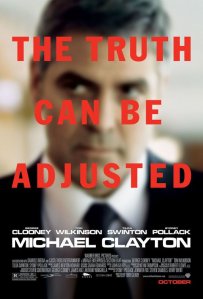 A smart, suspenseful, terrifically acted corporate thriller, this movie hums along with great precision thanks to a deeply articulate screenplay by writer/director Tony Gilroy. The acting trio (George Clooney, Tom Wilkinson, Tilda Swinton) delivers sensational performances muddled with doubt and weary, nervy complexity; each comes across a full human being in what could have come across as a dull Law and Order episode. I don’t understand why Gilroy plays around with the film’s timeframe, because he spends nearly ten minutes at the end in a suspenseful car chase where we already know the outcome. There is a murder that is played against Hollywood convention; it’s quick, grimly efficient, and scary in how soon it’s all over. Michael Clayton is a first-class movie that respects the intelligence of an audience.
Nate’s Grade: A
Share this:

Ocean’s 13 (2007)
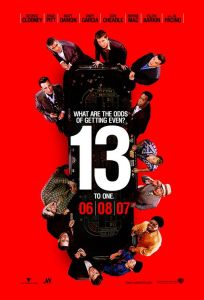 Much more like 11 than 12, this latest Ocean’s caper is just as preposterous as all the others but remembers that the audience needs to have fun too. Danny (George Clooney) and his baker’s dozen are plotting revenge on Willie Bank (Al Pacino, looking like a leather couch), a ruthless casino mogul who pushed old friend Rueben (Elliot Gould) out of a business agreement. The boys must outwit casino workers, modern technology, and a super computer able to detect pupil dilation in order to fleece Bank’s Vegas eyesore. Thankfully, all of the players are back and given tasks to do, and some of the means of their scheme are ingenious. How do you pass a lie detector tests? Place a tack in your shoe so that all your truthful answers match the intensity of your false ones. How do you get your hands on rigging dice? You send a couple guys to work in the Mexican factory and, why not, start a worker’s revolt. Ocean’s Thirteen glides along almost too smoothly, barely stopping to enjoy the crazy amount of absurd machinations before they fly by. The dialogue is packed with coded terms and the film doesn’t even stop to explain them. The movie works on the contact high of cool it luxuriates in, but unlike Ocean’s Twelve, this time the gang is given an objective, allows the audience in on their plot, and then we sit back and watch the execution. Steven Soderbergh and the gang have created a slick and amusing sequel. It lacks the freshness of the first go-round in 2001, but Ocean’s Thirteen is the most satisfying three-quel so far in a summer already weighed down by them.
Nate’s Grade: B
Share this:

The Good German (2006)
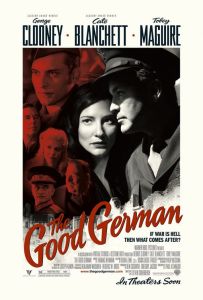 Steven Soderbergh has always seemed uncomfortable with his success and thus tried to stretch his creative wings with experimental gambles. They’re certainly ambitious but many times Soderbergh seems to be giving himself busy work. Did anyone see Bubble? I didn’t think so. The Good German is a film that wants to be seen as a forgotten relic from the 1940s, and Soderbergh went so far for period accuracy that he filmed with equipment from the same bygone era. That kind of artistic integrity is great, but what does it do to make the movie any better? The Good German aspires to be a cinematic cousin to Casablanca, even aping the iconic ending to that famous film. You’ll also get Chinatown déjà vu, especially when characters say, “Hey Jake, it’s Berlin.” The plot hinges on a murder around the Berlin conference with the Allied powers that will decide the fate of Europe and reshape the map. The story is too muddled and confusing and seems to amount to little to nothing after flirting with intrigue. The actors give hammy performances that may be true to the stagy, well-articulated acting styles of old Hollywood, but it does little in the realm of being enjoyable. Cate Blanchett is intended to be Marlena Dietrich, and George Clooney is intended to be Cary Grant, but neither manages to escape being a second-rate impression of their film noir forbears. There’s an interesting post-war story buried under all this period homage and Method-style artifice, but Soderbergh only seems interested in pleasing himself with these experimental errands, and this is coming from someone that loved Schitzopolis.
Nate’s Grade: C+
Share this:

Good Night, and Good Luck (2005)
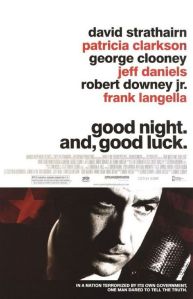 George Clooney’s pet project is articulate and a tad dull. The black and white cinematography is elegant; you can practically taste all the smoke onscreen. The idea of press vs. fear-mongering politician is very relevant today, and the film’s insight into the running of TV news is really interesting, but this is a movie that works best as a study and not as strict entertainment. It?s not stuffy or ideologically overwhelming; in fact it’s easy to follow and easy to get into, even if it leans too heavily on speeches. Clooney, as I predicted, is transforming himself into a terrific director with a great feel for his material. With Good Night, and Good Luck it seems like he got exactly what he wanted, regardless if an audience is going to walk away feeling they got their money’s worth.
Nate’s Grade: B
Share this:

Syriana (2005)
 Written and directed by Stephen Gaghen, Syriana is very reminiscent of his Oscar-winning work with Traffic. It’s very dense, complex, and demanding of its audience, which is both its best and worst aspect. I needed a notepad to keep up with the multiple criss-crossing storylines. It’s similar to Traffic in scope and texture, but this film seems a whole lot angrier. Whereas Traffic felt like it was trying to hold a mirror up to society, show us the truth of the failing War on Drugs, this movie feels like a wake-up call as well as a call to arms. Syriana is desperate to shake people out of complacency and show them how the world is running. I love the fact that the “Free Iran” committee in the film that preach Iran’s desire for democracy are not backing the emir’s son that wants to educate his country, install democratic freedoms, put women on equal footing as men because … he wants to open the oil fields to China because they’re offering more money. They are backing the less-enlightened son because he’s willing to give America what it wants: oil. The movie is a mostly potent microcosm about questioning who has our best interests at hand. It’s a bit slow at parts and incredibly rushed at others, and your head will be left spinning trying to keep track of the wealth of information it throws at you. It is thought-provoking even without an emotional connection. This flick reminded me of The Constant Gardener, also a screed against the evils of big business though grounded in an evolving love story. This is a movie I admire more than I can say I enjoyed.
Nate’s Grade: B


 nathanzoebl
You must be logged in to post a comment.