Blog Archives
Wolfs (2024)
 George Clooney and Brad Pitt star as rival fixers, unscrupulous men the rich and powerful call upon to clean up the messes of the rich and powerful, as Clooney portrayed in 2007’s Michael Clayton. It’s clearly playing upon the movie world depiction of these kinds of characters, whose titular name comes from the famous Pulp Fiction fixer played by Harvey Keitel. I don’t know what writer/director Jon Watts (Cop Car, Spider-Man: No Way Home) wanted to say or even achieve once he brings these two bickering and aging alphas together on-screen. The first ten minutes is played completely straight, as the drama of a high-powered woman in peril (Amy Ryan) leads to dueling fixers with different bosses being put in charge of disposing of a body and returning stacks of ill-gotten goods. You might assume with this premise that the movie will be a cantankerous buddy movie, with the professionals trying to measure their competition over the course of one long hectic night. It plays with this professional rivalry for a while, but then Wolfs gets bogged down by mafia wars, double crosses, and convoluted conspiracies the fixers are trying to untangle while bringing on an unexpected third wheel to the night of shenanigans. The plot gets easily lost, and the comedy feels lacking and underwritten, relying upon the star power of its leads to serve some kind of ironic undercurrent of energy. I kept thinking to myself that this premise, with these actors, should be a lot more fun. By the end, it feels almost like a setup for a wacky TV series for further adventures, but if this is the level of entertainment we’re getting from this pairing, let the old men die off-screen, thank you.
Nate’s Grade: C+
Share this:

Solaris (2002) [Review Re-View]
 Originally released November 27, 2002:
A most amazing thing occurred when I sat down in my theater to watch Steven Soderbergh’s sci-fi remake, Solaris. The majority of the theater was women, no small part I’m sure to George Clooney and the promise to see his posterior not once but twice. As the film progressed I kept hearing the rattling of seats and the exit doors. When the lights came back on more than half my theater had walked out on Solaris. I have never seen this many walk outs for any film before, and if one has to hold this title Solaris certainly does not deserve this dubious honor.
Clooney plays Chris Kelvin, super future psychologist who is struggling to overcome the grief over the suicide of his wife, Rheya (Natascha McElhone). Clooney is dispatched to a space station orbiting the mysterious glowing planet Solaris. Seems strange goings on, are, well, going on. When he arrives he finds that the station head has taken his own life and the two remaining crew members on board could use more than a few hugs. Clooney goes to sleep (in a bed resembling bubble-wrap) and is startled awake when his dead wife is suddenly lying right beside him. But is it his wife? Is it merely his memories being recounted? Is it Solaris messing with his gray matter? Does Rheya have consciousness of the past or of her self? What are her thoughts on her new materialization? Good luck Steven Soderbergh, existentialist party of one.
It’s not that Solaris is necessarily a bad film, it’s just that it’s plodding, mechanical and overly ambitious. There are long periods of staring, followed by brief exposition, then more staring, sometimes earnestly but mostly slack-jawed. Solaris is attempting to be an existential meditation on identity and self, but what really occurs is a lot of nothingness. For a movie that was over three hours in its original 1971 Russian conception, and a mere 93 minutes in its slimmer Soderbergh size, I could likely get this movie done in 6 minutes. It could be argued that its arduous pacing amplifies its methodical subject matter but whatever.
 Clooney has said in interviews how Solaris was the most challenging role of his career. To this I make a collective noise of disagreement. Clooney turns from grief-stricken to confusion, then back to grief-stricken with nary a line of dialogue. The effect is more dampening than emotional. Clooney’s conscience gets even worse when he banishes New Rheya into the cold vacuum of space then Another Rheya appears the next night. He just can’’t escape this dead woman.
I’m very pleased to see the glassy-eyed, apple-cheeked actress McElhone in movies again. She seemed to be on the cusp of mainstream acceptance after prominent roles in 1998’s Truman Show and Ronin, yet she just disappeared. McElhone is a wonderfully expressive actress and deserves to be a leading lady.
Soderbergh’s take on existential dread could be described as a noble failure. Solaris is the type of overreaching, underachieving film only really talented people could make. And for anyone wanting to leave after the double dose of Clooney’s derriere, they both happen in the first 30 minutes. You can go after that if you so choose.
Nate’s Grade: C+
——————————————————
WRITER REFLECTIONS 20 YEARS LATER

I think Steven Soderbergh is the perfect film artist to discuss the topic of the “noble failure.” That’s what I dubbed his remake of Solaris in 2002, and having re-watched it twenty years later I would still concur. Soderbergh is the ultimate idiosyncratic indie auteur who, miraculously, found himself Hollywood success and power. Soderbergh is probably best known for the Ocean’s Eleven trilogy of slick, star-powered heist movies, or his Oscar-winning 2000 movies Traffic and Erin Brockovich. The last time a person scored two Best Director nominations in the same year was 1938 (Michael Curtiz for Angels with Dirty Faces and Four Daughters, if you are dying to know). Soderbergh has never rested on his many laurels, and every new mainstream success inevitably saw the man flirt with new narrative and technical experimentation. It seems like Soderbergh gets restless every so often and needs to find a different reason to excite him about a filmmaking challenge. He made a small indie about workers in a decaying doll factory that was released same day on DVD as it was in theaters. He made a two-movie political epic on the rise and fall of revolutionary Che Guevara to showcase the amazing capabilities RED high-definition digital camera. He created an action vehicle for MMA fighter Gina Carano because he saw a future star-in the-making in her bouts. He filmed a movie entirely on an iPhone camera because he could. He made a movie about male strippers based upon Channing Tatum’s past experiences and it became one of the most successful movies of his career.
 In short, Soderbergh is a restless artist who always seems to be trying to challenge himself. However, many of those experiments don’t always work. 2018’s Unsane would have been forgettable minus its iPhone gimmick. 2006’s The Good German would have been forgettable without its pastiche to older Hollywood style. Even when his movies do not fully work, you feel Soderbergh’s passion to experiment and push his boundaries. It’s with this context that I re-watched 2002’s Solaris, based upon the 1972 meditative and melancholic sci-fi movie by Russian filmmaker Andrei Tarkovsky. It’s amazing to me that Soderbergh, right after his twin Oscar noms and the box-office success of 2001’s Ocean’s Eleven gave him artistic cache, said, “I want to remake a three-hour Russian movie from thirty years ago.” And the studio said, “Oh, well, keep it under 50 million and half as long and we don’t care.” In 2002, Solaris was one of my more memorable theatergoing experiences, as I detailed in my original review. I’ve had walkouts during other divisive movies but nothing like what happened for Solaris. I’m fairly certain it was a matter of the crowd being sold a sci-fi movie with Clooney’s handsome mug, “from the director of Ocean’s Eleven,” and the promise of catching some Clooney rear nudity (12 days prior, the movie had received an R-rating before successfully appealing to a PG-13). They weren’t expecting a very minimalist, cerebral, and slow movie about grief and identity (it got a rare F grade from opening weekend Cinemascore audiences). By the end of the movie, the majority of patrons in my theater had left early. I thought maybe revisiting this movie twenty years later would perhaps allow me to find new artistic merit into this box-office dud. I have not.
There are ideas here worth exploring and unpacking, especially once the main conflict is fully established, namely Clooney’s dead wife Rheya (Natascha McElhone). Why is she coming back is less an interesting question, and thankfully the screenplay by Soderbergh ignores answering. It’s all about the effect it’s having on her husband and whether or not she is who she is. There’s an existential question of whether or not she constitutes living and what aspects do we hold onto to prove we are who we are? Is this the real Rheya, has she been plucked back from an afterlife? Is this a Rheya who has access to her earlier memories? Or is this Rheya merely a composite of her husband’s memories and personal and flawed interpretations? The mind boggles.
It’s that final question that presents the most intriguing exploration, as it presents Rheya less a fully-dimensional character and more a prisoner to her husband’s perspective. His view of Rheya can be biased, flawed, filling in gaps with assumptions and speculations, like his speculation that the real Rheya was so remorseful about aborting her child that she took her own life after being confronted by her husband. This leads the Solaris-rebooted version of Rheya to be more undone by depression and suicidal impulses. I enjoyed this portion because it shifted the criticism onto Clooney who refused to let her be gone. He even plans on taking Rheya back to Earth, even though that might not be possible. Will she evaporate if she gets too far away from the orbit of Solaris? We’ve gone beyond whether or not Rheya is a hallucination because the other crew mates (Jeremy Davies, Viola Davis) see her too. The movie flirts with the confrontation of Clooney’s character’s implicit control, that he’s literally dreaming a version of her for his emotional needs and he doesn’t care whether or not it’s the real Rheya. It begs the question of how well anyone can truly know another person. There will always be some observer distance, unable to fully delve into every hidden quarter of another person’s mind and heart. Clooney accepting his loss would have been a fine ending point, or refusing to, and Solaris does end on a similar downer ending, though with more radiant ambiguity. It’s interesting but it doesn’t really open up thematically or character-wise, keeping Clooney’s mournful space psychologist at a unsatisfying clinical distance. Just because we see moments of characters longing and looking emotionally bereft does not mean we know them. Maybe, in the end, that was Soderbergh’s meta-textual in-movie criticism.
 At 93 minutes, there’s not much to Solaris beyond its intriguing questions that feel only fitfully toyed with. There is a lot of empty space here for diving deeper into the characters and the relationships and big questions, but the movie feels too weighed down with its overwrought import. Scenes don’t play out so much as escape from the ponderous atmosphere. There are intriguing questions here but there isn’t enough story material to keep me connected. As a result, I became restless myself, zoning out while I watched a person stare off into the distance for the eleventh time, this time knowing that their internal thinking had to be different, somehow, from the ten other times. It’s a sci-fi movie without big special effects or action sequences. It’s starring George Clooney in, possibly, his most insular, minimalist role of his career. It was never going to be a jaunty crowd-pleaser. I haven’t seen the 1972 Russian movie but given its lengthy running time and the fact that it’s reflective of a Russian cultural experience, I have to assume there is more substance there and an adequate foundation to tease out these questions, but I’m free to admit my assumptions, much like Clooney’s character, could be all wrong.
As for my original review in 2002, I got to hand it to my twenty-year-old self. This is a solid analysis and with some snappy wordplay to boot. I’m impressed by this review. Solaris is another of Soderbergh’s “noble failures,” a project that cannot quite grasp its reach, but I’d rather artists like Soderbergh keep trying and litter the cinema with noble failures than inundate us with the same-old same-old.
Re-View Grade: C+
Share this:

The Tender Bar (2021)
 When adapting a memoir into a movie, it’s important to ask whether the subject has lived an interesting life that people would want to see. With The Tender Bar, based on the 2006 memoir by journalist JR Moehringer, I think the filmmakers lost sight of this. Young JR has elements of an interesting personal experience; his father, a famous radio DJ, has been absent for his whole life yet JR still pines for him while listening to the radio (the father is simply referred to as “The Voice”); his mother goes through chemotherapy for cancer; his grandfather, whom he and his mother have been forced to move back home to live with, is suffering from dementia; his uncle Charlie (Ben Affleck) runs the local bar and pushes JR to read mountains of classic literature in order to become a better writer. Any of those elements could be further explored and mined for relatable human drama and bittersweet coming-of-age lessons. That’s not what The Tender Bar does. Strangely, it cavalierly jumps around these plot points, never really settling on one for long, only braiding them together in a way that feels fleeting and stalled for building momentum. The choice of mixing in non-linear flash forwards and flashbacks (as well as a narrator) complicates matters and feels like the adaptation was struggling to relay the info it needed. Too much of this movie dwells on the least interesting part of this story, namely JR falling in love with a girl in college who repeatedly dumps him. It’s so frustrating to watch especially when we have more interesting scenarios passed up just to watch this dumb kid get his heart broken by this same girl for the umpteenth time. I wish JR had just remained a youngster and we could have focused on his real father figure shaping him, his uncle, and their time spent running the local watering hole. Mysteriously, this movie is directed by George Clooney, who shows no real affinity for the story or its characters. The movie is generally warm and gauzy but bereft of significant personal details to make the drama more resonant. It’s like you took a coming-of-age story and melted it down to its most recognizable base components. The Tender Bar is assuredly a case where the appeal of the novel must have been from the voice of its author. The story, at least presented onscreen, is a wistful shrug of a movie with an above-average Affleck performance. It’s a nice but dull experience, which is likely an apt description of most ordinary people’s lives.
Nate’s Grade: C+
Share this:

The Midnight Sky (2020)

The Midnight Sky is really two sci-fi survival movies in one. In 2040, the world is experiencing a planet-killing ecological disaster. A team of astronauts, lead by a pregnant Sully (Felicity Jones), is returning from a multi-year mission to check if a moon of Jupiter is habitable. On Earth, Augustine (George Clooney with a Santa beard) is the lone scientist left at an Arctic research station. He has cancer and sees his life as having run its course, that is, until he finds a small girl (Caoilinn Springall) who missed being evacuated. They band together to brave the wintry, poisonous elements to travel to another outpost to better communicate with the returning astronauts and possibly secure an escape from this dying world. It sounds like it should be a very exciting and interesting movie. There are even sinking ice floes, space walks amidst deadly asteroids, and Augustine having to stop at points lest he overtax his frail body. In practice, the movie isn’t so much exciting as it is ponderous, grasping for a larger philosophy and existential meaning that seems entirely elusive. We’re treated to several flashbacks of a young Augustine (different actor but still voiced by Clooney) that seem superfluous until a grand reveal that made me audibly groan so loud I thought my neighbors would complain. I kept waiting for the relevancy between the stories to be demonstrated, and when it happened it was not worth the two-hour wait. The realization was so hokey that it retroactively made me dislike the movie’s moments that had been working earlier. As far as direction, this might be one of Clooney’s strongest turns as a visual storyteller, even if he borrows liberally from other recent sci-fi movies, notably Gravity, The Martian, and Interstellar. There are moments of stark beauty and terror. Ultimately, the whole movie amounts to a sad man taking stock of his life and legacy (is he a metaphor for the Earth? Is the Earth a metaphor for him?), and I’m still wondering how something this glum could also be so maudlin. The pacing is another issue. I was always eager to jump to the other storyline to see what they were doing (a cinematic “grass is greener” mindset). The acting is fine and I wish I could have spent more time getting to know the crew of this space mission (including Kyle Chandler, Demian Bichir, David Oyelowo, and Tiffany Boone) or conversely gotten to feel more of bond between Augustine and his near-mute charge that felt like it was providing insight into this man. Looking back, there’s a reason for some of the stilted characterization, but having an excuse for why your characters aren’t better developed is like preparing an excuse why you did something self-sabotaging. The rest of The Midnight Sky doesn’t better compensate for this storytelling choice, and so the movie feels too dull, frustrating, opaque, and overly manipulative, aided and abetted by Alexandre Desplat’s sappy score. No more than the sum of its parts, you can soon watch The Midnight Sky on Netflix and fall asleep to it on your own couch.
Nate’s Grade: C+
Share this:

Suburbicon (2017)
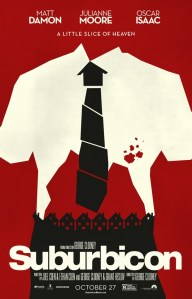 Suburbicon began as a script written by Joel and Ethan Coen back in the 1980s. They shelved it and went on to other stories and justifiable acclaim. George Clooney came across the old screenplay and rewrote it with his longtime partner Grant Heslov (Monuments Men). Clooney’s version of suburban strife is a wash and also easily the worst effort of Clooney’s Oscar-nominated directing career. I wish Suburbicon would make up its mind on which of the three different movies it wants to tell. This is possible proof that Coen brother stories should best be left chiefly to the Coens.
Set amidst the 1950s, an African-American family moves in to an all-white suburban neighborhood and instantly changes the climate. The Mayers have upset the other middle-class white neighbors who want them gone, and they don’t mind subjecting this black family to all forms of harassment to get the job done. Meanwhile, Gardener (Matt Damon) and his wife (Julianne Moore), her twin sister (also Moore), and his son, are threatened by loan shark goons. The family is never the same but there’s more than meets the eye to this domestic tragedy, and the costly cover-up ensnares everyone in danger.
 This is a movie that feels badly stitched together with competing ideas and storylines. Two of these competing movies are so haphazard and lazily explored that it feels like Clooney and company tacked them on for some sort of extra failed social commentary about The Way We Live Now. The shame of it is that either of these vestigial storylines could have existed as their own compelling movie. The integration of the suburbs with a black family brings about an intense reaction. Fellow suburbanites harass the family at all hours of the day, destroy personal property, and do everything to let them know they are unwelcome in this “good-natured” community. The reactions are so virulent and disgusting, and all for a family just existing on the block, shopping at the same grocery store, thinking they too were eligible for the American Dream. There’s a movie there in its own right because, as evidenced in Suburbicon, it’s just background for a larger indictment on suburban values hypocrisy that never generally materializes. At no point does Clooney give the racist response any depth, nuance, or even a deserving spotlight. The only thing we learn is that it’s wrong, which should already be obvious. The entire storyline feels so unfairly attached to another unrelated movie. This family’s story is worth telling right rather than just having something else to cut back to.
Then there’s the larger satire on suburbia itself and its reported family values philosophy. Just because bad people exist and bad things happen in a “nice” community does not mean your satirical work is done. You’re just supplying air quotes to your location. This is the most facile form of irony, lazily slapping together something vulgar against an idyllic setting of morality. That’s why I had no interest in The Little Hours, a comedy that looked to be built around one sole joke, unexpectedly offensive nuns (“Oh ho, that pious person used profanity, and that will never not be funny”). Suburbicon is a story that could have existed in any setting, which further devalues any attempt at legitimate social satire. This isn’t about The Way We Live Now or Even Then.
If you look closely you can see the bones of a Coen brothers’ story here, the only movie of the three that could have worked for Suburbicon. An insurance fraud scam that involves murder and complications is a juicy start for a thriller with some dark comedy edges. This aspect of the movie is the most compelling because it’s obvious that the most attention has been paid to it. Also, there are reversals and unexpected turns that keep the story twisting and turning while accessible. However, the impact of the story is limited by the fact that none of the characters are generally likeable or that interesting. You won’t really feel anxiety over whether or not these people get away with their scheme, which deflates the film’s acceleration of tension despite the best efforts of Alexadre Desplat to replicate an ominous Carter Burwell, a.k.a. “Coen brother,” score. If you don’t care about the characters then they better get into some crazy escalating collateral damage. For a while, it feels like Clooney and Suburbicon understand this principle and begin to ratchet up a body count, though oddly it’s far too fast. Oscar Isaac (The Force Awakens) turns up as a nosy insurance investigation and is taken care of only in his second appearance. The film doesn’t take the time to force the characters to luxuriate in the unease. It just goes straight for the sudden violence, and after awhile it becomes pat and expected.
 This is Clooney’s weakest directorial effort yet. He’s clearly working from the visual framework of the Coen brothers’ classics, using the cookie-cutter production design of colorful suburbia for intended kitschy menace. Even some of the camera angles feel like something lifted from the Coen brothers. Alas, Clooney is not the Coens. He is a director capable of great things depending upon the subject matter, but this movie is a misfire from the start. Clooney cannot decide what the tone is supposed to be, so different actors seem to be operating in their own separate, competing movies. Damon (The Martian) is at either turn hapless or malevolent. I never knew what his read on his character was supposed to be. Moore (Kingsmen: The Golden Circle) is so over-the-top as a distressed housewife that you think she might start bouncing off the walls. It’s only Isaac that feels like he finds the sweet spot of what Clooney must have been going for, and thus it’s even more disappointing about his character’s limited screen time.
Messy, tone deaf, and lacking greater commentary, Suburbicon is a fatally flawed, overbearing dark comedy that has things on its mind and no clear idea about how best to articulate them. It feels like dissonant movies badly stitched together. The overall execution is lazy and relies upon the simplest form of irony to substitute as subversive suburban satire. The tone veers too wildly and the actors are desperate for some better sense of grounding. The characters are pretty flat and poorly developed. It’s an altogether mess that has a few inspired moments and a whole lot more uninspired. The victimized black family deserves to have their own movie and not be the backdrop of somebody else’s broad comedy. The racism is far too real to mesh with the comic goofiness of the rest of the criminal shenanigans. Clooney needed to settle on the movie he wanted to tell. I doubt the final version of Suburbicon that I saw is close to the Coen’s original screenplay. There may have been a good reason that they originally shelved it. Clooney shows that replicating the Coen look and style can be a fool’s errand even by an otherwise talented director. This is the worst Coen brother movie and it’s not even theirs.
Nate’s Grade: C-
Share this:

Hail, Caesar! (2016)
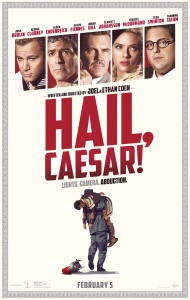 The biggest enemy of the celebrated Coen brothers always seems to be expectations. I count only two misfires during their storied filmmaking careers, but sometimes their larks are pilloried for not quite measuring up to their masterpieces. Hail, Caesar! is on par with Burn After Reading and O Brother, Where Art Thou? It’s still a fun, fizzy, and entertaining film and a celebration of Old Hollywood and its movie magic. Loosely centered on an embittered studio head (Josh Brolin), the film is a series of vignettes highlighting different 1940/50s pastiches, including the realms of Esther Williams, Carmen Miranda, Gene Kelly, and John Wayne. If you’re a fan of the old Hollywood pictures and their stars, the indulgences will play better; you can certainly feel the warmth the Coens have for the films of yesteryear. The plot kicks off with a major star (George Clooney) kidnapped, but it’s really the small side stories and moments that are most memorable, and the Coens are still unbeatable when it comes to being silly and clever. I loved a scene where Brolin asks religious advisors for approval over the script of his biblical epic and they offer legitimate notes over flawed story logic. There’s also a delightful song and dance numbers with a group of sailors lamenting the lack of ladies (“But mermaids ain’t got no gams”). The real star of the movie is Alden Ehrenreich (soon to be young Han Solo) as singing cowboy-turned-actor-turned-studio-sleuth. The sequence where his character tries to rapidly adapt into a “serious actor” on the set of some British melodrama makes for great fish-out-of-water comedy, gamely matched by an increasingly exasperated Ralph Fiennes as the director. The ending doesn’t exactly tie everything together but Hail, Caesar! is more a movie of distractions, of spinning plates, or bumbling bosses trying to hide bad behavior from the press and keep hold of their sanity. If you’re a fan of old Hollywood, there should be just enough to make you smile. If you’re not a fan, then you’ll shrug off the Coens and their latest film lark.
Nate’s Grade: B
Share this:

Money Monster (2016)
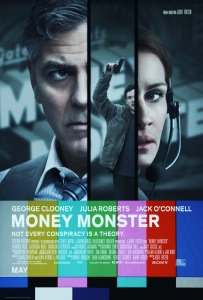 Jodie Foster hasn’t acted in a movie since 2013’s Elysium, and if you saw that movie you might have some sense why she’s taking time away. As a director, she has few film credits to her name, which makes each new Foster directing effort raise the question, “Why this one?” I would assume her last effort, 2011’s The Beaver, was her desire to work again with her Maverick co-star Mel Gibson and perhaps give him a career boost. Money Monster is a would-be hostage thriller with a socially conscience message about the greed and recklessness of Wall Street; however, the Bernie Sanders faithful, let alone anyone mildly educated on the excesses of Wall Street, will find this movie surely lacking, as will anyone looking for a competent and engaging thriller.
Lee Gates (George Clooney) is the host of Money Monster, a financial entertainment show where he provides stock tips to his loyal viewers. One day and angry man, Kyle Budwell (Jack O’Connell), wanders onto the set brandishing a gun. He demands Lee strap on a bomb vest. Kyle lost his life savings on a bad stock tip and he demands justice. Lee agrees to hear the guy out and get to the bottom of why this stock dramatically fell of a cliff, which leads him to suspect internal manipulation from the CEO (Dominic West). Lee’s director Patty (Julia Roberts) stays put through the duress and remains the voice in his ear, coaching him to safety and running research to discover the truth.
 While I was watching Money Monster I had to remind myself that this wannabe message movie existed in our reality, because the brunt of its ire against Wall Street criminal shenanigans is targeted specifically against one bad trader instead of the system. It’s like this movie exists before the 2008 financial meltdown, before the Oscar-winning movies Inside Job and The Big Short, but it doesn’t. It’s borderline insulting that the screenplay myopically focuses all of its attention on one bad actor and lets the rest of the Wall Street elite escape blameless for criminal misdeeds. The bulk of the movie after Kyle begins his hostage standoff is tracking down this bad trader and digging through archives to pin the blame for a stock fall on this guy, all the while keeping him away from the news so he doesn’t get suspicious. It’s a ludicrous turn of events that manages to take a big picture story with relevancy and find the smallest, most insignificant way to tell its tiny story. The condemnation should be for the system and not one guy, and not one character breaks from this preposterous thinking. It feels like they exist in a different time and place. If you didn’t know anything about Wall Street before this movie you would still be left clueless. Is there supposed to be a happy ending when they bring this guy to justice? The movie sets up an ending that doesn’t exactly feel like anyone learned a lesson or even that the villain was properly punished (oh no, he suffers the scorn of Internet memes!). The final line is so glib and self-satisfied that I groaned. By the end of Money Monster I was wondering what any character had learned from the experience except, maybe, to have better locks on the studio doors.
The other debilitating problem is that Money Monster is a movie that cannot find a character for you to care about. The setup should be so obvious and elicit audience sympathy and a natural underdog to root for against a corrupt system. Instead Kyle is a moron. First off he invests all of his money into one single stock based upon one tip from Lee’s TV show. That’s a pretty big risk. Next he takes hostages and makes demands, and yet none of those demands are for the return of his money but rather a simple apology. There’s also the fact that he’s more a ranting and raving angry lunatic than somebody who has targeted ire against the body of Wall Street, making for a pretty uninteresting hostage scenario. You also have to factor in that there will be no good outcome for Kyle, and so he’ll be leaving his girlfriend and unborn child left to fend for themselves after he blew away all their money on a bad gamble. This is not a sympathetic character nor is he rendered in a fashion to make him that interesting. He’s an angry and impulsive man whose actions are almost always about himself and his sense of being wronged. The other two primary characters, Lee and Patty, are completely absent personalities beyond staying cool under pressure. If you put a gun to my head I would not be able to tell you anything about either of those characters as people. Lee doesn’t seem to go through any sort of introspection over his own culpability with his TV show, and Patty is so laser focused on the problem at hand that we know nothing about her other than her capability. Spending 90 minutes with this trio of lackluster characters is a waste of 90 minutes.
 Despite the brisk pacing, I was bored mercilessly with Money Monster. I just didn’t care and Foster and company gave me no reason to care. The pacing made it hard to develop these characters; they felt like chess pieces being randomly assembled across a board, moved when the plot required it, and inert without these manipulations. When the movie goes outside is another example of nothing feelings believable. The will-he-be-shot suspense sequences are hackneyed and dumb. There are a couple of moments of solid comic relief at the expense of character egos, with Emily Meade (That Awkward Moment) serving as the highlight of an otherwise monstrously mediocre movie. Here is a list of other actors that are wasted in do-nothing parts: Caitriona Balfe (TV’s Outlander), Giancarlo Esposito (TV’s Breaking Bad), Christopher Denham (Argo), Lenny Venito (TV’s The Sopranos), and Chris Bauer (TV’s True Blood).
Money Monster is a disappointment in just about every stripe, from its perfunctory performances from it’s a-level movie stars, to the development of its characters, from its suspense sequences, and especially from its frustrating and laughably short-sighted vilification of Wall Street misdeeds on one culprit. It’s like this movie was pulled from a time capsule from the 1990s. Foster’s direction is perfectly acceptable though indistinct from any other journeyman. I cannot say what attracted her to this project as a director except for the opportunity to work with Clooney and Roberts. Otherwise, Money Monster is a thriller that keeps butting heads against reality, reminding the audience at every turn of its airless artificiality and stark superficiality.
Nate’s Grade: C
Share this:

Tomorrowland (2015)
 Crafting movies around theme park rides is a rather risky creative proposition. For every Pirates of the Caribbean mega-franchise, there’s a Haunted Mansion. Theme park rides are more locations then they are stories, so it’s an adaptation where there’s nothing really to adapt except for a setting starting point. Tomorrowland has a few nods to its spiritual source material, but it’s an original science fiction film with much on its mind beyond entertainment. With Brad Bird (Mission: Impossible Ghost Protocol, The Iron Giant) turning down the new Star Wars to make Tomorrowland, I had definite expectations. Bird hasn’t made a bad movie yet. He still hasn’t but Tomorrowland is definitely the worst film in Brad Bird’s heretofore-unshakable pedigree.
Casey (Britt Robertson) is a dreamer with a capital D. While her teachers bemoan the cataclysmic shape of world events and instability, she doggedly raises her hand to ask, “Yeah, but what can we do to fix it?” Her father works for NASA but the nation has lost interest in space and has stopped looking at the stars. Casey sneaks out every week to thwart the demolition of a NASA launch platform. She can’t let it go. She comes across a mysterious pin that, when touched, transports her to a hidden world, a future city called Tomorrowland. But there are others that are looking for this city too. A slew of androids chases after her to retrieve the pin. Robot child Athena (Raffey Cassidy) becomes a protector for Casey and the two set off to find Frank (George Clooney), a hermit and mechanical mastermind who once lived at Tomorrowland before becoming disillusioned.
 This is one of the few movies where the more characters explained the plot the more confused I ultimately became. The story by Bird, Damon Lindeloff (Prometheus, HBO’s The Leftovers) and Jeff Jensen doesn’t exactly a clear narrative, and that begins with the structure, inserting two framing devices that are too cute for the movie. The first 15 minutes is Frank’s childhood experience discovering Tomorrowland, and this is probably because we won’t see Clooney’s grown-up Frank until an hour into the movie. It takes far too long to get going, instead becoming a series of unnecessary plot detours, like a trip to a collectibles store in Austin or a trip to the Eiffel Tower. Is there a reason that a return to Tomorrowland is saved for the very end of its final act? Probably because utopias are boring, which the movie itself admits and admonishes us for accepting. You see, dear reader, it’s all of us and our collective negativity poisoning the planet. Our use of cynicism and our love of dystopias in movies and literature are to blame. In this proclamation, a movie as madly genius as Mad Max: Fury Road is leading to the downward spiral of humanity, and nobody who sees that brilliant film could accept that. Tomorrowland has some legitimate points, precisely aimed at the inconvenience of action over the convenience of stasis. In one of the better articulations of its shiny happy message, a character says that people accept the worst because “they don’t have to do anything today.” It’s the global equivalent of, “I’ll start my homework tomorrow,” knowing we’ll probably never get around to it, to our own detriment.
Tomorrowland’s idealism would be easier to swallow if it wasn’t so oppressively scolding. First, allow me to reject its notion that popular culture wallows in darkness and there is no inherent value with this predisposition. If this was true then no one would read the wealth of Russian literature, which is reams and reams of pages of suffering, unrequited longing, confusion, anxiety, pressure, and finding what grace one can. One of Casey’s teachers upholds George Orwell’s 1984 as a living testament to what we’re going through today, but Orwell’s novel isn’t popular or well revered just because it’s desolate. Would millions of readers be foolish for finding something powerful and poignant in Cormac McCarthy’s award-winning dystopian cannibal road trip, The Road? Just because one is optimistic doesn’t mean you’re in the right, and just because one is pessimistic it doesn’t mean you’re in the wrong. Perhaps the culture is too hesitant to take necessary action because it’s easier to buy into the argument that our actions are meaningless; hence why the newest argument against environmental reforms to curb the effects of climate change amount to, “Yeah, but what difference will it make now?” If Tomorrowland was trying to rouse its audience into action, it went about it the wrong way. The movie’s tone is far too scolding and stuck on can-do platitudes to be anything beyond an earnest motivational poster that will ultimately be ignored.
Then there’s the film’s restricted view on what constitutes the Right Dreams. Casey refuses to allow the NASA launch station to be demolished because it supplies her dad with a job, but really it comes down to her idealism of man’s capacity to achieve. And yet, her chosen way of expressing this, besides general perkiness, is to cling to an older definition of what constitutes achievement. The space shuttles were grand but we’ve outgrown them and space travel itself has migrated into the private sector. Just because U.S. astronauts aren’t being launched into space with the frequency they once were, does that means the country has somehow lost its ideals? Or are we allowed to adapt to the demands of the times? Strangely, Tomorrowland holds onto a retro definition of what constitutes achievement, something also touched upon in Interstellar, where Matthew McConaughey shook his McConaugh-fist at all these young kids for not having the same level of interest in the old technologies and pursuits. Tomorrowland fixates on the scientific dreams of the 1960s, but that’s no longer a representation of our world. What it ends up pining for is a throwback to Disney’s own era of gee-whiz futurism, a world where flying cars are valued above, say, the Internet.
If you think about it, Tomorrowland’s utopia is pretty much a progressive version of Ayn Rand’s Atlas Shrugged. In Rand’s famous ideological tome, the “best and brightest” (a.k.a. rich industrialists) decide they’ve had enough with the common man getting in their way, and so they up and leave and start their own secret paradise where they won’t be disturbed by the likes of us “normies.” With Tomorrowland, it’s not the business types who take their ball and go home but the inventors, scientists, and artists, the creative class, who are given magic passage to a hidden world where their work will be undisturbed by those deemed less creative and/or essential. It’s intended to be inspirational but it awkwardly falls into a murky class-consciousness it can’t escape. Who defines the value of creativity exactly? Is there a Tomorrowland board of directors that says, “You know what, we definitely need that guitar player. Forget having plumbers.” Are the day-to-day laborers and paper-pushers, the ordinary people that keep the infrastructure of the world running, are they just deemed less significant? Tomorrowland apparently only has the best and brightest when it comes to all things, including the people that take out your garbage and unclog your sinks. Are the gravediggers the finest from around the world? Is the world’s greatest and most creative gravedigger still a few notches below a rather lackluster environmental scientist? As you can see, it invites all sorts of questions that will go unanswered because, again, the film’s message is everything, and the particulars of its invite-only exclusive society are off limits.
 The action sequences are also strangely dull for a filmmaker such as Bird. Each sequence has its moments of inventive orchestration, especially a brawl in the sci-fi collectible shop that squeezes in lots of homage. Too often the action is missing the creative spark Bird has showed in so many of his past films, particularly 2004’s The Incredibles. The mayhem is also a little too intense for younger children, especially with real people being so callously zapped into dust out in the open (not exactly keeping a low profile, robot henchmen). There’s also a child robot who factors into a lot of the peril, and then very uncomfortably into a late scene where she expresses her love for the grown-up Frank. I understand they had a connection when they were kids but the movie still ends with Clooney cradling a child in his arms and talking what could have been their tale of romantic love. It’s just a little creepier than affecting. Speaking of which, are children going to be entertained by something this message-laden and obtuse in plot? Are adults going to be entertained with this movie? Who is this movie actually for?
The saving grace of Tomorrowland is the performance of its plucky heroine played by Robertson (The Longest Ride, TV’s Under the Dome). She’s got great presence on screen and a naturally charm that is far less oppressive than the material she’s delivering. Clooney (The Monuments Men) is his standard appealing, handsome, wounded leading man, and it’s a mistake to hold his character out of the action for so long. When George Clooney is on the poster for your big-budget sci-fi movie about the power of dreamers, you shouldn’t wait a whole hour to get around to his character. Magnifying this problem is the fact that the narrative has so few characters who actually matter, mainly four, and one of them isn’t significant until an hour in and another isn’t until the very final act.
Tomorrowland is a sincere, hopeful, and idealistic film that shoves its message in your face and doesn’t offer much in the way of an alternative besides, “Do better.” The problem is that this message of hope and agency is lost amidst a plot that is swallowed whole by near-constant exposition, a clunky framing device, and a world-destroying scheme that seems horribly convoluted in a manner unfitting for the supposed smarty-pants antagonists. It’s simply not a very good story, not told in a very good way, and a message that needs to go beyond a simplistic slogan to be more inspirational. It’s a pretty film with some fun moments, but Tomorrowland is a reminder that not all nostalgia is credible, not all dreams are equal, and messages are digested better when the audience cares about what is happening and (key point here) understands it. Me? I’ll prefer going to see Mad Max: Fury Road again, but that’s just me dooming humanity. Worth it.
Nate’s Grade: C+
Share this:

The Monuments Men (2014)
 An all-star cast, a true-life tale that incorporates a treasure hunt, a race against time, Nazis, and fish-out-of-water tropes as non-soldiers are placed in harm’s way, plus the skills of George Clooney behind the camera; in short, how could this go wrong? With that plot makeup and this cast it would take more effort to tell a boring big screen adventure of the real-life Monuments Men (and women). And yet, the movie found a way. It’s by no means a bad film and its heart is in the right place, but allow me to explain why The Monuments Men sadly fails to live up to its mission.
It’s 1944 and Adolf Hitler doesn’t just have his sights on constructing a permanent empire, he wants all the world’s art treasures as well. The Nazis have been plundering famous works of art, and while the war is coming to a close with the Allied invasion, the fate of these priceless works of art may be in jeopardy. Frank Stokes (Clooney) is tasked with putting together a team to save Europe’s art from the Nazis. He puts together an unconventional group of soldiers (Matt Damon, John Goodman, Bill Murray, Bob Balaban, Jean Dujardin, Hugh Bonneville) and search for the hidden loot.
 The film looks like it’s going to be a high-concept heist film when it reality it’s a series of vignettes that do not add up to a solid whole. Early on, the Monuments Men team is scattered to the wind, divided into pairs, and so we have four or five competing storylines that don’t develop as desired. To be fair, there are some very good scenes, well executed and written by Clooney and Grant Heslov (The Men Who Stare at Goats) where the conflict is turned up, but the film cannot escape the fact that it feels more like a series of scenes than a cohesive story. Not all of the stories are equal in their interest as well. The Cate Blanchett (Blue Jasmine) and Damon storyline in France amounts to little else than her stalling for as long as the plot necessitates, then handing over the Very Important Info, then she’s swept aside. The comical asides, notably with Murray and Balaban, feel like scene fillers when there could be stronger material. Once they’re reunited as a group, you wonder why we even needed the time apart. Perhaps it’s an attempt to showcase a wider sampling of stories and perspectives on a complicated war, which is fine, but the characters don’t get the same complicated examination. Despite physical descriptors, these guys are fairly one-note and stay that way, which is a real shame especially when we start losing Monuments Men. The attention is split amongst a bunch of characters lacking proper development. If I felt like we knew these guys on any substantive level, I would feel more at their untimely passing.
Another issue that exacerbates the directionless feeling pervading the film is that it lacks a clear and concise goal. I understand they’re saving and rescuing art, but that’s kept vague until the very end of the film when it becomes more concrete. Until then, the guys are just traveling from place to place, retrieving this piece or that, having comic misadventures, and the movie just feels like it needs a stronger guiding force to corral all these stories, a concise goal that each scene builds onto and where the urgency increases. Late in the film, I got a glimpse of exactly what kind of movie Monuments Men could have been. Once the war is over, the Germans are replaced as antagonists by the Russians (two-for-two with classic American movie villains) and it becomes a race against time to get to the art before the Russians confiscate it. There was always a ticking clock in the film, as Hitler was assembling his art and his command would destroy them in spite of returning them. However, in the very end of the film, the urgency is cranked up, made real, and for once the film emerges with a sense of suspense. I think it would have been a more engaging film experience if the scope of the film were narrowed simply to the material covered in the climax, namely beating the Russians to the art reserves. It practically has a Raiders of the Lost Ark feel with two parties trying to outrace the other to the next precious treasure. How cool would that movie have been?
 Another problem is the film’s seesaw tone never really gels together in a satisfying manner. The film awkwardly switches gears from drama to comedy to action without smooth transitions. Clooney wants his film to be a comical buddy comedy but also a poignant remembrance of the lives lost so that we can enjoy our great treasures. Clashing tones take away from the effectiveness, making us feel that Clooney didn’t feel confidant with either direction to make a movie. Alexander Desplat’s overbearing musical score instructs the audience what they should be feeling at any given moment. It vacillates without similar transitions informing you with little transparency that you should feel whimsical, now sad, and now heroic, now go back to whimsical. The entire film, from a story standpoint to a technical standpoint, cried out for a greater sense of unity.
Then there’s the question of whether art is worth people giving up their lives, and this is a valid question that deserves consideration. I was never in doubt what Clooney and company would say to this ethical query, but it’s as if Clooney has little faith in his own audience. He gives three separate speeches about the significance of art and culture and why it is worth dying for. I expected one hefty speech, but three? It’s like Clooney is afraid his audience will waver when blood starts to be shed, and so we need to be reminded by the professor why art is significant to mankind’s value. The point has been made; it doesn’t need to be belabored. The film even ends on recycling this debate, with Clooney putting one final stamp of judgment before the credits roll.
One gets the sense while watching The Monuments Men that it would make a better documentary than a fictional feature film, at least this incarnation of a fictional film. Hearing from the men who lived it will be far more interesting than watching the comic squabbles of Clooney’s crew through Europe. I was instantly reminded of an engrossing documentary from a few years ago called The Rape of Europa, which looked at the subject of saving the arts from Hitler, not specifically the Monuments Men. That documentary was filled with so many different fascinating stories, I remember thinking that any one of them could have made a stellar movie. Monuments Men is further proof that a sharper, more contained focus would be best rather than trying to tell as many war stories involved on the topic. Clooney has proven himself an excellent director and despite his film’s faults it’s still an entertaining film in spurts. I just think we all expected better given the pedigree of talent involved and the can’t-miss quality of the history.
Nate’s Grade: B-
Share this:

Gravity (2013)
 Director Alfonso Cuaron spent over four and a half years developing his latest film, Gravity. The tale of two stranded astronauts had to invent technology to fully realize Cuaron’s zero gravity vision, carefully programming precise camera movements into a room full of LED flat screens to orient the harnessed actors and light them properly. It could have gone stupendously wrong in so many ways. Instead it’s the biggest leap forward in movie technology since 2009’s Avatar and surely one of the best science fiction films since 2006’s Children of Men, Cuaron’s last movie. It is a thrilling, awe-inspiring, astonishing, illuminating, and altogether brilliant film. Films like Gravity are the reason we go to the movies.
High above planet Earth, astronauts Mike Kowalski (George Clooney) and Ryan Stone (Sandra Bullock) are repairing the Hubble telescope when a field of satellite debris crashes into their shuttle. Both of the astronauts are adrift in space and have to maneuver to the safety of a space station. The debris storm circling the Earth is gathering size and force, and these two are running out of oxygen and safe places to hide.
 Gravity is one of those movies that you feel like ordinary English adjectives do it a disservice. I can refer to it and visually resplendent, awe-inspiring, and borderline transcendent, but my words will ultimately prove fruitless, because the experience of Gravity is beyond description. This is the reason we go to the movies, to be amazed, to feel something new, and Cuaron has taken the next great leap forward in technical moviemaking while also retaining the artistic soul of an engaging thriller. You could simply view Gravity as a visual feast and be content, or you could view it as a harrowing survival thriller and be content, or you could view it as Cuaron’s spiritual exploration on the perseverance of life against all odds (more on this later). Any way you shake it, it’s hard to come away from Gravity being disappointed, though I know with every lofty word of praise I inject that the bar is set even higher in audience expectations.
From a visual standpoint, Cuaron has crafted a truly immersive film going experience that puts you in the center of the action. The signature long takes amaze just as much as the visuals, both of which give you the sensation of what it’s like to be in space, weightless, free-floating, and oh so vulnerable at a moment’s notice. It’s been almost 45 years since Stanley Kubrick’s 2001 showed the visual poetry of zero-gravity acrobatics, and the sheer visual still has plenty of potency left. But coupled with Cuaron’s blinkless long takes, the illusion is rarely broken, especially in the first twenty minutes, which establishes the stakes and the reality of survival in space. Ignoring all aspects of the plot and acting, you could sit through the entirety of Gravity and find it a sumptuous, invigorating experience purely from the cutting edge special effects. There is a real sense of majesty to the views from space, overlooking our blue orb, the vastness of it all. It would be overwhelmingly beautiful if it weren’t also simultaneously terrifying. Space, much like nature itself, has an indifferent cruelty to it, and Cuaron does an exceptional job of presenting both the grandeur and the inherent dangers of space.
My nerves were racked throughout those tense 90 minutes of intense orbital activity. As a thriller, Gravity is a very well constructed setup with pristine execution. Each problem is dealt with in the immediacy, the unique particular of space allowing us a new perspective on the survival/disaster thriller model. First she has to stop floating. Then she has to get more oxygen. Then she has to get to a more safe location. Then she has to get back home. It may sound like not enough little plot pit stops but each one is pivotal and a remote respite from jeopardy. The wholeness of space is so complete that it feels like the odds are forever stacked against Stone. I was breathless through many of the suspense sequences, nervously tapping my feet, urging the onscreen characters onward. Cuaron and his son, co-writer Jonas, make it clear early the steps of her journey, and each feel like a natural result of the dire changing circumstances. The accumulative debris is given a 90-minute countdown for return, so we’re always wary that Stone will be caught back in the orbiting mass of projectiles. The sense of peril is kept on high and doesn’t relent, leaving you feeling like every nerve is spent by the conclusion. It’s a top-notch thriller that doesn’t involve the use of a single gun or car chase.
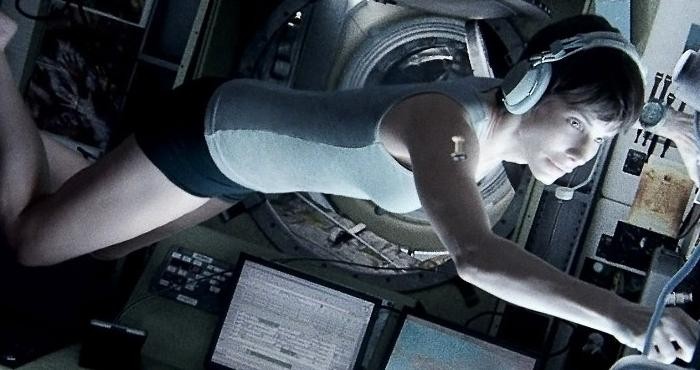 If there is one complaint, I suppose it could be over the somewhat thin back-story and characterization of Stone. I don’t know what a medical officer is exactly doing in space fixing the Hubble telescope but oh well. Cuaron keeps the audience firmly stuck in Stone’s predicament; we do not cut away to any flashbacks of life on Earth, and so it makes fleshing out a central character notable difficult. People don’t usually open up into revealing monologues while they’re trying to fight for immediate survival. She’s got the standard tragic back-story, losing a daughter, but for me this was enough to work with. I don’t necessarily need Stone to be a thriving, complex, emotionally nuanced character because my empathy was already there as soon as the peril began. I wanted her to survive because she was a person; I didn’t have to relate to her on a deeper fundamental level to root for her survival. There are some nice late scenes where Stone reflects on the existential crisis, on knowing her imminent death, on the fog she’s been trapped within since her daughter’s accidental death. Bullock (The Heat), in her best performance to date, is able to pull you in. If faced with your imminent end, how would you attempt to make peace of things, let alone stranded away from all human contact? It’s a strong awards-caliber performance and while her character isn’t given much development, she still has an arc, and I think there’s a greater thematic link with her crossing.
I’m no fan of Terrence Malick (Tree of Life, To the Wonder) but I understand people’s assertion that the man is a film theologian, making the theater a borderline religious experience for his faithful fans. In my eyes, Gravity has an unmistakable spiritual subtext that it can be viewed in different directions. Firstly, it’s hard not to feel an overpowering sense of awe when taking in the sheer magnitude and beauty of the incalculable universe. But then there’s Cuaron’s opening text that prefaces how outrageously impossible life in space is, contemplating all the harsh realities. And yet, here we are. Whether you chalk that up to something religious like God or just the fortune of the cosmos, it’s still a remarkable journey. The evolution of Stone is also reminiscent of that of life on Earth. When she finds refuge in the space station, she removes her suit, curling up in a fetal ball, while the camera centers her and she slowly rotates. The womb imagery is obvious but still effective. There’s also a third act assist that seems like direct divine intervention by most accounts. Then, spoilers, as she lands on a hospitable planet, she emerges from the sea, triumphant, taking her first steps onto land. Triumphant against all odds, against the cruel vacuum of space, life proves to be the winner. Again, whether you ascribe this to a creator God or a wonder of lucky evolutionary forces, it’s hard to escape Cuaron’s spiritual subtext tugging away at you, making the personal survival of Stone a greater analogue for the genesis of mankind and the emergence of humanity.
This is one of the few films I would recommend seeing in 3D. Cuaron has spent four and a half years translating his vision to the big screen and you’ll do yourself a disservice if you don’t see Gravity on the biggest screen possible. It is a film experience to be savored that will not measure up when you are forced to watch such outsized splendor on your puny home TV. This is an expertly made thriller, a visually transcendent, cutting-edge trip to space, and a revitalizing time at the movies. It’s as awe-inspiring as it is terrifying. It’s bursting with stimulation for the senses as well as a reawakened sense of spirituality, of something greater to be thankful for. I am in awe of Curaron as a filmmaker and I am in awe of his finished product. It was worth the wait. Now I hope I never have to wait another seven long years again before I see the words “directed by Alfonso Cuaron” again.
Nate’s Grade: A


 nathanzoebl
You must be logged in to post a comment.