Blog Archives
Cloud Atlas (2012)
 Most people regarded David Mitchell’s 2004 sprawling novel Cloud Atlas was unfilmable. It has six different stories each set in a different time period, slotted into a different genre, and each a variation on storytelling. Mitchell’s tome was structured like a series of nesting dolls, each narrative pulling back to reveal a character reading the previous manuscript, and eventually the direction was reversed. We go from the mid-nineteenth century to post-apocalyptic and back again. I read the book over the summer and found it to be enthralling, especially because each storyline was written so distinctively in a different writing style. The post-apocalyptic linguistics definitely took some getting used to. How could you turn this unwieldy book into a workable movie?
The Wachowski siblings, Andy and Lana, teamed up with German director Tom Tyker (Run Lola Run) to try and find a way. They decided to split up the stories into a musical syncopation, with stories blending into one another. As a result, Cloud Atlas is six different movies for the price of one but it’s far more than the sum of its parts. Cloud Atlas coalesces, bleeds, and bends, becoming a Mobius strip of causality and courage and love. The trio of directors, who shot simultaneously with two separate film crews, has done the impossible and translated Mitchell’s brilliant novel into a soaring, compelling, and multifaceted epic on hope and humanism.
Where to begin with this one? Well, in 1849, Adam Ewing (Jim Sturgess) is traveling across the Pacific back to his home in San Francisco. He’s fallen ill on the ship and keeping the secret of a stowaway in his chamber, a Moriori slave named Autua (David Gyasi). In 1931, Robert Frobisher (Ben Whishaw) is a penniless gay musician looking for refuge. He offers his services to the aged but still famed composer, Vyvian Ayers (Jim Broadbent). Ayers will dictate and Frobisher will assist in writing. In 1971, Luisa Rey (Halle Berry) is a reporter investigating a series of murders tied to a nuclear facility and a report the head honcho (Hugh Grant) doesn’t want exposed. In 2012, Timothy Cavendish (Broadbent) is a small-time publisher who mistakenly checks himself into a nursing home that won’t allow him to leave. In 2140, a new working class is grown from the lab. Somni 451 (Doona Bae) is one of these fabricants. With the help of a revolutionary (Sturgess), she escapes her confines and learns the horrors of the totalitarian world and becomes part of the rebellion. And 100 winters after “The Fall,” mankind has descended into agrarian tribes. Zachry (Hanks) is a goat herder who reluctantly agrees to take Meronym (Berry) to a hallowed mountain. Meronym belongs to the last group of technology-abled civilization, the Prescients, and Zachry mistrusts her and is tempted to kill her to protect his people. Just describing this stuff is tiring and could take up two reviews.
 This is going to be a very divisive movie, this much I can tell. It’s so powerfully earnest that you either embrace its mushiness and ambitions or you smirk and mock its New Age philosophy and optimism. There will be no middle ground with this film. We’re talking about transmigrating souls over the course of 500 years, Tom Hanks as a post-apocalyptic goat herder, and an evil presence known as Old Georgie, who looks like the forgotten cousin to the Wicked Witch of the West. There is some stuff in this movie that is plenty goofy, especially when seen on the surface. It takes a while to ease into the film, adjust to its tempo and accept the context of those goofy elements. But once that’s established then it feels like you can handle anything. There’s such an overflowing of feeling in this movie that it’s easy to make fun of it, to dismiss it under the safety of ironic detachment. It would be easy to decry the Cloud Atlas team for being self-indulgent or pretentious. What they are doing is far from normal, but the achievement of Cloud Atlas is the graceful way it finds to connect the rhythms of a deeply felt humanity. It has its stirring moments and memorable scenes, but when compacted and collected into a beautiful whole, that’s where the movie transcends. When an authoritative character barks, “You are but a drop in an ocean,” and our hero responds, “What is an ocean but a series of drops?” you either roll your eyes or you cheer. This is an earnest movie that wears its humanism on its sleeve. You either roll with that or you don’t, and I decided to embrace the big, messy, mushiness of the whole project and was swept away.
For a three-hour movie, the time flew by, and by the end I knew I had to see Cloud Atlas again. The first viewing requires much in the way of processing. You’re stringing together the disparate strands of the narrative, you’re listening hard to decipher the post-apocalyptic tongue of Zachry and company, and then you’re also keeping track of what actors are playing what characters, crossing lines of race and gender. The disguised actor factor is something of a fun ”who’s who” party game throughout the movie; initially distracting and somewhat questionable (especially the cross-racial makeup). I think seeing Cloud Atlas a second time will allow me to immerse myself further, finding new depths and connections. The pacing is surprisingly swift for a three-hour movie. You barely notice the time is gone, and honestly I could have done with even more movie, especially during the Neo Seoul segment. Given the six segments, some stories are going to be more compelling than others. I don’t think too many people are going to be as compelled with Frobisher’s creative sessions as they are Somni’s escape from enslavement. Initially, you’ll be scratching your head what they all have in common, and the lighthearted segments seem to clash with the more severe segments of systemic abuses. But then the big picture starts to eventually emerge and you see the parallel themes of oppression, bondage, rebellion, sacrifice, abolition and the yearning for freedom at all costs. The filmmakers find clever ways to thematically link their different tales. The movie starts to become a musical experience, much like Frobisher’s central melody, the overlapping notes of repetition and the swelling movements of human life in minor and major.
 As anyone who endured the Matrix sequels will attest, the Wachoswkis are film theologians and Cloud Atlas is unabashedly spiritual. The filmmakers openly favor examining the spiritual side of Mitchell’s novel rather than the political. I found the results to be intriguing but short of profound. From a philosophical/theological standpoint, Cloud Atlas is not breaking new ground or even going into great depth. We’ve got some basic Eastern notions like reincarnation and trying to improve upon one’s soul through various lifetimes. There’s also the notion that death is just a transitional phase and not the end. The film is also very interested in the transcendentalist interconnections of human history. “With each crime and each act of kindness, we give way to our future,” says Somni at one point. I like this; it’s essentially karma in its purest form but it also denotes that every choice gives ways to multitudes of possible futures (perhaps pedestrian but I still like it). I feel that human kindness is long-reaching and casts out many ripples, and Cloud Atlas is a film all about the ripples, seeing the long-reaching effects to causes, and discovering that individuals can become movements and movements can become inspiration. I also like the relatable debate over religious belief in the far-flung future; the Valley people worship Somni as their gracious Goddess, but the more advanced Prescients view her as a person, noble and with strong and important ideas but flesh and blood. And yet the film doesn’t look down on Zachry and his people for their beliefs; Somni inspires them to do good. Do the details matter when the results are positive? Cloud Atlas has plenty of intriguing questions roiling around, moments of pause worthy of post-screening debate. It’s not too deep but it’s far from shallow (the Wachoswkis love their Christ-like imagery, don’t they?).
From a filmmaking craft standpoint, Cloud Atlas is often breathtaking. In some respects it feels like something radically new, a $100 million dollar art film. The visuals are wonderful and the different time periods all come across handsomely mounted, perfectly realized, the details vivid and period appropriate. The future worlds are easily the most engrossing just because of how different they are. You’re never spoon-fed the answers in this movie, so we’re left to put together what lead to each future. I would have loved to have gotten even more details about Somni’s world, a time where democracy has been replaced by “corpocracy,” a world run by corporations. The ambitious story structure of Cloud Atlas could have easily become confusing, but the filmmakers smartly give each segment its own little undivided period to set up that world and its unique tone. They even provide date stamps. Then things get more spliced together, the different storylines cascading and braided together. Some of the storylines have to wrap up early and others are saved for heartbreaking finales of tragic resonance. The elliptical romances spanning centuries provide nice counterpoints and satisfying out-of-time conclusions for storylines that don’t always end cheerful. The movie is often thrilling, intellectually stimulating, disturbing, and poignant, though to be fair it comes up short when it comes to emotional involvement. Like the stunted depth of its philosophy, the movie has a way of drawing you in but never fully; it’s all about a wealth of human feelings and the nature of humanity yet it quixotically comes up short emotionally.
With up to six roles to play, the actors are given plenty to work with. It would be redundant to say you’ve never seen many of these actors like they are in Cloud Atlas (has anyone ever seen Berry in whiteface?). Every actor gets to play heroes and villains, saints and sinners. Only Weaving (The Matrix) and Grant (The Pirates! Band of Misfits) play antagonists in just about every story, and when you have Weaving at your disposal you have to give the man a role with menace. Grant gets to play a post-apocalyptic marauding cannibal. You won’t see him eat anybody’s face in one of those Bridget Jones movies. Like the filmmakers, the actors display full commitment to their varied roles no matter how silly some of the future diction may sound (“for true-true”). Hanks instantly anchors your empathy as Zachry and grounds a storyline that has the biggest danger of slipping into silliness. Readers will know I’m not the biggest Berry fan, and that is probably being charitable. However, I was truly impressed with her work in Cloud Atlas and would easily classify this as her best work since her Oscar-winning turn in Monster’s Ball. Her portrayal of Luisa Rey has such fire and her Meronym has such melancholy. Broadbent (The Iron Lady) is still highly enjoyable as a pompous sort, I’m always happy to see Keith David, and Weaving is delightful in his venomous villains, as a devil, a hit man, and most vividly as the Nurse Ratchet-style sadistic head nurse antagonizing Cavendish. The real breakaway star is Bae (The Host), who also benefits by having the most involving storyline. Her gradual awakening is just about note-perfect, alternating between curiosity, horror, amazement, and finally anger. All of those emotions need to be free of histrionics but if too underplayed then Somni seems like a walking zombie. Bae finds the right somber middle ground and her journey is the most emotionally rewarding.
 In the end, there’s so much to unpack, dissect, discuss, debate, and contemplate with this movie, and every hour I think of some new connection that dovetails the plots. Cloud Atlas is a thrillingly artistic mosaic, a giant puzzle that begs for closer examination. Unlike the films of Terrence Malick, this is a dense, challenging work that is also accessible and, here’s the heretical part film snobs, entertaining. We get a kaleidoscope of the human experience told in beautiful flourishes. There are a lot of demands with Cloud Atlas, and ultimately it may demand multiple viewings to completely sort out one’s opinion on this gigantic picture of gigantic feeling. I’m still uncertain whether I really enjoyed it or loved it, nagging doubts concerning the limited emotional attachment to consider. I’m curious what a second viewing, stripped of analyzing which actor is in what body, will allow me to further appreciate the scale and scope of the film’s achievement.
The individual stories of Cloud Atlas may not be terribly profound but collectively this movie is something special. I anticipate it will be trendy to mock its sincerity and ambition and New Agey spirituality (not that a negative opinion is automatically invalid). We live in a cynical world. It’s rare to find a movie that has so many things to say with such intense earnestness. It’s even more rare for that movie to be good. Due to the sci-fi elements and time hopping, The Fountain and 2001 will be natural film comparisons, but In some ways Cloud Atlas reminds me more of another divisive film, 2001’s Moulin Rouge!. Both were sincere movies about the genuine power of love and human connection, told with such artistic flair, drive, and ambition, and both attempt to transform the traditional tropes of storytelling and drama into a brave new 21st century collage of sight and sound and sprawling spirits. Simply put, you’ll never see a movie like Cloud Atlas again. So do yourself a favor and see it already, then find someone to talk about it and compare how fast the time goes. Then, if you’re like me, see it again.
Nate’s Grade: A
Share this:

Circumstance (2011)
 Despite a slate of quality movies by homegrown filmmakers, Iran is not exactly the most film friendly country conceivable. Governed by a strict set of Islamic moral laws, filmmaking has often been conflated with Western cultural corruption. In 2010, Jafar Panahi, an internationally renowned Iranian filmmaker, was sentenced to six years in prison for nebulous charges of conspiring against ruling forces. He was also banned from making any movies, or even scriptwriting, for 20 years. Just imagine what the country’s moral authority would say about Circumstance, an independent drama about teen lesbians. The controversial movie was filmed in Lebanon and populated with Iranian-born actors living in North America. The movie is, no surprise, banned in Iran.
Atafeh (Nikohl Boosheri) and Shireen (Sarah Kazemy) are two teenage girls living in modern-day Tehran. They are both free-spirited and yearning for the freedoms not afforded under strict Islamic law. They sneak away from their families to go to parties where they drink, smoke, listen to forbidden music, and dance with boys. The two girls’ lives become even more complicated when they start having new feelings for one another. Shireen’s parents are dead and she lives with her traditional uncle, who is looking to marry the girl off. A suitable suitor is Mehran (Reza Sixo Safai), Atafeh’s older brother. Mehran is back after an, unsuccessful, stint in drug rehab and looks to stern religion to guide him. Shireen and Atafeh must keep their love a secret or risk losing everything they hold dear.

Circumstance seems, under the circumstances of geopolitical intolerance, to be casually tagged as “that Iranian lesbian movie,” much like Brokeback Mountain was initially dismissed as that “gay cowboy movie.” In a sense the movie doesn’t rise beyond the sum of its parts, but it does portray an intriguing slice of life hidden from mainstream society. You pretty much expect that things are not going to work out for these star-crossed Iranian girls, but that doesn’t stop you from hoping that they’ll beat the long impossible odds (the girls talk about running off to Dubai where “anything is possible”). The character work can be lacking, sadly. The girls will drift from scene to scene, perhaps metaphorically indicating the limited role of women in this strict environment. Then again it could just be a screenwriting deficiency. There’s enough interest in a secret lesbian romance behind the veil, but the story would have resonated greater had the characters been given greater attention. They seem real; there’s little in the film that seems inauthentic. The girls and their lives of limited options feels pressingly real, I just wanted to buy into their romance more. The friendship is there but the establishment of desire is taken for granted. A couple of sequences with roaming hands do not substitute for laying down character work. By the end of the movie, one of them blithely accepts her destiny as an unhappy subjugated bride, while the other escapes for a life abroad with possibility. The emotional impact of the ending is diminished. We feel sorry for them, but do we feel the ache of tragedy? I could not, and the unreasonably abrupt ending left zero in the way of resolution.
If you’re looking to quicken a few heartbeats, Circumstance should do the trick. Naturally a story about two young women falling for each other has a spark of eroticism. Writer/director Maryam Keshavarz offers a welcomed feminine perspective on budding sensuality. Her camera lingers on close-ups of hands, fingers dancing across goose bumped flesh. The film manages to be erotic without dipping into exploitation; there is only the briefest of partial nudity and the girl-on-girl activity is tastefully portrayed. Keshavarz could have pushed further so that the audience would feel the sense of longing that drives Shireen and Atafeh.
The unrequited lesbian romance is practically a genre unto itself in independent cinema. It’s a natural magnet for drama: suppressed feelings, oppressive regimes forbidding the forbidden love, and the spark of sensuality at the bloom of youth. I would argue that 1999’s Aimee and Jaguar is the best unrequited romance of modern cinema, gay or straight. Like Circumstance, that film dealt with a surprising lesbian romance during a time when homosexuals were persecuted (Germany in World War II). It seems given the terrain that you’d expect Circumstance to walk the line between unrequited lesbian romance and coming of age tale. While not as fully convincing about the sickness that first love can develop, like 2004’s teen lesbian romance My Summer of Love which gave the world Emily Blunt, Circumstance does present an interesting story due to the particular hostilities the girls must evade. Iran is a rather hostile place for women of all stripe, let alone ones with homosexual tendencies. This is, after all, the same country whose leader publically proclaimed that Iran did not have one gay citizen. The pressures to conform are omnipresent. Atafeh and Shireen are detained simply for going out late and wearing makeup in public. I wish the film had gone into greater specifics about the dangers the girls faced, rather then operate on the assumption that their actions would easily fall in the “no-no” category. I don’t consider myself a sadist, but more scenes like the police detention would dial up the peril as well as better articulate the impossibility of their romance.

While not living to its potential as an unrequited romance, Circumstance succeeds in other ways, namely as a showcase of the cultural struggles of modern-day Iran. We get an interesting glimpse into the underground youth culture, showcasing a world that fights for existence where young people will risk their lives for a taste of Western or modern culture. The particulars of this underground scene are not dealt with in any meaningful way; the characters just seem to duck into hidden parties and peel off their street clothes. One of the characters in the film states that everything is political, and just by showing the flourishing underground youth culture Keshavarz has made a political statement. I would have enjoyed more examination on this cultural schism. We see friends of Atafeh discussing the finer qualities of Milk in a hidden video store, discussing the relatability of the human rights message. They even plan on dubbing it over into Farsi and attaching it to a bootleg of the Sex and the City movie for maximum exposure. When this youthful rebellion gets uncovered late in the film, Iranian officials blame a widespread conspiracy involving Israel and the United States to weaken Iran. Circumstance oddly steers clear from showing many consequences of being caught. As a result, the hidden youth culture feels too protected from the country’s powerful Morality Police.
The Mehran character is the movie’s biggest stumbling block. He’s supposed to be an antagonist in some respects, though his long creepy lustful stares don’t seem to amount to much. His transition from failed musical student to religion convert is poorly handled. He’s seen smoking hardcore drugs but then it appears that Mehran is never tempted again with drugs. I assume that, as presented, Mehran has replaced drugs with religion (Karl Marx would nod to himself). The film’s conflict between modernism and theocratic rule is minimally addressed. The fact that the father, an affluent, college-educated middleclass secular man who was a rebel in his youth, is drawn back to religion by the film’s end is hard to swallow without more convincing evidence or commentary. The entire storyline where Mehran secretly spies on his family with hidden videos seems completely superfluous. It’s just another way to make the guy look creepy, which is just piling on. The hidden surveillance, the idea that women are always being scrutinized, could make for an interesting addition, but not as presented.
The two female leads, Boosheri and Kazemy, are both lovely ladies, giving tender, emotional, affecting performances. I just wish that Circumstance were less shallow when it came to its characters and specific plotlines. This unrequited romance is missing some necessary ingredients to work as a movie. The character work and plot can be frustratingly shallow at times, and the obvious peril of being young, female, and gay in Iran is too often left assumed. Circumstance is an interesting cultural document of Iran, but as the “Iranian lesbian movie” it fails to stretch beyond this simplistic branding.
Nate’s Grade: B-
Share this:

A Single Man (2009)
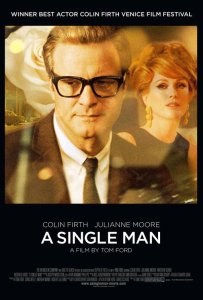 Tom Ford is a rare human being. He seems to be good at everything. The prominent fashion designer has never been averse to risk. He left work in America to toil for Gucci, a faltering European luxury brand. He became the creative director from 1994-2004, eventually leaving to form his own company. And after decades of success in the world of fashion, Ford decided to make the jump into movies. From fashion mogul to film director, nobody else has done it, let alone done it with such acclaim right out of the gate. A Single Man has been met with rich praise and Ford has been touted as a natural filmmaker. Perhaps Ford’s odyssey into moving pictures will inspire others to drop their needle and thread and pick up a camera instead. Who wants to see a Project Runway/Project Greenlight crossover?
In the early 1960s, George Falconer (Colin Firth) is a 50-year-old English professor still recovering from the loss of his love. Jim (Matthew Goode) and George had been together for over 16 years, that is, until Jim died in a car accident one rainy night. George has never fully recovered since that awful night. He doesn’t intend to waste any more time waiting for a reunion; at the end of the day, he will kill himself. He lays out his suit, empties his safety deposit box, and writes letters to his remaining friends and family. This will be George Falconer’s last day in Los Angeles, but perhaps in the meantime he’ll discover more reasons to give life another chance.
 Ford comes from the world of high fashion and here he proves that he should be taken seriously as a filmmaker. He has a sumptuous eye for visuals. A Single Man looks great in every scene. The costumes and period details are impeccable and may even give the historical consultants from Mad Men some due pause. The cinematography by Eduard Grau can become irritating because the colors go from drab to vibrant, reflecting the main character’s changing moods (lifted spirits = brighter colors!). At first it’s a neat visual gimmick but as it persists it becomes a crude blinking light, inelegantly summing up what the movie feels it cannot communicate. At times it just feels like piling on. I don’t need the color to drain from the screen to understand that George is sad.
Ford’s adaptation skills, on the other hand, could use some more polish. He and David Scearce spent years adapting the 1964 novel by Christopher Isherwood. They even added the whole suicide angle, which becomes their narrative crutch. There is a refreshingly funny sequence where George tries to act out his suicide position and goes from the shower to his bed, finally deciding upon shooting himself inside a zipped sleeping bag to cover the ensuing mess. This little five-minute stretch is like an oasis of humor in the super serious desert that is the rest of the film. The second half of the film is dominated by a will-he-or-won’t-he flirtation with a good-looking lithe college student (Nicholas Hoult, the boy all grown up from About a Boy). The kid shows definite interest. The romantic angle syncs up with George’s lost love and proves to be a welcomed distraction to George’s dejection. However, their connection is extremely thin, with Hoult making flirty eyes and inquisitively tilting his head for an hour. The romantic story exists as a means of making sure the narrative can mend George’s broken heart.
The story meanders for too long with a few revealing flashbacks, but honestly how hard is it to wring pathos from a suicidal man? How hard is it to write a middle-aged man taking stock of his life, getting his affairs in order, and saying his fuzzy goodbyes to people who don?t realize the significance. Everything gains magnitude under that prism; every pause, every inhalation, every wistful glance becomes riddled with deeper subtextual meaning, or so we are lead to believe. Every moment can unlock a new memory or secret, like when he sniffs a stranger’s dog and recalls his former beloved pet he shared with Jim. Under this guide, it is hard to tell whether the movie is doing any actual dramatic lifting. So much is supposed to be interpreted in the blankness, which the audience is entrusted to craft meaning to the character’s nostalgic pit stops. “Oh, he must be taking in the scent of the ocean one last time,” or, “Oh, he must be thinking about… something. But he’s gotta definitely be thinking about something. Something deep.” Can you see how this might get tedious after a while?
 A Single Man could have afforded more peaks into George’s background and less of Julianne Moore. She plays an old boozy Brit friend of his from back in the day. Her moments onscreen, while limited, are a chore to get through because Moore just consumes her characters sadness. She gets drunk on the one emotion she’s been hired to play. She’s certainly not embarrassing herself like in 2006’s Freedomland, but this isn’t a performance for her illustrious highlight reel. I don’t care if she does get nominated for a supporting actress Oscar, as seems all but certain; I expect more from Moore.
Firth is the whole movie so it’s a relief that he turns in the performance of his career. He gives a complex portrayal that doesn’t nicely fit into the typical Firth cinematic creature: priggish, clever, dry, ultimately a good guy. Here you can practically see the gears in his head processing the last moments of life. The extent he can convey with his eyes or simply the corners of his mouth are exquisite. He provides so much of what the narrative does not. He’s a sad creature mired in one long day of existential grief, but I need more from this character than what Ford affords.
George Falconer gives a dandy speech about the fear of the minority, almost outing himself to his college class, but for a flick about an older gay male passing through life to be an invisible member of society, Ford adopts a “don’t ask, don’t tell” approach to narrative. He buttons up his characters emotions. Understatement is lovely when there’s enough to work with. That’s the issue with A Single Man. Ford hasn’t given himself enough to work with, instead forcing the audience to make up the work by inserting meaning into every furtive brow and pained expression. This is a meditation on a life in passing, told through a series of small vignettes. I need more than a melancholy man listening to the clock strike seconds off his soon-to-be-ended life. If I wanted to watch that movie I’d check out the latest Gus van Sant art house masturbations.
Nate’s Grade: B-
Share this:

Bruno (2009)
 Sacha Baron Cohen struck comedy gold and financial riches with Borat, his popular anti-Semitic foreign character that skewered American ignorance and xenophobia. Now, he’s back at it as Bruno, an extremely gay Austrian TV host who travels across America in hopes of being famous. The problem this time is that the Borat formula just doesn’t work the same with this character. Borat at heart had an innocence to him that made his outrageous statements tolerable, but Bruno is mostly obnoxious and you feel pity for the dupes that he annoys. The Cohen-Larry Charles technique of crash interviews snares some high profile victims like Congressman Ron Raul and Paula Abdul, but the movie is also thinly staged with corporate compliance from NBC/Universal opening doors for Cohen. There are a small number of worthy targets, from gay brainwashing counselors to stage parents willing to submit their children to anything for a buck, but the best is saved for an Arkansas fighting ring. It’s depressing that a bunch of people foaming at the mouth to see violence would become so incensed and repulsed by men kissing. Regardless, this movie is a string of unfunny skits slapped together with the message of breaking down homophobia. My question to Cohen: how exactly are you going to rid people of homophobia by inundating them with over-the-top gay stereotypes? Doesn’t that reconfirm what they feel? Bruno doesn’t make you feel uncomfortable because he?s gay; he makes you feel uncomfortable because he’s a jerk.
Nate’s Grade: C
Share this:

Milk (2008)
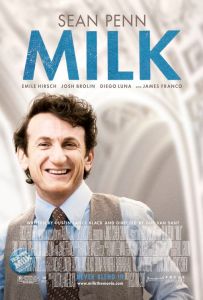 The biopic of America’s first openly gay elected official is stirring, thoughtful, and occasionally limited. Sean Penn gives a wonderful performance as the captivating and tragic Harvey Milk, assassinated in 1978 by fellow San Francisco councilman Dan White (Josh Brolin). He changes his look, his voice, how he carries his shoulders and moves his arms; it’s a terrific and transformative performance that only sometimes hits a few fey stereotypes. The movie mostly follows Milk’s path as a community organizer who successfully mobilized the gay rights movement. You’ll witness local politics in depth, and that’s my one reservation with this fine film – it focuses too heavily on the political formation of a movement and less on the man that kick-started it. You get little glimpses of Milk the man, and most of those glimpses happen to be his romantic relationships with annoying men. That said, director Gus Van Sant orchestrates real archival footage from the time including protestors and homophobic spokespeople, and it gives the movie an authentic relevancy. The deadly confrontation between Milk and White is played in a painful, very un-Hollywood approach that made me wince hard. It’s amazing to watch Milk and realize how far the American public has come since the 1970s and how much further we, as a nation, have to go.
Nate’s Grade: A-
Share this:

Shortbus (2006)
 How do we define pornography? John Cameron Mitchell (creator of Hedwig and the Angry Inch) wrote and directed an examination on human relationships that also employs hardcore sex. Yes, the actors are really having sex and we really see, among other things, a man fellate himself to climax. There’s hetero sex, homo sex, masturbation, and, in small flashes, a whole sweaty orgy of people of all shapes, sizes, colors, and tastes. This movie celebrates the sheer possibilities and enjoyment of sex. Mitchell isn’t the first serious filmmaker to show people really doing it, and the movie shows sex in a realistic fashion that is rarely seen, with all the humor, playfulness, and stumbles that can arise. It?s refreshing and a great window into the depths of human interaction. That’s the deal: everyone in this film is reaching out to feel something. The script mostly follows the pursuit of a sex therapist who has never had an orgasm. The sex will get the headlines but it’s the quiet reflections on human connection that really sneaks up on you and can hit hard. The movie doesn’t cover every facet with ease, like a stalker-esque character, and some of the acting is a bit amateurish; however, it’s a daring film that has a disarming sweetness to it and an open-hearted message that’s rather romantic after all. And no, it’s not porn.
Nate?s Grade: B
Share this:

Running with Scissors (2006)
 Ever since author James Frey imploded into a million little pieces, the memoir has come under intense scrutiny. At issue is the validity of the written word, whether these people are being honest as they recount their tortured yet inevitably redemptive lives. What is the difference between nonfiction and memoir, and does it implicitly imply personal bias? Running with Scissors is the 2002 best-selling book detailing the bizarre childhood of Augusten Burroughs. It’s a book with lots of out-there claims but they’re all held in check by Burroughs’ tart observation and witty writing. When translated to the silver screen, Running with Scissors loses credibility without the author’s voice. I doubt many people going in cold will even believe what they’re seeing.
In the 1970s, Augusten (Joseph Cross) is a gay teen growing up in the care of his alcoholic father (Alec Baldwin) and his deeply delusional, bipolar, wannabe poet mother (Annette Benning). When their marriage hits one of its many slags they seek out a therapist, Dr. Finch (Bryan Cox). He has a room he dubs his “masturbatorium,” a resemblance to Santa Claus, and a family just as whacked as he is. His oldest daughter, Hope (Gwyneth Paltrow), helps him in his practice and thinks that pets talk to her, even from beyond the grave. Natalie (Evan Rachel Wood) is the rebellious daughter who likes to play doctor via electric shock therapy. Agnes Finch (Jill Clayburgh) is the matriarch of this cracked family that also enjoys eating some dog kibble here and there. When Augusten’s mother signs over adoption papers he becomes the reluctant newest member of this dysfunctional family.
 The trouble with translating a book is that you lose the author’s voice and commentary. Running with Scissors maintains the horrifying living conditions for Augusten and the stable of oddballs, but lost is the author’s snappy humor that carried him through this tumultuous time. It’s definitely weird but it’s far from engaging. Without the wit and dark humor from Augusten’s voice we’re left with a series of loosely bandaged scenes about crazy characters and crazy anecdotes, little of which contains further importance. This is a fan of the book talking here, and I’m afraid that the film adaptation has heightened some of the weaknesses of the book, namely the loose storyline. When pieced together as a film, Running with Scissors can become slightly tiresome and overly reliant on background details. The film treats its wild, kitschy production design and 70s nostalgia as a character on par with anyone. It makes for great production design, true to the spirit of the book, but also serves as a narrative distraction. Too much attention seems to be put on getting things to look right than getting the screenplay to feel right.
Without the author’s voice the results lose credibility. It’s funny to see a Christmas tree up year round, and it’s funny when Dr. Finch is convinced God is communicating to him through his bowel movements, but it all just comes off as another joke like the art direction and nothing more. When fully added together without any sense of pathos, it all seems like a joke. The subplot involving Augusten’s sexual relationship with a much older schizophrenic patient (Joseph Fiennes) seems mishandled without much insight. Running with Scissors presents all examples of dangerous, sometimes illegal, behavior and doesn’t bat an eye, nor does it pass judgment. While this may irk some and seem irresponsible it’s just another case of little mattering. Running with Scissors, as an adaptation, presents little of consequence.
Director Ryan Murphy also adapted the screenplay and knows a thing or two about dysfunction and trashiness, having created the risky TV show Nip/Tuck. His adaptation has a blunted feel, but it also seems too broad. Then again, maybe only fans of the book would notice. He has a good feel for his actors and can stage some nice shot selections, but man, someone needs to slap his hand away from the AM radio. Running with Scissors is crammed with so many popular 70s tunes that it becomes a crutch, with Murphy hitting the soundtrack button whenever he needs some kind of character catharsis. It doesn’t work and comes across as indulgent and simplistic. There are so many zippy classic pop songs you may think Elton John is owed a writing credit.
 The acting is one of the elements that help give life to this adaptation. Benning has been generating Oscar buzz for her deeply self-involved portrayal of a mom held hostage by her illness. Benning digs deep and displays a comic range of absurd behavior and wild paranoia. She’s all over the place and you can’t help but loathe her, that is, if you ever take her seriously. But then, once overly medicated, she gives an entirely secondary performance as an emotionless zombie, and we feel a sliver of sympathy, a true surprise. It’s a good, meaty role, however, I actually think Clayburgh gives the more Oscar-worthy performance. In a lot of ways she’s resigned to her fate and yet manages to be the gauzy heart of the picture. She tells me more with her wrinkles than Benning does in her gesticulating outbursts.
The rest of the cast work admirably. Cross is our focal point of the story and does a fine job of, essentially, gawking and looking perplexed. He’s like a blank, gangly canvas, and I wonder what else Cross is capable of than a performance built around indignant reactions. Wood is developing into a lovely adult actress and has some of the best foul-mouthed lines. It’s just nice to see Paltrow in a movie again. Baldwin has transformed from leading man into incredibly versatile supporting actor that excels as comedic lunkheads. Cox remains one of my favorite character actors of all time. There’s nothing this man cannot do. The actors all do a good job of filling out their zany characters while leaving their own imprint.
The issue with Running with Scissors is that when you strip away the author’s caustic voice, then the movie strains credibility, even with the knowledge that it?s based on a personal memoir. The movie gets all the wackiness but misses out on some of the finer points and humor that helped save Augusten from his unorthodox housing. The story feels dulled and stretched too broad, and yet it still manages to be intermittently entertaining despite these flaws. The actors range from good to great and the art direction is fantastic, even if Murphy expects it to do more work than his screenplay. Running with Scissors isn’t as nervy, engaging, or provocative as its source material. Then again little else is. Consider the film Running with Safety Scissors.
Nate’s Grade: B-
Share this:

Brokeback Mountain (2005)
 Go ahead and work the snickers out of your system. Brokeback Mountain has been dubbed “that gay cowboy movie,” and been condemned by certain fundamentalist Christian organizations as “a very dangerous and insidious message to America.” But what message is Ang Lee’s film even putting out there? It seems to me that Brokeback Mountain is putting a human face on a slur, making homosexuals look like you or me. For some that prospect may be terrifying. The movie is playing well on the blue-state coasts, expectedly, but it’s also surprisingly playing well in America’s heartland. It seems that people are lining up all over to see a movie about two gay cowboys in love. And perhaps the more people that witness Brokeback Mountain, the harder it will be to listen to those so-called family advocacy groups with their sterling Christian morals. Maybe people will really see what’s behind many of the words of outcry – hate and ignorance (I am in no way insinuating that disliking the flick means you are homophobic). Despite all this political talk, Brokeback Mountain is by no means a political movie. It’s a love story, above all, and it’s a doozy.
In the summer of 1963, Ennis Del Mar (Heath Ledger) is a quiet man looking for work in rustic Wyoming. He finds a job as a sheep herder working atop the canyons and mountains of Brokeback. Working alongside Ennis is Jack Twist (Jake Gyllenhaal), a charismatic rodeo rider. The weeks are long and Ennis and Jack are all the company they have, excluding the hundreds of sheep they tend. Eventually, the more taciturn Ennis finally opens up and bonds with his herding partner. “That’s more words than you’ve spoken in two weeks,” Jack says. “Hell,” Ennis adds, “That’s the most I’ve spoken in a year.” The rules have been laid out: every night one man sleeps in a tent campsite, the other sleeps next to the sheep to guard them. Well one night Ennis has had too much whisky and cannot make it back to the sheep. Jack invites him to sleep in the tent instead of freezing outside. Then something surprising takes place – both men have an alcohol-fueled bout of rough sex. The next morning both men stress they “ain’t queer,” but they have a hard time fighting their feelings inside. Ennis warns that, “If this thing, it grabs hold of us again… at the wrong place… at the wrong time… and we’re dead.” He recounts a childhood memory where his father showed him the corpse of an older homosexual man, brutally beaten and mutilated. For them, their love must stay on Brokeback Mountain.
 The men part ways. Ennis marries Alma (Michelle Williams), a quiet woman after his own heart, and fathers two daughters. In Texas, Jack meets fellow rodeo rider Lureen (Anne Hathaway) and gets involved in a relationship with her, fathering a son of his own. But Jack still thinks of his Brokeback pal and sends him a postcard. Ennis nearly lights up at the returned sight of Jack and the two passionately embrace. He tells Alma that Jack is an old “fishing buddy” and they sneak away every few months for a fishing getaway. Really the men are returning to the countryside to rekindle the love that they haven’t left behind. But can they keep their love a secret, and should they even have to?
I wonder if Lee would ever have directed this if 2003’s Hulk didn’t bomb so badly. Lucky for us, he’s taken the Brokeback helm and infuses lots of emotion into the story. The Wyoming countryside (actually Canada, but it’s all close enough) is gorgeous, and the film has a great earthy feel. Best of all, Lee allows his love story to breathe and go at its own pace, never cutting corners or rushing an emotion. There’s a lovely, lilting feel to the film, and Lee’s guided hand allows the story to play out to its grand promise. Based on Pulitzer Prize winner Anne Proulx’s 11-page short story, screenwriters Diana Ossana and Larry McMurtry (Lonesome Dove, The Last Picture Show) have given incredible depth and subtext to the tale. McMurtry, in particular, has great knowledge of the West and the cowboy lifestyle, and the screenplay gives you an idea of small-town Western life. There are a few moments at bars, social scenes, stores, but they brilliantly give you every detail you’d need to know about this way of life. I even loved how the people of Wyoming wore fashions that were five years removed from their height of popularity, which is exactly how fashion moves around to the smaller parts of America. Ossana and McMurtry are also commended for presenting their characters as people first and never as agenda bulletins. All three lend a level of authenticity that makes the story feel organic and never trite.
In films about forbidden desire and heartbreak, the acting is the cornerstone for how powerful the tale resonates. The acting in Brokeback Mountain is phenomenal. Ledger is the breakout star and the majority of the film’s focus. He gives the performance of his life. Ledger is outstanding as the reserved, taciturn Ennis, brought to believe that queers were something sub-human and now he wrestles with his own identity. He may be a restrained man of few words but you see every emotion bubble under the surface, every conflict played out in his eyes. Ledger’s few violent or emotional outbursts are startling because they show an uncontrollable feeling, one even he can’t withhold 24/7.
Gyllenhaal has the showier role but masterfully displays the frustration of forbidden love. He’s willing to sacrifice everything for Ennis, and the fact that Ennis won’t do likewise tears him apart. Isn’t love enough, he wonders. There’s a moment in the film that so sharply displays Jack and Gyllenhaal as an actor. It involves two different shots in a moving truck. The first is Jack headed to Ennis’ ranch, singing, bouncing, and with a wall-to-wall smile. The second is Jack driving away from the ranch unfulfilled, sullen, broken, and seemingly unable to cry another tear. It’s two small moments and they sum up Jack and Gyllenhaal perfectly. The only thing unsettling about Gyllenhaal’s performance is his late 70s porn star ‘stach. With his tremendous work in Jarhead and now Brokeback Mountian, Gyllenhaal is in class all his own (he’s got the dreamiest doe-eyes in Hollywood).
The ladies of Brokeback Mountain have less screen time to play with but they each deliver fine performances. Williams is a silent, put-upon mother and is shattered when she discovers her husband’s secret love. She just crumbles. She’s never the same and Williams showcases her character’s distress and mounting bitterness. One of the film’s highpoints is her confrontation with Ennis, many years later, finally sharing all that she knows. Me thinks an Oscar nod is headed in her post-Dawson’s Creek future. Hathaway plays quite an opposite character. She begins as a wild, headstrong cowgirl with a healthy sexual appetite, something perhaps Jack sees as a reflection of his self. Then their love dies at some point and she pours herself into work, but Hathaway illuminates every step along the way. Her small smile during a scene where Jack finally browbeats her obnoxious father is terrific.
This is an elegiac, engrossing love story. Brokeback Mountain is not necessarily a “gay thing,” more so it’s a story about forbidden love and about the consequences of moving forward without ever letting go. That sounds universal, right? Nothing “gay” about that. Brokeback Mountain explores the force of love and shows how uncontrollable and unpredictable it is. Jack and Ennis are just as surprised by their feelings and their rough night of passion as the audience, but the happiness they share is hard to argue.
 Because of the film’s gentle pace, and Lee’s loose control, we really immerse ourselves in their relationship as they frit away the hours looking after sheep. There was a woman in my theater (I won’t name names, partly because I don’t know hers) who felt that Brokeback Mountain was far too slow and could have been put to better use by cutting 2 hours out. The film’s placid pace is integral to the story’s success; you need to see how expansive that countryside is to feel alone, you need to have the many small conversations to draw out a closer camaraderie, you need the added time to open up to these men, and then once you have –BAM! — they turn their worlds upside down. This buildup is necessary for our connection to the characters but it’s also essential so we can understand what happens. Yes, the film portrays love as it truly is: an all-encompassing emotion that can be as maddening as it is passionate. But Brokeback Mountain doesn’t dare introduce a gay romance, something so dangerous in this land, all lickity-split. It’s supposed to be a surprise to these men, grown up with John Wayne movies and strong, silent role models. The movie enjoyably takes its time to seduce an audience with its tale before choking out every last tear in the end.
The tragedy of Lee’s film is that these men have each found the love of their life but, because of society’s prejudices, are not allowed to act. As a result, each man puts on a different face and pretends they’re a happy heterosexual Western buck for the public, but each is being eaten away inside. Ennis drinks a lot and is full of self-loathing. Jack is less publicly reserved about his feelings and finds momentary comfort with other warm bodies, mostly through silent nods with other closeted gay men. I’m reminded of a line in Paul Thomas Anderson’s Magnolia: “I have a lot of love to give; I just don’t know where to put it.” Ennis and Jack cannot quit each other but they also tragically can never fully commit to one another, at least without any threat of ostracism or death. That’s the power of Brokeback, that it shows you these simple men, shows you their love, and then won’t let that happy ending ever manifest that we yearn for. When we reach our somber, haunting conclusion there weren’t many dry eyes in the theater, mine included. Brokeback Mountain is a love story that won’t let itself be happy, and that’s what provides all the kicks to the gut and lumps in your throat.
I think some of the more hostile criticism of Brokeback Mountain is because of how normal Jack and Ennis are presented. Neither is a swishy stereotype, neither is any less of a man, and that notion probably terrifies the homophobes: “Well, they look normal, and if they get gay then maybe I will too!” That’s a shame really, because those ignorant few will miss out on a powerful, sweeping, complex, aching love story with fantastic acting. Ledger and Gyllenhaal will make you feel every moment of joy, every moment of pain, and every lingering conflict on what makes them whom they are. Lee stressed that he wanted to show the world a love story where you really felt that love was an uncontrollable force. His heartfelt, touching film is a revolution for being a normal love story, albeit with two classic Marlboro men. There is no propaganda, no gay agenda, but perhaps the film will open people’s eyes and strip away any narrow definitions we have toward the ownership of love. Brokeback Mountain set out to merely tell a good story, not change the world. It’s accomplished the first part and maybe, just maybe, it’ll spark discussion, debate, and lasting memories to lay groundwork for the second.
Share this:

Rent (2005)
 Rent is one of Broadway’s biggest sensations in the last decade and has become a cultural cornerstone for many. Jonathan Larson updated Puchini’s famous opera La Boheme, transplanting the setting to East Village New York, swapping TB for AIDS, and turning his characters into struggling bohemians fighting for their voices to be heard and love to be kindled. The musical also has an added sense of tragedy. Larson suddenly died on an aneurysm during the final dress rehearsal, sadly never getting to see his finished creation. Rent went on to win Tonys (including Best Musical), a Pulitzer Prize, and damn near the heart of every girl I went to college with. To say it’s been a smash is an understatement. And where ever there’s money and an insatiable audience, there will be Hollywood’s eyes. Now comes time for the Hollywood gloss with director Chris Columbus (Home Alone, Stepmom) and when Rent ditches the intimate confines of theater and hits the big screen, it’s much harder to hide its flaws.
The story takes place within the span of one year (or 525,600 minutes as you’ll be told repeatedly in song), covering Christmases from 1989 to 1990. Mark (Anthony Rapp, Dazed and Confused) and Roger (Adam Pascal) are roommates trying to keep warm during the winter in their giant New York loft. They’re flat broke and their former friend and current landlord Benny (Taye Diggs) expects a full year’s rent to be paid pronto. Roger is racking his brain trying to write that one perfect song; he’s also HIV positive, the unfortunate side effect of a relationship with a junkie. Mark is an aspiring filmmaker and has also recently been dumped by the impetuous performance artist Maureen (Idina Menzel) for … another woman, Joanne (Tracie Thoms), a lawyer. It must be noted that all three of these characters do not have HIV/AIDS; they’re in the minority. Tom Collins (Jesse L. Martin, Law and Order), a gay school teacher, is visiting Mark and Roger when he gets mugged in an alleyway. Angel (Wilson Jermaine Heredia), a drag queen with a heart of gold comes to his rescue. Both men have HIV but won’t let their shortened time stop them from falling in love with one another. Mimi (Rosario Dawson) lives below Roger and Mark and works as an exotic dancer down the street. She too has HIV from a nasty smack habit. She also has her heart set on Roger but he needs a little motivation. For a year these characters will interact and live, love, die, and sing a whole lot.
 The villain of the piece seems to be Benny by default (unless you count AIDS, poverty, and ignorance). Our unemployed band of heroes is upset because dear Benny expects them to, gasp, pay their rent. The scoundrel! Here’s what I don’t get; clearly Benny has a dream for a business and the other artists denounce this artistic dream because it involves money exchanging hands. Benny’s passionate about his dream and actually does something productive like make friends and influences with the business establishment, people with capital to bankroll an entrepreneur’s dream. It’s like everyone’s mad at Benny because he put a suit and tie on and got a job.
Besides, there is something inherently pretentious about Rent’s anthems of sticking it to the man and brash commercialism. Guess what, after 9 years Rent is a franchise. You can get Rent T-shirts, coffee cups, soundtracks, and practically anything that can be merchandised and marketed to the disenfranchised youth with disposable incomes. A musical about the soullessness of commercialism is itself a cash cow, so it rings a little hollow when the deadbeats thumb their noses at the evils of capitalism. Seriously, Mark just about gets hives at the thought of being a cameraman for a TV news show (he calls it “selling out”). In the end he quits his job so he can make his masterpiece … cobbling together home movie footage.
The film version of Rent is populated with 6/8 of the original Broadway cast (Dawson and Thoms are the only fresh faces). This is a well-intention move by Columbus but it backfires. It’s one thing to listen to 20-something bohemians fight for their artistic integrity and worry about food, shelter, rent. It’s quite another thing when the majority of your cast is in their late 30s. You’ve gone from a bohemian to a potential bum. I’m not condemning the pursuit of your artistic ideals and making your name in the world, but not at the price of food and shelter. I’m reminded of a line from The Big Lewbowski: “Your revolution is over! The bums lost. The bums will always lose!”
 It’s hard to feel for some of these characters, who come across as whiny, pretentious, or just plain misguided. Maureen is irritated that her life partner is upset that she was flirting during their engagement party. I mean, really, what’s to get upset about? It’s pretty bad when Rent kills off one of its main characters in a musical montage. A MONTAGE! Afterwards all the characters eulogize what made this person so great. Hey, all that character stuff would have been handier before the death, and then I would have felt something.
Some of these same problems exist with the original stage version, but Rent the movie, and especially Columbus as director, make some bad additions. The original stage version of Rent took place in modern day when it opened. Here, Columbus has dialed back the timeframe and set his story from 1989-1990 (someone forgot that a song references Thelma and Louise, which came out in 1991, but oh well). What makes this time jump shaky is that the film also adds a scene of the happy families championing each other over their racially mixed lesbian daughters’ engagement. They moved time backwards but people’s tolerance was moved forward. That’s not all. It’s bad enough that Roger has a Bon Jovi haircut for the entire film, but then Columbus adds scenes of his escape to New Mexico and we, the audience, are treated to Roger belting his heart out to nature on top of a desert gorge … just like in Bon Jovi’s “Blaze of Glory” music video. Maybe this finally explains why they transported the film to the 1980s.
Where the musical does strain credibility is its fear of fulfilling the dark end of Puccini’s opera. Moulin Rouge! is also based on Puccini’s tragedy and it had the guts and the ambition to end on a tragic note. I‘ve cried at the end of Moulin Rouge!, but I didn’t feel like misting up during Rent. (Spoilers) It’s rather terrible that Mimi can be brought back from the dead by the power of a cheesy rock ballad, and if this holds true, then Bon Jovi is wanted to the E.R., stat! The cheap fake-out ending for Rent is just the nail in the coffin. Everyone has AIDS and thus on borrowed time and yet we can’t have an adult ending dealing with tragedy.
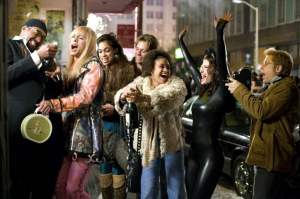 With all this in mind, some things in Rent really do work. The songs are catchy, somewhat fun, and the splashy lyrics follow suit. The cast collectively are entertaining and sing well, though Dawson can get a bit monotone at times. Some of the dance numbers are exciting and amusing, like the “Maureen: Tango” between Joanne and Mark chatting about the spotty behavior of their former and current lover. At one point we flash to them in full classic dress buffeted by a chorus line of fellow tango-ers. “La vie Boheme” is the sassiest and most electric song, finally piecing Larson’s sardonic, witty pop culture lyrics with a lively image. This is a musical that’s got clever lyrics, good singing, and catchy pop rock songs.
For many, especially the Rent heads, a movie version of their favorite musical will be bulletproof. They’ll be thrilled to enjoy an afternoon with their best friends on the silver screen singing their favorite harmonies. I’m sure fans of Rent and fans of broad musical theater will be pleased. For me, the movie falls apart when you pay attention to the story, the characters, the drama, and then the choices in adapting it to film. I just didn’t care for most of the characters and found the story dated, pretentious, and overly romantic, even if the majority of the characters do have HIV and/or AIDS. Columbus’ poor decision making turn Larson’s rock-opera into a movie that wants points for being different when everything about it has practically become marketable and cliché. I’d recommend buying the soundtrack instead of seeing the movie, because at least then you can turn it off when you reach your breaking point.
Share this:

Alexander (2004)
 I was standing in a theater weeks ago and saw a large banner for Oliver Stone’s epic about Alexander the Great. I listed the names; Colin Farrell, Angelina Jolie, Val Kilmer, Rosario Dawson, Jared Leto. This had to be perhaps the greatest assembly of pretty actors ever in a motion picture. There’s a whole lot of sex appeal there, and Anthony Hopkins, as the film’s reflective narrator, isn’t too shabby looking himself for a man his age. After having seen Alexander, it’s safe to say the actors sure are pretty but the movie is far from it.
Alexander (Farrell) is one of the greatest historical figures. He rose to become a Macedonian king, dominated much of the known world before he was 30, and then died mysteriously at a young age. In flashes to his youth, we see Olympias (Jolie) coaching young Alexander on his future glory. Standing in her way is one-eyed King Phillip (Kilmer), Olympias’ husband though not the father to Alexander. She frets that he will sire a direct heir to the throne, and upon Phillip’s assassination, Alexander reaches new heights. He travels to Babylon with the purpose of avenging his father’s death, rumored to be paid for by Persian gold.
Alexander keeps traveling east conquering new lands but returning kings to their rule and assimilating “barbarians” into his armies. His generals begin to question Alexander’s actions, especially his surprise marriage to an Asian peasant woman (Dawson). He is unable to sire a male heir with her. Hephaistion (Leto), Alexander’s childhood friend and lifelong lover, worries that Alexander has become power hungry and distrustful of those around him. Many of his men only want to see home after seven years of battle. After defeat in India, Alexander decides to turn back but he never sees home again.
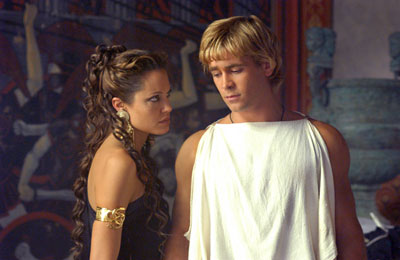 For such a lavish biopic, Alexander seems fairly remote. We don’t really get to know much about the psychology of Alexander. He’s a historical figure with equal parts good and bad ready for debate, but whenever Alexander does hit some of its star’s less-than-stellar moments, it seems to gloss right over them. Hopkins will narrate about some town that resisted, then we’ll see a quick image of it burning, and then we move on. Or we’ll see a slew of dead army officials and Hopkins will say, “He slaughtered all he felt were responsible for mutiny, but I’d expect any general to do the same.” There are several moments where we’ll hear Alexander massacred a town, or sold people into slavery, and then we get the next scene. It’s quite comical, almost as if Hopkins is a tour guide at a museum saying things like, “And then Alexander ate all of the first born babies. Moving on now…”
There are just so many awful laugh-out-loud, loopy moments in Alexander. It’s not enough that Jolie speaks in some bizarre accent; to make sure the audience understands that she’s duplicitous she has a snake wrapped around her in every scene. I’m not kidding; every scene that Jolie is in she has snakes coiled around her.
There’s a moment late in the film that is so hilariously dreadful, it’s hard to believe what you’re seeing. Hephaistion has caught ill and is on his death bed. Alexander is wrought with emotion but then strolls over to a window and begins another huge speech that ends up being all about his glory. What makes the scene go from bad to I-cannot-believe-they’re-doing-this bad is that Hephaistion, in the background, is convulsing and dying. You see his body tense up, twitch, leap into the air, and practically do some kind of triple axle, all while Alexander speechifies blithely unaware. I challenge anyone not to laugh.
Stone needlessly complicates his film with flashbacks, giant leaps forward in chronology skipping Alexander’s rise to respected leader, and skittish hallucinations. Stone is accustomed to breaking up the chronology of his films, but Alexander is too long and too campy to play around with for effect.
The acting of Alexander is set to overkill. Farrell seems miscast and doesn’t have the weight to carry such a historically meaty role. He looks pretty, and he can snarl like a pro, but the only thing worse than his overblown performance is his terrible blonde hair. This just wasn’t the right role for this talented actor. Jolie is so naturally seductive that she could have played her role mute and been effective, maybe more so. Kilmer seems to be working some kind of Irish accent but he comes off the best of the three. Leto gets overshadowed by his bangs.
Alexander also seems to speed over its star’s bisexuality. It wasn’t uncommon for men to bed both sexes, but the movie seems terrified of portraying anything beyond longing glances. Alexander and Hephaistion are reduced to some whispers here and there, but the limit of their physical affection stops at hugs. It actually is kind of funny the amount of times they hug, which I think is over five. You can tell the filmmakers wanted more but then were like, “Eh, let them hug again.” In some weird turn, it seems the film shows more depth with Alexander’s relationship with his horse than with his lifelong lover.
For a three hour movie about a military man who conquered much of the known world, there’s a shocking lack of action. Alexander has two action set-pieces and then that’s it. The first set-piece is a battle between Alexander and the vastly numbered forces of the King of Persia. The battle lasts twenty minutes and is disjointed, bloody, and perfectly indicative of the confusion of war. Stone cuts back and forth between majestic aerial shots showing the progress of battle and hand-to-hand combat amid the sand and dust clouds. Stone also labels certain sections of the armies, which gives a greater understanding of the battle. It shouldn’t be a surprise that this battle is the highlight of Alexander.
The only other action set-piece comes very late in the movie. Alexander’s forces have marched all the way into India. Warriors on the backs of monstrous elephants stampede onward to intercept Alexander’s armies. This battle is also chaotic, and Stone utilizes a lot of quick point-of-view shots like people getting squashed by pachyderms. The action is satisfying if a bit over the top (a warrior gets impaled on a slow-moving elephant’s tusks), that is until Stone goes off the deep end. Alexander gets wounded in battle and suddenly the film switches tints, bathing everything in reddish and bright neon hues. Everything has a tin outline. It’s rather ridiculous and unfortunately reminds me of Ralph Bakshi’s misguided animated Lord of the Rings.
 That’s all you get for action, so I hope you like speeches rich with superfluous historical name-drops, because that’s what Alexander is all about. I’d bet money that nearly an hour of this three-hour opus involves people delivering speeches. Alexander rallies his men, Phillip talks about the Greek tragedies, Olympias strokes Alexander’s greatness and need for kingship, his generals talk about his decisions, and then we get endless moments of Alexander talking about a new world, bringing people together, and respecting other cultures. Alexander seems to go dead as soon as some character pulls out a soapbox. Worst of all, many speeches involve lots of historical references that an audience cannot be expected to keep up with. The overall effect is like listening to an unwanted party guest drone on. Alexander may be trying to talk to death his enemy.
What makes all of this worse is that the dialogue and the drama are so melodramatic. The center of Alexander’s creaky psychology is a domineering mother and a scornful father who scream at each other a lot. Whenever someone has a disagreement in Alexander they resort to over emotive screaming. You may start tuning the actors out after awhile. Much of the dialogue is terrible, but there is the occasional howler line like, “It is said that the only defeat Alexander suffered was Hephaistion’s thighs.” You may concur with Alexander’s men and want to return to your family as soon as possible after watching this.
I was trying to think how something like this, so misguided and off the rails, could chug along without a peep from someone saying, “Hey, maybe this isn’t working.” Then I got it. You see, Alexander is Oliver Stone. Both men are revered for previous victories, both men are generals that take full control of their armies, and both men are fiercely stubborn. If someone questioned Alexander’s decisions, chances are they could be killed. Now I’m fairly certain Stone wouldn’t go that far (there may be many graves dug over the grumblings over U-Turn), but I can see how difficult voicing dissension might have been.
Stone’s long in the waiting Alexander epic is bloody, ponderous, exaggerated, talky, sumptuous and off-the-charts loony. This is a giant mess only a visionary director could amass. Only historical junkies might be entertained by Alexander, and the rest of us will just be glazed over. We never get to really know Alexander, nor do we even get our money’s worth for action, so unless you click your heels to the thought of hours of speeches, skip Alexander. Trust me, it’s far from great.
Nate’s Grade: C-


 nathanzoebl
You must be logged in to post a comment.