Blog Archives
Honey Don’t (2025)
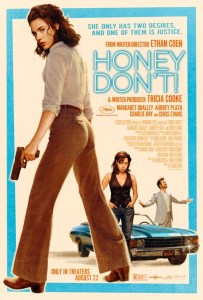 It’s the second collaboration between Ethan Coen and his wife Tricia Cooke and reportedly the second in their “B-movie lesbian trilogy” (the planned third film is tentatively titled Go Beavers). It’s better than 2024’s Drive-Away Dolls, a randy cartoon that was so overpowering and underwhelming. This time the filmmakers play around in the film noir genre with Margaret Qualley as a wily private eye, Honey O’Donahue. The whodunnit plot is a series of disconnected threads and plotlines that don’t connect together in interesting or surprising ways. It begins with an immediate mystery: a woman, dressed right out of Faster, Pussycat! Kill! Kill!, walking down an embankment to inspect an overturned auto and the body inside. Boom. I’m intrigued right away. Sadly, this might be the high point. A third of Honey Don’t involves Chris Evans playing a debauched minister selling drugs on the side and exploiting his congregation. His storyline seems to run in parallel with Honey’s investigation without really crossing in meaningful ways. It even resolves without her intervention. It’s also incredibly dull and repetitive, with Evans’ reverend being interrupted during sex multiple times for comedy, I guess. Honey Don’t exists as a winky flip on the noir genre, this time with lesbians! It doesn’t so much feel like a compelling story with colorful characters as it does a writing exercise. Qualley fares better as the straight-laced yet flirty private eye than she did as the horny caricature in Drive-Away Dolls. She’s got a self-possessed charisma and determination that works. If only the rest of the movie didn’t repeatedly let her down. It’s not offensively bad, or even as aggressively cringey as their previous collaboration, but Honey Don’t is another middling, daffy, disposable genre riff by Ethan Coen that makes me long for an eventual reunion with his brother.
Nate’s Grade: C
Share this:

Queer (2024)
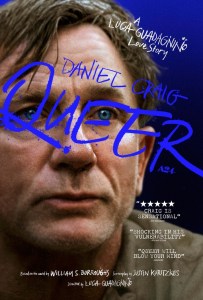
Based upon Beat writer William S. Burroughs, and by the creative team behind this year’s Challengers, Queer is a gay romantic drama equal parts desire and desperation. It also happens to be a confounding artistic misfire and one of the more head-scratching Oscar-bait entries of late.
Set in the 1950s, William Lee (Daniel Craig) is a middle-aged writer living in Mexico City and looking for companionship. One day he meets Eugene Allerton (Drew Starkey, Outer Banks), a young Army expat who he can’t stop thinking about. Lee circles the man, flattering him and throwing affection his way, and eventually the two of them get involved in a relationship, though Allerton is quick to proclaim he is “not queer.” Can they find something lasting or meaningful and work through their own doubts and personal hang-ups?
What really hinders this doomed romance is that it never feels special for either of the participants, at least something to remember through the ages. Unrequited romances in an era where people could never act out their passions because they were considered inappropriate or obscene are their own sub-genre of movies, the Romance That Could Not Be. I initially thought that Queer was going to be a gender flip of 2015’s Carol, Todd Haynes’ film about two gay women trying to carry on a covert relationship through glances and finger touches. Queer is not Carol, and I wasn’t even a big fan of Carol. For starters, even though the setting is in 1950s Mexico City, it doesn’t at all feel like any of the characters are being forced to repress their authentic selves. I’m unfamiliar with whether or not Mexico was so accommodating to gay foreigners, but from a narrative standpoint, it saps the story of conflict on a social scale. If society accepts these men carousing around the neighborhood for homosexual hookups, then what’s halting our gay couple for achieving happiness cannot be external, it must be internal. That means we need to know much more about these characters because we can’t just blame the pressures of society keeping these men apart and/or repressed. The problem with this approach is that the story keeps both of these characters too far at a distance to fully understand them, including any faults that might ultimately lead to their falling out or parting ways.

The burden of romances that are meant to be so powerful they leave a mark, good or bad, is that you need to feel that ache and power so that it feels tragic they could not work out, that they will be haunted by the memory of what they had and what could have been. With Queer, I can’t understand what drew either of these men together beyond lust and inertia. Eugene is an enigmatic blank of a character, a young G.I. who doesn’t consider himself queer. That’s as much as you’re going to get about this man as he’s mostly held as a desirous placeholder, something for our older character to yearn over, but he already feels like a half-remembered, overly-gauzy nostalgic memory of a person even in the present. He’s just kind of there. He doesn’t say much, he doesn’t do much, but he’s reciprocal, and I guess that’s something. The character of William Lee is a writer living abroad, ostensibly writing and publishing with financial freedom. His life abroad is essentially an ongoing vacation where he gets to casually drink, stroll about, and find younger men to warm his bed. Now if Lee had all these things but, because of his middle age, he was seen as less desirable, that these young men only used him for their own gratification and then abandoned him, then we have a scenario where he might find someone who can fulfill what he is missing, who can be different from the others. I don’t know what either of these men see in one another because they’re both so terribly underwritten. It makes it hard to care or become emotionally invested in these men and their connection.
Then the movie just collapses entirely in its meandering, abstract, and generally mystifying second half. I figured the movie would be these two men leaning into their feelings and daring to act them out, becoming infatuated with one another, and that’s really only the first half. Then Lee gets the idea to travel to South America to look for a rare plant believed to offer telepathic powers. Now clearly there’s some metaphors here about the desire for connection and understanding, and you would think the motivation would be spurred by being denied these aspects. Instead, Lee and Eugene seem to lack any real challenge to being together, nor is there any pertinent threat that Eugene will leave him or that there is any competition for his affections. There’s not really a conflict present that can keep them apart; even Lee’s drug addiction plays such a minimal part. I suppose it’s meant to convey the character’s dependency issues, but then present a parallel where Eugene is his new drug, his new obsession, and chasing it leads to his self-destruction. That’s not what we get. We get a boring couple going on a weird vacation. This journey south becomes one very tedious expedition into extended trippy visuals and sketchy symbolism like vomiting out one’s heart. It was at this point that my wife had lost all patience with the movie and just wanted it to end. I couldn’t blame her. Even if the story and characters were lacking for the first half, they’re just abandoned completely in that second half. The movie is actively challenging you to disengage with it when it already gave me little to hold onto.

The main headline for Queer was that this is Craig’s big awards gamble, and he is good, but absent the material to really explore the complexity of his character, the performance is limited because Lee is so archetypal. He’s the middle-aged lush, the sad gay man looking for love and connection in an era that was not kind to said pursuit, and yet in Queer he’s not really persecuted, he’s not really challenged, and he’s not really explored in any meaningful manner. Craig has a few moments where he showcases the vulnerable heartache at the edges of this man, giving you a glimpse of a tortured soul that would have been worthy of being explored with more development. Alas, as the movie descends into its second half abstract, Lynchian morass, I gave up my attempts to find meaning and depth and just became morbidly curious where this all could possibly lead. The conclusion is meant to evoke some sense of tragedy and regret, but Queer failed to make me interested in these two men being together and it failed in making me interested in them at all. At two hours, the biggest struggle of Queer is the patience of the audience to keep watching.
Nate’s Grade: C-
Share this:

Love Lies Bleeding (2024)
 With 2019’s Saint Maud, writer/director Rose Glass made her mark in the realm of religious horror, but it wasn’t just a high caliber boo-movie, it was an artistic statement on isolation, on obsession, and with stunning visuals to make the movie stand out even more. Next up, Glass has set her sights on a similar tale of isolation and obsession, in the realm of film noir.
In 1989, Lou (Kristen Stewart) works as the manager of a small gym in the American Southwest. She spots Jackie (Katy O’Brian) passing through on her way to a bodybuilding competition in Las Vegas. Together, the two women form a passionate relationship and are transfixed over one another, but in order to keep the good times rolling, each will be required to commit more desperate acts, including body removal and keeping secrets from Lou’s estranged father, Lou Senior (Ed Harris), a shooting range owner who operates as a cartel gun runner.
 Love Lies Bleeding powers along like a runaway locomotive, a genre picture awash in the lurid and sundry language of film noir with a queer twist, until it goes completely off the rails by its conclusion, a pile-up of tones and ideas that’s practically admirable even if it doesn’t come together. Until that final act, what we’re given is a contemporary film noir escapade following desperate and obsessive people get completely well over their heads into danger. Reminiscent of the Wachowski’s Bound, we have a film noir that lets the ladies have all the fun playing into the tropes of the sultry femme fatales, and in this movie, both the lead characters are their own femme fatales and ingenues. Lou is the one who pushes steroid use onto Jackie, who resists at first and wants to go about building her body the old-fashioned way. Lou is also the one with the shady past and connections that come calling back at the worst time. Once fully hooked on her diet of steroids, Jackie becomes increasingly more unpredictable and desperate, leaving Lou to try and clean up their accumulating messes. They both use the other, they both enable the other, and they both project what they want onto the other even after their collective screw-ups. It’s a self-destructive partnership but neither can see through the haze of desire. They see one another as an escape, when really it’s an unraveling of self (though I suppose one could argue “living your best self,” already a subjective claim, could include being a genuine garbage human). In a way, this is a relationship that’s all rampant desire and unfulfilled consumption, and it leaves both parties always wanting more. It’s a bad romance with bad people doing bad things badly, and if that isn’t a tidy summation of most film noir, then I don’t know what is.
For the first hour, I was right onboard with the movie and its grimy atmosphere. The plot has a clear acceleration point, though the first twenty minutes is also given to some cheap “who-slept-with-who-before-they-knew-who” drama that I was instantly ready to put behind. However, once the climactic death hangs over our two lovers, there’s an immediate sense of danger that makes every scene evoke the gnawing desperation of our characters. The screenplay by Maud and Weronika Tofilska has such a deliberate cause-effect construction, and no film noir would be complete without the loose ends the characters would have to fret over. What also helps to elevate the immersion is the electric chemistry between Stewart (Spencer) and O’Brian (The Mandalorian), who worked previously in the world of women’s body building and clearly felt a kinship with this role, and she is also a born movie star. The two women are great together, enough so that the audience might start believing that these two lost souls are actually good for one another. We too might get seduced by the possibility that everything will turn out for the better, when we all know that’s not how film noir goes. I will say there are some gutsy decisions toward the end that will test audiences with their loyalty to our couple, but most felt completely in character even if their lingering impact is for you to reel back, hold your breath, and then heavily sigh.
 It would also be impossible to discuss the movie without discussing just how overwhelmingly carnal it can be. I recently reviewed Drive-Away Dolls and noted how horny this lesbian sex comedy road trip was, though to me it felt empty and exploitative. With Love Lies Bleeding, the desire of these two women, and their mutual fulfillment, serves as another drug for them to mainline and then abuse. There is a hanger to the film’s gaze that is effective without feeling overly leering. The body building aspect puts a more natural fixation on lingering on the muscles and curves of human forms, and how Jackie is intending to transform herself into a fantasy version. The sexual content begins to ebb as soon as the murder content ramps up.
Unfortunately, for a movie that gets by on some big artistic chances, not all of them work, and most of the miscues hamper the final thirty minutes. In the final act, Jackie abandons Lou and goes off on her own to her Las Vegas bodybuilding competition, and at that point it’s like she’s in a completely different kind of movie. Hers is a movie about drug addiction and hitting a wall, as she has some very public freakouts and hallucinations. Although from there, Love Lies Bleeding indulges in some peculiar imagery that emphasizes the extreme bulging muscles of Jackie like she was the Hulk. While the movie never presents these flights of fancy as magic realism meant to be taken literally, the sheer goofiness of these moments and imagery can hamper moments, especially during a climactic showdown that feels more like someone’s kinky dream. Ultimately, I don’t think the characters of Lou or Jackie are that interesting. Lou’s criminal past was deserving of more attention far earlier, and Jackie is so narrowly-focused that every scene with her after a certain point is only going to reinforce the same obsessive drive and perspective. Like other genres, film noir works with archetypes, and Love Lies Bleeding isn’t re-inventing the genre, merely giving it a very specific sapphic spin, set amidst the haze of the go-go 1980s.
Rose Glass is a hell of an intriguing filmmaker after two very different movies in two very different genres, both of which have been defined for decades by male filmmakers. This woman is a natural filmmaker with clear vision, and even through the bumps, you know you’re in good hands here with a storyteller that’s going to take you places. The cinematography is fluid and grimy to the point where you may feel the need to take a shower afterwards. Everything seems coated with dirt and sweat. The synth-heavy musical score accommodates rather than overwhelms. The performances are strong throughout, and the screenplay choices, while not always working out, are bold and in-character. Love Lies Bleeding provides just about everything you could want from a lesbian bodybuilder film noir thriller, a movie that recognizes the sizzle of its genre elements and makes grand, scuzzy use. At this point, we should all be paying attention to whatever Glass wants to do next as a filmmaker. It might not be perfect, it might not even work, but it will certainly demand our attention and time.
Nate’s Grade: B
Share this:

Drive-Away Dolls (2024)
 Drive-Away Dolls is an interesting curiosity, not just for what it is but also for what it is not. It’s the first movie directed solo by Ethan Coen, best known as one half of the prolific filmmaking Coen Brothers, who have ushered in weird and vibrant masterpieces across several genres. After 2018’s The Ballad of Buster Scruggs, their last collaboration, the brothers decided to set out on their own for an unspecified amount of time. This led Joel Coen to direct 2021’s atmospheric adaptation of Macbeth, and now Ethan has decided that the fictional movie he really wants to make, unshackled by his brother, is a crass lesbian exploitation sex comedy. Well all right then.
Set in 1999 for some reason, Jamie (Margaret Qualley) is an out lesbian who unabashedly seeks out her own pleasures, even if it brings about the end of her personal relationships. Her friend, Marian (Geraldine Viswanathan), hasn’t had a lover in over three years and is much more prim and proper. Together, these gal pals decide to drive to Tallahassee, Florida using a drive-away service, where they will be paid to drive one way, transporting a used car. It just so happens that these women have mistakenly been given the wrong car, a vehicle intended for a group of criminals transporting contraband that they don’t want exposed. Jamie is determined to get laid and help Marian get laid all the while goons (Joey Slotnick, C.J. Wilson) are trailing behind to nab the ladies before they discover the valuable contents inside the trunk of their car.
 Drive-Away Dolls is clearly an homage to campy 1970s exploitation B-movies but without much more ambition than making a loosey-goosey vulgar comedy consumed by the primal pursuit of sexual pleasure. I was genuinely surprised just how radiantly horny this movie comes across, with every scene built in some way upon women kissing, women having sex, women talking about having sex, women pleasuring themselves, women talking about pleasuring themselves, and women talking about pleasuring other women. When I mean every scene I mean virtually every scene in this movie, as the thinnest wisp of a road trip plot is barely holding together these scenes. From a representational standpoint, why shouldn’t lesbians have a raunchy sex comedy that is so open about these topics and demonstrates them without shame? Except it feels like the crude subject matter is doing all the heavy lifting to make up for the creative shortcomings elsewhere in the movie, which, sadly there are many. The script is co-written by Coen and his wife of many years, Tricia Cooke, an out lesbian, so it feels like the intent is to normalize sex comedy tropes for queer women, but the whole movie still feels overwhelming in the male gaze in its depictions of feminine sexuality. I’m all for a sex-positive lesbian road trip adventure, but much of the script hinges upon the uptight one learning to love sex, which means much of the story is dependent upon the promiscuous one trying to then bed her longtime friend and get her off. Rather than feel like some inevitability, the natural conclusion of a friendship that always had a little something more under the surface, it feels more like a horny and calculated math equation (“If you have two gay female leads, you can get them both kissing women by having them kiss each other”).
I’m sad to report that Drive-Away Dolls is aggressively unfunny and yet it tries so hard. It’s the kind of manic, desperate energy of an improv performer following an impulse that was a mistake but you are now watching the careening descent into awkward cringe and helpless to stop. The movie is so committed to its hyper-sexual goofball cartoon of a world, but rarely does any of it come across as funny or diverting. When Jamie’s ex-girlfriend Suki (Beanie Feldstein) is trying to remove a dildo drilled onto her wall, she screams in tears, “I’m not keeping it if we both aren’t going to use it.” The visual alone, an ex in tears removing all the sexual accoutrements of her previous relationship, some of which can be widely over-the-top, could be funny itself. However, when her reasoning is that we both can’t use this any longer, then the line serves less as a joke and more a visual cue for the audience to think about both of them taking turns. It doesn’t so much work at being funny first and rather as a horny reminder of women being sexual together. The same with a college soccer team’s sleepover that literally involves a basement make-out party with a timer going off and swapping partners. It’s not ever funny but features plenty of women making out with one another to satisfy some audience urges. I will admit it serves a plot purpose of first aligning Jamie and Marian into awkwardly kissing one another, thus sparking carnal stirrings within them.
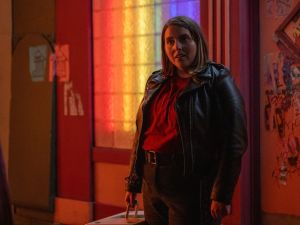 My nagging issue with the movie’s emphasis is not a puritanical response to vulgar comedy but that this movie lacks a necessary cleverness. It doesn’t really even work as dumb comedy, although there are moments that come close, like the absurd multiple-corkscrew murder that opens the movie. It’s just kind of exaggerated nonsense without having the finesse to steer this hyper-sexual world of comedy oddballs. The crime elements clash with the low-stakes comedy noodling of our leads bumbling their way through situation after situation that invariably leads to one of them undressing or inserting something somewhere. The brazen empowerment of women seeking out pleasure is a fine starting point for the movie, but the characters are too weakly written as an Odd Couple match that meets in the middle, the uptight one learning to loosen up and the irresponsible one learning to be less selfish. The goons chasing them are a pale imitation of other famous Coen tough guys; they lack funny personality quirks to broaden them out. There’s a conspiracy exposing political hypocrites condemning the “gay agenda,” and I wish more of this was satirized rather than a briefcase full of reportedly famous phalluses. If you got a briefcase full of famous appendages, I was expecting more jokes than blunt objects.
I feel for the actors, so eager to be part of a Coen movie, even if it’s only one of them and even if it’s something much much lesser. Qualley (Once Upon a Time… in Hollywood) is a typical Coen cartoon of a character, complete with peculiar accent and syntax. She’s going for broke with this performance but the material, time and again, requires so little other than being exaggerated and horny. There is one scene where her physical movements are so broad, so heightened to the point of strain, that I felt an outpouring of pity for her. It feels like a performance of sheer energetic force lacking proper direction. Viswanathan has been so good in other comedies and she’s given so little to do here other than playing the straight women (no pun intended) to Qualley’s twangy cartoon. Her portrayal of sexual coming of age and empowerment was better realized, and funnier, in 2018’s Blockers, a superior sex-positive sex comedy.
 As a solo filmmaker, Ethan Coen seems to confirm that his brother is more the visual stylist of the duo. The movie is awash in neon colors and tight closeups of bug eyes and twangy accents, but the most annoying stylistic feature, by far, is the repeated psychedelic transition shots, these trippy interstitials that don’t really jibe with anything on screen. It felt like padding for an already stretched-thin movie that can barely reach 75 minutes before the end credits kick in. That’s why the extended sequences where the intention seems exploitation elements first and comedy second, or third, or not at all, makes the whole enterprise feel like a pervy curiosity that has its empowering yet obvious message of “girls do it too” as cover. Agreed, but maybe do more with the material beyond showcasing it. Ethan Coen is a prolific writer who has written short story collections (I own his 1998 book Gates of Eden), poetry collections, and he even wrote five one-act plays before the pandemic struck in 2020. I’d love to see those plays. This man has true talent but it’s just not obviously present throughout this film.
Drive-Away Dolls is an irreverent sex comedy with good intentions and bad ideas, or good ideas and bad intentions, an exploitation picture meant to serve as empowerment but still presents its world as exploitation first and last. It’s just not a funny movie, and it’s barely enough to cover a full feature. I suppose one could celebrate its mere existence as an affront to those puritanical forces trying to oppress feminine sexuality, but then you could say the same thing about those 1970s women-in-prison exploitation pictures. It’s a strange movie experience, achingly unfunny, overly mannered, and makes you long for the day that the two Coens will reunite and prove that the two men are better as a united creative force; that’s right, two Coens are better than one.
Nate’s Grade: C-
Share this:

Bottoms (2023)

I really wanted to like Bottoms, a sex comedy told from the perspective of a marginalized group literally learning how to defend themselves and develop a sisterhood of support and violence. It’s a high school comedy with two very winning leads, Rachel Sennot (also co-writer) and Ayo Edebiri, and it’s from the same director as Sennot’s breakout 2020 indie, Shiva Baby. It’s just that the comedy is working so hard, the energy level is cranked up so high, but the results tipped more into the realm of obnoxious characters overselling lackluster material. The two main characters create a school fight club under the guise of teaching their fellow female students how to defend themselves, though the real reason is to impress and then sleep with the hot cheerleaders that they’re crushing over. This also leads to them soaking up all the physical tumbles and sweaty wrestling contact with their crushes. The sleaze of the premise feels a little too easily excused in a misplaced “girls can do it too” sentiment. The explosions of real violence, including actual literal bloody deaths, doesn’t feel properly integrated into the tone of this heightened universe. There’s so much aggressive exaggeration that it’s hard to find a baseline here. It almost feels one or two jokes away from a spoof movie. There are no straight characters (not hetero-normative) characters to better play off the stilted silliness. I just don’t think the jokes and callbacks are there. The banter is occasionally amusing but it tapers off too often like an improv jag slowly running out of steam. It’s not a good sign during the end credit blooper reels when the outtakes prove that only one or two actors may actually be skilled at improv, one of them perplexingly retired NFL athlete Marshawn Lynch who is actually quite funny as a laid back teacher learning about feminism. The ensemble is filled with good actors having real fun playing such arch spins on high school movie stereotypes, and I applaud reclaiming the high school sex comedy from a modern lesbian perspective, but unfortunately Bottoms didn’t work up that many genuine laughs from me.
Nate’s Grade: C
Share this:

Eileen (2023)
 Based upon the novel of the same name, and adapted by the novelist and her husband, Eileen is an affectingly broody unrequited romance awash in noir trappings and feelings. It’s set in a prison facility in 1960s Boston, and one young worker Eileen (Thomasin McKenzie) becomes enraptured with her new co-worker Rebecca, a psychologist with an exceptional sense of confidence and hunger, played by Anne Hathaway. For a solid hour, the movie becomes something akin to 2015’s Carol, a lesbian romance where the social norms of the time force both participants to speak in codes and glances and gestures. Eileen is given to flurries of intense daydreams, often sexual, and sees a fellow creature in Rebecca, who doesn’t so much as walk through rooms as slinks, doesn’t so much as stare but smolders. Hathaway is in full-on femme fatale seduction mode here and enjoying it. It is following along this path of possible mutual connection, of finally acting upon these hidden desires, and then the movie takes a SHARP LEFT TURN and stays there for the rest of the duration. The twist works, and forces the audience to reconsider our notions of obsession and perspective, but it also feels like we’ve abandoned the prior movie into this new even pulpier, slightly more manic movie, and I don’t know if I wanted to leave so suddenly. If this twist were to stand, I think it needed to be introduced sooner, especially if it obliterates the prior dramatic work, and allow more time to deal with its myriad consequences. There is a powerfully gripping and deeply devastating monologue by Marin Ireland that might be the best part of the movie. Eileen the movie is a little like Eileen the character, gliding on appearances and secretly something much darker at its core.
Nate’s Grade: B-
Share this:

Nimona (2023)
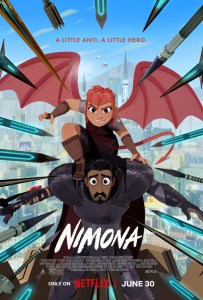
Based on the graphic novel by ND Stevenson (She-Ra), itself a web comic from 2012-2014, Nimona was developed by Blue Sky Animation Studios and originally scheduled to be released in 2020, and then Disney bought Fox, shut down Blue Sky, and pushed back against the gay content of Nimona before just canceling it altogether in 2021, and then Netflix came in and saved the project and released it, gay and all, during the last day of Pride Month. It’s been a long, protracted journey for Nimona to get to your screen and, reader, it was worth it. The movie is a rambunctious and revisionist fairy tale that is both subversive and deeply sincere, enough so that an emotional confrontation of accepting someone on their own terms elicited genuine tears on my part (for those keeping record, that’s three straight animated movies in the month of June that caused me to cry). Nimona (voiced superbly by Chloe Grace Moretz) is a high-energy prankster in a fantasy world melding Medieval culture with future technology. She befriends a fellow outsider, Ballister (voiced by Riz Ahmed), after the kingdom views him as a wanted villain. Together, they try and clear Ballister’s name by finding the real killer, and maybe they can wreck some stuff too just for fun. The cell-shaded style, a familiar aesthetic in the realm of video games, adds a bright and slickly appealing quality to the animation, and the frenetic pace and anarchic humor keep the movie bristling with entertainment, while the emotional core (vulnerable outcasts finding community) sneaks up on you and delivers a more resonating climactic finish than simply vanquishing a baddie. The ending even has rich thematic notes of The Iron Giant, which is never a bad influence. The queer content is also treated without sensationalism and treated as any other aspect of human compassion. The heart and message are just as impressive as the visuals and the humor. Nimona is a funny all-ages adventure that deserves its big screen moment after its long gestation.
Nate’s Grade: B
Share this:

Knock at the Cabin (2023)
 Knock at the Cabin continues M. Night Shyamalan’s more streamlined, single-location focus of late, and while it still has some of his trademark miscues, it’s surprisingly intense throughout and Shyamalan continues improving as a director. The premise, based off the novel by Paul Tremblay, is about four strangers (Dave Bautista, Nikki Amuka-Bird, Rupert Grint, Abby Quinn) knocking on the door of a gay couple’s (Jonathan Groff, Ben Aldridge) cabin. These strangers, which couldn’t be any more different from one another, say they have come with a dire mission to see through. Each of them has a prophetic vision of an apocalypse that can only be avoided if one of the family members within the cabin is chosen to be sacrificed. Given this scenario, you would imagine there is only two ways this can go, either 1) the crazy people are just crazy, or 2) the crazy people are right (if you’ve unfortunately watched the trailers for the movie, this will already have been spoiled for you). I figured with only two real story options, though I guess crazy people can be independently crazy and also wrong, that tension would be minimal. I was pleasantly surprised how fraught with suspense the movie comes across, with Shyamalan really making the most of his limited spaces in consistently visually engaging ways. His writing still has issues. Characters will still talk in flat, declarative statements that feel phony (“disquietude”?), the news footage-as-exposition device opens plenty of plot hole questions, and his instincts to over-explain plot or metaphor are still here though thankfully not as bad as the finale of Old, and yet the movie’s simplicity also allows the sinister thought exercise to always stay in the forefront. Even though it’s Shyamalan’s second career R-rating, there’s little emphasis on gore and the violence is more implied and restrained. I don’t think Shyamalan knows what to do with the extra allowance of an R-rating. The chosen couple, and their adopted daughter, are told that if they do not choose a sacrifice, they will all live but walk the Earth as the only survivors. It’s an intriguing alternative, reminding me a bit of The Rapture, an apocalyptic movie where our protagonist refuses to forgive God and literally sits out of heaven (sill worth watching). The stabs at social commentary are a bit weaker here, struggling to make connections with mass delusions and confirmation bias bubbles. I really thought more was going to be made about one of the couple being a reformed believer himself, with the apocalyptic setup tapping into old religious programming. It’s a bit of an over-extended Twilight Zone episode but I found myself nodding along for most of it, excusing the missteps chiefly because of the power of Bautista. This is a very different kind of role for the man, and he brings a quiet intensity to his performance that is unnerving without going into campy self-parody. He can genuinely be great as an actor, and Knock at the Cabin is the best example yet of the man’s range. For me, it’s a ramshackle moral quandary thriller that overcomes Shyamalan’s bad writing impulses and made me actually feel some earned emotion by the end, which is more than I was expecting for an apocalyptic thriller under 100 minutes. What a twist.
Nate’s Grade: B-
Share this:

The Whale (2022)
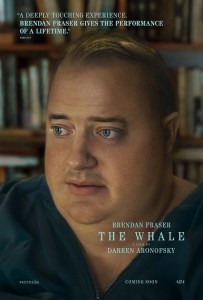 Much has been written about Brendan Fraser’s comeback role and the mountain of prosthetics he was buried under to portray a self-loathing 600-pound man in director Darren Aronofsky’s The Whale. The concern was that the movie would stigmatize overweight people as disgusting and treat fatness like a moral indictment, condemning their lifestyles as slovenly and doomed to misery. I watched the film ready to cringe at a moment’s notice with the hyped portrayal that earned such livid and divisive reactions. I found The Whale to be deeply empathetic but I’m uncertain about whether or not it was fully compassionate, and it’s that artistic distinction that I’m trying to square as I analyze Aronofsky’s melodramatic yet flawed character study.
Charlie (Fraser) is a morbidly obese English teacher who keeps his camera off during his online classes. The closest relationships he has is with his nurse, Liz (Hong Chau), who checks on him regularly with alarm and concern, as she’s also the sister of Charlie’s deceased partner. The movie chronicles one eventful week in Charlie’s life as he tries to make the most of his dwindling time and reconnect with his estranged teenage daughter, Ellie (Sadie Sink).
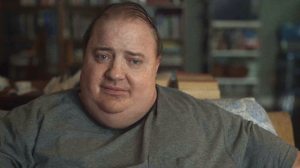 For me, Charlie is less a clinical case of what being morbidly obese can do to a person and he’s more a case study of self-destruction. In 1995’s Leaving Las Vegas, Nicholas Cage won an Oscar playing a man determined to drink himself to death over the course of one eventful weekend in Vegas, and I saw more parallels with his character and Charlie, a man who turned to eating as his source of grief that then became his vehicle for self-destruction. The movie is not casting judgment that all fat people, even those approaching the size of Charlie, are destined for eternal loneliness or crying out for help. However, this specific man is using his increasing weight as a form of suicide. This facet makes Charlie interesting but also increasingly confounding as well. He seems genuinely remorseful about the time he’s missed from his now-teen daughter’s life. He’s saved up his life’s money and plans to give it to her, but I kept wondering why, exactly, he had to die for this? He won’t take care of himself because any medical cost could take away from the handsome sum he plans to leave, in full, to Ellie. He apologizes for being absent but seems unable to see an alternative where he can be present. After so many years apart, maybe she would actually prefer having her dad back in her life? Charlie stubbornly holds to an all-or-nothing ideal, like some kind of fumbling romantic gesture, but he doesn’t have to die for his daughter to live her best life. She doesn’t even get a say. It’s his inability to see through this false choice he’s determined is the best outcome that makes the character frustrating. He only views his death, and I’m sure the insurance to go with it, as his biggest reward that he can offer his estranged daughter, and that makes it even more frustrating at the very end, where he’s trying to prove something to her but is also likely traumatizing her for life. That love he proclaims so readily for his daughter seems questionable when he prefers a misguidedly noble demise to getting to know her and allowing her to choose for herself. The character seems so frustratingly myopic about his own life and its value only being its end.
Complicating this matter is the reality that Ellie is, quite clearly, a horrible person. She’s angry at the world and trained her ire on her absentee father, who she believes left her and her mom to pursue an illicit affair with one of his male students (the reality is a bit more complicated). She is well and truly awful. Ellie insults her father repeatedly. She yells that she wants him to die and that she would be better off. She agrees to spend time with him for a hefty price. She even takes pictures of him and posts them online for social media derision. She’s detestable, and yet the screenplay by Samuel D. Hunter (Baskets), adapted from his play, wants me to yearn for a hopeful father/daughter reconciliation. There isn’t a hidden pool of depth with this character, a brilliance that we know just needs to be nurtured and that Ellie can tap back into. She’s just the unrepentant worst. I think The Whale errs by placing so much of its dramatic foundation on this pairing. It made me question why this man is literally killing himself for this bratty teen. The late reveal for Charlie’s essay that he often quotes like a religious mantra is obvious and still doesn’t open up Ellie as a character. There’s a brief tear-stricken moment at the end that I guess is meant to represent Ellie with her guard down, but I didn’t buy it, and I found her to be a thinly written archetype that is unwinnable. She’s more of a plot device to motivate a redemption arc. Maybe the point is she’s undeserving of her father’s graceful overtures but I guess that’s parenting, folks.
 Charlie says he’s always been a bigger guy but his weight got away from him after the loss of his partner, and it’s this unfathomable grief that caused Charlie to go on feeding binges. He sought comfort in the immediate appeal of food, and plenty of people can relate to stress eating or eating their feelings when times are turbulent. I don’t think the movie is setting Charlie up as a cautionary tale to avoid. Charlie’s grief is tied to religious intolerance and its own trauma. He opened himself to another person and then had his new sliver of happiness dashed away directly related to a religious intolerant mindset that his partner was unable to break free from. He’s a victim who saw no way out including a heavenly reward supposedly denied to him. It’s not this dead man’s fault that he was raised in a diseased environment that viewed his own identity as an illness, and it’s not worth blaming this man for being unable to break free from this mentality. It’s the intolerance that has contributed to Charlie’s weight gain and his fatalistic sense of self. Heartbroken, Charlie has retreated from the world, and it’s the guise of spiritual salvation that proves alluring to the determined young missionary, Thomas (Ty Simpkins, Jurassic World). He sees the flesh as the prison for the soul, and he tries to sell Charlie on a salvation that asserts itself as liberation from his body, which the young man views with horror. Charlie doesn’t want the spiritual guidance, especially from the same community that poisoned the mind of his late partner. Like the Ellie character, I don’t think we gain much with this storyline and the amount of time that the screenplay gives Thomas. I guess we’re meant to see him as another wayward soul trying to live authentically, but he’s another underwritten archetype given misplaced emphasis.
The best reason to sit through The Whale are the performances from Fraser and Chau. We’ve never seen Fraser in a movie quite like this, a man best known for broad slapstick comedies (George of the Jungle, Furry Vengeance) or dashing action-adventure movies (The Mummy films), and he’s great. His performance is less mannered than you would assume for an actor undergoing such a physical transformation. In fact, his vocal range makes Charlie often sound anesthetized, like he’s already given up moving out of a comfortable yet limited range of emotional output. It’s kind of heartbreaking but he’s also got a gentle heart that chooses to see the best in people, even when they might not be there. Fraser is compelling in every moment and disappears into the role of Charlie. His best scene partner is Chau (The Menu), and the movie is at its best when they’re sharing the screen. Liz is the closest friend Charlie has, and they have a shared special kind of pain relating to the loss of Liz’s brother. She’s also enabling his self-destructive impulses and is devastated that Charlie is accepting a doomed fate rather than letting her take him to a costly hospital. Chau is heartbreaking as you feel her fear and guilt, afraid of losing another person so dear to her but also severing another connection to her brother.
 The Whale is an experience that makes me wonder about its best artistic intentions. Even the title of the movie feels like a glancing blow; what other analogy are you supposed to make other than Charlie as our very own Moby Dick? The critical essay he keeps reciting takes a sympathetic view of the marine animal and posits the fruitless efforts of those who wish to cruelly hunt it down and how this will not provide personal fulfillment (it shouldn’t be too hard to figure out who represents who in this dramatic dynamic). It’s also the least distinguishable Aronofsky film of his provocative career, confined to a single location and devoid of the director’s usual vision and verve. It feels like a challenge in restraint for Aronofsky, almost like he’s approaching theater and just wanting to get transfixed by the dramatic surges of the actor’s interactions. I found the central character to be interesting but confounding, not that human beings are ever so clearly understandable in every facet of their being. I don’t think the supporting characters really added much, with the exception of Hong Chau, and I wish the daughter plot had been scrapped. But if you’re sitting down to watch The Whale, you’re doing so to experience Fraser’s career-best performance where he reveals layers to his acting that you never knew were possible. He can still lean into his innate generous spirit and charm to get you to root for Charlie to find some peace. For Fraser alone, The Whale is worth watching and might open some hearts.
Nate’s Grade: B-
Share this:

The Hours (2002) [Review Re-View]
 Originally released December 25, 2002:
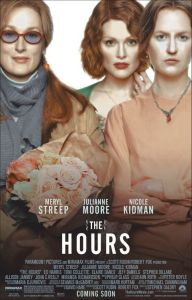
Okay, after watching the Golden Globes award show and seeing The Hours crowned with the highest prize, and hearing incessantly about Nicole Kidman’’s fake prosthetic nose in the movie, it was time to venture into that darkened theater and see how good the awards-friendly The Hours was. Little did I fully realize what I was getting myself into.
Nicole Kidman plays Virginia Woolf, who is in the midst of writing her novel Mrs. Dalloway, where she proposes to display a woman’s entire life through the events of a single day. Julianne Moore plays Laura Brown, a housewife in 1951 having difficulty adjusting to a domestic life that she feels ill equipped for. Meryl Streep plays Clarissa Vaughan, a gay copy-editor in 2001 planning a party for a poet and former lover (an emaciated Ed Harris), who is suffering from the late stages of AIDS. These three storylines will be juggled as the film progresses, with each woman’s life deeply changing before the end of the day.
The Hours is a meandering mess where the jigsaw pieces can be easily identified. The attempt at a resolution for an ending, tying the three storylines together, is handled very clumsily. The film spins on and on that you start to believe the title may be more appropriate than intended. What this movie needed was a rappin’ kangaroo, post haste! The film is wrought with victimization and screams “Give me an award already!” Before you know it you’’re being bludgeoned to death with what is profoundly the most over serious Lifetime network movie ever assembled. And there’s nothing fundamentally wrong with Lifetime movies but The Hours does not share the sensibilities of its TV brethren.
 Kidman, nose and all, gives a strong performance displaying the torture and frailty of a writer trapped within her own mind but too often relies on wistful staring or icy glares. Moore is effectively demoralized but cannot resonate with such a shallow character. Streep is the least effective of the three and fizzles among an over-stuffed assembly of characters.
The supporting cast is unjustly left for dead. The characters are seen as parody (Toni Collette as Moore’s un-liberated homemaker neighbor), extraneous (Claire Danes as Streep’s daughter, Allison Janney as Streep’s lover, Jeff Daniels as Harris’ ex-lover, you know what, almost anyone in the Streep storyline), one-note (the workmanlike John C. Reilly who plays yet another doting and demystified husband) or merely obnoxious (Moore’s brat child that refuses to separate from her). It appears The Hours is the three lead actress’ game and everyone else is not invited to play along.
Stephen Daldry’s direction shows surprising stability and instinct after his art-house pandering Billy Elliot showed little. The technical aspects of ‘lThe Hours are quite competent, especially the sharp editing and musical score, which just points out further how slickly hollow and manufactured the film is.
The Hours is an over-glossed, morose film that is too self-important for its own good. It sucks the life out of everything. And for all its doom and gloom and tsunami of tears, the only insightful thing The Hours is trying to pass off onto the public is that women are more depressed than you think.
Nate’s Grade: C
——————————————————
WRITER REFLECTIONS 20 YEARS LATER
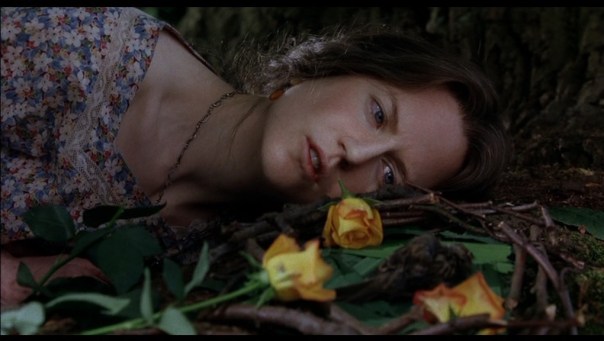
I thought 2002’s The Hours would be a good movie to come back to not necessarily because I thought it would be revelatory but because I thought it may have been emblematic of my more dismissive, glib attitude when I was a twenty-year-old smart alack getting published in his college newspaper and considering myself a hotshot wordsmith. I was worried that my initial review would come across as snide and condescending considering the subject matter. I dubbed it the “most over serious Lifetime network movie ever assembled” and yet, twenty years later, after having devoted two more hours watching The Hours, I must say that this comment still holds merit.
I was fully ready to disavow my younger self as being unkind to this movie, or being too quick to dismiss a movie about women’s suffering through three generations, especially as a young man trying to be clever and, by early 2000s standards, snarky and cynical. Well, even in 2022, I still dislike The Hours, and it’s because of how overwrought everything comes across in this movie. This movie is overstuffed with the trapping of importance, and the 1950s section featuring Julianne Moore as an unhappy housewife stifling her desires (not to be confused with her 1950s unhappy housewife also stifling her desires in 2002’s Far From Heaven) is played to the point that it could be self-parody. That’s not the kind of artistic approach you’d think you would want in something so transparently desirous of special award consideration. For me, it was unmistakable even early on, and the heightened melodramatic atmosphere made me, at several points, almost want to giggle at how obvious and cloying and annoyingly reaching each moment came across. There is no subtlety to be had with The Hours, and that’s fine, but there is also no real striking substance beyond a few transitory moments of grace that stand out. The Moore segment has her drifting through the day like a zombie and almost on the verge of tears at every single turn. I felt sorry for Moore, who is coasting on emotional instinct as the character she’s been given is, at best, meant to be a symbolic placeholder of millions of women of her era. Her interaction with her son makes her sound like a deranged android grasping for human behavior. The moment where they sift flour together and claim it’s beautiful was just so stupifying. It’s amazing to me that Moore was nominated for Best Supporting Actress for this role. She’s also the example of the kind of woman that Woolf was writing about with her titular Mrs. Dalloway heroine, but without Woolf explicitly commenting, the entire 1950s segment is one big airless melodrama, meant as a misdirect of the movie’s miserablist obsession with suicide. By the time old lady Julianne Moore shows up to unload a hasty monologue explaining decades of unknown drama, you may have decided that the three stories could have been two (or one).

Each of the three plot segments is intended to better inform the other, to coalesce into a thesis statement on the plight of women, except each storyline is so thinly written. Without the others to provide direct companionship, each one of these storylines would be pitifully minimal and fail to evolve the notions of feminine hardship. Virginia Woolf (Nicole Kidman) is sad because she feels stifled by the country and doctors who are trying to improve her mental health. Laura Brown (Moore) feels stifled because she is a cloested lesbian pretending to be a happy and doting housewife to her oblivious husband (John C. Reilly, not to be confused with his other oblivious husband in 2002’s Chicago). And Clarissa Vaughan (Meryl Streep) is sad because one of her closest friends (Ed Harris) is dying from AIDS. That’s it. Each of the three timelines is threaded together for the intention of greater relevance, but what it really does is put the onus on the viewer to find more relevancy in context. Sometimes the three women will be doing the same actions, sometimes one will make a comment that seems to be answered by another, and sometimes they’ll inadvertently quote one another or Woolf’s novel. Except the connections and layers are superficial and clinging to an obvious thesis and biding its overlong time for absent depth.
Much of the early publicity around The Hours circulated around Kidman’s fake nose, which producer Harvey Weinstein hated (he also hated the score by Phillip Glass that would later be nominated for an Academy Award) but Kidman absolutely loved. During the time of production, she was divorcing Tom Cruise and was a tabloid magnet but the prosthetic nose allowed her a degree of refreshing anonymity with the paparazzi. She kept the nose on for the entire movie. I’ve been more critical of Kidman’s since her early 2000s career summit (Moulin Rouge, The Others, The Hours), but she legitimately is good in this and has more spark and reserved melancholy than she’s shown in numerous latter roles. Whether she deserved the Best Actress Oscar over the likes of Diane Lane (Unfaithful), Salma Hayek (Frida), Renee Zellweger (Chicago), and Moore (Far From Heaven), is another question I think I already know the answer to, but it allowed every single critic and would-be Oscar historian to use the same hacky joke: “she won by a nose.”

This cast is stacked to the point that even small parts are played by great actors. On top of the big three you’ve got Harris and Reilly, Toni Collette, Claire Danes, Margo Martindale, Eileen Atkins, Allison Janney, Miranda Richardson, and Jeff Daniels. It’s an embarrassment of acting riches, which makes it all the more disappointing when they are kept strictly as archetypes and stereotypes.
Director Stephen Daldry is a complete mystery to me. His first three directing features earned him three Oscar nominations for Best Director (2000’s Billy Elliot, The Hours, 2008’s The Reader). I thought The Reader was horribly misguided but it led to Kate Winslet winning her first Oscar, and I thought his follow-up, 2011’s Extremely Loud and Incredibly Close, was also horribly misguided and was still nominated for Best Picture. I don’t understand the adulation.
In my original review, I concluded by saying, “The Hours is an over-glossed, morose film that is too self-important for its own good. It sucks the life out of everything. And for all its doom and gloom and tsunami of tears, the only insightful thing The Hours is trying to pass off onto the public is that women are more depressed than you think.” I thought re-evaluating the movie twenty years later would prove more insightful and perhaps prove my younger self wrong, but the me of the year 2022 was the one in the wrong. I agree that its central thesis is relevant, but having three underwritten stories of sorrow stacked atop each other and expecting poetry is asking a lot. I wish this movie was indeed better but it’s prime early 2000s overwrought Oscar bait.
Re-View Grade: C


 nathanzoebl
You must be logged in to post a comment.