Blog Archives
The Spiderwick Chronicles (2008)
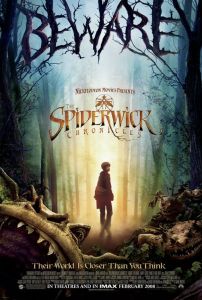 This imaginative fantasy family film is adapted from five books from the Spiderwick series, so you’ll be forgiven for thinking that it packs a lot of storylines at a brisk pace. This 97-minute film should appeal to all members of the family because, while derivative, it has plenty of action, interesting fantasy characters, and even some palpable thrills. The movie has a better handle over interspersing psychological real-world drama with the monsters. Freddie Highmore is the best special effect in the film as he plays two twins who are vastly different in personality and temperament. Director Mark Waters (Mean Girls) deals with the fantastic but also makes the film feel grounded, never letting the otherworldly elements to take over. The movie is a modestly entertaining escapade.
Nate’s Grade: B
Share this:

August Rush (2007)
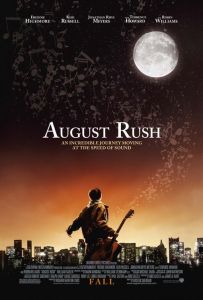 Am I too cynical for my own good? I’d like to think that I appreciate authentic works that tug at my heartstrings, and I’m a believer in the power that music can have, which are part of the reasons I named Once the best film of 2007. In comparison, August Rush tries to go all message and winds up skirting over why I should even care what happens to its characters.
In 1994 or so Lyla (Keri Russell) is a concert cellist in New York City. Louis (Jonathan Rhys Meyers) is the lead singer in a rock band touring the area. They meet atop a rooftop, look deeply into each other’s eyes, and then have sex. Parents, do not condone this behavior with your daughters and sons. But they’re separated through lame circumstances and nearly miss each other several times. This romantic encounter has spawned a son growing in Lyla’s womb. She gets into a car accident late in the pregnancy and was told by her manager/father tells her the baby has passed away. He is a liar because the baby was born and he signed it up for adoption.
 Flash forward 11 years. The child has gown up into the likes of Evan (Freddie Highmore) who lives in a boarding school for orphan boys. He knows his parents are out there in the world somewhere and he believe he can find them through the connection music. He gets lost in New York City and follows a troop of child musicians to the Wizard (Robin Williams). He looks after a gathering of orphan musicians that play on street corners. It’s like Oliver Twist meets American Idol with an extra dose of sugar. Sure enough Evan stars drawing a crowd and the Wizard wants to make sure he doesn’t lose his biggest earner.
This film is a ludicrous and manipulatively maudlin mess. August Rush plays all the big notes; the film’s script is entirely comprised of big moments that waddle and crash into one another, and as such it ignores any details. Like the fact that Evan has the ability to connect to his long-lost parents simply by strumming an instrument, but he’s never heard of musical notes or touched an instrument until he was 11. If the kid hears music everywhere, which reminded me a lot of Bjork in the superior Dancer in the Dark, wouldn’t it stand to reason he would try to, I don’t know, play music? Now I’m not saying he’d have access to every musical instrument at the boy’s boarding house but surely he could have drummed something? I find it unbelievable that a musical prodigy would wait until he was 11 before he picked up an instrument. Also, he learns what sounds are labeled as what letter notes by a cherubic little tyke with some powerful pipes of her own. He goes immediately from learning what an F sharp is to scribbling complex musical notation on blank sheets of music stanzas. How does he know all the symbols and placements and everything that the little girl did not teach him in their brief instructional moment? I’ll go back even further. How come Lyla and Louis give up trying to find each other so easily? Why does Louis wait 11 years before he searches the Internet for Lyla, who, being a world-class cellist, would not exactly be low profile? And why does a pregnant Lyla not do more to, you know, get in contact with her child’s father when he’s even in the exact same city? It’s details like these that August Rush hopes to will the audience to ignore, but to me it was proof time and again that the film’s indifference to plot, character, and maintaining any level of credibility even on a heightened “urban fairy tale” level.
If you replaced the stars then this movie would prove to the world that it belongs on the Lifetime TV network. It’s a melodramatic free-for-all that turns the topic of music into a quasi-religious experience. Now I know for many that music actually can maintain a religious level of power and sweep, but I challenge people watching August Rush to replace the word “music” in the dialogue with any other word to fully realize how cheesy the dialogue is. Let’s try replacing “music with “the force,” and now read this choice line of dialogue: “You know what [the force] is? God’s little reminder that there’s something else besides us in this universe; harmonic connection between all living beings, every where, even the stars.” And: “[The force] is all around you, all you have to do is listen.” This is the kind of film where characters can look up into the void with wistful, wide-eyed looks and somehow connect over the ether. That’s how the characters stay together and eventually reunite in a predictable and sappy manner.
The music itself is rather unremarkable. It’s well composed but I wouldn’t be able to recall it again even if I had a gun to my head. When the movie trumps the message of the transcendent power of music it doesn’t help when the music it presents is less than special.
The acting befits the same cheesy atmosphere of the movie. Highmore is pretty vacant and looks like he’s shrugging from scene to scene, that is, until he bangs his hands against a guitar neck and everyone somehow calls this genius. I think part of Highmore’s problem is that regular folks just think that honest-to-goodness geniuses don’t really have to work hard for results. This is, of course, false. Mozart was a prodigy, yes, but he didn’t just yawn and write down invisible notes that were dancing in front of his eyes waiting all day to be transcribed. He worked hard. Highmore just looks off into the distance and he seems to be in a trance. It’s annoying.
 Russell gets to pine for something just outside her reach (turns out it’s a son) but she doesn’t flash an iota of the grace and magic she showcased in Waitress. Meyers gets to “sell out” and then reunite his mid 90s alternative rock band. Here’s the thing — the sound EXACTLY THE SAME after 12 years and yet on their first gig back together they have a huge crowd? The movie is trying to tell me that the tastes of pop culture wouldn’t change in a dozen years. Williams manages to give hints about a troubled past as a musical prodigy eaten up by a system hungry for the next big thing. He also bellows and growls and comes across like a creepy Fagan for a team of street urchins.
August Rush is sticky, sappy, manipulative and maudlin feel-good rubbish. This is the kind of movie that most people will probably never get. Perhaps people who live, breathe, sleep, and eat music will feel more inspired by its message of human connection and spiritual fulfillment via the power of music. That’s swell but it still doesn’t excuse the fact that August Rush is a overly serious, laughable, syrupy work. If you’re going to dismiss its faults as the film being a “fairy tale” well then the film still doesn’t establish any hard rules for its universe. The characters are still one-note and behave in annoying and moronic ways because the plot demands it of them. And classifying the film as a fairy tale still doesn’t make the music any better. I can’t believe this stuff had a shot of beating the spectacular songs from Once for 2007’s Best Song Oscar. In fact, August Rush wishes it was Once because that low-budget charmer was able to communicate the power of music honestly and profoundly with the added benefit of beautiful tunes. I would like to recommend that all people thinking about renting August Rush.
Nate’s Grade: C-
Share this:

Charlie and the Chocolate Factory (2005)
 The visuals by Tim Burton are suitably lavish but it’s missing the heart of the 1971 film. I never thought I’d say a movie worked despite Johnny Depp’s performance, but that’s the case here. It was far too off. Whereas Gene Wilder had the dichotomy of warmth and madness, Depp was just the kooky Michael Jackson-esque weirdo in a bobbed haircut (I thought Neverland had been found). Perhaps the added Michael Jackson vibe makes the premise a lot darker, what with luring children into a chocolate factory. Charlie is a really boring character lacking definition beyond his “goodness.” Once they get to the factory he?s basically wallpaper, watching his peers fall one by one to their vices. I’m not sold on a Wonka back-story. I don?t need to know why he is as he is; I need no tormented childhood and daddy issues. This new film has more polish but the old film has more togetherness and lasting power.
Nate’s Grade: B-
Share this:

Finding Neverland (2004)
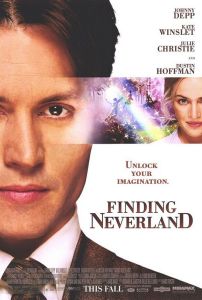 My friend George Bailey and I came to a similar conclusion during a recent conversation. There are a handful of movies, usually released around this time of year, that are packed to the gills with awards hype and general goodwill. Then I see them and feel underwhelmed for whatever reason and I walk out and feel that I should like the movie more than I do (if I do at all). I don’t know what to call it, societal guilt, elitism, but this is exactly what I felt when I left Finding Neverland.
J.M. Barrie (Johnny Depp) is in search of his next play. It?s 1903 London, and the financier (Dustin Hoffman) of his last play has taken a financial bath. Barrie’s also emotionally closed off from his wife (Radha Mitchell). One day in the park, Barrie stumbles across Sylvia (Kate Winslet), a widow managing four boys by her lonesome. Barrie takes a shining to her children and delights in spending long days with Sylvia and her boys. From his encounters with Sylvia and the boys, Barrie works up the inspiration to write a new story, called Peter Pan. Of course the public has its own gossip about a married man gallivanting about with a widow and her boys (think recent Michael Jackson scandals). Then there?s Sylvia?s mother (Julie Christie), who is set to put her house back in order starting with removing Barrie from their lives.
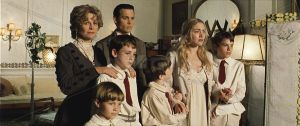 The message of the movie is about the need for adults to slow down, open their imagination, and become bewitched by the power of believing. Because it’s not like there aren’t any other Hollywood movies out there that teach us to loosen up and enjoy life. Thank you Finding Neverland, I never would have found this out by myself. The message of belief overpowering all is also a bit naive, but then it works into the whole cross-stitching of sap the movie is generating.
Not even Depp can save the film. Long established as one of the most versatile and exciting actors, Depp finds ways to disappear into his oddball characters. In Finding Neverland, Depp sports an impressive Scottish brogue, but, sadly, this is the most impressive aspect about his performance. There had been much talk about Finding Neverland being Depp’s next opportunity at finding Oscar, but it would be a shame if Depp won for such a lackluster, artificial performance especially when he’s been brilliant so consistently in other movies. J.M. Barrie was somewhat eccentric, but in Finding Neverland he comes off as mostly vacant. The film tries to show that Barrie didn’t really fit in, but instead of becoming a showcase for Depp’s acting it becomes a showcase for Depp’s silence. The performance is so subtle that it doesn’t even come off as a performance. If Depp stood in the background of a movie, it would be akin to this performance.
Winslet has also been a very versatile actor. Her role in Finding Neverland never really deepens beyond Disadvantaged Woman. She’s been hit by adversity, she’s beset by four rambunctious kids and an icy mother, but that’s about all the film does for her characterization. Winslet is a tremendously talented actor, as evidenced by her Oscar-worthy performance in this year’s Eternal Sunshine of the Spotless Mind. So why strand her in a role where her character’s greatest acting moment is coughing fits?
Director Marc Forster (Monster’s Ball) has the frustrating habit of having two shot styles he shoots in. He decides between medium shots which usually involve two or three people, or large close-ups. While I was watching Finding Neverland I never once thought to myself that something was filmed in a visually interesting way. Some of Forster’s decisions seem unnecessary, like when he has to visually show us scenes of imagination instead of allowing the audience to, gasp, use their own imagination (hey, isn’t that the message of the movie?).
Finding Neverland tries so hard to be a three-hanky movie (and truth be told I heard a lot of sniffling in my theater during the last half hour), but what stops the film short is how unbelievably transparent everything is. Finding Neverland could have explored the rich complexity of an enigmatic figure like J.M. Barrie, but instead it settles for goopy sentimentality at every opportunity. Barrie becomes sugar-coated into an earnest father figure, and in the process key facts are sugar-coated as well. What do you mean? Well, Sylvia’s husband didn’t die until several years after Barrie wrote Peter Pan. Barrie’s wife didn’t have her affair until long after Peter Pan. Also, the original Peter threw himself in front of a train because of how upset he was about his connection to the famous character. I guess that’s why this is a biographical movie merely “inspired” by true events, much like Hidalgo.
The filmmakers rely on cloying tricks to make an audience care about its characters. The movie paints in very stark black and white tones, mainly “adults = shortsighted” and “children = special.” This is a film that is proud to take the easy road and makes little effort to cover its pride. It plays toward audience expectation and thus loses any long lasting magic.
Finding Neverland takes the easy road for audience-friendly sappiness. Barrie insists that 25 orphans be strategically placed around the theater on opening night of Peter Pan. Sure enough, the theater is full of old white men with monocles, and apparently they just don’t get the spirit of theater. The orphans laugh and squeal from the stage antics, and somehow this triggers all those old curmudgeons to learn to laugh once again. You see, all it takes is strategically placed orphans to make us laugh at life again.

When Sylvia is hanging laundry she starts to gently cough. If you’re smart, you’ll instantly figure out what trajectory is in store for her, but even if you miss this single cough don’t worry, because Sylvia will be doubled over with coughing later to spell it out for everyone. You can all but see the strings being pulled (the audience will cry… now!). All can be overcome in the end, those who didn’t understand will, and we’ll all be happier and live life to the fullest, in theory of course.
Finding Neverland wants to be Shakespeare in Love, another whimsical movie that shows how a writer utilized the people and events around them to pen a masterwork. Except in Shakespeare in Love there was a romance to fall back on, as well as some ripe comedy, but with Finding Neverland there isn’t anything to fall back on. It’s a Hallmark card mass-marketed to the largest possible audience.
Everything about Finding Neverland is disappointingly under whelming. The direction is shabby, the actors are marooned by their weak roles, and nothing is sacred in the film’s pursuit of that tearjerker ending. This is a movie for people that ask little of their movies, and yet I can reasonably see Finding Neverland becoming an audience favorite and riding good word of mouth all the way to awards season. Finding Neverland is a film that never takes flight because it’s too content to stay grounded by going the easy route.
[Nate’s Grade: C


 nathanzoebl
You must be logged in to post a comment.