Blog Archives
Apocalypto (2006)
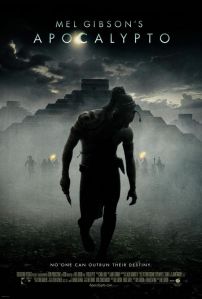 Apocalypto is an action movie set 500 years in the past with a cast of entirely unknown actors, some of who have never acted before. But what does everyone want to talk about? Mel Gibson hates Jews. He’s been in a heap of trouble ever since a DUI where he said some very unkind things about God’s chosen people. He’s made the apology tour and checked into alcohol rehab, the new go-to defense whenever a celebrity screws up. The public finds it hard to separate art from the artist; Frank “It’s a Wonderful Life” Capra was anti-Semitic but few seem to bring that up. Some people have sworn off Gibson thanks to this disgraceful incident. That’s a shame because Apocalypto is brilliantly filmed and Gibson’s finest directing effort yet.
The Mayans seem pretty at ease 500 years ago. We open on a hunting party dividing up a recent kill and playing a prank on one of their members that is having trouble making little Mayans with the wife. Jaguar Paw (Rudy Youngblood) is the son of the tribe?s leader. In the forest they encounter a group of survivors from a different village. They warn of a group of mercenaries that razed their town, killed their people, and took the rest. Jaguar Paw?s father warns not to speak of what they have seen to their people. Fear is contagious, we?re told. That night the same mercenaries attack Jaguar Paw?s village. He scrambles to lower his pregnant wife and young son into a cavern for safety. The surviving men and women are tied up and sent marching. The village?s children are left to fend for themselves and most likely perish without any adults.
 Jaguar Paw and his fellow captives are headed for a Mayan temple. The women are sold into slavery. The men are painted blue and guided to the top of the temple to become sacrifices to an unhappy god. The men are held on a slab, have their hearts cut out, finally then have their heads sliced off and kicked down the stairs. Through a fortunate set of circumstances Jaguar Paw breaks free and races into the forest to return to his family, who is in danger of drowning if the cavern fills with rain water. The mercenaries are not far behind and willing to go to any length to kill Jaguar Paw.
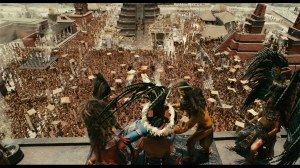
From an anthropological standpoint, Apocalypto is fascinating. Gibson has turned back time and immerses the viewer in a world unseen for 500 years. The details are astounding, and whether they are note-for-note historically accurate or not is inconsequential. You are seeing a living, breathing world right before your eyes. I loved soaking in the new-ness of the experience, seeing how this forgotten world operates, and the power struggles within. These people have great faces, great hulking muscular frames, and great expressions needing to be seen. Gibson has crafted a film that you’ve never seen before, at least with this kind of budget and filmmaking prowess. Apocalypto can quite often be breathtaking to behold. The production design and costumes (yes, there are more than just loin cloths) are incredibly rendered and add greatly to the authenticity and mood. I loved visiting the Mayan temple city (“down town” I guess you could call it) and seeing the different factions intersect, like green painted upper-class harpies being carried around the crowd.
The parallels Gibson puts out there seem tenuous at best. The Mayans have lived beyond their resources, experiencing plague, and feel that the need to pacify the masses, and turnaround their bad luck, is a whole slew of human sacrifices. There’s an Iraq War reference in there if you want to go looking for it and perhaps an ecological one as well. I don’t know if Gibson is using the Mayans as a cautionary example of a society that crumbled. We are treated to an opening quote detailing that no great society can be conquered from outside until it has become corrupt from within. Maybe this is Gibson’s way of telling America to sit up and fly right. Or maybe it’s just an intellectual glob toweled over the blood and guts to make everything seem more meaningful.
The acting is a surprise. Many of these people are really good, especially Youngblood who has a soulful face and a terrific presence onscreen. Gibson creates a great sense of community in the early moments. People feel natural and in touch with their surroundings. Their interaction and the visual shorthand feel like storytelling tricks from classic silent movies. Gibson manages to tell us a lot with little. There are some gut-churning moments, and some of them are because of character. A man from Jaguar Paw’s village hopes his wife did not give up fighting before she perished, because if she did then she will be sent to hell. He pleads that when he dies he might endure the tortures of hell, just so he can be with her again. That hits hard. A cranky mother-in-law also provides a shining emotional moment completely played in solemn silence. A little girl surrounded by crying children tries to assure the adult captives, “They are mine now. I will take care of them.”
 The last hour of the movie is a non-stop foot race as Jaguar Paw valiantly attempts to escape his enemies and return to his swatch of the jungle. There are some fantastic escapes and imagery, like Jaguar Paw outrunning an actual jaguar. The ending is fantastic and a fitting climax for the title. I would have enjoyed just a little shove further, like a new character marveling at some gold trinket Jaguar Paw had gotten from the Mayan temple. “This is gold. Can you tell me where there is more?” he would say. “Tell you?” Jaguar Paw would say in a hearty laugh. “I’ll SHOW you where to get more. Follow me.” The resolution is pretty obvious but left to the imagination. I guess after much derring-do I just prefer more finality with my comeuppance.
This may be about a dead culture and spoken entirely in a dead language, but Gibson’s bloody art house flick is a lively macho action movie at its core. It’s structured exactly like a typical Hollywood action movie, and I don’t know if this adds another level of brilliance to the final product or makes it seem more ordinary taken apart from its historical context. Gibson’s trade is misery. He’s been a martyr onscreen and he prefers to tell stories about the anguished and tortured. Jaguar Paw is beaten, wronged, and has to race against time to save his family. When Jaguar Paw moves onto his own turf he turns his knowledge of the land to turn the tables on his enemies. The movie presents familiar archetypes like the wise father, well-meaning oaf, and impetuous hothead villain, Super Biggest Bad Guy (he does wear the most skull trophies, that has to count for something). The villains are larger than life and have great menace to them. Even better, they’re highly memorable and despicable, and yet they seem to operate within a tribal code of their own honor. They scowl with the best of them.
This familiarity makes viewing Apocalypto less jarring, This is an independent movie high school jocks could enjoy. That may sound dismissive but it’s a compliment. Gibson has great technical skill and after decades of shoot-em-up pictures, he definitely knows how to build and sustain exciting and rewarding action sequences. You know when the bad guys with personality are going to have big deaths, and you know when you see a hunting weapon in Act One that it is going to be put to awesome use in Act Three. The lines of action are well structured and smartly played. When you boil it down, it may just be an action movie, but because of Gibson it’s a good action movie.
 With The Passion of the Christ, I was appalled by the violence, more so how Gibson fell in love with the blood and gore, turning it into pornography. That was the message of The Passion — Jesus sure knew how to take a lickin?. But with Apocalypto, the violence is savage but the appeal of this project is on recreating a world, not sadism. Apocalypto is more interested in opening eyes than shutting them because of nauseating and relentless gore. This isn’t exactly a movie fit for nuns and missionaries, though. Gibson embraces the cruelty of man and showcases some real horrors. The temple sacrifices are fitting and gruesome, but never seem exploitative. There are moments that I wish Gibson would have pulled back, like an extended scene of a jaguar chewing a man’s head or a gusher of blood spritzing out of a man’s temple like a broken sprinkler. I think Gibson loses control of his story and gives in to his own bloodlust in these moments, which serve to take you out of the movie and go, “Ick.”
The violence is also easier to stomach because the audience is more invested in story and character. Everyone that paid a ticket in 2004 knew Jesus was going to die in the end, at least, I really hope they did. That might have been a shocker to a remote few. It was all about witnessing suffering and testing how much you could watch. You felt the pain, all right. Apocalypto, in contrast, is tame and more focused on escape than futility.
After The Passion of the Christ made heaven and earth move at the box office, Gibson can afford to make any movie he wants. If he wants to make a movie about Mayans in Mayan, so be it. At least Gibson knows how to tell a good action story. Apocalypto is beguiling and often breathtaking to behold. The details create a rich environment that feels wholly alive. It’s a typical action movie plucked down in a different historical setting, creating the most unique movie experience of the year. It’s a man’s man independent movie but also manages to hit key emotional notes. I don’t care what he thinks of Jews or anyone else. His art speaks for itself, and Apocalypto is fascinating. It’s an art film for jocks, it’s an action movie for science geeks. Bless you Mel Gibson, you’ve brought us all together in the weirdest way possible.
Nate’s Grade: B+
Share this:

A Very Long Engagement (2004)
 Deep in the heart of WWI trenches, we begin this sprawling tale by narrowing in on five French soldiers. Each man has been accused of self-inflicting a wound to escape service, and each man is sentenced to spend the rest of their likely short lives in No Man’s Land, the stretch of bare land between the two trenches. One of these men is Manech (Gaspard Ulliel), a young country boy engaged to the charming Mathilde (Audrey Tautou). When she learns his fated punishment and fails to hear word from Manech, she steps out to launch her own investigation into the possible whereabouts of Manech or the possible details of her fiancé’s demise. She enlists her family, solicits strangers, and puts ads in newspapers to unravel the truth. Along the way she hears various stories from all sorts of people and attempts to form them into a clear picture of what went on in that trench, good or bad.
A Very Long Engagement could be flippantly described as “Rashomon in a trench,” but from the get-go it grabs you by the lapels and will not let go. Once again, Jeunet tells his story in a criss-crossing narrative. Front and center we learn about each doomed man’s life in snapshot, and while the device has a slight eulogy feel, it’s a fantastic way to show the depth of characters in such brevity. A Very Long Engagement is an immeasurably rich film where each detail is threaded into the film to create a magnificent artistic tapestry beyond compare. The tiniest details in the film like Mathilde’s tuba playing (the only instrument whose sound mimics a distress call), to the mail carrier choosing to slide his bike over gravel just further enhance the vibrant, animated world of Jeunet.
 Jeunet is quite possibly the most visually gifted director working today (he turned down Harry Potter 5). He couldn’t film an ugly shot composition if he tried with all his French might. As expected, A Very Long Engagement is gorgeous to look at. The production design is massively intricate, the cinematography, while computer assisted, has a shimmering radiance to it. This is simply the best looking film of all 2004, Hero be damned. You could pause any second in this film and use it as a glossy postcard. Jeunet has the technical credentials to fasten together complex and beautiful worlds. A Very Long Engagement is a technical marvel and gorgeous to experience.
Tautou, also as expected, is wonderful once more. She’s the anchor of the film and the audience feels every heartbreak and glimmer of hope this talented actress explores. The supporting cast is full of familiar Jeunet players and each performance adds to the richness of the film. They feel like characters and not stock roles or cliches.
There is some difficulty with following the storyline. There are so many subplots built upon other subplots that the film’s momentum takes a bit of a dive in the second act. A Very Long Engagement can also get very confusing when it comes to remembering so many names. There are maybe 30 characters to keep track of and as the subplots mount new characters are added to the pile, including a widow played by a surprisingly fluent Jodie Foster. It’s best to employ some kind of memory trick to keep the many colorful characters of Jeunet’s world straightened.
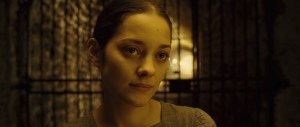 The focus of A Very Long Engagement is on Mathilde’s investigation into what really happened in that trench. She wants to know what happened to her beloved, and as her search picks up steam we get further glimpses of her relationship with Manech. One of my biggest problems I had with 2003’s Cold Mountain was that Jude Law was travailing through hell and back to get back to his beloved Nicole Kidman even though their relationship pre-war lasted as long as a Super Bowl commercial. It’s not that I disbelieve the overpowering nature of love, but I need more from my characters than shifty glances and a quick ejaculation of love (get your mind out of the gutter). Now, in A Very Long Engagement, Jeunet opens by showing the measures Manech will endure to return to his beloved, however, as the film goes on we also see enough peeks into the depths of their relationship beforehand, which dates all the way back to when they were children
A Very Long Engagement forges such a grand and sweeping love story that the audience gets just as immersed as Mathilde about the search for her man. There are so many lovely, intelligent moments between Mathilde and Manech, like their first sexual encounter. Every time Manech lights a new match Mathilde removes an article of clothing until, under the soft light of the newly lit match, she’s nude and blows the match out herself. The characters’ overriding love also taps into small truisms like when Mathilde makes arbitrary games for herself to ensure her love’s safety. (“If I can count to ten before that car passes, then he is alive.”) Mathilde’s faith and devotion are driving her investigation and the audience is behind her 100% of the way, fully invested in this mystery. When we reach our conclusion, I don’t mind telling you I was bawling like a baby.
The film has a merry whimsical tone during its origami-like narrative, but when it hits the trenches the film gets down and dirty. Jeunet shows a fascinating view into the hardships of everyday trench life as well as the machinery of death. Storming the other side’s trench, or “going over the top” as it was called, is seen in all its sordid features. There are hearty splashes of blood and gore that can be jarring.
There’s one terrifying scene in A Very Long Engagement involving the explosion of a makeshift hospital. The hospital is inside a hangar for zeppelins (hydrogen gas) and a missile has crashed into the roof with its nose sticking inside. One of the zeppelins becomes loose and slowly floats to the missile nose with unforgivable certainty. People are running around trying to shield themselves from the inevitable, but it does nothing. The moment is played so agonizingly slow that we become overwhelmed with terror. This was the life of WWI warfare.
 Having said this, the stark war violence doesn’t exactly gel exceedingly well with the whimsical romantic elements. For some, A Very Long Engagement will seem like two very tonally different movies butting heads and intruding upon the other (perhaps Amelie Goes to War?). Sometimes it does take a while to adjust to one tone after spending time with the other. I feel that the emotional investment in the characters and the anticipation of unraveling the mystery serves as thematic glue over the disproportionate tones. Some will feel chaffed by the two stark tones, but I think the power of the love story will conquer most hearts into experiencing the bloodshed of war to earn the shedding of tears by the film’s romance.
Jeunet has re-teamed with Tautou and created another masterpiece. A Very Long Engagement took hold of me from the start and mesmerized me with its beauty, grace, cruelty, excitement, and warmth. This is a great mystery and a great love story with great visuals and great characters. The opposing tones (whimsy vs. violence) won’t work for everyone, and the film takes one too many divergent paths in the middle, but A Very Long Engagement is a film of such startling originality and feeling that it should be treasured. I was floored by what Jeunet had to offer and deeply moved by the time I had to leave the theater. They don’t make them like this much anymore. Now if you’ll excuse me, I have something in my eye.
Nate’s Grade: A
Share this:

Maria Full of Grace (2004)
 No other actress stood out to me this year as 23-year-old Catalina Sandino Moreno. She plays the movie’s Maria, a Colombian woman who agrees to carry 60-something condoms filled with heroin in her gut to the United States. The first half of the film is unjudegmental and nerve-racking, especially when Maria gets snagged by U.S. customs. The second half revolves around Maria trying to land on her feet in an unfamiliar land. The greatness of Maria Full of Grace relies on debut writer/director Joshua Marston framing his story like camera is an invisible voyeur. The film suggests that Maria is only one of thousands that have turned into drug mules to make ends meet or seek better lives. Maria Full of Grace is startling, immersive, delicate and quietly touching as Maria rediscovers the promise of the American dream.
Nate’s Grade: A
Share this:

The Passion of the Christ (2004)
 The Passion of the Christ is a retelling of the last 12 hours of Jesus Christ’s life (perhaps you’ve heard of him?). In these final hours we witness his betrayal at the hands of Judas, his trial by Jewish leaders, his sentencing by Pontius Pilate, his subsequent whippings and torture and finally his crucifixion. Throughout the film Jesus is tempted by Satan, who is pictured as a pasty figure in a black hood (kind of resembling Jeremy Irons from The Time Machine if anyone can remember). The Passion spares no expense to stage the most authentic portrayal of what Jesus of Nazareth endured in his final 12 hours of life.
For all the hullabaloo about being the most controversial film in years (and forgive me for even using the term “hullabaloo”), I can’t help but feel a smidgen of disappointment about the final product. The Passion is aptly passionate and full of striking images, beautiful photography and production values, and stirring performances all set to a rousing score. But what makes The Passion disappointing to me is the characters. You see, Mel Gibson’s epic does not devote any time to fleshing out the central characters. They are merely ciphers and the audience is expected to plug their feelings and opinions into these walking, bleeding symbols to give them life. Now, you could argue this is what religion is all about, but as far as a movie’s story goes it is weak. The Passion turns into a well-meaning and slick spectacle where character is not an issue. And as a spectacle The Passion is first-rate; the production is amazing and the violence is graphic and gasp-inducing. Do I think the majority of people will leave the theater moved and satisfied? Yes I do. But I can’t stop this nagging concern that The Passion was devoid of character and tried covering it up with enough violence to possibly twist its message into a Sunday school snuff film.
 For my money, the best Biblical film is Martin Scorsese’s 1987 The Last Temptation of Christ (also a film mired in controversy). Last Temptation, unlike Gibson’s spectacle, was all about Jesus as a character and not simply as a physical martyr. Scorsese’s film dealt with a Christ consumed by doubt and fear and the frailties of being human. But the best part is the final 20 minutes when Jesus is tempted, by Satan, to step down from the cross and live out a normal life. Jesus walks away from the cross, marries Mary Magdalene, fathers children (this is where the controversy stemmed from but they were married) and dies at an old age. Jesus is then confronted by his aging apostles who chastise him for not living up to what he was supposed to do to save mankind. Jesus wakes up from the illusion and fulfills his mission and dies on the cross. Now, with the story of Last Temptation an audience has a greater appreciation for the sacrifice of Jesus because they witness his fears and they witness the normal life he forgoes to die for man’s sins. There is a sense of gravity about what Jesus is sacrificing.
With The Passion Gibson figures if he can build a sense of grand sacrifice by gruesomely portraying the tortures Jesus endured. Even if it is Jesus, and this may sound blasphemous, torturing a character to create sympathy and likeability is the weakest writing trick you can do. Yes Jesus suffered a lot, yes we should all be horrified and grateful, and yes people will likely be moved at the unrelenting violence he endured, but in regards to telling a story, I cannot feel as much for characters whose only characterization is their suffering. Sure, The Passion flashes back to some happier moments of Jesus’ life, which I like to call the Jesus Greatest Hits collection, but the movie does not show us who Jesus was, what he felt (beyond agonizing pain) or the turmoil he went through in finally deciding to give up his own life for people that despised him. The Passion is not about character but about spectacle.
So let’s talk about the violence now, shall we? Gibson’s camera lovingly lingers on the gut-churning, harrowing, merciless level of violence. But this is his only message. It’s like Gibson is standing behind the camera and saying to the audience, “You see what Jesus suffered? Do you feel bad now? FLAY HIM MORE! How about now?” What was only three sentences of description in the Gospels takes up ten minutes of flogging screen time. Mad Mel has the urge to scourge. After an insane amount of time spent watching Jesus get flayed and beaten the violence starts to not just kill whatever spiritual message Gibson may have had in mind, but the violence becomes the message. The Passion does give an audience a fair understanding of the physical torture Jesus was subjected to, but the movie does not display Christ as fully human, enjoying life and love, or fully divine. The only thing The Passion shows us about Jesus is that the son of God sure knew how to take a whuppin’. For Gibson, the violence is the message and the point is to witness what Jesus endured. Some would call that sadistic.
 The actors all do a fine job and it’s impressive that everyones’ lines is in two dead languages (Latin and Aramaic, though for the life of me I can’t tell them apart). But the acting is limited because of the nature of the film. Had there been more moments of character the acting would come across better. As it stands, the acting in The Passion is relegated to looks of aguish or looks of horror, interspersed with weeping. Monica Bellucci (The Matrix sequels) really has nothing to do as Mary Magdalene but run around in the background a lot. Jim Caviezel (Frequency, Angel Eyes) gives everything he has in the mighty big shoes he tries to fill. It’s too bad that his Jesus spends most of the screen time being beaten, which kind of hampers his acting range.
Now let’s address the anti-Semitic concerns. Let’s face facts; you are not going to have a film about the crucifixion of Jesus and have some Jews coming off in a good light. Just as you would not have a film about the Holocaust and have some Germans coming off in a good light. It is unavoidable. The Passion does portray a handful of Jewish religious leaders as instigators for Jesus’ eventual crucifixion, but there are also Jewish leaders who denounce their actions and just as many people bemoaning the torture of Jesus as there are calling for it. Who really comes off looking bad are the Romans. Excluding the efforts to make Pilate look apprehensive, the Roman soldiers are always seen kicking, punching, whipping, spitting on Jesus and laughing manically with their yellow teeth. How anyone could watch The Passion and come away anti-Semitic and not anti-Italian is beyond me.
And like I said before, most people will be extremely satisfied with the film because it’s hard to find a person who doesn’t have an opinion on Jesus. Gibson is counting on audiences to walk in and fill in the holes of the character so that The Passion is more affecting. Gibson’s film is worthy spectacle, and despite the vacuum of character I did get choked up four separate times, mostly involving Jesus and his mother. The Passion is a well-made and well-intentioned film that will hit the right notes for many. I just wish there were more to it than spectacle. I really do.
Nate’s Grade: C
Share this:

The Man on the Train (2003)
 A dark stranger gets off a train in France. He has piercing blue eyes and a weathered face with a machine-like expression. This man is Milan (Johnny Hallyday) and he’s stopping by this small French town for a new job. Oh, Milan’s business is robbing banks. In this small village he befriends a garrulous retired poetry teacher, Monsieur Manesquie (Jean Rochefort). The two men spend their time wishing they had the life of the other. Milan openly seeks a comfortable life surrounded by books. Manesquie is a huge fan of Clint Eastwood movies and longs for some action in his life. He secretly dreams of one day robbing a bank just for the fun of it.
So, an interesting start for a film, right? Sure. But this IS the movie. The Man on the Train is a middling character experiment. The two men rub off each other, with Milan teaching a young boy the wonders of poetry, and Monsieur Manesquie learning how to properly fire a gun. The scenes are nice and both actors are splendid (especially French rocker Hallyday) but the film is one long muddled and meandering trip until our inevitable climax. The ending feels needlessly open-ended and a tad clumsy. There’s also a subplot featuring a young mistress for Monsieur Manesquie that sticks out like a sore thumb.
The Man on the Train is well shot and well acted but it only feels like the first half of a movie. I’m sure plenty of people out there will appreciate the character nuances and small moments, but this is a film completely driven by small moments that never adds up to anything larger. Maybe The Man on the Train just isn’t for me. Or maybe I need to just wait for the second half, if it ever gets made.
Nate’s Grade: C+
Share this:

City of God (2003)
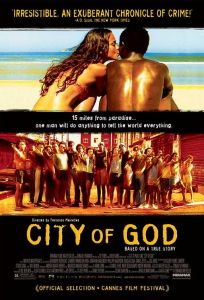 Looking for a film that really packs a genuine wallop? Take the visual panache of a pre-Madonna Guy Ritchie (Snatch) film, the juvenile delinquency and debauchery of a Larry Clark (Kids) film, the propulsive narration and bloody violence of a Martin Scorsese (Raging Bull) film and mix it with a cast of about 40 characters. What you get is City of God, a brilliant and vibrant film that pulsates with exhilarating action, thoughtful commentary and devastating power.
In the 1960s, the Brazilian government transported its impoverished citizens outside of Rio de Janeiro, a glamorous tourist magnet. This new place of residency was a distant housing project of shabby slums, ironically titled City of God. In this begotten neighborhood the police rarely emerge (except to occasionally pick dead people’s pockets) and crime has become rampant. A mixture of poverty and an overabundance of guns and testosterone have bred a culture of criminals where teenagers populate ruthless gangs.
 Our story focuses on Rocket (Alexandre Rodrigues) narrating the rise, and many falls, of all the flashy thugs of the City of God and the ripples they create in the community. Hes a young boy who is too scrawny to be a hoodlum like his older brother Goose. His brother belongs to a gang known as the Tender Trio, who are used to hijacking propane tanks for small gain. They get the idea to knock off a brothel at the urging of Lil Dice, a younger kid with ambition and a heart like a stone. After the successful robbery Lil Dice cleans up after the Trio, sifting through the brothel killing everyone inside and laughing insidiously.
The murder spree has long lasting effects, with each member of the Tender Trio finding an untimely end. Lil Dice grows from calculating child into a big-time burgeoning cruel gangster, who now calls himself Lil Ze (Leandro Firmino De Hora Phellipe). Ze has climbed to the level of kingpin the most pragmatic way possible: systematically eliminating all of the competition. Ze attains reign over the city. He instructs others not to do anything to arouse the outside police (the locals are paid off), and thus has made the City of God a safe place for rich tourists to drive in and purchase their drugs. It seems that Ze ruling by fear has brought newfound safety and prosperity.
Rocket’s path is quite different. As he matures into a teenager he discovers a love of photography. His attempts at a life of crime are short-lived; he simply likes his victims too much to rob them. Ze has Rocket take pictures of his gang strutting their machismo that eventually gets published onto the front page of a newspaper. Rockets reaction is that he thinks his death certificate has been signed. Ze’s reaction is delight. Lil Ze’s great weakness is his self-believed sexual inadequacy. When turned down by a girl he seeks out her good-looking boyfriend, Knockout Ned (Seu Jorge), and humiliates him. He terrorizes Ned, raping his girlfriend in front of him and inspiring him to long bloodthirsty battles of vengeance against Ze that will engulf the City of God.
 A complaint that could be levied against City of God is the numbing effect of its violence. The gangsters in this film aren’t the mustache-twirling types of Gangs of New York, but merely kids. This isn’t any kind of glamorized Hollywood gun battle. When these kids get hit their bodies go limp; they drop to the ground in weeping masses. The films message of the hereditary nature of barbarism is clear. One of the amazing parts of the film is that it was mainly filmed in the actual City of God and uses a cast almost entirely of non-actors.
City of God is a loud announcement to the world of the arrival of a fresh, invigorating and monumental talent with director Fernando Meirelles. The visual flair he utilizes to advance his storyline is amazing yet never falters into the land of gimmickry. The narrative folds in on itself time-wise (much like Tarantino films) yet rhythmically connects the numerous lives and history of the City of God in one lustrous and captivating tapestry of urban decay. A fantastic example is a scene that chronicles the entire history of one apartment and the origins of the entrance of drugs in one un-moving shot. Imagine the Natalie Imbruglia “Torn” video but with drugs and guns.
 There is one sequence of crushing emotional power that has been burned into my memory. The sequence involves a bawling child, no older than seven, being forced to decide where he would rather be shot, in his foot or his tiny trembling hand as punishment for his mischief. The reality of City of God is a harrowing one. As you can clearly see, City of God is not for the weak. The movie has its definite squirm-worthy moments of discomfort and will not be a good choice if you and your date are looking for that perfect weekend movie. This is a difficult movie to sit through at times, and the reality can be grim and uncompromising, but City of God is rewarding in respect to the amazing narrative and visual accomplishments. This is an unforgettable film.
The film piles on the body count while at the same time advancing a pacifist message between the bursts of adrenaline and bullets. Meirelles’ film will leave your jaw dropped to the floor by its sprawling complexity. This is what great filmmaking is all about. City of God is one of those movies that once you’ve left the theater you excitedly claim, “Now thats why I see movies.” City of God is simply a cinematic masterpiece and not only the best film I’d seen in 2003 but also one of the best movies I’ve seen in my life.
Nate’s Grade: A+
Share this:

Talk to Her (2002)
 Before one can assess Talk to Her, the new Spanish import from famed writer/director Pedro Almodovar, one must come to grips with what they have seen. It’s not every film you see that has a giant vagina. Yes, you read correctly dear reader, a gigantic yet scalable recreation of the most sensitive part of the female anatomy. Was there also a giant penis you might reasonably ask? No, but there was an incredible shrinking man that burrowed into the enormous vagina and lived the rest of his days with the labia and clitoris as his next-door neighbors. And what may be even more surreal is that all of this, thematically and metaphorically upon retrospect, makes absolute sense.
So maybe this opening salacious salvo was a bit hyperbolic, but describing Almodovar’s unusual meditation on life, love and death can prove quite ponderous. To explain the story of Talk to Her is to miss its complexity and richness. This is a film destined to spark conversation afterwards.
Almodovar’s colorful melodrama centers on two sets of relationships. Benigno (Javier Camara) is the most attentive boyfriend a woman could have. He talks to former ballerina Alicia (Leonor Watling), washes her hair and makes sure she gets plenty of exercise and attention. Oh yeah, Alicia has also been in a coma for four years. Benigno carries on like he was involved in a normal relationship, except the woman of his heart cannot return a single glance.
 Marco (Dario Grandinetti) is recovering from a former relationship when he falls completely in love with Lydia (Rosario Flores), a female bullfighter. She is having trouble competing in a very male dominated “sport” (I don’t really consider stabbing animals a sport per se). At the start of a bullfight Lydia is horribly gored and dragged around the arena like a rag doll. The results leave Lydia lying in a coma with no hope of ever waking up. It is at the hospital where Marco meets Benigno, who is one of the most helpful nurses. He helps Marco overcome his grief over his fallen love. Benigno shows that unresponsiveness and death cannot deter a man’s love. The two men bond and become very close; however, dark clouds are on the horizon, as Benigno’s fantasy cannot last much longer.
Almodovar has routinely enjoyed tweaking the establishment, especially gender roles and religion (there’s a few tacky priest molestation jokes), but with Talk to Her he attempts to forge serious drama through odd circumstances (ballerinas, bullfighters, giant vaginas, oh my!) and all without the use of irony. The result is a quietly affecting film that burrows its way inside you, much like the shrinking man burrows into … well, you remember.
The movie is darkly comic in its portrayal of Benigno’s delusional relationship, and yet Talk to Her is also a celebration of love and friendship. The affection that is shown is perplexing but also transfixing with the ability to love someone who is mentally not even there. The film questions the compensations we make for love. Some people pretend that their mate is a different person and glaze over character flaws. Could it not be possible then that someone would compensate for an entire person?
Almodovar has created a very female-centric film despite our female leads spending the majority of their screen time lying perfectly still. Talk to Her is an engrossing and intriguing character-driven story. It may start out like a sick joke but the layers of humanity Almodovar effortlessly injects into his story create the most bizarrely touching movie of 2002.
Nate’s Grade: A
Share this:

Sex and Lucia (2002)
 “Put lots of sex in it. Thats always good,” says a character in Sex and Lucia, the steamy Spanish import now playing. And Sex and Lucia is true to its very title. There are many scenes with Lucia, our heroine, and there’s also oodles of sex. This is the type of movie where if people can walk around without a stitch on, they will. This is the type of movie where a babysitter will masturbate to her mother’s porno. This is the type of movie where shower heads are not used for their intended purpose. No wonder this movie went unrated.
Sex and Lucia is a genuinely erotic movie. And when it comes to eroticism in cinema, the Europeans make us look like sickly amateurs. After exploring whatever late-night stimuli is offered on Showtime or Cinemax youll get an idea of how poor American eroticism is. Usually they involve an adventurous couple, or a sex therapist, or a Jacuzzi/swimming pool, or a lonely stewardess/waitress/secretary and usually Shannon Tweed stars. What disarray the state of our erotic union is in. But for all its shocking and stimulating moments, Sex and Lucia is an intriguing tale of loss, love and sexuality, of course, even if it’s told rather obtusely.
Lucia (Paz Vega) is a waitress in Madrid. She enters into a fiery relationship with a writer named Lorenzo (Tristian Ulloa). Their passion seems to burn as fast as the many cigarettes in the film. Their relationship is full of joyous sex, impromptu strip teases, and blindfolded foreplay. But Lorenzo has a secret he hides from Lucia. Six years ago he fathered a daughter he has never seen when he had a tryst on the beach of a Mediterranean isle. The mother has sent their daughter, Luna (named after the full moon on her conception), into the care of a former porn star and Belen, her randy teenage daughter, in Madrid. Its here that Lorenzo first meets his daughter and then Belen starts coming onto him.
 After learning some disconcerting news about her boyfriend, Lucia leaves to take some refuge on the same sunny Mediterranean island where Luna’s mother lives. Lucia actually takes refuge with her and looks back upon her stormy relationship with Lorenzo. The island has many deceiving holes that fall into caverns all along its beach, directly echoing the rabbit hole for Alice.
This, believe it or not, is the most easily understandable part of the movie. I’ve told you what took place but after seeing it even I dont know what happened. The story has several moments, even entire subplots, that could be the truth, fantasy, sections of Lorenzo’s story, an exaggerated dream, or maybe all of them combined. Your guess is as good as mine, reader.
Writer/director Julio Medem utilizes about every narrative trick in the book to create an alluring puzzle. He washes out the colors of the film (also seen in Three Kings) and seems to correspond to the surreal quality of many story lines. The cinematography is a gorgeous delight. Vega has a smolder and can act circles around her Spanish competition. She gives a brave performance, partially for being as nude as often as she is, and also for displaying the fragile emotions of Lucia so well.
Sex and Lucia is indeed quite sexy but it’s more than just art house porn. The film’s story is an intimate tangle that just might stimulate the largest organ: the brain.
Nate’s Grade: B
Share this:

Crouching Tiger Hidden Dragon (2000)
 Ang Lee’s mythical tale of ancient… (Taiwan?) is full of visual marvels and plenty of moments of awe that make the audience believe in the power of cinema to transport once again. However, upon further viewings and more butt pain because of the large length, the film is not “one of the best ever made” as has been praised. When you get down to it and think the film really isn’t about anything but retrieving a sword and feminist roles. The visuals are striking poetry and the action is exciting and top-notch and that’s what really counts in the end.
Nate’s Grade: B
Share this:

Run Lola Run (1999)
 There is a certain vibe some movies resonate while watching. With some it’s the mood of pure nausea, some the feel of being derivative and meandering, but there are those few that seem to leap from the screen, slap you in the face, and scream cool. It happened with Pulp Fiction, it was there with Trainspotting and The Matrix, and you better believe every precious frame of Run Lola Run drips with a feeling of absolute cool.
Since the movie is foreign, German, and subtitled, I’m sure most out there don’t know about it. It’s the tale of Lola’s desperate quest to save her boyfriend Manni. See Manni runs money for a very shady character and has accidentally lost a bag of money earlier. Lola has twenty minutes to retrieve 100,000 Deutschmarks somehow or else he will in an act of desperation rob a corner grocery store which inevitably means his doom. So Lola dashes out the door and she runs. And does she ever!
 Born in an age of avant garde MTV videos and a declining attention span nationwide, Lola is a dizzyingly kinetic concoction of energy ]and excitement.The movie is a colorful fireworks display of multiple outcomes and the varying degree minute choices and details can have on our lives. The movie is a living video game telling Lola’s trek three different ways and showing the possibilities of chance and fate.
With each run the audience’s heart beats to the thumping presence of the blistering electronica soundtrack pulsing along Lola’ runs. It simulates her racing heart and that of the audience watching. Within an hour of seeing the flick I had to run out and get the soundtrack, and after a brief listen it made me want to run myself.
The movie has more energy than the Energizer bunny, and our carrot-topped heroine could run circles around his fluffy ass. The narrative structure poses the question to audiences how our lives could be different with any of the small choices that occur day-to-day in our lives. The idea was seen in last year’s Sliding Doors but is much better played out here. All I can say is that Run Lola Run will go down as one of the coolest movies of the millennium and ushers in a new time and genre for the world of cinema. I want my Lola running shoes.
Author’s note: I was so enamored with this film I went as Lola for two Halloweens in a row.
Nate’s Grade: A


 nathanzoebl
You must be logged in to post a comment.