Blog Archives
Bugonia (2025)

A remake of a 2003 South Korean movie, Bugonia is an engaging conflict that needed further restructuring and smoothing out to maximize its entertainment potential. Jessie Plemons stars as a disturbed man beholden to conspiracy theories, namely that the Earth is populated with aliens among us that are plotting humanity’s doom. He kidnaps his corporate boss, a cold and cutthroat CEO (Emma Stone), who he is convinced is really an Andromedan and can connect him with the other aliens. The problem here is that the story can only go two routes. Either Plemons’ character is just a dangerous nutball and has convinced himself of his speculation and this will lead to tragic results, or his character will secretly be right despite the outlandish nature and specificity of his conspiracy claims. Once you accept that, it should become more clear which path offers a more memorable and interesting story. The appeal of this movie is the tense hostage negotiation where this woman has to wonder how to play different angles to seek her freedom from a deranged kidnapper. Both actors are at their best when they’re sparring with one another, but I think it was a mistake to establish so much of Plemons and his life before and during the kidnapping. I think the perspective would have been improved following Stone from the beginning and learning as she does, rather than balancing the two sides in preparation. The bleak tone is par for a Yorgos Lanthimos (Poor Things) movie but the attempts at humor, including some over-the-top gore as slapstick, feel more forced and teetering. I never found myself guffawing at any of the absurdity because it’s played more for menace. The offbeat reality that populates a Lanthimos universe is too constrained to the central characters, making the world feel less heightened and weird and therefore the characters are the outliers. I enjoyed portions of this movie, and Stone’s performance has so many layers in every scene, but Bugonia feels like an engaging premise that needed more development and focus to really get buggy.
Nate’s Grade: B-
Share this:

Eddington (2025)

I’ve read more than a few searing indictments about writer/director Ari Aster’s latest film, Eddington, an alienating and self-indulgent movie starring Joaquin Phoenix on the heels of his last alienating and self-indulgent movie starring Phoenix. It’s ostensibly billed as a “COVID-era Western,” and that is true, but it’s much more than that. I can understand anyone’s general hesitation to revisit this acrimonious time, but that’s where the “too early yet too late” criticism of others doesn’t ring true for me. It is about that summer of 2020 and the confusion and anger and anxiety of the time; however, I view Eddington having more to say about our way of life in 2025 than looking back to COVID lockdowns and mask mandates. This is a movie about the way we live now and it’s justifiably upsetting because that’s where the larger culture appears to be at the present: fragmented, contentious, suspicious, and potentially irrevocable.
Eddington is a small-town in the dusty hills of New Mexico, neighboring a Pueblo reservation, and it serves as a tinderbox ready to explode from the tension exacerbated from COVID. Sheriff Joe Cross (Phoenix) has had it up to here with mask mandates and social distancing and the overall attitude of the town’s mayor, Ted Garcia (Pedro Pascal). Joe decides to run for mayor himself on a platform of common-sense change, but nothing in the summer of 2020 was common.

Eddington is a movie with a lot of tones and a lot of ideas, and much like 2023’s Beau is Afraid, it’s all over the place with mixed results that don’t fully come together for a coherent thesis. However, that doesn’t deny the power to these indefatigable moments that stick with you long after. That’s an aspect of Aster movies: he finds a way to get under your skin, and while you may very well not appreciate the experience because it’s intentionally uncomfortable and probing, it sticks with you and forces you to continue thinking over its ideas and creative choices. It’s art that defiantly refuses to be forgotten. With that being said, one of the stronger aspects of Aster’s movies is his pitch-black sense of comedy that borders on sneering cynicism that can attach itself to everything and everyone. There are a lot of targets in this movie, notably conspiracy-minded individuals who want people to “do their own research,” albeit research ignoring verified and trained professionals with decades of experience and knowledge. There’s a lot of people talking at one another or past one another but not with one another; active listening is sorely missing, as routinely evidenced by the silences that accompany the mentally-ill homeless man in town that nobody wants to actively help because they see him as an uncomfortable and loud nuisance. For me, this is indicative of 2025, with people rapidly talking past one another rather than wanting to be heard.
When Aster is poking fun at the earnestness of the high school and college students protesting against police brutality, I don’t think he’s saying these younger adults are stupid for wanting social change. He’s ribbing how transparently these characters want to earn social cache for being outspoken. It’s what defines the character of Brian, just a normal kid who is so eager to be accepted that he lectures his white family on the tenets of destroying their own white-ness at the dinner table, to their decidedly unenthusiastic response. I don’t feel like Aster is saying these kids are phony or their message is misapplied or ridiculous or without merit. It’s just another example of people using fractious social and political issues as a launching point to air grievances rather than solutions. The protestors, mostly white, will work themselves into a furious verbal lather and then say, “This shouldn’t even be my platform to speak. I don’t deserve to tell you what to do,” and rather than undercutting the message, after a few chuckles, it came across to me like the desperation to connect and belong coming out. They all want to say the right combination of words to be admired, and Brian is still finding out what that might be, and his ultimate character arc proves that it wasn’t about ideological fidelity for him but opportunism. The very advancement of Brian by the end is itself its own indictment on white privilege, but you won’t have a character hyperventilating about it to underline the point. It’s just there for you to deliberate.
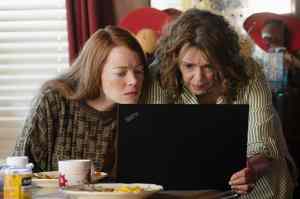
Along these lines, there’s a very curious inclusion of a trigger-happy group in the second half of the movie that blends conspiracy fantasy into skewed reality, and it begs further unpacking. I don’t honestly know what Aster is attempting to say, as it seems like such a bizarre inclusion that really upends our own understanding of the way the world works, and maybe that’s the real point. Maybe what Aster is going for is attempting to shake us out of our own comfortable understanding of the universe, to question the permeability of fact and fiction. Maybe we’re supposed to feel as dizzy and confused as the residents of Eddington trying to hold onto their bearings during this chaotic and significant summer of 2020.
I think there’s an interesting rejection of reality on display with Eddington, where characters are trying to square news and compartmentalize themselves from the proximity of this world. Joe Cross repeatedly dismisses the pandemic as something happening “out there.” He says there is no COVID in Eddington. For him, it’s someone else’s problem, which is why following prevailing health guidelines and mandates irks him so. It’s the same when he’s trying to explain his department’s response to the Black Lives Matter protests that summer in response to George Floyd’s heinous murder. To him, these kinds of things don’t happen here, the people of Eddington are excluded from the social upheaval. This is an extension of the “it won’t happen to me” denialism that can tempt any person into deluding ourselves into false security. It’s this kind of rationalization that also made a large-scale health response so burdensome because it asked every citizen to take up the charge regardless of their immediate danger for the benefit of others they will never see. For Joe, the tumult that is ensnaring the rest of the country is outside the walls of Eddington. It’s a recap on a screen and not his reality. Except it is his reality, and the movie becomes an indictment about pretending you are disconnected from larger society. It’s easier to throw up your hands and say, “Not me,” but it’s hard work to acknowledge the troubles of our times and our own engagement and responsibilities. In 2025, this seems even more relevant in our doom-scrolling era of Trump 2.0 where the Real World feels a little less real every ensuing day. It’s all too easy to create that same disassociation and say, “That’s not here,” but like an invisible airborne virus not beholden to boundaries and demarcations, it’s only a matter of time that it finds your doorstep too.

You may assume with its star-studded cast that this will be an ensemble with competing storylines, but it’s really Joe Cross as our lead from start to finish, with the other characters reflections of his stress. I won’t say that most of the name actors are wasted, like Emma Stone as Joe’s troubled wife and Austin Butler as a charismatic conman pushing repressed memory child-trafficking conspiracies, because every person is a reflection over what Joe Cross wants to be and is struggling over. Despite his flaws and some startling character turns, Aster has great empathy for his protagonist, a man holding onto his authority to provide a sense of connectivity he’s missing at home. Our first moment with this man is watching him listen to a YouTube self-help video on dealing with the grief of wanting children when your spouse does not. Right away, we already know there’s a hidden wealth of pain and disappointment here, but again Aster chooses empathy rather than easy villainy, as we learn his wife is struggling with PTSD and depression likely as a result of her own father’s potential molestation. This revelation can serve as a guide for the rest of the characters, that no matter their exterior selves that can demonstrate cruelty and absurdism, deep down many are processing a private pain that is playing out through different and often contentious means of survival. I don’t think Aster condones Joe Cross’ perspective nor his actions in the second half, but I do think he wants us to see Joe Cross as more than just some rube angry with lockdown because he’s selfish.
It’s paradoxical but there are scenes that work so splendidly while the movie as a whole can seem overburdened and far too long. The cinematography by the legendary Darius Khnodji (Seven, City of Lost Children) expertly frames and lights each moment, many of them surprising, intriguing, revealing, or shocking. There can be turns that feel sudden and jarring, that catapult the movie into a different genre entirely, into a Hitchcockian thriller where we know exactly what the reference point is that I won’t spoil, to an all-out action showdown popularized by Westerns. Beyond Aster’s general more-is-more preference, I think he’s dabbling with the different genres to not just goose his movie but to question our associations with those genres and our broader understanding of them. It’s not quite as clean as a straight deconstructionist take on familiar archetypes and tropes. It’s more deconstructing our feelings. Are we all of a sudden in a forgiving mood because the movie presents Joe as a one-man army against powerful forces? It’s all-too easy to get caught up in the rush of tension and satisfying violence and root for Joe, but should we? Is he a hero just because he’s out-manned? Likewise, with the conclusion, do we have pity for these people or contempt? I don’t know, though there isn’t much hope for the future of Eddington, and depressingly perhaps for the rest of us, so maybe all we have are those fleeting moments of awe to hold onto and call our own.

Eddington is an intriguing indictment about our modern culture and the rifts that have only grown into insurmountable chasms since the COVID-19 outbreak. It’s a Western in form pitting the figure of the law against the moneyed establishment, and especially its showdown-at-the-corral climax, but it’s also not. It’s a drama about people in pain looking for answers and connections but finding dead-ends, but it’s also not. It’s an absurdist dark comedy about dumb people making dumb and self-destructive decisions, but it’s also not. The paranoia of our age is leading to a silo-ing of information dissemination, where people are becoming incapable of even agreeing on present reality, where our elected leaders are drowning out the reality they don’t want voters to know with their preferred, self-serving fantasy, and if they just say it long enough, then a vulnerable populace will start to conflate fact and fiction. I don’t know what the solution here is, and I don’t think Aster knows either by the end of Eddington. I can completely understand people not wanting to experience a movie with these kinds of uncomfortable and relevant questions, but if you want to have a closer understanding of how exactly we got here, then Eddington is an artifact of our sad, stupid, and supremely contentious times. Don’t be like Joe and ignore what’s coming until it’s too late.
Nate’s Grade: B
Share this:

Kinds of Kindness (2024)
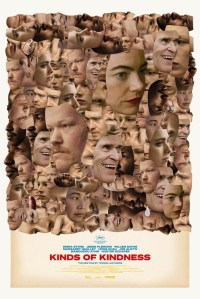
Yorgos Lanthimos might be one of the strangest filmmakers ever to fall into favor with the Oscars. Hot off the critical and commercial success of 2023’s Poor Things, we have a new Lanthimos joint not even six months later. This is a collaboration between his Greek co-writer from The Lobster and The Killing of a Sacred Deer, arguably the less “mainstream” Lanthimos movies. This movie is an anthology of three stories with the same actors playing different roles in each story. The problem is that I didn’t engage with any of the stories and found them long, meandering, and poorly paced. That Lanthimos specialty is a cracked-mirror version of the world, mixing the bizarre as if it were mundane, and it’s a trying tonal tightrope for most thespians to excel within that space. There just isn’t enough here, and each new story feels like starting over rather than fulfilling a conclusion. The prior Lanthimos movies had an interesting premise or turn of events that could sustain a whole movie; Kinds of Kindness doesn’t have stories that can sustain three vignettes. I can take weird, alienating, and challenging Lanthimos, as I’ve been a fan ever since his Dogtooth debut, but this is easily his weakest movie yet. The actors all do credible work having distaff conversations in, what appears like, people’s palatial homes and doctor offices. It’s hard to glean a larger theme, point of view, or even general entertainment value with this dull entry. It feels like Lanthimos and his collaborators had a couple free weekends, the use of some rich friends’ homes, and said, “Well, we’ll make it an anthology because then we don’t have to compose a full movie.” Instead of one disappointing movie, now you get three. Kinds of Kindness is, worst of all, mostly forgettable, and given Lanthimos’ track record, that really is the biggest sin possible.
Nate’s Grade: C
Share this:

Poor Things (2023)
 Poor Things is going to be a lot to many people. It is a lot, and that’s kind of the larger message because ultimately, for all its peculiarities and perversions, the movie is also an inspiring fable about living one’s life to the fullest and embracing the choices that make us happy and content. It’s a feminist Frankenstein allegory as well as an invitation to see the world with new eyes and a fresh perspective, to embrace the same hunger for a life that defines the journey of Bella Baxter from woman to child to woman again. Under the unique care of director Yorgos Lanthimos and screenwriter Terry McNamara (reuniting after 2018’s triumphant and irreverent The Favourite), Poor Things proves to be an invigorating drama, a hilarious comedy, a stunning visual experience, and one of the year’s finest films.
Bella (Emma Stone) lives a life of solitude with her caregiver, a brilliant but disfigured surgeon named Dr. Godwin Baxter (Willem Defoe), who Bella refers to as “God,” and for good reason. Bella is herself one of the doctor’s experiments. Her body belongs to an adult woman of a different name who killed herself. Her mind belongs to the baby that had lived through its mother’s suicide. “God” resuscitated the body of the mother by giving her the brain of her child. She’s curious and defiant and soon yearns for independence and discovering the outside world. A caddish lawyer, Duncan Wedderburn (Mark Ruffalo), is drawn to Bella and offers to take her on a grand adventure to parts of the world. She agrees, and from there Bella gets an education on the plentiful pleasures and pains and puzzles of being a human being.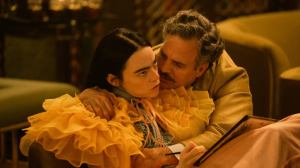 In many ways, Poor Things serves as a fish-out-of-water fairy tale that invites the audience to question and analyze the Way Things Are. Bella’s childlike perspective allows her to strip away the assumptions of adulthood and the cynicism of disappointment. Everything is new and potentially exciting, but she can also cut through the cultural hang-ups and repressive rules of polite Victorian society. This is expressed perhaps most memorably in her embrace of sexuality and the pursuit of physical pleasure. She’s told not to seek out this pleasure except for very specific settings and situations, and this confounds her. Why aren’t people doing this all the time, she asks after an extensive session of vigorous sexual activity. She is a person incapable of shame during a modest time of conditioned shame. This brashly hedonistic reality might prove too morally demented for many viewers uncomfortable with the premise. In context, it is a grown woman’s body being operated by the mind of a child. We are told that she grows and matures as she accumulates her worldly experiences, but the movie keeps it purposely vague how analogous her brain-age might be and whether that maturation is of a pace with traditional aging. It’s a reverse of 1979’s The Tin Drum, a German movie where a child refuses to grow up once he hears the drudgery of the adult world, and so he remains three years old in appearance but continues maturing intellectually and emotionally. There’s a cliche about looking at the world with a child’s unassuming eyes, and that doesn’t necessarily mean only looking at the things that are safe and appropriate for children.
Bella responds with wonder to the many pleasures of being human, but, sadly, it’s not all puff pastries and orgasms. The world is also filled with horrors and injustices, and Bella’s personal journey of discovery is also one discovering the human capacity for cruelty and selfishness. Some of this is a response to Bella wanting to assert herself and independence, as she very reasonably doesn’t understand why all these men get to tell her what to do or expect that they should. At one point, Duncan literally hurls her books into the sea so that she will not continue educating herself. This extends to later in the movie when Bella looks at prostitution in a Parisian brothel as a means of earning a living. Her same sexual appetites, that were enthusiastically encouraged by Duncan, are now paradoxically looked at by the same man as wicked. Absent riches, Bella is treated as a disposable commodity and she’s trying to make sense of why one version of her receives respect and adoration and another version is looked with disgust. It seems that an essential part of maturation is acknowledging the faults of this world and its entrenched systems of thought, but does giving in to these systems make one more human or merely more cynical? Is it a matter of learning or is it a matter of giving up on changing the status quo? These are many of the questions that the movie inspires as we join Bella on her fantastic journey of self-discovery.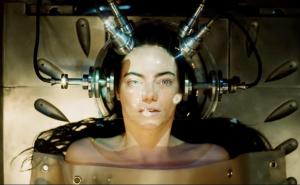 This movie would not work nearly as well without the fearless performance from Stone (Cruella). She gives everything of herself for this role and rewires the very movements of her body to better portray such a unique elding of a character at so many crossroads. Her early physicality is gangly like she’s learning how to operate this adult body of hers that appears too ungainly, and her expressions are without restraint, as if she’s peeled back every acting impulse to instead find a purity of perception. There is a transparent and transcendent joy in her performance as well as an ache when Bella discovers the awful shortcomings of this world. Lanthimos movies exist in a different world than ours, a cracked mirror universe of deadpan detachment and casual cruelty, so it requires a commitment to a very specific tone of performance. And yet, the requirements of this role work against that Lanthimos model of acting because Bella cannot be detached from this world. As a result, there is the same matter-of-fact reaction to the world but channeled through an idealistic innocence rather than the sarcastic skepticism that can dominate the director’s oeuvre.
The supporting cast contributes wonderfully. Dafoe (The Lighthouse) is a natural at being a weirdo, but he exhibits a paternal love for his creation that is surprisingly earnest. I laughed every time he went into one of his extended wails when he was disconnecting himself from a machine to handle his bodily gasses. Ruffalo (The Adam Project) is devilishly amusing as he abandons all pretense of likeability to play a deeply manipulative but fascinating louse, a character that is almost as transparent about his desires as Bella. His faux elitism is a constant source of comedy. Kathryn Hunter (The Tragedy of Macbeth) has a memorable and sinister turn as the brothel madame who teaches Bella about the nature of capitalism and socialism. Christopher Abbott (Black Bear) appears late as a privileged man from Bella’s past reappearing with his own demands, and his is the most terrifying portrait in the entire wacky movie, an antagonist that’s all too real and scary in a movie given to such brilliantly quixotic flights of fancy.  Under Lanthimos’ direction, the movie presents the world as an awesome discovery and the lurches into the surreal allow the viewers to see the marvels of existence with the same awe as Bella. The movie feels like it takes place in a science fiction universe of crazy visuals and the avant garde incorporation of past, present, and future. It makes every scene something to behold. This is his most visually decadent film of his career. The musical score by Jerskin Fendrix, a first-time film composer, and it works on a thematic level as trying to discover new kinds of sounds along with the journey of its heroine. However, there are sequences where the music feels like an assault on your ears. While intentional, the detours into abrasive dissonance can make one long for something less experimental and more traditional at least for the sake of your own sensitive eardrums.
Life can be decadent, it can be confusing, it can be ridiculous, it can be heartbreaking, it can be terrifying, but it’s an experience worth savoring and embracing, and this ultimately is the message of Poor Things. Stone is brilliant as she confidently carries us along for every moment of an exploration of what it means to be human, and with an ending that is so fitting and satisfying that I wanted to stand and applaud. For those squeamish from the heavy amounts of sexuality, Poor Things is at its core a very pro-life movie. It’s an inspiration to make you think one minute while making you snort laughing the next. May we all see the world with the voracious hunger and curiosity and boldness of Bella Baxter with her second chance at this one life.
Nate’s Grade: A
Share this:

Cruella (2021)
 I don’t think I’ll be shocking any readers when I disclose that this Cruella doesn’t kill a single dog in her new movie. I hope I didn’t ruin the experience for anyone hoping for mass puppy slaughter. I figured Disney was going to go this route as they developed a villain biopic for Cruella DeVil, a woman obsessed with making coats from the skin of dalmatians. How exactly does one make a character like that sympathetic? Well by essentially making her a fan fiction version of Cruella DeVil and providing an even more dislikable antagonist to root against. The question then arises does this really count as a villain biopic when the character is so reconstructed? It follows the blueprint of 2014’s Maleficent where it posits that the story we’ve been told has been a matter of misunderstandings and smear campaigns from the Powers That Be. Cruella isn’t a puppy murderer. Now she’s a school outcast, plucky orphan with her own motley crew, and up-and-coming avant garde fashion designer looking to get her big break.
It presents her as an underdog on several fronts and with a back-story that might go down in history for its reclamation. Minor spoilers ahead, considering it’s early in the movie, but Cruella’s mother was literally killed by dalmatians pushing her off a cliff. The blunt re-imagining might even draw titters of laughter as the movie says, “Here’s the real reason she dislikes dogs.” However, even this tragic revision doesn’t make this Cruella hate dogs. There’s even a cute pooch on her team. This is a Cruella that’s not so cuddly but not unlovable either. She’s presented as a scrappy underdog with a punky attitude and whether this works will depend on your adherence to what a Disney villain biopic should be. Personally, I had no fidelity to the character of Cruella DeVil so I didn’t care. I wanted an entertaining movie with a strong lead performance from Emma Stone, and that’s what I got.
 Set in 1970s London, Estella (Stone) is a lonely girl born brilliant but tempered by an uncaring society. After the dalmatian-assisted murder of her mother, Estella and her pals are meeting out their days with small-time grifts and cons. Estella dreams of being a fashion designer and her boys manage to get her an entry level job at a department store. Her experimental window display gets the attention of The Baroness (Emma Thompson), a sharp-tongued and formidable fashionista that makes the world tremble. Estella adopts the identity of “Cruella,” with her natural half-black and half-white hair, to upstage the Baroness, draw publicity for her own unique fashion creations, as well as enact vengeance and retrieve her mother’s missing necklace/family heirloom stolen by the Baroness, as if you needed even more reasons to dislike this lady.
Cruella in many ways feels like The Devil Wears Prada mixed with a superhero origin tale. The Estella/Cruella dynamic is played like a secret identity, wherein she adopts one to achieve a personal goal and becomes seduced by the freedom the alternate identity has to offer. The first half plays quite like Prada, with our fashion upstart working her way up the chain, gaining attention for her insights and designs while fighting against a system meant to squash new ideas. The character of the Baroness is very clearly patterned after Miranda Priestly (Meryl Streep) and the command she wielded in her influential position atop the established fashion industry. At first, Estella wants to gain her approval and become a protégé, and then she wants to topple her, crush her, and it becomes a matter of how far she will go, with characters saying variations on, “You’ve changed. It used to be Estella, now it’s only Cruella.” Even The Devil Wears Prada featured a similar character descent for its protagonist. Except the question never seems too in doubt with Cruella because the character of Cruella is less a person succumbing and fraying, like the Oscar-winning 2019 Joker prequel, and more a tale of self-actualization and empowerment. That’s why it feels more like a superhero origin and less like the Joker’s origin. She’s becoming more confidant, more assertive, and more accepting of her true nature.
 Under the direction of Craig Gillespie (I, Tonya), Cruella feels like a colorful, sprightly caper, something with more attitude and dark humor than I would have believed capable of being forged from the Mouse House with their own intellectual properties. This could have easily been a cash grab but Gillespie and his team of screenwriters, including one of the writers from 2018’s The Favourite, decides to take that big Disney checkbook and have fun with it. This movie reminded me of a PG-friendly version of 2020’s Birds of Prey for adolescents. It’s got slapstick, schemes, contraptions, narrative shuffling, charming and weird characters, and a lot of visual style and attitude to spare. Above all else, this is a fun movie, and one that assembles set pieces and mini-goals that lead to enjoyable payoffs. There’s a funny big heist as the mid-point but it doesn’t go according to plan, as so we watch as Estella and her team have to adapt and get out of a series of escalating traps. The rivalry between Cruella and the Baroness leads to some gaga dress designs I’m certain will get Oscar attention in due time. There’s plenty of life simply coursing through this movie from the actors to the visuals to the extensive music library. Even when the movie is overstaying its welcome (this could have easily been trimmed down by 15 minutes) the movie still finds ways to keep you entertaining and pleased.
Chief among those reasons is Stone (La La Land) as our star. She’s honed her British accent after her Oscar-nominated performance from The Favourite and it’s easy to see a straight-line from that cunning social climber to this new role. Stone finds the right mix of camp and pathos to make the character work. She’s no exaggerated cartoon but she needs a certain energy level to keep you charged. She’s no mousy heroine but a powerful force looking for the right armor that fits. Stone might not be playing the Cruella DeVil of the 1961 cartoon but she’s playing a version of the character that is more capable of carrying a two-hour-plus movie. Special consideration should be paid out to Paul Walter Hauser, who was so memorably dimwitted in I, Tonya, and portrays Horace, a similarly dimwitted member of Cruella’s crew. The man knows what he’s doing when he’s given these roles and it’s easy to see why he keeps getting more.
The amount of needle-drop music cues in this movie puts 2016’s Suicide Squad to shame. I was amazed how that movie could literally go from song-to-song with barely a gap, sometimes only using mere seconds to make its sonic case. The Cruella soundtrack is wall-to-wall music selections, many from the 1960s and 1970s rock and punk scene, and it’s another holdover from I, Tonya that Gillespie has brought with him. The over reliance can become distracting in itself because of the sheer volume of musical selections, many of which can be exceedingly literal (you better believe, yet again, “Sympathy for the Devil” by the Rolling Stones is called in). It’s a sign of just how powerful the Disney brand can be as I’m sure a huge chunk of the movie’s budget went toward getting all these dozens and dozens of music clearances. If you consider it like a kid’s introduction to classic rock songs, it’s excusable, but the number of songs can also be distracting.
 Whether you consider Cruella a faithful or radical reinterpretation of the Disney villain, the live-action showcase is a star vehicle for its shining star. Stone is captivating and having a grand time in her fabulous fashions, and the movie makes it easy to feel her highs as well. It’s not exactly a great movie as many of its supporting characters are underwritten or overly convenient, and its question over the madness and identity of its heroine is more theory than practice, but Gillespie and his team have decided to make Cruella a fun movie, and to that end they have succeeded. It’s colorful, breezy, punky, funny, and consistently amusing, with outlandish set pieces, outlandish characters, and outlandish escapes. Yes, the mom-killed-by-dalmatians tragic back-story might elicit its own howls of bafflement, but the movie doesn’t belabor it for extra ironic impact. Cruella (or Cruella Lite, if you will) is an entertaining reinterpretation that knows what to scuttle to work on its own terms. Whether those alterations are too drastic or defang the character are up to you, but I’d rather watch a kinder, softer, yet still prickly Cruella than one skinning dogs.
Nate’s Grade: B
Share this:

The Favourite (2018)
 As soon as I saw the name Yorgos Lanthimos attached to the royal costume drama The Favourite I knew it would be one of my most anticipated films of 2018. I’m not naturally a sucker for these kinds of movies without some interesting new angle (Mary Queen of Scotts, we’ll meet soon), but Lanthimos has quickly become one of my favorite (favourite?) voices in cinema, rivaling perhaps even the esteemed Charlie Kaufman. His movies are so wonderfully weird and tonally distinct. A Lanthimos joint, if you will, is two hours of surprises and expanding the surreal with assured foresight. He’s earned such a highly regarded reputation as far as I’m concerned that I’ll see any movie with his name attached in any creative capacity. The Favourite is a different kind of costume drama.
In the early 18th century, Queen Anne (Olivia Colman) is leading her country through a protracted conflict with the French that is weighing heavily on everyone. Lady Sarah Marlborough (Rachel Weisz) is the Queen’s childhood friend, close confidant, and secret lover. She’s also perhaps the real power behind the throne, directly influencing the Queen to enact her own bullish policies. Harley (Nicholas Hoult), leader of a parliament, is worried about the country going bankrupt from the military expenditures. Enter Abigail (Emma Stone), a cousin to Sarah and someone seeking to save her once proud family’s name. She rises through the ranks and becomes a rival for the Queen’s affections and a threat for Sarah to maintain her position of power in the court and with the Queen.
 What distinguishes a Lanthimos experience is the development and commitment to a distinct vision and the sheer unpredictability. You really never know where the man’s films will go next. One minute you’re following a man struggle to find a romantic partner, and the next they’re talking about turning people into lobsters. One minute you’re watching a family deal with a creepy stalker, and the next people are debating which family member should be killed in the darkest family game night ever enabled. Even though Lanthimos did not write The Favoruite, it still feels of his unique, deadpan, darkly comic worlds and his fingertips are all over it. The story is already playing fast and loose with the history (it’s pretty unlikely Queen Anne was a lesbian, despite the centuries of character assassination from Sarah) so its curiosity where it might go next is electric, especially when it shows some bite. This is a movie that’s not afraid to be dark, where characters can behave badly, testing our sympathy and allegiance as they fight for supremacy. I love how unapologetic the characters are in their pursuits. They will scheme and manipulate to whatever extent works and demonstrate abuse of power for power’s sake (poor bunny). “Favor is a breeze the shifts direction all the time,” says Harley. “Then in an instant you’re back sleeping with a bunch of scabrous whores.” The ensuring two hours of palace intrigue and political gamesmanship is given a sordid boost from the historical deviations, making the political more personal and even more intriguing. I cackled often throughout with the amazingly witty one-liners and curt insults as well as the wonky asides and tonal juxtaposition. It’s a funny movie for offbeat audiences who enjoy offbeat humor.
This is a costume drama that is radical amongst the stuffy world of prim and proper Oscar bait involving kings and queens and the ostentatious royal courts. I’d say it reminds me of Stanley Kubrick’s Barry Lyndon and how it broke from the long film tradition of costume dramas, but I’ve never watched Barry Lyndon, my lone Kubrick omission (what, do you have three hours to spare?). Lanthimos has an anachronistic visual style that allows The Favourite to feel modern and different as it plays in familiar terrain. What other Oscar drama can you expect to see a modern dance-off in the queen’s court? The visuals make use of very stylized deep photography with the use of fish-eyed lenses and a locked camera position even while panning and moving. It’s not exactly the colorful, punk rock aesthetic of Sofia Coppola’s Marie Antoinette but it gives the film a dreamlike, odd sensibility. It’s a nice visual pairing that achieves the same effect as the screenplay by Deborah Davis and Tom McNamara; it piques your interest, drawing you closer with each moment.
 Lanthimos requires a very specifically attuned ironic wavelength that comes across as purposely deadpan, muted to better make the bizarre as the mundane. It’s a type of acting that can be very restrictive unless an actor can tap into that specific rhythm. The three women that top line The Favourite are each terrific. Colman (taking over Queen Elizabeth from Claire Foy in Netflix’s The Crown) is the standout as the temperamental monarch. Her favor is the prize and at some level she knows that people are playing games with her. It’s hard to know what degree of self-awareness Queen Anne is capable of considering she is beset by maladies both physical and mental (she really did lose 17 children in her lifetime, a dozen of them miscarriages). Because of all of this, the unpredictable nature of the Queen matches the unpredictable nature of the film, and one second she can be childish and defiant, the next playful and warm-hearted, the next manipulative and pushy, the next easily cowed and embarrassed. It’s a performance that has definite comic high-points as she howls at her servants and confuses her confidants, but there are layers to the character that Colman digs into. Sure she can be volcanic in rage or extremely funny when giving into the Queen’s whims, but it’s the degrees of sadness and vulnerability that creep through that round out the performance and person.
Weisz (Disobedience) has already starred in one kooky Lanthimos film (The Lobster) and easily slips into those peculiar comic rhythms again like a nicely fitting dress. Hers is the “fall” of the rise-and-fall tale, so she begins self-satisfied and ends humbled, except under Weisz she is never truly humbled. Her spirit does not break regardless of her unfortunate circumstances, including at one point being held hostage at a brothel. Even when she knows she must write a gracious letter she can’t help herself, composing drafts that keep veering into profane insults. Weisz is deliciously deadpan and never abandons the confines of that narrow acting range required for a pristine Lanthimos performance. Stone (La La Land) is the freshest face of the troupe as the underestimated young companion who rises through the ranks thanks to her cunning. Stone adopts a solid British accent, which is helpful, but her intonations are perfectly suited for Lanthimos. There are small, stranger moments where the character is breaking the facade with the audience to reveal an eager peculiarity, an imitation of a monster that’s random, or the most delightfully dismissive “yeah, sure” snort in the history of film. Stone is a versatile talent with comic bonafides, so it’s fun and satisfying to see her expand her already impressive, Oscar-winning range.
 This is a movie that does not work without a distinct vision, sure handed direction, and pitch-perfect acting, all seamlessly working in tandem to create such a finely crafted dark comedy that can go in many perversely entertaining directions at a moment’s notice. Lanthimos and his cadre of award-worthy actresses have great, prankish fun playing dress up in their fancy locations and making a costume drama with a dash of anarchic farce. The Favourite doesn’t quite rise to the top of my own list of Lanthimos favorites (I’d probably rank it a noble third) but it’s still a razor-sharp, sardonic, unpredictable, and wonderfully, vibrantly weird movie worth celebrating.
Nate’s Grade: A
Share this:

Battle of the Sexes (2017)
 In 1973, tennis player Billie Jean King (Emma Stone) was the number one player in the world, but to many she was still only just a woman playing a man’s game. Bobby Riggs (Steve Carell) was a retired tennis player trying his hand at being a family man. He’s restless and eager to prove something. He’s a natural hustler and so he sees female tennis players fighting for equal pay as his opportunity at a comeback. Riggs wants to prove a point about the inferiority of female athletes. He will play and beat any female tennis pro. He embraces the term of being a male chauvinist and becomes a lightning rod. Men around the world cluck about their biological superiority in athleticism. Billie Jean King feel the full pressure to prove him wrong and make a stand for the women’s movement.
I was pleasantly surprised at the degree of depth given to the characters in Battle of the Sexes, turning what could have been a light-hearted and sprightly throwback to a sports novelty into something a bit deeper and more meaningful, a thoughtful character piece on this climactic conversion of sports, celebrity, and feminism that still resonates.
Billie Jean King is the number one women’s tennis player in the world at age 29. She’s also deeply in the closet and Battle of the Sexes gives considerable attention to this internal conflict of self. The film successfully makes you feel her yearning and unrestrained attraction to hair stylist Marilyn Barnett (Andrea Riseborough). The directors film their first interaction in extreme close-up, which forces them together tighter and allows us to see every little tremor of nerves play across Stone’s face. Her affair with Marilyn coasts on that combination of guilt and compulsion, the push and pull of what she desires and what she can have. Sponsors would not take kindly to an openly gay tennis star. Billie Jean King is struggling with her concept of who she is versus the expectations of others and society. By stepping up to Riggs’ challenge, she is fighting for her own sense of agency. She feels the intense pressure to perform with the credibility of women’s sports placed upon her shoulders. She’s fighting for equal pay and fair treatment, but what happens to that mission if she fails against a 55-year-old oaf? Billie Jean King comes across as a compelling specimen, feisty and independent but also hampered by what those around her would think over her feelings for another woman.
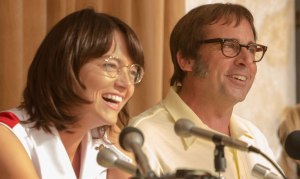 Stone delivers a far more layered and emotionally engaging performance here than in her Oscar-winning turn in La La Land. Hers is a character trying to become comfortable in her own skin. Riggs is the showboat while Billie Jean King is not comfortable in the spotlight. Stone displays the grit and tenacity as well as the vulnerability and complexity of her character’s self doubts and internal struggles. Her scenes with Marilyn have a vitality to them that is absent throughout the rest of the movie, allowing the audience to understand how that burgeoning romance unlocks something within her, something that she might not even fully comprehend. When she does win the big match, Stone seeks solitude and just cries her eyes out, finally able to let her guard down, acknowledge the toll of the moment, the relief of not letting down the women’s movement, and the sheer elation of rising to the occasion. It’s a moment where Billie Jean King feels her most free, where she’s sobbing by herself. Once that’s done she has to collect herself and get back in front of the cameras, adopting her shield once again to face the outside world.
And then there was Bobby Riggs, 55 years old at the time and languishing on the seniors’ tennis circuit and desperately missing the spotlight. The movie finds notes to make him more of a character rather than simply a misogynistic antagonist, and whether that shaded portrayal is deserved is another question. Riggs is fully convinced of his physical capabilities and that he can beat the stars of the women’s tour. These are women fighting for equality and equal pay but Bobby, and he’s certainly not alone, believe that the sexes are inherently unequal when it comes to physical competition. For him, it’s a way to prove his skills and send a message as well, but more so, as presented in the film, it seems like it’s the spotlight that he misses most. He’s enviously licking his lips at the tournament prize purses on the tennis circuit now, even the women’s prizes. He can make more money than he’s ever earned in his pro career. He can still contend, he can still prove something, and the money and stage has never been bigger. He’s getting far more attention at 55 than he ever received during his pro tennis career where he won four Grand Slam titles (he was the number one player for three years). Carell (The Big Short) is well suited to play broad characters that get even bigger with attention. He’s soaking up every moment as if he’s finally getting what he feels is long overdue, and every hammy PR stunt only magnifies the intensity of that attention. He’s a huckster who gleefully adopts the moniker of a misogynist. At 55, Bobby Riggs has found himself in the biggest spotlight with waves of adoring fans and he doesn’t want to give it up.
 You know who else comes across really well in this movie is Billie Jean’s husband, Larry King (not to be confused with the TV host of the same name). It’s not a film that props up the husband as the focal point of someone else’s story; there are more important aspects than how Billie Jean’s lesbianism affects him. However, he is still an important person in Billie Jean’s life and he is processing a form of loss. His relationship with her cannot stay the same, but Larry recognizes what she needs and chooses to be supportive rather than vindictive. He cares enough to put her needs ahead of his own, and that only increased my empathy for him. A marriage pulled in multiple directions is ripe for examination, and it’s rare to maintain sympathy for all of the participants and this movie does.
By the time that seismic tennis battle comes about, the directors Jonathan Dayton and Valerie Faris (Little Miss Sunshine, Ruby Sparks) smartly refrain from lots of edits and angles, instead preferring a standard TV shot to better immerse the audience. The camera angle allows for the entire tennis court to be displayed, and we’ll watch sets play out in long takes with the two athletes running up and down the court. This allows us better understand and appreciate the strategy of both players, and it also probably makes the special effects budget happy as they don’t have to do much to cover the presence of the stand-ins playing the game instead of our movie stars. Even though I knew how the match would end, I was glued to the screen because of everything the match represented. By forgoing the quick cuts and multiple angles that can jazz up the excitement of a tennis presentation, the film is able to carefully illustrate Billie Jean King’s strategy and skill. She intended to run Bobby Riggs up and down the court and exhaust him. Letting the tennis game play out in a wider presentation also better serves the sense of payoff. This is the moment we’ve all been waiting for, as were the 50 million Americans that tuned in. When she does win, I couldn’t get enough of the montage of chagrined male faces twisting in pained grimaces as this lady proved to be the superior player. You could give me a whole movie of pained reaction shots from misogynists and I would be ecstatic.
 It’s also hard to ignore the parallels Battle of the Sexes makes with our current climate. 44 years later, women are still fighting tooth and nail for equality and credibility without qualifiers. Serena Williams is not just the greatest female tennis player of all time; she’s also the greatest tennis player, period. Women’s sports are often seen as lesser in comparison to the men, and abhorrent pay discrepancies are still a reality. Look at the U.S. women’s soccer team, which won the World Cup in 2015, only earning a small fraction of the U.S. men’s team, who finished fifteenth out of a group of sixteen. The casual sexism and lowered expectations extend beyond the realm of sports, as the 2016 presidential election serves as a powerful reminder of the obstacles professional women face in modern society. It’s easy to view Battle of the Sexes through the lens of the 2016 election: a very capable woman who just wanted to do her job is lambasted by an inferior opponent coasting on puffed-up bravado, masculinity, sensationalism, and the sense that the established order of white males is losing something divinely theirs. I’ll admit that channeling this analogue does provide the ending with even more uplift.
Battle of the Sexes is an engrossing story with big personalities, big conflicts, and big stakes, and it feels just as socially resonant forty years later. The messaging can be a bit heavy-handed at time, as Bill Pullman’s character seems to be a composite of all male chauvinism personified, but it’s still easy to get swept along with its sunny cinematography, 1970s period soundtrack, and feel-good story that remembers to always be entertaining. The characters have more depth than I was expecting, and the actors bring extra layers and shades to their roles, making Bobby Riggs a better rounded character than he might have been in real life. Battle of the Sexes is a timely crowd pleaser that doesn’t lose sight of its characters in the guise of its message. By the end of the film, I was cheering, moved, and nicely satisfied, and what more could you ask for?
Nate’s Grade: B+
Share this:

La La Land (2016)
 I understand that the year 2016 has been, charitably put, unkind to many people and why we all could use a little escapism around this time of year. Writer/director Damien Chazelle made a big Oscar splash with 2014’s Whiplash to make his passion project, a sincere musical that recreates the style of classic Hollywood. La La Land is a stylistic throwback that has enchanted critics and seems destined to compete for some of the biggest awards this season. Just imagine how much better it would be if it was great.
Chazelle and company certainly knows how to make an impression. The opening number transforms an L.A. traffic jam into a full-blown song-and-dance explosion, with commuters exiting their cars and coalescing into a teaming mass of jubilation on the freeway. It’s a moment that is sincere and full of energy and promise. The brightly colored commuters come together in long unbroken shots with a widescreen camera that dives and dips and leaves plenty of space for the audience to appreciate the dancing. This is a movie that wants you to see all of the rainbow-colored performers while they strut their stuff. It’s here that we’re introduced to Mia (Emma Stone), a part-time barista and struggling wannabe actress, and Sebastian (Ryan Gosling), a jazz musician who dreams of opening his own club at a historic site. These two dreamers resist each other but of course destiny has another plan. A highlight is a flirty sequence set atop a Hollywood Hillside overlooking the purplish dawn. Mia and Sebastian sing how beautiful this scenic view would be if only they were with someone they loved, playfully antagonizing the other into a dancer’s rivalry. The dancing is mischievous and fun and performed in wide angles to soak in the movements. It’s easy to get caught up in Chazelle’s early swell, a transporting experience that extols the virtues of classical musicals by the likes of Vincent Minnelli, Gene Kelly, and especially Jacques Demy’s The Umbrellas of Cherbourg. Chazelle fills out his frame like a painter. There’s an infectious love for Old Hollywood that tries to alchemize its influences into something new and old, and for a good while Chazelle is able to maintain this fizzy, effervescent experience and remind you of the soothing joys of a good movie musical told with finesse and brio.
 Then after about forty-five minutes the fizz gets a little staler and that’s when I felt the gnawing emptiness underneath all the Old Hollywood homage. It reminded me of 2011’s Best Picture winner, The Artist, as a movie that is more affectionate imitation than genuine substance. As I wrote in my review for The Artist: “The entire affair has such a slight feel to it; the movie is a confection, a sweet treat that melts away instantly after viewing. If you strip away all the old Hollywood nostalgia, there is very little substance here.” It’s all mimicry of the highest order but Chazelle hasn’t put enough authentic feeling into his imitation. There’s a fealty to the sources of his inspiration that Chazelle is replicating, and his screen pops with coded visual reminders (look, it’s Gosling leaning off a street lamp), but it fetishizes the inspirations rather than building from them. Quentin Tarantino is transparent about his outré influences but he doesn’t forget to tell an engaging story too. It’s in the movie’s dispiriting second half that it becomes all too clear just how little substance there is to our lovers as well as the industry satire. This is miles away from Singin’ in the Rain, folks (my favorite film musical, for the record) and more the same old broadsides about the industry: they’re shallow, they’re inconsiderate, they swallow up the dreamers, they “worship everything and value nothing,” as Sebastian put it. It’s not like the movie is telling you anything you haven’t heard before, and that’s fine but it limits any impact. It also seems to exist in a universe where minorities are mere background players to prop up the dazzling lives of the beautiful white leads. Imagine the enjoyment if some of that snappy industry satire was reserved for its less progressive casting practices. Can you imagine this kind of movie starring Tessa Thompson (Creed)?
Affection can only go so far because eventually the gravity of your characters, their relationship, their goals and dreams and relatability will need to kick in, and it doesn’t. I think this is because the first forty-five minutes are the typical rom-com story of the boy getting the girl. It’s the portion where the movie weaves its old Hollywood spell and courts us too, and it’s fun. And like bad relationships, once it has you La La Land feels like it has to do less work. Chazelle has to manufacture a series of pity problems (more below) to push his lovers apart and question whether these two star-crossed kids might make it after all. If the beginning half is the swirling romance that reverently celebrates old Hollywood, the second half is the attempt to “ground” the film in a sense of realism. It feels too late tonally to switch gears and it undercuts the first half. It might sound contradictory but if La La Land was just going to be a trifle then I wish it went all-in rather than half-heartedly trying an “edge” of harsh reality to mix the sour with the sweet. Just because the movie sets up the dreams of its characters, puts them together, and says not so fast doesn’t mean that Chazelle has properly set up this nascent melancholy.
 Mia and Sebastian are not particularly strong characters. The unified star power of the lead actors is enough to disguise this fact for a majority of the movie and maybe for some the entirety. They don’t have anything of import to say beyond their dreams and their jobs that are presently in the way of achieving said dreams. I couldn’t tell you anything else about these characters. For Mia and Sebastian, the world is divided into those who are pure and those who are impure, the real artists and the phonies, and the dichotomy will rankle anyone who has interacted with more than their share of hipster. Sebastian is a music snob who wants to impress upon the world the importance of jazz even as it shrugs indifferently. Nobody gets it, man. He’ll fight the good fight no matter what because Sebastian’s fight is Chazelle’s: taking outdated material and exporting value to a new generation. The characters serve the plot and exist to entwine and then be dutifully pulled apart. It’s hard to invest in the characters when they won’t show who they are and why they should be together. Maybe that’s the point ultimately, a rich meta commentary on how attenuated the central courtships in movies themselves are, or the fleeting relationship between film and audience, or maybe I’m just hoofing as hard as the leads to insert more meaning here.
The second half paddles into what my friend Ben Bailey affectionately termed White People Problems: The Musical. I won’t fully concur but the conflicts are too forced and the characters become whiney. Sebastian rejoins a pop band where he doesn’t feel 100 percent creatively fulfilled because he isn’t performing “true jazz.” The band is also popular and this causes friction because he has “sold out” on his dream, as if toiling during for any period of time is giving up. I guess you must be single-minded or it doesn’t count. Their combined egos won’t allow for different variations of success. La La Land pretends to endorse the dreamers but does it really? The only dreamers who seem to count are Mia and Sebastian. What happened to Mia’s lively group of roommates and friends from the beginning party? What about the nebbish screenwriter the movie mocks for an easy laugh? There are no significant supporting characters in this movie; the universe belongs to Mia and Sebastian. They’re not as insufferable as the characters from Rent but it’s definitely a detriment. Look at the characters in Fame, a group of hungry teenagers who came from all walks of life and circumstances to try and achieve their titular dream of stardom.
 The limitations of its doe-eyed leads present some issues. Stone (Birdman) is smashing in the movie but part of that is because, aside from some song-and-dance choreography, the movie asks very little of her other than to be cute, a trait Stone has in natural abundance. There are two standout scenes for the actress. The first is an audition where she pretends to be a mistress getting the “sorry, I can’t do this” phone call from the man she thought had loved her. The sheer variety of emotions that Stone is so able to quickly convey on her face, in her tremulous eyes, and posture are remarkable. Of course the problem is that she’s too objectively good to keep getting blithely rejected by cold-hearted casting agents. The second is a musical showcase where Stone belts out a story about how her aunt inspired her to be a thespian. Stone is effortlessly captivating but she deserves better than to be foil to a grumbly Gosling. I feel that Gosling is one of those actors who can be amazingly talented when plugged into the right role and with the right director (see: Half Nelson, The Believer, The Big Short). He has an easygoing charm that all-too easily morphs into smarm without the right guidance or motivation on his part. Sebastian feels like a scowling grump who wants to bludgeon the world with his point of view. It feels more like he’s in it for submission. Gosling’s performance left me wanting someone else to play his part. They were so strong on screen in Crazy, Stupid, Love but that sizzling chemistry of old is gone here. They feel inert together, amplified by Gosling’s antiseptic performance. They’re both rather limited singers, very thin of voice, and that does hurt a musical. The songs by composer Justin Hurwitz and lyricists Benj Pasek and Justin Paul are exceptionally milquetoast. They’re all slight renditions on the same blandly pleasant tune. They evaporated from my memory by the time the end credits started rolling. Moana has nothing to fear come Oscar time from these at-best competent compositions.
If imitation is the highest form of flattery, then Chazelle’s anodyne musical is brimming with appreciation and adoration for the world of classic Hollywood, and that alone will be effectively transporting for many film critics and select audiences bred on a diet of Fred Astaire and Ginger Rogers. La La Land is an airy confection but one that dissipates all too easily after viewing thanks to the limited characters, the limited singing, the limited dancing, the limited songs, and the lack of overall substance independent from imitation. It has its lovely moments and Stone is an ingénue worth loving, though not as much her slim character, a dreamer who dreams the dreams of a dreamer. The breezy and bubbly first half doesn’t really mesh with the second half. I think it’s telling that Mia and Sebastian’s “love theme” is a sad plaintive piano trinkle. As the characters get more sullen and sour, the fizzy fun fades away and it starts to feel like a New Year’s Eve hangover that left you addled and warm but only in a vaguely ephemeral sense. If it leaves you toe tapping and giddy, I’m glad. I’m already mentally prepared for it to practically sweep the Oscars, as they do love celebrating their own importance. La La Land is a movie musical that is stuck looking backward that it loses its own footing.
Nate’s Grade: B-
Share this:

Birdman or (The Unexpected Virtue of Ignorance) (2014)
 Expecting a comedy from Mexican director Alejandro Gonzalez Inarritu would have preposterous. The man was known for his cinema verite of suffering, notably Babel, 21 Grams, Biutiful, and his best film, Amores Perros, roughly translated to Love’s a Bitch. Perhaps there isn’t much of a shift going from tragedy to comedy. Inarritu’s newest film, Birdman or (The Unexpected Virtue of Ignorance), has been wowing critics and audiences alike, building deafening awards buzz for its cast, Iarritu, and the superb cinematography, but will it fly with mainstream audiences? This may be one of the weirdest Oscar front-runners in some time.
Riggan (Michael Keaton) is an actor best known for playing the superhero Birdman in the early 1990s and walking away from the franchise. He’s still haunted by that role (sometimes literally) and struggling to prove himself as an artist. He’s brokered all his money into directing, adapting, and starring in a theatrical version of Raymond Carver’s short story, “What We Talk About When We Talk About Love.” The show is in previews and about to open its run on Broadway but it’s already got a rash of problems. The leading man needs to be replaced immediately. The supposed savior is famous actor Mike (Edward Norton), an undeniably talented but temperamental actor who pushes buttons to find some fleeting semblance of “truth.” Mike’s girlfriend, Lesley (Naomi Watts), is growing tired of his antics and desperate for her own long-delayed big break. Laura (Andrea Riseborough) is Riggan’s “girlfriend” and co-star and may be pregnant. Sam (Emma Stone), Riggan’s personal assistant and also his detached daughter, is fresh from rehab, and spiteful against her neglectful dad. Toss in Riggan’s best friend/manager/play producer (Zach Galifianakis), Riggan’s ex-wife (Amy Ryan), and a feared theater critic (Lindsay Duncan) who is determined to kill Riggan’s show to send a message to the rest of Hollywood polluting the integrity of the theat-tah. Oh, and throughout all this, Riggan hears an ominous voice that alternating encourages him and humiliates him.
 It’s an industry satire, a bizarre comedy, a father/daughter drama, an examination on identity and the complicated pulls of affection and admiration, and a stunning virtuoso technical achievement. As a movie, Birdman is hard to pin down or categorize. It’s a movie that you definitely need to experience on your own rather than have described (don’t stop reading, come back…), and that is a reason enough to see the film, a rare aspect among modern movies. It’s an artistically offbeat movie and yet it ultimately is about one has been actor looking back on his career and coming to terms with his own impact with pop-culture, art, and his family. It’s about a man struggling to find his place in his own life, beset at all odds by doubters and traitors and obstructionists. The refreshing aspect about Riggan is that he’s a has-been but not a sad sack; he’s fighting from the beginning, sometimes pathetically and sometimes in vain, but the man is always fighting to regain his dignity, to reclaim his life’s narrative, and to fight for his legacy. Riggan, after all, set the stage for the modern superhero industry that currently dominates Hollywood bean counters. He was too just soon, and the parallels with Keaton (Batman) are superficially interesting but there’s more of an original character here than a reflection of the actor playing him. He’s neurotic, egotistical, hungry, and fighting for respect, like many actors, and the film flirts with the façades people inhabit. Many of the characters are emotionally needy, desperate for validation wherever they can find it.
Another strength of the film is that it finds a moment for each of its talented ensemble players to shine, chief among them Keaton. The actor hasn’t had a showcase like this in some time and he is a terrific guiding force to hold the entire story together. Whether it’s marching in his tighty whities or working through his complicated degrees of neuroses, Keaton is alive in a way that is electrifying. We see several highs and lows over the course of two hours, some moments making us cheer on Riggan and others making us wince, but he comes across more like a person than just the butt of a joke. It’s also just fun to watch him adopt different acting styles when he steps on stage, including one early on where he’s purposely too stilted. It’s so comforting to watch Norton (The Grand Budapest Hotel) get to be great again, not just good but great. Early on, you see the appeal of Mike, his allure, and Norton keeps pushing the audience, as well as the characters, back and forth with his wealth of talent. Stone (Amazing Spider-Man 2) spends most of the film as the sulky daughter but she gets to uncork one awesomely angry monologue against her loser dad. The thawing father/daughter relationship ends up supplying the film with its only degree of heart. Watts (The Impossible) is comically frazzled for the majority of her time but gets a memorable character beat where she breaks down in tears, realizing her dream of “making it” might never materialize. Riseborough (Oblivion) also has moments where he sadness and vulnerability cut deep. The supporting characters aren’t terribly deep but they all have a moment to standout.
It’s a decidedly offbeat film that dips into the surreal though never dives completely inside. The movie is rather ambiguous about whether or not the fantastical flourishes are a result of Riggan being mentally ill, or at the least overtaxed with stress. Is there really a Birdman or is it a voice in his head, a manifestation of his ego or a ghost to remind him of the past when he was a star? Does Riggan really have the powers he seems to believe he does, including the ability to make objects move with his mind? Innaritu playfully keeps the audience guessing, treating the bizarre in an offhand manner reminiscent of magic realism. The bizarre embellishments blend smoothly with the film’s darkly comic tone. It’s a funny movie but one that you laugh at between clenched teeth.
 Is it all the unblinking camerawork a gimmick? I don’t think so. While the story can engage with its weirdness and surreal unpredictability, the long tracking shots bring a heightened reality to the unreal, they bring a larger sense of awe to the proceedings, watching to see the magic trick pulled off to the end. If anything, it’s an extra thrill to the script and greatly compounds the artistic audaciousness of the film, but I think it also channels the live-wire energy of theater, of watching actors have to walk that tightrope of performance and blocking, weaving together to pull off the ensemble. It makes the film medium feel more like live theater. Thematically I think the style also connects to the anxious mentality of Riggan. In the end, I don’t truly care that much whether it’s a gimmick or not (though I vote it is not) because the camerawork is rapturous. Made to resemble an entire two-hour tracking shot, it is a joyous thrill to watch these technical wizards do their thing, to watch the best in the business perform a visual magic trick over the duration of two hours. Even if you don’t care for the overall movie you can at least be entertained by the imaginative and thoroughly accomplished cinematography by Emmanuel Lubezki, fresh from his Oscar for Gravity and who should be clearing shelf space for the next bushel of awards he’s destined to win with this film. It’s an intoxicating experience to behold, though the film is structured into 10-minute or so chunks for feasibility. If you want to watch a real cinematic magic trick, check out the film Russian Ark, which is an entire movie, performed in one uncut single tracking shot.
I’m still wrestling with the debate over whether Birdman is an artistically ambitious romp or a truly great movie. Much like the characters in the film, I’m wrestling with whether I have confused my admiration with adoration. It’s a movie that I feel compelled to see a second time, and maybe a third, just to get a handle on my overall thoughts and feelings. That may be a sign that Birdman is a film for the ages, or maybe it’s just a sign that it’s not as approachable and denied a higher level of greatness by its obtuseness. Inarritu’s surreal showbiz satire is plenty entertaining, darkly comic, and a technical marvel thanks to the brilliant camerawork. The percussion-heavy musical score is another clever choice, naturally adding more urgency and anxiety to the proceedings. Birdman is a strange and beguiling movie, one that deserves to be seen, needs to be experienced, and stays with you rolling around in your brain. That sounds like a winner to me.
Nate’s Grade: A
Share this:

Movie 43 (2013)
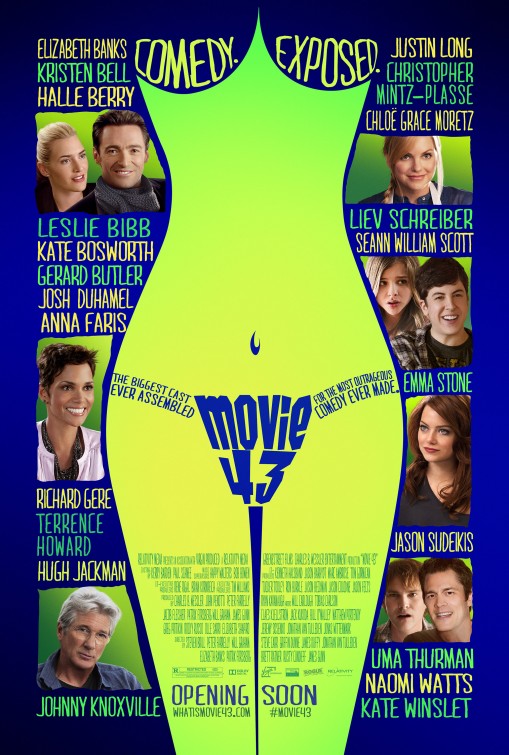 There were two driving reasons why I chose to go see Movie 43, the collection of 13 comedy sketches from different writers and directors. First, the red band trailer made me laugh, so I figured it was worth a shot. If one sketch didn’t work, there was always another ready to cleanse my comedic palate. The other reason is that I have been compiling sketches written by myself and my friends with the intent to make my own sketch comedy movie in 2013. Part of me was also concerned that something so high-profile might extinguish my own project; maybe we came up with similar material with sketches. After watching Movie 43, a tasteless, disconnected, and ultimately unfunny collective, I have renewed hope for my own project’s success.
Like most sketch comedy collections, Movie 43 is extremely hit or miss. This ain’t no Kentucky Fried Movie or even the Kids in the Hall flick. Rating this worth viewing depends on which side racks up the most. Unfortunately, there’s more terribleness than greatness on display, but allow me to briefly call out the film’s true highlights. The best segment in the movie, the one that had me laughing the longest, was a bizarre fake commercial that does nothing more than presuppose that machines, as we know them, are really filled with small children to do the labor. Seeing little urchins inside a copy machine or an ATM, looking so sad, with the faux serious music welling up, it made me double over in laughter.
 With the actual vignettes, “Homeschooled” and “Truth or Dare” where the standouts that drew genuine laughter. “Homeschooled” is about a mother and father (real-life couple Naomi Watts and Liev Schreiber) giving their son the total high school experience, which amounts to degrading humiliation. Dad makes fun of his son’s penis in the shower. Mom and Dad throw a party with the cool kids but don’t invite their son. Dad tapes his son to a flagpole. The kid gets his first awkward kiss thanks to his mom. It’s outrageous without falling victim into being crass for the sake of crass, a common sin amongst many of the vignettes. “Truth or Dare” starts off innocuously enough with Halle Berry (Cloud Atlas) and Stephen Merchant (Hall Pass) on a blind date. As the date progresses, they get into an escalating game of truth or dare that each has them doing offensive acts, like blowing out the candles on a blind kid’s birthday cake. This segment knows when to go for broke with it silliness and it doesn’t wear out its welcome, another cardinal sin amidst the other vignettes.
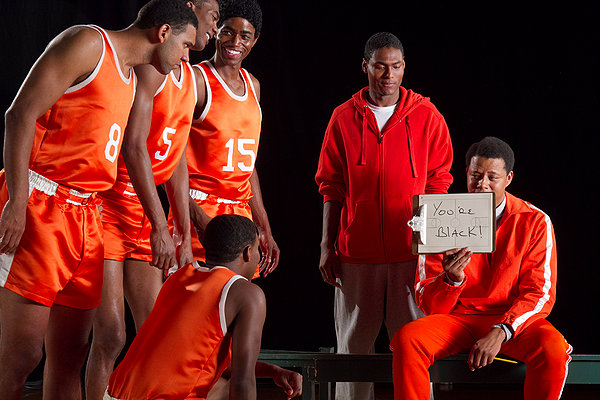
But lo, the unfunny sketches, or more accurately the disappointing sketches, outnumber the enjoyable. Far too often the sketches are of the one joke variety and the comedy rarely leaves those limited parameters. So a sketch about a blind date with a guy who has testicles hanging from his chin (Hugh Jackman) is… pretty much just that. There’s no real variation or complications or sense of build. It’s just that. A commercial about an iPod built to model a naked lady is… exactly that and nothing more. A speed dating session with famous DC superheroes like Batman (Jason Sudeikis), Robin (Justin Long), Supergirl (Kristen Bell) and others should be far cleverer than what we get. While I laughed at the sports sketch “Victory’s Glory,” it really all boils down to one joke: black people are better than white people at basketball. That’s it. “Middleschool Date” starts off interesting with a teen girl (Chloe Grace Moritz) getting her period on a date and the clueless men around her freaking out that she is dying. However, this is the one sketch that doesn’t go far enough. It really needed to increase the absurdity of the situation but it ends all too quickly and with little incident. “Happy Birthday” involves two roommates (Johnny Knoxville, Sean William Scott) interrogating an angry leprechaun (Gerard Butler) for his gold. It pretty much just sticks to slapstick and vulgar name-calling. That’s the more tiresome aspect of Movie 43, the collective feeling that it’s trying so desperately to be shocking rather than, you know, funny.
The worst offenders of comedy are the scathingly unfunny “Veronica” and “The Proposition.” With “Veronica,” Kieran Culkin tries to woo his lady (Emma Stone) with a series of off-putting sexual remarks, delivered in an off-putting “bad poetry delivery” manner, while the film is off-puttingly shot with self-conscious angles that do nothing for the comedy. It’s a wreck. “The Proposition” is just one big poop joke. It’s far more gross than gross-out.
 The frame story connecting the varied vignettes is completely unnecessary. Well, I suppose there is one point for its addition, namely to pad out the running time to a more feature-length 94 minutes. The wraparound storyline with Dennis Quaid pitching more and more desperate movie ideas never serves up any good jokes. Its only significance is to setup an ironic counterpoint that gets predictable and old fast. Example: Quaid says, “It’s a movie with a lot of heart and tenderness,” and we cut to a couple that plans on pooping on each other. See? You can figure out its setup formula pretty quick. I don’t understand why the people behind Movie 43 thought the perfect solution to pad out their running time was a dumb wraparound. These sketches don’t need a frame story; the audience is not looking for a logical link. For that matter why is the guy also pitching commercials? I would have preferred that the frame story was completely dropped and I got to have two or three more sketches, thus perhaps bettering the film’s ultimate funny/unfunny tally.
There will be a modicum of appeal watching very famous people getting a chance to cut loose, play dirty, and do some very outrageous and un-Oscar related hijinks. The big name actors do everything they can to elevate the material, but too many sketches are one joke stretched too thin. I suppose there may be contingents of people that will go into hysterical fits just seeing Hugh Jackman with chin testicles (I think the Goblin King in The Hobbit beat him to it), just like there will always people who bust a gut when a child or an old person says something inappropriate for their age, or when someone gets kicked in the nuts (the normal ones). I just found the majority of Movie 43 to be lacking. It settles far too easily on shocking sight gags and vulgarity without a truly witty send-up. It wants to be offensive, it gleefully revels in topics it believes would offend the delicate sensibilities of an audience, but being offensive and being funny are not automatically synonymous. You have to put real work into comedy. Movie 43 isn’t it.
Nate’s Grade: C-


 nathanzoebl
You must be logged in to post a comment.