Blog Archives
Into the Woods (2014)
 Theater fans, take this review with a Broadway-sized grain of salt because I’m going to admit I’ve never seen Into the Woods prior to its film release. I consider myself a Stephen Sondheim fan, especially with Sweeney Todd. Now with all that established, I found Into the Woods to be a thoroughly uninvolving and middling musical without any memorable tunes and a series of annoying characters that just kept running in comic redundancies. Perhaps it’s my own ignorance to the original 1987 theater production, considering subversive and edgy and not the most natural fit for the Disney brand. Perhaps I’m just not hip enough to Sondheim’s academic use of melody. Or perhaps others out there will share my opinion that Into the Woods is a tuneless bore.
In a fantasy kingdom, a Baker (James Corden) and his wife (Emily Blunt) are trying to conceive a child but having difficulty. A witch (Meryl Streep) reveals that the only way to undo the infertility curse is to gather a series of magical items. The baker ventures into the aforementioned woods, desperate to find these items, often running into the likes of other fairy tale icons like Red Riding Hood (Lilla Crawford), Cinderella (Anna Kendrick), Prince Charming (Chris Pine), the Big Bad Wolf (Johnny Depp), Jack (Daniel Huttlestone) and his beanstalk, and the entrapped Rapunzel (Mackenzie Mauzy).
 It must have been more relevant back in 1987, but today we are awash in the darker side of fairy tales. Analyzing the implications of “happily ever after” in a more adult and pessimistic way is nothing new. We’re saturated with TV shows and movies that have explored these issues before, revealing the darker truths to some of our favorite fairy tale characters, so it’s hard for a Woods novice to approach the show without a sense of ”been there, done that.” It’s unfair for Sondheim but that’s the reality that greets an adaptation of a musical that’s almost thirty years old. Because of this context, the insights and subversions with the fairy tale characters never feel somewhat pat. The fact that Little Red Riding Hood might be featuring a sexual awakening related to the dangerous Big Bad Wolf is the only striking one that adds dimension to her character. Other “twists” given to the characters are either predictable or just underwhelming. Oh, Prince Charming isn’t so nice and marrying into royalty isn’t the fantasy it’s made out to be? Then there are character betrayals that come out of nowhere, without any proper setup, that feel like the musical is just flailing around in transparent shock value. Just because someone suddenly does something out of character does not mean it was a good plot choice. The guilty party even sings, “I’m in the wrong story,” admitting the identity crises. I wouldn’t have a problem with these wrinkles if they felt better setup or there was more commentary attached. Instead, as delivered in the film, it feels rushed and unearned.
Music is inherently subjective (then again so is film, I mean…), so I’m sure others will vociferously disagree with my stance that Into the Woods is mediocre. True to Sondheim’s works, he establishes character-based melodies that fold and cascade atop one another, weaving in and out. The problem is when none of those melodies captures your attention. These are not humable tunes. To my ears, the songs just collided into one another forming one long string of tonal mélange. The singing is more than adequate by the performers (though Pine’s crooning is a bit subpar) but the songs just flatline. I just took a break from writing and listened through Amazon.com’s soundtrack for the show, sampling every song one again, and they all just blend together. There isn’t one song that burrows its way inside your brain, taking residence beyond the immediate. Then again, if you’re one of the fans of the show who loves these songs then having a fresh coat of Hollywood production will make them sound even better for you, especially with Corden and Blunt and Streep as the top performers.
Another hindrance for me was that I found many of these characters to be insufferably annoying. I found Red Riding Hood and Jack to be irksome and thieves, and so I didn’t feel much sympathy when Jack’s breaking and entering and giant manslaughter lead to dire consequences in the last act. Does not the lady giant deserve her vengeance? Her home was broken into, pilfered for its valuables, a small portion of which would have been sufficient but Jack cannot help his felonious ways, and then the boy killed her husband in a hasty escape attempt. If anything, I would have preferred the lady giant picking her teeth with the plucky lad. I also wanted Little Red to remain in the belly of the wolf (spoiler alert?). Cinderella lost my interest with her wishy-washy behavior. I believe it’s meant to be funny that she keeps returning and running off for three days in a row of princely balls. Another way of looking at that behavior is frustration. The only characters I actively cared about were the Baker and his wife, and the calamitous plotting of the musical’s second half tested even those allegiances.
 The story gets to be rather redundant as well once the main characters are established and their plight is set in motion. I suppose I can now understand why Into the Woods is one of the most popular stage productions to perform at high schools and colleges: the scarcity of scene changes. Much like other aspects of the film, the setting just blends together and becomes tiresome. My pal Eric Muller remarked, “It’s called Into the Woods and not Into Multiple Sets.” I got sick of the woods. The plotting requires the various characters to keep running into one another again and again. It’s amusing at first but once it keeps going, and going, and going, the repetition loses its charm. You start to feel like the show is as lost as the characters and just going in circles to bide its time.
Acting-wise, I cannot fault the big-screen version. Blunt (Edge of Tomorrow) has a great singing voice and has shown great range as an actress in 2014. Streep improves upon her shaky start to musical theater from Mamma Mia. She’s still the great Meryl and seems to be one of the few people having fun. She enlivens every scene she’s in. Pine (Star Trek Into Darkness) is enjoyably self-involved as his caddish prince. Depp (Transcendence) is suitably lascivious though he only has about five minutes on screen. Corden (soon to be the new host of CBS’ Late Late Show in 2015) is the real standout. The man has a self-effacing likeability to him that serves as an anchor for the show. He’s funny and tender but he’s the heart of the story, and the film is at its best with Corden as its center.
If you’re a fan of the original Into the Woods, chances are you’ll likely find enough in this adaptation to enjoy. Director Rob Marshall (Chicago) and his crew re definitely fans and you can feel their appreciation for the source material. However, if this is your first exposure to the Broadway show, then you may too find the characters annoying, the commentary underdeveloped and dated, the songs tuneless and unmemorable, and the plotting to be redundant and tedious. The actors do what they can but it was ultimately a losing cause to my ears. I found the film more exhausting than transporting. I’m at a loss how people can work up such passions for a show that feels so thoroughly blah. I await the Sondheim crowd to tar and feather me as an ignorant heathen, but there you have it. Into the Woods is an underwhelming musical that made me want to turn on the radio.
Nate’s Grade: C
Share this:

Edge of Tomorrow (2014)
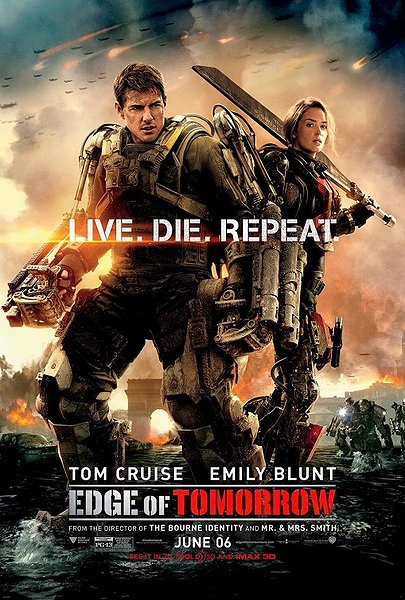 I’ve always been one able to separate the art from the artist, so while Tom Cruise may annoy people in real life because he jumped on a couch one summer, that doesn’t halt my enjoyment of the man’s movies. It seems with every new Cruise vehicle that under-performs at the box-office that I must be in the minority. Cruise hasn’t had a hit to his name since 2011’s suitably awesome Mission Impossible: Ghost Protocol. Both Oblivion and Jack Reacher, perfectly solid action movies, failed to make over $100 million domestically, further calling into question the drawing power of Tom Terrific. It seems that his latest, Edge of Tomorrow, is going to suffer a similar fate. This is a shame. As my critical colleague Ben Bailey said in his own review for the film: “Edge of Tomorrow might just be the most critically acclaimed box-office bomb of 2014.”
William Cage (Cruise) is chiefly an Armed Forces PR flak. He goes on TV to push the talking points of the United States military, which is in a heap of trouble. Aliens have landed in central Europe and spread quickly, proving to be nearly unstoppable. There was one soldier who was able to lead a successful counter attack. The “Angel of Verdun” is Rita (Emily Blunt), a soldier Cage proudly chirps only spent a day in her mechanical fighting suit beforehand yet proved to be so deadly. After vaguely threatening a high-ranking official rather than report for a doomed counter assault, Cage is shipped to the frontlines as a deserter. In hours he and a motley crew of ground forces are flown to the beaches of France, where the aliens will slaughter them. In the firefight, Cage is covered with alien blood and gains their special power. The reason the aliens have won every battle, save one, is because they have the power to reset time. They learn from their errors, which is why they always anticipate humanity’s attacks. Now Cage has this power. Every time he dies, the day resets and he starts over, trying once again to survive. The only person who understands him is Rita, who once had the same power. Together, with some extensive training, they may be able to thwart the alien invaders for good.
 Edge of Tomorrow is the ultimate video game movie, and while I would normally mean this in a pejorative sense, it is actually a compliment. With every death, Cage gets to start over, looking for a way to complete the next stage of the next level, learning from his costly mistakes and hoping to get to the boss battle that usually closes the level. From a structure standpoint, it’s a pure video game, albeit an older sidescroller (remember those, kids?). The visuals and mechanical battle suits also further support the video game comparisons. But really, Edge of Tomorrow is Groundhog Day meets Starship Troopers but brilliantly executed. There is something deeply satisfying about the Groundhog Day formula, namely getting seemingly endless chances to fix one’s mistakes, to try out new paths. It’s also inherently satisfying as an audience member because you watch your hero fail time and after time but they’re still active, they’re still trying to achieve a goal, or a new goal, and thus when they do succeed it’s even more triumphant and gratifying. We get to learn alongside our protagonist. Also, it allows the narrative to explore new material without going stale. In most stories we have one set path, but in films like this one with a time loop, it’s like we get to see all the wheels-within-wheels, the stories just offscreen happening simultaneously. It opens up the world in more interesting and playful ways, providing more payoffs than just one set narrative destination. We get assorted answers to our “what if”’s. Plus we get more screen time with Bill Paxton (2 Guns) as a comically hardass master sergeant. Edge of Tomorrow mines all these areas expertly. This is a movie that embraces the possibility of its sci-fi premise. It’s constantly clever, fast-paced, lively, and expects its audience to keep up with the pace.
It’s great to see director Doug Liman flex his action-thriller abilities again, ineffective or dormant since 2005’s Mr. and Mrs. Smith. The man has an innate ability to orchestrate action without losing sight of character. The beach invasion sequences have plenty going on, enough so that you won’t be bored after multiple trips, and unlike last summer’s disappointing Elysium, this is one movie that knows how to make proper use of a mech suit. These suits don’t look that impressive but they pack some mighty firepower. It’s rather cool when Cage, after a litany of failed trips, has the beats of combat to memory, knowing to shoot in this direction at the right second. It’s like watching a man harness the omniscient power of God (“I said I was a god. Not THE God.”). Under Liman’s guidance, the action is big and exciting and fun, more so than any other Hollywood action movie I’ve seen this year (The Raid 2 is still in a class its own).
The action sequences and special effects are all relatively good, but it’s just the sheer fun of the movie that makes it special for a summer would-be blockbuster. It’s like you get multiple movies smattered together but the eye is always forward to the goal, taking out the alien brain/host. The structure is almost foolproof: by the end of Act 1 he gets the time-tripping powers, and by the end of Act 2, he loses them and the heroics to close the movie have to count for real. I wish the final boss battle didn’t happen to take place in the bowels of a famous landmark/destination, but I suppose Liman and company needed a change of pace from all the beach activity. While the movie covers plenty of ground repeatedly it never feels old or directionless; while it has its share of sticky exposition and silly plot mechanics, it never overwhelms the story or the entertainment factor. The basics of who the aliens are, how they attack, what their magic blood does, what the rules are for utilizing said alien time-repeating power, you would imagine that they would be too silly or bog things down, but they don’t. Except for the very end (the concluding two minutes), the movie plays within its own system of rules. That also means no unrealistic romantic entanglement. Sure we expect movie stars to fall for one another, especially in peril, but for Rita, every day is the first day she’s ever met Cage. He develops feelings for her but she credibly keeps thoughts of romance at bay.
 It’s also a mordantly mirthful movie. Cage can only reset when he dies; if he is just wounded and passes out, he’ll lose his special reset power. So every insurmountable roadblock, wrong choice, or crippling injury must be met with one conclusion, namely Cage being snuffed out. Rita carries out most of the executions in the second half, with a blasé sense of routine duty, like a plumber fixing a clog. It doesn’t really get old and Liman utilizes montage well to give the comedy an extra punch. It lightens a movie more or less centered on human annihilation and mortality. And for the legions of Tom Cruise haters, there’s got to be some degree of entertainment value in watching the man die again and again and again and, well you get the point.
Cruise ably shows again that he is more than capable of carrying an action film (he’s over 50 now too). The man still has enough energy and physical stamina of an action hero in his 30s, and his charisma is still there in spades. It’s also interesting to watch Cruise play a cowardly character. I should have expected it considering that Cage’s arc has to start somewhere before he becomes the super soldier. However, the movie would never have been as good if Cruise didn’t have a strong leading lady, and the surprisingly buff Blunt (Looper) is an excellent match for her costar. She’s tough and can beat the snot out of you. Just her very walk exudes confidence and determination (is it too late for her to be Wonder Woman in the next Superman film?). Having walked in Cage’s shoes before with the time-replay power, she has an extra weariness to her, a certain devil-may-care attitude, especially in battle. The two actors make a winning team and Cage’s recruitment of Rita is another mission with another worthy payoff.
The original title was All You Need is Kill, based on a Japanese graphic novel, and I can’t help but think how much of a better, striking title that is to describe this movie. It’s a wonderfully entertaining movie, with its action spectacle tempered with an intelligence rare for a summer blockbuster that doesn’t have Christopher Nolan’s name attached as director. Here is a playful sci-fi movie that doesn’t downplay its sci-fi, doesn’t dumb down its plot, and explores the richness of its world one dead Cruise at a time. It’s clever and satisfying and brings all the visual fireworks you’d demand. It’s a rotten shame that Edge of Tomorrow appears destined for the cinematic scrapheap. We need more movies like this one. Reverse the tide people and see this movie on the big screen while you can. It’s everything we want in a summer blockbuster fully realized.
Nate’s Grade: A-
Share this:

Your Sister’s Sister (2012)
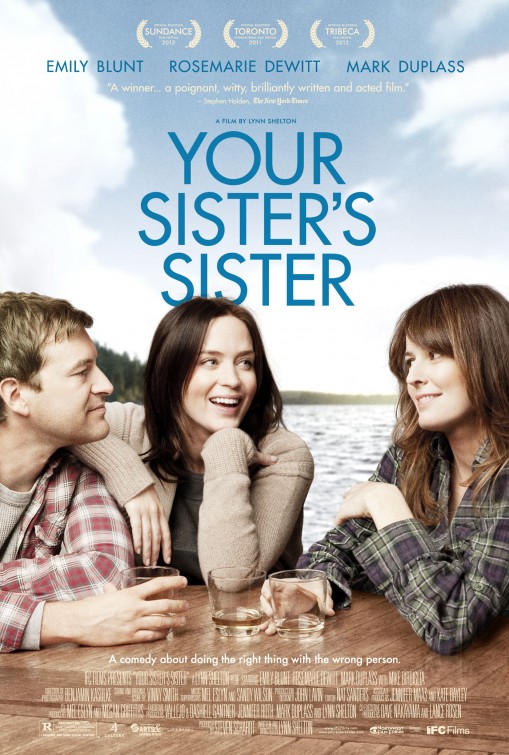 Lynn Shelton is quickly becoming one of my favorite indie film artists. Her writing and directorial offerings are somewhat relegated to the fly-on-the-wall hipster “mumblecore” category, but what separates Shelton is her narrative momentum, her laser-like focus with character, and her sense that a movie needs to build to something significant. With 2009’s Humpday, it was two dudes who might have sex as a test of their masculinity (you really need to see the movie for the full context). With Your Sister’s Sister, it’s the full ramifications of a bunch of delicious relationship secrets getting out there. Everyone in the film has something to hide and something to lose, and watching it all play out with humor and sweetness and honesty that is rare in movies.
Jack (Mark Duplass) is still coming to terms with the death of his older brother. His best friend, Iris (Emily Blunt), who was his brother’s girlfriend at the time of his passing, offers a suggestion. She arranges some alone time for the guy to clear his head. He bikes out to her family cabin but is surprised to find a guest already there, Hannah (Rosemarie DeWitt), Iris’ older sister. Hannah and Jack break the ice by bonding over their personal loss: his brother and her ending a seven-year relationship with her girlfriend. Over a long night of drinking, the two decide to impulsively have sex. The next morning is even more awkward when Iris shows up at the cabin, planning to finally reveal her own feelings for Jack. What follows may be one of the few character-based sitcom plots I’ve witnessed.
 Much like Shelton’s previous movie, the greatest strength of the film is how beautifully naturalistic it all feels while still telling an engaging story. The film has a relaxed vibe that washes over you, allowing you to immerse yourself in what feels like a real group of friends. There’s a tremendous naturalistic ease the film exudes, with the actors so familiar with one another that they truly feel like family. When I have well developed characters, and actors who seem so knowledgeable of their character’s tics and flaws and secrets and smallest details, I could honestly listen to them talk for hours. I don’t want to mistakenly give the impression that this movie is a dull yakfest where the participants are in love with the sound of their own exceptional voices. Each scene in this movie advances the plot further, twisting the screws, complicating matters, and brimming with delightful awkwardness and tension. With 2009’s Humpday, I wrote: “What I really appreciated about Humpday is that every moment feels genuine and every scene has a point. I was amazed that Shelton and her small unit of actors had made it so that every conversation had purpose; there is so little fat to this screenplay. Each scene reveals something new about a character or pushes the narrative forward toward its uncomfortable climax, and each moment never breaks the reality of the story.” And the same can be said for Your Sister’s Sister as well.
While the premise is a bit of a sitcom novelty with some farcical developments thrown in, the depth of the characters and the fantastic acting help to make sure that Your Sister’s Sister is nothing but graceful and beguiling. And the escalating conflicts, personal revelations and complicated feelings, always find a way to come across as organic to the story. That’s another amazing part of the film, that even with all the sexual hijinks that it still manages to feel grounded and surprisingly relatable. These are interesting, complicated, flawed, and spectacular characters, and watching them interact, profess their love through small actions and big declarations, seeing their heartfelt camaraderie, and watch them navigate their troubled lives to find some semblance of a happy ending is a joy to watch. This is a potent little movie, fully realized, poignant, funny, and genuine.
The film was shot over the course of 12 days and Shelton has said that much of the dialogue was improvised, working off her outline. Improvisation is a dangerous tact when dealing with a dialogue-driven film, such as this one. Just because it’s coming off the top of your head doesn’t mean it’s going to sound good. Not everyone is gifted with the ability to improv dialogue that is true to character, revealing, advances the story, as well as just being entertaining. Luckily, Your Sister’s Sister is the exception.
If Your Sister’s Sister does have a weakness, it’s the third act that seems to stall out without giving us much in development before tidying the broken relationships up again. The film’s comedic structure could feel, in lesser hands, like a generic sitcom. It is to Shelton and her actors’ credit that the twists and turns still manage to feel as believable as possible. The third act hits when all the secrets come out, pushing the characters away. Rather than (minor spoilers) ramping things up, we merely endure an extended wordless sequence of images of Jack biking around and the sisters burying the hatchet. Then it’s time for our big happy romantic declaration that tidies everything up, and we’re done. While satisfying on an emotional level given our empathy for the trio, the third act does seem very thin for an otherwise lean and well-structured story. It feels like perhaps Shelton only had enough plot for two acts.
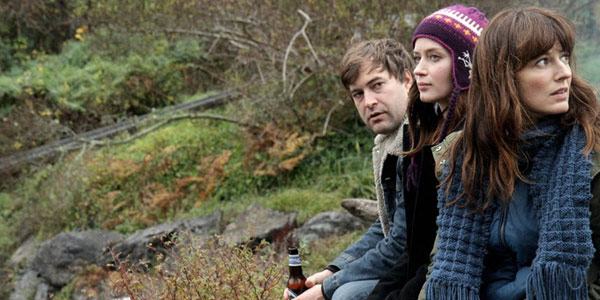 The main trio is a rather engaging ensemble that convincingly plays a besotted group of friends and family. Duplass (Safety Not Guaranteed) has gotten considerably more attention since starring in Shelton’s last movie; the man and his schlubby, smirky charm are ubiquitous. He has a way of being edgy without pushy and nonplussed and flummoxed without going overboard. Duplass has a natural fit for comedy but the man can really excel with the meatier drama bits as well, displaying the painful yearning of a man caught between his desire and the need to move on. He’s a winning and likeable presence that can still be endearing even when he’s flailing around or making others uncomfortable.
DeWitt (The Watch) was a late addition to the cast, replacing Rachel Weisv (The Bourne Legacy) when scheduling conflicts got the best of her. She deserves extra kudos for how good she is considering the miniscule prep time she had compared with her costars. DeWitt is amusing in how cagey and sardonic she can be, and her chemistry with Blunt (Looper) is outstanding. I greatly enjoyed the subtle nuances between them, the way their body language and gestures added extra layers to their relationship, the familiar communication and sisterly code, and just the smallest details that felt well thought out. The relationships in Your Sister’s Sister feel sweetly genuine, and with the benefit of great actors, it lays the groundwork for characters we care about.
Three people sharing time in a cabin might not seem like an exciting setup for a movie, unless, of course, there’s some supernatural presence murdering them in grisly fashion. However, when you lock away three great actors who know their characters inside out, a smart script that allows them the space to develop but pushes the movie forward scene-by-scene, and direction that feels seamless with the storytelling, then you have something special, and that something special is Your Sister’s Sister. While I think Shelton’s previous film had more at play concerning male relationships and sexual politics, this one, with a more straightforward, farcical plotline, is still plenty entertaining and with strong character work (the ending does leave one very large question unanswered). This is charming, sweet, unassuming little indie film that will provide a solid dose of smiles and laughs.
Nate’s Grade: B+
Share this:

Salmon Fishing in the Yemen (2012)
 Salmon Fishing in the Yemen will likely not be outdone in 2012 for strangest title of a mainstream film release. It is indeed about the crazy idea of bringing salmon to an emerging system of rivers in a Middle Eastern country. You’d expect some cultural conflicts and even some can-do uplift by the end. What I wasn’t expecting was a hokey romantic comedy to take hold of the movie. Ewan McGregor plays a repressed fish expert who partners up with Emily Blunt, whose company represents a wealthy Yemen sheik with a cockamamie dream. I felt that the sheer magnitude of project, transforming an environment, the triumph of the human spirit and cooperation, would be compelling enough. But this trifle of a romance demands the greater attention. There’s a contrived plot point where Blunt’s boyfriend of three weeks is presumed dead in Afghanistan. Guess who comes back later? This entire storyline hinges around the fact that she was only with the guy for three weeks; even she admits, “I never got to know him better.” The coupling feels extra tacky because McGregor is married too. Sure his marriage appears to be in a rut, but does that excuse his behavior? The political satire of the British government also feels pretty tin-eared and forced, like they’re compensating with volume for wit. Then there are the corny moments like McGregor foiling an assassination attempt on the sheik with a fly fishing rod. Yes, he whips it around the attacker’s arm like Zorro. Salmon Fishing in the Yemen is a nice enough little film, at least it would have been had it ever been allowed to jettison the yoke of a lackluster romantic comedy.
Nate’s Grade: C+
Share this:

Looper (2012)
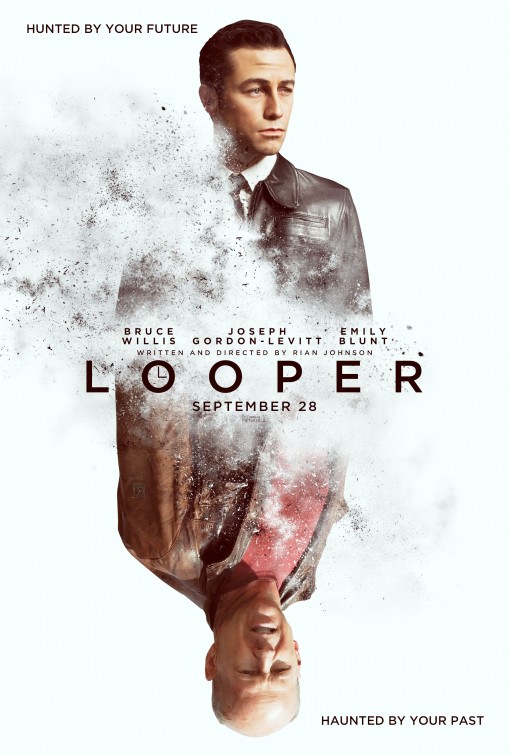 I became a Rian Johnson disciple the second that 2006’s Brick ended. I was floored by the originality, the artistic vision, the intelligence, and the creative voice. This was a unique filmmaker and I instantly knew this writer/director would be a man worth following. His follow-up, 2009’s The Brothers Bloom, was three fourths of a great movie, but a bit of an overdose on whimsy. Then I read that Johnson was next going to try his hand at time travel, and I could not contain my excitement. One of my favorite film genres and one of my favorite up-and-coming indie filmmakers together. I was expecting Johnson to do for time travel what he did with film noir (Brick) and the con movie (Brothers Bloom). How could Looper disappoint? Well, sadly, the movie found a way. It feels like Johnson smashed two halves of two different movies together, one good and one not so good.
In 2072, time travel is invented but instantly made illegal. The only people who have access to time travel are the mob. They have a surplus of dead bodies that need to disappear, so the mob sends them back 30 years. In 2042, Joe (Joseph Gordon-Levitt) is employed as a looper. He kills the guys the mob sends back in time and then disposes of the bodies. He’s paid well, and he and his fellow loopers live it up as privileged members of the Kansas City social sphere. Abe (Jeff Daniels) runs the show in town; he’s a mob guy from the future. There’s a catch to all the looper riches. The mob also wants to protect them in the future, so they send back the looper’s future self to be executed. It’s called closing the loop. And if you don’t kill your future self, bad things will definitely happen, just ask Seth (Paul Dano), a looper hacked apart to lure his future self back.
 The day comes where Joe is tasked with executing his future self, Old Joe (Bruce Willis). Old Joe escapes and goes on the run. Younger Joe is now under extreme pressure to kill his guy, or else the mob might just find him and start slicing body appendages. Old Joe is looking for the Rainmaker, who in 30 years will become a criminal tyrant responsible for much death. But in 2042, he’s only a child. Old Joe’s mission is to kill the child before he becomes the Rainmaker, and before he murders Old Joe’s eventual wife. While fleeing the mob, Joe takes refuge on a farm outside of the city. Sara (Emily Blunt) and her young son Cid (Pierce Gagnon) warily take in Joe but they’re also hiding a secret, that Cid has powerful telekinetic powers that can be put to great damage.
The film’s premise is compelling and allows for plenty of mind-bending possibilities, and Johnson has a fresh take on the sci-fi genre. Hunting down your future self is a grabber of a concept and I loved the scenes where Joe and Old Joe would sit down and converse. There’s the natural tension of Joe’s mission to eliminate his future self, but there’s also a flurry of ideas, ones that make the film better developed. Old Joe has an edge in foreknowledge but Joe has his own edge. He can change Old Joe’s memories by choosing different actions. He swears if he ever sees a picture of Old Joe’s wife that he’ll do everything in his path to alter fate, to make it so he never finds her. As a result, Old Joe is hobbled by headaches and fuzzy memories because the order of events is no longer concrete. “This time travel stuff fries my brain like an egg,” Old Joe admits. That, my friends, is a fascinating struggle for dominance and a refreshing take on time travel. Then you throw in the mob chasing after both Joes and you got an extra sense of urgency. Looper is playfully heady but easy enough to follow. It’s a thriller that doesn’t get bogged down in time travel logistics but it doesn’t pander to its audience either. If it did, I’m fairly certain Joe (addict, criminal, selfish) and Old Joe (eventual child slayer) would have taken turns to be more likeable. For a solid hour, Looper is alive with narrative jujitsu, a nice balance of action, drama, dark humor, intelligent plotting, stylish direction, the occasional startling visual, and strong acting from Gordon-Levitt and Willis.
And then the Looper becomes a completely different movie. Once the action shifts to Sara’s farm is where this movie completely unravels. I just couldn’t believe what was happening. The first half was so intriguing, intellectually stimulating, and thrilling, and then I got stuck on a farm and the movie turned into a lame version of Children of the Damned. I didn’t come for a telekinetic kid movie; I came for a time travel movie. The second half of this movie is practically wall-to-wall telekinetic kid stuff. The action slows down to a crawl and the flurry of ideas turns to a trickle as we introduce Strong Single Mom and Weird Son. I may have a cold heart but I didn’t care about these characters. I found the romance forced and Sara to be poorly developed. I found the kid annoying, and when he got mad and made his stupid mad face, it irritated me. Mostly I was irritated that the promise of the first half of the film had stalled out, and that this was where the movie was choosing to spend its dwindling time. It’s like the movie has been swallowed inside out by this stupid telekinetic subplot. The climax is fine but why did we have to travel through Dumb Farm Rest Stop to get there? Is it so that Joe can learn to be a better person? I didn’t buy that growth, especially with a kid as annoying and obviously dangerous as Cid. I suppose one night of sex with Emily Blunt (The Adjustment Bureau) could do the trick.
Besides the whole farm deal, there are other nagging questions I have that devalue Looper in my eyes.
 1) So in the future the mob is the only entity with access to time travel, but all they use it for is to dispose of bodies? That’s it? Biff Tanner used a sports almanac from the future to become king of the world. Are you telling me an organization that has historically profited from gambling would make no use of foreknowledge for personal gain?
2) Why would the mob have the loopers kill their older versions of themselves? This seems like a natural conflict of interest that could readily be avoided. Instead of having that particular looper kill his future self, thus closing the loop, why not assign that future version to a different looper? That way you don’t have to run the risk of the past looper letting his future self go. Or you could just never tell them what happened. For that matter, why does the mob have to send the guys back alive? Could they not simply just kill them and send the dead bodies 30 years back in time? This seems like an easier solution that also minimizes risk.
3) If you’ve just uncovered the power of time travel, why are you even bothering to send back your dead bodies 30 years into the past? Why not send your dead bodies back BILLIONS of years where the Earth is still forming, hot, and uninhabitable? I find this to be a better solution (I also wrote this solution in my own time travel screenplay, so there’s that too). Why can’t the mob feed dead bodies to dinosaurs? I’d love to see that.
4) You have a mob guy from the future, and you do nothing with that? Abe has one wisecrack about being from the future, and it’s a good one, but otherwise this guy could have just been from the present. The movie does nothing with the juicy element of a mob boss from the future. Maybe he doesn’t do as he’s told and arranges for his own rule. Or maybe he utilizes a sports almanac and makes some prescient bets, huh?
5) The movie takes place almost entirely around the confines of Kansas City. I find it hard to believe that a criminal organization would be sending all its bodies to Kansas City. Perhaps the mob also sends people across space and time, otherwise this means that we’re only following the future evil masterwork of the Kansas City mob.
6) I suppose you have to ask at what point do you really start to nitpick the whole butterfly effect of cause and effect paradoxes. With all time travel movies, there’s going to be some degree of suspension of disbelief, because changing one action can have wide-ranging consequences. However, with Looper there are several instances that gave me pause. Firstly, there’s the central idea of killing the Rainmaker as a child, which would negate the killing of the loopers, which would negate Old Joe seeking out the Rainmaker to kill. I’ll look beyond that. So Old Seth, in the film’s most horrifying sequence, starts noticing his fingers are disappearing, then his nose, and then his legs, etc. The mob is torturing young Seth to lure back the missing target. It’s an amazing visual sequence, but are you telling me that cutting off young Seth’s body parts would not have altered his future to a greater degree? I’m fairly certain when you start removing fingers and legs that Old Seth’s timeline would have been dramatically altered and he would cease to exist or follow the exact path to wind up in the past again. For that matter, why even bother luring the older Seth back? Could they not just take care of him by killing young Seth? What are they going to do with young Seth? If they’re just going to kill him then they should have just done that to begin with.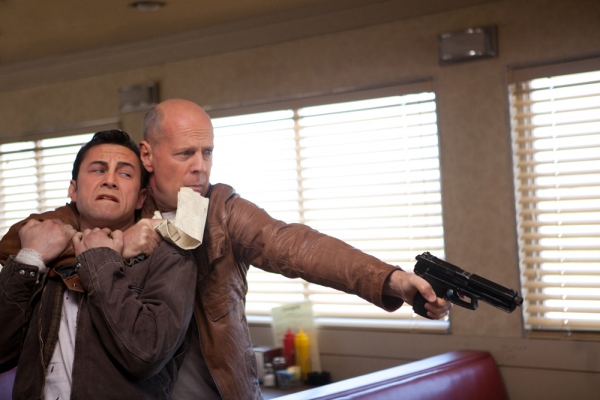
Johnson has plenty of thought-provoking questions he’d like to address within the bounds of a sci-fi action thriller. Would you kill a child if that kid were going to grow up and be a monster? Is redemption possible after doing horrible things? Could you kill your future version of yourself? Would you sacrifice everything to prevent future misery? These are legitimate questions and Looper deserves credit for spending time to ponder them, but I just wish Johnson could have gone back in time and chosen a different path.
Coming off of the stupendous Brick and the perfectly enjoyable Brothers Bloom, my expectations for Johnson’s third film were astronomical, especially given this crafty man’s take on time travel. I love the premise, love the actors involved, and love the ideas toyed around with, but the movie completely falls apart at the halfway mark. The pacing gets slack, the story becomes forced, and Looper transforms into a different, unwelcome movie. I can’t help but feel disappointed, partly from my expectations but also from the knowledge that Johnson could do better. The story just isn’t as well developed as it carries on, and the telekinetic subplot feels like a dull leftover from another movie. After an invigorating first half, Looper crumbles under the weight of a weak subplot that consumes the movie. There’s a good amount of thrills and intellectual stimulation aboard, but it’s all concentrated in the first half of the movie. I can’t recommend one half of a movie. I’ll still eagerly anticipate Johnson’s next project, but Looper is a sci-fi thriller that unravels at an alarming rate, turning a possibly great movie into a mediocre one.
Nate’s Grade: C+
Share this:

The Five-Year Engagement (2012)
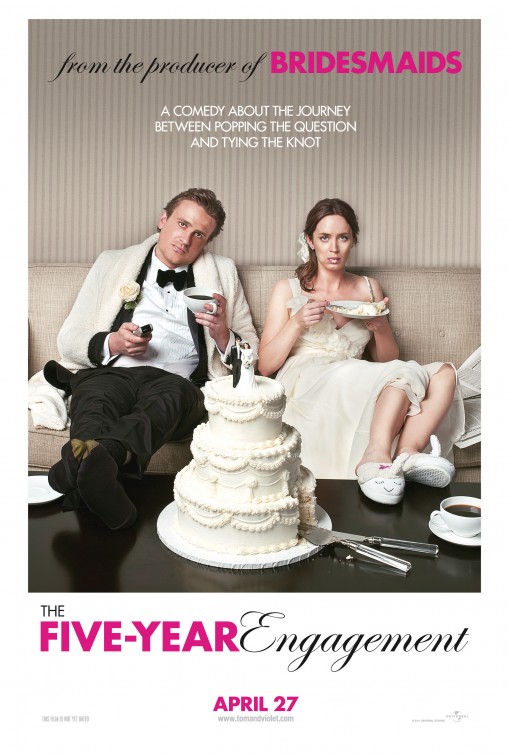 Relationships are serious business. In most Judd Apatow productions, they’re funny business. With The Five-Year Engagement, there’s romance to be found in surprising places, but the omnipresent feeling is one of dread. All those advertisements highlighting the comedy will start to melt away, and what you are left with is a funny, if bittersweet, anti-romantic comedy, more uncomfortable with hard-hitting truths than congenial laughs. My theater even had a few walkouts.
Tom (Jason Segel) and Violet (Emily Blunt) are happily in love. He’s a sous chef in a trendy San Francisco restaurant and she’s eager to gain a graduate fellowship at UC-Berkley in psychology. She doesn’t get accepted to Berkley, but the University of Michigan offers her a spot. Tom and Violet agree to put their wedding on hold and move to Michigan so that she can take advantage of an amazing opportunity. Michigan is not to Tom’s liking, especially since he can’t find a fulfilling job and settles with making sandwiches at a campus sub shop. It’s all just temporary, he keeps reminding himself. Then Violet’s two years gets extended, and Michigan isn’t just a temporary pit stop, it’s possibly home. Tom’s disappointment spirals, and he and Violet begin to drift apart, he resenting her for giving up his own dream to support hers. She begins getting emotionally attached to her Psychology professor, Dr. Childs (Rhys Ifans), in ways that straddle the mentor-student boundaries. Meanwhile, Violet’s sister, Suzie (Alison Brie), gets pregnant after a one-night stand with Alex (Chris Pratt), Tom’s best man and coworker, at the couple’s engagement party. They get married, have kids, and Tom and Violet are still stalling. This is the story of two people who deserve their happily ever after except life keeps putting obstacles in their path to the altar.
 You will be unprepared for how sobering The Five-Year Engagement can be. Some of these arguments between Tom and Violet cut right to the bone with an exacting level of painful authenticity. The level of uncomfortable intimacy can make the movie feel grueling. At the same time, I don’t want to give the impression that it’s some Apatow version of a John Cassavettes flick. There’s still plenty of comedy but the film is much more of a drama than any previous Apatow production. Part of the squirm factor comes in the very nature of the premise. The Five-Year Engagement picks up where most rom-coms end, with our happy couple together at last. We know these two are meant for one another; however, the majority of the screenplay involves watching two likeable, funny, loving people drift emotionally apart. Eventually they get back together in the end in a mad rush to staunch the gloom prevailing over the movie. It’s a hard act to watch people drift apart, losing the connections that once bound them together, and witnessing the glow of romance fade into complacency and resentment. Again, this is all handled in ways that find humor in uncomfortable places (like Tom, hopped up on painkillers, apologizing for smiling during sad news), but it can still be uncomfortable, and I don’t know if the ending, while happy, will justify the journey for many audience members.
I was shocked how much I found myself relating to the plight of the characters in The Five-Year Engagement, so much so that I simultaneously felt an extra level of engagement and discomfort. I will spare you the gory details, as I am a gentleman first and foremost, but relationships that just fizzle out rather than ending in some abrupt manner (infidelity, commitment issues, lack of availability, etc.) are not any more enviable. I related to the general sense of malaise that can plague a long-term relationship, the feeling of being forever a plus-one in your spouse’s circles, the resentment over the demands of a job or school, the small cracks that mask a lot of pain, the kind that is suffused with rationalization that to assert what you feel is to be selfish and inconsiderate, the loss of intimacy, physical and emotional, the guilt of being unhappy or making someone unhappy, and the sad realization that maybe love just wasn’t enough. What happens when nice people who are good for each other are just dealt rotten circumstances? Phew. I feel like I’m turning this into a therapy session. Let’s talk about something inappropriate in the next paragraph.
The biggest reason for sticking it out, both for Tom and Violet and the audience, is that Segel and Blunt have terrific chemistry together. Segel (Forgetting Sarah Marshall) is a big endearing lug of a man, and putting his career on hold to support his fiancé gives him an extra surplus of sympathy as we watch him spiral into despair and then resentment. He’s a funny, likeable guy, and we know he and Violet are meant for one another and we want them to get together, even as this looks less likely to come true after the circumstances that push them away. Granted, you must swallow the hard-to-believe reality that Tom couldn’t find a decent job in Ann Arbor, a college town that has to have some fine dining along the outskirts of town if not in the city. Blunt (The Adjustment Bureau) makes me fall in love with her yet again with a performance. Just like in 2011’s Bureau, she creates a charming, vibrant, luminescent portrayal of a person in love, so much so that I am envious of the man of her affections (her pantomime of “Circus Solei sex” made me feel all warm and fuzzy in multiple places). Violet has her own share of flaws but that just made her more relatable. I enjoy the way Segel, as a screenwriter (he co-wrote the movie with his regular collaborator, director Nicholas Stoller), is charitable with his characterization. He’s not afraid to make himself look mean and hurtful and wrong. He’s not afraid to make the girlfriends in his movies, even the ones who are about to dump him, justifiable in their decision-making. This is not a case of good guys and bad guys; it’s much more like life where everyone can draw good reasons, and the consequences just suck. Out of all of the Apatow films, Segel has done the best job of making his characters feel most like actual people than broad comedic types.
Luckily, the movie has its funny, peculiar little moments to make the drama bearable. I appreciate the little touches of comedy, which percolate through the heaviness. The wide supporting cast is peopled with the usual blend of oddballs and loudmouths. Pratt and Brie provide an ongoing foil as the couple who didn’t seem right for one another, made initial impulsive decisions, but have stuck it out and are happy; instead of waiting for the right time they embrace the mantra that there is no perfect time in life but the present. Pratt (TV’s Parks and Recreation) is great as a smart-aleck who grows into a responsible father. Brie adopts a British accent and becomes even more adorable, as all fans of Community would know. She’s quite funny as Violet’s sister and has a standout sequence where she and Violet have a very adult conversation in front of children so they disguise their voices as Cookie Monster and Elmo. The juxtaposition is a hoot and yet also a nice moment to add characterization. I also enjoyed seeing Chris Parnell (TV’s 30 Rock) as a sad sack faculty spouse stay-at-home father who clears his misery with kitting. There are some gory comedic set pieces around arrows being shot into legs and toes getting amputated, but the movie’s best comedy comes in the small moments, from Tom ‘s patchy “I’ve stopped caring” facial hair, to a self-described “pickle nerd” played by Brian Posehn, to the percentages of every undergrad named “Ashley” or “Zack,” to Tom’s hopelessly overmatched chase with Professor Childs, to a running gag about grandparents dying before Tom and Violet wed.
 I would like to take this time and observe that the University of Michigan, as well as its tenured professor, is responsible for the disruption of happiness between a young couple in love. How many other couples have you destroyed, U of M? When will your taste for suffering ever be quenched? And no, I’m not just saying this because I’m a diehard Ohio State Buckeyes fan, as well as a grad student. My point being: Michigan wants to kill Tom, Violet, and every person you hold dear (In short: Go Bucks).
You’d think with a title like The Five-Year Engagement they wouldn’t want to overstay their welcome, but like most Apatow productions, the film runs a bit on the long side. About 20 minutes into the movie, I felt the need to go to the bathroom. I rationalized staying put. Then about 90 minutes in, that urge became overwhelming but I reasoned the movie had to be over soon. And I kept telling myself that… for another 30 minutes. Then I just ran out and did my business, feeling the elation of relief. At over two hours, the movie feels excessive. Because of the drift away structure, the movie feels especially long in the second act, where we get hurtful scene after hurtful scene, and where Tom and Violet go their separate ways and start dating new people (the fact that Violet dates her smarmy professor feels realistic and yet also like a gut-punch to Tom). Some of the colorful characters that typical people Apatow productions feel more forced than usual, especially Violet’s collection of fellow psych grads played by the likes of Kevin Hart (Think Like a Man) and Mindy Kaling (TV’s The Office). They don’t seem well grafted to the story. The happy ending, while welcomed, also feels unlikely given the proceeding drama, and its brash adherence to rom-com conventions is a tad disappointing.
Watching the dissolution of a relationship is something of a hard sell to mainstream audiences, though Vince Vaughn was able to get audiences to see his anti-romantic comedy, 2006’s The Break-Up, which admittedly had bigger names and a lighter touch on the material. The Five-Year Engagement has its share of comedy but it’s pretty sublimated to the heavy drama of watching two people in love fall out of love and battle resentment, self-destruction, and apathy. Segel and Blunt are so good together we’re willing to give them a wider berth to stretch their wings, sow their oats, and eventually find one another again, falling back in love after a flurry of obstacles, realizing that finding and connecting with your right person is an ongoing process and not some prize to be awarded. I found myself connecting with the movie in several ways, so much so that it made me fee dour for the rest of the evening (you may feel differently). The movie gets so many subtle things right about how relationships can sour, and yet it still manages to overstay its welcome and fill its roly-poly narrative with annoying characters. At least the movie has helped me discover my perfect woman: Alison Brie with a British accent. However, Emily Blunt will also do in a pinch.
Nate’s Grade: B
Share this:

The Adjustment Bureau (2011)
 Gentlemen, if you were looking for an original excuse about not calling a girl back, try this one on for size: I couldn’t call because a team of men who control human destiny told me that if I did they would erase my memory and keep you from the fame that you are destined to achieve. She’ll probably at least give you points for originality before throwing a drink in your face (but it was all part of The Plan, or was it?).
David Norris (Matt Damon) has just lost a New York congressional election thanks to his frat boy ways of old resurfacing. As he composes his concession speech inside the men’s restroom, he meets Elise (Emily Blunt), a ballet dancer hiding out. They have one of those crazy only-in-a-movie conversations that manages to feel authentic. Then they kiss. She inspires him to ditch his prepared remarks and speak from the heart to the national TV audience, which eats it up. David spends the rest of his days trying to meet the enchanting Elise again. Then he runs into a big stumbling block. He’s late to a meeting and catches a group of mysterious men in suits and fedoras fiddling around with people frozen like statues. They are the adjusters, the ones who ensure that the participants of mankind follow The Plan. These are the people responsible for the illusion of choice in our lives. If we deviate too far from The Plan, causing ripple effects that too need to be accounted for and adjusted, they step in. Richardson (John Slattery) is the spokesmen for the group and decides to just level with David. He is not supposed to be with Elise. He has a different future ahead of him, so sayeth The Plan. They will throw obstacles between the two of them. David seeks out Elise and fights against the whole universe for the two of them to make a future together.
 Horrible title aside, The Adjustment Bureau is a sometimes corny but often deeply satisfying movie. It may distract with some efficient and just-smart-enough sci-fi leanings and magic tricks, but it’s really a unabashed romance at its core. Not just that, it’s a good romance, once that flutter the heart and causes the ends of your mouth to do that thing, you know – smile. It helps when you have movie tars as gorgeous as Blunt and Damon, and are such good actors that they can fill their roles with dangerous amounts of charm, but let’s credit writer/director George Nolfi (The Bourne Ultimatum, Ocean’s Twelve). He takes a fairly routine concept (powerful forces control our lives and choices) and turns it into a finely tuned character-driven romance. Immediately from their first meeting in a men’s room, Blunt and Damon have that electric dynamic that you can genuinely believe in. Their chemistry will knock you over. You feel the spark between these two, which is essential because the two characters spend years apart at times, forever hoping to reunite. In that brief encounter, you fall in love as well and realize that this character, and this actress, is worth waiting for. I think people are going to be surprised that The Adjustment Bureau is a big gooey, stars-in-the-eyes love story, and it’s actually good. It’s a really enchanting love story, tackling the question of whether whom we love is a result of choice or destiny. This central concept is what every sci-fi element and thriller sequence is spun from. Here’s a funny thought: it’s all in service to the story.
It’s rare to see a studio movie that mixes so many different elements together to such effective, satisfying results. The film doesn’t get overly dark despite the cosmically long-reach and determination of the adjusters. There’s never any real threat of danger, only a broken heart or dashed dreams. The film has many light moments throughout, creating a rather bouncy tone that suits the romance angle nicely. The adjusters aren’t very menacing, more so comically perturbed. John Slattery, all silvery Mad Men appeal, is a perfect foil as the face of the adjusters. He feels like an exasperated parent baffled by the thought-processes of his youthful charge. It helps that these cosmic accounting agents have a finite level of power. If they had unlimited power then the film would fail to have any hope for David and Elise. But we learn that there are only so many adjusters that there are limitations to their powers, and that they can be outsmarted with enough gumption. Mingling with that light touch is enough whimsical science fiction to engage your brain. The concept of the adjusters and their supernatural abilities is nicely teased, setup, and then developed, making sure never to rock the audience with too much weirdness at one time. It’s a gradual process of discovery and it leads to a somewhat goofy, but infectiously amusing, climax that involves multiple doorway portals and magic hats. Yes, I said magic hats, which means there is an honest to God good reason why that stupid fedora hat, seen so prominently in advertising that it feels like the third-billed star, is featured. Admittedly, a concept like a magic hat that allows you to teleport through doorways would seem silly, but Nolfi makes it all work. The hardest aspect to believe (in a film with, I repeat, magic hats) is that Blunt could be a ballet dancer, let alone a future star of the medium. I’m by no means saying that the British beauty has anything to worry about in appearance, but she does not have a ballet dancer’s dangerously minuscule physique. Natalie Portman in Black Swan looked like a real-deal ballerina of fragile frame. Blunt doesn’t have the movement or the physique.
 In his directorial debut, Nolfi does enough good things, and does them with a smooth sense of style, to impress. The visual trick of going in one door and opening to another world walks a dangerous line of over saturation, but it’s playfully utilized enough to forgive. Nolfi is not perfect with his plotting, falling to misstep that can push back momentum. Characters will be chatting, and then they’ll walk away and we’ll get a title card that says something like, “Three years later,” and it sort of makes it feel like we have to start all over again. The fact that this happens more than once means that Nolfi might have wanted to plot his story around a series of events that occurred more often than Senate election terms. If we have to begin with David losing one campaign at the start and then zoom ahead at several points through another campaign, then perhaps the timeline could have been condensed a bit in retrospect. The film manages to be religious and faith affirming without pushing an agenda or overstating its romantic cause. The ones behind the plan are only referenced in oblique business terms, never confirming a certain high power but definitely nodding in that general direction.
Damon and Blunt are a terrific team. This is easily Blunt’s finest role as an actress since breaking out in 2006’s Devil Wears Prada. The actress has taken many a role that makes use of her large crystalline eyes and her sometimes go-to acting response of simpering. But in this film, she finally finds that perfect role that makes use of Blunt’s modest, goofy charm. She’s never been a leading actress in a traditional set; there’s always been a delightful goofy appeal that set her apart. When Blunt offers her playful smiles and asserts those glassy eyes of hers, you too will be smitten. Her character is a charming woman thanks to Nolfi’s writing, but having an actress of Blunt’s ability fill her out is a blessing. Damon is at a point in his career where he just grinds out good-to-great performances that manage to be convincing in unassuming, dignified ways. Damon has never been an actor given to the superfluous. His character feels like a sincere sport, which is amazing considering he’s supposed to be playing a politician. He’s the kind of guy you’d actually stand in the rain to vote for, and you understand why Elise would keep a place tucked away deep in her heart for the dashing Damon.
While the movie hinges on the coupling of Damon and Blunt, the rest of the supporting cast does fine work matching tone and making the most of their roles. Actors like Anthony Mackie (The Hurt Locker), Terrence Stamp (Valkyrie), and Michael Kelly (Changling) can make any movie better.
 The Adjustment Bureau, on paper, should not work. A sci-fi fantasy that’s unapologetically grounded in romance. A tone that nestles firmly in a safe, bubble-wrapped whimsy. And those magic hats, need we forget them? On paper this should be one overly silly, dumb, tonally disjointed, cornball movie worth venomous mocking. And yet it works; it does better than “works,” it succeeds. Blunt and Damon are terrifically charming together and imbue the movie with a sense of cheerful optimism in the face of uncertainty (and perhaps heaven itself). You desperately want these two crazy kids to get back together; they’re good, decent, charming people, winning personalities apart and even better together. What might have fallen apart in other hands becomes this endearing, fizzy piece of studio entertainment that fulfills and exceeds most expectations. I was really taken by this movie, won over by its effusive charm offensive, and left buoyant with happiness by the time the tidy, perhaps too tidy ending, came rolling. The Adjustment Bureau is hooey but it’s my kind of hooey.
Nate’s Grade: A-
Share this:

The Wolfman (2010)
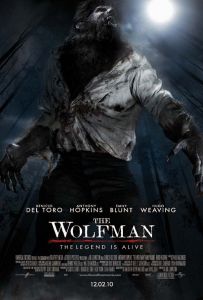 After re-shoots, reedits, a second director late in the process, and delayed release dates, it’s no surprise that The Wolfman is a bit of a shaggy mess.
In 1880, Lawrence Talbot (Benicio Del Toro) is an actor who returns home to England when he learns that his brother has been killed. Gwen (Emily Blunt), the fiancé to Talbot’s dead bro, writes that the departed brother was mauled, which points toward some kind of vicious creature roaming the woods. Inspector Aberline (Hugo Weaving) has been called in to clear the matter. Talbot’s father, Sir John (Anthony Hopkins), welcomes his prodigal son back but warns him of the dangers lurking in the countryside. The villagers are ready to blame the gypsy caravan and their chained bear when the feral creature strikes again, thus exonerating the bear. Talbot is bitten by the beast but survives only to transform into the cursed werewolf once every full moon.
Structurally, this movie feels like it’s all Act 1 and Act 3 with about ten minutes in between. By that I mean it’s all protracted setup and climax and little to connect the two. The beginning takes so long, with characters walking around like zombies who have no sense of wonder or fear given the extravagant circumstances. This is a movie that confuses set changes with plot advancement. Dour characters enter half-lit rooms and say little that isn’t cryptic or terse about the unusual happenings. This is what you have to look forward to for about an hour. The central mystery of who is the initial Wolfman is pretty easy to figure out when you play the economy of characters, which only compounds the movie’s sluggish pacing problems. You’re going to have definite pacing issues when your monster can only appear once a month, so say hello to massive time-lapse montages with the moon. It makes it hard to keep track of how much time is actually elapsing.
 There is little cogent explanation for why anything happens and the movie does an extremely poor job of maintaining a credible suspension of disbelief. What exactly are the rules here? What are the limitations for the Wolfmen? How far back does this whole thing go? The movie traces it back to an Indian kid, who looks like Gollum, in a cave, but where did he get it from? What is the history of this lycanthropy illness? When you turn into the monster, do you have any control? Are you a slave to your animal impulses? Are you culpable for what happens? Is it more like having multiple personalities except one of them is harrier? Nothing is really made clear and the movie just plows along while the unanswered questions continue to pile up, never to be addressed.
The Wolfman does a fine job of establishing an ambiance that feels ripped right from the old Hammer horror films, but fog and shadows and art direction can only take you so far. Every room looks like it’d be a prize-winning example of how to build a haunted house, though the lighting tends to be overly murky. Danny Elfman also provides a darkly lush score that mingles well with the onscreen atmosphere. But the refined sets only tease a better movie. An attack at the gypsy camp can get interesting. The beast flaring up at an insane asylum calls for something wickedly entertaining and scary, but everything is over before it really gets going, and we’ve moved on to the next scene of character sitting glumly in the dark. There’s nothing to startle beyond some overused jump scares. The movie lacks good scares because the film fundamentally can’t sustain a mood because the plot is never elaborated.
The character work is exceedingly shallow. Talbot is the main character but what do we learn about him? He’s an actor, he left town, he gets bit by a wolf, he skips stone’s with his dead brother’s girl, and that’s about it, folks. There’s an entire back story about Talbot spending time in a mental ward, which could prove to be fascinating but it’s just another set piece and nothing more. Talbot is pretty much a placeholder for a character; he’s the dude that has to get bit for there to be a story. He’s more catalyst than character, and you can feel that painful realization in how Del Toro (Traffic, Che) plays his non-character. Del Toro is a truly capable actor but he sleepwalks through the entire movie and mumbles most of his lines. Despite being a dead ringer for Lon Chaney Jr., he brings no energy to his role, nor does he ever seem truly concerned with his beastly transformation. You got more reaction and contemplation from Michael J. Fox in Teen Wolf.
The rest of the actors try and make good with the parts they’ve been tossed. Blunt (Sunshine Cleaning) can be a very good actress but she’s playing the thankless task of the underwritten love-interest-to-monster part. She’s no more fleshed out than the blonde damsel that screams and faints in the old classic monster movies. Blunt has the annoying habit of her voice turning into this simpering whine when she’s distressed. Hopkins (Fracture) pretty much gives the plot away with his maniacal cackling and incessant ear-to-ear grinning. You can pretty much faithfully assume where his character is going from the first malevolent twinkle in his eye. The screenplay exerts no effort to disguise its easily telegraphed character reveals. The person who comes out best is Weaving as the inspector, but that may be directly linked to the fact that he has the least amount of screen time of any of the main characters.
The special effects are fairly good and the practical makeup effects by screen legend Rick Baker are even better. The actual Wolfman is a snarling, spooky creature, but I wonder why we don’t get more shots allowing us to fully view the makeup work. Director Joe Johnston (Jurassic Park 3, Jumanji) seems to be more of a proponent of CGI, which means that we get scenes of Wolfie jumping from ye olde rooftop to rooftop like he’s any sort of wily creature. There’s nothing in the movie that really makes use of the specifics of being a Wolfman. We get a few POV shots of the Wolfman running extremely fast, but little else takes advantage of what makes the Wolfman a creature to be reckoned with. We only get a slew of decapitations and sliced innards that display the ferociousness of those wolf claws. Johnston isn’t afraid of gore but he doesn’t help his case when he fails to create any feeling of dread. It’s hard to dread what you can barely understand and with people you don’t really care about. Consider me stubborn, but when I got to a movie called The Wolfman I want some attention paid to the title animal.
 As I was watching The Wolfman I began to disassemble it in my head and piece together my own version of the film, an infinitely better version. For the sake or argument, I’ll explain my version and you can tell me which seems like the superior product. In my imaginary version, I completely eliminated Blunt, Hopkins, and most of the other side characters. I focused on Talbot and the Inspector and their relationship. Talbot has known about his lycanthropy for some time but he’s been able to control it for the most part, until recently. It haunts him, his inability to stop the sinister urges inside him that take over. The inspector is called in after the mysterious murders have picked up and they resemble some equally gruesome murders from 20 years prior (when Talbot first grappled with his hairy alter ego). The bent of the plot would then be on the relationship forged between the two men, how it turns into mutual affection and admiration all the while Talbot is trying to stay one step ahead of the investigation. Then my Act 2 break would be the Inspector finally realizing who is responsible for the murders (his friend!) and struggling with his own moral obligation to meet justice. Maybe this sounds too much like a crime thriller, but to me that sounds like a better film than watching two CGI werewolves claw at each other and spit.
The Wolfman is yet another misguided remake in a genre being gutted by horror remakes. The old monster movies of old were more than creature features and deserve better treatment than this bloody mess. I suppose few films can survive given the retooling process this one went through. This super serious monster movie has terrific production design, some alluring atmosphere, and a whopping void where a story should be. Characters will bumble about and the plot hums along with no explanation or elaboration given, meaning that setup often immediately crashes into climax. That’s not a satisfying recipe for a moviegoer. The Wolfman is mostly suspense-free and the actors are phoning it in; Hopkins is a kook, Blunt trembles her lower lip, and Del Toro seems to be drugged. This is mostly a costume drama with a little gore splashes in for good measure. It’s boring and half-baked and the best attribute is the scenery. If I wanted to watch scenery I’d flip through a Home and Gardens magazine. I was expecting entertainment here but instead it’s just another reminder to stick with the original.
Nate’s Grade: C
Share this:

Sunshine Cleaning (2009)
 This mordant family drama has an intriguing premise, sisters who start a business cleaning up after messy crime scenes, but the film suffers from a crippling passivity. It’s nicely acted all around, especially Emily Blunt as the more troubled, wild child sister. The dysfunctional characters are established with momentary glimpses to back-stories, mostly tragic, but the narrative just sort of nudges them along. Sunshine Cleaning is a little too removed and clinical for its own good. The working-class characters are rundown but that doesn’t mean the movie has to feel the same way. Subplots and characters will be abandoned or left with no resolution. Alan Arkin’s scheming grandfather character never seems related to the plot, and he feels like he was lifted from another movie with a wackier veneer. It also makes time for cute sentimental elements that don’t jibe with the film’s tone, like using a CB radio to talk to loved ones in heaven. Sunshine Cleaning is sweet and sincere drama with some dark humor mixed in and it comes across as affable entertainment. Still, this movie had much more promise, if only it was less reserved and afraid to get its hands dirty.
Nate’s Grade: B-
Share this:

The Devil Wears Prada (2006)
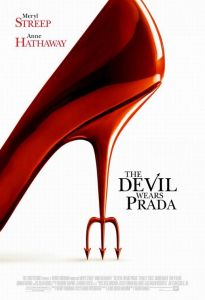 One part fantasy, one part incisive satire on the fashion industry, The Devil Wears Prada, on paper, may not be more than another formulaic entry where a young innocent gets caught up in the temptations of power and influence. I know little about the fashion industry other than what I can gleam from TV’s insanely watchable Project Runway and even I was charmed. Andrea (Anne Hathaway) is an idealistic journalism student paying the bills working as the assistant to Runway magazine’s ferocious editor in chief, Miranda (Meryl Streep). Andrea’s plain style of dress draws sneers and snickers from her rail-thin, nose-raising colleagues, and some smart snark from Miranda, who always seems to eviscerate people without raising the timber of her voice. The movie is typical with its rise-and-fall power structure, but even though it may be lightweight, The Devil Wears Prada is lots of fluffy fun, and all signs of life point to Streep. It’s almost a foregone conclusion that you’ll get a worthy Streep performance, but she’s totally unleashed in The Devil Wears Prada. Every time she sweeps into a scene she commands attention and steals the movie. We’re all just living in this woman’s world on borrowed time, and she knows it. Streep is in grand comedic form, dominating the movie with glares; just an inching of her facial expression can cause titters. It’s a juicy role and, mark my words, the most Oscar-nominated actress in history is going to get another nom for this performance. Hathaway proves to hold her own as well beyond those dark doe-eyes and cherry stem lips. The movie starts to drag in a third act trip to Paris, and Andrea’s empathy seems to get a bit out of tune (she feels worse about being better at her job than a co-worker than missing her boyfriend’s birthday). The Devil Wears Prada is an enjoyable, easily digestible piece of high-gloss fluff elevated by Streep’s dominating turn as a fashion lioness.
Nate’s Grade: B


 nathanzoebl
You must be logged in to post a comment.