Blog Archives
Sentimental Value (2025)

It’s an old cliche to say “they don’t make movies like this anymore,” but with our current media environment, there’s a reluctant truth to the fact that many genres, particularly adult dramas, romantic comedies, and non-action comedies, have declined steadily from their studio heyday. And yet Sentimental Value is also proof against this adage, as this wonderful movie is the kind of engrossing, mature, and thoroughly artistic original adult drama that Hollywood would have positioned decades ago to prominent award glory, like your Terms of Endearment or Rain Mans. I guess the caveat is that Sentimental Value comes from Norway, so outside the Hollywood system, and it’s reminding every movie lover not just of what we’ve lost in recent times with studio output of rich adult dramas, but it reminds us why we love the movies. Sentimental Value is easily one of the best movies of the year and a triumph all around of acting, writing, directing, and editing. It’s so thoroughly well-realized that it feels like we’ve been dropped into the realm of a classic novel brought to stunning life with a level of care, insight, and artistry that is rare to experience in any medium. I knew right away I was in for something truly special.
We begin by tracing the history of a house in Oslo, particularly the Borg family that has lived there for generations going back to pre-World War II. The father, Gustav (Stellan Skarsgard), is a famous film director who divorces his wife when their two daughters are young. The oldest daughter, Nora (Renate Reinsve), grows into a talented but neurotic theater actress, one beholden to stage fright even after all her accolades. Her younger sister, Agnes (Inga Ibsdotter Lilleaas), has married, has a young son, Erik, and she works as a historian researching specifically her grandmother who was tortured by the Nazis. After the death of their mother, Gustav resurfaces in their lives after a long absence working in Hollywood. He has plans. He has written a semi-autobiographical screenplay about the life of his mother, and he wants to film it in their family house, and he wants Nora to play the starring role. The sisters are resentful and wary of their father, but could this entire artistic enterprise be a push for reconciliation and better understanding for everyone?

I’m talking mere seconds into the movie, director/co-writer Joachim Trier (The Worst Person in the World) had already grabbed me with his deft storytelling. A narrator provides the complicated history of this house, treating it like a living vessel that itself has been an observer to the many generations residing within. The details are so precise and telling, like a novel giving you a larger sense of the world that exists beyond the margins of what we can see and hear. To say the movie is a complex family drama is only scratching the surface. Let’s just unpack some of the layers inherent from its premise. Gustav’s world is cinema and he wants to make what might be his last movie his greatest and most personal. He’s telling his story, asking his own daughter to play his own mother. When Gustav was a child, he was the last person to speak to his mother before she decided to take her own life by hanging herself. Think about the psychology at work here, a father trying to reconnect with his estranged daughter through the means of her playing his own mother and possibly better understanding his loss that has haunted him since childhood. Then Gustav also wants Erik, his grandson, to play the younger version of himself in the movie, though Agnes is against the idea. There are so many intriguing layers at play with all of this, the use of art to process grief and trauma, the mirrors of family members portraying other members as engines of empathy, and the act of filmmaking as recovery. I’ll slightly spoil the movie to say that Nora turns down the role. The rest of the movie is about how she gets to “yes.”
In the wake of Nora’s rejection, Gustav offers the role to an American actress, Rachel Kemp (Elle Fanning), a hot commodity that convinces Netflix to get involved. However, with the streaming giant attached, there are several compromises that Gustav must endure. He intended the project to be in his native tongue but now it’s in English. He isn’t allowed to bring back older members of his crew he’s worked with for decades, like a retired cinematographer who is infirm to the point where he needs to walk around with a cane. With each compromise, you can see Gustav making a mental cost-benefit equation. He envisions this movie as his most important, and possibly his last, and it becomes a gauntlet of what shape it might eventually take to get made and if that shape is too malformed and unrecognizable from his original artistic vision. When you consider this movie could also be his vehicle to better understand his own mother, as well as an amends to his daughters, then every new compromise bears even more significance. Rachel is eager to please a director as well-regarded and as famous as Gustav, but she also recognizes her vulnerabilities and shortcomings. She can’t shake the feeling that she’s not right for the part, that Nora is the rightful pick, and she’s struggling to get a better grip, plus there’s the whole Norwegian accent that she has to master as well. Fanning (Predator Badlands, A Complete Unknown) has a few standout scenes but even she recognizes she’s the interloper to this family.

Reinsve has been a collaborator of Trier’s all the way back to 2011’s Oslo, August 31st, but it was her starring role in 2022’s The Worst Person in the World that cemented her international stardom. She’s a wonderfully intuitive and expressive actress, inviting us in with every scene to study her character’s guarded emotional responses and occasional outbursts, like her stage fright hysteria. As the older sister, Nora has built more resentment against their father, whom she blames for everything that her family lacked back in Norway while her father was off in Hollywood making movies with celebrities. Nora is wary about filmmaking, viewing the theater as more of a pure artistic and worthy medium for acting, though you could even view this designation as a division she has drawn: “this is my territory, and that is my father’s territory.” Now he wants to bring her into his world, and she can’t help but be skeptical after all their time apart. Why now? Why this? While this is a splendid ensemble drama with great attention paid to many characters, for all intents and purposes, Nora is our protagonist, and Reinsve keeps us compelled to examine every internal development of this character.
Every actor is at the top of their game, contributing to a marvelous ensemble that makes this family so richly felt. Skarsgard (Dune) is used to playing heavies, stooges, and bad dads, and the role of Gustav allows him to tap into all of those mercurial skills to bring to life a man who is trying to take stock of his life late in its run and make some changes, notably who is allowed inside his cherished circle. Skargsard is mournful but still egotistical, reaching for reconciliation but not begging for it, using the enterprise of the movie and particularly the leading role offer as the unspoken apology. However, Gustav is more than just an absent father, as in the screenplay, by Trier and longtime collaborator Eskil Vogt, he’s also still suffering from his own trauma with the loss of his mother. This movie is an attempt to better understand her and perhaps her psychology that would lead her to make such a heartbreaking decision to end her life. It’s an honest attempt to bring back to life a woman he dearly misses while also discovering a path of forgiveness, while he seeks his own act of forgiveness with his own adult daughters. I told you, there are layers all over this movie.

As the younger sister, Agnes has a more charitable view of her father, and she even acted for him in one of his earlier movies and fondly recalls how warm his attention and affection felt. She’s wary about his desire to have her son, who has professed an affinity for filmmaking but not acting, play the role of young Gustav. She’s worried about her child going through the same level of attachment and disenchantment that she experienced when she was younger and wanting to grow closer to a man who had kept his distance from his family. Agnes’ story is one of uncovering the history of her grandmother, a member of the Norwegian resistance who was taken into custody during Nazi occupation and endured all kinds of torture. Her grandmother is indicative of an entire generation of resistance, and by re-examining one person it provides a larger statement about the sacrifices of those who deserve not to be forgotten, whose memories persist even after the horrors they survived. The movie makes an implicit line between her suffering and eventual suicide but making it a direct line of cause and delayed effect is not so simple. People are complicated by nature, and Agnes fits this bill as well, as demonstrated by Lilleaas’s commanding supporting performance. I think she has what may be the most affecting scene in the movie, a sisterly heart-to-heart that strikes you right in your own heart.
Reminiscent of Ingmar Bergman and Francois Truffaut, Sentimental Value is a richly realized drama with such engrossing and complex characters told in a richly entertaining fashion. There are stylistic touches, like the recurring omniscient narrator, but the movie is more grounded in the simple pleasures of transporting us into the lives of other people and to embrace their flaws and hopes and desires. The actors are incredible and bring such startling life to these characters and their nuances. I could have endured an entire series in this world but at a little over two hours, Sentimental Value feels complete and satisfying. It’s the kind of movie “they don’t make anymore,” to our detriment, so when you discover a film as beautifully executed as this one about the relatable issues that drive many families apart and can bring them back together, then you thank your lucky stars that we still have filmmakers dedicated to making complex adult dramas without any high-concept gimmick to couch their real intentions. This is a marvelous movie about life. Full stop. See it, reader.
Nate’s Grade: A
Share this:

Predator: Badlands (2025)
 This movie plain rules. I was a nominal Predator fan beforehand but these last two movies, both directed by Dan Trachtenberg (10 Cloverfield Lane) and written by Patrick Aison, have taken the concept of a badass alien bounty hunter and made it so much more interesting than its killing prowess. Badlands is the first movie told entirely from a Predator’s perspective, also known as the Yautja. We’re set on an alien world, a proving ground that has claimed many who attempted to make their mark, and we’re following a “little brother” Yautja named Dek who wants to make big brother proud and stick it to dad. There’s also just the general struggle for survival in a hostile world where even the grass can kill you. That’s what I loved about Badlands, how seamlessly it drops you into its perspective and the fascinating sense of discovery along the way. Every ten or so minutes introduces another obstacle, character, or environmental detail that creates such a more vivid picture of this planet, and those details will almost all come back in important and satisfying ways for our climax, proving Dek has learned many lessons. Where the movie goes from great to amazing is when Thia (Elle Fanning) is introduced as a legless android from a Weyalnd-Yutani corporate expedition. It’s a perfect buddy pairing: he’s stoic and inflexible and quiet, and she’s chatty and goofy and friendly. The way the two of them genuinely bond and grow to become allies is surprisingly satisfying on an emotional level, which is not something I thought I’d ever say about a Predator movie. The action is immersive and clever and quite creative with its various details, but the real winning formula is just how structurally sound and engaging it is from the character dynamics. I cared. I celebrated their victories. I celebrated their rewarded faith in one another. Badlands is badass as delightful sci-fi/action but it’s also badass as a funky found family movie that felt like magic. Even if you’ve never enjoyed a Predator movie, or seen one, give Predator: Badlands a well-served trip.
Nate’s Grade: A
Share this:

A Complete Unknown (2024)

I’m not really a Bob Dylan fan. While I can appreciate several of his songs, it’s his voice that has always put me off. An entire movie about the mystique of Dylan and his rise through the 1960s folk scene was never going to be too appealing for me. So keep all of that in mind as I tell you that A Complete Unknown is a thoroughly fine movie with the not-so grand insight that this famous troubadour might just be a talented prick. The end. Director/co-writer James Mangold returns to the musical biopic sub-genre almost twenty years after his Walk the Line (a non-Joaquin Phoenix Johnny Cash has a cameo in this movie too, securing the Boomer Music Cinematic Universe). It all feels very stately and staid and reverent and, especially during its climax, hopelessly quaint. The conclusion is over whether or not Dylan will play music at the Newport Folk Festival that the fuddy-duddy programmers demand. Will he go electric? Will he play traditional folk? Will you care? I suppose it’s about people trying to control and define this idiosyncratic artist who wants to be himself, whatever that may be, whatever feathers may be ruffled by the traditionalist gatekeepers of the folk music scene. This celebration of artistic integrity and creative revolution would mean a little more if I got a better understanding of Dylan as a person. Blessed with audience foreknowledge, we already know he’s going to be successful and that his creative impulses will be rewarded. Timothee Chalamet does a fine Dylan impression and recreates the famous songs with an impeccable nasally impersonation. For my money, I’d rather this have been a Pete Seger (Edward Norton) movie about his passing of the torch from one generation of folk artists to another and recognizing that the culture and peace movement were moving beyond him. Regardless, if you’re a Bob Dylan fan, there’s plenty to like, especially many extended jam sessions. If you’re looking for more than a handsomely recreated Best Of album, you might need to read a book instead.
Nate’s Grade: C+
Share this:

Live by Night (2016)
 With only three films, Ben Affleck has successfully reinvented himself as one of Hollywood’s most talented directors when it comes to adult crime thrillers. It’s not just his superb directing chops; the man also serves as producer, lead actor on most films as well as a screenwriter, and Affleck’s ability to write flawed yet deeply human characters within genre parameters has accomplished actors flocking to work for him. Beyond his 2012 film Argo winning Best Picture, Affleck has gotten three different actors supporting Oscar nominations (Amy Ryan, Jeremy Renner, Alan Arkin). He’s an actor’s director and a man who knows how to satisfy an audience hungry for authentic genre thrills and interesting characters. His latest film is an adaptation of Dennis Lehane’s novel and is Affleck’s most ambitious film yet and it’s gorgeously brought to life. There’s still plenty to like and entertainment to be had with his Prohibition era gangster flick Live by Night, but it’s also unquestionably Affleck’s weakest film yet as a major director.
 Joe Coughlin (Affleck) is a hardened WWI veteran who says he came back to Boston as an “outlaw” (he seems to turn up his nose at being called a “gangster”). Joe settles into an easy life of crime with the local Irish gang lead by Albert White (Robert Glenister). Unfortunately, Joe’s lover, Emma Gould (Sienna Miller), happens to be White’s main squeeze. Joe and Emma sneak around and carry on their relationship without proper discretion. Their secret is found out, Emma is dealt with, and Joe escapes with his life, serving a prison sentence and then enlisting in the Italian mob under local boss Maso Pescatore (Remo Girone). Joe is sent to Tampa to manage the rum-running business, starting his life over. The area is ripe for expansion and it isn’t long before Joe is making friends and enemies over his exploits. He falls in love with Graciella (Zoe Saldana), a fellow criminal with a working operation of Hispanic bootleggers. Joe warms to a local police chief (Chris Cooper) and his daughter, Loretta (Elle Fanning) a girl who experiences the darker side of vice and becomes a troublesome born-again leader. All the while Albert White has relocated to Miami, and the specter of vengeance looms just within reach.
It’s a Prohibition gangster flick and Affleck makes sure to check as many boxes as he can when it comes to audience expectations for a pulpy hardboiled action drama. The production design is aces and the cinematography by Robert Richardson (The Hateful Eight) is beautifully composed with its use of light, shadow, and framing. There are shots of violence that are exquisitely rendered so as to be their own art, like a man falling down a stairwell with a Tommy gun blasting above bathed in light. The production details are a sumptuous aspect that Affleck and his team put supreme effort into to better make their movie transporting. The action sequences have a genuine delight as they pop. A shootout throughout the grounds of a mob-owned hotel is an exciting climax that finds fun ways to provide genre thrills. The rise-and-fall structure of the story, mingled with a simple revenge motivation, is a suitable story vehicle for the audience to plug into. There are fun characters, fun moments, and sizzling action, all decorated in handsome period appropriate details. While Live by Night has its share of flaws, a dearth of entertainment is not one of them.
Tone and coherency end up being Affleck’s biggest obstacles he cannot overcome. It’s somewhat of a surprise considering his other directorial efforts brilliantly melded several genres while telling invigorating stories. I think the main fault is a screenplay trying to do too much when more streamlining was optimal. The specific goal that sets Joe in motion is a bit hazy and fails to provide a larger sense of direction for the arc of the tale. Affleck’s previous films were rock-solid in crafting overarching yet specific goals that propel the scenes onto a natural narrative trajectory. With Gone Baby Gone, it’s finding the missing girl. With The Town, it’s getting closer to a bank employee without having that relationship discovered by his cohorts. With Argo, it was rescuing the hostages. With Live by Night, it’s mostly getting vengeance against Albert White, though we don’t know how. In the meantime, we have episodic incidents failing to register connective tissue or at least a cause/effect relationship where it feels like a natural order of organic conflicts. The opening act in Boston that sets up Joe’s tragic love, jail time, and enmity with White could be removed entirely. I’d miss the thrilling 1920s car chase, which is also unique in that it’s the first period car chase I can think of that utilizes the mechanical limitations of the vehicles for extra tension, but it’s at best a moment of flash. Having the story pick up with Joe putting his life back together in sunny Florida would have been a cleaner entrance into this world for an audience. Once Joe ingratiates himself into this new world, the audience has to play another game of character introductions and assessing relationships and the balance of power. It feels a bit redundant after having our previous act pushed aside to reboot Joe’s world.
 It feels like Affleck is trying to corral so many historical elements that he loses sight of the bigger picture. Joe’s criminal path seems comically easy at times as he builds a fledgling empire along the Floridian west coast. First it’s the law and then it’s the KKK and then it’s religious revivals that need to be dealt with. Each incident feels like a small vignette that observes the historical setting with an angle that will be perfunctorily dropped in short order. The conflicts and antagonists don’t feel sufficiently challenging and that lessens the intended suspense. When Joe is dealing with the KKK, it feels like he’s restraining himself out of politeness rather than a series of organic restrictions. The elements and tones don’t really seem to inform one another except in the most general sense, which leads to the film lacking suitable cohesion. It’s easy then for Affleck to overly rely on stock genre elements to provide much of the story arrangements.
The characters have difficulty escaping from the pulp trappings to emerge as three-dimensional figures. Graciela gets the worst of it, proving to be a capable bootlegging criminal in her own right who loses all sense of personality, agency, and import once she becomes romantically entwined with our hero. It’s as if she erased herself to better heal his broken heart. How kind of her. The religious revival element is ripe for further examination but it’s kept at a basic level. We’re never questioning the validity of Loretta’s conversion and sudden celebrity. Chris Cooper’s pragmatic lawman has the most potential as a man trying to keep his morals amidst the immoral. The character isn’t utilized in enough interesting ways that can also flesh out his dimensions, and his conclusion suffers from that absent development. The characters serve their purpose in a larger mechanical sense but they don’t feel like more recognizable human beings.
Affleck’s innate talent with actors reappears in a few choice moments, just enough to tantalize you with the promise of what Live by Night could have been. The standout moment for me is a sit-down between Joe and Loretta where she unburdens her self-doubts. This is a woman who has been preyed upon by others, had her hopes dashed, and is trying to reinvent herself as a religious leader, but even she doesn’t know if she believes that there’s a God. The scene is emotional, honest without being trite, and delivered pitch-perfect by Fanning (The Neon Demon). It’s the kind of scene that reminded me of The Town and Gone Baby Gone, how Affleck was deftly able to provide shading for his characters that opened them up. Miller (American Sniper) has immediate electricity to her performance and reminds you how good Affleck is at drawing out the best from his actors. British TV vet Glenister is so good as a villain that seems to relish being one that you wish he were in the movie more. He has a menace to him that draws you in closer. Maher (The Finest Hours) is a memorable cretin who you’ll be happy to be dealt with extreme prejudice. There isn’t a poor casting choice in the film (hey Clark Gregg, hey Anthony Michael Hall, hey Max Casella) except possibly one, and that’s Affleck himself. I know part of the reason he selects his directing efforts is the possibility of also tackling juicy acting roles, but this time he may not have been the best fit. He’s a little too calm, a little too smooth, a little too out of place for the period, and his director doesn’t push him far enough.
 A strange thing happened midway through, namely how politically relevant and vicariously enjoyable Live by Night feels specifically for the year 2017. It’s a movie largely sent in the 1920s with characters on the fringes of society, and yet I was able to make pertinent connections to our troubled times of today. After a contentious presidential election where many feel that insidious and hateful extremist elements are being normalized and emboldened, there is something remarkably enjoyable about watching a murder montage of Klansmen. The Tampa chapter of the KKK takes aim with Joe’s business that profit from fornicators, Catholics, and especially black and brown people. They’re trying to shake Joe down for majority ownership but they’re too stupid, blinded by their racist and xenophobic ignorance, to accept Joe’s generous offers, and so they can’t help but bring righteous fury upon their lot. There is something innumerably enjoyable about watching abusive bigots brought down to size with bloody justice. I could have seen an entire movie of Joe and crew tearing through the Florida chapters of the KKK and just cleaning out the rabble. This sequence whets the appetite for what comes later. Without going into specific spoilers, the climax of the movie involves the put-upon minorities rising up against their bosses who, like the Klan, felt they were too powerful, too indispensable, and too clever to be seriously threatened. In its own way, it’s like a dark crime actualization of the American Dream. Unpack that if you will.
Live By Night is Affleck losing the depth of his world to its surface-level genre pleasures and they are indeed a pleasure. This isn’t a bad movie by any measure, only one of slight disappointment because it had the markings and abilities to be much more than the finished product. The tonal inconsistency and storylines provide episodic interludes and enticing moments, whether in action or acting, but they don’t blend together to form a more compelling and impressive whole. It’s a gangster movie that provides the gangster genre trappings but loses sight of what makes the characters in these movies so compelling, the moral complications, shifting loyalties, the impossible positions, and enclosing danger. I don’t think you’ll sweat too much over whether the main character will come out on top, which somewhat hinders the intensity of the action. When your movie is more predicated on those genre thrills than character or story, that’s an even bigger hindrance. It’s a fun world worth visiting but it doesn’t have the staying power of Affleck’s better efforts.
Nate’s Grade: B
Share this:

The Neon Demon (2016)
 The prospect of a new Nicolas Winding Refn movie is akin to a trip to the dentist for me: long, painful, and full or regret over one’s life choices. The Neon Demon will not change this perception of mine. I hated this movie, and the more I think about it the more I hate it. Unlike Refn’s last film, the punishing, overwrought, and nihilistic Only God Forgives, there isn’t even a kernel of an idea of a movie here. I loathed Only God Forgives but I’ll at least credit Refn for crafting something with potential in its plot dynamics. In better hands, somebody could have done something with the setup for that movie. I don’t think anyone could work with what Refn offers in The Neon Demon because he offers nothing. That’s not entirely true. He offers pretty pictures and alluring shot compositions, bathing the screen in high-contrasting colors. What he fails to offer is a story, or characters, or any reason that this movie shouldn’t exist instead as a ten-minute short. Somebody enlighten me and tell me what exactly this vacuous and tedious art exercise offers.
Perhaps I’m being too cruel so allow me to explain the plot. Jesse (Elle Fanning) is a 16-year-old girl fresh off the bus to L.A. She gets hired at a modeling agency and makes friends with a makeup artist, Ruby (Jena Malone), who also works in a coroner’s office beautifying corpses. Jesse quickly rises through the ranks of the modeling world because of her fresh face and youthful, pure demeanor. She makes enemies with older models (Bella Heathcote, Abbey Lee) who feel threatened by her. And Keanu Reeves plays a sleazy motel owner who sticks a knife down Jesse’s throat for fun. Or that was a dream. I think. Then there’s a confrontation that includes necrophilia, murder, and cannibalism. And even after the cannibalism the movie still goes on for another fifteen minutes!
 There is not nearly enough plot or any substance to carry out Refn’s near two-hour running time, which becomes all the more obvious with one dreary, pretentious, artfully self-indulgent scene after another. There are long segments where I cannot even tell you from a literal level what is happening on screen. Is Jesse descending into madness? Is Jesse losing herself to the vanity of the industry in a heavy-handed visual metaphor? Does anything happening register with the slightest merit? Refn is possibly trying to tackle the same meandering dream logic that populates David Lynch’s more obtuse filmmaking entries, like Lost Highway and Mullholland Drive (recently voted the top film so far of the twenty-first century by the BBC). I’m not a fan of untethered David Lynch but he will at least keep things interesting. The Neon Demon is a powerfully boring enterprise in annihilating audience patience. There’s no there there.
Another problem I have with Refn’s movies is that he hangs much of his meandering on broad and obvious themes and assumes they’re revelatory. Only God Forgives was all about the pointless nature of vengeance and cyclical violence, and you felt the pointlessness with one grisly and uncomfortable moment after the next. With The Neon Demon, Refn falls back on the most general of broadsides against the fashion industry. Did you know that people working in a surface-level industry could be shallow? Did you know that young women are exploited for their beauty and then quickly cast aside? Did you know that succumbing to the appeals of vanity could be self-destructive? These are the most general themes and they are presented without able commentary. It’s like Refn thinks touching upon these shallow themes is enough substance to justify all the excesses.
This is borderline unwatchable cinema. The plot is like Showgirls without the camp but still following some of the basic plot beats. There is nothing interesting about these characters at all and that’s because they’re not people but robotic figurines at best. They’re dolls for Refn to pose and play around with his purple lights. It’s like watching two hours of somebody rearrange fancy-looking furniture. The characters are just as significant as the nearest love seat or coffee table. I’ve complained about all the empty space in Refn movies and The Neon Demon is no different. This movie is padded out exponentially to become Refn’s longest movie in his career. He cares far more about his shot compositions and cinematography than storytelling. At this point I don’t think Refn has any interest whatsoever in telling a story. He wants to construct a visually immersive film experience. The Neon Demon is little more than the misty atmosphere of the impermissible, the phantasmagorical. Refn deploys controversial imagery and plot elements but he deploys them in place of actual substance. Anybody can get a strong response by throwing in a necrophilia sex scene, but has that reaction been earned and has this moment been properly setup by careful development? Absolutely not. Things just happen.
 This was also billed as Refn’s horror movie but there’s nothing genuinely terrifying, at least from an intentional standpoint. You don’t feel any sense of danger or even a sense of uncertainty until the very end, and by then the movie has meandered far too much for the horror elements and gore to have an impact beyond lazy shock value. This is a movie where pretty people stand around and then, on the turn of a dime, do something outrageous. Refn hasn’t laid the groundwork for a descent into mental instability with our lead character, which seems like the most obvious solution. I could see a Black Swan-style psychosexual story about obsession with perfection and how this blinds one woman into making a multitude of sacrifices, driving her over the edge and into murder. Black Swan was a great, often brilliant movie. Go watch Black Swan instead, folks.
I think I have a solution that will benefit us all, dear reader. Nicolas Winding Refn should forgo the director’s chair and devote his career to being a cinematographer. He has an alluring eye for visual compositions and a great feel for atmospheric lighting, but with each passing movie I feel the man’s disdain for narrative filmmaking. His skill set is best utilized at making pretty pictures. Get him away from directing actors. Get him away from writing stories. Have adults in charge of the other aspects that help make a movie what a movie should be. The Neon Demon is a confounding, obnoxious, obtuse, intellectually destitute and monotonous movie experience. It’s frustrating to deal with the Cult of Refn in cinematic circles because I just cannot see what they see (I liked Drive well enough). The Neon Demon is too shallow and tortuous to be an insightful commentary on beauty, too oblique and maddeningly dreamlike to be an engaging story, and too devoid of interesting characters to hold your attention as they drift from one scene to the next. I’d be more forgiving of Refn’s indulgences if he was a short filmmaker. I’d allow more latitude for experimentation. The Neon Demon is not a movie. It’s a collection of half-formed, shallow ideas that Refn has thrown together, a whole lot of dead and empty space connecting them together, and an 80s synth score to underline the high-contrast colors. At this point I’d rather go back to the dentist than sit through another Refn film.
Nate’s Grade: D
Share this:

The Boxtrolls (2014)
 Another delightful film from the creators of ParaNorman, the whimsical Boxtrolls is another stop-motion treasure that plays just as well for children as it does adults. The fanciful world follows the industrious title creatures that have wrongly been demonized as villains. Snatcher (a tremendous Ben Kingsley) has much to gain by stirring up boxtroll fears, and if he captures them all he’ll finally be allowed to join the town’s inner circle of muckity mucks. We follow “Eggs” a boy who has been raised by the boxtrolls since he was a baby and his re-emergence with the world above ground, notably with the help of a morbid little girl, Winnie (Elle Fanning). The world building is confident and well developed, the storyline finds nuanced ways to be touching and deliver serious messages about peer pressure, assimilation, and the ways which we judge ourselves and whether those are even of merit. But the main draw is the glorious animation, so fluid, so lively, and a landscape that makes full use of color and light and shadow. It’s an immersive experience that your eyes don’t want to blink for fear of missing something. The plot is droll and expertly sequenced with its variety of character and comic asides. The vocal cast does a terrific job, notably Kingsley and a hilarious Tracy Morgan. The film can get a little spooky for young children but should still be comfortable viewing. The Boxtrolls is further proof that the animation house Laika is operating at near-Pixar peak levels of brilliance and deserve the benefit of the doubt with any future films.
Nate’s Grade: A
Share this:

Maleficent (2014)
 We’ve seen several stories try their hand at reclaiming villains, telling the tales from their relegated and forgotten points of view; after all, history is written by the winners. This technique can be illuminating and fascinating when done right, like Grendel or Gregory Maguire’s popular Wicked novels. However, does the public really have that much knowledge of Maleficent? Did most people even know what her name was? For that matter, do most people even know what the real name of Sleeping Beauty is or do they, like myself, just indifferently refer to her as Sleeping Beauty? That relative audience ignorance provides a wide canvas to retell this woman’s story.
In an ancient kingdom, there were two lands, one with men and one with magical creatures. Maleficent (Angelina Jolie) is a cheerful fairy with long angelic-like wings and a pair of horns coming from her head. She befriends Steffen (Sharlto Copley) an orphan with ambition to be the next king of men. He betrays Maleficent, drugging her and cutting off her wings to prove to the dying king that she is dead. Years later, and now king, Steffen has a christening for his new baby daughter, Aurora (Elle Fanning), and Maleficent shows up. She curses the young child, declaring that on her sixteenth birthday she shall prick her finger on a spinning needle, fall into a deep slumber, and only be awakened by true love’s kiss. Steffen destroys all the spinning wheels he can find and sends out his daughter into the countryside for protection where she’s raised by three fairies taking on the form of humans (Imelda Staunton, Leslie Manville, Juno Temple). It’s really Maleficent who helps raise her, watching over her and protecting her through the years, regretting the horrible choice she made in anger.
 I’ll start by saying the reason you should see this film, by far, is Angelina Jolie (Wanted). She is terrific. You can readily tell how much fun she’s having with the character, and everything from her command, her physicality, her presence, her vocal delivery, is top-notch. She’s great from start to finish, the perfect embodiment of the character. Would you believe this is her first live-action film role in almost four years? Wow, did movie audiences miss her. If only the remaining movie was as good as Jolie.
It’s a shame then that just about everything falls into a rigid fantasy formula that squeezes any sense of magic dry. Maleficent is the queen of the fantasy half of this world, and after her betrayal by Steffen (more on that below), she seeks vengeance, cursing an innocent child and then remarkably caring for her through a hasty montage. It’s hard to ever accept Maleficent as a malevolent character, and I’m sure that’s by design by the Mouse House. She doesn’t do anything too scary and when the time comes she ends up making the right decisions. There isn’t really much of an exploration of her character here. There’s the pretense that she’s hero and villain but that falls away very quickly, especially with her loving relationship with Aurora. She wants to do right and feels terrible about the curse, but again that’s quickly taken care of. Aurora literally spends five minutes onscreen in her “eternal slumber.” It’s more like a magical nap. If the relationship between Aurora is what makes our heroine whole again, then the climax is saving Aurora, not getting vengeance against Steffen in a dumb CGI battle.
The magical fantasy world also feels oddly underutilized. At least in past Disney efforts like Alice in Wonderland and Oz the Great and Powerful, the worlds at least felt like they had been explored, with many of the magical creatures pitching in during an Act Three battlefield. That isn’t the case here. The opening with young Maleficent (Isobele Molloy) introduces some strange creatures and some fairies, but they end up being little more than background dressing, meant to only communicate the change in Maleficent. In the end, it’s just Maleficent and her trusty crow (Sam Riley in human form) and that’s it. Question: if she can transform her pet into any number of creatures, including a dragon, then why didn’t she do this before? When she’s racing to save Aurora from pricking her finger, would a dragon have not been a faster mode of travel than a horse? Maleficent’s powers are also too ill defined, and her big weakness just happening to be iron feels trite, like her version of kryptonite. The fairy world and its powers aren’t given the examination it deserves. As a whole, the world of Maleficent feels less than magical. It feels more like a series of scenes rushing through a plot holding fast to the beats of recent Disney live-action hits.
I don’t think I’m reading too much into what is intended as a fantasy film for families, but Maleficent is one big analogue for rape. Hear me out. The title character falls in love with a man who likewise tells her he loves her but is just using her to his own advantage. He then drugs her drink and while she’s unconscious has his way with her, leaving her physically disfigured and feeling betrayed. She turns inward, rejects the outside world, and dwells in sadness and seclusion. She doesn’t tell others about her attacker until many years later. The public is quick to blame the victim. And then ultimately, once she feels “whole” again thanks to reaching out to others/support, she is able to confront her attacker and rise above his destructive influence, returning to some semblance of her former self. When looked at in its entirety, does that not sound like an intentional analogy for rape/sexual assault? Maleficent’s character arc mirrors the experiences of rape victims, and the fact that this kind of mature storyline is played out in a Disney summer family film is kind of extraordinary. It’s not so explicit that little kids will walk home asking mom and dad about the persistent nature of “rape culture,” but its presence and articulation is a start. As a rape analogue, it’s not offensively handled unless you are one who finds its very inclusion an offense for a PG-movie. Now, this storyline does transform the character in a way others may dislike. Rather than being a powerful agent of evil, she’s a woman who was victimized by a man and that’s why she turns toward the dark side. For some this will be a disappointing turn of events. I can’t say one approach is better than the other from a feminist point of view, but I credit Disney for following through with uncomfortable symbolism for rape to describe Maleficent’s arc.
 The rest of the cast fill out their roles but lack the flare of Jolie. Copley (District 9) is proving that he may be best under the guidance of Neil Blomkamp. He was one of the better parts of Elysium but without Blomkamp he makes such mystifying choices as an actor. His voice and performance were powerfully wrong for Spike Lee’s unnecessary Old Boy, and his demeanor is all over the place with Maleficent. To his credit, the character is horribly underwritten and given so little mooring to try and understand his ever-changing decisions and temperament. Fanning (Super 8) is an innocuous Aurora though the actress has often showed much more ability. Here she just laughs a lot. Riley (On the Road, Control) is wasted comic relief and as a companion. The three color-coded fairies are consigned to broad comic relief, usually bumbling and getting into slapstick brawls with one another. I can’t imagine children finding them too funny.
Maleficent the character is given great care by Jolie, the actress. Maleficent, the movie, is slapped together and feels devoid of any sort of engaging storytelling or big-screen magic to leave a favorable impression. It’s a rather expected and unexceptional retelling that hits all the notes you’d expect, though without as many magical fantasy creatures, which seems like an oversight for a world of fantasy. The rape analogue is a bold choice for the filmmakers and deserves credit. I wish I could also give them credit for the storytelling and characterization, both of which are rather flat and rote. The special effects are likewise unremarkable. Outside of the rape symbolism, this is a movie you can likely predict every step of the way just looking at the poster. I was able to even predict the left-turn ending concerning “true love’s kiss,” though Frozen already got there first. If you have low expectations and simply want to watch Jolie and her killer cheekbones be fierce, then perhaps Maleficent is worth checking out. Otherwise, this villain’s retelling feels far too familiar and safe and underwhelming to be worth the effort.
Nate’s Grade: C
Share this:

Reservation Road (2007)
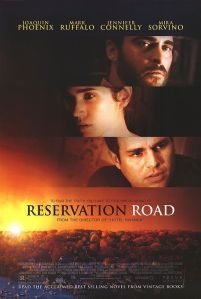 What happened here? Director Terry George was coming off of 2004’s stirring Hotel Rwanda, he had A-list talent like Mark Ruffalo, Joaquin Phoenix, Jennifer Connelly and the results end up feeling like a parody of awards-hungry prestige films steeped in grief and set in suburbia. To be fair, the acting is mostly respectable even if the characters start yelling a majority of their lines. The film moves at an absurdly swift pace that doesn’t allow much time for the actors to react reflectively about grief and guilt. The movie is kept afloat by some contrived coincidences, like Ruffalo’s lawyer being hired by Phoenix to find the culprit responsible for the hit and run that killed his son (surprise, it was Ruffalo behind the wheel!). Reservation Road doesn’t dwell too long on the plot setups it crafts and stumbles into a sudden and convenient epiphany by Phoenix. The conclusion is neither satisfying nor emotionally grueling, and the movie just kind of ends abruptly with little resolved, crushed under the weight of failed pretensions. This movie wants to dig deep and say Big Things about the human condition but it’s hard to do when you’re as emotionally inert and dramatically flaccid as Reservation Road. Seriously, what happened here?
Nate’s Grade: C
Share this:

The Door in the Floor (2004)
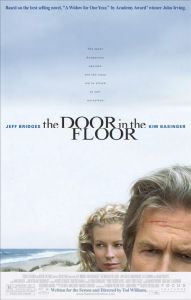 John Irving is one of the most accomplished and popular fiction writers of our times. His pulpy, unconventional, and compassionate novels have translated into many films with varying degrees of quality (World According to Garp, good; Cider House Rules, okay; Simon Birch, dreadful). The Door in the Floor is an adaptation of his novel, A Widow for One Year, but it only adapts the first third of the novel. This time around will the absence of quantity directly shape the quality of an Irving adaptation?
The plot for The Door in the Floor almost sounds like something you’d see late at night on Cinemax. Eddie (Jon Foster) is a teenager learning what it takes to be a writer. He becomes an assistant to Ted Cole (Jeff Bridges), a giant in the world of childrens literature but a playboy at home. Eddie spends the summer at Ted’s quaint cottage and is instantly smitten with Ted’s estranged wife, Marion (Kim Basinger). Theirs has been a loveless marriage ever since a tragic accident killed their two sons. Both are handling the grief in their own ways. Ted has become bitter and takes his anger out on his manipulation of other women, notably a neighbor (Mimi Rogers) who poses nude for his paintings. Marion has become insular and turns into a stone whenever the accident is mentioned.
 Eddie tires of his glorified chauffeuring duties for Ted and his mistress. He spends his lonely days fantasizing about Marion, including masturbating to the image of her clothes. When Marion accidentally stumbles into this embarrassing situation, she not only calmly apologizes but lays out additional pairs of clothing for Eddie to get his kink. This opens the door for Eddie to engage his fantasy, and embark on a deflowering tryst with Marion. Ted’s reaction isn’t one of anger or resentment but more of a job well done. It is around this time when we realize that Eddie looks remarkably like her two lost sons.
The film’s best moments are not the colorless, tepid tryst between Eddie and Marion, or the broader comic moments with Teds assault on tact; oh no, the best moments are when anyone onscreen shares time with Ruth (Elle Fanning), Ted and Marion’s precocious 4-year-old daughter. She’s a tad demanding, like insisting to know where every picture of her family remains, but comes across as adorable without stepping over into cloying. Her interaction with Bridges is wonderful, her wide-eyed questioning is sweet, and her acting is much more authentic than her sister, the more seasoned Dakota Fanning (Man on Fire). Hopefully the Fanning family has learned some dos and donts from the Culkin family.
Bridges performance is amazing. He bares more than just his backside in this film. The role of Ted is very meaty, and Bridges is the perfect actor to sink his teeth right into it. Bridges is alarmingly coy, blending a disarmingly comic roly-poly ability, as well as a brooding, stinging anger barely masked by ego and affability. I cannot imagine anyone else stepping into Ted’s shoes and delivering a better performance. Bridges’ tortured and droll work may be Oscar material.
 Basinger’s performance is equally amazing. Amazingly bad, that is. Her character is supposed to be shattered by the loss of her sons, but Basinger plays the role so heavily intoxicated by grief that Marion becomes nothing more than a walking ghost. She’s so zombie-like for the entire film, that her performance could be rivaled by a coma patient. For some reason unbeknownst to me, ever since winning a Best Supporting Actress Oscar in 1997, Basinger has yet to follow with a really good performance.
The Door in the Floor is Jon Foster’s real big break as a young actor. His previous roles amount to little, including Kevin Costner’s son in 13 Days and the vitally integral Gas Station Cashier in Terminator 3. Some awkwardness is apparent in his rise to larger material, but Fosters apprehension serves his character best, like a dinner scene between him and Marion where he tells a bad joke to break the ice. Foster’s performance is a bit bland, but that’s because his character is more of a transparent adolescent fantasy.
Poor Mimi Rogers, a.k.a. Mrs. Tom Cruise Number One. She’s a capable actress, and a fine-looking woman, but she’s been given such a small one-note character that it seems almost exploitative that such a well-known actress spends the majority of her time with her robe around her ankles. A late scene involving her violent hysteria at being dumped by Ted and it is meant to be comic but it seems more like a fizzy tantrum. All this and she gets the dubious notoriety of having a drawing of the most sensitive part of her anatomy projected in glorious widescreen.
By now an audience is more or less used to Irvings mix of slapstick and grief, of pathos and situational humor. The Door in the Floor follows this tried-and-true recipe and provides a healthy amount of entertainment for an audience. It can effectively make an audience laugh and supply knots in their throat at separate turns; however, in the harsh light of day, if you strip away at The Door in the Floor you’ll find that most every character is self-involved, curt, closed off, and just plain unlikable. Ted is a jerk. Marion is a zombie, and not so great a mother. Eddie is bland. The only real character worthy of empathy is Ruth.
 Now, movies dont necessarily all have to have likable characters, and in fact some of the most interesting and memorable characters are unlikable, but for a family melodrama its important to feel for their grief instead of feeling their grief. If you cant feel for the characters then youre just watching without any baited interest. Many films can make you feel bad by watching someone on hard times, but it’s a true accomplishment if you feel the character’s personal pains (and somehow the films of Lars von Trier accomplish both). Theres little investment beyond the surface level of amusement. So, The Door in the Floor is amusing,but it struggles to be anything beyond because of the limitations of its characters. For some, a movie that provides surface-level amusement from polished actors is good enough, and in some instances Id agree.
Director Tod Williams (The Adventures of Sebastian Cole) also served as the adapter of Irvings dense work. Williams knows a thing or two about family melodrama and the denial of guilt, and he keeps the pacing brisk and the laughs at an even pace. Williams’ best decisions are on the small visual notes he hangs on, like a stunning, visually alluring final image. The story is a bit uneven in tone, thanks to Irving’s eccentric source, but Williams saves his narrative whammy for the very end, and Bridges brilliantly delivers the backstory we’ve been holding our breath for.
The Door in the Floor is a solid, if surface-level enterprise in the exploration of guilt and mourning in a family setting. Bridges gives an amazing and memorable performance that helps make you forget about the rest of the films somewhat lackluster acting. Fans of Irving’s works will likely be taken back in pleasure, and fans of adult melodrama will not likely walk out disappointed. The Door in the Floor has glimpses of something more but settles for being a well-acted, nondescript affair.
Nate’s Grade: B-


 nathanzoebl
You must be logged in to post a comment.