Blog Archives
Eternal Sunshine of the Spotless Mind (2004) [Review Re-View]

Originally released March 19, 2004:
No other movie this year captured the possibility of film like Michel Gondry and Charlie Kaufman’s enigmatic collaboration. Eternal Sunshine was a mind-bending philosophical excursion that also ended up being one of the most nakedly realistic romances of all time. Joel (Jim Carrey restrained) embarks on having his memories erased involving the painful breakup of Clementine (Kate Winslet, wonderful), an impulsive woman whose vibrant hair changes as much as her moods. As Joel revisits his memories, they fade and die. He starts to fall in love with her all over again and tries to have the process stop. This labyrinth of a movie gets so many details right, from the weird physics of dreams to the small, tender moments of love and relationships. I see something new and marvelous every time I watch Eternal Sunshine, and the fact that it’s caught on with audiences (it was nominated for Favorite Movie by the People’s friggin’ Choice Awards) reaffirms its insights into memory and love. I never would have thought we’d get the perfect romance for the new millennium from Kaufman. This is a beautiful, dizzingly complex, elegant romance caked in visual grandeur, and it will be just as special in 5 years as it will be in 50, that is if monkeys don’t evolve and take over by then (it will happen).
Nate’s Grade: A
——————————————————
WRITER REFLECTIONS 20 YEARS LATER

“How happy is the blameless vestal’s lot!
The world forgetting, by the world forgot:
Eternal sunshine of the spotless mind!
Each prayer accepted, and each wish resigned;”
-Alexander Pope, Eloisa to Abelard (1717)
“Go ahead and break my heart, that’s fine
So unkind
Eternal sunshine of the spotless mind
Oh, love is blind
Why am I missin’ you tonight?
Was it all a lie?”
-Kelly Clarkson, Mine (2023)
This one was always going to be special. Eternal Sunshine of the Spotless Mind is not just one of my favorite movies, it’s one of those movies that occupies the place of Important Formative Art. It’s a movie that connected with me but it’s also one that profoundly affected me and changed me, that inspired me in my own creative ventures. With its elevated place in my memory, I’ll also admit that there was some mild trepidation about returning to it and having it not measure up to the impact it had all those twenty years ago. It’s impossible to recreate that first experience or to chase after it, but you hope that the art we consider great still has resonance over time. This happened before when I revisited 2000’s Requiem for a Dream, a movie that gobsmacked me in my youth, had such innate power and fascination, and had lessened over the decades. It was still good art but it wasn’t quite the same, and there’s a little tinge of disappointment that lingers.

When I saw the movie for the first time it was at a promotional screening. I was a senior in college and had dyed my hair bright red for the second time. After marveling over my first encounter with 1999’s Run Lola Run, I was determined to have hair like the titular Lola. My parents were hesitant and set parameters, like certain grade achievements, and I met them all. Afterwards they had nothing left to quibble so I dyed my hair red, as well as other colors, my sophomore year and then again my senior year. At the screening, a publicist for the studio asked if I wanted to compete for a prize. I demurred but then she came back and asked again, and sensing something to my advantage, I accepted. It turns out the pre-show contest was a Clementine (Kate Winslet) look alike contest and my only competition was a teen girl with one light swath of blue hair. The audience voted and I won in a landslide and was given a gift basket of official Eternal Sunshine merchandise that included the CD soundtrack and a bright orange hooded sweatshirt modeled after the one Clem wears in the movie. That sweatshirt quickly became one of my favorite items of clothing, something special that nobody else had from a movie I adored. I wore it everywhere and it became a comfort and a confidence builder. Back during my initial courtship with my wife, in the winter months of 2020, she held onto the orange hoodie as a memento to wear and think of me during our time apart. She said it even smelled like me, which was a comfort. It had meaning for us, and we cherished it. I had to marry her, of course, to ensure I’d eventually get the sweatshirt back in my possession (I kid).
The lessons of Eternal Sunshine run deep for me. On the surface it’s a breakup movie about an impulsive woman, Clem, deciding to erase her memories of her now ex-boyfriend Joel (Jim Carrey). Out of spite, he elects to have the same procedure, and from there we jump in and out of Joel’s head as a subconscious avatar experiences their relationship but in reverse. It’s the bad memories, the hurt and ache of a relationship nearing or past its end, but as each memory degrades and Joel goes further into the past, he discovers that there are actually plenty of enjoyable memories through those good times, the elation and discovery, the connections and development of love, that he doesn’t want to lose. He tries to fight against the procedure but it becomes a losing battle, and so he gets to ride shotgun in his cerebellum as this woman vanishes from his life. What began out of spite and heartache ends in mourning and self-reflection.
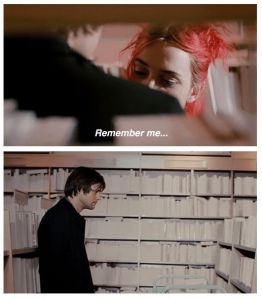
At its heart, the movie is asking us to reflect upon the importance of our personal experiences and how they shape us into the people that we are. This includes the ones that cause us pain and regret. The human experience is not one wholly given to happiness, unfortunately, but there are lessons to be had in the scars and pain of our individual pasts. I’m not saying that every point of discomfort or pain is worthwhile, as there are many victims who would say otherwise, but we are the sum total of our experiences, good and bad. With enough distance, wisdom can be gained, and perhaps those events that felt so raw and unending and terrible eventually put us on the path of becoming the person you are today. Now, of course, maybe you don’t like the person you are now, but that doesn’t mean you’re also a prisoner to your past and doomed to dwell in misery.
After my divorce from my previous wife in 2012, I wrote a sci-fi screenplay following some of the same themes from Eternal Sunshine. It was about two dueling time travelers trying to outsmart one another, one hired to ensure a romantic couple never got together and one hired to make sure that they had. The characters represented different viewpoints, one arguing that people are the total of their experiences and the other arguing people should be capable of choosing what experiences they want ultimately as formative. Naturally, through twists and turns, the one time traveler learns a lesson about “living in the now,” to stop literally living in the past and trying to correct other people’s perceived mistakes, and that our experiences, and our heartache, can be valuable in putting us into position to being the people we want or living the lives we seek. It shouldn’t be too hard to see that I was working through my own feelings with this creative venture. It got some attention within the industry and I dearly hope one day it can be made into a real movie. It’s one of my favorite stories I’ve ever written and I’m quite proud of it. It wouldn’t exist without Eternal Sunshine making its mark on me all those years ago.
It’s an amazing collaboration between director Michel Gondry and the brilliant mind of Charlie Kaufman. The whimsical, hardscrabble DIY-style of Gondry’s visuals masterfully keeps the viewer on our toes, as Joel’s memories begin vanishing and collapsing upon one another in visually inventive and memorable ways. There’s moments like Joel, after finding Clem once she’s erased her memory of him, and he storms off while row after row of lights shuts off, dooming this memory to the inky void. There’s one moment where he’s walking through a street and with every camera pan more details from the store exteriors vanish. A similar moment occurs through a store aisle where all the paperbacks become blank covers. It’s a consistent visual inventiveness to communicate the fraying memories and mind of Joel, which becomes its own playground that allows us to better understand him. The score by Jon Brion (Magnolia) is also a significant addition, constantly finding unique and chirpy sounds to provide a sense of earned melancholy. By experiencing their relationship backwards, it allows us to have a sense of discovery about the relationship. This is also aided by Kaufman’s sleight-of-hand structure, with the opening sequence misleadingly the beginning of their relationship when it’s actually their second first time meeting one another. The pointed details of relationships, both on the rise and decline, feel so achingly authentic, and the characters have more depth than they might appear on the surface. Joel is far more than a hopeless romantic. Clem is far more than some Manic Pixie Dream Girl, a term coined for 2005’s Elizabethtown. She tells Joel that she’s not some concept, she’s not here to complete his life and add excitement; she’s just a messed up girl looking for her own peace of mind and she doesn’t promise to be the answer for any wounded romantic soul.

The very end is such a unique combination of feelings. After Mary (Kirsten Dunst) discovers that she’s previously had her memories of an affair with her boss erased, she takes it upon herself to mail every client their files so that they too know the truth. Joel and Clem must suffer listening to their recorded interviews where they are viciously attacking one another, like Clem declaring Joel to be insufferably boring who puts her on edge, and Joel accuses her of using sex to get people to like her. Both are hurt by the accusations, both shake them off as being inaccurate, and yet it really is them saying these things, recorded proof about the ruination of their relationship. Would getting together be doomed to eventually repeat these same complaints? Clem walks off and Joel chases after her and tells her not to go. Teary-eyed, she warns that she’ll grow bored of him and resentful because that’s what she does, and she’ll become insufferable to him. And then Joel says, “Okay,” an acceptance that perhaps they may repeat their previous doomed path, maybe it’s inevitable, but maybe it also isn’t, and it’s worth it to try all the same. Maybe we’re not destined to repeat our same mistakes. Then it ends on a shot of our couple frolicing in the snow, the descending white beginning to blot out the screen, serving as a blank slate. It’s simultaneously a hopeful and pessimistic ending, a beautifully nuanced conclusion to a movie exploring the human condition.
Winslet received an Oscar nomination for her sprightly performance, and deservedly so, but it’s Carrey that really surprises. He had already begun to stretch his dramatic acting muscles before in the 1998 masterpiece The Truman Show and the far-from-masterpiece 2001 film The Majestic. He’s so restrained in this movie, perfectly capturing the awkwardness and passive aggressive irritability of the character, a man who views his life as too ordinary to be worth sharing. Clem begs him to share himself since she’s an open book but he’s more mercurial. She wants to get to know him better but to Joel there’s a question of whether or not he has anything worthwhile getting to know. Carrey sheds all his natural charisma to really bring this character to life. It’s one of his best performances because he’s truly devoted to playing a character, not aggressively obnoxious Method devotion like in 1999’s Man on the Moon.
Eternal Sunshine of the Spotless Mind is a messy, enlightening, profound, playful, poignant, and mesmerizing movie. A perfect collaboration between artists with unique creative perspectives. I see something new every time I watch it, and it’s already changed my life in different ways. I used to see myself as Joel when I was younger, but then I grew to see him as self-pitying and someone who too often sets himself up for failure by being too guarded and insular. It’s a reminder that our cherished relationships remain that way by allowing ourselves to be vulnerable and open. We are all capable and deserving of love.
Re-View Grade: A
Share this:

Celeste and Jesse Forever (2012)
 Celeste (Rashida Jones) and Jesse (Andy Sandberg) have been best friends ever since high school, the couple everyone admired. They’ve been married for six years but now they are in the middle of divorce proceedings. Why? Celeste loves her longtime best friend but worries he’s not maturing or stable to be her marriage partner. During their separation, Jesse admits he’s found another woman whom he cares about. Celeste professes to be happy but deep down is troubled, second-guessing her decision now that there’s a real threat she might lose Jesse. The two buds act like nothing has changed, goofing around and paling it up, but how long can they keep up this façade? Eventually, someone is going to get hurt because divorce cannot be shrugged off. Reality has a way of outliving ironic detachment.
Can you remain best friends with someone you once loved? How about someone you once knew as your spouse? Celeste and Jesse are certainly trying but their idealistic “BFF” status seems destined to meet a harsh reality. Celeste and Jesse Forever is labeled as a “loved story” and I think that’s a pretty apt description. These two characters clearly have a deep affection for one another, but after six years the feelings just aren’t enough. What happens when you marry your best friend but that just isn’t enough? I was hoping for some greater answers from the movie, or at least a harder examination on why some relationships fall apart when things look like they should work. That’s not exactly what the movie offers. For a film with an aim to be more realistic about the fallings out of love, the movie follows a familiar formula. There’s the cute guy at yoga (Chris Messina) into Celeste, but first she has to get settled. I think I wouldn’t have minded this character if he didn’t feel so much like a plot device, a hasty happy ending meant to be put in a holding pattern until called upon. The “Jesse” half of the title will be gone for lengthy chunks of the movie. His portrayal also borders on simplistic. I wish we got more of his side of the relationship, especially since he’s going through sudden change himself. After seeing the trailer, I thought I was going to find the movie immensely relatable. Maybe I just got all the recognizable personal drama out of my system with The Five-Year Engagement (double feature for bitter lovers?).
 Fortunately, the movie is also fairly funny. The comedy can feel a tad sitcomish at times with misunderstandings and catching people in embarrassing situations. The screenplay by Jones and co-star Will McCormack (TV’s In Plain Sight) is routinely amusing, settling with soft chuckles rather than anything histrionic. It fits the subdued tone of the movie, since it’s about people coming to terms with messy emotions and not whacky mishaps. Then there’s a whole subplot involving a teen pop star (Emma Roberts) that feels recycled from a whole other movie. This storyline leads to a few good jokes but it doesn’t seem to add anything of value to the plot. The comedy doesn’t overpower the dramatics, and Celeste and Jesse Forever finds a nice tonal balance between the heartache and humor. I wouldn’t say the film is necessarily quirky but it certainly operates to an offbeat comedic rhythm. There are a few cringe-worthy editions but the characters and the actors make it worth any personal discomfort.
If Jones (TV’s Parks and Recreation) needs a good boyfriend I will gladly volunteer my services. My God this woman is beautiful. I don’t want to set off any alarm bells, but this woman is a goddess. She’s also extremely talented and a naturally charming presence. Her chemistry with Sandberg (That’s My Boy) is out of this world. They are so relaxed together, so amiable, so enjoyable, that it really does come as a shock when their unamused friends have to sternly remind them they are getting a divorce. They have a wealth of in-jokes and secret couple codes, and they’re so cute together that you wonder if maybe, just maybe, they’ll reconcile by the end. Sanberg is better than I’ve ever seen him, giving a strong, heartfelt performance as a nice guy trying to make sense of his eroding situation. But this movie is Jones’ movie, and she shines. While her facial expressions can get a little overly animated at times (TV-ish mannerisms?), this movie is a terrific showcase for her dramatic and comedic talents. This woman will excite you, frustrate you, break your heart, make you laugh, but you’ll be glued to the screen.
 The tricky part is that Celeste is both our protagonist and antagonist. She is the root of her own unhappiness, and coming to terms with the fact that she was wrong is a big moment of personal growth, however, it’s not exactly the direction audiences may be happy with. It’s harder to root for a character that is sabotaging her own progress. Jessie, especially as played by Sandberg, is pretty much an adorable puppy dog throughout the whole movie; it’s hard to stay upset with him, and occasionally Celeste will lead him on and then punish him for following. She tells him to move on but then pulls him back to her when he threatens to do just that. She chastises him for not being serious enough, for not having direction, yet you get the impression throughout the movie that Celeste bares some responsibility in this situation as well. Jesse is laid back, though hardly the arrested development slackers dotting most of modern comedy these days. As one character notes, perhaps Celeste enjoyed keeping her husband grounded, limited, stuck. I don’t chalk it up as malice, more a comfortable situation that Celeste is afraid to disrupt. She’s the overachiever, he’s the underachiever, they compliment one another, that is, until Celeste decides they don’t. Then when it looks like Jesse’s growing up, she wants him back, or thinks she does, at least this newer version of Jesse. As you can see, it’s complicated. At no point would I dismiss Celeste as a callous person, but the movie is tethered to her personal growth of being able to admit fault. Her window with Jesse has passed. The movie is about her journey to realizing that.
Celeste and Jesse Forever feels like a movie of small waves. It doesn’t have the Big Declarative Moments of most rom-coms or indie romances, and that’s because it’s not a romance as much as an autopsy on why a romance went down for the count. It’s melancholy without getting mopey. It has certain hipster tendencies but nothing that rises to an insufferable level of twee; it’s routinely adorable and rather heartfelt in places, though I wish it had offered more potent insight into its characters. This isn’t going to be a movie that people build up great emotion for. By nature it’s pretty low-key, choosing to handle its emotional pyrotechnics with delicacy and the occasional comedic set piece. For a comedy about divorc,e this si surprisingly sensitive. These are nice people, good humored, and you sort of wish the movie would just scrap any indie ambitions and substitute a happy ending. You want to shout at the screen, “Just reconcile already!” Maybe that was me just using the movies as good old therapy again (see: The Five-Year Engagement review, or don’t). Celeste and Jesse Forever is an agreeable, affable, bemusing movie, with enough laughs and emotion to justify giving it a chance.
Nate’s Grade: B
Share this:

9 (2009)
 9 began its life with acclaim. Director Shane Acker won a Student Academy Award and a 2004 Oscar nomination for Best Animated Short for his eleven-minute tale of post-apocalyptic ragdoll people. Blown up to feature length and with a screenplay by Pamela Pettler (Corpse Bride), 9 the film is being sold on the name appeal of producers Tim Burton and Timur Bekmambetov (director of Wanted). It’s being sold to gloomy animation aficionados. I can hear the producers saying, “These guys will see anything that?s dark and different.” I advise everyone to surf YouTube and watch the eleven-minute original short by Acker. You’ll save eight bucks and see the more effective and satisfying version of 9. If you wanted to boil 9 down, it’s like The Brave Little Toaster starring the villainous robots from The Matrix. Sound like a winner?
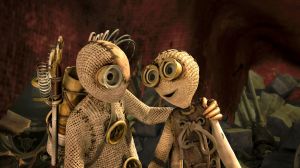
War machines have killed humans. The only life on our planet is a handful of numbered ragdoll creatures. The main hero, #9 (voiced by Elijah Wood), awakes in the home of a dead scientist. The outside world is demolished. He finds other little ragdoll people like him, each numbered 1-8. Together they must try and make sense of this scary new world and survive the roaming robots still on the hunt for… something. #9 accidentally gives life back to the monstrous Machine, who we learn is responsible for the downfall of mankind. Way to go, ragdoll. The Machine is patching together mechanical minions to take over the ashen remains of a post-apocalyptic world absent life. Seriously, I’m at a loss what the big evil Machine hopes to accomplish. Then again, maybe it’s just in need of a hobby.
 Even at a scant 79 minutes, 9 the movie still feels stretched and draggy, chiefly because the plot is lousy and the character work stopped at the design stage. I was bored throughout, I didn’t care about any character, and the movie failed to even arouse my curiosity to solve the mysteries of the movie. I didn’t even care if I found out why these ragdoll creatures existed or what had happened to leave the world in chaos. I sat in my chair, completely uninvolved with what was happening onscreen. Part of this is because a majority of the plot involves these tiny characters walking from one point (a church) to another (a factory) over and over again; the plot could be substituted by a linear line connecting Point A and Point B. It’s all so crushingly repetitious. And these are not short distances either, compounded by the fact that it’s little eight-inch ragdolls walking these great expanses of land. I invite every reader to position two fingers on their hand, index and middle, and then proceed to pretend to walk across. That, ladies and gentlemen, is the miniature plot of 9 magnified for your edification. Just imagine weird robots chasing after your fingers and you get the drill. There’s not enough story here to make the jump and fill out a feature film.
The characters have an interesting design, to be sure. Each has different sewn parts but Acker makes the mistake of animation where the design is the full personality of the character. #8 is a big dolt, #1 is an old tyrant, #6 is a loon (voiced by Crispin Glover, naturally), #7 is a lady rag doll warrior complete with some purposeful enhanced womanly hips, and so on. The bland characters don?t ever take a moment to ask more important questions. These creatures have just been given life in a hostile world absent of life, so how about a moment where they ponder something a bit existential (Why am I here? What is life?) before they immediately speak English fluently and assimilate perfectly in a world they were born into moments earlier? The characters are a challenge to feel any empathy for.
The mechanical monsters designs also come across as highly derivative; then again, so does the movie as a whole. The main villain, The Machine, looks exactly like the Sentinels from the Matrix movies. It has a central red glowing eye, a head lined with pistons, lots of twisty tentacles, and even creates shockwaves of electricity that seem to bathe over the mighty creature. I think it even makes a similar noise as the Sentinels. Then there’s also one mechanical minion whose key design feature is a mutilated doll head. Too bad I already saw this exact same design in Toy Story 14 years ago. Here’s the thing: I don’t automatically cry foul whenever a design concept looks familiar, but when things just keep hitting you in the face with familiarity then it develops into a pattern. The overall film feels stitched together by the parts of other, better movies.
 At least there’s a saving grace with bad animated films: you have something moderately interesting to watch considering the painstaking work that goes into every frame. That is not the case with the dreary 9. The entire landscape is post-apocalyptic, which means the sets are little more than ash, ruins, and barren remains. There are only so many scattered mechanical remains you can see before it all just starts resembling one vast junkyard. The setting is not 21st century, but more like mid twentieth in some unidentified Eastern European city (a film reel reveals that we’re in communist territory). I’m not saying that it’s impossible to find beauty in destruction, but this movie misses out. Acker and company has created a competently animated movie with a somewhat different look and feel, but there isn’t a single moment of wonder or awe to be had. It lacks an imaginative spark.
This animated tale lacks a sense of wonder, a sense of intrigue, even a sense of scale. The visuals and story are derivative of other sci-fi/fantasy films. In the original short, the characters were silent, causing the viewer to work harder at interpreting body language and context. If the ragdolls are just going to spout lame exposition gunk, they should have stayed silent. Director Rob Marshall’s upcoming big screen musical, Nine, need not worry about being confused with this film. In about two weeks, everyone except those with Hot Topic punch cards will have forgotten this mediocre movie. People who say, “It’s only an animated movie, give it a break,” are deluding themselves. No matter the genre, an audience should expect to be entertained. 9 just makes me hopeful that in the future Acker proves why he was targeted as a talent on the rise.
Nate’s Grade: C
Share this:

Sin City (2005)
 Like film noir on steroids. Director Robert Rodriguez has made the most faithful comics adaptation ever; giving life to Frank Miller’s striking black and white art. The visuals are sumptuous but the storytelling is just as involving, a perfect mix of noir/detective elements and subversive, highly memorable characters. Sin City may be the most violent studio film … ever, but the over-the-top tone keeps the proceedings from becoming too nauseating, even after limbs are lost, heads roll (and talk), and dogs pick away at living bodies. This is a very ball-unfriendly movie; lots of castrations. The blood even looks like fluorescent bird crap. The stories become somewhat repetitious (anti-hero saves distressed woman), but Miller and Rodriguez keep their tales tight, pulpy, comic, and unpredictable. My friend turned to me after it was done and said, “That was a great movie.” I could not argue.
Nate’s Grade: B+
Share this:

Eternal Sunshine of the Spotless Mind (2004)
No other movie this year captured the possibility of film like Michel Gondry and Charlie Kaufman’s enigmatic collaboration. Eternal Sunshine was a mind-bending philosophical excursion that also ended up being one of the most nakedly realistic romances of all time. Joel (Jim Carrey restrained) embarks on having his memories erased involving the painful breakup of Clemintine (Kate Winslet, wonderful), an impulsive woman whose vibrant hair changes as much as her moods. As Joel revisits his memories, they fade and die. He starts to fall in love with her all over again and tries to have the process stop. This labyrinth of a movie gets so many details right, from the weird physics of dreams to the small, tender moments of love and relationships. I see something new and marvelous every time I watch Eternal Sunshine, and the fact that it’s caught on with audiences (it was nominated for Favorite Movie by the People’s friggin’ Choice Awards) reaffirms its insights into memory and love. I never would have thought we’d get the perfect romance for the new millennium from Kaufman. This is a beautiful, dizzingly complex, elegant romance caked in visual grandeur, and it will be just as special in 5 years as it will be in 50, that is if monkeys don’t evolve and take over by then (it will happen).
Nate’s Grade: A
Share this:

Lord of the Rings: Return of the King (2003)
 To all those hairy-footed Tolkien geeks that chewed me out for having the audacity to call 2002’s Two Towers, of all things, boring, let me say this: while I still find the second entry of The Lord of the Rings to be disappointing and pretty flawed, the final chapter, Return of the King, is a glorious and satisfying conclusion. Instead of doing a usual review (plot synopsis, strengths/weaknesses, etc.), I’m going to bring back the charges I had against Two Towers and explain why Return of the King does not suffer from these ills. Will the defendant please rise as I read aloud the charges.
Charge Number One: Two Towers has nothing going on for its majority except hyping an oncoming battle.
And I still feel this way. Short of the great Helms Deep battle, there was oh so little going on in Two Towers that they could have easily trimmed an hour away from it. And don’t give me this crap about the whole kingdom of man subplot or Aragorn (Viggo Mortensen) realizing his eventual responsibilities. Whatever. Now, in Return of the King, there is so much going on and the pacing is so tight, that despite being the longest film by far (3 hours and 20 minutes), this is the FIRST Lord of the Rings films that has not put me to sleep in the theaters. The nearly hour-long battle involving the 200,000 Orc army with its huge elephant creatures is mesmerizing and visually stunning. But even after the battle and before, unlike Two Towers, there is plenty going on that actually matters, not just three characters running around endlessly.
 Charge Number Two: Despite nothing going on except waiting for a battle, Two Towers has little characterization of any of its characters.
So even though little is going on, Two Towers still doesn’t use all this free space to deepen characters. But in Return of the King, the characters come through and shine. The hobbits are back to the front burner and the film is better for it. Sam (Sean Astin, in the finest performance of the film) and Frodos journey becomes increasingly important and the strain and deception of Gollum puts a wedge between their friendship. When Frodo (Elijah Wood) looks scornfully at Sam and dismisses him from their journey, it’s heartbreaking. Why? Because after two years we as an audience have come attached to these characters and do feel for their struggle. When Sam, toward the climax, says, “I may not be able to carry the ring, Mr. Frodo, but I can carry you!” I dare anyone to try not choking up. We also get deeper moments of character with peripheral characters, like Faramir realizing he can only satisfy his father by a suicidal mission. Even the smaller characters from the second film, like Eowyn (Miranda Otto) and her kingly father Theoden (Bernard Hill), have wonderful moments where the emphasis is on characterization. Return of the King is filled with rich character moments that remind us how much we enjoy and feel for these people … uh, and hobbits.
Charge Number Three: Most of the characters from Fellowship of the Ring have scant appearances in Two Towers.
This still holds true. Gandalf (Ian McKellen, brilliant) returned from the dead but had about three minutes of screen time. The elves (Liv Tyler, Hugo Weaving, Cate Blanchett) were given the amount of screen time most people would consider cameos. And then the hobbits were left alone for the overlong subplot involving Theoden and his clan. What Two Towers really was was the dwarf, elf, and Aragorn movie. And I like each of those characters but this story is not theirs its the hobbits. So the disproportionate amount of time spent with Gimli (John Rhys-Davies), Legolas (Orlando Bloom) and Aragorn felt like what would happen if, in Star Wars, C-3PO and R2D2 had their own film. It wasn’t as interesting and it wasn’t right. But with Return of the King, the attention is back to the hobbits, and all of the characters in the entire film have at least one stirring moment of quality time. Gandalf is back in a big way and its welcomed. What else is welcomed is the increasing attention Merry (Dominic Monaghan) and Pippin (Billy Boyd) have. They started as merrymakers, but by this trilogys end they are desperate to join the ranks and fight. The shared moments between Merry and Eowyn in battle are great. The moments between Pippin and Gandalf are even better. And even though the elves still get the short end of the stick, they make lengthier appearances that are more satisfying. It appears, though, that Cate Blanchett’s longest amount of time in this whole trilogy was narrating the opening prologue.
 Charge Number Four: Excessive dwarf jokes.
Even if you disagree with me on the previous three charges, you must agree with me that Two Towers had about a million dwarf jokes too many. Return of the King, to my knowledge, doesn’t even have ONE dwarf joke. Fabulous. This is not to say I want less Gimli. The subplot involving the Two Towers trio seeking an army of the dead (a tad deus ex machine) is intriguing, and his competitive banter with Legolas is still ripe (Bah! That still counts as one!).
Return of the King is an amazing experience and one that is a fully satisfying conclusion, unlike say, I don’t know, maybe the last two Matrix films. The danger feels more abundant now that the end is near and the tension mounts. The payoffs are rewarding and the climax is fittingly climactic. However, the 20-minute resolution is a bit drawn out. It seems director Peter Jackson can give us three hours of fast-paced action but cant speed through a medley of hugs. You think its over…. and then theres more, then you think its over…. then there’s more. This is a small quibble for such an epic trilogy, and Return of the King proves that it’s really one large triumphant film, with a bit of a sag in the middle. What? Did you think I’d get through all this Lord of the Rings love-fest and not take one last jab at Two Towers? Though I still prefer Fellowship of the Ring out of the three, Return of the King cements the trilogys cinematic greatness in our time. Oh yeah, and the cinematography, special effects, production design, makeup, and score are magnificent too.
The defendant is cleared of all charges.
Nate’s Grade: A
Share this:

Lord of the Rings: The Two Towers (2002)
 My countrymen and fellow Americans, I come here not to praise Lord of the Rings: The Two Towers but to bury it. I don’t know if it’s a result of being the bridge between the beginning and end of this saga (taking the role of neglected middle child), or a result of unmet sky-high expectations, but I may be alone here in saying that Two Towers was a letdown. I’ll try and frame my reasoning as to not be attacked by hairy hobbits and men with pointy hats and long flowing beards.
1) Story structure. Unlike Fellowship of the Ring, where were introduced to a rich world and have suitable character set-up, the second LOTR film puts almost all our characters on the backburner and gives us an insufferably long subplot involving a king and his brood. The movie peters out an ending and seems to throw its hands in the air saying, “See ya a year from now.”
2) Length. This wasn’t a problem with the previous film but man did Two Towers become unbearable as it went. Some described the first film as three hours of walking; well the second could be described as two plus hours of folks hyping a battle and then — a battle. Seriously, theres a lot of talk about a significant battle and that’s it. An hour could have easily been cut from this. It got to the point where my then-girlfriend was sprawled across my lap pleading for me to somehow make the movie end.
3) Characterization. So much time is spent doing nothing you think the film would further round the characters? Oh how stupid you would be. Nothing new seems to be drawn from any character, with the exception of the treacherous yet likable Gollum. Several people from Fellowship (Liv Tyler, Cate Blanchett, Hugo Weaving, Ian McKellen) have screen time that amounts to no more than a cameo, so why in the world aren’t we getting anything more from our already established heroes? Everyone just looks friggin bored. As was I.
4) Excessive dwarf jokes.
I re-watched Fellowship and all of the reasons Two Towers suffered were not evident. So what does this tell me? Nothing particularly, except not to see the movie in the theater again. Two Towers is by no means a bad film. The cinematography, production and special effects are all breath-taking and sweeping. I’ll still look forward to seeing the next, and last, installment in Peter Jackson’s Rings epic, but Two Towers has left a bitter taste of disappointment to linger upon.
Nate’s Grade: B-


 nathanzoebl
You must be logged in to post a comment.