Blog Archives
Pain Hustlers (2023)
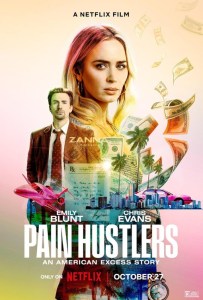
Pain Hustlers is the next attempt to dramatize the numerous stories behind the opioid crisis, a storytelling edict that is becoming its own tragic true-crime sub-genre (Dopesick, Pain Killer, Four Good Days, Recovery Boys, All the Beauty and the Bloodshed). The Netflix original has a starry cast and a topical and serious subject but it’s an un-serious movie caught up in the superficial quirks and appeal of being and making a goofy crime story of greedy sleazeballs.
Liza (Emily Blunt) is a struggling single mother trying to claw her way out of debt and, with her unfinished education and criminal record, few options are widely available. Then enters Pete Brenner (Chris Evans), a loud, gouache pharmaceutical rep for a powerful pain killer. He promises a lifestyle of luxury and power, as long as Liza is willing to ignore or bend a few ethics along the way. Together, they build a sales force of attractive women who wine and dine smaller doctors in order to get them to prescribe their special drug to anyone in need. It’s just that a drug intended for end-of-life pain wasn’t meant for common headaches. As sales boom, Liza begins to worry that her glitzy lifestyle is built upon a mountain of American corpses.
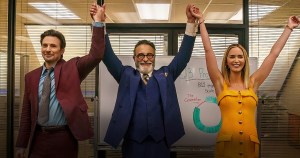
The biggest drawback of Pain Hustlers is that it fully focuses on the glitz and gives lip service to the cost of chasing that avarice. Plenty of movies illuminating bad people doing bad things are accused of glamorizing the misdeeds, from gangster movies to dark romances, though this narrow viewing often seems to conflate depiction with condoning the behavior (see: The Wolf of Wall Street). Watching stories about people stumbling their way into glamorous positions should provide some allure so as to better understand the seductive draw for the characters. The world of vice and power will be a compelling conflict, but for Pain Hustlers, it falters by just focusing on the high-powered lifestyle yet it still lacks specificity to make this story feel interesting on its own. You’ve seen variations of this kind of story before (we’ll call it Scorsese-esque) about the people struggling with less who get a ticket into a new world of access and freedom and then begin to worry At What Cost. Pain Hustlers goes through its plot beats with the most mechanical of movements. The personal details from this supposedly true story feel so generic, reminiscent of similar tales like, Love & Other Drugs and Hustlers. It feels less like an insider account of how these shady people exploited so many and more like the screenplay was cobbled together by what the filmmakers assumed this story must have pertained without reading much of the source novel by Evan Hughes. It’s absent the useful details that allow more of these accounts to prosper as we investigate moral relativism.
The other nagging shortcoming of Pain Hustlers is the consequences for all these bad people. I’m not saying that we need to see comeuppance and justice levied in order for the movie to work thematically; very often these white collar criminal types receive the faintest glance of judicial punishment. What this movie lacks is the emphasis on the consequences, and considering our main characters are pushing sleazy doctors to push highly addictive opioids, that’s a big miss. The movie is all about the climb for its heroine, the comparison of having the fancy life versus a life without. It shortchanges the extremely human cost of its bad actors in a way that does a disservice to the movie and its message. Because of its lack of specificity, this story could have been propelled by any prescription drug, from Viagra to Lipitor. The fact that we’re talking fentanyl, a drug responsible for 200 deaths every day last year according to the CDC, seems immaterial, and that is bizarre.
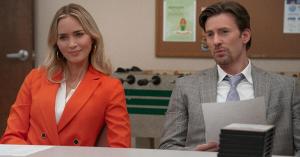
The effects of the opioid crisis begun by Purdue Pharma and the Sackler family, and then trickled down through the complicated tributaries of the American medical infrastructure, will be felt for generations. This is a major story. It would be like, say, telling the story of a struggling single mom who decides to take a career advancement in the Nazi Party in 1940s Germany. You’re not just doing a disservice to the people who really suffered, you’re doing a disservice to the audience to ignore the gravity of their moral culpability and excuse-making, of the drama of the character having to confront their part. For a movie about people profiting from opioid over-prescriptions, there is a grand total of one scene where Liza has to deal with the harsh real-world consequences of her actions (minor spoilers ahead, but I’d advise you to continue, dear reader). Early in the movie, when Liza was forced out of her home, she spent a few days living in a motel. The neighbor lady at the motel has a husband who dies from the opioid crisis, and this one man is meant to symbolize what she has wrought as a whole. It doesn’t work, and the fact that the movie presents Liza in tears trying to make amends to this widow, a character we haven’t had any thought over since Liza leaving her Act One beginnings, is a pitiful excuse for a reckoning.
Evans (The Grey Man) and Blunt (Oppenheimer) feel on autopilot here, namely because of the broad and bland characterization. Blunt resumes her Southern accent I recall from the Quiet Place movies, but her energy level feels too low, too disengaged, like she’s already at her quiet rectitude character phase when she should be at the gee-whiz giddiness of her moral slide. Evans is meant to be playing a cad prone to vulgar boasts and condescension for those he willfully steps over to reach his goals, but his “sleazeball” acting tics feel too forced, too played up, in all the ways that Blunt feels dialed down. There’s no baseline for the two of them, so the scenes they share together feel over and under-cooked, and with a generically developed rise-and-fall screenplay to boot. Andy Garcia (Father of the Bride) is the most interesting character as the head of the company, a doctor who began trying to ensure those in desperate need could have the dignity of mitigating their pain, and transforms into a megalomaniacal huckster who only wants to keep meeting the next sales projections. His rise-and-fall seems much more steep and intriguing than trying to give us Liza, a gutsy single mom (with a wacky mother of her own played by Catherine O’Hara) who we’re supposed to identify with and forgive for playing her part in a deadly chain that has wrecked untold lives across the country and world. She did it for her own kid’s medical treatment. So it’s all okay, right?

This is director David Yates’ first movie away from the familiar confines of the Harry Potter universe since the ill-fated 2016 Tarzan reboot, and only his second non-Potter movie since 2005. Given that history, I’m curious whenever this man jumps onto a non-Potter project because you would assume it has to be special in some manner. I’ll credit Yates with changing his visual preferences from the very drabby and gray palette of his Potter filmography.Pain Hustlers adopts a lot of the stylistic tics we expect in glitzy crime thrillers, from handheld camerawork to sun-bleached colors. There are other techniques to bring a documentary-like authenticity, but the constant cutting back to black-and-white interviews with the characters after the fact only serves as a narration crutch to keep things moving. The character narration lacks further insight from the distance or remorse of the onscreen events. The whole movie feels like a copy of a Scorsese imitator, something akin to 2009’s forgettable The Middle Men, a crime movie about a plunge into the underworld from a naif that doesn’t try too hard beyond empty reconfiguration of the superior style of its influences that I doubt anyone really remembers (you might as well add directorial narration, “Ever since I was young I always wanted to make a gangster movie…”). As immediate evidence to the case, there is a slow-motion house party in Pain Hustlers set to “Turn Down For What.”
Should you spend two hours watching Pain Hustlers? Not really, though if you have a fascination with the many schemers who contributed to making the opioid crisis as trenchant and terrible as it currently is, and likely will be for the near future, then maybe there’s some mild value to be had here. But even those people would be better served watching another Netflix series tackling the same subject matter, the 2023 limited series Pain Killer. For me, the Pain Hustlers story was too broad, and where it could have broken out with specificity is where it decided to wimp out and defer to genre cliches. It’s hard for me to argue that you should spend two hours watching this movie on the subject when you would be far better served, from an informative and entertainment standpoint, watching the two-part, four-hour 2021 documentary Crime of the Century by masterful filmmaker Alex Gibney. That film is damning and compelling and authentic in ways Pain Hustlers can only hope to imitate.
Nate’s Grade: C
Share this:

Cocaine Bear (2023)
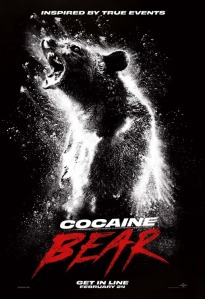 If you’re going to watch one movie with a cocaine-addled ursine killing-machine, it might as well be Cocaine Bear. In a lot of ways, this movie reminds me of Snakes on a Plane, a similarly deadly animal thriller sold on its bizarre concept and the promise of ironic entertainment, and both of the movies creatively peaked before anyone saw the movie. The true story is that in the 1980s, a drug-running plane dropped shipments of cocaine in Tennessee wilderness and a bear came across some cocaine, ate it, and died. The movie asks, “What if it became a coked-out slasher killer?” I wanted this movie to be more fun than it is, and I think the crux of my disappointment stems from the movie working one obvious joke into utter oblivion. The absurdity of a bear being high on drugs is about all you’ll get through 90 minutes. There are characters and subplots that you won’t care about, nor find terribly funny despite having Keri Russell, Alden Ehreneich, Brooklynn Prince, Kristofer Hivju, Isiah Whitlock Jr., Margo Martindale, and the final performance from the late Ray Liotta. It’s a lot of people, staring agog and saying, “A bear can’t do that,” and then we watch the bear do exactly that. There’s some impressive gore at turns and the CGI bear is workable for this kind of budget. The shame of it is too much just isn’t that funny. The movie is too content to rest upon its arch premise without adding enough additional comedy development to actively engage. If you’ve seen the trailer, you’ve seen the movie. This movie needed to be funnier, darker, weirder, or just anything in addition to the simple premise of a bear high on drugs and running a rampage. Is the joke ultimately on me for expecting more from a movie called Cocaine Bear?
Nate’s Grade: C
Share this:

Babylon (2022)
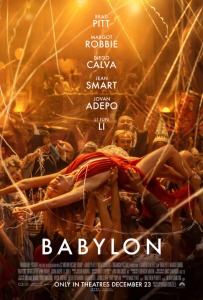 I completely understand how Babylon is such a divisive movie, and this seems entirely the point of writer/director Damien Chazelle (Whiplash, La La Land). It’s over three hours long, it’s got a budget of around $100 million dollars, and the entire enterprise just shouts artistic hubris, at best, and petulantly self-indulgent miasma at worst. Any movie that literally opens with a sequence that includes shots of an elephant defecating and a prostitute urinating on her giggling john is clearly trying to provoke a very strong response, and Chazelle’s expose on the early romanticized days of Old Hollywood is, chiefly, intended to revile and disgust. Chazelle’s mission is to rip apart the cozy nostalgia and hazy romance of the dawning of the film industry, to proclaim that Hollywood has always been a cesspool of exploitation and misogyny and racism and greed. The movie wallows in giddy exploitation but also hijacks the illusion of achieving stardom and asks whether or not the lasting art is worth all of the horror and ugliness of the systems that produce it. Babylon is a wild party of a movie with multiple sequences brimming with pure brilliant filmmaking bravura, and it also ends in a way that just might collapse Chazelle’s righteous fury and contempt.
Within the first half-hour, we are introduced to the three main characters we’ll be charting over many years. Nellie LaRoy (Margot Robbie) crashes a big house party that would make Gatsby jealous. She’s come to California to follow her acting dreams, which her family and small-town peers would sneer at, and she is faking it until she makes it with her boisterous personality. Manny Torres (Diego Calva) is a Mexican-American just trying to get his big break in Hollywood and willing to do whatever it takes to pal around with those in the movies (he is one of our primary elephant wranglers). Jack Conrad (Brad Pitt) is the highest-paid silent movie star famous for his sweeping epics as well as his drinking and multiple broken marriages. Over the next few years, as the industry transitions into the precarious era of sound, each of these three will experience their own rise and fall as they struggle to hold onto their dreams despite the many personal compromises and risks they have to endure to cling to that glitz and glamor.
 If Baz Luhrrman’s Great Gatsby and The Wolf of Wall Street had an illicit baby, and then it was raised by Boogie Nights-era Paul Thomas Anderson, you might get Babylon. It is a big movie founded on the principle of grandiose excess in all capacities. First off, it’s three hours long though this might be some of the fastest-paced three hours, albeit twenty minutes could have been trimmed here and there. I was never bored once, partly because the structure of the movie is episodic in nature, boasting varied sequences that run the gamut from brilliant to ridiculous to brilliantly ridiculous. From an overall thematic standpoint, there isn’t really any subtlety or nuance. The movie is like having the director screaming in your face. Chazelle’s depiction of Old Hollywood is one of direct shame and wanton hedonism, and beyond the obvious “It was always this bad” moralizing there isn’t much more that Chazelle has to articulate, except for a strangely misguided and arguably antithetical coda (more on this later). For almost three hours, Chazelle holds the industry accountable on their buzzy, boozy wavelength of high energy and thrills.
Babylon is presented as a big raucous party where you’re happy to be a guest but also glad you can go home to your own bed. This isn’t a movie that excuses the misdeeds of its degenerates and hangers-on and the systems of power that enshrined the horrible to be even more horrible. Babylon pushes its many characters into uncomfortable questions of what they’re willing to compromise for fame. It’s a process of assimilation and people cutting free their identity, which can be liberating for some and lacerating for others. A significant supporting character is a black jazz musician who begins to find success in the pictures. Then the producers want the man to blacken his face even further, and the ensuing anguish and rage is so palpable that it’s hard to think Chazelle has anything but seething contempt for the sordid history of his own industry. Babylon yearns to be shocking, to be provocative, and it does so easily, sometimes too easily. It’s exceptionally gratuitous to a fault, cavorting with topless women, drug binges, abrupt and callous violence, and all sorts of lewd bacchanalia. Chazelle is demystifying Hollywood’s self-serious fable, and he’s doing so by boldly leaving no bodily fluid untapped and un-splattered.
 This movie is a lot, and it’s also offering very little on a thematic level, so I can understand why plenty of people would hold their repulsed noses and say, “Not for me.” I get it. Not everyone is going to want to watch Nellie projectile vomit onto a hoity-toity snob during a party where she’s trying to re-frame her coarse, lower class identity to be accepted by the brain-dead social elites. Hollywood is presented as a vehicle for self-actualization, but the system is relentless and unforgiving, and even those who achieve success are never afforded a secure perch. The careless regard for safety in Old Hollywood is highlighted by memorable moments, like when a Medieval war epic is halted as a dead extra has a spear sticking straight up in his gut. The crew argue that the man was known as a drinker and therefore it must have been an accident of his own doing. And then the movie skips back to filming, this man’s passing given no more passing thought. And yet there are thousands arriving every year to work themselves senselessly to be the next awaiting sacrifice for this town. It’s an industry built upon human suffering and I can see how many viewers would view the many examples as wallowing in the muck for titillation. The difference for me is that I don’t feel like Chazelle is glorifying any of these antics…
…With the exception of the ending, of which I will discuss more in depth because I find it to be wholly curious and in conflict with every fiber of the movie up until this very final point. I don’t think much of this would spoil the movie for you, but if you wish to avoid my discussion of the conclusion, then skip to the next paragraph, dear reader. The film has a very definitive perspective on the movie industry’s sadistic history and yet in the last five minutes, Manny is subjected to a montage of cinematic high points, zooming ahead into history to include such movies as Terminator 2, Titanic, The Matrix, and Avatar, and he weeps. For 170 minutes, Chazelle has taken us along the road of perdition of Hollywood exploitation and degradation, complete with a skin-crawling trip through hell with Tobey Maguire. And then in the final ten minutes, Chazelle says, yeah, but maybe all of that exploitation and death and disaster was all worth it because we now have movies like… Avatar. It’s the conclusion where Chazelle, as my pal Ben Bailey would say, reveals himself as an art maximalist, that only the art remains and only the art shall matter, arguing that all the vile behavior we’ve endured has meant nothing. It’s the opposite of what the rest of the movie has been purporting, and it’s strangely sentimental for an unsentimental film. It feels like a misguided misstep that concludes with excuse-making and moral relativism, which is far queasier than any of the gratuitous sequences of nudity, drugs, vomit, piss, and rat-eating.
 The technical qualities of Babylon are outstanding, and when working in such symbiotic symphony, they can be absolutely thrilling to exhibit. The sterling production design, extravagant costuming, and swinging cinematography work with the fevered editing and pumping score, and expertly recreate this era with amazing scope and lived-in period detail. I’m still humming the score’s memorable, jazzy, percussive leitmotifs days later. There are sequences that are simply stunning, such as the first day on a movie set for Nelly and Manny, both of them making names for themselves through problem-solving and scene-stealing, and the revelations and race-against-time brinkmanship are electric. The introduction of sound also creates many complications, brilliantly encapsulated in a comedic sequence where Nellie is trying to adjust to this new reality on a soundstage. It’s a comedy of errors cracked up to a hallucinatory madness by the end. Chazelle also delivers one of the best fart jokes in film history, where Conrad is in a bathroom questioning the appeal of sound and why audiences would want to hear, and as punchline, a giant fart erupts from one of the bathroom stalls. The parties are ribald, with the opening making use of an elephant as a literal distraction stomping through a mansion, and a latter one that ends in a frenzied man-to-snake fight. The entire sequence with Maguire is best left as a stupefying surprise, a sequence that reminded me of the dread-fueled Wonderland scene in Boogie Nights. In my view, even if you found the movie was thematically shallow, the individual sequences are so entertaining and so technically executed that the movie demands to be seen.
I’ve noticed some complaints that Chazelle’s messy opus could have pulled from actual Hollywood scandals, that he didn’t need to make up characters and fictional scenarios. That’s fair, but Chazelle wants to impart an impression rather than a case-by-case history of literal bad men. There are characters meant to resemble clear inspirations, like Fatty Arbuckle (who was innocent, by the way) and the affair of Greta Garbo and Marlene Dietrich or Errol Fylnn’s penchant for underage girls, but I don’t think the movie loses its spirit or bite because it’s not strictly recreating existing historical scandals. It’s still an expose on Old Hollywood without the names.
 Babylon is a rip-roaring experience that condemns the history of cinema through the expansive art of cinema, and it’s a wild party populated by sleazy provocateurs and capitalists. Even some of the criticisms of Babylon I can find artistic explanations for, from its gratuitous nature to even the sidelining of its minority and queer stories, perspectives themselves cruelly sidelined and erased from the studio system of Hollywood. Even its overwhelming explicit nature is partly the point, as characters spin round and round, indulging in every debauchery to avoid the march of mortality. Robbie’s high-energy performance is like if a bag of cocaine became a sentient human being. It’s all about sensation and distraction and the many willing to give everything to be part of that, and for almost three hours, Chazelle makes the manic chaos absorbing and horrifying before going soft in the end and arguing that maybe it’s all worth it. Babylon is dazzling filmmaking that will exhaust and nauseate as many as it potentially thrills. I’m glad Chazelle decided to use much of his carefully built artistic cache to make something this extravagantly divisive and ambitious.
Nate’s Grade: A
Share this:

My Son Hunter (2022)
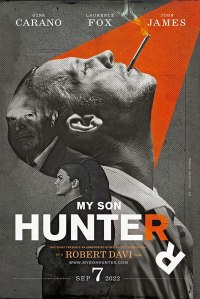 I’ll never understand the pathological obsession people have with Hunter Biden and what may or may not be on his laptop. This fixation on President Biden’s son seems so unshakably quixotic, hoping that with each new murky examination somehow, magically, there will be impropriety and criminality if you only look right. This dogged obsession with, at best, a tertiary figure to the true target of conservative ire reminds me of the crackpot theories concerning Vince Foster, a deputy White House counsel who took his own life in 1993. It was ruled a suicide by five investigations, and yet there are still enough people that are unsatisfied with this provable reality and want to see something more nefarious, more suspect, and simply more. Surely Vince Foster must have been assassinated by the Clintons, and especially Hilary, because he knew too much. It’s nonsense but to some it’s the only thing that makes sense. Such is the same with the Hunter Biden laptop, which some have deluded themselves into thinking could have been the difference maker between a President Biden winning by eight million more votes and a second-term for Trump. It’s difficult for the rational mind to fathom how many ordinary voters would truly care about a presidential candidate’s son’s liaisons, especially when that person is a private citizen and not employed in government.
I figured it was only a matter of time before a rapacious conservative media bankrolled a Hunter Biden Laptop Movie, and it seems only natural as Breitbart’s first foray into narrative filmmaking. The movie takes a lot of style and attitude notes from the latter films of Adam McKay, borrowing liberally from the mixture of documentary and cheeky fourth-wall breaking motifs from The Big Short and Vice. I’ll admit it makes for a slightly more entertaining movie, and My Son Hunter wasn’t the complete disaster that I had dreaded. It’s still not a good movie, by far, and its points are leaden and misleading at best and downright false and speculative at worst, but I’d rather watch a conservative movie that attempts to ape better filmmakers. Trying and failing is at least better to watch for 80 minutes than simply preaching to the converted and not even trying.
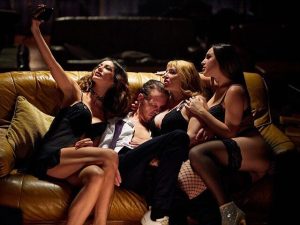 Hunter Biden (Laurence Fox) is drifting through life, parties, and may be the biggest hindrance to a would-be President Joe Biden (John James). Hunter left his laptop at a repair shop but thankfully the media refuses to cover the story, instead downplaying it as a possible Russian disinformation campaign in the last weeks before the 2020 presidential election. Joe can’t have anything go wrong so close to his possible big victory, but Hunter, at least in this not-at-all biased interpretation, seems like a walking catastrophe waiting for his next landmine.
Before even discussing the filmmaking merits, let’s tackle the chief purpose of this movie, which is to defame Hunter Biden and by association Joe Biden. It’s not exactly breaking news that Hunter Biden has lived a troubled life. The man has been upfront about his own struggles with addiction; he wrote about it openly in his own 2021 memoir. Watching Hunter snort anything within reach, party with hookers, and hang out with lowlifes just feels gratuitous because it’s the same characterization over and over. That’s all the movie covers for its first 30 minutes, Hunter partying with strangers and strippers (but still in a demure way where nobody, even before passing out on the floor, removes their clothes). It feels like we’re wallowing in a man’s degradation and it’s unseemly because the intention is not meant to be empathetic. The target audience watching this won’t likely care about Hunter genuinely getting better as a person. That’s not what this expose is for, trying to better understand his humanity and vulnerability. This is merely a roundabout way to taint Joe Biden, a figure too boring by himself, so the critics have to settle for Hunter and his salacious escapades and work on grimy guilt by association.
I can hear some griping that the movie presents Hunter in a more sympathetic light, at least early, with him recognizing his own screw-up nature but feeling powerless to rise above. He also talks about the grief of losing his mother and sister at such a young age, as well as his older brother in 2015. However, any pretense of humanizing goes out the window once big daddy Joe arrives, and Hunter becomes a sniveling sycophant who shrugs his way through life, not just aware of his nepotistic privilege but fully comfortable with his participation in corruption and graft. Any introspection is abandoned and it makes any prior introspection appear phony. It’s hard to square the Hunter in the beginning who talks about the wounds of losing his mother with the Hunter who complains that his dad never supports his art, complete with cutaway to his finger painting. There’s an entire six-minute stretch where Hunter is lectured to, by his stripper named Kitty (Emma Gojkovic) who just happens to be the estranged child of Christian missionaries, about China’s concentration camps for its Uyghur population, and he stares slack-jawed, as if he hasn’t kept up with the news in years (the reprehensible concentration camps for Muslims have been well-documented by the mainstream media). This Hunter is merely a stand-in for vague political corruption, an irredeemable naif that is only meant to make his father appear worse, and that’s also why now that Republicans have won the House, you’ll see a lot more of Hunter Biden’s name in 2023 because, obviously, investigating his previous business handling as a private citizen is the cure for inflation and higher gas prices.
 So what does the movie profess to expose, especially so that had this evil laptop of incriminating evidence been properly adjudicated, then Donald Trump, the most unpopular president in the modern era, would have easily won re-election? It’s a rehashing of what led to Trump’s first impeachment in 2019. Hunter Biden was on the board of a Ukrainian energy company, Burisma, and he most definitely got that position because of his name, and of course this is the only instance in the history of the world where that has happened before to the scions of the rich and famous. When Jared Kushner, who actually worked in Trump’s White House, was offered over two billion dollars by the Saudi royal family upon leaving his taxpayer-paid position, I’m sure it was completely for his unparalleled expertise on Mid-East diplomacy. Anyway, this Burisma position was already investigated internally by the State Department for conflicts of interest, and the Ukrainian prosecutor that Joe Biden pressured to be removed as VP was not threatening to investigate Hunter. This prosecutor was corrupt and refused to investigate Russian-backed assets; he even refused to investigate Burisma. There was no inappropriate arm-twisting to protect Hunter or Joe Biden, as thoroughly debunked during the 2019 impeachment trial. It’s all pretty established, but that doesn’t matter to its target audience, the same group who keeps desperately re-shaking a disparate collection of incorrect election anecdotes to produce a bigger picture like one of those pesky Magic Eye pictures that only “true American patriots” can properly see.
That’s really the majority of the specific accusations against Hunter. It impugns his associates, like Devon Archer who was sentenced for defrauding a Native American tribe in 2022, but too many of the accusations are broad and reaching, much like the Burisma condemnation. Biden did invest in shares of a Chinese technology company, Face++, as part of a larger portfolio, and China has reportedly used this technology to surveil citizens it’s looking to persecute. This is not great, but I wonder how many other venture capitalists have holdings with connections to other similarly sundry applications, especially with technology. I’m not excusing this, I’m just saying this “a ha!” accusation isn’t quite the deathblow the movies seems to assume. If it was, it wouldn’t need a character to literally explain the context of why this is so damning. The larger accusations of bribery and funneling ill-gotten monies back to daddy Joe are weak too, no matter how many times the movie adds titles to tell us, “This really happened” (but it didn’t). So many of these accusations are like Burisma, where it’s a purposely misconstruing of events and a deliberate ignoring of context or corroborating information that would deter their argument.
Hunter Biden isn’t the world’s greatest businessman by any measure. He’s also not the world’s most infamous criminal who fails to be held accountable because of his cushy connections. Hunter Biden hasn’t even been banned from operating a non-profit in New York state because he used a kids-with-cancer charity like a personal piggy bank (sorry, that was Trump’s children). Let it be known by this self-professed progressive, if Hunter Biden is guilty of a crime then prosecute him. Put him in jail. I don’t care. He doesn’t deserve special treatment. But at the same time, if he’s just a guy with problems, he doesn’t deserve this crazy level of unbridled antipathy.
 Following the McKay model, characters will stare directly into the camera for comedic effect, to add additional commentary, like when the movie flatly states, “This is not a true story… except for all the facts.” Of course, the screenwriters have a harder grasp of those stubborn facts. These are the same writers of The Obamagate Movie, which proposes to expose the “Deep State conspiracy to undermine the Trump administration and the fake Russian collusion narrative.” Again, facts are stubborn things, especially when the end of the movie laments when, oh when, will truth matter over lies and the powerful be held responsible for their corrupt actions (were these people just willfully hibernating during the scandal-a-week Donald Trump presidency?). The attempts at humor are often juvenile and stupid, like an opening scene where Hunter has a psychic conversation with a tiny dog while he’s high on drugs, and this is after a cartoon graphic of Hunter’s heart pops onscreen. The jabs against Joe Biden are mostly of the creepy hair-smelling and loony grandpa variety with groan-inducing malapropisms (“Nothing can threaten my erection;” see instead of “election” the dumb man said “erection”). The movie also squeezes in other conservative grievances, like opening with a Black Lives Matter protest and admonishing the media for its portrayal. I think having one of the protesters working as a stripper (to pay off her college loans, she tells us) is meant to be some insult to liberal protestors or even higher education. The same with having a stripper announce her pronouns. Is this the nightmare world the liberals all demand when even the people sleazy men pay to get naked would inform us of their preferred pronouns? I’m surprised they went the entire movie without a trans joke.
I don’t know why Fox (Inspector Lewis, White Lines) would agree to portray Hunter Biden. He doesn’t exactly resemble the man. He looks like a more gaunt version of Ebon Moss-Bachrach (Girls, The Bear). Fox provides the best reason to watch the movie because he’s not acting like he’s in lazy agitprop. Give credit where it’s due, the man gives a dark journey-of-the-soul kind of desperate sheen to this man, that is, until the script just turns him into a shrugging and sulking man-baby. Gina Carano (The Mandalorian) makes a brief appearance as a Secret Service detail to the Bidens, who never missed an opportunity to snidely confide to the camera about how much she loathes these men. John James (Dynasty) doesn’t work as Joe Biden at all, but he seems like he could have been a Sopranos-style goombah goon character reference for Paulie Walnuts. Many of the Eastern European actors who the production utilized from its Serbia filming site seems to have been dubbed over, so I don’t know how much criticism to offer Golkovic as Kitty, the stripper who also happens to be a former lawyer too. She’s a Swiss army knife of uses, including the intended moral uprising the filmmakers would like to believe they can engender.
 I’d like to conclude as a reminder why journalists believed that the Hunter Biden laptop story, which broke in the final weeks of the 2020 election, and was teased by none other than Rudy “Hand down my pants” Giuliani, would be met with skepticism. For an election about competency, a national COVID response, and basic human empathy, it seemed awfully strange that Hunter Biden’s name was coming up again so late, and once more from Giuliani, the man who was caught meddling in American diplomacy so that he could strong-arm Ukraine into pushing a sham investigation to slander Joe Biden. It was all just a bit too convenient, and especially when there wasn’t any corroborating evidence at the time, just one business shop’s word that, no for real, this must be Hunter Biden’s legit laptop. In the end, I doubt any voters could have been persuaded by the laptop, and those that were would have voted for Trump already. Nobody cares about Hunter Biden. And nobody should care about this silly and slimy movie trying to make him into the new conservative obsession. Go after Joe Biden for policy reasons, go after him for his age, but his son? In Joe terms, that’s baloney, man.
Nate’s Grade: D
Share this:

River Road (2022)
 I was asked to review River Road by an Ohio producer, although he is the lone Ohio connection and it was filmed in British Columbia, so it doesn’t exactly count as an official Ohio indie. It’s written and directed by Rob Willey, a Canadian commercial and music video director with one previous feature credit, 2016’s Dark Cove, a horror thriller with a budget of only $25,000. Willey is definitely a talented visual stylist, that much is apparent from watching clips of his shorts or the trailers for his movies. He sure makes a pretty picture. My issue with River Road as a drama is that the plot, characterization, and structure felt not nearly on par with the alluring visuals.
Travis (Cody Kearsley, Daybreak) is a Vancouver guitarist living a wild life of drugs, sex, and rock and roll. He meets Zoe (Lexi Redman) at his journaling spot while he’s luxuriating at a friend’s home on the eponymous River Road. She’s an American visiting a friend and over the course of a party they hook up in more ways than one. Zoe’s cocaine ends up being heroin and now both become inexorably tied together, two addicts sinking lower and relying upon one another for support. Travis empties his bank account, sells his belongings, including his prized guitar, and then considers increasingly risky crime to be able to afford more drugs. This brings him and Zoe to their most dangerous option: robbing local drug lord, Fresno (Steven Roberts), and making a very bad man a very clear enemy who will want very real and violent vengeance.
 In short, I found these characters to be insufferable. This is billed as a crime movie but it’s really more of an addiction narrative following the descent of two people into more desperate and self-destructive behavior. As an addiction narrative, it’s best to start with some tangible semblance of what the “before times” are like so we have a baseline to contrast with the damaging effects of drug abuse. If we followed a story about a deranged homeless man with alcoholism who suddenly started using crack, that’s not enough of a dramatic contrast to effect much added drama and tension. This is the first error of River Road. Our introduction to Travis is that he’s a traveling hedonist, playing in a rock band and going through women like water. He has a montage about “getting clean” after the band’s last tour but this literally lasts minutes before he’s right back to snorting cocaine at the local parties (maybe we have different definitions of “clean”). With Zoe, we have one meet-cute first encounter, and then she’s already at the same party snorting cocaine and introducing Travis to heroin. This all happens fifteen minutes into the movie, so not enough time to effectively establish a “before” phase, but Willey errs by failing to give us more to either Travis or Zoe as characters. They were vague before and now, for the next hour, they will be defined by the depths of their addiction. However, I was never emotionally engaged with either of them so I found much of their rather redundant wallowing to be tedious and, shocking, failing to provide further needed characterization.
My engagement was also hampered by much of the clunky and inauthentic dialogue. When people speak, you don’t really feel like you’re learning much about them; it’s like empty air unless they’re directly expositing what is, by all other means, unclear. Travis says, via helpful future narration, that he never met someone “so alive” like Zoe and he was won over by her sense of humor. I shook my head and wondered where the evidence for this was, because the previous twenty minutes did not establish either of these aspects. The dialogue often falls into being redundant or exceedingly expository. We’re told Zoe has a great sense of humor, but where did we see it? We’re told this romance was electric, but where did we see it? The conclusions are being dictated to us rather than shared and earned. And then paradoxically we’re given scenes where characters will talk in circles but just hit the same note into oblivion. I found every scene with music producer Cash Dirty (Sunee Dhaliwal) to be excruciatingly long and unnecessary. I think he’s supposed to be “comic relief” but he’s just a more verbose version of most of the men, trading in the same levels of hedonism and casual misogyny. The big villain likes to keep taking but it’s the same improv note with too much time to fill. I’ve seen this kind of haphazard writing before in other indies that confuse “authenticity” with uninteresting and bland dialogue.
 If you’re making an addiction movie you chiefly go one of two tonal routes: tragedy or immersion. Naturally, you can combine the two like Requiem for a Dream, but usually a filmmaker wants you to feel an emotional connection or a vicarious immersion with an overload of style. So, if you’re falling short from a characterization standpoint you can at least provide a satisfying array of style to bring to haunting visual and auditory life what the addiction process is like. I suppose one could argue that depictions of addiction without even the attempted integrity of characters and drama is simply cheap exploitation, and that can be true. With River Road, the characters don’t cut it to supply the tragedy. It’s just not there. I think it was another screenwriting error to provide not one but two framing devices, Travis and Zoe each narrating from the future when they’ve both gotten some form of treatment or help. I understand why this would be appealing to Willey because you can immediately plug into a scene of the past and cut to the character literally explaining, via voice over, what they were thinking at any moment. The problem with this is that the insight of these future narrators is pretty deficient. We don’t need future Zoe to tell us such obvious statements like “once you’re high there is no pain, there are no worries.” I think we understood that through the serene expressions on their faces, plus the general nature of drugs. They’re appealing for a reason. The other problem is that having both of our participants in this doomed love story as future storytellers means they won’t die. It eases some of the tension of its more fraught Act Three when they begin their dangerous decisions.
There’s also a misplaced twist at the one-hour mark that I find absolutely self-defeating, but to explain further will require some spoilers, so if you want to remain pure dear reader, skip to the next paragraph. From the fifteen-minute mark until the one-hour mark, we’re beset with redundant scenes of Zoe and Travis getting high, wandering around, being happy, and then being mopey during their withdrawal times, which shockingly don’t take up more time. It’s awkward to watch Travis mess up recording his guitar part for a song, and this is one of the few instances where we at least get a semblance of personal before/after contrast, but how many stagnant scenes do we need of people getting high, then begging people for money, then getting high again? This descent into debauchery doesn’t feel like we’ve regressed too far. Then at the one-hour mark the twist detonates that Zoe… actually knew about Travis when she saw his band perform in New York City. She stalked him online and followed him and planned her “chance meeting,” and my response was to merely shrug. So what? What does this twist do for the narrative? They were addicted to heroin before the first act was finished, so what does her being a stalker change with their current addiction crisis? After he demands she leave, Zoe comes back, and it’s as if this weird twist never happened for all its minimal impact. Travis does get to scream that Zoe hooked him on heroin on purpose, to try and control him, but, again, this is not evident with what we’ve seen onscreen. Also again, what does it matter? They’re stuck now. The manipulative woman trope, added onto the crazy groupie trope, is tacky, though I don’t know if we’re supposed to adopt Travis’ assessment when he learns the real truth. If this twist were going to be effective, we needed a lot more work done with Zoe’s characterization, with more time spent establishing a clear persona before the drugs became the dominant force. As it’s written, the twist plays like, “Hey, that vague girl who got addicted to drugs really quickly had maybe some other motives while she was vague.” You can’t earn that Gone Girl-style twist without putting in the proper time and effort for the rug pulling to genuinely upend the viewer.
 From a technical standpoint, River Road is a slick-looking movie with moody, neon-drenched cinematography and an atmospheric and evocative film score, both done by Willey (he also edited and produced too). There are some fantastic visual compositions here and that’s where I think Willey has his true passion. The movie makes extensive use of montage where you can tell the shot composition and arrangement and editing are just much more ambitious. It almost feels like the drug montages and time lapse montages were what Willey enjoyed making the most. In contrast, the scenes of characters talking have less appealing composition, often relying upon a stifling shot-reverse shot rhythm where each person is left in a single shot. After a while, the discerning viewer can start to categorize the scenes that Willey prioritized more. Every filmmaker invariably does this to some degree; it’s just more apparent with River Road. The drug use sequences are entrancing, like the first taste of heroin leading to Zoe and Travis losing one another in the cosmos with snow falling on them being overlapped. I’m surprised we don’t have more visual sequences trying to convey the highs. Much of the scenes after this initial jolt are watching people close their eyes and nod in contentment. The editing in the montages is also smooth and seamlessly melting from shot to shot with ease. There are other scenes where the editing gets less prioritized as well. A scene where Zoe is laying perpendicular across Travis’ stomach kept cutting at sharp forty-five-degree angles that it ruined the flow of the scene. Likewise, a climactic foot chase is hampered from edits where the proximity is hard to judge. We needed more shots of Person A being seen with Person B. Without, or without clear markers to denote progression of the chase, it’s a jumble of frantic images without forming an important visual continuity.
River Road is a production where I would recommend just about every element with one big exception, the storytelling. I don’t blame the technicians nor the actors. It’s the screenplay that doesn’t know what to do with its 85 minutes, the wasted and redundant characterization, and the shrug-worthy climax (why do I care about an ultimate showdown between the big bad dealer and the guy who Travis works with at the gym?) that mitigate the other shining qualities. I think Willey is a filmmaker with some serious chops but maybe defer on the screenwriting next time.
Nate’s Grade: C
Share this:

Elvis (2022)
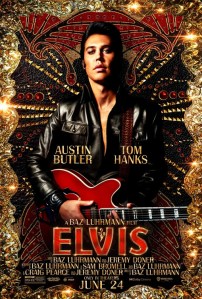 Elvis the movie is exactly what I would have hoped for from a Baz Luhrmann film, which is an experience that no one else can provide, a messy, chaotic, crazy, sometimes tin-eared yet audacious and immersive kaleidoscope of sight and sound that feels like a theme park ride. As with all Luhrmann films, the first 20 minutes is a rush of tones, characters, and near constant frenetic movement; it’s so much to process before the movie eventually settles down, at least marginally, or the viewer becomes better acclimated to the madcap storytelling style of this mad Aussie. I feel completely certain that people will call Elvis brilliant, and people will deem Elvis to be ridiculous and campy, and I would say it defiantly manages to be all of these identities at once. It is ridiculous, it is campy, it is emotional and sincere, it is, at points, even brilliant, and in a way, this shambolic style perfectly symbolizes Elvis himself, a performer that seems to be anything that the viewer projects onto him, a trailblazer who suffered for his art before becoming an irreplaceable industry and edifice of pop-culture obsession unto himself.
We chart the rise of Elvis Presley (Austin Butler) from a young crooner in the 1950s to the best-selling solo artist in recording history. Colonel Tom Parker (Tom Hanks) discovers Presley, granted after he’s been a chart-topping local hit in the South, and sees a grand opportunity. With Elvis, there is no limit to where they both can go, and so Parker becomes Elvis’ manager for over twenty years for better and worse, engineering Elvis’ tour of duty in the military to take him away from negative headlines, only for him to meet and marry Priscilla (Olivia DeJonge), to locking him into a Vegas headlining gig to erase the mystery man’s heavy debts to the mob. Under Luhrmann’s guidance, you’ll experience it all and then some in the frenzied 160 minutes.
 Elvis was many things for many people. He was a smooth crooner, he was an electric live performer, he was the benefactor of being a white vessel for music that was built upon the less heralded work of black performers, he was a victim, he was selfish, he was devoted to his fans and the stage, he was… America. In 2022, I would have asked if contemporary culture even cared about Elvis anymore, a man who died over 40 years ago, and whether we even have a lens to appreciate the man. Was he simply coasting off the hard work of other black performers? Did he groom his eventual bride considering her age upon their meeting? Was Elvis too old fashioned to even be anything other than a musical touchstone that other artists have surpassed? Is he just a joke? Luhrmann does a fine job of re-contextualizing Elvis, what made him unique for his era, and what made him still captivating to watch to this day. Even the archival footage the closes the movie is a reminder of the unmitigated power the man put into his singing.
It wouldn’t be a Luhrmann movie without a narrator, and this time we get the story’s main antagonist as our prism to view Elvis, marking him chiefly as victim. Tom Parker is a cartoon of a character especially as portrayed by Hanks. I love me some Tom Hanks, the man is an American treasure, and I appreciate that the man is definitely going for broke, but I don’t know at all what he was going for with this performance (the makeup does him no favors also). Hanks is fascinating because he is playing a villainous character that is constantly trying to re-frame their villainy, telling his side of the story but being careful, though not that careful, to always have an answer for an accusation. It feels like Hanks has stepped off the wacky Moulin Rouge! stage and everyone else in the movie is playing things completely straight. The entire acting troupe is all playing under one direction, and then there’s Hanks in his fat suit, who is breaking through the fourth wall, compulsively narrating our story, and acting like a loquacious Loony Tunes figure any second away from his own song and dance. His repeated use of the term “snow job” and “snowman,” which he dubbed himself as a showman, is overused to the point of being a verbal crutch, reminiscent of how often Jay Gatsby had to say some variation of “ole sport” in the 2013 movie or else he might irrevocably burst into glitter (or so I assume). It’s such a bizarre performance of wild choices that I can subjectively say it might be Hanks’ worst and yet it also feels like Hanks is giving Luhrmann exactly what he wants. It’s such a bold move to essentially cede your famous biopic to the most ridiculous character to tell from their ridiculous perspective. Imagine I, Tonya being told from Paul Walter Hauser’s character or House of Gucci being told from Jared Leto’s character, and that’s what we have here. I almost kind of love it, and in doing so, we see from the manipulator how he worked his magic to keep financial control over Elvis. Even Elvis’ later years are provided with a perspective that re-frames the man as a victim of a moneymaking machine that wouldn’t stop until it had drained every last drop of blood from this hard-working man.
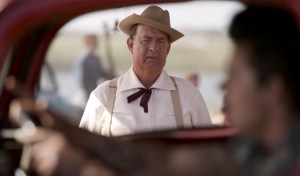 I think this is smart because, on the surface, Elvis might not be the most complicated person to devote two hours to unpacking his character dimensions. He liked to sing, as it touched something deep inside him, and he wanted to be true to himself, but this framework isn’t any different from any number of famous musician biopics we’ve become more than accustomed to. He dealt with drug addiction and erratic behavior but, again, even this is musical biopic basics. Even his doomed relationship with Priscilla is familiar stuff, as she could rarely compete with the demands and the allure of the stage. I think Luhrmann and his co-writers wisely saw that the best storytelling avenue with Elvis is through the lesser-known Colonel, a bizarre and calculating figure cackling in the shadows. There are significant questions over who this proud huckster really is and what he did to bully and cajole Elvis into his favor. There’s inherent conflict there as well as an angle that I would argue most are unfamiliar with. I didn’t know much about the history of Elvis the man but I knew even less about this would-be Colonel.
The most Luhrmann of sequences is Elvis’ breakthrough live performance where it feels like every woman in attendance is catching a fever of combustible hormonal fury. The way the man shook his hips, moved his body, his gyrations that so many adults felt were dangerously subversive, were part and parcel of the younger Elvis. He really was a born performer, and even says he can’t sing if he isn’t allowed to move how he feels he must with the music. During this crazy sequence, Luhrmann’s camera is trained on the emotional response of the audience experiencing a sensation that cannot be contained, bubbling to the surface into tears, shrieks, and convulsions, and it moves through the crowd like waves. It’s such an enthusiastic experience that plays right into the stylistic and tonal wheelhouse of Luhrmann. It’s also an unsubtle reminder, not that much is subtle in a Luhrmann movie, that part of the man’s appeal was his raw sexual magnetism.
In a modern era, the condemnation of Elvis as a corrupting influence on the youth feels comically quaint, until you remember that all of this was also filtered through a very racist paranoia. Elvis was deemed a danger because he was an accessible introduction to music and culture that was associated with black people. The accusations of Elvis corrupting the youth are all tinged with racial implications about his source of inspiration, never mind that Elvis was also influenced by a religious revivalism. The movie doesn’t say that Elvis was a sham, only succeeding off the work of other esteemed yet unfairly unheralded black artists. With the many onscreen performances, he is clearly talented, and offers his own versions of others’ songs, but he’s also deferential to the people he grew up with and the music he clearly loves and wants to be a part of to the detriment of whatever Tom Parker and his handlers believe is commercially viable. B. B. King (Kelvin Harrison Jr.) even remarks about Elvis’ own privilege when he thinks about bucking politicians demanding that he perform safe songs without his signature dancing (“They’ll arrest me for just crossing the street. You are a famous white boy who makes them too much money.”).
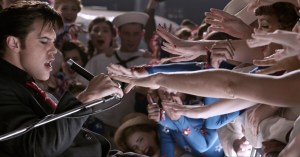 I’ve purposely delayed from discussing the best reason to go see all 160 ungainly minutes, and that is Butler’s glorious performance. The young man simply dissolves into the role and makes you forget you’re watching an actor. The way he captures the cadence, the drawl, the presence of Elvis, and not just his jerky movements, is phenomenal, and then you remember that it’s Butler doing all his own singing as well, and the spell is near complete. He is Elvis. It’s a performance guaranteed to win as many plaudits as awards season has to offer. Through Butler’s performance, a younger generation can understand what all the hubbub was about. The man brings the character to life but he especially brings Elvis the performer to startling life. Even if you hate Luhrmann’s other movies, and he is definitely divisive, and even if you couldn’t care less about Elvis in the year 2022, this movie is well worth watching for the sheer brilliance of Butler alone.
In some ways, Elvis the movie feels like a perfect assignment for director Baz Luhrmann. His unconventional stylistic approach livens up an otherwise conventional rise-and-fall tale, broadening the appeal of Elvis for an audience that might have otherwise shrugged at a movie chronicling the man’s exploits. The subject matter is also the squarest for Luhrmann, which makes it also the safest movie of his career, which is truly saying something considering some of the imaginative highs of this movie. There will be just as many people put off by the excessive, in-your-face style of the movie as drawn in by that Luhrmann razzle dazzle. Watching Elvis feels like you’re watching two movies simultaneously atop one another. Luhrmann can be exhausting even at his best but he’s also one of the few filmmakers that makes watching a movie such a textual experience, where sight and sound are layered in such meaningful and granular details to better immerse the viewer. The way even the sound designs ebbs and flows, braids musical notes and themes and older selections of influential resources as it all composes a wonderful soundscape. Few put this kind of thought into every nanosecond that Luhrmann does, himself a natural showman who cannot help himself. While plenty will wish for restraint, I say, much as others asked for restraint from Elvis’ gyrations, to let Baz be Baz, and he lets Elvis be Elvis to the giddy entertainment of the audience.
Nate’s Grade: B
Share this:

Shut In (2022)
 It’s easy to see the appeal of contained thrillers from a production standpoint, but I’ve always found them to be a fun, crafty thought exercise that I’ve often enjoyed playing along. I’ll rename them “survival thrillers” because I think that’s truer to what they encounter, whether it’s in a small, contained environment or whether they are simply a victim of unique circumstances. I enjoy watching a character analyze and attack a problem and find workable solutions. There’s a natural vehicle for satisfaction there, whether it’s Matt Damon learning how to farm on Mars, or Ryan Reynolds being buried alive in a coffin, or a group of teenagers stuck on a ski lift. It’s a fun scenario to try and solve, especially in the relative comfort of your own home. Given their success and general low-cost nature, it was only a matter of time before these kinds of thrillers would dominate indie direct-to-streaming cinema. I guess then I shouldn’t be that surprised the Christian movie market would want in too. Shut In is the first original film distributed by The Daily Wire, the subscription run by conservative political wunderkind Ben “debate me!” Shapiro. Shut In began as a 2019 Black List script, the list of the most liked unproduced screenplays, and at one point Jason Bateman was going to direct. From there, it’s now Ben Shapiro’s Godsploitation thriller, and it has its own virtues and sins.
Jessica Nash (Rainey Qualley) is doing her best with some of the worst circumstances. She’s got two young children, one still an infant, and scraping by for money. She’s a recovering meth addict and has inherited her grandmother’s home that she’s looking to sell. As she’s cleaning up the premises, she accidentally locks herself inside a pantry. Making matters worse is that her meth-addict ex-boyfriend Rob (Jake Horrowitz) and his no-good pedophile pal Sammy (Vincent Gallo) come around looking for a score. Jessica must use her wits, strength, and fortitude to escape the pantry, keep the dangerous men away from her children, and also reject the temptation of indulging in drugs as an escape for her mounting troubles.
 From the vantage point of a survival thriller, Shut In makes more under its circumstances that I would have assumed but also, strangely, less with the personal stakes. Whenever developing a problem-solution story structure, you need to make sure the dots connect and there’s a natural progression of events. You’re stuck in a room, now what? Jessica benefits because she has a helper on the outside; however, that person is only a young child, and therefore unreliable and unable to firmly grasp multi-step instructions. This also allowed me to channel the main character’s frustrations as well, especially when she was asking her kid to find things like tools to better claw away at the door and floor. This gives her an outlet but another challenge as well because the child becomes a point of vulnerability. When Sammy comes back into the picture, his presence is immediately the priority, and Jessica needs to neutralize him or make sure he cannot reach her daughter on the other side of the door. Screenwriter Melanie Toast seems to understand that the predicament she devises runs into natural end points, so she throws in extra escalations, which then become the next challenge. It’s self-aware scripting, but it also runs the risk of the challenges feeling not as challenging and the movie feeling more episodic.
The most confounding plot point was how underplayed the drug addiction angle is. It’s part of her overall tragic past, and the movie hints about past sexual trauma as well to further haunt our lead’s dark “before time,” but we don’t ever really feel her trouble with staying clean. It’s more like the drugs represent her former life, the one with her ex who is still in the thrall of meth. We could have used maybe even a monologue of Jessica talking about the pull of drugs, how important they were to her before, and how she never liked the persons he was, perhaps the shame she feels for the things she had down previously for drugs, and her intent at redemption, all to the audience of the child she’s meaning to do better by. There’s an entire character arc worth of detail that can be unleashed to really provide better depth. When her ex tosses his three grams of meth into the pantry, it’s meant to be a significant temptation, but the movie never really plays this as a sufficient challenge. It would be as if the guy just tossed in a small packet of laundry powder for how much personal attention it’s given. There was a short moment where it looks like, with all hope lost, that Jessica might succumb, but for the far, far majority of the running time, this drug temptation is underplayed. If this Jessica wasn’t going to struggle over using drugs again, why not just have her toss them down the sink? It’s a curious mitigated plot point for something that seems more significant than presented.
 This is also directed by D.J. Caruso, a man who was making big-budget Hollywood action movies in the early 2010s like Eagle Eye and I Am Number Four. This is likely the lowest budget Caruso has ever worked with, but he doesn’t make the movie feel visually dull. There’s way too much imagery with apples though, including apples rotting at their core (you get it?) and eventually Jessica peeling the brown from an apple and saying the rest is still plenty good (you get it?). It feels like the apple was a lazy visual symbol meant to appeal to its, presumably, more Christian-affiliated target audience (“You see, the apple… means… temptation”). The tension can be finely attuned especially when we’re trapped in the pantry with Jessica and having to rely upon the sound design to understand the looming threats. I wish Caruso had pulled back at more points. Later, Sammy holds Jessica’s kid hostage with a knife to her little throat, promising to kill her, while everyone is screaming so loudly that it almost feels like we’ve landed in farce. The exploitation thriller elements feel in conflict with the lighter Christian elements. The God parts feel almost tacked on, especially when Jessica doesn’t reveal anything about her own faith. Looking at a hanging cross and deciding not to do drugs does not count as sufficient integration.
This is also Vincent Gallo’s first film role in ten years. for a period in the late 1990s, Gallo was the toast of the indie film scene and then he burnt through all that collective good will (also credit The Brown Bunny making people question those earlier accolades). I’ll credit Gallo acting like a believable creep and a snarling threat. He’s the best actor in the movie, and he delivers enough in this do-nothing part that makes me wish he would act more often. Qualley (sister to Margaret Qualley, also the daughter of Andie MacDowell) is fine, though her Southern accent seems to get the better of her at parts. Her performance is more physical than emotional.
 Shut In is a small movie likely intended for a small audience while it drafts off the genre formula of larger, more polished survival thrillers. It goes through stretches where it relatively works, stripped down to its bare genre essentials, and then moments where I wish more was going on viscerally and intellectually. That’s where the movie needed to open up its protagonist more substantially, give more consideration to her internal struggles rather than keeping everything strictly externalized. Her drug addiction and the immediate proximity of drugs needed to be much more a trial of will. If you’re stuck with characters in a confined space, you need to either use that time to make the character more intriguing and compelling or keep the obstacles coming. Shut In transitions with new obstacles to overcome, but it still doesn’t feel like enough for this 89-minute movie. It’s an acceptable genre entry but had more potential with its lead character and with its thrills. It settles too often, and there’s nothing godly about settling when you could have been an even mightier movie.
Nate’s Grade: C+
Share this:

The United States vs. Billie Holiday (2021)
 The good news is that Andra Day is a surefire star. In her debut performance, the singer makes a bold impression as Billie Holiday, with her raspy voice, sterling stage presence, and powerful singing. Day was nominated for an Academy Award, just as Dianna Ross was for her own film debut, also playing Holiday in 1972’s Lady Sings the Blues. The highlight of this movie is a tight close-up of Day singing “Strange Fruit,” her anti-lynching protest song, written by a Jewish schoolteacher, a song that incensed the U.S. government and essentially began the woe-begotten War on Drugs with a racist task force targeting Holiday as their first victim to make an example of. The moment is filled with rising emotions and barely held restraint and the sheer power of Day’s performance communicates the danger and anger of this politically-charged song that earned such controversy. However, the rest of the movie is a bit of an unholy mess, as director Lee Daniels (Precious) takes his signature campy, over-the-top style and cannot say no to any creative decision in his mind. I don’t know what’s harder to grasp, the clashing tones or timelines, as the movie literally and figuratively jumps all over the place, at one instant having Holiday on top of the world, and another being beaten by a parade of one-dimensional and nearly indistinguishable abusive men, to waltzing through heroin hallucinations, and cuddling close with an FBI informant (Trevante Rhodes) who is definitely a fictional character. Like the recent Judas and the Black Messiah, we divest time from the star to the men who betray her, but none of these louts and schemers are worth that precious time. It becomes an uncomfortable misery montage as we watch Holiday get abused, shoot up, cry, get harassed by the police, and repeat endlessly for 130 minutes. I don’t know if maybe Daniels was trying to make me feel like I was on drugs while watching but the antic, unfocused, and careening narrative and energy levels certainly made me feel dizzy and nauseated. An then there are ridiculous moments where I just wanted to laugh, like the backroom of racist government agents saying lines like, “This jazz music is the devil’s work. That’s why this Holiday woman has to be stopped.” This is based on a chapter of a book about the early War on Drugs, not Holiday’s biography, and it feels very much like her own identity and significance is being strung along just to be a martyr for the evils of government persecution. The movie paints her chiefly as a victim and then seems to glorify in victimizing her, and it all feels so garish and ghoulish and misguided. Billie Holiday deserves an amazing movie but she’ll just have to settle for an amazing performance in an otherwise melodramatic mess of a movie.
Nate’s Grade: C
Share this:

Cherry (2021)
 Between 2014 and 2019, the Russo brothers directed four Marvel movies with a combined worldwide box-office of over six billion dollars, so for their first foray from the world of super heroes and magic space gems, the brothers had carte blanche to pick whatever project they desired and Cherry was it. Watching all 140 minutes of this true-life tale, you get the feeling it’s less a story about loss and redemption and more an overly extended excuse for Joe and Anthony Russo to use every stylistic trick they’ve ever wanted to employ to make their own inferior Goodfellas (or Casino). Free of MCU oversight, these guys are practically going full Tony Scott or Darren Aronofsky with the multitude of their visuals tricks and gimmicks. We’re talking different aspect ratios, color washes and spotlights, heightened fade outs, fourth wall breaks and freeze frames, chapter titles complete with prologue and epilogue, in-your-face subtitles, tracking shots, and even oblique angles such as a point of view from inside Tom Holland’s inspected rectum. Cherry is aggressively flashy to compensate for how little substance there is with its story and humdrum characters. It’s based on a true story about Nico Walker (Holland), an Iraq War veteran coming back to Ohio, getting hooked on drugs, and resorting to robbing banks The trauma of his war experiences leads him to seek help and the system fails him and pushes opioids on him, turning him into another addict among too many who is desperate to do anything for cash. On paper, that sounds like it would be interesting, and the shocking part is that for all these identifiable dramatic elements and stylistic flourishes, Cherry is kind of dull. Everything feels like it’s kept at a surface-only level. Walker is just not that interesting even though interesting things happen to him. You would think it’s about PTSD, the opioid crisis, economic anxiety, and while these elements are present they are not really explored with any sustained nuance or theme. The level of social commentary stops at Fight Club-level snarky sight gags, like the names of the banks being “The Bank” and “Shitty Bank.” There’s too much bloat with the plot and running time. By far the most interesting section of the movie was his descent into addiction and the criminal excursion, but Walker doesn’t even exit the war until over an hour in. We did not need all the fluff before the war to properly set up this limited character. The real drama of the movie is post-war, and there’s an hour of setup that could have been cleaved away. You leave this stuff in as “texture” if you’re building something rich in atmosphere and character but I can only tell you what has happened to Walker externally. He’s perfectly unremarkable. The movie is too shallow for its own possible ambitions, and it ultimately feels like cribbed notes and homages to other movies the Russos enjoyed, like Goodfellas or Requiem for a Dream or Boogie Nights. It only reminds you of other, better movies, and one I was reminded of was Roger Avary’s Rules of Attraction. I appreciated the flash and style of that 2002 movie because it was about empty characters living empty lives striving for something they were incapable of, so the excessive and prioritized visual artifice worked. With Cherry, the visual trickery is distraction from the underwritten characters who the movie very much wants us to see favorably through their struggles. I enjoy Holland (Spider-Man: Far From Home) as an actor immensely but he is miscast here. He’s too boyish and charming and genial to ably perform dark and gritty antiheroes. You sense he’s eager to try these “darker roles” to prove himself but he doesn’t need to. Ciaria Bravo (Wayne) plays the girlfriend/infatuation object/junkie partner and she looks so young that see feels like an unsupervised child onscreen. Maybe that works with her as a symbol of innocence. Cherry is a movie that left me indifferent and shrugging throughout all its excesses and meandering. It feels like a movie the Russos needed to get out of their system, one of creative indulgence charging into familiar territory when more restraint, nuance, and contemplation would have sufficed, and maybe their next movie will be more mature and fulfilling and worthy of 140 minutes.
Nate’s Grade: C
Share this:

Music (2021)
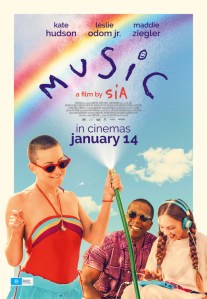 I didn’t even know Music existed until a couple weeks ago. The musical was nominated for two Golden Globes, including Best Comedy or Musical, and a passion project for the pop singer Sia. She wrote, directed, and cast her music video muse, Maddie Ziegler, as the titular figure Music and filmed back in 2017. Then I read about the backlash from the autism community for the film’s portrayal of autism and I became more intrigued. Currently, Music rates even lower on Rotten Tomatoes than Cats, and the reviews have been equally as baffling and unkind. Sia has responded defensively on social media to her film’s critics, and the brewing controversy has given the movie a fascinating rubberneck quality of, “You have to see this.” It is with that morbid curiosity that I sat and watched Sia’s Music, a movie awash in misguided decisions.
Music (Ziegler) is a teenager living in Los Angeles who is severely autistic and in need of care. She needs eggs in the morning, insists on a walk around the neighborhood, loves dogs, and has her headphones on to shield her from being overwhelmed by exterior noise. Music escapes into elaborate fantasies where she dances along to soaring pop songs. Her grandmother dies early and the only living relative is Zu (Kate Hudson), a recovering drug addict who doesn’t want to play mom to her demanding younger sister. Eventually, Zu begins to see her sister differently and bonds with her neighbor, Ebo (Leslie Odom Jr.), who teaches boxing classes to the neighborhood youth. Zu is getting her life straightened out and learning responsibility, though she might ultimately still decide Music is too much for even her.
 Let’s tackle the biggest issue of contention, the film’s portrayal of autism. Ziegler is not autistic or, to my knowledge, neurodivergent. This fact alone doesn’t necessarily mean the movie was doomed to insincere failure. It may well become the norm that neurodivergent actors play neurodivergent characters, much as it seems has happened with trans characters and firmly established for ethnicity. However, I think much of the response to a person outside of a community portraying that community comes from the intent and the depiction. Are they coming from a good place? Are they trying to portray this life in an honest fashion? And is the portrayal harmful, derogatory, or trading in negative stereotypes? With Music, I have no doubt that Sia was coming from a good place. She has spoken about the autobiographical elements of the movie and basing the character of Music on someone that she knew personally. I know there are people like Music on the autism spectrum. It’s a spectrum for a reason. The problem comes with the depiction of a person this severely autistic from an outsider. I’ll explain in a comparison.
In 2001’s I Am Sam, Sean Penn played a mentally challenged man fighting for custody rights. He was nominated for a Best Actor Oscar. In the film, Sam had a group of friends, all of whom were similarly mentally challenged, and some of them were played by actors who were genuinely living with that same condition and others were played by actors only pretending. It was very apparent who was who, and it made the entire movie feel uncomfortable because it felt like the real people were being caricatured in literal proximity. It didn’t feel right, and I can’t imagine twenty years later that filmmakers would make that same choice. On the other hand, with the Netflix series Atypical, the lead character is played by a neurotypical actor but the portrayal of a character on the spectrum is done with great empathy and consideration, with an outreach toward those within the autism community. Intent and depiction are the keys.
The onscreen depiction of autism in Music is pretty galling and potentially harmful for those within the community. It’s all negative stereotypes. Ziegler is constantly contorting her body, making silly putty faces, side-eye glances, hitting herself in the head, and playing to the most abrasive and controversial cliches of those living with autism. She can barely mutter more than a few words, usually in imitation. Because this is the depiction of the character, having a neurotypical actor in this role can feel plenty insulting to many viewers. Music is less a character and presented more as a burden because of her needs and challenges. She gets Zu into trouble and lashes out in public. At no point does Music come across as more than an assembly of tics and ugly stereotypes.
 It’s not just that the depiction in unflattering, as all characters do not need to be unerring shining examples for their individual communities, it’s that the movie doesn’t bother to give her any inner life. There are a few of passing comments about how Music sees the world, like a savant too pure to take in all the majesty at once, but these are merely gestures. The biggest opportunity into the mind of the character would have been through the numerous musical numbers but these are, by far, the most confusing artistic choice by Sia. I was expecting the musical numbers to provide insight with Music, to give voice to a character who has trouble communicating. Someone would ask how she was feeling and we’d zoom into her mind and the singing would be her way of expressing that answer or her complicated emotions about any topic. The use of singing and music would be her voice. Alas, this doesn’t happen at all. Like at all. This is shocking to me and the movie never really recovers from this misstep. The musicals are confusing because they often seem to be from the perspective of Zu instead and communicating her own struggles. Is Music just imagining her own sister’s inner turmoil through dance? There are also musical numbers devoted to exploring Ebo’s inner turmoil. That means two other characters are given primacy over Music in her own personal imaginary musical interludes.
What is the point of the musical numbers then, besides squeezing in ten or so Sia music videos into a dramatic narrative that doesn’t appear to be connected to them? The music videos themselves are very reminiscent of Sia’s recent output, largely single takes and bursting with bright pastel colors and goofy costumes that look like a children’s TV show. The dancing is interpretative, which means a lot of emphasis through the body movement and facial expressions, and you may find it slightly lacking or perhaps too goofy that it takes away from the emotional content or attempted investment. I enjoy musicals and I even like the approach, in theory, that Sia would have been articulating, shedding light on a personal experience that re-sees the world as a more whimsical, wholesome, and friendly environment. This approach succeeded in Lars von Trier’s 2000 film Dancer in the Dark, where Bjork’s love of old musicals shaped the way she chose to escape from the world and highlighted the discrepancies between fantasy and reality. That’s not what Music does or even attempts to do. You could remove the musical numbers completely or just serve them on their own. The only direct story connection comes with a side character, a Chinese teenager who is pushed into being a boxer by his belligerent father. He secretly wants to be a dancer. In his lone appearance in the musical numbers, he gets to indulge in his dream and dance and sing (or lip synch) and it has emotional resonance because it’s an expression of his inner desires and the longing is felt. Why is this one supporting character, who could have easily been removed entirely from the narrative, the only one that fits with the approach to the musical interludes providing actual insight? As far as the quality of music, it sounds very much like Sia’s pop ditties and there are a couple winners. “Together” has a buoyant bounce and swooping, cheerful melodic hook that is hard to resist.
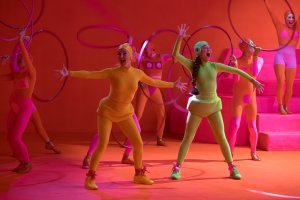 Hudson (Bride Wars) is the real main character of the movie and her struggle with responsibility is a familiar arc, from screw-up on the margins to matured adult with goals and a found family. She’s an trying to stay clean though she’s really just looking to skip out on life and enjoy a permanent vacation in Costa Rica. This is even her stated goal after inheriting the guardianship over Music. There are plans late to transfer her sister into a group home but this deliberation isn’t really given the attention it’s due, in fact I don’t think I can recall even the mention of it prior to the potential move-in day. The character of Zu is completely stock, a neo-hippie wild child that needs to learn to slow down and accept responsibility. I don’t know what that looks like because for most of the movie she’s just having her sister tag along while Ebo explains things about autism in a delicate fashion (including physical restraints, which have met with plenty of disagreements from the autism community who cite the danger they pose). You would think Zu might have a better handle on this stuff, or that her grandmother would have been more helpful with that instruction book she left behind for the care of Music. This is more a movie about a recovering addict getting her life together and bearing with her burdensome younger sister. Seriously, the character of Music could have been a coat rack for all the impact and agency displayed. Hudson does an admirable job with what she’s given even if grungy and strung out are hard for such a naturally sunny and charming actress more prone to breezy rom-coms. Odom Jr. (One Night in Miami) is wasted as the kindly neighbor harboring a secret and mending a broken heart. At least he gets to sing too.
While watching Music, I kept thinking of an obvious creative choice that would have sidestepped a majority of the mushrooming controversy and spared Sia. Why not just make the character of Music someone with a different condition? Why not make her suffer from post-traumatic stress, or an anxiety disorder, something keeping her form living the life she desires and communicating all that goes on inside her person? Automatically, it eliminates the controversy over the negative depiction of autistic stereotypes from a neurotypical actress and it makes the character more a central figure in her own story that can be developed and examined. Frankly, in 2021, we don’t need portrayals like Music to better understand life with autism. This kind of movie might have been met more charitably in the 1990s but now it’s instantly problematic, and I feel like much could have been avoided by removing the autistic aspect to Music’s character, especially since it does so little to the story other than create havoc and challenge. Beyond that, Music falters because the many musical sequences fail to tie back to the characters in meaningful ways. I’m confused over the shifting perspective as well. From a technical standpoint, the movie looks and sounds like a professional movie with a polished Sia soundtrack. However, it’s the poor thinking behind these decisions that dooms the project. While it’s no Cats-level disaster, at least nobody was living with human-feline creatures at home. Music is not a good movie but it’s the kind of rare artistic flop that might be worth viewing just for its audacious missteps, like 2018’s Welcome to Marwen. I don’t think we’ll be getting a second feature film from Sia any time soon.
Nate’s Grade: C


 nathanzoebl
You must be logged in to post a comment.