Blog Archives
Win Win (2011)
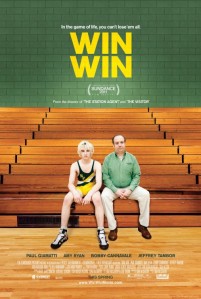 After two stellar movies (The Station Agent, The Visitor), writer/director Thomas McCarthy has proven that he may be one of the greatest humanist voices working in cinema today. He writes wonderful stories about people who find connections via unorthodox family units. McCarthy can spin bizarre elements into deeply felt human dramas. Win Win is another hodge-podge of storytelling elements. It follows the life of Mike Flaherty (Paul Giamatti), a midwestern lawyer and high school wrestling coach struggling to get by. Then a sullen teenager (Alex Shaffer in his acting debut) lands on his doorstop looking to see his grandfather in Mike’s guardianship. The kid also happens to be a gangly wrestling phenom. Things are going great for Mike, that is, until the kid’s mother comes looking for him and wants him back. Win Win assembles a great group of flawed, empathetic, relatable characters that make conflicted choices that they then have to abate. Giamatti is reliably fantastic as the center of McCarthy’s humanist universe. He can communicate so much despair and relief just with his expressions. Teamed up with a cast that includes Amy Ryan, Bobby Cannavale, Burt Young, and Jeffrey Tambor, the movie works best when you can just sit back and take in great actors relishing playing great roles. Win Win doesn’t all come together in the end like other McCarthy films; there’s definitely a missing ingredient feeling to the movie. Shaffer’s limitations as an actor hamper some of the later dramatic moments. The end is satisfying, but I felt like I should have felt more. While it doesn’t strike the same seamless balance of comedy and drama as The Station Agent, this is certainly a film that should be winning for most audiences.
Nate’s Grade: B+
Share this:

Hanna (2011)
 We all seem to love child prodigies. The concept of someone so small doing something well ahead of their years seems to fascinate our minds. I suppose the same holds true for professional killers. We all seem smitten with teenage depiction of super-powered killing machines. Last year presented Kick-Ass whose real star was the adolescent Hit Girl (Chloe Moretz-Grace), pint-sized reaper of carnage. Then there’s River from Serenity, Gogo from Kill Bill: Volume One, the ladies of Sucker Punch, the Heavenly Creatures girls (at least this one is based on a true story), and pretty much half the cast of Battle Royale. Just wait until The Hunger Games comes to screens in 2012, built upon the premise of 12-18-year-olds fighting to the death on national television (so the premise is almost exactly Battle Royale). We love our innocence mixed with ironic cynicism. Along comes Hanna, the tale of another teenage girl leaving a trail of bodies in her wake.
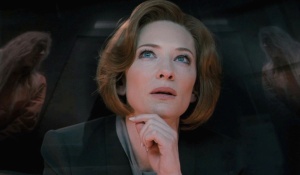
Hanna (Saoirse Ronan) is a sixteen-year-old girl living above the Arctic Circle with her father, Erik (Eric Bana). She’s been in survival mode all of her life, preparing for a day when she would finally break free and seek vengeance. CIA Agent Marissa Wiegler (Cate Blanchett) killed Hanna’s mother and has been lying in wait to finish the job, eliminating the rest of the family. Erik has taught his daughter well to think on her feet, master several languages, and become an excellent marksman/fighter. Hanna makes the choice to set their plan into motion. She triggers a device that signals to the CIA where they are. Marissa sends a crew to pick up Hanna and Erik, but only finding the girl. Once in an underground CIA compound, Hanna turns her focus on Marissa, killing her double (good call, lady), and breaking out of the compound. She finds that she’s been taken to Morocco. Fortunately, a family is traveling through the land and Hanna can catch a ride before she meets up with dear old dad in Berlin. Marissa sets out on a manhunt to find Erik. She hires a group of German criminals (led by Tom Hollander) to retrieve Hanna (“I need you to do things my agency will not let me do,” she reasons). Everyone is on a crash course to Berlin, where Hanna’s mysterious origin will be finally revealed.
 Director Joe Wright blew away all my expectations for him. The British director was mostly known for visually lavish period pieces like Pride and Prejudice and Atonement. This is a drastic change of pace and proof that the occasional art director can produce a great-looking, meditative action thriller that still delivers the goods. Wright’s camerawork is beautiful, making artful use of composition, lighting, and editing to deliberate purpose. There were several moments that I just got caught up in the look of the film, aided by the energetic if sadly too-often absent score by The Chemical Brothers (I love the chunky bass groove on “Container Park”). I was just impressed what could be produced under the guise of action cinema. This is an elevation of the genre. Wright’s color palette is awash in ominous reds, soft blues, and delicate yellows, which helps give the film this painterly approach to photography. Pay attention to the dream-like visual metaphors connected to fairy tales (Marissa seems to have a tooth cleaning fetish –“What big teeth you have…”). At the same time, Wright knows how to stage a terrific action sequence. His signature tracking shots allow the audience to become enveloped in the action, taking in the punches and kicks without the disorientation of the popular erratic editing style of modern action cinema. Bana taking down a bunch of goons in a subway level is made more thrilling because we see every second of activity, allowing the moment to build in tension as he is followed, then cornered, then strikes out.
17-year-old Ronan has left the awkward pubescence of The Lovely Bones far behind her. Like her Atonement director, she too steps far beyond our concept of what she is able to perform. Ronan is a five-foot-tall wrecking crew. She keeps her eyes intensely focused, tense blue orbs. At the same time that she convincingly kicks butt up and down the screen, Ronan successfully communicates the internal drama of her character. Hanna is an outsider trained her whole life for a single purpose. When she’s left in a Moroccan back room, Hanna is overwhelmed by the cacophony of noises by electronic appliances, at a loss to make the melange of sound cease. She’s a victim of her own upbringing and her father’s quest for vengeance. Ronan keeps her icy cool demeanor when she means business, but the Irish lass and her straw-blonde hair manage to find the girl inside the super girl. Bana (Star Trek) is suitably stoic and conflicted as the father, and all hail Blanchett (Robin Hood) as a good villain for once. With her Southern drawl, she presents an alluring sense of menace throughout without breaking down into over-the-top histrionics. Blanchett is so good as a slippery CIA agent that you wish she didn’t farm out her villainy to a group of German goons.
 What holds Hanna back from greatness is it uneven natures of its plot and the lack of sustainable action. The movie is just as much a strange coming-of-age saga for a girl who was raised in the woods. The lengthy travelogue with the British family from North Africa through Spain kills the film’s momentum routinely. Things will start picking up, the excitement builds, and then we cut back to the goofy caricature of a flighty liberal family (Olivia Williams and Jason Flemying as the parents). Despite the painful “do what you feel?” parenting cues, the family unit seems to have some level of functionality. These scenes are meant to contrast with Hanna’s own upbringing. It’s meant to show the life that Hanna has never been allowed to choose. But I got that rather quickly. Also, if you want to sell the “alternative path” contrast it would have more impact if this foil family were more appealing and less annoying. Even moment Hanna tags along as a stowaway with this family it disrupts the momentum. I understand that Hanna needed some narrative excuse to get from the rocky deserts of Northern Africa into central Europe, but when you’re dealing with a super kid, why rely on her just hitching a ride with a van full of hippies?
What really let me down was the lack of sustainable action that developed. While I’ve already credited Wright’s handling of the onscreen fisticuffs, I just wish there was more of it. The action occurs in spurts that fail to keep up. That tracking shot fight sequence is wonderful, but it’s too short. Hanna taking out men twice her size is undeniably enjoyable, but short of an excellent sequence of hide-and-pummel through a cargo ship yard, Hanna is never put in a position of risk. Sure she’s in danger but she’s never overmatched, which is part of the reason why the action sequences only happen in bursts. Her competition never seems to be truly threatening. Hollander (looking eerily, eerily like celebrity blogger Perez Hilton) in white bike shorts is not that intimidating. He’ll stand out, which might not be what a CIA agent wants when she hires goons to track and kill a super kid, but he’s never more threatening than Henchman #2 status, though he’s been irresponsibly promoted for the purposes of this movie. I realize that Wright and his screenwriters, Seth Lochhead and David Farr, wanted a character-based action thriller. Hanna is that film, but it could have been a more thriller vehicle if more attention was spent on the realities of their dramatic setup. The problem with making Hanna a super kid warrior is that she needs either BETTER competition or MORE competition. Pick one. But having a small number of inferior toughs seems like the worst outcome for people who want solid, sustainable action.
 The plot of Hanna is fairly conventional but the style and feel of the film are anything but. Wright has assembled a first-class art-thriller that would have been a work of true greatness if the plot could have gotten itself figured out. Splitting time between action set pieces and a family road trip is not an ideal use of running time. The action works fantastic, that is, when it does make its too-brief appearances. I’ve read several comparisons to Run Lola Run due to the stylized visuals, pace-setting electronica score, and likely general German setting, but I feel these comparisons are surface-level; Lola was a firecracker of style and energy rarely replicated in film (it’s my go-to film to show people who are self-described haters of foreign films). Hanna is no Lola, but Hanna is still a class ahead of her peers. Wright and company have produced a film that is moody, stylish, thrilling, and just a little bit ridiculous. As Hanna says to her prey, she just missed your heart. Whether that’s by design or accident, we’ll never know.
Nate’s Grade: B
Share this:

Sucker Punch (2011)

Director Zack Snyder (300, Watchmen) has been drubbed in many circles for being an empty visual stylist, someone in the Michael Bay camp that worships at the altar of style. Snyder is a nearly unparalleled visual stylist. If only he would use his considerable talents for the purposes of good. I’m not a Snyder basher by trade, and have enjoyed all three of his previous films to some extent, but it’s obvious that Snyder spends much of his time scribbling down imagery he thinks will be cool, and then figuring out how to connect it all at the last minute. So Sucker Punch gives us a bevy of highly stylized, anime-influenced imagery complete with a posse of full-lipped ladies with heavy fake eyelashes operating heavy weaponry in fetish-style clothing. If you were expecting much else, then you’re the one who’s been suckered.
Baby Doll (Emily Browning) is a 20-year-old sent to live the rest of her days locked away inside a dilapidated mental ward thanks to her wicked stepfather. He even makes arrangements with a dastardly orderly (Oscar Isaac) to lobotomize Baby Doll to shut her up for good. Then step dad can swindle the family estate for all its worth. While in this asylum, Baby Doll imagines she’s inside a different world to survive. Her fantasies offer her a world to escape to. Inside, she plots with a group of other patients, including Rocket (Jena Malone), her feisty take-charge sister, Sweet Pea (Abbie Cornish), Blondie (Vanessa Hudgens), and Amber (Jamie Chung). Together, along with the sage advice from a mysterious mentor (Scott Glenn) in her visions, they will collect four items to secure their escape. But time is of the essence. The lobotomy doctor, known as the “High Roller” in the fantasy (played in a major surprise by Mad Men‘s Jon Hamm), is scheduled to come do his needle through the brain trick in a matter of days. It’s up to Baby Doll to utilize the therapeutic techniques of Dr. Gorski (Carla Gugino) and retreat into her mind to find the key to save herself.

You can tell Snyder was trying to crowbar in a meek message about female empowerment, but I ask you: is it female empowerment when the women have to be reduced to pretty play things that still operate in the realm of male fantasy? Just because women fight back does not mean that you are presenting a feminist message. Baby Doll’s mode of power is erotic dancing? And her main outfit looks like a grown replica of Sailor Moon’s, which should be a dream come true for just about every male fan of the animated series. You think having characters in short skirts and names like “Baby Doll,” “Sweet Pea,” and Sucker Punch is no more about female empowerment than some ridiculous women’s prison movie where they all fall into long lesbian-tinged shower sequences. That’s female empowerment, right? It’s got women loving women, so what could be more empowering to women?
After Sndyer’s kitchen sink approach to storytelling, the one thing that Sucker Punch lacks, in abundance, is sense. There is no real connective tissue to anything happening onscreen. Snyder employs two different framing devices before slipping into the metaphorical delusions of a third. I felt like I was tumbling through the Inception dream levels without a roadmap or a competent guide. Considering that the first framing device, Baby Doll being locked away in a mental ward, is only featured onscreen for ten minutes, Snyder could have exercised the bit completely. The second framing device, that Baby Doll has imagined her institutionalized imprisonment into a vaguely 1920s-esque burlesque theater/brothel seems just as unnecessary, but whatever. But it’s the third metaphorical level that gave me a headache (more on that later). The premise alone, girls use fantastic imagination to escape from a cruel prison, is good enough to tell a compelling tale. But there desperately needs to be a connection to those images, a relationship between the fantasy and the movie’s reality. In Sucker Punch, there is no substantial relationship to anything. It is a barrage of images meant to arouse and entertain but little more. The different metaphorical levels are only metaphors for, well, hot girls kicking ass, which isn’t so much a metaphor as it is a literal translation. And when the girls are at play in those fantasy sequences, the movie drops all pretenses of any purpose. It’s not just reality defying, which is what movies were meant for, but it defies its own narrative. If I can just cram whatever cool junk I want then what purpose do I even need to set up characters or develop a plot. When the ladies are off on their fantasy tours, they’re invincible and no law of physics, or man, applies to them. It zaps all danger from the screen, and with that, all tension. They all become superheroes who just run around doing super heroic things. And I might have cared if I felt there was any real purpose for what I was watching other than Snyder wanting to scratch a few cinematic itches.

The girls’ quest to attain their needed items for escape is laid out in the most shockingly lazy manner. Snyder uses the power of dance, yes dance; you see, when Baby Doll starts movin’ them hips of hers, she plunges into a fantasy world of her own doing. And then we witness all sorts of crazy things, and she returns back from the fantasy and the mission is complete. The girls have stolen whatever item they were after. I was expecting the fantasy binges to have some direct correlation with the makeup of their world, so that, say, if they have to cross a massive bridge to gain their item, in the brothel they have to cross some massive barrier. It’s the height of indolence for Snyder to simply type “character dances” and then we get an indulgent fantasy sequence and the job is done. We don’t see the steps the girls had to do to win their freedom, the relationships between fantasy and reality, or any clever plotting along the way. There’s no cleverness at all to be had. The fantasy is not just an escape for the characters; it’s an escape from having to do any thinking when it came to storytelling. Imagine what would happen to other works of cinema if they followed this same approach. Why watch the back-and-forth arguments of a courtroom thriller when we could just have “prosecutor dances” and cut to the case being over? Or why bother watching the complicated struggles of a relationship drama when we can have “guy dances” and just cut right to the shot of the camera spinning around the couple kissing? It’s like a fast forward button that eliminates all plot development. Isn’t that much more satisfying? What, you mean it isn’t because it’s a self-indulgent diversion that has no connection to the main storyline and fails to add anything?
I think ultimately Snyder just really wanted to make the most expensive music video of all time. The dialogue is clipped and kept to a minimum, mostly of the expository “you need to do this now” variety. There are long stretches of full-length musical interludes by Tyler Bates (300) and Marius De Vries (Moulin Rouge). The duo orchestrates some uninspiring fuzzy alt covers of alt songs, so familiar tunes like Bjork’s “Army of Me” and the Pixies’ “Where is My Mind?” get a polish they didn’t need (how many times is that Pixies song going to be covered?). Worst of all is a bizarre mash up of Queen’s “I Want It All” and “We Will Rock You” with a rap track. And of course no film that aimed to ape the tropes of Alice in Wonderland would be complete without some version of Jefferson Airplane’s “White Rabbit,” this time covered by talented Icelandic singer Emiliana Torrini. The entire musical oeuvre is a bunch of distorted, loud, blaring guitars meant to amplify the visual noise.

Sucker Punch is not so hot in the acting department. Browning doesn’t particularly act well in the movie, but then again nobody does, especially Gugino’s awful accent. But this isn’t a film about acting so much as it’s looking the part. And Browning is a geek fantasy come to life, samurai swords, pigtails and all. She makes for a great moving poster.
Expect nothing more from Sucker Punch than top-of-the-line eye candy. Expect nothing to make sense. Expect nothing to really matter. In fact, go in expecting nothing but a two-hour ogling session, because that’s the aim of the film. Look at all those shiny things and pretty ladies, gentlemen. This is the perfect film for a 13-year-old kid fed on anime, comic books, and horror films and who don’t give a lick about things like plot, character, or substance. It’s like somebody combined One Flew Over the Cuckoo’s Nest with every single damn videogame cut scene in the history of time. I was waiting for the next dance/trance sequence where Baby Doll was going to start jumping on turtles and collecting coins. It’s a series of vignettes that have no connection whatsoever. Sucker Punch is really a live-action Heavy Metal, except with even less plot. This isn’t a fairy tale. This is a meth-fueled explosion of a Hot Topic store, captured in Snyder’s signature slow motion. Everyone is entitled to their own fantasies but not everyone gets a $100 million dollar check to throw them all together on screen.
Nate’s Grade: C+
Share this:

The Adjustment Bureau (2011)
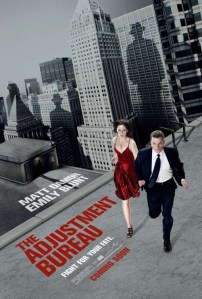 Gentlemen, if you were looking for an original excuse about not calling a girl back, try this one on for size: I couldn’t call because a team of men who control human destiny told me that if I did they would erase my memory and keep you from the fame that you are destined to achieve. She’ll probably at least give you points for originality before throwing a drink in your face (but it was all part of The Plan, or was it?).
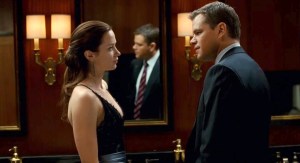
David Norris (Matt Damon) has just lost a New York congressional election thanks to his frat boy ways of old resurfacing. As he composes his concession speech inside the men’s restroom, he meets Elise (Emily Blunt), a ballet dancer hiding out. They have one of those crazy only-in-a-movie conversations that manages to feel authentic. Then they kiss. She inspires him to ditch his prepared remarks and speak from the heart to the national TV audience, which eats it up. David spends the rest of his days trying to meet the enchanting Elise again. Then he runs into a big stumbling block. He’s late to a meeting and catches a group of mysterious men in suits and fedoras fiddling around with people frozen like statues. They are the adjusters, the ones who ensure that the participants of mankind follow The Plan. These are the people responsible for the illusion of choice in our lives. If we deviate too far from The Plan, causing ripple effects that too need to be accounted for and adjusted, they step in. Richardson (John Slattery) is the spokesmen for the group and decides to just level with David. He is not supposed to be with Elise. He has a different future ahead of him, so sayeth The Plan. They will throw obstacles between the two of them. David seeks out Elise and fights against the whole universe for the two of them to make a future together.
 Horrible title aside, The Adjustment Bureau is a sometimes corny but often deeply satisfying movie. It may distract with some efficient and just-smart-enough sci-fi leanings and magic tricks, but it’s really a unabashed romance at its core. Not just that, it’s a good romance, once that flutter the heart and causes the ends of your mouth to do that thing, you know – smile. It helps when you have movie tars as gorgeous as Blunt and Damon, and are such good actors that they can fill their roles with dangerous amounts of charm, but let’s credit writer/director George Nolfi (The Bourne Ultimatum, Ocean’s Twelve). He takes a fairly routine concept (powerful forces control our lives and choices) and turns it into a finely tuned character-driven romance. Immediately from their first meeting in a men’s room, Blunt and Damon have that electric dynamic that you can genuinely believe in. Their chemistry will knock you over. You feel the spark between these two, which is essential because the two characters spend years apart at times, forever hoping to reunite. In that brief encounter, you fall in love as well and realize that this character, and this actress, is worth waiting for. I think people are going to be surprised that The Adjustment Bureau is a big gooey, stars-in-the-eyes love story, and it’s actually good. It’s a really enchanting love story, tackling the question of whether whom we love is a result of choice or destiny. This central concept is what every sci-fi element and thriller sequence is spun from. Here’s a funny thought: it’s all in service to the story.
It’s rare to see a studio movie that mixes so many different elements together to such effective, satisfying results. The film doesn’t get overly dark despite the cosmically long-reach and determination of the adjusters. There’s never any real threat of danger, only a broken heart or dashed dreams. The film has many light moments throughout, creating a rather bouncy tone that suits the romance angle nicely. The adjusters aren’t very menacing, more so comically perturbed. John Slattery, all silvery Mad Men appeal, is a perfect foil as the face of the adjusters. He feels like an exasperated parent baffled by the thought-processes of his youthful charge. It helps that these cosmic accounting agents have a finite level of power. If they had unlimited power then the film would fail to have any hope for David and Elise. But we learn that there are only so many adjusters that there are limitations to their powers, and that they can be outsmarted with enough gumption. Mingling with that light touch is enough whimsical science fiction to engage your brain. The concept of the adjusters and their supernatural abilities is nicely teased, setup, and then developed, making sure never to rock the audience with too much weirdness at one time. It’s a gradual process of discovery and it leads to a somewhat goofy, but infectiously amusing, climax that involves multiple doorway portals and magic hats. Yes, I said magic hats, which means there is an honest to God good reason why that stupid fedora hat, seen so prominently in advertising that it feels like the third-billed star, is featured. Admittedly, a concept like a magic hat that allows you to teleport through doorways would seem silly, but Nolfi makes it all work. The hardest aspect to believe (in a film with, I repeat, magic hats) is that Blunt could be a ballet dancer, let alone a future star of the medium. I’m by no means saying that the British beauty has anything to worry about in appearance, but she does not have a ballet dancer’s dangerously minuscule physique. Natalie Portman in Black Swan looked like a real-deal ballerina of fragile frame. Blunt doesn’t have the movement or the physique.
 In his directorial debut, Nolfi does enough good things, and does them with a smooth sense of style, to impress. The visual trick of going in one door and opening to another world walks a dangerous line of over saturation, but it’s playfully utilized enough to forgive. Nolfi is not perfect with his plotting, falling to misstep that can push back momentum. Characters will be chatting, and then they’ll walk away and we’ll get a title card that says something like, “Three years later,” and it sort of makes it feel like we have to start all over again. The fact that this happens more than once means that Nolfi might have wanted to plot his story around a series of events that occurred more often than Senate election terms. If we have to begin with David losing one campaign at the start and then zoom ahead at several points through another campaign, then perhaps the timeline could have been condensed a bit in retrospect. The film manages to be religious and faith affirming without pushing an agenda or overstating its romantic cause. The ones behind the plan are only referenced in oblique business terms, never confirming a certain high power but definitely nodding in that general direction.
Damon and Blunt are a terrific team. This is easily Blunt’s finest role as an actress since breaking out in 2006’s Devil Wears Prada. The actress has taken many a role that makes use of her large crystalline eyes and her sometimes go-to acting response of simpering. But in this film, she finally finds that perfect role that makes use of Blunt’s modest, goofy charm. She’s never been a leading actress in a traditional set; there’s always been a delightful goofy appeal that set her apart. When Blunt offers her playful smiles and asserts those glassy eyes of hers, you too will be smitten. Her character is a charming woman thanks to Nolfi’s writing, but having an actress of Blunt’s ability fill her out is a blessing. Damon is at a point in his career where he just grinds out good-to-great performances that manage to be convincing in unassuming, dignified ways. Damon has never been an actor given to the superfluous. His character feels like a sincere sport, which is amazing considering he’s supposed to be playing a politician. He’s the kind of guy you’d actually stand in the rain to vote for, and you understand why Elise would keep a place tucked away deep in her heart for the dashing Damon.
While the movie hinges on the coupling of Damon and Blunt, the rest of the supporting cast does fine work matching tone and making the most of their roles. Actors like Anthony Mackie (The Hurt Locker), Terrence Stamp (Valkyrie), and Michael Kelly (Changling) can make any movie better.
 The Adjustment Bureau, on paper, should not work. A sci-fi fantasy that’s unapologetically grounded in romance. A tone that nestles firmly in a safe, bubble-wrapped whimsy. And those magic hats, need we forget them? On paper this should be one overly silly, dumb, tonally disjointed, cornball movie worth venomous mocking. And yet it works; it does better than “works,” it succeeds. Blunt and Damon are terrifically charming together and imbue the movie with a sense of cheerful optimism in the face of uncertainty (and perhaps heaven itself). You desperately want these two crazy kids to get back together; they’re good, decent, charming people, winning personalities apart and even better together. What might have fallen apart in other hands becomes this endearing, fizzy piece of studio entertainment that fulfills and exceeds most expectations. I was really taken by this movie, won over by its effusive charm offensive, and left buoyant with happiness by the time the tidy, perhaps too tidy ending, came rolling. The Adjustment Bureau is hooey but it’s my kind of hooey.
Nate’s Grade: A-
Share this:

A Nightmare on Elm Street (2010)
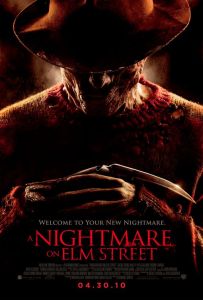 The next in an endless assembly line of vapid horror remakes, a new trip to the realm of Elm Street at least held some promise. The famous boogeyman Freddy Kruger was going to be played by Oscar-nominee Jackie Earle Haley (Watchmen). Has any other actor of Haley’s caliber played a blatant slasher villain in recent memory? And the playground of the Nightmare on Elm Street franchise was the world of dreams, which should be fruitful territory for some bug screen chills. I mean you don’t have to adhere to earth logic anymore, not that horror movies tend to. I didn’t expect much but I expected the movie to do more. Many of the signature moments from the first film are simply repeated. How does an entire school of young kids forget that Mr. Krueger molested them? What is the point of hiring Haley and giving him nothing to do? Lead actress Rooney Mara (soon to be seen in as the “girl” in David Fincher’s Girl with the Dragon Tattoo) looks as bored as somebody watching her movie. Her performance is lifeless for a film that requires energy and action. There is such wasted potential in the world of reams and personal fears. The whole movie just feels so rote and routine, following an established pattern of terrorizing the teens and knocking them off one-by-one; you get an overwhelming impression that everyone was just going through the motions, repeating someone else’s song and not bothering to make it their own.
Nate’s Grade: C-
Share this:

The Eagle (2011)
 In 140 AD, the Roman Empire has spread its reach across the European continent. Commander Marcus Aquila (Channing Tatum) is stationed in northern Britain. 20 years earlier, Marcus’ father led a legion of Romans into the northern British territory. The natives attacked them and Rome’s golden eagle, a significant idol under the guidance of Marcus Senior, was lost to history. Marcus has endured shame and vowed to redeem his family name. After surviving a nightly attack at the fort, Marcus displays great bravery but is injured. He’s honorably discharged from the Roman military. While he regains his strength, Marcus plans on venturing into the northern British highlands and finding that missing eagle. He teams up with Esca (Jamie Bell), a slave whose life he saved, and the duo goes beyond the wall that separates civilization (Rome) for the wilderness (native Britons).
Too often The Eagle feels like its wings were clipped. With such life and death stakes, the movie feels curiously adrift and prosaic. It never feels like it has any rush to go anywhere. In some regard, that makes the film feel like a product of the Hollywood of old, where a plot was allowed to meander and marinate to build to something worthwhile. But The Eagle is hardly worthwhile. It begins with some amount of excitement but that quickly dissipates with an interminable middle that feels like it’s still going on even as I write this. The plot is far too lean to cover a wide canvas, and the characters are far too shallow and incurious. They say so little, and what they do say means so little. It’s general variations on the idea of honor and sacrifice. They’re just focused on retrieving the prize. Meaningful conversation would just get in the way of things. The character dynamics between Marcus and Esca is stilted and kept at a distance. The class struggle and history of foreign occupation is never really addressed beyond a superficial nod. It’s like being stuck with two boring guys on a long, uninteresting road trip. Director Kevin Macdonald (State of Play, Last King of Scotland) gives the proceedings a docudrama touch thanks to his background in nonfiction films; too often this means he goes on half-baked Terrence Malick-like asides to admire a grain of wheat or some old artifact. The docudrama approach seems to conflict with the relatively old fashioned feel for this film, like Macdonald is trying to do his best to lift up material in want. There’s just so little at the core of this movie.
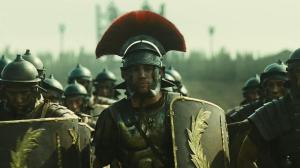 Tatum (G.I. Joe, Step Up) tries some form of an accent, though I’m not exactly sure what region of the Roman Empire the man is hailing from. He still has an imposing presence that manages to fill in the gaps of his acting ability, much in classic Hollywood tradition. And yet the man seemed more masculine in a Nicholas Sparks movie from last year. Bell (King Kong, Jumper) takes his haunted, submissive character to heart and gives a performance that confuses submission with understatement. He main mode of acting is the power of serious staring. The two actors don’t ever develop any onscreen sense of camaraderie or warmth. Even during the climax, you never feel like these guys have anything more than a civil employer/employee relationship. That’s why the laugh-out-loud, tonally jarring ending seems so out of place. Instead, Marcus and Esca strut through the halls of Rome, music triumphantly rocking out, and says, “What do you want to do now?” like they’re lining up weekly wacky adventures to be had. You’ll be surprised to see actors like Donald Sutherland, Mark Strong, Denis O’Hare, and even A Prophet‘s Tahar Rahim littered among the cast. Why are they in this movie when they have such insignificant parts compared to their bland leads?
The colonial perspective also started rubbing me the wrong way. Now colonial tales have long been featured in pop culture. I don’t on the surface have an issue with a storyteller utilizing a massive horde of natives to stand in as an antagonistic force. But sometimes that dynamic creates a skewed rather culturally tactless portrayal. Are the overpowered, conquering empires always blameless? Do the natives, who have been displaced and killed, not have a respectable grievance? Do they not have a right to fight for the lands that have been taken? Too often, the natives are viewed as blunt brutes (just watch the “cowboys and Indian” pictures from the 1950s) and the figures of expansion are viewed as heroic pioneers. The Britons come across as, essentially, the Indians. The filmmakers always want us to side with our hunky hero Marcus and his quest for honor at every turn, but the movie takes great turns to make the natives seem extra villainous. For a while they just come across like another culture. They have community, customs, and the like; it’s just not the dominant culture’s community and customs. And then, in an appalling moment of cheap melodrama, the Briton chief kills a child to send a message to Marcus and his Romans. This material is handled so indelicately that an unsettling undercurrent emerges and gains steady traction.
 So what if the Britons stole one gold eagle 20 years ago? “It’s not just a piece of metal. The eagle is Rome,” we are reminded by Marcus. Symbols are great, but a one-man search in a land as large as Scotland seems impractical so many years hence. And then you have to take into account the time passage. It’s been two decades seen this beloved bauble went M.I.A., and damn near anything could have happened to it. It could have been thrown into the ocean. It could have been buried. It could have been smashed to smithereens. It could have been taken to another land. It could have been melted down into smaller, gift-shop sized eagles on sale to the general public. I’m just saying that in the ensuing 20 years anything could have happened to this bird. The fact that one guy can traipse on foot through Scotland and the first group of natives he runs into happen to possess the artifact that went missing 20 years prior is just insulting. First chance and he lucks in? I was eagerly waiting for an ending where Marcus, brimming with pride at having returned the eagle to Rome, is informed by one of the politicians that it’s the wrong eagle (“Here we go again!”).
The Eagle is dressed up to be an old time adventure story, but it’s just too slovenly paced and generically plotted to work. The lead characters are bland, distant, and noble to the point of annoyance. When a character is defined entirely as forward thinking, exceptionally lucky, ethically straight figure of honor, excuse me when I start to yawn. And when all he’s tasked with is finding an old relic that miraculously happens to be with the first freaking group of people he finds, then excuse me for eyeing my watch. The Eagle has some workmanlike action and suspense to it, brief moments of activity over what is in essence two hours of silent walking (it’s like somebody cut out the middle of a Lord of the Rings movie and sold it). The Eagle, both the film and the titular hunk of metal, are simply not worth the effort.
Nate’s Grade: C
Share this:

Let Me In (2010)
 Essentially a faithful remake of the Swedish pre-teen vampire romance, Let the Right One In, this American reinterpretation loses points in originality and freshness but makes up for it with a bigger budget and better acting. Even fans of the original, and count me as one, must admit that Chloe Grace Moretz (Kick-Ass) as a pint-sized vampire stuck forever in pre-pubescence, and Richard Jenkins (The Visitor) as her aging caretaker, are upgrades. The true surprise is the eerie assuredness of the entire production from director Matt Reeves, he of shaky-cam Cloverfield fame. The entire film just feels so placidly precise, even as it draws tension and sets up for one vicious poolside climax. Some of the audience unfriendly moments from the original have been exorcised (say goodbye to lingering gender identity questions), but Let Me In still happily dwells in an unsettling place, forcing its characters to do questionable things in the name of companionship and forcing the audience to decide how they fell about that. Also, the film still retains its ambiguity for interpretation; whether you view it as a depressing saga of use and abuse, or an disaffected teen romance is entirely up to you. Let Me In won’t grab peoples’ attention in the same way its Scandinavian predecessor did, but it doesn’t screw it up either. And these days, that’s got to count for a lot.
Nate’s Grade: B+
Share this:

Dogtooth (2010)
 Dogtooth is a surprising, sometimes shocking, sometimes maddening vicious little film that serves up dark satire with plenty of tense, incredulous laughter. But make no mistake; this is no comedy in the traditional sense. This Greek flick is deceptively slow-witted, drawing us in to a very different world. The film chronicles the three teenage children (one older brother, two twin sisters) kept at home in isolation by their parents. These kids have been taught to fear the outside world, they have been taught erroneous vocabulary (a “zombie” is a yellow flower; a woman’s privates are known as a “typewriter”), they believe that cats are man-eating beasts, that Frank Sinatra is their grandfather singing to them, their dead little brother lives on the other side of a hedge that they toss food to, and that overhead planes can be plucked from the sky. They even have to get on all fours and bark to scare away intruders. And then there’s a troubling budding sexual element, made considerably more complicated once the woman the father hires to satisfy his son introduces sexual curiosity to the twin sisters. Dogtooth is a detached yet fascinating portrait of one seriously screwed up family, where children are trying to make sense of the limited and sometimes fantastical concepts they’ve learned through severe sheltering. This manufactured artificial world, a satiric swipe at those who believe ignorance to be a suitable protection, is perilous yet believable. Dogtooth raises plenty of questions about the nature of society, parenting, knowledge, responsibility, and identity all in a package of bleak social satire that Luis Bunuel could admire. It may take some effort, but give yourself over to this Greek oddity and enjoy the unique weirdness.
Nate’s Grade: A-
Share this:

The Mechanic (2011)
 The Mechanic is a routine remake of a 1972 Charles Bronson hitman thriller. But when did “mechanic” ever become commonplace slang for “killer”? The film treats this concept like everyday knowledge. Bishop asks, “You know what a mechanic is?” A character responds matter-of-fact: “A hitman.” And the “mechanic” services are advertised via a system that includes a Craigslist style message board. It makes me wonder what the “adult services” section on Craigslist was really all about this whole time.
Arthur Bishop (Jason Statham) is the world’s greatest hitman. He meticulously plans his hits, deciding whether to make it look like a suicide or an accident or whether to send a message. He’s the cleanest of the cleaners. Then he gets a very delicate assignment – he’s to take out his mentor, Harry McKenna (Donald Sutherland, taking a paycheck). Bishop’s boss (Tony Goldwyn) tells him that somebody is going to kill Harry. If it’s Bishop at least he can make it more humane. Bishop takes out his mentor and makes it look like a carjacking. Then Harry’s screw-up of a son, Steve (Ben Foster), appears to get vengeance for his old man. Bishop takes the hotheaded kid under his wing and trains his to be an assassin. Then, naturally, Bishop discovers he was set up and played by his employers, which brings about a larger examination on the cyclical nature of violence. Just kidding. There’s more killings.
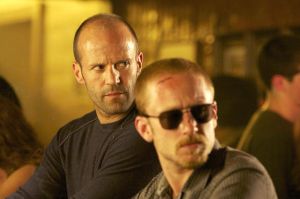 To say that The Mechanic is a well-oiled formula picture is probably the kindest thing that can be said. It follows the path of its hitman forbears fairly close. The opening pre-credit sequence is a hit that established the abilities of our deadly lead, Donald Sutherland pops up just long enough to lay down the necessary exposition for the film, and then before we even finish the first reel (20-minute mark) the movie manages to introduce a sexy female (Mini Anden) whose only purpose, in grand action movie tradition, is to have enthusiastic sex with the lead whenever his tank is low. The rest of the movie follows rather lockstep with the various beats of the genre, meaning that Bishop takes on an apprentice, shows him the ropes, they bond by taking out the bad guys, and then of course the final show drops and the truth about Bishop killing Harry is revealed. Along the way, The Mechanic does enough to satisfy genre fans looking for the goods when it comes to thrills.
The best moments are the tag-team hitman efforts of Bishop and Steve. The stuntwork is occasionally impressive like when Bishop and Steve repel down a large hotel building or when a car literally drives all the way inside a bus. There’s a brutal, visceral fight between Steve and his first kill that serves as the film’s highpoint. It was these sequences that made me actually sit back and think, “You know, I think this concept would actually play best as an ongoing TV series.” Think about it: you’d have your target of the week, the planning and execution that always make for satisfying payoffs, and then week-to-week Bishop and Steve would continue their complicated relationship with Bishop’s guilt eating away at him while he tries to keep the truth at arm’s length away from his neophyte partner. To me, that sounds much more dramatically rich while still keeping the body count consistently high.
Of course by hewing so close to the confines of genre, The Mechanic also has very little going on outside of the mini-missions of the hit jobs. Bishop obviously has been misled and setup by his sleazy employers. It’s fairly clear early on that when a guy gets out of a limo in a three-piece suit and tells you that the old man in the wheelchair is the bad guy, red flags should be waving. There doesn’t seem to be a formidable opponent in this fight mostly because Bishop is long described as the best at what he does. So how do you stop the best? You’d think you’d hire other players of comparable skill or offer an incalculable amount of money to kill the guy. But our villain doesn’t do any of this. Five minutes prior to his death, our villain fails to even once threaten Bishop (don’t even pretend like that’s a spoiler). The main conflict is really the complicated connection between Bishop and Steve; however, this relationship is kept at a slow simmer the whole film, even after Steve pieces together the ugly truth. The character development is left mostly at an inferential level. That means that there are long stretches where the characters glare, dispense with macho cool speak, glare with sunglasses, and then fall back on some unique hitman quirk they all have to relax (Bishop listens to classical music on vinyl records because he takes life yet appreciates beauty! IRONY!).
 But the ending needs to be further discussed because it leaves a terrible aftertaste. Given the dramatic dynamic at work, you pretty much know that Bishop and Steve will eventually come to a head. Bishop regrets what he’s done and is trying to make amends and find some meager form of redemption by taking Steve under his wing. He’s trying to make amends for the many sins in his life. He’s coming to terms with his life’s choices. So then you would assume (spoilers to follow) that when Steve ultimately seeks his own very deserved sense of vengeance, that the old pro would accept his doomed fate. It makes the most sense. It provides an end for the character’s journey, it provides closure to Steve, and it allows for an ending where people have to pay for their life’s mistakes. It’s not even downbeat because it feels right; it’s the correct ending for this material. It’s also the way the original Mechanic ended. But why end the movie on Statham accepting death? That would shuttle any chances for Mechanic sequels. And so, in a colossal cop-out, our hero narrowly survives and even manages to set up a bomb to take out Steve. While his young partner was emotionally unstable and looking for an outlet for his billowing anger, but the man was warranted in his vengeance. It’s entirely the wrong ending for not just this kind of movie but this movie specifically. It smacks of a pathetic attempt to leave the option open for a would-be franchise. It eliminates the entire idea of consequences mattering.
Statham gives the exact same performance he’s been giving in every movie for a decade plus. You know what you’re getting with a Statham action vehicle, for better or worse. He’s going to get shirtless, he’s going to dispatch the bad guys with relative ease, and never once will an expression flash across his stony face. He even verbalizes guilt while still being completely stone-faced. You don’t really buy any inner turmoil with this guy; he’s too “cool” to have feelings other than anger and vengeance. But then Foster practically redeems the entire movie. The young actor has been delivering intense performances for years now, whether it is an emotionally unstable guy in Alpha Dog, an emotionally unstable guy in Hostage, an emotionally unstable guy in 3:10 to Yuma, or an emotionally unstable guy in The Messenger. Notice a pattern? I’m amazed the reservoir of little tricks Foster finds to make Steve pop. Foster gives a far better performance than the movie deserves.
The Mechanic is a routine action movie that fails to rise above its genre conventions due to a lackluster plot, some vapid character development, and a horrendous ending. Statham does his thing, his shirtless chest gets due prominence, but the movie lets both he and a game Foster down. The kills are rather sloppy leaving behind mountains of evidence and dead bodies, and yet there seem to be no consequences. That makes for a long march to an inevitable conclusion with a few bursts of colorful violence to entertain. But what actually exists on the screen isn’t half bad. It’s fairly unremarkable, straightforward genre pap, but that can be suitable for the right audience and the right frame of mind. I was seeking something brainless to excite me when I caught The Mechanic, and it modestly achieved these modest goals.
Nate’s Grade: C
Share this:

127 Hours (2010)
 So would you give your right arm for a good movie? 127 Hours is the true-life tale of a man trapped between a rock and a hard place. Hiking in dusty canyons, James Franco gets his arm pinned under a rock. And that’s about it from the plot standpoint. That’s because everything is leading up to the grisly inevitability that he will be forced to cut his own arm off for survival. And director Danny Boyle (Slumdog Millionaire) does not let you off the hook. You will see every gruesome second of a man hacking away his own arm, slicing nerve-by-nerve, crushing bones, etc. It’s not the uplifting experience that Boyle and the producers mistakenly believe. The film’s true success is that it still manages to be entertaining and exciting, despite having a central character unable to move more than inches. It’s fascinating to watch Franco use the tools at his disposal to survive for five days before, well, you know. Boyle does a terrific job of making an intimate almost claustrophobic plot feel much more open. Nobody probably could have done this movie better than Boyle, taking his kinetic trademark style and allowing us to enter the mind of Franco’s fallen hiker. 127 Hours isn’t so much an inspirational tale as it is a morbid curiosity that entertains in spurts. But all the visual tricks in the world can’t get people to want to pay to see a man cut off his own arm.
Nate’s Grade: B


 nathanzoebl
You must be logged in to post a comment.