Blog Archives
Night Swim (2024)
 It feels like the genesis of Night Swim was somebody saying, “We need a new way to do a haunted house movie so… what if…?” and then just pointed to different parts of the home and questioned whether it could be haunted. What I’m saying is we were probably a coin flip away from a terrifying tale of a haunted barbecue grill (working title: Dead Meat). A haunted pool would naturally lead to the question, “Well, why don’t you stay out of the pool?” and, well, we don’t really have an answer, so the pool can’t do too much because it’s immobile. There’s a possibility here with some spirit linked to the pool water seeking sacrifices and offering rewards in return, but this is downplayed so much and eventually forgotten during the muddied reasoning that concludes this confusing movie. I don’t think the film can even stick to its own rules. It needs to be either goofier, fully embracing its ridiculous premise of a haunted swimming pool, or going even darker and deeper with its back-story and rules and how this corrupts the new family, not because of some evil possession but from the simple wish-granting opportunity of feeding this monster for personal gain. There’s a way to make this concept work, specifically bringing the revelation earlier and dealing with the devil’s bargain implications and moral relativism. Alas, instead we get a movie about a husband being possessed by evil spring spirits and literally playing a game of Marco Polo with his children and, upon stalking them, pounces by ominously shouting, “You’re supposed to say ‘Polo’!” Just keep swimming, folks.
Nate’s Grade: C
Share this:

Anatomy of a Fall (2023)

I was so looking forward to watching the French drama Anatomy of a Fall, nominated for five Oscars including Best Picture and Best Director for Justine Triet, that I had to track down the publicity department for Neon Studios and hound them to finally get my annual Neon screener box-set for critics. It took several weeks, and email chains, but thankfully the good folks at Neon supplied me with their screener box, like Christmas morning for a film critic. The surprise Oscar nominations only made me more eager to finally watch this movie. As Anatomy of a Fall played, and the criminal case became ever more complicated, shedding further light upon the characters and their stormy marriage, I found myself sitting closer and closer to my TV, finally sitting on the floor right in front of it. Part of this can be explained by trying to better read the subtitles, though truthfully half of the movie is in English, but the real reason was that I became absorbed, waiting anxiously to see where it could go next, what twist and turn would further reassess our fragile understanding of the events, the people, and the possible circumstances. The original screenplay is so thoroughly engaging, and with supremely talented acting and clever directing, that I knew I was in good hands to ensure my investment of 140 minutes wouldn’t be wasted.
Popular novelist Sandra Voyter (Sandra Huller) is talking with a female reporter about her process as they lounge in her home. They’re drinking, laughing, and then the loud sounds of a steel drum start echoing from upstairs, thanks to Sandra’s husband, Samuel (Samuel Maleski), who puts the song on repeat. He’s passive aggressively sabotaging the interview, and Sandra bids goodbye to the interviewer. Hours later Samuel is found on the ground outside with blood seeping from a head wound. The attic window is open, the same attic he was remodeling before presumably falling to his death. Did he take his own life or was foul play involved? Did Sandra actually kill her husband?

At its core, the movie is an anatomy of a criminal investigation, a prosecution and the personal defense, but it’s really an anatomy of people and the versions of themselves that they selectively present to others and themselves. It’s an old maxim that you can never know what’s going on inside a marriage, or really any relationship, as the inner reality is far more complex than what is easy to digest and categorize by the public. It’s not new to hide aspects of ourselves from wider scrutiny and consumption. It also isn’t new for a larger public profile to invite speculation from online busybodies who think they are entitled to know more. The mystery about whether or not Sandra is guilty or a cruel victim of suspicious circumstance is a question that Triet values, but clearly she values other more personal mysteries more, chiefly the mystery of our understanding of people and why they may choose to do inexplicable acts. How close can we ever really know a person? The upending of her life pushes Sandra to re-examine her own marriage in such a high stakes crucible that can determine whether or not she spends the rest of her life in jail. Under those extreme circumstances, the bigger question isn’t how someone may have committed murder, or taken their life, but the unexamined why of it all that nibbles away at Sandra as well as our collective consciousness as viewers. To me, that’s a more compelling and worthwhile mystery to explore than whether or not it was a murder or suicide (there is a wild theory finding some traction online blaming the death on the family dog).
I don’t feel it’s a significant spoiler to prepare the viewer to know that Triet keeps to ambiguity to the bitter end, refusing to specify what actually happened to Samuel. It’s ultimately up to the viewer to determine whether they think Sandra is guilty or innocent, and there’s enough room to have a debate with your friends and Francophile colleagues. I’ll profess that I found myself on the Team Sandra bandwagon and fully believed she was being railroaded by the French judicial system and press. The righteous anger I felt on behalf of this woman rose to volcanic levels, as it felt like much of the French prosecution’s line of questioning and theorizing was mired in blatant eye-rolling misogyny and conjecture. They insist that because Sandra is bisexual that she must have been flirting with her female interviewer on the day of Samuel’s death, because that’s how it works for bisexuals, obviously, to only be able to size every person they meet, no matter whatever anodyne circumstances, as some possible or inevitable sexual conquest. As an outsider to the French judicial system, I was intrigued just by how the trials are conducted, which seems far less formal despite the wigs and robes, where the accused can interrupt anytime to deliver speeches and question experts. I also appreciated how much attention Sandra’s family friend and defense attorney puts into helping her shape her image, to the press, to the court, to the judge, down to her perspective of her marriage to her vocabulary choices. Rather than be a reflection of Sandra as coolly calculated, I viewed it as learning to prepare for the dangers ahead. It reminded me of Gone Girl with the media-savvy lawyer coaching his high-profile client through their trouble.
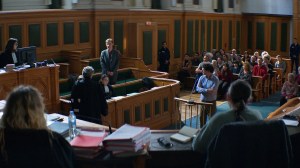
Of course, there are larger implications with this prosecution. Sandra isn’t just on trial for suspicion of killing her husband to clear the way for her next lover, she’s the victim of all the ways that women are judged and found guilty by society. Sandra is a successful novelist, the top provider, and her husband isn’t, and it eats away at him, festering resentment that she is somehow stifling his own creative dreams. Is she giving him space or being distant? Is she doing enough or too little? Is she a supportive spouse or selfish? Is she a good mom or a bad mom? Is she allowed an independent life or should she be fully devoted to the titles of mom and wife? It’s the struggle to fit into everyone’s impossible and conflicting definition of what makes an acceptable woman and mother, and it’s infuriating to watch (think America Ferrera’s Barbie speech but as a movie). It’s also an indication of the cultural true crime obsession and turning people’s complicated identities and nuanced relationships into easy-to-digest fodder for morbid entertainment. It’s not like there’s some grand speech that positions Sandra as the martyr for all of embattled womanhood, but through her trial and media scrutiny, these social issues are projected onto her like a case study.
As much as I loved Lily Gladstone and Emma Stone in their respective performances in 2023, at this point I’d gladly give the Best Actress Oscar to Huller (The Zone of Interest). First off, she delivers a tremendous performance in three separate languages, as her character is a native German who marries a Frenchman and then they agree to speak in English as their linguistic “middle ground,” a language that isn’t native to either of them. Huller slips into her character seamlessly and it’s thrilling to watch her assert herself, press against the bad faith assumptions of others. One of the highlights of the movie is the most extended flashback where we witness the simmering resentment of this marriage come fully to force, and while it’s unclear whether this moment, as the other occasional flashbacks, is meant to be conveyed as Sandra’s subjective memory or objective reality, it serves as a mini-climax for the story. It’s here where Sandra pushes back against her husband’s self-pitying criticisms and projections. It’s a well-written, highly satisfying “Amen, sister” moment, and Huller crushes it and him. There were moments where I was in awe of Huller that I had to simply whistle to myself and remark how this woman is really good at acting. With such juicy material and layers to sift through, Huller astounds.

Another actor worth celebrating is Milo Machado-Graner (Waiting for Bojangles) as the couple’s only child Daniel, a young boy who is partially blind because of an earlier accident from Samuel’s negligence and the one who discovers his dad’s body. This kid becomes our entry point into the history of this marriage but it also turns on his perceptions of his parents, as Sandra is worried over the course of the trial that Daniel will learn aspects of their marriage that she was trying to shield from him, and he may never be able to see his father and mother the same way again. It’s a rude awakening for him, and key parts of the trial rest upon a child’s shaky memory, adding intense pressure onto a hurting little boy. There’s a key flashback that will change the direction of the case, but again Triet doesn’t specify whether this is Daniel’s memory, Daniel’s distorted memory looking for answers whereupon there might not be any, or the objective reality of what happened and what was said. Machado-Graner delivers a performance that is built upon such fragility that my heart sank for him. It’s a far more natural performance free of histrionics and easy exaggerations, making the response to such trying events all the more devastating.
Anatomy of a Fall was not selected by its home country for consideration for the Academy’s Best International Film competition despite winning the Palme D’Or, the top prize, at the prestigious Cannes Film Festival. Not to take anything away from 2023’s The Taste of Things, a French drama I’ve heard only fabulous responses, but clearly they picked the wrong contender and lost a winnable race. Do you know the last time France won the Oscar for Best Foreign/International Film? You have to go all the way back to 1991’s Indochine, a movie about the history of France’s colonial occupation of Vietnam. For a nation known for its rich history of cinema, it’s now been over thirty years since one of their own movies won the top international prize at the Academy. Oh well, there’s always next year, France. It’s truly befuddling because Anatomy of a Fall is such an easily accessible movie that draws you in and reveals itself with more tantalizing questions. It has supremely accomplished acting, directing, and writing. Anatomy of a Fall is a spellbinding, twisty movie and one of the absolute best films of 2023, in any language.
Nate’s Grade: A
Share this:

It Lives Inside (2023)
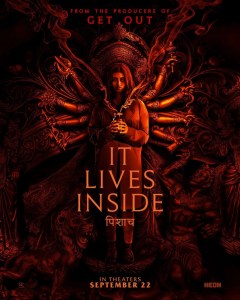 It’s a horror movie as examination on assimilation from an Indian-American standpoint and giving a different culture its own big screen boogeyman. It Lives Inside is about Samidha, a teenage Indian-American girl trying to fit in her suburban high school, which often involves her downplaying or abandoning her cultural roots and practices. She’s all but abandoned her childhood friend Tamira as an impediment to her social acceptance by the cool Caucasian kids. She then feels even more guilt when her friend goes missing and might be possessed by a demon of Hindu lore that feeds off negative energy (no wonder it’s targeting high school girls). This is the latest movie that uses the vehicle of horror to examine more personal themes, bringing a specific culture into the forefront and allowing wider audiences to learn from the horrors of trying to fit in when you feel different and ashamed for being different. As Samidha searches for her missing friend, she’s also forced to seek out help from her disapproving and more conservative mother, a woman steeped in her heritage. Where the movie left me wanting was in the exploration of its specific mythology as well as the development of the divide between mother and first-generation daughter. That’s the core of what can make this movie special, and yet what we get are more scenes of jump scare PG-13 terror and canoodling. It’s not a terribly scary movie, though the eventual creature design has some nicely unsettling angles. There’s one moment of hair floating that really unnerved me, but most of the movie falls on generic atmosphere effects. There are so many sequences of one high school English teacher working alone in the school (where is anyone else? Does this woman do nothing else?) and running through corridors as lights flicker and sinister sounds linger. By the end, It Lives Inside is an acceptable horror movie that would have benefited from spending more of its time on the perosnal elements that would have made it stand out rather than fit in with the horror crowd.
Nate’s Grade: B-
Share this:

The Iron Claw (2023)
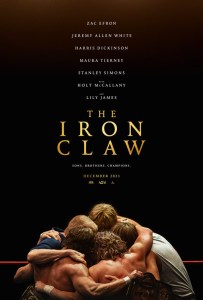 The true story of a wrestling family that was beset by so much tragedy it might as well be a lost Shakespearean drama. The Iron Claw follows the Von Erich brothers, lead by oldest brother Kevin (Zac Efron). They’re all competing for their father’s approval, the same man who gives them updated son rankings at the breakfast table. Kevin and his three brothers (Jeremy Allen White, Harris Dickinson, Stanley Simons) are living out their old man’s dream of being a professional wrestler of significant renown, and the appeal of the brothers is as a fighting family of wrestlers rather than as single entities. In essence, they don’t seem to matter unless as a collective. This leads to plenty of misguided attempts to curry favor with their toxic parent and a pile-up of tragedies that would be absurd if it wasn’t actually true. The issue for me was that I didn’t see the other brothers as fully dimensional characters, and side stories like Kevin’s romantic escapades felt lacking as illumination. It felt for much of its running time like a good movie but one going about its business with a little too much expediency. I was interested but felt like the brothers were more reflections on Kevin than their own separate characters. However, the film’s last twenty minutes are by far the best part and finally find a way to elevate the drama as well as better personalize it through Kevin’s grief and survivor’s guilt. “It’s okay dad, we’ll be your brothers,” spoken with the innocent yearning of a child, pretty much broke me and caused me to sob. If you’re a fan of 1980s professional wrestling, or meaty dramas about the suffering of strong men from strong men, I’m here to assure you that it’s okay to cry here. The Iron Claw is a fine drama that comes together by its end for an off-the-ropes wallop, and the lingering sadness is one that will be hard to shake for hours.
Nate’s Grade: B
Share this:

The Butterfly Effect (2004) [Review Re-View]
 Originally released January 23, 2004:
Notice: I found Ashton Kutcher, star of The Butterfly Effect, on a trip to buy dog food, and cordially asked him to write a review. This is what he sent me. It’’s totally him. I wouldn’’t make this stuff up. That would be dumb.
“So, like, this Nate guy asked me to do a review of my new awesomest movie, The Butterfly Effect. Dude, like anyone needs a review for the most awesomest movie ever. I mean, like, the term ‘awesomest movie ever’ should say, like, everything. The only thing possibly more awesome than The Butterfly Effect would be trucker hats …… or two chicks totally making out. And I only said ‘possibly more awesome,’ which doesn’’t mean it is more awesome, because, dude, like I said before, The Butterfly Effect is the most awesomest thing ever. You can’t dispute that. Don’t even try. I’m awesome!
Like, the story goes like this, man. I play this guy, like I know big stretch there, but he’s not the most awesome guy ever, which is what you’d be thinking since it’s the most awesomest movie ever. But no, he’s like this kid who blacks out and has this wickedly twisted childhood where he stars in his neighbor’s kiddie porn, has his dog set on fire, and, like, his dad is all crazy, or, like I like to say, insane in the ole’ membrane. Ha, I totally made that up right now. I’m awesome!
So, you’re like saying, ‘Dude, that movie sounds less than awesome. Yes, sir, I am having definite doubts about the awesomeness of this movie. Like, do I need to go to the movies to, like, feel bad? I got my parents to do that for me. That and school.’ Hey man, I’m there, I know what you feel. ‘Cause right when you are like, ‘Dude, when is Demi gonna’ show up playing his mom?’ I find these old journals of mine and, dude, use them to travel back in time. I know, the awesomeness has returned. And I use the journals to go back and try and punk time, man. I try and make things better and change the future but I like totally just make it worse. I know, double punk’d, man! I try and fix the life of this hot girl in the movie (she showed her boobs in that Road Trip movie, did you see that? That part where she shows her boobs, oh man … It is awesome) but things don’’t work out. Like she becomes a crack ho at one point. Dude, total punk’d. I’m awesome!
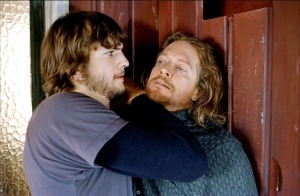 I should be taken as a serious actor. I didn’t hit my head on something and I grew a beard, what more do people need to know I got the goods? I mean, I don’t want to keep saying it but …… beard. C’mon! When actors want to be taken seriously they, like, grow beards. That’s why all those people in movies before 1970 (I know, it surprised me too that there were older movies) got awards and stuff. Beards, dude. Beards. When Billy Dee Shakespeare, like, invented acting, he totally imagined dudes, and chicks too, with beards. That’s why girls can’t be taken as serious actors, ‘cause they can’t grow beards. Ha. I’m awesome!
So, like, if you ever wondered what it would be like to see me, Ashton Kutcher, the most awesome man alive …who ever lived, no… the most awesome human being …-the most awesome thing …- ever, as a frat boy, or like, some poor dude with no arms, then you should see my new movie, The Butterfly Effect. After all, it is the most awesomest thing ever. That’s awesome. So, like, you people reading (is that what school is for?) should go see my movie. I’ll tell you why in two words: beard.”
Nate’s Grade: C+
——————————————————
WRITER REFLECTIONS 20 YEARS LATER
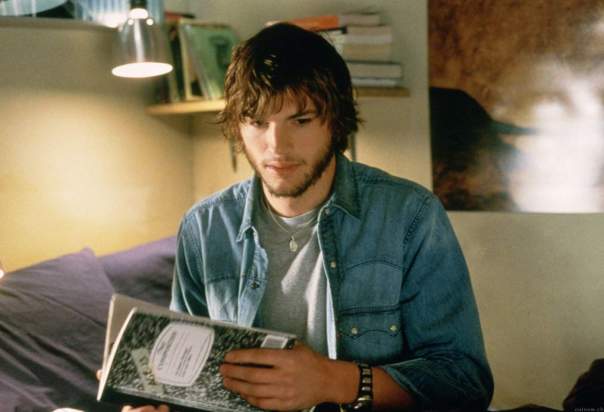
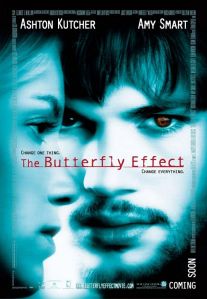
It’s hard to remember but there was a time where Ashton Kutcher was the king of the early 2000s universe. He had parlayed his excitable supporting character on a late 90s network sitcom into a successful movie career top-lining wild comedies, and he had also found success as a producer, bringing new life to the hidden camera prank TV show with his eponymous Punk’d where many of his celebrity friends would be victimized for the lols. The man even single handedly made goofy trucker hats a fashion mainstay. I know we haven’t seen much of the Kutch in a while, as he’s settled into his non-profit charities and being a family man, ceding the spotlight to his wife and former sitcom girlfriend, Mila Kunis. The Kutcher brand was stronger than ever at the time of The Butterfly Effect, enough so that Kutcher signing on as an executive producer was what finally got this widely read industry script to finally get made. You must view The Butterfly Effect as a point not just in Kutcher’s career but also in millennial edge-lord culture, the concept that anything dark is therefore compelling, and the more twisted the better. Re-watching the movie twenty years later, I wanted to laugh out loud at so many points because The Butterfly Effect is so serious while being so silly as it plumbs every depth of misery, both for its characters as well as any potential audience members still keeping track of the messy metaphysics.
Kutcher plays the adult version of Evan, a kid who has had quite a challenging upbringing to put it mildly. Mom (Melora Walters) is doing her best while Evan’s father is locked away in a mental asylum, and she’s worried her child might have inherited dad’s instability. He blacks out for extended periods and is found holding a knife or having drawn a horrible massacre at school, and even worse neighborhood tragedies (oh, I’ll get to all of them). A psychiatrist advises him to start journaling as a therapeutic means, and so he does, and when adult Evan reads his childhood journals, the words become blurry and he’s able to travel back in time to those exact moments. With this great power, adult Evan tries to right the wrongs of his life and those around him, but as all time travel stories are destined to discover, there are cruel unintended consequences to endure.
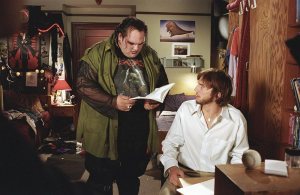 Watching this movie is like watching a checklist of events that producers thought would be dark and grisly and So Messed Up, but this movie is so self-serious that it could be a parody of what a moody teenager would think of as a “mature movie.” Let me just list some of the content the movie covers: the drunken dad next door (Eric Stoltz) is a pedophile who records his daughter and son and Evan in child porn, the kids put a firecracker in a mailbox that blows up killing a mother and her baby, an angry kid kidnaps Evan’s dog and ties him in a bag and literally sets the bag on fire killing the animal, lots of violence against young children including murder, attempted suicide, disturbing behavior in children including traumatic self-harm at school, prison rape, multiple mental asylums, disfigurement and disability, prostitution and addiction, and in the original ending, the one I re-watched, a fetus literally strangling itself with its own umbilical cord rather than being born. Wow. Just… wow. This movie is only two hours and it crams enough sundry melodrama and grimdark grist to fill out a month of the grimiest soap opera ever. Because of the sheer amount of disturbing content, every new provocative addition makes the movie’s tone teeter further and further into unintended self-parody. Once you’re starting to process the homegrown child pornographer, the movie throws animal cruelty at you, and so on. It’s not enough that Evan had a bad childhood of trauma, but does he have to experience all the traumas?
Much of the movie follows Evan’s morose quest to improve the life of his unrequited love, Kayleigh (Amy Smart as the adult version). He runs into her after several years apart and merely bringing up the past with her pedophile father filming the two of them propels her to kill herself off-screen. She’s literally introduced in one scene and then in the next she’s dead, and it’s all Evan’s fault, so says her angry brother via the answering machine clunkily informing us. Evan goes back and stops her dad from molesting her, so now dad only molests her brother Tommy instead, who Evan kills as an adult defending himself. He travels back in time and now her brother is dead and she’s become a heroin-addicted hooker and that won’t do. He travels back again and manages to improve the lives of Kayleigh, Tommy, and their friend Lenny, except in this timeline Lenny and Kayeligh are the romantic couple and Evan has no arms, having lost them in the childhood mailbox explosion. He travels back again and this time Kayleigh gets blown up as a child. Ultimately Evan concludes he cannot save her and have everything he wants, so he makes some form of sacrifice by the end; in the theatrical cut, young Evan upsets her so she chooses to live with her mother rather than her pedophile father, and in the director’s cut, he ensures Kayleigh will never meet him by killing himself in the womb (his mother reveals she’s had multiple miscarriages, leaving the impression other future siblings have done the same). I appreciate how the filmmakers have streamlined their convoluted time travel tale into a simple task of trying to get the girl, but it also becomes so overwrought that I wanted to shake my head and sigh.
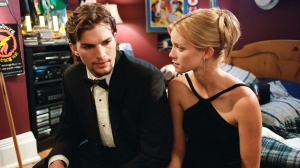 These characters are put through an emotional and often physical grinder, so it’s hard not to feel sorry for them. I long felt the film’s contempt for Kayleigh ever since young Evan (a young Logan Lerman) tells her, “You don’t even know how beautiful you are,” like she’s so stupid to see the obviousness of his compliment. I think dark comedy is the best way to read the movie, laughing along the way as Evan fails time and again to improve the lives of everyone through his space-time interventions. He can save this kid but doom his mother to lung cancer. He can save this person but is locked away in prison. It’s a no-win scenario for Evan, so he decides it’s better if he was never born, negating all the possible good he’s done in his life, including maybe being a force that could keep Kayleight from living with her dad. Maybe not having that friend and an advocate push her into that decision doomed her to a life of molestation, so way to go Evan.
I kind of loathe the time travel method in this movie but at least it provides a limitation that works within the universe of The Butterfly Effect. He can only travel reading his journals, which means he’s stuck in whatever nightmare timeline he’s responsible for unless he can recapture some part of his childhood scribblings. Reading them aloud is also an unexpected source of dark comedy because it makes me question how forthcoming a child of trauma would be about writing down his experiences in simplistic shorthand (“So today Kaleigh wasn’t feeling so good. Her face blew up. I was sad”). I did like that this inherited disorder provides more mystery to his family line, a source of material not covered in either of the Butterfly Effect direct-to-DVD sequels unrelated to Evan’s troubled story. This is perhaps the second worst method of time travel I’ve found in the movies after 1980’s Somewhere in Time where Christopher Reeve uses the power of positive thinking to convince himself he’s in 1912, and lo and behold he shall be.
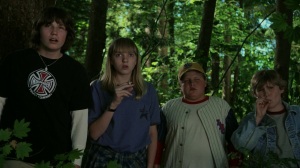 Watching this movie is like revisiting a Goth phase you had as a brooding teenager but have since considered a point of embarrassment (not that being Gothic is something to be ashamed of, simply that it was an overzealous step in asserting a misguided sense of what being a mature adult meant, generally disaffected and cynical and edgy for its own attention). The Butterfly Effect is an endless improv game of “yes and” where the proceedings only get worse. My original review in 2004 was one of my more unconventional reviews, and I just wanted to adopt my perception of the “Kutcher brand” persona of the era and make a bunch of dumb jokes, several of which I’m not too ashamed to admit still made me chuckle (“two words: beard.”). I’d lower my grade a tad but there is still a car-crash fascination of watching a movie try so transparently hard to be so twisted.
Re-View Grade: C
Share this:

American Fiction (2023)
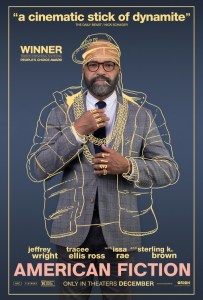
Cord Jefferson’s hilarious, inflammatory, and insightful comic fable can be boiled down to the question of what exactly does it mean to be a “black writer” in this day and age? According to the main character, English professor and middling writer Thelonious “Monk” Ellison (Jeffrey Wright), he would pointedly argue that he is a black writer and thus his novels, never ones to climb a best-seller chart, should qualify as black literature. The publishing industry seems to think differently. Their conception of a “Black story” is one defined through poverty, guns, drugs, gang violence, degradation, and all sorts of depressing stereotypes of socioeconomic disadvantage. If there are stories of triumph, they will usually be relegated to the same familiar settings of struggle: slavery, the Civil Rights era, and modern ghettos. A simple slice-of-life about a middle-class family isn’t necessarily seen with the same level of acceptance. With American Fiction, Jefferson and Monk push through, trying to exploit a system of exploitation at its own game, and the results are biting and hilarious and a condemnation of the low expectations that can govern the supposedly open-minded values of others when it comes to celebrating authentic minority stories.

The movie really takes off once Monk decides to, as a sarcastic lark, give the publishing world what it seems to crave, a novel (My Pafology) that plays into every urban stereotype. He adopts a nome de plume, “Stagg R. Leigh,” and riffs that he’s currently a fugitive from the law. The intention was to make fun of the limited black literary stories that he despises, and yet the incendiary manuscript becomes a hot commodity. They’re already talking about turning it into a movie. Monk is aghast but the money is very appealing, so he puts his moral superiority aside to see how far he’s willing to pander if the check is right. His alter ego is deemed more authentic and compelling when he doesn’t even exist and is only a combination of the same worn-out and destructive stereotypes. It becomes an ongoing game for Monk to see where exactly a line can be drawn. He actively tries to make his manuscript objectively worse, and at every step it only seems to have the opposite reaction among white editors and agents and producers salivating to celebrate it. There’s a very telling scene where Monk is part of a literary award body scouring through manuscripts for potential worthy award-winners. He and another prominent black author (Issa Rae), the best-selling author of We’s Lives in Da Ghetto, are critical of My Pafology and its adherence to harmful stereotypes, but the white liberals won’t hear it and want to reward it. “It’s really important that we listen and uplift black voices,” one of them says obliviously. Of course, if they knew the truth that the author was really an upper middle-class East Coast academic, there wouldn’t be the same rush to elevate this “brave and inspiring” story of the streets. To Monk’s ire and chagrin, there is no bottom when it comes to the appetite for degrading stories that neatly fit into a pre-existing mold.
Jefferson’s screenplay, based upon the 2001 novel Erasure by Percival Everett, is bristling with biting intelligence. This extends beyond the identity crisis of Monk in the world of publishing to his personal life, and the time spent with his fractured family is just as illuminating as the time spent in publishing. Monk’s need for money is driven less from his own desire to live large and more about caring for his ailing mother who needs to be placed in a costly assisted living home as she plunges further into dementia. His shared moments with his mother can be heartbreaking as well as informative. His relationship with his brother, Clifford (Sterling K. Brown), who is embracing his black sheep status as a now openly gay middle-aged man, is a regular point of reflection for both characters who feel their identities are in free fall. Their conversations about being accepted as you fully are help reinforce the major themes mirrored through Monk’s publishing odyssey with his alter ego. The Hollywood satire is best encapsulated by Adam Brody’s shallow movie producer, a good white liberal who is sold on the project after he perceives that Monk leaves their meeting after hearing police sirens. His every appearance is a gift. Not everything in Jefferson’s adaptation feels as exceptionally well integrated. I don’t think the romantic subplot quite works but Jefferson is smart enough to frame that as possibly the larger point, an offshoot that presents an alternative of happiness for our bitter protagonist that he will inevitably decline.

This is also a deserving showcase for Wright (Westworld, The Batman), one of our best character actors who rarely gets the plaudits he deserves. He’s a brilliant actor when it comes to consternation and exasperation, and his unexpected journey of discovery and success allows him to assess how much he’s willing to go along with a deceptive narrative in a ludicrous industry of perception. Wright’s performance is equal parts amusement, like a conman who can’t believe he keeps getting away with his ruse, and head-shaking anger at being marginalized unless he erases the complicated, unique parts of himself.
I also want to celebrate the very ending of American Fiction that goes even harder on industry satire. Jefferson gets extra meta and presents a series of possible endings for Monk’s story, from Monk’s preferred ending that leans more ambiguous and open-ended, to the Hollywood happy ending and other versions, each their own condemnation on the studio system and the larger demands of mass audiences for tidy endings. It’s a level of comic bravado that American Fiction hasn’t really fully channeled until that moment and its absence makes this conclusion, a choose your own adventure of bad endings, hit even harder. He’s been saving his full satirical might until the very end and it was worth it.
Who exactly gets to qualify what constitutes the black experience? Certainly not I, a 41-year-old white guy writing on the Internet. Even though the source material is over twenty years old, the struggles of identity and acceptance and the lens of which we subject others’ experiences through are still relevant in an increasingly hostile cultural environment for different attempts at diversity. American Fiction is hilarious and smart and produces as many thought-provoking questions as solid belly laughs. It’s a cutting satire but with characters that are compelling beyond their connection to larger satirical points. This is more than a message movie, and it’s a statement debut film for Jefferson as a filmmaker and primarily as a storyteller. Jefferson began as a journalist and has worked on several critically-acclaimed TV shows, winning an Emmy for an extraordinary episode of HBO’s Watchmen. He is a talent, and American Fiction is proof that he has a voice and the confidence to carry it through into one of the best films of 2023.
Nate’s Grade: A-
Share this:

Killers of the Flower Moon (2023)
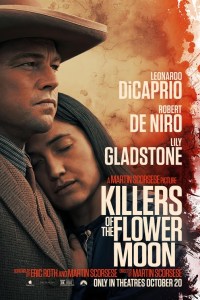
Killers of the Flower Moon has the banner of an Important Movie, telling a story many history books have overlooked for too long, an American tragedy built upon one of America’s original sins with the indigenous peoples, and tying a direct line to not only how we live now as well as how we choose to remember the past. The true story behind the murder of the Osage Nation natives in the 1920s is an urgent story that gets to the heart of greed and the human capacity for evil, and Martin Scorsese’s three-and-a-half-hour movie is somber and mournful and appropriately devastating. But I’m also wondering why I wasn’t as enchanted with it as a movie-going experience. Should I feel movie critic guilt for finding the movie merely good but not transcendentally great?
The whole of Killers of the Flower Moon is bleak, which is naturally much of the point. It’s difficult to retell the history of Native Americans in this country, or before there was a “this country,” without making use of lots of synonyms for the word “bleak.” The first hour presents the Native Americans as being legally incapable of greater agency; the murders are consistent, sloppy, and obvious, but the fact that no investigation was triggered for years in an acknowledgement that, simply put, the government just didn’t care about dead Indians. Oh, I hear you saying, but weren’t these Osage different? They had so much money from their oil rights that the local economy exploded with vultures offering common services for egregiously inflated prices to take advantage of people unaccustomed to having money and options. Even with a surge of riches, the Osage didn’t have an elevation in status. They were still looked upon as interlopers in the way of powerful white men getting that money, and there’s nothing these greedy people won’t do to get that money, especially with a system of justice of little accountability for dead minorities. One of the more galling scenes is when the town coroners are questioned over their unusual protocols, like chopping a corpse into tiny pieces so it could not be re-examined by other professionals. The whole town is in on this vile scheme, every doting neighbor can be guilty through complicity or complacency. Death after death, they all know what’s really going on; it’s plain as day, but nobody outside of the Osage feels the burning outrage, and that’s the point of the first half of the movie, to give the audience the same sense of anger and futility.
The majority of the lengthy movie follows our villains plotting their very obvious conspiracy, with Leonardo DiCaprio badly clenching his jaw in every scene as Ernest Burkhart, a WWI-veteran who comes home, becomes a cabbie, and marries Mollie (Lily Gladstone), one of the rich local Osage women. The question for the rest of the movie is whether or not his love for her is genuine or perhaps she is just a means to an end. He’s the lead of the movie and a total dope, a man who unironically proclaims repeatedly, “I love me some money!” Seems hard to read this guy, right? He’s an idiot, and again this might be the point, that this sort of small-thinking man could be the hinge on this entire conspiracy, which results in a lot of Mollie’s family members dying under increasingly mysterious circumstances to consolidate their inheritance. It’s a frustrating and spiritually exhausting experience to watch all these poor characters get murdered, again, so casually and transparently. One of them is staged as a would-be suicide except he’s shot through the back of the head and the gun wasn’t left at the scene. Eventually, the FBI does finally (finally!) arrive in town at the two-hour mark, but by then, I’ve been watching two hours of people dying without a legal stir.

This perspective is best embodied through Mollie, beautifully played by Gladstone (Certain Women, First Cow). When we first meet her, she’s a forward woman who can assert herself and what she wants. Then it all goes downhill after marrying Ernest. She loses damn near every family member she has and is forced to rely upon her husband for support, the same idiot bungling his way through arranging the deaths of her family members. She’s a personal stand-in for the Osage Nation as a whole, as we watch what they have whittled down and bled dry, watching the weight of all this suffering deteriorate their spirits and dignity. This is Mollie, our avatar for tragedy. She’s literally bedridden for a solid hour, and I dearly missed Gladstone’s presence. Since we’ve been aware of the bad deeds of the bad men from the start, much of Killers of the Flower Moon becomes a waiting game of when Mollie is hopefully going to wise up or at least suspect what is happening to her and her family. When will she see Ernest as a more nefarious force in her life, the kind of person you don’t want to solely trust with the responsibility of delivering your life-saving intravenous medicine. It adds to the overall frustrations of watching. Gladstone’s performance rises above whatever limitations her character is stricken with. First off, it’s a powerful performance of immense sorrow; having to watch her pained reaction to overhearing her sister’s skull sawed open for a disrespectful public autopsy is just sickening. The movie lives off this woman’s response to unfathomable trauma on repeat. When she is bedridden and lost in a medical fog, she still manages to communicate her wariness and suspicion through these extra layers of obfuscation.
Robert DeNiro, appearing in his eleventh Scorsese movie, is terrifying as a kindly cattle baron who fashions himself as the best friend of the Osage, preferring to refer to them by their indigenous names and warmly speaking their language. He’s also a monster, a stand-in for American big business and the blood-stained hands of capitalism without morals and oversight. The dramatic core of the movie, besides how far will this go before consequences will at long last germinate, is how can such self-styled men of God commit such heinous acts? How can people justify and equivocate over their own cruel crimes? This question is epitomized in Ernest and his direct connection to Mollie, but it’s also epitomized through DeNiro’s character, William Hale. We have two characters fulfilling the same thematic purpose, which might be the point, but it makes for a redundant narrative experience. DeNiro’s character is so much more interesting than Ernest too, with the full cognitive dissonance of being an avowed man of the people and true ally to the Osage while he’s plotting their demise. DeNiro holds to this homespun, Foghorn Leghorn accent throughout, and I can’t recall him ever raising his voice. It’s a performance where the lasting terror comes through its friendly disconnect. It’s a more impressive performance than watching DiCaprio grimace and mumble through three and a half hours.

Some chastise Killers of the Flower Moon for choosing to tell its story from the perspective of its white perpetrators. I understand from a narrative standpoint and an overall larger thematic point why this was done. Scorsese clearly thinks of his own limits of being the one to tell this story, appearing as a cameo in the coda to provide commentary on how the American morbid desire for true crime and historical atrocities will lead to yesterday’s outrages becoming today’s distilled and de-contextualized “content.” The problem is the movie already feels frustrating as is while we wait for there to finally be some accounting for the ongoing injustices, and centering the entire perspective on only the Osage would magnify this frustration with even less elucidation on the depths of what was happening. Scorsese strips away a lot of the stylistic flourishes and even the electric pacing and editing that we come to expect from his filmography. This is a slow, ponderous movie. It’s meant to provoke outrage. It’s also designed to frustrate, and I suppose I can admire that while also impatiently shifting in my seat and wondering how many of these 206 minutes could have been lost. I feel like a philistine for looking at a $200-million Scorsese movie, while this man is in the late stages of his career and clearly thinking of this reality, and asking, “Hey, can you give me maybe less movie?”
If you haven’t noticed, dear reader, I am a critic in conflict. Killers of the Flower Moon has fantastic production values, strong acting, and the importance of staging history as it was rather than how it may be remembered, especially over events long ignored by history. I even admire the choices that are deliberate that make the movie feel less like easily consumed entertainment. It’s a movie that I feel compelled to see a second time before I settle on my eventual rating (a seven-hour commitment). It’s a sad movie, a bleak movie, a challenging movie, a meaningful movie, and an Important Movie about Important Things. It’s also long, frustrating in structure and execution, and occasionally redundant with its characterization and plotting, giving the impression that things have been stretched beyond breaking. Again, maybe that’s the larger thematic point, but then again I might just be stuck in a rabbit hole of excuses to find some justification for my less-than-ecstatic reaction to Killers of the Flower Moon, a movie of strident artistic vision that can also feel like you’re eating your vegetables for three nonplussed hours.
Nate’s Grade: B
Share this:

The Zone of Interest (2023)

The Zone of Interest is one of the more maddening film experiences I’ve ever had, and I’m sure that was part of the intention of writer/director Jonathan Glazer (Under the Skin). While based upon a 2014 fictional book by Martin Amis, Glazer had hollowed out the novel’s fake story and replaced it with its inspiration, the Höss family, a real-life German couple and their children who literally had their villa next door to the horrendous Auschwitz concentration camp. The husband was the chief commandant for the camp, and he had his family literally sharing wall space with the notorious factory of death. The entire feature film is then given to observing this family from afar as they try to live a “normal domestic life” in the shadow of something profoundly abnormal and abhorrent. It’s a classic example of a type of movie I will dub the “Yeah, okay, so what?” movie. I get it, I do, but why is this exactly a feature film?
I understand artistically what Glazer is going for here. It’s the ironic juxtaposition of the ordinary and the awful, asking the viewer to think about how many millions of Germans went along with the mounting anti-Semitic and racist policies of Nazi Germany out of self-interest and/or willful ignorance, the banality of evil, as Hannah Arendt termed it. That becomes the challenge of the movie, watching this family tend to the garden, host a birthday party, and read bedtime stories while watching the gloom of the chimneys, listening to the constant soundtrack of scattered gunshots and the screams of victims, including the wails of babies. Every scene is elevated by the dramatic irony of the context that it is happening next door to a concentration camp. We watch them plant flowers, and it just so happens to be next door to a concentration camp. We watch them invite the mother-in-law to make her new bedroom her own, and it just so happens to be next door to a concentration camp. It gets tedious as a viewer because without the irony, we’re just watching a family live their life. I get that’s the point, this example of one family trying to ignore the terrifying reality literally at their very doorstep. I understand that message and I understand why that is even more relevant to our troubled modern times with an alarming rise in anti-Semitism and the celebration of fascism and repressive strongmen. However, I don’t think we get real insights into these characters because they’re more just general ideas intended to forward the critical thesis of the power of self-delusion and excuse-making. That’s fine as a starting point for a provocative movie, but don’t make me watch a family do their laundry for an hour and then tell me it’s an Important Statement because they happen to be next door to the horrors of history.
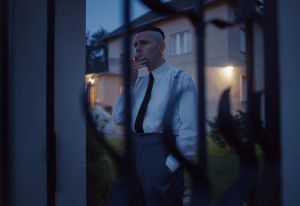
Let me try this same kind of approach on another human tragedy. Say we have a family drama about a hard-working couple trying to go through the day-to-day challenges of marriage and raising a family, and it JUST SO HAPPENS that they live within distance of… the internment of the Japanese in World War II. Does this magically transform and elevate the ordinary actions on-screen into more than what they are? Perhaps to some, but for me it felt too transparently methodical and quickly redundant. I don’t need a whole movie documenting a family next door that barely scratches the surface of their circumstances of living.
There are a few moments that manage to break through. There’s a scene where the daughters are swimming in the nearby river and the family realizes that the gray streams intruding upon the water are the ashes from the camp. From there they furiously scrub themselves clean, the grotesque horror something they attempt to cleanse, whether they’re horrified because the ash belongs to people or because it specifically belongs to Jews. The mother (Sandra Huller) refuses to move away after her husband Rudolph (Christian Friedel) is reassigned by the Nazi brass. This is the home she’s put her time into remodeling and reshaping and she isn’t going to just let anyone live under her roof. This setback is far more upsetting to her than anything she overhears on the other side of her garden walls. There’s also an ongoing story where one of the Höss children is leaving behind a trail of apples, inspired by a favorite bedtime fable, and this has an unfortunate unintended tragedy for people these children will never know or see. There’s an offhand remark by the mother-in-law as she’s touring the backyard where she wonders if a woman in her book club is among the throng next door in the camps. Rather than use this as a moment of reflection over the genocide occurring next door, she then moves onto lamenting that she never got this same woman’s curtains that she always prized. I wish the movie had more of these character moments that directly confront the willful ignorance rather than keeping the audience simmering with the same meditative Big Picture concept that has been relentlessly winnowed down so finely that it may as well be dust.

Glazer makes very specific choices to highlight the detachment of the movie. His camera angles are often taken from far fixed points, and the coverage makes for smooth edits that let you know there were multiple cameras filming these scenes rather than the stress of multiple setups and different takes to cobble together. This makes the movie feel closer to a documentary where we have captured real life as it is happening instead of a group of actors on a set pretending to be different people putting on a show for our entertainment.
The Zone of Interest is a movie that crushes you in the everyday details, and in that it reminded me of 2020’s The Assistant, another indie that didn’t quite work for me. That film was about a young woman who served as a film production assistant to a producer modeled after Harvey Weinstein, and it asked how much she can ignore for the sake of her own upward mobility. It had a really compelling premise but the movie spent most of its running time just watching her do her job, filing papers, getting coffee, walking home, with the implicit knowledge banging around in our anxious minds to then elevate the mundane (she’s not just fixing the copy machine, she’s fixing the copy machine and Harvey Weinstein might be abusing someone just in the next room!). This ironic juxtaposition proved too tiring for me without also exploring the characters and conflicts more explicitly. Things happening off-screen while far more boring things happen on-screen is not itself great drama. Being drama-adjacent does not automatically magically imbue the ordinary with transcendent meaning. I need more than, “Big things are happening… over there.” The Zone of Interest is a critical favorite for 2023 but I think many viewers will have the same response I did: yeah, okay, so what?
Nate’s Grade: C+
Share this:

Eileen (2023)
 Based upon the novel of the same name, and adapted by the novelist and her husband, Eileen is an affectingly broody unrequited romance awash in noir trappings and feelings. It’s set in a prison facility in 1960s Boston, and one young worker Eileen (Thomasin McKenzie) becomes enraptured with her new co-worker Rebecca, a psychologist with an exceptional sense of confidence and hunger, played by Anne Hathaway. For a solid hour, the movie becomes something akin to 2015’s Carol, a lesbian romance where the social norms of the time force both participants to speak in codes and glances and gestures. Eileen is given to flurries of intense daydreams, often sexual, and sees a fellow creature in Rebecca, who doesn’t so much as walk through rooms as slinks, doesn’t so much as stare but smolders. Hathaway is in full-on femme fatale seduction mode here and enjoying it. It is following along this path of possible mutual connection, of finally acting upon these hidden desires, and then the movie takes a SHARP LEFT TURN and stays there for the rest of the duration. The twist works, and forces the audience to reconsider our notions of obsession and perspective, but it also feels like we’ve abandoned the prior movie into this new even pulpier, slightly more manic movie, and I don’t know if I wanted to leave so suddenly. If this twist were to stand, I think it needed to be introduced sooner, especially if it obliterates the prior dramatic work, and allow more time to deal with its myriad consequences. There is a powerfully gripping and deeply devastating monologue by Marin Ireland that might be the best part of the movie. Eileen the movie is a little like Eileen the character, gliding on appearances and secretly something much darker at its core.
Nate’s Grade: B-
Share this:

Aporia (2023)
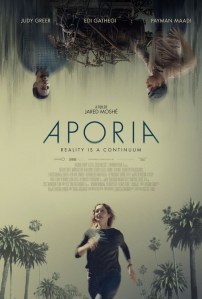
In writer/director Jared Moshe’s low-budget indie film Aporia, the Trolley Debate, killing one person in order to spare the lives of, presumably, more people or a greater number of people, gets its own movie in a thoughtful and provocative little indie. The thorny ethical questions are given their rightful due, and this is where Aporia really shines for me, as a small-scale sci-fi story with Big Ideas bursting forth and the understanding to give them adequate space for satisfying contemplation. It bowled me over.
Sophie (Judy Greer) is still very much not over the death of her husband, Malcolm (Ed Gathegi). He was killed by a drunk driver months ago and that driver also seems to have escaped justice. Sophie is left alone to raise their pre-teen daughter Riley. That’s where Jabir (Payman Maadi) comes in. He was a friend of Malcolm and reveals they had been working on a prototype for a time machine in secret. The machine has its own limits. It sends a photon particle back in time, which will kill any living creature that it materializes inside. All you need are the time, place, and coordinates and you could kill anyone. The further in time you need to go the more power the machine will have to draw. Sophie is beside herself but taken over with the excitement of possibly bringing her husband back to life. All it takes is murder.

What the characters have created is essentially a magic gun that can shoot into the past, which means the only use for this time travel device is to take life. They will only ever be murderers if they decide to use it, and so it becomes a question over under what circumstances would it be permissible to utilize this weapon. The first victim is obvious, the man responsible for the death of Sophie’s husband, and like magic he returns good as new without any memory of ever having been gone. It’s an important rule introduced that only the people in the room with the machine will still have memories of the previous timelines before the space-time revisions. This is a good move for an obvious dramatic one, so that the characters will be able to be impacted by the changes because they can recall a life without them, but it also sneakily supplies another complication. Each one of them has the potential to use the machine alone and thus never having the others realize what they had done. It’s one more tricky ethical question, asking whether you would betray the trust of someone close to you if you could get away with it. Naturally, the characters debate the merits of when to use the machine and when not to, with each new use further complicating matters because the next change can always destabilize the state of things, and then it’s a chain of changes to try and find the right order, and that leaves a trail of bodies littering the past.
It wouldn’t be a compelling time travel narrative without the ole’ favorite of unintended consequences. By removing the drunk driver before he could ever fatefully get behind the wheel, Sophie has brought back her husband and felt like the cost was negligible, as that driver in present-day is an abusive husband who gets drunk and yells at his family while he escapes justice for manslaughter. However, once you start pulling at the knots of the human timeline, some interesting and unexpected results can happen. That same man has been removed but his family isn’t necessarily better off. Kara (Whitney Morgan Cox), the widowed wife, is struggling to make ends meet as a single mom with a daughter (Veda Cienfuegos) suffering from multiple sclerosis (MS). They are deep in medical debt. It seems that the least this man did was help provide a financial cushion. Without his presence, they’ve had to go it alone and they’re broke and likely unable to continue paying the costly medical treatment for this adolescent girl. Because of Sophie’s desire to bring back her husband, she has doomed this innocent victim. Sophie’s guilt causes her to seek out the family, check up on them, and upon the discovery of their hardships, befriend mother and daughter and find a way to make things right as the unknowing perpetrator of their dilemma. From there it becomes a game of thinking how she can erase their misfortune while keeping her own husband.
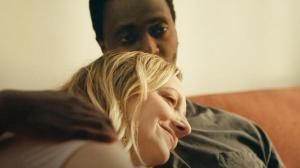
I will discuss one significant turn because I think it’s an evocative example of the thought-provoking nature of the screenplay, but I will warn you there will be significant spoilers. If you wish to remain pure, dear reader, then skip to the next paragraph. The team comes up with a new name to eliminate to solve the fortunes for Kara and her daughter, a man who swindled her, a Ponzi scam artist who left her penniless and forced to close her bakery. Seems open and shut with an obvious bad person, thus an easy solution. But you should recognize there are no easy solutions in stories untangling timeline interference. All of a sudden, Sophie and Malcolm come home to discover that they have a completely different child. Their teen daughter is now a teenage boy with a different personality and different interests. How? How could eliminating one bad man in a completely different state change the course of history enough that their child has been affected? They debate the possibilities, perhaps something as small as a different sperm winning out or conceiving her on a different day or month, but the results are irrefutable. While their child is alive in this timeline, in a very real sense they have both now lost their daughter. The person they raised together, loved, and helped shape has been eliminated and the grief is palatable. This new child is a stranger, but they too are strangers to this child. They are absent formative memories and do not have the shared connections and history to draw upon. When Sophie tries to comfort this new Riley, she doesn’t know what may work because she doesn’t know anything about this child. I don’t think the filmmakers are making negative commentary on adoption, which is essentially what this scenario mirrors, but the grief goes two ways. They mourn the child blinked from existence, and this child also had his parents blinked from existence and replaced with lookalikes, they just don’t understand it yet. It’s this escalation that personalizes the unintended harm of what they’re doing and sets the stage for the final decision.
The ending is going to divide people but it felt note-perfect for me. It ends on an emotional high of coming to terms with their culpability but also on accepting uncertainty. We end on an ambiguous note, absent a resolution about the final extension of the final decision. I think it works very well not just in trying to have it multiple ways but because after being in the know, it puts the characters, and vicariously the viewer, in a state of vulnerability and the acceptance of staying there. It’s an uplifting conclusion thematically because it’s about accepting loss but also accepting our limitations. The final conversations are inadequate because how can you summarize a life with another person, whether a lover or a friend or a spouse, into just a handful of clumsy words. Our vocabulary does us a disservice when it comes to expressing the glorious debt we feel having had these people in our lives. That is why the movie ends on an emotional high for me and really comes together, personalizing the ethical conundrums.

Greer (Halloween Kills) has had a long career as a supporting actress, usually the funny but supportive best friend to the lead, and as an outstanding voice actress (Archer, Let’s Go Luna), but rarely does she get a meaty dramatic lead role. She’s terrific here and serves as our dramatic anchor through the turbulent changes and moral soul-searching. She is our reflection, and Greer’s emotional journey is well encapsulated in a performance that doesn’t go big into histrionics but is more carefully grounded and natural. I don’t think the movie would work as well, at least on an emotional level, without her.
Is Aporia a perfect film? Well, very few are, and the movie could have even more development, leaving possibilities behind given its tantalizing premise. I’m glad the movie didn’t go overboard into some slapdash thriller territory and instead grounded its science fiction timeline wonkiness into engaging human drama about loss, sacrifice, and acceptance. As my pal Eric Muller said, Aporia likely works better as a screenplay than a finished film, though this discounts the heavy-hearted contributions of Greer. I’m glad this movie emphasized its ideas and provided the time to really dwell in them, even if the movie is only about 90 minutes altogether. Aporia is a deeply engaging movie that worked on all levels for me, enriching emotions and satisfying intellect, and is definitely worth the discovery.
Nate’s Grade: A-


 nathanzoebl
You must be logged in to post a comment.