Blog Archives
Rebel Moon: Director’s Cut (2024)
 What a rarity for a movie to potentially appear twice on my worst of the year list, and such is the destiny of Zack Snyder’s Rebel Moon, originally released in 2023 and the first half of 2024, and now with added lengthier director’s cuts. So what do you get in the newest “Snyder cuts” besides fewer hours in your day? Let’s tackle the opening sequence demonstrating the power and villainy of our evil empire as they invade a crumbling city in resistance. Within short order we’ve witnessed: 1) female priestesses being forcefully disrobed and having their breasts branded, 2) an adorable little CGI pet become a literal suicide bomber, 3) a son brutally beating his father’s brains out of his skull to spare their family only for them all to be massacred anyway. Yikes. While there is a little more world-building absent from Snyder’s prior cuts, like a religious sect that turns the teeth of their conquered victims into a decorative washboard, even the extra time, and it is literally hours over the course of the two parts, feels strained and still poorly developed to better understand the world, the characters, the conflict, the history, anything that could make Snyder’s hopeful franchise its own universe. Theres now a giant metal goddess whose tears fuel space travel. All right then. One of the more interesting characters, the samurai-esque loner robot, is given more material but he’s still just as inscrutable. There’s plenty more cruelty here, slow-motion head shots painting the screen in sticky viscera. There’s also plenty more breathless and awkwardly extended sex scenes, but hey, at least those are consensual, so there’s that. I’m just stunned why Netflix would want different versions of these movies when they’re ultimately all housed under the same banner. It sure feels like the “Snyder cut” brand is now an expected marketing ploy to be exploited for added publicity. After all, why watch one long slightly bloody poorly written sci-fi space opera, when you could watch TWO versions, one of which being even bloodier and more miserable? Will there be an even Snyderier Snyder cut, adding more scenes of side characters suffering and even more festishized gore in even slower motion? Will the whole movie just be played in slow motion, now requiring nine hours? Where does it even end, Netflix?
Nate’s Grade: D
Share this:

Rebel Moon – Part Two: The Scargiver (2024)
 Back in December, Zack Snyder offered his very Snyder-y holiday take on big-budget space operas with Rebel Moon, a project that began as his Star Wars pitch that was turned down. It was what you would expect from a Snyder movie: big, loud, silly yet played completely serious, and drained of all vibrant color. Rebel Moon Part One was on my worst of 2023 list and I felt was a waste of two hours. I was not looking forward to the concluding Part Two. I was worried it would be two more hours of the same, and now having seen Part Two, a.k.a. The Scargiver, the edgy nickname of our lead rebel Kora (Sofia Boutella) fighting the good fight against the Evil Empire, I can now say that the Rebel Moon duology is now a dreary waste of four of your waking hours.
Saying Scargiver might be minimally better than Child of Fire (did you remember that was the subtitle for Part One? Don’t lie to me, dear reader, you know you didn’t) is a nominal victory. There’s more action and a clearer sense of climax, with our underdogs planning their guerrilla war against the overpowering forces approaching (we’re basically watching the training of a Vietcong-like insurgency) and then pulling off their unexpected victory. The problem is that we’re still stuck with all the same characters from Part One, few of which will prove to be emotionally engaging or intriguing. We’ve assembled our fighting force thanks to the events of Part One, but far too many of them are interchangeable and punishingly free of personality besides the default character creation setting of “stoic badass.” There’s one lady who has laser swords so at least that sets her apart. When it comes to attitude, personality, perspective, and even skill level, these characters are awash, which makes the action falter when it comes to any sort of meaningful emotional involvement. The bare bones story is so plain with broadly drawn good versus evil characters from its obvious cultural influences. The fact that it’s derivative is not itself a major fault, it’s the fact that it does so little with these familiar pieces that the movie feels like it’s trying to skate by on your familiarity. After four hours, it’s clear to me that Snyder and his co-writers composed this not as a living, breathing universe with its own lore and history and intrigue, but as a story where he could have used the Star Wars universe to fill in the gaps.
 Snyder can be a first-class visual stylist but his sense of fluid and engaging action stops at “cool images,” like living splash pages from comic books. Like Part One, there is no sense of weight to these action sequences. Things are just happening, and then in the next shot things are just happening. Occasionally there will be a sliver of relation, but whether it’s 60 minutes or 6 minutes, the effect is still the same. The action feels like it’s all happening in a vacuum, and the momentum we feel the upstarts are gaining is hampered. We went through the trouble of explaining their counter-offensives, so why does so much of it feel like it’s just watching a jumbled, ashen group of characters fire guns? This is best epitomized by Jimmy the robot (voiced by Anthony Hopkins) who has gone rogue from his programming and sits out much of the action for reasons entirely unknown. Then he arrives, takes down a few evil tanks, and I guess decides to sit back out. If this is our fighting force, what exactly has it amounted to? This makes the entire movie, and its predecessor, a frustrating viewing even for forgiving action fans. Things blow up good, and there are a few impressive visual orchestrations, but it’s so fleeting and slim.
Over the course of two two-hour movies, totaling four hours, with the promise (threat?) of more, it’s clear that what we really had here was perhaps one underdeveloped movie at best that has been unfortunately spread out over two (and counting) movies of time. Part One was entirely about assembling the team of rugged defenders, and this could have served as the first 45 minutes of the overall movie, with the events of Part Two filling in the rest. With Scargiver, the defenders don’t even start training the villagers until 40 minutes into the movie and the big battle doesn’t kick in until a full hour. Structurally, this doesn’t feel like we’re using our time wisely, and this is best evidenced by the fact that after AN ENTIRE MOVIE of character back-story, Snyder still stops the action to have his characters sit around and share their sad back-stories. Did these characters just not talk at all to each other after initially gathering person-by-person? Tarak (Staz Nair) still hasn’t put a shirt on. I felt like yelling at my TV as the character took turns, and another 15 minutes, for each member to share their tortured back-story again but with different visuals. I was almost worried that right before the battle another character would say, “Wait, before it all really goes down, I need to share, yet again, more of my back-story.” It’s not like these extra glimpses give us new understanding or even meaningfully differentiate their characters; they’re all just victims of an abusive space government that imposes its terrible will most forcefully.
 There is one tragic back-story that does separate itself from the pack, notably because it literally separates itself from the pack and is told well before our group share. Kora explains her part in the assassination of the royal family, securing the military coup that left the Evil Empire extra evil, and I guess the guy named Balisarius as supreme leader (oh how this man must have been teased for his name as a schoolchild, which might be his own tragic back-story that we’ll get three helpings of with an eventual Part Three). This betrayal is personal and stands out, with Kora being the one to shoot the little princess, a girl who, in her dying breath, says she forgives Kora. That’s rough. This is actually a good sequence from a character standpoint as it establishes Kora’s accountability and guilt convincingly. However, Snyder makes some baffling creative choices that blunt the impact of this sequence. During the assassination, the musical score favors a string quartet, which is an emotionally plaintive choice. However, the music is actually diegetic to the scene, meaning it’s coming live from the room. There is literally a string quartet of musicians playing in the room while the royal family is betrayed and slaughtered. These guys are really dedicated to their art to keep playing throughout, and I assume they must also be part of the conspiracy or else big bad Balisarus (snicker) would kill them too. You might as well have them also start stabbing the royal family with their bows. It’s details like this that trip up Snyder, a man beholden to images and ideas but lacking the finesse to make them work.
An issue I had with this conflict was the disparity in scale between the forces, mainly my nagging question of why put together a ragtag group of space adventurers to defend this town if the Evil Empire could just nuke the planet from space? Well Snyder attempts to answer this early with Part Two, and the answer appears to be… grain. This community theorizes that the empire needs their grain yield so badly that they wouldn’t do anything to damage it, so their plan is to harvest all their wheat, turn it into grain, and then use the grain like human shields, hiding behind the valuable resource as cover and distributing it across the village. This is beyond silly. First, this isn’t like an entire planet harvesting grain, it’s one little village on the outskirts. It’s not like we’ve seen a giant warehouse that goes for miles and miles stockpiled with thousands if not millions of deposits of this food. Also, we’re talking grain here (stay tuned for my exclusive Rebel Moon-related podcast called “Talkin’ Grain”). It’s not like we’re talking about some super rare mineral or substance that is only found on this one planet, something linked toward like the power source for an ultimate weapon or space travel. We’re talking about grain here. Grain. You think this Evil Empire won’t nuke the planet because they’re worried they won’t get enough grain, the same crop that can be harvested on multitudes of other planets? How about they just kill everyone and then repopulate the planet with robots to harvest the precious grain? Or how about this simple village make some upgrades as we’re in a future world with space travel and artificial intelligence but people are still harvesting wheat by hand like they’re the Amish. Regardless, I hope you love slow-mo montages of grain harvesting because that’s what you’re getting for the first 40 minutes, as if Snyder is rubbing your face in his silly non-answer.
 In the conclusion to Rebel Moon Part Two, once the dust has settled, and long since that grain has been harvested, the last five minutes sets up a would-be Part Three, informing us that an unresolved storyline is next up on the docket. The characters gang up for their next adventure, and you’re expected to be chomping at the bit for this continuation. I openly sighed. Every movie feels like a tease for the next adventure, and it seems to promise that this one will be the real one you’ve been waiting for, but it feels like franchise bait-and-switch. It’s more than incomplete or lazy storytelling, it’s a scheme to leverage interest in a world and series that deserves little. The universe of Rebel Moon is not interesting. The characters of Rebel Moon are not interesting. The visuals of Rebel Moon are fine, though some of the costume choices again can rip you right out of the reality of this universe (a guy fighting in blue jean overalls?!). In short, not enough has been established, developed, or even paid off to make Rebel Moon an interesting and satisfying movie, let alone two, let alone three, let alone however many Snyder wants to leech out of Netflix. I would say Part Two is better because at least it provides an ending but it doesn’t even do that, merely an intentional passing of the baton to the next movie, and round and round we go. Rebel Moon is a living poster stretched to its breaking point. Leave this shallow universe behind.
Nate’s Grade: C-
Share this:

Rebel Moon – Part One: A Child of Fire (2023)
 Creating an original sci-fi/fantasy universe is hard work. It involves bringing to life an entire new universe of characters, worlds, back-stories, rules, conflicts, cultures, and classes. There’s a reason major studios look to scoop already established creative universes rather than build their own from scratch. This is what director Zack Snyder had in mind when he pitched a darker, grittier, more mature Star Wars to Disney, who passed. Over the ensuing decade, Snyder and his collaborators, Shay Hatten and Kurt Johnstad, continued working on their concept, transforming it into an original movie series, resulting in Netflix’s big-budget holiday release, Rebel Moon – Part One: A Child of Fire, a clunky title I will not be retyping in full again. Snyder’s original results of the “darker, grittier Star Wars” are rather underwhelming and don’t make me excited for the concluding second movie being released in April. Why go to the trouble of building your own universe if you don’t want to fill in the details about what makes it important or at least even unique? I can see why Snyder would have preferred Rebel Moon as a Star Wars pitch, because they could attach all the established world-building from George Lucas and his creative collaborators as a quick cheat code.
In another galaxy, the imperial Motherworld is the power in the universe. The king and his family have been assassinated, and in the power struggle that follows, several planets have taken up arms to fight for independence. On a distant moon, Kora (Sofia Boutella) is doing her best to live a nondescript life as a farmer, helping to provide for her community and stay out of trouble. Well trouble comes knockin’ anyway with Admiral Atticus Noble (Ed Skrein) and his fleet looking for resources and powerless villagers to abuse. Kora’s history of violence comes back to her as she fights back against the Motherworld soldiers with cool precision. Her only hope is to gather a team of the most formidable warriors to protect her village from reprisals. Kora and company band together while her mysterious past will come back to haunt her reluctant return to prominence.
 For the first thirty to forty minutes of Rebel Moon, I was nodding along and enjoying it well enough, at least enough to start to wonder if the tsunami of negative reviews had been unfairly harsh, and then the rest of the movie went downhill. One of the major problems of this Part One of a story is that it feels like a movie entirely made up of Act Two plotting. Once our hero sets off on her mission, the movie becomes a broken carousel of meeting the next member of the team, seeing them do something impressive as a fighter, getting some info dump about their mediocre tragic backstory, and then we’re off to the next planet to repeat the process. After the fifth time, when a character says, “Anyone else you know?” I thought that the rest of the movie, and the ensuring Part Two, would be nothing but recruiting members until every character in the galaxy had joined these ragtag revolutionaries, like it was all one elaborate practical joke by Snyder. Some part of me may still be watching Rebel Moon, my eyes glazing over while we add the eight hundred and sixty-sixth person who is strong but also shoots guns real good. Then the movie manufactures an ending that isn’t really an ending, merely a pause point, but without any larger revelations or escalations to further our anticipation for Part Two in four months’ time. What good are these handful of warriors going to be defending a village in a sci-fi universe where the bad guys could just nuke the planet from orbit? Find out in April 2024, folks!
The entire 124-minute enterprise feels not just like an incomplete movie but an incomplete idea. This is because the influences are obvious and copious for Snyder. Rebel Moon starts feeling entirely like Star Wars, but then it very much becomes a space opera version of The Magnificent Seven, itself a remake of Akira Kurosawa’s Seven Samurai. With our humble farmer, our high plains drifter trying to turn their back on an old life of violence, and the recruitment of our noble fighters to ward off the evil bandits coming to harass this small outpost, it’s clearly The Magnificent Seven, except Snyder doesn’t provide us the necessary material to invest in this scrappy team. The characters are all different variations of the same stoic badass archetype, like you took one character mold and simply sliced it into ten little shear pieces. The characters don’t even have the most basic difference you could offer in an action movie, variation in skill and weapons. One lady has laser swords (a.k.a. lens flair makers) but pretty much everyone else is just the same heavy gun fighter. One guy doesn’t even bother to put on a shirt. Some of them are slightly bigger or more slender than others but the whole get-the-gang-together plot only really works if we have interesting characters. If we don’t like the prospective team members, it’s like we’re stuck in an endless job interview with only lousy candidates.
 The fact that Rebel Moon is derivative is not in itself damaging. Science fiction is often the sum of its many earlier influences, including Star Wars. Rebel Moon cannot transcend its many film influences because it fails to reform them into something coherent of its own. There is no internal logic or connection within this new universe. The original world building amounts to a slain royal family, an evil fascist regime, and maybe a magic princess connected to a prophecy of balance, and that’s it. All the flashbacks and expository data dumps fail to create a clearer, larger picture of how this sci-fi universe operates. The inner workings are kept so broad and abstract. We have an imperial evil and assorted good-hearted little guys. The movie begins by introducing a robot clan of knights that are dying out, and even a young Motherworld soldier who seems likely to defect, both opportunities to go into greater character detail and open up this world and its complications. So what does Snyder do? He leaves both behind shortly. Even though we visit a half dozen planets, these alien worlds don’t feel connected, as if Snyder just told concept artists to follow whatever whim they had. They don’t even feel that interesting as places. One of them is desert. One of them has a saloon. One of them is a mining planet. It’s like the worlds have been procedurally generated from a computer for all we learn about them. They’re just glorified painted backdrops that don’t compliment the already shaky world building. They’re too interchangeable for all the impact on the plot and characters and any declining sense of wonder.
Given the open parameters of imagination with inventing your own sci-fi/fantasy universe, I am deeply confused by some of the choices that Snyder makes that visually weigh down this movie in anachronistic acts of self-sabotage. Firstly, the villains are clearly meant to be a one-to-one obvious analog for the Empire in Star Wars, itself an analog for the fascists of World War II, but Lucas decided having them as stand-ins was good enough without literally having them dress in the same style of uniforms as the literal fascists from World War II. You have an interconnected galaxy of future alien cultures and the bad guys dress like they stepped out of The Man in the High Castle. It’s too familiar while being too specific, and the fact that it’s also completely transparent with its iconic source references is yet another failure of imagination and subtext. I just accepted that the Space Nazis were going to look like literal Nazis, but what broke my brain was the costuming of Skrein’s big baddie in the second half of the movie. At some point he changes into a white dress shirt with a long thin black tie and all I could think about was that our space opera villain looks like one of those door-to-door Mormon missionaries (“Hello, have you heard the Good Word of [whatever Snyder is calling The Force in this universe]?”). Every scene with this outfit ripped me out of the movie; it was like someone had photo-shopped a character from a different movie. It certainly didn’t make the devious character of Atticus Noble more threatening or even interesting. I view this entire creative decision as a microcosm for Rebel Moon: a confused fusion of the literal, the derivative, and the dissonant.
 Snyder is still a premiere visual stylist so even at its worst Rebel Moon can still be an arresting watch. He’s one of the best at realizing the awe of selecting the right combination of images, a man who creates living comic book splash pages. I realized midway through Rebel Moon why the action just wasn’t as exciting for me. There’s a decided lack of weight. It’s not just that scenes don’t feel well choreographed or developed to make use of geography, mini-goals, and organic complications, the hallmarks of great action, it’s that too little feels concrete. It feels too phony. I’m not condemning the special effects, which are mostly fine. The action amounts to Character A shoots at Bad Guy and Character B shoots at Other Bad Guy, maybe behind some cover. There’s only one sequence that brings in specifics to its action, with the challenge of defeating a rotating turret gun pinning the team down from escape. That sequence established a specific obstacle and stakes. It worked, and it presented one of the only challenges that wasn’t immediately overcome by our heroes.
The Snyder action signature of slow-mo ramps has long ago entered into self-parody territory (I’m convinced a full hour of his four-hour Justice League cut was slow motion), so its use has to be even more self-aware here, especially in quizzical contexts. There are moments where it accentuates the visceral appeal of the vivid imagery, like a man leaping atop the back of a flying griffin, akin to an 80s metal album cover come to life. Then there are other times that just leave you questioning why Snyder decided to slow things down… for this? One such example is where a spaceship enters the atmosphere in the first twenty minutes, and a character drops their seeds in alarm, and those seeds falling are detailed in loving slow motion. Why show a character’s face to impart an emotion when you can instead see things falling onto the ground so dramatically?
 The actors are given little to do other than strike poses and attitudes, and for that they all do a fine job of making themselves available for stills and posters and trailers. Boutella (The Mummy) is good at being a stoic badass. I just wish there was something memorable for her to do or make use of her athleticism. The best actor in the movie is Skrein (Deadpool) who really relishes being a smarmy villain. He’s not an interesting bad guy but Skrein at least makes him worth watching even when he’s in the most ridiculous outfit and awful Hitler youth haircut. There’s also Jena Malone (Sucker Punch) as a widowed spider-woman creature. So there’s that. Cleopatra Coleman (Dopesick), who plays one half of a revolutionary set of siblings along with Ray Fisher, sounds remarkably like Jennifer Garner. Close your eyes when she’s speaking, dear reader, and test for yourself. I was most interested in Anthony Hopkins as the voice of our malfunctioning android (literally named “Jimmy the Robot”) operating on mysterious programming that hints at something larger in place relating to perhaps the princess being alive. Fun fact: Rebel Moon features both actors who played the role of Daario on Game of Thrones (Skrien and Michiel Husiman).
Even with all the money at Netflix’s mighty disposal, Rebel Moon can’t make up for its paltry imagination and thus feels like an empty enterprise. I’m reminded of 2011’s Sucker Punch, the last time Snyder was left completely to his own devices. I wrote back then, “Expect nothing more than top-of-the-line eye candy. Expect nothing to make sense. Expect nothing to really matter. In fact, go in expecting nothing but a two-hour ogling session, because that’s the aim of the film. Look at all those shiny things and pretty ladies, gentlemen.” That assessment seems fitting for Rebel Moon as well, a movie that can’t be bothered to provide compelling characters, drama, or world-building to invest in over two to four hours, once you consider the approaching Part Two. I wish this movie had a more distinct vision and sense of humor, something akin to Luc Besson’s lively Fifth Element, but fun is not allowed in the Zack Snyder universe, so everything must be grim, because grim means mature, and mature means automatically better, right? Rebel Moon is a space opera where you’ll prefer the void.
Nate’s Grade: C-
Share this:

Shazam! Fury of the Gods (2023)
 I enjoyed 2019’s Shazam! because it felt like a breath of fresh air, a lighter story compared to the relentless gloom and doom of the DCU. It was more a silly Big-style body swap movie than a super hero romp, tapping into childhood wish fulfillment of getting to transform not just as an adult but as a super-powered adult on a whim. It was funny, sweet, and different. The 2023 sequel, Shazam! Fury of the Gods, feels like the definition of a sequel for the sake of a sequel. It is thoroughly mediocre and lacking the charm and heart of the original. I’ll try and deduce why this super-charged sequel feels so lacking and why the fun feels so forced.
Billy Batson (Asher Angel) can turn into Shazam (Zachary Levi) by uttering the magic name, and now his foster family share his same super abilities. They’re trying to adjust back to “normal life” when the Daughters of Atlas, Hespera (Helen Mirren) and Kalypso (Luicy Lui), arrive with a vengeance. Turns out Shazam’s powers were stolen from the Greek gods, and now they want them back, and if they don’t reclaim their power, the gods will destroy the world of man.
 I think one of the most lacking elements of Fury of the Gods is that it loses its core appeal. The first movie was about a child fulfilling their adult dreams and leaping into maturity before their time. Levi (Apollo 10 1/2) was goofy and enjoyable in his broadly comical fish-out-of-water portrayal as a kid in an adult’s body. Now, the growing pains of being an adult, and a superhero, have been eclipsed. In fact, the amount of time we spend with Billy is pretty sparing. It’s all Shazam all the time, and this hurts presenting a worthwhile contrast between the mythic and the recognizably human. You forget the initial dynamic of this kid pretending to be an adult and what advantages this affords. At this point, being an adult is the same as being Billy Batson, who is approaching 18 and will age out of the foster system. This reality creates an existential crisis for Billy, as he’s afraid his family will move on so he’s eager to keep them together all the time, trying to maintain control. It’s about fear of change; however, I never fully understood why Billy was so worried. He’s already found a home with a loving mother, father, and extended clan of siblings, so why does aging out matter? He’s not going to be removed from his home. His siblings also aren’t talking about shipping out to the different corners of the world to begin careers or higher education. It’s a forced conflict to make the character uneasy about growing up. If the first movie was about a kid coming to terms with himself and letting others in, then this movie is all about a kid worrying his relationships will arbitrarily evaporate. This anxiety over losing something meaningful could have been an interesting storyline, but it’s all so contrived, and the whole body swap dynamic, the selling point of the first film, feels strangely absent.
Likewise, the villains have questionable motivation and character development. The movie begins with cloaked and masked figures wreaking havoc in a museum, and then it makes a big deal that these figures happen to be… women (also middle-aged and older at that). The opening is meant to be surprising in a way that feels out of date (what… g-g-girls can be powerful too?). It’s a strange point considering we’ve already had Wonder Woman. This same easily-satisfied, lowest common denominator plotting is disappointingly prevalent. These powerful gods want their father’s powers back but they already seem pretty powerful, so the movie lacks a fitting explanation of why these extra powers are worth all this effort. I suppose there’s a general revenge and righting of wrongs but the characters don’t play their parts too scorned. They’re more annoyed and tired, which doesn’t make for the most compelling villains. Another Daughter of Atlas has the power to mix and match the world like a volatile Rubix cube, but what is this power? It’s virtual obstacle-making but it feels arbitrary too in the world of superpowers. The ultimate scheme to conquer the world is as flimsy as the reasons it’s ultimately defeated.
 Let me dissect that part for a few words, the solutions to overcoming our vengeful gods. They raise an army of mythical creatures to destroy Philadelphia and it’s Ray Harryhausen character designs with cyclops and unicorns and the like. The way to reach through to the monsters and bring them on your side is to offer them a gift of “ambrosia,” some tasteful bounty that they can’t help but fall in love with. So what is the solution to this? One of the kids literally drops a handful of Skittles onto the street and the unicorn happily snarfs them down. Yes, through the power of Skittles-brand candy the heroes are able to save the day. There’s even a moment where the kid is riding the unicorns into battle and screams, “Taste the rainbow,” before the movie cheekily cuts her off before she can unleash an added “MF-er.” What is this? I’m usually agnostic on product placement in movies; characters have to eat and drink, etc. But when it’s egregiously transparent and played as the key to victory against all odds, that’s a bit much. If the joke is that contemporary food is a blast of flavor that nobody would have been prepared for thousands of years ago with their palettes, then any modern food could have worked. It didn’t have to be a brand-name candy with its brand-name slogan screamed in battle. This is but the first of several contrived and unsatisfying deus ex machina solutions that erase consequences.
Even with returning director David F. Sandberg (Lights Out), the enterprise feels like an empty retread relying too much on rote spectacle and missing the heart and perspective of its predecessor. There is an action sequence atop a collapsing suspension bridge and the song “Holding Out for a Hero” plays, and then we have a character comment on it, and it all seems like a desperate attempt to add some energy or style or fun to the sequence that is absent. The action relies on a lot of watching characters zip pedestrians to safety, but it’s the end result we see, not the whoosh and flurry of the arduous mission. The whole sequence feels like it’s going through the motions, as much of the movie does, falling back on a formula of superhero blockbuster autopilot. The CGI army of villains, the face-offs between characters shooting magic beams at one another, the overly quippy and tiresome dialogue and mugging cranked up to overdrive, the world-saving stakes feeling so minor. I was longing for some of the ’80s Amblin tone of the original, which got surprisingly dark. With Fury of the Gods, everything feels so safe and settled, with the stakes feeling inauthentic and the action reinforcing this with effects sequences that feel like Saturday morning cartoon filler.
 There’s a strange question with the family powers. The extended brothers and sisters can utter “Shazam” and turn into adult alter egos, but the character of Mary (Grace Caroline Currey, Fall) now transforms into a super suited version of herself with slightly different hair. In 2019, she transformed into actress Michelle Borth (Hawaii 5-0). Mary is the oldest sibling, and we’ve undergone a time jump of years to account for the ages of the kid actors, so does this mean that as the kids get older they will just turn into versions of themselves? Does this mean that the Zachary Levi-persona is set to expire once Billy turns legally an adult at 18? The implications of this casting choice made me question the very reality of the Shazam universe’s mechanics.
I can see certain audiences enjoying the slapstick and gee-whiz goofiness of Shazam! Fury of the Gods, and I have no doubt that the people making the movie wanted to tap into that childlike wonder of magic and myth. The problem is that this feels like the most inessential of the dozen DCU movies, going through the motions rather than exploring cogent and potent drama. Just take the character of Pedro (Jovan Armand) who is unhappy with his larger body and transforms into a handsome, slim, musclebound version of himself as a fantasy. That’s an interesting psychological exploration for the character, on top of his own self acceptance on a whole other front. Or take the sidekick from the first movie, Freddy (Jack Dylan Grazer), and his Romeo and Juliet-esque romance of a super-powered being from the other side of the conflict. There’s some drama there as well as his understanding of who the good and bad guys can be. Or simply take the perspectives of the parents trying to raise a household of kids who can transform at whim and what worries and joys this can offer. There’s material here to be finely explored, fun dynamics going beyond just repeating the Big-style body swap hi-jinks. Unfortunately, this is a sequel that feels like what made the original special has been replaced by blockbuster status quo.
Nate’s Grade: C
Share this:

The King’s Man (2021)
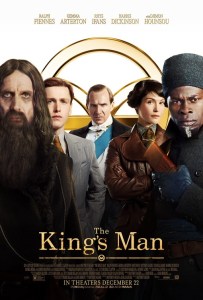
In 2015, I was completely on board with a Kingsman franchise. Based upon the Mark Millar comics, the film was a hip, transgressive, action-packed, and refreshingly modern remix of stale spy thriller tropes. It also followed a satisfying snobs vs. slobs class conflict and a My Fair Lady-stye personal transformation of street kid to suave secret agent. In short, I loved it, and I said co-writer/director Matthew Vaughn used big studio budgets smarter than any other blockbuster filmmaker. Flash forward to 2017, and the Kingsman sequel started to show cracks in my resolute faith in Vaughn, and now with the long-delayed Kingsman prequel, I just don’t know if I care any more about this universe. It feels like the appeal of the franchise has been stamped out by its inferior additions. This one chronicles the origins of the Kingsman tailors/secret agency, a question nobody was really asking. It’s the beginnings of World War I, and a comical cadre of super villains, such as Mata Hari, Rasputin, and future assassin Gavrilo Princip, is meeting to plot doom and destruction and goad the world’s powers into war (in a goofy but appreciated comical touch, Tom Hollander plays the leaders of England, Germany, and Russia). Ralph Fiennes plays Orlando Oxford, a pacifist leading a special team trying to thwart the drumbeats of war by taking out the shadow brokers. The Kingsman movies were known for its attitude and cheekily crossing the line from time to time, but that willful perversity seems so desperate with this new movie. During the Rasputin mission, the disheveled madman literally stuffs an entire pie into his face, tongues Oxford’s wound on his upper thigh, and lasciviously promises more to come for him and Oxford’s adult son. The sequence is almost astonishing in poor taste and grotesque, and it just seems to go on forever. And yet, thanks to the sheer audacious energy of Rhys Ifans as the pansexual cleric, this actually might be the best or at least most entertaining part of the 130-minute movie. The problem is that The King’s Man doesn’t know whether it wants to commit to being a ribald loose retelling of history or a serious war drama. It’s hard to square Rasputin cracking wise and sword fighting to the 1812 Overture and an interminable 20-minute tonal detour that seriously examines the horrors of trench warfare. It jumps from silly comic book violence to grisly reality. That entire episode is then washed away with a joyless climax that feels like a deflated video game compound assault. I’ll credit Vaughn for dashes of style, like sword-fighting from the P.O.V. of the swords, but this movie feels too all over the place in tone, in ideas, in execution and lacking a dynamic anchor. Fiennes is a dry and dashing leading man, though I was having flashbacks of his 1998 Avengers misfire at points. It’s a story that doesn’t really accentuate the knowledge base of future Kingsman, and it’s lacking a sustained sense of fun and invention. It needed more banter, more subversion, more over-the-top and less formulaic plot turns. In my review of The Golden Circle, I concluded with, “It would be a shame for something like this to become just another underwhelming franchise.” That day has sadly arrived, ladies and gentlemen.
Nate’s Grade: C
Share this:

Spiral (2021) / A Quiet Place Part II (2021)
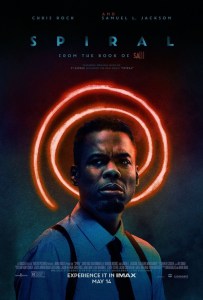 Chris Rock seems like an odd choice to spearhead a revival of the dormant Saw franchise, but the actor was a rabid fan of the grisly horror series and came to producers with an idea for a new Saw movie, and the results are Spiral: From the Book of Saw, like it’s a Biblical chapter. A Jigsaw copycat killer is targeting corrupt police officers and those who protected them, and Rock plays a detective who dared to turn in his partner after he murdered a crime scene witness. Rock’s character is seen as a traitor by his fellow brethren in blue, and as the Jigsaw copycat continues his or her bloody rampage, the history of police abuse and cover-ups comes to light. The problem with Spiral is that it feels like an entirely different independent script that somebody attached gory Saw set pieces and said, “Reboot.” The Saw set pieces get increasingly ludicrous and gross and the drama in between, where Rock tracks clues and barks at his peers, feels like boring connective tissue the movie can’t even bother to pretend is worth the effort. Both parts feel rote, the police conspiracy thriller and the gory death traps. The movie is also entirely predictable by the nature of the economy of characters. Within 15 minutes, I was able to predict the identity of the copycat killer as well as their connection and motive. This movie desperately needed more time with Rock and Samuel L. Jackson together. Another issue is that the movie ends abruptly and with a needed extra turn missing, perhaps where Rock agrees to work with the killer and justifies the executions as righteous reform. I wanted this new Saw to be more in keeping with Saw 6, the best sequel and most topical of the franchise where health care employees were put to fiendish ironic tests to punish them for denying medical coverage. It feels like targeting bad cops would produce more social commentary, but I guess that would get in the way of watching people try and sever their own spine on a single nail. Spiral doesn’t feel any more promising than the other attempted Jigsaw reboot in 2017 even with its topical elements. It might be cheap enough to earn a sequel, but it feels like a franchise eternally going in circles.
 A Quiet Place Part II is the first movie I’ve seen physically in theaters since the middle of March 2020, and I genuinely missed the experience. It’s been the longest I’ve ever gone in my adult life without seeing movies in the theater, and this was one that felt like the presentation would be elevated by the big screen and superior sound system. Taking place nearly minutes after the conclusion of the 2018 hit, the surviving Abbott family ventures off their farm to find refuge and potentially find a way to protect themselves and neighboring communities from the killer monsters attracted to noise. The opening is the only flashback we get; everything else is forward-looking. I would have enjoyed getting more Day One experiences where the monsters first attacked, especially as we become open to new characters and their own harrowing journeys. The movie, written and directed by John Krasinski, isn’t quite as novel and brilliantly executed as its predecessor, but it’s still a strong sequel that gives you more while leaving you wanting more by the end. The majority of this lean 97 minutes is split between the family, one half staying put in a warehouse basement, and the other traveling out into the open to find a radio tower. The set pieces are still taut though rely more on jump scares this go-round, granted well executed jump scares that still got me to jolt in my seat and squeeze my girlfriend’s hand a little tighter. Cillian Murphy (Batman Begins) is the most significant addition as an Abbott family friend who has lost his whole family since that opening flashback. He’s a broken-down man, a parallel for Krasinski’s father figure from the first film, and at points it feels like he’s being set up to appear sinister, or at least hiding some dark secret that never really comes to fruition. The world building is expanded and introduces a very Walking Dead-familiar trope of desperate people being just as dangerous as deadly monsters, though in a world of hearing-enhanced creatures, I would think there’s more danger in larger numbers than security. The movie earns its triumphant ending even if the staging, and cross-cutting, is a little heavy-handed. A Quiet Place Part II is a successful sequel that understands the unique appeal of its franchise and how to keep an audience squirming while also remain emotionally involved and curious for more.
Nate’s Grades:
Spiral: C
A Quiet Place Part II: B+
Share this:

Gladiator (2000) [Review Re-View]
 Originally released May 5, 2000:
Director Ridley Scott has given the world of cinema some of its most unforgettable visual experiences. But can Scott breath new life into a genre whose heyday was when a badly dubbed Steve Reeves oiled his chest and wrestled loincloth-clad extras in the 1950s?
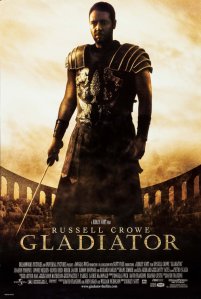
The year is roughly 180 AD and Rome is just finishing up its long-standing assault on anything that moves in the European continent. General Maximus (Russell Crowe) merely wants to retire back to his loving family and get away from the doom and war that has plagued his life. This is made all the more difficult when the ailing Emperor bypasses his treacherous son Commodus (Joaquin Phoenix) and decides to crown Maximus as the Defender of Rome. Because of this Commodus rises to power through bloody circumstances and has Maximus assigned to execution and his family crucified. You’d think crucifixion would be so passé by now. Maximus escapes only to be sold into slavery and bought by a dirt-run gladiator training school. As he advances up the chain and learns the tricks of the primal sport he seeks but vengeance for his fallen family.
Gladiator is an absorbing and sweeping spectacle of carnage and first-rate entertainment. The action is swift and ruthlessly visceral. The first movie in a long time to literally have me poised on the edge of my seat. The blood spills in the gallons and life and limb go flying enough your theater owner may consider setting down a tarp.
 What Gladiator doesn’t sacrifice to the muscle of effects and action is storytelling. Are you listening George Lucas? Gladiator may unleash the beast when the rousing action is loose, but this is coupled with compelling drama and complex characters. Phoenix may at first seem like a snotty brat with an unhealthy eye for his sister (Connie Nielsen), but the further Gladiator continues the more you see in his eyes the troubled youth who just wants the love of his father that was never bestowed to him. Maximus is a devoted family man who regularly kisses clay statues of his family while away, and must ceremoniously dust himself with the earth before any battle.
The acting matches every sword blow and chariot race toe-for-toe. Russell Crowe marks a first-rate staple of heroism. Every calculating glare he exhibits shows the compassion and ferocity of this warrior. He becomes a rare breed – an action hero who can think and actually act. Oliver Reed, in what sadly was his last role, turns in a splendid and charismatic turn as the head of the gladiator school of Fine Arts and Carnage. Mysteriously everyone carries a British accent closer to them then a toga two sizes too small. Even Crowe who is nicknamed “The Spaniard” speaks like he walked out of Masterpiece Theater.
The effects and visuals are a sumptuous feast. The aerial shots of Rome and the Coliseum are simply breath taking. Gladiator rivals American Beauty for the most rose petals used in a movie, except in this one they don’t shoot out of Mena Suvari’s breasts.
Ridley Scott’s track record may be hit or miss but Gladiator is definitely one sorely not to be missed.
Nate’s Grade: A-
——————————————————
WRITER REFLECTIONS 20 YEARS LATER
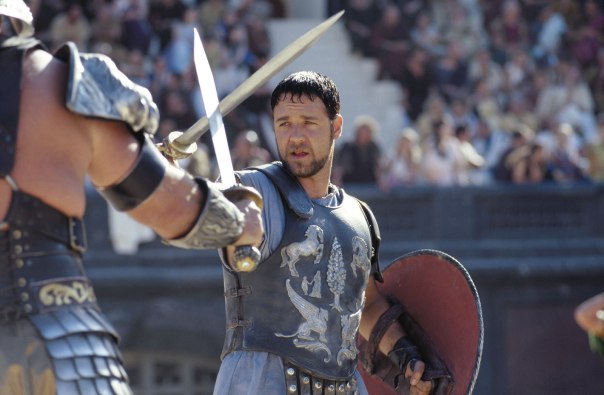
As Russell Crowe famously barked, “Are you not entertained?’ It was hard to argue in 2000 and it still holds true to this day. Gladiator was a big-budget throwback to the swords-and-sandals epics of old Hollywood. It was a box-office hit, made Crowe a star, and won five Academy Awards including Best Picture. My own elderly grandmother loved it so much that she saw it three times in a theater that summer, which was practically unheard of in her later years (she also, inexplicably, loved the 1999 Mummy movie). It was a millennial DVD staple. I can recall everyone on my freshman dorm hall owning it and hearing it on regular rotation. As studio projects were getting bigger with more reliance on CGI, Gladiator felt like a refreshing reminder on how powerful old stories can be with some modern-day polish. Re-watching Gladiator twenty years later, it still resonates thanks to its tried-and-true formula of underdog vengeance.
We all love a good story where we follow a wronged party seek to right those wrongs, plus we all love a good underdog tale, and given the pomp and circumstance of the gladiatorial arena, it’s easy to see how this movie was engineered to be a success from the page. This isn’t a particularly new story. Stanley Kubrick’s Spartacus mined the same territory with an even bigger scope, both in politics and in war, and there have been many movies covering the same history around the rise of Commodus, like 1964’s The Fall of the Roman Empire and The Two Gladiators. We’ve seen this kind of story before even in this setting but that doesn’t matter. The familiarity with a story isn’t a hindrance if the filmmakers take their story seriously and make an audience care about its characters. It all comes down to execution. As long as the filmmakers don’t get complacent and take that formula familiarity for granted, old stories can have the same power they had for decades because, deep down, cooked in their structure, they just work.
 Gladiator gives us everything we need to know by the conclusion of its first act, introducing us to Maximus, showing his leadership and loyalty, giving us the strained father-son relationship with Marcus Aurelius and Commodus, the expectations of the son of his ascendancy, the regrets of the father and hope for a return to a Republic, the reluctance of Maximus to be more than a general of Rome, and finally after the murder of the old emperor, a decisive choice for Maximus that challenges his morals and responsibility. From there, screenwriters David Franzoni (Amistad), John Logan (The Aviator), and William Nicholson (Les Miserables) put our hero and villain on parallel tracks heading for a collision. Maximus rises through the ranks of gladiators and builds a name for himself, getting called to the major leagues of bloodsport, and Commodus schemes to have his old enemy killed with increasingly dangerous trials in the Coliseum. It’s a natural progression and escalation, which makes the storytelling satisfying as it carries on. Gladiator never had a finished script when they began filming, which has become more common with big budget tentpoles with daunting release dates and rarely does this work out well. However, this is the exception (the screenplay was even nominated for an Oscar). It should be stated that the events of Gladiator pay very little to the actual history but fidelity is not necessary to telling a compelling story (the real-life Commodus rose to power after dear old dad died from plague). Use what you need, I say.
Ridley Scott was on an artistic hot streak during the start of the twenty-first century, directing three movies within one and a half years of release and earning two Oscar nominations. He wanted to veer Gladiator away from anything too cheesy of older swords-and-sandals epics, as reported. This isn’t about homoerotic wrestling with men in unitards (in Jerry Seinfeld voice: not that there’s anything wrong with that) and instead about the grit and superficial glory of Rome. The opening battle in Germania is meant to show Maximus in action but it also shows just how overpowering the Roman Empire was during this time period. They just massacre the remaining German tribe, and there’s a reason we don’t focus on battle strategy and instead on the chaos. The conclusion of the battle is a shaky camera mess of bodies and flames and dark shapes. It’s a bloody mess and not something to be glorified. Maximus is tired. His men are tired. Even Marcus Aurelius is tired of his decade-long conquering of a map, adding little inches to an already gargantuan territory. When is it all enough? When is war a self-perpetuating quagmire?
 This same dismissive view over conquest and glory carries throughout. When Maximus becomes a slave, he must play the blood-thirsty appetites of the crowd to reach his goals. He disdains the theater of combat, the delaying of strikes simply to draw out the drama of two men fighting to the death. Later, these same venal interests of the mob form a protection for Maximus. He’s too popular to just be assassinated because the Roman people just love watching how he slays opponents. There’s an implicit condemnation of popular entertainment built around the suffering of others. Scott has a purpose for his depictions of violence, and you could even make the argument he is drawing parallels between the bloodthirsty crowds of the Coliseum and modern-day moviegoers screaming for violence. What are the human costs for this entertainment? It’s not explicitly stated, and some might even say this level of commentary for a movie awash in bloodshed makes any such condemnation hollow or hypocritical. Maybe. The violence feels like it has weight even when it can border on feeling like a video game stage with enemies to clear.
Crowe (The Nice Guys) was already making a name for himself as a rugged character actor in movies like L.A. Confidential and The Insider, but it was Gladiator that made him a Hollywood leading man, a title that he always seems to have felt uncomfortable with. Crowe wasn’t the first choice of Scott and the filmmakers (Mel Gibson turned Maximus down saying he was too old), but it’s hard to imagine another person in the role now. Crowe has a commanding presence in the film, an immediate magnetism, that you understand why men would follow him into hell. That flinty intensity plays into the action movie strengths, but there’s also a reflective side to the man, a sense of humor that can be surprising and rewarding. There’s more to Maximus than avenging his wife and child, and Crowe brings shades of complexity to an instantly iconic role. He finds the tired soul of Maximus when he could have simply been a kickass killing machine. Between Crowe’s three Best Actor nominations in a row from 1999-2001, I think he won for the wrong performance. It’s a shame Crowe hasn’t been nominated since, which seems downright absurd. People have forgotten what an amazing actor Crowe can be, singing voice notwithstanding (I need a sequel to Master and Commander please and thank you).
 This was also a breakout role for Joaquin Phoenix (Her), who has risen to become one of the most celebrated and chameleon-like actors of his generation. The character of Commodus is your classic example of an entitled child who doesn’t understand why people don’t like him. He’s a sniveling villain prone to temper tantrums (“I am vexed. I am very vexed”). Much like his co-star, Phoenix finds layers to the character rather than resting on a stock villain characterization. He’s really the jealous son who envies the preference and love given to Maximus, first from his father, then from his widowed sister (Connie Nielsen), and then from the Roman people. He whines that they love Maximus in a way he will never deserve. It’s hard not to even see a Trumpian psychology to Commodus, a man not equipped for the position of power he occupies who longs for adulation he hasn’t earned. You can hate the man, but you might also feel sorry for him despite yourself. When he wants to be pompous, he can be hilarious (I adored his quick reaction shots to the theatrical combat). When he wants to be creepy, he can be terrifying. You can even see some of the broken pieces here that Phoenix would masterfully use to compose his Oscar-winning Joker performance.
The supporting cast was gifted with great old actors getting one last victory lap. Richard Harris was so stately and grandfatherly that it got him the role of Dumbledore in the Harry Potter franchise. It also served as a great sendoff for Oliver Reed (Oliver!) as Proximo, the selfish, trash-talking former gladiator turned gladiator trainer. Reed died months into the production and before he had wrapped his part, requiring extensive reworking from the screenwriters (Logan was on set for much of the production to cater to the immediate day-to-day story needs). Scott used a body double and parlayed visual effects to recreate Reed’s face, much like what 1994’s The Crow was forced to do after the unfortunate death of its star, Brandon Lee. I kept looking for what moments would be Reed and what moments would be the CGI-enabled Reed double, and it was harder to determine than I thought, so nice job visual effects team. Reed had a reputation of being a carousing reprobate, so having a final performance that allowed him to tap into those old impulses plus the regrets of older age was a wonderful final match.
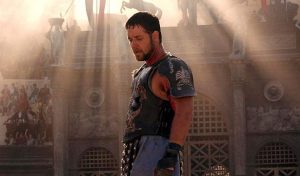 The other big takeaway upon my twenty-year re-watch was how recognizable and stirring Hans Zimmer’s famous score was, which lost the Oscar that year to Crouching Tiger, Hidden Dragon, and that seems insane to me. Zimmer has been in a class all his own since the 90s with classic, instantly hum-able scores for True Romance, The Lion King, The Dark Knight, Inception, and The Pirates of the Caribbean, which borrows heavily from his theme for Gladiator. The score greatly adds to the excitement and majesty of the movie and can prove transporting by itself.
A truly bizarre post-script is the story of how the studio tried to develop a sequel. Gladiator was hugely successful but any sequel presented problems. Given the death of its star, following another character makes the most sense, and yet that’s not the direction the screenplay took. Eventually, the sequel to Gladiator was going to follow the ghost of Maximus as it travels through time including to modern-day. Just take a moment and dream of what could have been. Alas, we’ll likely never get time-traveling ghost Maximus now and we simply don’t deserve it as a society.
Reviewing my original film critique from 2000, I feel that my 18-year-old self was more entranced with making snappy, pithy blurbs than going into further detail on my analysis. My early reviews were far more declarative, saying something was good or bad and giving some detail but not dwelling on going deeper into the examination. This line, “The blood spills in the gallons and life and limb go flying enough your theater owner may consider setting down a tarp,” makes me cringe a little because it’s just trying too hard to be casually clever. I do enjoy the Mena Suvari rose petal joke. Still, I celebrated that a studio movie could emphasize its story first and foremost and my observations are still valid. I’m all but certain the only reason I knew who Steve Reeves was back then was because of his many appearances via Mystery Science Theater 3000 covering his cheesy swords-and-sandals films of old that Ridley Scott was so eager to avoid recreating (“Do you like films about gladiators?”)
Because the movie does so much so well, with some exceptional, it’s hard for me to rate Gladiator any lower than my initial grade of an A-, so that’s where I’m keeping it twenty years later. I think the national conversation has cooled on Gladiator, forgotten it because it wasn’t quite as audacious as other examples of early 2000s films, but it sets out to tell a familiar story on a big canvas and deserves its plaudits for somehow pulling it all off with style and gravity. It would be flippant to say Gladiator still slays the competition but it’s still mighty entertaining.
Re-View Grade: A-
Share this:

Shazam! (2019)
 It seems like the secret to the success of the DC movie universe is making fun, lower stakes adventures with the characters the public has the least knowledge about. Shazam actually begun as a “Captain Marvel,” and now comes on the heels of the MCU’s Captain Marvel. We follow Billy Batson (Asher Angel), a teenage orphan trying to find his missing mother. He stumbles into a wizard’s realm and is given a special power whereupon he turns into a square-jawed, broad-shouldered superhero (Zachary Levi) by saying “Shazam.” What follows is like a superhero version of Big and it’s goofy, charming, and reminiscent of an 80s Amblin movie, where children’s movies were allowed to be a little creepy and weird. The movie is light, cheerful, and heartfelt with its doling out of family messages to go along with the slapstick and personal growth. It’s very much envisioned from a young boy’s fantasy perspective of being a super-powered adult, where the first things to be done include buying beer, going to a “gentleman’s club,” in between testing out bullet invulnerability and flight. Levi (TV’s Chuck) is excellent at playing an adult version of a kid. I was initially dismissive of his casting but he’s perfect for this part. There’s a satisfying sense of discovery for Shazam and his excitable foster brother (Jack Dylan Grazer) that doesn’t get old. The movie is more concerned with how the superpowers are affecting Billy’s relationships and sense of self than any larger, planet-destroying danger. The film even sets up its villain (Mark Strong) by giving him a decent back-story and opening the movie to explain his crummy family. It’s not a three-dimensional villain by any means but the attention given to make him something more is appreciated. The other foster kids in Billy’s new family are more archetypes but amusing, and their involvement in the final act raises the joy level of the finale. Shazam! is a movie where people are genuinely excited to be superheroes or associated with them, and that gleeful, buoyant revelry is downright infectious.
Nate’s Grade: B+
Share this:

Serenity (2019)
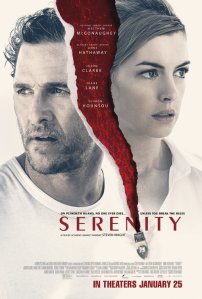 Serenity might have the most bizarre plot twist of any film this year, or maybe even the last few years. For the sake of you, dear reader, I’ll not spoil it, but it’s hard to talk about this neo-noir crime thriller without revealing its larger grand design. I have no real idea what writer/director Steven Knight, a talented wordsmith who has written Eastern Promises, Locke, and Peaky Blinders, was going for with this murky genre mishmash. Matthew McConaughey plays Dill, a local fisherman who for the first 18 minutes of the movie is obsessed with a hard-to-catch tuna like it’s Moby Dick. Literally, this is the key plot for 18 minutes. Then his old flame (Anne Hathaway) comes to town and looking for Dill to help her kill her abusive husband, Frank (Jason Clarke). Now we’re on fertile noir ground, and then one hour in the film throws a curve ball that nobody will see coming, and it spends another 45 minutes dealing with those repercussions. Some of this added knowledge leads to creepy exchanges where Dill is peeling back the veneer of his sleepy island town residents, but really it’s a confusing and unnecessary twist that leads to strange thematic implications and tonal oddities that may lead to unintentional laughter. The sentimental ending conclusion, born out of murder both real and imaginary, feels like it was ripped out of Field of Dreams and forcibly grafted on. So much of the drama is about following what is expected of us, and there are more than a few passing, though intriguing, Truman Show-esque moments that reward further examination, but these are put on hold to slay the abusive husband/step dad through the power of an elusive fish. I don’t know what to make out of Serenity. The acting is fairly solid, the photography is stylish, and Knight knows how to spin a mystery, but to what end exactly? It feels like a passionate albeit misguided student film trying to say New Things about old tropes. In the end, it’s a fish tale that is better off being thrown back. See, I can do fish things too.
Nate’s Grade: C
Share this:

Babel (2006)/ Blood Diamond (2006)
 The world is a global community. It is increasingly difficult to shut out unpleasant news just because it happens to an unfortunate few we’ll never know. Hollywood has reminded us through the years that our actions do have sound repercussions, including our indifference. Babel is Mexican-director Alejandro Gonzalez Inarritu’s examination on the fragility of human relationships in the world. Blood Diamond wishes to shine the spotlight on America’s love of diamonds fanning the flames of genocide in Africa. Both movies wish to convince the public that they matter, and not just in box-office, though that would be appreciated. Both of these films have good intentions but the results are sloppy and leaden.
In typical Inarritu fashion, the different storylines of Babel converge, blend, criss-cross, and crash together. The timeline isn’t as disruptive as it was in 21 Grams, so that is a welcome relief. The storylines offer wide-eyed views into different worlds and cultures. A Morocco goat herder purchases a riffle for his sons to protect the herd. The two brothers turn sharp-shooting into a competition, with the one betting the other he cannot hit a bus far in the distance. On that bus is Richard (Brad Pitt) and Susan (Cate Blanchett), a married couple at odds with each other. Suddenly a shot whizzes through the window and into Susan’s neck. Richard panics and struggles with his options being far removed from advanced medical care and being unable to speak with the natives.
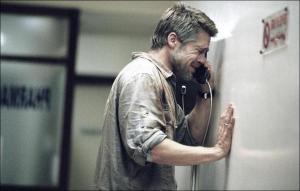 The incident becomes the shot heard round the world. The U.S. government is quick to suggest a terrorist link (who didn’t see that one coming?) but caught up in red tape to rescue the couple. Their nanny, Amelia (Adriana Barraza), cannot find someone to watch the kids so she can attend her son’s wedding in Mexico. Santiago (Gael Garcia Bernal) agrees to drive her and the kids south of the border where the blonde moffetts can learn things like how to kill a chicken. Things take a sour note when reentering the United States at a border crossing manned by suspicious patrolmen.
And half a world away, a deaf-mute Japanese schoolgirl (Rinko Kikuchi) deals in the aftermath of her mother’s suicide by flashing her vagina at boys and throwing herself at older men. Therapy might also be a workable alternative.
The strong ensemble acting is what kept me watching. Babel is filled with many talented actors that each get a turn to look pained, incredulous, and helpless. This is a movie primarily built around sadness and misfortune, and actors jump at those chances. Exhibit A: Brad Pitt. I’ve always thought his serious acting credentials get cast aside because of his good looks (the man even played a Greek god), but he’s into his 40s now and weathering some grown-up gray and wrinkles that, I don’t know how, add a mature sexiness to the man, much like George Clooney. Pitt was serviceable in Babel but failed to impress. He gets to pace a lot and look haggard but he still seems like a distant character. The whole American tourist storyline cannot outrun the sense of pointlessness it seems to be circling. The greatest moments of acting come from the extreme anxiety of Barraza and the dissatisfied yearning of Kikuchi. I expect both women to get nominated for many awards.
The most frustrating aspect of Babel is how little it matters. It’s hard to connect with the characters. And in the end, nothing all that tragic happens to reach anything profound. Most characters leave their shadowy places and only a small number are changed for the worst, mostly the victims of some very bad decision making. But when the movie concludes there is only one dead body and one displaced person. That’s it, and Babel doesn’t even hang on to let us feel that pain. It just skips from story to story never settling in and never evoking any human emotion except for that of morbid curiosity. These people are victims of fate and not much else. Babel is a letdown of a letdown.
 The Japanese schoolgirl storyline has no place in this film. The other three storylines all have a pertinent relationship, but the only thing that ties the schoolgirl into this web of international kerfuffle is that her father once owned the gun in question. Wow. It might have made better drama, and more sense, had this riffle had some significance, like it was the weapon of choice for her suicidal mother. Nope, it’s just another object with no more bearing to this family than a stapler. I think the deaf-mute Japanese schoolgirl is a terrific character and intensely intriguing, especially as she battles the trials of teenage life and feeling like even more of an outcast than usual, but this story needs its own separate movie. It has no business being here and, like much of Babel, adds little understanding or significance. So much of the movie isn’t even told to the audience, like character back-stories and written catharsis, so any distraction feels like a waste of time for a 140-minute movie.
The ending is symptomatic of the film in general; it just kind of peters out and thinks its message has been well-received. What message? What the hell is Babel saying? Stop, look, and listen? The world stage is at such a precarious time and is, for better or worse, unified; someone else’s problem has ripples that will become our problem. Isolationism is dead. But Babel squanders any attempts at a deeper message by playing it safe; never pushing further than the scene descriptions it has confined itself to. The title refers to the Biblical story where God punished man’s arrogance by creating multiple languages. Most of the conflicts revolve around communication issues, but they really only seem like a small portion of the story. When Amelia takes the kids to Mexico, there really aren’t any communication problems. When the car is stopped by the Border Patrol there aren’t any slip-ups in communication, but Santiago freaks out and bolts. The central idea of Babel, lost communication, never really feels properly executed except with the Japanese schoolgirl, who, like I said, doesn’t even belong here.
When Babel does have something political to dwell upon it is usually very lazy. Law enforcement treats illegal immigrants like crap. The U.S. government is more interested in punishing perceived threats than medically helping those in need. American tourists are boorish and see dusty places like Morocco as a place to be alone, despite all the impoverished people shuffling about. Give me a break. There’s nothing within Babel that makes it worth more than one viewing. Once you know the outcome for characters than the film ceases to have a point. This is a true surprise and disappointment from the team that had so much emotional vitality and open humanity with Amores Perros and 21 Grams. I guess a lot must have gotten lot in translation.
 On the flip side, while Babel is a mildly interesting movie desperately needing a message, Blood Diamond is a message in desperate need of an interesting movie. The message rings loud and clear in the film?s opening moments: conflict diamonds are bad. They account for 15 percent of all diamond sales and help finance genocide, civil war, and child brainwashing in Africa. The diamond industry says they cannot decipher which diamonds are which, but come on, they know. They use their market share to control world prices, thus creating a windfall for African rebels. They come up with more diamonds, and the diamond industry purchases them to take them off the market. Got it. But now what?
The short answer is, “‘Just say no’ to conflict diamonds, that is.” The long answer is one very trite movie that wears its liberal idealism on its sleeve with a bit too much fondness. Africa has become the cause celebre of recent films, but have any of them really made a difference? Did The Constant Gardener make us think twice about why drugs are so cheap (because Africans are exploited)? Did Syriana make us think twice why oil was comparatively cheap for Americans (because Africans AND Middle Easterners are exploited)? I doubt it. I may sound a pinch too cynical but I believe that the Unites States of America just generally doesn’t care as long as prices stay nice and low. I applaud filmmakers for attempting to open eyes and change hearts and minds, especially for many thought-provoking and worthy causes. But if you’re going to sponsor a message movie than you need a spoonful of sugar to help the medicine go down.
 Blood Diamond will make you gag, that’s how heavy the message is. It displays a depressing showcase of Africa recycling violence, but it always manages to stay on point. The movie is supposed to be concerned with the well being of Africa, but yet it hangs its attention on a pair of white people. Danny (Leonardo DiCaprio) is a South African diamond smuggler who gets the classic Hollywood redemption arc, courtesy of Solomon (Djimon Hounsou) an enslaved mine-worker that has found a pink diamond the size of a bird egg. Danny and Solomon form a reluctant partnership to get recover the diamond, rescue Solomon’s lost son, and get everyone out of the raging gunfire. But the film is focused on Danny’s arc as he goes from scoundrel to savior, with all those black faces in the background just becoming that — background. The film’s climax involves Danny running through a mining camp looking to rescue Solomon’s lost son. However, Danny shoots and kills all the other kids holding weapons as he dances in between explosions. You cannot root for that as a moral audience member, can you? Danny may save one child but he’ll blow away all the rest, and to the pounding score of Hollywood glory. If this was meant to seem meditative than God help us all.
Jennifer Connelly plays a photo journalist that?s a self-described action junkie. She says she just can’t go through her day sipping lattes and reading Ziggy in the funny papers, not with knowing how cruel the world is to one another. Did she just become aware of this? The world has always had people getting treated poorly and will forever. Her character is an outlet to the Western world, a lens that can capture and broadcast the horrors of Africa which she flippantly predicts will be a minute on CNN “between sports and weather.” She’s your prototypical bleeding heart and the not-so-subtle outlet for the righteous indignation of the filmmakers. There’s nothing to her character except a camera for proof, an unyielding moral compass, and a pair of breasts for Danny to improbably snuggle up to.
 The message of Blood Diamond is what we’re reminded of time and again, including tidbits to clue us in on how it all began (where did Africa learn some brutality? Why white colonists of course). The movie is built as an action vehicle, but it’s an action vehicle going in the wrong direction. The bursts of action are frequent but never anything well imagined or exciting. Usually the film follows two, or more, characters talking and then they’re interrupted by bouts of gunfire. Danny starts uttering “GO!” and “MOVE!” every other breath and they escape. This formula is repeated for the rest of the movie. It hampers getting to know and feel for the characters and sure as hell doesn’t amount to a lot of interesting action. There’s the main problem: we can’t feel for the characters because the movie doesn’t spend enough time with them, and yet we can’t get excited because the movie doesn’t spend enough time to build effective suspense. Blood Diamond finds its way into a balancing act it is hopelessly ill-prepared for.
Director Edward Zwick (Glory, The Last Samurai) is used to fashioning mass-friendly entertainment with cultural issues bubbling to the surface. Perhaps, though, he should have taken a cue from Andrew Niccol’s Lord of War. That film had an easily identifiable message (guns can be bad) but found ways to engage an audience. It had a lot of political ire and troubling statistics to dish, but Niccol knew that an audience must be entertained first and foremost. He found inventive camera angles, stirring monologues, and fascinating true-life anecdotes about arms trading. The main character wasn’t likeable but you just wanted a longer peek into this world behind the curtain. Blood Diamond lacks the biting insights that made Lord of War powerful and enjoyable. Even Lord of War handled the subject of turning children into a blood-thirsty army better. Zwick seems adrift and too close to his message to care about sharpening a good movie.
The movie has a handful of odd moments. In our introduction to Danny he is negotiating a weapons deal. He speaks to the head of a militia in a highly accented speech and subtitles pop up on the screen. Naturally, you would assume the language currently being spoken is not English. Danny is actually just impersonating an African’s English speaking voice. If you listen to what they’re saying they speak English the entire time. And the line, “In America, it’s bling-bling, but over here it’s bling-bang?” No. A thousand times no.
 DiCaprio is muscling his way into a riveting and meaty actor of prominence. His accent is near flawless, just like his Bah-stun accent was in The Departed. He gives more simmer to his role than deserved. Hounsou is a great actor but his most emotive scenes involve a lot of yelling that just seems like yelling. A lot of high-volume yelling doesn’t work when the character is so flimsy. Both of these actors are victims of playing characters with little else to them besides the title of Victim and Victimizer. Connelly and DiCaprio have no chemistry to them, not that the film’s neutered sensuality and agitated story help much. It’s as if Blood Diamond expects that by smashing the two characters together long enough their romance will be plausible. It isn’t. The romance is a distraction at best and eye-rolling at worst.
Babel and Blood Diamond are both pieces of misguided Oscar-bait. Innaritu and his writer for three films, Guillermo Arriaga, have said to have clashed since Babel‘s release and may no longer work again together in the near future. I welcome this trial separation because their film collaborations seem to be dulling. Babel has all the technical skills evident in 21 Grams and Amores Perros, but nothing substantial or contemplative. Conversely, Blood Diamond is a message movie posing as an action flick. It can’t succeed with poorly constructed action sequences and archetypal characters posing as openings for outrage and shameful finger-wagging. The movie is crushed to death by a message. Blood Diamond is a message movie that’s so weighted down it never gets very far. Both films are marginally interesting but nothing transcendent or demanding. Hollywood has its heart in the right place. They just need to make better movies.
Nate’s Grades:
Babel: B-
Blood Diamond: C


 nathanzoebl
You must be logged in to post a comment.