Blog Archives
The Odd Life of Timothy Green (2012)
 My friend and critical colleague Ben Bailey had warned me about The Odd Life of Timothy Green and he quite eloquently voiced his dumbfounded musings, which I will try my best not to knowingly replicate though I’m sure there will be some carryover. But whatever he wrote could not prepare me for what I ultimately got with The Odd Life of Timothy Green. Ladies and gentlemen, I think this movie broke my brain.
Cindy and Jim Green (Jennifer Garner and Joel Edgerton) are having trouble conceiving a child. One night they write a list of their hopes for a future child, place them in a box, and bury this chest of hopes in their garden. The next day they are shocked to discover a child covered in dirt claiming to be their son, Timothy (CJ Adams). He is the physical manifestation of all those buried hopes and wishes with some leaves attached to his ankles. The Greens take their magical parenthood in stride, trying their best to impart wisdom to their new son. They teach the kid how to play soccer, stand up to bullies, and interact with other human beings. Timothy has a secret he can’t bring himself to tell his new mom and dad, but if you have a hard time figuring out what his leaves falling off means, then there’s nothing I can do for you.
I feel like I just watched a movie where every person on Earth is depicted as being insane. Not goofy, not eccentric, not a little funny, no, we’re talking get the butterfly nets and padded cells. I feel partially insane just having watched the film, obviously still suffering from a contact buzz of insanity. I accept suspension of disbelief and that fantasy-based family films are going to have a whimsical nature to them. We cannot apply every rule of reality and logic to them, and I accept this. But The Odd Life of Timothy Green seems to exist in a fractured, cracked version of our own world, where the most bizarre and fantastical elements are just given a halfhearted shoulder shrug. People react to otherworldly events as if they were doing laundry. Where’s the awe? Or, more so, where is the skepticism? Seriously, if anybody told you they grew a child from a garden, would you accept this notion at face value? Their great piece of proof is that the kid has leaves attached to his ankles. Don’t you think, I don’t know, the parents could have taped those on? Beyond one guy, no one investigates this strange botanical phenomenon or even has the slightest inclination to. Where’s the intellectual curiosity, people? It’s like everyone in town has a lobotomy. Is there not one person in this small town that will dare stand and say, “You know, I think I’m going to require more empirical evidence to buy the story that this kid was formerly plant food.” And then they ran that one man out of town on a rail and salted his land.
 Timothy Green tries to gather a slew of messages and feel-good moments; it’s just that none of them feel coherent or truly earned. The parents don’t feel like responsible or even interesting adults. I understand we’re not going to dwell too much on the disappointments of a couple unsuccessful in conceiving a child (this is becoming an odd trend for Garner), but I expected more than one good cry and a bottle of wine. I want to empathize with these people but the movie makes it impossible time and again with their nonsensical behavior; it’s like they’re adults as envisioned by a child. On that note, I think the movie probably makes more sense from a fantasy point of view to flip the participants. It seems more likely that a child would try and grow new, ideal parents only to learn a lesson about the duds they’re stuck with. The Green family members all work one note, whether it’s the snide sister (Rosemarie DeWitt), the slaphappy grandpappy (M. Emmet Walsh), or the emotionally distant dad (David Morse), it’s all a tiny nub of characterization that gets whittled down to nothing. And then Timothy just seems to step into everyone’s lives and change them forever with little effort. He gets an older girl to fall in love with him, his father to stand up for himself and his family, and all the not nice people in town to be somewhat less not nice. He gets his mom to speak her mind to her bitchy boss (Dianne Wiest), which ends up getting her fired, so it’s a mixed message.
You want a prime example of this film’s collective shared insanity? Take this line from one of the board members from the town pencil factory: “If this boy can have leaves on his ankles, then we can make a pencil out of leaves.” What exactly does one have to do with the other, you may ask? I suppose it’s some claptrap about what is truly possible or whatever. My apologies to Ben Bailey for treading ground he has examined closely, but this cautionary line of dialogue glows with the intensity of 100 neon signs. It’s everything that is wrong and crazy about this movie, and the fact that it is spoken without a hint of irony or humor is all the more galling.
Here’s my problem with Timothy the life-changer: the kid is a dullard. He has no personality, he has no real insights or perceptions into life, he’s not funny, he’s not that interesting, and he eerily stays in the same modulated emotional presence. I found this kid far more unintentionally creepy than endearing. On paper, Timothy Green sounds like it should be a horror film and not the saccharine family slop that it is. Timothy just comes across like a rather bland kid with some weird tendencies, like his repeated inclination to soak up any sunny opportunity to photosynthesize (he gives Scott Stapp a run for his arms-wide-open pose throne). If a character is going to touch people’s lives and change their perspectives on life, then at least make that person fitting of praise. This kid just seems like a hazy mystic that’s playing it as he goes. Come to think of it, did anyone see him do anything superhuman? Cindy and Jim didn’t even find him in the garden, only inside their home covered in dirt. Who’s to say that young Timothy Green wasn’t a con artist this whole time?
 Then, likely as a defensive means to soothe my ailing brain, I started coming up with my own version of where Timothy Green should have gone. The ability to write down a bunch of general attributes and then grow a child seems too good to pass up. I desire more of this unique child cultivation process. For instance, Cindy and Jim want their kid to rock out as a musician, but they simply write “rocks” on their slip of paper before burying it. How is the magical entity that raises mutant plant kids going to be able to understand what the family intends with this vague entry? What if Timothy Green was born with rocks in his head? I wanted the film to simply turn into a comical version of The Monkey’s Paw, where every new version of Timothy Green would go horribly wrong. The first was born and then immediately suffocated because Cindy and Jim forgot to write “working lungs.” Then there would be the Timothy born with a “hunger for life” and become a cannibalistic plant zombie. Or the Timothy born with “his mother’s heart” and then upon his birth Cindy’s heart would go missing. What I wanted was a macabre trial and error game where the would-be parents had to refine exactly what they were asking for with the nondescript magical being in charge of answering hopeful parents. I want The Odd Lives and Deaths of Timothy Green and I want Cindy and Jim to have to bury all the malfunctioning prototypes in the same garden. Then, when they do perfect their perfect kid, the police find a yard littered with the corpses of children and haul them away.
The movie is told through the framing device of the Greens telling their story to the adoption agency, and why this adoption agency continues to listen after, “We grew a boy in our yard,” is beyond my guess. In a film breaking every boundary of believability known to mankind, this aspect to me seems the most incredulous. This is an adoption agency with standards and rules to follow, and to think they would allow a couple to drone on and on about their magical child that grew from a garden and changed people’s lives, instead of calling security and having them escorted from the premises, followed home, and then have their home exhumed for human remains of this child, is beyond me. And then, spoiler alert, they get a kid in the end. What adoption agency could reasonably and responsibly allow these two people, with no physical shred of evidence about their magical child other than some leaves and testimonies, to care for another human being?
Allow me to also question the sincerity of these two damaged people especially concerning their desire for a child. It sure seems like Cindy and Jim are planning on using their present and/or future child as means of settling some longstanding scores between relatives. When it looks like Timothy is finally going to do well in soccer, that’s when they pounce, airing out their resentments. Cindy brattily unloads against her sister: “I’ve had to listen to your perfect kids, well look at my kid! That’s my kid!” And then Jim finally let’s his distant father have a piece of his mind: “I could have been a good player too, dad. I had skills. If only you would have been more supportive.” Am I supposed to find any of this funny, because it comes across as far more sad. I feel like the reason that Cindy and Jim want a child is to desperately prove to their family that they are superior parents. It feels like one very crazy way of proving a point and one where the child will suffer, especially if he or she cannot live to a degree of excellence to provide mom and dad filial ammunition. Another example: both Cindy and Jim are oddly very jealous over the relationship their pseudo son forms with the slightly older gal, Joni (Odeya Rush). They try and talk him out of spending time with her, arguing there are so many fish in the sea for him to pay attention to. Are you really laying the argument that a 10-year-old should be playing the field? It also seems weirdly petty and controlling for two supposed adults to be jealous that their son chooses to spend part of his waking hours with another human being. So, does that sound like a loving and healthy family?
The Odd Life of Timothy Green is certainly odd but probably not for the reasons that Disney or the filmmakers had in mind. It feels like it exists in an alternative universe where everyone lacks any common sense, curiosity, or relatable human emotions. Nobody acts like a recognizable human being in this film, not for a single second. These people are all zombies, cowed into the cult of Timothy, the magical and, ultimately, messianic figure. But allow me to declare the emperor has no clothes. This Timothy is not worthy of the adulation he receives. He walks around like an ecological Forrest Gump, spitting sappy platitudes and changing lives with the insipid nature of all these easy messages. I wish I could say there was one genuine moment in this movie, but I cannot. It takes a magical premise and suffocates it with unearned solemnity. Why can’t a movie about growing a kid in your garden try and be, you know, fun? Well, I suppose embarrassing music recitals and kids getting hit in the head could be mistaken for fun, but I prefer a well developed story, characters I care about, and a genuine sense of enchantment to go with the supernatural. If we can make a movie about a kid with leaves on his ankles, then we can turn any sort of half-formed maudlin pap into family entertainment. Kids deserve better than The Odd Life of Timothy Green, and, for the record, so do plants.
Nate’s Grade: D
Share this:

Wreck-It Ralph (2012)
 Disney has taken plenty of drubbings with its non-Pixar animation output. They’ve all but abandoned traditional 2D animation, and the failure of The Princess and the Frog is unlikely to alter that decision-making. The Disney stand-alones have gotten better in quality; last year’s Tangled was well received and banked some nice dough. I expect Wreck-It Ralph to do even better. A film about the lives of video game characters seems ripe for a merchandizing bonanza, plus all the parents will need something to shut up their sweet little bundles of joy for two hours of relief.
Wreck-It Ralph (voiced by John C. Reilly) is the villain of a classic arcade game. He climbs a condo building, Donkey Kong-style, and smashes windows. Felix (Jack McBrayer) is the handyman the player controls, hopping from ledge to ledge fixing what is broken with his magic hammer. But Ralph is tired of always being the bad guy, getting hurled off the roof at the end of every game by the residents. He’s labeled as a “bad guy” but he doesn’t believe he’s so bad. To convince the townspeople of his game of his worth, Ralph abandons his game to seek a medal like what Felix earns at the end of every game. He trounces around an assortment of games, including a space Marine shoot-em-up led by the no-nonsense Calhoun (Jane Lynch), before landing in Sugar Rush, a girlie version of Mario Kart. Here he meets the rascally girl Vanellope (Sarah Silverman). She agrees to help Ralph get his medal if he’ll help her build a racing car and get her in the game. Vanellope lives on the run as a glitch in programming. The other game characters tell her she’s a mistake, but she knows she’s a racer at heart. Except without Ralph, Felix and the other game characters seem like they’re glitching. If they can’t get him back, they may lose their game and their home.
 It’s essentially a Toy Story for gamers, discovering the hidden world of video games when nobody’s looking. There’s a great sense of fun and discovery learning about these characters and their worlds as well as what they do off the clock. I love the idea of a support group for video game villains coping with their lot in life. I feel like this could have been a movie unto itself and I would have been pleased. There are plenty of references to games from the 80s and 90s, before everything became an endless variation on first-person shoot and kill games of sport. Really the references are only going to work for former or current gamers in their 20s or 30s, maybe even 40s. Are teenagers even going to understand the famous Konami code or get the subway scrawl, “All your base are belong to us”? Heck, are teenagers even going to know what arcades are at this point? The cameos are kept to a minimum as we switch over to our main characters. Wreck-It Ralph isn’t as clever or groundbreaking as the Toy Story films, but it gets points for trying something different than most family films, which are content with the somehow irresistible combination of fart jokes and inappropriate pop-culture references. Even non-gamers will likely find something to enjoy with the movie. I’ve gone on record saying that there will likely never be a good video game movie. Allow me to amend that statement: there will never be a good movie BASED upon a video game.
Set in the world of video games is another matter. The animation style is very colorful and impressive, with some fun quirks to give the movie an extra dash of personality. I really enjoyed how the Weeble-like people in Ralph’s game move in staccato 8-bit style; a herky-jerky movement that left me smiling every time. The running jokes helped to turn a half-hearted gag into a thing of beauty, like Calhoun’s tragic bridal backstory. The antagonist of King Candy (voiced by an unrecognizable Alan Tudyk) proves to be more interesting than at first glance. The different game settings all have very different tones, allowing the movie to present a nice variety of visual imagery. Some of the more frenzied action of the “Hero’s Duty” game might scare young children. The animation looks wonderful and even the recreation of the graphically limited games is cause for some amusement. That’s probably the best word for Wreck-It Ralph; it’s routinely amusing and provides enough chuckles for me to mildly recommend to others. I would not, however, recommend seeing this movie in 3D. You would think a world of video games would be quite a boon in the extra dimension, but the 3D is hardly noticeable at all. This may be the worst 3D rendering of a major movie I’ve ever seen, and usually animated films are the best ones to see with 3D. Regardless, the substandard 3D won’t detract from what is an enjoyable theatrical experience.
What helps smooth over the film’s flaws is the presence of heart. Yes it too can get saccharine at turns, and that’s not a joke about Sugar Rush, but you’ll be surprised that by the end of the movie, you may actually be feeling things in your heart-space for these characters and their plights. Again, here is another 2012 movie that rips off the ending to the brilliant 1999 animated classic, The Iron Giant. Perhaps some of my emotional engagement is residual association from that masterpiece. If this is true, and Hollywood filmmakers have found the secret formula to make audiences feel emotions, then I await the onslaught of movies copying the ending to The Iron Giant (I won’t spoil it but for God’s sake, go out and see that movie). After about 30 minutes, the film really becomes a buddy picture between Ralph and Vanellope, outcasts from their games. Neither character is that deep, though perhaps that goes with the programming. They both are denied better lives because of others prejudices against them. When they join forces as a team to buck the establishment is when the movie finds a wealth of sweetness. While their character arcs will be completely predictable, from the misunderstanding and reconciliation, but that doesn’t mean it misses the mark. Their relationship, and the film’s simple goals, can get bogged down in the messy plot mechanics of the movie (there are a lot of rules to digest). The climax, though, is filled with all number of payoffs, some big some small, some you’d forgotten about; I’m genuinely impressed how smoothly the movie ties together storylines, finding a perfect return of the bad guy support group pledge to form an emotional peak.
 There is a fun to be had and Wreck-It Ralph has enough colorful imagery to make your eyes glaze over. However, the story is a blend of familiar “be yourself” aphorisms given a retro polish. The motivation for Ralph, and Vanellope as well, is very flimsy, and the more time they repeat these miniscule goals (get a medal/compete in a race) the flimsier they become. Ralph is risking it all to get a medal because a shiny award is all it takes to convince the people in his game that he deserves better. The dubious logic seems pulled right out of a video game. There’s also a fair amount of messages about not being trapped by labels, breaking from the herd, believing in yourself, all those sorts of Disney beatitudes they’ve been dishing since the 90s. The plot also seems to fly well below its potential. We’re talking about a world of video games, and there’s a definite interest in seeing these realms mix and match. Unfortunately, the movie spends 2/3 of its running time in the candy-coated land of Sugar Rush. It’s here where Vanellope takes over the movie. Her relationship with Ralph works in fits and starts, and her annoyance level will vary sharply depending upon your tolerance index for Silverman’s baby-doll voice. Aside from a few retro cameos and puns, the humor is assuredly juvenile and filled with endless slapstick. Hope you like three minutes of “duty/doodie” jokes. You’re better than this, Wreck-It Ralph.
There’s one glaring plot hole that I feel deserves some deliberation. Throughout the film we glimpse Felix’s hammer magically fixing things that are broken. Just one whap and good as new. A late conflict arrives with the danger of the Sugar Rush game getting its plug pulled. The residents of the game could flee, but Vanellope would be stuck because she is a glitch, she cannot escape the game if it goes dead. Well couldn’t Felix use his hammer, tap Vanellope, and then “fix” her? To that end, what happens if the whole arcade goes out of business? We see the displaced game characters hang out at the surge protector, modeled like a train station. But what if that gets unhooked as well? How far can these guys run away to? They all seem inevitably doomed due to the dwindling business of arcades. Maybe somebody should start up a non-profit charity. Cue the Sarah McLachlan song (for just quarters a day, you can help a video game character in need…).
Colorful, vibrant, and occasionally witty, Wreck-It Ralph is Disney’s latest animated film to succeed with a solid formula of heart, attitude, and with an extra dash of nostalgia. I did enjoy the film but I always kept thinking there were so many better movies ready to be made given this setup. It does seem a little confused about who its audience is. It’s a bit too childish for grown-ups and a bit too plot-heavy and full of nostalgia for little kids. It packs a lot of jokes and plot into 108 minutes, which feels draggy at turns but flies by with enough spirit and energy that it’s hard to complain. Wreck-It Ralph is a perfectly entertaining movie that fits the definition of cute. It manages to make you care about the characters, which is a small miracle when you’re dealing with characters named Vanellope. Now that they’ve established this universe, hopefully Disney and the writers can expand their storytelling and really have fun with the possibilities at play.
Oh, and the short before the movie about a couple looking to find one another in the big city is rather cute though I liked it better before it went overboard with the supernatural.
Nate’s Grade: B
Share this:

Frankenweenie (2012)
 Tim Burton’s stop-motion remake of his own 30-minute short is a cute movie, even with the creepy subject matter. It’s the story of a boy and his dog and coming to terms with loss, although that seems to get stalled since the kid brings his dog back to life. Frankenweenie is, as my pal Eric said, Burton’s love letter to the Universal monsters of old, as other kids resurrect their pets into mummies, vampires, werewolves, etc. As a story, it’s pretty plain and seems thin and padded out. The animation is fun to watch but I couldn’t shake my questions about the character design. It feels like the only parts that move on these bulky faces are their tiny mouths. It’s a strange design that undercuts the animators’ efforts, and I couldn’t help comparing it to the superior and expressive animation from ParaNorman. I’d say this is the weakest stop-motion film with Burton’s name attached to it, but by no means is Frankenweenie a bad film. It’s got some fun jokes and any story about the loss of a beloved pet is going to have plenty of heart. There are some pretty solid jokes but they all seem to pool in the first act. I enjoyed Sparky the dog’s romance with the neighboring poodle, more so than any of the human relationships. Beyond the kid/dog aspect, I found it hard to engage with the movie. If you have to see one stop-motion animated film about the supernatural, check out ParaNorman instead.
Nate’s Grade: B-
Share this:

Brave (2012)
 Perhaps after a series of ambitious, mature, celebrated animated works, we just hold Pixar to unrealistic expectations. Their latest film Brave isn’t bad by any means, but it’s certainly second-tier Pixar among their cherished catalog of hits (somewhere along with Monsters Inc. and A Bug’s Life, I’d say). The movie is an eye-popping beauty to watch; the Scottish highlands look gorgeous and teaming with life, and our heroine, Princess Merida (voiced by Kelly Macdonald), has a signature mess of red tresses that look incredibly real. The hair practically blazes onscreen. Even though the independent-minded young heroine has been a staple of stories, and particularly animation, since the 1990s, Merida is still a feisty, engaging, and relatable lead. Her friction with her mother (Emma Thompson), who wants Merida to accept royal responsibilities and marry a suitor, creates some nice sparks, and the mother-daughter dynamic is an exciting new avenue for Pixar to explore. Without spoiling too much, Merida, in a moment of anger, has a spell cast with disastrous results. It’s here, at about the 30-40 minute mark, where the movie goes in a completely different, and unwelcome, direction. The rest of the film becomes a series of chases and comical close calls and lots and lots of slapstick humor. The timeframe of the movie, about 36 hours as near as I can tell, is too short for substantial character growth. And so, by the film’s end, the character development feels facile and forced and just unbelievable. Rather than keep its focus on Merida making her own way against a patriarchy, the film devolves into a supernatural buddy comedy and then concludes in a clumsy, dues ex machina fashion. The tone is uneven, and some points are a bit scary for young children, and I kept thinking that this was more a Dreamworks release. I may sound overly critical but that’s because we’ve come to expect the best from Pixar. Brave is an entertaining, funny, and often visually astounding movie, and while it’s second-tier Pixar, that’s certainly better than most.
Nate’s Grade: B
Share this:

John Carter (2012)
 John Carter has been in the longest development hell of any movie project in the history of cinema. If nothing else, that’s at least an accomplishment. Author Edgar Rice Burroughs first published his tale of interplanetary adventure in “A Princess of Mars” way back in 1912. It was his first published work, even before the phenomenon that would make him a star, Tarzan. Ever since 1931, filmmakers have been trying to realize Burroughs’ grandiose sci-fi vision but have never been able to finish. In the last decade, the movie has gone through different stages of development, with Robert Rodriguez, Kerry Conran (Sky Captain and the World of Tomorrow), and Jon Favreau attached as director at different points. Then Disney snatched up the rights and hired one of its own, Pixar director Andrew Stanton, to do what nobody has been able to do for 80 years –bring Burroughs’ vision to the big screen. It doesn’t hurt when Disney gives you a reported $250 million to spend.
John Carter (Taylor Kitsch) is a Civil War veteran haunted by his past. He’s chased by a group of bandits and stumbles into a cave that transports him to Mars, known as Barsoom to the natives. Carter discovers that he’s found himself in the middle of another civil war, this time between the cities of Zodanga and Helium. The Tharks are a race of 10-foot tall four-armed warrior creatures, and their leader, Tars Tarkus (Willem Dafoe), sees Carter as the turning point in getting his people’s lands back. Carter will also help solidify Tars Tarkus’ place as leader to his people. John Carter is a coveted free agent on the red planet. Princess Dejah Thoris (Lynn Collins) wants John to help her people survive against the Zodangans, lead by Sab Than (Dominic West). Dejah’s father (Cirian Hinds) has brokered a shaky peace on the promise that she and Sab Than will marry. The mysterious Therns, lead by Matai Shang (Mark Strong), are the real power players on Mars. They have offered a powerful new weapon known as the “ninth ray” to give Sab Than the upper hand. All John really wants to do is return home, but first he has to find a way back.
 John Carter is an amusing, entertaining throwback to old-fashioned B-movies. Even the depiction of life on Mars is charmingly retro, what a future would look like to a man from the early twentieth century perspective. As a result, the aliens fight with Bronze era weapons and guns that behave like trinkets from a Western. Even the minimalist alien design, the Roman-esque costumes, the fact that everyone can breathe air, and low-grade technology of these advanced species (flying machines that look like Da Vinci designed them) come across as nostalgic, vestiges of the past more so than insights into the future. It’s like watching those old sci-fi TV shows from the 1950s and how they predicted man would have colonized the solar system by now and already have a working lunar colony (Newt Gingrich is trying his best). The movie channels the spirit of old adventure serials and captures a certain gee-whiz, childlike sense of fun. There are moments where Stanton has a playful sense of storytelling, like a near montage of Carter’s determined escapes from officer Powell (Bryan Cranston? Why not?). While being PG-13, there is still a feeling of the Disney-fication of the tale, complete with tamer outfits for Dejah Thoris (do a Google image search) and an adorable alien “dog” sidekick that befriends John.
The best moments are easily the scenes where John integrates into the indigenous Thark tribes, finding a sense of community and a bonding with Tars Tarkas. If the movie had only featured this alien race instead of all those warring people-who-have-red-henna-tattoos-on-so-they-must-be-aliens-right, I think the movie would have succeeded better. One alien race focuses the narrative but instead we get four (three?). When our climax does come into view, the pieces have all fallen into place and the action is suitably thrilling. Stanton’s live-action debut isn’t the homerun that Brad Bird’s Mission: Impossible 4 was, but the large-scale action is satisfying and imaginative enough. The payoffs work and Stanton has nicely intertwined his storylines so that everything comes to a head. The Earthbound framing device, with Edgar Rice Burroughs (Daryl Sabara) reading the diary of his rich departed Uncle John, enriches the narrative once the full context is revealed, gearing up the audience for a long-awaited reunion to end the movie on a perfect high note.
What John Carter also has going against it is the pull of time. It’s hard not to see how derivative the story and characters are; Burroughs’ original novels were hugely influential to science fiction writers, and you can see similarities in Star Wars, Avatar, and other works. Scenes in this movie will feel like rip-offs from other movies, like an arena battle with giant alien hordes from Attack of the Clones, riling up a native alien species against its imperial antagonists in Avatar, Deja Thoris clearly has her DNA all over Princess Leia, and the dynamics of jumping through space travel via gateways made me think of how excellent a movie Stargate was (watch it again; it’s terrifically executed). Carter can easily be credited as the predecessor to superheroes. Now it’s unfair to say that John Carter rips off these other sci-fi movies when every one of them was released long after Burroughs’s novels had been widely published. It’s unfair, but you can’t help but feel the way you feel, and I was feeling a fairly resounding sense that I had seen much of this tale before and better. The actual terrain of Mars is a little less than inspiring. Its rocky vistas don’t make it feel too noticeably alien. We don’t ever really get a good view of alien culture outside of the Tharks. John Carter’s one big addition is that the character, given his physiological makeup and Mars’ gravity, can leap to impressive heights that were only previously known by Italian plumbers in video games. This means we get a lot of John Carter jumping up, jumping around, jumping like a Martian jumping bean. But just because you can jump really high, doesn’t that mean you’d be plummeting at a high rate of force? Wouldn’t John seriously break his legs leaping 500 feet in the air and then landing?
 The script, credited to Stanton, Mark Andrews (co-director of Pixar’s upcoming Brave), and Pulitzer Prize-winner Michael Chabon, is weighed down with expositional slog that it cannot break until the third act. I was expecting a better and more graceful story given Stanton’s previous film, WALL-E, which could be taught in film classes as a textbook example of elegant visual storytelling. With John Carter, it feels like we’ve been hit with the Martian phone book. We’re inundated with unfamiliar names and given scant time to adjust. While a gamble that the audience intelligence will catch up, it also makes for a confusing half of a movie. It’s hard to keep track of all the different names; Tharks this, Hellium that, Zodanga this, Jeddak that, Therns here, Barsoom there, etc. The movie doesn’t gradually expand its Martian history, it just plops us, along with Carter, right into the middle. The opening structure is also a bit confusing, as we’re jumping around time without any proper setup. Still, the movie cannot be accused of being stupid; hokey and convoluted, yes, but not stupid.
And boy do we get a lot of talking for an action movie set on Mars. The middle section is quite heavy with yapping. Kids who came thank to their trust of the Disney name will probably be bored as the movie explains to us things we already know and things we don’t care about knowing. For a two-hour plus film that has a lot of political infighting, I’m surprised that the movie is pretty pedestrian when it comes to its politics. It all really comes down to an arranged marriage to broker peace. That’s not very complicated. The main villains, the ghostly Therns, are completely incomprehensible when it comes to motivation. I have no idea what they stood to gain. If they have a gateway that can take them to Earth, or they have their own copies on Earth, why aren’t they using this to their advantage? Why aren’t they grabbing more Earthmen to form an army of jumping Jacks? Why the significance of the “ninth element” when we all know the fifth element is love? But more importantly, as last year’s Green Lantern proved, it hurts your movie when your hero can’t be bothered to be heroic. It takes far too long for John Carter to seem like he gives a damn about anything. I understand he’s a war-weary vet, but the movie feels like 90 minutes of him shrugging while everyone on Mars desperately pleads with him to save them.
Kitsch (X-Men Origins: Wolverine) is going to be having a fairly big breakout year given his mug appearing in several high-profile, high-budgeted movies. The guy has already proven with steady work on TV’s Friday Night Lights that he can act, though the results are not so convincing with John Carter. I think he was going for some sort of gruff, Clint Eastwood-esque loner but he just comes across as wooden. Add his character’s reluctant nature, and it makes for a pretty uninvolving hero. Fortunately for Kitsch (what an unfortunate last name), the supporting cast is there to pick up the slack. Collins (TV’s True Blood) is the real breakout star of the movie. She’s feisty and strong and passionate and altogether easy on the eyes she could give Leia a run for her money in a metal bikini competition. Collins’ performance is filled with urgency, like she’s compensating for our taciturn lead actor. When she’s on screen you feel engaged in the story. Dafoe (Spider-Man) finds the right mixture of humor and pathos as the leader of the Tharks. West (300) has such a slimy sneer to him, it’s magnificent to watch. I’m starting to think that Strong needs to take a break from playing villains (I count eight bad guy roles sine his breakout in 2008’s RocknRolla) except that he’s so good at playing them. I think if Mark Strong ever plays himself in a movie about his own life, he’ll inevitably be the bad guy.
John Carter is an entertaining throwback to the adventure serials of old, a retro sci-fi action film that falters somewhat from a talky, uneven, exposition-laden script. When this movie works, it works quite well. There’s just too much stuff in this movie, too many alien races, too much exposition, and too many other movies that make John Carter feel derivative. What was once amazing and imaginative in 1912 will not have the same effect on audiences in 2012, especially those who have grown up on pop culture inspired by John Carter. I don’t think anyone can say the final product was worth the wait, but John Carter is a modestly fun adventure. I wouldn’t mind taking another trip to Mars, just as long as it doesn’t take 80 years.
Nate’s Grade: B-
Share this:

The Secret World of Arrietty (2012)
 This adaptation of Mary Norton’s classic book, The Borrowers, is colorful, imaginative, and the antithesis of what has become the modern-day family film. It’s less antic with its pacing, it has a more somber mood, and the ending is essentially anticlimactic. While commendable on one hand, The Secret World of Arrietty is also a minor work under the tutelage of the brilliant Hayao Miyazaki. Like other Miyazaki works, the film immerses you into an imaginative world where all the details fit. The story itself within that world is a bit low-key. Arrietty is a 13-year-old tiny person, a Borrower, living with her mother and father inside a human being’s home (they refer to people phonetically as “beans”). Her friendship with one of those “beans,” a boy named Shawn, is pleasant and gradual, as she feels she cannot trust the enormous human. I kept waiting for something larger and more significant to happen, but it didn’t. The story feels too slight to justify being the introduction, and likely final, chapter of these characters. The world of Arrietty is beautiful to watch but after a while you’re just watching pretty pictures.
Nate’s Grade: B
Share this:

The Muppets (2011)
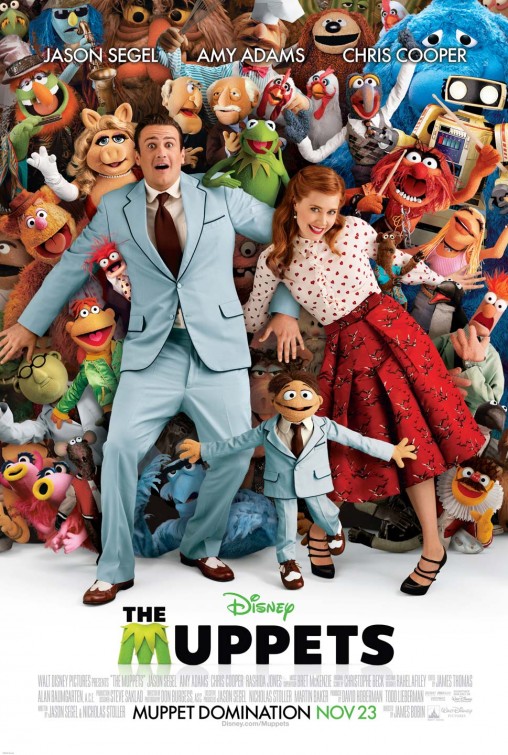 You’d hardly expect the duo behind the raunchy, R-rated comedy Forgetting Sarah Marshall to be the saviors of the Muppets, the famous puppet crew that has been languishing since their last big screen outing, 1999’s underwhelming Muppets in Space. Actor Jason Segel took a meeting with Disney after the Jim Henson Company did some puppet work for Sarah Marshall. He just point-blank asked them what their plans were after acquiring the Muppets. They had nothing. Segel and Nicholas Stoller (Get Him to the Greek) put together a script and, lo and behold, the two self-described Muppet enthusiasts were given the opportunity to bring new life to the classic creatures. The Muppets is just about everything a Muppet lover could ask for and will be sure to entertain a new, younger generation of fans with the Muppets core brand of silliness and sweetness.
Set in the town of Anywhere, Gary (Segel) and his girlfriend Mary (Amy Adams) are planning a trip to Los Angeles. She’s hoping that he’ll finally propose to her in the scenic city of angels. There’s one catch: Gary’s brother Walter is coming along too. Oh, and Walter is a Muppet. Walter is obsessed with the Muppets ever since he watched their TV show in the 1980s. The show was an escape for a kid who felt… different. Walter is anxious to visit the Muppet studios, but the studio is in disarray and the Muppets have all gone their separate ways. Tex Richman (Chris Cooper), what else but an evil oil barren, plans to buy the Muppet studio and tear it down. Walter, Gary, and Mary must seek out the Muppets to rescue the old studio, and the only way to raise enough money in time is to put on one more rendition of The Muppet Show.
 The Muppets is a refreshingly retro and charming vehicle that reminds you of all those warm and fuzzy feelings you had for this crew. It’s unironic, innocent, sweet and wholesome in a way that doesn’t make you gag but self-aware and silly enough to continuously be clever. When a big song-and-dance number breaks out in the town of Anywhere, once the stars have left the townspeople collapse in exhaustion. The gang decides it’ll be quicker to “travel by map,” so we cut to a map and see a red line charting onward. Muppets will regularly break down the fourth wall, with Fozzie commenting on a sudden explosion, “Wow, I didn’t think we had that in the budget.” Tex Richman actually verbally articulates “maniacal laugh.” The group gathering is sped up when the character 80s Robot suggests streamlining the rest in a montage. It’s not the kind of jokes that will make your sides ache with laughter but it pins a smile to your face from beginning to end, although Chris Cooper’s out-of-nowhere rap number left me in stitches. The very question of whether the Muppets can fit into our snarky, over-caffeinated, self-indulgent culture is addressed. Segel and Stoller have found a way to reenergize the Muppets for a new generation while staying true to what makes them special. My friend Eric Muller said watching The Muppets was like “getting an oil change for your soul.” He couldn’t be more right.
Watching the movie, I’m awash in feelings of nostalgia for Jim Henson’s finest creations. Segel is an unabashed Muppets fan and the movie is a celebration of the TV show that inspired him; the TV show is lionized for its inspiration to children. Because of that heavy helping of nostalgia, Muppet fans will feel like their spirits have been lifted. Those who had a mild curiosity about the Muppets will probably just scratch their head and call the film pleasant. The movie’s goal is rather huge: to make the Muppets relevant again. However, the vehicle for this goal, the old puttin’ on a show routine (Mickey Rooney has a cameo!), can feel slight. Also, the Disney product placement can be a bit annoying at times. Really, thanks for reminding us once again about how poor Cars 2 was thanks to a billboard advertisement. The movie isn’t in the same league as Henson’s troika of Muppet movies from the 1970/80s, but Segel and Stoller’s efforts should be a delight for Muppet fans waiting for the triumphant return of their favorite characters. You may find yourself unconsciously singing along to “Rainbow Connection” at the close of the film.
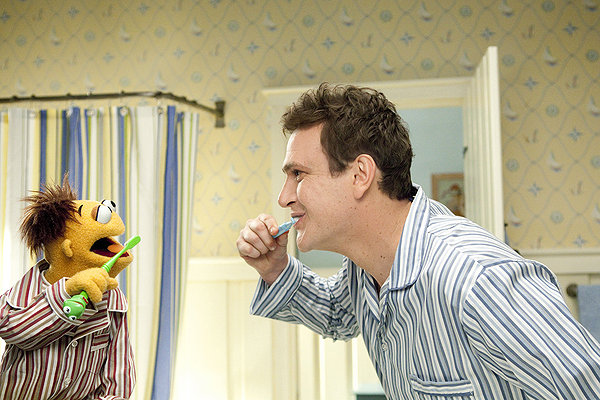
One aspect that is never spoken openly about is the fact that Gary and Walter are brothers, a human and a Muppet. I was expecting some throwaway reference to Walter being adopted, or maybe there could even be a funny sit-down where Walter is given the devastating familial news. We see a montage of the two brothers growing up, and while Gary shoots up like a weed Walter remains at the same height through the years. Does this mean that Muppets attain maturity at a faster rate? That Muppets are fully formed at birth? The mysteries of the universe are left undisturbed.
The music is cheerful and eminently hummable. Recent Muppet outings in the 1990s tried to keep the musical comedy formula going, but the result was some rather tin-eared musical numbers. I challenge anyone to be able to recite more than a few bars from Muppet Treasure Island (my favorite of the three), Muppet Christmas Carol, or Muppets from Space. To everyone’s good fortune, this newest Muppet incarnation has Bret McKenzie, one half of the daffy Flight of the Conchords, supervising the songs. You can instantly tell the musicianship has been raised considerably. The opening number “Sing a Happy Song” is a catchy and bouncy track, putting the audience in the right kind of upbeat mood. “Man or Muppet” is a ballad where Gary and Walter must confront their identity crises. It’s played completely straight, which makes the song even funnier as it builds into a crescendo of self-actualization: “If I’m a man that makes me a Muppet of a man.” There’s also a G-rated performance of Cee-Lo Green’s famous f-bomb kiss-off song, this time performed entirely by chickens. And the aforementioned rap by Chris Cooper is just astoundingly random, and not that bad either. The funny and cheerful music greatly adds to the overall enjoyment of the film.
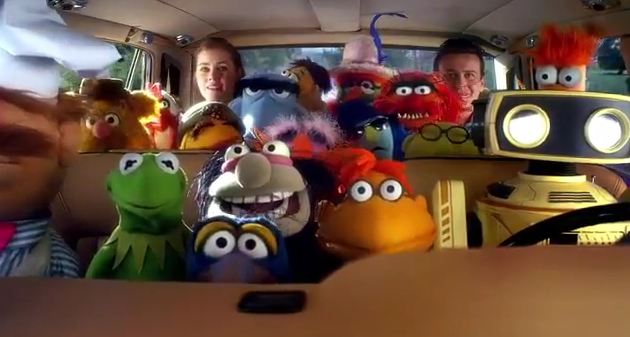 Segel (I Love You, Man) is pretty much a big goofy human version of a Muppet. He’s a winning presence, much like Adams, who slides right back into her adorable Enchanted-flavored M.O. The two actors are a near perfect union of humans who capture the ineffable “Muppetness.” The multitude of celebrity cameos makes for some fun sightseeing (Jack Black has the most extended stay, not by choice). “Hobo Joe” might be my favorite of the cameos. But while the new characters are the initial focus, the emphasis on the film is rightly placed upon the classic Muppets. Kermit and Miss Piggy and the gang are back and the film’s entire plot is essentially their reunion. That means we get wonderful sequences rediscovering the Muppet team, like getting the gang together for a heist. These characters need one another; the bonds are undeniable. It’s actually touching when the Muppets speak candidly about how much they need one another. Fozzie has fallen on hard times especially. Kermit’s mournful song about losing touch with his old pals includes the line, “Was there more I could have said?/ Now they’re just pictures in my head.” While the film’s goal is to really just gather the Muppets back together, you’ll be glad that this goal is accomplished. You will be amazed how much you feel for felt.
The Muppets is a triumphant return to form and rekindles the fondness fans have felt for Jim Henson’s lovable creations. Thanks to Segel and Stoller, and the whimsical direction of Flight of the Conchords director James Bobin, the Muppets is a delightful, charming, and heartfelt family film that will give you a serious case of the warm fuzzies. The songs are catchy, the jokes are amusing, the pacing is swift, and the movie is fun from the start. As a Muppet fan, it left me with a smile pinned to my face the whole time. Like the big screen Simpsons movie, the universe of the Muppets is too big for 90 minutes, so naturally some favorites will be shortchanged when it comes to screen time. Since Disney paid half a billion dollars for the Muppets, I’d expect they plan on making use of the property. After this splendid relaunch, one can only hope that we won’t have to wait too long for the next Muppet movie.
Nate’s Grade: A-
Share this:

Real Steel (2011)
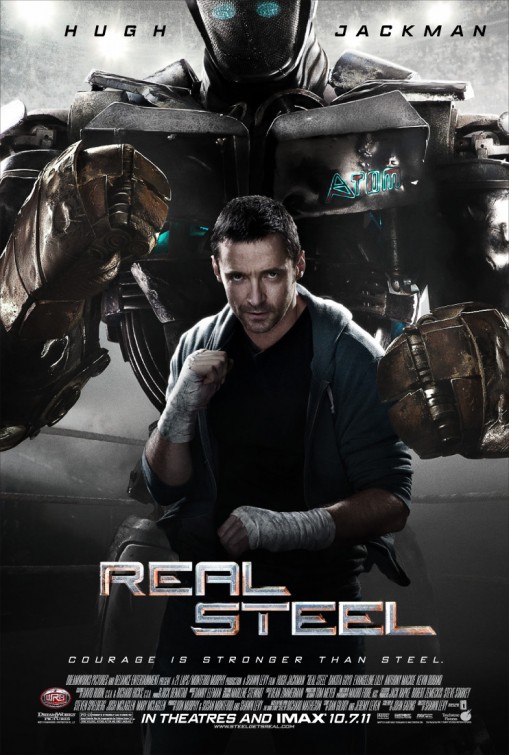 In the future world of Real Steel, set in 2020, robot boxing has become a huge sensation. It seems that audience bloodlust was not being satisfied with flesh and blood hitting the canvas, so robot brutality will do. Whatever happened to mixed martial arts, a sport arguably more popular than boxing in this day and age, popular enough it even got its own uplifting sports drama earlier this year (the overlooked Warrior). I strongly doubt that in only nine years we’d have giant fighting robots and that this “sport” would be nationally recognized. Did anyone see Comedy Central’s mechanical Coliseum showdown, Battlebots? There’s your answer, America.
In this future world where trucks have glass panels to show the world your feet (why? Because it’s “futuristic” you fool), Charlie Kenton (Hugh Jackman) is a has been. He enjoyed a fleeting career as a professional boxer before the mechanical men came into popularity. Now he goes from town to town trying to scrounge up some petty money with small-market robot boxing rings. His only pal is Bailey (Evangeline Lilly), his former flame and the owner of the boxing ring/chop shop that Charlie calls home. Charlie owes plenty of money to plenty of not nice people. His solution arrives in the form of his 11-year-old son, Max (Dakota Goyo). Charlie ran out on Max and his mother when Max was a baby, but now mom’s dead and custody is being discussed. Mom’s aunt (Hope Davis) and her rich hubby want Charlie to sign away his parental rights, which he agrees to do for the right price. Max spends one last/first summer with his estranged father before going off to live with his auntie. The two bond when Max discovers a beat-up old sparring robot when father and son are skimming parts illegally at a junkyard. The old bot, which Max names Atom, becomes a champion fighter. Father and son ride the success all the way to a championship bout with Zeus, a legendary robot that destroys all challengers. Can they stun the world? Can father and son bury the hatchet? If these answers are in doubt, I advise you to see any sports movie ever released.
J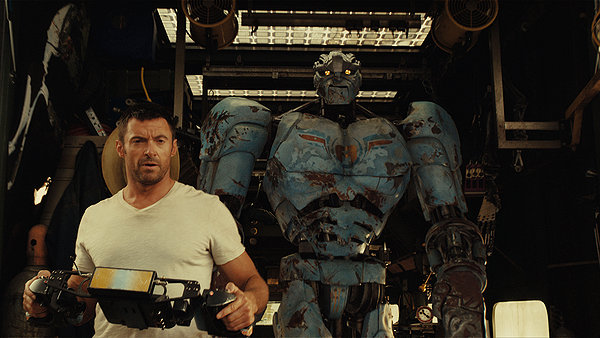 ust in case you stood clueless and slack jawed at the film’s storytelling prowess, you’re in luck because every character will take great pains to explain the significance of plot points, key metaphors and symbols, and personal motivations. Usually this stuff is tucked away as subtext, but Reel Steal decided that it would rather rub the audience’s nose in the architecture of its screenplay. Characters will just go around speaking blurting out their feelings in the most transparent way possible: “I can’t be with you again, I’m afraid of being hurt again, and seeing you in that ring is like seeing my father again in that ring, and fighting this fight is your attempt to regain redemption and prove yourself wrong, and the robot is old and busted but still has some fight in it left, just like you Charlie…” It gets tiresome. Max squeals, “All I’ve ever wanted was for you to fight for me!” Your dad’s kind of a lout, kid. You’d be better off being adopted by your preposterously rich aunt, which is really the moral we learned from Annie. Who talks like these people? It’s astounding how blatant the film is about explaining its sotry mechanics so that the dumbest common denominator in the audience can walk away feeling like Roger Ebert (“Did you notice how the robot was a metaphor for Charlie? I did.”).
Never in my life would I have anticipated that someone would watch Over the Top and say, “What if we added robots?” This movie essentially is a souped-up version of Sylvester Stallone’s 1987 flick where a dad fights for the custody of his kids through the weirdly court-approved process of the gentleman’s game of arm wrestling. First off, who in their right mind would make a movie about professional arm wrestling? There’s a reason this specific sports genre still stands with one entry. Charlie finds redemption over one summer spent with the kid he abandoned and then sold. The strange thing is that Max knows from the start that he’s more a commodity than a valued son. Yet he still bonds with dear old dad though he’s still going off to live with his rich aunt by the end. The father/son relationship becomes the heart of the movie, but what good can come from two annoying characters learning to get along? They’re still too annoying for me.
Charlie’s fight to become a better father is hampered by the fact that I wanted to strangle his kid. There was rarely a moment that passed where I didn’t want to punt this little brat. From the moment he first steps on screen, Max is surly and aggravating. Given that he’s meeting the father who abandoned him, I’d expect some confrontation but this little twerp cops a bratty attitude throughout. He hops on the boxing ring mic and walks around with a phony swagger and challenges the biggest baddest robot. The kid seems like a chip off the ole block, falling victim to hubris just like dead. When Goyo (Thor) screams it becomes a high-pitched caterwaul that caused me to writhe in physical pain. The subplot of Max teaching the robot how to dance is just embarrassing. You better believe the kid teaches his metal friend how to do the robot. The young actor deserves a fair share of the blame. Goyo flounders, overselling every emotion and hovering at a persistant petulant level of acting. I do not advocate the endangerment of children, obviously but I’d be lying if I failed to admit that I would have slept soundly had Max tumbled to his death in the robot junkyard. Goyo is so powerfully awful that he may well be the tarred as the Jake Lloyd of this decade (Lloyd infamously played the twerpy kiddie Darth Vader in the first of the regrettable Star Wars prequels). It’s hard for me to root for the reunion of father and son when I’d rather see father bury son in the ground.
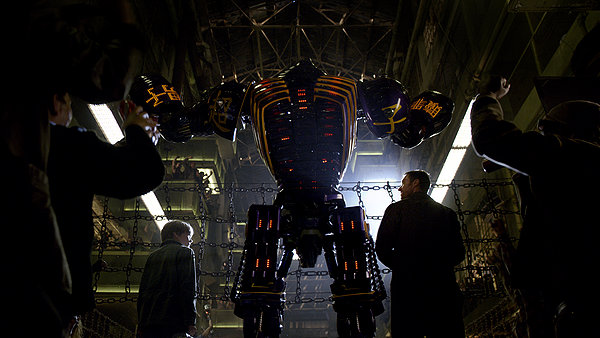 Real Steel is littered with nonsensical or dropped subplots, the worst offense being Atom’s secret. It’s revealed midway into the film that Atom is not just a sparring robot but a sentient being. It’s faking that it can only shadow human movement. When Charlie “teaches” Atom how to box he really is teaching the robot, though conveniently Atom seems to keep this knowledge to itself. Even when it’s being battered mercilessly, Atom doesn’t employ the skills it’s been taught. Maintaining his cover is more important than self-preservation, so suck on that Asimov. The fact that Atom is sentient is the filmmaker’s desperate attempt to add empathy to the robot. Without sentience, the robot is just a junky avatar that can be scrapped. It’s a piece of equipment but if sentient it becomes a character we can feel for. You don’t share empathy with a coffee maker. I kept waiting for this secret to somehow get out because it’s kind of a monumental deal. But it never does get out. The story never once revisits this gigantically important revelation. What does this mean about other robot boxers? Are they too sentient? What do they think about destroying each other for sport? There are important questions here that are ignored. What’s the point of making Atom sentient if you never do anything with it? It’s only a ploy to drum up empathy, but at no point does Atom feel like a character, only a collection of parts. It’s a coffee maker on steroids.
The movie borrows liberally from other sports movies, taking the emotional beats from Rocky and the family drama from a film like The Champ, though loses the downer ending. Everything is too recognizable, too formulaic, as if it was assembled on a factory floor. The only points of surprise are when Real Steel just carelessly drops plotlines, as mentioned above. What’s the point of introducing a plot point like the robots can malfunction if hit correctly in Act One and not have it resurface in Act Three? Jackman (X-Men) acts with all the power his neck veins can afford. He seems to be constantly growling or on the precipice of said growling. The romantic subplot with Bailey is an undeveloped thread only meant to tie back together into a pretty bow at the plot’s earliest convenience. Lily (TV’s Lost) plays the “girl,” which means all she’s given to do is remind the hero of his potential and be the warm body waiting in bed. But this is a family film, so we stop at late-night cuddling. Then Max ends up being a savant at mechanical engineering and electronics because… he plays video games? Give me a break. And it just so happens that every character we’ve been introduced to will be in attendance for the big fight, even the Texas bookie (the great and underutilized Anthony Mackie). Wouldn’t Detroit bookies take umbrage to this?
Do you like reaction shots? Real Steel is chock full of them: people wincing, people yelling and clapping at TVs, people muttering under their breath the optimistic instructions, “C’mon, c’mon, c’mon.” You accept some reaction shots as part pf the terrain of the sports movie, but when they’re presented in excess then it becomes a crutch, the director reminding the audience what to feel with the subtlety of a sharp stick to the eye. Then again subtlety was never the forte of director Shawn Levy, he of Date Night and Night at the Museum fame. The special effects are strong and the boxing sequences even have some livened suspense to them, though why would anyone build a robot boxer with two heads? What advantage does that offer other than two things to hit? Levy gets lost in the special effects and treats the actors with the same indifferent level of care that the humans show the robots.
Real Steel wants to be a rousing, family-friendly crowd pleaser; it just won’t ever let you forget that this is its primary function. This outlandish sports flick is much like its robotic pugilists: big, dumb, loud, and prone to malfunction. The film has no faith in its audience’s intelligence so every feeling and symbol is plainly explained with unwanted diligence. The characters are unlikable or underwritten, the story is shackled by lockstep devotion to formula, and Goyo’s wretched performance makes it damn near impossible to sympathize with the father/son reunion. Filled with unresolved plot setups and a mystifying similarity to Over the Top, Real Steel is just like every other boxing movie on record except this one has robots. I’m fairly certain the screenwriters were robots too. Why else would they make a robot becoming sentient seem like no big deal? Obviously this is propaganda to lull us into complacency before the impending robot war. Real Steel is a classic example of a movie done by committee; it feels like it was crudely assembled from the spare parts of other, better movies.
Nate’s Grade: C
Share this:

Pirates of the Caribbean: On Stranger Tides (2011)
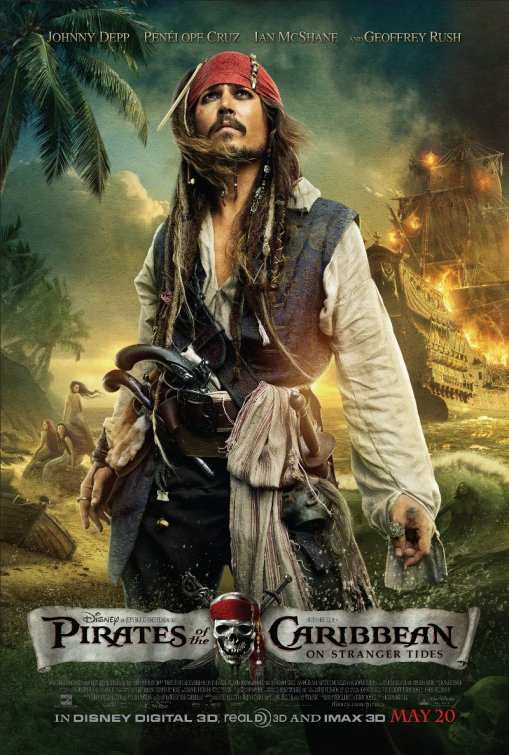 The public reaction to the two previous Pirates of the Caribbean sequels, 2006’s Dead Man’s Chest and 2007’s At World’s End, were decidedly mixed, though that didn’t stop them each from earning a bazillion dollars. Fans didn’t care for the darker tone, the confusing interlocking of the story, and especially the bloated running times. It feels like Disney’s uber-producer Jerry Bruckheimer must have taken notes from the sequel backlash and they amounted to: “Less of everything.” Welcome to less plot, less character, less involvement, and far less entertainment. Welcome to Pirates of the Caribbean: On Stranger Tides.
It’s been a few years since the non-world-ending events of At World’s End, and Jack Sparrow (Johnny Depp) has been in London putting a new crew together. Except, it’s a Sparrow imposter. Turns out it’s Angelica (Penelope Cruz), a former lover of Jack’s who woud still like to settle some scores. She and her father, the feared pirate captain Blackbeard (Ian McShane), force Sparrow to lead them to the Fountain of Youth. Apparently, Jack at one point had the map. King George II (a delightfully hammy Richard Griffiths in one of the film’s best scenes) is in a race against the Spanish crown. The English monarch hires Barbossa (Geoffrey Rush), Sparrow’s occasional enemy and ally, to find the fountain as well. It’s a race to see who can benefit from eternal youth first because, apparently, no one can share a source of water. Second grade teachers nationwide are very disappointed, Disney.
The entire enterprise just lies there on the screen, devoid of all energy or danger. The entire picture is just so shockingly inert, lazy, phoned in from every angle, missing any resonance of magic. Rob Marshall was the wrong man to be tapped as the new director of this series. Marshall has a fine eye for visuals, but the man couldn’t stage an action sequence to save his life. The Oscar-nominated director of musicals like Chicago and Nine stages his action sequences like dance sequences, which on paper don’t sound too far off. That’s until you realize action needs to incorporate story, location, build in tension, create organic obstacles, and be easy to follow. The action sequences in On Stranger Tides aren’t outlandish enough. It’s all so dull, a sword fight here a sword fight there. Short of a mermaid attack sequence, there’s no excitement to be found onscreen. That is disastrous for a franchise that has built a reputation for its anarchic, wild action and storylines. Marshall’s action angles and editing don’t communicate urgency. There’s no mood to these set pieces. The editing feels like it’s always catching up, always too late, needing a myriad of trims. Action cinema has been lambasted when it’s hyper edited and the audience cannot see what is happening; On Stranger Tides is not edited enough. One of the reasons these half-baked action sequences can never get going is because they always seem to be starting and stopping with the lackadaisical editing, always a step behind. The shots linger when they shouldn’t. The ingredients are there for a tasty meal but the chef (Marshall, screenwriters) doesn’t know what to do. The musical score by Hans Zimmer tries very hard to compensate and rattle the audience, compelling them to think what is transpiring on screen is exhilarating. It is not, and the music is just loud and annoying.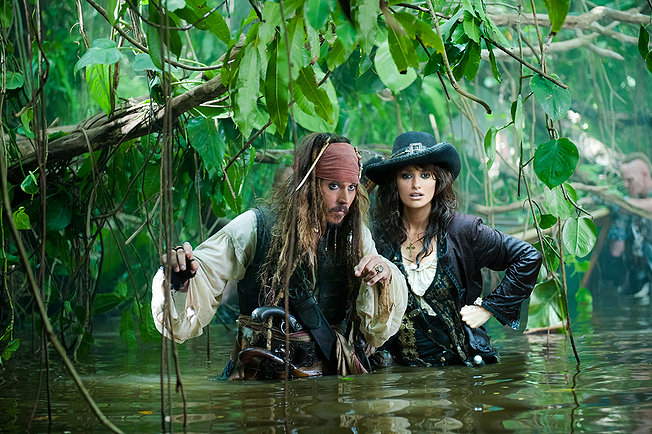
One of the chief criticisms of the two Pirates sequels were that they were overstuffed with storylines, characters, setups, and were just far too convoluted and confusing for their own good. So with On Stranger Tides we get a simplified, pared down one-off movie. Much of the film is just characters walking in circles and, likewise, talking in circles. Motivations are flimsy. The dialogue is stilted; Sparrow’s malapropisms and one-liners feeling sloppy (“I agree with the missionary’s position,” he quips. Groan). The entire premise is to get to the Fountain of Youth, and then they get there and, well, very little happens. The characters will talk about little, walk a few feet, talk about little more, and this process repeats. Barbossa should be an interesting foil, going from fop to pirate by film’s end, and yet his every appearance in the movie feels like when the next-door neighbor appears on a TV sitcom. It’s an intrusion meant to remind you that you, the audience, like this character, even if they don’t serve any point in the story. The plot lacks any twists and turns, ultimately having every competing force converge on the Fountain of Youth at exactly the same time for a slapdash climax that involves more lackluster sword fighting, just like all the other sequences. On Stranger Tides is a full half-hour shorter than the third movie, and yet it still feels like an eternity at two hours and seventeen minutes because it spends so much time doing so little.
At least the other three Pirates movies found clever ways to mingle their sci-fi mythology into an old-fashioned Errol Flynn swashbuckling adventure. With On Stranger Tides, the sci-fi fantasy elements are just as underdeveloped as the characters. The Fountain of Youth is another of those magic do-hickeys that involve gathering magic tokens and blah blah blah, mermaid tears, silver chalices. Hey, if you wanted to drink up some mermaid tears, have them watch 2009’s Oscar-winning best documentary, The Cove. That ought to do it (a scene driving the mermaids into nets oddly reminded me of The Cove). Blackbeard and Angelica have a Jack Sparrow voodoo doll, which is highly effective, and yet this plot device is nearly forgotten for the entire film. There is no clever application of this unique device. Blackbeard has a magic sword that makes ships come alive. Why? How? It’s just another magical Macguffin, like Jack’s compass. Man-eating mermaid temptresses is an interesting idea, and a great way to squeeze in a lot of obfuscated nudity in a Disney film for teen boys who have not discovered the Internet. Too bad the mermaids are confined to one scene, albeit the highpoint of an otherwise bad film. Their feeding frenzy is the only moment in the film that channels that high-flying sense of verve that made the original so memorable. Don’t even get me started on the fishy romance presented between the captive mermaid (played with all the acting capability of a French perfume model) and a missionary (Sam Claflin). The whole experience feels like a shambled, draggy, inarticulate rip-off of Last Crusade, complete with a climactic drink from a magic chalice. I appreciate Marshall’s emphasis on practical special effects but if these are the results then bring back the previous sequels’ CGI vomitorium. This franchise feels like every ounce of energy and danger has been squeezed out of it.
So does that means that this Pirates venture is more character-based now that it has jettisoned side characters and complex plots? Fat chance. The problem is that Jack Sparrow is not a good lead protagonist. He’s not meant to be a classic good guy. He’s a libertine, somebody who makes selfish choices but will revert to do something proper when his conscience nags him enough. Sparrow is more of the dashing rogue at best. Does anyone remember how he was going to trick doomed men into signing their souls to Davy Jones? He also needs a foil, a striaghtman to bounce off of. I almost miss the wooden performance of Orlando Bloom. Without a do-gooding striaghtman, Jack Sparrow plays like a man adrift, searching for his groove. Unfortunately, Sparrow never finds it in this vehicle, which just asks him to go through motions and mannerisms. Blackbeard makes for one very bland villain. McShane (TV’s Deadwood) can glower and chew scenery with the best of them, but his baddie never seems too menacing. He burns one guy alive and threatens to kill his own daughter in order to keep Jack in line. I’m sorry, but that doesn’t even compare after the previous films included a monstrous ship captain who would readily slice prisoners’ throats and a British bureaucrat who hanged an eight-year-old before the freaking opening credits. Blackbeard, in contrast, just comes off like a crusty old man in need of a shave.
 The film’s biggest addition was bringing in Jack’s former flame Angelica, a woman he robbed of her virtue and personally betrayed. But is there any tension? No, because Jack and Angelica don’t have any old feelings for one another they rehash (oh how I was even pleading for a trope like that), and the characters don’t really feel any antagonism either. Sure they will parry and threaten one another, but it’s so devoid of danger or tension or interest. This is no screwball romance. They feel like a couple that can’t be bothered working up any notable feelings toward one another. Therefore, all their shared scenes, and there are many, sink the film’s flow. Their bickering should bring some sparks. She should be exciting; she’s the daughter of a notorious pirate, she was going to be a nun until Jack Sparrow came sailing into her life. She should be sore. She should be angry. She should be a lot of things that ultimately the character is not. Cruz (Nine, Vicky Cristina Barcelona) doesn’t come across as an equal or love interest, she just feels like an annoying sidekick, harping on “Yack.” At one point, Jack tells her, “If you had a sister and a dog, I would take the dog.” When she’s got a personality like this, I’d agree.
Depp (Alice in Wonderland, Sweeney Todd) is obviously a comic gift and his Sparrow character will go down in the ages as one of the most universally beloved figures in cinema history. Everyone adores this character, a loveable scoundrel. But that doesn’t mean the screenwriters can just strand him in a crummy story with nothing to do. Depp will always be enjoyable when he puts on his Captain Jack eye liner and does that funky, swishy walk of his, but even he feels like he’s phoning this one in. He realizes that his character is trapped in a sodden adventure that offers little to do as a character and an actor.
I never thought I would say this, but On Stranger Tides makes me positively reevaluate the other Pirates sequels (I admit to being one of the few critics who liked Dead Man’s Chest a good deal). If this is what a simplified Pirates of the Caribbean film gets you, bring me back the messy, maddening plots of the previous films. Bring me back the scope, the danger, the clever mingling of genre elements, the adventure, the sizzle, the anarchy, and bring me back director Gore Verbinsky. Marshall has no feel for this material or how best to serve story. I never expected a movie with this kind of budget to be so lifeless. It all just sits there on screen, expecting the pieces to come together through ardent wishful thinking. On Stranger Tides suffers not because it strips away some of the excess and convolution that plagued the other films, it suffers because it gives no reason for its existence. It does not enrich the characters, the Pirates universe, or provide a rip-roaring story. Obviously, the film exists to line the coffers of Disney. It may earn plenty of booty this summer, but this is no way to rejuvenate a sinking franchise.
Nate’s Grade: C
Share this:

Tron: Legacy (2010)
 In 1982, TRON was a movie ahead of its time. It took place in a world inside the world of computers, which couldn’t have been that advanced back then. But “ahead of its time” and good are not the same things. Arguable one of the most influential science-fiction films in terms of design and CGI, the original TRON was a financial dud for its film studio. All this makes it so curious why Disney would spend upwards of $200 million dollars on a fancy, shiny, big-budget sequel to a movie people didn’t really give a damn about before. TRON: Legacy looks to capitalize on a generation of geek nostalgia. At least it doesn’t fare as poorly as the Star Wars prequels.
Sam Flynn (Garrett Hedlund) is 27 years old and the lead shareholder of Encom ever since his father, Kevin Flynn (Jeff Bridges), mysteriously disappeared in 1989. Kevin had found a way inside the world of computers, which he called The Grid. He studied it and based his company’s arcade games on what he found. Then after saying he was going to break the world of gaming wide open, he vanished. Then in 2010, Alan Bradley (Bruce Boxleitner, a sight for sore eyes) visits Sam with a message. He got a page from a number that’s been disconnected for over 20 years. Sam ventures into his father’s old arcade/workstation and gets zapped inside the world of computers. Now he’s amidst all those racing light motorcycles and flying disc battles. The slinky program Qorra (Oliva Wilde) rescues Sam from the gladiatorial battles. Inside this realm, the Grid is run by Clu (CGI Bridges), a digital doppelganger of Kevin Flynn. Sam is reunited with his dear old dad and together they try to escape this digital prison and stop Clu.
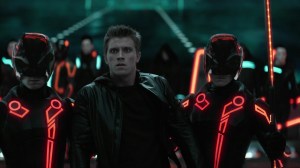 Never have I felt more like an old man than after watching TRON: Legacy. All the special effects dazzled, but after a while it felt relatively empty and insubstantial. But what did all those gleamy flashes of light and snazzy 3-D effects do, ultimately? Distract from the void of a story. I consider myself a fairly intelligent individual, able to follow complicated narratives and appreciate complex storytelling. And yet, when the lights came back up in my theater, I said, “There is a lot that I never understood.” The setup is relatively painless, but where the movie grinds to a deadly halt is for an exposition-heavy 20 minutes in the middle after our second big action sequence. When father and son are reunited they get to talking, and talking, and talking some more about God knows what. I think my brain shut off from all the stilted dialogue. Every character seems to stop and unload a pile of exposition. Even though the characters seem to explain so often, you always feel like you’re still missing something important. You still feel left out. But after this dreadful slog, suddenly there’s Michael Sheen (Frost/Nixon) to save me from my stupor exactly like he did at the end of the turgid Twilight film, New Moon. He brought me back to life, but after his campy, cane-guitar rockin’ sequence of battle, I was trying to get caught up on the parameters of plot and setting. But then the film just flew from one set piece to another and I was forever lost. I couldn’t tell you why anything happened in the last hour of the movie. It just seemed like one thing was following another without any sense of logic or foresight. I got the idea of the need to escape this virtual world and that there was a special doorway to make this happen, but after that it all became an unintelligible chain of ones and zeroes.
The incoherent screenplay by Lost scribes Adam Horowitz and Edward Kitsis is a bleak vehicle for special effects. TRON: Legacy will certainly melt your eyes but it leaves the brain cold and overlooked. The rules of the TRON universe are never adequately explained. When Qorra suddenly drives a vehicle off the Grid and says, “We can do this, they can’t,” you’re forced to just shrug and go with it. Why is Clu trying to kill Sam and his dad when he’s pretty much had the run of things for 20 years? What exactly is his plan for world domination? He thinks his electro-tanks will be able to take out the military powers of the real world? Do these programs have free will or does their engineering trap them? Why would they gather at a stadium to cheer the death of other programs in violent sport? All of these walking/talking computer programs got me thinking about The Matrix and how much more creative and effective and overall better that movie was with storytelling. There are some token nods to character, mainly Sam’s reunion with his long lost pop, but this is a movie designed to mesmerize with flashing lights rather than story and character. I would find this somewhat acceptable if I wasn’t bored so much, let alone paid an extra four bucks for the luxury of being bored in three dimensions.
 But if special effects are what you want, TRON: Legacy delivers big time. The sleek production design is married seamlessly with the flashy, techno-oriented effects inside the computer world. Watching the floating spaceships and zooming racecars is a luscious, exhilarating rush to experience. The visual style obviously has to hew close to the first film in 1982, which seems to handcuff the imagination of the crew. We’ve made gigantic leaps in the world of movie special effects but we’re stuck with characters in glow-in-the-dark jumpsuits and cityscapes that look at like half-finished neon outlines. I haven’t seen a 3-D movie since two-time reigning king of the world James Cameron’s Avatar, but I would readily advise people to see TRON: Legacy in 3-D if available. It gives the film that extra whiz-bang quality. This is not just a cheap grab at extra cash where the studio throws a 3-D rush on a film late in the game. The 3-D, which kicks in when Sam travels inside the computer world (like the change into color from the Wizard of Oz), feels more immersive without resorting to hurling countless objects at the audience. The greatest 3-D effect, bar none, is Olivia Wilde (TV’s House, Year One). Director Joseph Kosinski has a steady background in computer effects, and it shows. His handle on actors is another matter entirely.
But the biggest misstep with the special effects occurs with the 1980-version of Bridges. Whenever we get a glimpse of this Bridges of old, whether it’s from Clu or a brief and distracting scene in the film’s 1989 opening, it’s another opportunity for the movie to remind you of its lack of authenticty. The de-aging technique still needs some serious tinkering. What it does is make an actor look like a plastic doll, with dead Polar Express zombie eyes. It’s creepy and off-putting and every time you see the de-aging effect it rips you out of the movie. Watching young Bridges take on older, current Bridges would have been more interesting if we had an entire digital rogues gallery of Bridges characters. Imagine the Dude and his drunken, self-destructive country singer from Crazy Heart involved in digital games of combat.
 There are some nice action sequences that begin to touch imaginative possibilities of this unique world. The flying disc duels are interesting enough for the time being. The first few disc battles make fine use of the unique features of the boomerang-esque weapon. The motorcycle battle where the ribbons of light/exhaust create a wall is still a great idea for battle of wits at high-octane speeds. It just never fully materializes. The edits don’t occur in that hyperkinetic Michael Bay fashion that discombobulates the senses; however, I never really grasped the geography of the action realms. In order for the viewer to appreciate the action and the moves and counter-moves, we need to understand the arena and boundaries of the setting. With the cycle chase, it just seems like they’re all appearing at random. An action sequence is less satisfying if it doesn’t seem like it’s building and making use of the particular surroundings. The moody score by electornica duo Daft Punk gives the film a thematic lift, though having them score with a full orchestra feels like hiring Yo Yo Ma and forcing him to play a trombone.
TRON: Legacy feels at times like a super-sized Light Bright meant to dazzle and distract from the gaping void at heart. The story merely exists to get the characters from one place to another. The leaden exposition pretty much destroys the film’s momentum. It becomes plodding and tiresome. It would be like if Luke Skywalker sat and listened to 20 years of history rather than actually, you know, doing something. It’s been 28 years since the first TRON and the world has gotten far more computer savvy, and the jargon from the first flick would be readily understood. TRON: Legacy doesn’t feel like you’re in a computer, just whatever weird alternative universe. It seems like the real legacy of TRON ends up being hollow special effects.
Nate’s Grade: C


 nathanzoebl
You must be logged in to post a comment.