Blog Archives
Tomorrowland (2015)
 Crafting movies around theme park rides is a rather risky creative proposition. For every Pirates of the Caribbean mega-franchise, there’s a Haunted Mansion. Theme park rides are more locations then they are stories, so it’s an adaptation where there’s nothing really to adapt except for a setting starting point. Tomorrowland has a few nods to its spiritual source material, but it’s an original science fiction film with much on its mind beyond entertainment. With Brad Bird (Mission: Impossible Ghost Protocol, The Iron Giant) turning down the new Star Wars to make Tomorrowland, I had definite expectations. Bird hasn’t made a bad movie yet. He still hasn’t but Tomorrowland is definitely the worst film in Brad Bird’s heretofore-unshakable pedigree.
Casey (Britt Robertson) is a dreamer with a capital D. While her teachers bemoan the cataclysmic shape of world events and instability, she doggedly raises her hand to ask, “Yeah, but what can we do to fix it?” Her father works for NASA but the nation has lost interest in space and has stopped looking at the stars. Casey sneaks out every week to thwart the demolition of a NASA launch platform. She can’t let it go. She comes across a mysterious pin that, when touched, transports her to a hidden world, a future city called Tomorrowland. But there are others that are looking for this city too. A slew of androids chases after her to retrieve the pin. Robot child Athena (Raffey Cassidy) becomes a protector for Casey and the two set off to find Frank (George Clooney), a hermit and mechanical mastermind who once lived at Tomorrowland before becoming disillusioned.
 This is one of the few movies where the more characters explained the plot the more confused I ultimately became. The story by Bird, Damon Lindeloff (Prometheus, HBO’s The Leftovers) and Jeff Jensen doesn’t exactly a clear narrative, and that begins with the structure, inserting two framing devices that are too cute for the movie. The first 15 minutes is Frank’s childhood experience discovering Tomorrowland, and this is probably because we won’t see Clooney’s grown-up Frank until an hour into the movie. It takes far too long to get going, instead becoming a series of unnecessary plot detours, like a trip to a collectibles store in Austin or a trip to the Eiffel Tower. Is there a reason that a return to Tomorrowland is saved for the very end of its final act? Probably because utopias are boring, which the movie itself admits and admonishes us for accepting. You see, dear reader, it’s all of us and our collective negativity poisoning the planet. Our use of cynicism and our love of dystopias in movies and literature are to blame. In this proclamation, a movie as madly genius as Mad Max: Fury Road is leading to the downward spiral of humanity, and nobody who sees that brilliant film could accept that. Tomorrowland has some legitimate points, precisely aimed at the inconvenience of action over the convenience of stasis. In one of the better articulations of its shiny happy message, a character says that people accept the worst because “they don’t have to do anything today.” It’s the global equivalent of, “I’ll start my homework tomorrow,” knowing we’ll probably never get around to it, to our own detriment.
Tomorrowland’s idealism would be easier to swallow if it wasn’t so oppressively scolding. First, allow me to reject its notion that popular culture wallows in darkness and there is no inherent value with this predisposition. If this was true then no one would read the wealth of Russian literature, which is reams and reams of pages of suffering, unrequited longing, confusion, anxiety, pressure, and finding what grace one can. One of Casey’s teachers upholds George Orwell’s 1984 as a living testament to what we’re going through today, but Orwell’s novel isn’t popular or well revered just because it’s desolate. Would millions of readers be foolish for finding something powerful and poignant in Cormac McCarthy’s award-winning dystopian cannibal road trip, The Road? Just because one is optimistic doesn’t mean you’re in the right, and just because one is pessimistic it doesn’t mean you’re in the wrong. Perhaps the culture is too hesitant to take necessary action because it’s easier to buy into the argument that our actions are meaningless; hence why the newest argument against environmental reforms to curb the effects of climate change amount to, “Yeah, but what difference will it make now?” If Tomorrowland was trying to rouse its audience into action, it went about it the wrong way. The movie’s tone is far too scolding and stuck on can-do platitudes to be anything beyond an earnest motivational poster that will ultimately be ignored.
Then there’s the film’s restricted view on what constitutes the Right Dreams. Casey refuses to allow the NASA launch station to be demolished because it supplies her dad with a job, but really it comes down to her idealism of man’s capacity to achieve. And yet, her chosen way of expressing this, besides general perkiness, is to cling to an older definition of what constitutes achievement. The space shuttles were grand but we’ve outgrown them and space travel itself has migrated into the private sector. Just because U.S. astronauts aren’t being launched into space with the frequency they once were, does that means the country has somehow lost its ideals? Or are we allowed to adapt to the demands of the times? Strangely, Tomorrowland holds onto a retro definition of what constitutes achievement, something also touched upon in Interstellar, where Matthew McConaughey shook his McConaugh-fist at all these young kids for not having the same level of interest in the old technologies and pursuits. Tomorrowland fixates on the scientific dreams of the 1960s, but that’s no longer a representation of our world. What it ends up pining for is a throwback to Disney’s own era of gee-whiz futurism, a world where flying cars are valued above, say, the Internet.
If you think about it, Tomorrowland’s utopia is pretty much a progressive version of Ayn Rand’s Atlas Shrugged. In Rand’s famous ideological tome, the “best and brightest” (a.k.a. rich industrialists) decide they’ve had enough with the common man getting in their way, and so they up and leave and start their own secret paradise where they won’t be disturbed by the likes of us “normies.” With Tomorrowland, it’s not the business types who take their ball and go home but the inventors, scientists, and artists, the creative class, who are given magic passage to a hidden world where their work will be undisturbed by those deemed less creative and/or essential. It’s intended to be inspirational but it awkwardly falls into a murky class-consciousness it can’t escape. Who defines the value of creativity exactly? Is there a Tomorrowland board of directors that says, “You know what, we definitely need that guitar player. Forget having plumbers.” Are the day-to-day laborers and paper-pushers, the ordinary people that keep the infrastructure of the world running, are they just deemed less significant? Tomorrowland apparently only has the best and brightest when it comes to all things, including the people that take out your garbage and unclog your sinks. Are the gravediggers the finest from around the world? Is the world’s greatest and most creative gravedigger still a few notches below a rather lackluster environmental scientist? As you can see, it invites all sorts of questions that will go unanswered because, again, the film’s message is everything, and the particulars of its invite-only exclusive society are off limits.
 The action sequences are also strangely dull for a filmmaker such as Bird. Each sequence has its moments of inventive orchestration, especially a brawl in the sci-fi collectible shop that squeezes in lots of homage. Too often the action is missing the creative spark Bird has showed in so many of his past films, particularly 2004’s The Incredibles. The mayhem is also a little too intense for younger children, especially with real people being so callously zapped into dust out in the open (not exactly keeping a low profile, robot henchmen). There’s also a child robot who factors into a lot of the peril, and then very uncomfortably into a late scene where she expresses her love for the grown-up Frank. I understand they had a connection when they were kids but the movie still ends with Clooney cradling a child in his arms and talking what could have been their tale of romantic love. It’s just a little creepier than affecting. Speaking of which, are children going to be entertained by something this message-laden and obtuse in plot? Are adults going to be entertained with this movie? Who is this movie actually for?
The saving grace of Tomorrowland is the performance of its plucky heroine played by Robertson (The Longest Ride, TV’s Under the Dome). She’s got great presence on screen and a naturally charm that is far less oppressive than the material she’s delivering. Clooney (The Monuments Men) is his standard appealing, handsome, wounded leading man, and it’s a mistake to hold his character out of the action for so long. When George Clooney is on the poster for your big-budget sci-fi movie about the power of dreamers, you shouldn’t wait a whole hour to get around to his character. Magnifying this problem is the fact that the narrative has so few characters who actually matter, mainly four, and one of them isn’t significant until an hour in and another isn’t until the very final act.
Tomorrowland is a sincere, hopeful, and idealistic film that shoves its message in your face and doesn’t offer much in the way of an alternative besides, “Do better.” The problem is that this message of hope and agency is lost amidst a plot that is swallowed whole by near-constant exposition, a clunky framing device, and a world-destroying scheme that seems horribly convoluted in a manner unfitting for the supposed smarty-pants antagonists. It’s simply not a very good story, not told in a very good way, and a message that needs to go beyond a simplistic slogan to be more inspirational. It’s a pretty film with some fun moments, but Tomorrowland is a reminder that not all nostalgia is credible, not all dreams are equal, and messages are digested better when the audience cares about what is happening and (key point here) understands it. Me? I’ll prefer going to see Mad Max: Fury Road again, but that’s just me dooming humanity. Worth it.
Nate’s Grade: C+
Share this:

Cinderella (2015)
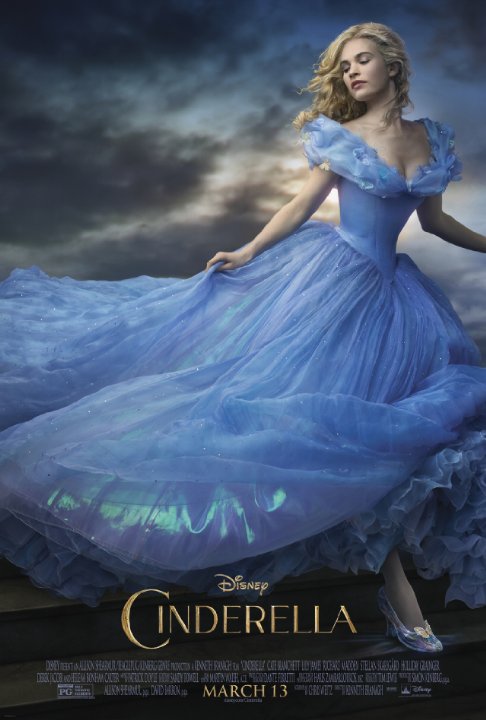 What is it about old stories that we enjoy so much? I pose this question after watching a commercial for the TV movie, Killing Jesus, based upon Bill O’Reilly’s best-selling novel. While it’s based upon a popular book, what can possibly be told with this newest rendition of the death of Jesus that hasn’t been shown a thousand times in other movies? There was even a movie that was released in theaters last year, Son of God, which covered the same territory with equal reverence. There’s something to be said for good stories and the universal appeal of the familiar, but why do people constantly pay more money for new renditions of the same old same old? That question leads me to Disney’s live-action Cinderella, a fairly faithful and warm-hearted rendition of the oft-told tale. I can’t exactly muster many reasons for an audience to dust off their best glass slippers and run out to the theater, but if you’re looking for the comforts of old and some family-friendly entertainment, then Cinderella will charm with its modest and achievable goals.
Cinderella (Lily James) is the titular put-upon heroine suffering under the cruelty of her two stepsisters and her new Stepmother (Cate Blanchett). Cinderella thinks back to the advice her mother gave her at a young age, to always be “kind and courageous.” One day she rides off into the countryside and comes upon a handsome man who just happens to be the Prince (Richard Madden). He’s smitten with their exchange and convinces his father to open the royal ball to all members of their kingdom, in order to see his special someone once more. His adviser (Stellan Skarsgard) is against such matters because he wants the Prince to marry for a political alliance, not for love. Cinderella is forbidden from attending the ball by her Stepmother, but luckily she has a Fairy Godmother (Helena Bonham Carter) who, with a pinch of magic, will make sure Cinderella attends in style and steals the Prince’s heart. None of this should be rather new to you, dear reader.
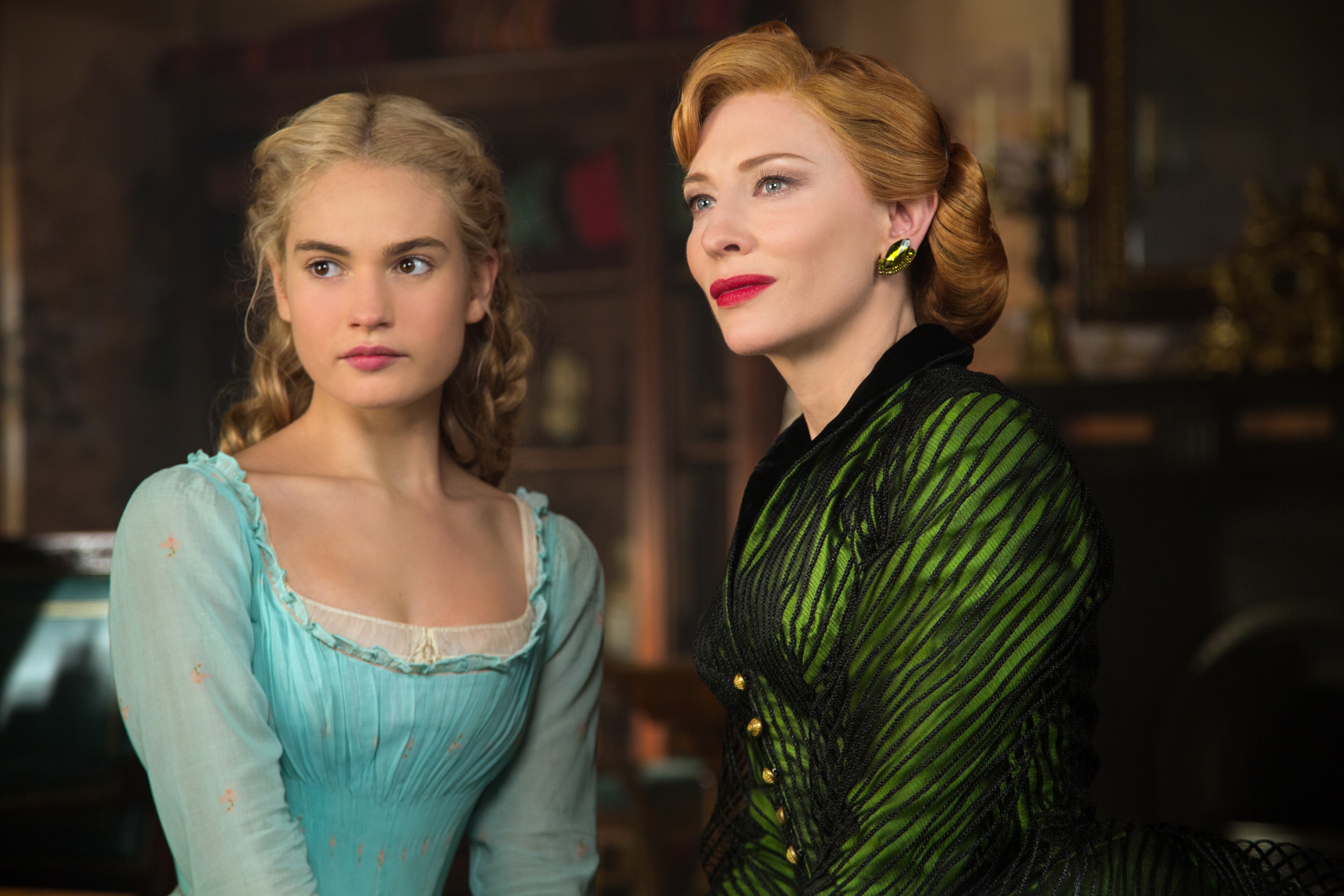 The first aspect of Cinderella I enjoyed was how it attempts to ground the story without losing a sense of magic to the proceedings. It’s still a fantasy film under director Kenneth Branagh (Thor), but there’s a concerted effort to place these characters in a world that resembles more of our own than the animated landscape from Disney’s original 1950 classic. Thankfully, half the movie isn’t spent with anthropomorphic mice wearing clothes and escaping the clutches of a house cat. There are a handful of helpful mice but at least they don’t talk and are mostly kept as cute accessories rather than co-stars. The reality of Cinderella’s hardships, especially after the death of her parents, is given an appropriate degree of solemnity. I also appreciated that the Prince is given an entire character to portray, one where his pursuit of a bride is placed in a political context about the security of his kingdom. He’s pressured to marry several available ladies for various political reasons, but he’s smitten with the girl he saw in the woods one fine day. The movie also succeeds in advancing a stronger, more developed relationship between Cinderella and her Prince. Instead of love-at-first-sight, they interact before the ball, and there is terrific chemistry between James and Madden (HBO’s Game of Thrones). There’s also a rather nice subplot between the Prince and his father (Derek Jacobi) that opens up their relationship. It’s a subplot that could have just as likely never existed and yet there’s something touching about the love shown between father and son. These moments, and the care to develop them, allow the characters to feel like flesh-and-blood people and to charm us all over again.
Another tilt toward greater narrative realism occurs with the villains, played by Blanchett (Blue Jasmine) and Skarsgard (Thor 2). While she’s still an arch villain, the treacherous Stepmother, who has no actual name, is given a generous treatment by Blanchett and especially writer Chris Weitz (The Golden Compass). The movie actually attempts to articulate her position, one where a woman of her age is left with few options to secure her family’s stability after the death of a husband. She clearly knows how society sees her waning value and Blanchett does a good job of casting that bitterness in way that you’re still reminded why she’s so furious and devious. I was so pleased I wanted more. I wanted the Stepmother to break down and admit that Cinderella is proof that her father will never love the Stepmother the same as Cinderella’s mother; she’ll always be second place to a ghost, and Cinderella is a constant reminder of this. Blanchett is also deliciously dishy as the wicked stepmother every moment she’s onscreen. Skarsgard can’t compete with the main attraction, but he provides an interesting secondary antagonist as he schemes behind the scenes to ensure the Prince marries a specific maiden with a reliable family name. He’s seemingly devoted to strengthening his kingdom, and he can’t let something as important as a marriage securing an alliance to fall aside because the Prince happens to be in love with a commoner. The extra dose of political intrigue is further attempt to ground and humanize the fairy tale, and it mostly succeeds.
 That’s not to say that the movie is without its fantasy pleasures. It is still a Disney movie about a famous Disney princess, and as such it maintains a bouncy, exuberant tone that keeps the heavier moments of drama from getting too heavy. Carter (Les Miserables) works wonders as the Fairy Godmother; she’s only in the movie for a solid ten minutes but she makes every second count. She has a silly nature that provides a welcomed jolt of scatterbrained comedy. Carter is clearly having a ball of her own with the role. The magical coachmen and assorted helpers supply extra cuteness. I also appreciated the quick fix of just creating a spell so that Cinderella’s step-family doesn’t recognize her at the ball. However, I never understood why all the artifacts of magic disappear at midnight but the shoes are left behind. Are they not magic too? Maybe only one of them happens to be magic and that was the one left behind. As presented, the shoe fitting is merely a ceremony rather than the missing clue toward finding the absent Cinderella.
So with all that said, does the new live-action Cinderella justify retelling what is one of the most retold stories in cinema history? I’d conclude a mild affirmative. It’s a charming adaptation that develops its characters with greater attention to detail, providing flights of fancy but also further humanizing the good guys and the bad. It’s no a deconstruction of the fairy tale, nor is it a revision, but it’s a faithful attempt to take what works but ground it in a slightly more realistic context, and it works. It’s at turns magical and touching and fun and buoyant and heartwarming. The casting all around is excellent, with every role impeccably chosen. Blanchett and Carter are great fun, and James and Madden have a winning chemistry. The technical merits are up to the same challenge, as the costumes and set design are gorgeous. Of course the aims of a new Cinderella movie are modest. Even if it benefits from a reworked attention to detail, we’re not reinventing the wheel here. It’s still the same story with the same major plot beats and the same ending we’ll all expect from the moment the Disney logo appears onscreen. The greatest achievement of Branagh’s Cinderella is that it makes you ignore these impulses. You find yourself once again returning to a familiar world and enjoying it all again.
Nate’s Grade: B
Share this:

McFarland USA (2015)
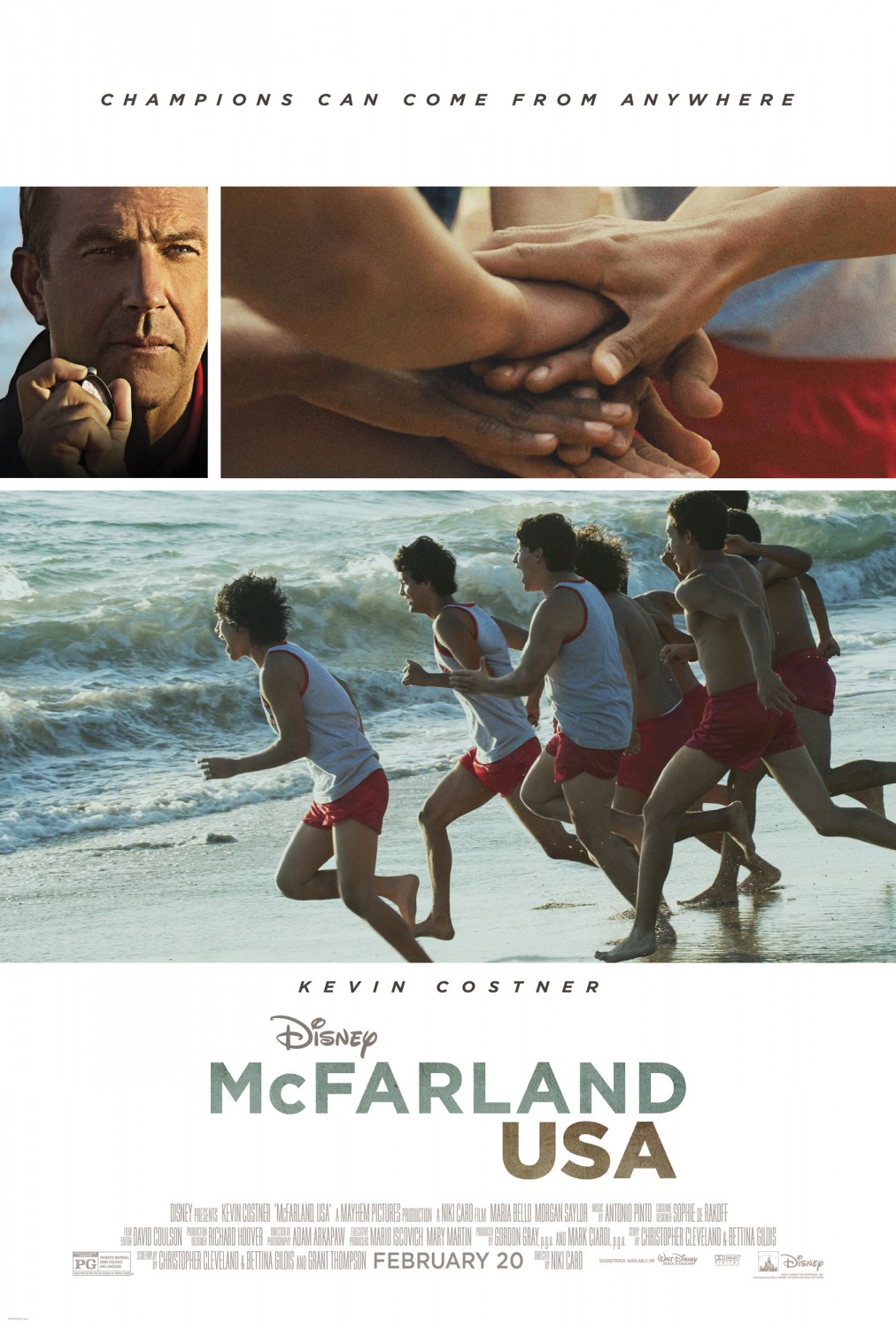 Many movies follow a proven formula very closely, but sometimes a well written, well executed formulaic movie can remind you how appealing that formula can be, and that is McFarland USA, an inspirational Disney sports film that warmed my heart. Kevin Costner stars as a science teacher and sports coach for a working class California town mostly populated with Mexican-American immigrant families. He sees the endurance and speed of several students and decides to form a cross-country team, even though he’s never coached anything related to track in his life. What follows is a mixture of the inspirational teacher film and the inspirational sports team film. Thankfully the screenplay and director Niki Caro (Whale Rider) take their time to flesh out the runners, giving them personalities and different degrees of depth, troubled by real-world problems without easy answers. The movie works as a great tool for empathy as it respectfully illuminates the limited economic opportunities and backbreaking labor of so many Mexican-American immigrants toiling in our fields. The movie creates an amiable sense of community and even though moments can feel contrived, I always had a smile on my face. The people came across as people, complicated, proud, hopeful. It opens up a world and showcases just how hard these people work to assist their families. Costner is a stable anchor for the film but it’s his young cast that really give the film its lift. The emotions are genuine and the uplift is earned, thanks to careful plotting and generous characterization. McFarland USA is a feel-good movie that’s better than good and a perfect film for the whole family.
Nate’s Grade: B+
Share this:

Big Hero 6 (2014)
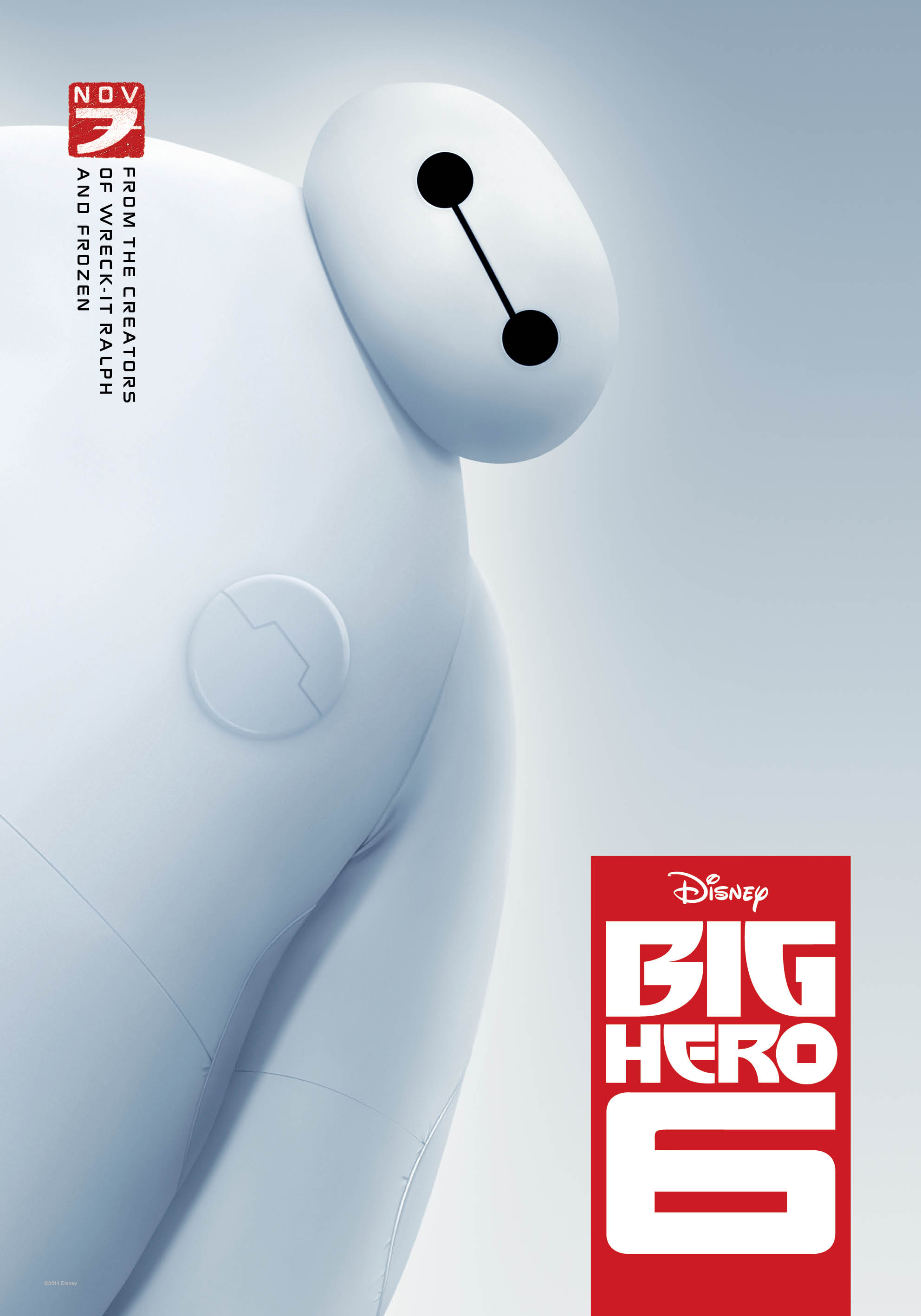 Disney’s first adaptation of a Marvel property, it’s essentially a superhero origin tale mixed in with the “boy and his robot” formula borrowed from The Iron Giant. The story is fairly predictable but charming and unafraid to deal with loss and grief. The real star, though, is the inflatable robot Betamax (voiced by Scott Adsit), whose unfailingly optimistic and helpful nature is a loveable addition to a genre plagued with doom and brooding. The action sequences are colorful and well developed and paced. It’s an agreeable pilot film for a new animated franchise, and the characters are likeable and fun while still having enough emotional resonance to make the hard choices of sacrifice hit you in the gut. It’s a welcome change of pace to have a character interested, first and foremost, in the mental health of others. You just want to hug Betamax (parents, your children will be begging for the toys). The plot does follow many similar plot beats of the superior Iron Giant but this film is still enjoyable enough on its own terms.
Nate’s Grade: B
Share this:

Maleficent (2014)
 We’ve seen several stories try their hand at reclaiming villains, telling the tales from their relegated and forgotten points of view; after all, history is written by the winners. This technique can be illuminating and fascinating when done right, like Grendel or Gregory Maguire’s popular Wicked novels. However, does the public really have that much knowledge of Maleficent? Did most people even know what her name was? For that matter, do most people even know what the real name of Sleeping Beauty is or do they, like myself, just indifferently refer to her as Sleeping Beauty? That relative audience ignorance provides a wide canvas to retell this woman’s story.
In an ancient kingdom, there were two lands, one with men and one with magical creatures. Maleficent (Angelina Jolie) is a cheerful fairy with long angelic-like wings and a pair of horns coming from her head. She befriends Steffen (Sharlto Copley) an orphan with ambition to be the next king of men. He betrays Maleficent, drugging her and cutting off her wings to prove to the dying king that she is dead. Years later, and now king, Steffen has a christening for his new baby daughter, Aurora (Elle Fanning), and Maleficent shows up. She curses the young child, declaring that on her sixteenth birthday she shall prick her finger on a spinning needle, fall into a deep slumber, and only be awakened by true love’s kiss. Steffen destroys all the spinning wheels he can find and sends out his daughter into the countryside for protection where she’s raised by three fairies taking on the form of humans (Imelda Staunton, Leslie Manville, Juno Temple). It’s really Maleficent who helps raise her, watching over her and protecting her through the years, regretting the horrible choice she made in anger.
 I’ll start by saying the reason you should see this film, by far, is Angelina Jolie (Wanted). She is terrific. You can readily tell how much fun she’s having with the character, and everything from her command, her physicality, her presence, her vocal delivery, is top-notch. She’s great from start to finish, the perfect embodiment of the character. Would you believe this is her first live-action film role in almost four years? Wow, did movie audiences miss her. If only the remaining movie was as good as Jolie.
It’s a shame then that just about everything falls into a rigid fantasy formula that squeezes any sense of magic dry. Maleficent is the queen of the fantasy half of this world, and after her betrayal by Steffen (more on that below), she seeks vengeance, cursing an innocent child and then remarkably caring for her through a hasty montage. It’s hard to ever accept Maleficent as a malevolent character, and I’m sure that’s by design by the Mouse House. She doesn’t do anything too scary and when the time comes she ends up making the right decisions. There isn’t really much of an exploration of her character here. There’s the pretense that she’s hero and villain but that falls away very quickly, especially with her loving relationship with Aurora. She wants to do right and feels terrible about the curse, but again that’s quickly taken care of. Aurora literally spends five minutes onscreen in her “eternal slumber.” It’s more like a magical nap. If the relationship between Aurora is what makes our heroine whole again, then the climax is saving Aurora, not getting vengeance against Steffen in a dumb CGI battle.
The magical fantasy world also feels oddly underutilized. At least in past Disney efforts like Alice in Wonderland and Oz the Great and Powerful, the worlds at least felt like they had been explored, with many of the magical creatures pitching in during an Act Three battlefield. That isn’t the case here. The opening with young Maleficent (Isobele Molloy) introduces some strange creatures and some fairies, but they end up being little more than background dressing, meant to only communicate the change in Maleficent. In the end, it’s just Maleficent and her trusty crow (Sam Riley in human form) and that’s it. Question: if she can transform her pet into any number of creatures, including a dragon, then why didn’t she do this before? When she’s racing to save Aurora from pricking her finger, would a dragon have not been a faster mode of travel than a horse? Maleficent’s powers are also too ill defined, and her big weakness just happening to be iron feels trite, like her version of kryptonite. The fairy world and its powers aren’t given the examination it deserves. As a whole, the world of Maleficent feels less than magical. It feels more like a series of scenes rushing through a plot holding fast to the beats of recent Disney live-action hits.
I don’t think I’m reading too much into what is intended as a fantasy film for families, but Maleficent is one big analogue for rape. Hear me out. The title character falls in love with a man who likewise tells her he loves her but is just using her to his own advantage. He then drugs her drink and while she’s unconscious has his way with her, leaving her physically disfigured and feeling betrayed. She turns inward, rejects the outside world, and dwells in sadness and seclusion. She doesn’t tell others about her attacker until many years later. The public is quick to blame the victim. And then ultimately, once she feels “whole” again thanks to reaching out to others/support, she is able to confront her attacker and rise above his destructive influence, returning to some semblance of her former self. When looked at in its entirety, does that not sound like an intentional analogy for rape/sexual assault? Maleficent’s character arc mirrors the experiences of rape victims, and the fact that this kind of mature storyline is played out in a Disney summer family film is kind of extraordinary. It’s not so explicit that little kids will walk home asking mom and dad about the persistent nature of “rape culture,” but its presence and articulation is a start. As a rape analogue, it’s not offensively handled unless you are one who finds its very inclusion an offense for a PG-movie. Now, this storyline does transform the character in a way others may dislike. Rather than being a powerful agent of evil, she’s a woman who was victimized by a man and that’s why she turns toward the dark side. For some this will be a disappointing turn of events. I can’t say one approach is better than the other from a feminist point of view, but I credit Disney for following through with uncomfortable symbolism for rape to describe Maleficent’s arc.
 The rest of the cast fill out their roles but lack the flare of Jolie. Copley (District 9) is proving that he may be best under the guidance of Neil Blomkamp. He was one of the better parts of Elysium but without Blomkamp he makes such mystifying choices as an actor. His voice and performance were powerfully wrong for Spike Lee’s unnecessary Old Boy, and his demeanor is all over the place with Maleficent. To his credit, the character is horribly underwritten and given so little mooring to try and understand his ever-changing decisions and temperament. Fanning (Super 8) is an innocuous Aurora though the actress has often showed much more ability. Here she just laughs a lot. Riley (On the Road, Control) is wasted comic relief and as a companion. The three color-coded fairies are consigned to broad comic relief, usually bumbling and getting into slapstick brawls with one another. I can’t imagine children finding them too funny.
Maleficent the character is given great care by Jolie, the actress. Maleficent, the movie, is slapped together and feels devoid of any sort of engaging storytelling or big-screen magic to leave a favorable impression. It’s a rather expected and unexceptional retelling that hits all the notes you’d expect, though without as many magical fantasy creatures, which seems like an oversight for a world of fantasy. The rape analogue is a bold choice for the filmmakers and deserves credit. I wish I could also give them credit for the storytelling and characterization, both of which are rather flat and rote. The special effects are likewise unremarkable. Outside of the rape symbolism, this is a movie you can likely predict every step of the way just looking at the poster. I was able to even predict the left-turn ending concerning “true love’s kiss,” though Frozen already got there first. If you have low expectations and simply want to watch Jolie and her killer cheekbones be fierce, then perhaps Maleficent is worth checking out. Otherwise, this villain’s retelling feels far too familiar and safe and underwhelming to be worth the effort.
Nate’s Grade: C
Share this:

Saving Mr. Banks (2013)
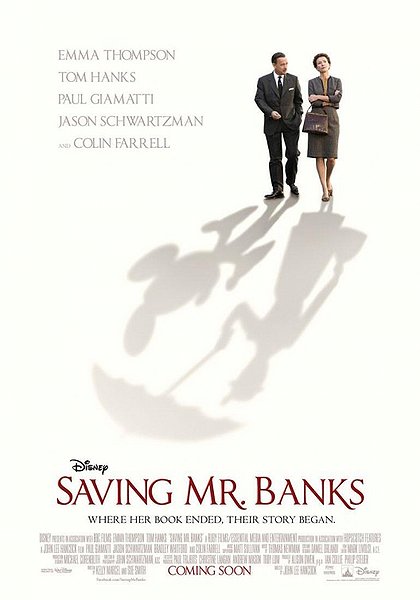 Seemingly sure-fire Oscar bait, Saving Mr. Banks left enough Academy voters cold and it’s easy to see why. First off, the behind-the-scenes sparring to adapt Mary Poppins is the movie we want to see, watching crotchety author P.L. Travers (Emma Thompson) butt heads with head honcho Walt Disney (Tom Hanks). The movie is at its best when these two share the screen, with Walt’s genial strong-arming finding little traction with Travers stern refusals (no Dick van Dyke, no animation, no mustaches). What I wasn’t expecting was a parallel storyline detailing Travers childhood in Australia dealing with an unstable home life thanks to a drunken father (Colin Farrell). It literally takes up half the movie, and while there are a few interesting juxtapositions, the screenplay just trades off scenes; one in 1961, then one in 1906, then back again, etc. The issue is that the flashbacks are never very revelatory and have no business dominating the running time. All of the information gleaned from these flashbacks could have been corralled into one late flashback, or even mentioned in a speech. Saving Mr. Banks gives you two movies running parallel, but most people will only be interested in the one. It’s a pleasant film, benefiting from strong performances by Thompson and Hanks (perfectly cast), but one can’t shake the feeling of Disney P.R. pervading the film’s retelling. It comes from the perspective that Disney is always right and that Travers was always wrong, having to work through her personal issues before relenting, even tearing up at the final product. In real life, Travers never forgave Disney and never allowed another of her Poppins books to be adapted into a film, though not for want of trying by the studios. It feels unfair to portray an author’s artistic integrity as an obstacle that needs to be defeated, but there it is, and Disney’s Mary Poppins, while beloved, resembles much of what Travers feared. Who defends the cranky authors of the world when they have a point? Saving Mr. Banks is an entertaining film, charming and likeable, until you begin to look beyond the fairy dust and realize the revisionism before your eyes.
Nate’s Grade: B-
Share this:

Frozen (2013)
 Enough time has passed that a revival of the 1990s Broadway formula that Disney stuck so aggressively to for so long is actually a welcome treat, especially when Frozen is this good of a movie. An extremely loose retelling of Hans Christian Anderson’s The Snow Queen, we follow two sisters and princesses, one of whom, Elsa, is gifted with magic powers controlling ice. She’s lived a life of solitude out of fear and penance for endangering her sister when they were kids. Ana has no idea, having her memory wiped through magic, and so she desperately wonders why big sis gives her the cold shoulder. After another accident, Elsa lets her powers loose, refusing to try and fit into the confines of society no longer. Ana is the only one who can save her and the town. Did you read any mention of a man in that plot breakdown? While there are significant male characters, including romantic suitors, Frozen is the story of a different kind of love, a familial love between sisters. It also generously pokes fun at Disney’s admittedly spotty record of heroines giving up their dreams for the first man they meet. Even the comedic side characters work wonderfully. Josh Gad (Jobs) as a magic snowman had me cracking up throughout with his dopey line reading and enthusiastic inflections. Idina Menzel (Rent) as the voice of Elsa is enthralling, and she gets the film’s “Defying Gravity”-esque showstopper, “Let it Go.” Kristen Bell (TV’s Veronica Mars) is terrific as the voice of Ana, vulnerable, heartfelt, and a little bit goofy, and she sings great. All the actors sing great (look what happens when you hire musical theater alums). Even better, the songs are catchy, well composed, and critical to the plot, short of a silly troll tune that should have been cut. The movie also looks gorgeous, which is surprising considering I thought the color palate would be limited with the film mostly taking place in the snow. But what makes the movie truly enjoyable is how emotionally engaging it is, the somber opening twenty minutes setting up just how much tragedy and misunderstanding there is between Ana and Elsa (the melancholy end to their song killed me). Their eventual reconciliation and the selfless acts of bravery might just make you misty. Frozen is a holiday treat for families, animation aficionados, and those hoping Disney could make a film with positive messages for young girls. In a weak year for animation, this rockets to the top of 2013. Just make sure you get the Disney version for your family and not, you know, the horror movie of the same name about people stranded on a ski lift. Though that’s a pretty good survival thriller itself, so, your call.
Nate’s Grade: A-
Share this:

Escape From Tomorrow (2013)
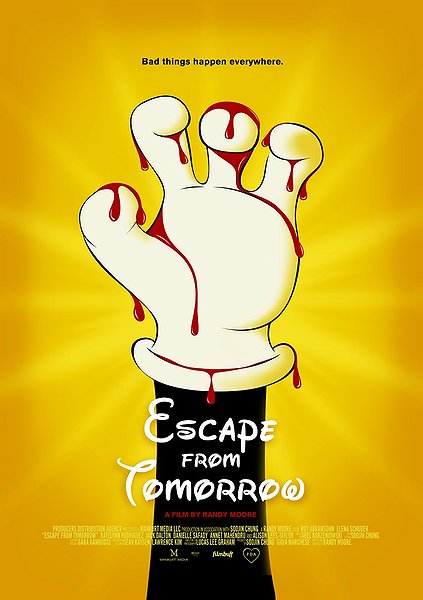 Escape From Tomorrow built a wave of buzz coming out of the Sundance Film Festival, namely because it was a bizarre, psycho-sexual little indie film shot secretly on the premises of Disney World and Disney Land. Writer/director Randy Moore shot his movie in secret, unbeknownst to Disney and the park employees. He was so paranoid about word getting out what they had done that Moore edited the film in another country. There is palpable fear at the reach and power of Disney’s coffers, enough so that a character mentioning the very D-word is silenced, and so I recall early on that people predicted Disney and its armada of lawyers would never allow Escape From Tomorrow to be released. Rather than get litigious, the Mouse House has decided to simply clam up, refusing comment. It’s a smart move, because besides a passing novelty, no one is going to remember the oh so monotonous Escape From Tomorrow in a matter of months.
The wisp of a plot involves a family vacationing at a Disney park. On the final day, the father (Roy Abramsohn) has been told he has lost his job. The rest of the day follows suit as the father loses his grip with reality, interpreting sinister signs throughout the park. He also keeps running into a pair of French teen girls who enjoy holding hands, being flirty, and singing. After the third or fourth time, the father starts to trail the girls, eerily entranced. They warn him that dire things will befall him if he doesn’t go with them.
 Take away the ballsy, surreptitiously recorded angle, the “how did they do that?” factor, and ultimately is there a movie here worth watching? I would definitively say… no. Admittedly it’s interesting to dissect how this guerrilla-style stunt was accomplished, watching scene after scene and figuring out what was shot in the parks unbeknownst to tourists and employees, what was likely shot on a set, where the cuts marry the two, and what techniques the director and his crew utilized to film a movie without blowing their cover. I think many of the scenes had to be improvised, at least the dialogue within the park, because starting and stopping and repeating lines in public, out in the open, would seem suspicious (the cursing would also seem to be courting danger). The Disney theme parks have millions of visitors, so people recording every action would not seem out of the ordinary. Escape From Tomorrow works as a stunt, with the audience picking apart the magic trick simultaneously as it’s performed.
However, a stunt is all that Escape From Tomorrow is because from a thematic, subtext standpoint, this movie is a mess. There just isn’t enough weirdness going on here and whatever small doses of it we get is given precious little connection to any larger theme. It feels like the filmmakers settled on the most facilely subversive idea – Disney Land, the happiest place on Earth, is not. Undercutting all of Disney’s famous family-friendly iconography with the occasional weird thing is not enough. A kid has black eyes. Ten minutes later a stranger makes an offensive comment. Ten minutes later something in a ride that is supposed to be happy looks mean instead. The majority of the movie plays out like you’re watching someone’s boring vacation. You don’t care about the characters. There is no plot to speak of, and that can be acceptable in an atmospheric film that serves as a visual descent into madness. There just isn’t enough madness here. Escape From Tomorrow is far too tedious to be effective. Long stretches are just watching the family traverse the theme park, notably with the father always running into the French teens. There is far too much padding, little connection from scene to scene, and the end is just a confusing muddle groping for a deeper meaning. Midway through, when the father is captured and held underground at Epcot, it looks like the movie is going to take that next step, ramping up the weirdness. Well that conflict is readily solved and then we’re back to the occasional boring out-of-place item. I want to say that Escape From Tomorrow is like David Lynch’s vacation video, but that is giving too much undeserved praise. This is like the deleted scenes of David Lynch’s vacation video.
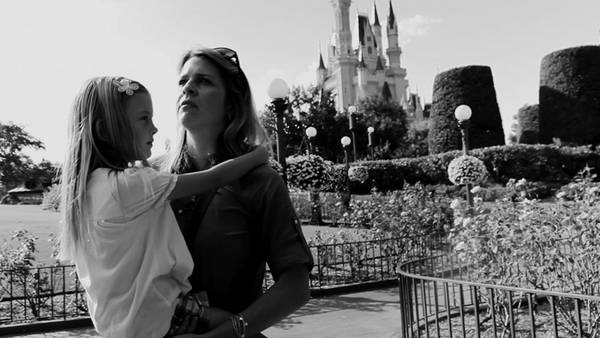 My colleague Ben Bailey countered my negative option with the idea that Escape From Tomorrow is meant to be a dark comedy and to view it through that lens; all right then, because as a “comedy” it still is half-baked, meandering, and poorly executed. The incongruous imagery, often sexual or demonic, is rather cheap in the sense that it’s just flipping the staid Disney script on wholesomeness with no more subversive substance than a moody teenager scribbling on his notebook. The Disney princesses double as high-priced courtesans? Okay, now go further rather than just taking a standard Disney character and making it adult in a shallow manner. There’s a scene where the father escapes by squeezing a tube of Neosporin to lubricate his hands out of confines, and oh boy, the white liquid shoots onto hanging pictures of female body parts. What a riot. Taking a cockeyed, perverted look at Disney is not the same as developing comedy, and even that cockeyed view is lame. I think that the father’s lustful pursuit of the French girls is meant to be comedic, but it was only creepy. When he sneaks up to spy on them in their bathing suits, how else should I interpret that? If this is supposed to be a comedy then Escape From Tomorrow is an even larger misfire.
Escape From Tomorrow is a nonsensical, plodding, superficial film, and it adds up to a whole lot of nothing. There isn’t a grander statement or sense of commentary. There is just scene-to-scene weirdness that grows old rapidly. I commend the ingenuity of the filmmakers for being able to secretly record a movie at one of the most heavily trafficked locations in the world. I don’t think the filmmakers had any clear vision of what they wanted to say with their movie, settling on “weird crap at Disney Land,” and then putting all their time and energy into planning how to pull off this coup, never mind the fact that the finished product was not nearly worth the effort. If you’ve ever wanted to be trapped on a bad vacation, then enjoy, movie masochists.
Nate’s Grade: C-
Share this:

The Lone Ranger (2013)
 With the director, star, and writers from Disney’s original Pirates of the Caribbean trilogy, you’d likely expect The Lone Ranger simply to be Pirates in the West, and it pretty much is, for better and worse. The pieces don’t nearly come together as well, and the characters aren’t anywhere close either, but I was mostly pleased with the finished results after coming to terms with the flaws of the execution. This is a semi-supernatural reinvention of the Lone Ranger and Tonto, prankish and proudly peculiar.
In 1869 Texas, John Reid (Armie Hammer) is the new district attorney for a small outpost along the railway run by tycoon, Mr. Cole (Tom Wilkinson). John’s brother (James Badge Dale) is the sheriff and the more accepted hero. This all goes awry when the nefarious criminal Butch Cavendish (William Fichtner) kills the sheriff, his posse, and leaves John for dead. He’s brought back thanks to Tonto (Johnny Depp), a Native American with his own quirks. Together, the duo struggle with the idea of justice versus vengeance and taking responsibility.
Thanks to screenwriters Justin Haythe, Ted Elliot, and Terry Rossio, it still follows the summer movie blockbuster blueprint while maintaining its own sense of self. I enjoyed the 1933 framing device and the sense of commentary it added to the legend of Wild West tall tales. Many of these story elements will be painfully familiar, from the unrequited love interest that needs saving, her plucky son, to even the villainous railroad baron, but the film finds ways to keep all these formula figures at least integrated and satisfying, doling out payoffs to several storylines. More so, the film just has a wild sense of fun to it, enlivened by Verbinski’s exuberant feel for action. When he gets things going, the man has a touch for inventive action orchestration akin to Steven Spielberg. He is a director who knows how to add scale and scope to action and make it felt. The movie feels constantly alive and full of surprises, stepping outside itself for some non-linear asides, adding bizarre examples of nature undone (In the words of Nicolas Cage: do not touch the bunny), and a heavy dose of magic realism. It’s just too funky and weird not to be interesting even when it threatens to be boring. Disney put crazy money into something this crazy, folks, reportedly $200 million.
 There are serious problems here much as there were in the Pirates sequels, notably a lingering sense of bloat. At 149 minutes, there could have been a lot of cuts. The saggy middle seems to almost derail all momentum, as Reid and Tonto stumble about the desert, filling in a majority of Tonto’s tragic back-story. Most of the supporting characters are chiefly underwritten. I pity the great Ruth Wilson, so nerve-fryingly awesome on the BBC’s Luther as an enthralling sociopath, and here she’s basically Love Interest/Single Mom for Reid. At least she does a decent job with her Texas twang. There’s plenty of overindulgence all around, and I won’t even entertain the argument that its handling of Native American displacement, while not as clumsily racist as feared, was anything other than schlocky. There are also three villains of different stripes that need to be juggled. There are a lot of storylines and characters to keep active and the movie just cannot keep up. The tone can be somewhat jarring as it dances around dark comedy, earnest sentimentality, tragic drama, and cavalier heroism. It feels like the movie never settles down, which can keep an audience from being fully engaged, fully invested. It hurts even more when the characters are nowhere near as charismatic as Captain Jack Sparrow.
Perhaps I’m being overly generous after coming from Man of Steel, and perhaps, nefariously, Man of Steel is still going on, locking me forever in some sort of parallel mobius strip where I’ll never be able to leave, but I greatly enjoyed the action sequences in Lone Ranger. Verbinski is one of the most talented visual filmmakers working today but, more importantly, he knows how to orchestrate large-scale action sequences in a way that they matter. Yes, like most things in The Lone Ranger, they can go on a bit too long, but here the situations develop naturally with organic complications, the sequences move the plot forward, and they escalate in excitement. The concluding twenty minutes involves a sumptuous dual train chase that keeps shifting and changing, going from atop to parallel trains, to cars being dislodged, people jumping from one to the other, all racing toward a bridge triggered with explosives. It’s a thing of beauty, this final action sequence, and Verbinski’s shot compositions allow things to play out so artfully while the audience still maintains its sense of orientation. It’s a finale that feels exhilarating, and the playful whimsy and sense of danger that the movie had been flirting with before comes together, enough for you to wish the whole movie had tonally coalesced with the skill shown toward the end. As an action fan, I was lapping it up, and the playful non-linear jumps, as well as the satisfying ends to some satisfying villains (Fichtner is terrific), left me grinning and hopping with excitement. A strong finish went a long way toward improving my opinion on the film and minimizing my misgivings.
Who is this dark, weird, somewhat clunky movie really appealing to? The Lone Ranger had its cultural peak back in the 1950s and thus the people actually excited for a Lone Ranger movie must be slim. And those people are probably going to be turned off by something as jokey and unfaithful to the source material as this movie. It does utilize the Ranger’s theme song, the William Tell Overture, but saves it for the end. What about kids? The movie is released under the Disney imprimatur and has the stamp of “from the creators of Pirates of the Caribbean.” Everybody loved the first movie and the sequels were also huge global hits, but this movie is even darker and somewhat grisly. There’s a moment when Cavendish literally cuts open a dude’s chest and eats his heart (mostly off-screen and implied mine you, but still). I can already hear the parental uproar. And while it’s somewhat implied that Cavendish and his men are cannibals, this storyline is never really touched upon again. Did we need the heart-eating scene to fully communicate how nasty our villain is? The true audience for the big-screen Lone Ranger may very well only be the mega fans of 2011’s Rango, Vernibski’s Oscar-winning foray into animation. If you like a somewhat weird, somewhat anarchic, tonally uneven movie with personality and eye candy, then perhaps Lone Ranger is for you. Problem is that this potential audience is going to be meager, but it does include me.
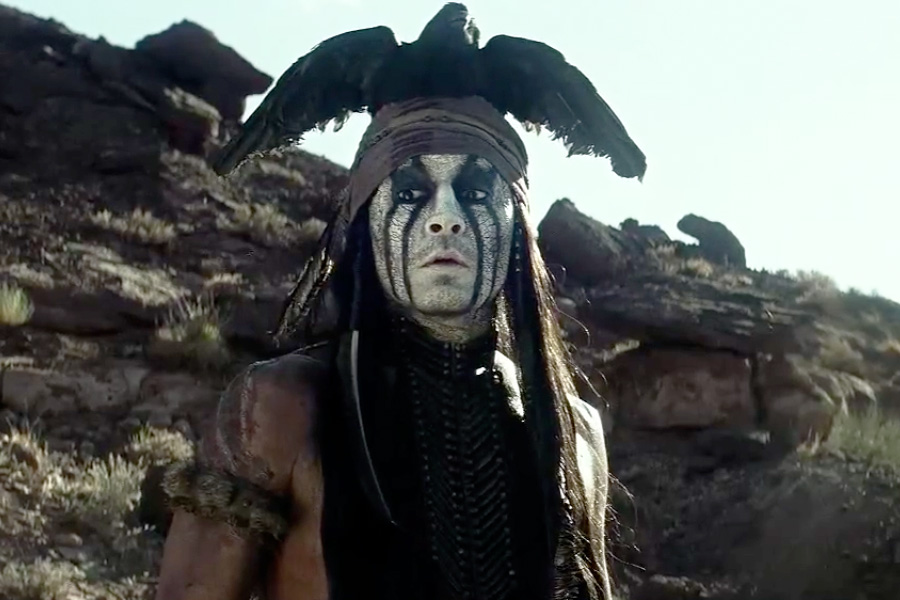 I know there are many people out there experiencing stage four Depp fatigue, and I can’t blame them. His penchant for peculiar character construction can get somewhat tiresome if the movie doesn’t have more going on. In something like Alice in Wonderland, a movie I didn’t even like, at least his weirdness fit with the weird world unlike, say, Dark Shadows, a movie best forgotten by everyone involved. Here his Tonto is as head scratching as he is humorous. And is there an inherent awkwardness having a white actor, in this day and age, playing a Native American? According to the Internet, Depp has said he “probably” has some Cherokee ancestors because he’s from Kentucky. The funny (awful?) thing is that Tonto is often in white face with his special face painting (red face in white face?). I just don’t think he can apply the same bug-eyed, swishy, eccentric sensibility to every character and call it a day. Just when you think he’s gotten away from starring in every movie with Helena Bonham Carter, surprise, here she is. And it’s not even a Tim Burton movie, people! Tonto is seen less as side kick and more of a co-lead if not the real star, and part of that is the bankability of Depp as a box-office draw, part of that is Depp as an executive producer on the project, and part of that is just because the kooky Tonto is just far more interesting than the straight-laced Reid. Hammer (Mirror, Mirror) has the jaw line, the look, and an engaging yet square appeal to him, and if anyone saw The Social Network you know the handsome lad can act. Too often he ends up being a minor foil to Tonto; it takes him far too much hemming and hawing before he accepts his masked outlaw status. As a result, he’s something of a bland fuss bucket.
Disney’s big-budget reworking of The Lone Ranger will probably be held up as the prime example, in a non-Michael Bay summer, of everything wrong with studio filmmaking, the punching bag for blockbusters. Some may even invoke a comparison to another costly Disney endeavor, last year’s flop, John Carter. There are plenty of faults the movie exhibits, namely an extended sense of bloat and an uneven tone, but I’d be lying if I said I was obsessed with the faults by its spectacular end. The movie does enough right, and enough semi-right with enough style and verve, that I left my screening feeling giddy and satisfied. It might be too dark, too glib, too weird, or too self-indulgent, but those are all reasons that made me like this movie even more. There’s a character with a wooden leg that doubles as a rifle, and not only that but one of our villains, a cavalryman, has a clear fetish for prosthetic legs. And this is a Disney film! I can’t help but love the spirit at large. Thanks to a fine supporting cast, Verbinski’s high wire visual stylings, and some strange sensibilities, not to mention a grand finish, The Lone Ranger is as entertaining in what it does right as with what it does wrong.
Nate’s Grade: B
Share this:

Oz the Great and Powerful (2013)
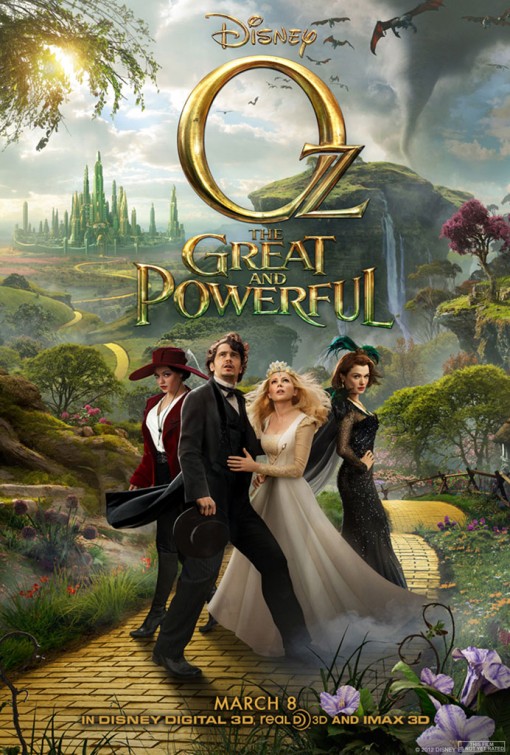 Usually when I’m watching a bad movie I have to stop and think where did things go so wrong, where did the wheels fall off, what choice lead to the disaster I am watching play out onscreen. In the case of Disney’s Oz the Great and Powerful, a Wizard of Oz prequel that pretty much hovers over the cusp of bad for its entire 130 minutes, I have to stop and think, “How could this movie ever have gone right?” I don’t think it could have, at least not with this script, this cast, and the edict from the Mouse House to keep things safe and homogenized, smothered in CGI gumbo and scrubbed clean of any real sense of venerable movie magic.
In 1905 Kansas, the magician Oz (James Franco) is used to bilking country folk out of their meager earnings. He’s a con man and runs afoul with a strong man in his own traveling circus. He makes a hasty escape in a hot air balloon and, thanks to a coincidental tornado, is whisked away to the Land of Oz. The people have long been told that a wizard would come and rescue them from the tyranny of the wicked witch. Theodora (Mila Kunis) and Evanora (Rachel Weisz), sisters controlling the Emerald City, task Oz with killing the other witch, Glinda (Michelle Williams). If he succeeds, Oz will become king and riches will be his. Along his journey he collects a band of cuddly sidekicks (flying monkey, China doll, munchkin) and learns that he may indeed be the hero that Oz needs to save the day.
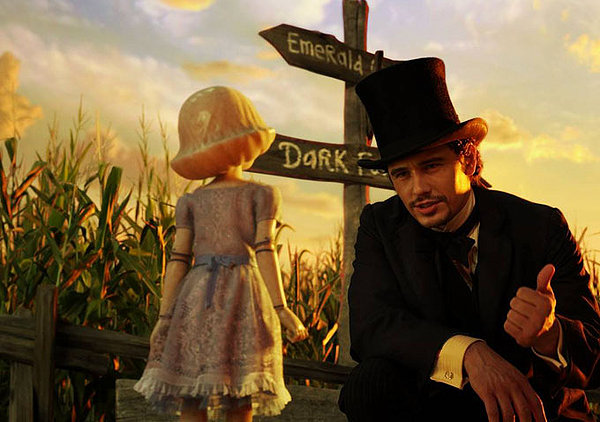 Oz the Great and Powerful is really just 2010’s Alice in Wonderland slapped together with a fresh coat of paint and some extra dwarves. I say this because, like Alice, this movie suffers from a plot that feebly sticks to the most generic of all fantasy storylines – the Great prophecy speaks about a Great savior who will save us from the Great evil. Naturally, the so-called chosen one has internal doubts about the burden they face, initially ducking out before finding that inner strength they had all long to prove they were indeed the one prophesized. It even got to the point where I was noticing some of the same plot beats between the two movies, like how last in the second act we spend time with a woman dressed all in white who we’ve been told is the villain but who is really the good guy. Then there’s the now-routine rounding up of magical creatures to combat the evil hordes in a big battle. Considering Alice was billion-dollar hit for Disney, it’s no surprise they would try and apply its formula to another magical universe hoping for the same results. Well I thought Alice was weak but Oz is even weaker. However, at least nobody absurdly starts breakdancing by the end. Small victories, people.
Beyond the formula that dictates the plot, the characters are poorly developed and broach some off-putting gender stereotypes. The character of Oz is portrayed as a scoundrel who eventually learns to be selfless, but I never really bought the major turning points for his character arc. Do all major characters need to be flawed men in need of redemption in magical worlds? I understand what they were doing with his character but I don’t think it ever worked, and certainly Franco’s performance is at fault as well (more on that later). The ladies of Oz, however, just about constitute every female stereotype we can expect in traditional movies. One of them is conniving but given no reason for why this is. One of them is pure and motherly. And then one of them gets lovesick so easily, falling head over heels for a boy in a matter of hours that she’s willing to throw her life away in spite. And all of these witches, who can actually perform magic unlike the charlatan Oz, sure seem like they don’t need a man to run the kingdom for them and tell them what to do. It’s sad that a conflict that involves feudal power grabs should devolve into a misconstrued love triangle. Then there’s the role of the little China Girl (voiced by Joey King) who adds absolutely nothing to the story except as another female in need of assistance and doting, except when she inexplicably behaves like a surly teenager in a tone-breaking head-turning moment. Oz keeps resting the very breakable doll on his shoulder, like a parrot. I suppose it’s better than tucking her in his pants.
The movie is also tonally all over the place. It wants to be scary but not too scary. Personally, I always found the talking trees to be spookier than the flying monkeys but that’s my own cross to bear. It wants to be funny but often stoops to lame slapstick and Zach Braff (Garden State) as a goofy flying monkey sidekick. It wants to be exciting but it never takes a step beyond initial menace. Its big climactic battle is more like a children’s version of something you’d see in the Lord of the Rings. The movie fails to satisfyingly congeal and so every set piece feels like it could be from a different movie.
 Some notable casting misfires also serve to doom the project. I like Franco (Rise of the Planet of the Apes) as an actor, I do, but he is grossly miscast here. He does not have the innate charm to pull off a huckster like Oz. Franco usually has an off kilter vibe to him, one that’s even present in this film, that gives him a certain mysterious draw, but he does not work as an overblown man of theatricality. Combined with lackluster character, it makes for one very bland performance that everyone keeps marveling over. It’s like all the supporting characters, in their fawning praise, are meant to subconsciously convince you that Franco is actually succeeding. Kunis (Friends with Benefits) is also a victim of bad casting. She can do the innocent ingénue stuff but when she (spoiler alert) turns mean and green it just does not work. When she goes bad she looks like Shrek’s daughter and she sounds like a pissy version of her character from Family Guy, which is ineffectual to begin with. Kunis cannot believably portray maniacal evil; sultry evil, a corrupting influence like in Black Swan, most definitely, but not this. There are lines where she screeches at the top of her lungs and it just made me snicker (“CUUUUUURSE YOOOOOOU!”).
I had faith that a director as imaginative as Sam Raimi (Spider-Man, Drag Me to Hell) would be a stolid shepherd for a fantasy-rich project such as Oz. I never got any sense of Raimi in this movie. It felt like he too was smothered completely by the overabundance of special effects. It’s a common complaint that modern movies are buried under an avalanche of soulless computer effects, but usually I find this bromide to be overstated. Having seen Oz, I can think of no more accurate description than “soulless computer effects overload.” At no point in the movie does any special effect come close to feeling real. At no point do you feel immersed in this world, awed by its unique landscapes and inhabitants (it feels often more like the land of Dr. Seuss than Oz). I chose to see the film in good ole standard 2D, though the 3D eye-popping elements are always quite noticeable. At no point do you feel any sense of magic, the most damming charge of all considering the legacy of Oz. The original Wizard of Oz holds a special place in many a heart. We recall feeling that sense of wonder and magic when we watched it as a child, the idea that movies could be limitless and transporting. While watching Raimi’s trip to Oz, I only felt an overwhelming sense of apathy that grew disquieting.
Then there’s the matter of the questionable messages that the movie posits. It celebrates the power of belief, which is admirable, but it’s belief in a lie. Oz is a fake, yet the movie wants to say that faith in false idols is something worth celebrating. Oz and his cohorts put together a deception to fool the denizens of the world into a false sense of security. Everyone believes in the Wizard of Oz so he has power but it’s all a sham. We’re supposed to feel good that these people have been fooled. Didn’t The Dark Knight Rises basically showcase what ultimately happens when a society’s safety is based around a lie and false idols? I understand that as a prequel one of its duties is to set up things for when Dorothy comes knocking, but do I have to be force-fed disingenuous moral messages?
Oz the Great and Powerful is a wannabe franchise-starter that feels like it never really gets started. There’s a generic hero’s journey, some underwritten characters, mixed messages, and poor casting choices, namely Franco and Kunis. The sense of movie magic is absent and replaced with special attention to marketing opportunities and merchandizing (get your own China Girl, kids). It feels more like the movie is following a pre-planned checklist of stops, cribbing from Alice in Wonderland playbook, and trying to exploit any nostalgia we have for this world and its characters. Except we love Dorothy, the Scarecrow, the Tin Man, the cowardly Lion, and Toto. I don’t think anyone really had any strong affection for Glinda or the Wizard. Just because we’re in the same land with familiar elements doesn’t mean our interest has been satiated. The Wizard of Oz backstory has already been done and quite well by the Broadway show Wicked, based upon the novels by Gregory Maguire. That show succeeded because it focused on the characters and their relationships (extra points for a complicated and positive female friendship dynamic). We cared. That’s the biggest fault in Raimi’s Oz, that amidst all the swirling special effects and fanciful imagination, you watch it without ever truly engaging with it. You may start to wonder if your childlike sense of wonder is dead. It’s not; it’s just that you’re old enough to see a bad movie for what it is.
Nate’s Grade: C


 nathanzoebl
You must be logged in to post a comment.